Who In The World Is Jesus?

Philippians 3.10

I want to know Christ and the power of his resurrection and the sharing of his sufferings by becoming like him in his death. 

Years ago, on one particular Good Friday, I took a large cross, lifted it onto my shoulder, and I walked around town for a few hours. It has been a habit of mine ever since I entered the ministry and it is part of my desire to bring the Lord to the people outside the church. I want people to see the sign that we see every Sunday morning in order to be reminded about what we did, and what the Lord has done for us.

Anyway, on that Good Friday I set out for my cross carrying venture and I received a variety of reactions. Some people honked their horns as they drove past. There was a man who offered me water because it was a particularly hot spring day. I even had someone spit at my feet. But mostly, people just stared at the strange sight of a man in all black carrying a cross around town.

I had almost finished my loop when I spotted a woman on the other side of the road with a perplexed look on her face. She was glaring at the cross and then she inexplicably crossed the street and demanded to know what in the world I was doing.

I calmly explained that I was carrying the cross because that’s exactly what Jesus did on Good Friday before he was crucified. And then she said something I, sadly, was completely unprepared to hear: “Who in the world is Jesus?”

I know that I, for one, take for granted the ubiquity of Christianity. That is, I assume that even people who never step foot in a church have, at least, some semblance of an idea about Jesus. But there, on that Good Friday, I encountered someone who knew nothing of the Lord.

Paul wrote to the church in Philippi, “I want to know Christ and the power of his resurrection.” Even on the other side of his Damascus experience, his desire to know the Lord was at the forefront of the apostle’s heart and mind. Even for as much as I know the Lord, from encountering God in the strange new world of the Bible, in the sacraments, in the still small silences, I too desire to know the Lord and the power of Christ’s resurrection. At the heart of the church’s gathering is a willingness to proclaim the wonders of God so that all of us come to know who Christ is and who we are in relation to Christ.

But what about those outside the church?

Or, to put it another way, how would you respond to someone who said, “Who in the world is Jesus?”

Faith is an exciting adventure not because it provides all the answers to our questions, but because it encourages us to ask questions in the first place. Here, at the tail end of Lent, with the cross hovering on the horizon, we are compelled to confront the incarnate truth. That truth has a name: Jesus. Jesus cannot be explained  from a pulpit or from a book. Jesus defies all of our expectations and often leaves us scratching our heads.

But that’s the point. God is God and we are not. The best we can do is tell the story of Christ’s death and resurrection that we’ve been telling throughout the centuries. The rest is up to God. 

Transformation By Disruption

Jesus was nothing if not zealous.

Jesus sees possibilities where we, too often, see failure.

Jesus believes in those who have quit believing in themselves.

Jesus makes a way where there is no way.

That’s exactly who Jesus is!

And, lest we ever forget, God is at least as nice as Jesus which also means that God is at least as zealous as Jesus. Because Jesus, as Paul reminds us, is the fullness of God revealed.
God is not merely sitting idly by watching the world spin down the toilet – God is showing up in places, flipping the tables of complacency, and is probing us to wonder about the ways things are so that we might move to where things can be.

Taking at step back from Jesus’ temple tantrum, with the tables overturned and the money-lenders cowering in the corner, it’s not hard to imagine the headline in the next issue of the Jerusalem Times: Jesus – The Disturber of the Peace

There have always been disruptors of the peace, those zealots who shake up the status quo.

And yet, the peace disturbed by Jesus that day, and still disturbs today, was no real peace. The weak and the marginalized were getting abused and forced into economic hardships all while God’s blessing were being construed as something to be purchased or earned.

And then God in Christ shows up to remind us there is no real transformation without disruption. Faithful following is only every possible because of disruption and dislocation – otherwise we are doomed to remain exactly as we are.

And, for some of us, that doesn’t sound too bad. Some of us would do quite well if things remained exactly as they are. But God is in the business of making something from nothing, of taking us from here to over there, of deliverance.

Change, real change, good change, is never painless. It’s why we put crosses in our sanctuaries, an ever present reminder of what happens should any of us start asking all of the right questions.

We have a method for dealing with disturbers of the peace.

And yet, it only takes a quick glance at the great stories of history to be reminded that the most important shifts from one thing to another have always come because of disruption.

We can point to the real change makers of the world, those who refused to accept things as they were, but Jesus, whether we like it or not, is the most striking example of disruption, dislocation, and painful challenge to our status quo. Ever since he showed up we’ve never really be able to return to normal because God in Christ is marching on, all while bringing us along for the ride.

“Zeal for your house will consume me,” the psalmist writes and the disciples apply to Jesus. And they were right – The zeal Jesus had for a new day did consume him. So much so that we killed him for it.

But even the grave couldn’t stop our disturber of the peace.

Ambassadors

2 Corinthians 5.20

So we are ambassadors for Christ, since God is making his appeal through us; we entreat you on behalf of Christ, be reconciled to God. 

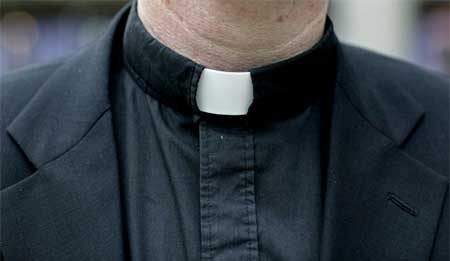
I love and loathe wearing my clergy collar when I’m out and about in public. I love the way it forces me to act like a Christian and the ways in which the faith breaks out from the walls of the church. And I loathe the awkward encounters it produces and the times in which I am compelled to defend the church from her detractors.

More often than not I don’t give much thought to what day I wear the collar or where I will be.

And sometimes I wish I was smarter about it.

When the time came for my second COVID vaccination shot I drove over to an abandoned department store and waited in line with hundreds of other people from the community. And it was only after I received the shot and sat socially distanced from the aforementioned crowds did I realize that I was wearing the collar.

And what made me realize my attire was the line that started to develop right in front of me of individuals who mistook me for a Catholic priest and asked if I would hear their confession.

Paul writes to the church in Corinth: “We are ambassadors for Christ, since God is making his appeal through us.” We, therefore, represent Christ and his church to those outside the church; we are strangers in a strange land.

And yet, with the privatization of faith, with faith often being something we do on Sundays and Sundays alone, there’s little reason to concern ourselves with ambassadorship. Unless we wear a cross around our necks, or a white collar around our throats, no one might ever know of our discipleship.

But then Paul has the nerve to remind us that some people will never see God except through us and the ways in which we exist in the world.

I have the benefit of representing the church not only because I am the pastor of one, but also because I walk around with my clergy collar. And when I dress that way I am forced to act like a Christian whether I want to or not. It is a constant and ever-ringing reminder that I am called to act, think, live, speak, and behave like a Christian.

And, though it pains me to admit, sometimes I need to wear the collar in order to live out my faith. 

Without it hanging around my neck it is all too easy to fade in among the crowd and pretend like I’m not an ambassador for anything but myself.

So when I sat in the post-apocalyptic department store and the line developed in front of me, I listened to each person rattle off their sins. I watched their eyes while they offered their pleas for pardon and assurance. I wanted to be like everyone else minding my own business. I wanted to flip through my phone for the required ten minutes of observation and then leave. But instead, I handed over the goods to each of my fellow Christians: “In the name of Jesus Christ, you are forgiven.”

Does that make me a better Christian than other Christians? Definitely not. “Reluctant” doesn’t do justice to the way I felt that day. And sadly, I know that, in large part, the only reason it happened and the only reason I responded was because of my outfit.

Which makes me wonder: What would it be like if all Christians in all places wore little white tabs around our necks? I mean, scripture does talk about “the priesthood of all believers.” Imagine how different the world would be if each and every Christian walked around knowing that everyone else had certain expectations about who we are and what we do.

It might just be the difference that makes all the difference. 

The Good News(paper)

Luke 13.1

At that very time there were some present who told him about the Galileans whose blood Pilate had mingled with their sacrifices. 

“I appreciate what you’re trying to do preacher, but I don’t come to church to hear about what’s going on in the world. I come to church to hear about God.”

I received that comment after worship one Sunday many years ago and I will never forget it. I can’t remember what exactly I preached about that day, nor do I remember what hymns we were singing, but I remember that comment. 

It’s a notable one. On one hand, the admission that the church exists to proclaim who God  is and who we are in relation to God is remarkable and downright faithful. But on the other hand, the dismissal of the world in the church is a denial of the very reality of reality.

Preaching is never done in a vacuum. A time and a place are always present in a preacher’s work, but that does not mean that the preacher notices or recognizes where they are. Even preachers who try to do the work of preaching without acknowledging their time or place cannot help but reflect time and place in their work. We preachers are reflections of the world around us whether we like it or not. 

The theologian Karl Barth is known for noting that preachers should work with the Bible in one hand and the newspaper in the other. That surely sounds like good advice: what we experience helps us to understand the scriptures and the scriptures help us to understand our experiences. The only problem is the fact that the newspaper is just as likely to mislead us regarding our time and place. And that’s not even mentioning the question of which newspaper we should be reading. We, indeed, live in a strange new world, made clear to us by various headlines, but when it comes to the life of faith, the strange new world of the Bible is our world. 

An atrocity has taken place in the holy city, it’s the front page headline of the Jerusalem Times – Pilate Cuts Down Galileans In The Temple. We don’t know why they were killed, or even how they were killed, only that in their executions their blood was mixed with the sacrifices they brought to the Temple. 

You can imagine the commotion this caused among the faithful.

So much so that some in the crowd approached Jesus and demanded to know why such a thing took place among God’s chosen people: What had they done to deserve such an awful fate?

“Nothing,” Jesus says, “They were not greater sinners than any other Galileans.”

And then the Lord pulls out another headline, another catastrophe on the hearts and minds of the people. A tower had fallen in Jerusalem, in the neighborhood of Siloam, just south of the Temple. 18 people died in the incident. And Jesus says, “They were not greater sinners than others either.”

How pastoral.

The rain falls on the good and the bad alike, as do famines and other such things, Jesus says in another part of the Gospel. Which can sound like unmitigated bad news. And yet, it is strangely Good News. It is Good News because God is not keeping some great ledger book in the sky and then raining down blessings or curses accordingly. God is not a warden watching over the prisoners to see how well, or how poorly, we behave. 

If God punished us according to the choices we make, not one of us would be left around to make any choices at all. 

Instead, God arrives in the world in a totally fragile and vulnerable way so that even if a tower falls on our heads, or if our lives are taken by a dictatorial political emissary, or if we die peacefully in our sleep, that it will not be the end for us. 

What we believe shapes how we behave. The cross and empty tomb give us the freedom, here and now, to live bold and faithful lives for the Lord and for others because the most important thing in the history of the world has already taken place. No headlines, bad or good, can take us away from the Love that refuses to let us go.

So, sure, take the Bible in one hand and the newspaper in the other, but never forget that the former is far more determinative than the latter. 

Clobbered By Grace

Psalm 78.18-19

They tested God in their heart by demanding the food they craved. They spoke against God saying, “Can God spread a table in the wilderness?”

Jesus spends the afternoon feeding 5,000 through his divine mercy. And, when all is said and done, bellies full to the brim, a crowd gathers to question the behavior of this God in the flesh. 

Jesus’ response – “You all are looking for me but for the wrong reasons. I delight in giving you food to eat, but I also have something else to offer.”

“What must we do?” The crowds intone.

“Believe” Jesus answers.

“Okay, we get that, but how do we really know you can make good on your promise? Can you rain down from manna from heaven for us like Moses did?”

And then Jesus says, “Moses didn’t give you the manna! It was God who gave the good gift!”

“Sure,” they say, “That’s fine. We’d like some of that bread from heaven please.”

And Jesus answers them, “Have you not heard anything I’ve said? I am the bread!”

What wondrous good news it is that, when Jesus showed up proclaiming the beginning of God’s new kingdom, he did so not with sermons about the Trinity, or the atonement, or justification, or any other big and abstract theological mishmash. Instead, Jesus began by pointing right at our stomachs, to that gnawing, unsatisfied, emptiness within and then invited us to dinner. 

Jesus feeds the hungry – that’s who Jesus is.

Think of the crowds during the days of Moses and during the days of Jesus, imagine how they felt while eating the bread. 

Did they deserve it? Did they earn it?

No!

The Psalmist reminds us that they had done everything but deserve it! God’s wrath was kindled against them and yet God gave them the bread anyway. The 5,000 didn’t have to lay out all their good works before Jesus delighted in filling their bellies. 

This is grace.

Grace plus Nothing.

Just when we, the people of God, expect to be clobbered with guilt – “You didn’t listen in the wilderness!” “You haven’t loved your neighbors enough!” – we actually get clobbered by grace. 

And, when that happens, we begin to realize that whenever we’ve gone looking for peace or happiness by doing this, that, and the other we’ve actually overlooked the God who has always been looking for us.

The One who offers us the gift we simply don’t deserve.

The heart of Christianity is this – We don’t have to give or say or pay anything – In Christ it has all been given, said, and paid for us. 

It is by grace and only by grace that we are accepted by God. 

Can God spread a table in the wilderness?

That question is often still our question. We look at the wildness of our lives, we spend more time looking backward than forward, and whenever we encounter our own disappointments and shortcomings, we wonder if God can really do anything about it. 

Frankly, it’s why some of us keep showing up to church week after week, in-person or online – we want an answer to our question. Can God make something of our nothing? Can God spread a table in the wilderness?

And the answer is, quite simply, yes.

God can and God does all the time. God is the Good Shepherd who goes after the one lost sheep, God is the Prodigal Father who rushes out to find us in the street even before we have a chance to apologize, God is the One who, rather than leaving us to our own devices, comes to dwell in the muck and mire of this life to offer us Grace plus Nothing. Amen. 

Crazy Love

Genesis 45.15

And he kissed all his brothers and wept upon them; and after that his brothers talked with him. 

Last week I paced through the “seasonal” aisle at the grocery store looking for the right Valentines. Was I searching for the items that would perfectly convey my love for my wife? No. Instead, I was trying to find appropriate cards/items that my son could distribute during his celebration of the holiday in his kindergarten class.

Tucked away behind the heart shaped boxes of chocolate varieties was a solitary box of Mandalorian Valentines, and I knew that Elijah would delight in giving them to all his friends.

And this morning, as I walked him to school, I asked him if he knew why he was bringing Valentines to school and he said, “I’m sure it has something to do with Jesus.”

And he wasn’t wrong!

Valentine’s Day is a particularly striking holiday because of the juxtaposition from how it started to what it looks like today.

There were numerous Christians in the early church named Valentine and many of them were martyred for their faith. That is, their commitment to the kingdom of God was such that the powers and principalities believed the only way to stop them was to kill them.

But perhaps the most famous Valentine was Valentine the Bishop of Terni during the 3rd century. The story goes that he was put under house arrest by Judge Asterius for evangelizing and the two of them eventually struck up a conversation about Jesus. The judge wanted to put Valentine’s faith to the test and brought in his blind daughter and asked for her to be healed. If Valentine was successful, the judge agreed to do whatever he asked.

Valentine, then, placed his hands on the girl’s blind eyes and her vision was restored.

Overcome by the miracle, the judge agreed to get baptized and freed all of the Christian inmates under his authority.

Later, Valentine was arrested (again) for his continued attempts to share the Good News and was sent before the Roman Emperor Claudius II. Valentine attempted to convince the Claudius to convert to the faith, but then Valentine was condemned to death unless he renounced his own faith.

Valentine refused and was beheaded on… (wait for it)… February 14th, 269.

Later additions to the story proclaim that, shortly before his execution, Valentine wrote a letter to the young girl he once healed and he signed it, “from your Valentine” which is said to have inspire the holiday we now enjoy.

So, what does a beheaded Christian martyr have to do with boxes of chocolate and bouquets of roses?

The book of Genesis is full of family betrayals and deceits. Particularly dreadful is the story of Jacob being sold into slavery by his brothers because they couldn’t handle their own jealousy. Jacob makes a name for himself in Egypt and eventually reconciles with the very brothers who abandoned/betrayed him when they come looking for food to eat.

Jacob’s love for his brothers was such that, even though they ruined his life, he “kisses them and weeps upon them.” 

Love is awful like that. It can make us do crazy and bewildering things. At least, they are crazy and bewildering according to the world.

But consider what we do on Valentine’s Day: we throw away gobs of money on trivial and fleeting items. The flowers will eventually fade and the chocolate will expire.

But others will say that St. Valentine’s willingness to die for his faith, and Jacob’s willingness to forgives his brothers, is even crazier.

Love is a crazy thing.

It also happens to be how God feels about us.

God, in Christ, full of hope and grace and mercy mounts the hard wood of the cross to die for us. And then, three days later, God gives him back to us.

Happy Valentine’s Day!

Winning By Losing

Luke 6.17

He came down with them and stood at a level place, with a great crowd of his disciples and a great multitude of people from all Judea, Jerusalem, and the coast of Tyre and Sidon. 

Blessed are you who are poor, hungry, weeping, hated, excluded, reviled, and defamed for yours is the kingdom of God. Woe to you who are rich, full, laughing, and respected for you will mourn. 

Love your enemies, pray for those who persecute you, turn the cheek, give to everyone who begs, on and on.

Jesus’ Sermon on the Plain in Luke 6 is filled with wonder and with confusion. It has attracted and bewildered Christian for centuries and centuries. For as many answers as it provides, it leaves us with even more questions.

Like the parables, the Sermon is designed to pop every circuit breaker in our minds; it doesn’t explain things to our satisfaction, but instead calls to our attention the unsatisfactoriness of all our previous explanations and understandings. 

Basically, we can help but walk away from Jesus’ sermon with our minds abuzz.

In the realm of the church, explanation is not the same thing as proclamation – though most of us prefer the former rather than the latter. We like things to be nice and orderly, we want things tied up neatly in a bow.

And Jesus rejects that desire completely.

Jesus, in his Sermon, isn’t telling us what works – he’s telling us what the Kingdom of God is like

One of my professors from seminary, Stanley Hauerwas, puts it this way:

“A common interpretation is that the Sermon is a law that presents an impossibly high ideal to drive us to a recognition of our sin. It is meant to drive us to grace. In other words, it is not really meant to tell us what to do but rather to remind us that Christian moral life is about love. This internalizes the Christian life so that what it means to be a Christian is to do whatever we do from the motive of love. “Love and do what you will” — bad advice if I have ever heard it! It has an even worse effect on christology; why would anyone ever have put Jesus to death if it is all just a matter of being loving?” – Stanley Hauerwas, A Sermon On The Sermon On The Mount

We are so very tempted to read all of Jesus’ words in his Sermon as a list of virtues that good people ought to have. We walk away thinking we’re supposed to be poor, or hungry, or persecuted because of our faith. We convince ourselves that turning the other cheek or praying for our enemies will make us righteous or blessed.

Yet, what we miss is the fact that Jesus’ words assume there are already people in the community called church who find themselves in such positions. 

Being blessed, according to Jesus, does not mean, “If you do this, then you will be rewarded.”

Being blessed, according to Jesus, means, “If you find yourself in a position like this, you are blessed because you are part of a community that makes all the difference in the world.”

Again, Jesus doesn’t promise his disciples, or us, that if we just muster up the courage to love our enemies then we will no longer have enemies. He doesn’t offer these words as a formula for how to prevent bad things from happening. In fact, loving our enemies and turning the other cheek generally guarantees that we will continue to have enemies who delight in hitting us on the cheek.

Christians don’t win by winning – we win by losing.

Remember, we worship the crucified God.

Jesus offers this Sermon to us, these descriptions and admonitions not because they will change the world. He proclaims all of it because the world has been changed by Christ forever, and we can no longer act as we once did.

We Christians are a weird bunch, in the end. We believe in impossible possibilities, and we pray for people the world never would, and we refuse to believe that anyone is a hopeless case.

And yet, without us living in such strange and faithful ways, the world will have no way of ever knowing what grace, peace, and mercy actually look like.

Hooked

Luke 5.8

But when Simon Peter saw it, he fell down at Jesus’ knees, saying, “Go away from me, Lord, for I am a sinful man!”

Jesus shows up by the lake of Gennesaret and crowds begin to gather to hear whatever it is he has to say. He starts teaching, if that’s what we want to call it – he tells stories, some of them make the folk scratch their heads, some of them make the people mad.

Talk of the first being last and the last being first always sounds like good news to those on the bottom rungs of life, but it sounds like unmitigated bad news to those with everything to lose.

Anyway, Jesus amasses such a crowd that, while standing by the seashore, the Lord decides to amplify his proclamations.

Down the way he stops a few boats and men who had been out all night fishing. They are busy cleaning their nets and Jesus decides to hop into one of their boats and says, “Hey, let’s get out on the water.”

And without giving it much thought, a nobody named Simon Peter pushes the boats out, and starts oaring the Lord back toward the crowds.

“Thanks Pete,” Jesus says, “This’ll do fine. Keep it steady will ya?”

And then Jesus teaches some more. Perhaps talk of fig trees and mustard seeds, maybe some more of that “all things being made new,” perhaps he ended with a particularly probing parable.

And then Jesus looks back to his conscripted fisherman and says, “Pete, since we’re out here already, what do you think about going deeper and let’s see if we can’t find ourselves some breakfast?”

“No offense, Lord,” Peter replies, “But I’ve been out all night fishing. You see, fishing is what I do. And there ain’t no fish to be caught. However, you seem to be on a roll today, so why not?”

15 minutes minutes pass and they catch more fish than they can safely bring aboard their aquatic vessel and they call out to the other fishermen to come help.

Pretty soon they have so many fish that the boats start sinking into the lake from which their plunder came.

Peter, with his arms burning from pulling in net after net, falls to the bottom of the boat and he says, “Get away from me Lord! I am not worthy of this!”

Jesus calmly replies, “No one is. But that’s the whole point. And you needn’t be afraid my friend, from now on you’ll be catching people.”

And Peter, along with his brother and their fishing partners, leave everything at the shore and they follow Jesus. 

I love this story.

Every time I enter the strange new world of the Bible to this little tale by the sea I am bombarded by Peter’s reaction to Jesus. He falls before the Lord with a feeling of complete unworthiness. He, somehow, understands that God is near in the person of Jesus in a way that is more tangible and palpable than he can comprehend. And it is in the presence of God that Peter feels his sin.

Does Jesus call Peter a sinner? Does Jesus list all of Peter’s faults and failures? No.

Instead, the experience of God’s wonderful presence leads Peter to a recognition of his unworthiness. And then, lo and behold, Jesus wants to have a sinner such a Peter in his service!

“C’mon Pete! It’s time to start catching people!”

It’s hard to know exactly when it happens, but somewhere along the line Jesus catches us. That’s what Jesus does, in the end. It’s not just the telling of tales, and the proclamations of parables, and the making of miracles. Jesus delights in gathering us, all of us, into the great net that, in the church, we call salvation.

And Jesus is very good at what he does.

Life, as we often perceive it, is little more than going through the motions and doing one thing after another. But Jesus doesn’t come to bring us more of the same. That’s the great witness and proclamation of the church – Jesus comes that we might have life and life abundant. Jesus shakes up the monotony of our daily existence, sets us free from the chains of sin and death, and invites us to the Supper of the Lamb that has no end.

Jesus’ divine fishing charter, his conscription of Peter, is not merely about gathering in whoever he can whenever he can – it’s about bringing us to a place we could never arrive on our own.

Hear the Good News, the very best news: The tall and the small, the good and the bad… Jesus’ net is wide enough for all of us.

Story Time

Nehemiah 8.5-6

And Ezra opened the book in the sight of all the people, for he was standing above all the people; and when he opened it, all the people stood up. Then Ezra blessed the Lord, the great God, and all the people answered, “Amen, Amen,” lifting up their hands. Then they bowed their heads and worshiped the Lord with their faces to the ground.

Most weeks we find leftover detritus in the pews after worship. There’s the occasional candy wrapper, a handful of loose change, and (my favorite) children’s drawings. The drawings are usually confined to the margins of various pieces of paper like offering envelopes or prayer cards and whenever I encounter one I am hit with waves of nostalgia.

There’s no telling how many bulletins I covered with Tic Tac Toe, Hangman, and comic book heroes over the years. 

But, at some point, either from pressure applied by my parents or the wandering gaze of other church members, I gave up my artistic Sunday morning pursuits and I attempted to be a good Sunday morning worshiper. I said all the right prayers, sang all the right hymns, I stood up and sat back down just like everyone else. And yet, there were plenty of Sundays when the sermon could not hold my attention and I needed something to do.

So I did the only thing I could do: I reached in front of me, grabbed a pew Bible, and I started reading.

This is my confession: I fell in love with the Bible not because of some gifted homiletician, or from a remarkably profound experience of Vacation Bible School, but because I read the good book Sunday after Sunday while worship was happening around me. 

There’s this moment in the Old Testament when the priest Ezra pulls the holy scriptures up and the gathered people rise in reverence and then fall to their knees in prayer. Their love for the Word is palpable from the pages of the Bible precisely because they understood it to be the remarkable thing that it is. 

And yet, today, I’m not sure how we feel about the holy scriptures.

It doesn’t help that we often use it like a bludgeon against those with whom we disagree.

It doesn’t help that the words within it get cherry-picked to make whatever argument we want to make.

It doesn’t help that the Bible can leave us scratching our heads more than wanting to stand up in reverence or pull us down in prayer.

But perhaps we can reclaim a love for the scriptures when we start to see them as the strange new world that God has made for us. Or, to put it another way, maybe it would help if we stopped reading it as if it’s an instruction manual of religious behavior and instead we started watching it like a movie.

You can’t understand a movie, or say anything about it really, until you’ve consumed the thing as a whole. The Bible is the same. It is not meant to be taken apart in these little discrete segments – it is meant to be seen, appreciated, and understood as an entire proclamation. 

When you start to see the Bible like a movie you start to appreciate how all the separate parts might be entertaining or enlightening but in terms of their meaning, you cannot know what it is until the end. Each story/chapter/verse seems like it’s going somewhere, but only when you see Christ on the cross and Christ risen from the grave, all the sudden you start to understand what’s behind everything!

So the next time you’re in church on a Sunday morning, or watching the livestream from the comfort of your couch, and you grow bored with the preacher up in the pulpit, reach for your Bible and enter the strange new world that God has made for you. 

It might just change your life. 

#PartyLikeJesus

John 2.1-2

On the third day there was a wedding in Cana of Galilee, and the mother of Jesus was there. Jesus and his disciples had also been invited to the wedding. 

It’s a bit I often use when I’m preaching for a wedding. Something about how, in the Gospels, people are forever asking Jesus about the kingdom of heaven and he has some rather strange and bizarre answers. The kingdom of heaven is like… a mustard seed. The kingdom of heaven is like… treasure buried in a field. The kingdom of heaven is like… yeast. On and on. But the thing Jesus compares the kingdom to most of all is a feast, a party.

I like to bring this up at weddings because immediately following my part, the newlyweds usually lead everyone in attendance to a reception during which they celebrate. It is my attempt at showing how the marriage ceremony, the part with all the religious language, is connected to everything that happens after. Or, to put it bluntly: Jesus is just as much present in the celebration as the ceremony.

And so it came to pass, during one particular wedding, that the bridal party actually listened to what I was saying throughout the ceremony to such a degree that, for the rest of the evening, they shouted “Party Like Jesus!” every time they lifted their campaign flutes.

I’ll admit that it was a rather contradictory moment, and yet it held the promise of the Gospel!

Contrary to how we might like to imagine it, a fair amount of Jesus’ ministry took place over a cup of wine with friends. He, to use the language of Robert Farrar Capon, was literally the Spirit of the party. Therefore, we do well to remember that feasts (maritally oriented or otherwise) are blessed opportunities to have a little slice of heaven on earth. 

I love that Jesus compares the kingdom to a feast because a feast (more often than not) is something we’re invited to. It is an ever ringing reminder that no matter what we do, or leave undone, God is the host, and God likes crowded tables. There is no bouncer at the party, save for a king who insists on dragging in people off the street. There is no list of pre-requisites to enter, save for recognizing that we have no business being at the party to which we’re invited. There isn’t even an expectation of reciprocation, save for the fact that we’re encouraged to stumble out from the party doing whatever we can to share the joy of it with others. 

Or, as Capon put it:

“Grace is the celebration of life, relentlessly hounding all the non-celebrants in the world. It is the floating, cosmic bash shouting its way through the streets of the universe, flinging the sweetness of its cassations to every window, pounding at every door in a hilarity beyond all liking and happening, until the prodigals come out at last and dance, and the elder brothers finally take their fingers out of their ears.”

And, because I believe that music often does a better job at conveying theological claim than mere words alone, here are some tunes to put us in the party spirit:

Miner is a folk-rock family band based in Los Angeles. Their propulsive “Tomorrow” is simple in terms of its lyrics and yet profound in its arrangement. The thematic “waves washing over” are  conveyed through the repetition of the vocals and the drums which build throughout the song. In a time when it feels like we’re bombarded by nothing but bad news, the proclamation of the Good News of better days is something, I think, we can all use right now. 

Real Estate is known for their catchy guitar earworms, and their easy rock feel. When I saw them live a few years ago everyone in the audience exuded happiness as they swayed back and forth to the music. The band covered the Grateful Dead’s “Here Comes Sunshine” back in 2016 and I love returning to this track for a little boost every so often. I hope it does the same for you.

May Erlewine is a singer-songwriter from Michigan who teamed up with the Woody Goss (of Vulfpeck fame) Band for an amazing record in 2020. The single “Anyway” has funky drums, a picky guitar riff, and a smooth melody. Who wouldn’t want to hear “I’m gonna love you anyway” over and over?