Devotional – Luke 19.1-2

Devotional:

Luke 19.1-2

He entered Jericho and was passing through it. A man was there named Zacchaeus; he was a chief tax collector and was rich.

Weekly Devotional Image

In a few weeks many churches will celebrate All Saints Sunday. In the United Methodist Church we use it as an opportunity to prayerfully give thanks and reflect on the lives lost in the local church over the last year. Some churches will ring bells and read off the names of the dead, others will cover their altars with belongings from the deceased, and others will invite grieving family members to come forward and offer thoughts on those who died.

But when we think of the Saints of the church, we tend to think about incredible figures from church history: Augustine, Francis of Assisi, Mother Teresa, etc. We think that to be saintly requires a life of such profound faithfulness that most of us will never come close to it. Therefore, the saints we daydream about are the ones also found in stained glass windows and famous paintings.

Saints, however, are the people who inspire us to be totally different. And more often than not, the truest saints are those who were once a lot like us, and were radically changed by an encounter with the living God.

zacchaeus-1

Zaccheaus is a beloved and often overlooked person from scripture. The wee-little tax collector, despised by the town, wanted to catch a glimpse of Jesus, so he climbed a tree. Jesus, upon seeing the man up above, called him down and invited himself over for dinner. This interaction fundamentally transformed Zacchaeus’ life and propelled him to return what he had taken “even four times as much.”

Some of God’s truest and most peculiar saints are much more like the little tax collector who recognized his weakness enough to climb a tree to catch a glimpse of the Messiah. Zacchaeus was a strange man and his interaction with Jesus was equally strange. The result of sitting together for a meal was enough to radically transform his life forever. But even in his strangeness, we catch glimpses of the truth; we begin our journeys of faith by recognizing our need, but doing something in response to that recognition, and then discover that the love and power of Jesus has transformed our lives in ways that we never could have anticipated.

Zacchaeus is the kind of saint who could inspire us to change our lives precisely because he is so much like us. If we were only inclined to confront our brokenness, climb a tree to catch a glimpse of the Lord (or walk into a church on Sunday morning), we might just hear Jesus say, “I’m going to your house today,” and our lives would be transformed.

Devotional – Luke 18.9

Devotional:

Luke 18.9

He also told this parable to some who trusted in themselves that they were righteous and regarded others with contempt. Weekly Devotional Image

Jesus knew how to use his words. When he was surrounded by day laborers, he used parables about seeds and vineyards. When he encountered the wealthy and the elite, he used parables about banquets and wedding feasts. Even when he called the first disciples (fishermen) he knew to use imagery about fishing for people to drive the point home.

The stories and parables of Jesus are magnificent in their ability to convey a greater point about the kingdom of God in a way that is approachable and applicable. This is why some of the most memorable sermons we hear (even today) are those that confront and reimagine Jesus’ parables for our time.

However, the beauty and applicability of Jesus’ parables are also a fundamental challenge in that Jesus often used specific parables for specific people. The day laborers heard about seeds and fields because it would make sense to them in a way that it wouldn’t to someone so wealthy they ever had to enter the fields. Similarly, what Jesus says to the rich young man (sell your possessions and give the money to the poor) was meant for the rich young man. Yet, today, many of us preachers apply Jesus’ parables generally for all with ears to hear and not necessarily in the same specific manner that Jesus did.

The parable of the Publican and the Pharisee is one that receives a pertinent introduction: “He also told this parable to some who trusted in themselves that they were righteous and regarded others with contempt.” This is to say that Jesus used this particular parable for a particular set of people because they needed to hear it. Yet, this Sunday, many preachers will take the time to preach these words to their congregations whether the people trust too much in their own righteousness or not.

1020

Jesus knew how to use his words, and sometimes we do not. In this particularly vitriolic political season we post Facebook statuses as if we hope someone who disagrees with us will read it and be transformed. We send snide emails to family members and friends with the belief that we are right, they are wrong, and our email will fix everything. We speak down to the people around us with mixed metaphors and problematic parables because we are so consumed by judgment that we forget what it means to “be” with others.

It is good and right for us to remember to listen when Jesus speaks whether Jesus’ words were meant for a particular group or not. For it is when we immediately assume that Jesus meant his words for someone we are bickering with, that Jesus is actually talking about us.

Devotional – Genesis 32.28

Devotional:

Genesis 32.28

Then the man said, “You shall no longer be called Jacob, but Israel, for you have striven with God and with humans, and have prevailed.”

Weekly Devotional Image

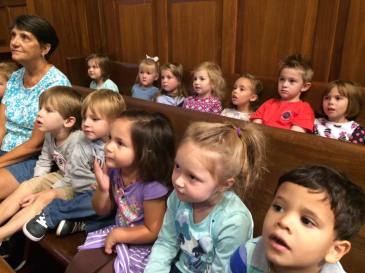
I gather in the choir loft of the sanctuary with the entirety of St. John’s Preschool every Wednesday morning at about 9:30am. By that time the children have all had an opportunity to get out most of their “wiggles” before sitting down in the stiff church pews and learning a story about God from the Bible. I generally try to start the academic year off with stories from Genesis and make my way through up to the stories of Jesus leading toward Easter Sunday.

When we learn about God making light from Creation, we turn the sanctuary lights off and on and talk about what a great gift it is to have light. When we talk about Adam and Eve hiding from God after eating from the tree of knowledge of Good and Evil, we play hide and seek in the sanctuary and talk about how God never stops looking for us even when we’re lost. And this year, when I was foolish enough to teach them about the story of Sodom and Gomorrah, we played red light green lights in attempts to reflect on how God offers us the wisdom of when to go and when to stop.

14440780_1104466649629648_5384631729784297628_n

Last week we met in the sanctuary to talk about one of my favorite stories from Genesis: Jacob wrestling by the banks of the Jabbok river. Jacob has run away from his family after stealing and tricking his brother Esau out of his birthright and blessing and is about to reencounter his brother. But before he can meet his fate in Esau, a strange man arrives in the middle of the night and wrestles Jacob until he, in a sense, learns his lesson. And from this struggle he receives a new name: Israel.

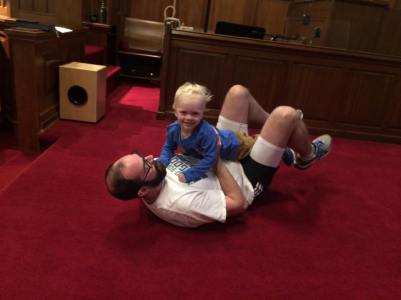
In order to bring the story to life, I had the preschoolers line up one by one and each of them were tasked with knocking me over in a wresting match. They all came forward and gave it their best shot (some were oddly more prepared for this than others) and I would pick them up and spin them around in circles. When one of our last two year olds came forward, I let him knock me to the ground, but instead of pounding on me like some of the older kids, he wrapped his arms around my neck and hugged me.

14502882_1104466592962987_8175825250906782039_n

I was then able to stand up with the boy in my arms and tell the kids the most important part of the lesson: God loves us so much that even when we’re angry, God will never let us go.

To be a Christian today almost implies a degree of struggling with God. We want to know why a hurricane, like Matthew, can wage destruction in places like Haiti, the Bahamas, and the East Coast of the US. We want to know why our presidential political system is filled with such vitriolic and hateful language. We want to know why bad things happen to good people and why good things happen to bad people. Yet, even amidst all the struggle and questions, what a blessing it is to know that God’s love is so strong that God will never let us go.

Devotional – 2 Timothy 2.8-9

Devotional:

2 Timothy 2.8-9

Remember Jesus Christ, raised from the dead, a descendant of David – that is my gospel, for which I suffer hardship, even to the point of being chained like a criminal. But the word of God is not chained.

Weekly Devotional Image

A few of my friends recently embarked on a new venture into the world of podcasting. They call themselves “Crackers and Grape Juice” and they regularly interview people about their faith in order to share the conversations with others through the Internet. One of their regular interviewees is Fleming Rutledge, a retired Episcopal priest, who truly has the gift of preaching. In a recent interview they asked Fleming about her love of scripture and her response was powerful: “If I love scripture, it is because my grandmother read me those stories when I was a child. The role of someone we love, loving us enough to read us scripture, makes all the difference.”

1200x630bf

What do we think of the bible? Is it a text that we are called to master like a subject from school? Should we memorize the facts and dates like a work of history? Should we analyze the literary techniques like a famous work from Shakespeare?

Today, in the lives of Christians, the Word of the Lord is often chained to the realm of the church. If we want our children to learn about the bible, we send them to a Sunday School classroom. If we have a friend grieving the loss of a spouse, we recommend that they go speak with a pastor. If we are unsure about how to encounter a troubling topic, we ask to hear a sermon about it in worship.

But, as Paul reminds us, the word of God is not chained! The bible demands our attention and our affection. It yearns to be read and savored. It should not be relegated to the confines of a church building and should instead sit at the heart of what it means to be a family and what it means to be a community.

Can you imagine how all children would feel about scripture if someone they loved took the time to read them the stories? Can you imagine how differently you would feel about the bible if someone took the time to read it to you when you were younger?

The call of Christians, all Christians, is to remember Jesus Christ, raised from the dead. We remember the great stories of the bible when we gather together in worship on Sundays, but that is not enough. We remember the greatness of the risen Lord whenever we share his gospel with the people we love: our families, friends, and neighbors. We remember the acts and grace of God whenever we sit down with one of our children and grandchildren to tell them about how Jesus changed our lives. We remember the resurrection when we believe the Word of God is unchained and worthy of our time.

Devotional – Luke 17.5-6

Devotional:

Luke 17.5-6

The apostles said to the Lord, “Increase our faith!” The Lord replied, “If you had faith the size of a mustard seed, you could say to this mulberry tree, ‘Be uprooted and planted in the sea.’ And it would obey you.”

Weekly Devotional Image

We are a people consumed and captured by the power of instant gratification. We want the greatest reward for the smallest effort. We post a picture online and we expect people to like it right away. We show up to church on Sundays and we want to be rewarded for our effort. We pray and we assume that God will answer us quickly.

But we, if we are anything, are slaves to God’s will and that requires patience and hardwork.

We have a church member at St. John’s who wears just about every hat you can think of; Dianne Wright is the lay leader and so much more. On Sunday afternoons she walks across the front lawn with a bunch of letters from the alphabet under her arm to change the marquee. On any given day she is writing cards to, and off visiting, the shut-ins from the church community. And she is forever on the look out for “churchy” objects and images that will help others grow in faith.

A couple months ago Dianne brought a sign over to the church and hung it against the refrigerator in the kitchen. She does things like this all the time but from the moment I saw this sign, the words have percolated in my mind: “Faith can move mountains, but don’t be surprised if God hands you a shovel.”

faith-can-move-mountains-but-dont-be-surprised-if-god-hands-you-a-shovel-4

Faith and discipleship is hard work. The disciples once asked Jesus to increase their faith, as if he could snap his fingers and it would just happen. But Jesus responds by telling them that faith the size of a mustard seed could pull a mulberry bush out of the ground move it to the sea. Have you ever tried to move a mulberry bush? The roots go deep down into the earth and make the work of replanting quite difficult.

Being a slave in God’s kingdom, yielding to God’s will, means that we have to do the right kind of work to increase our faith. We can’t just ask for it and expect everything to change immediately. It takes the habits of prayer, scripture reading, and communal worship to increase our faith. When we work to follow the commands of Jesus, difficult though they may be, our faith will increase.

God owes us nothing, and yet we are still loved. God’s invites us back into the realm of grace over and over even when we do not deserve it. Christ still loved us while we were yet sinners. And God gives us the power to move mountains and uproot mulberry bushes, but only if we’re willing to work for it.

Devotional – 1 Timothy 6.10

Devotional:

1 Timothy 6.10

For the love of money is a root of all kinds of evil, and in their eagerness to be rich some have wandered away from the faith and pierced themselves with many pains.

Weekly Devotional Image

In the United Methodist Church we spend a lot of time every fall preparing for Charge Conference. Charge Conference is an annual meeting in the life of the church where we evaluate where we’ve been and where we’re going, we discuss challenges and new approaches, and we vote on things like the budget and pastoral compensation.

Paying pastors is one of those things in the life of the church that we like to handle quickly and then move on to a different subject. Frankly, whenever we talk about money we want to address it as fast as possible and then get back to “doing church.” Money makes us uncomfortable.

On some level this is a good thing. We know that Paul writes to Timothy about the love of money being a root of all kinds of evil. Or we can think about a time when the fear regarding finances sent the church in a frightening direction. Or we can reflect on how the love of money has reshaped a relationship with a friend or with someone in our family.

tithe

However, money and wealth is one of the things that Jesus talks about more than anything else, and we have slowly removed it from our common experiences in the life of the church.

On the Virginia Conference website for the United Methodist Church there is a page dedicated to the bishop. On that particular page anyone can find narrative information about our bishop, but there is also a link to what is called the “Appointment Workbook.” If you click on the link you will have access to a list of all the pastors in the Virginia Conference, how long they served, how many new people are attending their churches, how much their churches are required to pay in apportionments, what percentage of the apportionments have they paid, AND their annual compensation. This is good and important information for the life of the church, but the fact that the entire list of pastors is not organized by name, or region, or new disciples, but by salary, shows how we have wandered away from the faith.

Paul warns us about the love of money in our individual lives and in the community of the church. When we become so consumed by the pursuit of money whether we are a teacher, or a doctor, or a denomination, we fall captive to the evil the sends us wandering away from the faith. As Christians, our ultimate call is to grow in our faith and Christlikeness, not in our annual salary.

Devotional – 1 Timothy 2.1-2

Devotional:

1 Timothy 2.1-2

First of all, then, I urge that supplications, prayers, intercessions, and thanksgivings be made for everyone, for kings and all who are in high positions, so that we may lead a quiet and peaceable life in all godliness and dignity.
Weekly Devotional Image

Two weeks ago I preached a sermon on the separation of church and state. As a congregation we looked at a few passages that addressed the tension between the state and the church and I proclaimed that perhaps now is the time for Christians to reclaim those things that make us seem strange in the eyes of the state (like refusing to bow and worship our country and politicians as if they were gods, or gathering together on a day set apart to hold ourselves accountable to honesty, truthfulness, and peace, or sitting before a table of ordinary bread and wine that become the extraordinary gift of body and blood).

After worship I invited everyone to join us for a time of further conversation on the topic so that it would feel less like a lecture and more like a dialogue. I used guided questions to help get the conversation rolling, and one particular question got everyone fired up: “Should Christians vote in the upcoming presidential election?”

Immediately individuals asserted that not only should we vote, but that we have to vote. As a right given to us through the constitution we must line up at the polls and decide who should be running the country. I tired to get the gathered group to think harder on the subject by asking if it would be more faithful not to vote, and therefore actively embody the fact that Jesus is Lord and that it doesn’t matter to us who wins the election; they didn’t buy it.

screen-shot-2015-06-19-at-3-11-31-pm

The conversation moved on from there to an assortment of other subjects, and when it was clear that we had exhausted the topic, we prayed together and prepared to leave. However, one person approached me as we were cleaning up and said, “I think the most faithful thing we could do is actually pray for our politicians, and in particular for the one we don’t want to wind up in the White House.”

Paul wrote to Timothy and urged him to remember to pray for everyone, including the kings and people in powerful positions. This was, and is, a call to pray for people who do not reflect the same kind of values and beliefs that we might hold. This was, and is, a call to pray for both Republicans and Democrats, for Hillary Clinton and Donald Trump.

To be faithful during this particularly tumultuous political season requires prayerful discernment, and it also requires us to actually pray for our politicians.

Devotional – Luke 15.1

Devotional:

Luke 15.1

Now all the tax collectors and sinners were coming near to listen to him.

Weekly Devotional Image

What kind of people do we want in church? What kind of people do we want to encounter in our lives? Day after day I am bombarded by articles with titles like “The Top Ten Ways To Get Millennials Into Church” or “Why Churches Are Losing Young Families” from concerned people within the church. Similarly, because I am considered a “Young Adult Clergy Person” I am often asked (as if I have some magic answer) “What can we do to get young people to come to church?” Our general church culture is consumed with this desire to get younger people sitting in the pews, and therefore makes the assumption that bringing younger people in will fix everything.

Jesus, however, drew in a different kind of crowd.

Through the proclamation of God’s kingdom, and through radical acts of healing, Jesus’ ministry brought in all the tax collectors and the sinners. They, the kind of people we would rather ignore or complain about, were the ones drawn to hear what Jesus had to say. They dropped their daily tasks to discover what God incarnate was really up to.

We, however, want our churches and our lives filled with “good” people. The kind of people who have their lives figured out, pay their taxes, and love their children. We want people with open and uncluttered schedules who can serve on different church committees and can volunteer to work in the church nursery on Sunday mornings. We want people who will sit quietly in the pews during worship and listen intently without questioning what we do.

worship-millennials-youth-young-people-christians-church

Can you imagine what the church (or our lives) would look like if we did our best to attract the same kind of people that Jesus did? What would we have to change in order to draw them in, and what kind of expectations would we have to crucify in order to love them with Christ-like love?

The larger community rejected tax collectors and sinners during the time of Jesus. They were viewed with suspicion and were kept at a distance. And yet Jesus offered something they wanted to hear. Who do you view with suspicion? Who are the tax collectors and sinners of our day? How would you feel if they showed up in church on Sunday?

Devotional – Philemon 1.3

Philemon 1.3

Grace to you and peace from God our Father and the Lord Jesus Christ.
Weekly Devotional Image

The beginning of Paul’s letter to Philemon contains an address that I use in nearly every communication I have with the church I serve. “Grace to you and peace from God our Father and the Lord Jesus Christ” are the words I use to begin worship on Sundays and the words I use to address all of my devotionals and epistle articles. There is something familiar and comforting about using the same words over and over regardless of how the community and the world has changed from week to week; no matter what we have going on in our lives, we are still greeted by the peace and grace of God when we communicate as a church.

The habit of using Paul’s words has shaped the way I interact with the people of St. John’s and the larger community. By beginning with these words I am transported back to almost all of Paul’s letter to individuals and communities, I am connected with the great tradition of the church, and I am reminded that I am called to point to Christ’s witness (and not my own).

The words are good and right and true, but it has been the habit of using them that has had a profound effect on the way I understand what it means to be a disciple.

Every Sunday at St. John’s we have a habit of standing together to affirm our faith using The Apostles’ Creed. The familiar words are printed in the bulletin and we all face the altar to proclaim what we truly believe. And yesterday, as individuals were lining up to leave the sanctuary, one of our youth pulled me aside to ask a question: “Why do we say we believe in the holy catholic church if we are the United Methodist Church?” In the moment I explained that the word “catholic” in the context of the Apostles’ Creed does not refer to the Catholic Church as a denomination but the “universal” church. And even though I answered him, his question stuck with me the rest of the afternoon.

How many times have we used the Apostles’ Creed in church without really thinking about what we say? Has the habit of using those words become so familiar that they no longer bear fruit in our lives? What other things do we take for granted in our worship and in our discipleship?

Habits are a good thing in their ability to shape our behavior. However, we have to be cautious against letting our habits become rote. The words we use in church and in our daily living have the power to transform us because what we believe shapes how we behave. So, we join together with the countless disciples of the past to say, “I believe in God the Father Almighty, maker of heaven and earth; and in Jesus Christ his only Son our Lord: who was conceived by the Holy Spirit, born of the Virgin Mary, suffered under Pontius Pilate, was crucified, dead, and buried; the third day he rose from the dead; he ascended into heaven, and sitteth at the right hand of God the Father Almighty; from thence he shall come to judge the quick and the dead. I believe in the Holy Spirit, the holy catholic church, the communion of saints, the forgiveness of sins, the resurrection of the body, and the life everlasting. Amen.”

0e4453898_1440084142_sermons-series-desktop-the-apostles-creed-3

Devotional – Hebrews 13.8

Devotional:

Hebrews 13.8

Jesus Christ is the same yesterday and today and forever.

Weekly Devotional Image

I try hard to read some theology every week that has nothing to do with the sermon for Sunday. I do this in order to learn more about what it means to follow Jesus without it being intimately connected with whatever will be proclaimed from the pulpit; discipleship is something I need to work on outside of the work required for the vocation.

Last week I opened up Tripp Fuller’s Homebrewed Christianity: Guide to Jesus – Lord, Liar, Lunatic… Or Awesome? and started to read. (I discovered the book through a podcast that mentioned the title and I decided to check it out.) The premise is straightforward in that Fuller wants the reader to confront the totality of Jesus’ identity, but I had a hard time getting through the first few pages. Fuller writes, “The full humanity of Jesus is something every Christian affirms, but when it comes to discussing his journey through adolescence, we like to keep it vague – “He grew in wisdom and stature” is the only mention in the Bible of his teen years. Of course, we don’t spend much time thinking about Jesus having lice in his hair or pooping, even if he did such things in the holiest of ways.”[1]

img_6935

I understand that Fuller wants the reader to encounter the depth of Jesus humanity, but today we seem to emphasize his humanity over and against his divinity. In church and in theology we hear so much about how Jesus is just like us that we sometimes forget he is also completely unlike us. We want to know that Jesus knows our struggles and is there alongside us when we are going through the valleys of life. But in so doing, we’ve made Jesus out to be a good teacher or an ethical leader, and not God in the flesh.

In Hebrews we read about how “Jesus Christ is the same yesterday and today and forever.” Jesus remains steadfast to love and forgiveness and Jesus remains committed to grace and mercy. We, on the other hand, neglect to love and forgive others. We forget what it means to give and receive grace and mercy. We change each and every day like the blowing of the wind. But Jesus is the same yesterday and today and forever.

Jesus is like us and totally unlike us. Jesus is fully human and fully God. Jesus went through his own angst-filled teenage years and shows us the light of the Lord in the midst of the darkness.

For as much as we want to identify with the humanity of Christ, we also do well to remember that Jesus, like God, never changes.


[1] Fuller, Tripp. Homebrewed Christianity: Guide to Jesus – Lord, Liar, Lunatic… Or Awesome? (Fortress Press: Minneapolis. 2015), 2.