Devotional – Acts 4.33

Devotional:

Acts 4.33

With great power the apostles gave their testimony to the resurrection of the Lord Jesus, and great grace was upon them all.

Weekly Devotional Image 

A father was with his four year old daughter last Christmas, and it was the first time she ever asked what the holiday meant. He explained that Christmas is all about the birth of Jesus, and the more they talked the more she wanted to know about Jesus so he bought a kid’s bible and read to her every night. She loved it.

They read the stories of his birth and his teachings, and the daughter would ask her father to explain some of the sayings from Jesus, like “Do unto others as you would have them do unto you.” And they would talk about how Jesus teaches us to treat people the way we want to be treated. They read and they read and at some point the daughter said, “Dad, I really like this Jesus.”

Right after Christmas they were driving around town and they passed by a Catholic Church with an enormous crucifix out on the front lawn. The giant cross was impossible to miss, as was the figure that was nailed to it. The daughter quickly pointed out the window and said, “Dad! Who’s that?”

He realized in that moment that he never told her the end of the story. So he began explaining how it was Jesus, and how he ran afoul of the Roman government because his message was so radical and unnerving that they thought the only way to stop his message was to kill him, and they did.

The daughter was silent.

A few weeks later, after going through the whole story of what Christmas meant, the Preschool his daughter attended had the day off in celebration of Martin Luther King Jr. The father decided to take the day off as well and treat his daughter to a day of play and they went out to lunch together. And while they were sitting at the table for lunch, they saw the local newspaper’s front-page story with a picture of Martin Luther King Jr. on it. The daughter pointed at the picture and said, “Dad! Who’s that?”

“Well,” he began, “that’s Martin Luther King Jr. and he’s the reason you’re not in school today. We’re celebrating his life. He was a preacher.”

And she said, “for Jesus?!”

The father said, “Yeah, for Jesus. But there was another thing he was famous for; he had his own message and said you should treat everyone the same no matter what they look like.”

She thought about it for a minute and said, “Dad, that sounds a lot like do unto others as you would have them do unto you.”

The dad said, “Yeah, I never thought about it like that but it’s just like what Jesus said.”

The young girl was silent again for a brief moment, and they she looked up at her dad and said, “Did they kill him too?”

bl-martin-luther-king-jr

50 years ago today, while standing outside St. Joseph’s Hospital, Assistant Police Chief Henry Lux announced, “Martin Luther King is dead.” Rifle-armed police were blocking the front entrances and immediately had to hold back a crowd that gathered quickly. The city of Memphis quickly went into a state of emergency as news of Dr. King’s assassination became public.

Dr. King was in Memphis to help organize a strike of sanitation workers for higher pay and the right to union representation. Though known for his work in the Civil Rights movement, Dr. King was active in regard to a number of subjects including the Vietnam War, capitalism, and unjust economic practices. And because he was so vocal in turning things upside down (read: the first shall be last and the last shall be first), he was murdered.

Dr. King’s legacy is one filled with hope and, at the same time, frustration. He certainly left the country better than he found it, but few would argue that his dream has truly come to fruition. We are still a racially broken country, we are still held captive to the drama and economics of warfare, and the income inequality is higher now than it has ever been.

Part of what made Dr. King’s words and work so powerful is that he did what he did as a testimony to the virtues made real to him in Jesus. The Lord he met in the pages of his bible spoke decisively to him about the need to be prophetic in a time such as his. Jesus was a savior concerned with those on the margins, and therefore Dr. King believed it was his duty to be concerned with those on the margins during his lifetime.

When you look through the old speeches, the videos of the marches, and you weigh out how much he was able to accomplish in his 39 years of life, it is clear that grace was with him. But Dr. King’s vision of a better world, Jesus’ vision of the kingdom of God on earth, did not die with them. Those visions are now part of our responsibility, whether that means providing voice to the voiceless, or being in solidarity with those without power, or simply befriending the friendless, there is still work to be done.

Today we give thanks for the life and the witness of Martin Luther King Jr., we reflect on the last fifty years since his assassination, and we are bold to pray that God might use us like God used Dr. King knowing full and well what might happen to us in the end.

Devotional – Psalm 118.1

Devotional:

Psalm 118.1

O give thanks to the Lord, for he is good; his steadfast love endures forever!

Weekly Devotional Image

Holy Week is easily the busiest week in the life of most churches. While the palm branches are still resting on the floor of the sanctuary, pastors and lay leaders are frantically putting together the last minutes items for Holy Week services. Meanwhile, families are frantically planning Easter Sunday meals, and making sure they have enough eggs and goodies for all the children. And because we are so busy this week, we often forget to think about, and reflect on, Jesus’ final week:

It was early in the morning when Jesus sent two of his disciples to a village atop the Mount of Olives to find a donkey. The day had come for Jesus to enter the holy city of Jerusalem during Passover, a time when the city’s population would balloon up to 200,000 people entering to celebrate. On a Sunday morning, while the crowds gathered with palm branches, Jesus entered Jerusalem. Five days later he would be killed on a cross.

holy-week

The two disciples procured a donkey and Jesus prepared to make his triumphal entry. Riding on a donkey was a richly symbolic act, one that can be traced back to the time of David. To arrive in the holy city on a donkey calls back to the prophet Zechariah who declared, “Rejoice greatly, O daughter Zion! Shout aloud, O daughter Jerusalem! Lo, your king comes to you; triumphant and victorious is he, humble and riding on a donkey.”

As he rode toward Jerusalem, droves of people arrived on the streets and they began to waves palm branches while he passed. They were so enraptured by Jesus that they took off their cloaks and placed them on the road with their palms in order to create a royal pathway for their king. They shouted things like “Blessed is he who comes in the name of the Lord!” and “Hosanna!” which means “Save us!”

At the same time, on the other side of the city, Pontius Pilate (the Roman Governor of Judea) entered Jerusalem with at least 1,000 soldiers to demonstrate the power of Rome during the Jewish celebration of the Passover. It was a show of force to prevent the people from revolting against their imperial rulers while they remembered that time when God had delivered them from captivity in Egypt.

But with Jesus, there was no show of force. Instead of armor and swords, the people took off their cloaks and waved palm branches. Instead of cowering away in fear they rejoiced in the humble man on the back of a donkey.

While the distance between the Lord and the city grew closer and closer, while the crowds were dancing and shouting, he began to cry. He looked out over the holy city and he wept for Jerusalem. He wept knowing that he was entering as the prince of peace, and within the next few days the very people who were begging for his salvation with their palm branches would reject him and call for his crucifixion.

And there was evening and there was morning, the first day.

On Monday, Jesus made his way to them Temple with countless other Jews. With the episode that had transpired the day before, all eyes were on the humble man with expectation of deliverance. As his feet walked over hallowed ground, Jesus encountered the moneylenders and changers who were taking advantage of all the Jews in Jerusalem. The prices for clean animals necessary for sacrificial rituals were vastly inflated to the benefit of the merchants and the religious elite.

Jesus, who had spent the better part of three years berating the elite for taking advantage of the poor and outcasts, Jesus, who had told the rich young ruler to sell everything he had and give it to the poor, became incensed when he saw the poor being ripped off in the name of God. He walked straight over to the tables and he lifted them off the ground and disrupted everything in the temple. He threw the merchants out of the Temple and declared that his Father’s house had been turned into a den of robbers.

The elite and powerful, who had heard about this mysterious man claiming to be the Son of Man, now had their attention on Jesus. It was one thing to have a crowd with palm branches welcoming him into the city, but to disrupt the economic scheme they had established was going too far. From this point forward, the tides began to turn against Jesus. The leaders started looking for a way to discredit him, or to remove him completely. For as long as Jesus stayed in Jerusalem, their power would be in question, and they would no longer make the money they had planned on.

And there was evening and there was morning, the second day.

On Tuesday, Jesus once again entered the Temple and he began to teach. If people were excited to see him after his entry in Jerusalem, they were now even more eager to listen to the one who had throne the merchants out of the sacred space. The Pharisees and religious leaders began to interrupt his teaching and demanded to know whom he thought he was to speak with such authority. Jesus, the one who shared parables with his disciples and followers, used parables to respond to their accusations. Over and over again he used examples to show how the powerful and lost sight of their responsibility to take care of God’s creation and he labeled them “hypocrites.”

He accused them of neglecting to practice what they preached, he called them “snakes” and a “brood of vipers” and he told them they had failed to do the one thing required of them which was to love the Lord their God with all their heart, soul, mind, and strength and to love their neighbors as themselves.

Jesus had a following, he had entered with a display of peace, but he had removed the leaders’ economic disparity, and now he had called them hypocrites. They tried to trap him in his words, but he continued to point to the love of God in all times and in all places.

And there was evening and there was morning, the third day.

On Wednesday Jesus left the arena of the Temple and continued his teaching on the Mount of Olives. Some of the disciples made comments about the beauty and the magnificence of the Temple and Jesus responded by foretelling the destruction of the temple and his own body. He revealed images of God’s cosmic plan for the world made manifest in Jerusalem and called for his disciples to stay vigilant no matter what.

He used parables to describe the call of his disciples and ended by saying that his followers would be blessed in the end if they had fed the hungry, gave water to the thirsty, welcomed the stranger, clothed the naked, cared for the sick, and visited the prisoner.

Word about Jesus continued to spread fast throughout Jerusalem and the leaders learned that he was now prophesying the end of their rule and the destruction of the temple. Gone was the joy the people felt on Palm Sunday. Fear was present with the leaders and the elite.

And there was evening and there was morning, the fourth day.

On Thursday Jesus continued to teach and gathered with his twelve disciples in the upper room for the Passover celebration. Around the table they remembered God’s great work in the delivery of the Hebrew people out of slavery in Egypt to the Holy Land; they remembered God’s actions in the lives of God’s people including themselves. But before the supper was over, Jesus did something radical. He took a loaf of bread, gave thanks to God, broke it, gave it to his friends and said, “This is my body, and I’m giving it for you.” Later, he took the cup, gave thanks to God, passed it to his friends and said, “This is my blood, and I’m pouring it out for you and for the world.” Even though he knew that in short time his disciple Judas would betray him he still shared this incredible meal and gift with his friend.

Later that evening, they arrived in the Garden of Gethsemane, and Jesus urged his disciples to keep awake while he prayed. He knelt on the ground and he communed with his Father and prayed about what was about to happen. But he ended the prayer by saying, “Lord, with you all things are possible; remove this cup from me; yet, not what I want, but what you want.” In essence he prayed, “Let thy will be done.”

When Jesus finished praying, Judas arrived with soldiers. They grabbed and arrested Jesus. The disciples fled into the distance. Jesus was dragged back into the city to be tried for blasphemy.

And there was evening and there was morning, the fifth day.

On Friday Jesus was brought to the Roman leader Pontius Pilate. The leaders demanded that he be crucified and executed, but Pilate could find no fault with Jesus. He then brought Jesus before the Jewish people and they chanted with loud and bellowing voices, “Crucify him!” The same people who had gathered on the road with palm branches yelling “Save us!” were now demanding Jesus’ death. In order to appease the crowds and the Jewish leaders, Pilate sentenced Jesus to death by crucifixion.

The soldiers whipped and beat Jesus nearly to the point of death and then, to mock him, they placed an opulent robe on his soldiers, and they made a crown of thorns for his head. They forced Jesus to carry his torture device, a cross, on his shoulders all the way to the place called The Skull. The crowds berated him on either side while he marched forward to his death. “If you really are the Messiah, save yourself!” “Where are all your disciples now?!” “Some King of the Jews you are!”

He arrived at the top of the hill and the soldiers nailed his hands and feet to the cross and hung him in the sky. For six hours Jesus’ life slowly slipped away while the crowds continued to mock him from the ground. With some of his final breaths he offered a prayer that has haunted the world ever since, “Father, forgive them, for they do not know what they are doing.” With two thieves on either side hanging on crosses, while some of his disciples watched from the distance, he died.

And there was evening and there was morning, the final week.

Jesus rode into Jerusalem on the back of a donkey proclaiming and inaugurating a time of humility and peace. Jesus rebuked the elite for preying on the poor and weak. Jesus confronted the hypocrites in leadership. Jesus called his followers to love God and neighbor. Jesus shared his final meal with the one who would betray him. Jesus was crowned with thorns and enthroned on a cross in the sky. Jesus forgave his murders from the moment of his death. And Jesus died so that we might participate in his kingdom and salvation.

Devotional – Psalm 118.24

Devotional:

Psalm 118.24

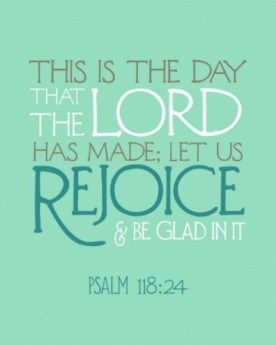
This is the day that the Lord has made; let us rejoice and be glad in it.

Weekly Devotional Image

Depending on where you grow up in church, there are some hymns that are so familiar you just know them deep down in your bones. All you need to hear is the first note, or the first word, and before you know it the rest of the hymn comes floating out. And, more often than not, you get the hymn stuck in your head all day long after worship.

However, for as many hymns as we know deep in our bones, there are an equal number of hymns that are so unfamiliar, that if we were to hear the entire song, we’d wonder if it was in our hymn book at all.

Throughout my life I went to church on Sunday; I prayed when I was supposed to, I listened when I was supposed to, and I stood up to sing when I was supposed to. There are hymns in our hymnal that immediately draw me to a particular time and place when I can remember it being used in worship. But prior to becoming a pastor, I had never heard the hymn “This Is The Day.”

I’m not sure how’s it possible, but I can remember being at one of my first clergy events having just been assigned to my first church, and everyone started singing it together and I had no idea what was going on. Embarrassed, I started opening and closing my mouth as if I knew the song, and spent most of the rest of the session looking for it in the hymnal and pondering how I could’ve missed it.

this-is-the-day-360x450

Fast forward to Sunday, when our choir both began and ended worship with “This Is The Day.” After half a decade of ministry I’ve used “This Is The Day” to start more worship services than I can count, but yesterday was the first time I ever heard the hymn at the end of a service.

And it was perfect.

This is the day that the Lord has made! Let us rejoice and be glad in it! What a wonderful way to be sent out into the world to be God’s people. The words are not meant for our orientation to worship alone. They can be a tremendous blessing and reminder that God has made each day, that we can rejoice and be glad in it.

Can you imagine how differently we would live if we started and ended every day with these words? Can you picture how wonderful it would be to contemplate the blessing of life every morning, and express gratitude for the joyful day every evening?

As we take steps closer to the end of Lent, as we prepare to enter into the darkness made manifest in the shadow of the cross, as we wait for the promised joy of the first Easter morning, let us give thanks to the Lord our God for each and every day, knowing we can rejoice and be glad.

Devotional – Ephesians 2.10

Devotional:

Ephesians 2.10

For we are what he has made us, created in Christ Jesus for good works, which God prepared beforehand to be our way of life.

Weekly Devotional Image

In a few minutes I will leave for a local funeral home to preside over a Service of Death and Resurrection for a longtime member of Cokesbury Church. I never met Frances Tyrrell, and yet I will be the one tasked with standing before her family and friends and offering words of grace, comfort, and hope.

It is a strange and mysterious thing that we ask people to speak on behalf of the dead, particularly when the person speaking never met the person everyone has gathered to celebrate and mourn.

After meeting with the family to begin making arrangements, they graciously lent me a copy of the Woodbridge Women’s Club’s History. Frances was an original member and pioneered a lot of the volunteer work that was done throughout the community. I flipped through the interview she gave and learned all about her life, from her birth, to her marriage, to her children, to her work. But there was one particular section that stood out.

At some point the interviewer, after realizing how deeply involved Frances had been in serving other people asked Frances, “So what does your family think about all this time you’ve given and all this work you’ve done?” To which she replied, “I never asked them.”

Rare these days are the individuals who do good works simply because God created them to be that way. More often we seek to serve such that we can be seen and congratulated for the work we’ve done.

But that wasn’t the case with Frances.

Paul says, “We are who God has made us, created in Christ Jesus for good works, which God prepared before hand to be our way of life.” I can’t help but feel as if we’ve largely lost sight of the truth of this verse from Ephesians. We might think, instead, that our way of life is to earn all we can and save all we can. Or we might think our way of life is about building that perfect house, and having 2.5 children, and constructing a pristine white picket fence. Or we might think our way of life is any number of other things.

IMG_0264

But how often do we consider the fact that we have been made to serve? When was the last time we made the needs of others our priority instead of our own? How often do we help others simply because we were made this way rather than because we think God expects us to?

When we come to the end of our days, when people gather together to remember who we were and what we did, let us pray they remember us, like Frances, for our commitment to others.

Devotional – Psalm 19.14

Devotional:

Psalm 19.14

Let the words of my mouth and the meditation of my heart be acceptable to you, O Lord, my rock and my redeemer.

Weekly Devotional Image

I love to read. I love reading fiction in order to jump into a world I could never imagine. I love reading theology to help open my mind to all that God has done, is doing, and will do. And I love reading out loud to others.

I’ve often joked that if the whole “being a pastor thing” didn’t work out, I would love to be paid to make audio recordings of books. Between making up voices for particular characters, and adjusting my pitch to reflect the tone of a sentence, I just love reading out loud.

So when I was invited to read to a few classes at Featherstone Elementary School this week (to celebrate Dr. Seuss), I jumped on the opportunity.

My first class was filled with excited four and five year olds who mistook their teacher when she informed them that I was there to read Dr. Seuss’ Green Eggs and Ham; they thought I was Dr. Seuss.

So I went along. And, for what it’s worth, they really liked my book.

My second class included those throughout the school who are autistic. I sat on the floor, and began reading The Cat in The Hat, when the teacher asked me to say something about the characters in the story. I tried to unpack the concept of character as best I could and then I resigned myself to just ask the question, “What is a character?”

Each of the students gave it a whirl, some of them getting closer to a definition than others, but then the last student spoke and this is what she said: “Character is doing the right thing even when no one is watching.”

ext

I know that I froze for a few seconds as her theological wisdom percolated in my mind.

Of course, she was referring to one’s character and not the character of a story, but her answer was so profound that I haven’t been able to get it out of my head.

In church I, or any leader, might say something like, “let the words of my mouth and the meditations of my heart be acceptable in thy sight, O Lord” and though we specifically mention being in the sight of God, what we really mean is that we hope we say and do the right thing in front of everybody else!

How often do we do what we do so that we might be seen doing what we are doing? Do we do the right thing even when no one is watching? Or, perhaps it’s better to put it this way: Do we do the right thing even when God is watching?

Devotional – Mark 8.36

Devotional:

Mark 8.36

For what will it profit them to gain the whole world and forfeit their life?

Weekly Devotional Image

When I do pre-marital counseling sessions I have a set of questions I use to get the conversation going. I always start with “What was your last fight about?” It knocks the couple back for a second, but then very quickly they can share with me a disagreement that they recently worked through (more often than not it has to do with wedding invitations!). All couples fight about something, and so instead of advocating for no fighting, I do what I can to help them see how they already reconcile their differences, and then encourage them to work on those practices.

Later in the conversation I will ask, “Why do you want me to perform the service?” The question isn’t about me particularly, but more to the point of having a church wedding. Many couples might think they want a church wedding, but they’ll come to pastor and ask for it to happen in a church but “without the God stuff.” I am of the opinion that if a couple does not want the Lord’s blessing on their wedding, then its probably better to be done in a local courthouse than in the Lord’s house.

But of all the questions, the one that usually stumps couples the most is, “How much money is too much money?” Most respond with something like, “There’s such a thing as too much money?!” But then I’ll ask the question again. Many couples getting married are young and not quite in a position to be swimming in the dough, but a time could come in which they will make more than they need. And so I ask if they’ve ever contemplated how much money would be enough money, and what would they like to do with the rest.

61056391_31343afdc6_b

It should come as no surprise that the most prevalent reason for divorce today is money. Whether it’s hiding money in a separate account, or arguments about how much to spend on a certain item, or not saving enough for the future, or a great number of other financial disagreements – money is at the heart of divorce more often than not.

And so, as a couple prepares to embark on the strange territory that is marriage, I ask, “How much money is too much money?” I ask the question to get them thinking about finances now, and later, but also to get them to think about what their lives are all about.

We are trapped in a world where the accumulation of wealth is the end all be all, but what will it profit us to gain everything at the expense of our lives? Is the time we spend at work making money more important than the time we spend with our friends and families? What will be more important at the end of our days, the money in the bank or the people we share our lives with?

Devotional – Isaiah 58.1

Isaiah 58.1

Shout out, do not hold back! Lift up your voice like a trumpet! Announce to my people their rebellion, to the house of Jacob their sins.

Weekly Devotional Image

If there’s one thing that most us have in common, it’s a dislike for hearing about our own sinfulness. Most of us are fine with raising the sins of other people, in fact some of us actually delight in bringing up the failures of others, but when we’re asked to take a good hard look in the mirror we’d rather turn away.

My suspicion is that we enjoy the sins of others because it makes us feel like we have our lives together. When we hear about that couple whose relationship is on the rocks, it makes us feel like the last argument we had with our spouse wasn’t really that bad. When we receive word that one of our children’s classmates is repeating a grade, it makes us feel like even though we know we could do more at least our kid is moving on. When we turn on the television and witness scenes of celebrities entering rehab facilities, it makes our addictions look manageable and therefore unnecessary to confront.

what-is-sin

But then the Word of the Lord beckons our attention through the sands of time: “Shout out, do not hold back! Lift up your voice like a trumpet! Announce to my people their rebellion, to the house of Jacob their sins.”

The challenge with this, of course, is that we are not necessarily the ones meant to do the shouting! The prophet Isaiah was given this unenviable task, and today we are the ones meant to receive this, and therefore the Lord’s, condemnation.

How often have we ignored our own sins while identifying the sins of others? How often have we continued down a path of pain and shame knowing full and well the results of our actions? How often have we heard a challenging word in Church only to think about who else it might apply to instead of ourselves?

The season of Lent, which we enter into on Ash Wednesday, is no easy thing. We embark on this journey through a strange season every year as a way to stand before the mirror of truth and see who we really are. It is a time of repentance for what we’ve done, and a time for listening about how God is calling us out of the pit of our sin. It is the liturgy (ie. work of the people) designed to give us the strength to hear about our rebellion, and do something about it.

Devotional – Psalm 50.3

Devotional:

Psalm 50.3

Our God comes and does not keep silence, before him is a devouring fire, and a mighty tempest all around him.

Weekly Devotional Image

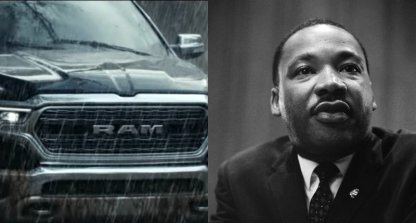
During the Super Bowl on Sunday, there was a commercial for Dodge Ram trucks. The advertisement began in darkness, and then text appeared on the screen announcing that the following words were spoken by Martin Luther King Jr. exactly fifty years ago to the day. The audio playback started, while the viewers witnessed a collage of pure Americana: construction workers, a student studying, a man doing push ups, and a cattle rancher all interposed with quick shots of a Dodge truck driving through mud. All the while you could hear Dr. King in the background saying these words:

“If you want to be important — wonderful. If you want to be recognized — wonderful. If you want to be great — wonderful. But recognize that he who is greatest among you shall be your servant. That’s a new definition of greatness. … By giving that definition of greatness, it means that everybody can be great … by giving that definition of greatness, it means that everybody can be great. … You don’t have to know about Plato and Aristotle to serve. You don’t have to know [Einstein’s] theory of relativity to serve. You don’t have to know the second theory of thermodynamics in physics to serve. You only need a heart full of grace, a soul generated by love. And you can be that servant.”

The recording was taken from one of Dr. King’s final sermons prior to his assassination. And, inexplicably, the advertisers failed to recognize, that part of King’s sermon [not quoted in the ad] was about the evils of advertising. Dr. King said:

“The presence of this instinct explains why we are so often taken by advertisers… you know those gentlemen of massive verbal persuasion. They have a way of saying things that get you in a bind: ‘In order to be a man of distinction you must drink this whisky’ ‘in order to make your neighbors envious you must drive this type of car’ ‘in order to be lovely to love you must wear this kind of lipstick or this kind of perfume’ and before you know it your just buying this stuff… And I am sad to say that the nation in which we live is the supreme culprit.”

Even from beyond the grave, Dr. King will not remain silent about the injustices and tragedies of the world. His words are still a rallying cry for those who wish to see God’s vision made into a reality. But some, with untold power, continue to manipulate his words for their own gain.

rammlk2-800x430

The Psalmist says, “Our God comes and does not keep silence.” The Word from the Lord blasts forth from the pages of our bibles, like the words of Dr. King’s sermon, and they beckon us to open our eyes to the truth. We live in a world that is still terribly broken and in need of divine healing. The marginalized are being pushed even further into the margins while the powers and principalities rule with an iron fist.

God will not keep silence, and neither should we.


You can read more about the Dodge Ram Commercial controversy here: MLK Jr. Sermon Used In A Ram Trucks Super Bowl Commercial Draws Backlash.

Devotional – Isaiah 40.25

Devotional:

Isaiah 40.25

To whom then will you compare me, or who is my equal? Says the Holy One.

Weekly Devotional Image

We live in the land of similes. No matter who we are, and no matter what we do, our days are filled with seemingly endless comparisons. We hear people say things like “My husband is like a couch potato” or “Baby you’re as bright as a firework” or “Ogres are like onions.” A simile is any figure of speech that describes an object, or action, in a way that isn’t literally true, however it conveys something we can understand through comparisons.

In the realm of the church, we use metaphors for God all the time, and the practice is problematic.

Just type, “God is like…” into a Google search bar and you’ll find all sorts of things. God is like oxygen, the sun, a lion, the wind, wifi, a mother hen, santa claus, a gps, an umbrella… And of course there are ways in which God is like those things, but at the same time God is totally unlike those things.

Screen Shot 2018-01-29 at 2.39.04 PM

The prophet Isaiah knew the challenge of making comparisons to unravel the truth of God’s identity. The people, in some ways, were blind to what God had done, because they forgot that God was the author of all things. And instead of experiencing God as totally other, they were elevating people and objects in their lives to be equated with the realm of the divine.

We, of course, do this today as well. We circle around our televisions and computers to catch up on the latest celebrity craze, and political drama. We make finite people and experience into more than they really are. And when we want to figure our what God is like, we use earthly comparisons like the sun, the wind, and even wifi.

And here is the beauty of the incarnation; God is at once exactly like us, and totally different from us. God in Christ is both human and divine. God is paradox, unreachable and yet experiential. There is nothing we can compare God to, however God chose to take on flesh and dwell among us such that we can know God’s character. God is beyond anything we can possibly imagine, and at the same time God is in the bread we break at the table. God’s understanding is unsearchable, and at the same time God reveals God’s identity to us in the waters of baptism.

And so Isaiah can say, with paradoxical certainty: “Have you not known? Have you not heard? The Lord is the everlasting God, the Creator of the ends of the earth. He does not grow faint or weary; his understanding is unsearchable. He gives power to the faint, and strengthens the powerless. Even youths will faith and be weary, and the young will fall exhausted; but those who wait for the Lord shall renew their strength, they shall mount up with wings like eagles, they shall run and not grow weary, they shall walk and not faint.”

Devotional – 1 Corinthians 8.9

Devotional:

1 Corinthians 8.9

But take care that this liberty of your does not somehow become a stumbling block to the weak.

Weekly Devotional Image

When I graduated from High School, my family put together a big party in the backyard and invited a ton of people. All of the usual suspects were in attendance: relatives, neighbors, and family friends. But my parents also extended a handful of invitations to my favorite teachers. And of all the teachers I had, my very favorite was my band director.

Mr. Rice was everything you could have wanted in a teacher. He was intelligent, funny, and easy to talk to. He made studying, and performing music, an absolute joy. Because of his commitment to his discipline, and his ability to lead and engage his students, some of my fondest memories from high school are of sitting in the band room playing music.

So I was in my parents’ backyard, celebrating my graduation from High School, when Mr. Rice walked around the corner. I remember the immense pride I felt in that moment, and not just for graduating, but also for the fact that he took the time to come celebrate with us.

As the afternoon wore on, people came and went, and Mr. Rice continued to mingle among the crowd, always keeping his right hand down by his side. He was someone who always spoke with both arms flying about (as if he were conducting) so it stood out that one arm remained unmoved. Finally, I had a chance to ask him about it and I noticed that he was holding a beer bottle, wrapped in five napkins, hidden down by his side. At first I thought he was hiding the drink because he was embarrassed, or worried it wasn’t allowed, and then I just decided to ask what the deal was. And I’ll never forget what he said: “I don’t want to become a stumbling block to others. Particularly my students.”

150174122

Mr. Rice was there to rejoice with us, but he was also cognizant of the role he was still playing regardless of the location and occasion. There were plenty of high school students in the backyard and he didn’t not want them to make some assumption that because he was drinking, that it would be okay for them to do so as well. Mr. Rice, even in the midst of a party, remembered who he was, and the impact he had on us.

To this day I give thanks to God for placing Mr. Rice into my life. I learned a lot from him, and not just about music. From his witness I learned about the virtues of kindness, hope, and patience. Through his leadership I learned what it means to listen and to guide. And above all, he taught me what it means to carry myself in such a way that I won’t become a stumbling block to others.