This week on the Strangely Warmed podcast I speak with Sara Keeling and Teer Hardy about the readings for the 17th Sunday After Pentecost [C] (Lamentations 1.1-6, Psalm 137, 2 Timothy 1.1-14, Luke 17.5-10). Sara and Teer both serve Mt. Olivet UMC in Arlington, VA. Our conversation covers a range of topics including boldness, the transformation of the church, ecclesial lament, The Melodians, honesty, The Brothers Zahl, rekindled gifts, shame, increased faith, the business of forgiveness, and mustard seeds. If you would like to listen to the episode or subscribe to the podcast you can do so here: Too Blessed To Be Stressed
Blessed be the name of the Lord from this time on and forevermore.
The writer, novelist, preacher, and theologian Frederick Buechner died on August 15th at the age of 96. His works attracted those inside and outside of the church and in the wake of his death countless tributes were made on his behalf. Among his remarkable books and witness to the faith, there is one longish quote that has stayed with me ever since I first encountered it:
“After centuries of handling and mishandling, most religious words have become so shopworn nobody’s much interested anymore. But not so with grace for some reason. Mysteriously, even derivatives like gracious and graceful still have some of the bloom left. Grace is something you can never get, but only be given. There’s no way to earn it or deserve it or bring it about, anymore than you can deserve the taste of raspberries and cream or earn good looks or bring about your own birth. A good sleep is grace, and so are good dreams. Most tears are grace. The smell of rain is grace. Somebody loving you is grace. Loving somebody is grace. Have you ever tried to love somebody? A crucial eccentricity of the Christian faith is the assertion that people are saved by grace; there’s nothing you have to do, there’s nothing you have to do, there’s nothing you have to do. The grace of God means something like: Here is your life, you might never have been, but you are because the party would never have been complete without you. Here is the world, beautiful and terrible things will happen. Do not be afraid. I am with you. Nothing can ever separate us. It is for you that I created the universe. I love you. There’s only one catch: like any other gift, the gift of grace can be yours only if you reach out and take it. Maybe being able to reach out and take it is a gift too.”
The passage has come to my mind a lot recently, not only because of Buechner’s death, and not only because “grace” really is such a unique word, but also because he describes grace as a good sleep and it’s been more than a month since I’ve had a good sleep! (I’ve been on paternity leave for a month; Phoebe Wren Mertins was born August 19th, 2022) Nevertheless, Buechner’s willingness to take a “stained glass word” and bring it down to earth is, I think, one of the most important hermeneutical tools in the church today. Therefore, I had decided to offer my own spin on the prompt “Grace is…”
Grace is driving to the hospital in the middle of the night while your wife is in labor, and every person goes out of their way to make sure she makes it straight to the delivery unit. It’s nurses telling us to stop apologizing for the things we need. It’s lactation consultants and pediatricians and doctors who bend over backward to show love and patience during a decisively impatient time. Grace is coming home from the hospital to countless cards and notes from friends and strangers alike rejoicing in the arrival of our daughter. It’s food being delivered to the door and dismissing hand movements every time we try to express our gratitude. Grace is the delivery of various gift cards to grocery stores and restaurants just to make the first few weeks a little easier. It’s the way grumpy old men make fools of themselves when they see you walking around the block with a newborn baby in your arms. It’s the curiosity of wide-eyed children leaving school seeing such a tiny little person and realizing, in some way, they used to be that tiny too. Grace is returning to work after a month with nothing but gratitude and excitement. Grace is waking up in the middle of the night over and over again for yet another diaper change, only to turn the lights on and see your daughter smiling at you.
Grace is God’s disposition toward us and we cannot earn it or deserve it. The only thing we have to do is reach out and accept it. And once we do, it truly is the difference that makes all the difference.
By faith the people passed through the Red Sea as if it were dry land, but when the Egyptians attempted to do so they were drowned. By faith the walls of Jericho fell after they had been encircled for seven days. By faith Rahab the prostitute did not perish with those who were disobedient, because she had received the spies in peace. And what more should I say? For time would fail me to tell of Gideon, Barak, Samson, Jephthah, of David and Samuel and the prophets – who through faith conquered kingdoms, administered justice, obtained promises, shut the mouths of lions, quenched raging fire, escaped the edge of the sword, won strength out of weakness, became mighty in war, put foreign armies to flight. Women received their dead by resurrection. Others were tortured, refusing to accept release, in order to obtain a better resurrection. Others suffered mocking and flowing, and evens chairs and imprisonment. They were stoned to death, they were sawn in two, they were killed by the sword; they went about in skins of sheep and goats, destitute, persecuted, tormented — of whom the world was not worthy. They wandered in deserts and mountains, and in caves and holes in the ground. Yet all these, though they were commended for their faith, did not receive what was promised, since God had provided something better so that they would not, apart from us, be made perfect. Therefore, since we are surrounded by so great a cloud of witnesses, let us also lay aside every weight and the sin that clings so closely, and let us run with perseverance the race that is set before us, looking to Jesus the pioneer and perfecter of our faith, who for the sake of the joy that was set before him endured the cross, disregarding its shame, and has taken his seat at the right hand of the throne of God.
Few, if any, of us plan to come to church in order to be astonished. Sure, we might be moved to tears or clapping by a song, there might be a line in a prayer that lingers in our hearts, we might ooh and ahh over the wayward comment of a kid during the children’s message. We might even say “amen” out loud in the midst of a sermon.
Miracles do happen after all.
But astonishment?
No thank you.
We don’t have time for astonishment in our manicured machinations on Sunday morning. We like our church, just like we like our God, within our control. We appreciate boundaries and expectations and predicability.
And yet, we come to church today, we gather before the throne of God, we open up and the good book, and what do we find?
“By faith Rahab the prostitute did not perish with those who were disobedient, because she had received the spies in peace.”
How dare the writer of Hebrews! We’ve got the young, and the restless, present in worship. This isn’t the place for such vulgarities!
Other translations soften the blow by calling Rahab a harlot, which is what my grandmother would call her. Whereas other translations up the ante by calling her a, well, I can’t even bring myself to say that word.
But there it is. Clear as day in the strange new world of the Bible: Rahab the prostitute and her faith.
Gideon, Barak, Samson, Jephthah, David, Samuel, they’re all good and fine, we can handle their stories and we can even understand their faith.
But Rahab?
Do you know her story?
Listen: Joshua has guided the people Israel to the edge of the Promised Land. He sends two spies into occupied territory to assess the situation. They approach Jericho, big city, and they wind up, of all places, at Rahab’s in the red light district.
I wonder why they went there…
Anyway, the king receives word that foreign spies have infiltrated his domain, and he dispatches some rough and tough foot soldiers to weed them out. They knock on Rahab’s door, she knows everyone after all, and she lies right to their faces.
“Sure,” she says, “I saw some fellas like you’re describing, but they paid their tabs and left.”
Meanwhile, our little hardworking harlot has actually hidden the spies within the thatch of her roof. She returns to them and says, “I’ve heard of your God and I would appreciate a little mercy begin flung my way when the walls come down.”
She hangs a scarlet thread from her window as a reminder to the spies and their people and, sure enough, when Joshua and the army of God enter Jericho, the red threaded house in the red light district is the only one spared in the entire city.
So, to be clear, Rahab is a prostitute, a lair, and a traitor to her own people.
And the writer of Hebrews includes her in the faith hall of fame!
It’s downright astonishing!
But maybe it isn’t. At least, not really. Because if you spend even the slightest among of time in the strange new world of the Bible you quickly discover that Rahab’s story isn’t unique. Noah gets naked, Abraham abandons, Moses murders, David deceives, Peter perjures, on and on and on.
Apparently, faith is the recognition, oddly enough, that no matter what we’ve done or left undone in the past, God can still use us now and in the future.
The writer of Hebrews is calling to our attention the astonishing fact that if someone like Rahab can be used for the purposes of the Kingdom, just imagine what God can do with someone like you, or even like me.
But then everything shifts. We read of these heroes from the faith, some of whom don’t really seem like heroes in the first place, we read about the abject terror and suffering that the faithful experienced in their response to God, we read of extremely serious and staggering details of the cost of discipleship and and then they all vanish into the great cloud of witness.
We are addressed. Across the great centuries of the church, the writer address us. You and me.
Yet all these, though they were commended for their faith, did not receive what was promised, since God had provided something better so that they would not, apart from us, be made perfect.
Their stories come to fruition in us. We are the fruit of the seeds planted long ago.
Look to Jesus, the pioneer and perfecter of our faith, who mounted the hard wood of the cross on our behalf, and who now rules at the right hand of God.
In short: you and me, we’re not alone.
We are bound to those from the past, those in the present, and those in the future in ways we can scarcely imagine. We are caught up in the triumph of the Trinity and are no longer defined by our sins and our shortcomings, but only by the grace and peace made manifest in the person of Jesus Christ.
All these verses in Hebrews, the faith hall of fame, they ring out for everyone to hear: our faith is not in us.
What rotten luck it would be if our faith was in us.
Have you watched the news recently? Paul is right, none of us is righteous, no, not one.
We are not the pioneers and perfecters of the faith. Jesus is.
And what wondrous Good News it is to hear of Jesus as our pioneer and perfecter. Particularly at a time when we spend most of our time thinking about, talking about, going backward.
Jesus is ahead of us, beckoning us into a new and astonishing reality.
What we might call, the church of tomorrow.
Christianity, contrary to how we might understand it, isn’t actually a religion. Religions are systems of beliefs and rituals that get the divine to do something for us. Whereas Christianity is the story of the God who does the unimaginable for us without us having to do anything in return.
The Lord is not waiting with arms crossed until we get our acts together. Instead, God condescends to our miserable estate and gathers us together and says, “follow me.”
To be the church in the world today is a strange endeavor. If we find ourselves concerned only with matters of life after death, or if we are consumed only by thoughts of holy figures and sacred rituals, we are not the church. We may be and do those things, but to be the church means being part of an alternative way of being in the world right now.
Put simply: we’re different.
We’re different in terms of space because we are geared in an outward matter. We are different in terms of story because we understand who we are not as something we earn or achieve, but instead a gift received. And we are different in terms of time because we believe God’s future is already overlapping with the present.
We are people who have received new pasts, in which our faults and failures no longer define who we are, and we have receive new future in which impossible possibilities rain down for nothing.
We are different. We are like Rahab: with the tiniest pinch of faith, we step into a future, God’s future, and everything is changed.
It’s too easy, at times, to lose sight of how weird it is to be part of the church. For many years we have endeavored to appear as appealing as possible to those outside. Whereas the real test of whether or not the church is the church is if we are sufficiently unacceptable to the world.
We are not yet another club or social gathering that provides a needed distraction from all that is wrong in the world.
We are the body of Christ for the world – we model God’s future in the present.
We live, oddly enough, by grace. We practice trust and honesty and forgiveness in the midst of a time in which those things sound like fairytales.
The church is God’s parable for the world.
We are the wild and weird story for a time and place that is desperate for a new narrative, albeit one that leaves people scratching their heads.
The kingdom of God is like a woman walking down the hallway at the hospital in the middle of the night, having just received word that her husband needs emergency surgery in order to survive. And as she walks, all alone, and the terror of the moment starts to sink in, she steps into the waiting room with nothing but fear, until she realizes the room is full to brim with the people from church who have come out in the middle of the night, simply to make sure she knows she’s not alone.
The kingdom of God is like a parent in the midst of Vacation Bible School who approaches a certain bald and bearded pastor, incredulous that the church would be willing not only to watch her children for a week, but that we would also love them, feed them, and teach them about Jesus for free.
The kingdom of God is like the man who shuffled down the center aisle last week, and approached the aforementioned pastor, with tears streaming down his face and his hands outstretched for the gifts of God. The same man who, when the pastor approached him after worship to make sure he was okay, declared, “Tears of joy. They were tears of joy!”
I don’t know if you knew what you were getting into when you walked into the church. Whether you’ve been here for decades or this is your first Sunday. The truth is, none of us really knows what’s in store once we hear the call of God.
The Gospels make it wonderfully clear that the disciples had not the foggiest idea of what was going to happen next. With a simple, “follow me” Jesus invites ordinary, if not awful, people to come out and be part of an adventure, a journey, that astonishes at every turn.
You and me, we’re not alone. We are all surrounded by the great cloud of witnesses, people like Rahab, who brought us to where we are right now. And because we are caught up in their story, because it is being perfected in us, we can do wild and wonderful things, we can cast away the works of darkness, we can be the place where loneliness is eradicated, we can befriend the friendless and love the loveless, we can do all these things because the grace of Jesus Christ really is the difference that makes all the difference.
Welcome to the church of tomorrow – it’s astonishing. Amen.
Now faith is the assurance of things hoped for, the conviction of things not seen. Indeed, by faith our ancestors received approval. By faith we understand that the worlds were prepared by the word of God, so that what is seen was made from things that are not visible. By faith Abraham obeyed when he was called to set out for a place that he was to receive as an inheritance; and he set out, not knowing where he was going. By faith he stayed for a time in the land he was promised, as in a foreign land, living in tents, as did Isaac and Jacob, who were heirs with him of the same promise. For he looked forward to the city that has foundations, whose architect and builder is God. By faith he received power of procreation, even though he was too old – and Sarah herself was barren – because he considered him faithful who had promised. Therefore from one person, and this one as good as dead, descendants were born, “as many as the stars of heaven and as the innumerable grains of sand by the seashore.” All of these died in faith without having received the promises, but from a distance they saw and greeted them. They confessed that they were strangers and foreigners on the earth, for people who speak in this way make it clear that they are seeking a homeland. If they had been thinking of the land that they had left behind, they would have had opportunity to return. But as it is, they desire a better country, that is, a heavenly one. Therefore God is not ashamed to be called their God; indeed, he has prepared a city for them.
We do a lot of looking backward in the church. And we come by it honest. We say words from ancient creeds, we sometimes sing songs written long before we were born, we sit in a room week after week constructed by people long dead, and we read from a book that has been passed down generation after generation.
Even the writer of Hebrews is quick to mention ancestors of the faith like Abraham and Sarah, and yet, we are also wonderfully reminded that faith is about looking forward, it’s about leaning toward God’s promises that have not yet come to fruition.
Consider this church for a moment…
At some point, 100 years ago, a group of people looked out at the world. A world coming out of a devastating global pandemic, teetering on the edge of a recession and depression, threats of international war hovering on the horizon, and they decided that the thing Roanoke needed most, this neighborhood in particular, was a church.
That had hope for things not yet seen.
They had hope for us.
Sometimes I’ll wander into our history room downstairs for a dose of wonder. We’ve got all the pictures and documents and we’ve even got a giant quilt, and whenever I’m surround by the stories and the people of this church, I wonder if they daydreamed about us. I wonder if they pictured us sitting in these pews singing these songs hoping these hopes.
I wonder if we day dream about those who will be here after we’re gone.
Part of the future is a relative unknowability. We do not, and cannot, know what tomorrow brings.
We only know that whatever tomorrow brings, God will be there.
And that’s faith.
Faith is such a churchy word. It’s in our scriptures and songs and prayers. It’s up on the wall of our classrooms, and it’s in our hearts. Faith is our word and yet it shows up in all sorts of unchurchy places. We talk of having faith in the economy, we hear about placing our faith in our politicians, we talk about movies being faithful to their source-text.
But what is faith?
Better put, what makes faith faithful?
I put the question out to a ton of people this week, online and in-person, churchy folk and decisively non-churchy folk. And I got a lot of answers. But I also got a lot of blank stares, and more than a few of those were from church people!
What is faith?
Faith is a five letter word that begins with f and ends with h and people use it to mean all sorts of things.
Faith is a possible wordle answer.
Faith is what keeps me going.
Faith is the gift to trust that the narrative shape of Jesus’ death and resurrection is the constitution of reality.
Faith is a genuine response to the experience of God.
Faith is accepting God’s acceptance of you.
Faith is a kind of homesickness, an inclination toward something you have not seen but you sense.
Martin Luther said that faith is often nothing more than believing God when God makes a promise.
It seems that Luther stole that from Hebrews.
Listen – By faith, by trust, Abraham responded to the call of God and traveled as a stranger in a strange land. He did not know where he was going. He only knew the One who called him to go. He stayed for a time living in tents, as did his descendants Isaac and Jacob who were also part of the promise of God.
Abraham looked forward to the city whose architect and builder is God.
Taking a step back from the strange new world of the Bible, it’s a bit odd that Abraham was so willing to march toward the unknown. When the comfort of familiarity surrounds us, why in the world would we leap into mystery? We read and read of Abraham’s faith, but his faith isn’t special, at least not really. It’s not some super gift that he had, or a blessing that was uniquely his.
What makes Abraham’s faith faith, it’s not the one who had it, but what his faith was in.
It’s like the thief on the cross next to Jesus. I’ve said this before, but I can’t wait to meet him in the resurrection of the dead. I want to ask him how it all worked out.
I can only imagine the angels whispering about his person. And then, a well-meaning delegate of the Lord steps up and says, “Excuse me, are you familiar with the doctrine of justification by faith?”
“Never heard of it.”
“Oh, well, did you tithe to the church? Were you present in worship at least 50% of the Sundays each year? Did you serve on any church committees?”
“What’s a church?”
And then finally, overwhelmed by the ridiculousness of this fellow, the angel says, “On what basis are you here?”
And he says, “The guy on the middle cross said I could come.”
From Abraham to Isaac to Jacob to Joseph to Moses, all of them died in faith without having received the promises. From a distance they saw the holy city; in faith they longed for something. Each of them, in their own way, were seeking a homeland, a place of knowing.
Faith, then, seems to be a homesickness for a home that is not yet here. A world in which the lion lays down with the lamb, where death is no more, where God wipes away all of our tears.
We catch these glimpses, every one in a while, in which our faith is made manifest in the present. It is the in-breaking of the kingdom of God, it is the assurance of things hoped for, the conviction of things not seen.
It’s the line of the faithful, marching forward to the table with hands outstretched ready to receive a gift we simply do not deserve, but the gift that is the difference that makes all the difference in the world.
It’s the kids of Vacation Bible School going buck wild singing songs about Jesus, cultivating friendship that are only possible because of the friendship of God.
It’s the man who came by the church this week, sheepishly knocking on the door, hoping for something to eat after being turned away from so many other places.
It’s the note in the song that lands so perfectly that we feel the tension easing out of our shoulders, or we find tears landing on the hymnal, or our smiles widen so much that we can’t even sing the next line.
And yet, each of those are not about what we do. When it comes to the matter of faith, we don’t bring much of anything to the table. The gospel doesn’t tell us to have faith, it gives us Jesus to place our faith in.
Again, think of the Table. When we come forward someone offers us the bread and the cup saying, “This is Jesus for you.”
There’s no talk of faith, or what we must believe, even though it’s true that everything depends on our believing in. The bread and cup, the body and blood of the Lord, direct our attention away from faith, which after all is weak and not much bigger than the size of a mustard seed. Instead of telling us to believe, it builds up our faith by giving us Jesus in the flesh.
I heard once that the church is like a beggar telling another beggar where to find bread. And perhaps there’s some truth in that. But it’s also deeply flawed. If all we can muster is the advice or the recommendation of where to find some sustenance for our bellies, then it’s not good news. If we’re really that hungry, we might not have the strength to go find the bread we’ve been directed toward.
Instead, the church is not one beggar telling another beggar where to find bread, it’s one beggar giving bread to another beggar. It’s someone standing at the front of the church and saying, “This is Jesus” and then placing it right in your hands.
The only thing you have to do, is receive it.
Faith is not a list of mental calculations that make you good enough to be part of the church. It’s not adhering to a set of doctrinal creeds that guard our theology.
Faith is merely a way of being.
And yet, the “merely” in that sentence betrays the wonderful and joyful truth of faith that changes everything.
Faith, for being the churchy word that it is, gets tossed to and fro all the time. We sing of faith, we literally have a hymnal called The Faith We Sing, we’re told to keep the faith, or that we must guard the faith.
But faith, again, isn’t about us. Faith is about Jesus.
Robert Farrar Capon, beloved grace-filled theologian, writes, “Faith doesn’t do anything.”
Talk about grabbing your audience from the first sentence.
“Faith doesn’t do anything; it simply enables us to relate ourselves to someone else who has already done whatever needs doing.”
And then he has this remarkable metaphor for faith.
Imagine you’re laid up in the hospital. There’s been an accident and your bones are broken. In time you will heal, but it will take time. And while you’re waiting for your body to get back in shape, you friend comes by to visit you upon occasion. You’re a half-decent person, you try to stay on the sunny side, but when your friend comes you can’t help but complain. The hospital food is atrocious, you don’t know if any of the hospital staff even know your name, and there are so many things you should be doing, but you can’t. Your house is a mess, the outside needs to be painted, a few of the boards on the deck need to be replaced, on and on and on.
And then, one day, your friend walks into the hospital room and says, “Listen, I hired a contractor to fix all the problems at your house. It’s all taken care of. It’s a gift from me to you.”
So what can you do?
You have two choices: you either believe your friend, or you don’t. Remember, you’re stuck in the hospital, and you can’t go inspect all the changes for yourself.
So, if you disbelieve your friend, well then you go on being a miserable bore whose no fun to be around.
But if you believe your friend, well then you have your first good day in a really long time.
This week on the Strangely Warmed podcast I speak with Peter Kwon about the readings for the 8th Sunday After Pentecost [C] (Hosea 11.1-11, Psalm 107.1-9, 43, Colossians 3.1-11, Luke 12.13-21). Peter is one of the pastors serving Annandale UMC in Annandale, VA. Our conversation covers a range of topics including foolishness, church cohorts, robe wearing, books, fear, the redeemed, old sermons, the already but not yet, Jonathan Franzen’s Crossroads, the grammar of faith, and identity. If you would like to listen to the episode or subscribe to the podcast you can do so here: The Good News Of Being A Burden
He was praying in a certain place, and after he had finished, one of his disciples said to him, “Lord, teach us to pray, as John taught his disciples.”
When the disciples badger Jesus for a way to pray he responds, “When you pray, pray like this: Lord, you are great. Do what you need to do. Give us some bread. Forgive us, because we are trying to forgive everyone indebted to us. And keep us away from evil.”
The Lord’s Prayer according to Luke is decisively different than the one recorded in the Gospel according to Matthew. It’s shorter, it dispenses with some of the elevated liturgical language, and it cuts right to the heart of the matter.
And, even though Christians say the Lord’s prayer over and over again, we can’t help but scratch our heads with regard to how strange of a prayer it really is. Particularly when we consider how Jesus told the disciples this prayer after they requested something akin to what John gave to his disciples.
John, unlike Jesus, was living by a different paradigm, one in which people could enter what we might call “The Program of Salvation.” There are different stages and expectations of what it means to get from where you are to where you can be. You confess and repent of all your sins, you start engaging in works of piety and social justice, and then you earn your heavenly reward.
In John’s “Program of Salvation,” redemption is all about having the right ethical, religious, moral, and political beliefs in order to make something new happen in the world.
Jesus, on the other hand, sees all things differently. He, himself, is the new thing that happens to, and for, everyone. There’s no “program” to get God to do anything.
Jesus doesn’t come to show the disciples, and us, how to get our lives in order in order to get good with God. Instead, Jesus is God who comes to us.
This, admittedly, can be frustrating for the many of us who would prefer it if Jesus were clearer about what we should and shouldn’t do. And yet, the proclamation of the Good News is, indeed, good news: Jesus saves us because we are in need of saving.
The challenges comes in admitting that we are not like what we ought to be.
The disciples, people like us, we want a program. We want salvation to be laid out nice and clear with regard to what we need to do, and say, and believe. We enjoy trite and memorable zingers of goodness like, be prepared or do a good turn daily. We love the idea of being reasonably good people getting better all the time.
But then Jesus responds to the disciples’ request for a prayer with one that runs against our notions of what it means to be faithful. Because, according to Jesus, to be faithful doesn’t require us to do much of anything. In fact, the only thing we can do, according to the prayer, is forgive.
The Lord’s prayer (Matthew’s and Luke’s) rejects all of our contemporary understandings of what it means to pray. It does not contain giant and lofty ideals that blanket our Sunday morning liturgies. It does not hint at ethical perfection, or dance around moral equivocation. It is just the bare necessities of keeping us together and fed so that we can finally start celebrating the wonderful and wild news that Jesus is for us, no matter what.
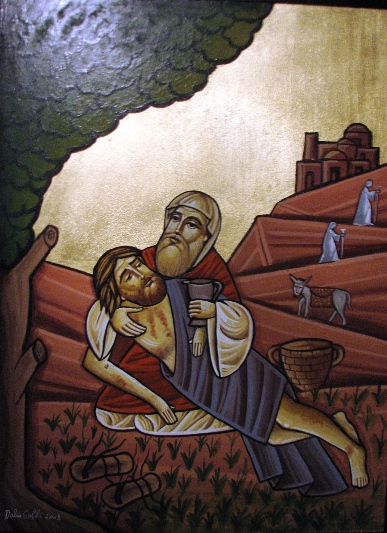
Jesus replied, “A man was going down from Jerusalem to Jericho…”
A few years ago, on July 5th, I was sitting in the church office when the church secretary called across the hallway:
“Umm,” she began. “I’m not sure how to quite put this, but, did you happen to see the woman in the bikini lying down in one of the church parking spaces on your way in this morning?”
A man was going down from Jerusalem to Jericho and fell into the hands of robbers, who stripped him, beat him, and went away, leaving him half dead.
From the safety of the secretary’s office we peered through the blinds and assessed the situation. All the way in the furthest spot away from the building, the one closest to the main road, was a young woman on her back, wearing nothing but a bikini, and she wasn’t moving.
The secretary promptly elbowed me in the ribs, “You’re a pastor, aren’t you supposed to do something?”
“Of course I’m supposed to do something.” I said as I waited for someone else driving by the church to do something.
Now by chance a priest was going down the road; and when he saw him, he passed by on the other side. So likewise a Levite, when he came to the place and saw him, passed by on the other side. But a Samaritan while traveling came near him; and when he saw him, he was moved with pity.
I felt pitiful as I reluctantly made my way across the parking lot, unsure of what was about to happen. Car after car came flying down the road while the woman was curled up on the asphalt, and not one of them slowed down to see the scandalous scene.
As I got closer I thought about picking up a stick, in order to poke her to make sure she was still of this world, but then she slowly rolled over on to her side and looked me right in the eye. She smelled like the basement of a fraternity house, the little clothing she had on had tiny little rips and tears in it, and she looked utterly perplexed.
For a time neither of us spoke, and then I remembered my vocation so I said, “Can I help you?”
“Honey, I could use a ride,” she said with a hiccup and a twinkle in her eye.
I slowly offered her my hand, and as I picked her up from the ground she said, “You’re wondering how I got here. Well, so am I. The last thing I remember is being at the park for the 4th of July, partying, having a lot to drink, and then I woke up in someone’s yard over there. I tried to walk home, but I lost my phone, my wallet, and I think I’m still drunk, so I decided to take a nap here in this nice parking spot.”
“Okay” I said, “I’ll drive you home.”
The Samaritan went to him and bandaged his wounds, having poured oil and wine on them. Then he put him on his own animal, brought him to an inn, and took care of him.
We wobbled across the lot arm in arm and I could feel the eyeballs of everyone in their cars silently judging me as they drove by. It took an inordinate amount of time to make it from her napping location to my car, and we had to stop no less than three times for fear that she was going to empty out what she had put in the night before.
Eventually, I struggled to get her buckled safely in and asked if she would be able to guide me to her house. To which she replied, “You should have been there last night! The lights and colors were just like illuminating.”
So I asked again, and she responded by pointing with her index finger toward the main road.
“Wonderful,” I thought, “directions by charades.”
We reversed out of the parking lot and I followed her finger across town.
At one point, as we neared the top of a hill, she slowly raised her hands up above her head and shouted, “Woooooo I love this part of the ride!”
When we passed by the police station, she sank as deep as possible into the seat until her feet were up on the dashboard and she let forth a burp that smelled of stale beer, hotdogs, and regret.
We had a time finding her house as we went up and down streets which she either could not read or remember. But eventually, we pulled up in front of a nondescript house and she let out a sigh of acceptance.
The next day he took out two denarii, gave them to the innkeeper, and said, “Take care of him; and when I come back, I will repay you what more you spend.”
We sat in the car in uncomfortable silence while she looked out the window at her future with a strange and detached look on her face.
“So, are you a pastor or something?”
“That’s what they call me on Sundays.”
“Do you do this kind of stuff a lot?”
“Honestly, not enough. What about you?”
“All the time.”
And with that she opened up the door and fell out of my car. She promptly picked herself up and staggered across the lawn and up to the front door all the while whistling a strange rendition of the Star Spangled Banner.
She made it to the front door, and patted down on her non-existent pockets for her keys that she didn’t have, and began banging on the door until someone let her in.
And then I drove back to church.
For the rest of the day I felt pretty good about myself. I had been the Good Samaritan. I only later realized that I never even bothered to ask for her name.
Which of these three, do you think, was a neighbor to the man who fell into the hands of the robbers” He said, “The one who showed him mercy.” Jesus said to him, “Go and do likewise.”
Jesus ends his parabolic encounter with this great question, “Which of these three, do you think, was a neighbor to the man who fell into the hands of the robbers?”
And immediately we know how this story is supposed to work. The Samaritan is the good neighbor, and we are supposed to be the good neighbor to our neighbors. But, who really wants to be like that?
The Samaritan is not a very good example, at least he’s one that we should be careful of imitation. He’s a fool! He wastes his good money on a no good stranger in a ditch, gives him his own ride, and then has the gall to put him up in a swanky hotel without receiving anything in return.
Moreover, Samaritans are outcasts. He is a loser who comes to deal with another loser. His actions are crazy and reprehensible. He lays down whatever his life might’ve been for someone he doesn’t even know, simply because he, as an outcast, has found solidarity with another in the dump that life has offered him.
The loser has found his truest neighbor, another loser.
Which, incidentally, is what the whole gospel is about – Jesus came to save a lost and losing world, by becoming lost and defeated. But in this world of ours, populated by losers, all of us are hopelessly committed to a version of the world that is obsessed with winning, by being the best, by looking out for ourselves.
It would be funny if it wasn’t so tragic. But it is tragic, because grace works only in the midst of being able to recognize how badly we need it.
Or, to put it another way, if Jesus wanted to be a better motivational speaker he would’ve ended the parable thusly: Don’t be like the Samaritan; it will ruin your life. You will become a mockery among your friends, you will be a loser.
But Jesus isn’t a motivational speaker, he is the Lord.
Which brings us back to the question posed at the end of the parable: Which person was the neighbor to the man in the ditch? But what if there’s a better question… and what if that better question is this: Which person in the story is Jesus?
The central figure, contrary to just about every version of this story ever told, or ever preached, is not the Good Samaritan. The Good Samaritan is simply one of three people who actually figures out what it means to be a properly good neighbor.
Jesus in the story, the one who demands all of our focus and attention, the one to whom the three are either neighborly or not, is the one down in the ditch.
Jesus is free among the dead – He is the one who, again and again, is with the last, the least, the lost, the little, and the dead.
If we want the parable to tell us to imitate the Good Samaritan, which it certainly does, then that’s fine.
But if that’s all the Good Samaritan is good for, then it isn’t very good.
Or, as Robert Farrar Capon so wonderfully put it: “The parables are true only because they are like what God is like, not because they are models for us to copy. It is simply a fact that the one thing we dare not under any circumstance imitate is the only thing that can save us.”
Jesus is the one down in the ditch. Jesus, the Lord of lords, has condescended himself to our miserable existence and can be found in the place of our own ditch-ness and suffering.
This story is but another resounding reminder that we don’t have to go looking for Jesus, or even that we have to be like the Good Samaritan to earn Jesus.
It’s that Jesus was willing to do for us what we could not, and would not, do for ourselves or our neighbors.
Jesus has moved in next door knowing that we, his neighbors, are a bunch of losers.
I in them and you in me, that they may be completely one, so that the world may know that you have sent me and have loved them even as you have loved me.
Why the United Methodist Church?
This is a question that I receive fairly often throughout the comings and goings of my life. I’ll be sitting in the stands watching my son play tee ball when the subject of employment comes up which inevitably leads to why I serve in the UMC. Or, I’ll preside over a wedding with lots of strangers only to be bombarded with questions about denominational affiliation as soon as the service ends. Or someone will see me working on a sermon at a coffee shop with my clergy collar on and they walk over to ask, “So what kind of Christian are you?”
For what it’s worth, I am a Christian before I am a Methodist. Or, put another way, I’m a Christian who happens to be a Methodist.
I follow Jesus, not John Wesley.
And yet, I find that Wesley’s understanding of the Gospel to be spot on.
There are a great number of moments from his life, and even more from his sermons, that resonate deeply in my soul, but nothing quite compares to his Aldersgate Street experience when he was 35 years old. This is how we wrote about it in his journal:
“In the evening I went very unwillingly to a society in Aldersgate Street, where one was reading Luther’s Preface to the Epistle to the Romans. About a quarter before nine, while he was describing the change which God works in the heart through faith in Christ, I felt my heart strangely warmed. I felt I did trust in Christ, Christ alone, for salvation; and an assurance was given me that He had taken away my sins, even mine, and saved me from the law of sin and death.” – John Wesley, May 24th, 1738
What makes his experience all the more profound is how little he felt an assurance before that moment, even though he had been ordained for a number of years!
I love the hymns we sing in the UMC, I love the connectional nature of our church and how we are bound together with other churches, and I love the incarnational focus of our ministries going to where the Spirit moves. But more than anything, I love the relentless proclamation of prevenient grace; God’s love precedes all things.
While sitting at the society meeting at Aldersgate Street, Wesley experienced what I have experienced and what I hope every person will come to experience: There is nothing we have to do to earn God’s love except trust that it is true. And when we live into that trust, we are living in the light of grace which changes everything. It changes everything because it means all of our sins, past/present/future are nailed to the cross and we bear them no more.
The work of Christ frees us from the law of sin and death so that we might live abundantly for God and for others. It is, quite literally, the difference that makes all the difference.
–
If you want to know more about how God works in the heart through faith in Christ, you can check out the Strangely Warmed podcast which I host. Every week we bring you conversations about the readings from the Revised Common Lectionary and we do so without using stained glass language.
And in the spirit he carried me away to a great, high mountain and showed me the holy city Jerusalem coming down out of heaven from God. I saw no temple in the city, for its temple is the Lord God the Almighty and the Lamb. And the city has no need of sun or moon to shine on it, for the glory of the Lord is its light, and its lamp is the Lamb. The nations will walk by its light, and the kings of the earth will bring their glory into it. Its gates will never be shut by day – and there will be no night there. People will bring into it the glory and the honor of the nations. But nothing unclean will enter it, nor anyone who practices abomination or falsehood, but only those who are written in the Lamb’s book of life. Then the angel showed me the river of the water of life, bright as a crystal, flowing form the throne of God and of the Lamb through the middle of the street of the city. On either side of the river is the tree of life with its twelve kinds of fruit, producing its fruit each month; and the leaves of the tree are for the healing of the nations. Nothing accursed will be found there any more. But the throne of God and of the Lamb will be in it, and his servants will worship him; they will see his face, and his name will be on their foreheads. And there will be no more night; they need no light of lamp or sun, for the Lord God will be their light, and they will reign forever and ever.
It happens, every so often, that someone reaches out with an inquiry about baptism.
A couple has a baby and they call the church office to ask if it would be possible for their newborn to be baptized. A stranger stumbles into church on a Sunday morning, is moved by the power of the Spirit, and approaches me afterward to discuss the holy waters. A long time church members sees someone else being baptized and, for the first time, desires to receive the promise of the covenant made by water and the spirit.
And, inevitably, we come to a moment when I ask THE question as it pertains to baptism: “Why?”
One of my professors once said that the most faithful churches are those who won’t marry or baptize anyone off the street. That is, if a random couple asks to be married, it would be better for them to get married by the justice of the peace. The covenant of marriage, at least as understood by the church, is only possible within a community who will help hold the couple accountable to the promises they make.
And the same holds true for baptism.
Should you grow weary or bored at any point in the next ten to fifteen minutes, you can look at the liturgies in the hymnal or google online and you will discover that the questions and promises of marriage and baptism are remarkably similar.
What makes them similar is the outward nature of a promise, that neither of the them should be entered lightly, and they are only possible within the connection of a community we call church.
A few years back I was serving a church with a preschool and I made it a point to hang out among the students and their families as much as possible. I was at the door nearly every morning welcoming them into our building, I led chapel time once a week in the sanctuary, and after a while I started getting invited to a lot of 4 year old birthday parties.
And I’m not sure how it happened, but at some point along the way we had three different families represented in the preschool who each had a parent in ministry.
Let me tell you, teaching preschoolers about the Bible is hard enough, but it takes on a whole new dimension when a few of those children would return home week after week to tell their pastor-parent what this pastor said.
Anyway, it came to pass that, one year, two brothers from the preschool asked if I would baptize them. And, of course, their mother was also a United Methodist pastor serving a church on the other side of town. So we decided to baptize the boys together.
But this was not to be an ordinary baptism. No, we did not schedule it to take place once picturesque Sunday morning in a sanctuary, we didn’t even consider baptizing them in the preschool where they learned of the faith. The boys wanted to be baptized in living water, a river or a lake or a stream.
It happened on a cold early May day, where we gather on the banks of, I kid you not, Whiskey Creek in Churchville, VA. I knew well enough to bring my fishing waiters because the water was liable to be cold. And it was frigid.
So we said all the things we normally say, I prayed with the boys by the creek’s edge, and then, because it was so cold, I had to literally carry the younger brother out into the middle of the creek, and his mother and I rapidly dunked him under the water three times in the name of the Father, the Son, and the Holy Spirit.
When he burst forth from the water on the final dunking, he screamed bloody murder, tears were streaming down his face. He hit me in the face and declared for everyone to hear, “I hate you Pastor Taylor!”
And then I had to go get his brother and do the same thing to him.
John the Revelator sees what we cannot, at least not yet. From the vantage point of a high and holy mountain, he takes in the New Jerusalem, the great rectification of all things. And, oddly enough, there is no church in the city, no place of worship. How can it be that, when God comes to dwell among us, there is no place to gather such as this?
There is no temple because God is the temple.
There is no darkness because God is the light.
There is no gate because God is the host.
Nothing unclean will enter this holiest of places, and neither will those who practice abomination or falsehood.
And there, in the center of it all, is the river of the water of life, bright as a crystal, flowing from the throne of God and of the Lamb.
This water, and more importantly from whom it flows, makes all things new, all things holy, all things clean.
There has long been an understanding of John’s vision as a prophecy. That is: it tells us about what will come to pass at some point in the future. Christian types will then hold these images over the heads of their dozing congregations and point to connective images in our surrounding culture as signs that the times have come. They do so as a warning about getting clean for the king, repenting in dust and ashes, so that, when the time comes, they will do what is necessary to make it through the gate.
And all of that might be right. But if that’s all that this is, then we’re in trouble. Big trouble. Big trouble because, none of us will make the cut. Abomination sounds like a big and scary thing, and yet all of us practice abominations on a regular basis. An abomination is anything that causes distrust or hatred – and we live in a world that runs on distrust and hatred! We are defined, so often, not by what we love but by what we hate. And that’s not even mentioning those who deal in falsehoods, namely all of us.
For as much as this is an image of something that will come to pass, it is also, at the same time, very much a description of how things are right now. Revelation is a timeless book not because it stands the test of time, but because it rejects all notions of temporal categories. It is beyond time. It has happened, is happening, and will happen. But, for creaturely creatures like ourselves, we can scarcely wrap our heads around it.
But John’s sees something that speaks into who we are and whose we are in present, past, and future. John sees the river. The river of the water of life.
Water runs through the strange new world of the Bible. In the beginning God swept across the waters and brought forth order out of chaos. In the days of Noah God set forth a rainbow in the sky. When God saw God’s people as slaves in Egypt, God led them to freedom through the sea, and eventually through the Jordan to the land that was promised.
In the fullness of time God sent Jesus, nurtured in the water of a woman and was baptized by John in the river Jordan. Jesus called his disciples to share in his baptism of death and resurrection and to spread to the Good News to all who will hear it.
The water that flows through the middle of the street of the city in John’s vision is the water through which we are delivered to a strange new land where even people like us are made holy.
Nothing unclean can enter the city and we can’t make ourselves clean. No amount of goodness, no down-on-our-knees prayers of repentance, no righteous acts of piety or mercy can wash away our sins.
The old hymn is right: What can wash away my sins? Nothing but the blood of Jesus.
Therefore, I can understand the hatred that came from the boy I baptized in Whiskey Creek. To be made clean implies there is a need to be made clean. And no one likes to admit there is something wrong with them. Moreover, baptism is the beginning of a journey into discipleship and following Jesus isn’t easy! I mean, look at who he decided to gather together as a church! Us! We’re stuck with each other whether we like it or not!
Now, could that boy articulate his hatred in the river with such theological insights? Probably not. But his emotional response to the cold waters of his baptism is a truth we often forget. Baptism changes everything.
The blood of the Lamb, who comes to take away the sins of the world, flows forth from the throne and makes a way where there is no way. It is the great cleansing flood that makes the impossible possible. Baptism is God’s way of saying yes to us when God has no good reason to say yes at all.
I, myself, was baptized at 19 days old. I had no choice. It was done to me.
But those who were gathered in the church 34 years ago took seriously the vows they made to raise me in the faith, with God’s help. So much so that I wound up going into the ministry.
Beware of baptizing your child! You never know what God might call them to do!
Anyway, when I was 25 and about to start serving in my first appointment, I had the opportunity to return to my home church and preach one last time as a layperson. I preached on the power of baptism and how I was a product of their promises.
After the service ended, and I was shaking hands in the narthex, a woman I had known my whole life approached me with a well worn Bible in her hand. She opened it up to the inside front cover and I saw names and dates covering every available inch. And with her index finger she moved across the name until she came to mine and she said, “Whenever we have a baptism I write down the name and date of the person and I pray for each of them every morning. Which means, I’ve prayed for you almost every single day of your life.”
I don’t know “why” my parents had me baptized. I’m not sure they were ever asked, or if they even gave it much thought. But that conversation with that woman in the narthex of the church is the beginning of an answer to the question.
The boys I baptized in Whiskey Creek, one of whom socked me in the face right after, that moment started a journey that is the adventure of faith. Each and every day they are learning more about what it means to love God, and to be loved by God.
Baptism is the radical reorientation of all things. Whenever we bring someone to the water, whenever we remember our own baptisms, the heavens are torn apart again and God meets us in the water, right where we are.
The radical nature of the sacrament is made manifest insofar as our baptismal identities are more determinative than any other part of who we are. The waters of baptism wash away any notion of our being defined by our faults and our failures. Each drop of baptismal water contains an ocean of grace and mercy and love deep and wide enough to engulf the entirety of everything that ever was or will be.
In baptism, the heavens are torn apart, the past, present, and future are confused in the best possible way, and the Lord declares, “you are my child.”
This week on the Strangely Warmed podcast I speak with Teer Hardy about the readings for the Sixth Sunday of Easter [C] (Acts 16.9-15, Psalm 67, Revelation 21.10, 22-22.5, John 14.23-29). Teer is one of the pastors of Mt. Olivet UMC in Arlington, VA. Our conversation covers a range of topics including hymnody, marriage, vikings, dreams, communal discernment, ecclesial friendship, world-turning, the joy of judgment, Eugene Peterson, fear, timelessness, church architecture, peace, and endings. If you would like to listen to the episode or subscribe to the podcast you can do so here: The Lamb Lamp








 think and let think