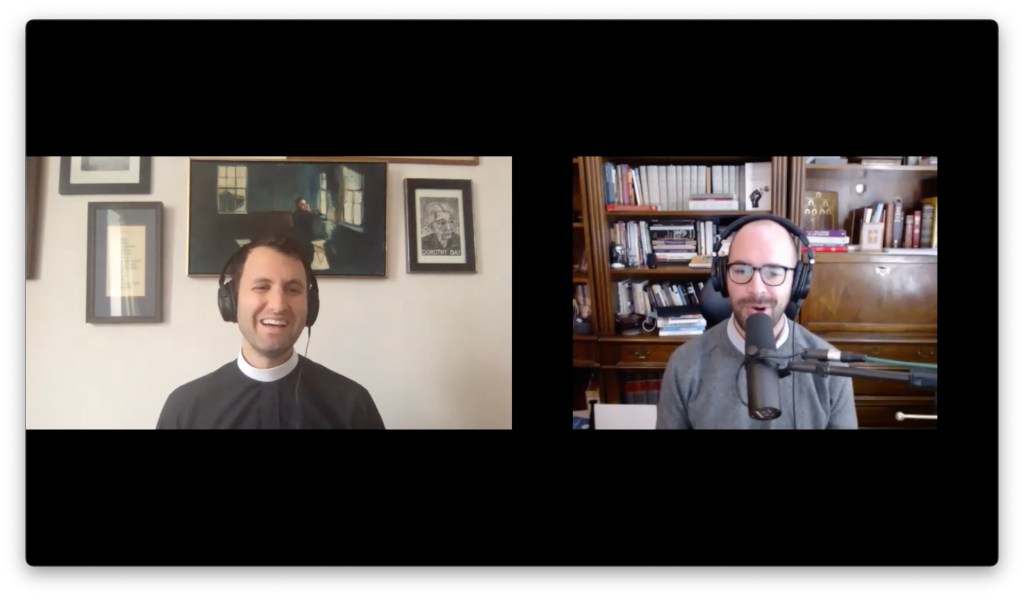
This week on the Strangely Warmed podcast I speak with Drew Colby about the readings for the 2nd Sunday of Advent [C] (Malachi 3.1-4, Luke 1.68-79, Philippians 1.3-11, Luke 3.1-6). Drew is the lead pastor of Grace UMC in Manassas, VA. Our conversation covers a range of topics including Advent disciplines, Handel’s Messiah, The Muppets, Christmas unicorns, Home Alone, prodigal love, J the B, the refiner’s fire, the Daily Office, darkness, God’s grace, missional moments, the Lord’s Table, and universalism. If you would like to listen to the episode or subscribe to the podcast you can do so here: Joyful Obedience
To you, O Lord, I lift up my soul. O my God, in you I trust; do not let me be put to shame; do not let my enemies exult over me. Do not let those who wait for you be put to shame; let them be ashamed who are wantonly treacherous. Make me to know your ways, O Lord; teach me your paths. Lead me in your truth, and teach me, for you are the god of my salvation; for you I wait all day long. Be mindful of your mercy, O Lord, and of your steadfast love, for they have been from of old. Do not remember the sins of my youth or my transgressions; according to your steadfast love remember me, for your goodness’ sake, O Lord! Good and upright is the Lord; therefore he instructs sinners in the way. He leads the humble in what is right, and teaches the humble his way. All the paths of the Lord are steadfast love and faithfulness, for those who keep his covenant and his decrees.
Tell me about your last fight.
That’s how I start every pre-marital counseling session and it never ceases to disappoint.
There have been countless occasions when the couple will stare absentmindedly at the floor or the ceiling while each of them wait for the other to say something, anything.
There have been occasions when, as soon as the request leaves my mouth, one of them will light into the other about some incident that occurred the day before.
But my favorite is when a couple smiles in return and they say some version of, “We never fight.”
To which I usually respond, “Then you’re not ready to get married.”
I will do my best to explain that I’m not asking about throwing an empty plate across the kitchen kind of fights, those require someone way above my pay grade. But what I’m looking for are those disagreements in which the couple has to figure out how they’re going to figure it out together.
And then, after a moment of consideration, one of the people sitting in my office will intone, “Well, just now while we were driving over here…”
Just about everything about how we live today is predicated on the antithesis of vulnerability. Don’t wear your emotions on your sleeve, don’t over share, and if someone asks how you’re feeling, never ever tell them the truth.
Our era is marked by progress and it seems as if nothing is outside our grasp – wealthy civilians can send themselves into space, individuals can purchase self-driving vehicles, and most of us hold these little devices in our pockets that can do far more than we even really know.
Life, therefore, is always getting better and better and the marks of success are found with strength, power, and might.
Which is why depending on anyone other than ourselves is seen as nothing but weakness.
And yet, the deep truth of our existence is that none of us would be here were it not for the help of others.
This is Advent. The colors in the sanctuary have changed, the readings and the hymns and the prayers have a different flavor, and we have our eyes squarely set on the manger, on Bethlehem, on the Promised One.
I, myself, have stepped fully into Advent having set up my Christmas light at the house two weeks before Thanksgiving, most of the Christmas presents have already been purchased, and I’ve been humming “Christmas Time Is Here” for a month.
And all of this, the early preparations, the color-coordinated chancel, it all leads, sadly, to this impression that we all have to have it all together all the time.
We expect, implicitly and explicitly, that we have to be perfect. We have to dress the part, act the part, and above all, be sure of the part that we are playing.
And that’s when the church becomes yet another version of the endless self-help programs around which we organize our lives. For as much as we might rejoice in seeing the children sing during a Christmas program, it is also about comparing our children to the rest of them. For as much as we might enjoy driving around to look at lights dangling from gutters, it’s also about making sure that our respective houses are up to snuff. For as much as we might celebrate the opportunity for festive gatherings, it’s also about making sure that other people know we know how to cook.
And, again, the church isn’t immune to this temptation! There is this lingering feeling that what we do is, of course, about worshipping the Lord in glory and splendor, but it’s also about making sure the people who are not part of our church know that we know what we’re doing and that we’ve got it together enough as compared to other churches in the area.
So then, as we sit in a sanctuary like this, singing the songs we sing, and pondering passages like this, it all feels a little off.
Teach us your ways O God – show us in the ways that lead to life. Remember your mercy, O Lord, and your steadfast love. Do not remember the sins of our youth, or our transgressions.
Why should we call upon God to be merciful when we have no need of it?
When the outside versions of ourselves leave no room for vulnerability, we become the very thing the psalmist calls for God to forget…
I hope that most of us are here this morning to have our lives made intelligible by the movements of the Spirit, and the proclamation of the Word, and the habits of our tradition, but chances are that a lot of are here because we’re hungry for something real, something with a little twinge of vulnerability.
I’ve been here long enough now to know quite a lot about a lot of you and I know that many of us are caught in situations in which there is little, if anything, that we can point to as being real. Instead, we are surrounded by vapid conversation that amount to a whole lot of nothing. We are bombarded with deceptions and half-truths not knowing what, or who, we can trust.
And then if (and its a big if) someone is real with us, we don’t know what to do with it.
However, here we are on the first Sunday of Advent, embarking on a new year in the life of the church, and the Lord shows up with a profound word of truth, honesty, and vulnerability.
The psalmist cries out: to you O Lord I lift up my soul. Help me in the midst of my distress. My life if not what I thought it would be! Please, God, teach me your truths. And Lord, be mindful of your mercy, remember me but not my sins and my shortcomings. You are good and I am not, and yet, guide me!
In the end, that’s Advent.
More than any other season in the church year, what we do these weeks is absolutely relevant to our particular situations. Advent tells us about own lives, our own limitations, the condition of our condition here and now.
Advent is not only who we are, it is where we are – is the time in between – between the first coming of Christ in the manger of Bethlehem, and the second coming with the new heaven and the new earth.
That’s why Advent is a season of waiting – not for presents under a tree, but the presence of the One who comes for you and me.
Advent reminds us through scripture, song, sacrament, sermon, and even silence, that God not only cares about us but also comes to dwell among us in the most vulnerable fashion of all: as a child born to the least likely of parents.
Just think about that for a moment: God doesn’t show up on the scene with a big booming thunder clap, or with a technicolor light show. God shows up quietly, in a forgotten and sleepy little town, as a totally human and totally vulnerable baby.
Which means, in the end, that all of our anxieties about having to be perfect don’t actually determine much of anything – we don’t have to have it all together for God to come to us. In fact, God shows precisely because we don’t have it all together!
Only in our vulnerability are we able to come to grips with the fact that God chooses to be vulnerable with us in order that God might redeem us.
Which is all another way of saying – there is no real connection without vulnerability.
This is true of friendships, marriage, and even the church.
I was listening to a podcast episode from a show called Invisibilia a few weeks ago and it was all about the different types of friendships we have. The tertiary friendships that exist because of friends of our friends. The habitual friendships that come and go. And the vulnerable friendships. And the episode exemplified this through the possibility of conversations regarding what happens in the bathroom. Basically, they made the claim that the truest sign of friendship is with the vulnerability of honesty regarding something all of us do regularly, and yet none of us ever talk about it. Therefore, if you have someone with whom your willing to talk about what happens in the bathroom, then you have yourself a real friend!
In marriage vulnerability takes on a whole new dimension because, regardless of the age of the people getting married, they do so knowing nothing at all about what they’re doing. Couples will stare at one another by the altar and they will make a promise to love and cherish someone who will not be the same tomorrow nor ten years later. Marriage, being the remarkable and confusing thing that it is, means we are not the same person after we enter it. The primary challenge of marriage is learning how to love and care for the stranger to whom you find yourself married.
In the church vulnerability is a given. And Methodists come by it honest. We preachers are sent to congregations, and congregations receive preachers and we have to get vulnerable right quick. People like me are called into the homes of those nearing the end of life, and at the dinner tables of couples who are no longer sure of whether they want to remain a couple, and at the baptismal font with a child bringing them into the faith.
And most of the time we don’t have enough time to really get to know one another.
But that’s why I love the church. It is a place and a space where we have to be vulnerable with each other whether we want to or not. It’s a remarkable vestige of a community in which the terrible disease of loneliness can be cured if we are willing to be vulnerable with one another.
And that’s a big if.
But when it comes to God, God really knows us. God knows our internet search histories. God knows the comments we write on social media but then we delete them before we make a big mistake. God even knows what we wish we could say at the Thanksgiving table but would never dare actually speak out loud.
And in the total knowledge of us, of our sins and our successes, God chooses, inexplicably, to remember our sins no more!
That’s wild stuff.
It’s what we call grace.
Could there be a better way to start a new year in the life of the church? Imagine, if you can, a people called church who simply allow broken people to gather, not to fix them, but to behold them and love them, all while contemplating the shapes the broken pieces can inspire.
God deals in the realm of vulnerability, working through weakness, in order to rectify the cosmos.
Which is all just a way of saying – no matter who you are and no matter what you’ve done, God already knows it and loves you anyway.
This week on the Strangely Warmed podcast I speak with Drew Colby about the readings for the 1st Sunday of Advent [C] (Jeremiah 33.14-16, Psalm 25.1-10, 1 Thessalonians 3.9-13, Luke 21.25-36). Drew is the lead pastor of Grace UMC in Manassas, VA. Our conversation covers a range of topics including the new year, Advent 1 recommendations, mandolins, Vince Guaraldi, Die Hard, divine promises, sacramental arrivals, sins, keeping the cross in Christmas, bullying, incarnational prayers, apocalyptic anticipation, and the end of the beginning. If you would like to listen to the episode or subscribe to the podcast you can do so here: The End Of The World (As We Know It)
Now when the king was settled in his house, and the Lord had given him rest from all his enemies around him, the king said to the prophet Nathan, “See now, I am living in a house of cedar, but the ark of God stays in a tent.” Nathan said to the king, “Go, do all you have in mind; for the Lord is with you.” But that same night the word of the Lord came to Nathan: Go and tell my servant David: Thus says the Lord: Are you the one to build me a house to live in? I have not lived in a house since the day I brought up the people of Israel from Egypt to this day, but I have been moving about in a tent and a tabernacle. Wherever I have moved about among all the people of Israel, did I ever speak a word with any of the tribal leaders of Israel, whom I commanded to shepherd my people Israel, saying, “Why have you not built me a house of cedar?” Now therefore thus you shall say to my servant David: Thus says the Lord of hosts: I took you from the pasture, from following the sheep to be prince over my people Israel; and I have been with you wherever you went, and have cut off all your enemies from before you; and I will make for you a great name, like the name of the great ones of the earth. And I will appoint a place for my people Israel and will plant them, so that they may live in their own place, and be disturbed no more; and evildoers shall afflict them no more, as formerly, from the time that I appointed judges over my people Israel; and I will give you rest from all your enemies. Moreover the Lord declares to you that the Lord will make you a house. Your house and your kingdom shall be made sure forever before me; your throne shall be established forever.
It was the perfect Christmas Eve service.
The weather was just cold enough with the faintest hints of snows falling from the sky without it worrying people away from driving to the local church.
The little cherubic children had practiced “Away In A Manger” for months and were ready to sing before the gathered people with little pipe cleaner halos hanging above their heads.
The pastor had prepared the perfect pulpit proclamation with enough humor and theological gravitas to get the ChrEasters (Christmas and Easter only people) back in church the following Sunday.
And the highlight of highlights was the so-called Living Nativity scene outside on the front lawn with the holy family, magi, angels, shepherds, sheep, goats, and one particularly cheerful looking donkey.
Like I said, it was perfect.
At the end of the service, while groups made their way up to the altar to take their traditional family color coordinated Christmas Eve pictures for Instagram, as the pastor shook hands and made small talk with all the unfamiliar faces, while the organist went through a carefully crafted holiday medley, as the poinsettias were passed out to later adorn dining room tables, while children scarfed down the sweets that were promised for good behavior during the service, as the ushers counted the largest offering ever received on a Christmas Eve… Joe and Maria, a man and young pregnant woman, stood outside the church shivering in the cold.
Their clothes were mismatched from an assortment of thrift stores, their bellies rumbled at a volume that could only rival the braying donkey, and they prayed that someone, anyone, would be able to help.
So they waited, listening to the laughter and frivolity that was taking place on the other side of the sanctuary doors.
And finally, while families fell out of the church, the couple spoke softly and humbly as asking if anyone had a place they could stay for the night, and every single person, pastor included, walked right passed them as if they didn’t exist.
Merry Christmas indeed.
King David was feeling high and mighty, all settled in his house. He sent for the prophet Nathan and said, “Don’t you think it’s about time we built a temple for the Lord who has delivered us from the hands of our enemies? I mean, we’ve got all this power and wealth and what good is it if we don’t show it off? I mean, for God!”
And the prophet intoned, “Sure, the Lord is with you.”
But that very same night, while the prophet was asleep in his bed, the word of the Lord came to Nathan and said, “Are you out of your mind? Go tell that David these words: I don’t need a house to live in, I don’t need a box for you to hide me away. I am the Lord God. I’m a mover and a shaker. I’ve got things to do, and you can’t domesticate this Spirit. Remember – It was me, The I AM, who took you from your father’s fields, I was with you when you took down the mighty Goliath, I was with you when you danced before the ark, and I will be with until the end. I’ve got plans for my people. So don’t waste your time with a temple, greater things are in store for the people Israel.”
An apt and succinct summary for this passage from 2 Samuel might be: My thoughts are not your thoughts, nor are your ways my ways, says the Lord.
In the strange new world of the Bible we come across a king and a prophet who are contradicted by the Word of the Lord – with all of their comfort and complacency they were so sure that they had it all figured out only to have it turned upside down.
Today, we’ve got plenty of examples in which, both in the religious and political realms, there are those who have no doubt what God’s purposes and plans are only to have them 180’d.
There’s a church in San Francisco that was having a problem. On Sunday mornings, while families and individuals walked through the main doors, they were treated to the smells and the sights and the sounds of the homeless who had slept in the alcove the night before. Sure, the ushers had shoo’d most of them away before the service but their presence was still palpable.
Week after week the pastor and the leadership of the church fielded complaints about the problem and people wanted to know what the church could do to help.
So, like any good church, they formed a committee and started a fundraiser. In a few short weeks they amassed $20,000 and decided to put it to good use.
Did they use the money to start a feeding ministry?
Did they use the funds to subsidize some low-income housing for those in need?
Did they use the finances to start job training programs?
Nope.
They used that 20 grand to install a motion sensor sprinkler system with the solitary purpose of spraying water every sixty seconds throughout the night to prevent anyone from trying to gather in the alcoves.
The Word from the Lord today in 2 Samuel serves as a warning against any overly assured reading of the will of God and reminds us, pertinently, that God is God and we are not.
But this also comes as a great challenge.
For, we are so sure, most of the time, of what God is up to (particularly during Advent). Most of us have heard the story of Mary and Joseph making their way to Bethlehem so many times, or we’ve seen enough plastic nativity scenes, or we’ve heard the crooning Christmas carols over and over again, such that we cannot see or hear how bewildering the story really is.
Our Advents and Christmases are far too domesticated for the Lord who refuses to be kept in a box.
Consider – God scatters the proud in the thoughts of their hearts, God brings down the mighty form their thrones, God lifts up the lowly, God fills the hungry with good things, God sends the rich away empty.
We worship a God who acts before we do and, more often than not, catches us by surprise.
David lived a life of surprises: He was anointed by the prophet Samuel after taking care of the sheep one afternoon, he confoundingly took down the mighty Goliath, he hid away from the wrath of Saul in a cave, he became king over Israel. Sure he was handsome and crafty, but the only reason David got to be the David we know is because God was with him. And yet, near the end of his days, he thought it only right to build a dwelling place for the Lord who had delivered him, and his people, time and time again.
But God does not rest on God’s laurels.
God is in the business of finding dwelling places not for God’s self but for God’s people. God is always ahead of us, from making the covenant with Abraham to waiting in Galilee for the disciples on the other side of the resurrection, God is moving and acting and shaking things up in ways that will surprise us.
Who could’ve imagined that the second born heel-grabbing twin would be the one through whom God’s blessing would be bestowed?
Who would’ve imagined that a harlot who lived on the edge of Jericho would be part of salvation’s genealogy?
Who could’ve imagined that a little shepherd boy would one day be king?
In all times and in all places, we do well to dwell upon where, today, God is moving ahead of us and acting in ways that we cannot even imagine.
What assumptions do we have about what is perfect and pleasing in God’s sight?
In what ways are we still trying to domesticate the wildness of God’s Spirit?
How receptive are we to the God who blows where He chooses and not necessarily where we choose?
Remember – God delights in the surprise!
Over and over again in scripture, and in life, God chooses the unexpected to bring about the Kingdom. God plucks people out of complacency and says, in different ways, shapes, and forms, “I’ve got a job for you!” God stirs up our understandings of the world, flips them upside down, and calls it Good News.
This is the final Sunday of Advent, our time between time. This season has a way of setting the stage for the already but not yet all while getting under our skin. Advent compels us, forces us, to slow down, wait, and notice what we so often miss.
God is God and we are not.
God works and moves in the world in ways that we would not, were it up to us.
And here, on the final Sunday of Advent, with thoughts of David and Nathan, with thoughts of Mary and Joseph, we cannot help ourselves but relish in the strange and wondrous and confounding Good News of Christmas.
For, the Messiah is born in the last place left in the little town of bread, to a virgin named Mary who has no standing in the world.
He grows up in the hick town of Nazareth, and leaves only to spend the rest of his days among the last, least, lost little, and dead.
And, (most surprisingly) he becomes obedient, even to the point of death – death on a cross.
That’s the God we worship.
God is not some perfect and clean and respectful and tame deity that we often domesticate throughout the church.
Our God is on the move, upsetting expectations, calling upon people we would usually ignore, and making a way where there is no way.
God reminds Nathan, and therefore David, that God is perfectly comfortable remaining in the tent. Why? Because tents are made to be moved. We, on the other hand, we rejoice in building temples and monuments and buildings to proclaim stability and importance. We do this, in large part, because we are afraid.
We are afraid of being forgotten. We are afraid of death. We are afraid that we won’t have anything to show for the lives we’ve been given
And how does God respond to our attempts of permanence?
God laughs.
God laughs at our feeble attempts at immortality by kicking up the winds of change and declaring that all things are being made new.
God laughs at our struggles for perfect moral existence and proclaims forgives for sins.
God laughs at our certainty and shows up in the most surprising of ways, as a baby, to change the world. Amen.
I will sing of your steadfast love, O Lord, forever; with my mouth I will proclaim your faithfulness to all generations.
The words of the dreadful Christmas song “Santa Claus Is Coming To Town” sum up perfectly how we all too-often imagine the Lord in our minds: “He’s making a list, he’s checking it twice; he’s gonna find out who’s naughty or nice…” We take those words to be Gospel truth and we believe that it will be like this into the dark night of all the tests that our broken world will never ever pass.
We do it with children this time every year with threats of the Elf On The Shelf returning to the North Pole to report certain behaviors to Mr. C.
We have it reiterated to us over and over again with movies and shows and songs asking us to discern whether or not we’ve behaved in such as way as to make it on the Nice or the Naughty list.
But Jesus (thanks be to God) ain’t Santa Claus.
Jesus will come to the world’s sin with no list to check, no test to grade, no debts to collect, and no scores to settle. He has already taken all of our sins, nailed them to the cross, and left them there forever.
Jesus saves not just the good little girls and boys, but all the stone-broke, deadbeat, sinful children of this world who He, in all of his confounding glory, sets free in his death.
Grace, as Robert Farrar Capon so wonderfully reminds us, cannot prevail until our lifelong certainty that someone is keeping score has run out of steam and collapses away forever.
But it all sounds just a little too good, doesn’t it?
In a world run by meritocracy, the Good News of grace sounds ridiculous if not inadvisable. If we don’t have eternal punishment to hold over the heads of those who follow Jesus Christ, what will possibly keep them in line?
Part of the problem stems from the fact that most of us have our theological wires crossed. We assume that we’ve got to do something in order to get God to do something for us. We believe that so long as we show up to church (or watch worship on Facebook) and read our Bibles and say a few prayers and volunteer every once in a while that it will be enough to justify life everlasting.
And yet, so many of Jesus’ parables, and teachable moments, and healing miracles have nothing AT ALL to do with the behavior of those blessed prior to their blessing.
They’re not about how we justify ourselves, but about how God in Christ justifies us.
God, in all of God’s confounding wisdom, runs out to the prodigal in the street before he has a chance to apologize, offers the bread and wine to Judas knowing full and well what he will do, and chooses to forgive (rather than condemn) the world from the cross.
We don’t strive to change ourselves to get God on our side, but we are transformed by God who chooses to be for us when we deserve it not one bit.
That’s what grace is all about – the unmerited, unwarranted, undeserved gift from God.
And, when we see grace for what it really is, then Christmas can really come into its own. Like the gifts under the tree that are (hopefully) given not as a response to good works or as an expectation that good works will come from them – we can celebrate the great gift of God in Christ Jesus who comes to do what we could not do for ourselves.
This week on the Strangely Warmed podcast I speak with Ben DeHart about the readings for the Fourth Sunday of Advent [B] (2 Samuel 7.1-11, 16, Luke 1.46b-55, Romans 16.25-27, Luke 1.26-38). Ben is the Associate Rector at Calvary-St. George’s Church in NYC. Our conversation covers a range of topics including phenomenal music, the uncontrollable God, riffing on the Magnificat, Kingdom ethics, the Prayer of Humble Access, obedience, impossible possibility, Israel’s calling, Hell, and Fleming Rutledge. If you would like to listen to the episode or subscribe to the podcast you can do so here: Give God The Verbs
The spirit of the Lord God is upon me, because the Lord has anointed me; he has sent me to bring good news to the oppressed, to bind up the brokenhearted, to proclaim liberty to the captives, and release to the prisoners; to proclaim the year of the Lord’s favor, and the day of vengeance of our God; to comfort all who mourn; to provide for those who mourn in Zion – to give them a garland instead of ashes, the oil of gladness instead of mourning, the mantle of praise instead of a faint spirit. They will be called oaks of righteousness, the plant of the Lord, to display his glory. They shall build up the ancient ruins, they shall raise up the former devastations; they shall repair the ruined cities, the devastations of many generations. For I the Lord love justice, I hate robbery and wrongdoing; I will faithfully give them their recompense, and I will make an everlasting covenant with them. Their descendants shall be known among the nations, and their offspring among the peoples; all who see them shall acknowledge that they are a people whom the Lord has blessed. I will greatly rejoice in the Lord, my whole being shall exult in my God; for he has clothed me with the garments of salvation, he has covered me with the robe of righteousness, as a bridegroom decks himself with garland, and as a bride adorns herself with jewels. For as the earth brings forth its shoots, and as a garden causes what is sown in it to spring up, so the Lord God will cause righteousness and praise to spring up before all the nations.
Two weeks ago, on the first Sunday of Advent, my family and I loaded ourselves into the car to drive around and check out the early Christmas Lights. We figured that there would either be only a handful of houses with any indication of the Holiday spirit, or because this has been the craziest year in recent memory that we would luck out with some incredible displays.
So we drove and we drove, and we saw all the staples: The LED projection of green snowflakes frantically circling around on the siding of a house, the dangling and frenetically flashing bulbs adorning the lowest limbs of trees, and we even saw a giant inflatable rainbow unicorn.
But the best house, the Clark Griswold house, was only a block away. I passed it on a run earlier in the week and knew we had to see it in all its electric, and eclectic glory. For, unlike houses with similar color schemes or even thematic connections throughout the lawn, this house had a little bit of everything.
None of the light strands matched any of the others.
There were six different Santa Clauses of every shape, size, and variety.
An inflatable Snoopy was, apparently, keeping watch over the pre-lit reindeer.
And, to cap it all off, there was a blimp floating in mid-air with penguins parachuting to the ground like they were in the middle of a holiday invasion.
And yet, even with all its glory, I couldn’t help but wonder what Isaiah, or Luke, or even John the Baptist would make of all our holiday pageantry. Because, chances are they would be horrified to see the ways we’ve trivialized the turning of the cosmos.
I don’t mean to sound too harsh, I too have lights up on the house, with a Christmas tree standing in the front window with far too many presents already wrapped and under the tree.
But we need to know, all of us, that these things, with all of their safe and sanitized renderings, may actually prevent us from seeing, hearing, knowing, and believing what the Lord has come to do.
The audience for this Advent text from Isaiah are those forced to the margins of life, the last, least, lost, little, and dead. They are, strangely enough, words of hope for people who feel no hope. They are words meant to comfort a people who feel no comfort in the world.
Even all these centuries later, this proclamation is aimed toward the afflicted, the brokenhearted, the captives, the mourners.
From those locked up in physical prisons, to those who feel imprisoned by their situations, Isaiah speaks to those who know not what tomorrow will bring.
It might feel or even seem bizarre, but this passage is also meant for people like us, those who are willing to wake up and live-stream a worship service on their phones, iPads, and computers on a Sunday morning.
Most of us move through life without giving too much thought to whatever it is we are wading through. Worship, blessedly, offers us opportunities to reflect on the here and the now, and we are challenged to imagine the not yet, the more of God’s design.
And we do this because who among us is truly content with our current circumstances?
Right now we are seeing more and more people kicked out of their homes and apartments because they simply can’t put together the money necessary because the bottom third of our economy is crumbling.
Right now parents are preparing to wake up with their children on Christmas morning without a single present under the non-existent tree.
Right now we are being warned that gatherings of more than ten people will most likely result in the most devastating of Januarys in which we will be burying more people than any of us are used to – 5 of the top 10 most deadly days in American history have all happened within the last week.
And, in the midst of all of this, most of us flock to the sentimentalities that hopefully distract us from the truth.
But when has that ever worked?
Whether we like it or not, our lives are bombarded with calls of such frightening frequency to make the best with what we’ve got that we no longer know what it is to hope.
And thus speaks Isaiah: The spirit of God is with me and I’ve been commanded to bring good news to a people drowning in bad news, to announce freedom to those who are trapped, and to break down the walls of prisons, it’s time for jubilee. We shall comfort those who mourn and give them garlands instead of ashes. They will be like tall trees for the Lord, steadfast and glorious. All the ruins shall be remade and the devastations of previous generations will be rectified. For I the Lord love justice!
God, through Isaiah, speaks to those who live in the world wondering if it has anything more to offer. It is received by those in worship who don’t know whether or not to hope for more. And, it is also spoken to those (though we know not how they will hear) who stopped coming to church long ago because they’ve given up hoping for anything else.
Listen – God has arrived; God shows up. God has taken action in the world to bring about a reality that we could scarcely come up with in our wildest dreams. And God’s work in the world is downright political – prisoners are getting released, reparations are being made to those who have been wronged, justice is for all.
It’s the time for jubilee in which debts are forgiven, punishments are lifted, and rectification reigns supreme.
God has, and is, turning the world upside down such that all of the empty streets of our too-comfortable neighborhoods are being transfigured into festivals of joy.
Why?
We were slaves in Egypt but God showed up and intervened – delivered us from bondage into the Promised land. Sure, we were content with what we had back there, at least in slavery we got three meals a day and clean water to drink and it only cost us our first born children! But God said there was more for us than Egypt-land.
We were slaves to sin and death but God showed up and intervened – delivered us from our miserable estate into salvation. Sure, we were fine with the way things were, so much so that when Jesus started talking about the first being last and the last being first we nailed him to the cross. But God said there was more for us than all of this.
God is in the business of intervention – an intrusion that will bring forth new life and halt our relentless march toward dust.
There have been many divine interventions – Exodus, Calvary, The Upper Room, The Empty Tomb.
And without those interventions of the Lord there is no hope and there is no “more.”
But God is the God of impossible possibility, who makes a way where there is no way, who delights in bringing something out of nothing.
God says through the prophet Isaiah, “Even in circumstances of the worst imaginings, captivity and imprisonment and mourning, this is not the end; there will always be more.”
Do we deserve it?
Nope.
Can we earn it?
Nope.
In the end, the gospel isn’t about being good – it’s about being rescued. It’s not about being safe – it’s about being saved.
For, there is nothing safe about the Lord. Isaiah speaks a word beyond the present, beyond the status quo, where there is actual Good News, where there is true liberty, where we wear garlands instead of ashes.
And it’s downright dangerous.
Consider the vision the Isaiah proclaims: It truly is an inversion of the ways things are for the way things should be. A world without prisons or borders or hunger or suffering.
To many that sounds more like chaos than paradise.
But, in the church we call this apocalyptic – Bible talk about the more beyond the now.
Isaiah’s apocalyptic proclamation is what taught Mary, the mother of God, how to sing:
“He has brought down the powerful from their thrones, and lifted up the lowly; he has filled the hungry with good things, and sent the rich away empty. He has helped his servant Israel, in remembrance of his mercy.”
When we come to church (even online) and are exposed to the words of Isaiah and Mary and so many others we are beckoned out beyond the world of predictability and into another world, a world of more, or risk, of gift.
In short, we’re given hope for things not yet seen.
And that hope, as noted, is a dangerous one, for good reason – just look at what happened to Jesus. Advent is the time between time in which we wait not only for the baby born in the manger, but also for the return of that baby-born-King who is the great I AM.
God is not done with this world and God is not done with us.
After all, these words of eschatological rendering don’t just describe the world – they re-create the world. It is a world made open in which the old foundations are destroyed in order for something new and something more to take their place.
Imagine – the lowliest of the low raised to the highest heights, the brokenhearted bound up in love, the captives set free, the prisoners released, no more debts, no more pain, no more suffering, no more death.
This is what God desires for us and for the world.
And, make no mistake, this is God’s work – the history of humanity has shown over and over again that we are incapable of rescuing ourselves from the forces that weigh us down. The great Good News of Isaiah’s declaration is that God will set everything right once and for all. God will end war forever.
God will bring down the mighty and raise up the last, least, lost, little, and dead.
God will overthrow the pride of the smug and the arrogant.
God will engulf the cosmos in a blaze of righteousness that will consume everything in us that needs to be burned away.
God has more in store for us than all of this.
And yet, we go forth from church (or from our couches as the case may be) and there are the same arguments around the dinner table, the same anxieties about our ever-shrinking bank accounts, the same blue Mondays will break in the morning.
We are not the world of God’s more.
At least, not yet.
For we all still sit in the shadow of sin, of our choices that result in the world looking more like our kingdom and less like God’s kingdom. We are so captivated by the ways things have been that we can scarcely imagine what they could be. We assume the world runs by debt and punishment all while God exists to show grace and mercy.
In spite of the condition of our condition, Isaiah has given us the possibility to be aware of a new world with new hope and new possibilities and new dreams and new hunger for something else, something more.
The church gives us the vision to see how watered down our versions of the Kingdom have been and it gives us the thirst for the new wine that intoxicates us with grace.
The church opens us up to the strange new world of the Bible where God exists not only with us but for us.
The church envelops us into the body of Christ where we are bound to and with one another for the sake of the already but not yet.
In short: The church gives us the Gospel, the Good News.
The very best worship services are those from which we go forth not to more of the same, but to more of the name that is above all names: Jesus the Christ. For, in him, we begin to see that the Good News really is good
A number of years ago, a rather famous theologian was in the middle of a lecture about the early church when a bright eyed and bushy tailed student raised his hand and said, “Professor, I don’t understand. If the early Christians were suffering daily, why did they stay committed to the cause?”
The professor did not hesitate before answering, “They kept the faith because the Gospel is an adventure; the Gospel is fun.”
Advent is actually an adventure – it reminds us that we are caught up in God’s great story and we have the good fortune of being characters in the epic-tale. It is an adventure because it is still unfolding, it is not over, greater things are just on the horizon.
In the Kingdom of God that is the adventure without end, there is always more to come. Amen.
Rejoice always, pray without ceasing, give thanks in all circumstances; for this is the will of God in Christ Jesus for you.
My son has a penchant for exaggeration.
(He probably gets it from his Father)
We decided to get him a Lego Star Wars Advent calendar in which, every day, he gets to open a new (tiny) lego set that he gets to build after consuming his breakfast. The first week of December resulted in a miniature Razorcrest (from The Mandalorian), Poe Dameron wearing a BB-8 holiday sweater, and many more.
And this morning, after scarfing down his pancakes, he ripped through the package and put together a red Sith Trooper in 7.5 seconds and triumphantly declared, “This is the best Advent ever!” while grinning from ear to ear.
When was the last time you felt truly joyful?
It’s a worthy question for Christian reflection, particularly in a time such as ours – a global pandemic, economic uncertainty, and the familiar no longer a possible reality.
“Rejoice always!” So Paul implores the church in Thessalonica. Notably, Paul’s call to joy is not a suggestion not merely an opportunity for contemplation, it is a command.
But how can we rejoice (always) when it feels like there’s nothing to rejoice about?
Joy, as we often speak about it, is a feeling. Like my son with his legos, it is a moment of bliss or happiness that leads to some sort of physical reaction like him smiling so much his mouth started to hurt.
But joy, properly understood, is also an expression, a kind of communication. However, it is not simply telling others that you are happy – it is a telling that is also an invitation to share in the telling.
Joy, to put it another way, is meant to be infectious.
At her best, the church is a people who invite each other to rejoice together. It’s why the covenants of marriage and baptism and not for the people getting married or baptized alone – they are a promise made by the community for the community.
We, that is the church, rejoice always, we pray constantly, and we give thanks in all circumstances. Interestingly, for Paul, joy comes first. Unless we are filled with joy we cannot pray and unless we pray we cannot give thanks.
Now, there’s (of course) a potential for a horrendous reading of this command in which Christians, “stay on the sunny side” despite all evidence of the contrary through their lives – like the meme of the dog drinking coffee in a house on fire saying “this is fine.” Rejoicing always, in that way (which is to say: improperly), can be used as the means by which we reject responsibility for others and even for ourselves.
Remember, however, Jesus did not ignore the truth and the brokenness of life – he wept for Lazarus, he turned the tables in the temple, and he was even afraid in the Garden of Gethsemane.
Christians are a people commanded to rejoice not in spite of the world, but simply because we know how the story ends. We can rejoice because we have found what was lost, ourselves.
Our joy is in the cross – a sign to us and to all that God chose to suffer for the sake of the world.
The strange new world of the Bible reveals God’s strange and confounding love for us in spite of us – we open up the pages to discover that God had joy in being one with us and that God took on all the consequences of being one of us; God incarnated love in the person of Jesus Christ for a people not good at loving in the first.
Our joy is inherently Adventen because it holds two seemingly-opposed things together at once – like the already but not yet, the once and future king, the cross and the empty tomb.
Joy, Christian joy, is the joy of knowing what awaits us even in death. And that joy gives us the strength to pray without ceasing and the courage to give thanks for a gift we simply do not deserve.
We have a joy to express and to share because God is coming again, bursting onto the scene like our favorite uncle with a salami under one arm and a bottle of wine under the other with no other hope in the world other than to party (read: rejoice) forever and ever.
This week on the Strangely Warmed podcast I speak with Ben DeHart about the readings for the Third Sunday of Advent [B] (Isaiah 61.1-4, 8-11, Psalm 126, 1 Thessalonians 5.16-24, John 1.6-8, 19-28). Ben is the Associate Rector at Calvary-St. George’s Church in NYC. Our conversation covers a range of topics including Fleming Rutledge, figuration, bad news, righteous justice, creative imagery, true laughter, upending Advent, praying online, homiletical grammar, and bearing witness. If you would like to listen to the episode or subscribe to the podcast you can do so here: Repeat The Sounding Joy
Comfort, O comfort my people, says your God. Speak tenderly to Jerusalem, and cry to her that she has served her term, that her penalty is paid, that she has received from the Lord’s hand double for all her sins. A voice cried out: “In the wilderness prepare the way of the Lord, make straight in the desert a highway for our God. Every valley shall be lifted up, and every mountain and hill be made low; the uneven ground shall become level, and the rough places a plain. Then the glory of the Lord shall be revealed, and all people shall see it together, for the mouth of the Lord has spoken.” A voice says, “Cry out!” And I said, “What shall I cry?” All people all are grass, their constancy is like the flower of the field. The grass withers, the flower fades, when the breath of the Lord blows upon it; surely the people are grass. The grass withers, the flower fades; but the word of our God will stand forever. Get you up to a high mountain, O Zion, herald of good tidings; lift up your voice with strength, O Jerusalem, herald of good tidings, lift it up, do not fear; say to the cities of Judah, “Here is your God!” See the Lord God comes with might, and his arm rules for him; his reward is with him, and his recompense before him. He will feed his flock like a shepherd; he will gather the lambs in his arms, and carry them in his bosom, and gently lead the mother sheep.
“A hopeless situation.”
That’s how she described herself while sheltering against the church from the wind. Above her mask I could see a tiredness in her eyes, a tiredness that was further echoed in her story. No job, no family, no food, no money, no hope.
Meanwhile, a van full to the brim with a family drove by and, even though all the windows were up, we could still hear all of them singing at the tops of their lungs, “It’s the hap-happiest season of all!”
I handed her a bag of food, offered to pray with her, and when she walked away I couldn’t tell if it had made any difference at all.
Can you imagine anything worse than being in a situation without any hope? Being forced so strongly to the margins of life that there was no one you could call to bail you out, no family that would welcome you in?
Hopelessness can derail individuals and families. And even though, at this time of year, we light candles and string up sparkly things, and decorate Christmas trees, and talk about hope in places like this, the sting of hopelessness can still hit harder than just about anything else.
God’s people Israel knew hopelessness. During the Babylonian Exile, the time in which Isaiah speaks his confounding word of comfort, they were a people who knew no comfort.
It’s challenging for people like us, today, to imagine, at all, what that time was like for God’s people – they had lost their homes, their nation, their possessions, their worship, their status, roots, stories, identity, and just about everything else.
They were truly strangers in a strange land.
They were swallowed up by their oppressors and compelled to adopt a way of life that ran counter to all they had ever known.
They were in a hopeless situation.
And, to make matters worse, the Lord of their ancestors had commanded them again and again to take no other gods save for the Lord God. Their idolatry, their wanton disregard for the commandments resulted in an exilic punishment.
To put it plainly, they brought it upon themselves.
And they were hopeless to do anything about it.
But it is precisely here, to a hopeless people, that God speaks through Isaiah:
Comfort, O comfort my people! Speak kindly to my people, remind them that the penalty for sin has been paid. A voice is crying out – Prepare the way of the Lord! The valleys will be lifted up, the hills will be brought down, God’s divine leveling will come to fruition. God’s glory will be revealed and all will see what God can do. A voice cries out – People are like grass, they wither and float away. But God stands forever and ever! So do not fear! God is coming with might! He will feed his flock like a shepherd; he will gather the lambs in his arms and carry them in his bosom.
Chances are, some of us are familiar with at least part of this proclamation from the prophet – In the wilderness prepare the way of the Lord. We hear those words every Advent in reference to John the Baptist who, spoiler warning, prepares the way of the Lord.
And J the B, as I like to call him, was no ordinary fellow.
He is rather alarming, coming straight out of the desert dressed in animal skins while eating insects and yelling about repentance. And, according to Mark’s Gospel, its precisely J the B showing up on the scene in ancient Palestine that marks the beginning of the gospel of Jesus Christ, the Son of God.
J the B has never been fully understood, and for good reason.
He shows up out of nowhere, and before we really get to learn much of anything, he is beheaded for crimes against the state. So for two thousand years he has stood in the midst of this season, with his strange sense of fashion and bewildering diet and discomforting theology completely out of sync with his age, our age, and just about any age.
Advent, for better or worse, is a time set apart in the church when we make a conscious effort to recover some of the strangeness from the strange new world of the Bible – and John embodies it all. Because, like J the B, Advent is rather peculiar. It’s out of sync with time.
As we talked about last week, Advent is about the time between time, the already but not yet, the pause between the once and future king.
To put it in musical terms: Advent is God’s great caesura…
The best parts of Advent are those that give us the courage and the conviction to rest in the tension of who we are, and what God has done for us in spite of who we are. We take time Sunday after Sunday to look toward the darkness into which, and for which, Jesus arrives.
Advent, in a way, is actually a lot more like Lent than we often make it out to be. We take stock of who we really are in order to come to grips with what it is, exactly, that Jesus does for us.
J the B arrives, confused for Elijah, proclaiming a baptism of repentance for the forgiveness of sins. He does so, to take the hint from Isaiah, to prepare the way of the Lord. There’s something about recognizing the condition of our condition that enables God to do the work that we so desperately need because all of us, whether we like to admit it or not, are hopeless cases.
It takes quite the Christian constitution to affirm the truth of Isaiah’s words: we are like grass and flowers that wither and blow away. Sin isn’t just something we do, it’s who we are. In ways big and small we regularly (like the Israelites before us) rebel against the Law of God, we insist on laying down at the altars of countless idols, and we are forever determined to be the masters of our own destinies.
Just take a look around – Covid cases spiking yet again, economic uncertainty as jobs are not rebounding, evictions are piling up as rents can’t be paid, and there’s no sign that any of it will slow down any time soon.
Obviously, some of this is out of our control, but some of it lies squarely with us and our unwillingness to love our neighbors as ourselves.
I know it might not seem like it, but confessing our sins is actually very good news for us. There’s a reason the Catholics have been doing it for millennia. There is a documentable psychological benefit to confessing our faults and failures, we literally release endorphins in the brain when we do so. But confessing our sins also benefits us by putting us squarely in an Adventen frame of reference.
Light is only light because of the darkness it shines in.
Grace is only grace because it cancels the power of sin.
Resurrection is only resurrection because it refuses to let death be the final word.
That’s a stark and frightening thing to admit but it’s part of the Christian witness. The message of John to a hopeless people, the message of Isaiah to an exiled people, is better for us than all the trimmings and the trappings that this season usually holds. All of the advertisements and pressures and assumptions only provide a shadow version of our own reality.
That’s not who we are.
We’re Christians! We’re sinners!
We’ve come to worship today, albeit in a way none of us quite imagined back before the pandemic struck, we’ve come to worship in some part because we know we need these words from Isaiah and from John more than we need the mall, and the wrapping paper, and the light shows, and the curated Christmas playlists, and the never-ending holiday-themed Lifetime Movie marathons.
We know we need these words from the prophets because we know we need Jesus – he’s the only hope we’ve got.
Without Jesus, we’re just a people in exile stuck in a hopeless situation. But Isaiah and John show up to prepare us for the appearance of God’s own self in the person of the Messiah. They remind us that God is active in the world in ways seen and unseen and it is upon the work of the Lord that the universe hinges.
But, how might we prepare for this? It was one thing to wander around during the days of J the B and find ourselves dunked into the Jordan river repenting our sins. But we are a people stuck in Advent between the once and future king – we already know what awaits us in the manger and on the cross.
What, then, is the right response to the triumph of God showing up?
The Beyonce of the Episcopal Church, Fleming Rutledge, makes the case that, during Advent, we should keep the tune O Holy Night stuck in our gray matter because when God shows up, the only proper response is to Fall On Your Knees!
Think about it: when the reality of God breaks in on from on high, the only thing we can do is recognize the great chasm across which God chose, and chooses, to traverse for us. When we see how God is God and we are not, we can’t help ourselves but fall to our knees in reverence.
J the B stands at the edge of time. He, in himself, holds the words of the prophets while pointing to the One who transfigures the cosmos. Advent, then, looks not just to the birth of a baby in the manger, but also to the long-awaited day of the Lord when rectification reigns supreme.
In Jesus Christ, the once and future King, the new day of righteousness is made incarnate. The old age of sin and death is crumbling away and in the coming kingdom of God there is the divine shepherd who gathers the sheep into his bosom.
That’s what J the B came to declare – our deliverance is nigh!
And how shall we respond? Fall On Our Knees!
God is going to level out all things. The mountains are coming down and the valleys are moving up. Creation will be reknit and all of us along with us.
Despite the language we might hear about in church about how it’s our job to prepare the way of the Lord – God is doing this work regardless of whether or not we participate in the divine clearing project.
And, frankly, its not going to be easy for people like us. For, God’s work of divine leveling means laying ourselves open and vulnerable to a vision of reality that is God’s will be done and not necessarily our own.
It means living every moment of our lives in anticipation of God’s bringing down the mighty and lifting up the lowly.
It means relinquishing our most cherished (and therefore flawed) understanding of what we have earned and deserved.
It means being ready to give up all of our privileges and advantages in the world on behalf of those who are stuck down in the valleys of life.
Again, this isn’t going to be easy. Particularly for a people drunk on our own self-righteousness.
We don’t like admitting our faults and failures.
We don’t like confessing our privileges and advantages.
We don’t like repenting of our wrong-doings.
In the time between time, Advent, we can (with the help of the Spirit and the church) take a good hard look in the mirror and confess the condition of our condition. That’s how repentance works – it is a change of life, a reorientation, a turning back. And we can’t turn without admitting that we need to turn in the first place.
But even if we can’t bring ourselves to confess the truth. God is still in the business of making something of our nothing.
For God does not desire the immense brokenness that surrounds us. God in Christ is reconciling all things to himself. The old age of Sin and Death was run by death and division. But in God’s kingdom, what we are preparing for and are being prepared for, is run on reconciliation, grace, and mercy.
So hear the Good News: Christ died for us while we were yet sinners, not before or after, but in the midst of our sin. And this proves God’s love for us. In the name of Jesus Christ, you are forgiven. The Kingdom of God is near. Amen.










 think and let think