(I Can’t Get No) Satisfaction

Isaiah 55.1-5

Ho, everyone who thirsts, come to the waters; and you that have no money, come, buy and eat! Come, buy wine and milk without money and without price. Why do you spend your money for that which is not bread, and your labor for that which does not satisfy? Listen carefully to me, and eat what is good, and delight yourselves in rich food. Incline your ear, and come to me; listen, so that you may live. I will make with you an everlasting covenant, my steadfast, sure love for David. See, I made him a witness to the peoples, a leader and commander for the peoples. See, you shall call nations that you do not know, and nations that do not know you shall run to you, because of the Lord your God, the Holy One of Israel, for he has glorified you.

I’ve been here in Woodbridge for about a month and I feel like I’m finally getting my bearings. I know where all of the essential stores are; I know what roads to avoid during rush hour; and I’m even starting to learn most of your names!

To preach properly you need to know your people.” I heard that over and over again in seminary and it’s so true. You’ve got to know the people before you can just stand up and tell them what God is saying. And so, over the last month, I’ve tried to learn a lot about a lot of you. And not just your names… I know who makes the best food and where it’s kept in the church kitchen. I know that a lot of the real meetings happen in the parking lot and not the conference room. And for a good number of you, I’ve learned what drew you here in the first place. But for as much as I want to learn about you, I also want to learn about the people who are not here yet.

This means I want to know about our community, what makes it tick, and how it transforms the people who call it home.

For instance: I’ve gone to a few local businesses just to ask questions without expectations. I’ve started conversations with total strangers in restaurants just to ask questions without expectations. And a few weeks ago, my wife, son, and I went to the most culturally relevant location in the area: Potomac Mills.

For those of you who are unfamiliar, Potomac Mills is one of the largest outlet malls in the country and it is what smaller malls aspire to be. It’s huge. It’s overwhelming. It’s capitalism at it’s finest.

Anyway, we got in the car and drove over to the mall with our stroller. When we parked and strapped Elijah in, we headed for the nearest door and entered the great arena of commerce. Now, some of you are probably wondering what we were looking for at the mall, you’re pondering the specific item we were searching for. But here’s the thing: we weren’t looking for anything. We just wanted to see what the mall was like.

And now some of you are thinking that we’re crazy.

It took a long time to do the whole loop at the mall, particularly with all of the random people and families moving about like fish against the current. And the thing that surprised me most wasn’t how many stores there were, or even how many people there were, but how quiet it was.

It was a strange and eerie experience to be in a place with so many people and have it be so subdued. At first I was worried that my ears were stopped up, but then I realized that it was so quiet because so many people were on their cell phones.

And that’s honestly what made it so hard to navigate, not the number of people, but the fact that most of the people had their heads down in their hands and were completely oblivious to everything else going on. Even the venders in their middle kiosks could have cared less about us as we milled about Potomac Mills.

And I can’t help but wonder if that’s what Isaiah felt like trying to reach God’s people. The prophet of the Lord attempts to interrupt the sensibilities of the crowd with a declaration, but the people were in Babylon, far removed from home, and they had other things to worry about. Like a crowd of people at the mall focused on their phones, perhaps Isaiah struggled to captivate the attention of the passing people with his enthusiasm and excitement. Picture, if you can, a person doing everything he or she can to convey the truth to a group of people who are far happier with a lie.

That’s Isaiah in our scripture today.

Attention! If you’re thirsty, come to the water. And those of you without money, come, buy, and eat! Why do you keep spending your money on things that cannot bring you satisfaction? Listen to the Lord so that you may live. God is making a covenant, a promise, to love us even when we cannot love ourselves. God is blessing us daily, God is glorifying us, and most of the time we completely miss it.

Today many, if not most, of us are so caught up in our gadgets and spider-webs of false connections that we really feel empty inside. Or we are spending our money and our savings on products and commodities that offer no real satisfaction. Or we believe that so long as we ascertain the right car, or the right job, or the right spouse, we will finally find that one missing thing to give meaning to our lives.

But in the kingdom of God, the normal rules of commerce and capitalism do not apply. In fact, they have been completely overturned.

Unlike just about everything else in the world, at God’s celebration we need not bring goods or money in order to procure a place at the table. Instead, water, bread, wine, and food will be provided without cost. Whereas we think that who we are, and what we’ve earned, and what we’ve saved defines us, God only requires that we bring two things: our thirst and our hunger.

Unlike the world, where many of us prefer to fellowship and worship and commune and eat with those whose income and status and skin tone are similar to our own, God’s vision of life in the kingdom is completely different.

banner-en

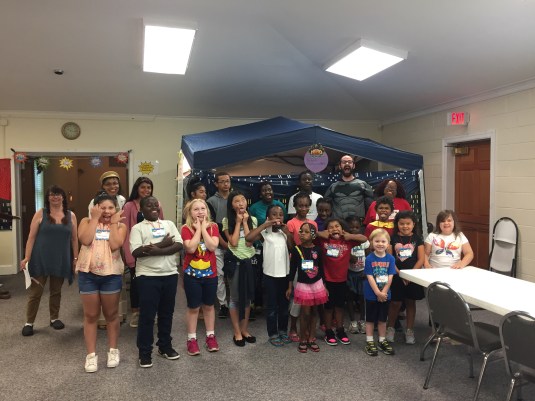
On Monday morning we opened our doors to children and youth from the community for Vacation Bible School. I, like a fool, stood by the entrance in my adult size Batman costume and welcomed everyone for a week of experiencing the love of God through Hero Central. Each day the kids learned about what it takes to be a hero in God’s kingdom: heroes have heart, courage, wisdom, hope, and strength. They did crafts and science experiments, they danced and sang, and they feasted around a common table. They learned bible stories about King David, Abigail, Jesus, the Beatitudes, and Pentecost.

On our last day I was sitting at the table with all of the kids, when one of them approached me with a huge smile on her face and all she said was, “I wish church was like this every day.”

I imagine that she wished church could be like that every day because Vacation Bible School was fun and exciting, but I think there was more to her wish than that alone. This week, the distractions of phones and the siren call of social media disappeared. Instead of a mall filled with adults staring into screens, the children experienced a church full of adults who got down on their level to share with them the love of God.

Instead of an experience where everyone looked the same, earned the same, and sounded the same, the children experienced a church full of disciples who could not have been more different from one another.

This week, our children and youth caught a glimpse of the kingdom of God made manifest on earth in a way that so few of us ever get to experience. Because in God’s kingdom, the place that Isaiah beckons the crowds to experience, invitations are made to all people: the rich and the poor, the old and the young, the perfect and the broken. The beautiful wonder and glory of this scripture is the fact that God welcomes ALL to the table. Always.

IMG_2824

During the time of Isaiah, and today, so much time is wasted on sustaining existence. We hear about the next new thing and we become obsessed even though we know that when it finally arrives we will be distracted by the next new thing coming down the pike. We ask ourselves questions that are predicated on maintaining the status quo. We go to things like the mall hoping for consumerism to fill a hole that no amount of money, or goods, or experiences ever can.

But God offers us something different. God looks at the shallow nature of our lives, God examines the mistakes and sins of our past, God evaluates what our minds stay focused on, and instead of leaving us to our own devices, God shares with us a new covenant. God makes a promise to be with us in spite of us.

God shows us a life that is based not on blessing the wealthy, but on protecting the poor.

God offers a covenant in which greed is shunned, and humility is glorified.

God presents a promise in which divisions are destroyed and community is congratulated.

Isaiah pleaded with the people of the Lord to open their eyes to the truth that no product could ever offer. Isaiah interrupted the distracted crowds with a vision of the kingdom on earth where those who are different are brought together in unity around a table where God is the host.

Opening up the doors of this church for a week of Vacation Bible School is a radical thing. We gave the children food, and education, and time for no other reason than the fact that God loves them. Compared to the priorities of the world, this place was strange this week.

Gathering together in a space like this for worship is a radical thing. While the world is consumed by the next new thing and a false community you can keep in your pocket, the church stands as a witness to the truth of God’s dominion. We lift up our prayers and we bend our knees because we know that what we believe shapes how we behave.

Coming to the table to feast on the Lord’s Supper is a radical thing. We search daily for products and goods to fill the holes we feel, we spend our time with people who look like us and sound like us. And yet at this simple meal, we are invited to a table with people who are completely unlike us. At this meal we get to taste a little bit of heaven on earth and we receive the only thing that can bring real satisfaction.

Today we live in a world where we are forever asking “Who gets in?” What does it take to earn a spot at the table? What kind of grades do I need to make to get into college? How long will I have to wait before it’s my turn?

But in the kingdom of God, at this table, all are welcome. Always. Amen.

tcaa-come-to-the-table-sermon-series-header

5 Tips For A Fruitful Vacation Bible School

I just finished leading Vacation Bible School for Cokesbury UMC in Woodbridge, VA and the experience led me to write 5 tips for a fruitful VBS:

vbs

  1. Learn The Names

There are few things as important as learning the names of the participants at Vacation Bible School. Whether the kids are regulars in worship or if it’s the first time they’ve entered a church, learning names shows that the church cares about who they are. I am new in my current appointment and am still learning the names of most people but I’ve made it a priority to learn the names of the children and the youth. We are blessed at the church I serve to be situated in a very diverse community and therefore the children at our VBS are all very different. It is good and right to learn the “Sallys” and the “Jims” but it means that much more when you take the time to learn how to appropriately pronounce the names of the children from other countries. On the first day of our VBS I called a couple of the kids by name and they responded with surprised looks and huge grins. Over and over again in scripture we learn about God calling people BY NAME! If we cannot learn the names of the children who come into our buildings for VBS, then we are failing to be the church God is calling us to be.


  1. Ditch The Phone

Go to any restaurant, or any large area of commerce, and you will see individuals (and families) with their heads down in their hands. The proliferation of portable devices has greatly transformed the cultural landscape in a tremendous way such that an entire family can sit down for a meal without ever uttering a word. At Vacation Bible School the phones and the tablets should completely disappear. Unless it’s an emergency, there is nothing so important that it should take attention away from the children and the youth that have arrived to learn about the love of God. By ditching the phones we are showing them that we, like God, care about them and we love them. Whereas many of them will return to homes with parents and older siblings sucked into the deceptive worlds of Twitter and Facebook, the participants can experience a little slice of being known and cared about in God’s kingdom at VBS if we believe our literal and physical relationships are more important than our digital ones.

  1. Get On Their Level

At VBS this week I have been the storyteller and have been tasked with sharing stories about David, Abigail, Jesus, the Beatitudes, and Pentecost. But before ever helping the children and youth enter the strange new world of the bible, I asked them about their favorite movie (almost all of them said Moana), or about their favorite meal (mostly chicken nuggets), or about their superhero (Wonder Woman). The Bible no longer offers an instant connection for children today and it is often experienced like an ancient relic from the past. By showing them that we care about what they value, and then demonstrating the value of scripture for our lives, it makes a connection between the things in a way previously unknown. Regardless of age, racial, and socio-economic divisions there is a need for connection between leaders and participants that can be achieved simply by getting on their level.

  1. Make Connections

VBS does not end when the children leave for the day. When they return home or move on to the next activity they are still absorbing what they’ve learned and experienced. Similarly, the church is tasked with making connections between sessions such that the kids know we’ve been thinking about them as well. For instance: one of our kids this week shared that he was excited about going to football practice after VBS ended that day. The next morning the first thing I asked him was: “How was your football practice yesterday?” The boy responded by staring at me and then saying, “How did you remember that?” (as if it was the greatest accomplishment in the world). The children and youth that attend VBS are more than the means by which we can grow the church, they are more than numbers on a piece of paper, they are more than the hope for the future. The children and youth that attend VBS are very much the church RIGHT NOW and they deserve to be known and heard just as much as anyone else in the church.


  1. Invite, Invite, Invite

Today, at least in the United Methodist Church, “invite” seems like a dirty word. Rather than offend or inconvenience anyone, we’ve simply stopped inviting people to church. Whenever leaders from the UMC get together we hear about a frightening statistic that should leave us shaking in our boots: “The average person in a UMC invites another person to worship once every 33 years.” At the very least the children and youth at VBS should be invited to attend worship the following Sunday to share a few songs they learned during the week. They should know that we want them to join us, not to increase numbers or to fill pews, but because we want them to continually know and experience the love of God, revealed in Jesus Christ, through the power of the Holy Spirit. It doesn’t take much to invite someone to church, particularly young children and youth that have been running around the church for a week, but it must be done with love, care, and with intentionality.

On Limping With God

strangely-warmed-spreaker-header

This week on the Strangely Warmed podcast I speak with Teer Hardy about the readings for the 9th Sunday after Pentecost (Genesis 32.22-31, Isaiah 55.1-5, Romans 9.1-5, and Matthew 14.13-21). The conversation covers a range of topics including what its like to wrestle with God, saying “ho” in church, and how the loaves and fishes bring more than an end to hunger. If you would like to listen to the episode or subscribe to the podcast you can do so here: Limping With God

4128890529_c7f52dbfb5_b

Devotional – Psalm 145.9

Devotional:

Psalm 145.9

The Lord is good to all, and his compassion is over all that he has made.

 Weekly Devotional Image

I arrived at church this morning mentally prepared for Vacation Bible School. I had read over the “Bible Story Teller” section, I knew where I needed to be and at what time, and I even had the perfect costume picked out: Batman.

However, I had assumed, foolishly, that the other adults would also arrive in some form of superhero costume. So, instead of blending in among a crowd of heroes, I stuck out like a sore thumb. However, when the children arrived (some from the church and some from the community) they were all shocked that the Caped Crusader was making his way around the building.

After our initial assembly time we broke out into age groups and then began making the rounds through the different centers. I made my way to the storyteller room and started teaching all of the children and youth about Samuel anointing a young David. The groups listened to my rendition and appropriately laughed at my silly jokes, they left with a sense that to be a hero in God’s kingdom one needs to have a compassionate heart, and they learned about how God is our true hero.

IMG_2824

Toward the end of the day, in my last bible story session, one of the youth was not as engaged in the others. I tried to include her as much as possible, but there was clearly something distracting her. When we finished, the rest of the youth walked out of the room, but she stayed behind as if to ask a question. Without prompting she lifted up her head and said, “Did you really mean that?” I said, “What do you mean?” She replied, “That God really loves everyone? Even me? You said that God’s love for David is the same as God’s love for eveyrone, and I want to know if that’s true.” And I said the only thing I could say, “Of course it’s true.”

I don’t know what’s going in her life to warrant her isolated behavior, or even her stark wonder at the fact that God could love her, but I am grateful for the opportunity to tell her the truth. As the psalmist says, “The Lord is good to all, and his compassion is over all that he has made.” God’s love and grace and mercy know no bounds. They are for ALL. And all means all!

From the youth who arrived for Vacation Bible School while wrestling with something beyond herself, to the man panhandling on the street corner, to the family sitting in the pews on Sunday morning, God’s love is for ALL.

Sometimes we lose sight of the tremendous extent of God’s love when we encounter people that we cannot love. When we disagree with them, or are angry with them, they feel outside the realm of God’s grace.

And sometimes we lose sight of the tremendous extent of God’s love when we feel like we know longer deserve it. When we really think about how we have sinned, or how we could be better, we feel outside the realm of God’s grace.

Then let us all hear the good news, the best news: The Lord is good to ALL, and his compassion is over ALL that he has made.

The Cost of Heaven

Matthew 13.45-46

Again, the kingdom of heaven is like a merchant in search of fine pearls; on finding one pearl of great value, he went and sold all that he had and bought it.

In my experience sermons are often very one sided. Someone like me, will stand in a place like this, and tell people like you, what God is saying. But sermons are meant to be more than a monologue, they need to be more than a lecture, they must be more than what I come up with in isolation.

So, I would like some of you to describe heaven for me. What do you think it will look like? Who will be there? What’s on the daily agenda?


There was once a man who lived a devout life and toward the end of his days God spoke to him and said, “I am so proud of the way you’ve lived that I’m going to do something I don’t usually do: I’m going to allow you to bring something with you to heaven. You may fill a briefcase with whatever you like and it shall be with you for eternity. Now remember I don’t often make this deal, so make sure you give it some thought.”

So the man did. For weeks and months he wrestled with what he would bring with him to heaven. He made pros and cons lists, he consulted his pastor (who was utterly bewildered by his question) and finally he decided on what to put in the briefcase.

Eventually the time came for the man to die and upon arriving at the Pearly Gates, St. Peter was patiently waiting to greet the man. St. Peter looked him up and down and said, “Hey man, look I’ve gotta ask: what’s in the briefcase? God never lets people bring something inside and he made an exception for you. So, can I see it?”

The man proudly opened his case and showed off 6 gold bars.

St. Peter stood there for a moment and then beckoned for the nearby angels, “Hey everybody, you’ll never believe it. God told this guy he could bring anything he wanted into heaven and he brought asphalt!”

In heaven the streets are paved with gold… Have you ever heard this before? Or maybe the image of heaven inside your mind is a cloud-like place filled with little fat cherubs floating around the air. Or maybe you think heaven is like a never-ending buffet with all of your favorite food.

the-pearl-of-great-price-daniel-bonnell

I get asked a lot of questions as a pastor. “How am I supposed to pray?” “Where is God in all of this?” “Should I tell my husband what happened?” But the question I’m asked the most, by far, is “What is heaven like?”

Today, when most of us think about heaven, the images conjured in our minds have far more to do with Hallmark than with scripture. Our hopes and dreams about our heavenly reward often reflect what movies and books describe than what the Lord describes.

I wonder if the crowds around Jesus were disappointed when he started talking about the kingdom of heaven. His parables, his long list of comparisons, contain nothing about pearly gates, or endless buffets, or even reuniting with long lost relatives.

The stories Jesus tells about the kingdom of heaven are down to earth, literally. At times he talks about the kingdom of heaven like a mustard seed. People disregard it and toss it away, but when it takes root it grows greater than any plant and won’t stop growing.

At other times he talks about the kingdom of heaven like yeast being mixed in with three measures of flour. When mixed and baked properly it would’ve been enough bread to feed hundreds of people.

At other times Jesus talks about the kingdom of heaven as a never-ending worship service. Which, to some people, sounds less like heaven and more like hell.

And more often than not, when Jesus talks about the kingdom of heaven he compares it to a wedding feast. I like the wedding feast connection because weddings are fun and full of joy and celebration. And, perhaps most importantly, there are always a couple people at the wedding who we never would’ve invited if it was our own, but God’s invitation is not like our invitation.

In today’s short passage, Jesus tells the crowds (and us) that the kingdom of heaven is like a merchant in search of fine pearls; on finding one pearl of great value, he went and sold all that he had and bought it.

Pearl of Great Price

More than a year ago I was down in Roanoke for the start of Annual Conference. Annual Conference is the once a year opportunity for United Methodist from all over Virginia to get together for prayer, worship, renewal, and church business. I arrived early last year to meet with some of my friends for breakfast, and half of us were about to be ordained in full connection. Though we had all served as pastors for a number of years, we had finally made it through the journey to kneel before the Annual Conference and would now serve the Lord as ordained elders.

And though the time at breakfast was filled with great joy and anticipation, there was also a dark cloud hovering over the gathering. The church is not what it once was and it’s hard to ignore how much it has changed. Gone are the days when one could assume that a church would grow simply by being in a neighborhood. Gone are the days when young couples and families show up on Sunday morning without an invitation. Gone are the days when the church is regarded with high esteem by the surrounding culture.

Last year, as it is now, the church is in a place where just having the doors open is not enough. The church is disproportionately skewing to an older age demographic. And the church is forever suffering under the weight of controversies like the Book of Discipline’s language about homosexuality.

So there we were at breakfast, sharing our excitement about joining the ship of Methodism in full connection, while the ship appears to flooding and without direction. We lamented the church’s current state of affairs, we offered opinions about how we might fix certain items, or how to change certain opinions, and then my friend Morgan interrupted everything.

He said, “I’ve been thinking a lot about Jesus’ parables recently, and one in particular. He tells the disciples that the kingdom is like a merchant in search of fine pearls; on finding one pearl of great value, he went and sold all that he had and bought it.” He had been looking down at the table up to this point, but then he raised his head and looked us in the eyes and said, “Do we still feel that way about the kingdom? I mean, are we willing to risk it all, to throw ourselves completely in? Or, at the very least, have we found a pearl in our churches?”

Today the church feels afraid. Few are willing to takes risks, we hold up frightening statistics as a way to guilt people into doing more, and we ask so many questions about the viability of the church going forward. But Jesus doesn’t transform life by scaring the hell out of people. No, Jesus transforms life by helping people like us see how heaven is close at hand.

Morgan’s question has haunted me for more than a year. With all the talk of negativity in the church, with all the fear and frustrations, Morgan turned it all upside down. Where is the pearl of great price in this place? What would I give up everything to possess in the kingdom?

When my son was one month old we brought him to church for the first time. I had taken 4 Sundays off to be at home with Lindsey as we adjusted to life with a newborn, but the time had come to return to the pulpit. I can’t tell you much about the service because I was so sleep deprived that most of it is a blur. But I will never forget the moment Lindsey brought him up to the front to receive communion. Without talking about it ahead of time I took the tiniest piece of bread, dipped it in the cup, and placed it in his mouth.

He has no idea what communion means or even what it is. But for the majority of his little life he has been in church every single week, learning the habits of God in worship, and receiving the body and blood of the one we call Lord. My son knows of no life outside the church. His life has been one defined by the movements not of the world, but by the liturgy.

And seeing him in church, watching him receive communion, hearing him say “amen” without even knowing what it means… I think I would sell everything to keep that.

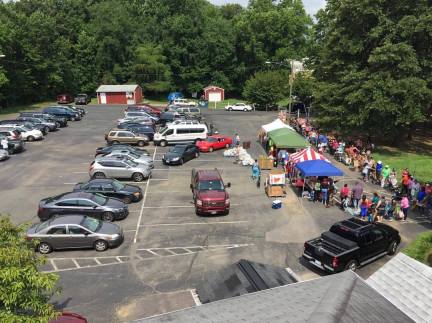
On Thursday morning I got to church early after working on the sermon a little bit and I discovered a great crowd of people in our parking lot. There were volunteers from Cokesbury, Old Bridge UMC, and from the Salvation Army, and they were all working together to distribute food to those in need. There was no cash box at the front for community members to pay for the food, there was no expectation that they would ever repay us, and (perhaps most importantly) there was no judgment about the fact that they needed food.

I stayed toward the sides of our lot and took it all in for the first time, though I introduced myself to a handful of families patiently waiting for the food. There was one woman who kept her eyes on me while I was moving about and I eventually went up to introduce myself. As I got close she took my hand all she said was, “Thank you. This has saved my life.”

20369172_10209226181322580_3977426946611839100_o

Experiencing her salvation in our parking lot, seeing the wonder and joy in her eyes, feeling her hope… I think I would sell everything to keep that.

Tomorrow morning we are going to open our doors to all sorts of kids from the community for Vacation Bible School. Some will come from privileged families and will have been here before. Some will come from situations they won’t talk about though it will be clear that the food we offer them will be the first food they taste that day. And a few will come from somewhere in between.

Our volunteers will fill the halls with joy and hope and laughter as we do arts and crafts, as we sing and dance, and as we all learn more about the bible.

Seeing the children and volunteers working together, hearing children excited to learn more about God, seeing individuals interact with one another in a place like this… I think I would sell everything to keep that.

And all of them, from my son in worship, to the woman in the parking lot, to the children in our building will experience the grace of God and they will leave transformed without cost.

In the parable the man sells everything he has for the pearl of great value – the pearl of God’s kingdom is of such importance that merchant gives away his very livelihood to hold on to a little slice of heaven. More important than the money he uses to purchase the pearl is his willingness to trust that the gift of God’s kingdom is more important than any earthly thing.

Friends, the kingdom of heaven is at hand. It is not just some place waiting for us in the by and by, it is also something that we can experience here and now. Because the kingdom is something that God is doing, and it is to be received as a gift; a gift like the bread and the cup, a gift like food in a parking lot, a gift like vacation bible school.

The kingdom of heaven is not something that can be acquired, or earn, or purchased; it is a way of being into which we can enter.

This beautiful and brief parable from the lips of Jesus is not about the cost of heaven. It is, instead, a testament to the fact that our response to the kingdom is total, it is everything we have. To be joined up in to this kingdom of heaven on earth, the kingdom that is both here and not yet, means committing our whole beings, without reserve, and with totality.

The kingdom of heaven is a gift that transforms every bit of our lives here and now.

There is no amount of money on earth that can purchase salvation. As the old hymn goes, “Jesus paid it all.” But the parable begs us to ask ourselves the same questions that Morgan asked me, “Do we feel like the merchant? Are we willing to risk it all, and throw ourselves completely in? Or, at the very least, have we found a pearl in this place?” Amen.

On The Tricky Wicket

strangely-warmed-spreaker-header

This week on the Strangely Warmed podcast I speak with Teer Hardy about the readings for the 8th Sunday after Pentecost (Genesis 29.15-28, 1 Kings 3.5-12, Romans 8.26-39, and Matthew 13.31-33, 44-52). The conversation covers a range of topics including what it takes to find “the one”, reading the bible to someone on Death Row, talking about sex in church, and Jesus’ obsession with parables. If you would like to listen to the episode or subscribe to the podcast you can do so here: The Tricky Wicket

mustard-seed

Devotional – Psalm 105.1

Devotional:

Psalm 105.1

O give thanks to the Lord, call on his name, make known his deeds among the peoples.

Weekly Devotional Image

I love Star Wars. When I was a boy I watched our VHS copies of A New Hope, The Empire Strikes Back, and Return of the Jedi so many times that they became unwatchable and we had to purchase new copies. I would read and reread the VHS cover so frequently that I began memorizing all of the inconsequential details. I still know almost every line in all three movies all from the time of my childhood.

I still love Star Wars as an adult. I’ve dressed up as characters from the universe for far too many Halloween celebrations, I definitely have too many Lego sets from the movies (that stay prominently displayed out of my son Elijah’s reach), and I even have a replica of Luke Skywalker’s green light saber from Episode VI.

Untitled

When new details about the upcoming films come out I become an evangelist for the films. I will turn just about any conversation in such a way that I can mention rumors about casting, or new hopes for screen writing, or even connections within the expanded universe. I become my nerdiest when I’m talking about Star Wars.

And I rarely talk about church the same way.

Don’t get me wrong: I love the church. I love the church’s liturgy, I love the call to preach, I love offering the sacraments, I love being with people in some of the most holy moments we can ever experience. But I rarely recommend the church to others in the same way that I recommend watching a Star Wars movie. And even with how much of my life has been blessed by Star Wars, God has done, and will continue to do, more than any film ever can.

The psalmist calls for the people of God to “make known [God’s] deeds among the peoples.” We tend to recommend things to people all the time like restaurants to try, books to read, and movies to watch, but when it comes to the church we often remain silent. Or, perhaps more importantly, when it comes to what God has done for us, we remain silent.

Part of this tendency is due to our belief that faith is a “personal and private” matter, which leads us to leave our faith to ourselves. Part of it also stems from the fact that we so often take our blessings for granted, or we don’t recognize where the blessings came from in the first place.

But God is the author of our salvation. God is the one working in and through our lives to bring about the kingdom on earth. God is the one who has transformed us.

How much better would it be then, to share with others what God has done for us?

We Don’t Belong To Babylon

Isaiah 44.6-8

Thus says the Lord, the King of Israel, and his Redeemer, the Lord of hosts: I am the first and I am the last; besides me there is no god. Who is like me? Let them proclaim it, let them declare and set it forth before me. Who has announced from of old the things to come? Let them tell us what is yet to be. Do not fear, or be afraid; have I not told you from of old and declared it? You are my witnesses! Is there any god besides me? There is no other rock; I know not one.


Years ago I spent a summer working for a Toyota Dealership up in Alexandria. I was a porter and I was responsible for parking customer’s cars, driving them into the bays, and then bringing them back out when the work was completed. Every day I hopped into more cars than I could count and drove with great care through a parking lot that had twice as many cars as it should have.

I loved working there. I loved how every day was different, I loved all the strange and bizarre things people kept in the cars, I even enjoyed the great range of music that people chose to blare through their sound systems. But the part of the job that I loved the most was the people I worked with.

All of the other porters were at least twenty years older then me, and none of them were white. We were quite the motley crew standing together waiting to park cars, and during the slow moments we regaled one another with stories. That summer I learned about Carlos’ difficult journey from Mexico to the United States, I learned about Jamal’s continued experience of racism even though we lived in a supposedly progressive place, and I learned about Michael’s love for his home country of Ghana.

Of all the other porters Michael took me under his wing and always made sure that I was always drinking enough water. He called me Mr. Taylor and would clap his hands when he saw me walking up early in the morning.

We worked side by side for an entire summer and by the end he felt more like a friend than a co-worker.

On one particularly rainy afternoon, while business was slow, I asked Michael about what it was like to live here after spending most of his life in Ghana. He told me about how for years he only dreamed of one thing; saving enough money to bring him and his family to the US. How for years they watched American movies and read American books and they knew they had to do everything they could to get here.

And when they finally saved enough, when they finally came to the US, they were disappointed.

I remember thinking: “Disappointed? How could they be disappointed with all we have to offer here?”

And then he told me that they were disappointed because it was dirty, because there were people in need, and that he and his family still felt like strangers in a strange land.

18540

Isaiah’s message from the Lord isn’t just some random call from a prophet for the people to know more about God – it comes at a particular time to a particular people in a particular place. These words were, and still are, meant for a people in captivity.

The people of God had grown distant from the Lord and after countless attempts to bring the people back into the fold; they were taken into captivity in Babylon. For two generations God’s people were in a foreign land and it was in the midst of the Babylonian captivity that Isaiah spoke these words from the Lord: I am the first and I am the last, there is no one else like me. If any are so bold as to claim to be like the Lord let them declare what is to come. Do not fear, or be afraid. Have I not told you what was to happen? You are my witnesses!

The people receiving the Word from Isaiah were a people without hope. They had lost their homes, their nation, their possessions, their faith, their traditions, their roots, their identity, and their sense of belong. The Babylonian empire was known for its power and its majesty, but it was not what they thought it would be. Like my friend Michael from Ghana arriving in a new place, the Israelites were strangers in a strange land. Babylon was a nation with its own roots and customs and gods, and Israel was a tiny nation that had been assimilated into the greater empire.

Every single day God’s people were surrounded by idols clamoring for their worship. But unlike all the idols of Babylon, unlike all of the customs and the experiences, Isaiah declared that only the Lord is first and last, only God calls the future into being.

And to be honest, it is almost impossible for us to connect with the captive situation during the time of Isaiah. We are so entrenched in the culture around us that we cannot even fathom what it would look like to be in bondage, to be chained down, to be strangers in a strange land. But we are.

We are in bondage to the next new thing; in just a few months droves of people will be lining the streets for the next iPhone, Potomac Mills will be nearly impossible to navigate through, and the promise of big deals will cause people to make irrational decisions and choices.

We are controlled by the current political structures that we think determine our lives. Just ponder about how much time we spend watching or reading the news that is now completely and totally focused on who said what, the next vote down the line, and the latest tweet from the White House.

We are chained to economic plateaus that are relatively inescapable. Here in this country we cherish the American Dream, but the truth is that the overwhelming majority of us will die in the same economic bracket we were born into.

We think that all of those things determine our lives. They have become our Babylon.

On any given day we will spend more time worrying about a new product, or politics, or our prosperity far more than anything else. Like the Israelites in Babylon, like Michael at the dealership, we Christians are strangers in a strange land. And here’s the frightening part: the longer we spend time in the strange land, the less strange it appears.

I know a man who started attending church later in life and quickly got involved. At first he volunteered as an usher, and pretty soon he was helping to lead worship as a liturgist. He loved church. He embraced the different rhythms and habits of the congregation and threw himself completely in.

And, of course, it didn’t take long for him to join one of the many committees at church. For months he attended the meetings and all of the other activities at church, but suddenly he stopped appearing around the church as frequently until he disappeared all together.

I asked to meet with him to discuss what happened and his answer was simple and hard to hear. He said, “I loved church because it was unlike anything else in my life, but at some point it started feeling the same. I experienced arguments in church meetings, apathy in the pews, and people never stopped lamenting about the past. I came to church to escape that kind of stuff from my life, only to discover that it was here as well.”

If the church is no better than the culture that surrounds it, if it doesn’t embody a different way of being, then it simply isn’t the church.

We are supposed to be strangers in a strange land. While the world around us strives to change our priorities the words of Isaiah ring even louder. While the culture tells us that we have to make it through this life on our own, Jesus tells us that we cannot do it on our own. While cultural idols strive for our allegiance, the Lord speaks loud and clear: I am the first and I am the last; besides me there is no God.

We don’t belong to Babylon. We belong to God.

And, as Isaiah is bold to proclaim, our God comes to us from the future. God is concerned about where we are going, whereas we often spend far too much time stuck in the past.

0f01ca760818853c9a197c7f191b52d3--religion-quotes-tattoo-quotes

The Israelites in captivity were stuck in the past just as much as they were stuck in Babylon. Their minds were focused on the old things, the failures of a distant time, memories from days long ago. They needed to hear the good and the true Word of God: “Who else can tell you what is to come? Let them try to prophesy the future. I am coming to you from the future for I am the first and the last, the beginning and the end. Do not fear, or be afraid! You are my witnesses. Remember what I have done for you, and you will know there is no other rock.

At the time of Isaiah’s proclamation the people were in danger of forgetting who they were, and whose they were. They wallowed in their present circumstances and were giving themselves over to the idols in their midst. They needed a probing and holy Word from the Lord. They needed deliverance from their chains. They needed to hope for things not seen, they needed to believe, they needed to know that God was with them even in the midst of captivity.

But maybe all this Babylonian captivity stuff is too much for today. We haven’t been stolen from our homes and delivered into a foreign country. Perhaps the talk of idols and nationalism, the comparisons within politics, and the particles of God’s time traveling omnipotence are just too heavy. Maybe we’ve got other things to worry about: bills to pay, people to call, children to raise, a marriage to sustain, a future to figure out. Perhaps we are so deeply rooted in this strange land that we can no longer see it as strange. Maybe our captivity has become our home.

Well then let us all hear the adapted word from the prophet Isaiah:

We cannot save ourselves. We have been and will be saved by God. There is nothing on this earth, or in the entire cosmos, like the living God. No amount of materialistic accumulation, economic growth, or political power will ever bring us satisfaction. Every little thing that we want to give meaning to our lives will fall away.

God, however, is almighty, eternal, and full of mercy. God is the one reaching out to us when we no longer have the strength to reach back. God is the one who surrounds us when we feel completely alone. God is the one who delivers us from the captivity to the Babylons in our midst.

As Christians, we are strangers in a strange land. Everything surrounding us is constantly telling us what to think, how to act, and what to believe. The world tries to tell us who we are and whose we are.

But we don’t belong to Babylon. We belong to God. The world’s ways are not our ways!

We are more than the stories of the past. We are more than the failures of the present. We are more than our captivity to the idols competing for our allegiance. We are God’s children.

And our God is an awesome God! Our God is the first and the last. Our God is the beginning and the end. Our God is in control. Our God makes a way where there is no way. Our God is king of the cosmos. Our God is the solid rock upon which we stand. Our God is concerned with our future. Our God believes in our future. Our God know where we’re going.

Thanks be to God that we don’t belong to Babylon. Amen.

An Altar Call To Dust

strangely-warmed-spreaker-header

This week on the Strangely Warmed podcast I speak with Jason Micheli about the readings for the 7th Sunday after Pentecost (Genesis 28.10-19a, Isaiah 44.6-8, Romans 8.12-25, Matthew 13.24-30, 36-43). The conversation covers a range of topics including Little House on the Prairie, Christian time travelers, being scared @#$%less, altar calls, and growing weeds with the wheat. If you would like to listen to the episode or subscribe to the podcast you can do so here: An Altar Call To Dust 

superbook_bible_stories_by_sukreih-d7hc4le

Devotional – Psalm 139.4

Devotional:

Psalm 139.4

Even before a word is on my tongue, O Lord, you know it completely.

Weekly Devotional Image

I was shaking hands with people on their way out of worship when a young man, about my age, walked up. We exchanged the pleasantries due to one another in a place like church and then he asked if I would be willing to pray for him. I said something like, “Sure I’ll be happy to add you to my prayer list” and then prepared to shake the next person’s hand. But the young man kept standing there and said, “No. I need you to pray for me right now.”

He told me about the struggles in his life all while people standing in line waited patiently. He shared about his inability to find work, his complicated relationship with his father, and his general feeling of despair. And then he grabbed me by the hands, closed his eyes, and waited for me to pray. So I did.

I had casually known the young man for a couple years but I had no idea about his struggles. Week after week we were in the same church, singing the same songs, offering the same prayers, but I knew nothing about what was happening under the surface.

The psalmist proclaims, “Even before a word is on my tongue, O Lord, you know it completely.” And this is good and right and true. The Lord knows what we need and what we want even before we can articulate what we need and what we want. But just because God knows our words before we do, that doesn’t mean that everyone else does as well.

shutterstock_153536591

In today’s world many of us are uncomfortable with the thought of asking someone to pray for us, let alone having him or her do it right in the moment of our asking. Instead we fill the time of prayer concerns with the needs of other with whom we are familiar. And even then, the expectation is usually that a general prayer will be offered for individuals and groups removed from the immediate situation so that we can move on to something else.

The Lord knows what we need, but the people closest to us (our friends, family, church members) usually don’t. Instead, they are habituated by the masks we wear. They grow comfortable with what they experience and then assume that so long as everything on the surface appears normative then everything deeper must be the same.

What would it look like for you to ask someone in your life to pray for you this week? And not the “can you pray for me sometime” casual request we are used to hearing but the “I need you to pray for me right now.” It might be uncomfortable and even frightening, but it is at the heart of what it means to be in relationship with others in a way that is true, deep, and faithful.