Devotional – 1 Samuel 3.1

Devotional:

1 Samuel 3.1

Now the boy Samuel was ministering to the Lord under Eli. The word of the Lord was rare in those days; visions were not widespread.

Weekly Devotional Image

It’s mean, but one of my favorite games to play is called, “Is it in the bible, or not?” I could be in the middle of a mission trip with middle school students, or in a nursing home with residents, or in a preschool surrounded by 4 year olds, when I will start the game and relish in the responses.

I’ll usually start with something tame like, “Can anything good come out of Nazareth?” and the participants will nod their heads in affirmation. But then I’ll up my game a little bit with something like, “With your utensils you shall have a trowel; when you relieve yourself outside, you shall dig a hole with it and then cover up your excrement.” People will usually scratch their heads wondering why I brought out something so unpleasant, but it’s there in Deuteronomy 23. By the end of the game I usually drop something like, “God helps those who help themselves.” To which people often express their agreement when in fact it’s definitely not in the bible.

mar6

We no longer know the story of God like we once did. I don’t mean to sound overly harsh, but it’s true. During the time of Jesus, young men grew up having most (if not all) of the Psalms memorized. Today we’re lucky if we can get through the 23rd Psalm. John Wesley, the founder of the Methodist movement, was able to quote scripture left and right. Today we need bible apps and Google searches to find the right verse. Even preachers like me fail to love the Word of the Lord in a way that is comparable with the preachers of the past.

Perhaps our lack of love for scripture is due to the fact that we have other things to distract us constantly, or that we have tools that can give us scriptural answers whenever we need them, or that we no longer revere the text for what it is. It’s impossible to particularly pinpoint the reason for the bible’s fall from grace in our contemporary world, but it’s something we are called to combat.

Because, unlike the days of Samuel, the Word of God is not rare today.

We live on the other side of the resurrection, we have churches with more bibles than they know what to do with, and we can jump into the strange new world of the bible whenever we would like to.

If you want to hear the Word of the Lord, if you want to receive a vision about what is to come, if you want to encounter the living God, you need not look further than the bible.

Keep The Mystery

strangely-warmed-spreaker-header

This week on the Strangely Warmed podcast I speak with Teer Hardy about the readings for the 2nd Sunday After Epiphany [Year B] (1 Samuel 3.1-10, Psalm 139.1-6, 13-18, 1 Corinthians 6.12-20, John 1.43-51). Our conversation covers a range of topics including Wesley Theological Seminary, the need for repetition, submissive liturgical postures, the rarity of the Word, mystery, metafiction, baptism, communion, sex and fornication, and the challenge of preaching on difficult passages. If you would like to listen to the episode or subscribe to the podcast you can do so here: Keep The Mystery

TH

Kicking and Screaming

Mark 1.4-11

John the baptizer appeared in the wilderness, proclaiming a baptism of repentance for the forgiveness of sins. And people from the whole Judean countryside and all the people of Jerusalem were going out to him, and were baptized by him in the river Jordan, confessing their sins. Now John was clothed with camel’s hair, with a leather belt around his waist, and he ate locusts and wild honey. He proclaimed, “The one who is more powerful that I is coming after me; I am not worthy to stop down and untie the thong of his sandals. I have baptized you with water; but he will baptize you will the Holy Spirit.” In those days Jesus came from Nazareth of Galilee and was baptized by John in the Jordan. And just as he was coming up out of the water, he saw the heavens torn apart and the Spirit descending like a dove on him. And a voice came from heaven, “You are my Son, the Beloved; with you I am well pleased.”

All of us have questions. We have questions about what it means to be a Christian, what the bible is all about, and how to make sense of it all in the ways we live. In November I compiled questions from the congregation and created this sermon series in which I will attempt to answer some of the questions that vex us in regard to faith. Today we begin the series with, “If Jesus was dunked, why do we only sprinkle?”

____


The parents stood next to me by the baptismal font, each trying desperately to keep their sons under control. Abe and Archer had never been up at the front of the church, the stained glass windows were mesmerizing, but more than anything, they just wanted to get down and run all over the place.

So I grabbed some of the water in the bowl and let it drip onto their hands as I read the words that countless Christians have heard before their baptisms. It was nothing short of God’s grace that as the water moved from hand to hand, both boys froze in their parents’ arms, and they almost prayerfully joined me in the sacrament that would change their lives forever.

I took them one after the other into my arms, lightly sprinkled water onto their heads and baptized them in the name of the Father, Son, and Holy Spirit. Afterwards, I carried them out into the middle of the sanctuary and you could hear a pin drop as the congregation took in the beloved sight of two newly baptized boys moving down the aisle. For them, the church, it was the first baptism in a very long time, and in those two boys they saw their future.

It was a beautiful baptism, and one that I will cherish till the end of my days.

Years later I stood with two different parents, one of whom is another United Methodist pastor, and two different sons, in a very different place. Instead of standing before the church in a church, we had, as the good ol’ hymn goes, gathered by the river. And by river I mean creek.

The crowd of people snuggled closer together as the wind howled through the trees. I came prepared with waders and got appropriately bundled up before stepping into the current. And the closer we came to the moment of baptism the more frightened the two boys looked about a moment that would change their lives forever.

However, I believe it was the fear of the water’s temperature that made them quake in their baptismal gowns more than the disruption the Holy Spirit was about to make real.

I grabbed the younger one first, carried him across the waters to the deepest part of the creek, and his mother and I thrust him completely under the frigid waters three times in the name of the Father, Son, and Holy Spirit. And he was kicking and screaming the entire time.

18301473_10210937077676980_3740734210783733526_n

I honestly tried to focus on the holiness of the moment, doing my best to make it right, but all I could think about was whether or not the older brother was going to hightail it out of there as soon as I tried to pick him up.

But when we made it back to the shore, I deposited the one brother for the other, took him out and did the same thing. He cried the whole way back to the shore.

It was a beautiful baptism, and one that I will cherish till the end of my days.

If Jesus was dunked, why do we only sprinkle? It’s an interesting question, and frankly one that has vexed the Christian church since nearly the beginning. In the account of Jesus’ baptism by John in Mark’s gospel, it says that Jesus was coming up out of the water when he heard the voice of God, therefore implying that he had been completely under the water. Yet, in many churches when baptism takes place it is done so with the pouring of water over someone’s head, or the sprinkling of water on the forehead.

Answering this question, the one about why we baptize, is at the heart of why there is no universal church. Just take a drive through Woodbridge and you will encounter just about every flavor of church there is and one of the things that divides us is our inability to answer the question.

Some churches believe that you can only baptize adults who have made the choice for themselves. And when they are baptized it has to be “living water” which is to say it cannot be contained in something made by human hands, and has to be in a creek, river, lake, or even the ocean.

Others say you can fully immerse someone in a pool or large baptismal font.

Some churches believe that you can baptize babies, with the consent of their parents, and can do so in a great number of ways, from dipping them in the font to sprinkling water across their foreheads.

And still yet in some churches, they believe that using water in baptism is unfaithful and will instead only baptize by the Spirit without any physical object being used.

And because we have no single answer to the question, there are an almost limitless number of Christian denominations throughout the world.

Do you want to know a secret? The amount of water used doesn’t really matter. Bring a kid to a creek, or a baby to the font, or an adult to the pool, all you want, baptism isn’t about what we do, but instead about what God does to us.

18275156_10210937077796983_8625008867195458354_n

Baptism, like communion, is what we call a sacrament. It is an outward sign of an invisible grace. It is one of the ways we experience the grace of God here and now through something we can touch, feel, and experience.

It is good for us to practice baptism as such because the whole of the gospel is done to earth, it takes place in the real, tactile, fleshy world. Whenever the Spirit is mentioned in scripture it is tied to the material – real water, real bread, real flames. The Spirit fills us in church when we gather, and sends us out from the church to be in the world.

The Spirit is not something meant for our hearts and souls without the bodily experience.

That’s why the story of Jesus’ baptism has all these great physical details… The people were gathering out in the wilderness at the behest of a radical man named John dressed in camel’s hair with a leather belt, perhaps with locusts and wild honey dripping out of the corner of his mouth. John declares that the one more powerful is coming, and that even he, John, would be unworthy to untie his sandals. And then Jesus is baptized by John in the Jordan, he comes up out of the water, still dripping with the experience, and the heavens are ripped apart as a voice says, “You are my Son, the Beloved; with you I am well pleased.”

Baptism-Jesus-4K-Wallpaper

Baptism is not some concept that we can relegate to our minds and our philosophical reflections. It is a defining act that grabs us out of who we were and pushes us into who we are.

Churches, for centuries, have fought battles and excommunicated Christians for their differing beliefs on how much water should be used for baptism. But more important than the amount of water, is the fact that baptism is a violent, disruptive, and transformative change that takes place in our lives.

When I first baptized the boys in the sanctuary, it was picturesque; it was everyone’s dream baptismal experience. But the baptism that took place in the cold creek was more in line with the theological conviction of what it means to be baptized.

            It might bother our modern sensibilities to think about children, or even adults, kicking and screaming on their way to baptism, but when we consider the truth of what we are doing to them and for them, it might be the most proper response.

Immediately following Jesus’ own baptism, the heavens were ripped apart. This was no happy-rainbow-spewing-splitting of the heavens, it was a violent rendering of the cosmos such that the earthly and the divine were coming into contact with one another. We might, in our minds, imagine a beautiful scene where sunshine broke forth from behind the clouds to surround Jesus with a glow, but the language of the gospel beckons us to imagine a scene more akin to the violent rendering of the bomb cyclone the east coast just experienced.

Baptism, whether it’s Jesus’ or our own, is a moment of profound transformation. When we baptize someone in the name of the Father, Son, and Holy Spirit, we are, as Paul puts it, baptizing them into Christ’s death so that they can be raised in new life with Christ.

That is no easy thing.

Baptism is the radical reorientation of all things. Whenever we bring someone to the water, whenever we remember our own baptisms, the heavens are torn apart again and God meets us where we are.

It is radical because in the sacrament we affirm that God’s kingdom is more powerful and life changing than anything else in existence. We proclaim that the water washes away every bit of who we were such that we can become the people God is calling us to be. We move into a way of being that is intimately connected with the life, death, and resurrection of Jesus.

I was baptized nearly thirty years ago when I was 19 days old. I have no memory of it at all. I don’t even know who was there or what was said. But it made all the difference. It made all the difference because a group of people who gave their lives to Jesus believed that in giving me to God my life would be about more than me. In baptizing me into the death of Jesus, and raising me into the new life of resurrection, I began a journey that has reshaped my understanding of the world and what it means to love God and neighbor.

Baptism doesn’t promise a perfect life. It is not a cloak of protection that we can drape over those we love. It should shake us that we do something so radical to the people we love. We baptize those whom we love because we want their lives to be about something bigger than themselves, we want them to know what it means to love God and neighbor, we want them to experience resurrection here and now.

I have brought infants, and toddlers, and even teenagers to the waters of baptism again and again because what God does through the Spirit is the most wonderfully disruptive thing that can ever take place. In those moments, God speaks from the torn open heavens, just like on the day Jesus was baptized to say, “You are my child.”

            And we are who God says we are. Amen.

A One Hundred and Fifty-Fold Cord

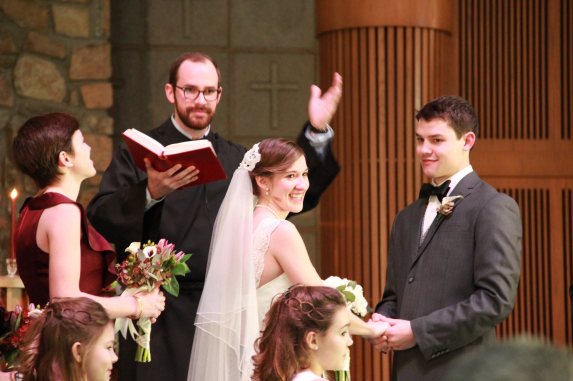
4 years ago, today, I presided over one of my first weddings, and it was for my sister and my (now) brother-in law. I don’t know if I’ve ever been more nervous leading worship than I was that day (so nervous that I forgot to invite my then fiancé (now wife) to offering one of the scripture readings), but we all made it through to the other side. I am grateful for my sister and her husband, I am grateful they asked me to participate in their holy ceremony, and I am grateful that God has so blessed their marriage. Below is the homily I offered 4 years ago…

1 John 4.9-12

God’s love was revealed among us in this way: God sent his only Son into the world so that we might live through him. In this is love, not that we loved God but that he loved us and sent his Son to be the atoning sacrifice for our sins. Beloved, since God loved us to much, we also ought to love one another. No one has ever seen God; if we love one another, God lives in us, and his love is perfected in us.

Ecclesiastes 4.9-12

Two are better than one, because they have a good reward for their toil. For if they fall, one will lift up the other; but woe to one who is alone and falls and does not have another to help. Again, if two lie together, they keep warm; but how can one keep warm alone? And though one might prevail against another, two will withstand one. A threefold cord is not quickly broken.

1498071_10151977138149016_1228625660_o

28 years. 28 years ago my parents, JT and Sarah Lynn Mertins, stood in the same position as both of you. Haley, I don’t know if you will remember all of this, but we used to watch their wedding VHS tape when we were growing up. Truly I tell you, it is a miracle that the wedding ceremony happened at all. When we would watch the tape, it appeared as if the cameraman had decided to smother vaseline all over the lens in order to achieve some sort of effect that left the viewers nauseous and confused. As my Aunt Laura made her way up the steps toward the altar she stepped on, and ripped, her dress. My uncle Bill Hanff and a friend stood over by piano the prepared to sing a wonderful rendition of “On the Wings of Love” though the pianist started the song in the wrong key and uncle Bill had to match accordingly. And then there was the hair and the dresses. There must have been enough hair spray in this church to light the whole thing on fire, but somehow, by the grace of God, our mother and father were married on this exact day 28 years ago.

And here we are now, ready for the two of you to enter into the holy state of matrimony. As I have looked back over the totality of your relationship, and all of the little steps that led you to this altar on this day, I am convinced that I will never marry a couple that I know as well as both of you for the rest of my life. So before I continue I want to show you something.

(Turn around, look out at the sanctuary. Gathered together in this room are the people who have made you, you. Family, friends, both the foolish and the fun, but more importantly, when you look out I hope you see faith. So soak up this view for a moment, you rarely get to see anything as glorious as this)

Faith, the people gathered together today are indicative of the kind of faith-lives that both of you are living. Everyone here has faith in both of you as individuals, and also as the married couple you are about to become. They have been there for you in every aspect of your lives, and today two families are joining together as a testament to the faith that you have in each other. They say a threefold cord in not quickly broken? Well neither is a one hundred and fifty fold cord.

However, for as much as everyone gathered together in this room are responsible for your relationship, no one can take more credit than God.

21427285_10209512982332426_5944900731650115605_o

When I found out that Matthew was moving to Africa for a year, I knew that the only thing that would be able to sustain your relationship was a resounding faith in the triune God. I know it wasn’t easy. Even with the notebook Matthew left behind, even with the commitment to read through the entire bible while you were apart, even with the advantages of technological communications such as Skype and email, you would not be standing here today unless you had tremendous faith in God, but more importably God has faith in you.

1490681_600936009974464_683923270_o

One of the things that I love most about you two is that, even with all the planning and the suits and dresses and decorations, today will not be the greatest day of your lives. Both of you strive to discover all of the joy in life and share it with one another. You earnestly love the lives that God has given to you, and you hope to share that love with everyone with ears to hear and eyes to see. Thats what it means when we say, “If we love one another, God lives in us.” The two of you have made a commitment to loving one another so that God abides and manifests himself in the world.

Matthew Logan, I have waited 23 years for a brother, and today I’m finally getting one! You are a remarkable man with compassion, faith, and hope. I have been privileged to watch you grow up, in a way, I’ve seen the way that you create and nurture friendships, I’ve seen the way that you have selflessly served others, and I have seen the many ways that you have committed yourself to my sister. Marriage will not be easy. There will be mornings that you wake up and wonder how such a beautiful woman can drive you so crazy. There will come a time when all the love that Haley can give you will not be enough, but you will never be alone. Beyond the multitudes that have gathered here today, God almighty is with you in all that you do. As a husband, literally, you have been called to love Haley with all that you are, live into the life that God is calling you toward, and to have your relationship shine as a beacon of hope and love to all the world. I have nothing but profound respect, enduring faith, and unending love for you, my brother.

Haley Lynn, precious sister of mine, you are a beautiful woman who has truly come into her own. I have been privileged to watch you mature into your truest self as you now prepare to enter into marriage with Matthew. I love how your willingness to serve others is so central for understanding who you are and what you do. Whether its helping out your students at school, or volunteering your time and energy for church, or helping your idiot brother match his clothing when we were in high school, serving and loving others is what you do. What a blessing you are to all of us, and what a blessing you will be to all the lives you touch in the future. Marriage will not be easy. There will be mornings when you wake up and wonder how such a funny man can drive you so crazy. There will come a time when all the love that Matthew can give you will not be enough, but you will never be alone. Your family, your friends, and your father in heaven are with you in all that you do. As a wife, you have been called to love Matthew with all that you are, to live into the life that God is calling you toward, and to have your relationship shine a beacon of hope and love to all the world. I have nothing but immeasurable respect, enduring hope, and unending love for you, my sister.

Matthew and Haley, God’s love was revealed to all of us through the incarnation in Jesus Christ. In his willingness to take on human flesh, God humbled himself to be just like us, in order to help transform us. God did not mount the hard wood of the cross because we loved him, but instead he came to die and live because he first loved us. Above all things, your marriage should, and will be, a testament to God’s love in the world through the redemptive acts in our Lord Jesus Christ.

In giving yourselves to each other, you are mirroring that great act of God coming to be with us.

And so, as you prepare to take these first steps into wedded life, I call both of you to hold fast to the people that love and support your relationship, hold fast to the faith and hope that you have in one another, but most importantly, hold fast to the good God whose joy knows no bounds, whose grace extends beyond our imaginations, and whose love was made known to all of us in the gift of his Son.

The Greatest Thing In History

I wrote about the Christian problem with Nuclear War back in August and in my naiveté I thought I wouldn’t have to bring it up again any time soon. I was wrong…

Following Jesus, being disciples of the living God, requires a life of pacifism. It is not just one of the ways to respond to War; it is the way. And yet, pacifism is a privilege of the powerful. It is far too easy to talk about the virtues of a commitment to pacifism from the comfort of the ivory tower that is the United States of America. Or at least it was until world leaders started threatening each other with Thermonuclear War comparing nuclear button sizes this week…

img_3715

Early in the morning on August 6th, 1945 the airfield was still remarkably dark so the commanding officer turned on floodlights for posterity. There were enough people wandering around on the field that the captain had to lean out of the window of the aircraft to direct the bystanders out of the way of the propellers before take off. However, he did have time to offer a friendly wave to photographers before departing.

The flight lasted six hours and they flew through nearly perfect conditions. At 8:15 in the morning they finally arrived directly above their target of Hiroshima and the bomb was released. It fell for 43 seconds before it reached the perfect height for maximum destruction and was detonated.

70,000 people were killed and another 70,000 were injured.

At about the same time the bomb was detonated, President Truman was on the battle cruiser Augusta. When the first report came in about the success of the mission, Truman turned to a group of sailors and said, “This is the greatest thing in history.”

We, as American Christians, have a problem with War. Historically, the early church and Christians did not engage in war – they believed their convictions in following Christ’s commands prevented them from waging violence against others. And, frankly, they were being persecuted and killed at such a rate that they didn’t have time to think about fighting in wars, nor were militaries interested in having Christians fight for them. You know, because of the whole “praying for their enemies” thing.

But then Emperor Constantine came onto the scene, following Jesus Christ turned into Christendom, and everything changed. With Christianity as the state sanctioned religion, Rome could tell its citizens to fight, and they did.

But still, there have always been those who respond to War throughout the church differently. There are Pacifists who believe conflict is unwarranted and therefore should be avoided. There are those who believe in the Just War Theory and that there can be a moral response to war with justifiable force. And still yet there are others who believe in the “Blank Check” model where they are happy to support those in charge of the military without really questioning who they are killing and why.

We might not realize it, but most Americans believe in the “blank check” model, in that our government regularly deploys troops and drones to attack and kill people all over the world (in war zones and other places) and we rarely bat an eye. So long as we feel safe, we are happy to support those leading without question.

But as Christians, Jesus commands us to love our enemies and pray for the people who persecute us. Now, to be clear, this is not a nice invitation or even a call to a particular type of ministry. We like imagining the “white, blonde hair, blue eyed” Jesus with open arms who loves us and expects the minimum in return. But more often than not, Jesus commands his disciples to a radical life at odds with the status quo.

“I say to you, ‘Love your enemies and pray for those who persecute you.’ Anybody can respond to love with love, but what good does it do to only love the people who love you. Instead, be perfect as your heavenly Father in perfect.”

            This is our command.

            And it is also our dilemma.

Jesus commands us to love our enemies and love our neighbors. But what are we to do when our enemies are killing our neighbors, or vice versa? Is there really such a thing as a just war? Are we called to remain pacifists even when innocent lives are being taken? Was it okay for us to take boys from Virginia and send them to Vietnam to kill and be killed? Should we send our military to North Korea to kill and be killed?

This is the controversy of War.

War, a state of armed conflict between two groups, is like an addictive drug. It gives people something worth dying and killing for. It often increases the economic wealth and prosperity in our country. It achieves for our nation all that a political ideal could ever hope for: Citizens no longer remain indifferent to their national identity, but every part of the land brims with unified life and activity. There is nothing wrong with America that a war cannot cure.

When the North and South were still economically and relationally divided after the Civil War, it was World War I that brought us back together as one country. When we were deep in the ravages of the Great Depression, it was Word War II that delivered us into the greatest economic prosperity we’ve ever experienced. When we were despondent after our failure in Vietnam (and subsequent shameful treatment of Veterans), the supposed weapons of mass destruction in Iraq gave us every reason to rally behind our country.

But we don’t like talking about death and war – that’s why the least attended worship services during the year are Ash Wednesday and Good Friday when we can do nothing but confront our finitude. But War commands and demands our allegiance, it is the fuel that turns the world, it has been with humanity since the very beginning.

And Jesus has the gall to tell us to love and pray for our enemies.

f637e93d742c45c49ac031b279f77fa5--funny-emails-not-funny

This week President Trump’s declared that if North Korea continues to provoke the Unites States we will respond with a power the likes of which the world has never seen his nuclear button is far larger and more powerful than Kim Jong-un’s. And in response to President Trump’s words tweet, Christians on the left and the right have responded with bombastic language (pun intended).

A Tweet from the Twitter account of U.S. President Donald Trump

On the right there have been pastors coming out to announce that God has given President Trump the right and the authority to wipe North Korea off the map. And on the left there have been Christian pacifists who have declared that the President is out of his mind and that we are on the brink of annihilation because of his crass words. However, we will never get anywhere near a kingdom of peace if war-hungry Christians use scripture to defend nuclear aggression or if pacifists keep perceiving themselves as superior or entitled. Otherwise the world will become a heap of ashes or people in the military who return from conflict will return as those from Vietnam – to a country that did not understand.

War is complicated and ugly and addictive. It reveals our sinfulness in a way that few controversies can. War illuminates our lust for bloodshed and retribution. War offers a view into our unadulterated obsession with the hoarding of natural resources. War conveys our frightening disregard for the sanctity of human life. War is our sinfulness manifest in machine guns and atomic weapons. War is the depth of our depravity.

Even the word “War” fails to express the sinfulness of the act. We so quickly connect the word “War” with the righteous outcomes of our wars. We believe we fought the Civil War to free the slaves, when in fact it had far more to do with economic disparity. We believe we fought Word War II to save the Jews, when in fact it had more to do with seeking vengeance against the Germans and the Japanese. We believe we went to War in the Middle East with terrorism because of September 11th, but it had a lot to do with long-standing problems and an unrelenting desire for oil.

Can you imagine how differently we would remember the wars of the past if we stopped calling them wars and called them something else? Like World Massacre II, or the Vietnam Annihilation, or Operation Desert Carnage?

On August 6th, 1945, we dropped the first atomic bomb on the city of Hiroshima in order to end the bloodiest war the world had ever seen. With the push of a button we exterminated 70,000 people in an instant, and our president called it the greatest thing in history. Truman was a lifelong Baptist and was supported by the overwhelming majority of American Christians, most of whom expressed little misgiving about the use of the atomic bomb. But that very bomb is the sign of our moral incapacitation and the destruction of our faithful imagination.

For we Christians know, deep in the marrow of our souls, that the “greatest thing in the history of the world” is not the bomb that indiscriminately murdered 70,000 people, but the life, death, and resurrection of Jesus Christ.

Jesus Christ is, and forever will be, the greatest thing in the history of the world because Jesus broke the chains of death and sin and commands us to follow him. Jesus Christ, Son of Man and Son of God, embodied a life of non-violent pacifism that shakes us to the core of our being and convicts our sensibilities.

There is, of course, the privilege of pacifism and its ineffectiveness when combatted by the evil in the world. Pacifism pales in comparison to the immediacy of armed military conflict, but it is the closest example we have to what it means to live like Jesus. And Jesus wasn’t particularly interested in offering us the path of least resistance toward salvation. Instead, he demanded our allegiance.

God in Christ came in order to reconcile the world through the cross. The living God through the Messiah spoke difficult commands and orders to the disciples, things we still struggle with today. But God was bold enough to send his son to die in order to save us, not by storming the Temple with swords and shields, not by overthrowing the Roman Empire and instituting democracy, but with a slow and non-violent march to the top of a hill with a cross on his back.

Devotional – Psalm 29.2

Devotional:

Psalm 29.2

Ascribe to the Lord the glory of his name; worship the Lord in holy splendor.

Weekly Devotional Image

It is rare for me to face the altar during worship. Unlike lay people, I spend most of my Sunday mornings staring into the faces of a bunch of people rather than at just one person in a robe. Worship, therefore, becomes a time when I try to guide people along a path that leads all of us to discover more about what it means to love God and neighbor, though I do it from a slightly different vantage point than everyone else in the sanctuary.

However, on Christmas Eve, we all joined together for at least one moment as we held our candles and the words of “Silent Night” filled the sanctuary.

Because the moment only comes once a year, I do whatever I can to savor it. After lighting the ushers’ candles so that they can spread the light throughout the sanctuary, I quickly made my way over to my wife and son and we all sang together. At some point I stopped signing and just listened to the harmonies wash over me. At some point I glanced around the room to rest in the glow of candlelight reflecting off the faces of the young and old alike. Christmas Eve, and in particular when we sing silent night, is one of the moments where it really feels like we worship the Lord in holy splendor.

I think it feels so special because it is so different from everything else we do. Usually, we do whatever we can to avoid the darkness of life by surrounding ourselves with devices that shine brighter than any flame – we stream music all the time to the degree that it becomes difficult to appreciate a single song for what it can convey – we move so quickly through this world that we don’t enjoy the presence of strangers, nor do we appreciate the beautiful complexity of humanity all around us.

But on Christmas Eve, it’s a little different.

candlesHanded

I am grateful for the experience I had on Christmas Eve, but I also want to find ways to experience that same feeling of difference regardless of the holiday. I want to live and move in this world such that I can truly appreciate my God and my neighbor without taking them for granted. I want to ascribe to the Lord the glory of his name each and every day so that I can remember how blessed I really am.

God has been so good to us, and I hope all of us can appreciate what God has done more than once a year.

The Holy Spirit Don’t Get It Wrong

strangely-warmed-spreaker-header

This week on the Strangely Warmed podcast I speak with Teer Hardy about the readings for the 1st Sunday After Epiphany [Year B] (Genesis 1.1-5, Psalm 29, Acts 19.1-7, Mark 1.4-11). Our conversation covers a range of topics including wild and wonderful West Virginia, creation as conversation, reclaiming the darkness, faith as disruption, elevating the Spirit, names with definite articles, the violence of baptism, and John as the original hipster. If you would like to listen to the episode or subscribe to the podcast you can do so here: The Holy Spirit Don’t Get It Wrong

TH

Think And Let Think’s Top 10 – 2017

I started Think And Let Think a few years ago as a way to compile my thoughts, sermons, and devotionals. After starting at my first church in 2013 it became an easy way for parishioners to access the sermons from Sunday if they were unable to attend. Over the years the scope of the blog has grown far beyond the people I serve in the local church, and 2017 saw a tremendous increase in readership. Below are the 10 most popular posts from 2017.

toptips10


  1. Open Hearts. Open Minds. Open Doors.

I preached exclusively from Romans during Lent. After reading through Barth’s Romans for the nth time, I felt like I needed to stay in the letter through a liturgical season and dragged my congregation along for the ride. This sermon was prompted by Paul’s reflections on Abraham’s righteousness and my contempt for the United Methodist Church’s slogan of open hearts, open minds, and open doors.

“We can have the perfect advertising campaign, with our slogan in big capital letters, but that does not redeem our sinful actions and behaviors. We might think we are righteous and that we are “color-blind” or “LGBTQ affirming” or “economically transparent” but we are nevertheless sinners in need of God’s grace and forgiveness. We can even leave the church doors unlocked all week long, but we will still be broken and in need of God’s redeeming love.”


  1. God Won’t Give You More Than You Can Handle

At the beginning of the year I preached through a series on Dumb Things Christians Say. One of the dumbest things Christians say on a regular basis is, “God Wont’ Give You More Than You Can Handle.” Oddly enough, it’s not true. This sermon works through the phrase and attempt to show that God doesn’t give us what we can handle, but that God helps us handle what we are given.

“Sometimes, we say things like “God won’t give you more than you can handle” because we don’t know what else to say. We encounter the shadow of suffering that is so suffocating we don’t know how to respond. So instead, we will that awful void with awful words. And we make God into a monster.”


  1. A Reminder For Those Attending Annual Conference

Annual Conference can be a time of great renewal and great cynicism. 2017 was no different. In the days leading up to the Virginia Annual Conference gathering I collected my thoughts in hopes that all of would remember that the church is primarily about God, and only secondarily about us.

“God is the one who first breathed life into John Wesley and sent him on a course that would forever reorient the fabric of the church. God is the one who breathed life into all of the churches of the Virginia Conference, who empowers the pastors to proclaim the Word from their respective pulpits, who shows up in the bread and in the cup at the table. God is the one who gathers us together for a time of holiness, who moves in the words we sing, who rests in the spaces between us when we worship, who calls us to serve the kingdom instead of serving ourselves.”


  1. The Mystery Of Marriage

I was privileged to preside over the wedding of one of my oldest friends this year and it prompted a wedding homily that gets at the heart of why getting married is such a strange act of faith.

“Love, the kind of love that will sustain your marriage, holy love, is Godly love. It is a love unlike anything else on this earth. It is beyond definition and explanation. It is deeper than the deepest ocean, and greater than the tallest mountain. It is sacrifice and resolution. It is compromise and dedication. The love that God has for you is the kind of love you are promising to one another and it is a mystery. It is only something you can figure out while you’re figuring it out.”


  1. The Church Doesn’t Exist To Make A Difference

It took five years of full time ministry before I received my first piece of anonymous hate mail. Because it was anonymous and therefore could not have a dialogue with the individual, I wrote a reflection about their complaint in hopes they would one day see it.

“Christians in America have played the political game for so long that we can almost no longer differentiate between America and God. Or, at the very least, we assume that if the church is not involved in the work of making the world a better place, than it’s not worth our time and attention. In scripture, Jesus calls this behavior idolatry.”


  1. Thoughts On The Cross Flag

In the days immediately following President Trump’s response to NFL players kneeling during the national anthem, the lectionary reading was Psalm 25.5: “Lead me in your truth, and teach me, for you are the God of my salvation; for you I wait all day long.” That week I found myself surrounded by conversations that had everything to do with politics, and nothing to do with God. And after reading the psalm, my thoughts on the Cross/Flag came flying out.

“It’s one thing for talking heads to ramble about the pros and cons of kneeling during the anthem but it’s another thing entirely when it comes to the realm of the church. These days the church seems to revolve around tweets from the White House more than the revealed Word of God. These days the church appears to spend more of it’s time debating the values of our country’s democracy than our Savior’s teachings and ethics. These days the church seems to believe that our salvation will come from Congress more than from Jesus Christ.”


  1. Ten Things I Learned From My First Week At A New Church

I moved from St. John’s UMC in Staunton, VA to Cokesbury UMC in Woodbridge, VA this year. It was my first pastoral reappointment and after finishing my first week at the new church, I put together a list of ten things I learned.

“Like being surprised, it’s important to remember that something will go wrong. On my first Sunday at St. John’s I completely forgot to give the offering plates to the ushers and they just stood by the altar patiently waiting until one of the choir members waved her hands to get my attention. For my first Sunday at Cokesbury we didn’t have anyone to play music. The long time organist retired the day before I arrived and the back up players were either out of town or don’t know how to read music. So instead of singing along to an organ or a piano or a guitar we did everything acapella and (thanks be to God) we made it through the service.”


  1. What Things?

After announcing to the church in Staunton that I was being appointed somewhere else, I discovered a tremendous freedom in my preaching (because like it or not, they were only stuck with me for a finite period of time). After reading the lectionary text for the week, Luke 24.13-19 (The Walk to Emmaus), I felt like the time had come to address a pertinent controversy in the community; naming the local High School after Robert E. Lee.

“We make so many assumptions of people without ever doing the good and difficult work of learning who they really are. We see a bumper sticker, or we hear an accent, or we observe a skin tone, or we read a Facebook post, and we let that dictate who they are to us. When truthfully, what we make of those limited observations says far more about us, than about the ones we see.”


  1. God Said It, I Believe It, That Settles It

Another sermon from the series about “Dumb Things Christians Say.” This one was based on “God Said It, I Believe It, That Settles It” with thoughts on church bathrooms, women speaking in church, and caring for refugees. (This one got me in some trouble)

“People have used this book, with understandings like “God said it, I believe it, that settles it,” to attack and belittle people for far too long. It has been used to justify the horrific practice of slavery. It has been used to subjugate and relegate women’s rights. It has been used to rationalize physical violence and aggression toward people of different religions. It has been used to incite fear and terror in those who do not believe. It has been used as a weapon again and again and again. And now we, the people of God, join together to say “no more!””


  1. On Not Looking Like A Pastor

I, apparently, don’t look, sound, or act like a pastor. And I think this is a good thing.

“We, Christians and Pastors alike, are more than how the world portrays us. We are broken people who are in need of grace. We are faithful people filled with the joy of the Spirit. We are hopeful people who believe the church is the better place God has made in the world. So I am grateful for not appearing like a pastor. I am grateful because I believe it will help me help others to see what the grace of God has done for me.”

The Gospel In 4 Verses

strangely-warmed-spreaker-header

This week on the Strangely Warmed podcast I speak with Jason Micheli and Teer Hardy about the readings for the 1st Sunday after Christmas [Year B] (Isaiah 61.10-62.3, Psalm 148, Galatians 4.4-7, Luke 2.22-40). Our conversation covers a range of topics including what gifts we should offer to Jesus, The Bachelor, incarnational theology, the importance of sermon titles, and how to keep the joy of Christmas in Christmastide. If you would like to listen to the episode or subscribe to the podcast you can do so here: The Gospel In 4 Verses

25189070_10210098781337035_4021485446077283482_o

An Old-Fashioned Christmas

Isaiah 9.2-7

The people who walked in darkness have seen a great light; those who lived in a land of deep darkness on them light has shined. You have multiplied the nation, you have increased its joy; they rejoice before you as with joy at the harvest, as people exult when dividing plunder. For the yoke of their burden, and the bar across their shoulders, the rod of their oppressor, you have broken as on the day of Midian. For all the boots of the tramping warriors and all the garments rolled in blood shall be burned as fuel for the fire. For a child has been born for us, a son given to us; authority rests upon his shoulders; and he is named Wonderful Counselor, Mighty God, Everlasting Father, Prince of Peace. His authority shall grow continually, and there shall be endless peace for the throne of David and his kingdom. He will establish and uphold it with justice and with righteousness from this time onward and forevermore. The zeal of the Lord of hosts will do this.

           Merry Christmas! There’s just something different about Christmas. No matter how young or old we may be, no matter what kind of year precedes this night, Christmas Eve never fails to brighten our spirits. I look forward to this night unlike any other night with a kind of joyful anxiety: I know this holiday carries with it more meaning than can be contained in any sermon, and yet to share the story of the incarnation is one of my greatest privileges.

But there is a question I must ask: Why are you here tonight? Some of you were raised in this church and can’t imagine being anywhere else. Some of you have come alone, and others are with large families taking up an entire pew. Some of you have been planning to be in this place at this time for weeks, and some of you decided to come on a last minute impulse. Some of you have been dragged here against your will, out of loyalty or guilt. And some of you are here perhaps for the very first time.

Some of you are young and full of hope and anticipation; most of your Christmases are still in front of you. Some of you who are older are filled with memories of Christmases past that will never come again. Some of you are looking forward to getting back to the presents and the trees, and some of you dread going home. So hear this: whoever you are, and whatever you’re feeling, I’m glad you’re here.

The people who walked in darkness have seen a great light; those who lived in a land of deep darkness on them light has shined.

_the_holy_family__nativity_scene___another_commiss_f6de659b784c8c14ecc1ee8b95fa4fa8

I ask a lot of questions, it comes with the job. But around this time of year I tend to ask the same question over and over: “What’s the best Christmas present you’ve ever received?” And the funny thing is, people have the hardest time answering. And not because they have so many gifts with which that have to weigh out and evaluate their answer, but because they just can’t remember.

For instance, can any of you remember what you opened three years ago on Christmas morning? What about last year?

Of course, there’s a better question to ask: “What’s one of your most beloved Christmas memories?” People can answer that one, and the response is almost always about spending time with a particular person; a beloved spouse, or child, or grandmother, or friend.

That’s what we remember most about Christmases past, the people we spend time with. It’s all we have to give to another, it’s all we really want to receive, and it’s what God gives to us.

Not a present under a tree, not a trite response to a prayerful need. God gives himself to us at Christmas.

There’s just something about Christmas that’s different. And there’s nothing quite like an old-fashioned Christmas. Do you know what I mean? A Christmas where all the kids actually showed up, all the presents were wrapped in time, there were no iPhones to distract us from conversations, no drones to charge before their first flight. Old-fashioned Christmases were all about the family, and the singing of carols, and feeling the warmth of the fire.

My father grew up in Germany, and his most vivid memories of old Christmases were waiting to see what would happen to the Christmas tree. Because unlike our contemporary trees filled with pre-lit LED lights that can do more than a stage production, his Christmas trees were covered in real candles. And on every Christmas Eve every candle would be painstakingly lit, and my father would sit there, like any young child would, waiting for the whole thing to catch on fire.

An old-fashioned Christmas.

There’s a church in our community that worships in a new building, but they still have the original sanctuary on the property. And all year long it just stands there off in the corner like the forgotten island of misfit toys, until Christmas Eve when they open the doors, brush off the dust, light the kerosene lanterns and have an old-fashioned Christmas service. That was the case, until a few years ago when they forgot to open a window, and the kerosene lamps sucked up all the oxygen and parishioners started passing out left and right.

But a real old-fashioned Christmas, which is to say a biblical Christmas, is altogether different. The strange new world of scripture opens up for us a scene where kings rage and wickedness rules the day, where the threat of taxation forces young couples to retreat to the comfort of their parents’ homes, and countries who think of themselves as the very best have forgotten the very least.

            You know, completely unlike today.

It’s strange how Christmas, at least the version we encounter at the mall, becomes a dream. We escape into the Christmases of the past, falsely assuming they held a tinge of perfection. But in the bible, Christmas is no dream; it is reality. And it is one that begins in the dark.

The darkness – evil, sin, suffering, distress, destruction – they are very much part of the world, even if we’re made to believe they are absent during Christmas. We live in a time of war, violence, anger, and wrongful use of power. And the darkness is not just out there, beyond the comfort of the sanctuary, it is very much here as well. The darkness of family fights, disease and death, aging parents, rebellious children, fear and guilt, loneliness, and shame.

And we have to take the darkness seriously, even when we’d rather not. We take the darkness seriously because Isaiah certainly did, because darkness is very much part of our experience, and because darkness is what the light of Christ makes it’s way into.

This time of year challenges us to search for meaning. I mean, every bad Hallmark channel movie struggles to define the reason for this season, but the closest we can get to the meaning of Christmas is right here in Isaiah: The people who walked in darkness have seen a great light.

Light is how we experience the presence of God, the arrival of grace, mercy, and peace. Light shines in the darkness.

That’s why we always end Christmas Eve worship with the lighting of candles. It is a strange and beautiful thing because it begins in the dark!

Our candles, as a witness to the one Christ candle, burn as a promise, a pledge, and perhaps as an act of defiance. Our flickering candles are what the life of faith look like as it resists the evil temptations of the world.

It looks like our faith because it is fragile.

Our flames are as fragile as a new baby born into the worst circumstances.

opt-the-day-after-christmas from Life Magazine Jamie Wyeth

But new life always starts in the dark, whether it’s a seed in the ground, a baby in the womb, or Jesus in the tomb, new life starts in the dark.

It is a strange, subversive, and dynamic way to change the world. It runs counter to all our assumptions of what it means to hold power. It is fragile like a flame, like a baby born in a manger, and like our faith can be at times.

But one flame, one baby, one faithful hope can be all that it takes to spark a rebellion that changes everything.

An old-fashioned Christmas is challenging because it is truer than all of the perfect manger scenes on our mantles and inflated on our front lawns. The incarnation of God is not some spiritual and mythical concept; it is very much the totality of God taking on flesh to enter this world of ours with all its agonies and joys, sorrows and splendor.

For a fleeting moment, we might experience a time where all is calm and all is bright while we are in this place holding our candles high. But we do so with the knowledge that the world still marvels at the darkness. So come to feast at this, Christ’s table, greet one another in the love that Christ offers us, and declare your defiance of the world’s expectations through the fragile flickering flame.

Because tonight, a night unlike any other night, we join together to wonder at the mystery of God’s power embodied in the fragile flesh of a newborn baby. Tonight, we join together as God’s light that shines in the darkness. Tonight we remember what an old-fashioned Christmas really looks like. Amen.