Apocalypse When? – Sermon on Luke 21.5-19

Luke 21.5-19

When some were speaking about the temple, how it was adorned with beautiful stones and gifts dedicated to God, he said, “As for these things that you see, the days will come when not one stone will be left upon another; all will be thrown down.” They asked him, “Teacher, when will this be, and what will be the sign that this is about to take place?” And he said, “Beware that you are not led astray; for many will come in my name and say, ‘I am he!’ and, ‘The time is near!’ Do not go after them. When you hear of wars and insurrections, do not be terrified; for these things must take place first, but the end will not follow immediately.” Then he said to them, “Nation will rise against nation, and kingdom against kingdom; there will be great earthquakes, and in various places famines and plagues; and there will be dreadful portents and great signs from heaven. But before all this occurs, they will arrest you and persecute you; they will hand you over to synagogues and prisons; and you will be brought before kings and governors because of my name. This will give you an opportunity to testify. So make up your minds not to prepare your defense in advance, for I will give you words and a wisdom that none of your opponents will be able to withstand or contradict. You will be betrayed even by parents and brothers, by relatives and friends; and they will put some of you to death. You will be hated by all because of my name. But not a hair on your head will perish. By your endurance you will gain your souls.


            The disciples have gathered together with Jesus. They’ve probably shared some bread, fish, and wine while sitting around and talking about the latest news from Galilee and the recent happenings in Jerusalem. Peter, ever extraverted, decides to change the conversation to the majesty of the temple: “Oh how lovely it was, adorned with remarkable stones and the gifts dedicated to God. Have you ever seen such gold in your lives?” The other disciples nod in approval, while Jesus remained silent. Bartholomew furthers Peter’s claim: “The temple of God is indeed a witness to God’s majesty in the world. Only the God of Abraham, Isaac, and Jacob could have such a place!” They all begin to agree with one another, affirming the glory and might of their God, the God of Israel, worthy of such a temple.

            But then, in sharp contrast to their excited exclamations, Jesus speaks up, “All of these things that you see, the temple in all its glory, the days will come when not one of these stones will be left upon another; all of them will be thrown down.

            The disciples have been around Jesus long enough to know that when he says something like this, its important to pay attention. “But how could this be?” they wondered; the temple was a sign of God’s glory. So then one of the disciples, perhaps Peter, asked on behalf of the whole group, “Teacher, when will this be, and what will be the sign that this is about to take place?”

apocalypse-when

            What a question. Its stories like this one that help to remind me how similar we all are to the disciples. Because that question is the same one I would’ve asked. Okay Jesus, things are going to get rough, when? What will happen to let us know that this is about to take place?

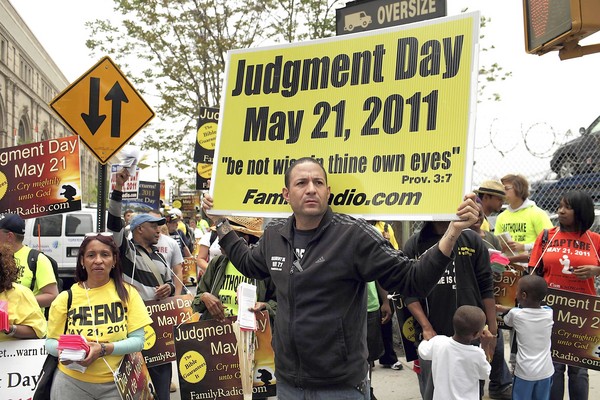
            How appropriate and funny is it that Jesus’ first warning about the apocalypse is directed toward the would-be-prophets who predict the end of the world? Just within my lifetime I can think of a number of examples of the self-affirmed prophets who claim to know the exact date of the approaching end of the world. And even though Jesus has clearly warned us against them, when they come forth with their predictions, they never fail to get a hearing, media presence, and air time.
61786025


And people listen to them! Droves of people go to the bank and withdraw their life savings, bunkers are dug and filled with emergency supplies, and some even take their own lives rather than accept the coming doom and gloom predicted by these would-be prophets. Jesus looks out at his disciples, and therefore every one of us, and declares, “Beware that you are not led astray; for many will come in my name and say, ‘I am he,’ and, ‘The time is near!’ Do not go after them.

            There always seems to be some other form of allegiance in the world that appears better than what we learn to live into from God’s Word. Some affiliation more fruitful, some path through the trials of life that seems more certain and secure. We would rather rely on reason than faith. We would prefer to deal with material possessions than with spiritual growth. The tragedy of the history of God and God’s people is that we have continually been a people running off like that, generation after generation, in pursuit of other, perhaps easier, gods.

            After this first warning, Jesus continues his diatribe regarding the eschaton: “When you hear of wars and insurrections, do not be terrified; for these things must take place first, but the end will not follow immediately. Nation will rise against nation, and kingdom against kingdom; there will be great earthquakes, and in various places famine and plagues; and there will be dreadful portents and great signs from heaven. But before all this occurs, they will arrest you and persecute you; they will hand you over to synagogues and prisons; and you will be brought before kings and governors because of my name.”

tumblr_lxqyysSSQ61qlvp8so1_500

            I have often heard non-Christians remark about how easy it is to be Christian. Those with a limited knowledge of what it means to be a faithful people often charge the church as being a means of escape from the harsh realities of the world. “It must be so easy to be Christian, you don’t have to worry about what really goes on in the world, just waiting for your heavenly reward.” However, in sharp contradiction to these claims Jesus very bluntly puts forth how very difficult it is, and will be, to be Christian. In a way, being Christian, is in some sense, an escape, not our of life, but right into the depth of it; from meaningless into meaning, from futility into purpose, from bondage into freedom.

            The Good News of Jesus Christ has always been paradoxical in its ability to disturb the ways of the world. Those with privilege look on it with suspicion, those with power look at it with disappointment. The Jewish leaders were shaken by it and fearful. Rome outlawed it. The first disciples all suffered persecution and condemnation. Jesus did not get killed for loving too much, but for turning the world upside down; for changing the perspective of what it means to be first and last, for defeating death, and removing power from the powerful.

            “This will give you an opportunity to testify. So make up your minds not to prepare your defense in advance, for I will give you words and a wisdom that none of your opponents will be able to withstand or contradict.”

            When Jesus addresses the disciples, describing for them the very trials and tribulations that they were to face he makes it clear that these are the hours of opportunity. When the world shouts No, the church responds with a resounding Yes!

            Our faith is not a creed, not a way of thinking about life, not 5 steps to make a better you; it is the I and Thou of a God who calls us by name, addresses us, seeks us, a moment of meeting, the time for hearing and becoming. Our faith is about confronting the problems of the world, living into them, and transforming the world for God’s kingdom. The Bible, God, and our faith is never on pause. The time is now!

            What Jesus describes in this passage is what we often call the apocalypse. What kinds of images come to your mind when you think about the apocalypse? Death? Destruction? Zombies? Though these are the popular images often associated the apocalypse, apocalypse deals with a revelation, which discloses the realm of God behind the world of historical and interpretable events.

            Timing is important when we talk about revelation from God. What Jesus describes, the events surrounding the suffering of his followers will happen in the future. There will come a time when Christians are called to testify to their faith when everything around them will argue the contrary. The apocalypse is coming in the future.

            However, most of the events that Jesus described took place within the 1st century of the church. The temple was destroyed in 70 AD, the disciples were called before synagogues and governors to witness to their faith. They were rejected by the world and suffered because of their association with Jesus Christ. Nations rose against nations and wars took place. The apocalypse happened in the past.

            What becomes real for us today, though, is that God’s revelation, the apocalypse, is happening right now! What Jesus described in his apocalyptic descriptions helps to show how what is going on is mixed with what is really going on. Events set in the larger context of God’s purposes in the world. We have been caught up in God’s great cosmic victory and therefore we are surrounded by symbols, signs, and mysterious elements regarding what is really taking place. As strange as this may seem to us as enlightened, modern, and rational people, it is a dramatic witness to the tenacity of faith and hope among the people of God.

            “You will be betrayed even by parents and brothers, by relatives and friends; and they will put some of you to death. You will be hated by all because of my name. But not a hair on your head will perish. By your endurance you will gain your souls.”

            How easy is it to be Christian? Apparently, its not. What is at stake for us in this passage is the commitment and call to be faithful witnesses under unusual stress and frustration. For us, here in Staunton, it might be hard to imagine suffering for our Christian identities. But faithfulness and endurance under threat and disapproval (and even penalty of death) are the qualities of discipleship during the time of witnessing. Disciples, and that means all of us here, are not exempt from suffering. If there is any doubt of this period of testing and testimony is still present, you need only look to what recently happened in the Philippines, or the dozens of Christians who were recently executed in North Korea for having Bibles, or the suffering of members within this church right now. Some of you might know of the suffering within the church, perhaps its even happening to you, just look around.

            Jesus’ address to the disciples regarding the apocalypse, the revelation of God, calls us to reflect on our own discipleship. I have been told again and again that if people are not complaining about me in the church I serve, than I am not doing my job. Being Christian implies a willingness to be pushed into the discomfort of discipleship in order to live into the new reality that Christ initiated with his death on the cross.

            Are we almost Christians? Are we content to arrive on Sunday mornings in order to go back to work on Monday without any change in our lives? Are we comfortable with seeing all of the suffering around us and letting it pass by our vision without stopping to question why? Are we ready to witness God’s kingdom transform the world without our participation?

            Or are we fully Christian? Have we felt the love of God in our hearts and we are ready to respond to that love with our commitment to faithfulness? Do we sit in the shadow of the cross while awaiting the glory of the resurrection? Are we ready to witness to the goodness of God even amidst our own suffering?

            I love the question the disciples ask: “When is this going to happen?” But there’s another question I feel compelled to ask: “Why is it going to happen?” If our Christian lives are comfortable and easy, perhaps we’re not doing enough. If the amount of suffering the first disciples went through was part of God’s revelation, then maybe we should be going far enough to disrupt the powers of the world. What would it take for us to believe so fervently, that we would live such faithful lives worthy of persecution from those around us?

            We have to know that what Christ is talking about is the end. And we have to know with equal knowledge that it is also the beginning. That the God of grace and glory is bent on rescuing his own from the misery that finds us in life, and continually working toward that salvation. That God is committed to saving us with the Good News according to Christ, and eagerly doing it by means of every life that will give itself away to him and his kingdom.

            Teacher, when will this be, and what will be the sign that this is about to take place? The apocalypse, the revelation of God, is now.

            Amen.

Weekly Devotional – 11/18/13

Devotional:

Psalm 46.1-3

God is our refuge and strength, a very present help in trouble. Therefore we will not fear, though the earth should change, though the mountains shake in the heart of the sea; though its waters roar and foam, though the mountains tremble with its tumult.


John_Wesley-3

In 1735 John Wesley, the founder of the Methodist renewal movement of the Church of England, made his way from England to the New World having been called to be a minister for the new colony of Georgia. Wesley prayed over this invitation for some time and eventually came to the conclusion: “My chief motive, to which all the rest are subordinate, is the hope of saving my own soul.” Though he had lived a devout life, and was ordained as a deacon in the Anglican Church, he felt that his own soul had yet to be saved.

During the voyage across the Atlantic, Wesley experienced a new kind of faith, one that he had yet to find in his own life. He recorded it as such in his journal: “There was now an opportunity of trying whether they (The German Moravians) were delivered from the spirit of fear, as well as that of pride, anger, and revenge. In the midst of the psalm wherewith their service began, the sea broke over, split the mainsail in pieces, covered the ship, and poured in between the decks, as if the great deep had already swallowed us up. A terrible screaming began among the English. The Germans calmly sung on. I asked one of them afterwards, ‘Was you not afraid?’ He answered, ‘I thank God, no.’ I asked, ‘But were not your women and children afraid?’ He replied mildly, ‘No; our women and children are not afraid to die.’”

This profound experience would follow Wesley throughout the rest of his life, inevitably leading to the discovery of his own profound faith in the God who had faith in him, despite his sinfulness.

The psalmist sings out, “God is our refuge and strength… therefore we will not fear, though the earth should change, though the mountains shake in the heart of the sea; though its waters roar and foam…” That kind of faith is remarkable, one that takes years to cultivate and nurture. Just as Wesley was surprised by the faith of the Moravians on the ship, so too, it is often difficult for us to maintain our faith in the midst of tragedy and fear. Yet, every Sunday the church gathers together to remember our God, to remember that God came in the form of flesh and mounted the hard wood of the cross for us.

So, the next time you’re confronted with the seas and mountains in your life shaking and spilling over remember the faith that God has in you. That time and time again God went after you, to find you, to call you by name, and to embrace you. How would your life change if you had the faith to look at death and suffering in the face and simply remark, “I am not afraid”?

God of the Living – Sermon on Luke 20.27-38

Luke 20.27-38

Some Sadducees, those who say there is no resurrection, came to him and asked him a question, “Teacher, Moses wrote for us that if a man’s brother dies, leaving a wife but no children, the man shall marry the widow and raise up children for his brother. Now there were seven brothers; the first married, and died childless; then the second and the third married her, and so in the same way all seven died childless. Finally the woman also died. In the resurrection, therefore, whose wife will the woman be? For the seven had married her.” Jesus said to them, “Those who belong to this age marry and are given in marriage; but those who are considered worthy of a place in that age and in the resurrection from the dead neither marry nor are given in marriage. Indeed they cannot die anymore, because they are like angels and are children of God, being children of the resurrection. And the fact that the dead are raised Moses himself showed, in the story about the bush, where he speaks of the Lord as the God of Abraham, the God of Isaac, and the God of Jacob. Now he is God not of the dead, but of the living; for to him all of them are alive.”


The Sadducees know exactly what they’re doing. They are not standing before Jesus truly desiring an answer to their question. They are not like the student whose paper is no longer decipherable because they have used their entire eraser while trying to answer a question. They are in Jesus’ presence for the purpose of embarrassment. Their aim is to argue, frustrate, and force Jesus into a particular way of thinking. The question that formed on their lips is not genuine. They are simply attempting to bait Jesus with one of their classic “what if” questions, a question on which their minds were settled long ago.

Haven’t all of us resorted to this kind of questioning at some point? The militarist asks the pacifist, “what if someone was attempting to rob you and your family, would you fight back?” or the child asks the mother, “what if the world ended tomorrow, would you really make me do my homework tonight?” or the skeptic asks the believer, “what if there is no God, would you still pray?”

“So, Jesus, Moses wrote for us about how to handle a situation if a married man dies without producing children. The wife is to remarry one of her brothers-in-law in order to have a child. But, what if this happened, and a woman remarried 7 brothers and never had any children with them, who would she be married to in the resurrection?”

resurrection


I knew a man who had a wonderful family life. He was a pastor, occasionally moved throughout his conference, but he had established roots in certain parts of the state. He enjoyed his work, but he loved coming him to his wife and children every afternoon. It was when everything seemed perfect that tragedy struck; his wife was killed in a car accident. In the wake of her death, the children were old enough to take care of themselves and when the pastor returned to work he no longer had the energy to serve the local church and so he retired. It was not for a lack of conviction or faith, but the loss of his wife struck him so deeply that he felt it would be irresponsible to try and serve others.

Time passed. The wound from his wife’s death remained open. He mourned. But after awhile he started to find a different rhythm in this new time of his life. The seasons passed and even though he still missed her, he was taking steps toward finding joy again.

He met his second wife later in life through mutual friends. It was clear that they had a connection but neither realized how deeply they cared for one another. When they married it was a joyous celebration and they spent the following decade together.

I got to know the husband and wife in their later years, visiting with them, hearing their story, and breaking bread together. They were meant for each other, and I don’t just mean finishing each others sentences kind of thing. They were adorable in their connection, in their refusal to be separated, and in their faithfulness when the former pastor developed a brain tumor.

I was unable to attend the funeral but I received a phone call from the new widow that evening. Through the abundant tears landing on the telephone I was barely able to make out her words but I could tell that something was worse than the emotions that come with attending the funeral service for your spouse. “I just don’t know what to think, Taylor,” she said while sobbing, “Today, during the service, my step-daughter, my husband’s daughter from his first marriage, delivered part of the eulogy. She stood before that crowded church and lamented the loss of her Daddy. But before she finished, she looked up in the air and said, ‘I’m so happy that Dad is back together with Mom now.”

I was silent.

“What does that mean about me?” she continued. “What will happen when I die? Will he be waiting for me?”

How could anyone speak into that situation? What could you say to help fill the void that her husband left, while remaining faithful to the God who has faith in us.

For a few moments I waited silently on the phone unsure of what to say. But then I remembered that Jesus had been asked a similar question…


Jesus was asked a question that would’ve typically elicited a pastoral response. After all, this story comes toward the end of Luke’s gospel; Jesus has already traveled all over Galilee proclaiming the Good News, healing the sick, feeding the hungry, and pastorally caring for his flock everywhere that he traveled. His answer to the Sadducee’s question is important and vital to our lives not only as Christians but also to all people who reflect on life and death.

Jesus begins his response to the Sadducees’ loaded question rather directly: “People who belong to this age marry and are given in marriage, but to those who are considered worthy of a place in that age and in the resurrection from the dead neither marry not are given in marriage. Indeed they cannot die because they are like angels and are children of God being children of the resurrection.”

In this first part of his response Jesus pointed out the inappropriateness of their question. There is a difference between this age, and the age to come. In this present age the reality of death makes marriage and the perpetuation of life essential. In order to continue the cycle of life, new lives need to be brought into the world. However, in the age to come, in the resurrection, death will be no more, death will die, and those who are blessed enough to attain the resurrection will be as children of God. There is no marriage in the resurrection because it is no longer needed, God’s purposes for life after life after death will be so glorious and inexplicably remarkable that marriage will be no more. 

heaven

There is a difference here between what we commonly imagine about heaven and life after death regarding the immortality of the soul and the resurrection. Many would have us believe that to be Christian means that we have immortal souls, but there is an important distinction between immortality and resurrection. Immortality is based on a doctrine of human nature that denies death; resurrection is based on a doctrine of God which says that even though we die, God gives life to the dead.

In the second part of his response Jesus relies on the teaching of Moses to help undermine the question from the Sadducees. The Sadducees believed that a teaching, belief, practice, or habit was not authentic unless it could be found in the Pentateuch, the first five books of the Bible, the so-called “Mosaic Law.” They would search through those books and unless it was there, it was not relevant or viable for their faith. So Jesus draws on the teaching of Moses, particularly the incident of the burning bush, to further defend his answer.

Do you remember the story? Moses, a shepherd for his father-in-law Jethro is out in the wilderness tending the flock. In the midst of his work he is confronted by a bush that is burning, but the flames refuse to consume the bush. In this interplay between human and the divine Moses is commissioned by God to deliver God’s people, the Israelites, out of slavery in Egypt to the Promised Land. Reluctant to undertake such a task, Moses questions, “Who am I to say sent me?” And God responded, “Tell them I AM sent you, I am the God of Abraham, of Isaac, and of Jacob.”

So when Jesus responds to the Sadducees he remembers this story for them. God is not a God of the dead, but of the living. What we do in the here and now is important, and God will take care of us when our time comes. You may think of Abraham, Isaac, Jacob, and Moses as being dead, but God is their God, they are alive through him.

The Sadducees, in their strict conformity to their theological persuasion were unable to comprehend that standing before them was God in the flesh, that Jesus himself was the Word, the new law, and the new covenant. He not only brought a new teaching, but he himself was the new teaching.

Just as during the time of Jesus’ interaction with the Pharisees, there has been confusion over the implications of the resurrection throughout the history of the church. Resurrection has often been understood in one of two ways: Experientially or Eschatologically.  (bear with me here)

An experiential resurrection would allow for all of us here to achieve a newness in our lives in the here and now on earth; “we have been raised to new life in Jesus Christ.” An eschatological resurrection would mean that God will give life to our bodies after we die to live and reign in the new heaven and the new earth; “Behold I am making all things new.”

What is important for us, what Christ conveyed to that crowd of doubters, is that both of these resurrections contain truth. There is a beauty in the experiential resurrection that we discover when we find ourselves caught up in the mission of God and there is an indescribable fulfillment in the eschatological resurrection that will come when God makes all things new.

Last-Judgment-(Fra-Angelico)-774816


So I stood there silent on the other end of the phone while the new widow cried out of frustration and fear. “What does that mean about me?” she pleaded “What will happen when I die?”

I took a deep breath before speaking into her reality.

“I don’t know whether or not this will bring you peace right now, but a long time ago somebody asked Jesus a really similar question about marriage in the resurrection. I can never tell you for sure what will happen, but I can tell you what Jesus says. In the next life, in the resurrection, there will be no marriage. God will wrap us up in such a way that marriage will no longer be necessary to convey the deep sense of love and connection that it does in this realm. Your husband will not be married to anyone but we will all belong to one another. I know that right now this probably isn’t the most helpful or pastoral response, but isn’t there something beautiful about the fact that when we go on to greater glory we will all be equal before everyone?”


The way Jesus confronted the question of the Sadducees is so relevant for us today as people of grace who contemplate both life and death. What will happen to us in the resurrection? Who will be belong to? Many of these questions trouble us because we are so desperately clinging to the material world here and now. In our families, marriage, and relationships we find fulfillment and purpose. If we lose someone that we root our identity in, what happens in the age to come?

God will take care of us. God will lead us through the loss of our loved ones and hold them within his warm embrace until that time that all the saints will be reunited; not as brothers, sisters, husbands, wives, but as children of God. 

Jesus’ response to the Sadducees is the way that God responds to our questions – not with answers which flatter us, or make the world simpler than it really is, but with his life given for us, that we might more fully give our lives to him.

As we prepare to go forth into the world remember that God is with you in the mundane and in the radiant. God is with you in life and in death, in marriage and divorce, in fear and joy. God is with us in all things here now and forevermore; he is not a God of the dead but a God of the living.

Amen.


Weekly Devotional – 11/11/13

Devotional:


2 Thessalonians 3.6-

Now we command you, beloved, in the name of our Lord Jesus Christ, to keep away from believers who are living in idleness and not according to the tradition that they received from us.


He had attended church throughout his life, but his faith was basically idle. He listened to the sermons, put money in the offering plate when it came by, and even attended a few bible studies. However, the extent of his belief, participation, and discipleship was lacking. It was clear that nothing excited him about church and he was simply attending because it was the “right thing” to do.

The pastor took notice of this and decided to invite the young man on a mission trip to build stoves for indigenous Mayans in the highlands of Guatemala. Though perhaps initially reluctant, the young man thought it might be a nice little vacation and he would get to work on his spanish.

37663_1409538169459_2274604_n

For 5 days he was worked to the bone. The food and coffee were often cold, the air was too thin for proper working conditions, he kept finding dried cement between his fingers, and he was perpetually exhausted. But something happened. Something changed within his disposition while in that remote village of the Highlands; his faith caught on fire. Though he felt run down by the physically exhaustion, for the first time in his live his faith was no longer idle. He was working for the kingdom of God and (as if the blindfold had been removed from his eyes) he began to see the importance, joy, and depth of what it means to be a disciple of Jesus Christ.

Paul wrote to the church in Thessalonica regarding the idleness present in the worshipping church. Clearly, there were people that were not participating to the degree that Paul would have liked and their behavior was detrimental to the greater church. While reading his words about isolating the idle believers it seems too drastic and definitely unchristian. Though it is perhaps extreme, the point that Paul makes is remarkably important: Christianity is dependent on the character of its disciples. If idleness is present throughout the church, the excitement and joy of what it means to the be the body of Christ for the world will disappear. Paul encouraged the Christians in Thessalonica to keep away from idle believers, but perhaps what we really need to do is help build up their faith, invite them to participate in ways that will light their faith on fire, so that the kingdom can become real for them.

So, if you know someone idle in their faith, reach out to them. Invite them to participate in new and exciting ways. Help them to see the glory and joy of what it means to be a follower of Jesus Christ.

If you feel that your faith is idle, find ways to engage in the local church. How can you serve those in need? Where can you be Christ’s body for others? What would it take to set your faith ablaze?

Faith is only faith when it is being practiced.

Then and Now – Sermon on Ephesians 1.11-23

Ephesians 1.11-23

In Christ we have also obtained an inheritance, having been destined according to the purpose of him who accomplishes all things according to his counsel and will, so that we, who were the first to set our hope on Christ, might live for the praise of his glory. In him you also, when you had heard the word of truth, the gospel of your salvation, and had believed in him, were marked with the seal of the promised Holy Spirit; this is the pledge of our inheritance toward redemption as God’s own people, to the praise of his glory. I have heard of your faith in the Lord Jesus and your love toward all the saints, and for this reason I do not cease to give thanks for you as I remember you in my prayers. I pray that the God of our Lord Jesus Christ, the Father of glory, may give you a spirit of wisdom and revelation as you come to know him, so that, with the eyes of your heart enlightened, you may know what is the hope to which he has called you, what are the riches of his glorious inheritance among the saints, and what is the immeasurable greatness of his power for us who believe, according to the working of his great power. God put his power to work in Christ when he raised him from the dead and seated him at his right hand in the heavenly places, far above all rule and authority and power and dominion, and above every name that is named, not only in this age but also in the age to come. And he has put all things under his feet and has made him the head over all things for the church, which is his body, the fullness of him who fills all in all.

allsaintsday

Today is All Saints’ Sunday, a particular fixture in the Christian liturgical calendar, often celebrated the first Sunday of every November. All Saints is a time and opportunity to name the death of our saints over the last year. And for us, as United Methodist in particular, “saints” refers to all Christians past and present, so we celebrate the church universal as well as those we have lost. Today is a day about remembrance and honor.

Paul writes to the church in Ephesus, “In Christ we have also obtained an inheritance, having been destined according to the purpose of him who accomplishes all things according to his counsel and will, so that we, who were the first to set our hope on Christ, might live for the praise of his glory.” What is this inheritance that he is referring to?

Bob Foley. Bob Foley was a long time usher at the church where I grew up. As a kid I can remember Bob handing me some of the children’s bulletins that I doodled over throughout the church services, and I can remember him patiently waiting on Christmas Eve’s services with candles in his hands. The first time I ever talked to Bob was when I was fourteen, the first Sunday that I ever ran the sound-system for our services. Bob fulfilled his usher obligations, handing out bulletins, helping new visitors and families find a pew, when he finally stood behind me looking over my shoulder. Now imagine with me if you will, a fourteen year old standing in front of a mixing board with hundreds of knobs, lights, and volume controls, at a church with a large sanctuary with hundreds of people prepared for worship. So with fear and trepidation defining my inner struggles Bob leaned forward and whispered in my ear, “good luck.”

soundboard01_big

I’m sure I messed something up that morning, perhaps I forgot to turn off our minister’s microphone so everyone wound up hearing him horribly attempt to keep the tune to “Be Thou My Vision,” or I turned the volume too high and there was feedback in the sanctuary, or no one heard the prayer over the Tithes and Offerings because I forgot to turn the microphone back on. I’m sure I messed up, but Bob walked over to me after the service ended, shook my hand, told me to call him Bob, and smiled while telling me how proud he was.

Thus started an incredible friendship that played itself out every Sunday morning as Bob and I would joke around in the back. He was old enough to be my grandfather but he never treated me like a child; he was encouraging, and respectful, but above all he was a happy man. Whereas many people would drag themselves into church on Sunday mornings, wiping away the sleep from under the eyes and trying to find a trash can for their coffee they had just chugged, Bob was always standing by the door with a smile because he genuinely cared about the church, he loved being there, and he loved God.

When Bob passed away it crushed me. I’ll never forget the feeling in the pit of my stomach when my mother called me during college to let me know what had happened, and I’ll never forget the awful feeling of walking back into the church for the first time without having Bob there with his customary smile.

Paul talks about an inheritance from Christ, something we receive through his mighty acts in the world. There is something special about getting to share the stories of the bible with someone, young or old, to talk about what God did with God’s people, but there is something indescribable about the way God is working in the world right now.

Bob Foley was a saint in my life. But what Bob offered for me and my Christian life was more than the typical church friendship. Bob never sat me down with scripture or told me how to live my life. He never criticized my decisions or offered unwarranted advice. What Bob did for me, was demonstrate how important faith is in the now. He might’ve loved to hear those old stories from scripture, but Bob felt God living in the world in the immediate, thats why he committed to being in church and sharing his smiles with everyone else; to him there was nothing better than being a Christian because he felt God’s presence.

When we read from Paul’s letter to the Ephesians, its as if he’s saying “It is such a great thing to be a Christian!” But, I wonder if that is the first thought that comes to our minds when we think about our Christian heritage today. May it be that the joy and excitement of the gospel has grown stale for many of us? Is living out our Christianity filled with images of too many commitments and disappointments? Have we grown complacent with what it means to be the church in the world? Perhaps a lot of us here are like the elder brother from Christ’s great parable, we see our wayward younger brother return home for a celebration and we are envious. Maybe we hear the words from our Father saying, “You are always with me, and all that I have is yours,” but the thrill and glory of these words have seemed to vanish.

Why are we here? Why did we wake up this Sunday morning and come to church? What brought us, what drove us to ever join together in the first place?

All of us are here because someone loved us enough to bring us, to invite us, to nurture us. Who was that person for you? Who was that saint in your life?

Paul writes about a “love toward all the saints” present in the community in Ephesus. That same love may, in fact, be half-present today in our lives through the casual “hello” at the Food Lion, in the wave as a car drives by in the neighborhood, and in the church fellowship activities in which we participate. But there is a temptation to take all of these things for granted, to live into them everyday, and never value them for what they really are.

I’m not proud to admit that I never realized how important Bob Foley was to my life until after he died. It was only in his absence that I began to appreciate the joy that he taught me every Sunday morning. I took my relationship with Bob for granted and I wish that I had lived into our friendship more while he was still here with us.

Like our relationship, it has taken me some time to discover what made Bob’s faith so worthy of emulation. I have wondered what it was that made him excited about the church, when so many others arrived more out of obligation than expectation.

Have you ever noticed that Paul almost never writes about the actual life of Jesus in his letters? Do you find it interesting that as a leader for the blossoming church in the first century, Paul rarely referenced the exciting life of Jesus Christ? He paid little attention to the Sermon on the Mount, the parables, the miracle stories, or other moving elements from the gospels. It seems, therefore, for the first Christians, what was most important was not what had happened in the past, but how Christ was living in and through them in the present. They most certainly remembered the words and actions of Christ in their worship, but their Christianity was exciting because Christ was still moving in their world.

Paul wrote to the church, “I pray that the God of our Lord Jesus Christ, the Father of glory, may give you a spirit of wisdom and revelation as you come to know him, so that, with the eyes of your heart enlightened, you may know what is the hope to which he has called you, what are the riches of his glorious inheritance among the saints, and what is the immeasurable greatness of his power for us who believe, according to the working of his great power.” The key word in this whole passage is “power.” When the first Christians appealed for conversion to the new faith they did not just talk about what had happened on a hill outside of Jerusalem in the year 33, but they witnessed to what Christ had done for them in their own lives.

Christ is a present power, rather than simply being an admired person from history, Christ transcends time and is with us in the present; that was the paramount miracle for the early church.

On this All Saint’s Day we are called to remember the saints of our lives, the Bob Foleys of the world, to be thankful for what they did for us, but to also live in the present. Be grateful for what they did, and live out our faith today. The saints and Christ are not just some historical influences in our lives but continually live and move through us in the ways that we continue to be faithful in the world.

Do you know God? I don’t mean some sort of dense theological knowledge, but real and tangible and simple. Do you know God in your life? We cannot have knowledge of a person until we see them in action and we shall not have faith in God until we trust and experience his divine love in the world.

There is a difference between the Word of God (Jesus Christ) and the word of God (scripture). Our knowledge of God in this community rests upon God’s Word as Jesus Christ. The Bible is not a textbook in the ordinary sense as a collection of facts that need to be checked and memorized but it is instead a story. In contains the majestic drama of God’s interaction with God’s people. The climax of the story is God’s coming down to dwell among us in the form of flesh, dying for us on a cross, rising again from the grave, returning to glory, and leaving behind a people of God endowed with knowledge of him.

When we remember the saints, when we gather together to read and proclaim scripture, it is important for us to remember God’s mighty acts in the world. However, what makes church and faith compelling, what moves us toward excitement, is God’s present power in the world! Today is the day that we can celebrate the lives that we have lost while also living into the exciting faith of what it means to be Christ’s body for the world.

Today we are called to remember those saints from our lives who shaped us into the people we are now. It is the time to remember disciples like Bob Foley who lived out his faith in his relationships with others, who felt the joy of Christ in his own life and in his own heart.

We remember those who have gone on with joy and with longing, for they are being held in the arms of our great Lord and we anticipate with joy the great reunion of all the saints of the church in God’s time.

Christians are not called to be motivated by the question: “what happens to me when I die?” but rather ”what am I doing with my life right now?” What we do in the here and now, how we live out our faith in the world, is what makes being the body of Christ an exciting and wonderful thing.

Jesus Christ is not a man of the past, a person to be remembered and recorded in history. Christ is alive! Christ is with us here and now in the gifts of bread and wine. Christ continues to live and breathe and change the world because we partake of him when we gather at his table.

If you are looking to find Christ in your life, if you want your faith to move from remembrance to lived reality, and if you want to find a joy worthy of celebration, then come. Come to Christ’s table and discover the inheritance that will change your life forever.

Amen.

Communion

Weekly Devotional – 11/4/2013

Devotional:


Psalm 17.6-9

I call upon you, for you will answer me, O God; incline your ear to me, hear my words. Wondrously show your steadfast love, O savior of those who seek refuge from their adversaries at your right hand. Guard me as the apple of the eye; hide me in the shadow of your wings, from the wicked who despoil me, my deadly enemies who surround me.

psalm-17-8

In the midst of suffering and disappointment in our lives, faith can be very difficult to hold on to. When we hear someone say, “life just isn’t fair,” we want to cry out, “Well, it should be!” Life is full of ups and downs, valleys and mountain tops, trials and accomplishments. Psalm 17 is a prayer of deliverance from those moments in our lives where we feel that life is no longer fair. It is a prayer for freedom to live into God’s righteousness and for God to come and surround us with his wings of protection and grace. While life is not fair all the time, it is right at all times to pray for God to deliver us from the wrong doings in our lives and the suffering we endure.

Additionally, there is something else in this psalm that can help us in our daily lives:

Once, while reading through some of the psalms with a few peers, a friend of mine remarked that there is often a lot of language about enemies in the psalms and he was unsure what to make of it. What does the psalmist mean with “my deadly enemies who surround me?” And then he made a statement that I will never forget: “We often read the psalms as if they were written for us individually and we forget about others who need to pray these words. Maybe we need to remember that we might be the enemies that the psalm prays about for other people.”

So, the next time you find yourself in a valley of your life, come back to Psalm 17. Read the words and pray them aloud. Know that it is a good and wonderful thing to be able to call out to the God who loves you to help deliver you out of troubling circumstances. But, the next time you find yourself on a mountaintop, ask yourself if you have been living faithfully according to God’s holy word. Is there someone praying for deliverance from an enemy that may in fact be you?


God and Relationships – Part 2

couple-holding-hands

One of my favorite theological blogs belongs to my friend and mentor Jason Micheli (www.tamedcynic.org). Recently, Jason produced a number of posts about the importance of being in relationships. In a similar vein, I have decided to post a few of my thoughts on the theological virtues of relationships.


“To say ‘I love you’ one must first be able to say the ‘I.’”

Fountainhead

So says the fictional Howard Roark to Dominique Francon in Ayn Rand’s behemoth novel The Fountainhead. Though Rand herself was staunchly opposed to all forms of religion, I believe her quote, in a way, speaks profoundly to the importance of what it means to be in relationship with another.

To use Rand’s language: To say “I love you” one must first be able to say “I.” And, perhaps, more importantly, to say “I do” in marriage, one must first be able to say “I.”

Will Willimon writes, “Most people think that the toughest part of marriage is deciding who we ought to marry, making the right choice, and preparing for the decision. We say we are deciding whether or not we are “in love” with this person. Curiously the church has traditionally cared less about our emotional attachments. What the church cares about is not who you have deep feelings for but rather whether or not you are a person who is capable of sustaining the kind of commitment that makes love possible.”

love-wedding-photo

In today’s culture people (young and old) often commit to a romantic and marital relationship before ever experiencing what it means to be an individual. Young people are maturing later and further delaying the ability to find sense in individuality and therefore seek identity in others. Yes- there must be sacrifice in all relationships, but not at the expense of losing whatever it is that makes you, you.

Before a couple can fully appreciate the depth of what it means to covenant their life to someone else, they have to know who they are in order to give themselves over.


But here’s where it gets a little complicated…


You will never fully know who you are.


As a pastor, when I stand in front of a couple leading a wedding ceremony, the question is not “Jack, do you love Jill?” Instead the question is, “Jack, will you love Jill?” There, in that precise moment, we discover that, according to the church, love is something you commit to, something you promise to do, a future activity, the result of a covenantal marriage rather than its cause.


As Stanley Hauerwas famously put it, “we always marry the wrong person.” This is to say that we never marry the right person because marriage and life changes us. There will come a time when you realize that the person you have been living with is no longer the person you married or met at the coffee shop or knew from high school.


No one can fully know what he or she is getting out of a husband or a wife. There is a lot to be said about preparing for marriage (meeting with professionals, discussing the future, etc.) but there is an element of unpredictability that must be respected. We can never prepare for marriage in totality, but we can prepare ourselves for a lifetime of commitment to someone who is always changing (ourselves included).


This is exactly why it is so important to understand what you say, when you say “I.”


You will change in ways that you cannot predict just as your partner will change. But, as Christians, we have been adopted into a new identity through water and the Spirit that sustains us throughout the many changes of our lives.


Christ is alive through us, in us, and with us.


If we hold on to that identity, love can be the result of our relationships rather than the requirement.


God and Relationships – Part 1

couple-holding-hands

One of my favorite theological blogs belongs to my friend and mentor Jason Micheli (www.tamedcynic.org). Recently, Jason produced a number of posts about the importance of being in relationships. In a similar vein, I have decided to post a few of my thoughts on the theological virtues of relationships.


(Some of the following elements were first taken from a post written by Ron Edmondson, and then re-evaluated for this post. You can check on Edmondson’s blog here: www.ronedmondson.com)


Relationships are tough, perhaps tougher now than ever before. The impact of social media and changes in our contemporary culture have affected dating, marriage, and divorce in ways that cannot be fully comprehended. Moreover, maintaining a relationship predicated on the model of discipleship of Jesus Christ is a challenge in and of itself.

One of the many blessings of what it means to be a pastor is being invited into a couple’s relationship during pre-marital counseling. A few weeks ago I shared the following thoughts with a couple preparing for marriage and I believe they are relevant for anyone engaging in a serious relationship.


You are different. You are different and thats a good thing! Both members of a relationship differ from one another physically, emotionally, psychologically, and theologically. This is not a curse against relationships but something to be celebrated. The more a couple can live into the differences that make them who they are, the better a foundation can be made for experiencing life together. God has uniquely created you to be you, and no one else.

Set your own path. Don’t let either set of families/in-laws dictate how you will go forward with your own family. Our respective histories are important but they do not define how we can be in relationship, or how we can raise a family. Try to make sure that you are in this with/for one another, do not let anyone (related or otherwise) divide you and your thoughts on family. Every couple has a number of other relationships, but care should be made to maintain the oneness that God intends to create within a relationship. Respect the advice given to you, but listen to your spouse and work together.

Prepare to be surprised. Life will not always be peachy and perfect. For the many mountain tops that you will experience, there will be a valley waiting on the other side of the horizon. No one can ever be completely prepared for the changes that might come, but we can prepare ourselves to be ready to handle and address the changes appropriately. When difficulties arise, and they will, this is a prime time to improve the strengths and dynamics of a relationship. Theologically speaking, it might feel like you are always sitting in the shadow of the cross, but the glory of the resurrection will come. Prepare to be surprised.

Model after other couples. Look around and pay attention to the people in your life in relationships that you admire. They will inevitably have stories to share and appropriate advice to give. Remember to not just simply insert their techniques and strategies into your relationships, but allow them to model what it means to be in a fruitful connection with someone else. Often times when we come to church we assume that everyone in attendance has everything together in their lives, and similarly we often make the same assumptions of people in relationships. There is always something under the surface that we cannot see. If other couples are willing to share some of that information with you, it will likely prove helpful for your own relationship.

Communicate. Evaluate your relationship with one another. However, wait for the appropriate time to do this (in the middle of a fight is not always the best time). Couples should ask themselves, “are we growing together as a couple or are we moving further apart?” Do not always assume that your partner feels exactly the same way as you do.  If you can create a habit of honestly checking in with one another about the greater trajectory of your relationship, it will help prepare you to be open with one another in a loving and life-giving way as you move forward. Communicating with one another might sound like a simple aspect of a relationship, but its importance makes it worth mentioning over and over again.

Put God first. This is perhaps one of the hardest things for a pastor to bring up with a couple because it sounds like the “preachy” thing to say. But, its important. A couple’s individual, and collective, relationship with God will help navigate the deep “valley-like” hardships of life and maintain a sense of stability when everything else feels like its crumbling. Talk about God with each other. Pray together. But also experience God in the way that only you can. Your first identity as a Christian will help so communicate who you are and whose you are. Far too many individuals in a relationship come to define themselves on the other person. You are not someone’s better (or lesser) half. You were uniquely made in the image of God and this is important to celebrate. Live into your relationship with God and it will strengthen your relationship.

Weekly Devotional – 10/28/2013

Devotional:

Luke 6.27-31

“But I say to you that listen, Love your enemies, do good to those who abuse you. If anyone strikes you on the cheek, offer the other also; and from anyone who takes away your coat do not withhold even your shirt. Give to everyone who begs from you; and if anyone takes away your goods, do not ask for them again. Do to others as you would have them do to you.”

images

I have a friend in ministry who once had this passage play itself out in his life in an interesting way. Though an ordained methodist, Jason experimented one Lenten season with wearing a clergy collar out in public. He was surprised to note how many people eyed him suspiciously at the local Starbucks and many strangers were willing to talk to him about their trials and tribulations in public locations. One week, while working on a sermon at a Barnes & Noble, Jason noticed a homeless man sleeping uncomfortably in one of the seats. It was clear that the man had not bathed in some time as many of the other patrons left a quarantine zone of empty seats between themselves and the man. Like many of us, Jason was used to seeing people in need and knew that somebody else could help this man. However, the more he attempted to work on his sermon, the more he realized that most of the people in the mini restaurant were staring at him, waiting for him to do something. Remember: he was wearing a clergy collar, everyone knew he was a Christian. So Jason reluctantly made his way to the counter, purchased a sandwich, and dropped in on the table in front of the homeless man. “Gracias” muttered the man under his pile of clothes while preparing to begin eating. “What’s your name?” Jason asked. “Jesus” the man replied.

Upon later reflection Jason wondered whether or not he would have given that man food if it were not for the fact that he marked himself as a Christian and therefore strangers had expectations of what he should do in the situation.


Jesus regularly challenged his disciples to change their lives in strange and uncomfortable ways. It is not easy to live into a new reality where we are called not to react to everything but instead continually act according to the kingdom principles of love, forgiveness, and generosity.


So, the next time you’re out in public and you see someone in need, or you’re being ridiculed by someone at work, know that following Christ’s commands are not always easy. But think about how you would act differently if everyone around you knew that you were a Christian and had expectations of you according to that identity. How would you act differently?

The answer to that question is what discipleship is all about.


(You can find out more about Jason and his ministry at www.tamedcynic.org)


The Magnificent Defeat – Sermon on Genesis 32.22-31

Genesis 32.22-31

The same night he got up and took his two wives, his two maids, and his eleven children, and crossed the ford of the Jabbok. He took them and sent them across the stream, and likewise everything that he had. Jacob was left alone; and a man wrestled with him until daybreak. When the man saw that he did not prevail against Jacob, he struck him on the hip socket; and Jacob’s hip was put out of joint as he wrestled with him. Then he said, “Let me go, for the day is breaking.” But Jacob said, “I will not let you go, unless you bless me.” So he said to him, “What is your name?” And he said, “Jacob.” Then the man said, “You shall no longer be called Jacob, but Israel, for you have striven with God and with humans, and have prevailed.” Then Jacob asked him, “Please tell me your name.” But he said, “Why is it that you ask my name?” And there he blessed him. So Jacob called the place Peniel, saying, “For I have seen God face to face, and yet my life is preserved.” The Sun rose upon him as he passed Penuel, limping because of his hip.

1383606_169741249886845_1520756210_n

Jacob was left alone. He had sent his entire family, all of his possessions, and his future across the Jabbok river. There he was all alone basking in the glow of the sunset, terrified but hopeful for the morning. Jacob had lived a strange life, but nothing would compare to what was about to happen.

Out of nowhere, a strange unnamed man arrived and began to wrestle with Jacob till daybreak. Scripture is rather lacking in details about this epic match, but we can imagine the blood, sweat, and tears that went into this fight. Two men grappling with each other in the bleak conditions of the ancient near east. When it seemed as if one man was finally getting an advantage, the other would return with a defensive move pinning the other one to the ground. This was probably not some glorified hollywood-esque battle, but rather like the ones you used to have with your brother or sister, where no one would relent.

PCH5808

The fight went on throughout the evening, and when the stranger knew that he could not prevail against Jacob, he struck him precisely on the hip socket, knocking it out of joint as they continued to wrestle. Then the stranger in the night said, “Let me go, for the day is breaking.” But Jacob said, “I will not let you go unless you bless me!” So he said to him, “What is your name?” And he said, “Jacob.” Then the man said, “You shall no longer be called Jacob, but Israel, for you have striven with God and with humans, and have prevailed.”

Though already having received a remarkable blessing, a new name, a new identity, Jacob further pushes the man, “Tell me your name!” But the man replied, “Why is it that you ask my name?” And there he blessed him. Jacob would later name the place Peniel (which means face-to-face) saying, “For I have seen God face to face, and yet my life is preserved.” And for the rest of his life, Jacob walked with a limp because of his battle with the man.

What a story! 

Some theologians are convinced that this narrative has received more scholarship than almost any other story from the Old Testament. Yet, last Sunday, when I casually mentioned this narrative to a few people before church, they remarked that they had never heard about it. In our current culture, we can no longer take for granted the amount of scriptural knowledge everyone has in the church. A lot of people will be quick to blame the laity for not reading enough scripture outside of church, but I believe the fault doubly lays with the clergy who are afraid or unwilling to preach on particular texts.

So, if you’ve never heard this story before, or even if its the 100th time you’ve heard a sermon on it, what do you make of it?

It is one heck of a story, but like many passages in scripture, we have read this section in isolation and we are missing the rest of the narrative. If we really want to know what is going on here on the sandy banks of the Jabbok river, we have to go back to the beginning…


Jacob was the son of Isaac and Rebekah (son of Abraham and Sarah). When Rebekah became pregnant with twins she felt a struggling within her womb, and after praying to God, “If it is to be this way, why do I live?” The Lord said to her, “Two nations are in your womb, and two people born of you shall be divided; the one shall be stronger than the other, the elder shall serve the younger.”

The first born was Esau, red and covered in hair, and later Jacob who came out gripping the heal of his brother; each of them were named after elements regarding their birth (Esau – red // Jacob – one who grabs the heel). When the boys grew up, Esau was a skillful hunter, a man of the field, while Jacob was a quiet man, living in tents. Isaac loved Esau; but Rebekah loved Jacob. 

Esau

Esau

Like most sibling rivalries, Jacob and Esau were combative throughout their lives. You can imagine them as children fighting over simplest little things while the father would side with one, the mother the other.

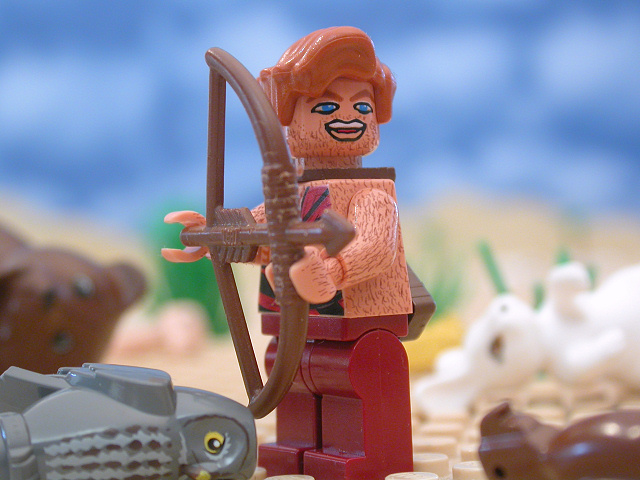
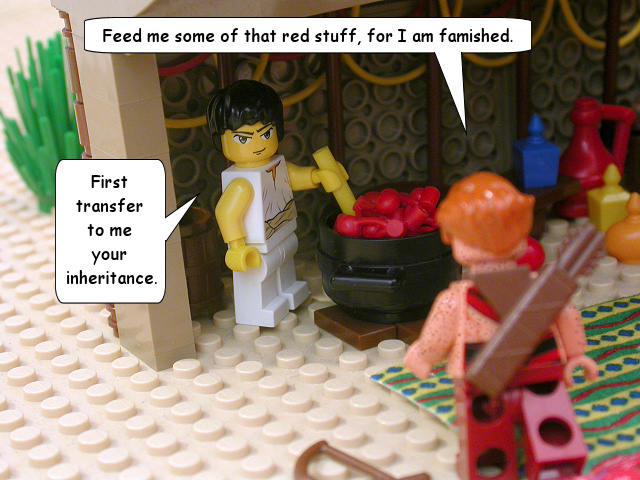
Once, when they were older, Jacob was cooking a stew while Esau came in from the field famished. Esau said to to Jacob, “Let me eat some of that red stuff, for I am famished!” Jacob, the cunning heal-grabber that he was, agreed to give his brother food, in exchange for his birthright, and thus Esau gave up his birth right to his younger brother.

07_gn25_30-31

And then later, when their father Isaac was approaching death, with weakened eyesight, he beckoned for Esau to bring him some wild game in order to bless him before his death. However, when the cunning little heal-grabber found out about this from his mother, he covered himself in fur and deceived his father by pretending to be his brother. Before Jacob had had enough time to even make it away from his father’s tent, Esau returned from the field shocked to discover that Jacob had stolen his blessing.

The heal-grabber had gone too far this time and Esau was furious. He vowed to kill his brother after the death of his father. But Rebekah discover Esau’s plot and sent Jacob away to flee from the inevitable wrath of his twin.

24_gn27_41

Years pass. Esau and Jacob continue to live out their lives apart from one another. When it seemed like Jacob might finally be able to forget his past and his brother, he had a vision which made him realize that he needed to return to the land of his father.

And so, with all his possessions and children and wives Jacob prepared to encounter his brother, unsure of what would happen. However, the little heel-grabber had one trick left up his sleeve; knowing that his brother would surely kill him, Jacob sent ahead of him all his possessions and family in order to appease Esau before their reunion, while thinking to himself, “I may appease him with presents that go ahead of me, and afterwards I shall see his face; perhaps he will accept me.” Therefore his gifts passed on ahead of him, and he stayed behind alone for the night before meeting his brother in the morning.

At this critical moment in his life, at the matrix of what would determine everything forward, spending the night on the border of the Promised land, Jacob struggled with God.

So you see, the story of Jacob wrestling with God is placed perfectly within the greater story of Jacob’s life; while anticipating a frightful reunion with his brother Esau, Jacob must first meet with the dreaded stranger of the night and these two meetings are intimately related to one another.

The story, as we find it in scripture is not explicit about who Jacob actually wrestles with. Is he wrestling with his metaphorical brother? Himself? A stranger of the night? Though arguments abound for many interpretations, it makes most sense to understand the story in such a way that Jacob is wrestling with God

During the night, the cool evening when precision and detail are lacking, the divine antagonist arrives and takes on features of others with whom we all struggle during the day.

What a man this heal-grabber was! He may have been frightened of the coming repercussions of the reconciliation between he and his brother, and he may have been afraid of the almighty Lord, but in the fray he held his own with either one.

This is no ordinary story.

In a way, what Jacob experienced was a magnificent defeat. A defeat because Jacob is left with a limp for the rest of his life, and magnificent in his ability to prevail. From that day forward Jacob limped every day to show others (and remind himself) that there are no untroubled victories with the Holy One. Yet his limp was also a reminder that he had prevailed in this skirmish between humanity and the divine.

It is important to note that this meeting with God, this nighttime wrestling match, did not lead, as we are wont to imagine, to reconciliation, forgiveness, and healing. It resulted in a crippling. There is a dangerous consequence of meeting the divine, resulting in a marking that we will carry throughout the rest of our lives.

And so, when the day broke the stranger left a crippled Jacob, now Israel, limping toward his powerful and vengeful brother.

Can you imagine how he must have felt? Weak after wrestling all night long, afraid of the coming consequences, isolated from all his family and possessions, sand caught in his eyes, clothing ripped, walking across the deserted landscape toward his brother?

When Jacob made his way forward, lessening the space between himself and inevitably, he bowed seven times until he came to his brother.

Like the stranger from the night before Esau rushed forward and grappled his brother to the ground, falling upon his neck. However, instead of punches and scrapes, Esau covered his brother with kisses and tears.

The juxtaposition of the wrestling in the night with Jacob’s reunion with Esau offers us a warning; God will not be taken lightly or easily. There will be no cheap reconciliations. On the way to the affronted brother, Jacob must deal with the crippling and blessing of God.

It is easy to take the story in isolation and make it into a simple lesson: “being a Christian is about wrestling with God. There will be times when we cannot understand what it happening and though we are grappling with the divine in a negative, God will positively hold onto us while refusing to let go.” And though that message is true, there is so much more going on with the greater story.

Don’t we all have a little Jacob in us? At times we’ve all acted like the little heel-grabber, willing to do less to receive more, willing to focus on ourselves alone rather than those around us. And at the same time, don’t we all have a little Esau in us too? At times we’ve felt betrayed, unloved, and hurt, our trust broken from broken relationships. Being Christian is about wrestling with God, but its also so much more. This story in scripture reveals to us how the love of God and the love of brother belong together. We were never meant to be alone, scavenging for ourselves, removed from others. We were all created in the abundant image of the triune God, made out of unified plurality to be in plurality with others.

Like Adam and Eve, like Jacob, like the disciples, and so many other figures from scripture, we want to know the answer to the ultimate question. We want to bridge the gap between us and God. In this passage Jacob wanted to know God’s name, the mystery of heaven and earth, to overcome all the distance. When wrestling, the stranger did not win, but he did not lose either. Jacob gained a great deal, but the depth of God’s being had not been given. The stranger stopped short of giving the ultimate gift – that would have to wait until a cramped night in the crib of a manger in Bethlehem.

In a few moments I will be inviting Isabella Bailey-May Sullivan and her family to come forward and gather around the baptismal font. In Isabella’s baptism she will be incorporated into this body here, to learn about these kinds of stories from scripture, to begin a life of wrestling and reconciling with God. Like Isabella, all of us gathered here have been grafted into the story of Israel through Christ’s death on the cross. We will encounter our brokenness through God’s Word but we will also rejoice in the grace that God gives us in spite of our brokenness.

And so what are we left to make of this heel-grabber and his wrestling match on the banks of the Jabbok? Like Jacob’s wrestling and Isabella’s baptism, when we enter the church we are marking ourselves for the rest of our lives. It is in this place through the worship of the people and the proclamation of the Word that all the Jacobs of the world become reconciled with the Esaus. Its where we can meet one another and God face-to-face and prevail. We might be brought down in a way that we are truly wrestling and we will walk away marked by God. Though we may not walk with a physical limp, we have been struck by the almighty God in a way that we will never be the same again.

And that, is good news.

Amen.