Think Small or: Don’t Think At All

1 Peter 1.18-21

You know that you were ransomed from the futile ways inherited from your ancestors, not with perishable things like silver and gold, but with the precious blood of Christ, like that of a lamb without defect or blemish. He was destined before the foundation of the world, but was revealed at the end of the ages for your sake. Through him you have come to trust in God, who raised him from the dead and gave him glory, so that your faith and hope are set on God.

With each passing day of this pandemic, I’ve come across countless posts and articles all about how to make the most of the time we now have on our hands. Which, of course, doesn’t even address the many who still have to work in the midst of all this and those who are putting their lives on the line so that others can have the aforementioned extra time on their hands. Nevertheless, I know people who are using this time to lose those ten pounds they’ve been meaning to get rid of, or become amateur sourdough bakers, or become professional live-streaming worship pastors.

Meanwhile, the talking heads on television are pitting the different political operatives against one another while blaming them for putting us in the mess in the first place.

Similarly, certain individuals are choosing to directly ignore the calls for social-distancing because they believe it is infringing on their freedoms.

And finally, special interest groups are pressuring elected leaders to “reopen” their respective jurisdictions for fear of what the long-term effects will be for the economy.

All of this can fall into the category of “thinking big.” Rather than addressing the small and local concerns that are, somewhat, within our control, we pass the buck along to someone else in hopes that they can bring about the change that requires the least from us. Or, a little closer to home, we’re feeling pressured to make the most of this pandemic by reimagining ourselves and fixing all the things we’ve let go for too long. 

The problem with “thinking big” is that it almost never works. 

Wendell_Berry_C_Guy_Mendes

Back in 1972, in the midst of the rise of feminism, racial reconciliation, and environmentalism, Wendell Berry had this to say on “thinking big”:

“For most of the history of this country our motto, implied or spoken, has been Think Big. A better motto, and an essential one now, is Think Little. That implies the necessary change of thinking and feeling, and suggests the necessary work. Thinking Big has led to the two biggest and cheapest political dodges of our time: plan-making and law-making. The lotus-eaters of this era are in Washington, D.C., Thinking Big. Somebody perceives a problem, and somebody in the government comes up with a plan or a law. The result, mostly, has been the persistence of the problem, and the enrichment of the government. But the discipline of thought is not generalization; it is detail, and it is personal behavior. While the government is “studying” and funding and organizing its Big Thought, nothing is being done. But the citizen who is willing to Think Little, and, accepting the discipline of that, to go ahead on his/her own, is already solving the problem. A person who is trying to live as neighbor to their neighbors will have a lively and practical understanding of peace and humanity, and let there be no mistake about it – they are doing that work.” – Wendell Berry, A Continuous Harmony 1972

The challenges, and problems, that feminism/racial reconciliation/environmentalism aimed to erase are still very much a part of the fabric of our reality. It’s been nearly fifty years since Wendell Berry wrote those words and women are still paid less than men, racism is very much alive, and the environment has passed the point of no return. (However, strangely enough, certain cities across the globe are seeing the skylines without smog for the first time in decades because everyone has been forced to stay inside).

The critique from 1972 is just as relevant today as it was then. The more we assume, or hope, that necessary changes will be accomplished by other people further up the ladder, the longer we will be disappointed. The same holds true with our own desires for self-improvement. If we want to use this time to become master bakers, or perfect painters, or marathon runners, that’s fine, but there’s a better than good chance we’re just going to disappoint ourselves.

Wendell Berry’s alternative, and an alternative from the gospel is to think little. Instead of waiting for the world to change, we can make small changes in our own lives. We can absolutely start and try new things, but keeping our goals in check will help us in these challenging times rather than shaming us into not accomplishing what we wanted.

In 1 Peter there’s this great line about how, through Jesus, we’ve come to trust in God. I love that because it’s not about trusting in ourselves or in other people. For, more often than not, we are masters of disappointment. But God? God remains steadfast no matter the circumstances; Jesus’ is still raised from the dead whether we can worship together in church, or we can run a marathon, or we can bake the perfect loaf of bread.

This is a strange time we find ourselves in. We can do things now we’ve never done before. But it’s also a pandemic. It’s okay if we don’t do anything at all. We can watch Netflix until our eyes hurt. We can go all the way to the end of the bag of Cheetos. We can wear pajamas all day long. The gospel has set us free from the expectations we place on ourselves and the expectations the world has placed on us.

The only thing we need to do is trust. Which, in the end, isn’t much at all. Because in the end, the rest is up to God. 

Don’t Use God As An Explanation

2B7CF14A-3879-4C45-B4BB-700F3D111C88-19861-00000C33EC35C980

“If we ask the elderly to commit suicide in order to shore up the economy for their grandchildren, then their grandchildren won’t have lives worth living.”

That’s what Stanley Hauerwas said to Jason Micheli and myself yesterday over the phone. We had a brief conversation about what it means to be the church in the midst of the Coronavirus pandemic and how to make sense of it theologically. Additionally, we addressed the lack of analogies for the current situation, what it means to be really connected, and the pulpit of America. If you would like to listen to the conversation, you can do so here: Don’t Use God As An Explanation

The Case Against “Ashes To Go” Revisited

I’m not a fan of “Ashes To Go” and when I wrote about it here on the blog last year it received a lot of backlash.

And I get it.

I understand the desire to take the church outside of its walls to meet people where they are. I understand wanting to keep up with a trendy expression of Christian community. I understand how turning a practice upside down can reinvigorate it for people in an exciting way.

But I still stand by the claim that Ash Wednesday is something that the people called church do together. And I think the UMC, in particular, really needs to observe it this year communally.

AshestoGo4

As the popularity of something like “Ashes To Go” continues to rise, we lose a connection with the ecclesial and liturgical practice that sets the stage for the season of Lent.

In case you are unaware of the true phenomenon that “Ashes To Go” has become, it usually looks something like this: 

On Ash Wednesday, a pastor (or pastors) will gather in the parking lot of his/her respective church and a drive thru line will form such that people in their cars will wait their respective turn for a ten second interaction with ashes that are hastily smeared on a forehead while the traditional words are uttered, “Remember you are dust, and to dust you shall return.”

Or a group of clergy will gather in a public space (like a park or a fast-food restaurant or a coffee shop) with a simple sign encouraging people to stop in for their “Ashes To Go.” Lines will develop during peak hours, people will hear the right words, and they will leave with a reminder of their mortality on their foreheads.

To be fair, I recognize that the current pace of our culture makes participating in an actual Ash Wednesday service challenging. Many of us are running around through the frenetic habits of our lives without time to do much of anything, let alone corporate worship. Moreover, I know people for whom the “Ashes To Go” is a sign of the church’s willingness to catch up with the times and start digging itself out of its ditch of irrelevancy.

But offering ashes devoid of a liturgy in which the practice is made intelligible is the equivalent of a clanging cymbal (to steal an expression from Paul).

To those who love “Ashes To Go”: I mean no offense. I only want to call into question the faithfulness and the efficacy of doing so. I have heard loads of stories about the beauty of meeting people in the midst of life and the possibilities of evangelism that can take place with “Ashes To Go” but I wonder if there are better occasions to share the gospel without watering down the holiness of Ash Wednesday to fit into other peoples’ schedules.

Fleming Rutledge has this to say about the practice:

“It’s pathetic. I know people who do it, people I admire. But people don’t know why they’re doing it. There’s no message involved. Christianity is not just about forgiveness. Forgiveness isn’t enough – there has to be rectification of evil. When I grew up nobody had ashes, only the Roman Catholics did it. And we all thought it was superstitious. I personally don’t like the ashes very much unless it id done within the context of an entire worship service with a full and faithful homily. Remember: the gospel says wash your face. It’s really weird to listen to that passage on Ash Wednesday and then leave with ashes across on your forehead after Jesus just told everyone to wash up.”

I agree with Fleming insofar as without taking place within a corporate liturgy, ashes merely become another idol, another popular display of religious affection, and it fails to embody what the whole thing is about. 

Ash Wednesday is not supposed to be easy or convenient – that’s the whole point.

It is a disruption of our way of being, a reminder of our finitude in a world hell bent on convincing us we’re going to live forever. And, because the practice is not self-interpreting, it requires the context of worship in which we can begin to scratch at the surface of what we are doing and why we are doing it.

And I use the word “we” specifically. I use “we” because Ash Wednesday is not about individual introspection and reflection. 

It is a practice of the community we call church.

000

This year (like most) the United Methodist Church is in the midst of an identity crisis. In the wake of last year’s Special General Conference that resulted in the doubling down of the so-called incompatibility of homosexuality with Christian teaching, the denomination is currently debating the values of separating over our differing theologies. Therefore, I think there is no better time for the church, while it’s still together, to be disrupted out of its status quo such that it can ask itself: “How did we get here?”

On Ash Wednesday we have the opportunity (read: privilege) to be marked with ashes as a sign that we are all incompatible with Christian teaching – that’s Christian teaching.

This Ash Wednesday can then become a marvelous and miraculous opportunity to discover a new way forward for God’s church.

Outside the fracturing and infighting within the UMC we live in a world that bombards us with the temptation to believe we can make it out of this life alive. And, to make it even worse, the world is also trying to convince us that we don’t need anyone else to make it through this life at all. According to the terms of the world, the individual reigns supreme. But, according to the church, no one can triumph without a community that speaks the truth in love.

Therefore, for me, “Ashes To Go” completely loses its connection with Ash Wednesday and the beginning of Lent because it just becomes another individualized consumer driven model of the church rather than being the incarnational and rooted practice of joining together to remember who we are and whose we are. 

Fencing Grace

closed-communion

What happens when a presidential candidate is refused communion at church? Ryan Couch wrote a brilliant reflection on the subject and Jason Micheli and I invited him to join us for an episode of Crackers & Grape Juice to talk about grace, closed tables, and baptizing the town drunk. If you would like to read his original post you can do so here: Joe Biden, The Town Drunk, And The Sacraments

And you can listen to our conversation here: Fencing Grace


Christmas Ruins Advent

Waiting is a dirty word, at least to the ears of most Christians (in America). After all, we are a people of action. We are not comfortable to sit idly by while something could be taken care of. In the world of United Methodism, this is inherently part of our DNA as John Wesley is the one who first said, “Never leave anything till tomorrow, which you can do today. And do it as well as possible.”

It is therefore strange and uncomfortable to arrive at church during the Advent season to hear all about the virtues of waiting.

BFFF9D60-A4DA-46D2-A1A7-3DF022255F83

In many ways we blindly stagger toward the word of waiting with connections to waiting to open what is under the tree more than waiting on Jesus. It functions as a trite and helpful little analogy that resonates with parents and children alike. And so long as we’re all patient, we’ll get that for which we hope on Christmas morning.

But, if we’re honest with ourselves, none of us want to wait around for anything, let alone presents, the birth of the Savior, or his promised return.

Or, to put it another way, if God isn’t going to bring us the kingdom, we’ll bring it ourselves. That’s the American way.

In his sermon “Waiting” from Minding the Web Stanley Hauerwas laments our inability to wait during a season all about waiting:

“Advent is a time, and time is at the heart of what it means for us to be a people who have learned to wait. Therefore at Advent, we think it important to at least act as if we are waiting… we play at being Jews for a few weeks, but we do so as if we are in a drama with designated roles for us to play. However, once the play is over, we have no reason to play the roles associated with waiting.”

There’s a reason that many in the mainline church avoid the early Pauline corpus in worship – it’s too apocalyptic. All that talk of Jesus returning again sounds like what people in crazy churches talk about. We are far more sensible. We are helping people become better people. We are taking care of business. 

And we do so because we have been habituated this way. Our bodies and our minds are shaped by practices and rituals that start to form us such that we no longer know how we wound up this way. Pay attention the next time you’re in church, notice how many times you hear the words “should” and “ought” and “must.” The church today has taken upon itself the burden of responsibility and habituates it into the people through the words and practices of worship that leave us feeling like we have to do something no matter what that something might be.

Consider how we treat the presents under the tree as children (and to some degree as adults). We were once encouraged to ask for particular things from Santa, or from friends and family, all under the auspices of possibly receiving those very gifts so long as we behaved accordingly. This is all the more relevant today with the meteoric popularity of the “Elf on the Shelf.” We are always making new ledgers to keep others in line.

But part of the message of the Gospel is that God has thrown out the ledger books forever! As Paul wrote, “And when you were dead in your trespasses and the uncircumcision of your flesh, God made you alive together with him, when he forgave us all our trespasses, erasing the record that stood against us with its legal demands. He set this aside, nailing it to the cross.” (Colossians 2)

The songs we sing (He’s making a list, checking it twice) and the traditions we practice (Elves hiding on shelves) form us into people who are afraid that our behavior will remove blessings (presents) from our lives. And for as much as we’d like to consider ourselves beyond these silly theological ramblings as adults – habits formed in childhood are very hard to break.

Which leaves us far more comfortable with waiting for a baby in a manger who appears innocuous and unable to judge us, than waiting for the Son of Man who comes to judge both the living and the dead. For, we know in our heart of hearts, we’ve done things for which we should rightly be judged.

We no longer know how to wait. We want to skip to Easter Sunday without having to confront Good Friday and we want Christmas without Advent. And yet all of them, both the comfortable and the uncomfortable, point us to something beyond ourselves: The judged judged has come to be judged in our place. Jesus’ crucifixion, made possible by his incarnation, has accomplished that for which it was purposed. 

Hauerwas puts it this way: “Jesus’ crucifixion rattled the very constitution of the universe because death could not hold him. Three days later he is raised. He walks with two former followers on the road to Emmaus, teaching them how to read Scripture. Such instruction was required, because they found it difficult to understand how the one to liberate Israel could end up on a cross.” 

Today, it seems we are a people who find it difficult to believe that God would choose to die for us. We’d rather hear about all the things we can do to earn God’s favor than to believe that God favors us regardless of our behavior. 

We are not particularly good at waiting because we want to take matters into our own hands. And yet part of the message of Advent is that if it were all up to us, we would fail. We need a savior who can come and do for us what we could not do for ourselves. In the end the only thing we have to do is wait, because the rest is up to God. 

Liturgy of Thanksgiving

Devotional:

John 6.35

Jesus said to them, “I am the bread of life. Whoever comes to me will never be hungry, and whoever believes in me will never be thirsty.”

Weekly Devotional Image

The older I become the more complicated Thanksgiving feels.

When I was a kid Thanksgiving was marked by plates upon plates of food, eavesdropping on grownup conversations, and running around in the cold until a responsible adult beckoned us back inside.

But as an adult, Thanksgiving often feels more like a powder keg of political positioning where everyone waits for the one person to say that one thing that will set everyone off. 

Gone are the days of civil and non-partisan Thanksgiving tables (if they ever really existed). Now we wear our red hats, or mention a recent debate sound bite, in order to make sure everyone at the table knows what side we are on.

Which is remarkably strange when we consider the fact that Jesus came to destroy the divisions that we so eagerly want to demonstrate around our tables.

Or, to put it another way, Jesus’ table makes what we usually do at our tables unintelligible.

thanks-be-to-god

Therefore, this year, I’ve put together a brief Liturgy of Thanksgiving to be used by anyone in order to redeem the Thanksgiving table. You may say it privately to yourself, or you may read it corporately with others, but the hope is that it will bring a sense of theological clarity to what our tables are supposed to feel like…

Prayer:

Almighty God, Father of all mercies, we your unworthy servants give you humble thanks for all your goodness and loving-kindness to us and to all whom you have made. We bless you for our creation, preservation, and all the blessings of this life; but above all for your immeasurable love in the redemption of the world by our Lord Jesus Christ; for the means of grace and for the hope of glory. And, we pray, give us such an awareness of your mercies, that with truly thankful hearts we may show forth your praise, not only with our lips, but in our lives, by giving up ourselves to your service, and by walking before you in holiness and righteousness all our days; through Jesus Christ our Lord, to whom with you and the Holy Spirit, be honor and glory throughout all ages. Amen.

Scripture:

John 6.25-35

When they found him on the other side of the sea, they said to him, “Rabbi, when did you come here?” Jesus answered them, “Very truly, I tell you, you are looking for me, not because you saw signs, but because you ate your fill of the loaves. Do not work for the food that perishes, but for the food that endures for eternal life, which the Son of Man will give you. For it is on him that God the Father has set his seal.” Then they said to him, “What must we do to perform the works of God?” Jesus answered them, “This is the work of God, that you believe in him whom he has sent.” So they said to him, “What sign are you going to give us then, so that we may see it and believe you? What work are you performing? Our ancestors ate the manna in the wilderness; as it is written, ‘He gave them bread from heaven to eat.’” Then Jesus said to them, “Very truly, I tell you, it was not Moses who gave you the bread from heaven, but it is my Father who gives you the true bread from heaven. For the bread of God is that which comes down from heaven and gives life to the world.” They said to him, “Sir, give us this bread always.” Jesus said to them, “I am the bread. Whoever comes to me will never be hungry, and whoever believes in me will never be thirsty.”

Meditation:

We cannot live by bread alone – so Jesus reminds the Devil and all of us during the temptations in the wilderness. But we do have to eat to live; it’s just that ordinary bread isn’t enough. When we sit around the table with friends, family, and even strangers, we are participating in a moment that is bigger and more important than just the sharing of food. It is through our conversations and our prayers that Jesus’ presence is made manifest among us. The table at Thanksgiving is an extension of the Lord’s table on Sundays and when we come to it we are reminded of who we are and whose we are. This is the work of God, and we are all witnesses.

Prayer: 

Lord, help us to be mindful of those who do not have a table such as ours around which we can gather, celebrate, remember, and rejoice in all you’ve done, are doing, and will do. As we eat and feast together, let the breaking of bread be a foretaste of the promised resurrection made possible through your Son, our Lord, Jesus Christ. Amen. 

The (Christian) Problem with The Death Penalty or: Why “An Eye For An Eye” Leaves Everyone Blind

For the first time in nearly two decades, the federal government will resume executions and, effectively, reinstate the federal death penalty. The announcement was made by Attorney General William Barr last week while indicating that five men convicted of murdering children will, themselves, be put to death in December of this year. Additional executions will be scheduled at a later time.

While public support for capital punishment has decreased, it is still advocated for in the Christian church and this is a problem.

Though denominations like the United Methodist Church have opinions against the death penalty clearly spelled out in governing documents like the Social Principles (“We believe the death penalty denies the power of Christ to redeem, restore and transform all human beings.”) the day to day experience and support for the death penalty is felt and experienced differently throughout the American church.

Capital punishment, killing someone in response to a crime, is as old as civilization itself. Some of the earliest archaeological discoveries of law codes contain the ramifications for shedding blood or taking someone’s life and, more often than not, it comes down to “An eye for an eye, a tooth for a tooth, a limb for a limb, a life for a life.” It’s there in Hammurabi’s code from ancient Babylon, and it is present in the Christian Bible.

The Death Penalty has been around for a very long time, and it is still employed for a lot of reasons, though not recently for Federal crimes. Some advocate for the death penalty because it is the only way to guarantee that someone will never recommit a violent crime, others claim that it helps as a deterrent to influence other away from committing similar crimes, and still yet others say it brings closure to families who grieve the loss of someone murdered. 

There are roughly 2,600 people on death row right now in the United States. And the state of Virginia, where I live, has executed more prisoners than almost any other state.

And again, for Christians, this is a problem because Jesus was killed by the Death Penalty.

The main reasons that people use to justify the death penalty can just as easily be used from a different perspective. Deterrence? In the south, where 80% of all death penalty convictions occur is the only part of the country where crime rates continue to increase. Closure? Statistics has shown that there is benefit for the families in the short term, but in the loan term they tend to experience bouts of depression and grief from another person’s death. 

And, since 1976, about 1 in every 9 death row inmates have been exonerated, usually after decades of living in a prison cell. 

And even among these statistic and facts, for Christians it is inconceivable to support the death penalty when the Lord we worship was killed by the same means.

69659

Christians love crosses. We put them up in our sanctuaries and in our living rooms, we tattoo them on our skins and wear them around our necks. But many of us have become desensitized to what the cross means: death.

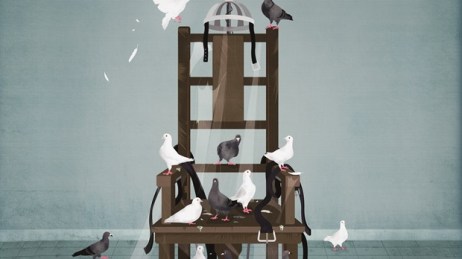
Let me put it this way: If Jesus died 100 years ago, Christians would be wearing nooses around our necks. If Jesus died 50 years ago, Christians would bow before electric chairs in our sanctuaries on Sunday mornings. If Jesus died today, Christians would hang hypodermic needles in our living rooms.

The cross was the electric chair for the Romans. The cross is like the hangman’s nooses of lynching mobs. The cross is like the lethal injections in modern prisons. It is the way people were killed by the state as a punishment for their crimes.

And, I’ll admit it, there are scriptures in the Bible that justify the practice of capital punishment. But there are also people in the Bible who committed capital crimes and God still used them for the kingdom.

We like the think about Moses talking to the burning bush, and leading God’s people to the Promised Land, but we don’t like to think about the fact that Moses murdered an Egyptian in cold blood before he met God in the wilderness.

We like to think about David defeating Goliath, and dancing in front of the Ark of the Covenant, but we don’t like thinking about the fact that David ordered one of his soldiers to die so that he could sleep rape his wife.

We like to think about Paul being knocked to the ground on the road to Damascus, and writing his letters to the churches by candlelight, but we don’t like thinking about the fact that Paul murdered Christians before his conversion.

One of the tenants of Christian theology is that nothing is impossible for God. But when we kill people for killing people, then we effectively remove all possibility of change in that person’s life. If we Christians really believe in the resurrection of Christ and the possibility of reconciliation coming through repentance, then the death penalty is a denial of that belief.

The beginning and the end of theology is that with God’s help and grace all things are possible. An alcoholic can kick the bottle, an atheist can discover faith, and a sinner can receive forgiveness. Why then do we keep slinging our nooses? Who do we keep sending people to the electric chair? Why do we strap people down for lethal injections? Why do we keep nailing people to crosses?

The message of Jesus’ ministry, of the cross, is mercy. And mercy triumphs over judgment.

That doesn’t mean that people who commit horrendous crimes get to walk away scot-free, nor does it mean that we should break down the walls of our prisons and let everyone run wild, but it does require us to fundamentally reshape our imagination regarding the so-called justice system. 

For centuries the death penalty was something that took place in public – crosses on a hill, nooses in a tree. The state used the death penalty to publicly frighten potential criminals from committing crimes. But now capital punishment takes place in hidden rooms with minimal witnesses. It has retreated from the public arena and can happen without disrupting our daily lives such that when the recent announcement was made by the Attorney General it was merely a blip on the radar in terms of our collective response.

But we are murdering people for murder.

Jesus once said, “You have heard that it was said an eye for an eye and a tooth for a tooth.” Interestingly, President Trumps has made it known on more than one occasion that this is his favorite verse from the Bible. But Jesus doesn’t stop there: “But I say to you, Do not resist an evildoer. But if anyone trikes you on the right cheek turn the other also.”

Violence only begets violence.

An eye for an eye leaves everyone blind. 

God sent God’s son into the world to transform the world. Not with the ways of the world, not with power and prestige, nor with armies and aggression, but with mercy and sacrifice.

God in Christ ministered to the last, least, lost, little – people like those who are waiting for the end of their days on death row.

And Jesus carried death on his back to the top of a hill to die so that we might live.

So long as we employ the death penalty, we will deny the power of God to redeem, restore, and transform all of us. As long as we sling our nooses, and prepare our needles, we will prevent grace from making new life in those who have sinned. As long as we murder murderers, we will never give God the chance to make the impossible possible. 

Grace Is For Losers

It started out innocently enough – the Tamed Cynic posted a meme with a quote from someone named Robert Farrar Capon: “God’s grace in Jesus Christ isn’t cheap. It’s not even expensive. It’s free.” I thought it was good and witty, but forgot about it with my continued scrolling through the strange wonders of the interwebs.

IMG-p14RobertFarrarCapon_cropped-44-247-150-2-5

But then I came across his name again, this time being quoted by my friend Joshua Retterer for an episode of Strangely Warmed. I was content to leave Capon among the great list of “Theologians I Know But Don’t Read” but Josh had the nerve to send me not just one of Capon’s book in the mail, but three.

And when I reluctantly opened to the introduction to “The Romance of the Word” I couldn’t put it down.

Fast-forward through the last six months and I’ve read nearly everything Capon published and it has completely ruined my ministry. His absolute insistence on the unwavering commitment to God’s unending and irrevocable grace has sunk deep into the marrow of my belief and I can’t kick it. Try as I might to end my sermons now with a “how to put this belief into practice moment” I can’t get out of my mind Capon’s fundamental claim that “good preachers ought to be like bad kids. They ought to be naughty enough to tiptoe up on dozing congregations, steal all their bottles of religion and morality pills, and flush them down the toilet.” Why? Because God’s grace is bigger than all of our preachments, and is never contingent on our ability to do much of anything. In fact, it is precisely our inability to do much of anything that makes grace necessary in the first place.

And so my preaching has changed, and it has ruined my ministry. It is ruined because all of the cheap moves I made to get people more involved (or worse: feeling guilty about lack of involvement), can no longer stand up to the unwavering claim of the cross.

I’ve been navigating these new waters for the last few months, and I thought I owed it to Jason and Josh to both thank them and castigate them for introducing me to Robert Farrar Capon. And I decided to record the conversation for an episode of the Crackers and Grape Juice podcast. If you would like to listen to the episode you can do so here: Grace Is For Losers

And, if you don’t want to listen to the three of us talk about Capon, you can just listen to the first part of the episode and hear the man himself preaching at Duke Chapel in 1988.

Live Pubcast Announcement – Incompatible

59422718_2226671284328152_1698007391963971584_o

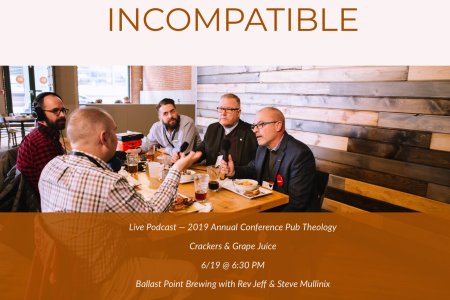
The Crackers & Grape Juice Team will be hosting our 4th Annual Pub Theology Live Podcast to kick off the beginning of the UMC Virginia Annual Conference. The Pubcast will take place at Ballast Point Brewery in Daleville, VA on June 19th from 6:30pm – 8pm. The topic for the evening is “Incompatible” and we will be joined by friends of the pod Jeff Mullinix and Steve Shamblin-Mullinix.

Jeff is the pastor of Maynard Avenue UMC in Columbus Ohio and his husband, Steve, is a teacher. On the other side of the denomination’s recent General Conference, their relationship and ministries have come into focus and they have agreed to come and share what it’s like to work and worship in a Church that has forgotten that we’re all incompatible with Christian teaching – that’s Christian teaching.

If you want to hear more about the event, and why we think it’s a worthy conversation, you can listen to the bonus podcast episode we made about the event here: Live Pubcast

Otherwise, we look forward to connecting with fans of the pod at Ballast Point on June 19th.

The (Christian) Addiction To War

peace_war__wallpaper__by_jackth31-d55t58i

The airfield was remarkably dark in the middle of the night so the commanding officer turned on floodlights for posterity. There were so many people wandering around on the field that the captain had to lean out the window of the aircraft to direct the bystanders out of the way of the propellers before take off. Though he did have time to offer a friendly wave to photographers before departing.

The flight lasted six hours and they flew through nearly perfect conditions. At 8:15 in the morning they finally arrived directly above their target of Hiroshima and the bomb was released. It fell for 43 seconds before it reached the perfect height for maximum destruction and was detonated. 70,000 people were killed and another 70,000 were injured.

At about the same time the bomb was detonated, President Truman was on the battle cruiser Augusta. When the first report came in about the success of the mission, Truman turned to a group of sailors and said, “This is the greatest thing in history.”

We, as American Christians, have a problem with War. Historically, the early church and Christians did not engage in war – they believed their convictions in following Christ’s commands prevented them from waging violence against others. And, frankly, they were being persecuted and killed at such a rate that they didn’t have time to think about fighting in wars, nor were militaries interested in having Christians fight for them. You know, because of the whole “praying for their enemies” thing.

But then Emperor Constantine came onto the scene, following Jesus Christ turned into Christendom, and everything changed. With Christianity as the state sanctioned religion, Rome could tell its citizens to fight, and they did.

But still, there have always been those who respond to War throughout the church differently. There are Pacifists who believe conflict is unwarranted and therefore should be avoided. There are those who believe in the Just War Theory and that there can be a moral response to war with justifiable force. And still yet there are others who believe in the “Blank Check” model where they are happy to support those in charge of the military without really questioning who they are killing and why. 

We might not realize it, but most Americans believe in the “blank check” model, in that our government regularly deploys troops and drones to attack and kill people all over the world (in war zones and other places) and we rarely bat an eye. So long as we feel safe, we are happy to support those leading without question.

But as Christians, Jesus commands us to love our enemies and pray for the people who persecute us. Now, to be clear, this is not a nice invitation or even a call to a particular type of ministry. We like imagining the “white, blonde hair, blue eyed” Jesus with open arms who loves us and expects the minimum in return. But more often than not, Jesus commands his disciples to a radical life at odds with the status quo.

“I say to you, ‘Love your enemies and pray for those who persecute you.’ Anybody can respond to love with love, but what good does it do to only love the people who love you. Instead, be perfect as your heavenly Father in perfect.”

This is our command.

And it is also our dilemma. 

Jesus commands us to love our enemies and love our neighbors. But what are we to do when our enemies are killing our neighbors, or vice versa? Is there really such a thing as a just war? Are we called to remain pacifists even when innocent lives are being taken? Was it okay for us to take boys from Virginia and send them to Vietnam to kill and be killed? Should we send our military to Syria to kill and be killed?

This is the controversy of War.

War, a state of armed conflict between two groups, is like an addictive drug. It gives people something worth dying and killing for. It often increases the economic wealth and prosperity in our country. It achieves for our nation all that a political ideal could ever hope for: Citizens no longer remain indifferent to their national identity, but every part of the land brims with unified life and activity. There is nothing wrong with America that a war cannot cure.

When the North and South were still economically and relationally divided after the Civil War, it was World War I that brought us back together as one country. When we were deep in the ravages of the Great Depression, it was Word War II that delivered us into the greatest economic prosperity we’ve ever experienced. When we were despondent after our failure in Vietnam (and subsequent shameful treatment of Veterans), the supposed weapons of mass destruction in Iraq gave us every reason to rally behind our country.

But we don’t like talking about death and war – that’s why the least attended worship services during the year are Ash Wednesday and Good Friday when we can do nothing but confront our finitude. But War commands and demands our allegiance, it is the fuel that turns the world, it has been with humanity since the very beginning.

And Jesus has the gall to tell us to love and pray for our enemies. 

To follow Jesus, to be disciples of the living God, requires a life of pacifism. It is not just one of the ways to respond to War, it is the way.

And yet, pacifism is a privilege of the powerful. It is very easy for me to write about the virtues of pacifism. No one is dropping bombs on my life or my community. I am not at risk for an invasion from a foreign oppressor. 

It is easy to be a pacifist in America.

christianity-military-750x400

And we will never get anywhere near a kingdom of peace if pacifists keep perceiving themselves as superior or entitled, otherwise people in the military who return from conflict will return as those from Vietnam – to a country that did not understand.

War is complicated and ugly and addictive. It reveals our sinfulness in a way that few controversies can. War illuminates our lust for bloodshed and retribution. War offers a view into our unadulterated obsession with the hoarding of natural resources. War conveys our frightening disregard for the sanctity of human life. War is our sinfulness manifest in machine guns and atomic weapons. War is the depth of our depravity.

Even the word “War” fails to express the sinfulness of the act. We so quickly connect the word “War” with the righteous outcomes of our wars. We believe we fought the Civil War to free the slaves, when in fact it had far more to do with economic disparity. We believe we fought Word War II to save the Jews, when in fact it had more to do with seeking vengeance against the Germans and the Japanese. We believe we went to War in the Middle East with terrorism because of September 11th, but it had a lot to do with long-standing problems and an unrelenting desire for oil. 

Can you imagine how differently we would remember the wars of the past if we stopped calling them wars and called them something else? Like World Massacre II, or the Vietnam Annihilation, or Operation Desert Carnage?

On August 6th, 1945, we dropped the first atomic bomb on the city of Hiroshima in order to end the bloodiest war the world had ever seen. With the push of a button we exterminated 70,000 people in an instant, and our president called it the greatest thing in history. Truman was a lifelong Baptist and was supported by the overwhelming majority of American Christians, most of whom expressed little misgiving about the use of the atomic bomb. But that very bomb is the sign of our moral incapacitation and the destruction of our faithful imagination.

For we Christians know, deep in the marrow of our souls, that the “greatest thing in the history of the world” is not the bomb that indiscriminately murdered 70,000 people, but the life, death, and resurrection of Jesus Christ.

Jesus Christ is, and forever will be, the greatest thing in the history of the world because Jesus broke the chains of death and sin and commands us to follow him. Jesus Christ, Son of Man and Son of God, embodied a life of non-violent pacifism that shakes us to the core of our being and convicts our sensibilities.

There is, of course, the privilege of pacifism and its ineffectiveness when combatted by the evil in the world. Pacifism pales in comparison to the immediacy of armed military conflict, but it is the closest example we have to what it means to live like Jesus. And Jesus wasn’t particularly interested in offering us the path of least resistance toward salvation. Instead, he demanded our allegiance.

God in Christ came in order to reconcile the world through the cross. The living God through the Messiah spoke difficult commands and orders to the disciples, things we still struggle with today. But God was bold enough to send his son to die in order to save us, not by storming the Temple with swords and shields, not by overthrowing the Roman Empire and instituting democracy, but with a slow and non-violent march to the top of a hill with a cross on his back.