Metanoia

Devotional:

Psalm 111.10

The fear of the Lord is the beginning of wisdom; all those who practice it have a good understanding. His praise endures forever. 

Weekly Devotional Image

Reaching new Christians, finding a way to engage with the so-called “nones” (no religious affiliation), is all the rage these days. Countless books are published about growing church by reaching new people, there are symposiums offered on the subject, and there are even “3-step programs” online about how to knock on strangers doors with the hope of getting them to become Christians.

Since the days of the first disciples the church has grown and changed with the addition of new people. Though, for the majority of the church’s life, it was not done by what we might call evangelism today. Instead it was either a matter of public normativity to be involved in a church, or people were forced into the realities of the church by overextending powers like the nation-state.

Today, however, Christians might canvas certain public spaces in order to “grow the church” by asking people to repent of their sins. Repentance, after all, is what John the Baptist was calling for in the wilderness and it’s what Jesus called his followers to do. But using it as the beginning of faith, as the mechanism by which people are initiated into the church, often falls flat.

karl-barth-smoking

Many years ago the theologian Karl Barth met with a group of Swiss Methodists and they had a rather interesting exchange on the same subject:

Methodist: “Should the church, in its proclamation to modern people, follow the example of Jesus and quite decisively call them to metanoia (repentance) as the first conscious step that initiates discipleship to Christ?”

Barth: “Certainly, this question causes some upset. But to my knowledge Jesus called the pious people of his time to metanoia. These people were the theologians, the scribes, the Pharisees (the Pietists back then and maybe as well as the Methodists just a little bit), and then the Sadducees (these were the liberals). And so it makes me uncomfortable when this picture emerges: the church stands here, and over there are modern people – and now we, the Christians, call for metanoia. Is not metanoia something above all else that we must call ourselves to do, us and those like us? I would say this about our established church. It is precisely the church that actually has need of metanoia!

(Barth in Conversation, Volume 1 1959-1962)

Metanoia, the act of repenting for sins, is at the heart of what it means to be Christian, but that doesn’t mean it should be the first entry point for exploring Christianity. Who wants to join a group where the first thing you are called to admit is your wrong being? Barth was right to call the church to repent first, because the church (today) often appears to be extremely judgmental and archaic. When the church leads the way with metanoia, when the church looks in on itself and admits its faults and failure, it then can encounter those outside with an open heart to the way God is moving in the world.

Metanoia, like fear, is the beginning of wisdom, because in (re)turning toward God we are struck by the profound truth that God chooses us in spite of our faults and failures. God still sends us Jesus knowing full and well that we will have to repent again and again. God makes a way where there was no way for us to enter into the kingdom on earth. But it begins with our metanoia.

Or, to put it another way, we have to get our house in order before we worry about anyone else.

Or, to put it yet another way, “Why do you see the speck in your neighbor’s eye, but do not notice the log in your own?”

Take What Ya Got And Go With It

strangely-warmed-spreaker-header

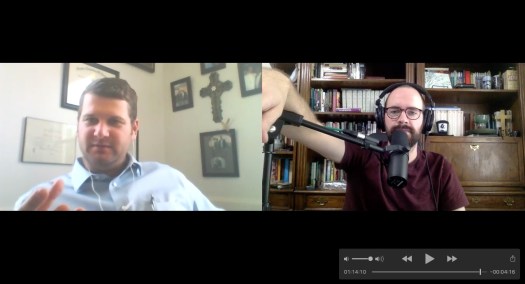
This week on the Strangely Warmed podcast I speak with Ryan LaRock about the readings for the 13th Sunday After Pentecost (1 Kings 2.10-12, 3.3-14, Psalm 111, Ephesians 5.15-20, John 6.51-58). Ryan serves as one of the pastors of Christ UMC in Fairfax Station, VA. Our conversation covers a range of topics including ordination papers, getting outside the church, dreams of patience, God in music, tinkering with prayer, Breaking Bad, literal funeral arrangements, mercy, prodigal years, and being stuck in the kitchen. If you would like to listen to the episode or subscribe to the podcast you can do so here: Take What Ya Got And Go With It

r

Also – The Crackers & Grape Juice team is excited to announce our first book! I Like Big Buts: Reflections on Romans (you can find the ebook and paperback on Amazon).

Let’s Get Angry!

strangely-warmed-spreaker-header

This week on the Strangely Warmed podcast I speak with Chenda Innis Lee about the readings for the 12th Sunday After Pentecost (2 Samuel 18.5-9, 15, 31-33, Psalm 130, Ephesians 4.25-5.2, John 6.35, 41-51). Chenda is an ordained elder in the United Methodist Church and she serves as one of the pastors at Annandale UMC in Annandale, VA. Our conversation covers a range of topics including the beauty of stoles and rainbows, crosses on fire, lynching and the Old Testament, the lived reality of the biblical narrative, divine patience, the value of anger, compassion on the margins, and appreciating the gift of life. If you would like to listen to the episode or subscribe to the podcast you can do so here: Let’s Get Angry!

cl

Also – The Crackers & Grape Juice team is excited to announce our first book! I Like Big Buts: Reflections on Romans (you can find the ebook and paperback on Amazon).

#ChurchToo 2

2 Samuel 11.26-27

When the wife of Uriah heard that her husband was dead, she made lamentation for him. When the mourning was over, David sent and brought her to his house, and she became his wife, and bore him a son. But the thing that David had done displeased the Lord.

Weekly Devotional Image

David saw something he wanted, a naked bathing woman, and he used his power and privilege to bring her to his bedchamber. Knowing full and well that she was a married woman, he nonetheless raped her and she became pregnant.

When David found out the result of his sexual assault, he worked to have the woman’s husband murdered in order to cover his tracks. And after the husband’s death, David sent for the woman and she was brought back to his house, and she bore him a son.

Names are important in the bible, and we must not forget that all of this happened to Bathsheba. But when the biblical writers stop using a name, or never use it in the first place, we know what the role of the individual is really like. Bathsheba went from the comfort of her home and her marriage to being nothing more than an object of the king. Her agency disappears in the story as David has his way with her and covers up his tracks.

But God was displeased.

The Lord then decided to send the prophet Nathan to hold up the mirror of shame to David by way of a parable. And when David heard the deep and frightening truth of the parable, by reacting harshly to his own fictional character in the narrative, he realized that he sinned against the Lord.

BUT WHAT ABOUT BATHSHEBA?

p01_churchtoo2_0318-1024x683

I am thankful for Nathan’s willingness to call truth to power, to put David in his place. I am even thankful that David realized his sins against the Lord. But what about his sins against Bathsheba and her husband? What about his sexual assault and murderous plotting?

Sometimes when we hear about forgiveness in the church it is whittled down to, “If you ask God to forgive you, all will be forgiven.” And in a sense this is theologically true, but it does not account for reconciling with the people we have sinned. It does not make up for the horrible things that have been done to individuals in the church, or under the auspices of the church.

The cross of Christ indeed reconciles ALL things, not just our relationships with God. But the cross of Christ also compels us to repent for how we have wronged God AND neighbor AND creation.

When Christians gather at the table to feast on the bread and the cup, it is not enough to just walk away feeling right with the world when we have let the sins against our brothers and sisters continue without reconciliation.

The story of David’s trespasses is a prescient reminder of what happens when we let our sins percolate. We might not be guilty of the same sins as the beloved king of Israel, but God still uses Nathans to speak truth into our denials such that we can know how we have sinned against God AND one another. And, God willing, the truth of our prophets will also compel us to seek out those we have wronged, and begin the difficult and challenging process of reconciliation.

Pedestals Are Meant To Be Broken

strangely-warmed-spreaker-header

This week on the Strangely Warmed podcast I speak with Chenda Innis Lee about the readings for the 11th Sunday After Pentecost (2 Samuel 11.26-12.13a, Psalm 51.1-12, Ephesians 4.1-16, John 6.24-35). Chenda is an ordained elder in the United Methodist Church and she serves as one of the pastors at Annandale UMC in Annandale, VA. Our conversation covers a range of topics including crumbs at the table, putting God in God’s place, the underrated prophet, losing agency, sharing passwords, reconciliation, Paul’s lack of gentleness, equipping the saints, being lost, and breaking pedestals. If you would like to listen to the episode or subscribe to the podcast you can do so here: Pedestals Are Meant To Be Broken

c

#ChurchToo

Devotional:

2 Samuel 11.2

It happened, late one afternoon, when David rose from his couch and was walking about on the roof of the king’s house, that he saw from the root a woman bathing; the woman was very beautiful.

Weekly Devotional Image

“It happened…” are two of the most problematic and undervalued words in all of the biblical witness. Up until 2 Samuel 11, David has been every bit of the perfect king that we like to imagine. He was called to serve out of the shepherd fields, he defeated Goliath, and he played for the mad king. But then, at the beginning of 2 Samuel 11 we get the frightening and overlooked words, “It happened…”

What happened?

David, from the comfort of his kingly home, wanders the rooftop until he peeps upon a woman bathing and decides that she shall be his. David learns that she is already married, and yet he disregards the information, calls for her to be delivered to his chambers, and then he sleeps with her.

And then we find out she became pregnant.

The story continues to with David’s scheming to have her husband murdered on the battlefield to cover for his adultery.

“It happened…”

What happened is perhaps one of the most terrible and horrific moments in the Old Testament because we are forced to reckon with the deep depravity of humanity. David was God’s beloved and chosen king and even he was unable to resist the temptation of his sinful desires. And the result of his adultery led to more travesties in the Old Testament than can be recorded in this devotional.

The “it” that happened was nothing short of the sinfulness that was present in the Garden with Adam and Eve, and made manifest in the Cross with Jesus Christ.

Almost a year ago the #metoo movement spread throughout Hollywood and the rest of the country. Women, who for years had been forced to remain silent, came out about their experiences regarding sexual harassment and assault. From the comfort of churches many Christians witnessed the sinful exploits of the past come to the surface while praising God that it wasn’t happening in their midst, until the #metoo movement started the #churchtoo movement.

ChurchToo-Photo_web

No person, no church, is immune from the temptations of sin. If anything, David’s episode with Bathsheba is a perennial reminder of what happens when we grow so confident and comfortable that we believe nothing should be beyond our grasp or possession.

But people don’t belong to us. We belong to God.

I’ve heard it said that marital infidelity is higher in the church than in almost any other gathering organization. If this is true we should be ashamed and earnestly repent of our sin. For we know the result of sin better than anyone! We know what happens to David and his family after his infidelity! We know what happens to Israel after her infidelity to God!

“It happened” to David when he believed he no longer needed God, when he became the master of his own universe. And so we pray. We pray for our church to know the story that is our story. We pray for all who feel the temptations of sin and believe they have no need of God. And we especially pray for ourselves knowing full and well that we are just as susceptible as anyone else.

Jesus’ Favorite Commandment

strangely-warmed-spreaker-header

This week on the Strangely Warmed podcast I speak with Daniel Burch about the readings for the 10th Sunday After Pentecost (2 Samuel 11.1-15, Psalm 14, Ephesians 3.12-21, John 6.1-21). Daniel is a Licensed Local Pastor in the United Methodist Church and he serves in Warsaw, VA. Our conversation covers a range of topics including cursing from the pulpit, peeping David, imperfections and temptations, happiness vs. contentedness, working toward perfection, hiding beers, wedding texts, The Crucified God, masks in church, and moving beyond the ordinary. If you would like to listen to the episode or subscribe to the podcast you can do so here: Jesus’ Favorite Commandment

d

Also – The Crackers & Grape Juice team is excited to announce our first book! I Like Big Buts: Reflections on Romans (you can find the ebook and paperback on Amazon).

Silence Will Sustain Your Marriage – A Wedding Homily

1 Kings 19.9-13

At that place he came to a cave, and spent the night there. Then the word of the Lord came to him, saying, “What are you doing here, Elijah?” He answered, “I have been very zealous for the Lord, the God of hosts; for the Israelites have forsaken your covenant, thrown down your altars, and killed your prophets with the sword. I alone am left, and they are seeking my life, to take it away.” He said, “Go out and stand on the mountain before the Lord, for the Lord is about to pass by.” Now there was a great wind, so strong that it was splitting mountains and breaking rocks in pieces before the Lord, but the Lord was not in the wind; and after the wind an earthquake, but the Lord was not in the earthquake; and after the earthquake a fire, but the Lord was not in the fire; and after the fire a sound of sheer silence. When Elijah heard it, he wrapped his face in his mantle and went out and stood at the entrance of the cave. Then there came a voice to him that said, “What are you doing here Elijah?”

IMG_4237

Let’s get a few things out of the way. You two, are without a doubt, the coolest couple I know. You’re hip, and fun, and just the right amount of edgy. You eat at really awesome restaurants, you spin the best vinyl, and you both often dress the way the rest of us will five years down the road.

I know this is especially true for you Parker. Because, though we’ve known each other since elementary school, when we played house league basketball and you ran around with your bowl haircut, it was in middle school that you began wearing girl jeans, white belts, and black skinny ties. That might sound a little ubiquitous now, but I promise you were the only one in our school who dressed like that.

Liz, I cannot speak to your sartorial habits from your youth, but I can affirm that you’re sense of wonder, in particular regarding the literary world, is cooler than a cucumber. Back after my own wedding, when you and Parker were visiting us, I was trying to brag about how well read we were as a couple, when you asked if I had read anything from Elena Ferrante. And, not only had I not read anything, I hadn’t even heard of her. And then when I expressed an interest in learning more, you simply left me a your own copy without even waiting to see my reaction.

You two are too cool.

And, in addition to being cool, you two have got to be the best gift-givers I’ve ever known. Parker, you sent me a framed business card from Elvin Jones when I got ordained. For those of you who are uninformed, Elvin Jones was the greatest American Jazz drummer of the post-bop era, and he played with Coltrane. When our son Elijah was born you two sent us his very first vinyl record, and a vintage copy of a recording of Elijah Rock. And you’ve never come to see us without bringing an assortment of toys for our dog Tennessee.

And that’s just a sampling of what you’ve showered me with! I am positive that if we took the time, most of the people here would be able to share similar stories of your gracious gift-giving abilities.

You two are cool, you care very deeply for the people in your lives, and just as you have given so much to all of us, now you come here to this place, at this time, to give yourselves to each other.

James Baldwin wrote about his discovery of love being the key to life while in the midst of starving.

This is no accident.

There is something about absence that draws us to existence. In our weakness we are bound together in ways we can scarcely imagine, both as individuals, and as entire communities. And it was through Baldwin’s hunger that he discovered the overwhelmingly transformative power of love.

Baldwin, of course, is most known for his writing on race and identity, his work “The Fire Next Time” still haunts me to this day, but the selection from Baldwin you chose for your wedding, I believe is indicative of his entire work. It was a profound love for humanity that compelled Baldwin to speak so candidly about her failures. It was in the recognition of our shackles to one another, and our freedom from one another, that he experienced the mystery of glory.

There are few things more glorious in this world than two people making the profound covenant that you two are about to make. In your words, in your prayers, in your promises you will enter into that mysterious state that both confounded and excited Baldwin, this paradox in which your bondage will mean your liberation.

It is just as Rilke says, if you learn to love the expanse between you, if you learn to accept and cherish the paradox we call marriage, then you will experience the impossible possibility of see each other as a whole AND before an immense sky.

Your relationship began over a shared love of books; both evidenced in the readings your chose for your wedding and your gift giving. Though, as many of us know, Parker you did everything in your power to learn as much about what Liz liked, including books, just so you could keep talking to her. And in case anyone here doesn’t know, Liz slept through the first date.

But you both kept trying; you took steps closer to one another with your intellectual curiosities and you took steps away with your own experiences. You ventured out to new and strange places together, and then back to places of comfort and familiarity. And that give and take, the binding and the liberating, is what eventually brought you right here.

pjf

Parker, you are an extremely grounded person, almost to a fault, and I am grateful that Liz keeps you comfortably off the ground. She pushes you and challenges you in ways that would make Baldwin proud, and she loves how dedicated you are to others.

Liz, you bring a sense of wonder to your relationship that is truly wonderful. You seek out new adventures, embrace creative moments, and you excel at being in the moment. I am grateful that in Parker you found a partner who both affirms your beautiful brain and can make you laugh better than anyone else, except for maybe Lenny Bruce.

A few weeks ago, the three of us were talking and I asked both of you to consider what you think marriage actually is. I challenged you to create your own working definition of what marriage could be and this is what you said: Marriage is bringing new worlds to each other.

I like that. I like it a lot in fact. Because that’s precisely what God brings to us.

In the story of Elijah we discover the strange new world of God’s reign. Elijah is afraid, he is in fact running for his life when he comes to the cave, when he hears the probing question from the Lord, “What are you doing here?” God promises to be present for the prophet, and from the safety of the cave Elijah experiences the great wind, and the earthquake, and the fire, and even the silence. But God is not in any of those things, not even in the silence.

However, it is only in the silence that Elijah is able to hear the question for the second time, and truly began to ponder his answer, “What are you doing here?”

When I asked you two if you wanted anything particular to happen during this wedding celebration, you said silence. How perfect! In a world hell bent of berating us with sounds and words and arguments, you wanted time to shut up and listen. You wanted the silence in order to appreciate the sacredness of this moment, so as to not give yourselves over to the ways of the world.

Silence is rare in God’s scripture, but silence is not absence. Silence is often the perquisite for the most profound discoveries we could ever hope to experience. It is in the silence before the first note of a song that we enter into the strange new world of anticipation, it is in the silence shared between two friends that sets them forth on a path to the strange new world of a relationship, and it is in the silence shared between all of us right now that God asks the most important question of the strange new world you two are about to embark upon, “What are you doing here?”

Shutting up might just be the thing that sustains you in your marriage.

But, it’s not just about being silent so that the other can speak and you can appropriately listen, it’s about shutting off all the noise under which we are suffocating. Silence is the beauty of self-reflection that allows us to see who we really are in order to give ourselves to the other. Without silence, we are just clanging cymbals making noise in the void.

In your marriage built on silence, you will find speckles of the divine in the other. Those speckles will shine forth in intimate moments shared in the silence of your apartment, in the rare silence of a subway ride, in the silence shared during a meal, and even in the silence as you prepare to fall asleep in your shared bed.

Silence might just sustain your marriage.

I’ve done a lot of weddings, and for the longest time I believed that where people got married didn’t matter. In a church? That’s fine. Out in a vineyard? That’s okay. In the backyard? Sure. But then you two invited all of us here.

I don’t know if everyone knows this, but we are gathered in the middle of a labyrinth. Christians have been using abyrinths for at least 1,000 years as a way to experience the divine. The journey to the middle of the maze is one marked by contemplation, reflection, and silence. It is a journey to a new world, one in which you can’t imagine, one in which without silence becomes meaningless.

It is therefore perhaps the most appropriate place to have a wedding. You two are preparing to embark on a long journey to the center of the labyrinth we call marriage. It will be filled with twists and turns, ups and downs, and in the silence of your journey you will find each other, and God will find you.

God always find us.

When Elijah stepped forth out of the cave, the stench of burning wood was still in the air, the boulders were crumbled into rocks, and the trees were split in two. The silence after the dramatic allowed him to really hear the question, “What are you doing here?”

And here we are, millennia later, and God is asking both of you the same question.

I’d like you both to look out at everyone gathered for just a moment. Their presence is an answer to God’s question. They are here because they believe in the impossible possibility of your marriage. They see in you what you have discovered in one another, and it will be through their hopes and dreams and prayers that your promise will be sustained in times of drama and in times of silence.

But at the end of the day, marriage is a mystery. It is like the paradox of being bound together and simultaneously being set free. It is like an empty tomb that stands a stark declaration about the defeated power of death. It is like the labyrinth in which we stand. It’s only something we can figure out while we figure it out.

Marriage is like the mystery of new worlds joining together.

So, my friends, it is my hope and prayer that you two recognize how profoundly mysterious your marriage will be, that you will cherish the moments of deep silence, and that you rejoice in the strange new worlds you are bringing to each other, and the strange new world that God has brought to you. Amen.

Reimagining the Church

strangely-warmed-spreaker-header

This week on the Strangely Warmed podcast I speak with Daniel Burch about the readings for the 9th Sunday After Pentecost (2 Samuel 7.1-14a, Psalm 89.20-37, Ephesians 2.11-22, Mark 6.30-34, 53-56). Daniel is a Licensed Local Pastor and he serves in Warsaw, VA. Our conversation covers a range of topics including cracking foundations, getting outside the church, movements vs. institutions, unrealized hope, footprints in the sand, Johnny Appleseed, citizenship, and refilling the cup. If you would like to listen to the episode or subscribe to the podcast you can do so here: Reimagining the Church

db

Also – The Crackers & Grape Juice team is excited to announce our first book! I Like Big Buts: Reflections on Romans (you can find the ebook and paperback on Amazon).

Devotional – 2 Samuel 6.14a

Devotional:

2 Samuel 6.14a

David danced before the Lord with all his might.

Weekly Devotional Image

I love to play the drums. And in particular, I love to play the drums during worship. It all began when I was in high school and was asked to begin playing for my home church’s contemporary worship service, and from the that point until I was appointed to a church after seminary, I played drums in worship nearly every Sunday.

I love playing drums while worshiping because it requires just enough thought to block out everything else, but I am also able to let myself go and really experience the profound nature of worship. Whether I’m playing simple rhythms on a djembe while a choir sways back or forth, or I’m laying down a solid two and four to encourage people to clap during a hymn, it is something I cherish.

When I was in college I played regularly for a contemporary service and every once in a while we were asked to play at a different location based on need. And on one such occasion, I set up the drum-kit in a dimly lit auditorium and we waited for a group of high-schoolers to enter the space. The energy was palpable that night and we played longer and harder than we usually did such that by the end of our set, I closed my eyes for the final song and really let myself go. And when I finally hit the last cymbal crash to end the song, I opened my eyes, and saw blood all over my drum-kit.

worship-drummer

Now, lest you think this is the beginning of a horror story, during the final song I accidentally opened up a blister on my hand and it went everywhere. However, because I was playing with all of my might, I had no idea what had happened until it was too late.

There are times in our lives when we, like David before the Ark or like myself behind a drum-kit, commit ourselves to the Lord with all of our might. Sometimes it happens when we’re singing a particular hymn, or when we hear a powerful refrain during a sermon, or when we get to experience the sound of sheer silence, and when it happens its unlike anything else.

David was able to dance before the Lord with all of his might because God had been present in totality with David from shepherding in the fields, to defeating Goliath, to being anointed king over Israel. God’s presence with us is what enables us to be fully committed to the divine in such a way that we lose sight of who we are, and begin to realize our fullest identities in Christ.