Partying with Jesus

Luke 14.15-24

One of the dinner guests, on hearing this, said to him, “Blessed is anyone who will eat bread in the kingdom of God!” Then Jesus said to him, “Someone gave a great dinner and invited many. At the time for the dinner he sent his slave to say to those who had been invited, ‘Come; for everything is ready now.’ But they all alike began to make excuses. The first said to him, ‘I have bought a piece of land, and I must go out and see it; please accept my regrets.’ Another said, ‘I have bought five yoke of oxen, and I am going to try them out; please accept my regrets.’ Another said, ‘I have just been married, and therefore I cannot come.’ So the slave returned and reported this to his master. Then the owner of the house became angry and said to his slave, ‘Go out at once into the streets and lanes of the town and bring in the poor, the crippled, the blind, and the lame.’ And the slave said, ‘Sir, what you ordered has been done, and there is still room.’ Then the master said to the slave, ‘Go out into the roads and lanes, and compel people to come in, so that my house may be filled. For I tell you, none of those who were invited will taste my dinner.’”

parables

Today marks the beginning of our July Sermon Series on The Power of the Parables. A favorite rhetorical device of Jesus’, a parable is a story that illustrates a lesson or principle usually without explanation. They are simple and life-sized with familiar characters and they are supposed to drive us crazy.

Over the centuries the parables have become so watered down through the church that they no longer carry the same weight and punch that they once did. The familiar parables are beloved to us, The Feast, The Mustard Seed, The Prodigal Son, The Good Samaritan, but during the time of Jesus they were frustrating and confusing. Over the next month we will do our best to recover this sense of strangeness and encounter the power of the parables.


I really didn’t want to go. I’m not one to feel anxious but the entire car ride was white knuckled and nauseating. As we went around the block until we could find an available parking space I came up with even more excuses to why we shouldn’t go into the party but I kept my mouth shut. While walking up the front steps my knees began to wobble but Lindsey put her hand in mine and confidently opened the front door and walked right in.

I really didn’t want to do.

Days before Lindsey had casually mentioned that we were invited to an engagement party for someone she knew from work. We were dating at the time so I was willing to do pretty much anything to keep her interested in me so I agreed to attend. The days passed and finally I decided to learn a little more about this couple before we showed up for their party. I assumed that the bride-to-be was a fellow coworker with Lindsey, that they had spent countless hours together learning about one another, but I was wrong.

She met the woman through work because she was a customer who happened to strike up a conversation one time and casually invited Lindsey to attend her engagement party. They had barely spent 30 minutes together and we were now supposed to join her and her husband-to-be for a celebration of their impending wedding.

“We can’t go,” I declared. “We don’t know them at all! If this was just a casual double date or even a dinner party I would entertain the thought of going, but we absolutely, positively, cannot go to a stranger’s engagement party!”

            Lindsey replied, “Oh yes we can, and yes we will!”

The moment Lindsey and I walked through the doorway we were engulfed into a living room filled to the brim with party-goers. Like the proverbial record scratching through a speaker system, most people turned to look at us and when no one recognized who we were they all went back to their prior conversations. To me, it was a nightmare.

Lindsey, on the other hand, was lapping it all up. She thrives on this kind of unexpected atmosphere and quickly began floating through the house to find the happy couple. I remained transfixed just on the inside of the front door watching her disappear into a large community filled with joy. It was only when she completely disappeared from view that it really hit me how even though I was in a room full of people, I felt absolutely alone.

Jesus was surrounded by a group of people at a party when someone shouted out, “Blessed is anyone who will eat bread in the kingdom of God!” Then Jesus said to him, “A man decided to have a party and invited many. He sent out his people to those who had been invited to announce that everything was ready, but each of them started to make excuses. One of them said, ‘Sorry, I just moved and I’ve got so much to take care of at the new house; please accept my regrets.’ Another said ‘I just bought a new car and I really want to give it a test spin; please accept my regrets.’ Another said, “We just got home from the honeymoon, and therefore we cannot come.’ So they returned to the party with bad news about the impending lack of attendance. The man throwing the party became frustrated and sent them back out into the streets to bring in the poor, the crippled, the blind and the lame.”

I wandered around the party, looking for an opportunity to jump into a conversation with anyone about anything. Lindsey was invited, but I felt compelled to attend and was trying to make the best of it. I literally knew no one in the house and was hoping to find a place to stay put until Lindsey returned. In the den I encountered a group of good looking young couples who were talking about their strong financial portfolios, so I kept walking right passed them. In the backyard, sitting around a fire, there was another group of friends talking about the virtues of libertarianism, so I kept walking right passed them. In the dining room I experienced an air of exclusivism as the group insisted on telling one inside joke after another, and I decided to start the loop all over again. These were not my people.

caleb050315 (1)

The crowded house felt like a never-ending loop of diversity and strangeness whereby I found no one like me. Everyone seemed so different and unlikely paired up in conversations and I continued to mingle about without ever opening my mouth.

In the kitchen I saw an opportunity for a small reprieve: a glass of water. My hope was that the act of walking into the space for a glass would give me a brief moment of purpose. With a glass in my hand, I turned away from the sink and was immediately met with an outstretched hand from a middle-aged man with a wide smile.

The servants returned from rounding up the poor, the crippled, the blind, and the lame, and still there was room at the party. The host had enough and he sent them back out once more and ordered them to compel people to come in, so that the party might be full.

The wide smile said, “My name’s Mark. Who are you?”

I returned the smile and attempted to introduce myself without giving away the strangeness of my attending a party to which I did not belong. He asked me about my work, I told him I was a student. I asked him about his work and he told me that he was in sales. We talked for about five minutes before he asked the question I dreaded: “So how do you know the happy couple?

I briefly thought about lying and making up some intricate story of our long time friendship, but after walking around without conversation for so long I decided to stick to the truth. I explained that I had no idea who they were, that they could be standing with us in the kitchen and I wouldn’t even know which two people we were celebrating. I confessed my discomfort in walking around a house without knowing a soul inside, and laid it all out.

The man looked back at me the whole time with a puzzled look on his face and then he said, “Well, I’m the father of the bride. And in my opinion it’s better to have a house full of strangers to celebrate than a house with no one at all. So I’m happy you’re here.

Parables are a strange breed. They are heard in a number of ways, even by the same person at different times. They defy explanation and demand proclamation. They should leave us scratching our heads just likes the first disciples, they should jolt us, and they should shock us.

At times we can identify with the party host. We have all spent time preparing for a celebration, filling out all the invitations, only to have people make excuses for not attending. We have known the embarrassment of putting all our energy into something and not having nearly enough people show up for the event.

At times we can identify with the people who have excuses. We’ve all received invitations to something we don’t want to attend, or something that has grown so familiar that it no longer holds the luster it once did. We have known the ease of creating an excuse in the midst of a moment and the hope that enough other people will show up to distract from our lack of attendance.

And at times we can identify with the people compelled to attend. We have found ourselves in an environment we did not deserve to be a part of. We know the strangeness of being surrounded by people who do not look like us, nor think like us, nor speak like us. We have known the joy that comes with being caught up in something bigger than ourselves, and the thrill that comes with being welcomed into a strange and new community.

That’s the power of a parable: it can strike us differently every time we hear it. A new detail will emerge that we’ve never seen before, or we will identify with a character we’ve never thought about before. The power of a parable is its ability to convey a deep and profound truth about Jesus without succumbing to the desire of explanation. We know what it means without anyone telling us what it means, even if it upsets our expectations about what the kingdom will look like. The power of a parable is its ability to show us that God’s kingdom is strange, unexpected, and beautiful.

A man was sitting in church one Sunday when he felt compelled to invite others to attend the following week. Whenever he brought the subject up with coworkers and friends they quickly and politely made excuses for not being able to attend. He couldn’t believe it; he was inviting them to discover God’s grace, not go to an office party. And as Sunday loomed closer, he began inviting complete strangers to join him in worship. He would rather have a church filled with oddballs and strangers discovering the grace of God, than no one at all.

A mother becomes distraught when all of the kids she invited to her son’s birthday party made excuses for not coming. She can’t bear to picture her son’s face while she places a birthday cake down at a table surrounded by empty chairs. So she gets onto Facebook and makes a plea for anyone, anyone, to come to her son’s birthday party. She would rather have a house full of strangers to celebrate her son, than for him to sit at that table all by himself.

A father rejoices when his daughter meets the man of her dreams and they plan to get married. In order to properly celebrate he sends out all the invitations he can afford to fill his house to the brim. And in the middle of the party he meets a complete stranger in the kitchen and believes that it’s better to have a house full of strangers to celebrate than a house with no one at all.

Partying with Jesus is a strange, unexpected, and beautiful thing; precisely because Jesus loved filling places with people who by all other accounts did not belong together. He was the original melting pot for diversity. He compelled his disciples to go out into the streets to share the good news. He knew that what he had to offer would radically transform the lives of the people who received it.

All of us are here, not because we received an invitation in the mail, but because someone once compelled us to come. They believed that bringing us in to this party was worth it because it would transform our very lives. And now we are compelled again to come to the party and to the table. Here we will feast and rejoice with the bread and the cup and Jesus is the one who looks at us in the middle of the party and says, “I’m happy you’re here.” Amen.


lord__s_supper_by_bclary-d37hhzp

Devotional – Galatians 6.2

Devotional:

Galatians 6.2

Bear one another’s burdens, and in this way you will fulfill the law of Christ.

Weekly Devotional Image

One of my friends has incurable cancer. He’s in his 30’s, married, has two kids, serves as a pastor, and his cancer will never go away. When he shared the news of his diagnosis, I was speechless; as far as I could tell he was in perfect health and it felt like I was smacked in the face. And then I did something that I’m ashamed of: I avoided him.

The days became weeks, and the weeks became months, and every time I picked up the phone to call him just to check in, I couldn’t muster the courage to dial the number. As a pastor, I spend time in hospitals and rehab centers almost every week with people from the church community who are suffering through cancer, or a major surgery, or depression. But when it came to Jason, I just couldn’t do it.

10471256_10202693825137758_887788040838328281_n

Maybe it was my own selfish need to believe that nothing was wrong with him; I wanted to keep the image I had of him in my head, instead of seeing his bald head and weakening body. Or perhaps his cancer hit too close to home and made me fear for my own health. Or maybe his cancer was just another frightening reminder of the fragility of life.

While I was ignoring him, my little sister was doing the opposite. When Jason needed to go for chemotherapy treatments, Laura-Paige volunteered to drive him and sit with him through the whole procedure. She told me that she never felt pressured to talk or console him, because the only thing he really needed was for someone else to be there.

Paul wrote to the church in Galatia and called for them to “bear one another’s burdens.” For by bearing the burdens of the people around us we can fulfill the law of Christ. It took me a long time to finally pick up the phone to call Jason and apologize for my lack of presence during his treatments and I still feel guilty for abandoning him in the midst of his pain. But I give thanks for my little sister and the countless others who bore his burdens during his fight against cancer.

In church we like to pretend that we’ve got everything together in our lives. So long as we can get on the right outfit, sit in the right pew, and offer the rights prayers we can appear however we want toward the people around us. The truth however, is that we are all broken and suffering through something. This week, let us take the time to reach out to just one person in our lives and start bearing their burden. Maybe we can attend an AA meeting with a friend who suffers from alcoholism, or we can sit with a neighbor going through chemotherapy, or maybe we can just ask how we can be present for someone in the midst of their life right now. And in so doing, we will fulfill the law of Christ.

Devotional – Luke 9.57

Devotional:

Luke 9.57

As they were going along the road, someone said to him, “I will follow you wherever you go.”

Weekly Devotional Image             It sounds easy. Jesus is walking along the road with his disciples and someone says, “I will follow you wherever you go.” In a sense, this is the same declaration we make each and every Sunday that we gather for worship; we want to follow Jesus wherever he goes. But do we really?

If we assume that Jesus is revealed to us in the sanctuary then it makes sense that we will follow him there. Sunday morning worship is a comfortable arena where we can feel good about our Christian identities; we can sing together from the hymnal, we can pray for the world to be a better place, and we can hear a sermon that makes us laugh and reminds us that God is love. But what about the end of the service? Are we willing to follow Jesus wherever he goes between worship services?

If Jesus walked into a Hillary Clinton rally to demand more honesty from our politicians, would we follow him? If Jesus wandered into a Donald Trump rally to demand an end to racism and bigotry, would we follow him? If Jesus marched against the NRA to boldly request better gun control laws, would we follow him? If Jesus made his way into the Pulse Nightclub in Orlando to spend time with a marginalized community, would we follow him? If Jesus asked us to take up our own cross and follow him to Calvary, would we follow him?

To follow Jesus is a radical thing. It means putting the needs of others before our own. It means seeking out the last, least, and lost in addition to the people who make us comfortable. It means we need to strive for mercy instead of sacrifice, communion instead of correctness, and Kingdom instead of nation. It means following him into the places of life that we would otherwise avoid.

maxresdefault

Many of us have grown comfortable with our Christianity because it does not ask much of us. So long as we can be present for an hour on Sundays, we believe we are covering our spiritual bases. In turn, the church has become another civic organization and no longer the life-giving arena of grace, mercy, and love.

And honestly, this makes sense. Throughout the gospel narratives Jesus’s followers and disciples continued to grow in number until he set his face toward Jerusalem. The closer he came to the cross, the more the people started to fall away. As the expectations and costs increased, the level of commitment dwindled.

At the end, while he was hanging on the cross with only a few faithful disciples remaining, it was a thief who wanted to follow Jesus wherever he went. And Jesus said, “Truly I tell you, today you will be with me in Paradise.”

Following Jesus comes with a cost, but the reward is beyond all measure.

Devotional – Galatians 3.28

Devotional:

Galatians 3.28

There is no longer Jew or Greek, there is no longer slave or free, there is no longer male and female; for all of you are one in Christ Jesus.

Weekly Devotional Image

Yesterday, while countless Christians were gathering across the country to worship the Lord, reports were coming in about the horrific and tragic attack in Orlando, Florida. While Christians were sitting in the pews with their families listening to sermons about things like love and grace and mercy, families in other places were frantically calling their children hoping they were not at the club the night before. While untold sums of people continue to believe that arming the nation will prevent further attacks and loss of life, Christ speaks from scripture: “Those who live by the sword will die by the sword.”

While the nation mourned throughout the day at the news became clearer, flocks of people flew to social media in order to call for prayer. While people stretched for miles in line to donate blood, members of the LGBTQ community were prevented from offering their arms. While media outlets were quick to blame the rise of Islamic terrorism, people changed their profile pictures in solidarity with a battered community. While 50 children of God were murdered for nothing more than their sexual identity and physical location, the UMC still believes that the practice of homosexuality is incompatible with Christian teaching.

While Christian communities wrestled with how to respond to this tragedy, politicians and public figures quickly deleted online comments like “you reap what you sow” implying the victims got what they deserved. While the world watched the most powerful nation in the world fall to its knees in sadness, many Americans have grown numb to the seemingly endless onslaught of gun violence across the land. While emergency responders and police returned home to hug their children, details about the victims were made available to the public.

While we weep and mourn the loss of life, we remember the words from Paul: There is no longer Jew or Greek, there is no longer slave or free, there is no longer male and female. Or, to take it further, there is no longer gay or straight; for all of us are one in Christ Jesus. As Christians it is our responsibility to be Christ’s hands and feet for the world, we are called to stop seeing events like the one in Orlando as a call to arms, but a firm commitment to peace. There is no greater time than now to start seeing the LGBTQ community as our brothers and sisters.

screenshot_2016-06-12_at_12-2

Devotional – Galatians 1.13

Devotional:

Galatians 1.13

You have heard, no doubt, of my earlier life in Jerusalem. I was violently persecuting the church of God and was trying to destroy it.
Weekly Devotional Image

“Would you ever prevent someone from receiving communion?” The probing question was asked during a clergy-training event I attended a few years ago. The discussion leader pushed the question back to each of our tables for debate before offering his answer. At my table an older woman made it clear to all of us that children should not be able to receive communion because “they can’t understand it.” A middle-aged man declared that he would not give communion to anyone living in sin, particularly if they were gay. And a younger man shyly offered that he didn’t think it was his responsibility to allow, or prevent, anyone from coming to God’s table.

Each of the tables debated who should be able to receive communion, and the longer we discussed… the louder the room became. Theological and scriptural references were flung back and forth regarding the power clergy hold over God’s table; stories were shared about the merits of refusing to serve communion and the power of offering it to everyone; relational bridges were broken and walls were erected.

The leader let us duke it out amongst ourselves for some time before patiently raising his hand for silence. After waiting for a moment for our attention to move from our argumentative vantage points he said, “Remember this: Even Peter perjured and Paul murdered. God’s love knows no bounds.”

Do we get so caught up with Paul’s letters and his travels that we forget how horrible he was before he encountered Christ on the road? Do we respect his theology so much that it blinds us to the vital narrative of his life?

In his letter to the church in Galatia, Paul specifically addresses his sordid past in order to demonstrate the power of God’s revelation. Only in the transformative and redemptive power of God’s divine love could a man like Paul be moved from murdering Christians to baptizing Christians.

lord__s_supper_by_bclary-d37hhzp

All of us are broken by the powers of sin and selfishness; no one is free from the temptations to take the easy path and neglect to follow the road that Jesus prepared for us. Therefore, it is vital for all of us to remember that church is meant to a hospital for sinners. No matter who we are, and no matter what we’ve done, there will always be a space for us at God’s table. The challenge is to remember that beautiful and graceful truth when we encounter people we deem less than worthy.

A Letter To My Son

Galatians 1.1-10

Paul an apostle – sent neither by human commission nor from human authorities, but through Jesus Christ and God the Father, who raised him from the dead – and all the members of God’s family who are with me, To the churches of Galatia: Grace to you and peace from God our Father and the Lord Jesus Christ, who gave himself for our sins to set us free from the present evil age, according to the will of our God and Father, to whom be the glory forever and ever. Amen. I am astonished that you are so quickly deserting the one who called you in the grace of Christ and are turning to a different gospel – not that there is another gospel, but there are some who are confusing you and want to pervert the gospel of Christ. But even if we or an angel from heaven should proclaim to you a gospel contrary to what we proclaimed to you, let that one be accursed! As we have said before, so now I repeat, if anyone proclaims to you a gospel contrary to what you received, let that one be accursed! Am I now seeking human approval, or God’s approval? Or am I trying to please people? If I were still pleasing people, I would not be a servant of Christ.

Galatians_692

Months ago, while I was planning all of our worship services for the year ahead, I read this text from Galatians for the last Sunday of May and I thought it was perfect. I knew that Lindsey was pregnant and that, if the timing worked out, this would be the first Sunday and opportunity to preach after the birth of our son. All of you would have listened to other preachers for four weeks, and then I would be standing up here proclaiming God’s faithful Word from Galatians.

The text is so fitting for today because Paul, having worked with the Galatian churches for some time, has been absent from the community and catches wind about their lack of faithfulness. Perhaps after the community listened to a group of different preachers for four Sundays in a row, Paul felt inclined to write to them about the true gospel.

Now, keep in mind, most of Paul’s letters are filled with elevated language complimenting the community from the conception. Galatians begins in a very different way. Far from kind and pastoral, Paul’s tone is irritated and cranky. Paul whips through the customary pleasantries and gets right to the point: “I am astonished that you are so quickly deserting the one who called you in the grace of Christ and are turning to a different gospel!”

So, here we are. I’ve been gone for about a month. I tried to keep away from my phone and email, I even attempted to avoid driving near the church on Sunday mornings, but I’ve heard through the grapevine about what’s really taken place. Our District Superintendent had the nerve to break four of his ribs shortly before preaching and called upon Larry Kreamer to fill in as best he good. Chris Markham had the nerve to get up here in the pulpit and preach about Mary Magdalene, calling all of us to recognize how quickly we lift proverbial stones to cast at one another, in particular toward people of a different sexual identity. Rick Maryman had the nerve to boldly call the church to remember the role of the Holy Spirit and never lose sight of the importance of Pentecost. And then Eric Fitzgerald stood up here last week and talked about how God’s ways are not our ways, and that there really is a time for everything; whether we recognize it or not.

I can’t believe it! I’ve only been gone four weeks and you all have fallen away from the gospel. You’ve listened to those who would rather distort the gospel of Jesus Christ and who offered something contrary to what has been offered previously! I knew I needed to pray for you in my absence but I didn’t know I needed to pray that much!

Of course, I am only joking. I am grateful for the witness and willingness of our gifted laity who faithfully proclaimed the gospel over the last four Sundays. It brings me a sense of peace that words cannot describe to know that, unlike the Galatians, all of you have held fast to the Good News and have continued to be servants of Jesus Christ.

For the sermon today, I decided to write a letter in the vein of Paul. Though instead of writing it to a wayward church in Galatia, I wrote it to my son Elijah. This passage is one that is easy to avoid, after all we’re reading a letter meant for somebody else’s church. We can write it off as a personal matter between Paul and the Galatians – except for the fact that this is God’s Word for us. Similarly, it is my hope that in the words I have written for my son, you will hear God speaking to you as well.

Transformed


Dear Elijah,

You are loved beyond your ability to comprehend. You mother and I eagerly awaited your arrival, we prepared by purchasing everything we thought we could possibly need, we read books on how to raise a child, we sought out advice from friends, family, and at times even strangers. You are the first grandson in the family, and in your short month of life, your grandparents have become completely obsessed with you.

And more than the family, there is an entire community who knows nothing about you other than your existence, and yet you are loved. Preschoolers from the church have bombarded me with questions about you, and what you look like, and how you’re sleeping, and a slew of other inquiries. Members from the church have flooded my email inbox wanting to know if we need anything to take care of you. And for as long as we’ve known that you were joining our family, the entire community has lifted you up in prayer.

You are loved beyond your ability to comprehend. But more than this church, and even more than your parents, God loves you with reckless abandon.

Over the years you will come to know more about God’s unending love through the stories of scripture that will be shared in worship. You will hear about God’s creative majesty in the foundation of the world, God’s calling of the people Israel to a new beginning, God’s persistence when the people fell away from the path, and even God’s grace made manifest in a manger.

In time you will experience the power and might of Jesus Christ. God in the flesh, born in a humble abode, who walked the roads of life with friends and strangers, healed the sick, fed the hungry, clothed the naked, broke the law, fulfilled the scriptures, died on a cross, and rose from the grave.

Elijah, the church will strive to share with you the radical message of Jesus Christ in such a way that it transforms your life forever. The people in the pews will gather you in, proclaim God’s Word, respond to it, and send you forth week after week to be Christ’s body for the world. No small task.

SeraPetrasPhotography_EWM-23

And Elijah, you will live and move and have your being in a world that few of us can even imagine…

As you become the person God is calling you to be, you will live in a world where the church is no longer the status quo for everyone. Christianity as Christendom has fallen away. You will be judged for your strange faith, rather than commended as many of us once were.

You will live in a world where homosexuality is normative. You will encounter couples that have otherwise been called incompatible with Christian teaching, but for you they will be perfectly compatible with Christian teaching. You will interact with people from such a wide plethora of diversity that you will want the world to be the mosaic it is, rather than hoping for birds of a feather to flock together.

Sadly, you will never know what it means to live into the mystery of life and faith. There will always be an answer for every one of your questions at just the click of a button. You will have to work harder to experience the profound wonder of God’s presence because you will rarely have to struggle for clarity.

And, I’m sad to say, you will never know of a life prior to September 11th. You will grow up in a world cowering in fear to the seemingly endless threat of international and domestic terrorism. You will be raised with the words Jesus gave to his disciples about striving for peace, while countless men and women are called to give their lives for the freedoms we hold so dear. Son, the world we live in is broken; we often succumb to the power of sin that pushes us to believe that violence and power control our destinies, and that death carries a strong sting.

Elijah, in time you will struggle and wrestle between the call of competing narratives and gospels that vie for your allegiance. Even though your mother and I, and your friends, and the church will do everything we can to hold fast to the gospel that was shared with us, at some point you will fall away. Whether through doubt, disillusionment, or some other reason, there will come a time when you will grow frustrated with this thing called church.

Elijah, it might happen when you start to understand the pressure that is constantly placed on churches to increase attendance, to raise the budget, to fill the pews, to do whatever it takes to improve the market share. You will see how many of us care more about being nice, or funny, or unassuming, that we make the church more about us than about God.

And on the other side, you will meet people who subvert the gospel to mean whatever they want it to mean; people who will use scripture like a weapon to attack others for their way of life and it will leave you feeling frustrated.

But Elijah, I want you to try to remember one thing: Jesus is Lord, and everything else is secondary.

Wherever you are led throughout your life, wherever the Spirit calls you to go, you will encounter Christians at both ends of the spectrum. Christians who will do whatever it takes, even at the expense of watering down the gospel, to make it as appealing as possible. And Christians who will take up the bible like a sword to mow down their enemies.

But Jesus, the one in whom we live and move and have our being, was not concerned seeking the approval of his fellow human beings. He did not belittle the immense and profound qualities of God’s love to being something easy and trite. Jesus pushed his followers into uncomfortable arenas of love and respect in order to transform the world.

And at the same time Jesus, the one in whom we live and move and have our being, was not concerned with attacking people for their differences and ostracizing them from the community. He did not use scripture to condemn the world. Instead, Jesus went out to the people that most of us would rather ignore and he told them that they deserved to be loved just as much as anyone else.

Elijah, God’s love in Jesus Christ is a mystery. Thanks be to God that there is not an easy and simple answer to that question of faith. Unlike almost everything else you will experience, it cannot be explained at the click of a button. Instead, you can only know the love of God through the table at which the church gathers, through the breaking of bread and the sharing of the cup. Only when God invites you to the table will you begin to enter the light from the darkness. Only in the sharing of communion will the competing narratives and false gospels begin to fade away. Only when you experience this little bit of heaven on earth, will you begin to rejoice in the mystery that is the grace of Jesus Christ.

Elijah, I love you. Your family loves you. The church loves you. But more importantly, God loves you.

-Dad


Amen.

Devotional – Acts 2.2

Devotional:

Acts 2.2

And suddenly from heaven there came a sound like a rush of a violent wind, and it filled the entire house where they were sitting.

Weekly Devotional Image

By the time we arrived at the hospital at 10 pm, my wife had been experiencing contractions for more than 12 hours and they encouraged her to walk around the unit in order to speed up labor. We walked in a circle around the labor and delivery unit at the hospital, taking breaks every few minutes to let a contraction pass, when it started to really sink in that we were about to have a baby. Perhaps it was the professional photographs of newborns adorned on every conceivable wall, or maybe it was the audible hum of all the medical machinery, or maybe it was the cry of babies from the nursery, but the time had definitely come for us to enter into the strange arena of parenthood.

When 7am rolled around, it was time for Lindsey to start pushing. With every breath and grimace the last nine months of preparation flew through my mind. I thought about finding out she was pregnant and the joy of sharing the news with our families. I remembered standing in front of the entire congregation and announcing that we would be adding another member to our flock. I thought about all the items we purchased for the nursery. I thought about the well-worn and earmarked edition of What To Expect When You’re Expecting sitting on the table next to our bed. I remembered all of the tips and tools we were taught in our birthing class (and promptly forgot all of them). And before I knew it, Lindsey had given birth to our son Elijah Wolf and the doctor placed him on her chest.

IMG_1105

The moment will forever remain etched in my memory as I watched Lindsey wrap her arms around Elijah and spoke the first words he ever heard: “We love you.” Like the disciples sitting together on the day of Pentecost, it felt like a gust of wind swept through the delivery room and filled the entire area. The sounds of the doctor and nurses disappeared, the anxiety had evaporated, and it felt like the Holy Spirit was circling our son and us. While my eyes filled with tears, Lindsey continued to nurture Elijah with her sweet voice when he opened his eyes for the first time, stared deep into his mother’s gaze, lifted out his arms, and placed his fingertips on her lips.

The Holy Spirit is with us always: In our delivery rooms and at our dinner tables, in our conversations and with our prayers, in our relationships and in our churches. I have experienced the Spirit’s presence over the last nine months in your willingness to surround Lindsey and I in your prayers. Thank you.

During the next few weeks, as Lindsey and I settle into parental rhythms with Elijah, I will continue to keep all of you in my thoughts and prayers. Until we are reunited in worship, I encourage you to look for those sacred moments when the Spirit shows up, and give thanks.

_SP19221

Love Hurts

John 13.31-35

When he had gone out, Jesus said, “Now the Son of Man has been glorified, and God has been glorified in him. If God has been glorified in him, God will also glorify him in himself and will glorify him at once. Little children, I am with you only a little longer. You will look for me; and as I said to the Jews so now I say to you, ‘Where I am going, you cannot come.’ I give you a new commandment, that you love one another. Just as I have loved you, you also should love one another. By this everyone will know that you are my disciples, if you have love for one another.”

2012-04_LT-TrueLoveHurts


Two weeks ago I stood before all of you and preached about love. I said, “Here we are, just like the disciples, a few weeks on the other side of Easter. For us the normalcy of life has returned. The shadow of the cross has crept back into our daily lives. We turn on the television and we want to know why we live in such a broken world. We confront people who drive us crazy. We grow tired of the seemingly endless race for the White House. We clench our fits with frustration over our lack of control. We worry about our bank accounts, and our children, and our futures.

“And then Jesus has the nerve to show up in our lives and ask, “Do you love me?If we love Jesus, then we have to love one another.”

I think the message was pretty straightforward. Jesus loves us so we should love each other. In fact, none of you complained about the service while shaking hands afterwards, I received zero emails regarding the content of the sermon, and after singing the hymn “Lord, I Want To Be a Christian” most of us left with smiles on our faces.

Today we are here in church reading about another example of Jesus calling us to love. We love this story. It repeats for us our assumption that whatever it means to be Christian, whatever creeds we affirm, whatever beliefs we proclaim, it at least means we are supposed to be nice and loving toward other people.

The fact that we often boil Jesus down to a guy preaching love makes sense. Jesus talks about love all the time in the gospels, toward all people regardless of circumstances. Love, in fact, seems to be what Jesus is all about. And in this story, during his final night with his friends, in his concluding remarks, he tells them to love one another just as he loved them.

Loving one another like Jesus sounds pretty nice. Don’t you think the world really would be a better place if we could all just get along?

Love is lovely, but it also gets us into trouble. If Jesus really was all about love in the Hallmark sense of the word, if we can whittle the entirety of the gospel down to “love one another” then why did Jesus have to die? Why would you put someone to death who is recommending that we love each other?

Jesus says, “I give you a new commandment, that you love one another. Just as I have loved you, you also should love one another.”

loveoneanother

Just as I have loved you…

A couple months ago I was sitting at a coffee shop downtown working on a sermon. As I often do, I was wearing a clergy collar and sitting near the door with a cup of coffee and my computer. For the overwhelmingly majority of my sermon writing coffee shop experiences, everyone ignores the pastor in the corner, but not this day.

A guy walked in, looking pretty disheveled, and immediately bee-lined over to me. His eyes were locked onto my collar and, before I knew what he was doing, he fell to his hands and knees and started to kiss my feet. Embarrassed, I tried to get him to stop, and when he could tell that everyone was staring at us, he asked to speak to me outside.

We sat down on a bench and he began to tell me about his troubles. He was down on his luck, no money, no job, no home. He had been kicked out of a couple local homeless shelters, but heard a rumor that he could get better help in Charlottesville. As he went on I caught myself preparing my response in my head rather than really listening to his dilemma. And as I often do I offered him a few dollars and suggested that he try SACRA or any number of other places in town.

He looked at me blankly and said, “Man, I just need a ride to Charlottesville.”

I don’t remember exactly what I said in response but I’m sure that I made excuses about how much work I had to do, or that I really needed to get back to the church. And as I went on listing my justifications he stood up while I was talking and he left me there sitting on the bench. My voice trailed off as he walked away, and before he turned the corner he said, “A man was going down from Jerusalem to Jericho…

Jesus loved people so much, that he was willing to correct them when they were wrong. When Peter tried to tell him that he was not supposed to die on a cross, Jesus quickly replied, “Get behind me Satan, for you are setting your mind not on divine things, but on human things.” Jesus was unwilling to sit idly by while people continued to miss signs of the kingdom and regularly corrected others when necessary.

And once, while I sat stunned on a bench, Jesus lovingly used the words from the story of the Good Samaritan through a homeless man to correct my understanding of what I was doing. That’s the kind of love that Jesus had for people, correcting them with love when they fell from the path

Just as I loved you…

A friend of mine was vexed when someone from his church continued to cheat on his wife. They all lived in a small community where everyone knew everyone’s business. And this particular man would get in his truck, drive to the other side of town, and cheat on his wife. Of course, the wife remained faithful and steadfast, even through she was traumatized by his infidelity.

Friends tried to convince the man that he needed to stop, and he even admitted that he knew what he was doing was wrong and against God’s will, but he couldn’t help himself. They tried getting him in therapy, they tried calling him everyday to remind him to remain faithful, but no matter what they did, it continued.

One day my friend grew so frustrated with the infidelity of the man that he showed up at his house and demanded the keys to the truck. He said, “It doesn’t seem like you can stop yourself, but you’ll have a hard time getting over there without your truck.”

And you know what? It worked.

Jesus loved people so much, that he was willing to disrupt their lives and sensibilities when they were wrong. He once gathered people together and said, “If your arm causes you to sin, cut it off. If your eye causes you to stumble, tear it out.” Jesus was unwilling to sit idly by while people committed horrendous sins against other people and neglected to honor God through their behavior.

And once, through a demand for car keys, Jesus lovingly disrupted a man’s adulterous tendencies. That’s the kind of love that Jesus had for people, disrupting them with love when they fell from the path.

Just as I loved you…

Back in June a young white man entered Emanuel AME Church in Charleston, South Carolina for bible study. The group gathered together to study God’s Word, and the man listened while they discussed scripture. However, when they bowed their heads in prayer, he took out a gun and killed nine of them.

After he was arrested, the family members of the nine victims were able to speak directly to the shooter during his first court appearance. One by one, each person addressed the murderer and offered him forgiveness.

“I acknowledge that I am very angry,” said the sister of one of the deceased. “But one thing my sister taught me what that we are the family that love built and we don’t have no room for hating, so we have to forgive. I pray for God to have mercy on you.”

“I forgive you,” said the daughter of one of the deceased. “You took something very precious from me. I will never talk to her again. I will never, ever hold her again. But I forgive you. May God have mercy on your soul.”

Near the end, the granddaughter of one of the victims stood up and said, “Although my grandfather and the other victims died at the hands of hate, this is proof, everyone’s plea for your soul, is proof that they lived in love and their legacies will live in love. So hate won’t win.”

Jesus loved people so much, that he was willing to forgive their faults and transgressions even at the point of his death. While the crowds gathered at the foot of the cross, while the crown of thorns dug into his skin, while he felt his life slipping away he prayed, “Forgive them Father, for they do not know what they are doing.” Jesus was unwilling to let anger, and aggression, and hatred get the better of him. He witnessed the abandonment of his disciples and followers, he experienced the people’s movement from “hosanna” to “crucify” and he still forgave them.

And once, while a murderer sat in a courtroom surrounded by the families of his victims, Jesus lovingly forgave him through their willingness to forgive. That’s the kind of love that Jesus had for people, forgiving them with love when they fell from the path.

Jesus didn’t get killed for loving too much. At least not in the way that many of us belittle the kind of radical love Jesus had for the people around him. Jesus got killed because his way of loving challenged the status quo and upset sensibilities. Jesus got killed because his love hurt.

On his final night with his friends, the very people that would be responsible for continuing his message of salvation and love, Jesus offered them a final commandment. “You have to love one another. Just as I loved you, you also should love one another.”

Jesus loved people so much that he was willing to confront others in the midst of their wayward behavior. He knew that time is a fleeting thing and that love, God’s love, demands confrontational action when we act selfishly rather than selflessly.

He was also willing to disrupt actions and attitudes that led to brokenness and abuse. He saw all people for their fundamental worth and he challenged others to seek holiness in every way, shape, or form.

And Jesus was convinced by the power of forgiveness when he was betrayed, broken, and even killed. He lived his life as God in the flesh to point others toward the power of grace and mercy.

To love like Jesus will hurt. It will put us in positions we would rather avoid, it will call our kind of behaviors and practices into question, and it will force us to confront the brokenness in one another. But this is the way everyone will know that we are his disciples, if we love each other just as he loved us. Amen.


Let’s Talk About Heaven

Revelation 7.9-17

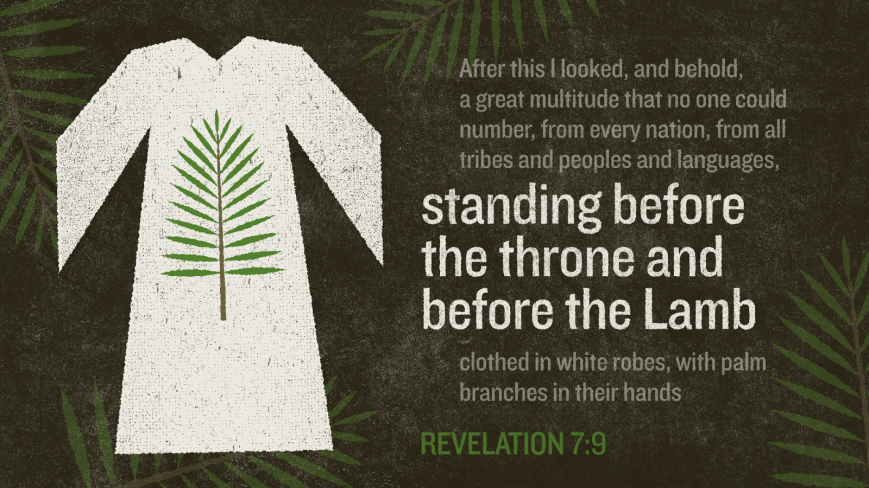
After this I looked, and there was a great multitude that no one could count, from every nation, from all tribes and peoples and languages, standing before the throne and before the Lamb, robed in white, with palm branches in their hands. They cried out in a loud voice, saying, “Salvation belongs to our God who is seated on the throne, and to the Lamb!” And all the angels stood around the throne and around the elders and the four living creatures, and they fell on their faces before the throne and worshiped God, singing, “Amen! Blessing and glory and wisdom and thanksgiving and honor and power and might be to our God forever and ever! Amen.” Then one of the elders addressed me, saying, “Who are these, robed in white, and where have they come from?” I said to him, “Sir, you are the one that knows.” Then he said to me, “These are they who have come out of the great ordeal; they have washed their robes and made them white in the blood of the Lamb. For this reason they are before the throne of God, and worship him day and night within his temple, and the one who is seated on the throne will shelter them. They will hunger no more, and thirst no more; the sun will not strike them, nor any scorching heat; for the Lamb at the center of the throne will be their shepherd, and he will guide them to springs of the water of life, and God will wipe away every tear from their eyes.”
agnus-dei-window-1024x768

The couple had recently celebrated their 60th wedding anniversary when they tragically died in a car crash. They were in relatively good health at the time, mainly due to the wife’s dedication to their diet and forcing them to both get exercise, but when the crash occurred they were immediately brought before St. Peter and the pearly gates.

After a quick check-in, much like the first minutes at a tropical resort, St. Peter volunteered to give them a tore of their heavenly abode. The mansion they would be calling home for eternity was filled with more rooms than they could count with a beautiful kitchen, swimming pool, and movie theater in the basement. As the wife squealed in delight with every passing accommodation, the husband grew skeptical and finally leaned over to Peter and asked, “So how much is this going to cost?”

Peter, flabbergasted, replied, “It’s free, this is Heaven.”

Later, they toured the endless golf course that started in their backyard. With perfect rolling hills that they could only have imagined on earth, they took in the beauty that was available whenever they wanted. The old man, again, asked Peter, “So what are the green fees?

Peter replied, “This is Heaven and you play for free.”

Finally Peter brought the couple to the clubhouse that was filled with people from their lives that they had loved and lost. The joyful reunions went on for some time until Peter motioned for the couple to go through the lavish buffet that had been prepared. The old man, still skeptical, quietly asked Peter how much the food would cost.

Peter, now growing frustrated, said, “Don’t you understand yet? This is Heaven, it’s all free!

The old man stood still and then asked, “Well where are the fat free and low cholesterol tables?”

Peter then began to lecture, “That’s the best part. You can eat as much as you like of whatever you like, and you never get fat or sick. This is Heaven!

Immediately the old man went off with a fit of anger, throwing down his hat and stomping out of the clubhouse.

Peter and the wife both tried to calm down the old man and asked what was wrong. The old man looked at his wife and said, “This is all your fault! If it wasn’t for your diet and exercise, I could have been here ten years ago!

What’s heaven like? I get asked this question on a pretty regular basis. I might be in my office with a grieving family who just lost someone they loved and someone will ask what the person is now “doing” in heaven. Or I’ll be here in the sanctuary teaching a lesson to the preschoolers when the subject of heaven comes up and one of them will say something like: My mommy told me that heaven is full of your favorite candy, and you can have as much of it as you want!

What’s heaven like? There are a decent number of times when scripture is descriptive about the beyond, but it is a far stretch from the jokes and movies many of have experienced on the subject. John caught a glimpse of the heavenly glory of God’s presence in a vision and described it like the grandest worship service to have ever occurred. Countless beings that have made it through the great tribulation surround the throne of the Lord where the Lamb is in the center. They sing with full voices and praise the Lord unceasingly for his majesty is beyond comprehension.

Rev 7v9

The problem with talking about heaven is that whatever we say, it is speculative at best. We can point to scripture where it is described, but the descriptions are made in such a way that heaven is beyond our comprehension. The whole point of heaven after all, is that it is totally other from earthly life. It is beyond life. It is glory and wisdom and thanksgiving and honor and power and might in a way that is impossible for us to understand during our earthly lives.

And even though we can only hint at what heaven might be like, it has become the pinnacle concern for many churches and Christians. What do I have to do to make it to heaven? Or what do we have to do in order to get other people to heaven? These questions dominate our thoughts and we grow anxious about whether or not we, and the people we love, will go on to our heavenly reward.

When talking about heaven, there is a strong temptation to make it so appealing with comparisons to earthly beauty that we neglect to think about the fact that we are called to exist here on earth until our deaths. But this text, this worshipful understanding of heaven, lets us know that God never promised we would not suffer. In fact the opposite is true. Suffering has always been part of our story, and even we here in the blessed region of Western civilization are not immune.

Only in death can we receive the gift of resurrection. It was only through Christ’s crucifixion that he could one day be raised again. The same holds true for us. Only when the bell tolls for us will we share in Christ’s victory over death.

And yet we still talk about it all the time. It is good and right for us to celebrate Christ’s resurrection, but when daydreams about our everlasting reward later prevent us from serving the needs of others right now it becomes cheap grace.

In many churches, like the ones most concerned about whether others are going to heaven or hell after they die seem less concerned with the hells on earth right now. Here in scripture John is confronted with the suffering of the great multitude before they arrive at the throne. They are granted a peace they did not have on earth: they will not hunger, nor thirst, the sun will not strike them, nor any scorching heat because the Lamb of God has shepherded them to the springs of life where God wipes away all tears. But before we can rejoice with the Lord in his divine kingdom, we will endure tribulations in our earthly lives.

Imagining that our lives will be free from suffering is what often leads people to leave the church when something goes wrong. I know too many people my age who were forbidden from attending funerals as children, and then when they finally attended a funeral for the first time when they were older they fell away from the church. I also know too many people who lived such perfect and sheltered lives that when they encountered true poverty for the first time they were overwhelmed by the brokenness of the world and have been unable to return to church.

The church is supposed to be the alternative to this overly rosy view of the world. We have the church to help us remember exactly what God has promised, and what God has not. The church is the place where we confront the hardships of life and rely on the people in the pews next to us to help us through the great tribulations we experience. We are not here to prance around pretending that we have perfect lives without suffering, but instead to proclaim that in trusting the Lord we will find the strength and courage to sustain us until that time when we will join Jesus in the victory over death.

The church is the means by which we combat the hells we experience on earth by attempting to give people hope and faith in something greater than earthly life can offer.

bigstock-Cross-against-the-sky-24690071-panorama

In this church, at St. John’s, we strive to help guide and nurture one another through a variety of means. We have bible studies for the young and the old to help us wrestle with how scripture can speak into our everyday experiences. We collect food and clothing and money for others who are desperately in need. We send people on mission trips to build and plant new foundations and relationships for people who really feel like they are living in hell right now.

But we also have a woman here in the church who has made it her calling to help nurture people in the midst of suffering in the best way she knows how. I believe that Dianne Wright is keeping Hallmark in business through the countless cards she sends out to the community. If you’ve been coming to this church for any regular period of time, and have had so much as a cold, you’ve probably received a card from Dianne Wright. They are always thoughtful, they are always written with purposeful words, and they are always filled with love.

I have the added benefit of not just receiving cards when I need them, but I visit enough of you and our shut-ins to know how prized these letters have become. I was visiting someone at King’s Daughters recently when I saw the familiar script sticking out of the cards adorned in a row on the window sill. The woman I visited described them as the most precious gift she had received since she went in to rehab.

Time and time again I will find myself visiting someone and the subject of Dianne’s cards will come up. They might appear to be a simple and casual gesture, but they speak volumes in the realm of how we are sustained by God’s grace through our neighbor Dianne.

As Christians, we are called to combat the countless hells on earth that plague people through our love and presence. For Dianne Wright, this has meant a ceaseless commitment to communicating through cards the love, depth, and peace of God.

Each of us, in some way shape or form, has gifts that we use to share God’s love with others. Perhaps we have the freedom to visit with people who can no longer visit us. Maybe we, like Dianne, have a penchant for penning letters. Perhaps we have been blessed with lucrative careers that allow us to give charitably to help others. Maybe God has molded us with a spirit of prayer and we can lift up the world through our clasped hands. Perhaps we have become familiar with a particular need in the world and all we need is a little nudge to start serving God by serving others. Maybe we have toyed with the idea of a calling to the ministry and we just need to take a step in faith that God can use us to spread the gospel. Perhaps we have the gift of carpentry like Jesus only we’ve been too nervous to ask someone we know if they need any repairs. Whatever our gift might be, God is calling us to use them to draw people into moments of heaven on earth.

When our time comes God will do with us what God wants. In God’s infinite wisdom and glory we will surround the throne and join in one voice with the saints who came before us, and with the saints who will come after us. We will be washed with the blood of the lamb and God will wipe away every tear from our eyes.

We know not when we will gather with the great multitude, but each day God gives us is a gift. A gift we should celebrate by being a gift for others. Amen.

Naked and Afraid

John 21.1-17

After these things Jesus showed himself again to the disciples by the Sea of Tiberias; and he showed himself in this way. Gathered there together were Simon Peter, Thomas called the Twin, Nathanael of Cana of Galilee, the sons of Zebedee, and two other of his disciples. Simon Peter said to them, “I am going fishing.” They said to him, “We will go with you.” They went out and got into the boat, but that night they caught nothing. Just after daybreak, Jesus stood on the beach; but the disciples did not know that it was Jesus. Jesus said to them, “Children, you have no fish, have you?” They answered him, “No.” He said to them, “Cast the net to the right side of the boat, and you will find some.” So they cast it, and now they were not able to haul it in because there were so many fish. That disciple whom Jesus loved said to Peter, “It is the Lord!” When Simon Peter heard that it was the Lord, he put on some clothes, for he was naked, and jumped into the sea. But the other disciples came in the boat, dragging the net full of fish, for they were not far from the land, only about a hundred yards off. When they had gone ashore, they saw a charcoal fire there, with fish on it, and bread. Jesus said to them, “Bring some of the fish that you have just caught.” So Simon Peter went aboard and hauled the net ashore, full of large fish, a hundred fifty-three of them; and though there were so many, the net was not torn. Jesus said to them, “Come and have breakfast.” Now not of the disciples dared to ask him, “Who are you?” because they knew it was the Lord. Jesus came and took the bread and gave it to them, and did the same with the fish. This was now the third time that Jesus appeared to the disciples after he was raised from the dead. When they had finished breakfast, Jesus said to Simon Peter, “Simon son of John, do you love me more than these?” He said to him, “Yes, Lord; you know that I love you.” Jesus said to him, “Feed my lambs.” A second time he said to him, “Simon son of John, do you love me?” He said to him, “Yes, Lord; you know that I love you.” Jesus said to him, “Tend my sheep.” He said to him the third time, “Simon son of John, do you love me?” Peter felt hurt because he said to him the third time, “Do you love me?” And he said to him, “Lord, you know everything; you know that I love you.” Jesus said to him, “Feed my sheep.”

do-you-love-me-pic


Jesus asks, “Do you love me?”

On the first Easter Sunday, Jesus rose from the dead. The angel at the tomb shared the Good News with the disciples and with the Marys, and later that day Jesus appeared in the room with the disciples. He commanded them to “Go” and spread the Good News to all the earth. But Thomas was not there. Thomas doubted his friends, and their stories about the risen Lord. So a week later Jesus appeared again before the disciples and offered his hands and his side to Thomas to prove the resurrection. He concluded the moment by saying: “Blessed are those who have not seen and yet have come to believe.”

After these incredible moments of resurrected existence, Jesus revealed himself to the disciples for a third time at the sea of Galilee when they returned to their former lives. What a fitting reading for the second Sunday after Easter. Just two weeks ago we were gathered in this sanctuary shouting “Hallelujah!” and praising the Lord for Jesus’ resurrection from the grave. We were living in the light of the resurrection, and boy was it bright! The scent of blooming lilies punctuated the air and invaded our nostrils. No matter what was happening in our lives, God bombarded us with the Good News, death defeated, and we left church feeling filled by the Spirit to be Christ’s hands and feet for the world.

And here we are two weeks later. The lilies are gone, the hallelujahs are still are our lips but they don’t have the same power, and the darkness of life has crept back in. Every year we experience Easter like a mountaintop, but at some point we have to travel back down to the valley of existence.

The disciples, after literally witnessing the resurrected Christ, decide to return to their old lives. Peter says to the boys, “I’m goin’ fishing!” and they reply, “We’re coming with you.”

Do you love me?

It seems strange from our vantage point that the disciples should return to their former occupations, even though Jesus told them to go and spread the news. It feels bizarre to hear about them going back to their boats and nets after their friend transformed the meaning of life and death. Yet, this is how people usually respond to an emotional overload. In the weeks after a baby is born, the new parents wonder about when they will be able to sleep again. After a wife loses her husband she wonders when it will be okay to laugh again. When something deeply and fundamentally transformative occurs, it is only natural to ponder about life before the change.

This story of a reunion by the sea is a reminder that there is no escape from the Lord. Wherever the disciples went, and wherever we go, Jesus is with us.

They were out all night fishing but didn’t catch a thing. Jesus stood on the beach watching the disciple row in to shore, but they did not recognize him. He commanded them to cast out their nets one more time and promised they would catch something. Three years earlier he had said the same thing to Peter and Andrew while they were fishing before they left everything to follow him.

They immediately caught so many fish that they were unable to haul in the net because it was so heavy. In that moment, as the pieces finally came together, Peter recognized who was standing on the shore, put on some clothes and jumped into the sea.

There are many details in this epilogue to John’s gospel: the mention of a charcoal fire draws us back to the charcoal fire around which Peter denied Jesus. The appearance of fish and bread to feed the disciples hunger propels us back to the time when Jesus fed the multitudes with bread and fish. Jesus even asks Peter three times, “Do you love me?” which connects with the three times he denied Jesus.

But this simple note that Peter was naked on the boat while catching fish, and decides to put his clothes on before swimming to Jesus, really stands out. It would have been easier to fish under the oppressive heat of the climate without the baggage of clothing, but instead of immediately jumping in (as he had done once before) Peter puts on clothes before he see the resurrected Lord for a third time.

Peter was naked and afraid. Not just physically naked without clothing, but maybe he was afraid of making himself completely vulnerable to Jesus. Perhaps he did not want to address the emotional denial of Jesus prior to his death. Maybe he didn’t want to admit his fallibility, or he did not want his life to be altered. But the resurrection changes everything.

Like we all do when we feel vulnerable, we put on the armor of denial and ignorance in order to protect ourselves from others. Afraid of the inevitable confrontation we sweep things under the rug and pretend that everything has gone back to normal. And then Jesus shows up with his question:

Do you love me?

Sure I do Jesus! I come to church nearly every Sunday, I listen to the pastor up in the pulpit, and I even try to sing the hymns in harmony.

Feed my lambs.

Do you love me?

Of course I do Jesus! I wear a cross around my neck, I always have my check written and ready for the offering, and I post pictures of prayers on Facebook for everyone to see.

Tend my sheep.

Do you love me?

Jesus, you’re making me a little uncomfortable… you know everything and you know that I love you. I’m a good person, I pay my taxes, I give a little money to charity, I try to pray before I eat my meals… what more could you want?

Feed my sheep.

Most of us have probably never faced a time like Peter did when he denied Jesus outright. We’ve never really had to suffer for our faith, and we’ve never really been afraid for following Jesus. But all of us have had moments where we denied him; we just might not realize it.

We might be in our car driving down the road, and perhaps we’re even listening to a Christian radio station, when we stop at a red light and we see someone standing in the median right next to us with a sign asking for money. Perhaps we reach out our hands to lock our doors, or we make judgments about how they got themselves into whatever trouble their in, and before we know it the light turns green and we are able to get on with our lives without being bothered by the panhandlers.

Jesus asks, “Do you love me?”

We might be having a cup of coffee with a friend and the topic of the recent Panama Papers comes up in conversation. We can feel our fists tightening as we complain about the ultra wealthy evading the taxes that all the rest of us have to pay. Perhaps we start drawing connections between the economically elite with criminals who prey on the weak and underprivileged and we wish someone would do something about it. But before too long the conversation moves on to another topic and we finally feel the tension start to slip away as we talk about something else.

Jesus asks, “Do you love me?”

We might be having dinner with our family when someone goes on a tirade about a particular political party. We keep our mouths shut because we’ve heard them go off like this but we can’t help but shake our heads in disappointment over their opinion. How could someone be so backward in their thinking? If they believe their candidate can fix all of our problems, then they are going to be sorely mistaken…

Jesus asks, “Do you love me?”

The conclusion to John’s gospel is like epilogue in its willingness to address many of the elements that made Jesus’ ministry what it was. As we read it, as we smell the fish cooking on the open fire, and we try to dry ourselves off after swimming in the sea, and as we listen to Jesus’ questions it reminds us of darkness.

do-you-love-me

Through this text we are forced to confront the darkness of our hunger for meaning in our lives, or our failure to recognize Jesus in our midst, or the fact that we have denied him by denying others. But at the same time, this story reminds us that none of the darkness has overcome the light. Christ still died for us while we were yet sinners. God still sent his Son into this broken world to start putting the pieces back together. The Holy Spirit still moves among us and calls us to love one another even when it feels impossible.

Christianity, at its best, is not about what we think or feel about Jesus – it’s about what Jesus does to us. Not a technique for how we can use him to accomplish our goals, but rather his plans for using people like us to transform the world by feeding and tending to the sheep.

Here we are, just like the disciples, a few weeks on the other side of Easter. For many of us, the normalcy of life has returned. The darkness of the cross has crept back into our daily lives. We turn on the television and we want to know why we live in such a broken world. We confront people who drive us crazy. We grow tired of the seemingly endless race for the White House. We clench our fits with frustration over our lack of control. We worry about our bank accounts, and our children, and our futures.

            And then Jesus has the nerve to show up in our lives and ask, “Do you love me?”

If we love Jesus, then we have to start loving one another. Which means that we have to feed Jesus’ sheep by encountering the person on the side of the road asking for money. And not by just addressing their financial situation, but also by treating them with worth and respect. It means that we have to tend to Jesus sheep by helping those trapped by the power of greed to see how their greed affects all of God’s creation. It means that we have to feed Jesus’ sheep when they argue and bicker about politics by listening and loving rather than ignoring and judging.

It is here at the lakeshore of life, that we discover what a strange Messiah we follow. A man who came and was hung on a cross only to forgive his murders; a man who went back to the friends who betrayed him, and ate breakfast with them by the sea; a man who got killed for calling people to serve the last, least, and the lost; a man who expects us to love him by loving others. Amen.