God, Stanley Hauerwas, and the Fourth of July

Today our nation celebrates the Fourth of July. Untold sums of people will adorn themselves in red, white, and blue to celebrate the freedoms we hold so dear. It is one of those rare days that entire communities, though regularly separated over things like race and socioeconomic status, will join together to remember how our country got started.

As a Christian, and particularly as a pastor, I often wonder about the celebration of the Fourth of July and what it says about the church. Stanley Hauerwas, the Christian ethicist, has wrestled with it as well. This is what he has to say about this holiday in his sermon titled, “God and the Fourth of July” from his book Disrupting Time: Sermons, Prayers, and Sundries.

Hauerwas

“For Christians, the Fourth of July is not our day. It is not “not our day” because Christians must oppose nationalism, though we should. It is not “not our day” because America is an imperial power whose use of the military is increasingly indiscriminate and disproportionate, though as Christians committed to peace that is a development we must oppose. The fourth is not a problem for us because of what we are against; it is a problem because our desires have been formed by our Lord. We are simply so consumed by the consummation of Christ with his bride, the church, that we find celebrations like the Fourth of July distracting.

“But, the bands and the fireworks are so undeniably entertaining. I am not suggesting we should avoid such entertainment. No, I will not tell you that. However, I will point out that if such entertainment seems more compelling that the celebration of this meal we are about to share together then we have a problem. For in this Eucharist God gives to us the very body and blood of his Son so that our desires will become part of God’s desire of his world. This is the end of all sacrifice, particularly the sacrifices made in the name of nations, so that we can rest in the presence of one another without fear, envy, and violence. In this meal, the beauty of our Lord blazes across the sky, rendering pale all other celebrations. So, come and taste the goodness and the beauty of our God, and, in so consuming, may we be a people who may even be able to enjoy the Fourth without being consumed by it.” – Stanley Hauerwas

bible-american-flag1

As Christians, what are we celebrating when we celebrate our freedom? Is it our freedom from the monarchic rule of England almost 250 years ago? Or are we be celebrating our freedom from the destructive powers of sin? Are we celebrating our freedom to drink beer, have a BBQ, and blow stuff up? Or are we celebrating our freedom from the shadow of death?

On Reading Sermons Online

I preach from a manuscript in the pulpit every Sunday. During the week I carefully craft the words that will be proclaimed and I humbly pray that the Lord will show up through, and even in spite of, my sermons. Personally, preaching from a manuscript allows me to articulate how I believe the Lord continues to speak through scripture without going off on tangents in the middle of the proclamation. Because I use manuscripts, I have a copy of every sermon I’ve ever preached from the first one as a teenager at Aldersgate UMC in Alexandria, VA to the one I preached at St. John’s UMC in Staunton, VA last Sunday.

By my cursory calculations I have preached over 200 times including Sunday sermons, special occasions, funerals, and weddings. Each of these sermons contain, on average, 2,000 words, which added together, comes to about 400,000 words on God’s holy Word. With the exception of funerals, all of these sermons are available to read online at any time via www.ThinkandLetThink.com

And the sad thing is, more people read my sermons online than come to worship on Sundays.

onlinesermons

I spent some time today going over the data points and statistics for the blog and I realized that on any given day nearly twice as many people read my sermon from Sunday than were in attendance in worship. Moreover, if the number of people who read the blog every week attended church on Sunday, I would be leading one of the larger churches in the entire Virginia Conference of the UMC.

I want to be clear that I am humbled by this kind of readership and I hope what I have posted has been fruitful for the people who view this blog. But I also want to be clear about another thing: reading a sermon online is not a substitute for gathering in worship.

Throughout the last century, the American Protestant Church has elevated the role of the sermon to the highest of worship elements. Just look at any bulletin on Sunday morning and the whole service usually builds up to the proclamation, and then people are sent home. More than prayers, and hymns, and God forbid the Eucharist, the sermon has come to define what it means to worship.

On one hand, sermons are important. They are the moment in worship whereby the Word of the Lord is proclaimed in a new and exciting way and becomes incarnate in the way that we live out what we hear. But the sermon is unintelligible without the rest of the service. The prayers and the hymns and the silences are what lend light to the words striving to resonate with God’s Word. What we preachers offer from the pulpit mean little, if not nothing, without the other parts of the worship experience.

Additionally, the sermon should not be the pinnacle of worship, but instead one of the integral parts that make the totality of worship life giving and fruitful. To equate all of worship with a sermon prevents the Holy Spirit from moving among the people in such a way that they can respond to God’s great word. To equate all of worship with a sermon implies that our words about God are more important than God’s Word about us. To equate all of worship with a sermon makes the preacher the focus of the worship rather than almighty God.

I am grateful that thousands of people have read this blog over the last few years. I am hopeful that the words found here have given life and meaning to the people who read them. But more than that, I hope these words have inspired people to gather with other Christians at least once a week. What we do, and who we are, is made incarnational in the practice of worship, not by reading sermons online.

Startup Stock Photos

Devotional – Luke 9.57

Devotional:

Luke 9.57

As they were going along the road, someone said to him, “I will follow you wherever you go.”

Weekly Devotional Image             It sounds easy. Jesus is walking along the road with his disciples and someone says, “I will follow you wherever you go.” In a sense, this is the same declaration we make each and every Sunday that we gather for worship; we want to follow Jesus wherever he goes. But do we really?

If we assume that Jesus is revealed to us in the sanctuary then it makes sense that we will follow him there. Sunday morning worship is a comfortable arena where we can feel good about our Christian identities; we can sing together from the hymnal, we can pray for the world to be a better place, and we can hear a sermon that makes us laugh and reminds us that God is love. But what about the end of the service? Are we willing to follow Jesus wherever he goes between worship services?

If Jesus walked into a Hillary Clinton rally to demand more honesty from our politicians, would we follow him? If Jesus wandered into a Donald Trump rally to demand an end to racism and bigotry, would we follow him? If Jesus marched against the NRA to boldly request better gun control laws, would we follow him? If Jesus made his way into the Pulse Nightclub in Orlando to spend time with a marginalized community, would we follow him? If Jesus asked us to take up our own cross and follow him to Calvary, would we follow him?

To follow Jesus is a radical thing. It means putting the needs of others before our own. It means seeking out the last, least, and lost in addition to the people who make us comfortable. It means we need to strive for mercy instead of sacrifice, communion instead of correctness, and Kingdom instead of nation. It means following him into the places of life that we would otherwise avoid.

maxresdefault

Many of us have grown comfortable with our Christianity because it does not ask much of us. So long as we can be present for an hour on Sundays, we believe we are covering our spiritual bases. In turn, the church has become another civic organization and no longer the life-giving arena of grace, mercy, and love.

And honestly, this makes sense. Throughout the gospel narratives Jesus’s followers and disciples continued to grow in number until he set his face toward Jerusalem. The closer he came to the cross, the more the people started to fall away. As the expectations and costs increased, the level of commitment dwindled.

At the end, while he was hanging on the cross with only a few faithful disciples remaining, it was a thief who wanted to follow Jesus wherever he went. And Jesus said, “Truly I tell you, today you will be with me in Paradise.”

Following Jesus comes with a cost, but the reward is beyond all measure.

Make the Church Great Again

Psalm 146

Praise the Lord! Praise the Lord, O my soul! I will praise the Lord as long as I live; I will sing praises to my God all my life long. Do not put your trust in princes, in mortals, in whom there is no help. When their breath departs, they return to the earth; on that very day their plans perish. Happy are those whose help is the God of Jacob, whose hope is in the Lord their God, who made heaven and earth, the sea, and all that is in them; who keeps faith forever; who executes justice for the oppressed; who gives food to the hungry. The Lord sets the prisoners free; the Lord opens the eyes of the blind. The Lord lifts up those who are bowed down; the Lord loves the righteous. The Lord watches over the strangers; he upholds the orphan and the widow, but the way of the wicked he brings to ruin. The Lord will reign forever, your God, O Zion, for all generations. Praise the Lord!

Psalms-Series-graphic


In the beginning, we met in people’s homes. The church wasn’t even called the church; it was called “ecclesia” which means a gathering. The earliest disciples of Jesus gathered together in homes to retell the story, break bread together, and engage in prayer.

As the centuries passed and the Good News spread across the world, gathering spaces called churches were erected in certain communities. Through this period, we met for worship in whatever church was closest. In didn’t matter if we didn’t agree with what the person at the front said, or even if we hated the people in the pews next to us, we only really had one option for church and it was good enough.

Today, in the American context, we have every possible flavor of church you could ever want. In our town alone there are at least 87 different churches within the city limits. We are no longer bound to attend church based on proximity; instead we attend church based on denominational affiliation, pastoral performance, and opportunities for youth. Whereas we once gathered as a truly diverse community of faith, we now tend to gather with people who make us comfortable and appear just like us. Whereas we used to be stuck with the church in our neighborhood, now there are websites dedicated to church reviews and helping people find the church that fits them best.

This week, I got online and I started reading church reviews from all over the country. After all, it could only help to see what people think of other churches to get an idea about what many of you might think about St. John’s. And, I’ve got to be honest; most of them are awful…

“Absolutely doumbfounded. Checked this church out for the first time today, and really wish I had read some of the other reviews first. It was creepy how strangers kept smiling and maintaining eye contact even after the service started. I lost track after 15 people introduced themselves. And the sermon was about nothing more than tithing. The ushers passed around cards talking about a “90 day challenge” … giving 10% of your income to that church for three months, but that’s not all folks, it said, “if you don’t feel blessed after those 90 days, there is a money back guarantee!!!” It felt more like an infomercial than a worship service. But they did share how they are giving away a free cruise on Father’s day weekend… The thing I regret most is not walking out of there in the middle of the service.

“Young people ruined the church. God used to be the foundation of our community and members got to know each other until they came and everything went downhill. The new young families came in wearing blue jeans and tee shirts; they were disrespectful of what it means to be holy. My heart is heavy that my church has become just another soulless generic space in hipsterland.”

“This was the worst restaurant ever. First of all, their bread was terribly sweet, and they make you literally stand in line for it. Then, you wait in line to dip your bread into a cup of what tastes like decades old grape juice. There was no main course. I sat in a stiff wooden bench for an hour before I was able to eat and there was a man wearing a dress who shouted the whole time. It was free however, though they asked for donations near the end and passed around a plate. I give it 1 star, and do not recommend it to anyone.”

However, I found one review that was so positive that I had to share it:

“In my life, I have never been with a group of people who were so fired up to make positive changes in the world. The entire experience was surreal, in the best way possible. There was a lady near me who came up at the beginning and wanted to know all about me. I honestly didn’t know it could be this exciting. I loved that the speaker didn’t need to use notes while he was talking. It felt genuine and meaningful and he even encouraged us to shout back when we felt the need to do so. Other people might make comments about how the parking lot was crowded but I think that’s a good thing! I’ve gone to gatherings like this my whole life, and for the first time I feel like we’re moving in the right direction and I left feeling charged up for action. It’s time to make America great again!”

15154070

That last review was a mash-up of descriptions from two recent political rallies centered on presidential candidates Hillary Clinton and Donald Trump. After reading negative church reviews for an hour, it shocked me that gatherings in support of the next president of the United States were garnering better reviews than households of God. And even more than their positive language, what they described appears like a perfect worship service; except for the fact that they are worshipping politicians rather than almighty God.

From the beginning we have looked for other people to take care of our needs. Whether it was in the Garden, or just the other day in Staunton, it is part of our human condition to rely on the “other” to help us. This is even more prevalent when it comes to our modern days “princes” otherwise known as politicians.

Now there isn’t anything inherently wrong with politicians: they stand before us and tell us what they will do for us. We vote for them and they represent our interests. Our failure is in our tendency to look for politicians to be our saviors.

The psalmist knew this basic fact of the human condition. The Hebrew people wanted kings just like all the other gatherings of people and so they got what they wanted. But in raising political leaders to be saviors they committed the ultimate sin that we still commit today: believing that we can save ourselves.

Praise the Lord! Do not put your trust in politicians, in feeble and broken individuals. When their breath departs, when their days come to an end, their plans perish. However, the Lord endures forever. Happy are those whose hope is in the Lord, who keeps faith forever, who executes justice for the oppressed; who gives food to the hungry.

God is the one from whom our help will come. God is a nurse who opens the eyes of those who refuse to see. God is a social worker who lifts up those who are bowed down under the weight of the world. God is a political activist who sets the prisoners free and watches over all foreigners. God is the one who reigns and remains steadfast forever.

The question for us, the question the psalm begs us to ask is this: Who do we really worship?

A few weeks ago the General Conference of the United Methodist Church met in Portland, Oregon, and among other things, they voted on a global annual budget. From now until 2020 the global United Methodist church projects needing and spending $604 million dollars. This money will be used in a variety of ways to support the denomination’s mission of making disciples of Jesus Christ for the transformation of the world.

The number, I’ll admit, is staggering. However, it pales in comparison to the 1 billion dollars that has been raised and spent in the 2016 presidential race. Add that to the countless hours we have spent glued to the television during debates, or the infinite number of Internet articles that support the candidate of our choosing, or just the mind-boggling number of bumper stickers and yard signs in Staunton alone and you will start to realize who we really worship.

The-Church-and-Politics-Sermon-Title-sm-535x428

It’s time to make the church great again. Not by going back to the days of old to be what we once were, but to look boldly to the future and believe that God can save us, not politicians, not public leaders, not even pastors. Can you imagine how much good the church could do if it was supported like a presidential campaign? Can you picture how many lives could be changed for the better if we worshipped the Lord the way we worship our politics?

God can use politicians to bring about God’s will on earth, but there is a limit to what they can accomplish. Moreover, the longer we wait for our politicians to save us, the longer we pass the buck on to someone else, the longer we will prevent God from using people like us to make the kingdom come here on earth. Believe it or not, God uses people like us to work for justice, feed to the hungry, love the outcasts; watch over strangers, orphans, and widows. As disciples of Jesus Christ our work is to act like Jesus.

If you get online and search for reviews of St. John’s, you won’t find any. Trust me, I looked. Either we haven’t offended people enough, or we haven’t inspired people enough to write a review of a “worship experience.” But maybe, just maybe, there are no reviews of St. John’s because we know the church is not something to be done and reviewed. We know the church isn’t like a restaurant or business that we can experience at our leisure. We know the church isn’t like a political party that makes promises that cannot be kept. We, after worshipping in these pews – offering these prayers – eating this bread and drinking from this cup, we understand that church isn’t about what we get out of it, but instead it’s about what God gets out of us.

If we really want to make the Church great again, then we need not look further than this table and the meal that has been prepared for us. For it is here, where heaven and earth meet for a brief moment, where we confess and are reconciled, that we remember how the Lord is the one who lifts us up when we’re down; how the Lord opens our eyes when we are blinded by the world; how the Lord reigns forever. Praise the Lord! Amen.

Devotional – Psalm 96.9

Psalm 96.9

Worship the Lord in holy splendor; tremble before him, all the earth.

Weekly Devotional Image

When was the last time you were really nervous? Can you remember being called to the front of the class as a child and the anxiety that poured on you like a wave when it was your turn to speak? Was it at your wedding when you saw your spouse standing next to you at the altar? Was it the moment you found out that you were going to become a parent for the first time? Was it the time you were called into your boss’ office and didn’t know whether you’d still have a job at the end of the meeting? At the heart of my vocation is a call to stand before the gathered congregation and proclaim words about the Lord. And, even after doing this for a number of years, I am thankful for a large pulpit that covers up my nervous ticks when I’m preaching.

This Sunday, my best friend (and the best man at my wedding) will be in town with his family and will worship at St. John’s. We became fast friends while in seminary and he is, without a doubt, one of the greatest preachers I’ve had the pleasure of hearing. And to be perfectly honest, I am really nervous about leading worship and preaching in front of him on Sunday. Perhaps its because I know how gifted he is, or because we are so close that I really respect his opinion, or maybe it’s the conflation of having not preached for a month because of the birth of my son. Whatever the reason, I am nervous about Sunday.

Sera Petras Photography_Lindsey + Taylor_w-431

However, nerves can be a gift. If you’re anything like me, being nervous often brings out some of my best work. When the deadline approaches, and my anxiety jumps up a few notches, my focus becomes clearer and I am more articulate. As I am placed in a situation that makes me nervous I respond from the heart, rather than stewing about it for a prolonged period of time and answering from my mind.

Sometimes we need to feel nervous before the Lord. Not necessarily every Sunday in worship, or every time we open our bibles, but we do need to have experiences when we “tremble before him.” We often sugarcoat church and worship to make it as appealing as possible with messages about how loved we are. And, even though those types of Christian experiences are important, we also need to have them balanced with conviction. We need close friends who can challenge us to be better than we are. We need churches that challenge our sense of the status quo and push us to be more like Jesus. We need experiences of God that leave us trembling so that we remember that God is God, and we are not.

Devotional – Psalm 23

Devotional:

Psalm 23.1

The Lord is my shepherd, I shall not want.
Weekly Devotional Image

I’ve done a lot of funerals. In my short time as a pastor I have presided over more services of death and resurrection than baptisms and weddings combined. And every funeral, much like every baptism and wedding, is contextual and different. Some families come in with a service already planned out in their minds with specific hymns and scriptural texts, and some families come in with their eyes glossed over and have no idea what they want the funeral to look like. I’ve read scripture from the recently deceased’s bible, I’ve been handed a tear stained eulogy to read aloud because the emotional strain was too high, and I’ve even been asked to sing a solo during a service. But one thing that has united every single funeral I’ve participated in has been the reading of Psalm 23.

Unlike other readings during funeral services, we print out the entirety of the 23rd Psalm in bold in the bulletins. When the time comes, I ask everyone gathered together to read the beloved words out loud and as we take a collective breath we begin, “The Lord is my shepherd, I shall not want…” An amazing thing happens when this psalm is read out loud in the context of grief and loss. You can audibly hear the anxiety in the air as the first words are read aloud; people read at different tempos and take breaths at different moments. But as the psalm progresses, so do the voices. It is as if the entire congregation, through the psalm, is able to take a collective breath of fresh air and release a profound sigh of comfort. The 23rd Psalm is a beautiful reminder of the powerful presence of the Lord in the midst of death, and encourages those of us who remain to live as faithfully as the person we have gathered to remember.

This week, no matter what we have going on, let us take a moment to faithfully proclaim the words to the 23rd Psalm with the knowledge that even after we’re gone, people will use these words to mark our Services of Death and Resurrection:


Psalm 23

The Lord is my shepherd, I shall not want. He makes me lie down in green pastures; he leads me beside still waters; he restores my soul. He leads me in right paths for his name’s sake. Even through I walk through the darkest valley, I fear no evil; for you are with me; your rod and your staff – they comfort me. You prepare a table before me in the presence of my enemies; you anoint my head with oil; my cup overflows. Surely goodness and mercy shall follow me all the days of my life, and I shall dwell in the house of the Lord forever.


h6bg5t5

With A Little Help From My Friends

John 20.19-29

When it was evening on that day, the first day of the week, and the doors of the house where the disciples had met were locked for fear of the Jews, Jesus came and stood among them and said, “Peace be with you.” After he said this, he showed them his hands and his side. Then the disciples rejoiced when they saw the Lord. Jesus said to them again, “Peace be with you. As the Father has sent me, so I send you.” When he had said this, he breathed on them and said to them, “Receive the Holy Spirit. If you forgive the sins of any, they are forgiven them; if you retain the sins of any, they are retained.” But Thomas (who was called the Twin), one of the twelve, was not with them when Jesus came. So the other disciples told him, “We have seen the Lord.” But he said to them, “Unless I see the mark of the nails in his hands, and put my finger in the mark of the nails and my hand in his said, I will not believe.” A week later his disciples were again in the house, and Thomas was with them. Although the doors were shut, Jesus came and stood among them and said, “Peace be with you.” Then he said to Thomas, “Put your finger here and see my hands. Reach out your hand and put it in my side. Do not doubt but believe.” Thomas answered him, “My Lord and my God!” Jesus said to him, “Have you believed because you have seen me? Blessed are those who have not seen and yet have come to believe.”

img_1433


Before I became your pastor, I was a pulpit-filler. If a pastor became sick, or was otherwise unavailable to preach, I was tapped on to come up with something to say from the pulpit. A phone call would arrive in the middle of a week, or even on Sunday morning, and I would have to whip something together right quick. For years I took the ”undesirable” Sundays: Memorial Day, Labor Day, Thanksgiving Sunday, and the Sunday after Easter; those Sundays when the regular pastor needed a break.

Every time I was tasked with preaching was an opportunity to grow in my faith while attempting to articular the faith for others.

When I was in college I got the phone call one week to preach for a Sunday evening service. I was fairly familiar with the context because I played the drums for the church every week, but this time they wanted me to come out from behind the drum set to proclaim God’s Word.

At the time I was living with a couple of roommates, but of course none of them went to church. Week after week they would rib me for waking up early on Sunday morning, they would jokingly mock me with questions about God’s presence, and they made sure I knew they thought there were better things I could be doing with my time.

So I thought this would be the perfect opportunity to get them to church.

It was on a Sunday night, so they couldn’t complain about sleeping in. We would be playing contemporary Christian rock songs, so they couldn’t complain about the music. And I was supposed to preach, so they couldn’t complain about it being archaic or a waste of time (I hoped).

I casually invited them to worship while we were having dinner one night; I shared that I was the preacher and that it would be a relatively short sermon, and I made sure to mention that it would really mean a lot to me if they would come.

Under the weight of my communal invitation and guilt, they all came to church that night and sat together in a pew near the back.

The service went well; the music balance was good, and the sermon was short and to the point, and then we moved to the communion table. Our resident pastor began talking about how whenever Jesus gathered with his friends he would breathe new life into them through his words and his presence. And on his final night he took bread, broke it, gave it to his friends and said, “Take. Eat. This is my body.” And then he took the cup and shared it with his friends saying: “Take. Drink. This is my blood.

One by one every person in the sanctuary gathered in the center aisle and started walking forward for communion. The pastor stood next to me holding the bread, and I stood next to her holding the cup and for each person that came forward we said, “The body of Christ given for you.” Or: “The blood of Christ shed for you.” Hands were outstretched penitently while people feasted on the Lord, and then the end of the line came forward, with my roommates.

Unsure of what was actually taking place, they stood up like everybody else and came forward without knowing what to do next. As they stood in front of us, and in front of the whole congregation, the pastor’s eyes darted back and forth between myself, and the ragtag roommates standing in front of us. Her eyes screamed, “Do something!”

So I did what anyone in my position would do. I whispered to my friends as quickly as possible: “I know this will sound weird… But you need to take a piece of bread, dip it in the grape juice, and eat it. Don’t worry I’ll explain it to you later.” And with that they all feasted on the body and blood of our Lord, and returned to their pews confused and bewildered.

On the day of Jesus’ resurrection, after appearing to Mary Magdalene and calling her by name, Jesus appeared before the disciples. They were locked away in a room full of fear and trembling when Jesus said, “Peace be with you.” Perhaps they were afraid of being crucified like he was by the Jews, or they were afraid of how the crowds would taunt them when they came out of hiding, or they were afraid of seeing their risen friend in their midst. But Jesus found it fitting to speak words of peace in the midst of their terror.

And immediately Jesus outlined what they were supposed to do: “Go. As the Father sent me, now I send you.” With his proclamation, Jesus empowered his friends to proclaim the Good News for everyone to hear.

But Thomas, one of the disciples, was not there to experience the resurrected Jesus. The disciples tried to explain what they had seen, heard, felt, and experienced. Yet, their eyes and fingers were not enough for Thomas. He did not trust his friends. He wanted to see and touch Jesus for himself.
09b

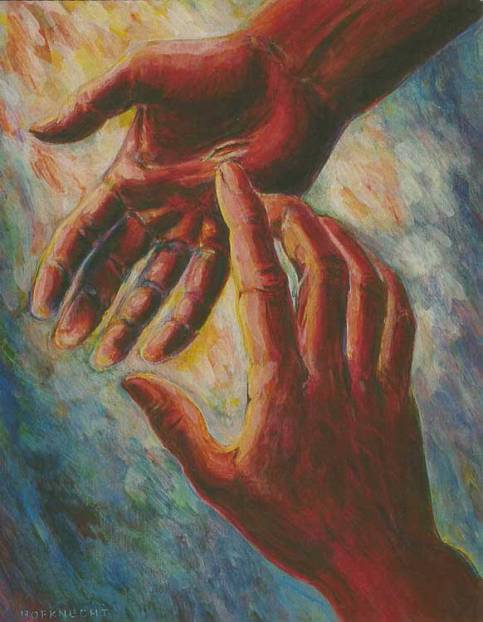
Sure enough, a week passed, and Jesus showed up again before the disciples and Thomas. Again Jesus greeted them by saying, “Peace be with you.” And he told Thomas to feel the scars on his hands and side, but before Thomas could even reach out he declared, “My Lord and my God!” And thus Jesus concluded the moment by saying, “Have you believed because you have seen me? Blessed are those who have not seen and yet have come to believe.

Thomas gets a pretty bad rap. Every year we follow Easter Sunday with this reading about doubting Thomas. He is the one disciple who gets a qualifier in front of his name. We don’t refer to eager Peter, or betraying Judas, but we do say doubting Thomas. For years pastors like me have used this Sunday and this story to call people like you to learn from the example of Thomas, to not doubt the Lord, to believe without seeing.

But the real problem with Thomas is not his lack of faith in the Lord, but his lack of faith in his friends. For three years he had traveled with this ragtag group of disciples, shoulder-to-shoulder they had watching Jesus perform countless miracles, and now when they tell him the Gospel, he does not believe them.

After the episode of my friends confusedly attending worship and receiving communion, I avoided the topic of church. I knew they had a strange experience through their lack of addressing the service in any way shape or form, and they stopped mocking me for going to church. At the time, I thought they thought I was nuts.

A few weeks passed and the topic of faith was still avoided like the plague until one morning I walked down the stairs and discovered one of my roommates crying on the couch. He had just received a phone call from a long time friend of ours whose father had died. The man was a staple in our community, regularly coached little league sports, and was another father figure for most of us. And when my roommate received the news, it devastated him.

I slowly made my way across the room and sat down next to him. For the longest time neither of us spoke. Finally my roommate looked up from his tears and he said, “I want you to pray for me.

I sat shocked. I didn’t know what to say. But he continued: “You know I don’t know much about God or church. But I know it’s important to you. When you were standing up before us in church I could tell that you really believed. I don’t know what I believe. And I can’t describe it, but I really feel like you need to pray for me.”

So I did.

When Thomas heard the news of the risen Lord through his friends, he didn’t believe them. Even though they were some of the people he should’ve trusted the most, he refused to accept their words.

When my friend felt the sting of death and loss, he didn’t know what to believe. But, for better or worse, he trusted me. Even though he had every reason to be suspicious and weirded out by what he had experienced in worship, he believed in God’s presence through prayer.

Thomas’ kind of radical suspicion of his friends still takes place in our lives today. We view church as a private thing, something we do on the weekends and don’t need to bring up during the week. We might know people in our lives that are suffering or are alone, but we assume that God will send them to us when they’re ready.

SnapshotImage

If we want to be faithful followers of Jesus, then me must stop distrusting our friends and neighbors. At the very least, we should stop questioning motives or thinking the worst in others when they express a difference of opinion.

To be faithful followers of Jesus requires a willingness to be sent by God to people who do not know God. It requires us to be vulnerable and uncomfortable while inviting others to discover God’s love in a place like this. It requires us to be the agents of belief for people who have not yet seen.

All of us are here because we are the product of someone influencing our faithfulness. Whether a parent or a friend or even a stranger, we were once invited to discover God through the power of church.

Friends, I promise you that the days of people showing up to church because a church is in their neighborhood are long gone. Today, people discover God’s presence, they begin to believe what they see and see what they believe when people like us are brave enough to invite them to church.

Because, for us, this table is the closest we can get to the presence of Christ. In the bread and the cup God invites us into the upper room when Christ shared the meal with his friends. When we feast on his body and blood we receive the grace necessary to be Christ’s body in the world.

This thing we call communion, whether at the table or just gathering in worship, has transformed my life. If you’re here in church, it’s probably changed your life too. So, may the God of grace and glory give us the courage to invite others to be transformed as well. Amen.

Devotional – Luke 9.35


Devotional

Luke 9.35

Then from the cloud came a voice that said, “This is my Son, my Chosen; listen to him!”
Weekly Devotional Image

When I was in seminary we had all sorts of assignments that were designed to get us engaged with scripture. When I took a class on the gospel according to Mark, I was required to read all 16 chapters out loud, in my spare time, at least once a week. When I was learning about biblical Greek, I was tasked with memorizing the Lord’s Prayer in Greek and I would mutter it under my breath everywhere I walked on Duke’s campus. And when I was enrolled in a class on the art of preaching, I had to work with a group to come up with a strange and exciting way to bring a scriptural text to life.

My group broke up parts of the worship service; one person would do the call to worship, one person would lead the rest of the class in singing a few hymns, one person was responsible for all of the prayers, and I was assigned the “sermon” section. Rather than waxing lyrical about the particular text (Jesus’ Transfiguration) we agreed that I should just retell the story in an exciting and dynamic way.

I prayed over the text during the days leading up to the worship service and decided that I would tell the story of Jesus’ Transfiguration from Peter’s perspective, from the future looking back on the incredible event. Like a lot of group of assignments, it felt like everything was just thrown together, but we were confident that God could make something out of our worship.

Transfiguration-3

When the day of the assignment arrived, everyone in the group nailed their respective parts and I eventually had to stand before the gathered class and give my rendition of the Transfiguration. As I went on and on as an older Peter remembering the past, I could tell that the class was starting to lose interest, so I started elevating my volume and delivery. I began building the story up through a crescendo until that pivotal moment when Jesus was clothed in white and everyone in the room went wide eyed. I, at first, thought that my command over the scripture had blown the class away, but I soon realized what had happened: While I was talking, one of my peers had slowly started to dim the lights in the room until it was rather dark (I was so focused on what I was saying that I didn’t even notice it). But then at the exact moment I described the dazzling whiteness of Jesus’ garment, she turned on the projector and I started to glow.

Transfiguration Sunday is an important event in the liturgical calendar as we bask in the glory of Christ right before we enter the season of Lent on Ash Wednesday. Important for us is a willingness to be knocked back by the dazzling power of Jesus’ life and work. We take the time to be blown away, just like Peter was, by how God’s love really knows no bounds.

This week, as we prepare to celebrate the Transfiguration, let us look for moments where God’s glory shines in our midst. We might see it in a perfect sunset, the laughter of a child, or in the still small silence of prayer. And whenever it happens, let us give thanks for the glory of the Lord.


Christmas Eve – Extra(Ordinary)

Luke 2.1-14

In those days a decree went out from Emperor Augustus that all the world should be registered. This was the first registration and was taken while Quirinius was governor of Syria. All went to their own towns to be registered. Joseph also went from the town of Nazareth in Galilee to Judea, to the city of David called Bethlehem, because he was descended from the house and family of David. He went to be registered with Mary, to whom he was engaged and who was expecting a child. While they were there, the time came for her to deliver her child. And she gave birth to her firstborn son and wrapped him in bands of cloth, and laid him in a manger, because there was no place for them in the inn. In that region there were shepherds living in their fields, keeping watch over their flock by night. Then an angel of the Lord stood before them, and the glory of the Lord shone around them, and they were terrified. But the angel said to them, “Do not be afraid; for see – I am bringing you good news of great joy for all the people: to you is born this day in the city of David a Savior, who is the Messiah, the Lord. This will be a sign for you: you will find a child wrapped in bands of cloth and lying in a manger.” And suddenly there was with the angel a multitude of the heavenly host, praising God and saying, “Glory to God in the highest heaven, and on earth peace among those whom he favors!”

christmascandle

Merry Christmas! O what a time to be gathered together. Christmas is just special. The way we decorate our homes with lights and manger scenes. The presents all piled up under the trees. The advent calendars filled with mediocre pieces of chocolate.

It’s hard not to get nostalgic and reminiscent during the holidays. When you pull out the favorite ornament, you remember your grandmother who crafted it with care. When you see the cracked serving platter you remember the uncle who had a little too much nog that one year and dropped it. When you finally plug in the lights on the front of the house, you remember all the years your father mumbled under his breath as he struggled to untangle all the cords.

Christmas is the best. Among the decorations, and the songs, and the gifts, we are reminded of the great story of Jesus’ birth. This is a story we have told again and again to the point that I bet you know all the details….

Joseph went from the town of Nazareth in Galilee, to the city of David called ­­­Bethlehem. He went there to be registered with Mary, to whom he was engaged and was expecting a child. And she gave birth to her firstborn son and wrapped him in bands of cloth, and laid him in a manger, because there was no place for them in the inn.

What a story, but it could have gone like this…

Mary sat in the uncomfortable airport lounge and could not believe that she could actually no longer see her feet. Everyday her body was changing with new movements, sounds, and smells. She found herself wishing for an easier pregnancy, feet that would stop swelling, and a baby that would stop kicking her in the side every time she fell asleep.

Mary was thankful for Joseph, how much he doted on her over the last 9 months, but if he made one more comment about how beautiful she looked she was going to punch him in the face. “I know I look like a cow!” she would say, “stop pretending that I’m something that I’m not.” Mary blamed the outbursts on the hormones, but sometimes it just felt nice to speak her mind.

She sat in the airport lounge, and couldn’t believe she had agreed to travel while pregnant. Joseph had been initially suspicious of the pregnancy, but he was a good man and stuck by her side. And here they were, waiting to get on the plane, and it felt like people’s eyes were magnetized to her belly.

Is it a boy or a girl?” someone asked for the thousandth time. Mary turned to her right and tried to return the smile, but her sarcasm got the better or her, and she said, “We’re just hoping it’s a human!

Are you going to try natural child birth?” someone asked for the thousandth time. Mary turned to her left and tried to return the smile, but declared, “That’s frankly none of your business!

Finally, a woman from the airline announced that anyone with medical needs could begin boarding the plane. “One of the rare perks…” thought Mary as she pushed herself up from the seat. She wobbled over to the gate like a penguin when an older woman walked up with her hand outstretched to rub Mary’s belly. Joseph quickly jumped in front to stop the arm from making contact and instead put out his arm to on a direct course to the woman’s abdomen and said, “How would you feel if a stranger tried to rub your belly?

Mary’s seat on the airplane felt smaller than usual and, try as she might, she couldn’t sleep. Joseph sat next to her with his earmarked copy of What To Expect When You’re Expecting open to the section on child-birth. And Mary cringed when she thought about what her body would be doing in the not too distant future.

By the time they finally landed, stood in line for the rental car, and finally made it out of the airport, Mary was exhausted. Her feet felt like flippers, and she was starting to feel what she thought were contractions, but she was determined to believe it was something else.

As they drove through the empty city streets late that night, the feeling grew worse and more regular until it came with such suddenness that Mary yelled at Joseph to pull the car over. In the dimly lit alley with cats meowing behind cardboard boxes and passersby ignoring the scene right in front of them, Mary gave birth to a baby boy, wrapped him in her fiancés sweater, and grinned from ear to ear.

All the pain she had felt, all the fear of how much her life would change, all the frustrations with strangers and inappropriate comments started to fade away into the darkness. Instead she saw her little baby as the light of the world. In him she saw a better and brighter future. In him she knew the world would be turned upside down. And she named him Jesus.

mary_and_baby_jesus

We know the story. We hear it year after year. We see it portrayed by children in church productions, and on the front lawns of countless homes. Mary and Joseph traveled to Bethlehem because the emperor believed that everyone needed to be registered. When they arrived there was no room at the inn, so Mary had her baby and placed him in a manger.

The text from Luke, rather than romanticizing the poverty of Mary and Joseph, invites us to see them as people much like us. The details are lacking and the narrative flows in a way that feels rather ordinary. Mary and Joseph were just two people trying to make their way in the world, like a couple traveling during the holidays. They were normal people; people who felt the pressures of the world and the judgments of others; people who were squeezed by rising taxes and governmental expectations; people who were weary from a variety of struggles including the fear of childbirth; people who were badly in need of hope.

And, as God would have it, the hope they so desperately needed came to them that night as a baby. In the ordinary ways of the world, something extraordinary happened. Jesus, the light of the world, was born to that struggling couple surrounded by the most ordinary of circumstances and changed the world forever.

The baby was extraordinary, God incarnate, capable of miracles and filled with Messianic hope. The baby, wrapped in swaddling clothes, God in the flesh, was born to guide the world in the ways that lead to life.

We are like Mary and Joseph and Jesus was born to us and for us. The story takes places in the ordinary but makes our lives extraordinary. So often we hear about how Jesus’ birth changed the cosmos and the very history of the world that we forget about how this wonderful and precious moment actually changed our individual lives as well. It changed us, people who are trying to understand our ordinary lives in light of the extraordinary news that God came as a baby for us.

If you haven’t spent much time in the Bible, this is how it works. If you haven’t experienced much of God’s presence, this is how God works. The extraordinary arises within the ordinary. The heavens break forth in the middle of a moment here on earth. What we usually see as normal and commonplace is often the realm of God’s marvelous work among us.

If you want to know God, you don’t have to go off on some high mountaintop, you don’t have to sink deep into the recesses of your ego. You just have to be in a place like Bethlehem, or an airport, or a rental car, or a church. You just need to be in the midst of trying to make your way in the world, getting along as best you can with what you’ve got. That’s when God loves to show up and change our lives forever.

When Jesus was born to Mary and Joseph the ordinary became extraordinary. In that tiny baby they would come to discover what it means to love God and neighbor in new and radical ways. In that tiny baby they would have their sins forgiven and salvation presented. In that tiny baby they would finally understand how much God loved them.

God loves to show up in the ordinary things of life. God shows up in the bread and juice offered to us at the table without cost. God shows up in the flicker of a flame as we sing silent night together. God shows up in the cry of a baby who came to change the world.

God shows up and makes our ordinary lives extraordinary. What a gift.

Merry Christmas.

gifts of god

Why We Do What We Do: Worship – Sermon on Luke 24.13-35

Four homilies on why we worship the way we do…

church

Gather

Luke 24.13-24

Now on that same day two of them were going to a village called Emmaus, about seven miles from Jerusalem, and talking with each other about all that had happened. While they were talking and discussing, Jesus himself came near and went with them, but their eyes were kept from recognizing him. And he said to them, “What are you discussing with each other while you walk along?” They stood still, looking sad. Then one of them, whose name was Cleopas, answered him, “Are you the only stranger in Jerusalem who does not know the things that have taken place there in these days?” He asked them, “What things?” They replied, “The things about Jesus of Nazareth, who was a prophet mighty in deed and word before God and all the people, and how our chief priests and leaders handed him over to be condemned to death and crucified him. But we had hoped that he was the one to redeem Israel. Yes, and besides all this, it is now the third day since these things took place. Moreover, some women of our group astounded us. They were at the tomb early this morning, and when they did not find his body there, they came back and told us that they had indeed seen a vision of angels who said that he was alive. Some of those who were with us went to the tomb and found it just as the women had said; but they did not see him.”


The receiving line following worship is vastly underrated. A lot of people make their way out of the sanctuary as quickly as possible, whereas others will wait in line just to ask that one question that popped up during the service. It never ceases to amaze me that some of the most profoundly theological and spiritual moments that take place at St. John’s happen in that line after worship on Sunday mornings. This month’s sermon series “Why We Do What We Do” has its roots in those conversations. Week after week I will hear some of you wonder about the purpose of an acolyte carrying in the flame for worship, or you ask about the value and importance of having a time for offering and collection, or you question why we talk so much about bible study, or you remark about how difficult it is to pray.

For any of you that have left worship with a question on your heart and mind, this sermon series is for you. This morning we begin with “Why We Worship.

Over the last two thousand years, disciples of Jesus Christ have been gathering on a regular basis to praise God. From the crowded upper rooms of the first century, to the ornate and opulent cathedrals of Europe, to the modern gymnasiums and living rooms filled with folding chairs, getting together is what we do as Christians.

I would now like to ask each of you to pull out your bulletin. You will notice that our worship is divided into four parts every week: GatheringProclaimingResponding – and Sending Forth. These four parts have connections with the ancient worship practices of the Israelites, but it can be specifically drawn to the story of the two disciples on the road to Emmaus. Jesus gathers the two men on the road, later he proclaims the scriptures and interprets them, then they respond by having a meal of bread and wine, and after the disciples eyes are opened to Jesus’ presence they are sent to proclaim what they had seen and heard to the disciples. These four parts have their beginnings in scripture, and we relive them each and every week.

When does worship begin? Some would claim that it starts whenever someone stands behind the lectern and starts to speak, but worship actually begins long before the moment we are all sitting in the sanctuary. God is actively involved in gathering us together from the moment we walk out our front door, to the thoughts we have while driving, to the quick and joyful conversations in the parking lot, to the greeting in the narthex and the ushers handing out the bulletins. All of these moments are part of God gathering us, and they all have an effect on the way we worship.

Once we arrive and are present in the sanctuary, God continues to gather us together in our announcements about upcoming activities in the church. It is a time of relating to one another and sharing opportunities about how we can grow in love of God and neighbor. Immediately following the announcements, we have what might be the most important piece of the gathering: preparing our hearts and minds for worship.

Rick will play on the organ for a brief period that we use to help center ourselves for the practice of worship. Worship is practice. We do it over and over to strengthen our spirits for the work of ministry in the world. Then the choir will rise to sing a call to worship, in effect calling us to worship the living God. We have a responsive reading as we center ourselves on the theme for the day, and we start singing our first hymn.

Picking hymns is easily one of my favorite parts of being a pastor. Spending time every week deep in the hymnal humming tunes and praying about which songs best fit with what we will do. And as we sing that first hymn, the acolyte and I will walk into the sanctuary signifying how the light of Christ is here with us in worship, how the light guides us and gathers us together.

By the time I actually make it to the pulpit, God is still gathering us together as we humbly bow and begin to pray as a community. The prayers we offer are a sign of our respect for the people in the pews next to us, as well as a commitment to the world around us. Finally, we gather our gifts of tithes and offerings to present to God (but we will talk more about why we give next week).

This is how God gathers us every week, just like God (in Christ) gathered the two disciples on the road to Emmaus to change their lives forever. So let’s continue letting God gather us for worship…

407025348_640


Proclaim

Luke 24.25-27

Then he said to them, “Oh, how foolish you are, and how slow of heart to believe all that the prophets have declared! Was it not necessary that the Messiah should suffer these things and then enter into his glory?” Then beginning with Moses and all the prophets, he interpreted to them the things about himself in all the scriptures.


After the disciples and Jesus were gathered on the road, after Jesus listened to them ramble on about the things they had seen and heard in Jerusalem, he proclaims the stories of scripture and reinterprets them through his gracious work. But notice, they still do not know who they are talking and walking with on the way.

I will be the first to admit that God’s holy scriptures can be confusing. There’s nothing like a seemingly random assortment of names through a genealogical proclamation that can leave us scratching out heads. But the more we read, the more we interpret how God is still speaking to us through the scriptures, the more it begins to start fitting together.

The second part of our worship is dedicated to proclamation, speaking words about God’s Word. We do this every week by reading from the bible, singing a hymn, and then listening to a sermon. The scriptures are picked according to a list called the Revised Common Lectionary, which compiles a great assortment of readings through a three-year cycle that goes through most of the bible. However, occasionally the scriptures are picked to fit a specific theme (like us using Luke 24.13-35 to talk about worship during this sermon series). We boldly proclaim the words of scripture and pray that somehow or another God can speak through a preacher to interpret these words for our lives today.

The middle hymn of worship is usually picked in reference to the specific text and our connection with it. Today we will sing “Open My Eyes, That I May See” because Jesus’ opened the eyes of the two disciples on the road to Emmaus through the breaking of bread and the sharing of the cup, but we also call on God to open our eyes to how the text continues to speak into our lives right now.

The sermon is a little bit harder to explain, because every preacher (and therefore every sermon) is different. Some can be funny and light-hearted; others are specifically focused on the Good News, whereas others can be more convicting about how we are living as disciples. The point of preaching is to challenge us to make God’s Word incarnate by the way we live our lives; which is precisely why preaching can be so hard to hear, and so hard to do.

This is how we proclaim God’s Word every week, just like Jesus proclaimed the scriptures and interpreted them for the disciples. So let’s proclaim God’s Word in worship…


Sermon:


A one sentence sermon: Whenever we gather in this place to do what we do, we join those first disciples and our eyes are opened to Jesus in our midst. Amen.

712603724d969fe0099b9850dd17303c_f1965


Respond

Luke 24.28-32

As they came near the village to which they were going, he walked ahead as if he were going on. But they urged him strongly, saying, “Stay with us, because it is almost evening and the day is now nearly over.” So he went in to stay with them. When he was at the table with them, he took bread, blessed and broke it, and gave it to them. Then their eyes were opened, and they recognized him; and he vanished from their sight. They said to each other, “Were not our hearts burning within us while he was talking to us on the road, while he was opening the scriptures to us?”


Jesus made it look like he was going to keep walking, but the disciples invited him to stay with them. While they sat at the table together, he took the bread and the cup, gave thanks to God, and gave it to them. Only then did they realize who had been with them the whole time. It was only in responding to the words they heard on the road, in the bread and wine on the table, that Christ became real for them.

The third part of our worship is focused on responding to the proclaimed Word of God. On most Sundays we do this by reaffirming our faith using the Apostles’ Creed, we make a public confession of who we are and what we believe. Other weeks we do something unique and special like last week when we broke off into pairs and prayed for each other. But the best and most faithful response to God’s Word happens when we gather at the table like those two disciples did with Jesus.

Breaking down the multiple elements of responding with Communion demands its own sermon series, but suffice it to say that this holy meal is what being a Christian is all about. We are invited by God no matter who we are and what we’ve done, we confess how we have fallen short of God’s expectations and are forgiven, we share signs of God’s love and peace, and then we feast.

This is how we respond to God’s glory in the church and in the world by feasting at the table, just like Jesus did with those two disciples whose eyes were truly opened. So, let us respond to God’s Word in worship…

Slide-400x400


Send

Luke 24.33-35

That same hour they got up and returned to Jerusalem; and they found the eleven and their companions gathered together. They were saying, “The Lord has risen indeed, and he has appeared to Simon!” Then they told what had happened on the road, and how he had been made known to them in the breaking of the bread.


I’ve always wondered what it must have felt like to be one of those disciples discovering the truth about their encounter from the road. But then I remember that I have had similar experiences: when I see someone come up in line to receive communion with a brilliant smile on their face, I realize that I am catching a glimpse of Jesus. When I witness one of our preschoolers reach out in concern toward one of their classmates, I realize that I am catching a glimpse of Jesus. When I see you greeting one another in love before, during and after worship, I realize that I am catching glimpses of Jesus.

After their incredible and momentous discovery, the disciples ran back to Jerusalem to share all they seen and heard. When we are confronted by God’s incredible power and glory, the only thing we can do is share what it felt like with others in our lives.

The final part of our worship is all about being sent forth into the world. While the notes of the final hymns are still resonating deep in our souls, as we continue to contemplate all we have seen and heard in this place, God sends us out into the world to share what we have experienced. I stand before the congregation and offer a benediction of blessing to go with us as we leave, and then the acolyte carries the light of Christ before us, encouraging us to take Christ’s light out into the world. Lastly, the choir sends us off with one final song, blessing us to be a blessing to others.

This is how we are sent forth from God’s house, just like the disciples ran to tell their friends what had happened. So, let us prepare to be sent forth to be God’s people for the world…

Print