Devotional – Psalm 27.4

Devotional:

Psalm 27.4

One thing I asked of the Lord, that will I seek after: to live in the house of the Lord all the days of my life, to behold the beauty of the Lord, and to inquire in his temple.

Weekly Devotional Image

Of all the questions I get asked, the one I hear the most is: “What’s heaven like?” I’ll be down in the preschool when one of the children will saunter over and randomly ask the question with their eyebrows askew. Or I’ll be sitting with a grieving family planning a funeral service when a new widow will ask the question as if she’s never really thought about it before. Or I’ll be working on a sermon in a coffee shop with my bible open on the table when a stranger will walk up to ask the question out of nowhere.

“What’s heaven like?”

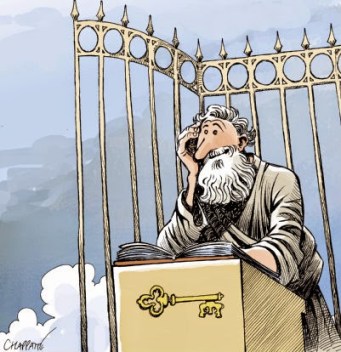
If Hallmark, the Lifetime channel, and uncles who tell bad jokes have anything to say about it, then heaven is a mysterious place in the clouds with fat little cherubic babies floating around playing harps, golden arches keeping certain people out, and Saint Peter sitting with a ledger.

st-peter-pearly-gates

If one of our preschool parents has something to say about it, then heaven (as she told her daughter) is a place filled to the brim with her favorite candy.

But if scripture has anything to say about it, then heaven is like a never-ending worship service. Which, to some people, sadly, sounds more like hell than heaven.

However, the bible is forever making connections between the worship of the Lord here and now, with the worship of the Lord in the New Kingdom. And not the announcements that always take to long to list at the beginning, and not the logistics of sitting down and then standing back up for hymns, but the beauty and wonder of encountering the beauty and wonder of the Lord.

The psalmist says the one thing worth seeking after is to live in the presence of the Lord each and every single day, to behold the beauty of the Lord, and to wonder and inquire in the house of God. In weekly worship, when we experience God’s faithful presence through a choice phrase in a prayer, or a melodic move in a hymn, or even a powerful sermon, we are catching a glimpse of heaven on earth. For when we gather in the house of the Lord, when we are confronted with God’s majesty, what could be better?

As Christians, we do well to seek out the presence of the Lord here and now as foretaste of the kingdom of heaven. We do it on Sundays when we gather together to proclaim and respond to God’s Word. We do it when we are invited to the table for communion. We do it when we sit with a friend and earnestly pray together. We do it when we hear God speak to us in the still small voice. And when we do, we receive an answer to the question, “What’s heaven like?”

Devotional – Psalm 80.3

Devotional:

Psalm 80.3

Restore us, O God; let your face shine, that we may be saved.

Weekly Devotional Image

On Sunday mornings I drive to church hours before worship so that I can properly prepare. I always begin in the sanctuary by praying by the altar and then I pray over every single pew. After I feel like have spent enough time with the Lord I will make sure the doors are unlocked and the heat is working before I step up into the pulpit to preach my sermon to an empty sanctuary. I will go through the sermon line by line and make any changes necessary before printing off the final version.

Yesterday morning I was standing in the pulpit and preaching to an empty sanctuary when I heard a soft voice say, “Hello?” My first instinct was to look up in case God was telling me to make a change to the sermon, but it was actually someone who walked into the church through the main office door. When I went to shake his hand in the hallway it was clear that he had been outside for a long time because he had very red cheeks and he kept bringing his hands up to his mouth to blow on his fingers. He explained that he was homeless and was walking down the street when he felt the need to walk into the church. He told me about various life situations that led him to where he currently is and then I invited him in the sanctuary so that we could sit down and talk some more.

I motioned for him to join me in one of the front pews and asked him to continue. But he didn’t. Instead, his eyes rapidly filled with tears and he wept. I sat stunned and unsure if I had said something wrong, and then asked him if everything was okay. He said, “I can’t remember the last time I saw a Christmas tree.”

Colorful holiday lights background, defocused

What I had neglected to think about was the overwhelming sense of joy that was radiating through our seemingly countless poinsettias and our perfectly adorned and lit Christmas trees; a sense of joy that was in sharp dissonance with what the man has experienced recently.

We talked some more and I learned all about his life, and when it felt like the conversation was coming to an end I asked how I could help him, or how the church could help him. To which he responded, “Honestly, I was just cold and lonely. All I wanted was to warm up and have some company. Thank you.” After that, we prayed together, shook hands, and he left.

This strange season of Advent is one that often leaves us filled with joy, but it can also be a time of deep sorrow. Instead of fondly remembering presents under the tree, we might remember our parents fighting and yelling at one another. Instead of recalling the smells of a delicious Christmas dinner, we might feel suffocated by the sadness of another Christmas without someone we love. Instead of humming the familiar hymns with a twinkle in our eyes, we might not even remember the last time we saw a Christmas tree.

The psalmist cries out: “Restore us, O God; let your face shine, that we may be saved.” O that the Lord would make his face to shine upon all of us through the lights of a Christmas tree, and give us the hope and the joy and the peace we so desperately need this time of year.

Devotional – Philippians 4.7

Philippians 4.7

And the peace of God, which surpasses all understanding, will guard your hearts and your minds in Christ Jesus.

Weekly Devotional Image

How do you think people would respond if there was something that, if consumed once a week, would improve mental and physical health and reduce mortality by 20-30% over a 15-year period? What if this miraculous elixir was in reach of millions of people in America and research has proven that it truly does make a tremendous difference in the lives of people who consume it? How quickly do you think it would become the most popular remedy in the country?

Last week, under the “Breaking News” tab on USA Today Online, was a story detailing the availability of this particular product and the research to back up the claims. And, believe it or not, the “miracle drug” is regular church attendance.

Generic Background Image

After 20 years of research, a group of colleagues from Harvard University published their work suggesting that regularly attending religious services brings about better physical and mental health. Regarding physical health, the researchers claim that, “Adults who attend a service at least once a week versus not at all have been shown to have significantly lower risk of dying over the next decade and a half.” Beyond physical health, participating in regular worship leads to “greater optimism and lower rates of depression.”

After reading the article, one would think that every house of worship would be filled to the brim every weekend!

However, the article begs the question: Why do people worship?

Do we gather together because we want the physical and mental health benefits? Are we so consumed by the fear of death that we will sit in uncomfortable pews once a week just so we can live longer? Do we understand and value worship the same we that we understand and value the prescriptions in our medicine cabinets?

Or, do we worship because in worship we encounter the living God? Are we so consumed by the love of God that we cannot understand a way of life without gathering together once a week? Have we been transformed by the Lord who knows us and calls us by name?

The peace of God, which surpasses all understanding, will guard our hearts and our minds in Christ Jesus. We encounter the peace of God whenever we gather together, whenever we proclaim God’s Word, whenever we respond to that Word, and whenever God’s sends us into the world to be the light that shines in the darkness.

Worship, though apparently beneficial for our mental and physical health, is not about what we get out of it. Instead, worship is about what God gets out of us.

Not My President


Colossians 1.11-20

May you be made strong with all the strength that comes from his glorious power, and may you be prepared to endure everything with patience while joyfully giving thanks to the Father, who has enabled you to share in the inheritance of the saints in the light. He has rescued us from the power of darkness and transferred us into the kingdom of his beloved Son, in whom we have redemption, the forgiveness of sins. He is the image of the invisible God, the firstborn of all creation; for in him all things in heaven and on earth were created, things visible and invisible, whether thrones or dominions or rulers or powers – all things have been created through him and for him. He himself is before all things, and in him all things hold together. He is the head of the body, the church; he is the beginning, the firstborn from the dead, so that he might come to have first place in everything. For in him all the fullness of God was pleased to dwell, and through him God was pleased to reconcile to himself all things, whether on earth or in heaven, by making peace through the blood of the cross.

not-my-president-anti-trump-protesters-900


A year ago today I stood in this pulpit and preached about how God’s kingdom is not of this world. I used Pilate’s interrogation of Jesus (“Are you the King of the Jews?” “You say that I am…”) to juxtapose the world’s expectations against God’s expectations. The sermon ended with a staccato’d refrain that emphasized the kingship of Jesus and our allegiance to his kingdom.

I said:

The world tells us to gain all we can.

            Jesus tells us to give all we can.

            The world tells us to seek vengeance.

            Jesus tells us to seek forgiveness.

            The world tells us to destroy our enemies.

            Jesus tells us to love our enemies.

            The world tells us we are the center of the universe.

            Jesus tells us that God is the center of all things.

            The world tells us to ignore the weak.

            Jesus tells us that the meek shall inherit the earth.

            The world tells us that death is the end.

            Jesus tells us that death is the beginning.

I didn’t think it at the time, but it was a pretty political sermon. After all, making the claim that Christ is our King is a political statement. But what I didn’t anticipate was how the words from that sermon would play out over the next 365 days.

We’re told not to mix politics with religion. Political opinions and religious beliefs are supposed to be kept in the private sphere, they are things we can think about on our own time but the world has no right to interfere with either.

Except the world interferes with both all the time. We hear about things like the Christian Coalition, and the need for Christians to take back the Supreme Court, and I even get emails asking about what the church is going to do regarding local school board decisions.

We hear that the church is not supposed to be political. We shouldn’t endorse particular candidates or platforms. We shouldn’t tell people how to vote, or even to vote at all. The church can’t be political in the sense that it can’t be Republican or Democrat, but the church itself is a politic. To be part of the church, to be part of the body of Christ, implies that our worldview is changed and therefore everything else changes as well.

Like many Sundays throughout the liturgical year, this one has a special focus and significance. However, Christ the King Sunday is a more recent addition to the Christian calendar. Whereas Christians have celebrated the likes of Maundy Thursday and Pentecost for a long time, Christ the King was only established as official day in the church in 1925. It took the church 1900 years to need this day the same way that we need it now.

In 1925, Mussolini had been head of Italy for 3 years, a loud insurrectionist in Germany named Hitler had been out of jail for a year and his Nazi party was rapidly growing in power, and the entire world was suffering under the weight of a Great Depression.

Yet, despite the rise of autocratic dictators, despite the lack of economic opportunities, despite the strange and uncomfortable silence between two World Wars, Christ the King asserted, and still does, that Jesus Christ is Lord and he shall reign forever and ever.

Throughout the last Christian year from Christ the King to Christ the King, we’ve read from Genesis to Revelation, we’ve encountered the living God in the stories from Creation to Redemption, we’ve been transformed by the Word of the God becoming incarnate in the way we live our lives…. And all of this, all of the Sundays, all of the sermons, all of the scriptures, have pointed to one thing: Jesus Christ is Lord.

That’s the thing about Christians, for us everything starts and ends with Jesus. In his letters Paul addresses this strange and beautiful quality of Jesus over and over again. And rather than trying to accommodate Jesus to the ways of the world, Paul calls for all Christians to put Christ first. Yet, Christ is the King of a Kingdom that is so different, and so far from what we’re comfortable with, that putting Jesus first is difficult.

In Jesus’ kingdom the rules and the ruler are different. All assumptions about what is important, and who we are to be, and what we are to care about, have been changed.

It’s like being deported to a strange new land where everyone else is speaking a strange language. It takes time to learn the lingo, and adapt to the habits of the people around us. It’s not a simple matter of fitting Jesus into our present way of thinking, nor is it just giving an hour of our week to worship in a church. We don’t fit Jesus into our lives; Jesus fits us into his.

We are the ones transferred, moved, and deported from one kingdom to another. We move from the kingdom of consumption to the kingdom of communion; from the kingdom of popularity to the kingdom of poverty; from the kingdom of destruction to the kingdom of deliverance; from the kingdom of competition to the kingdom of cooperation.

Everything about what we think we know and understand changes in the kingdom of God, because Christ is King.

USA ELECTION AFTERMATH

The last two weeks have been particularly tumultuous in our country: Economically disenfranchised people are fearful about the potential of losing their health care coverage, while some devastated Democrats are calling for the murder of Donald Trump. Muslims are being threatened with a registration much like the Jews were forced to register in Germany prior to World War II, while Trump voters are being physically assaulted across the national landscape. Immigrants are cowering in fear over whether or not they’re going to be deported, while countless protestors are flooding the streets of cities and the pages of social media with the declaration: Not My President.

Some are berating and demeaning the crowds for their rejection of Donald Trump as their president as if this is the first time people have rejected the president-elect in the United States. It was only sixteen years ago that tee-shirts and bumper stickers were mass produced with pictures of George W. Bush accompanied by the words: Not My President. It was only 8 years ago that Confederate flags were waved during protests after Barack Obama won the election and people were chanting: Not My President.

Thank God Jesus is not our president.

For if Jesus were our president we would have had to pick him to lead us, and we never would have picked him to lead us. We would never willingly elect someone who told us that the first will be last and the last will be first. We would never willingly elect someone who told us to sell all of our possessions and give the proceeds to the poor. We would never willingly elect someone who told us to open up all the borders and let all the refugees in. We would never willingly elect someone who spent so much time with the riff-raff of society.

If Jesus were our president he would be a product of the world rather than a product of God’s incarnation. He would have to make promises to the rich in order to maintain economic stability. He would have to compromise with other world leaders who treat their citizens like dirt. He would have to second-guess the stories he told out of fear that he would not be re-elected in the future.

If Jesus were our president he would have to make us promises that he could never keep, instead of being the glue that keeps all of us together. He would have to take sides in political debates and ostracize entire communities. He would have to brag about the stability of the union rather than name the brokenness that is keeping us from becoming who God is actually calling us to be. He would have to order the extermination of particular individuals and communities in order to keep our country safe.

Thank God Jesus is not our president. Jesus is our King. And instead of electing him, he elected us.

The kingdom Jesus rules is not of this world and it forces us to confront how broken our world really is. Jesus, as our king, subverts the powers and principalities and shows us a new way.

In this broken and flawed world, we see and know God because we see and know Jesus. Jesus is the image of the invisible, the very beginning of everything in creation. Jesus is before all things, and in him all things hold together.

When we encounter things that appear diametrically opposed, things like Republicans and Democrats, Christ is the glue that holds it all together. Through the blood of his death, the blood that was poured out for the world, we encounter the “other” as brother and the “stranger” as “sister.” All the worldly things that seek to divide us are broken down by the glory of the cross that seeks to bring peace and reconciliation rather than division and destruction.

807586_1

It is not an easy thing to be a Christian, to worship Christ as King. We need the strength of God to endure everything with patience while giving thanks to the Father, because we cannot do discipleship on our own. But when Christ becomes first in our lives, when every Sunday is like Christ the King Sunday, when we realize that we a part of a strange new kingdom, everything else starts to change.

Our King does not build walls to keep people out, nor does our king require the registration of different communities under the auspices of “safety.” Our King invites all to the table to discover the power and love of his grace.

Our King does not call for his followers to take up the sword to wipe out political opposition. Our King forgave the people who delivered him to the cross.

Our King does not pander to us with empty promises in order to procure our allegiance. Our King meets us where we are with a simple invitation saying, “follow me.”

Nearly 100 years ago, Christians all across the world needed the first Christ the King Sunday. They needed a Sunday set apart to reflect on how the Lordship of Christ outshines even the most powerful of dictators and the most devastating of depressions.

Today, we need it just as much. We need Christ the King Sunday because it helps to remind us that Jesus’ kingdom is not of this world. It forces us to confront the strange reality of our King being nailed to a cross for the people of his kingdom. It reminds us that peace comes through his sacrifice, a sacrifice that we remember at this table.

Do not be conformed to the ways of this world, but be transformed by the bread and the cup at the Lord’s Table. Instead of consuming the politics and priorities of the world, be consumed by the grace of God made manifest is Jesus Christ. Reject the powers and principalities that seek to undo God’s creation, and kneel before the true King: Jesus Christ. Amen.

Devotional – Luke 17.5-6

Devotional:

Luke 17.5-6

The apostles said to the Lord, “Increase our faith!” The Lord replied, “If you had faith the size of a mustard seed, you could say to this mulberry tree, ‘Be uprooted and planted in the sea.’ And it would obey you.”

Weekly Devotional Image

We are a people consumed and captured by the power of instant gratification. We want the greatest reward for the smallest effort. We post a picture online and we expect people to like it right away. We show up to church on Sundays and we want to be rewarded for our effort. We pray and we assume that God will answer us quickly.

But we, if we are anything, are slaves to God’s will and that requires patience and hardwork.

We have a church member at St. John’s who wears just about every hat you can think of; Dianne Wright is the lay leader and so much more. On Sunday afternoons she walks across the front lawn with a bunch of letters from the alphabet under her arm to change the marquee. On any given day she is writing cards to, and off visiting, the shut-ins from the church community. And she is forever on the look out for “churchy” objects and images that will help others grow in faith.

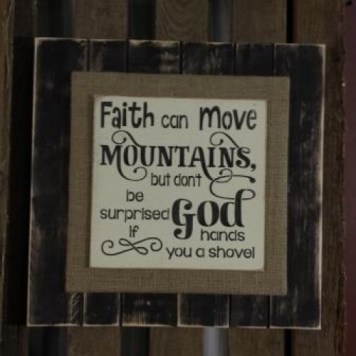
A couple months ago Dianne brought a sign over to the church and hung it against the refrigerator in the kitchen. She does things like this all the time but from the moment I saw this sign, the words have percolated in my mind: “Faith can move mountains, but don’t be surprised if God hands you a shovel.”

faith-can-move-mountains-but-dont-be-surprised-if-god-hands-you-a-shovel-4

Faith and discipleship is hard work. The disciples once asked Jesus to increase their faith, as if he could snap his fingers and it would just happen. But Jesus responds by telling them that faith the size of a mustard seed could pull a mulberry bush out of the ground move it to the sea. Have you ever tried to move a mulberry bush? The roots go deep down into the earth and make the work of replanting quite difficult.

Being a slave in God’s kingdom, yielding to God’s will, means that we have to do the right kind of work to increase our faith. We can’t just ask for it and expect everything to change immediately. It takes the habits of prayer, scripture reading, and communal worship to increase our faith. When we work to follow the commands of Jesus, difficult though they may be, our faith will increase.

God owes us nothing, and yet we are still loved. God’s invites us back into the realm of grace over and over even when we do not deserve it. Christ still loved us while we were yet sinners. And God gives us the power to move mountains and uproot mulberry bushes, but only if we’re willing to work for it.

Devotional – Luke 15.1

Devotional:

Luke 15.1

Now all the tax collectors and sinners were coming near to listen to him.

Weekly Devotional Image

What kind of people do we want in church? What kind of people do we want to encounter in our lives? Day after day I am bombarded by articles with titles like “The Top Ten Ways To Get Millennials Into Church” or “Why Churches Are Losing Young Families” from concerned people within the church. Similarly, because I am considered a “Young Adult Clergy Person” I am often asked (as if I have some magic answer) “What can we do to get young people to come to church?” Our general church culture is consumed with this desire to get younger people sitting in the pews, and therefore makes the assumption that bringing younger people in will fix everything.

Jesus, however, drew in a different kind of crowd.

Through the proclamation of God’s kingdom, and through radical acts of healing, Jesus’ ministry brought in all the tax collectors and the sinners. They, the kind of people we would rather ignore or complain about, were the ones drawn to hear what Jesus had to say. They dropped their daily tasks to discover what God incarnate was really up to.

We, however, want our churches and our lives filled with “good” people. The kind of people who have their lives figured out, pay their taxes, and love their children. We want people with open and uncluttered schedules who can serve on different church committees and can volunteer to work in the church nursery on Sunday mornings. We want people who will sit quietly in the pews during worship and listen intently without questioning what we do.

worship-millennials-youth-young-people-christians-church

Can you imagine what the church (or our lives) would look like if we did our best to attract the same kind of people that Jesus did? What would we have to change in order to draw them in, and what kind of expectations would we have to crucify in order to love them with Christ-like love?

The larger community rejected tax collectors and sinners during the time of Jesus. They were viewed with suspicion and were kept at a distance. And yet Jesus offered something they wanted to hear. Who do you view with suspicion? Who are the tax collectors and sinners of our day? How would you feel if they showed up in church on Sunday?

Devotional – Philemon 1.3

Philemon 1.3

Grace to you and peace from God our Father and the Lord Jesus Christ.
Weekly Devotional Image

The beginning of Paul’s letter to Philemon contains an address that I use in nearly every communication I have with the church I serve. “Grace to you and peace from God our Father and the Lord Jesus Christ” are the words I use to begin worship on Sundays and the words I use to address all of my devotionals and epistle articles. There is something familiar and comforting about using the same words over and over regardless of how the community and the world has changed from week to week; no matter what we have going on in our lives, we are still greeted by the peace and grace of God when we communicate as a church.

The habit of using Paul’s words has shaped the way I interact with the people of St. John’s and the larger community. By beginning with these words I am transported back to almost all of Paul’s letter to individuals and communities, I am connected with the great tradition of the church, and I am reminded that I am called to point to Christ’s witness (and not my own).

The words are good and right and true, but it has been the habit of using them that has had a profound effect on the way I understand what it means to be a disciple.

Every Sunday at St. John’s we have a habit of standing together to affirm our faith using The Apostles’ Creed. The familiar words are printed in the bulletin and we all face the altar to proclaim what we truly believe. And yesterday, as individuals were lining up to leave the sanctuary, one of our youth pulled me aside to ask a question: “Why do we say we believe in the holy catholic church if we are the United Methodist Church?” In the moment I explained that the word “catholic” in the context of the Apostles’ Creed does not refer to the Catholic Church as a denomination but the “universal” church. And even though I answered him, his question stuck with me the rest of the afternoon.

How many times have we used the Apostles’ Creed in church without really thinking about what we say? Has the habit of using those words become so familiar that they no longer bear fruit in our lives? What other things do we take for granted in our worship and in our discipleship?

Habits are a good thing in their ability to shape our behavior. However, we have to be cautious against letting our habits become rote. The words we use in church and in our daily living have the power to transform us because what we believe shapes how we behave. So, we join together with the countless disciples of the past to say, “I believe in God the Father Almighty, maker of heaven and earth; and in Jesus Christ his only Son our Lord: who was conceived by the Holy Spirit, born of the Virgin Mary, suffered under Pontius Pilate, was crucified, dead, and buried; the third day he rose from the dead; he ascended into heaven, and sitteth at the right hand of God the Father Almighty; from thence he shall come to judge the quick and the dead. I believe in the Holy Spirit, the holy catholic church, the communion of saints, the forgiveness of sins, the resurrection of the body, and the life everlasting. Amen.”

0e4453898_1440084142_sermons-series-desktop-the-apostles-creed-3

On Sitting At The Reject Table – Luke 14:1, 7-14

Luke 14.1, 7-14

On one occasion when Jesus was going to the house of a leader of the Pharisees to eat a meal on the Sabbath, they were watching him closely. When he noticed how the guests chose the places of honor, he told them a parable. “When you are invited by someone to a wedding banquet, do not sit down at the place of honor, in case someone more distinguished than you has been invited by your host; and the host who invited both of you may come and say to you, ‘Give this person your place,’ and then in disgrace you would start to take the lowest place. But when you are invited, go and sit down at the lowest place, so that when your host comes, he may say to you, ‘Friend, move up higher’; then you will be honored in the presence of all who sit at the table with you. For all who exalt themselves will be humbled and those who humble themselves will be exalted.” He said also to the one who had invited him, “When you give a luncheon or a dinner, do not invite your friend or your brothers or your relatives or rich neighbors, in case they invite you in return, and you would be repaid. But when you give a banquet, invite the poor, the crippled, the lame, and the blind. And you will be blessed, because they cannot repay you, for you will be repaid at the resurrection of the righteous.

__CpSjwy


Throughout the gospels, people are forever asking Jesus about the kingdom of heaven. What does it take to get in? Who will be there? When will it happen?

And whenever Jesus is asked about the kingdom of heaven, do you know what he compares it to most often? A wedding feast.

I love weddings. I love getting to spend time with a couple as their special day gets closer and closer. I love working with families in terms of making the wedding ceremony as special and faithful as possible. I love being invited into this profoundly holy moment at the altar of marriage and bringing two people into an everlasting covenant. But more than all of that, I love weddings because they are as close as we can get to heaven on earth.

During the months leading up to a wedding, while I’m working on pre-marital counseling and the homily and the order of worship, the couple has a lot of work to do as well. They have to procure a reception location, taste test the hors d’oeuvres and the main course, and find the perfect DJ. But perhaps the most difficult and taxing requirements prior to the wedding are the guest list and the seating arrangements.

Nearly every couple I have married has struggled with who to invite and where to seat them. Does that uncle that no one has seen in years warrant an invitation? And what about your cousin’s ex-wife? Maybe we should just send her an invitation to be kind, but if she shows up where can we put her? And where in the world are we going to put the pastor and his wife?

At one wedding, I rushed through the rehearsal under the blistering sun and everyone was remarkably thankful when I stopped talking. Because the wedding was out of town, we were invited to the rehearsal dinner and upon arrival we did not know where to sit. There was clearly an area for the bridal party, so we avoided that table and decided to just sit at a table in the middle of the room. Like an awkward moment in a middle school cafeteria, we waited to see who would sit next to us, but as family members and friends entered the room, the father of the groom stood up to make a speech. He welcomed everyone and thanked the room for supporting his son and soon to be daughter-in-law, and then he pointed over at me. He said, “Now everyone, this is my pastor and the woman sitting next to him is his wife. So all you young men, you need to stay away from her tonight. Because Taylor has the power to send you to heaven, or to hell.” The room erupted in laughter at the joke, and it was pretty funny, but no one, and I mean no one, sat next to us for a long time.

Jesus was once invited to the house of a leader of the Pharisees and was being watched closely. When he arrived he noticed how particular people chose to sit in places of honor and he used the moment to teach about the kingdom of God. “When you get an invitation to a wedding, do not sit in the places of respect and honor. Someone might come up to you who is more distinguished and important and they will take your place. You will then have to disgracefully move to the reject table. Instead go and sit at the reject table from the beginning, so that when the host comes by he may call you to a grander table. For all who exalt themselves will be humbled and those who humble themselves will be exalted.”

There is always a strange moment at wedding receptions when all the guests stand in line at a poster or some other Pinterestly designed labeling system for where each of us will be sitting. At another wedding, after preaching and leading the ceremony, we got in line with everyone else to find our names and our corresponding table. As my eyes went down the list, I knew that we literally knew no one at the wedding (except the bride and groom) and I wasn’t hoping for anything special. But when my eyes finally made it to the end of the list, I knew that we were definitely assigned to the reject table.

You know the one, the table where you send the odds and ends, that strange second cousin that you had to invite and you hope he doesn’t get too rowdy, the piano teacher from a decade ago, the weird friend your mother insisted on inviting but who always drove you utterly crazy. That table.

When we made our way to the back of the room, it only took one glance to confirm our suspicions that we were at the reject table because no one was talking and none of the people knew each other. At every other table in the reception area conversations were flowing and laughter was breaking out, but at the reject table it was silent.

In the silence you could almost sense the recognition of our reject status, but the nail on the coffin was when the pastor and his wife pulled out their chairs and sat down. At a wedding, if I sit at your table, you are part of the rejects.

At first we just further perpetuated the silence by sitting there awkwardly fumbling with our cell phones and such, until I decided to break the ice and compliment the camouflage koozie that was keeping a beer cold in the hand of who I can only imagine was a distant cousin. I said something stupid like, “Man, I could barely tell you were even drinking a beer.” At first he didn’t respond, either because the joke wasn’t funny, or because he was unsure of how to speak to a pastor about beer. But when Lindsey laughed at my foolish attempt to be funny, the whole table seemed to take a collective breath and relax.

From that first, albeit strange, compliment a conversation began to percolate and eventually spilled out over the whole table. Within ten minutes we were probably the rowdiest table in the entire room and were regularly being shushed by other guests while the speeches were being made. We didn’t care that we couldn’t see the bride and groom at their table in the front, we didn’t care that we were the very last table to be called to go through the buffet line, we didn’t care that we were the misfits at the reject table. Instead, we were just happy to be there.

From the humility of the reject table we were exalted to the joy of the wedding celebration.

Jesus spoke to the people gathered together to teach them about the virtues of humility. And in telling the parable of the wedding banquet he was not just assigning them to be humble at weddings, but in all aspects of life. To live the kind of selfish and exalted life of the best table is to forget that we depend on God. It is to believe that we are in control of our lives and that we have the power to save ourselves. It is a fundamental lack of trust that the Lord will provide.

humility word in mixed vintage metal type printing blocks over grunge wood

Humility, on the other hand, is an unselfish way of living while depending on the Lord. It is to believe that our lives are not our own and that only God has the power to save us. It is a fundamental trust in the Lord’s ability to provide.

And Jesus does not leave it at that. He pushes the gathered body even further. Whenever you’re invited somewhere, live humbly. And whenever you are the host, do not invite people with the expectation that they will provide the same courtesy. Do not invite your family, and your neighbors, or your rich friends assuming they will do the same. Instead, invite the poor, the crippled, the lame, and the blind. Invite the people you would otherwise ignore. And you will be blessed precisely because they cannot repay you.

This is a tough commandment for all soon to be married couples. Most of them would never dream of omitting an invitation to family members, and friends, and rich relatives who give the best wedding gifts. They would never dream of inviting strangers and outcasts and rejects to their wedding feast and celebration.

But the marriage of Christ with Christ’s church is a wedding celebration that all of us have been invited to. We are here in the midst of worship: the wedding of God with God’s people, and none of us should have been invited. We can never repay the kindness of God’s invitation, we are unworthy of sitting in these pews, we fail to be obedient to the kind of love that we experience here. And yet we are invited. And frankly, we are all sitting at the reject table.

Jesus Christ invites us to this place to celebrate the great victory over death, the resurrection of glory, and the reconciliation of all things. And that’s different than just being included. Many churches love to claim and proclaim their inclusiveness. Inclusive has become such a buzzword in Christianity that you will find it on nearly every church website and every church bulletin you come across. We so desperately want to appear welcoming and inclusive with the hope that it will draw people into our wedding celebration called the church.

But being inclusive is lazy. Because being inclusive does not require us to do anything but sit here, stare at the doors, and hope people will show up.

            Jesus did not lead an inclusive ministry.

            What Jesus led was a ministry of invitation.

Much like being invited to a modern wedding celebration, Jesus actively went out seeking others to draw them into the party. He met them where they were and invited them to join him on the way that leads to life. His ministry was about breaking down the labels and constructs that people were isolated into, and gathering all of the so called rejects together to celebrate the glory of God.

Our Lord invites all without expectation and without assumption. God Almighty knows our sin and our failures and still sees potential. The Lord meets us where we are through the words of our worship and through our friendships. The great story of scripture, from this passage in Luke to the entire narrative, is not about God waiting for us to show up, but God’s great work to find and transform us.

Sitting at the reject table comes at a cost. It means being surrounded by people we do not know, people we probably don’t agree with, and people who might drive us crazy. It requires a tremendous amount of humility and trust and faith. But it’s also the way we got invited to this party. Amen.


00035522_h

Devotional – Genesis 15.6

Devotional:

Genesis 15.6

And he believed the Lord; and the Lord reckoned it to him as righteousness.
Weekly Devotional Image

“If you believe that God exists, and confess Jesus as Lord, you will go to heaven.” So said one of the staff members during our mission trip to Raleigh, NC last week. The youth were all assembled on the floor, they had shared their “Yea God” moments from the day, they had joined together for a few worship songs, they listened to a testimonial, and were now being offered a one-way ticket to glory. During the testimonial a few youth began to cry in response to the vulnerability of the young man sharing his story. The lights were dimmed to just the right degree. And then he hit them with the “If you just believe that God is real, and confess Jesus as Lord, you will go to heaven.”

However, there is a difference between believing that God exists, and believing God.

In a relatively recent poll, it was determined that 9 out of 10 American adults believe that God exists, and more than 40% of Americans say they go to church weekly. However, less than 20 % are actually in church on Sundays. In the US we have a considerably high number of people who believe that God, or some sort of universal spirit exists, but only a fraction of them believe God enough to gather with a regularly worshiping community.

tumblr_ny91sd9Df61s91yx0o1_1280

Believing that God exists is something that most people are willing to admit. When confronted with the totality of the universe they’ll confess that there might be someone, or something, behind the scenes. When they encounter a question without an answer, they are okay with assuming that “God” might be the answer.

But believing God is another story.

When Abraham was promised descendants more numerous than the stars, he did not simply believe that God exists in reality, but instead believed what God revealed to him. Abraham believed the promise.

When Moses discovered the burning bush, he did not simply believe that God was real, but instead believed what God revealed to him. Moses believed that God was going to deliver God’s people out of bondage.

When Jesus cried out from the cross, “Father forgive them, for they do not know what they’re doing”, he did not simply believe in the existence of God, but instead believed what God revealed to him. He believed in the power of God’s grace to forgive, even from the point of death.

We can believe God exists without much trouble or hesitation, because to believe God is real requires very little of us. But to believe God, to believe that God works in the world, that God makes good on God’s promises, that the Holy Spirit empowers us to serve and sacrifice, requires us to live radically different lives.

Devotional – Psalm 19.1

Devotional:

Psalm 19.1

The heavens are telling the glory of God; and the firmament proclaims his handiwork.

Weekly Devotional Image

“Where do you feel God’s presence?” This is one of my favorite questions to ask whenever I gather with fellow Christians, and one that I will be asking the youth on our mission trip to Raleigh, North Carolina this week. “In your daily life, where do you feel the presence of the Lord?”

The good and faithful members of St. John’s are usually quick to say they feel God’s presence in the sanctuary whenever they gather for worship. Whether it be a particular hymn, a stained glass window, or even the rare good sermon, they feel like God is with them when they’re sitting in the pews.

Others will tell me that they experience God’s presence in the silence of the morning right after they wake up, or the moment right before they fall asleep. They can describe feeling comforted by the Lord’s presence in that moment when they are otherwise totally alone.

And still yet others tell me they regularly experience God’s presence in nature. There is something about the sounds of the woods, or the view of a sunset, that is indicative of God’s great majesty and power.

God-s-nature-god-the-creator-18227111-600-468

In the psalms we read about the earth proclaiming the handiwork of the Lord. From the smallest cell in a leaf to the great horizons of the Blue Ridge Mountains, the world around us declares the work of the Lord.

The challenge of discovering the Lord in nature is in not taking nature for granted. How often do we get in the car to drive along I-81 without taking a glance at he mountains in the distance? How often do we sit in our backyards without giving thanks for the light and subtle breeze? How often do we curse the bees flying around our heads without giving thanks for their pollinating practices?

This week, as we continue to take steps in faith, let us look for the presence of the Lord in the pines and the poplars, the plateaus and the prairies, the ponds and the puddles, the wind and the wake, the stars and the sky, the breeze and the bulbs, the fungi and the fireflies.