The Elephant In The Room

Romans 5.1-11

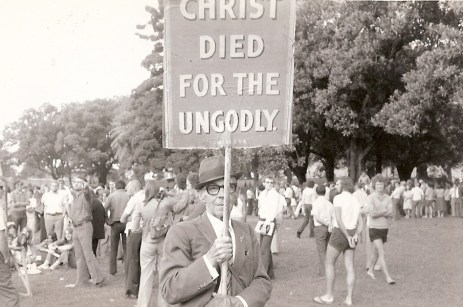
Therefore, since we are justified by faith, we have peace with God through our Lord Jesus Christ, through whom we have obtained access to this grace in which we stand; and we boast in our hope of sharing the glory of God. And not only that, but we also boast in our sufferings, knowing that suffering produces endurance, and endurance produces character, and character produces hope, and hope does not disappoint us, because God’s love has been poured into our hearts through the Holy Spirit that has been given to us. For while we were still weak, at the right time Christ died for the ungodly. Indeed, rarely will anyone die for a righteous person – though perhaps for a good person someone might actually dare to die. But God proves his love for us in that while we still were sinners Christ died for us. Much more surely then, now that we have been justified by his blood, will we be saved through him from the wrath of God. For if while we were reconciled to God through the death of his Son, much more surely, having been reconciled, will we be saved by his life. But more than that, we even boast in God through our Lord Jesus Christ, through whom we have now received reconciliation.


Sometimes I’ll be running at the gym, or walking the dog, or just sitting in my office when an idea will pop into my head. The idea starts like seed and then it germinates throughout my mind into sermon topics and bible studies and blog posts. The idea grows and grows and before it disappears into the gray matter of my brain I make sure to write it down.

And, (would you believe it?) an idea is coming to me right now! But I don’t have any paper up here so I need you all to write this stuff down (seriously).

Okay, we are justified by faith, God’s faith in us. That’s what we talked about last week. And because we are justified by faith, we have peace with God through Jesus. And, I mean, not only that, but we are bold to boast of God’s grace in our worst moments, because we know that our suffering leads to endurance, and endurance leads to character, and character leads to hope.

Yeah, that’s good.

We arrive at hope because God’s love has been poured into our hearts through the Spirit. And we know that God loves us because while we were still weak, Christ died for the ungodly. Right? Like, how often will someone die for a righteous person? Though, I guess for a good person someone might actually dare to die. But God proves his love to us in that while we were sinners Christ died for us!

Still with me?

Okay, and its even more than that, now that we have been justified by Christ’s blood we will be saved from the wrath of God. Through Jesus’ death we were reconciled back to God, and through Jesus’ life we will be saved! This is worth boasting about!

Did you get all of that?

Let me try to simplify in case I lost any of you: We are justified by God’s faith in us. Suffering leads to endurance, endurance to character, and character to hope. We arrive at this hope because we know God loves us. And we know God loves us because Christ died for us while we were yet sinners…
domain117

Paul is hard to take from the pulpit. Give me one of the stories of Jesus’ healings, or any of the parables; they preach themselves. Sometimes I even think it would be better to just read the scripture and not preach anything at all. But with Paul it takes on a new and strange and difficult dimension. Paul, in his letter to the Romans, writes in a form of rhetoric almost lost to the sands of time. In our current age of 140 character tweets from our President, frenetic television shows, and fast-paced YouTube videos, we no longer have the minds, nor the time to hear Paul’s theology.

A theology that was probably dictated to someone else to write down while Paul was thinking it up.

You can almost hear that in the reading can’t you? It’s like he remembered something from a few sentences back and wants to clarify it.

The Epistle to the Romans is not a perfectly crafted sermon meant for pulpit proclamation. Instead, it’s practical theology dictated from the greatest missionary the world has ever known.

Paul begins this section by addressing suffering; it’s the part of the passage that is most often mentioned. And he’s not just talking about some esoteric understanding of suffering. Paul is talking from experience! At the time of this letter, Paul was not a young, pre-maturely balding, healthy pastor standing in a pulpit telling his worn and suffering congregation to keep their chins up. No, this is entirely different. Paul suffered for the gospel, was arrested and persecuted, and yet he continued on. That’s why he can say that suffering leads to hope. For Paul it’s not a false and empty promise, it’s what he has experienced.

And then we come to the section about dying for others.

maxresdefault (3)

Dying for others, for one’s country, for our families, these stories captivate our hearts and our emotions. The thought of all the firefighters courageously rushing into the World Trade Center buildings on September 11th, or the countless volunteers who went to the other side of the world to fight in World War II, or just hearing about a mother who sacrifices herself to save her children, these stories really pull our heart strings.

But here, in Paul’s letter to the Romans, this is even more radical than any of those stories. We have to try to put aside the emotional waves of grief and reverence for the stories of modern sacrifice for one’s friends, family, or country. Paul does not say that Jesus died for his friends or his family or even his country.

            Christ died for the ungodly!

Paul says that Christ died for us while we were his enemies!

Talk about an elephant in the room… While we were yet sinners, Christ died for us. We hear it in Romans, we hear it every time we come to the table for communion, but do we believe it?

We don’t like talking about sin, we good Christian folk. We want to hear about love, peace, joy, hope, and happiness.

Only the converted, those whose lives have been truly captivated by Christ, think of themselves as sinners. Others won’t have anything to do with it. That, my friends, is why we so seldom read from Paul’s letters in worship; we don’t like the idea of ourselves as sinners, as ungodly.

“Preacher, can’t you just give us a little more grace and love from the pulpit? Nobody wants to come to church to hear about sins!” And yet, we enjoy reading in the gossip columns and watching TMZ to learn about other people’s sins, but that’s their problem.

We don’t like admitting our shortcomings, our faults, and our helplessness. We reject that gospel and substitute our own, one we talked about a couple weeks ago. We’d rather believe the American gospel: God helps those who help themselves. Actually, Paul tells us quite the opposite: When we could not help ourselves, when we were stuck in the shadow of sin, Christ died for us.

73d8be39b92edf6031d5a129be633895

In our current age of tweets, twenty-minute TV shows, and traffic filled websites, we want everything compartmentalized as much as possible. Instead of reading a newspaper we want a short and brief email every morning that tells us only what we need to know. Instead of buying the latest hit book and spending an afternoon in our favorite chair, we read a summary online so we can talk about it with our friends. And instead of coming to church for an hour a week to experience the presence of God, people read the sermon online and check off the box on the Christian list of to-dos.

We, whether we admit it or not, are consumed by a desire to compress as much as possible into something as small as possible. Paul completely rejects this desire and notion that we can limit the gospel to any particular sentence or paragraph. The Gospel, the Good News, is nothing less than the life, death, and resurrection of Jesus Christ, Son of Man, and Son of God.

But, if we cannot resist the temptation, if we have to have something small, something we can keep with us at all times to know what the gospel is, this might work: While we were still sinners, Christ died for the ungodly.

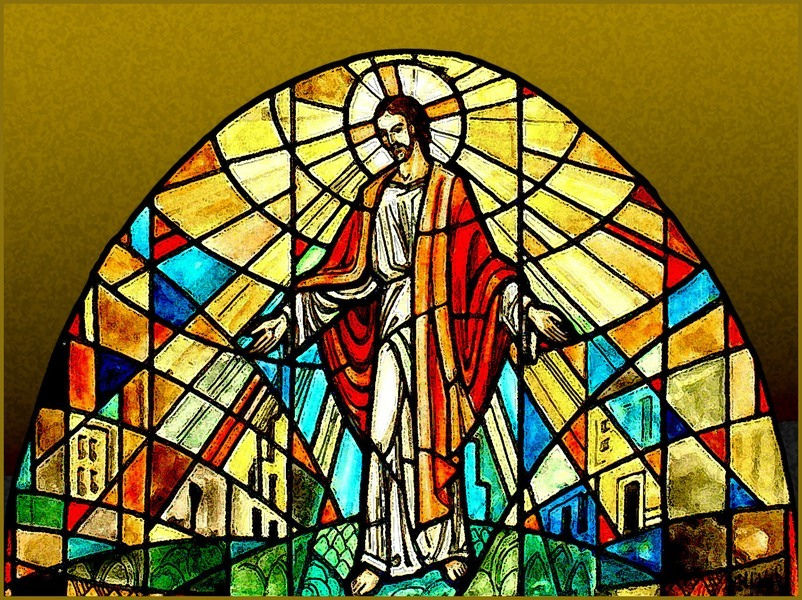
            This is crazy stuff people! Our Lord and Savior, the one in the stained glass window behind me, he died for the ungodly!

Who is the ungodliest person you can think of right now? I know some of you will immediately think of the members of ISIS who are terrorizing regions under their control. Others of you will immediately think of the leaders in North Korea who are trying their best to develop nuclear weapons of mass destruction. Some of you might think of Donald Trump and the seemingly endless Executive Orders streaming out of the Oval Office these days. Some of you might even be thinking about the person sitting in the pew next to you.

If it’s too hard to think of someone ungodly, just think about one person you’re angry with right now…

Jesus died for that person. Whoever you’re thinking of, whoever that completely backwards and horrible and disappointing person is that’s bouncing around in your mind right now, Jesus died for them.

That’s the real elephant in the room. Jesus died precisely for the sort of person that would crucify him and mock him while they were doing it. People like us.

These things we call faith and discipleship are not very religious in the sense of being pretty and easy to handle. They are not something we can carry around in our pockets during the week only to show up when we need them. The cross of Christ is far too offensive to be religious.

The cross and the death of Christ shatter our expectations given to us by the world. They, in all their strangeness, reorient us back toward the radical nature of God’s love. The offensive and scandalous cross is our paradoxical hope and joy. Because in and through the cross, God did something that none of us would do.

            As the old hymn goes, the immortal God hath died for me.

God’s love in Christ is so comprehensive and so bewildering that it is able to wash away even the greatest of sins.

We started this sermon with a dictation, an imaginative way to reimagine the writing of Paul’s letter to the Romans. If you wrote down anything I hope you wrote this: While we were yet sinners God died for the ungodly, for us.

Now I want you to write down the name of the person you thought of just a moment ago, the person who you’re angry with. Write his or her name at the top as if you meant to send this letter to them.

Now you know that I’m going to ask you to send it. And I know that you probably won’t. You won’t for the same reason I wouldn’t; it’s offensive and it’s uncomfortable. We won’t send this affirmation of God’s unnerving love to someone else because it would force us into an area we’d rather avoid; we don’t want to come off as too evangelistic, or too churchy. We don’t want to admit our sin.

Can you imagine the shock on the person’s face if they received your dictated letter from the adapted words of the apostle Paul? Can you picture how bewildered they would be by something Christians say all the time? Can you imagine how it would change the way you look at them for the rest of your days?

While we were still weak, Christ died for the ungodly. In our weakness we reject the challenge to confront our sins and we reject the forgiving nature of God’s love for the world. We forget that Christ died for our shame and our sin and our sadness. We forget that Christ died for our disappointment and our degenerate derelictions and our deficiencies. We forget that Christ died for us and for the people whose names’ are at the top of our letters.

And yet Christ still died for us! What wondrous love in this that that caused the Lord of bliss to bear the dreadful curse for my soul! To God and to the Lamb who is the great I am, we shall sing! And when from death we’re free, and through eternity, we shall sing.

For while we were yet sinners, Christ died for us.

Amen.

Love The Sinner, Hate The Sin

Matthew 7.1-5

Do not judge, so that you may not be judged. For with the judgment you make you will be judged, and the measure you give will be the measure you get. Why do you see the speck in your neighbor’s eye, but do not notice the log in your own eye? Or how can you say to you neighbor, “Let me take the speck out of your eye,” while the log is in your own eye? You hypocrite, first take the log out of your own eye, and then you will see clearly to take the speck out of our neighbor’s eye.


We announced this sermon series a couple months back, and ever since then a number of you have expressed your excitement about the possibility of confronting these Christianisms. Whether you were in the middle of suffering and someone said, “God won’t give you more than you can handle” or a friend tried to explain how your struggles were given to you by the Lord because “everything happens for a reason” or any number of situations, these dumb things that Christians say are things all of us have heard.

However, some of you have also expressed your concern about today’s statement, the last one in the series, “love the sinner, hate the sin.”

It sounds so right doesn’t it? What could possibly be wrong with it?

We can all agree that Christians say a lot of dumb things, but this is a good thing to say, right?

post_image2-720x360

In my experience, when people say “love the sinner, hate the sin” they are usually referring to homosexuality. For many, it is a kind and Christian way to say, “I love my gay friends, but I hate that they’re gay.” In this post-truth, post-liberal, post-whatever period, it is a way for some of us to cover our true feelings while appearing congenial toward those whom we disagree with about sexuality.

Though recently, when I’ve heard people say it they are now using it with regard to the realm of politics. It is amazing how quickly the Christian cover-all for conversations about homosexuality has shifted to conversations about who, or who isn’t, running the country. “Well, I know she voted for that traitor Hillary Clinton, but I love her anyway.” Or “Donald Trump is ruining our country, but I love him anyway.” “I love my brother, but he can be a bleeding liberal.” “I love my sister, but she’s so conservative she’s off the political spectrum.”

Love the sinner, hate the sin.

It sounds good, but it’s pretty hard to hate another’s sin, without harming the sinner.

What is sin? We don’t talk about it anymore. Pastors like me would rather talk about God’s loving nature, than God’s judgment. We would rather tell people like you to love your neighbors, than to tell you to tell your neighbor they’re sinners. We would rather skip over the hard and strange passages about condemnation than truly proclaim that God’s scripture is still speaking to us today.

But for a long time, and I mean a LONG time, sin was THE thing that pastors talked about; sinners in the hands of an angry God, fire and brim stone, and repent or burn forever.

We’re afraid of sin. And not sin as a behavior; we’re afraid to talk about it because it makes us, and our congregations, uncomfortable. I hear again and again that people don’t want to leave church feeling miserable about their lives and their behavior, so preachers like me water down the gospel and we avoid even mentioning sin.

In fact, I had a professor in seminary who taught us to preach ten sermons about grace for every one sermon about sin. We preachers, and you Christians, can’t handle the topic of sin like we once could.

But what is it?

In both Hebrew and Greek the words for sin basically means “to wander from the path” or “to miss the mark.” Sin is any action, thought, or behavior that divides us from God. Sin can be any choice, or lack of choice, that results in failing to do something we know we should.

And here’s the thing: We all do it. All of us sin. From the guy standing before you in a white robe, to the decades long Sunday School teacher, to the child drawing on his bulletin, to the person in the pew across the aisle, to you. We are all sinners.

We think, say, and do things we should not. And we fail to think, say, and do things we should.

lovehate1-750x400

Love the sinner. Of course we are supposed to love the sinner. Jesus did it all the time. Most of his ministry was about loving sinners. The problem is that Jesus does not call his disciples to love sinners, but to love our neighbors.

This is an important difference. The difference being the starting point. If we say we are going to love sinners, we will view other people more like sinners and less like neighbors. It automatically puts us into a place of judgment where we are the righteous, and they are not.

Loving sinners also furthers the problematic identity problem where by we understand and identify others by their mistakes. We label people by their sins. Regardless of when the sin occurred, and even regardless of frequency, we still call people things like cheaters, adulterers, and liars.

Or, to put it another way: Instead of seeing our neighbors as our neighbors, we judge them and identify them by which political candidate’s name was on a sign in their front yard.

A while back one of my friends was starting a new job fresh out of college. He was understandably nervous when he entered the office building for the first time and made his way to a cubicle near the corner of the room. He quietly unloaded his boxes of pertinent materials onto his desk and set up pictures of his family and friends while other employees walked idly by.

There were signs that someone had used the cubicle before him: an accidental scratch across the desk, a piece of discarded paper in the trashcan, and finger smudges on the computer monitor. But other than that, the cubicle was empty.

He worked his first full day under the weight of focus, though a few people came by to introduce themselves. And when it was time to go home he packed his bag and opened the top drawer to grab his pen when he noticed a post-it note near the back. Without thinking much about it, he grabbed it and read three big words: DO NOT TRUST. And underneath those words were the names of five people from the office.

Can you imagine? No matter how hard he tried to forget the note, no matter how hard he tried to trust the people in spite of what he read, his entire perspective had been reshaped by those three words.

The same happens when we view others as sinners first, and neighbors second. We should always try to love them, but we can love them even more if we see them first as our brothers and sisters and less as sinners in our midst.

Jesus says, “Why do you look for the speck in your neighbor’s eye, but do not notice the log in your own eye?” We’re good at seeing the sin in others. That’s what Facebook is for! So we can vent about the sinners in our midst and all the problems they’re causing for the rest of us!

Jesus used this expression because he knew that the disciples would struggle with the tendency to judge others. So instead of loving the sinner, perhaps it’s better to say “I am a sinner, and I ‘m trying love my neighbor.”

But we still have to face the end, “hate the sin.”

Jesus spent a lot of time with sinners: drunks, prostitutes, thieves, murderers, traitors, and countless others who sinned against the Lord. Jesus routinely gathered with them to do what we will do in a few minutes, he broke bread with them. Jesus gave him the most precious gift he had to offer, his time. And then he told them to follow him.

But Jesus never, not even once, said to any of them, “I love you, but I hate your sin.”

Jesus, instead, offered forgiveness.

He encountered all kinds of people who were defined by their choices, and he saw them for who they were in spite of their sins. His love was such that it knew no bounds. It was enough.

            But we are not like Jesus. We fail to love the other as brother and the stranger as sister. We have logs in our eyes and say things like, “love the sinner, hate the sin.”

love

There was a man who died, and upon his death he arrived at the pearly gates in heaven. He looked all around and soaked up the sights of the fluffy clouds and he was so excited to see people just on the other side of the gate that he had missed for so long. He wanted to run straight to them but there was a line leading up to St. Peter. So the man got in line and waited patiently for his turn.

He knew it wasn’t the right thing to do, but as he got closer he couldn’t help eavesdropping on the conversations between St. Peter and the soon to be residents of heaven. “Oh you did so much for that soup kitchen!” “You’re the one who read scripture out loud in church every week, very good, very good.” And so on. But when the man’s turn came, St. Peter looked down in the Book of Life and then said, “Yeah you were a believer, but you skipped the ‘not being a jerk about it’ part.”

Saying, and living by, “love the sinner, hate the sin” makes us jerks. It means the log in our eye is so large that we are unable from seeing others as brothers and sisters. It means that our own sinfulness blinds us from truly loving.

There is sin in this world. People will make the wrong choice, they will choose evil. We will make sinful decisions; we will avoid doing the things we know we should do. But instead of rallying together and focusing on all the sins and problems of other people, instead of flocking to the Internet and like-minded dinner parties to declare the sins of the other, we all need to take a good hard look in the mirror. We need to recognize the log in our own eyes before we dare point out the speck in another.

Because Jesus, looks right into our hearts and says “I love you, log and all.”

God in Christ knows the prejudices we’re ashamed of, God knows the golden calves we worship instead of Him, God sees our self-righteousness and indignation and says, “I love you, log and all.”

God sees the emails we craft out of anger but are too afraid to send, God knows the ways we lie to our spouses and our children, God witnesses the depth of our depravity and says, “I love you, log and all.”

God was there with us in the voting booth, God hears the sighs we utter in response to someone on the other side of the political aisle, God knows how we really feel and says, “I love you, log and all.”

“Love the sinner, hate the sin.” We say it. We read it. We might even live by it. But we should just stop with the word “love.”

Love.

617564_1

Not Hallmark love. Not Valentine’s Day love. But love like Jesus. That might be good enough. Because loving like Jesus does not mean turning away from the sinners in our midst. It means walking up to a crowd of people who are about to do something terrible and saying, “Who among you is without sin? Let him cast the first stone!”

It means encountering the beauty of the Lord and responding with the truest words we can ever say: “Have mercy on me Lord, a sinner.”

It means being humble enough to seek out those whom we have wronged and asking for their forgiveness.

It means caring for those on the margins regardless of the decisions they’ve made or the sins they’ve committed.

It means reaching out to the people who we disagree with most not to change their mind, but to offer them the same thing Jesus offer us, time.

So the next time we say “love the sinner, hate the sin.” Let’s just stop with love. Amen.

Devotional – Isaiah 58.1

Devotional:

Isaiah 58.1

Shout out, do not hold back! Lift up your voice like a trumpet! Announce to my people their rebellion, to the house of Jacob their sins.

Weekly Devotional Image

Sin is an ugly word. It is an ugly word because it makes us uncomfortable. When I encounter people in my life who no longer attend church, they often describe their reasoning as “church was only about sin” or “I left every week feeling miserable.” Sin is an ugly word.

It is true that in some churches sin is the focus of nearly everything. But in Mainline Protestant Christianity, we avoid even mentioning sin because of its ugliness. We preachers would rather talk about God’s loving nature than God’s judgment. We would rather tell our people to love their neighbors as themselves than to tell their neighbors that they’re sinners. We would rather skip over the hard passages about condemnation than reflect on how they are still speaking directly to us even today.

And yet, God speaks through Isaiah to say, “Shout out, do not hold back! Lift up your voice like a trumpet! Announce to my people their rebellion, to the house of Jacob their sins.”

There are definitely bad ways to “shout out” about people’s sins. Logging on to Facebook in order to belittle the other for their differing political or social opinion might sound like a blaring trumpet blast, but it accomplishes nothing good. Sending anonymous letters or notes to people because of their former lifestyles might feel like “not holding back” but it usually just leaves them hurt and afraid. Judging others from afar with our like-minded peers might feel like “announcing their rebellion” but it will just harden our hearts.

ba5a88_745ed11d50df4caf94abfd12d5025422

However, there are good ways to “shout out” about people’s sins. First, we must remember that we too are sinners who have fallen short of God’s glory. Second, we can only speak the truth of another’s sin in love, which is to say, we need to be in relationship with the person to such a degree that they can hear what we have to say without blowing it off. Third, we can only “announce rebellion” if we are willing to help the person to move out of their sinfulness; we cannot simply declare their sin like a trumpet blast unless we are willing to do the hard work of helping them out of it. And finally, we can only announce another person’s sins if we are prepared to hear our sins as well.

The existence of the church is a response to our need to hear about our sinfulness. We gather together to hear the Word so that we might be transformed into God’s people. But this cannot happen if we are more concerned with transforming others, than with transforming ourselves. We cannot announce the sins of another, unless we can first say “Have mercy on me O Lord, for I am a sinner.”

So shout out, and lift up your voices like a trumpet. But beware, for the trumpet will blow in your direction as well.

Racism is America’s Original Sin

A few days ago Teer Hardy and I spoke with Bishop Will Willimon about his new book Who Lynched Wille Earle? The conversation also covered a number of other topics including the inauguration of Donald Trump, the black church, and prophetic preaching. Check it out here: The Idolatry of Race and subscribe to Crackers & Grape Juice.


4371604984_6212ed3d58_z


Devotional – John 1:29

Devotional:

John 1.29

The next day [John] saw Jesus coming toward him and declared, “Here is the Lamb of God who takes away the sin of the world!”
Weekly Devotional Image

The quest for the historical Jesus, for the most authentic and true description of the man, dominated a strain of theological thought during the 19th and 20th centuries. Theologians would dissect scripture, historians would recover artifacts, and pastors practically posit who Jesus really was during the first century. In large part it was a response to the world’s obsession with historical and verifiable truth at the time, but it also captivated the minds of many Christians who sat in the pews on Sunday mornings.

Through their work Jesus was seen as a Rabbi (a teacher and prophet of first-century Judaism), a Light to the Gentiles (a philosophical mediator between differing groups), a Monk who ruled the world (a monastic example of the need to remove oneself from the world), the Prince of Peace (the divine example of pacifism), a Liberator (the opposition to economic and social injustice), and a slew of other identities.

In response to this growing trend, Albert Schweitzer famously said that going to look for the real Jesus is like looking into the bottom of a well; we know there is something down below, but what we’re really seeing is a faint reflection of ourselves.

historical-jesus

Many of us are guilty of this similar line of thought even today. We have a social cause on our radar and we twist and manipulate Jesus to defending our cause. Politically, regardless of which side we identify with, we make the assumption that Jesus is on our side when debating someone with a different position. Our churches are so sure that Jesus supports our behavior that we are suspicious of everyone outside the bubble of our experience.

John, however, saw Jesus and declared, “Here is the Lamb of God who takes away the sin of the world!”

How do we see Jesus? Do we limit Jesus to some political ideology or ethical principle? Do we believe that Jesus is our side and that we have a responsibility to convert those who disagree with us? Do we look for Jesus and only see a faint reflection of ourselves?

Or do we see Jesus like John? Do we open up scripture to enter the strange new world of the bible and encounter the Lamb of God? Do we understand Jesus as totally other and at the same time just like us? Do we believe that Jesus has not only taken away our sin (and therefore calls us to be holy) but also taken away the sins of our enemies?

How do we see Jesus?

Kidnapping Santa Claus


Isaiah 11.1-10

A shoot shall come out of the stump of Jesse, and a branch shall grow out of his roots. The spirit of the Lord shall rest on him, the spirit of wisdom and understanding, the spirit of counsel and might, the spirit of knowledge and the fear of the Lord. His delight shall be in the fear of the Lord. He shall not judge by what his eyes see, or decide by what his ears hear; but with righteousness he shall judge the poor, and decide with equity for the meek of the earth; he shall strike the earth with the rod of his mouth, and with the breath of his lips he shall kill the wicked. Righteousness shall be the belt around his waist, and faithfulness the belt around his loins. The wolf shall live with the lamb, the leopard shall lie down with the kid, the calf and the lion and the fatling together, and a little child shall lead them. The cow and the bear shall graze, their young shall lie down together; and the lion shall eat straw like the ox. The nursing child shall play over the hole of the asp, and the weaned child shall put its hand on the adder’s den. They will not hurt or destroy on all my holy mountain; for the earth will be full of the knowledge of the Lord as the waters cover the sea. On that day the root of Jesse shall stand as a signal to the peoples; the nations shall inquire of him, and his dwelling shall be glorious.

advent_2015_screen


One Christmas, many years ago, there was one thing I wanted more than anything else: I wanted to kidnap Santa Claus.

I must’ve been 7 years old when I decided it was time to enter the world of criminal activity and I began plotting my plan. At the time, my bedroom was in the basement just down the hall from the living room and the fireplace where Santa usually entered the house. For months I eagerly anticipated that hallowed night when we would leave out the cookies and the milk, when we would deck ourselves out in matching pajamas, when we would struggle to sleep with the excitement of the morning presents so close at hand, but this time I was going to be ready.

In the days that led up to Christmas, the time we call Advent, I went through every drawer and found items that could be used for my trap. I took every tie and belt that I owned and tied them together in one long rope. It wasn’t quite enough so I started collecting random bits of string I found around the house and added them to my dress clothes accessories. I carefully laid out the entirety of it from my bed, through my room, down the hall, around the corner, and right up to the front of the fireplace.

The key to the whole operation was the last piece attached to the last tie, my plastic Fisher-Price stethoscope. You see, with the stethoscope at the very end, it would functionally wrap around Santa’s ankle so that I could pull from my end in my bedroom and bring ole Saint Nick down to the ground.

And so I practiced. I set up the elaborate trap and forced my little sister to stand by the fireplace while I ran back to my bedroom, got under the covers and pulled as hard as I could. Over and over again I yanked on the line perfecting the angles and the force necessary to bring my prey into captivity. It was perfect. Now of course, my mother was very concerned when she discovered that all of my nice belts and ties were wrapped together and when she asked what I was up to, I replied, “Don’t worry about it.”

On Christmas Eve, we went to church with everyone else and I didn’t listen to a word. All I wanted was to get back to the house and catch the red-dressed man.

Why? Well I’m not entirely sure, but why not? After all, this guy shows up in homes every year and brings overwhelming cheer to so many. I guess I just couldn’t stand all the mystery, I wanted to know what compelled him to do what he did, and I wanted to know what he would say.

And so, after setting out the milk and cookies, after being tucked into bed, I waited until my parents went back upstairs and I set the trap. For minutes, which seemed like hours, I laid in bed with my hand tightly gripping the last belt. My focus was pure and unwavering. I listened for any sound that would indicate the moment to pull, I sniffed the air for the delicious smells of peppermint that accompany those from the North Pole, I held on for the slightest vibrations in response to Santa’s boot falling perfectly into the stethoscope.

            And then I woke up.

Anticipation, expectation, patience, waiting: These are the words we can’t stand during this season we call Advent. Instead, we’d rather know what’s wrapped under the Christmas tree, we have lights hung up on the gutters before Thanksgiving, and we plan our holiday meals weeks in advance. We want to skip right to Christmas morning, and we can’t imagine it any other way.

And who can blame us? Christmas is all about the presents, and the songs, and the lights. The word “Christmas” conjures images of trees, and children ripping through wrapping paper, and squeals of delight. At least, that what Christmas means to the world.

Christmas is actually about Jesus. But with the advent of consumer driven commodities and the need for economic growth, Christmas has become the competition of corporations. Black Friday doesn’t even start on Friday anymore, but at 5pm on Thanksgiving Day. Americans will spend almost as much money on material goods from Thanksgiving to Christmas as we do the rest of the year combined. And we do all this to celebrate a homeless baby born in a stench-filled manger. Or, just take a drive around Staunton at night sometime this week, there used to be mangers and magi in yards, now you’re lucky it you can find a plastic baby Jesus behind Frosty the Snowman, Rudolf the Red-Nosed Reindeer, and giant inflatable renditions of Santa Claus.

Advent, this strange and beautiful season in the life of the church, is all about our re-participation in the season of anticipation, expectation, patience, and waiting.

It’s like planning to kidnap Santa Claus for weeks and dreaming about what might happen. Advent is a time where we are forced to wait, like the Israelites did so long ago, for so long, to find out what would happen. While the world fast-forwards to the next consumer driven holiday, while retailers are already putting out decorations for Valentine’s Day, while the world rushes on and on and on, we wait.

We wait and remember how long God’s people waited for what we have: Jesus the Christ.

A shoot shall come out of the stump of Jesse, and a branch shall grow out of his roots. Peace comes from a stump. Out of something that appears completely and utterly finished, an object that others would gloss over comes the sign of new life – a green sprig.

3f187ee188f77c511fdbb525f08307d2

This is how hope and peace begin – they emerge like a tiny tendril in unexpected places through the least likely of people. Like a child foregoing their Christmas presents so that other might rejoice in the celebration this year; hope and peace appear in this world in strange and beautiful ways.

From the line of David will come a child, and the Spirit of the Lord shall rest upon him, wisdom and understanding, counsel and might, knowledge and fear, will be his. He will not judge by what his eyes see or by what his ears hear, but with righteousness he will transform the world.

For centuries the Israelites waited for a child such as this. While new powers and principalities dominated their very existence, they prayed in anticipation of the Messiah who would come to turn the world upside-down, they proclaimed the faithfulness of the Lord in sending the shoot from the stump, and they dreamed about how reality would change.

In that day, the wolf shall live with the lamb, the leopard shall lie down with the kid, the calf and the lion and the fatling together, and a little child shall lead them.

This is not what the world looks like today. There are no predators and prey lying sweetly together in the fields. Republicans and Democrats are not skipping hand in hand down the main streets of our communities. Children are not content with Christmas trees without presents bursting from the bottom. The protestors at Standing Rock are not dancing around the fires with the leaders of the Dakota Access Pipeline while snow falls from the sky.

2016-09-16-1474044012-2676960-defend_the_sacred

Isaiah’s vision of a child leading the way to peace is strange because it is so different from what the Israelites experienced, and it is so different compared to the terror and brutality and greed that we experience.

We don’t know peace.

            We know fear and violence and pain.

We see the images of fires raging through communities and leveling places like Gatlinburg to the ground. We hear the screams of children in Aleppo on the news as they run from bombs falling out of the sky. We experience the terror of ever-shrinking bank accounts when we feel pressured to fill this particular season with as many material goods as possible.

We are a fearful people. Even today, we are just like the Israelites waiting for a better day, a day of hope, a day of peace.

I failed in my attempt to enter the criminal world by kidnapping Santa Claus because I fell asleep. I was exhausted by the insatiable desire to get precisely what I wanted. Instead of patiently waiting for the mystery, instead of living into the reality of things unseen, I fell asleep on Christmas Eve with a belt tied around my hand.

Peace and hope come from unexpected places. But when we are so consumed by our desires, when we want to skip right to Christmas morning, when our sin stands in the way of God making all things new, we become the ax resting by the roots of the stump. We become the stumbling blocks that prevent God’s peace and hope from reining in this world.

Our desire for an answer to every question propels us into a place where we no longer consider the consequences of our actions.

            Our desire for economic prosperity fuels our inability to remember those who suffer at the hand of our greed.

            Our desire for material fulfillment prevents us from ever being the people God is calling us to be.

In my attempted Christmas Eve kidnapping, I wanted to have control over the one bearing gifts. But God calls us to relinquish our control and seek the will of the Lord.

In life we want answers to all our questions, but God calls us to be the answers to our questions. If we want peace, then we have to become part of the solution, and not part of the problem.

Advent is the time for us to wait and remember. We wait for the Lord and remember our brokenness. We wait for the Lord to do a new thing, and we remember that we are called to be people of peace. We wait and remember that through God’s help, we can destroy the ax that is our sinfulness, and instead we can bear fruit in the kingdom of God.

Isaiah promises the people a future of peace, a time we cannot yet imagine, though it will be so new and strange and wonderful that it will be like predators and prey lying contently with one another. This is a vision of God’s infinite future of reconciliation when we are brought into unity with one another, with creation, and with the Lord.

But’s Isaiah’s vision of a future of peace is also a promise of peace here and now. Peace from a stump. Peace from a baby. Peace from something like a loaf of bread.

            For it is at this table, where bullies and the bullied sit together, where the weak and meek eat with the healthy and wealthy, that we catch a glimpse of the future of peace. This meal, the bread and the cup, are a foretaste of God’s heavenly banquet, this is the place where all divisions end.

God is doing a new thing whenever we feast together. It’s not just that we march up to the front and catch a glimpse of heaven only to return to our pews with thoughts of sugarplums dancing in our heads. No, we come to this table, we are consumed by that which we consume, and we are changed. The meal follows us when we leave, God works in us through the power of the Spirit and we necessarily become the people of peace that God promised so long ago.

Isaiah saw, with eyes wide open, a vision of the kingdom of God that we wait for every Advent. He had a vision of a baby being born into the world in order to transform the world. He saw the glorious dwelling of the Lord made manifest in the least likely of places.

And through this, he had hope. Hope for things yet unseen. Hope for old and backwards assumptions being lost to the sands of time. Hope for new vision and hearing to perceive the world through the power of the Spirit. Hope for peace. Amen.

Devotional – Romans 15.7

Devotional:

Romans 15.7

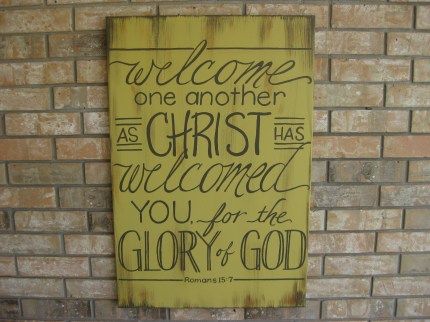
Welcome one another, therefore, just as Christ has welcomed you, for the glory of God.

Weekly Devotional Image

It is hard to welcome one another, until we ourselves know what it means to be welcomed. We can imagine what we need to do and how we need to behave, we can get out the best silverware and the matching dinner sets, we can fill everyone’s cups to the brims, but until we have experienced being welcomed, we will struggle to welcome others.

I spent the last week in Orlando, Florida with my in-laws for the Thanksgiving holiday. They were forced to practice a new type of welcoming and hospitality because they hosted their 7-month old grandson for the first time. In addition to the normal preparations for people visiting, they had to procure a stroller, pack-n-play, diapers, wipes, and an assortment of other necessary items. Moreover, they had to adjust their schedules to the sleeping habits of our son and reorient all of their plans around his general disposition and mood.

And while we sat around the dinner table on Thanksgiving I was struck by how welcomed I felt throughout the week. They could have made assumptions about what we needed and then acted on it, but instead they approached us and asked what they could do to help. They could have become quickly frustrated with Elijah changing their plans but they adapted and made us feel comfortable. They could have expected us to change to fit into their way of life, but instead they changed to fit into ours.

img_9511

One of the most brilliant aspects of the Advent season is our anticipation of the way God fit into our way of life by taking on flesh and being born as a baby in a manger. Rather than giving up on humanity’s inability to repent and turn back to God, God comes down and meets us where we are. God, in Christ, welcomes us into the kingdom of God by connecting with us in ways that we can perceive and understand.

The same holds true for the life of the church, and for us as individual Christians. We welcome one another just as Christ welcomed us, for the glory of God. When we encounter those for whom the church is a strange new world, we don’t just wait for them to “catch up,” instead we adapt our ways to meet them where they are. When we welcome people into our homes for food and fellowship, we don’t dominate the conversation with whatever we want, instead we seek to invite all present to shape what we talk about. When we discover new people sitting in the pews near us, we don’t make quick judgments about who they are based on their appearance, instead we remember how the Lord welcomed us and we do the same toward others.

Do Not Listen To Preachers (Including Me)

Jeremiah 23.23-29

Am I a God near by, says the Lord, and not a God far off? Who can hide in secret places so that I cannot see them? Says the Lord. Do I not fill heaven and earth? Says the Lord. I have heard what the prophets have said who prophesy in my name, saying, “I have dreamed, I have dreamed!” How long? Will the hearts of the prophets ever turn back – those who prophesy lies, and who prophesy the deceit of their own heart? They plan to make my people forget my name by their dreams that they tell one another, just as their ancestors forgot my name for Baal. Let the prophet who has a dream tell the dream, but let the one who has my word speak my word faithfully. What has straw in common with wheat? Says the Lord. Is not my word like fire, says the Lord, and like a hammer that breaks a rock in pieces?

Pastor Holding Bible ca. 2000


A young preacher stands in the pulpit after a long week of parish ministry. The visits have all been made. A new budget for the coming year is finished and ready for approval. Plans for the Community Cook-Out came to fruition as people from all over the community gathered together.

The young preacher stands in the pulpit and looks out at the congregation. He sees couples that he has counseled; children that he has baptized; families that are struggling; individuals whose husbands or wives he has buried; and he even sees people he has never seen before. He looks over the bulletin one last time just to make sure that everything is listed the way it is supposed to be, and then he begins by saying, “This morning the sermon will be short and sweet”

“Hallelujah!” Someone shouts out from a pew.

“Is that for the short, or for the sweet?” says the preacher.

The congregation laughs.

The preacher sighs.

The art of preaching is a strange thing, but an even stranger thing when we consider that what we want from a sermon is something short and sweet. Some of you have been quick to say that you want a sermon that leaves you feeling good on your way out from the sanctuary. Others have said that you want a sermon that gives you something to think about during the week, or one that helps to remind you that God is love, or that Jesus wants the world to be a better place, etc.

I would classify myself as a short and sweet preacher. I fundamentally believe that if you cannot say what you’re trying to say in 15 minutes then you’re never going to say it. Additionally, I love pleasing all of you. I live for those moments in the receiving line following worship when some of you offer praise for what you heard through the sermon. I know I’m supposed to be humble, but it feels pretty good to be congratulated and praised for preaching.

In the last few years we’ve had an abundance of sweet sermons; times when I wanted all of you to leave with just one thought: “God loves you.” I’ve done my best to make you laugh and smile when thinking about the abundant glory of God’s grace. I’ve tried to cheer you up during times of domestic and international strife. I’ve worked to make this place as appealing as possible for as many people as possible.

And that is why you should not listen to preachers, including me.

“Am I close to you?” says the Lord. “Or am I far away? Who thinks they can hide in secret places so I cannot see them? I am the Lord! Do I not fill up heaven and earth? I have heard what those prophets have said who prophesy in my name saying ‘I have dreamed, I have dreamed! How long will they continue like this?”

The prophet Jeremiah lived during a time filled with false prophets, people who would ascend to places like this in front of a gathered people and make claims on behalf of the Lord. They would spout off about their visions of what the Lord was doing, and the more they said, the further they moved away from God.

God warns us against listening to false prophets, about succumbing to their visions, and about what happens when we trust them more than the Word.

False-Prophets-Media-Header-960x350

It would be easy today to make this whole sermon about the false prophets of our contemporary experience. We’ve got plenty of false prophets who use their skill to sell us on what they believe the future should hold. In fact this whole sermon could just be a warning against listening to the likes of Donald Trump and Hillary Clinton.

What kind of dreams are they selling?

“I have dreamed of a future where everyone can, and should go to college for free. Where healthcare will be free for everyone. We need to remember what made us great and start taking from the wealthy and giving it to the poor. It’s not about progress; it’s about fairness. We need to make America fair again.”

“I have dreamed of a wall unlike any other wall. This wall will fix all of our problems. It will bring wealth back to our country. We need to bomb the Middle East into oblivion to assert ourselves as the top of the world. We need to make America great again.”

Politicians have always been false prophets making promises that cannot be kept; selling a vision of the future that rarely comes to fruition. And we know this is true. That’s why we’ve grown so jaded by our political seasons and apathetic about whatever will happen.

But there are more false prophets out there than just politicians, and one of them is talking to you right now.

Through the prophet Jeremiah, God warns us against listening to people like me, people who march up to the front of the gathered church and strive to proclaim God’s faithful word. For whenever we hear a preacher go on and on about the beauty and majesty of God’s Word, whenever the Lord is watered down to a spirit of love, whenever we hear more about the preacher’s dreams than God’s will, we need to be reminded that the Word of the Lord is like fire, and like a hammer that breaks a rock into pieces.

Since we’ve been together in this strange thing called church, I’ve preached over 150 sermons. I’ve preached from Genesis to Revelation. I’ve mentioned the patriarchs and the prophets. I’ve proclaimed the possibilities of the psalms. I’ve proudly preached on the power of parables. I’ve done different series on “Why We Do What We Do” and “The Basics” and “New Beginnings” and “Strange Stories from Scripture.” I’ve even dressed up and preached not one, but TWO sermons from the perspective of a donkey.

And for what?

Has the preaching in this place challenged you to be a better disciple? And maybe not just from me, but have you ever left this church really feeling convicted by what you heard and wanted to live differently? Or has your experience been like most, and you leave feeling pretty good on Sunday afternoon?

We preachers are tempted by the practices of false prophecy. We like to be liked. We want to fill pews with people to boost our egos. We need to hear praise from lay people on their way out the door. We yearn for success. We, after years of sermon preparation and proclamation, fall prey to hearing our own voice so deeply that we no longer hear others, nor do we hear the Lord.

For the last three years I’ve had a dream about the future of this church. I have dreamed of Sunday mornings where so many people fill the pews of this sanctuary that I cannot know everyone’s names. I have imagined crowds gathered around the baptismal font in anticipation of bringing a new person into the life of our church. I have pictured people having to park on the front lawn because there are not enough spaces left in our parking lot.

IMG_1691

And because I had this dream, I preached and worked toward things like our Community Cook-Out. I implored our Church Council to use enough money to give away the food and the games and the fellowship all for free. I sent out hundreds and hundreds of post-cards to all of our neighbors so that they might join us on the front lawn.

I have dreamed, and I want the dream to become real. So I work week after week on ideas and programs and sermons that will draw people into this sanctuary on Sunday mornings until that dream becomes reality.

A couple weeks ago I was standing in our narthex right before our opening hymn. Most of you were sitting in the pews; our liturgist had gone through the pertinent announcements and necessary welcome. Rick was playing something melodic on the organ as we prepared our hearts and minds for worship when I stepped onto the carpet with our acolyte.

Without thinking much about it, I started to count the back of all your heads. I started with the front left and made my way toward the back, then my eyes moved to the front right and all the way toward the back. My lips must have been moving because our acolyte looked at me and said, “What are you doing?”

“I’m counting…” I said while trying to not lose track of the number.

And then he asked, “Why?”

Why?

In his question, in the simple raise of an eyebrow at my action, my heart caught on fire, it burned like a blaze, and I felt it crumble into ashes.

For how long have I deceived my own heart? For how long have I been so consumed by the number of people in our pews that I have forgotten the call to share the Good News? For how long have I proclaimed a God of love who is so loving that he does not expect us to live changed and transformed lives? For how long have all of us listened to false prophets who preached their own dream instead of speaking the Word of the Lord faithfully?

In his question I heard the Lord convict my heart because I have been caught up in church growth not for the sake of the kingdom, but for my own affirmation. I have wanted the front lawn to be packed with people from the community not for the sake of the kingdom, but for the pews to be filled in worship. I have preached sermons to make us feel better not for the sake of the kingdom, but for all of you to come back the next Sunday.

Sermons are a good and strange thing. After all they are the means by which the Word of the Lord is interpreted for our lives on a weekly basis. But they cannot be blindly accepted without challenge. For to only ever hear about God’s grace does a disservice to the Lord who is always calling us to live more like Christ. And, on the other hand, to only ever hear about how sinful we are neglects to reveal the light of Christ that shines in the darkness.

God cares more about spreading the Good News than about filling up the pews.

And sometimes that Good News is that we need to be better than we were when we arrived, that we are called to a life of discipleship that pins us against the world, that the Lord expects great things from us. The Good News is that God has not abandoned us to our sinful desires and devices, that God believes we can be better even if we don’t, and that we can transform the world but we first must transform ourselves.

We need good preachers, men and women who are willing to lay down their egos at the altar and faithfully proclaim God’s Word. And we need good lay people who are willing to crucify their fears and speak the truth in love toward the preachers who have fallen into the trap of false prophecy.

So, may the Word of the Lord be like a hammer that breaks our lives into pieces! Let it shatter our false identities and insecurities, let it break down all our preconceived notions and assumptions, and let it burn and blaze forever and ever. Amen.

The Gifts of God – Peace

Micah 5.2-5a

But you, O Bethlehem of Ephrathah, who are the one of the little clans of Judah, from you shall come forth for me one who is to rule in Israel, whose origin is from of old, from ancient days. Therefore he shall give them up until the time when she who is in labor has brought forth; then the rest of his kindred shall return to the people of Israel. And he shall stand and feed his flock in the strength of the Lord, in the majesty of the name of the Lord his God. And they shall live secure, for now he shall be great to the ends of the earth; and he shall be the one of peace.


IMG_8605-5843

The children looked perfect in their Christmas pageant costumes. One by one they entered the chancel area in preparation for proclaiming their individual lines. The shepherds came first, watching over their sheep. Then the animals of the manger came forth, including a cow, a bird, and a mouse. They all made it to their spots and sat perfectly still as a donkey, Mary, and Joseph walked up to the microphone and exclaimed that a baby would soon be born, but they would need to find a place to stay.

Then the angelic cherubs boldly walked down the center aisle in the dark each holding an electric candle. The lead angel walked up to the microphone and frightening declared: “Do not be afraid! I bring joy to everyone!” The wise men and a camel followed the star to the manger where they presented the baby Jesus with their gifts of gold, frankincense, and myrrh.

I had the best vantage point of the entire production from up here in the pulpit. I could see all of the children with their costumes and I could also look out at the faces of all the parents, families, and friends that had gathered for this spectacular performance. I was honestly beaming while I stood up here on Tuesday evening because the kids had all done such a great job, they all nailed their lines, and were standing perfectly still in their spots.

Except for one of our shepherds.

Throughout the weeks of practice we had purposely withheld the shepherd staffs from the children knowing full and well that they would play with them too much. And during the actual performance most of them were being wonderful, but one of the shepherds could not overcome the desire to do something.

At first he just twirled the staff around in his hands like trying to start a fire on the carpet. Later, he swung it from side to side like a microphone at a rock and roll concert. I tried my best to whisper powerfully for him to stop, and though he would for a moment or two, he would then start up with something new.

As we were nearing the end of the performance, nearly all of the characters and animals from the manger scene were in place; the little shepherd grabbed his staff and started lifting it into the air. I, of course, immediately thought of Moses lifting up his staff in the wilderness to strike the rock for water. I, of course, immediately thought of how theological our young shepherd was being as he lifted the staff into the air, but then I realized he was about to bash somebody on the top of the head!

Breaking character from the pulpit, I quickly reached down and stopped the staff in mid arch. My eyes went down the shaft of the staff to the little hand, to the arm, to the face of the young shepherd, and instead of seeing a repentant and apologetic look; he had the biggest and proudest grin on his face.

IMG_0610

We lean toward violence. From Preschoolers picking up shepherd staffs, to fights in high school, to international and political disagreements, we lean toward violence. There is a power that comes with violence and demonstrates our importance and opinion. Violence has been at the forefront of some of the most important historical moments in the entirety of human existence and still captivates our attention. The movies that make the most money, the stories that garner the most attention, the moments we can’t tear our eyes away from usually contain violence.

As I have found myself saying too often from this pulpit: just turn on the TV or get online and you will be immediately bombarded with the violence in the world and the local community. Even this season of Advent and preparation for the holidays tends to bring out the worst in us. We have short tempers with the people ahead of us in line while we are buying gifts. We mutter inappropriate comments about drivers that are just driving too slowly. And we secretly expect to receive as many good gifts as we give.

Our lives and the world are filled with aggression, anger, and violence.

Yet, the prophet tells us about the one who will come with peace.

Micah spoke during a time of considerable unrest. The situation was grim with corrupt political leaders. There were fearful enemies on the horizon. Internal disputes were pinning people against one another. (Sound familiar?) And while the people saw no hope, Micah saw the promise of peace. Micah looked beyond the present circumstances, he looked beyond the news headlines and the talking heads, he looked beyond the broken and tarnished community to what God was promising to do.

From the little town of Bethlehem will come one who will rule the world. From a back road town of insignificance will come the one who will lead his flock in the way that leads to life and peace.

Many of us have a hard time imaging that an impressive hero can come from such a small town and such a fragile beginning. We, instead, look to politicians and presidents, magistrates and ministers, to fix all of our problems. But from the words of scripture this morning, Micah is jumping up and down and waving his arms to move us in an entirely different direction. He is pointing not at the towering leaders of the world on CNN. He is not drawing us to the political buildings in Washington DC. Instead he is pushing us to a small, out of the way, little place called Bethlehem.

55f81b353eaa23507d83b12e70adb998

Jesus is the one of peace, the one who comes as a light in the darkness, the one who will stand and lead like a shepherd. Jesus came from humble beginnings and changed the world.

One of the things that the bible loves to show us is that true power and peace often comes from unexpected people in unexpected places. Many of us have heard the Christmas story so many times that we are desensitized to the insignificance of Bethlehem in the most significant story ever told.

Yet, important babies that change the world can be born just about anywhere. Bethlehem is proof of that. Every baby has the potential to help remind us of the way that leads to peace. Jesus is proof of that.

This week, our little neck of the woods made national news. A local geography teacher landed in the hot seat for an assignment where her students were required to copy a text in Arabic from the Quran. The purpose was to demonstrate the beauty and power of calligraphy and, in a sense, teach students to appreciate people who have differing beliefs and opinions. However, when a particular parent found out that the text in Arabic said, “There is no god but Allah. Muhammad is the messenger of Allah” everything came to a head.

In the days that followed, a community meeting was held at a local church for concerned parents who were outraged by the assignment. Augusta County rightly started to step up security measures in order to maintain the peace, but the longer the situation percolated the more frightening it became. On Thursday morning there were armed guards at Riverheads elementary school. And on Thursday afternoon, every student in Augusta County was ordered to leave their respective school and the buildings were to go on lockdown. Lastly, Friday’s classes were completely canceled.

Augusta County received so many threats by phone and mail that they believed they could not guarantee the safety of their students and decided to cancel an entire day of school.

There are so many facets to the story that we don’t have enough time to address all of them, but suffice it to say, it is sad. It is a sad that a teacher did not take the time to re-evaluate what text she was having the students copy. It is sad that an entire community responded immediately out of fear and hatred. It is sad that such a tremendous amount of people were filled with rage to the point that Augusta County had to cancel school. It is sad.

While Fox News picked up the story for the nation to learn about what was going on here, I felt God’s Word calling me to listen to the Bethlehem-like voices. Instead of reading news article after news article from talking heads, I went to the local youth of our community and listened.

This is what one of them said: “Religion is not the problem. Religion does not breed terrorism. Ignorance breeds terrorism. Lack of education breeds terrorism. Failure to see the world around you breeds terrorism. Incompetence breeds terrorism. The inability to accept one’s wrongs breeds terrorism. The inability to connect and empathize and understand your fellow human beings is what breeds terrorism.”

I don’t know how to fix or change what happened in Augusta County this week, but if we continue to treat everyone who is different from us with nothing but suspicion and fear, then we have lost our connection to the one who comes in peace. If we make the self-righteous assumption that everyone should look like us, think like us, and talk likes us, then we have stopped following Jesus.

For too long we have lived with a culture that teaches us to defeat our enemies so that only our friends will be left. But that’s not what Jesus calls us to do! Jesus, the one born in a manger in Bethlehem, Jesus the one who shall be our peace, Jesus the one who we worship on Christmas Eve and every Sunday of our lives, tells us to love our enemies! Jesus calls us to pray for those who persecute us. Jesus tells us to live our lives in the way that leads to peace.

God’s peace in Christ is a gift; a gift with strings attached. God gives us peace, but we are to be instruments of God’s peace on earth. We know that peace is not easy. It requires a willingness to sacrifice and be vulnerable with people who differ from us. Peace is uncomfortable. Peace is strange. Peace is difficult because it is so contrary to the ways of the world.

Peace is hard, but so is following Jesus. Amen.

What Is Truth?

John 18.33-38

Then Pilate entered the headquarters again, summoned Jesus, and asked him, “Are you the King of the Jews?” Jesus answered, “Do you ask this on your own, or did others tell you about me?” Pilate replied, “I am not a Jew, am I? Your own nation and the chief priests have handed you over to me. What have you done?” Jesus answered, “My kingdom is not from this world. If my kingdom were from this world, my followers would be fighting to keep me from being handed over to the Jews. But as it is, my kingdom is not from here.” Pilate asked him, “So you are a king?” Jesus answered, “You say that I am a king. For this I was born, and for this I came into the world, to testify to the truth. Everyone who belongs to the truth listens to my voice.” Pilate asked him, “What is truth?”

During the celebration of holy mass in the chapel of the Carmelite Monastery 6 members of the OCDS community made promises to the Order.  Dr. Jason Bourgeois and Judy Hawkins professed their temporary vows for 2 years and David Travers, Suzie Megown, Kathryn Theobald and Wendy Corbella professed their Difinitive Promise to the Secular Order.  Fr. Lawrence Herzog, OCD celebrated the mass which was attended by the Carmelite Nuns and families of the OCDS community.


Christ the King Sunday is the New Year’s Eve of the Christian calendar. Many of us might celebrate the New Year beginning on January 1st, but in the church the season of Advent is the beginning of our year as we wait for the coming of the Lord on Christmas. For centuries the church has celebrated this rhythm where we start a new year in anticipation of Jesus’s birth, we proclaim Jesus’ life and teachings, and we mark his death and resurrection with Holy Week. Then we look forward to the celebration of Pentecost when God’s Spirit was poured out on the first disciples, and we have a long season of what we call ordinary time to learn more about the stories from scripture.

The Christian year is built the way it is so that we retell the greatest story ever told, every year.

But just like with the celebration of New Years Eve we need a big party to mark the end of our year, we need to pull out all the stops and look back over where we’ve been, and get excited about where we’re going. We need our New Years Eve, but for us we call it Christ the King Sunday.

Since the foundation of the early church, disciples have worshipped Christ in his three offices: Prophet, Priest, and King.

Throughout the Christian year we learn about Jesus as Prophet whenever he shared a lesson with the disciples, whenever he told a parable, and whenever he spoke out against the injustices of the world. Like a true Prophet Jesus spoke the truth in love. He went out to the last, least, and lost and helped to speak words that gave them value. Jesus confronted the hypocrisy of society and challenged the world to behave according to the way God would have us to behave.

Throughout the Christian year we learn about Jesus as Priest whenever he healed the sick, fed the hungry, and clothed the naked. Like a true and holy Priest Jesus shared his final meal with his friends and told them he was offering his body and blood for their sake and for others.

Jesus atoned for the sins of the world by sacrificing himself and dying a terrible death on a cross.

Throughout the Christian year we learn about Jesus as King whenever we hear about the kingdom of God, whenever we discuss what it means to take up our cross to follow him, and whenever we confess Jesus as Lord. Like a true King Jesus watched out for the people of his community, fed the multitudes and offered a new way of life. But perhaps one of the greatest insights into what it means to worship Christ as King comes from Jesus’ interaction with Pontius Pilate.

It was early in the morning when the Jewish elders brought Jesus to Pilate with death on their minds. Of course, according to the Law, they could not kill him but they knew that the Roman leader could. So Pilate entered the headquarters and asked Jesus, “Are you the King of the Jews?” Jesus answered, “Are you asking because you want to know, or did other people tell you about who I am?” Pilate replied, “I’m not Jewish! Your people, your chief priests, your nation handed you over to me. So, what have you done?”

Jesus answered, “My kingdom is not from this world. If it were from this world, my followers would be fighting to the death to keep me from being handed over. But as it is, my kingdom is not from here.” Pilate asked, “So you are a king?” Jesus answered, “You say that I am a king. For this purpose I was born, and for this I came into the world, to testify to the truth. Everyone who belongs to the truth listens to my voice.” Pilate asked him, “What is truth?

truthianm

What is truth?

Pilate wanted to know. Christians have wanted to know. And if we’re honest with ourselves, we want to know as well. What is truth?

Seeing as how today is our New Year’s Eve, I thought we would do well to look back over the last year and examine what we have learned to be true…

In Advent we learned about how everyone is given a new beginning in Jesus Christ. That when God came into the world it changed everything, and when you discover Jesus in your heart it changes everything. It changes the way you think, the way you speak, and the way you act.

During the winter we asked tough questions about are faith like “Is it better to be cremated or buried?” and “Is it appropriate to have an American Flag in our sanctuary?” We talked about how being a Christian means sacrifice, how food will not bring us closer to God, and how God strengthens the weak.

During Lent we spent the season praying for God to cleanse us of our sins, and heal our brokenness. We got back to the basics of our faith by looking at the Ten Commandments, admitting that we cannot save ourselves, and that God is God (and we are not).

During Holy Week we went from the joy of the last supper with a foot washing on Maundy Thursday, to the shadow of the cross on Good Friday, to the glory of the resurrection on Easter Sunday.

Before Pentecost we looked to the stained glass windows in our sanctuary to learn about the faith attested in the Good Shepherd, the Methodists, and the Johns. On Pentecost we listened to two of our youth proclaim that the church is not a building but a people.

Throughout the summer we retold some of the greatest and strangest stories from the Old Testament, we even had a donkey preach one of the sermons, and we spent time praying for one another.

And this fall we addressed why we do what we do. Why we worship, why we give, why we serve, and why we pray. (All of them bring us closer to God)

What is truth? Every Sunday that we gather in this sanctuary is an attempt to answer that very question. Every sermon, every prayer, every hymn is all geared toward discovering the truth in our lives.

As we look forward to a new year in the Christian calendar we anticipate more services attempting to answer Pontius Pilate’s question and the question that rests in our hearts. We will have sermon series and bible studies, we will have prayer vigils and fellowship events, we will have baptisms, and we will have funerals, all striving to answer “What is truth?

For us today, sitting here in this worship service, Jesus has a simple and profound answer: My kingdom is not of this world.

In the wake of the tragic terrorist attacks in Paris, the French community continues to mourn and grieve over the fragility of life. For days, Parisians have gathered from across the city to place flowers and light candles in memory of all the innocent people who lost their lives.

A French interviewer recently caught sight of a father and son who were kneeling by the flowers and the interviewer asked the boy if he understood what had happened. The four year old said, “bad guys who were very mean did something very bad. We need to be very careful and my family has to move out of France.” The father quickly interrupted and said that they did not need to leave because France was their home but the son, with a quiver in his lip reminded his father about the bad guys who have guns and can shoot us because they’re really mean.

The father took a moment to think about what his son said, and then he replied, “Yes. They have guns. But we have flowers.”

The son was incredulous, “But flowers don’t do anything!”

“Of course they do,” said the father, “look, everyone is putting flowers here. It’s to fight against guns.”

“It’s to protect us?” “Exactly”

Then the son asked, “And the candles too?” “Yes. The candles are to remember all the people who are gone.”

The boy, who had clearly been distraught the whole time, finally began to smile as he took in the abundance of flowers and candles in the square and looked right at the interviewer to say, “The flowers and the candles are here to protect us.”

We live in a remarkably tumultuous world that feels like it’s on the brink of something terrible. Just turn on the television or open a newspaper and you are immediately bombarded by tragedy after tragedy. But when a young boy discovers the power of a flower, something dismissed by so much of the world, we are reminded that Jesus’ kingdom is not of this world.

It is not easy thing to be a Christian, to live our lives in such a way that Jesus is our king. Because our king asks us to do some strange things like: pray for our enemies, turn the other cheek, and give away our clothing and possessions to help those in need. But Jesus’s kingdom is not of this world, it does not harmonize with the expectations of the world.

The world tells us to gain all we can.

            Jesus tells us to give all we can.

            The world tells us to seek vengeance.

            Jesus tells us to seek forgiveness

            The world tells us to destroy our enemies.

            Jesus tells us to love our enemies as ourselves.

            The world tells us that we are the center of the universe.

            Jesus tells us that God is the center of all things.

            The world tells us ignore the weak.

            Jesus tells us that the meek shall inherit the earth.

            The world tells us that death is the end.

            Jesus tells us that death is the beginning.

What is truth? The answer to the question is our collective effort to know who we are and whose we are, to remember the stories of scripture so that they shape our lives, to live out the incarnation so that the world can be transformed.

The whole Christian year is the attempt to answer: “What is truth?

But today Jesus gives us one response: “My kingdom is not of this world.

Thanks be to God. Amen.

christ-the-king 2