Why We Do What We Do: Worship – Sermon on Luke 24.13-35

Four homilies on why we worship the way we do…

church

Gather

Luke 24.13-24

Now on that same day two of them were going to a village called Emmaus, about seven miles from Jerusalem, and talking with each other about all that had happened. While they were talking and discussing, Jesus himself came near and went with them, but their eyes were kept from recognizing him. And he said to them, “What are you discussing with each other while you walk along?” They stood still, looking sad. Then one of them, whose name was Cleopas, answered him, “Are you the only stranger in Jerusalem who does not know the things that have taken place there in these days?” He asked them, “What things?” They replied, “The things about Jesus of Nazareth, who was a prophet mighty in deed and word before God and all the people, and how our chief priests and leaders handed him over to be condemned to death and crucified him. But we had hoped that he was the one to redeem Israel. Yes, and besides all this, it is now the third day since these things took place. Moreover, some women of our group astounded us. They were at the tomb early this morning, and when they did not find his body there, they came back and told us that they had indeed seen a vision of angels who said that he was alive. Some of those who were with us went to the tomb and found it just as the women had said; but they did not see him.”


The receiving line following worship is vastly underrated. A lot of people make their way out of the sanctuary as quickly as possible, whereas others will wait in line just to ask that one question that popped up during the service. It never ceases to amaze me that some of the most profoundly theological and spiritual moments that take place at St. John’s happen in that line after worship on Sunday mornings. This month’s sermon series “Why We Do What We Do” has its roots in those conversations. Week after week I will hear some of you wonder about the purpose of an acolyte carrying in the flame for worship, or you ask about the value and importance of having a time for offering and collection, or you question why we talk so much about bible study, or you remark about how difficult it is to pray.

For any of you that have left worship with a question on your heart and mind, this sermon series is for you. This morning we begin with “Why We Worship.

Over the last two thousand years, disciples of Jesus Christ have been gathering on a regular basis to praise God. From the crowded upper rooms of the first century, to the ornate and opulent cathedrals of Europe, to the modern gymnasiums and living rooms filled with folding chairs, getting together is what we do as Christians.

I would now like to ask each of you to pull out your bulletin. You will notice that our worship is divided into four parts every week: GatheringProclaimingResponding – and Sending Forth. These four parts have connections with the ancient worship practices of the Israelites, but it can be specifically drawn to the story of the two disciples on the road to Emmaus. Jesus gathers the two men on the road, later he proclaims the scriptures and interprets them, then they respond by having a meal of bread and wine, and after the disciples eyes are opened to Jesus’ presence they are sent to proclaim what they had seen and heard to the disciples. These four parts have their beginnings in scripture, and we relive them each and every week.

When does worship begin? Some would claim that it starts whenever someone stands behind the lectern and starts to speak, but worship actually begins long before the moment we are all sitting in the sanctuary. God is actively involved in gathering us together from the moment we walk out our front door, to the thoughts we have while driving, to the quick and joyful conversations in the parking lot, to the greeting in the narthex and the ushers handing out the bulletins. All of these moments are part of God gathering us, and they all have an effect on the way we worship.

Once we arrive and are present in the sanctuary, God continues to gather us together in our announcements about upcoming activities in the church. It is a time of relating to one another and sharing opportunities about how we can grow in love of God and neighbor. Immediately following the announcements, we have what might be the most important piece of the gathering: preparing our hearts and minds for worship.

Rick will play on the organ for a brief period that we use to help center ourselves for the practice of worship. Worship is practice. We do it over and over to strengthen our spirits for the work of ministry in the world. Then the choir will rise to sing a call to worship, in effect calling us to worship the living God. We have a responsive reading as we center ourselves on the theme for the day, and we start singing our first hymn.

Picking hymns is easily one of my favorite parts of being a pastor. Spending time every week deep in the hymnal humming tunes and praying about which songs best fit with what we will do. And as we sing that first hymn, the acolyte and I will walk into the sanctuary signifying how the light of Christ is here with us in worship, how the light guides us and gathers us together.

By the time I actually make it to the pulpit, God is still gathering us together as we humbly bow and begin to pray as a community. The prayers we offer are a sign of our respect for the people in the pews next to us, as well as a commitment to the world around us. Finally, we gather our gifts of tithes and offerings to present to God (but we will talk more about why we give next week).

This is how God gathers us every week, just like God (in Christ) gathered the two disciples on the road to Emmaus to change their lives forever. So let’s continue letting God gather us for worship…

407025348_640


Proclaim

Luke 24.25-27

Then he said to them, “Oh, how foolish you are, and how slow of heart to believe all that the prophets have declared! Was it not necessary that the Messiah should suffer these things and then enter into his glory?” Then beginning with Moses and all the prophets, he interpreted to them the things about himself in all the scriptures.


After the disciples and Jesus were gathered on the road, after Jesus listened to them ramble on about the things they had seen and heard in Jerusalem, he proclaims the stories of scripture and reinterprets them through his gracious work. But notice, they still do not know who they are talking and walking with on the way.

I will be the first to admit that God’s holy scriptures can be confusing. There’s nothing like a seemingly random assortment of names through a genealogical proclamation that can leave us scratching out heads. But the more we read, the more we interpret how God is still speaking to us through the scriptures, the more it begins to start fitting together.

The second part of our worship is dedicated to proclamation, speaking words about God’s Word. We do this every week by reading from the bible, singing a hymn, and then listening to a sermon. The scriptures are picked according to a list called the Revised Common Lectionary, which compiles a great assortment of readings through a three-year cycle that goes through most of the bible. However, occasionally the scriptures are picked to fit a specific theme (like us using Luke 24.13-35 to talk about worship during this sermon series). We boldly proclaim the words of scripture and pray that somehow or another God can speak through a preacher to interpret these words for our lives today.

The middle hymn of worship is usually picked in reference to the specific text and our connection with it. Today we will sing “Open My Eyes, That I May See” because Jesus’ opened the eyes of the two disciples on the road to Emmaus through the breaking of bread and the sharing of the cup, but we also call on God to open our eyes to how the text continues to speak into our lives right now.

The sermon is a little bit harder to explain, because every preacher (and therefore every sermon) is different. Some can be funny and light-hearted; others are specifically focused on the Good News, whereas others can be more convicting about how we are living as disciples. The point of preaching is to challenge us to make God’s Word incarnate by the way we live our lives; which is precisely why preaching can be so hard to hear, and so hard to do.

This is how we proclaim God’s Word every week, just like Jesus proclaimed the scriptures and interpreted them for the disciples. So let’s proclaim God’s Word in worship…


Sermon:


A one sentence sermon: Whenever we gather in this place to do what we do, we join those first disciples and our eyes are opened to Jesus in our midst. Amen.

712603724d969fe0099b9850dd17303c_f1965


Respond

Luke 24.28-32

As they came near the village to which they were going, he walked ahead as if he were going on. But they urged him strongly, saying, “Stay with us, because it is almost evening and the day is now nearly over.” So he went in to stay with them. When he was at the table with them, he took bread, blessed and broke it, and gave it to them. Then their eyes were opened, and they recognized him; and he vanished from their sight. They said to each other, “Were not our hearts burning within us while he was talking to us on the road, while he was opening the scriptures to us?”


Jesus made it look like he was going to keep walking, but the disciples invited him to stay with them. While they sat at the table together, he took the bread and the cup, gave thanks to God, and gave it to them. Only then did they realize who had been with them the whole time. It was only in responding to the words they heard on the road, in the bread and wine on the table, that Christ became real for them.

The third part of our worship is focused on responding to the proclaimed Word of God. On most Sundays we do this by reaffirming our faith using the Apostles’ Creed, we make a public confession of who we are and what we believe. Other weeks we do something unique and special like last week when we broke off into pairs and prayed for each other. But the best and most faithful response to God’s Word happens when we gather at the table like those two disciples did with Jesus.

Breaking down the multiple elements of responding with Communion demands its own sermon series, but suffice it to say that this holy meal is what being a Christian is all about. We are invited by God no matter who we are and what we’ve done, we confess how we have fallen short of God’s expectations and are forgiven, we share signs of God’s love and peace, and then we feast.

This is how we respond to God’s glory in the church and in the world by feasting at the table, just like Jesus did with those two disciples whose eyes were truly opened. So, let us respond to God’s Word in worship…
Slide-400x400


Send

Luke 24.33-35

That same hour they got up and returned to Jerusalem; and they found the eleven and their companions gathered together. They were saying, “The Lord has risen indeed, and he has appeared to Simon!” Then they told what had happened on the road, and how he had been made known to them in the breaking of the bread.


I’ve always wondered what it must have felt like to be one of those disciples discovering the truth about their encounter from the road. But then I remember that I have had similar experiences: when I see someone come up in line to receive communion with a brilliant smile on their face, I realize that I am catching a glimpse of Jesus. When I witness one of our preschoolers reach out in concern toward one of their classmates, I realize that I am catching a glimpse of Jesus. When I see you greeting one another in love before, during and after worship, I realize that I am catching glimpses of Jesus.

After their incredible and momentous discovery, the disciples ran back to Jerusalem to share all they seen and heard. When we are confronted by God’s incredible power and glory, the only thing we can do is share what it felt like with others in our lives.

The final part of our worship is all about being sent forth into the world. While the notes of the final hymns are still resonating deep in our souls, as we continue to contemplate all we have seen and heard in this place, God sends us out into the world to share what we have experienced. I stand before the congregation and offer a benediction of blessing to go with us as we leave, and then the acolyte carries the light of Christ before us, encouraging us to take Christ’s light out into the world. Lastly, the choir sends us off with one final song, blessing us to be a blessing to others.

This is how we are sent forth from God’s house, just like the disciples ran to tell their friends what had happened. So, let us prepare to be sent forth to be God’s people for the world…

Print

When Should We Pray? – Sermon on James 5.13-20

James 5.13-20

Are any among you suffering? They should pray. Are any cheerful? They should sing songs of praise. Are any among you sick? They should call for the elders of the church and have them pray over them, anointing them with oil in the name of the Lord. The prayer of faith will save the sick, and the Lord will raise them up; and anyone who has committed sins will be forgiven. Therefore confess your sins to one another, and pray for one another, so that you may be healed. The prayer of the righteous is powerful and effective. Elijah was a human being like us, and he prayed fervently that it might not rain, and for three years and six months it did not rain on the earth. Then he prayed again, and the heaven gave rain and the earth yielded its harvest. My brothers and sisters, if anyone among you wanders from the truth and is brought back by another, you should know that whoever brings back a sinner from wandering will save the sinner’s soul from death and will cover a multitude of sins.

00030228_h


Sunday morning: 11am. The gathered community of faith was sitting patiently in the pews waiting for the worship service to begin. Week after week the people sat in the same pews with the same expressions on their faces. Year after year they listened to preachers come and go telling the same stories about Jesus from different perspectives.

It was just like every other Sunday morning. Mr. Smith sat all the way up on the right hand side in the front pew with his notebook and pen in hand ready to take notes on whatever he heard. Jimmy, John, and Josh were midway back on the left quietly giggling while drawing stick figure battles all over the bulletin. And Miss Ethel, old and frail, was still slowly making her way up the center aisle while the first hymn was being played.

Worship is repetitive; for nearly two millennia Christians have gathered once a week to say the same prayers, hear the same stories, and sing the same songs. Worship is just like any good habit, and the longer you have it, the more fruitful it will become.

The congregation sat attentively while the pastor preached on the power of prayer. The seasoned Christians had heard sermons like this one before; they could almost imagine how the preacher would tie it together before he even spoke the words. The newer Christians were getting a little tired of hearing about prayer week after week, they wondered about when the pastor would call for them to lead a revolution to turn the world upside-down, they wanted to hear about power, not about prayer. And the youth, bless their hearts, if you had called their names from the pulpit in the middle of the service they would have looked up with bug-eyed expressions as if their teacher had singled them out in the middle of class.

The preacher was getting to what he imagined was the pinnacle of his proclamation, the words were flowing accordingly, and he no longer needed to look at his notes to drive the point home. As he stood up in the pulpit, gazing out over his gathered flock, he lifted up his fist for the final paragraph and froze in mid-sentence when he saw Miss Ethel slowly slump over in her pew having taken her final breath on earth.

Hands

When are we supposed to pray? James would have us pray all the time. Are any among you suffering? They should pray. Are any cheerful? They should sing songs of praise. Are any among you sick? They should call for the elders of the church and have them pray over them, anointing them with oil in the name of the Lord.

No matter what is going on in life, whether we’re on a mountaintop of joy, or in the bottom of a valley of sorrow, we should pray. We pray in celebration and in defeat, we pray during the mundane, and we pray during the extraordinary.

The end of James’ letter is a favorite among preachers because it explains itself. There’s no need to go digging through the grammar to exegete a strange or divergent meaning. James means what he says:

We should pray all the time.

            Prayers of deep faith will bring about salvation on earth.

The Lord will raise us up.

            Through prayer, any sin can be forgiven.

            We should confess our sins to other people, and pray for others to be healed.

            Righteous prayers are powerful and effective.

            Elijah was just like us, and he prayed for a drought for three years and it did not rain, and as soon as he prayed for the rain to fall, it did.

            If anyone begins to wander away from faithful life, we do well to reach out and bring them back out of love.

            That’s it.

So, then why is prayer such a last resort for many of us?

James clearly outlines that if Christians do anything, they should pray. As individuals and as a community we are defined by the fact that we believe in relying on something bigger than ourselves being active in the world. Yet, more often than not, Christianity has been compartmentalized into just having a personal relationship with Jesus Christ (something you can do without the church). But having a personal relationship with Jesus Christ, though wonderful, is not what Jesus wants from us. Instead, we are called to be people of prayer who live like Jesus in community with our brothers and sisters in faith.

James clearly outlines what prayer can accomplish: it keeps us humble when life is full of success, and it keeps us hopeful when life is full of disappointment; it encourages us to open our eyes to the ways God is moving in the world, and it encourages us to be active participants in God’s kingdom here on earth.

Prayer is about relationship; it’s about connecting with God through the people around us.

The pastor stood in the pulpit and did not know what to do. He was trying desperately to string the final thoughts of his sermon together when Ms. Ethel fell over in her pew and died. He could feel all the eyes in the sanctuary look from her pew, to him in the pulpit, expecting him to do something. But he panicked and froze.

This was not something they covered in seminary, there was no class on ministering to the dead in the middle of a worship service, so the pastor stood in the pulpit and stared back at the church.

One of the ushers immediately called the rescue squad, but the rest of the church slowly stood up from their pews and began to gather around Ms. Ethel’s pew. No directions were offered, no specific pages of the hymnal were referenced, but as if God’s was orchestrating the entire thing, the congregation gathered around her lifeless body and began to pray and sing.

The words of faith came pouring from their mouths, thanksgivings were uttered, and intercessions were demanded. The great songs like Amazing Grace and How Great Thou Art were sung and hummed by the church. And by the time the ambulance had taken Ms. Ethel away, the pastor and the entire church were holding each other in tears of pain and joy, recognizing the loss of life while acknowledging the hope of the resurrection.

When asked later about the moment of prayer, the parishioners simply explained that in the midst of something so profound, the only thing they could do was pray.

james-4x3

Prayer can be beautiful, but it can also be uncomfortable. We don’t like having to wrestle with our finitude, we don’t like having to admit that one day we will die, that’s why weddings are much more crowded than funerals. But prayer, done rightly, is the most faithful thing we can ever do as Christians.

If James had it his way, we would spend more of our time confessing our sins to our fellow Christians. Talk about uncomfortable. When I encouraged all of you to take time to walk up to the pulpit and proclaim your sins, I did so in jest, but it would make us a more faithful community.

Look around the room: you all are beautiful. On the surface you’ve got the right outfits and dispositions. But on the inside, everyone is facing a battle that they rarely share with anyone else. It is a mistake to assume that we are eager to surrender our privacy to the church, but imagine (if you can) what it would be like if we trusted each other enough to do so.

If we could find just one person to confess to, we would make ourselves vulnerable and ready for healing. Confession is the beginning of transformation.

How are we, as a church, shaped by prayer?

Worship is structured around prayer. We pray for God’s presence to be made known to us in this place on Sunday mornings. We pray collectively for the world toward the beginning of the service. We pray silently from our pews lifting up our own joys and concerns. We pray for the offering that is collected by the ushers. We pray through the hymns we sing and the creeds we confess. The best sermons we hear are the ones less about our lives and more like prayers offered to and about God. And we end worship with a prayer.

In addition to worship we pray before our bible studies and youth meetings. We pray before every committee and before the church council. We are a people of prayer… but are we being shaped by prayer?

We are now going to try something that will probably make us uncomfortable.

In a few moments I will ask us to find someone else in church and ask for their prayers. We tried this on Wednesday night at The Circle meeting and it was a challenge. I asked for the youth to give me just one thing that I could pray for regarding their lives. Immediately I heard about friends or family members that needed prayer, but that wasn’t what I was talking about. I asked, “How can I pray for you right now?” and I want each of us to ask that same question right now.

So, as your able, I encourage you to find someone else in the church, you don’t have to wander too far, but find someone that is not in your immediate family. Once we’ve paired up, I want both people to take an opportunity to share something they need prayers for. This doesn’t have to be an ultimate confessional moment, maybe the thing you need is more patience with your children, perhaps you feel confused about decision and you could use some discernment, or maybe you’re unsure about what God is doing in your life.

Whatever that thing is I want you to share it, and the person who hears it will pray about it. The prayer can be as simple as “Lord, in your mercy, hear our prayer.” Or it can be filled with other words. The point is, I want everyone in this church to have the opportunity to share a need they have, and have someone in this church pray for them right away.

I know this is uncomfortable, but sometimes the most faithful things we do as disciples are born out of discomfort. So, let’s give it a try….

In the words of James: Are any of us suffering? We should pray. Are any of us filled with joy? We should sing songs of praise. Are any of us sick? We should call for our brothers and sisters in Christ to come and pray over us. We should confess our sins to one another, and pray for one another, so that we may be healed and transformed. Amen.

O To Be Wise – Sermon on Proverbs 1.20-33

Proverbs 1.20-33

Wisdom cries out in the street; in the squares she raises her voice. At the busiest corner she cries out; at the entrance of the city gates she speaks: “How long, O simple ones, will you love being simple? How long will scoffers delight in their scoffing and fools hate knowledge? Give heed to my reproof; I will pour out my thoughts to you; I will make my words known to you. Because I have called and you refused, have stretched out my hand and no one heeded, and because you have ignored all my counsel and would have none of my reproof, I also will laugh at your calamity; I will mock when panic strikes you, when panic strikes you like a storm, and your calamity come like a whirlwind, when distress and anger come upon you. Then they will call upon me, but I will not answer; they will seek me diligently, but will not find me. Because they hated knowledge and did not choose the fear of the Lord, would have none of my counsel, and despised all my reproof, there they shall eat the fruit of their way and be sated with their own devices. For waywardness kills the simple, and the complacency of fools destroys them; but those who listen to me will be secure and will live at ease, without dread of disaster.”

seek-wisdom

Wisdom is standing on the street corner shouting at anyone within distance. In all the town squares she is that preacher standing on a box yelling at the crowds to repent from their ways. At the entrance of the largest cities she is the one holding up the signs about our idiocy and the power of God’s wrath. She is all the preachers, prophets, and teachers that weep in sadness that their words are no longer heeded. Wisdom is frightening and demanding.

How long, all you simple minded people in this congregation, how long will you love to remain being so simple in your thoughts and reflections? How long will you enjoy scoffing at the events in your life and hate the knowledge that is given to you in scripture and in church?

Listen to Wisdom right now, because she is pouring out all her thoughts to you and making all of her words known in this place.

Yet, she has called and called, she has screamed and screamed, and none of us have listened. We ignored her words and demands, and now she laughs at our suffering and at us. She will relish in the calamities that come like a whirlwind, she will delight in our frustration and anger. She knows that when we are at the end of our ropes, when we have nowhere else to turn, that we will turn back to her, but it will be too late.

Because we have so consistently hated knowledge and did not fear the Lord, we will eat the fruit of our way, and be sated with our own devices.

Wisdom cries out from the streets, yells at us in our cars and in our pews: “Waywardness kills the simple, and our complacency as fools will be our undoing. But whoever listens to Wisdom will be secure and will live at ease, without dread of disaster.”

Are you feeling uncomfortable yet? When you heard me rambling up here about Wisdom’s disposition, did you squirm in your pews? This is one tough scripture precisely because Wisdom does not mince her words and comes with a clear and stern warning. We can continue in our stupidity that leads to suffering, or we can listen to Wisdom and live in peace.

For a long time, the book of Proverbs has been marginalized and forgotten in contemporary American Christianity. Similarly the church might confess that our wisdom has suffered a similar fate in culture. Many of us no longer read our bibles, we no longer know what it means to pray, and we live in fear rather than in hope.

But are we really at fault? The church has not done the best job of equipping Christians for the work of discipleship, and the world is full of other options for Wisdom. We are constantly overwhelmed with choices and advice. For instance: The front of our church right now is filled with most of the books that I was assigned to read in seminary. You can read about what it means to do church, you can read books about preaching and teaching, you can read about suffering and temptation, but none of those books taught me the true wisdom of what it means to be a pastor.

Any of us can read about the importance of praying for our enemies in scripture, but the words cannot possibly prepare us for the moment when someone grabs us by the hands and actually asks us to pray for them.

Any of us can turn on the news, or search online to hear about the refugee/migrant crisis happening in Europe right now, but all we hear and learn means very little unless we ourselves are forced to flee our home in hopes that someone else will welcome us in.

So it’s not so much that we have not been given the chance to learn and become wise, but because there are so many options out there, we run the risk of feeling like we just walked into at an all-you-can-eat-buffet prepared for people who ate before they arrived.

wisdom-large-3

Books and television shows and lecture halls can point us in the right direction, but lady Wisdom will more often show up in the places where we live our lives. She shows up in the busy streets, in the public squares, and at the bustling intersections. Wisdom appears in our simple experiences, in the blink-and-you’ll-miss-it advice from an acquaintance, and in the quick responses of our children.

On Wednesday night St. John’s hosted the first meeting of “The Circle.” It was designed as a space where the youth of the church can feel comfortable sharing reflections on their own discipleship and partake in communion with one another. Our first meeting went pretty well, the conversation flowed naturally, and I was incredibly impressed by the youth’s ability to convey how Jesus is real for them.

But toward the end of the meeting, I saw the youth really come alive. We were sitting around the table with our bibles opened to Proverbs 1.20-33. We read together about Wisdom yelling out from the streets and then I asked them to share pieces of advice they wished they could tell their parents without fear of getting in trouble.

Up to that point I thought all the youth were really enjoying The Circle, but with one question about advice for their parents, they all became animated and had more advice than I could possibly write down. We went back and forth for at least fifteen minutes before we were able to agree on a solid list that everyone agreed on and, in the true spirit of Wisdom, I am now going to share the list with all of you.

Disclaimer: Parents, your children were vulnerably honest about their responses and they knew I would be sharing them in church. I will not tell you who said what, but listen carefully, because the advice might be for you…

I wish my parents knew that nobody is perfect.

            I wish my parents knew that is not worth it to takes things so seriously all the time.

            I wish my parents knew that they could trust me; after all, I trust them.

           I wish my parents knew how much it hurts when they interrupt me.

            I wish my parents knew that patience is still a virtue, even when you’re old.

            I wish my parents knew that I am smarter than they think I am.

            I wish my parents knew that if they tell me “not to have an attitude,” I am DEFINITELY going to have an attitude.

            I wish my parents knew that I love them, but sometimes I don’t love their cooking.

Wisdom is a tough pill to swallow. But even as difficult as it is to hear Wisdom speak to us this way, whether it be the dreadful warnings in scripture or the advice from our children, it is difficult to argue with her warnings. The advice the youth offered was so profound that it not only applies to parents but to all people. We could read about how we are supposed to behave as rational human beings, but having a youth tells us that patience is a virtue, and to remember that nobody is perfect actually affects us in all the right ways.

It shocks us to hear something so right from someone we least expect. It bewilders us to hear Wisdom crying out in the streets when we would otherwise like to ignore her.

To walk in the way of Wisdom is incredibly demanding. We cannot claim to be wise by reading a lot of books and watching a lot of television, true wisdom requires us to act and move in the world.

gods-wisdom-02

When Wisdom cries out, when we hear about what our children wish they could say to us, it hurts (or at least cuts deep), but it makes sense. When we forget about who we are and whose we are, when we forget about the ways of God built on love, we often get ourselves in terrible predicaments. We say things without thinking, we act without conscience, and we believe we are smarter than the people around us.

I regularly discover wisdom in the people from this church who listen for the still small voice of God while the world is screaming and spinning. I will be in my office after a difficult phone call, or standing outside shaking hands following worship, or walking through the grocery store, when one of you will come up to me and say something that just reorients my entire being. Something like: “Remember God loves you too

Wisdom is all around us, particularly in the people in the pews next to us, calling to us to start behaving like God wants us to. Because Wisdom is finally approachable and possible as we participate in the practices of God, who is Wisdom. We start to see and hear the Wisdom around us as we search for ways to love like God, listen like God, and even laugh like God, in the complicated and ordinary places of life.

I experienced the depth of Wisdom this week when our youth spoke far beyond their ages and dropped some important knowledge on me. In them I experienced a power greater than my own, and realized that if I gave up my false assumption that I was greater than, or wiser than, those youth, I would start to recognize the true wisdom around me and actually listen.

Where do you hear Wisdom? Do you hear her in the scriptures you read? Do you find her in the worship services at St. John’s? Have you seen her shouting through a parent or a spouse or a child? Does she make you uncomfortable when she shows up?

Wisdom speaks to us all the time; we only need the patience to hear her, and the strength to respond. Amen.

Crumbly Faith – Sermon on Mark 7.24-37

Mark 7.24-37

From there he set out and went away to the region of Tyre. He entered a house and did not want anyone to know he was there. Yet he could not escape notice, but a woman whose little daughter had an unclean spirit immediately heard about him, and she came and bowed down at his feet. Now the woman was a Gentile, of Syrophoenician origin. She begged him to cast the demon out of her daughter. He said to her, “Let the children be fed first, for it is not fair to take the children’s food and throw it to the dogs.” But she answered him, “Sir, even the dogs under the table eat the children’s crumbs.” Then he said to her, “For saying that, you may go – the demon has left your daughter.” So she went home, found the child lying in the bed, and the demon gone. Then he returned from the region of Tyre, and went by way of Sidon towards the Sea of Galilee, in the region of the Decapolis. They brought to him a deaf man who had an impediment in his speech; and they begged him to lay his hand on him. He took him aside in private, away from the crowd, and put his fingers into his ears, and he spat and touched his tongue. Then looking up to heaven, he sighed and said to him, “Ephphatha,” that is, “Be opened.” And immediately his ears were opened, his tongue was released, and he spoke plainly. Then Jesus ordered them to tell no one; but the more he ordered them, the more zealously they proclaimed it. They were astounded beyond measure, saying, “He has done everything well; he even makes the deaf to hear and the mute to speak.”

crumbs

Brandy had high expectations for Staunton, Virginia. When she moved here with her adult son Verney, who suffers from Cerebral Palsy, she knew that one of the best ways she could get connected with the community was finding a church home so she went looking. Each Sunday she would get herself ready with just the right outfit, she would put Verney in his wheel chair, and they would worship with a different church. The days between Sundays were spent in prayer about whether or not it was the right fit.

At some point she felt that she had found her church home and she approached the pastor about whether she could join. The conversation was great, she immediately felt loved and welcomed, she learned about Sunday school options, and different opportunities to serve in the church. But before the meeting was over she asked another quick question. “When do you think you could baptize my son Verney, and when will he be able to start taking communion?” The pastor stared back at her with a puzzled look on his face. “Ma’am,” he began, “I will not baptize your son, nor will I offer him communion. He can’t understand what they mean. And honestly, there would be no point.”

Jesus entered the house and did not want anyone to know he was there. Yet, word about him had spread so quickly that he could not escape notice. A woman, whose daughter had an unclean spirit, heard that Jesus had entered the town and she went to bow at his feet.

Up to this point Jesus, as a Jew, had been ministering to the Jews. He had read to them from the Torah, he had proclaimed God’s reign like one of the prophets from old, and he lived according to the law. This woman who came to beg at Jesus’ feet was not Jewish, she was a Gentile of Syrophoenician origin.

The woman was prostrate on the floor begging the Lord to cast out the demon from her daughter. And Jesus said, “Let the children be fed first, for it is not fair to take the children’s food and throw it to the dogs.” But she answered him, “Sir, even the dogs under the table eat the children’s crumbs.”

Imagine a homeless person banging on your door to ask for a favor, or a mother with a handicapped son asking for her son to be given communion, and you can get a sense of what was taking place in front of Jesus.

The unnamed Syrophoenician woman was driven by something more than proper etiquette and expectation; she was so desperately afraid for her daughter’s life that she was willing to beg at the feet of Jesus, a man from a completely different culture and way of life. Yet, Jesus’ response to the woman is one that many of us would rather overlook. We don’t hear Jesus immediately proclaim the grand scope of God’s kingdom; Jesus doesn’t reach out with his hands for a blessing. Instead he calls the woman a dog, and tells her that his mission is for the Jews alone.

The Syrophoenician woman, with no worth or status, does not go quietly into the night. She holds her ground and pushes the point back to Jesus and says: “even dogs eat the crumbs from the table.” When I read this story I imagine a sly smile stretching across Jesus’ face, a smile of recognition that this woman understands the way God’s upside-down kingdom is supposed to work, she believes in God’s goodness, she yearns for the kind of love than goes beyond all borders of culture and race.

So in response to her declaration, Jesus blesses her daughter, and rids her of the demon.

But the story is not over yet.

Jesus continues on his way, and people brought him a deaf man with a speech impediment. The deaf man was brought into a private place away from the crowds and Jesus used the power within him to open the man’s ears and release his tongue. In response Jesus ordered the people to tell no one what he had done, but the more he ordered the more zealously they proclaimed it.

This was radical.

During the first century, the time of Jesus, people who were blind, people who were deaf, and even women had little or no status at all. They were consistently removed from populated areas of life and were largely ignored. In those days people were afraid of anything that was different than the status quo; Jesus embraced it.

The story of the Syrophoenician woman and the deaf man are intricately linked because they demonstrate Jesus’ willingness to upset the expectations of the world and welcome all into God’s love.

body-and-blood-mark-jennings (1)

After Brandy’s meeting with the pastor, the meeting where he told her there was no point for him to baptize or share communion with her son, she abandoned the church. When I met her for the first time and she told me her story, she couldn’t remember what eventually brought her to St. John’s, but when she got here she was afraid. She was afraid that this church would be like the first. She was afraid that this church would see her son as worthless, invisible, and unworthy of their time.

There is something about our own sinful nature, perhaps our deep insecurity, which pushes us to institute rules that give certain people an elevated status while denigrating others. These divisions can take place over differences in physicality, economics, race, gender, sexual identity, and an assortment of other identifiers. Even today in our modern contemporary world, there is a sense that we are supposed to avoid people who are unlike us, that we are entitled to brush past the people in need in our community and in the global community, and that we have no need to embrace the things that separate us.

Jesus’ actions in the two stories from Mark 7 are worth our careful consideration and emulation. Jesus shows how a worthless unnamed gentile woman and an ignorable deaf man are actually vital and worthy people in the kingdom of God. This story forces us to reopen our eyes and ears to the fact that there are no barriers between God and humankind. Nothing can ever separate us to from God’s love in Jesus Christ, not race, class, gender, ethnicity, age, sexual orientation, or physical condition. And if there are no barriers between God and God’s people, then there should be no divisions between us.

Brandy was afraid of how this church would respond, but this church knows the stories of Jesus. All those years ago this church community welcomed Brandy and Verney with open arms, he was baptized in the name of the Father, Son, and Holy Spirit and was always reminded that he had a place at God’s table. This church knows that the best kind of faith is crumbly faith; you only need a little taste for the world to change.

When God came in the form of flesh in Jesus Christ the world was turned upside down. Throughout his earthly ministry Jesus time and again demonstrated that all people are worthy of God’s love. His work and words testified to the fact that the Lord is gracious and merciful, slow to anger and abounding in love. Jesus did everything he could to embody how the Lord is good to all, God’s compassion is over all creation. Jesus even went so far as to carry a cross on his back, hike under the ridicule of the world, and die to defeat death.

communion_elements

We remember and experience how far God was willing to go for our sakes in the bread and in the cup of Communion. When we are invited to this table to feast on the crumbly bread of Jesus’ body and partake in his blood we are like the Syrophoenician woman, we are like the deaf man, and we are like Brandy and Verney. We all come with our shortcomings and brokenness, we all share disappointments and failures, but when we stand before the throne we are all made new in God’s love.

I don’t know what you might be going through in your life right now. Many of us are remarkably reluctant, if not downright afraid, to share where we feel broken in our lives. We don’t want to admit our shortcomings or fears.

But remember the people from God’s word, remember the strong and resilient faith of the Syrophoenician woman who gave voice to God’s power in the world. Remember the deaf man whose life was forever changed as he was welcomed back into the heart of the community. Remember Brandy and Verney who were given hope in the midst of fear. And remember that you are always welcome at Jesus’ table, where the crumbs of eternal life are waiting. Amen

Who Are You? – Sermon on James 1.17-27

James 1.17-27

Every generous act of giving, with every perfect gift, is from above, coming down from the Father of lights, with whom there is no variation or shadow due to change. In fulfillment of his own purpose he gave us birth by the word of truth, so that we would become a kind of first fruits of his creatures. You must understand this, my beloved: let everyone be quick to listen, slow to speak, slow to anger; for your anger does not produce God’s righteousness. Therefore rid yourselves of all sordidness and rank growth of wickedness, and welcome with meekness the implanted word that has the power to save your souls. But be doers of the word, and not merely hearers who deceive themselves. For if any are hearers of the word and not doers, they are like those who look at themselves in a mirror; for they look at themselves and, on going away, immediately forget what they were like. But those who look into the perfect law, the law of liberty, and persevere, being not hearers who forget but doers who act — they will be blessed in their doing. If any think they are religious, and do not bridle their tongues but deceive their hearts, their religion is worthless. Religion that is pure and undefiled before God, the Father, is this: to care for orphans and widows in their distress, and to keep oneself unstained by the world.

who-am-i


The small town sheriff was frustrated when he received a phone-call from the station that interrupted his Sunday supper. A report had come in that a group of young boys were throwing water balloons at strangers walking along Main Street. Reluctantly, the sheriff changed out of his Sunday best into his uniform and went to find the hooligans.

Just as the report noted, a group of young boys were standing on a street corner with a bucket of water balloons and were striking anyone within distance. As he approached in his patrol car, he expected to hear the boys laughing and hollering, but they were rather silent as he inched his way forward. He recognized all the boys from his local church, and dreaded the phone calls he would be making to all of their parents, but he knew their behavior had to stop.

The boys were smart enough not to throw a balloon at the police car, but the sheriff was still nervous to roll down his window in case a wayward throw made it inside. “What do you think you’re doing?” he yelled to the boys. In unison they all solemnly replied, “we’re working for the Lord.” He was mystified by their response, after all how could throwing water balloons at strangers be equated with the almighty? So the sheriff sat in his car with one eyebrow raised and motioned for them to explain.

The ringleader then stepped forward and said, “Didn’t you hear the preacher this morning sheriff? He told us to go out baptizing in the name of the Father, Son, and Holy Spirit. We’ve got Holy Water Balloons and we’ve done already made 45 Christians.”

Every good thing in our lives, every generous act of giving, every perfect gift, every blessing, every compliment, is from above.

Throughout our days, the Lord nurtures, guides, and provides all that we need. More often than not, God uses the people around us to do so, but nevertheless God supplies the goodness in our lives.

The letter of James is beautiful, and it begins with a quick assessment of the discipled life and what it means to live into this identity.

James knew how to notice the small things, because the small acts of life are the nuts and bolts of existence. It is the little things, the small actions and the tiny compliments, that hold together the fabric of our lives and give us the power to build and shape community. What we say and how we act are more important than we can possibly imagine.

The Lord has given us new life by the Word of truth and the power of scripture so that we would become a kind of first fruits. We have been given the great blessings of God’s presence, scripture, and Jesus Christ and now we have the responsibility to let those blessings bear fruit in our lives, and in the lives around us.

We must understand this, children of God, we should be quick to listen, slow to speak, and slow to anger, because our anger does not produce God’s righteousness. How many times have we jumped to a conclusion, or said something without thinking it through and immediately regretted it? How valuable is James’ advice: be quick to listen, slow to speak, and slow to anger?

Our contemporary conversations are filled with “uhhs” “buts” “likes” and other verbal bridges because we are afraid of silence. Rather than actually listening to others, or at least giving them the chance to speak, we fill up every ditch between our words out of fear that someone else will jump in with something else to say. Imagine how much our relationships would change if we only heeded James’ words in our conversations? Can you picture how different our identities would be if we were quick to listen, slow to speak, and slow to anger?

If we have the strength to change the way we converse, then we will begin to welcome with meekness the implanted word that has the power to change the world. Instead of relying on our own words at all times and places, with patience we can remember the great Word of God in Jesus Christ and put all our trust in him. Instead of believing that we are alone in the world and in our situations, we will come to see that God is with us, and has carried God’s people through this before and will again.

But it’s not just about the words we use and speak, as Christians we are invited to be doers of the Word and not merely hearers who deceive themselves.

Have you ever departed from church on a Sunday morning, after hearing a particularly convicting message, only to believe that it had nothing to do with you? Have you ever picked up the bible and started reading only to think about the other people the scripture should apply to instead of you?

For if we are hearers of the word and not doers, then we are like those who look at a mirror and as soon as we walk away immediately forget who we are. Our identities are rooted in the scriptures we read, and in the water of our baptism. But too often, we leave from church, or we put down the bible, or the water dries from our hair, and we immediately forget who we are and whose we are.

If church is supposed to accomplish anything on a regular basis, it is to act like a giant mirror so that we catch a glimpse of who God is calling us to be, and then never forget what we have seen.

who-am-i-1024x575

It was New Year’s Eve 1999 and Javier was afraid. For months news pundits and writers speculated about the “end of the world” coming with the year 2000. In addition to some strange and warped biblical prophecies, technologically proficient workers warned about the change that might come with the digits 99 changing to 00 and the blackouts that could ensue. For weeks people throughout the world prepared for the worst, and the rhetoric about the end times increased.

So Javier found himself getting ready to attend a worship service with his family and friends in El Salvador on the eve of the new millennium and he was afraid. The service itself was fine; it proclaimed the word of God’s faithfulness in spite the warnings about the new millennium, yet Javier could not rid himself of the fear that was shaking him to his core. Before the service came to a close, Javier stood up, walked to the front and asked to be baptized. He did not know what the New Year would bring, he did not know what would happen to the world, but he figured that a little water on his head couldn’t hurt.

Except, that simple affirmation that God was bigger than himself, that simple humbled moment of reverence to God’s power to save was enough to change Javier’s life forever. Of course, the year 2000 did not bring about the end of the world, but it did bring about Javier’s new identity in Jesus Christ. From that night forward he saw himself as a disciple and has lived into that ever sense.

My own baptism took place when I was 19 days old. Other than some strange blurry photographs of my mother and father standing at the front of the church, I have no idea what it was like or what happened. But it came to shape my very identity. The people who were present in worship that day 27 year ago took seriously the commitment to raise me in faith, and helped me hold on to my identity in Jesus.

The Sunday before I became the pastor at St. John’s I stood before my home congregation and thanked them for nurturing me in the faith all these years and said goodbye. But while I stood in the narthex shaking hands after the service, a much older woman came up with a very worn bible in her hands. Without saying much she turned to the back inside cover and showed me my name and the date of my baptism. For decades she had written down the name and date of every person baptized in her presence and made a point to pray for every single one of them, every single day. Her prayers shaped me into who I am.

Those of us to look in the mirror and remember who we are when we walk away, those of us who are doers of the word will be blessed in our actions. Our religion is pure when we, like the disciples from long ago, actually live into the Word of God and start caring about the people in our midst. Our religion is pure when we clasp our hands together and pray for the world. Our religion is pure when we remember our baptisms and are thankful.

tumblr_m8lkq3H8zQ1rqn80jo1_500

Who are you?

What defines your identity?

Perhaps we’ve forgotten who we are and whose we are. Instead of seeing disciples of Jesus Christ in the mirror, we only see fathers, mothers, brothers, sisters. Instead of holding on the image of God in our hearts, we turn away from the mirror of church and we immediately forget what God is speaking into our lives.

Do you remember your baptism? Can you recall the details of what eventually led you to yearn for the water of a new identity? Were you, like Javier, led to baptism out of fear? Were you, like me, led to baptism before you even had a chance to know what was happening?

Baptism is not about quantity; we’re not interested in throwing Holy Water Balloons at everyone within distance. Baptism is instead about discovering our fullest identity in Christ through a covenant by water and the Spirit.

Today, we are all invited to remember our baptisms and be thankful. In a few moments I will pray over our baptismal font, and everyone may come forward to remember and give thanks. The mirror behind the water is there for us to take a good look, so that when we turn around we will not forget who we are.

Disciples of Jesus Christ: Remember that every good thing is from above, that God has given us the word of truth so that we may bear fruit in our lives. Remember to be quick to listen, slow to speak, and slow to anger. Remember that we are called to be doers of the Word. Remember your baptism and be thankful. Remember who you are. Amen.

Too Blessed To Be Stressed – Sermon on Ephesians 6.10-20

Ephesians 6.10-20

Finally, be strong in the Lord and in the strength of his power. Put on the whole armor of God, so that you may be able to stand against the wiles of the devil. For our struggle is not against enemies of blood and flesh, but against the rulers, against the authorities, against the cosmic powers of this present darkness, against the spiritual forces of evil in the heavenly places. Therefore take up the whole armor of God, so that you may be able to withstand on that evil day, and having done everything, to stand firm. Stand therefore, and fasten the belt of truth around your waist, and put on the breastplate of righteousness. As shoes for your feet put on whatever will make you ready to proclaim the gospel of peace. With all of there, take the shield of faith, with which you will be able to quench all the flaming arrows of the evil one. Take the helmet of salvation, and the sword of the Spirit, which is the word of God. Pray in the Spirit at all times in every prayer and supplication. To that end keep alert and always persevere in supplication for the saints. Pray also for me, so that when I speak, a message may be given to me to make known with boldness the mystery of the gospel, for which I am an ambassador in chains. Pray that I may declare it boldly, as I must speak.

too-blessed-to-be-stressed

Friends, I want to share with you the secret of being too blessed to be stressed. Have you felt yourself crumbling over the demands of life? Are you frustrated with your children and their inability to actually listen? Are you worried about your loss of independence? Well then, this sermon is for you.

I know that it might seem impossible to get to a place where being blessed wipes away all the stress of our lives, but we can do it!

Here are my top five tips on how to be too blessed to be stressed:

1) Walk away from the problems! Life is too short to worry about other people. When you start to feel that stress bubbling in your gut, just walk away. We are not our brothers’ keepers. We don’t need to let other people bring us down with their worries, so just walk away.

2) Read or watch something funny! Laughter is the cure to stress. The purpose of life is to be happy all the time, so it is time for us to start embracing the hilarity of life. Instead of complaining and being stressed, we need to turn on our TVs to that witty sitcom and let the laughter loose.

3) Stop procrastinating! Seize the day. Don’t put off to tomorrow what can be done today. Avoid procrastination and stress will disappear.

4) Give your money to church! You just have to plant that little seed, and you will be rewarded one hundred-fold. Money is the root of all evil, but the point of life is to prosper. If you give you money to church, you will start to receive even more blessings than you can imagine. Give your money to the church, and you will really be too blessed to be stressed.

5) Praise the stress away! Give thanks in the midst of your troubles and peace will start to slip right in. Just look at your problems and say to yourselves, “I am thankful for this” and everything will change. But what if your too stressed to even say a praise? Try holding your arms out to your side and take in deep breath, and as you breathe out, slowly lower your arms. Once you pushed out all the air, breathe in and out 5 times in quick suggestion. I would check with your doctor before trying this, because it might not be safe for everyone, but it sure works for me!

If you follow my five easy tips, you will be too blessed to be stressed!

7b839f659cabce0fbe9c4eafa477161b

Ok, let’s be real for a moment. Everything I just said, from the praising your stress away, to breathing in and out in repetition, I stole from other sermons. In just a quick search on the internet I found a seemingly limitless amount of prosperity-gospel sermons aimed at ridding stress, by being blessed. From the likes of Joel Osteen and others, I created a list of five bits of advice that I had found that guarantee to turn your life around.

Here’s the problem: All these promises of wealth, health and happiness by following a simple list, a guaranteed better life by blind faith, do not resonate with scripture.

The praise service had been hitting all the marks. The band was in sync, people had their hands up in the air thanking the Lord, and a few were even dancing in front of their fold out chairs. The gymnasium had been transformed into a space of worship, and they were quickly running out of room.

The sermon was delivered with a never ending smile, encouraging people to look on the sunny side side, celebrate successes, and praise God in all time in all places. Coffee was passed around to all the worshippers, and whether it was the caffeine or not, people were jazzed up for God.

Following the service, as was customary, the preacher waited by the door and shook hands with people as they exited. His smile had remained bright and white from the sermon throughout the whole service, and was now shining upon families as they departed. However, one woman paced back in forth at the back of the line before finally throwing up her hands and walking out.

Worried that he had done something wrong, that pastor apologized to the couple in front of him and chased the woman out the door. “Ma’am,” he shouted as she stormed off to her car, “Don’t forget to praise God!

She stopped dead in her tracks on the asphalt, made a quick 180, walked right up to the preacher, and put her finger up to his nose. “I’ve had it up to here with you and all your silly happiness and praise. I can’t stand coming to a church that won’t let me be angry.

As Christians, and as human beings, we are often told to “go with the flow” “chill out” and “relax” but Paul’s words to the church in Ephesus are a reminder to stand firm. Not with antiquated and backwards beliefs, but firm in our convictions. That woman stomped out of worship because her life was in shambles, and the preacher was telling her to be joyful and praise God. In not so many words he was telling her that being a Christian is easy, and requires us to be happy 24-7-365.

Paul’s words to the church were unpopular. We would rather hear from the prosperity preachers, and the praise preachers, that tell us how easy life can be if we only have faith in God, if we only “walk away from the problems”, if we only give our money to church.

Friends, being a Christian is not popular, nor is it easy.

Paul’s words are still unpopular because they are a challenge to such a secular society, particularly the one we live in.

Be strong in the Lord in the strength of his power. Put on the whole armor of God. There will come times when the wiles of the devil tempt us at the very heart of our being. Our truest struggles are not against enemies of blood and flesh, but against rulers, and authorities that strive for injustice at every turn.

Following Christ means standing firm in defense of justice and love. Taking up our crosses means that we will suffer for the love of God, and if we are too blessed to be stressed, then we are not working hard enough for the Kingdom.

So, take up the whole armor of God and stand firm. God has provided us with the power of truth, righteousness, peace, faith, salvation, the Spirit, and prayer. These are our tools to work against the evils of our world, we shall adorn them over our bodies for our lives, and we can remain steadfast in our convictions.

If we walk away from the problems of life, then we are not following Jesus’ command to minister to the last, least, and lost. Ignoring the stresses and injustices of life means that we are not loving our neighbors as ourselves.

If we give our money to church with the expectation that it will solve all of our problems, it will not! The offering plate of worship in not a cash register for a commodified exchange. We give as a response to God’s goodness, not as an expectation of blessing in return.

And if we try to praise the stress away, if we only want to hear about the joy, then we will continue to ignore the truth of reality and what it means to really follow Jesus.

Put on the whole armor of God because you will need it.

For a long time being Christian was just what everyone did. Most people were born into Christian families and went to the same church their whole lives without ever giving it a second thought. We lived in a Christian culture.

Interestingly enough, today following Christ means being counter-cultural. Imagine how strange a thing it is that we come back week after week to learn about being humble and risking unpopularity. We hear stories about how suffering and ridicule, if not worse, are part of our identity.

I like to joke that Jesus could use some new PR, because the stuff church offers doesn’t sell. There are no quick fixes and simple schemes. There are no “five easy steps to happiness.” Even in during Jesus ministry, the crowds grew to an incredible degree, but by the end, he was all alone marching up the hill with a cross on his back.

Jesus speaks to us through the words of scripture today calling us to be counter-cultural, to stand firm in the strength of God’s power.

“I am too blessed to be stressed” is such a strange thing for a Christian to claim. Having faith implies struggle. Discipleship is a journey filled with wonder, joy, and hardship.

This is the kind of thing that we are bold to proclaim. That God came in the form of Christ to walk among the people and turn the world upside-down. That Christ offered stories and commands that help to shape our lives so that we can shape others. That Jesus went to the very limit of his life dedicated to the profound power of love and it got him killed on a cross. That three days later he rose from the grave, defeated death, and offered salvation to the world.

maxresdefault

We are not too blessed to be stressed. If we are anything we are too blessed to be content. When we remember all that God was willing to do for us and for the world, it ignites a desire in our hearts to start transforming the world. When we feel God’s love in our lives through a friend, we are given the strength to do the same for someone else. When we break down and raise our clenched fists in the air at God, when we pray from the depth of our being, God shows up and starts to reorient our lives through change.

We are too blessed to be content. The world is full of rulers, authorities, cosmic powers of darkness, and spiritual forces of evil. God has blessed us to stand firm against the injustices of life and say “no more!” We will not sit idly by while the world tells people they have no value, we will not participate in a system that perpetuates economic disparity, we will not give in to the evil powers of prejudice and presumption.

We say, “no more!” and we clothe ourselves with the whole armor of God and we go marching against the evils of the world. We wear the belt of truth and open our eyes to what is really going on. We strap on the breast plate of righteousness and live according to love rather than hate. We put on shoes that allow us to get on the move and declare the gospel of peace. We brandish the shield of faith, holding on to the promises of God. We adorn our heads with the helmet of salvation, hold the sword of the Spirit, and we persevere in prayer.

We say “no more!” to the rulers, and the authorities, and the cosmic powers of darkness because we are too blessed to be content. Amen.

Strange Stories From Scripture: A Week In The Word – Sermon on Judges 3.12-23

Judges 3.12-23

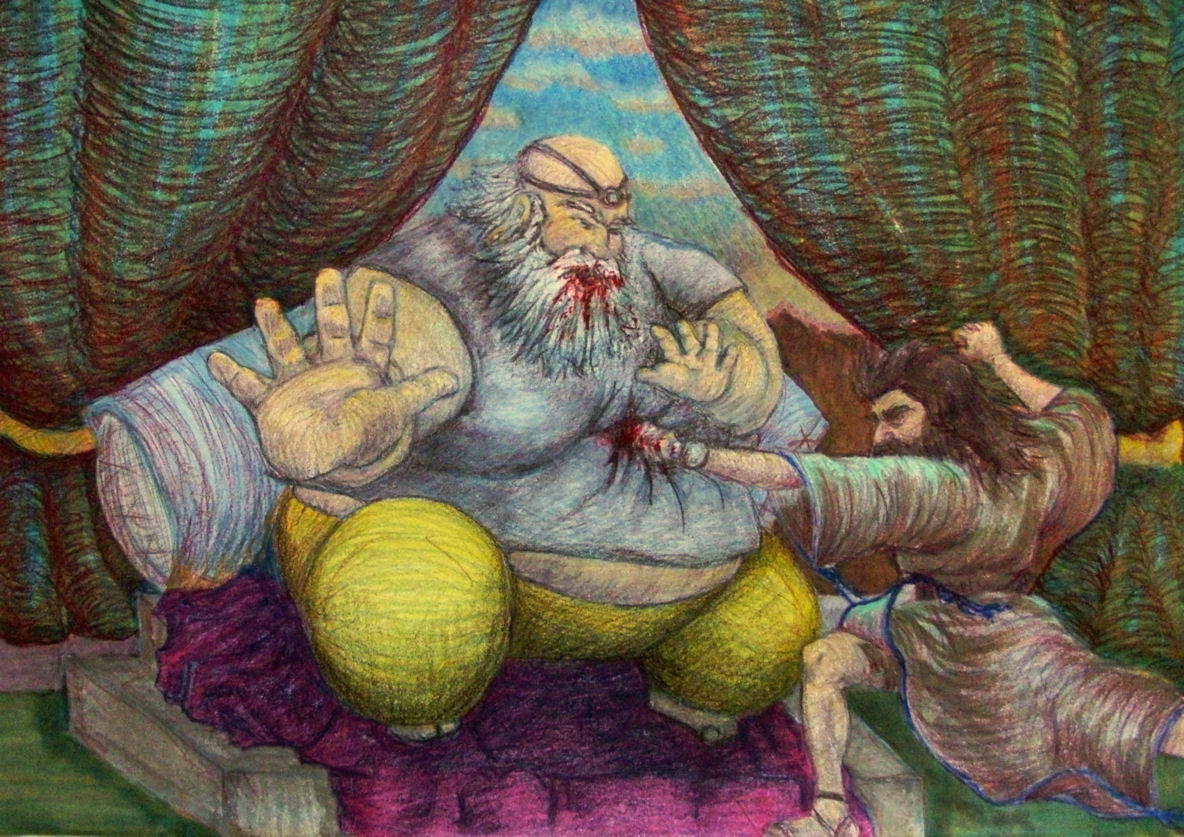
The Israelites again did what was evil in the sight of the Lord; and the Lord strengthened King Eglon of Moab against Israel, because they had done what was evil in the sight of the Lord. In alliance with the Ammonites and the Amalekites, he went and defeated Israel; and they took possession of the city of palms. So the Israelites served King Eglon of Moab eighteen years. But when the Israelites cried out to the Lord, the Lord raised up for them a deliverer, Ehud son of Gera, the Benjaminite, a left-handed man. The Israelites sent tribute by him to King Eglon of Moab. Ehud made for himself a sword with two edges, a cubit in length; and he fastened it on his right thigh under his clothes. Then he presented the tribute to King Eglon of Moab. Now Eglon was a very fat man. When Ehud had finished presenting the tribute, he sent the people who carried the tribute on their way. But he himself turned back at the sculptured stones near Gilgal, and said, “I have a secret message for you, O king.” So the king said, “Silence!” and all his attendants went out from his presence. Ehud came to him, while he was sitting alone in his cool roof chamber, and said, “I have a message from God for you.” So he rose from his seat. Then Ehud reached with his left hand, took the sword from his right thigh, and thrust it into Eglon’s belly; the hilt also went in after the blade, and the fat closed over the blade, for he did not draw the sword out of his belly; and the dirt came out. Then Ehud went out into the vestibule, and closed the doors of the roof chamber on him, and locked them.

Today marks the second part of our series on Strange Stories from Scripture. As a church we are taking time to look at those wonderful moments from the bible that they never talked about during Sunday school. These are the stories that make us blush, raise our eyebrows, and leave us scratching our heads.

Many of us are familiar with the well-known stories of Moses leading the Israelites through the wilderness, we know all about King David and his kingdom, we can even recall the miracles of Jesus, but the bible is also full of tales that are just begging to be used in worship and our daily lives.

Our first story was from the book of Numbers regarding the foolish prophet Balaam and his talking donkey. We explored how the donkey attempted to steer Balaam in the right direction, and pondered about the donkeys in our lives.

Today we are talking about Ehud and King Eglon from the book of Judges.

Ehud-and-Eglon (1)

Monday.

I’m sitting in my office, going over the emails from the weekend when I pull out the list of all the scriptures from now until Christmas Eve. I reread the plan for the sermon series on Strange Stories from Scripture, I wonder if people felt convicted by the sermon on Balaam and his donkey yesterday. I check the email once again to see if anyone took the time to send me a complaint about the sermon. The only one I receive makes a comment about seeing such a “smart… donkey” in the pulpit, but I file it away for later.

The A.C. is pumping out cold air, and I open up my bible to Judges 3 to read the scripture for Sunday. The story of Ehud and Eglon. As the words flow past my eyes, I can’t help myself from giggling in the office: Ehud stabs him in the belly, and Eglon was so fat that the blade disappeared and the dirt came out. I quickly scan through a number of other translations to see what they do with the vague “dirt” description. Some call it dirt, most call it dung, but at least one calls it poop.

When I see the word poop in the bible, it just makes me laugh.

I wonder if people will let me get away with saying poop from the pulpit on Sunday morning. I quickly make a note to pray about it during the week, before deciding whether or not to put “poop” in the sermon.

This has got to be one of the funniest and strangest stories in the bible, but before I dive into sermon writing, I decide to leave the word document open on my computer, and get to some of my other daily tasks before returning.

Tuesday.

The screen stares back at me empty. So I decide to get the mental juices flowing and rewrite the story in my own words:

The Israelites messed up again. Whether they were grumbling for more food, or worshipping false idols, they messed up, and the Lord decided to raise up King Eglon of Moab against God’s people, because they were continually messing up. King Eglon, with the help of God, went and defeated Israel and ruled over God’s people for 18 years.

But then, of course, the Israelites started to cry out to the Lord for delivery, perhaps they had seen the error of their ways, so God decided to provide their savior, Ehud, a left-handed man.

The Israelites, at the time, were in the habit of sending their taxes to King Eglon, and Ehud used this delivery to make his attack. He fashioned himself a double-edged sword, and attached it to his thigh under his clothes.

King Eglon was a very fat man.

ehud2

When Ehud finished delivering the money, he sent his compatriots away, and teased the King with the promise of a secret message from God. Eglon sent away all of the people from his inner court and invited Ehud to share this secret. But as Ehud leaned in to deliver the precious secret, he removed the hidden dagger and thrust it into Eglon’s belly.

Strangely enough, the further Ehud pushed, more of Eglon fat rolled over the blade until it disappeared from view, and Eglon’s poop came out. Then Ehud snuck out of the chamber and locked the doors behind him.

I rewrite the story, looking for sermonic inspiration that would drop down from heaven like manna in the wilderness, but I just sit in my office wondering what in the world God is trying to say through the text. Throughout the day the phone and doorbell continue to ring at church, and I welcome the distractions.

Wednesday.

I pull out some commentaries on the text, and decide to see what other people think God was saying. A few of them go into remarkable detail about the significance of Ehud being left-handed, while others address how detailed the descriptions were, and a few even propose a sexually metaphorical interpretation.

The more I read, the less the story makes me laugh. Instead of looking at the story like a cartoon with poop on the floor, I see human beings driven by enough anger and fear to conquer a nation, and murder a king.

Reluctantly, I start searching online for other sermons about Ehud and Eglon. Do people preach about this? What in the world do they say?

One of the sermons is titled, “Lefty vs. Hefty” and it is all about the differences between the two central characters. The writer emphasizes Ehud’s cunning against Eglon’s girth.

One of the sermons is titled, “Salvation” and it goes into profound detail regarding how, supposedly, God ordains the killing of people even today who get what they deserve. The preacher calls for the people to commit themselves to a radical system of justice, where they take matters into their own hands, just like Ehud did.

One of the sermons is titled, “The Power of Praise” and it focuses on how Ehud was able to trick Eglon into giving him the opportunity to strike. It ends with a reminder for the listeners to be careful about the promises they hear and the compliments offered their way, because a dagger might be lurking in the corner.

The more I read from God’s Word and from other sermons the more I regret picking the scripture for the series:

Eglon, the fat king, is now less a caricature, and more like the punishment God ordained for the people for messing up.

Ehud, the people’s deliverer, is now less a righteous judge, and more like a murderer.

Months ago I thought it would be perfect and hilarious to use this text during a series on Strange Stories, but now I worry about what I will actually say about it when the time comes.

Thursday.

Sitting in a coffee shop in attempts to begin crafting a sermon, I continue to stare at a blank screen. I have started at least three different sermons but before I am able to start really crafting a deep response to the Word, I highlight the text and pressed “delete.” Nothing feels good enough, all of the attempts feel flat.

How is this story speaking anything into our world today? What does the death of Eglon at the hand of Ehud have anything to do with the life of St. John’s and the community of disciples?

I close the computer and grab a nearby newspaper in hopes to distract myself from the seemingly endless flicker of the cursor on my computer. The top article says “US drops Atomic Bomb on Japan 70 years ago today.

1945-08-07-New-York-Times-headline

Before I realize it, I am sucked into the article, and the sermon floats away from the forefront of my mind. The writer has reproduced the original texts used the Associated Press the day the Atomic Bomb was first reported:

“An atomic bomb, hailed as the most terrible destructive force in history and as the greatest achievement of organized science, has been loosed upon Japan… The atomic bomb destroyed more than 60 percent – 4.1 square miles – of Hiroshima, city of 343,000 and radio Tokyo reported “practically every living thing” there was annihilated… Secretary of War Henry Stimson said, “If they do not now accept our terms, they may expect a rain of ruin from the air the like of which has never been seen on this earth.” (From the original AP article http://bigstory.ap.org/urn:publicid:ap.org:3fd267ba7b3c40479382189c99172d61)

I read the article and tears begin to form and fall down my face. Normally I would hide my face from the other patrons, but I am so struck by the words that I forget where I am and what I’m doing. 70 years ago we dropped the most powerful weapon we had ever created on a nation and virtually wiped out an entire city in a matter of seconds.

I start to remember where I am, and the sermon that needs to be written. The connections between the article and the scripture start to form:

Did Ehud leave the sword in Eglon because he wanted the effects to be devastating? Did he want to leave his mark in such a way that death was not the only consequence? Was the Atomic Bomb our sword that we had hidden under our clothes? Did we attack Japan in such a way that death was only the beginning of what we wanted to accomplish?

I wonder what people will think if I try to draw a connection between the anniversary of the Atomic Bomb with the death of Eglon at the hand of Ehud. Did Ehud do the right thing? Did we do the right thing? I have no idea where the sermon is heading.

Friday

I sigh deeply in front of my computer. Picking the Ehud and Eglon story was a bad idea. I explore an idea about dressing up like Ehud with a sword in church but it feels trite, impractical, and vaguely irreligious. I start writing a poem about how the Lord calls people to do extraordinary things during extraordinary times, but then it feels like I’m telling people its okay to murder and steal.

I sit in silence with my hands outstretched praying for the Lord’s will to be done, and for the sermon to be written. And I wait.

Saturday

The Community Cook-Out is going well; children are running around, adults are being fed, and conversations are flowing all over the place. I am thankful for the distraction the cook-out has provided, though I’m also worried about tomorrow morning. What will I say when the time comes? What is God’s Word speaking into our lives right now?

I watch the community in action. Not just the church, but all the people who make Staunton what it is and I think about Jesus. I remember the call to live radically transformed lives based on love and forgiveness, not on fear and retribution. I see people breaking bread for the first time, and I see Jesus in the midst of the people providing hope, the Holy Spirit giving life to our words and relationships, and God making new and lasting connections.

I think about Jesus and the new life he invites his disciples to experience. I think about the lengths God was willing to go to to respond to the cries of God’s people, raising up prophets and judges. I think about God finally offering the most precious gift he ever could, his Son, to die for all the people out on the front lawn of the church, and for the world.

I wonder if the story of Ehud and Eglon isn’t so much about how we react when the world pushes us into a corner, but about the trajectory of God’s gifts to the world. That at one time God would raise up a judge to save Israel, but that now God raised up his Son to save us from ourselves and from death.

Sunday

I stand in the sanctuary before disciples hungry for the Word of God and I say: I offer this to you in the name of the Father, and the Son, and the Holy Spirit. Amen.

How The Dishwasher Taught Me To Pray – Sermon on Ephesians 3.14-21

Ephesians 3.14-21

For this reason I bow my knees before the Father, from whom every family in heaven and on earth takes its name. I pray that, according to the riches of his glory, he may grant that you may be strengthened in your inner being with power through his Spirit, and that Christ may dwell in your hearts through faith, as you are being rooted and grounded in love. I pray that you may have the power to comprehend, with all the saints, what is the breadth and length and height and depth, and to know the love of Christ that surpasses knowledge, so that you may be filled with all the fullness of God. Now to him who by the power at work within us is able to accomplish abundantly more than all we can ask or imagine, to him be glory in the church and in Christ Jesus to all generations, forever and ever. Amen.

pray

I loved my college roommates. Some of us knew each other from high school, and others were grafted in along the way, but nevertheless, when we lived together it felt like a little family. We tried our best to communicate needs within the domicile, we kept it quiet when someone had a midterm the next morning, and we quickly learned to share common appliances for the betterment of the entire living situation.

Between us we would come to earn Bachelor degrees in Philosophy, Religion, Biology, Communications, and History. I always kind of imagined that we would be a awesome group Jeopardy team with the wealth of knowledge spread between us. Living together in college was great, but it wasn’t always easy.

There was the time we discovered mice in the house. We did our best to keep the kitchen clean, and spread mouse traps throughout the house, but during the cold winter months they came back like clockwork.

There was the time a huge snow storm came through, trapping all of our cars, and we ran out of heating oil to keep the house warm.

There was the time that we all contracted swine flu at different intervals. As one person became sicker and sicker, those of us who were well shared the responsibility of caretaker, until we started displaying our own symptoms.

Part of the beauty of living with other people was the sharing of life experiences. We celebrated each others successes, and grew to really rely on one another. Part of the challenge of living with other people was learning how to change our habits and needs based upon the habits and needs of other people.

Ephesians 3.14-21 is a prayer. Paul is writing to this new faith community in the hopes that his prayers will be answered by the Lord of hosts. He prays for the congregation because he knows that he cannot give them what they need in order to grow, but through prayer the church will learn to fully rely upon God.

The beginning of the prayer establishes the main focus: Paul prays for the church to be strengthened in its inner being, from the inside out, by the power of God. He hopes that the individuals that make of the community will see the vital importance of letting Christ into their lives and then change accordingly.

If Christ dwells in the hearts of the people, if they are rooted and grounded in love, then they may have the power to comprehend what is the breadth and length and height and depth of Christ’s love that surpasses all knowledge.

During college, I was the only person from the house that went to church. While my roommates enjoyed the comfort of their beds on Sunday mornings, I was making my way out the door to worship the Lord. I learned to accept their priorities, and on some level they learned to accept mine.

For instance: I made them pray with me whenever we ate dinner that I had prepared. I felt that if I was willing to go through all of the steps necessary to make a dinner for all of us, then they could bow their heads with me in prayer. So once a week, we would sit in our living room, eating on paper plates with plastic silverware, and they would listen to me pray.

prayer (1)

It is difficult for many of us to hear about God’s unending love, particularly a group of college-age men who just wanted to eat. It may seem so obvious to us that it no longer strikes at the core of our being. We hear “God is love,” and “love is patient, love is kind,” and “Love you neighbor as yourself,” and “God’s love knows no bounds” and instead of that love becoming clearer, it just floats around in the air.

Faithful love is even harder to grasp for those of us who do come to church because we hear about all these beautiful and wonderful things, we look around at a church filled with people who appear to have their lives figured out, when in reality we are all struggling with a myriad of secrets, private disappointments, lost hopes, and frustrations.

It’s hard to hear about love, when we don’t feel love in our lives.

Paul’s prayer for the church in Ephesus is all about letting Christ in to change lives: I pray that, according to the riches of his glory, he may grant that you may be strengthened in your inner being with power through his Spirit, and that Christ may dwell in your hearts through faith, as you are being rooted and grounded in love.

Letting Christ into our hearts is like moving in with a new roommate. At first, we spend a lot of joyful time getting to know one another, discovering common likes and interests. We do a great job putting all the dishes away and keeping the house clean, but then we have to start making compromises, whether we want to or not.

I learned about this type of faithful living the right way through my wife Lindsey. When we were dating, and I was getting ready to ask her to marry me, I dreamed about what it would be like to live together. I imagined the way we would set up our living room, where we would put the record player, and even where we would dance to all of our old jazz 33s.

After the wedding, while we were still giddy from the honeymoon, we decided to tackle the challenge of combining all of our possessions in the kitchen. We debated the value of keeping our plates in one cabinet versus putting the coffee cups near the coffee pot. We worried about the safety of keeping our knives in a drawer or right on the counter top. And we experimented with the location of the microwave in relation to the toaster and whether or not we would blow the fuse if they were both on at the same time.

praying_hands_clean_dirty_dishwasher_magnet-rcfdd698c86904ddaa1e6594a1d17e547_x7qgu_1024

The real challenge came to the precipice over the dishwasher. I was of the opinion that it did not matter where dishes and cups were placed in the dishwasher, so long as we could fit as many things as possible. Lindsey was not of the same opinion. For the first few weeks, whenever I put a plate away, she would come behind me and rearrange the dishwasher. It got to a point that I started purposely putting items wherever I wanted because I didn’t think it mattered, but sweet Lindsey would watch me live out my frustration, and then when I left the room, she would bring order to the dishwasher.

I don’t know how long this continued, but I do know when it stopped. Lindsey was working late one night, and the dishwasher was almost full. I saw my opportunity to prove that the dishwasher works fine no matter where the dishes are placed. So with a mischievous grin on my face I rearranged the order into chaos, I started the dishwasher. I couldn’t wait to see her face when she got home, I imagined the apology she would offer me regarding her wrong interpretation of dishwasher etiquette, it was going to be something beautiful.

But when the dishwasher cycle finished, I knew I was in trouble.

How could this have happened? Whenever Lindsey ran the dishwasher, everything came out all nice and clean and ready to use. But this time, there was still food on a few of the dishes, and some of the utensils looked worse than when I put them in!

I was wrong, and I learned to change. Now I will freely admit that sometimes I still place something in the wrong place, but after my passive-aggressive experiment, I have learned to alter my focus because Lindsey was right.

prayer_2014_02_07-13

The incident with the dishwasher taught me that prayer is about change. When I forced my roommates to pray in college, was I doing it because I was concerned about them, or was I doing it because I thought I was better than them? Did I earnestly pray to the Lord during that time, or did I just want them to hear the sound of my voice?

The beauty of prayer comes to fruition when we let Christ in to change us, and when we are willing to give up some of our space for the Lord. The dishwasher taught me that if prayer is only about myself, that if I am only concerned with my thoughts and actions, then I am neglecting to let God in to make some important changes.

Faithful living is about giving up those habits and behaviors that are no longer fruitful, reprioritizing and reorganizing our lives, so that God can make us clean.

In a few moments we are going to end our service not here in the sanctuary, but outside on the front lawn. We are going to gather in a group and we are going to pray.

First we will pray for God to give us the strength to give up some room, and let Christ in. That instead of focusing on just our needs and wants that we will begin to comprehend the love of Christ and the fullness of God.

Then we will face the sanctuary and we are going to pray for our church. So many of us, myself included, get caught up in such a tunnel-visioned view of prayer that we neglect to pray, like Paul did, for the community of faith.

And finally we will turn to face the community around us and pray once more. Prayer is not just about you and me, and it is not just about the church, prayer is about communing with the Lord about the very fabric of life.

If we want our lives to change, if we want our church to change, if we want to let God’s love reign, then we have to be willing to give up some space. We have to learn to rearrange the dishwashers of our lives so that everything can be made clean.

Amen.

The Upside-Down Kingdom – Sermon on Mark 6.30-34

Mark 6.30-34

The apostles gathered around Jesus, and told him all that they had done and taught. He said to them, “Come away to a deserted place all by yourselves and rest a while.” For many were coming and going, and they had no leisure even to eat. And they went away in the boat to a deserted place by themselves. Now many saw them going and recognized them, and they hurried there on foot from all the towns and arrived ahead of them. As he went ashore, he saw a great crowd and he had compassion for them, because they were like sheep without a shepherd; and he began to teach them many things.

251121425_640

Last Sunday our mission team gathered in the parking lot after worship, prayed together, and then set out for the beautiful bounty of West Virginia. I don’t know how the rest of the team felt as we made our way west, but I was excited; we were committing ourselves to a community, we were going to be Christ’s hands and feet, and we were going to experience God’s upside-down kingdom.

McDowell County, West Virginia is nothing short of beautiful. While the roads twist back and forth and the topography ebbs and flows, you are constantly bombarded by the beauty of God’s creation. Sitting behind the wheel, the scenery flies past the window and all evidence of humanity’s presence is gone except for the occasional roadside house and the road beneath the wheels.

By the time we finally made it to Welsh, WV we were ready to work, and we were ready to get out of the cars. But the scenery had drastically changed from the journey; when we arrived in Welsh it felt as if time had stopped. At one time Welch was one of the ten most populated places in the United States. More coal has been found and produced in McDowell County than nearly every other coal mining venture in the rest of the country. The community grew rapidly as the industry boomed, but now it is a ghost town.

IMG_0228

The final moments as we drove up to where we would be staying for the week were met with silence as we absorbed our surroundings. Countless empty buildings littered the streets, handwritten signs adorned the windows begging people and businesses to consider renting the space, and for the longest time we drove without seeing another human being.

The apostles, those first ragtag disciples, had gathered all around their teacher to share with him all they had done and taught. They went on and on about the lives they had changed, the miracles they were able to perform, and moments they had experienced God’s presence. But then Jesus said to them, “Come away to a deserted place all by yourselves and rest awhile.” For many were coming and going, and they had no leisure even to eat.

Our mission team had arrived in our deserted place, but we would find little rest. Our church team was divided into two different work groups; the first would be working in a local food pantry, helping them to organize different donations before the weekly distribution on Saturday, the other would be working on painting the floors of house in the small town of War. The time before and after working would be spent in prayer, bible study, fellowship building, and learning about the local community.

From the Food Pantry group we learned that 100% of the children in McDowell County are on Free/Reduced lunch and that more than 50% of the children are considered homeless. From a former coal miner we learned that for a long time McDowell County was one of the wealthiest in the nation thanks to their coal mining, but that now the mines are being shut-down, and more and more people are without work and purpose.

11145167_10204335886108256_7977281946266719389_o

It would have been easy to show up in McDowell, roll up our sleeves, work hard, and leave feeling good about the work we had done. It would have been easy to make a few friendships, pray for the people we met, and return to our lives in Staunton. It would have been easy to return to the pace of life here without being affected by what we had seen and experienced, but Jesus calls us to live in the Upside-Down Kingdom where our lives are flipped around.

When the crowds were gathering to see this special man named Jesus, many were coming and going and the had no leisure even to eat; what a perfect description of the lives that many people are living today. Far too many of us rush through the mundane aspects of daily living without taking the time to reflect on what we are actually doing.

Kids grab Pop-tarts on their way out the door in the morning, young professionals order the same cup of coffee with urgency before their daily commute, families sit down at a communal table to eat but each member has their nose down in a smart phone in order to connect with others, while actually disconnecting from the people in their midst.

Many of us Christians spend our faith lives just like the crowds so long ago. We treat church not like the precious gift that it is, but like any other commodity in our lives. Instead of seeing it as a vital and life-giving space, we see it as another item on the never-ending check-list of existence. Some of us have so much to do, that church has become an occasional venture, rather than a regular necessity. So many of us are coming and going at such a tremendous speed that we no longer have the time to feast on God’s Word in prayer and in worship.

The mission team, however, abandoned the fast pace regularity of life, and were forced to adjust to God’s schedule. Every morning we woke up to eat and begin our devotions; How were we experiencing God’s Upside-Down Kingdom? Where had we seen brokenness in the community? What is God trying to do through us this week? We began and ended every single activity with prayer, and we devoted ourselves to the people we were serving.

PPT-UpsideDownKingdom

Now many saw the disciples and Jesus, so they hurried there on foot from all the nearby towns and arrived ahead of them. As Jesus went ashore, he saw a great crowd and had compassion for them, because they were wandering like sheep without a shepherd; and he began to teach them many things.

Jesus loved to teach people about the kingdom of God, and he did so with parables. The Kingdom of God is like a mustard seed; though tiny and small, it grows into one of the greatest plants providing shade and offering life. The Kingdom of God is like a wedding-feast where the least of society are invited to eat at the head table. The Kingdom of God is like a sower who goes out to sow, he knows not how the seeds grow but provides rich soil for the seeds to settle in.

While we settled into the rhythms of mission work in McDowell County, we started to  experience what God’s Upside-Down Kingdom is really like.

The Kingdom of God is like a group of privileged folk from Staunton, Virginia who gave up a week of their lives to serve a community of people they had never met. Time and time again they were questioned by the people about their work. No one could understand why a group such as ours would give up their precious time, give up their vacation, to get down on their hands and knees to change a person’s life. We did not go in order to earn our own salvation, we did not go to make ourselves feel better about our faith, we went because God’s Kingdom is one that has been flipped upside-down by the work of Christ, one that compels us to go and love when the world stands bewildered at our actions.

The Kingdom of God is like a house with plywood floors. Rough around the edges, with splintered pieces jutting out all over the place, in need of a few good coats of paint. The pieces of plywood met in different angles and sizes with the grain of the wood running in different directions, requiring dedicated attention while painting. God invites all to participate in this Kingdom, and we are not meant to be all alike. In fact God calls us to celebrate the things that separate us, so that we can learn to live in harmony with one another in the midst of differing grains.

The Kingdom of God is like a child laughing while running around a tiny yard in the middle of West Virginia with a 6 week old puppy. While adults slaved away in the house painting the floors, young children were laughing in a way that helped us to remember why God called us here in the first place; not to just help someone with their material needs, but share in the joy that comes with recognizing God’s grace in something as simple as a puppy, or as profound as a young family moved to tears because of our sacrifice.

The Kingdom of God is like a foot-washing the night before Jesus died, and the last night of a mission trip. Each of us took a turn in the chair and were prayed over by the rest of the church group. Every person was lifted up to God and we gave thanks for all that they had given, praised God for the witness they were discovering in their life, and asked God to be with them as they were sent forth into new places. Each person was valued, appreciated, and celebrated. In God’s Upside-Down Kingdom, even the smallest of servants, even the tiniest bits of effort, are embraced and lifted up for the true value they contain.

The Kingdom of God is like leaving a mission field, to return home only to realize that everywhere we go is a mission field. That whether we are serving the needs of a community in West Virginia, or living into a new reality of love right here in Staunton, God’s Upside-Down Kingdom is everywhere.

The people we served in West Virginia we hungry for something greater than themselves. Though desperately in need of things like food, clothing, and shelter, they actually hungered for something much more precious: value and worth.

The challenge of the story of Jesus with the crowds, is that we read about a people who were hungry while so many of us are full. We are not like the people who gathered to discover Jesus, we are not like the desperate crowds rushing to meet the Lord ahead of the disciples. Nobody here is so eager to find God that they beat me to this sanctuary on Sunday mornings.

For many of us, church is just one of the many activities that fills our modern lives, rather than the one place where we discover lives worth living.

11745349_10207136174344490_769335585716666659_n

Like many mission trips, I think we got more out of it than the people we served. We thought we were going to help them in the midst of suffering, only to discover that we needed to be healed just as much. We needed to stop viewing ourselves as better than the people we were serving, we needed to learn to love them in spite of their behavior and past experiences, we needed to start looking at them the ways God looks at the world: with love.

We went all the way to West Virginia to learn about God’s Upside-Down Kingdom only to realize that we are part of it as well.

When the crowds gathered at the feet of Jesus, when he had compassion on them because they were like sheep without a shepherd, he taught them about things like the Kingdom of God. When we get together every week for worship, we are just like those crowds resting at the feet of the Lord eager and ready to learn. It is through our prayers and hymns, through the people in the pews next to us, and through the words of scripture and a sermon that we discover ourselves in the midst of God’s Upside-Down Kingdom, and we begin living accordingly.

What a blessing to know then, that every day is an opportunity to serve God’s kingdom from the beauty of McDowell, West Virginia to the beauty of Staunton, Virginia. We are called to be Christ’s hands and feet for the world, so let’s get out there and do it. Amen.

God Is God And We Are Not – Sermon on Psalm 24

Psalm 24

The earth is the Lord’s and all that is in it, the world, and those who live in it; for he has founded it on the seas, and established it on the rivers. Who shall ascend the hill of the Lord? And who shall stand in his holy place? Those who have clean hands and pure hearts, who do not lift up their souls to what is false, and do not swear deceitfully. They will receive blessing from the Lord, and vindication from the God of their salvation. Such is the company of those who seek him, who seek the face of the God of Jacob. Lift up your heads, O gates! and be lifted up, O ancient doors! that the King of glory may come in. Who is the King of glory? The Lord, strong and mighty, the Lord, mighty in battle. Lift up your heads, O gates! and be lifted up, O ancient doors! that the King of glory may come in. Who is this King of glory? The Lord of hosts, he is the King of glory.

P-019-w_I_Am_Not_God.37205641_std

Be careful.” That’s what they kept saying when they found out I was invited to preach at a church in the heart of Detroit. I had been living in Birmingham, Michigan (a rather wealthy suburb north of Detroit) helping serve a church for the summer when I received the opportunity to fill in at another church one Sunday. And as soon as I was asked, all the warnings started coming in: “Be careful” “Park as close as possible to the church” “Keep your wallet in your front pocket.

I remember thinking these people were crippled by fear, how bad could it really be? We were talking about driving into Detroit on a Sunday morning to preach at a church…

When the morning arrived I was filled with excitement. I picked out the perfect bow tie to go with my blazer, hoping to assert my authority regardless of my young age, I had a prepared a theologically profound manuscript sermon, hoping that it would get people to shout “amen!” from the pews, and I spent the long drive down Woodward Avenue in silence, hoping to boost my holiness before the service began.

The closer I got to the church, the stranger I began to feel. I hadn’t noticed it at first, but the longer I drove, the less people I saw on the streets. The buildings went from inviting homes and businesses to abandoned shells of carpentry. The streets went from well maintained to pot holes that required a car to drive up on the sidewalk in order to avoid.

In a matter of minutes I had gone from “Pleasantville” to a post-apocalyptic movie set, and my excitement was quickly replaced by fear.

By the time I pulled in the parking lot, I realized that I hadn’t seen another human being for at least ten minutes. The streets had been largely deserted leading up to Cass UMC, and it was strangely silent when I stepped out of my car.

So here I was, standing in the heart of Detroit, in a bowtie and blazer, with a bible and sermon tucked under my arm, completely alone on a Sunday morning.

My footsteps across the concrete reverberated in echoes through the abandoned buildings flanking the church and even though it was a bright sunny day, I felt like I was walking down a dark alley in the middle of the night. The building itself was an architectural masterpiece having been built in 1883 with Tiffany’s stained glass windows, though I could tell from the street that bullet holes had cut through the once remarkable windows.

When I reached out my hand to open the doors, the height of my new fears were realized: It was locked.

Cass_Avenue_Methodist_Episcopal_Church_-_Detroit_Michigan

I knew no one from the church, I had no way to contact anyone, and all of the warnings started to really flow through my mind. But I did what any good pastor would do, I sat down on the front steps and waited for someone to open the door.

30 minutes later, a disheveled looking old man, the first person I had seen in a long time, peeked from around the corner, walked up the steps, and unlocked the front door without saying a word. I wandered around the building until I found the sanctuary, searched in vain for a worship bulletin, and resigned myself to sit down in a chair by the altar.

During the next hour, the most random assortment of people started flowing in through the sanctuary doors. The church, once renown in the heart of Detroit, was being filled with people who slept outside the night before, people who had no money to put in the offering plate, and people who were having conversations with themselves at a volume loud enough for everyone else to experience.

A group of 7 older black women arranged themselves on folding chairs near the front, and without really discussing it they all flipped their hymnals to the same page and started to sing. A man with wrinkled fingers was hunched over a piano in the corner struggling to keep up with the singing, and a young man had seated himself behind a drum-set hidden in the corner, and was wailing away to a song that only he could hear.

When the first hymn ended, the women huddled together to pick another hymn and began singing. At some point in the middle of their fourth hymn, with the pianist still planking away, and the drummer smashing the cymbals, a gentleman stood up in the middle of the sanctuary with his eyes trained on me. He walked down the main aisle slowly and deliberately until he was towering over me and then declared, “Son, if you don’t start talking, they ain’t liable to quit singing.

The earth is the Lord’s and all that is in it, from the sea to the mountains, from the rivers to the deserts, from the people to the animals; for the Lord has founded life upon the earth. Who then shall worship the Lord in holiness? And who shall stand with the Lord in the holiest of places? Only those who have clean hands, and pure hearts, those who do not lift up their souls to what is false, who do not break their promises. They will receive a blessing from the Lord, and vindication from the God of their salvation. Such is the company of those who seek the Lord.

I stood up after the end of the next hymn, and grabbed the hand held microphone to start participating in worship. I felt like a fool standing in my khakis and blazer, with my bowtie tilted just slightly to the side. I felt ridiculous with my over examined sermon under my arm, and bible in my hand. I felt like I didn’t deserve to stand before the congregation, but all of their eyes were on me. (just like all of yours are right now)

I took off the jacket and tie, rolled up my sleeves, ditched the sermon on my chair, and let the Holy Spirit go to work.

Let us pray” I began, and before I could start praying for our service, the people started shouting out their own prayers. “O Lord, help this boy to preach.” “Yes Lord, show us your mercy.”My God show me your glory!” “Remove our sins, give us your Spirit, clean our hearts!” “Your will be done!” “Have thine own way Lord!” “Help this boy preach, preach preach.

It was only after a few moments of silence that I finally said “amen” without having added any of my own prayers.

I preached on the apostle Paul’s second letter to the church in Corinth, about the new creation that comes in knowing Christ. I talked about moments that transform our lives. I said things like “there is a new life in Christ, but just because we find Christ it doesn’t mean our life will get better, but that we are called to make other lives better.” And instead of the typical, and silent, congregation I was used to, the people kept shouting at me while I preached. “Ain’t that the truth!” “Yes Lord!” “We know it, we know it” “Lord, give him strength to preach.” “Speak through him God.

When I got around to the close of the service, when I offered a benediction to the congregation, when the final amen was uttered, I heard them say in return, “Thank you Jesus.”

be-still-and-know-that-i-am-god-960x250

Lift up your heads, O gates! Open up you ancient doors! the King of glory is coming. Who is the King of glory? The Lord, strong and mighty, merciful and majestic, the Lord. Jesus Christ the author of salvation, the Good News, the Messiah. The Holy Spirit full of wisdom and truth, giver of life, and partner to our prayers. Lift up your heads, O gates! Open up you ancient doors! The King of glory is coming! Who is the King of glory? The Lord of hosts, he is the King of glory.

We can dress the part, we can read all the right books, we can memorize all the hymns and prayers, but unless we are looking for holiness in our lives, unless we are ready to bow down to the King of glory, then we are forgetting the truth: God is God and we are not.

Many of us are good Christians, we pray for our friends and family, we come to church, we put money in the plate, but there is a profound difference between believing we are holy, and wanting to be holy.

When I arrived at that church in Detroit years ago, I foolishly thought I was bringing something to them. With my well prepared outfit and sermon, I made the assumption that I was bringing God with me, nice and shiny, like a school project. I became my own main character in the story of worship, and it prevented me from seeing the King of glory.

When I stood up in the pulpit to proclaim the words, the people did not see a young man with a seminary education, they did not see some white fool trying his best to not pass out, they saw a vessel for the Lord. Their prayers were not to me, but for the Lord to work through me. The recognized the great division between God and me, and knew that Jesus was the bridge between the two.

They knew that God is God and we are not.

In our contemporary American culture, we tend to view ourselves as the center of the universe.

We assume that everything revolves around us, and that so long as our needs are being me, then everything else should be fine.

We believe that if we wear the right clothes, and get the right education, that holiness will follow accordingly.

We feel holy for giving up an hour every week to sit in a place like this and sing hymns, offer prayers, and listen to a sermon.

That church in Detroit had something that I never knew I needed: They believed that God was the center of the story, that God had the power to transform their lives, and that God really was the King of glory.

Too many of my friends have left the church because they “didn’t get anything out of it.” They might try different styles of worship and different denominations, but if they don’t get anything out of it, they will rarely return. However, church isn’t about what we get out of it, its about what God gets out of us.

Believing we are already holy limits God’s power to make us holy.

It is in the recognition of the great divide between humanity and the Lord that we can let Jesus get to work on our hearts and souls. It is in the great admission of Jesus as the King of glory we start to see ourselves, not as the center of the universe, but instruments for God’s love to be heard in the world. It is in the words of our worship that we recognize the Holy Spirit’s movement in our midst and our lives start to change.

If we remain in the assumption of our holiness, then our lives will stay the same.

But if we truly desire for the Lord to make us holy, then our lives will be transformed. Amen.