This week on the Strangely Warmed podcast I speak with Drew Colby about the readings for the Resurrection of the Lord [C] (Isaiah 65.17-25, Psalm 118.1-2, 14-24, 1 Corinthians 15.19-26, John 20.1-18). Drew is the lead pastor of Grace UMC in Manassas, VA. Our conversation covers a range of topics including McDonalds, Easter songs, champagne, ecclesial delight, the super psalm, good verbs, lectionary podcasts, Adam’s helpless race, commandment keeping, the destruction of death, All Things Beautiful, skepticism, and brevity. If you would like to listen to the episode or subscribe to the podcast you can do so here: The Divine Ellipsis
O give thanks to the Lord, for he is good; his steadfast love endures forever! Let Israel say, “His steadfast love endures forever.” Open to me the gates of righteousness, that I may enter through them and give thanks to the Lord. This is the gate of the Lord; the righteous shall enter through it. I thank you that you have answered me and have become my salvation. The stone that the builders rejected has become the chief cornerstone. This is the Lord’s doing; it is marvelous in our eyes. This is the day that the Lord has made; let us rejoice and be glad in it. Save us, we beseech you, O Lord! O Lord, we beseech you, give us success! Blessed is the one who comes in the name of the Lord. We bless you from the house of the Lord. The Lord is God, and he has given us light. Bind the festal procession with branches, up to the horns of the altar. You are my God, and I will give thanks to you; you are my God, I will extol you. O give thanks to the Lord, for he is good, for his steadfast love endures forever.
Every pastor has a favorite Palm Sunday story.
Like the year when the palm branches were delivered way too early and dried out so much that when the gathered congregation shook them over their heads in worship, palm branch particles went flying in every direction resulting in sneezing and coughing fits among the people of God.
Or the time when the pastor thought it would be a great idea to dress up like a donkey and preach the sermon from the perspective of the animal that carried Jesus into Jerusalem, to which the pastor received perhaps the greatest Sunday morning comment of all time: “You know, you’re not the first donkey we’ve had in that pulpit.”
Only they used a different word for donkey.
Or the time when the children of the church processed in waving their palm branches and lifting up their hosannas only to begin smacking one another in the face with their aforementioned palms until a nearby parent had to jump in to break up the melee and mutter, a little too loudly, “Lord, save me from these kids!”
And I think the reason preachers like me like to tell a cute or funny little story about Palm Sunday is because the actual story of Jesus’ triumphal entry into Jerusalem is rather confounding.
Put another way: Palm Sunday is perhaps the strangest Sunday of the year.
For, it begins in celebration and ends in catastrophe. It starts with “Hosanna” but it finishes with “Crucify.” It begins with life and it ends with death.
At they are approaching Jerusalem Jesus sends two of his disciples to procure a colt for his entry into the holy city. He rides in a cartoonish way, with his feet nearly dragging on the ground on either side of the animal, and the people of Jerusalem comes out in droves to see the would-be Messiah. They are overcome with reverence, so much so that they begin to take their own clothing, and spread it on on the road only to be trampled upon by the colt. They make a royal carpet as they worship the King of kings.
They take leafy branches from the fields and they wave them to and fro and they shout, “Hosanna! Blessed is the one who comes in the name of the Lord! Blessed is the coming kingdom of our ancestor David! Hosanna in the highest heaven!”
Hosanna. I’ve always loved that word. It’s such a churchy word. It makes me think of my own childhood and parading around the sanctuary. It makes me things of the musical masterpiece Jesus Christ Superstar and the crowds singing, “Hey sanna Hosanna, sanna sanna Hey, sanna ho sanna hey sanna.”
Hosanna is a wonderful word. And, every Palm Sunday, we reach into the vault of churchy words, we dust off this old familiar declaration, and we proudly put it on display. We shout it in our hymns, we put the word on the lips of our children, we hear it read in the scriptures. And then, at the conclusion of worship, we wrap it up and place it back into the church vault with our other special words only to come back one year from now.
We are familiar with this word. It conjures memories and songs. Churches everywhere will join us in our shouts of Hosanna today.
But do we know what it means?
Save us.
It is a declaratory pleading. It is an emphatic demand.
Save us. Now!
Saved?
That’s a word you don’t hear much in churches like ours. We’re Methodists. We sing and we eat and we sing some more. We try to love each other. Really, we do.
Love, peace, grace, mercy, forgiveness. Those are our words.
But saved?
How many got saved on Sunday? We don’t talk like that.
We might make fun of those other types of church that talk in such a way.
I remember someone once asking me if I was saved, and I said something like, I suppose so, and he said he’d been saved no less than 9 times.
Hosanna! Save us!
Really?
Well, perhaps we should go look in the Bible for this word, where else does it appear besides Jesus’ triumphal entry into the city that will kill him?
There’s a woman, suffering from a hemorrhage for 7 years. She’s among the crowd one day and she says to herself, “If I but touch the hem of his garment I will be saved.”
Well, in our Bible’s it says, “made well.”
But it’s the same word for saved. The same word the crowds cry out as Jesus’ enters Jerusalem.
And she suffers from more than just her bleeding. She’s isolated, outcast, thrown away by the likes of her family and her friends. She is a nobody with no hope in the world. Until the hope of the world walks past one day and she reaches out. She’s got nothing until she gets saved.
Jesus saves.
There’s a blind beggar sitting by the roadside. Like the woman he is unseen by all because of his inability to see. Forgotten and abandoned. And when the Lord walks by he shouts out, “Son of David have mercy on me.” The disciples are quick to shut him up. The Lord has more important things to do than to waste his time on you.
But the Lord comes anyway and says, “What do you want me to do?”
I want to see.
And Jesus says, “You faith has saved you.”
He has nothing to show for anything. He’s desperate. And in a moments notice, he is in the parade of the faith. Dancing and shouting for joy.
Jesus saves.
There’s a rich man, well to do, Mr. Z they call him behind his back. While his fellows get poorer and poorer he gets wealthier and wealthier. He’s a tax collector. One day he climbs a tree to see Jesus. And the Lord calls him down and says, “Got any plans for lunch?”
They go to Zacchaeus’ house and the crowds are incensed. How dare the Lord go to eat with that sinner! What do they talk about over lunch? We don’t know. We only know that as they leave the house the tax collector is changed. He says, “I will give back everything that I have taken with interest.”
“Salvation” Jesus says, “has come to this house.”
Jesus saves.
It’s no wonder the crowds grew and grew and grew. It’s no wonder the strange new world of the Bible talks of people leaves their plows in the field and their bread in the oven when the Messiah shows up.
Because the Messiah is the one who saves.
And there’s no such things as being a little bit saved, or partially saved. It means a total and complete salvation.
So when they wave their palm branches, when they place their cloaks on the road, they scream for salvation from the only one who can bring it.
Hosanna! Save us Jesus!
Save us, from what?
Jerusalem is occupied, the Roman garrison enters the holy city on the other side. Pontius Pilate comes riding in on a war course while Jesus enters on a donkey. The people of God, therefore, are living as strangers in a strange land in the very land God had promised. Their way of life is fracturing, their faith is under scrutiny, they have no bright hope for tomorrow.
And here comes the Messiah! The one who makes everything right! He’s saved others and now he’s going to save us. He’s going to give us our city back. He’s going to bring back our way of life. He’s the new king!
The crowds grow and grow, and the shouts of Hosanna echo through the city streets, until they see the cross.
It is strange and not so strange to know that those same people who shouted Hosanna at the beginning of the week were shouting crucify by the end.
It’s all too easy for us to cast Jesus into role of our own choosing.
It’s all too easy for us to put words, our words, into Jesus’ mouth.
We would still like to see him parade around into the madness of our circumstances to champion our hopes and dreams, to disrupt and frustrate the plans of our enemies.
But Jesus doesn’t come to bring us more of the same.
Jesus comes to save us.
He doesn’t enter the holy city to establish yet another political machine that result in one group lording it over everyone else.
He doesn’t pass out swords and shields to storm the temple walls.
He doesn’t even offer programs of personal morality that will make the world a better place.
One of the craziest parts of Palm Sunday is that, according to the strange new world of the Bible, Jesus doesn’t say anything.
He merely rides into the city that will kill him.
But it’s Palm Sunday. We don’t want to have to think about Friday yet. We like the images and the sounds of our children waving palm branches high in the air. But there is no jumping from today to Easter Sunday.
Put another way, we do well to remember there is no resurrection without crucifixion.
It’s in our hymns and in our creeds and even in our prayers, but we try to stay away from the crucifixion as much as possible. And for good reason – it is the sign of our total and utmost depravity. But it’s also the heart of God.
God, the creator of the cosmos, lays aside almightiness to come and dwell among us in the muck and mire of life, to be one of us.
God becomes vulnerable for us.
And how do we return the favor?
Crucify, Crucify!
Why? Because we want salvation on our own terms. We want to take matters into our own hands. We want to save ourselves.
We don’t want to be saved in our sins, we’d rather lord it over other sinners who are worse than us. The only problem with that is, according to the kingdom of God, none of us is righteous, no, not one.
You see, we crucified Jesus not because he was God, but because he was God and then failed to come up to our standards in doing so. It’s not that we weren’t looking for the Messiah; it’s just that he wasn’t the one we were looking for.
We’re fine with being saved only so long as it fits neatly into our expectations of what it means to be saved.
The crowds wave their branches and they shout their hosannas. Save us Jesus, save us! And, by the end of the week, that’s exactly what he does, whether we deserve it or not, whether we like it or not.
Jesus saves.
O give thanks to the Lord, for he is good, for his steadfast love endures forever.
This week on the Strangely Warmed podcast I speak with Alan Combs about the readings for Palm Sunday [C] (Psalm 118.1-2, 19-29, Luke 19.28-40). Alan is the lead pastor of First UMC in Salem, VA. Our conversation covers a range of topics including intergenerational trauma, the whole story, Holy Week, difficult hymns, The Wesley Bros comic, responsibility, the elected reject, singing stones, choices (or the lack thereof), and the not normed norm. If you would like to listen to the episode or subscribe to the podcast you can do so here: Passionate Palms
Now before the festival of the Passover, Jesus knew that his hour had come to depart from this world and go to the Father. Having loved his own who were in the world, he loved them to the end.
The synoptics (Matthew, Mark, and Luke) treat us to the scene of Jesus’ final evening with his friends as they sit around a table sharing bread and wine.
John, however, takes the scene a little bit further.
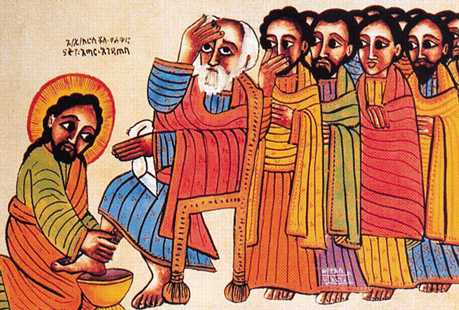
While eating at the table, Jesus gets up, takes off his outer robe, and ties a towel around himself. He begins washing all of the disciples’ feet and wipes them off with the towel around his waist.
Peter, of course, objects to the humble (read: humiliating) act of his Lord, but Jesus hits him hard with, “You do not know what I am doing, but later you will understand.”
Only after every disciple’s feet are washed does Jesus arise, and begins to teach:
“Listen, you call me Teacher and Lord which is good and fine because that is who I am. But check this out: If I, your Lord and Teacher, am willing to get down on the floor to wash your feet, you also ought to wash one another’s feet. This is what the Kingdom of God is all about – the first being last and the last being first. Things are getting flipped upside down right here and right now. And I do and say all of this knowing that one of you will betray me, it is to fulfill the scripture, ‘The one who ate my bread, has lifted his heel against me.’” Shortly thereafter, Judas leaves and sets in motion the world turned upside down. In mere hours the guards will arrive in the garden, Jesus will be arrested, put on trial, sentenced, beaten, and left to die on the cross.
The foot washing has always been a little strange and a little weird to the people called church. For one, as mentioned, the other Gospels don’t include it, and for another, it reveals the heart of God in a way that feels uncomfortable.
Not only does Jesus, God in the flesh, get down on his knees to wash the dirty feet of the disciples, one of whom will shortly betray him, another will deny him, and the rest will leave him hanging to die on a cross, but then Jesus has the gall to command us to do the same for one another.
And yet, in a way, more than being told what we are supposed to do, the whole message of this final moment is, again, about what Jesus does for us.
In the foot washing, Jesus repeats in himself the great lengths to which God was willing to go for a people undeserving – how far God was willing to go to wash us clean from our transgressions.
This moment, one that might make us cringe or, at the very least, furrow our brows, it reveals to the disciples and to us that the Lord, the Alpha and Omega, the Beginning and the End, is about to suffer and die just to rid us of the stench and dirt of sin and death that latches onto us.
And, notably, this is the final act of Jesus toward his disciples before Easter and, as John so wonderfully notes, Jesus loved his disciples to the end. Including Judas.
Do you see what this means? Even the worst stinker in the world, even the one who betrays his Lord to death, is someone for whom Christ died. While we were yet sinners, Christ died for us.
Jesus, bewilderingly, loves us to the end, loves us so much that he was willing to take our sin upon himself, mount the hard wood of the cross, and leave them there forever. Thanks be to God.
This week on the Strangely Warmed podcast I speak with Alan Combs about the readings for the Fifth Sunday of Lent [C] (Isaiah 43.16-21, Psalm 126, Philippians 3.4b-14, John 12.1-8). Alan is the lead pastor of First UMC in Salem, VA. Our conversation covers a range of topics including record breakers, timelessness, keeping Easter in Lent, Makoto Fujimura, laughing in church, terrible testimonies, tremendous transformation, clarity (or the lack thereof), authorial soliloquies, and John Daker. If you would like to listen to the episode or subscribe to the podcast you can do so here: Narding Out
Jesus sees possibilities where we, too often, see failure.
Jesus believes in those who have quit believing in themselves.
Jesus makes a way where there is no way.
That’s exactly who Jesus is!
And, lest we ever forget, God is at least as nice as Jesus which also means that God is at least as zealous as Jesus. Because Jesus, as Paul reminds us, is the fullness of God revealed. God is not merely sitting idly by watching the world spin down the toilet – God is showing up in places, flipping the tables of complacency, and is probing us to wonder about the ways things are so that we might move to where things can be.
Taking at step back from Jesus’ temple tantrum, with the tables overturned and the money-lenders cowering in the corner, it’s not hard to imagine the headline in the next issue of the Jerusalem Times: Jesus – The Disturber of the Peace
There have always been disruptors of the peace, those zealots who shake up the status quo.
And yet, the peace disturbed by Jesus that day, and still disturbs today, was no real peace. The weak and the marginalized were getting abused and forced into economic hardships all while God’s blessing were being construed as something to be purchased or earned.
And then God in Christ shows up to remind us there is no real transformation without disruption. Faithful following is only every possible because of disruption and dislocation – otherwise we are doomed to remain exactly as we are.
And, for some of us, that doesn’t sound too bad. Some of us would do quite well if things remained exactly as they are. But God is in the business of making something from nothing, of taking us from here to over there, of deliverance.
Change, real change, good change, is never painless. It’s why we put crosses in our sanctuaries, an ever present reminder of what happens should any of us start asking all of the right questions.
We have a method for dealing with disturbers of the peace.
And yet, it only takes a quick glance at the great stories of history to be reminded that the most important shifts from one thing to another have always come because of disruption.
We can point to the real change makers of the world, those who refused to accept things as they were, but Jesus, whether we like it or not, is the most striking example of disruption, dislocation, and painful challenge to our status quo. Ever since he showed up we’ve never really be able to return to normal because God in Christ is marching on, all while bringing us along for the ride.
“Zeal for your house will consume me,” the psalmist writes and the disciples apply to Jesus. And they were right – The zeal Jesus had for a new day did consume him. So much so that we killed him for it.
But even the grave couldn’t stop our disturber of the peace.
This week on the Strangely Warmed podcast I speak with Wayne Dickert about the readings for the Fourth Sunday of Lent [C] (Joshua 5.9-12, Psalm 32, 2 Corinthians 5.16-21, Luke 15.1-3, 11b-32). Wayner is the pastor of Bryson City UMC in Bryson City, NC. Our conversation covers a range of topics including fresh expressions, summer internships, stones, dis-grace, mighty waters, praying by listening, new creations, ambassadors for Christ, prodigals, and Robert Farrar Capon. If you would like to listen to the episode or subscribe to the podcast you can do so here: Don’t Be A Jerk
This week on the Strangely Warmed podcast I speak with Wayne Dickert about the readings for the Third Sunday of Lent [C] (Isaiah 55.1-9, Psalm 63.1-8, 1 Corinthians 10.1-13, Luke 13.1-9). Wayner is the pastor of Bryson City UMC in Bryson City, NC. Our conversation covers a range of topics including the Nantahala River, joy, well-digging, recreation for re-creation, praise, church meetings, the ministry of restoration, idolatry, divine challenges, and holy fertilizer. If you would like to listen to the episode or subscribe to the podcast you can do so here: The River of Life
This week on the Strangely Warmed podcast I speak with Chandler Ragland about the readings for the Second Sunday of Lent [C] (Genesis 15.1-12, 17-18, Psalm 27, Philippians 3.17-4.1, Luke 13.31-35). Chandler is the pastor of Black Mountain UMC in Black Mountain, NC. Our conversation covers a range of topics including strange new worlds, Encanto, covenants, righteousness, living in church, narrative preaching, memorizing scripture, waiting on the Lord, the Apostles’ Creed, Mississippi, and the status quo. If you would like to listen to the episode or subscribe to the podcast you can do so here: Less Is More
They tested God in their heart by demanding the food they craved. They spoke against God saying, “Can God spread a table in the wilderness?”
Jesus spends the afternoon feeding 5,000 through his divine mercy. And, when all is said and done, bellies full to the brim, a crowd gathers to question the behavior of this God in the flesh.
Jesus’ response – “You all are looking for me but for the wrong reasons. I delight in giving you food to eat, but I also have something else to offer.”
“What must we do?” The crowds intone.
“Believe” Jesus answers.
“Okay, we get that, but how do we really know you can make good on your promise? Can you rain down from manna from heaven for us like Moses did?”
And then Jesus says, “Moses didn’t give you the manna! It was God who gave the good gift!”
“Sure,” they say, “That’s fine. We’d like some of that bread from heaven please.”
And Jesus answers them, “Have you not heard anything I’ve said? I am the bread!”
What wondrous good news it is that, when Jesus showed up proclaiming the beginning of God’s new kingdom, he did so not with sermons about the Trinity, or the atonement, or justification, or any other big and abstract theological mishmash. Instead, Jesus began by pointing right at our stomachs, to that gnawing, unsatisfied, emptiness within and then invited us to dinner.
Jesus feeds the hungry – that’s who Jesus is.
Think of the crowds during the days of Moses and during the days of Jesus, imagine how they felt while eating the bread.
Did they deserve it? Did they earn it?
No!
The Psalmist reminds us that they had done everything but deserve it! God’s wrath was kindled against them and yet God gave them the bread anyway. The 5,000 didn’t have to lay out all their good works before Jesus delighted in filling their bellies.
This is grace.
Grace plus Nothing.
Just when we, the people of God, expect to be clobbered with guilt – “You didn’t listen in the wilderness!” “You haven’t loved your neighbors enough!” – we actually get clobbered by grace.
And, when that happens, we begin to realize that whenever we’ve gone looking for peace or happiness by doing this, that, and the other we’ve actually overlooked the God who has always been looking for us.
The One who offers us the gift we simply don’t deserve.
The heart of Christianity is this – We don’t have to give or say or pay anything – In Christ it has all been given, said, and paid for us.
It is by grace and only by grace that we are accepted by God.
Can God spread a table in the wilderness?
That question is often still our question. We look at the wildness of our lives, we spend more time looking backward than forward, and whenever we encounter our own disappointments and shortcomings, we wonder if God can really do anything about it.
Frankly, it’s why some of us keep showing up to church week after week, in-person or online – we want an answer to our question. Can God make something of our nothing? Can God spread a table in the wilderness?
And the answer is, quite simply, yes.
God can and God does all the time. God is the Good Shepherd who goes after the one lost sheep, God is the Prodigal Father who rushes out to find us in the street even before we have a chance to apologize, God is the One who, rather than leaving us to our own devices, comes to dwell in the muck and mire of this life to offer us Grace plus Nothing. Amen.







 think and let think