Wake Up! – Sermon on Romans 13.11-14

Romans 13.11-14

Besides this, you know what time it is, how it is now the moment for you to wake from sleep. For salvation is nearer to us now than when we became believers; the night is far gone, the day is near. Let us then lay aside the works of darkness and put on the armor of light; let us live honorably as in the day, not in reveling and drunkenness, not in debauchery and licentiousness, not in quarreling and jealousy. Instead, put on the Lord Jesus Christ, and make no provision for the flesh, to gratify its desires.

00036884_h

On April 4th, 1742, Charles Wesley came up for appointment as university preacher in St. Mary’s in London. Charles preached from Ephesians 5.14 which reads, “Awake, thou that sleepest, and arise from the dead, and Christ shall give thee light.”

Now, just for context sake, Charles Wesley was the younger brother of John Wesley, the primary founder of the Methodist renewal movement that eventually led to the formation of the United Methodist Church. Both brothers believed that, at the time, the Church of England was losing a sense of purpose and needed to be renewed. They were strongly rooted within their church structure, but they considered their ministries to be caught up in spreading scriptural holiness throughout the land. While John was known for his organization and preaching, Charles was known for his ability to write hymns; some of his more celebrated hymns are sung on a regular basis in many churches: Christ the Lord is Risen Today, Come Thou Long Expected Jesus, Hark! the Herald Angels Sing, O for a Thousand Tongues to Sing, to name a few.

So, Charles found himself invited to preach in front of a university audience that he largely believed had lost sight of what it meant to be Christian in the world. Those in attendance that day were far more consumed with the “academic pursuits” of Christianity rather than a deep and inward sense of what it meant to be forgiven and loved.

Like many young and naive pastors, Charles preached a sermon filled with a barrage of frightening assumptions and left many in attendance frustrated, angry, and ignorant.

ArtMuseum-Awake-thou-that-sleepest

Here are a few of his lines, adapted for our contemporary period: Wake up! Everyone of you, wake up out of your dreams of worldly happiness. What is the state of your soul? If God required you to die right now while I am preaching, are you ready to meet death and judgement? Have you fought the good fight and kept the faith? Have you secured the one thing needful? Have you recovered the image of God, even righteousness and true holiness? Are you clothed in Christ? Do you know that God dwells in you by his Spirit that he has given to you? Have you received the Holy Spirit? Or do you even know if there is a Holy Spirit at all? If any of these questions offend you, be assured that you are not a Christian nor do you desire to be one. Indeed, your very prayers have been turned into sin; and you have definitively mocked God this very day by praying for the inspiration of his Holy Spirit when you did not even believe that such a thing existed!

Needless to say, this was Charles’ first, and very last, occasion for preaching there.

Though Charles chose to preach from Paul’s letter to the church in Ephesus, Paul also wrote in a similar vein to the church in Rome: “Besides this, you know what time it is, how it is now the moment for you to wake from sleep!” What is the “this” that he is talking about? Love is the fulfillment of the Law. So, besides knowing that love is the fulfillment of the law, it is now time for us to wake up! For salvation is nearer to us now than when we became believers; the night is far gone, the day is near. Let us then lay aside the works of darkness and put on the armor of light; let us live honorably as in the day, not in reveling and drunkenness, not in debauchery and licentiousness, not in quarreling and jealousy. Instead, put on the Lord Jesus Christ, and make no provision for the flesh, to gratify its desires.

A-Thanksgiving-meal-has-at-least-3000-calories

Coming off of a major holiday weekend where we have all gratified our desires with mountains of mashed potatoes, rivers of gravy, quarries of cranberries, and seas of stuffing, where many of us were filled with debauchery and quarreling as we competed for the best holiday shopping prices on Black Friday, where we are now more focused on Santa Claus than Jesus Christ… it is very difficult for a young foolish pastor like myself to preach this text without ruffling some feathers. I used to laugh when I read Charles Wesley’s sermon “Awake, thou that sleepest” but now I’m beginning to understand how important it was for him to preach those words.

ap_black_friday_21_dm_121123_wg

Today is the first Sunday of Advent, the beginning of the Christian year. Just as we came to a conclusion with Christ the King Sunday last week, today we begin by looking forward, with expectation, to the birth and arrival of our King. But here’s the great paradox, even though we are looking forward to Christmas, it feels like we’re stuck looking to the past. In many areas of church life this is a plague that has permeated throughout a multitude of ministries, relationships, and conversations. We talk about where we are as a church, what we want to do, but far too many of our imaginations are trapped by the past. 

If, as Paul argues, love is the fulfillment of the law in he past, then love is most assuredly also the appropriate mode of action in the present.

Being Christian is all about love in action; not just a reflection on the past, but also a waking up to the present and the future. 

For disciples of Jesus Christ, one of the hardest things to wrap our heads around is “time.” We are a people who regularly remember the past, in order to live into the present, while also looking forward to God’s promises. We are a people rooted in time, removed from time, and unaware of God’s time. Our past is constantly invading the present, and the future has already met with the present in the presence of the Holy Spirit within the faithful community.

If your head is spinning, don’t worry. It should be.

God-in-time

God’s future casts a light into the present and provides the illumination of the reality by which we are all called to live. Because God has promised to come again and make all things new, a new heaven and a new earth where death will be no more, death will die, then we are called to live into God’s future reality in the present. We are called to love in order to fulfill the Law.

What makes us unique as a people is precisely the fact that God has invaded our present with the Spirit, with his Son who walked among us, with his Word, with his sacraments, that we are a distinctive people with expectations of how the world needs to be.

For us, the time is now! Wake up! 

As Christians we are not to be content with passively accepting injustices and evils in the world. Our faith demands that we reach out in love to combat the sinfulness of the world. How often do we think about our obligations to love outside of our families and our church community? What could this world look like if we seriously considered loving all, and all means ALL, of God’s creatures?

We are creatures of the present, though we are so consumed with our pasts. Our text today encourages us to look to the future in order to know how to act. As Paul wrote elsewhere in Romans, do not be conformed to this world, but be transformed by the renewing of your minds. Discover newness in your lives which the future will bring.

Wake up! We are no longer burdened by living for ourselves, but we are privileged to live for God, we are a people who obey his will for our lives. That is what Paul means when he says we are to clothe ourselves in the Lord Jesus Christ. Its what he means by putting off the darkness and putting on the armor of light!

Because of Christ’s redemptive act on a cross in a place called The Skull we have all been liberated from the burdens of a sinful past. We strive forth with confident steps into a future that is always bringing us closer and closer to the fulfillment of God’s redemptive plan for the entirety of creation. We are here as a people of anticipation, here the first Sunday of advent, remembering while anticipating Christ’s in breaking in the world in order to bring about God’s kingdom on Earth.

Wake up! This moment is the eternal moment – the now – when the past and the future stand still, when the past ceases its going, and the future its coming. This moment is not a time that comes and goes, it is God’s eternal moment, a spot of clarity amidst the ridiculous chaos of our lives.

This passage from Paul, read for us this first Sunday of Advent, deepens our understanding of the future whose coming we celebrate both in the birth and in the return of Jesus Christ.

So, how can we wake up from the sleep that we are caught up in? How can we love in such a degree so as to fulfill the law?

Love is always the essentially revolutionary action.

We love the way that Christ loved, and still loves us…

We can reach out to the lonely in our community, those who do not have a family to share this holiday season with. We can gather together in the front of the church selling Christmas trees while demonstrating Christ’s love in the world through the way we reach out to those who stop by. We can participate in quilt for a cause, letting our fingers and needles and thread create a tangible sense of love for individuals in our community. We can donate money for the Children from Social Services who we have adopted for Christmas presents this year, reminding them that nothing will ever separate them from the love of God in Jesus Christ.

We can open our eyes to the injustices within our local community, and abroad, and be willing to speak out against the disparity present. We can love the unlovable, reconcile with friends and family from whom we have been separated, and we can provide a little warmth this coldest time of the year.

Our love for others, creation, and God is never just a concrete act, something that once began and continues on a course. Our love is the Beginning, the Miracle, the Creation in every moment of time, it sets our hearts aflame for Christ Jesus and allows us to be his body for the world.

And so, though paradoxical, what we are doing, the ways that we embody love, can be no more than point to the victory which has occurred, does occur, and will occur in Jesus Christ. Love directs us to the one whose very birth we now await and anticipate. Love awaits the ends of darkness which is the Beginning of the light of the world.

Wake up! You all know what time it is, and it is time for us to wake from our sleep. This is the beginning, another chance to start again. Whatever baggage you are carrying, whatever sin you believe is too harsh to be forgiven, whatever frustration you are dealing with in your life, today is a new beginning. We have gathered together as a community to rid ourselves of the darkness in our lives. We are here to care for one another. You are not alone. You are part of a community of faith that loves you because God loves us. Put on the armor of light. Prepare yourselves to be surprised by God’s grace in the world.

Wake up! Put on the Lord Jesus Christ. Do not be consumed by your past, but with excited expectation live in the present and anticipate God’s future for you.

This table is our Beginning. For it is here that we gather to confess our faults, receive forgiveness, reconcile with our community, and feast at Christ’s table. This place is where past, present, and future all wind themselves together. Christ’s table is the matrix of time; it is where we remember God’s mighty acts, anticipate his birth and coming again, and live into the new reality of love, mercy and forgiveness.

Wake up! God is waiting for you.

Amen.

00036884_h

Jesus Said What? – A Thanksgiving Sermon on John 6.25-35

(preached at Cherryvale UMC in Staunton, VA on 11/27/13)

John 6.25-35

When they found him on the other side of the sea, they said to him, “Rabbi, when did you come here?” Jesus answered them, “Very truly, I tell you, you are looking for me, not because you saw signs, but because you are your fill of the loaves. Do not work for the food that perishes, but for the food that endures for eternal life, which the Son of Man will give you. For it is on him that God the Father has set his seal.” Then they said to him, “What must we do to perform the works of God? Jesus answered them, “This is the work of God, that you believe in him whom he has sent” So they said to him, “What sign are you going to give us then, so that we might see it and believe you? What work are you performing? Our ancestors ate the manna in the wilderness; as it is written, ‘He gave them bread from heaven to eat.’” Then Jesus said to them, “Very truly, I tell you, it was not Moses who gave you the bread from heaven, but it is my Father who gives you the true bread from heaven. For the bread of God is that which comes down from heaven and gives life to the world.” They said to him, “Sir, give us this bread always.” Jesus said to them, “I am the bread of life. Whoever comes to me will never be hungry, and whoever believes in me will never be thirsty.”

Jesus said to them, “I am the bread of life. Whoever comes to me will never be hungry, and whoever believes in me will never be thirsty.”

00029400_h

After miraculously feeding 5,000 people, the crowd stayed on the other side of the sea. Though they had been properly fed by the Word, the loaves, and the fishes, when they discovered that this miracle man was nowhere to be found, they got into the boats and went to Capernaum looking for Jesus.

When they finally caught up with him on the other side, they called out, “Teacher, where did you come from?!?” Jesus responded, “Very truly, I tell you, you are looking for me for the wrong reasons, you came here not looking for signs, but because I gave you enough to eat yesterday. Do not work for the food that spoils, but instead for the food that endures for eternal life, which the Son of Man will give you. For it is on him that God the Father has set his seal.”

“Okay, okay, so what do we have to do in order to perform the works of God?

Jesus answered simply, “This is the work of God, that you believe in him whom he has sent.”

“Well, who do you think you are Jesus of Nazareth? What sort of sign are you going to perform? Why should we listen to you? How can you prove what you are saying to us? Sure, yesterday you fed all of us, made something out of nothing, but so did Moses in the wilderness. Why should we turn away from him, to you?”

“Very truly, I tell you, it wasn’t Moses who gave you the bread from heaven, the manna, but it is my Father who gives you the true bread from heaven. For the bread of God is that which comes down from heaven and gives life to the world.”

“Now Jesus that sounds pretty good to us, we would like some of that bread!”

jeswelcom

“No, you don’t get it. I AM THE BREAD OF LIFE. Whoever comes to me will never be hungry, and whoever believes in me will never be thirsty.”

One of the great paradoxes of what it means to be Christian, is that we already know the end of the story while we’re stuck in the middle of it. Because we read from God’s word in order to remember the mighty acts of God in the world, we are all well versed on what happens in conclusion. Therefore it becomes nearly impossible for us to imagine the depth and meaning of these narratives in and of themselves.

Try with me, if you can, to imagine that you are there among the crowd. Yesterday you were blown away by this nothing of a man who made something out of nothing. As you stood in line with your stomach rumbling, you were given more fish and bread than you had ever seen in your life. Now, you were so hungry that you ate until your stomach was about to explode, (just like many of us will do tomorrow…) and the next day, the miracle man was gone. As your hunger started to creep back up, you agreed with those around you to go looking for this Jesus.

So here you are, gathered together to hear him speak once again. Some of the people in the front challenged him about Moses’ miracle in the wilderness, something about Manna, but you just want him to provide some more food. So as Jesus begins to describe this true bread from heaven that gives life to the world, your mouth begins to water. You imagine a glowing loaf cooked perfectly, warm and moist on the inside, with just enough crust on the outside. You join the chorus around you, “Give us some of that bread Jesus! We want that always!” And Jesus responds, “I am the bread of life.”

For us, the temptation to jump to the end of the story is great. We hear “bread of life” and we think about Holy Communion, we think about the last supper that Jesus shared with his disciples, we think about the crucifixion and the resurrection. And though it is important to know the end of the story, we’re not there yet.

I imagine that many who had gathered together that day were very confused. “What did he say? He’s the bread of life? What in the world could that mean?”

They don’t get it. The crowds that had witnessed Jesus’ miracle the day before knew exactly what they wanted, but thats not what Jesus is offering.

Today too many of us give the impression that numbers and popularity and packed pews are all important and sufficient in themselves. Many churches seem willing to accept people on any terms, if only they will come at all. How interesting is it then, that Christ would only accept the crowds on his terms, and would not want them upon any others. It hurt and frustrated him that they were merely interested in his ability to provide an easing of material difficulties or an increase in their comforts. “You came to me only for the chance of loaves and fish.”

8105338460_5b6fa706bf_z

Similarly, in our contemporary culture people are hugely interested in the by-products of Christianity, but hardly at all in Christianity itself. Crowds of folk are constantly looking for whatever they can get out of church and worship. They are primarily interested in the kind of faith that will give them bread and fish, bigger homes, shorter hours, better health, happier families. Today Christ looks into the depth of our hearts and triumphantly declares, “there are far better and more satisfying things within your reach than you have realized.”

The whole exchange begins with an accusation by Jesus regarding the crowds’ overwhelming desire and interest in full stomachs, instead of the power of theologically oriented signs. Jesus proposes to give them enduring food and not the kind they consumed the day before. The exchange then elicits a question from the crowd about the “works of God” which Jesus reduces to one, namely belief; belief “in him whom he has sent.”

What is belief? What does belief mean for each of you? Are we called to believe in God, in Jesus Christ, in the Holy Spirit? Is belief about accepting the bible as truth? Can we boil down our belief to something like the Apostles’ Creed?

Often times belief in Christian living is compartmentalized into believing that God simply exists.

The kind of belief that Jesus talks about with the crowds in John 6 is a different kind of belief. Belief is more than mental affirmation, belief is a world view, belief is a paradigm shift, belief is about a redefinition of reality.

What we believe, shapes how we behave.

Everything about what we do begins with belief; we believe in Jesus Christ and the things for which he stands, the way and the truth and the life he teaches us, the God whom he reveals to us, the grace and faith he came to offer us, the victory over death which he makes possible even for the least likely of us, the kingdom of God that he inaugurates for us. 

Okay Jesus, you want us to believe, to drop everything, to change our lives, to pick up our own crosses, to follow you. But why? Moses fed us with the manna in the wilderness, what can your belief offer us?

Moses was Moses, a mighty servant and steward of the Lord. Yet what Moses gave to the wandering Israelites was not the bread from heaven; it is God the Father who gives you the bread from heaven, and that is being offered to you this day. What Moses provided, rather what God provided through Moses, was merely food. What Jesus offers the crowd is the almighty God.

Tomorrow, millions will gather together with friends and family to celebrate the wonderful holiday of Thanksgiving. Crowds will develop in all of the airports, the roads will be filled with traffic, and kitchens will be teaming with individuals trying to concoct the perfect mashed potato – turkey – gravy – cranberry – stuffing combination of all time. After exchanging pleasant and cliche reflections on what we are most thankful for this year, most of us will partake to ridiculous degrees on the food set before us. Mountains of mashed potatoes will be eroded with rivers of gravy. Quarries of cranberry salad will rival seas of stuffing.

A-Thanksgiving-meal-has-at-least-3000-calories

Perhaps most frightening is the fact that within 24 hours, we can go from thanking God for all the blessing in our lives, to fighting one another at Best Buy in order to purchase something to fill our insatiable appetite.

ap_black_friday_21_dm_121123_wg

We know what we want, but thats not what Jesus is offering.

I like to think that, as the church, we have matured from our fragile days of discipleship in the first century. I like to believe that because we know the end of the story, we are better prepared to heed Jesus’ call to a life in the kingdom. I like to imagine that, as moderns, we are ready to take up our crosses in brilliant fashion and follow Jesus into glory.

But the truth is, we are still standing in that crowd asking Jesus for the bread.

We struggle so desperately to find meaning in our lives through failed relationships, the accumulation of material possessions, and vocational discernment. We hear the word of the Lord in scripture, and then quickly fall back away into the shadow of our lives. We thank God for our families and then bicker and fight as if they were not precious gifts in our lives.

Just as He did that day in the crowd, Christ looks out to all of us this thanksgiving season and offers us something more fulfilling than anything else. “I am the bread of life, whoever comes to me will never be hungry, and whoever believes in me will never be thirsty.”

“I am the bread of life”; search throughout the scriptures, I challenge you to find something equally simple and profound in summarizing the Good News. This the gospel of Jesus Christ at its very finest! How ample in its sweep, how generous in its description, how impossible to evade. This is a passage to which we can all cling in the darkest moments in our lives. With this one sentence we discover an everlasting hope that will endure all things.

“I am the bread of life”; Jesus Christ is as important to us as the very food we eat. Indeed, Christ is more important to us than food. No amount of food or drink or any material thing will ever fill us the way that Christ does. Through the bread of life that Christ offers we receive strength to live out our faith, we are sustained and nurtured and loved in all things.

“I am the bread of life”; The triune God is an end to all the craving and discontent in our lives. The bread of life roots our identities in the one from whom all blessings flow, the maker in whom we live and move and have our being.

lord__s_supper_by_bclary-d37hhzp

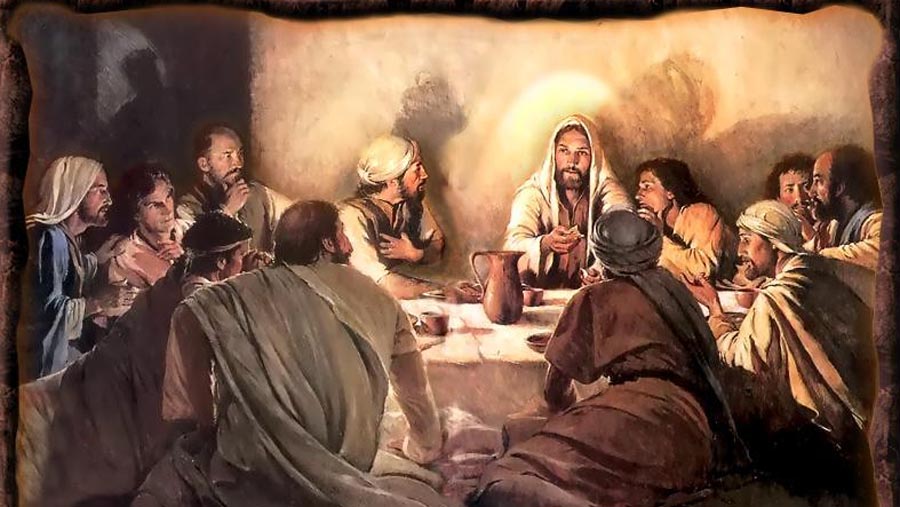
In a few moments all of you will be invited to Christ’s table to partake of him through the bread and the wine. Just as Jesus stood before the crowd to proclaim his identity as the bread of life, Jesus once gathered with his disciples to remember the stories of God in the world and share one final meal.

What are you thankful for this year? How have you been trying to fill the voids in your life? If you want to be filled, if you want to find a sustenance in your life, if you desire to have your life transformed, if you need to be made whole, if you want to discover purpose and faithfulness in your life, if you desire to know God, if you hope to find peace in your lives, then come. Come to Christ’s table. Feast on the true bread from heaven, believe in Jesus Christ, and be filled by the Spirit.

Amen.

00029400_h

Apocalypse When? – Sermon on Luke 21.5-19

Luke 21.5-19

When some were speaking about the temple, how it was adorned with beautiful stones and gifts dedicated to God, he said, “As for these things that you see, the days will come when not one stone will be left upon another; all will be thrown down.” They asked him, “Teacher, when will this be, and what will be the sign that this is about to take place?” And he said, “Beware that you are not led astray; for many will come in my name and say, ‘I am he!’ and, ‘The time is near!’ Do not go after them. When you hear of wars and insurrections, do not be terrified; for these things must take place first, but the end will not follow immediately.” Then he said to them, “Nation will rise against nation, and kingdom against kingdom; there will be great earthquakes, and in various places famines and plagues; and there will be dreadful portents and great signs from heaven. But before all this occurs, they will arrest you and persecute you; they will hand you over to synagogues and prisons; and you will be brought before kings and governors because of my name. This will give you an opportunity to testify. So make up your minds not to prepare your defense in advance, for I will give you words and a wisdom that none of your opponents will be able to withstand or contradict. You will be betrayed even by parents and brothers, by relatives and friends; and they will put some of you to death. You will be hated by all because of my name. But not a hair on your head will perish. By your endurance you will gain your souls.


            The disciples have gathered together with Jesus. They’ve probably shared some bread, fish, and wine while sitting around and talking about the latest news from Galilee and the recent happenings in Jerusalem. Peter, ever extraverted, decides to change the conversation to the majesty of the temple: “Oh how lovely it was, adorned with remarkable stones and the gifts dedicated to God. Have you ever seen such gold in your lives?” The other disciples nod in approval, while Jesus remained silent. Bartholomew furthers Peter’s claim: “The temple of God is indeed a witness to God’s majesty in the world. Only the God of Abraham, Isaac, and Jacob could have such a place!” They all begin to agree with one another, affirming the glory and might of their God, the God of Israel, worthy of such a temple.

            But then, in sharp contrast to their excited exclamations, Jesus speaks up, “All of these things that you see, the temple in all its glory, the days will come when not one of these stones will be left upon another; all of them will be thrown down.

            The disciples have been around Jesus long enough to know that when he says something like this, its important to pay attention. “But how could this be?” they wondered; the temple was a sign of God’s glory. So then one of the disciples, perhaps Peter, asked on behalf of the whole group, “Teacher, when will this be, and what will be the sign that this is about to take place?”

apocalypse-when

            What a question. Its stories like this one that help to remind me how similar we all are to the disciples. Because that question is the same one I would’ve asked. Okay Jesus, things are going to get rough, when? What will happen to let us know that this is about to take place?

            How appropriate and funny is it that Jesus’ first warning about the apocalypse is directed toward the would-be-prophets who predict the end of the world? Just within my lifetime I can think of a number of examples of the self-affirmed prophets who claim to know the exact date of the approaching end of the world. And even though Jesus has clearly warned us against them, when they come forth with their predictions, they never fail to get a hearing, media presence, and air time.

61786025


And people listen to them! Droves of people go to the bank and withdraw their life savings, bunkers are dug and filled with emergency supplies, and some even take their own lives rather than accept the coming doom and gloom predicted by these would-be prophets. Jesus looks out at his disciples, and therefore every one of us, and declares, “Beware that you are not led astray; for many will come in my name and say, ‘I am he,’ and, ‘The time is near!’ Do not go after them.

            There always seems to be some other form of allegiance in the world that appears better than what we learn to live into from God’s Word. Some affiliation more fruitful, some path through the trials of life that seems more certain and secure. We would rather rely on reason than faith. We would prefer to deal with material possessions than with spiritual growth. The tragedy of the history of God and God’s people is that we have continually been a people running off like that, generation after generation, in pursuit of other, perhaps easier, gods.

            After this first warning, Jesus continues his diatribe regarding the eschaton: “When you hear of wars and insurrections, do not be terrified; for these things must take place first, but the end will not follow immediately. Nation will rise against nation, and kingdom against kingdom; there will be great earthquakes, and in various places famine and plagues; and there will be dreadful portents and great signs from heaven. But before all this occurs, they will arrest you and persecute you; they will hand you over to synagogues and prisons; and you will be brought before kings and governors because of my name.”

tumblr_lxqyysSSQ61qlvp8so1_500

            I have often heard non-Christians remark about how easy it is to be Christian. Those with a limited knowledge of what it means to be a faithful people often charge the church as being a means of escape from the harsh realities of the world. “It must be so easy to be Christian, you don’t have to worry about what really goes on in the world, just waiting for your heavenly reward.” However, in sharp contradiction to these claims Jesus very bluntly puts forth how very difficult it is, and will be, to be Christian. In a way, being Christian, is in some sense, an escape, not our of life, but right into the depth of it; from meaningless into meaning, from futility into purpose, from bondage into freedom.

            The Good News of Jesus Christ has always been paradoxical in its ability to disturb the ways of the world. Those with privilege look on it with suspicion, those with power look at it with disappointment. The Jewish leaders were shaken by it and fearful. Rome outlawed it. The first disciples all suffered persecution and condemnation. Jesus did not get killed for loving too much, but for turning the world upside down; for changing the perspective of what it means to be first and last, for defeating death, and removing power from the powerful.

            “This will give you an opportunity to testify. So make up your minds not to prepare your defense in advance, for I will give you words and a wisdom that none of your opponents will be able to withstand or contradict.”

            When Jesus addresses the disciples, describing for them the very trials and tribulations that they were to face he makes it clear that these are the hours of opportunity. When the world shouts No, the church responds with a resounding Yes!

            Our faith is not a creed, not a way of thinking about life, not 5 steps to make a better you; it is the I and Thou of a God who calls us by name, addresses us, seeks us, a moment of meeting, the time for hearing and becoming. Our faith is about confronting the problems of the world, living into them, and transforming the world for God’s kingdom. The Bible, God, and our faith is never on pause. The time is now!

            What Jesus describes in this passage is what we often call the apocalypse. What kinds of images come to your mind when you think about the apocalypse? Death? Destruction? Zombies? Though these are the popular images often associated the apocalypse, apocalypse deals with a revelation, which discloses the realm of God behind the world of historical and interpretable events.

            Timing is important when we talk about revelation from God. What Jesus describes, the events surrounding the suffering of his followers will happen in the future. There will come a time when Christians are called to testify to their faith when everything around them will argue the contrary. The apocalypse is coming in the future.

            However, most of the events that Jesus described took place within the 1st century of the church. The temple was destroyed in 70 AD, the disciples were called before synagogues and governors to witness to their faith. They were rejected by the world and suffered because of their association with Jesus Christ. Nations rose against nations and wars took place. The apocalypse happened in the past.

            What becomes real for us today, though, is that God’s revelation, the apocalypse, is happening right now! What Jesus described in his apocalyptic descriptions helps to show how what is going on is mixed with what is really going on. Events set in the larger context of God’s purposes in the world. We have been caught up in God’s great cosmic victory and therefore we are surrounded by symbols, signs, and mysterious elements regarding what is really taking place. As strange as this may seem to us as enlightened, modern, and rational people, it is a dramatic witness to the tenacity of faith and hope among the people of God.

            “You will be betrayed even by parents and brothers, by relatives and friends; and they will put some of you to death. You will be hated by all because of my name. But not a hair on your head will perish. By your endurance you will gain your souls.”

            How easy is it to be Christian? Apparently, its not. What is at stake for us in this passage is the commitment and call to be faithful witnesses under unusual stress and frustration. For us, here in Staunton, it might be hard to imagine suffering for our Christian identities. But faithfulness and endurance under threat and disapproval (and even penalty of death) are the qualities of discipleship during the time of witnessing. Disciples, and that means all of us here, are not exempt from suffering. If there is any doubt of this period of testing and testimony is still present, you need only look to what recently happened in the Philippines, or the dozens of Christians who were recently executed in North Korea for having Bibles, or the suffering of members within this church right now. Some of you might know of the suffering within the church, perhaps its even happening to you, just look around.

            Jesus’ address to the disciples regarding the apocalypse, the revelation of God, calls us to reflect on our own discipleship. I have been told again and again that if people are not complaining about me in the church I serve, than I am not doing my job. Being Christian implies a willingness to be pushed into the discomfort of discipleship in order to live into the new reality that Christ initiated with his death on the cross.

            Are we almost Christians? Are we content to arrive on Sunday mornings in order to go back to work on Monday without any change in our lives? Are we comfortable with seeing all of the suffering around us and letting it pass by our vision without stopping to question why? Are we ready to witness God’s kingdom transform the world without our participation?

            Or are we fully Christian? Have we felt the love of God in our hearts and we are ready to respond to that love with our commitment to faithfulness? Do we sit in the shadow of the cross while awaiting the glory of the resurrection? Are we ready to witness to the goodness of God even amidst our own suffering?

            I love the question the disciples ask: “When is this going to happen?” But there’s another question I feel compelled to ask: “Why is it going to happen?” If our Christian lives are comfortable and easy, perhaps we’re not doing enough. If the amount of suffering the first disciples went through was part of God’s revelation, then maybe we should be going far enough to disrupt the powers of the world. What would it take for us to believe so fervently, that we would live such faithful lives worthy of persecution from those around us?

            We have to know that what Christ is talking about is the end. And we have to know with equal knowledge that it is also the beginning. That the God of grace and glory is bent on rescuing his own from the misery that finds us in life, and continually working toward that salvation. That God is committed to saving us with the Good News according to Christ, and eagerly doing it by means of every life that will give itself away to him and his kingdom.

            Teacher, when will this be, and what will be the sign that this is about to take place? The apocalypse, the revelation of God, is now.

            Amen.

God of the Living – Sermon on Luke 20.27-38

Luke 20.27-38

Some Sadducees, those who say there is no resurrection, came to him and asked him a question, “Teacher, Moses wrote for us that if a man’s brother dies, leaving a wife but no children, the man shall marry the widow and raise up children for his brother. Now there were seven brothers; the first married, and died childless; then the second and the third married her, and so in the same way all seven died childless. Finally the woman also died. In the resurrection, therefore, whose wife will the woman be? For the seven had married her.” Jesus said to them, “Those who belong to this age marry and are given in marriage; but those who are considered worthy of a place in that age and in the resurrection from the dead neither marry nor are given in marriage. Indeed they cannot die anymore, because they are like angels and are children of God, being children of the resurrection. And the fact that the dead are raised Moses himself showed, in the story about the bush, where he speaks of the Lord as the God of Abraham, the God of Isaac, and the God of Jacob. Now he is God not of the dead, but of the living; for to him all of them are alive.”


The Sadducees know exactly what they’re doing. They are not standing before Jesus truly desiring an answer to their question. They are not like the student whose paper is no longer decipherable because they have used their entire eraser while trying to answer a question. They are in Jesus’ presence for the purpose of embarrassment. Their aim is to argue, frustrate, and force Jesus into a particular way of thinking. The question that formed on their lips is not genuine. They are simply attempting to bait Jesus with one of their classic “what if” questions, a question on which their minds were settled long ago.

Haven’t all of us resorted to this kind of questioning at some point? The militarist asks the pacifist, “what if someone was attempting to rob you and your family, would you fight back?” or the child asks the mother, “what if the world ended tomorrow, would you really make me do my homework tonight?” or the skeptic asks the believer, “what if there is no God, would you still pray?”

“So, Jesus, Moses wrote for us about how to handle a situation if a married man dies without producing children. The wife is to remarry one of her brothers-in-law in order to have a child. But, what if this happened, and a woman remarried 7 brothers and never had any children with them, who would she be married to in the resurrection?”

resurrection


I knew a man who had a wonderful family life. He was a pastor, occasionally moved throughout his conference, but he had established roots in certain parts of the state. He enjoyed his work, but he loved coming him to his wife and children every afternoon. It was when everything seemed perfect that tragedy struck; his wife was killed in a car accident. In the wake of her death, the children were old enough to take care of themselves and when the pastor returned to work he no longer had the energy to serve the local church and so he retired. It was not for a lack of conviction or faith, but the loss of his wife struck him so deeply that he felt it would be irresponsible to try and serve others.

Time passed. The wound from his wife’s death remained open. He mourned. But after awhile he started to find a different rhythm in this new time of his life. The seasons passed and even though he still missed her, he was taking steps toward finding joy again.

He met his second wife later in life through mutual friends. It was clear that they had a connection but neither realized how deeply they cared for one another. When they married it was a joyous celebration and they spent the following decade together.

I got to know the husband and wife in their later years, visiting with them, hearing their story, and breaking bread together. They were meant for each other, and I don’t just mean finishing each others sentences kind of thing. They were adorable in their connection, in their refusal to be separated, and in their faithfulness when the former pastor developed a brain tumor.

I was unable to attend the funeral but I received a phone call from the new widow that evening. Through the abundant tears landing on the telephone I was barely able to make out her words but I could tell that something was worse than the emotions that come with attending the funeral service for your spouse. “I just don’t know what to think, Taylor,” she said while sobbing, “Today, during the service, my step-daughter, my husband’s daughter from his first marriage, delivered part of the eulogy. She stood before that crowded church and lamented the loss of her Daddy. But before she finished, she looked up in the air and said, ‘I’m so happy that Dad is back together with Mom now.”

I was silent.

“What does that mean about me?” she continued. “What will happen when I die? Will he be waiting for me?”

How could anyone speak into that situation? What could you say to help fill the void that her husband left, while remaining faithful to the God who has faith in us.

For a few moments I waited silently on the phone unsure of what to say. But then I remembered that Jesus had been asked a similar question…


Jesus was asked a question that would’ve typically elicited a pastoral response. After all, this story comes toward the end of Luke’s gospel; Jesus has already traveled all over Galilee proclaiming the Good News, healing the sick, feeding the hungry, and pastorally caring for his flock everywhere that he traveled. His answer to the Sadducee’s question is important and vital to our lives not only as Christians but also to all people who reflect on life and death.

Jesus begins his response to the Sadducees’ loaded question rather directly: “People who belong to this age marry and are given in marriage, but to those who are considered worthy of a place in that age and in the resurrection from the dead neither marry not are given in marriage. Indeed they cannot die because they are like angels and are children of God being children of the resurrection.”

In this first part of his response Jesus pointed out the inappropriateness of their question. There is a difference between this age, and the age to come. In this present age the reality of death makes marriage and the perpetuation of life essential. In order to continue the cycle of life, new lives need to be brought into the world. However, in the age to come, in the resurrection, death will be no more, death will die, and those who are blessed enough to attain the resurrection will be as children of God. There is no marriage in the resurrection because it is no longer needed, God’s purposes for life after life after death will be so glorious and inexplicably remarkable that marriage will be no more. 

heaven

There is a difference here between what we commonly imagine about heaven and life after death regarding the immortality of the soul and the resurrection. Many would have us believe that to be Christian means that we have immortal souls, but there is an important distinction between immortality and resurrection. Immortality is based on a doctrine of human nature that denies death; resurrection is based on a doctrine of God which says that even though we die, God gives life to the dead.

In the second part of his response Jesus relies on the teaching of Moses to help undermine the question from the Sadducees. The Sadducees believed that a teaching, belief, practice, or habit was not authentic unless it could be found in the Pentateuch, the first five books of the Bible, the so-called “Mosaic Law.” They would search through those books and unless it was there, it was not relevant or viable for their faith. So Jesus draws on the teaching of Moses, particularly the incident of the burning bush, to further defend his answer.

Do you remember the story? Moses, a shepherd for his father-in-law Jethro is out in the wilderness tending the flock. In the midst of his work he is confronted by a bush that is burning, but the flames refuse to consume the bush. In this interplay between human and the divine Moses is commissioned by God to deliver God’s people, the Israelites, out of slavery in Egypt to the Promised Land. Reluctant to undertake such a task, Moses questions, “Who am I to say sent me?” And God responded, “Tell them I AM sent you, I am the God of Abraham, of Isaac, and of Jacob.”

So when Jesus responds to the Sadducees he remembers this story for them. God is not a God of the dead, but of the living. What we do in the here and now is important, and God will take care of us when our time comes. You may think of Abraham, Isaac, Jacob, and Moses as being dead, but God is their God, they are alive through him.

The Sadducees, in their strict conformity to their theological persuasion were unable to comprehend that standing before them was God in the flesh, that Jesus himself was the Word, the new law, and the new covenant. He not only brought a new teaching, but he himself was the new teaching.

Just as during the time of Jesus’ interaction with the Pharisees, there has been confusion over the implications of the resurrection throughout the history of the church. Resurrection has often been understood in one of two ways: Experientially or Eschatologically.  (bear with me here)

An experiential resurrection would allow for all of us here to achieve a newness in our lives in the here and now on earth; “we have been raised to new life in Jesus Christ.” An eschatological resurrection would mean that God will give life to our bodies after we die to live and reign in the new heaven and the new earth; “Behold I am making all things new.”

What is important for us, what Christ conveyed to that crowd of doubters, is that both of these resurrections contain truth. There is a beauty in the experiential resurrection that we discover when we find ourselves caught up in the mission of God and there is an indescribable fulfillment in the eschatological resurrection that will come when God makes all things new.

Last-Judgment-(Fra-Angelico)-774816


So I stood there silent on the other end of the phone while the new widow cried out of frustration and fear. “What does that mean about me?” she pleaded “What will happen when I die?”

I took a deep breath before speaking into her reality.

“I don’t know whether or not this will bring you peace right now, but a long time ago somebody asked Jesus a really similar question about marriage in the resurrection. I can never tell you for sure what will happen, but I can tell you what Jesus says. In the next life, in the resurrection, there will be no marriage. God will wrap us up in such a way that marriage will no longer be necessary to convey the deep sense of love and connection that it does in this realm. Your husband will not be married to anyone but we will all belong to one another. I know that right now this probably isn’t the most helpful or pastoral response, but isn’t there something beautiful about the fact that when we go on to greater glory we will all be equal before everyone?”


The way Jesus confronted the question of the Sadducees is so relevant for us today as people of grace who contemplate both life and death. What will happen to us in the resurrection? Who will be belong to? Many of these questions trouble us because we are so desperately clinging to the material world here and now. In our families, marriage, and relationships we find fulfillment and purpose. If we lose someone that we root our identity in, what happens in the age to come?

God will take care of us. God will lead us through the loss of our loved ones and hold them within his warm embrace until that time that all the saints will be reunited; not as brothers, sisters, husbands, wives, but as children of God. 

Jesus’ response to the Sadducees is the way that God responds to our questions – not with answers which flatter us, or make the world simpler than it really is, but with his life given for us, that we might more fully give our lives to him.

As we prepare to go forth into the world remember that God is with you in the mundane and in the radiant. God is with you in life and in death, in marriage and divorce, in fear and joy. God is with us in all things here now and forevermore; he is not a God of the dead but a God of the living.

Amen.


Then and Now – Sermon on Ephesians 1.11-23

Ephesians 1.11-23

In Christ we have also obtained an inheritance, having been destined according to the purpose of him who accomplishes all things according to his counsel and will, so that we, who were the first to set our hope on Christ, might live for the praise of his glory. In him you also, when you had heard the word of truth, the gospel of your salvation, and had believed in him, were marked with the seal of the promised Holy Spirit; this is the pledge of our inheritance toward redemption as God’s own people, to the praise of his glory. I have heard of your faith in the Lord Jesus and your love toward all the saints, and for this reason I do not cease to give thanks for you as I remember you in my prayers. I pray that the God of our Lord Jesus Christ, the Father of glory, may give you a spirit of wisdom and revelation as you come to know him, so that, with the eyes of your heart enlightened, you may know what is the hope to which he has called you, what are the riches of his glorious inheritance among the saints, and what is the immeasurable greatness of his power for us who believe, according to the working of his great power. God put his power to work in Christ when he raised him from the dead and seated him at his right hand in the heavenly places, far above all rule and authority and power and dominion, and above every name that is named, not only in this age but also in the age to come. And he has put all things under his feet and has made him the head over all things for the church, which is his body, the fullness of him who fills all in all.

allsaintsday

Today is All Saints’ Sunday, a particular fixture in the Christian liturgical calendar, often celebrated the first Sunday of every November. All Saints is a time and opportunity to name the death of our saints over the last year. And for us, as United Methodist in particular, “saints” refers to all Christians past and present, so we celebrate the church universal as well as those we have lost. Today is a day about remembrance and honor.

Paul writes to the church in Ephesus, “In Christ we have also obtained an inheritance, having been destined according to the purpose of him who accomplishes all things according to his counsel and will, so that we, who were the first to set our hope on Christ, might live for the praise of his glory.” What is this inheritance that he is referring to?

Bob Foley. Bob Foley was a long time usher at the church where I grew up. As a kid I can remember Bob handing me some of the children’s bulletins that I doodled over throughout the church services, and I can remember him patiently waiting on Christmas Eve’s services with candles in his hands. The first time I ever talked to Bob was when I was fourteen, the first Sunday that I ever ran the sound-system for our services. Bob fulfilled his usher obligations, handing out bulletins, helping new visitors and families find a pew, when he finally stood behind me looking over my shoulder. Now imagine with me if you will, a fourteen year old standing in front of a mixing board with hundreds of knobs, lights, and volume controls, at a church with a large sanctuary with hundreds of people prepared for worship. So with fear and trepidation defining my inner struggles Bob leaned forward and whispered in my ear, “good luck.”

soundboard01_big

I’m sure I messed something up that morning, perhaps I forgot to turn off our minister’s microphone so everyone wound up hearing him horribly attempt to keep the tune to “Be Thou My Vision,” or I turned the volume too high and there was feedback in the sanctuary, or no one heard the prayer over the Tithes and Offerings because I forgot to turn the microphone back on. I’m sure I messed up, but Bob walked over to me after the service ended, shook my hand, told me to call him Bob, and smiled while telling me how proud he was.

Thus started an incredible friendship that played itself out every Sunday morning as Bob and I would joke around in the back. He was old enough to be my grandfather but he never treated me like a child; he was encouraging, and respectful, but above all he was a happy man. Whereas many people would drag themselves into church on Sunday mornings, wiping away the sleep from under the eyes and trying to find a trash can for their coffee they had just chugged, Bob was always standing by the door with a smile because he genuinely cared about the church, he loved being there, and he loved God.

When Bob passed away it crushed me. I’ll never forget the feeling in the pit of my stomach when my mother called me during college to let me know what had happened, and I’ll never forget the awful feeling of walking back into the church for the first time without having Bob there with his customary smile.

Paul talks about an inheritance from Christ, something we receive through his mighty acts in the world. There is something special about getting to share the stories of the bible with someone, young or old, to talk about what God did with God’s people, but there is something indescribable about the way God is working in the world right now.

Bob Foley was a saint in my life. But what Bob offered for me and my Christian life was more than the typical church friendship. Bob never sat me down with scripture or told me how to live my life. He never criticized my decisions or offered unwarranted advice. What Bob did for me, was demonstrate how important faith is in the now. He might’ve loved to hear those old stories from scripture, but Bob felt God living in the world in the immediate, thats why he committed to being in church and sharing his smiles with everyone else; to him there was nothing better than being a Christian because he felt God’s presence.

When we read from Paul’s letter to the Ephesians, its as if he’s saying “It is such a great thing to be a Christian!” But, I wonder if that is the first thought that comes to our minds when we think about our Christian heritage today. May it be that the joy and excitement of the gospel has grown stale for many of us? Is living out our Christianity filled with images of too many commitments and disappointments? Have we grown complacent with what it means to be the church in the world? Perhaps a lot of us here are like the elder brother from Christ’s great parable, we see our wayward younger brother return home for a celebration and we are envious. Maybe we hear the words from our Father saying, “You are always with me, and all that I have is yours,” but the thrill and glory of these words have seemed to vanish.

Why are we here? Why did we wake up this Sunday morning and come to church? What brought us, what drove us to ever join together in the first place?

All of us are here because someone loved us enough to bring us, to invite us, to nurture us. Who was that person for you? Who was that saint in your life?

Paul writes about a “love toward all the saints” present in the community in Ephesus. That same love may, in fact, be half-present today in our lives through the casual “hello” at the Food Lion, in the wave as a car drives by in the neighborhood, and in the church fellowship activities in which we participate. But there is a temptation to take all of these things for granted, to live into them everyday, and never value them for what they really are.

I’m not proud to admit that I never realized how important Bob Foley was to my life until after he died. It was only in his absence that I began to appreciate the joy that he taught me every Sunday morning. I took my relationship with Bob for granted and I wish that I had lived into our friendship more while he was still here with us.

Like our relationship, it has taken me some time to discover what made Bob’s faith so worthy of emulation. I have wondered what it was that made him excited about the church, when so many others arrived more out of obligation than expectation.

Have you ever noticed that Paul almost never writes about the actual life of Jesus in his letters? Do you find it interesting that as a leader for the blossoming church in the first century, Paul rarely referenced the exciting life of Jesus Christ? He paid little attention to the Sermon on the Mount, the parables, the miracle stories, or other moving elements from the gospels. It seems, therefore, for the first Christians, what was most important was not what had happened in the past, but how Christ was living in and through them in the present. They most certainly remembered the words and actions of Christ in their worship, but their Christianity was exciting because Christ was still moving in their world.

Paul wrote to the church, “I pray that the God of our Lord Jesus Christ, the Father of glory, may give you a spirit of wisdom and revelation as you come to know him, so that, with the eyes of your heart enlightened, you may know what is the hope to which he has called you, what are the riches of his glorious inheritance among the saints, and what is the immeasurable greatness of his power for us who believe, according to the working of his great power.” The key word in this whole passage is “power.” When the first Christians appealed for conversion to the new faith they did not just talk about what had happened on a hill outside of Jerusalem in the year 33, but they witnessed to what Christ had done for them in their own lives.

Christ is a present power, rather than simply being an admired person from history, Christ transcends time and is with us in the present; that was the paramount miracle for the early church.

On this All Saint’s Day we are called to remember the saints of our lives, the Bob Foleys of the world, to be thankful for what they did for us, but to also live in the present. Be grateful for what they did, and live out our faith today. The saints and Christ are not just some historical influences in our lives but continually live and move through us in the ways that we continue to be faithful in the world.

Do you know God? I don’t mean some sort of dense theological knowledge, but real and tangible and simple. Do you know God in your life? We cannot have knowledge of a person until we see them in action and we shall not have faith in God until we trust and experience his divine love in the world.

There is a difference between the Word of God (Jesus Christ) and the word of God (scripture). Our knowledge of God in this community rests upon God’s Word as Jesus Christ. The Bible is not a textbook in the ordinary sense as a collection of facts that need to be checked and memorized but it is instead a story. In contains the majestic drama of God’s interaction with God’s people. The climax of the story is God’s coming down to dwell among us in the form of flesh, dying for us on a cross, rising again from the grave, returning to glory, and leaving behind a people of God endowed with knowledge of him.

When we remember the saints, when we gather together to read and proclaim scripture, it is important for us to remember God’s mighty acts in the world. However, what makes church and faith compelling, what moves us toward excitement, is God’s present power in the world! Today is the day that we can celebrate the lives that we have lost while also living into the exciting faith of what it means to be Christ’s body for the world.

Today we are called to remember those saints from our lives who shaped us into the people we are now. It is the time to remember disciples like Bob Foley who lived out his faith in his relationships with others, who felt the joy of Christ in his own life and in his own heart.

We remember those who have gone on with joy and with longing, for they are being held in the arms of our great Lord and we anticipate with joy the great reunion of all the saints of the church in God’s time.

Christians are not called to be motivated by the question: “what happens to me when I die?” but rather ”what am I doing with my life right now?” What we do in the here and now, how we live out our faith in the world, is what makes being the body of Christ an exciting and wonderful thing.

Jesus Christ is not a man of the past, a person to be remembered and recorded in history. Christ is alive! Christ is with us here and now in the gifts of bread and wine. Christ continues to live and breathe and change the world because we partake of him when we gather at his table.

If you are looking to find Christ in your life, if you want your faith to move from remembrance to lived reality, and if you want to find a joy worthy of celebration, then come. Come to Christ’s table and discover the inheritance that will change your life forever.

Amen.

Communion

The Magnificent Defeat – Sermon on Genesis 32.22-31

Genesis 32.22-31

The same night he got up and took his two wives, his two maids, and his eleven children, and crossed the ford of the Jabbok. He took them and sent them across the stream, and likewise everything that he had. Jacob was left alone; and a man wrestled with him until daybreak. When the man saw that he did not prevail against Jacob, he struck him on the hip socket; and Jacob’s hip was put out of joint as he wrestled with him. Then he said, “Let me go, for the day is breaking.” But Jacob said, “I will not let you go, unless you bless me.” So he said to him, “What is your name?” And he said, “Jacob.” Then the man said, “You shall no longer be called Jacob, but Israel, for you have striven with God and with humans, and have prevailed.” Then Jacob asked him, “Please tell me your name.” But he said, “Why is it that you ask my name?” And there he blessed him. So Jacob called the place Peniel, saying, “For I have seen God face to face, and yet my life is preserved.” The Sun rose upon him as he passed Penuel, limping because of his hip.

1383606_169741249886845_1520756210_n

Jacob was left alone. He had sent his entire family, all of his possessions, and his future across the Jabbok river. There he was all alone basking in the glow of the sunset, terrified but hopeful for the morning. Jacob had lived a strange life, but nothing would compare to what was about to happen.

Out of nowhere, a strange unnamed man arrived and began to wrestle with Jacob till daybreak. Scripture is rather lacking in details about this epic match, but we can imagine the blood, sweat, and tears that went into this fight. Two men grappling with each other in the bleak conditions of the ancient near east. When it seemed as if one man was finally getting an advantage, the other would return with a defensive move pinning the other one to the ground. This was probably not some glorified hollywood-esque battle, but rather like the ones you used to have with your brother or sister, where no one would relent.

PCH5808

The fight went on throughout the evening, and when the stranger knew that he could not prevail against Jacob, he struck him precisely on the hip socket, knocking it out of joint as they continued to wrestle. Then the stranger in the night said, “Let me go, for the day is breaking.” But Jacob said, “I will not let you go unless you bless me!” So he said to him, “What is your name?” And he said, “Jacob.” Then the man said, “You shall no longer be called Jacob, but Israel, for you have striven with God and with humans, and have prevailed.”

Though already having received a remarkable blessing, a new name, a new identity, Jacob further pushes the man, “Tell me your name!” But the man replied, “Why is it that you ask my name?” And there he blessed him. Jacob would later name the place Peniel (which means face-to-face) saying, “For I have seen God face to face, and yet my life is preserved.” And for the rest of his life, Jacob walked with a limp because of his battle with the man.

What a story! 

Some theologians are convinced that this narrative has received more scholarship than almost any other story from the Old Testament. Yet, last Sunday, when I casually mentioned this narrative to a few people before church, they remarked that they had never heard about it. In our current culture, we can no longer take for granted the amount of scriptural knowledge everyone has in the church. A lot of people will be quick to blame the laity for not reading enough scripture outside of church, but I believe the fault doubly lays with the clergy who are afraid or unwilling to preach on particular texts.

So, if you’ve never heard this story before, or even if its the 100th time you’ve heard a sermon on it, what do you make of it?

It is one heck of a story, but like many passages in scripture, we have read this section in isolation and we are missing the rest of the narrative. If we really want to know what is going on here on the sandy banks of the Jabbok river, we have to go back to the beginning…


Jacob was the son of Isaac and Rebekah (son of Abraham and Sarah). When Rebekah became pregnant with twins she felt a struggling within her womb, and after praying to God, “If it is to be this way, why do I live?” The Lord said to her, “Two nations are in your womb, and two people born of you shall be divided; the one shall be stronger than the other, the elder shall serve the younger.”

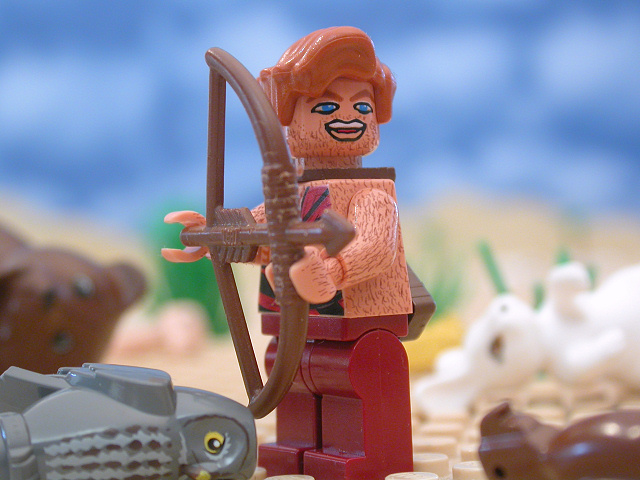
The first born was Esau, red and covered in hair, and later Jacob who came out gripping the heal of his brother; each of them were named after elements regarding their birth (Esau – red // Jacob – one who grabs the heel). When the boys grew up, Esau was a skillful hunter, a man of the field, while Jacob was a quiet man, living in tents. Isaac loved Esau; but Rebekah loved Jacob. 

Esau

Esau

Like most sibling rivalries, Jacob and Esau were combative throughout their lives. You can imagine them as children fighting over simplest little things while the father would side with one, the mother the other.

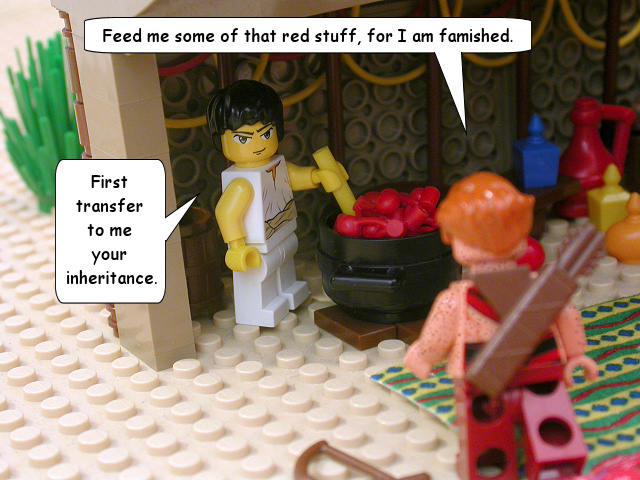
Once, when they were older, Jacob was cooking a stew while Esau came in from the field famished. Esau said to to Jacob, “Let me eat some of that red stuff, for I am famished!” Jacob, the cunning heal-grabber that he was, agreed to give his brother food, in exchange for his birthright, and thus Esau gave up his birth right to his younger brother.

07_gn25_30-31

And then later, when their father Isaac was approaching death, with weakened eyesight, he beckoned for Esau to bring him some wild game in order to bless him before his death. However, when the cunning little heal-grabber found out about this from his mother, he covered himself in fur and deceived his father by pretending to be his brother. Before Jacob had had enough time to even make it away from his father’s tent, Esau returned from the field shocked to discover that Jacob had stolen his blessing.

The heal-grabber had gone too far this time and Esau was furious. He vowed to kill his brother after the death of his father. But Rebekah discover Esau’s plot and sent Jacob away to flee from the inevitable wrath of his twin.

24_gn27_41

Years pass. Esau and Jacob continue to live out their lives apart from one another. When it seemed like Jacob might finally be able to forget his past and his brother, he had a vision which made him realize that he needed to return to the land of his father.

And so, with all his possessions and children and wives Jacob prepared to encounter his brother, unsure of what would happen. However, the little heel-grabber had one trick left up his sleeve; knowing that his brother would surely kill him, Jacob sent ahead of him all his possessions and family in order to appease Esau before their reunion, while thinking to himself, “I may appease him with presents that go ahead of me, and afterwards I shall see his face; perhaps he will accept me.” Therefore his gifts passed on ahead of him, and he stayed behind alone for the night before meeting his brother in the morning.

At this critical moment in his life, at the matrix of what would determine everything forward, spending the night on the border of the Promised land, Jacob struggled with God.

So you see, the story of Jacob wrestling with God is placed perfectly within the greater story of Jacob’s life; while anticipating a frightful reunion with his brother Esau, Jacob must first meet with the dreaded stranger of the night and these two meetings are intimately related to one another.

The story, as we find it in scripture is not explicit about who Jacob actually wrestles with. Is he wrestling with his metaphorical brother? Himself? A stranger of the night? Though arguments abound for many interpretations, it makes most sense to understand the story in such a way that Jacob is wrestling with God

During the night, the cool evening when precision and detail are lacking, the divine antagonist arrives and takes on features of others with whom we all struggle during the day.

What a man this heal-grabber was! He may have been frightened of the coming repercussions of the reconciliation between he and his brother, and he may have been afraid of the almighty Lord, but in the fray he held his own with either one.

This is no ordinary story.

In a way, what Jacob experienced was a magnificent defeat. A defeat because Jacob is left with a limp for the rest of his life, and magnificent in his ability to prevail. From that day forward Jacob limped every day to show others (and remind himself) that there are no untroubled victories with the Holy One. Yet his limp was also a reminder that he had prevailed in this skirmish between humanity and the divine.

It is important to note that this meeting with God, this nighttime wrestling match, did not lead, as we are wont to imagine, to reconciliation, forgiveness, and healing. It resulted in a crippling. There is a dangerous consequence of meeting the divine, resulting in a marking that we will carry throughout the rest of our lives.

And so, when the day broke the stranger left a crippled Jacob, now Israel, limping toward his powerful and vengeful brother.

Can you imagine how he must have felt? Weak after wrestling all night long, afraid of the coming consequences, isolated from all his family and possessions, sand caught in his eyes, clothing ripped, walking across the deserted landscape toward his brother?

When Jacob made his way forward, lessening the space between himself and inevitably, he bowed seven times until he came to his brother.

Like the stranger from the night before Esau rushed forward and grappled his brother to the ground, falling upon his neck. However, instead of punches and scrapes, Esau covered his brother with kisses and tears.

The juxtaposition of the wrestling in the night with Jacob’s reunion with Esau offers us a warning; God will not be taken lightly or easily. There will be no cheap reconciliations. On the way to the affronted brother, Jacob must deal with the crippling and blessing of God.

It is easy to take the story in isolation and make it into a simple lesson: “being a Christian is about wrestling with God. There will be times when we cannot understand what it happening and though we are grappling with the divine in a negative, God will positively hold onto us while refusing to let go.” And though that message is true, there is so much more going on with the greater story.

Don’t we all have a little Jacob in us? At times we’ve all acted like the little heel-grabber, willing to do less to receive more, willing to focus on ourselves alone rather than those around us. And at the same time, don’t we all have a little Esau in us too? At times we’ve felt betrayed, unloved, and hurt, our trust broken from broken relationships. Being Christian is about wrestling with God, but its also so much more. This story in scripture reveals to us how the love of God and the love of brother belong together. We were never meant to be alone, scavenging for ourselves, removed from others. We were all created in the abundant image of the triune God, made out of unified plurality to be in plurality with others.

Like Adam and Eve, like Jacob, like the disciples, and so many other figures from scripture, we want to know the answer to the ultimate question. We want to bridge the gap between us and God. In this passage Jacob wanted to know God’s name, the mystery of heaven and earth, to overcome all the distance. When wrestling, the stranger did not win, but he did not lose either. Jacob gained a great deal, but the depth of God’s being had not been given. The stranger stopped short of giving the ultimate gift – that would have to wait until a cramped night in the crib of a manger in Bethlehem.

In a few moments I will be inviting Isabella Bailey-May Sullivan and her family to come forward and gather around the baptismal font. In Isabella’s baptism she will be incorporated into this body here, to learn about these kinds of stories from scripture, to begin a life of wrestling and reconciling with God. Like Isabella, all of us gathered here have been grafted into the story of Israel through Christ’s death on the cross. We will encounter our brokenness through God’s Word but we will also rejoice in the grace that God gives us in spite of our brokenness.

And so what are we left to make of this heel-grabber and his wrestling match on the banks of the Jabbok? Like Jacob’s wrestling and Isabella’s baptism, when we enter the church we are marking ourselves for the rest of our lives. It is in this place through the worship of the people and the proclamation of the Word that all the Jacobs of the world become reconciled with the Esaus. Its where we can meet one another and God face-to-face and prevail. We might be brought down in a way that we are truly wrestling and we will walk away marked by God. Though we may not walk with a physical limp, we have been struck by the almighty God in a way that we will never be the same again.

And that, is good news.

Amen.


Prepare To Be Surprised – Sermon on 2 Kings 5.1-15

2 Kings 5.1-15

Naaman, commander of the army of the king of Aram, was a great man and in high favor with his master, because by him the Lord had given victory to Aram. The man, though a mighty warrior, suffered from leprosy. Now the Arameans on one of their raids had taken a young girl captive from the land of Israel, and she served Naaman’s wife. She said to her mistress, “If only my lord were with the prophet who is in Samaria! He would cure him of his leprosy.” So Naaman went in and told his lord just what the girl from the land of Israel had said. And the king of Aram said, “Go then, and I will send along a letter to the king of Israel.” He went, taking with him ten talents of silver, six thousand shekels of gold, and ten sets of garments. He brought the letter to the king of Israel, which read, ‘When this letter reaches you, know that I have sent you my servant Naaman, that you may cure him of his leprosy.” When the king of Israel read the letter, he tore his clothes and said, “Am I God, to give death or life, that this man sends word to me to cure a man of his leprosy? Just look and see how he is trying to pick a quarrel with me.” But when Elisha the man of God heard that the king of Israel had torn his clothes, he sent a message to the king, “Why have you torn your clothes? Let him come to me, that he may learn that there is a prophet in Israel.” So Naaman came with his horses and chariots, and halted at the entrance of Elisha’s house. Elisha sent a messenger to him, saying, “Go, wash in the Jordan seven times, and your flesh shall be restored and you shall be clean.” But Naaman became angry and went away, saying, “I thought that for me he would surely come out, and stand and call on the name of the Lord his God, and would wave his hand over the spot, and cure the leprosy! Are not Abana and Pharpar, the rivers of Damascus, better than the waters of Israel? Could I not wash in them, and be clean?” He turned and went away in a rage. But his servants approached and said to him, “Father, if the prophet has commanded you to do something difficult, would you not have done it? How much more, when all he said to you was, ‘Wash, and be clean’?” So he went down and immersed himself seven times in the Jordan, according to the word of the man of God; his flesh was restored like the flesh of a young boy, and he was clean. Then he returned to the man of God, he and all his company; he came and stood before him and said, “Now I know that there is no God in all the earth except in Israel; please accept a present from your servant.”

Prayer

Have you ever gone looking for God? Maybe your church or your prayer life was no longer cutting it, and you thought about actively seeking out the God who you used to meet in the sanctuary.

For a long time, I made it my duty to help other people find God.

I would help organize trips to domestic or foreign locations, often leading youth and adults into uncomfortable situations so that they could live out the calling of the gospel by serving their neighbors.

Whether you lead a group to Winchester, Virginia or Xela, Guatemala the paradigm remains basically the same: Take a group of people out of their comfort zone, encourage them to serve others through physical means, participate in theological reflection and fellowship, and return home a changed individual.

I have been blessed to see wealthy American men weep in the arms of poor Guatemalan women after working for a week in a remote village, I have seen privileged teenagers play in the destroyed and desolate streets of New Orleans with other children who had lost everything. I have seen college-age Christians sing and chant hymns fervently with their eyes closed after having not stepped foot in a church in years.

Desktop

All of these trips were fantastic and were remarkably important for the people who participated. The only problem was, after returning home, it only took a few weeks to fall back into the same routine as if nothing had actually happened. In fact I’ve seen nearly the same thing occur after a group does a Bible study for months: as soon as they finish, they are on fire for Christ, but within a few weeks, that fervor has disappeared. The thought usually goes something like, “I did what I could but I can only do so much” “I tried to keep the fire alive, but I have other responsibilities” “I know this is what Christ wants me to do, but it’s too hard.”

We often engage in these activities expecting to experience God on our terms, only to return back to life the same as before…

Many, many years ago, a foreign warrior named Naaman had it all. He had the favor of his king, he was consistently victorious on the battlefield, and he had power. He was the kind of guy that you hated in high school. The proverbial quarterback of the football team, straight-A student, the guy who had everything just fall into his lap easily. But Naaman had a big problem: he was a leper. Covered in this invasive skin condition, there was nothing he could do to rid himself of the suffering.

The CEO of the huge multinational corporation can get the best table at any restaurant in town without even calling for a reservation, but his son is in rehab for an addiction to heroin. The famous and celebrated writer travels the world to give lectures and presentations – but he’s an alcoholic. The beautiful actress can turn every man’s head, but she dreads the lights and cameras in case they show an unflattering angle. The envied mother in the community has perfect children that never get in trouble but she weeps every night out of her loneliness and depression.

In every life there is a “but.” What’s yours?  Naaman was a successful military man in great favor with the king, but he was a leper.

However, one day, an unnamed completely insignificant Israelite, the quiet girl who always sat in the shadows, the one whose name no one could remember said the obvious: “Naaman, all you have to do is visit the prophet in Samaria, he can cure your leprosy.”

Why Naaman listened to this woman, we will never know, but he gathered his treasures and traveled to visit the king of Israel. After an embarrassing episode, where it is clearly apparent that Naaman does not know the way God works because he seeks healing from the king rather than the prophet, Elisha invites Naaman to his home so that he will learn there is a prophet in Israel.

The scene that follows is remarkably comical. Naaman comes in full regalia, with an impressive entourage, and gifts galore: ten talents of silver, six thousand shekels of gold, and ten sets of garments. He stands proudly before the house of the prophet but he does not even get invited inside. Instead, Elisha sends out a messenger to instruct the officer to wash seven times in the Jordan River.

Naaman is incensed! “This so called ‘prophet’ doesn’t even have the decency to come greet me? And then he is so bold as to claim that his river is mightier than ours?” So Naaman went away in a rage.

But, just as before with the unnamed woman, some unnamed servants approach Naaman, “If the prophet had commanded something difficult, would you not have done it? How much more, when all he said to you was, ‘Wash, and be made clean’?” And so Naaman went down to the Jordan and immersed himself seven times and his flesh was restored.

de-saussure-elisee-et-naaman

Before returning to his homeland, Naaman went to Elisha and proclaimed, “Now I know that there is no God in all the earth except in Israel!”

Like many people who go out seeking to find God, Naaman knew how it was supposed to work. However, the scripture today confirms Naaman’s lack of understanding when interacting with the divine. First, he brings all of his treasures to the king of Israel assuming that he would have the power to cleanse him. Second, he arrives at Elisha’s home expecting to be regarded as the dignified warrior he is, only to be slighted by Elisha’s lack of welcome.

Like Naaman, so many of us go out expecting to find God on our terms and in the ways we want.

If we travel to an impoverished part of the country, or if we go visit a remote village on the other side of the planet we will surely find God. If we sweat in the mud all day long for our brothers and sister we will be blessed by God almighty for our actions. Yet, like Naaman, we cannot meet God on our own terms, but it is God who meets us.

What takes place here with Naaman is the way the Bible often deals with God. The extraordinary arises within the ordinary. The heavenly breaks out amid the earthly. What we tend to view as ordinary and plain, the Bible wants to depict as the realm of God’s amazing work among us.

Elisha, and all the other prophets from the Old Testament have something that we have lost in the church these days. They have freedom from the society around them. They are not blown about by the winds of doctrine or expectation, they are not captive to special interest groups, they do not follow all the latest fads, they do not unquestionably serve the latest liberal or conservative agenda. They serve, rather, their living God – that God who is on the move toward the establishment of the kingdom on earth.  – They hear God and follow him accordingly; this gives them the freedom from all the voices of this world and from every ideology that would capture them for its own selfish purposes. They meet God in the ordinary ways of life, respond to the call, and are transformed.

The healing of Naaman is one remarkable story. God takes an enemy of his chosen people and restores him to good health. In spite of the antagonism between two seemingly opposed people, God interrupts Naaman’s life in order to bring about a revelation.

Naaman was healed, but in what way? Yes, there is the physical healing, by washing himself seven times in the Jordan Naaman loses the leprosy that had so plagued him, but there was something else more powerful going on here in the story.

In this narrative Naaman learns about humility and encounters the living and active God. It is not the kings, nor the warrior, in the story who understand the ways of God, but it is through the unnamed servants that Naaman comes to experience the divine. It was through humbly following the commands of his servants that Naaman found cleansing in the muddy waters of the Jordan, but more importantly he found new life in a God that meets us in the ordinary.

What is your “but”? What is your excuse for not letting God meet you where you are? When we meet the triune God it would seem that it happens without regard for being rich or poor. Perhaps even more dramatically God extends his mercy, and works out his plans through the unnamed people in our lives, the ones we so often overlook in our day-to-day living.

Somewhere in your life, God is calling you away from the distraction that you are so rooted in. Perhaps God has been using someone to bear a word of hope for your leprosy, for your “but”. Maybe its your mother who you have neglected to call for the last few months that just wants to tell you that God loves you. Maybe it’s the homeless man on Beverly Street who muttered “Thank God” under his breath when you gave him a dollar. Maybe it’s the co-worker who doesn’t treat you with enough respect or your own child who drives you mad when they neglect to clean their room or do their homework. It might be someone who you are jealous of, or threatened by.

Our scripture today boldly declares that God is the one looking for you. If you want to meet God, then you don’t have to go off on some mountaintop, or move to some sort of spiritual summit. You just have to let yourself go, like Naaman, and be willing to let God take over and ready for the changes in your life.

Be prepared to be surprised. When you meet the unnamed person that God is using to address your leprosy, it will almost inevitably offend you in some way, just as Naaman was furious over Elisha’s lack of decorum. The message will cut deep into your life by way of its simplicity, or its unexpectedness, and it will occur in a way that only you will be able to comprehend.

When God comes to meet us where we are, it does not occur through overwhelming theatrics, flashing lights and great booming sounds. God does not meet us where we expect him to, but rather through simple things:

Yesterday morning I stood here right in front of the altar with my cousin Devin. Devin is currently part of a confirmation class in Alexandria, VA at Aldersgate UMC regularly learning more about faith, God, and the Bible. At the end of this confirmation period, Devin will kneel before his home congregation and will be welcomed as a member into the church. But, Devin has not been baptized, and baptism is a requirement for confirmation.

Devin and I talked and he made it clear to me that he wanted me to be the one to baptize him. So after a conversation regarding the importance of the sacrament of baptism, about what it will mean for him and his life, I welcomed Devin to come here for the weekend and be baptized.

So there we stood yesterday, with the muted overcast light coming through the “I am the good shepherd” stained glass window lighting up the altar. I ran my fingers through the cold water talking to Devin about the glorious ways that God has interacted with his people through water over the centuries. And as I held the water in one hand, and Devin in my other, I said, “Devin, many years ago Jesus gathered at the Jordan River and was baptized by his cousin John. In the same way Jesus calls all of us to be baptized in order to be brought into his body, the church.”

1373497_10151926400772840_183143865_n

I stood there for perhaps just a moment frozen in my own words. As I looked down at his blonde head I realized that just as John baptized his cousin, here I was, blessed to be doing the same thing to my cousin.

God confronted me in that moment. In a solitary blink of time I was flooded with the knowledge that the Jordan River where Jesus was baptized is the same river where Naaman was cleansed of his leprosy. That I was standing before almighty God baptizing my cousin in the same way that John baptized his. It was not grand: the sky did not open up with the Sun beating down on us, no trumpets were heard blaring from heaven, and the wind did not blow through the building. But it was perfect, because in that moment God met us in the ordinary: through the simple water and words of baptism.

water2

God does not meet us where we expect him to, but through the ordinary rather than the extraordinary. God meets us in the proclamation of his Word, in the remembrance of a man named Naaman who walked down to the Jordan River, and through a young man’s baptism on a rainy Saturday morning.

What is God calling you to? Where has God been trying to meet you?

Prepare to be surprised.

Amen.

(preached at St. John’s UMC on 10/13/13)

Three Envelopes – Sermon on Luke 17.1-6

Luke 17.1-6

Jesus said to his disciples, “Occasions for stumbling are bound to come, but woe to anyone by whom they come! It would be better for you if a millstone were hung around your neck and you were thrown into the sea than for you to cause one of these little ones to stumble. Be on your guard! If another disciple sins, you must rebuke the offender, and if there is repentance, you must forgive. And if the same person sins against you seven times a day, and turns back to you seven times and says, “I repent,” you must forgive.” The apostles said to the Lord, “Increase our faith!” The Lord replied, “If you had faith the size of a mustard seed, you could say to this mulberry tree, ‘Be uprooted and planted in the sea,’ and it would obey you.

Jesus says, “If another disciple sins, you must rebuke the offender, and if there is repentance, you must forgive.”

photo-006

On his very first Sunday at his very first church, a young pastor was appropriately nervous. He tried to make sure all the elements of worship had been taken care of: enough ushers to take up the offertory, a volunteer to lead the children’s message, and a witty (but to the point) sermon that helps to convey the gospel. All things considered the service went very well and the congregation was remarkably kind in the comments immediately following worship. “Maybe this isn’t going to be so hard after all,” the young reverend thought.

And so, after ditching his robe in the office, he locked up the building and made his way into the parking lot. There standing beside an old pick up truck was an older man who seemed more worn and tired than his vehicle. “Great” the pastor thought, “I haven’t even been here for one Sunday and I’ve got people out in the parking lot waiting for something.”

The older man walked quickly across the lot with determination and stopped right in front of the novice preacher. “I know I’m not supposed to do this,” he grumbled, “but I’m the pastor that you’re replacing. I’m not here to tell you what to do, or to warn you about certain people, or even what to preach about. I just wanted you to know that in your office desk I have placed three envelopes numbered accordingly. You look like your fresh out of seminary, so you probably wont even need them. But, just in case: If things ever get really tough open the first envelope.” And with that he turned around, got in the truck, and drove off never to be seen again.

three-envelopes

The first nine months in the church went by like a breeze. This was the honeymoon period that the new pastor had heard about in seminary. The laity were quick to volunteer, and excited about the prospects of starting new programs and opportunities. Church attendance grew a little, but more importantly it did not decline. And the best of all, people were getting along with one another! There was no bickering, no gossip behind closed doors, no confrontations. The young man thought he had it made!

But then, as if it happened over night, everything fell apart. Disagreements about the nursery led to many volunteers no longer attending church, frustrations with the facilities led to disgruntled shufflings during the worship services, and the chair of the church council resigned because his chili did not win during the church chili cook-off. Try as he might, the new pastor could not change anything. He attempted to have meetings with individuals and groups to help create reconciliation, he added more communion services, and he prayed fervently for the church but nothing worked.

One day, while working in his office, he came across the three letters from the former pastor. Seeing as how he was quickly running out of ideas, he presently opened envelope number one and found these words from the former pastor: “I’m so sorry that its come to this. If you have opened the first envelope things have become fairly tumultuous. My advice: Blame it all on me. I’m long gone and most of those people will never see me again. Blame me from the pulpit, in conversations, wherever you see fit and I promise, things will get better.”

Though initially nervous, the young pastor was thrilled to discover that it actually worked. He got up in the pulpit the following Sunday and preached a condemning sermon about the former pastor. “All this fighting, all these disagreements… they’re his fault! He didn’t love you enough, he didn’t pray enough, and he didn’t proclaim the gospel well enough.”

And it worked! People started loving one another again. Attendance picked back up. And there was a positive buzz in the worship space every Sunday morning. However, within a few months, they were back to their same fights and disagreements. It seems that the plan had worked, but it was only a temporary fix for a much bigger problem.

The young pastor then decided it was time for envelope number two: “Blame it all on them! I know this sounds crazy but try it. Show them the error of their ways, that their sins have blinded them from the gospel, and they need to repent. Trust me, things will get better.”

The following Sunday the young pastor stood in the pulpit and preached the most fire and brimstone sermon the church had ever heard. People were quaking in the pews, afraid that the floors would open up, pulling them to the deep pit below. They were confronted with their sinfulness and everyone left in silence.

Again, for whatever reason it worked! The pastor was so thrilled with his ability to so quickly turn his congregation around and make them a people of love rather than hate.

But it was not to be. Before too long they were back to their familiar shenanigans, arguing about Christmas tree sales and Spaghetti dinners, ignorant of the needs of one another, and generally displeased with all things church.

Feeling nearly defeated, the young pastor held on to a smidgen of hope while cradling the third and final envelope. “This one has to work” he thought, “this is my last chance.” And so, upon opening the letter, these were the words he found: “start preparing three envelopes.”

______

Sadly, over the last century, this is how church has been played out in a lot of communities, particularly those of the United Methodist persuasion. Doing church often feels more like a roller coaster ride than a community sustained by love and forgiveness. Fights break about between congregants, arguments over scheduling and planning dominate most conversations, and old grudges are sustained throughout decades. Moreover, pastoral changes occur in an almost rhythmic fashion when things become particularly tough and a congregation is given the opportunity to start all over again.

Jesus-Picture-Last-Supper-With-Disciples-Painting

In our scripture this morning, Jesus paints a very different picture of what it means to be the body of Christ…

Jesus said to his disciples, “Arguments, disagreements, fights, they’re all bound to come, but don’t you dare be the ones to bring about these problems! It would be better for you if your feet were cemented in a bucket and you were thrown into the lake, than for you to be the cause of this frustration! Pay attention! If someone in the church sins, you must confront them, and if there is repentance, you must forgive. Even if that same person bothers you seven times a day, and turns back seven time to apologize, you must forgive.” Then the apostles responded to their Lord, “Please increase our faith!” But Christ responded, “If you even have a smidgen of faith, faith the size of a mustard seed, you could say to all the trees in your yard, “be uprooted and thrown into the sea,” and they would obey you.”

Now, I think all of here can sympathize with the people who look at Jesus and see only a noble teacher, or only the bearer of ethics, or only a political revolutionary. After all, who Jesus was, what he was trying to accomplish, was far from self-evident. There were people who stood in Jesus’ midst and said, “Truly this is God’s son,” but there appear to be more people who said, “this guy is nuts!” (Willimon, Collected Sermons, 206)

Did you hear what Jesus said to his disciples? “It would be better for you if a millstone were hung around your neck and you were thrown into the sea than for you to cause one of these little ones to stumble.” Really Jesus?

As I’ve remarked on another occasion, there are many passages in scripture that are never read aloud in church, and this is one of them. It makes sense to me why its not part of the lectionary: Jesus is pretty upfront about what it means to be in community, the ramifications of such, and how it gets played out.

Time and time again Jesus said things we wish he had not. I’m not sure of the full ramifications of “hate your mother” or “go and sell everything and give to the poor,” or “turn the other cheek”… Well, to be honest, I do know what he meant when he said those things, but I don’t like it! For most of us, it isn’t that we’ve listened to Jesus and found him perplexing; it’s that we’ve listened to him and found him to be too difficult. (Willimon, Collected Sermons, 207)

Contrary to the church in the story I started with, Jesus calls his community to enter into confrontation, when necessary, while being prepared to forgive. Jesus’ followers are not to stand at a distance from the sinner, observing from safety, but are instead called to actively seek the sinner’s restoration. Rather than being a community where everything is solved from the pulpit, the community of faith according to Christ is one that is lived out between the pews.

Far too often have churches relied on blaming someone or something to solve the surface level problems. Though it was an exaggeration, many churches do in fact function under new leadership by destroying the former pastor. Similarly, many pastors stand in the power of the pulpit casting a shadow across the entire congregation saying you are wrong and I am right. Neither of these practices accomplishes anything, other than a pastor having to start writing his or her own three letters.

One of the ways that we can live into the type of community Christ called us into, rather than one of our own devices, it to remember our Wesleyan roots. John Wesley, and his Methodist movement, always emphasized the responsibility of Christian believers to discipline one another. As the movement spread and Methodist societies/groups began to sprout up, Wesley implored them to begin their weekly meetings by asking each other: “What known sins have you committed since our last meeting?” or “How is it with you soul?”

The Wesleyan movement was largely successful because of this type of practice. Rather than church simply being a thing to do, Wesley rediscovered the importance of living in a community that held one another accountable to the gospel of our Lord.

Now let me be clear, though Wesley had the right point, I’m not advocating for us to greet each other with “so Ken, what sins did you commit this week?” every Sunday. However, I believe we need to reclaim Christ’s call for us to love one another so deeply that we become genuinely concerned with the well being of our brothers and sisters in Christ.

Sometimes this type of faithfulness and forgiveness feels impossible. To continually love someone so deeply in spite of his or her shortcomings is not easy. Yet, with God all things are possible. God raised a man from the dead. Even our small faith cancels out the impossible; our faith lays hold of the God with whom nothing is impossible, and it is God who empowers the life of discipleship. All it takes is a smidgen, the tiniest amount, of faith to give rise to practices even more extraordinary than we can possibly imagine.

Therefore to do this, to follow Christ’s call from the scripture today is not in any way extraordinary; rather, it is simply part of the daily life of those whose lives are oriented around the majesty and mercy of God.

We are NOT a church of three envelopes! Look around the sanctuary, no literally look around at those in worship, we are all brothers and sisters in Christ, we are the fellow disciples that Christ speaks to from the scripture today. Living the way that Christ has prepared for us will be difficult, but our faith, even at its weakest moments, is enough to sustain us as a whole. There might be people in this sanctuary who frustrate you, who get under your skin, and bother you tremendously. There might be people who are bringing down those around them and causing them to stumble. There might be people here that you have never said a word to. Our church is the place where we have the freedom to speak the truth toward one another out of love, the type of place where we forgive when repentance is present even if someone sins seven times against us a day.

communion_elements

In a few moments all of you will be invited to Christ’s table to receive his body and blood. This celebration encompasses for us the entirety of what it means to be Christ’s church. We all fall short of God’s glory and he still waits for us with open arms, beckoning us to join him at the table. As brothers and sisters in Christ we are privileged to nurture one another in faith, to respond with repentance when confronted with our shortcomings, and to be forgiven and continuously reconciled unto one another.

So as we prepare to feast together, remember that living in a community of faith and repentance was so important to Christ that, for him, it was worth dying for.

Amen.

(preached at St. John’s UMC on 10/6/13)

Dear Archer and Abram… – Sermon on Jeremiah 29.1, 4-14

(Preached at St. John’s UMC on 9/29/13)

Jeremiah 29.1, 4-14

“These are the words of the letter that the prophet Jeremiah sent from Jerusalem to the remaining elders among the exiles, and to the priests, the prophets, and all the people, whom Nebuchadnezzar had taken into exile from Jerusalem to Babylon.

It said: Thus says the Lord of hosts, the God of Israel, to all the exiles whom I have sent into exile from Jerusalem to Babylon: Build houses and live in them; plants gardens and eat what they produce. Take wives and have sons and daughters; take wives for your sons, and give your daughters in marriage, that they may bear sons and daughters; multiply there, and do not decrease. But seek the welfare of the city where I have sent you into exile, and pray to the Lord on its behalf, for in its welfare you will find your welfare. For thus says the Lord of hosts, the God of Israel: Do not let the prophets and the diviners who are among you deceive you, and do not listen to the dreams that they dream, for it is a lie that they are prophesying in my name; I did not send them, says the Lord. For thus says the Lord: Only when Babylon’s seventy years are completed will I visit you, and I will fulfill to you my promise and bring you back to this place. For surely I know the plans I have for you, says the Lord, plans for your welfare and not for harm, to give you a future with hope. Then when you call upon me and come and pray to me, I will hear you. When you search for me, you will find me; if you seek me with all your heart, I will let you find me, says the Lord, and I will restore your fortunes and gather you from all the nations and all the places where I have driven you, says the Lord, and I will bring you back to the place from which I sent you in exile.”

photo (4)

The year was 594 BC, and everything was falling apart.

The prophet Jeremiah had seen it all. Coming from a village from the small tribe of Benjamin, he had been called by God and given the unenviable task of being appointed over nations and kingdoms, to pluck and pull down, to destroy and overthrow, to build and to plant (Jer. 1.10).

Babylon was growing stronger and stronger, while Judah was growing weak from internal turmoil. By the time the year 594 had come around, most of the Israelites had been exiled to Babylon, removed from their precious promised land.

In the midst of particular unrest in Jerusalem, Jeremiah learned of similar frustrations among the exiles in the foreign land. More specifically, Jeremiah learned that false prophets were claiming that the exiles would soon be going home had provoked the unrest. However, God’s plan for the exiled Israelites would have to take place on God’s time.

prophet-jeremiah

In the year 594, with unrest brewing in Babylon, Jeremiah sent a letter to the exiles against their false hope for an early return.

For our sermon today I have decided to try something different. In many ways, the letter Jeremiah wrote to his fellow Jews living in a foreign land, speaks to the no longer dominant Christians today living in our culture.

This sermon has been prepared as a letter, using Jeremiah’s epistle as a template, written for both Archer and Abram Pattie, the two young boys who will be baptized later in the service. I hope however, that you will notice that this letter is not just for them, but also for all of us…

Dear Archer and Abram,

Build houses and live in them; plant gardens and eat what they produce… But seek the welfare of the city where I have sent you into exile, and pray to the Lord on its behalf, for in its welfare you will find your welfare.

Today is the day that you are welcomed into God’s church through baptism. All of us have gathered together to witness this incredible event, prayerfully waiting and watching for the water to be poured over your heads. We are all here because we love you, because we are committing ourselves to you, and because we have been down your path before.

But, it won’t be easy.

The world today is an entirely differently place than it used to be. 50 years ago, this church was packed with people filling up nearly every single pew. Most of the restaurants, businesses, movie theaters, were all closed on Sunday because it was expected that we maintained Sabbath and reverence for holy worship. When you went out in public you could expect to see families together in prayer, the bible and its wonderful scriptures were a part of daily living often being read from the dining room table, and churches were growing and growing.

Today, you two are being baptized into a church that no longer fits that mold. Instead of the glory days of Jerusalem, you are entering into a time where the church feels like it is in Babylonian captivity.

The church and the world have changed but that’s a good thing! You are privileged to grow up in a church that no longer has to fit the expectations of the world, but gets to instead meet the expectations of almighty God.

Grow up in this community. Dig deep roots. Make friends. Play sports. Study Hard. Take advantage of the opportunities around you. Spend time with people who do not look like you, do not talk like you, and do not act like you; learn about yourself from them. But remember one thing: God’s kingdom is not of this world. You are being welcomed into a new family that is defined by its love of God and neighbor and therefore you are part of something so much bigger and so much greater than yourselves. Rejoice in what you have here, and hold fast to the love of God that will shower down on you every single day.

Do no let prophets and the diviners who are among you deceive you, and do not listen to the dreams that they dream, for it is a lie that they are prophesying in my name; I did not send them.

Archer and Abram, growing up will be tough. There are going to be people, and corporations, and television shows, and politicians, and advertisements, and all sorts of other false prophets that will try to tell you about the world. Every time you turn around you will be force-fed new information about how you are supposed to see, feel, believe, and understand everything. You will be told about the importance of maintaining your individuality and allegiances to the powers around you: Truly I tell you Caesar can come in all shapes and sizes.

They will try to fill holes and spots and negativity in your lives with all sorts of garbage.

False prophets will always tell you exactly what you want to hear: If you take this weight loss pill you will have the body of your dreams, if you drive this car your neighbors will respect and admire you, if you invest enough money in our company you will never have to worry about finances again…

The only one who can ever make you whole, the only one who will every truly love you, no matter what, is the triune God.

False prophets and diviners will try to label you and help you create your own identity on their terms. But today they can never compare to your new identity in Jesus Christ. Today you are being baptized in the name of the Father, Son, and Holy Spirit. Today you are becoming God’s children and nothing, nothing, can ever compare to that. We, the church, are here to help nurture you in your discipleship, we will take vows of love and commitment to help mold you in the faith, so that you will always remember that nothing, nothing, will ever separate you from the love of God in Jesus Christ.

For surely I know the plans I have for you, says the Lord, plans for your welfare and not for harm, to give you a future with hope.

Archer and Abram, God has a plan for both of you. From the very beginning it was God who breathed the breath of life into both of you, you were each uniquely created in the image of God. Many have claimed over the centuries that being made in the image of God means we have rational thought, or an imagination, but today I am telling you that being made in the image of God means that you were both created to be in community.

God’s plans for you include growing up in a place like this, feeling the love of God through your brothers, sisters, mothers, and fathers in Christ. God wants us to be here for you, and you to be here for us.

Things will get tough in your lives. There will be moments when it feels like God does not have a plan for you, that all you see and feel and hear is anything but your welfare. But God will always be there. This church will always be there. Because of our baptismal commitments to you we will always wait with open arms ready to help you, nurture you, believe in you, and support you in everything you go through.

Many years after Jeremiah sent his letter, after Israel had fallen captive to foreign nations, after Rome had laid siege to great Jerusalem, there was little hope. But one remarkable night, God came and dwelt among us in the flesh and became hope incarnate. God walked through the streets in Jesus Christ teaching about the kingdom, healing the sick, feeding the hungry, and bringing people into fellowship with one another. When our love failed, when we crucified Jesus on the cross, God’s love remained steadfast and the hope that we have always waited for became real and tangible in the resurrection.

In the beginning of our faith, when Christianity was still a budding movement there was pain and fear and frustration. Many people died for the faith that is now being passed on to you, but you will probably never be required to die for your faith. More likely, you will be given the dilemma, or opportunity, to summon up the courage to react against an injustice at the grocery store, or speak up for the voiceless in an argument, or love someone who is so unlovable. It will not be large and it will not be grand, but it will be good enough. Remember who you are, and whose you are.

20130929_114851        20130929_114826

God has a plan for you, a plan for your welfare, to give you a future with hope. There is something greater than this world; there is something more powerful than we can imagine, something brighter than the sun, and lovelier than the moon. It is your future, your future with hope because God loved you enough to die on the cross.

Then when you call upon me and come and pray to me, I will hear you. When you search for me, you will find me; if you seek me with all your heart, I will let you find me.

Archer and Abram, God is the one who lets us come to him with our requests and he hears and answers them. God’s gracious will to hear us, to know us, and to love us in prayer is the basis of the covenant that will take place in the waters of your baptism. God’s love is so superior, so majestic, and so clear that it makes our prayers immediately necessary.

God is ready for us to call on him. By living into a new reality, one that is shaped by prayer and scripture, by seeking God with our whole hearts, by practicing justice and loving-kindness we will find God with you.

We do not keep God locked up in this church, you do not have to be sitting in the pews or singing in the choir loft to find God. All you have to do is call upon him. When you search for God, you will find him. You will find God in the wonderment of creation, in the perfectly pitched harmonic notes of a song, in the warmth of the fire in the winter, in the hug of your mother when you make it home, in all sorts of places because God is always there.

Today you are being wrapped up into God’s great cosmic story. When you open the Bible you will now discover that it is not just some story about some people from the past but it is the very story of your lives. We are all here to rejoice with you today.

Sincerely,

Rev. Taylor Mertins


Nearly 2,500 years ago Jeremiah wrote a letter of truth to his friends in exile. He warned that things would not turn around immediately, that they would have to persevere through tough times before God would bring them home. This letter continues to live on for all of us today. The false diviners will continue try to make sense of the world for us, we will continue to feel like a strange people in a strange land, but God has plans for us.

God wants us to love each other in the same way that he first loved us. God wants us to wrap Archer and Abram up in love to teach them the stories of scriptures and how to be in communion with the divine. And above all, God wants us to know that no matter what we are loved.

Amen.

photo (5)

Family and Faith: Others – Sermon on Matthew 12.46-50

(The concluding sermon in a three part series on Family and Faith. Preached at St. John’s UMC on 9/22/2013)

Matthew 12.46-50

While he was still speaking to the crowds, his mother and his brothers were standing outside, wanting to speak to him. Someone told him, “Look, your mother and your brothers are standing outside, wanting to speak to you.” But to the one who had told him this, Jesus replied, ‘”Who is my mother, and who are my brothers?” And pointing to this disciples, he said, “Here are my mother and my brothers! For whoever does the will of my Father in heaven is my brother and sister and mother.”

family_praying_hands

Families of faith – part 3. We began by looking at the role of God within the family- we talked about how our individual relationships with God extend out toward others around us including our family, and we left with the challenge to encounter God through scripture and regular prayer. Last week we were challenged by Paul’s description of the Household code in his letter to the church in Ephesus, we pondered over the problematic interpretations of hierarchical family structures throughout the centuries, and we left with the challenge to submit to one another out of reverence for Christ.

Today we conclude our sermon series on Faith and Family. We have already covered the first two primary aspects of Christian families: God and the family unit itself. And now we come to the end by addressing the role others play in families of faith.

Matthew perfectly paints the picture for us.

Jesus has been speaking with the crowds for some time about an assortment of things: The metaphor of a tree and its fruit, a comparison of the sign of Jonah to the resurrection, and warnings against the return of an evil spirit.

Everyone is gathered tightly together, inspired by the words. Here we have Jesus at his very best, teaching with his disciples. This is where they belong, nestled together, perhaps sharing some bread and wine, daydreaming about the kingdom of God.

And then someone told him, “Look, Jesus, your mother and your brothers are standing outside, wanting to speak to you.” There is no hesitation on Jesus’ side, no spared moment to contemplate his action, he simply questions to the one who interrupted: “Who is my mother, and who are my brothers?” And with the simple gesture of his hands toward the disciples in the room he continued, Here are my mother and brothers! For whoever does the will of my Father in heaven is my brother and sister and mother!”

bricktestament

bricktestament1

Have you heard this story before? It’s fantastic, clear, straightforward, and it contains its own simple message: Whoever does the will of God is your new family. I love passages like this one because it does not require preaching; it preaches itself!

In the first century, this story was one of the most widely quoted in early Christian literature. People loved to share this little anecdote about the new family in Christ because wherever the Gospel was received, families were divided, and those cut off from their blood relatives found immense comfort in the knowledge that they now belonged to Jesus’ true family. However, as the centuries passed, Christianity became the dominant faith, it went from being a movement to an organization, and it was an expectation for people to be Christian.

This story lacks the same luster that it held in the beginning because being Christian is no longer considered revolutionary, its more like a club or civic group. Today, commitment to Christian faith may still result in alienation from family members, like it did in the first few centuries, but for different reasons: in our time family members might reject the Christians in their midst because they cannot comprehend or tolerate such a waste of time or talent. Some of you have perhaps experienced someone in your own family or social group dismiss you for being a Christian, but chances are this hasn’t happened. However I would venture to guess that everyone here can think of a person that has treated you differently, even just once, for being part of a community of faith.

I’ve felt called to the ministry since I was 16, and the seed itself was planted long before that. When I shared it with my family they embraced this revelation in my life and have done everything in their power to support it. My friends and church affirmed my call and rejoiced in my own discovery. Passages like this one from Matthew always sounded nice, but I already had my Christian family in addition to my church family.

Years later, when I was in college, I got a phone call from my grandfather. He spent most of his years living either in France or Florida so I had a very minor relationship with him, and when he called to say that he was coming to visit I was elated. I planned my whole week around his arrival and took care of all of my assignments early so that I could spend as much time with him as possible.

I remember picking him up from his hotel and showing him all around campus before we made our way to the restaurant. Our conversation flowed so easily and I soaked up every detail. It was turning into the kind of night that I had prayed and hoped for.

After ordering our food, he looked up from his folded menu and said something that I will never forget: “Taylor, I think going into the ministry is a waste of your time.”

What was Jesus’ family doing outside when they called for him? What did they want to speak to him about? Did his mother and brothers think he was crazy and want to stop him? Probably! We’re talking about Jesus here. You know the guy who helped some fishermen bring in the biggest haul of their lives only to tell them to leave it on the shore and follow him. The guy who made just as many enemies as he made disciples everywhere he traveled. The guy who questioned authority, walked on water, ate and drank with the poor and the outcast.

If he were my brother I would’ve tried to stop him too!

bricktestament2

Everything Jesus did carried with it a hint of disruption. You say you need to stay behind to bury your father, I say let the dead bury the dead (Matthew 8.22). You want to know what to do to inherit eternal life? Sell all of your possessions and give to the poor (Mark 10.21). I could go on, but the point is: following Jesus requires us to make significant changes in our lives.

Rather counter-culturally, Jesus calls his disciples his new family as a replacement for the traditional family. This is not a rejection of his biological family, but an extension of the family unit to those beyond blood relation.

In the church today we carry on this practice through the sacrament of baptism and the reception of members. When we baptize individuals in the faith we are welcoming them into a new family where everyone that gathers is connected with everyone else.

That means when you look around this morning at the congregation you are not just sitting with neighbors and fellow Stauntonians, but you are with your brothers, sisters, mothers, fathers, sons, daughters, aunts, uncles, and cousins. All who gather in the name of the Lord to worship and do the will of God are the new family (for better of worse).

This passage strikes forth to combat loneliness in the world. We’ve all lost someone in our lives, and this place, this church, is where we come to rediscover what it means to be together. It is also particularly meaningful to those who have been liberated from an emotional slavery to dysfunctional families and can now find a new family in the church.

Last week more than sixty people gathered together in our fellowship hall for a murder mystery spaghetti dinner. Everything had been taken care of. We advertised it appropriately, gathered plenty of donations, and set up the room beautifully. A team of us gathered the night before to make sure all the food was prepared and ready to go. The day of the dinner came, and many volunteers arrived early to put everything in the right place and when everything started we could all breathe a sigh or relief.

We made it through the first two acts of the play, and after praying, everyone lined up to receive their gourmet spaghetti. I was enjoying myself in the kitchen, helping as I could, when some guest barged in, “Um, there’s somebody outside to see the pastor.”

“Right now?” I thought to myself. I mean we’re in the middle of serving all of these people dinner, they paid for this, and now somebody needs me. And so I reluctantly made my way out of the kitchen and into the fellowship hall.

Standing in the doorframe was a homeless man who had seen the sign out front and the cars in the parking lot and decided to come in. At first I felt like everyone in the room had their eyes on that disheveled man, everyone sitting quietly looking at him, but then I realized that many of the eyes were on me wondering, “what’s the pastor going to do?”

After speaking together in the hallway, I collected a container of food for him, asked if he would like to stay and eat with us, but he expressed his desire to keep walking. I made my way to the door with him, shook his hand, asked if there was anything more we could do, and wished him well.

As I stood there in the doorway, one foot in the church and one on the brick walk way, I considered my position. I could hear my church family behind me upstairs in the fellowship hall eating and laughing together, while watching this homeless man walk away from the building. Who is my brother?

What Jesus offered his disciples, what he still offers each and every one of us is a new family. Jesus called all of us to this church and this way of life in order to live into the kingdom of God on earth. Some might consider our participation in the church as irrelevant or a waste of time but its not. We are here to be Christ’s body for the world. That means we have to learn a new language and a way of thinking. It means that when a homeless man walks into our fellowship hall he is our brother!

We sit at a remarkable moment in time. For perhaps the first time in centuries Christianity no longer carries with it the air of gravitas that it once held. Sunday mornings are now recognized as a time to sleep in more than the time to be reverently present in worship. Though the majority of Americans still identify their faith in God through Jesus Christ, the church is losing its role in the political arena and churches are struggling to fill their worship spaces.

Many people look at the changes to the role of the church in the world and they see failure. I see opportunity.

We have the opportunity to discover what has and always is the case – that the church, including the people called by God, embodies a social alternative that the world cannot know on its own terms. Perhaps because we are finally being seen again as counter-cultural we are free to be faithful in a way that makes being Christian today an exciting and life giving adventure.

Many people today do not understand the church. It’s why people like my grandfather consider my vocation a waste of time. Our responsibility to Christ’s church is not to describe the world in a way that makes sense, but rather to change lives, to be re-formed in light of the stunning declarations of the gospel.

Families of faith contain three important priorities: God, the family itself, and others. When Jesus was asked about the greatest commandment he responded by calling his disciples to love the Lord their God with all their heart, soul, mind, and strength, and to love their neighbors as themselves. If we want to cultivate families of faith we need to learn how to maintain these three important areas of our lives: God, our family, and others.

One of ways we can live out our calling to maintain relationships with others is to simply go out and be Christ for the world. It means being willing to open our eyes to the suffering and tragedies around us and no longer ignore them. We can continue to bring donations to the church, bags of food and clothing, but to really live out our Christian identity we have to follow Christ and be radical people committed to the kingdom.

I know my grandfather loves me, and that precisely why he wanted to stop me. Just like Jesus’ mother and brothers he was no doubt concerned about what I was going to do with my life. And frankly he just did not understand. But nothing can ever compare with the importance of following Christ. It is my prayer that we all live everyday to the fullest potential of our baptismal identity ready to be a strange people in a strange land, willing to invite the lost and lonely into our space to feel the warmth and love of God, and eager to go out into the world to serve one another.

Jesus asks: Who is my mother and who are my brothers?

You are.

Amen.