Be dressed for action and have your lamps lit; be like those who are waiting for their master to return from the wedding banquet, so that they may open the door for him as soon as he comes and knocks.
We worship an odd God.
Jesus, when the crowds push for proclamations about the kingdom, often resorts to the telling of a tale that pops every circuit breaker in the minds of those who hear what he has to say. Preachers like me, on the other hand, rejoice in providing “aha!” moments from the pulpit in which everything is tied neatly in a bow. But Jesus tells all sorts of parables that simply do not explain anything to anyone’s satisfaction. Instead, Jesus’ parables call attention to all the unsatisfactoriness of every previous explanation.
Listen to the so-called parable of the Watchful Servants: “Be dressed like those who are waiting for their master to come home from the wedding, so that you may open the door for him as soon as he arrives. The master will have you sit down to eat, and he will come and serve you.”
Jesus asks us to imagine ourselves as those waiting for a master to return from a wedding that we weren’t invited to. Stay awake and welcome the Lord’s arrival because he, apparently, is bringing the party with him.
Jesus is wild. He, again and again, contrasts the ways we so foolishly live in this world by showing how the opposite, in fact our doing not much of anything, is the only good news around. The sooner we accept that our lives are already changed in Jesus, forever, the sooner the party walks in through the door.
Therefore, we needn’t worry about whether or not we’re invited to the party, we don’t have to lay awake night after night fearful if our popularity, goodness, or faith have been enough. Our salvation, the party incarnate, is never contingent on our ability to make it happen.
Jesus does not come to the door with sober judgments about what it takes to make it in this life and beyond, nor does Jesus come with grim requirements about what it means to make it past the bouncer at the party called the kingdom of heaven.
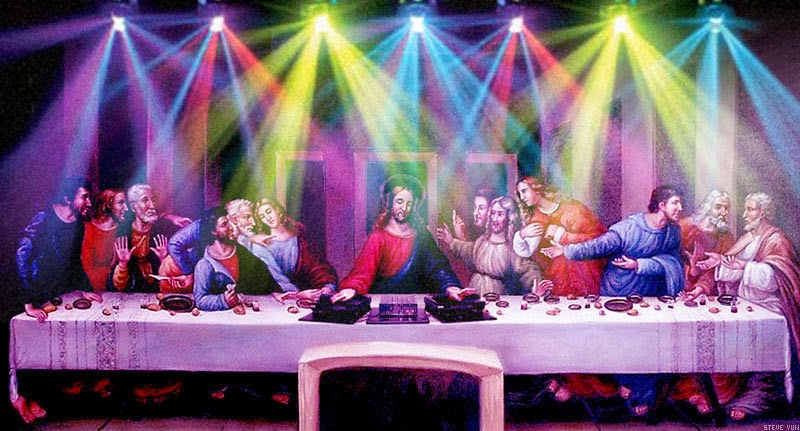
Instead, Jesus comes humming along to a song from the distant dance floor, perhaps with a few snacks and drinks hidden under the cover of his robe, and before we can say or do anything, he sets up the table and beckons us close.
It’s a strange parable.
But it’s right there in the strange new world of the Bible, and it’s also right here right now.
We are blessed by the risen Lord who knocks at the door, even in our deaths, and he comes bringing the party with him. And, wildly enough, the party is not off in some different place or some different time. It is with us right now, it’s just that most of us are too stubborn to notice. We, to take the language of the parable, are so consumed by the busyness of our lives that we can’t even hear Jesus banging on the door.
Our whole lives, the mess of our busyness, lead only toward our deaths. And it’s all okay, because in baptism we’ve already died with Christ. It is Jesus who is our life. Jesus is the one who comes for us from the wedding feat – he comes to us with the celebration under his arm and he wants nothing more than to rejoice with us.
This week on the Strangely Warmed podcast I speak with Peter Kwon about the readings for the 9th Sunday After Pentecost [C] (Isaiah 1.1, 10-20, Psalm 50.1-8, 22-23, Hebrews 11.1-3, 8-16, Luke 12.32-40). Peter is one of the pastors serving Annandale UMC in Annandale, VA. Our conversation covers a range of topics including the unexpected Gospel, Holes, sacrifices, Fleming Rutledge, relationships, LCD Soundsystem, singing our prayers, God’s loquaciousness, judgment, eschatological hope, Dogmatics In Outline, Sunday clothes, and preparation. If you would like to listen to the episode or subscribe to the podcast you can do so here: One Of Us
Then God spoke all these words, “I am the Lord your God, who brought you out of the land of Egypt, out of the house of slavery; you shall have no other gods before me. You shall not make for yourself an idol, whether in the form of anything that is in heaven above or that is on the earth beneath of that is in the water under the earth. You shall not bow down to them or serve them, for I the Lord your God am a jealous God, punishing children for the iniquity of parents to the third and the fourth generation of those who reject me but showing steadfast love to the thousandth generation of those who love me and keep my commandments. You shall not make wrongful use of the name of the Lord your God, for the Lord will not acquit anyone who misuses his name. Remember the Sabbath day and keep it holy. Six days you shall labor and do all your work. But the seventh day is a Sabbath to the Lord your God; you shall not do any work – you, your son or your daughter, your male or female slave, your livestock, or the alien resident in your towns. For in six days the Lord made heaven and earth, the sea, and all that is in them, but rested the seventh day; therefore the Lord blessed the Sabbath day and consecrated it. Honor your father and your mother, so that your days may be long in the land that the Lord your God is giving you. You shall not murder. You shall not commit adultery. You shall not steal. You shall not bear false witness against your neighbor. You shall not covet your neighbor’s house; you shall not covet your neighbor’s wife, male or female slave, ox, donkey, or anything that belongs to your neighbor. When all the people witnessed the thunder and lightning, the sound of the trumpet, and the mountain smoking, they were afraid and trembled and stood at a distance and said to Moses, “You speak to us, and we will listen, but do not let God speak to us, lest we die.”
It doesn’t happen often, but every once in a while I regret picking the text I picked for a Sunday morning. I will be in the middle of the week, staring at a blank work document on my computer, and I’ll wonder how God is going to show up and make something of my nothing.
Case in point, last Sunday we looked at and talked about Moses’ call from the burning bush. That would’ve been a great text for Vacation Bible School Sunday. It would’ve been fun and even easy to talk about how God shows up, and showed up, in unexpected ways and places. I could’ve pointed toward all these holy moments from the Food Truck Party and then wrapped it all up with a, “In the name of the Father, Son, and Holy Spirit.”
But no. I decided that this was the Sunday to preach the Ten Commandments.
You shall not murder.
You shall not bear false witness.
You shall not take the Lord’s name in vain.
On and on.
So I spent the early part of my week wracking my brain, praying for the Lord to give me something to say.
And then, on Monday night, I was sitting on the floor of one of our classrooms upstairs, with all our wonderful children and youth, trying my hardest to convey the story of God providing the manna in the wilderness. But, before jumping into the Bible, I wanted to get their little minds working so I asked each and every kid, “What’s your favorite breakfast?”
And I received some good answers: Pancakes, French Toast, Lucky Charms.
But then one of the kids said, “My favorite is waffles, but I hate it when my Dad makes me eat scrambled eggs.”
Alright, I thought, no need to get worked up about it.
And then another kid shouted, “Donuts!” To which another yelled, a few decibels louder, “I want her answer because I love donuts more than she does!”
And then another kid, under his breath, said, “I would give my life for a donut right now.”
Bewildered by the dramatic events unfolding before me, I took a breath, and happened to glance at the wall above their little heads and there, for everyone to see, was a poster with the ten commandments.
And I realized in that moment, the kids had broken three of the ten!
The Ten Commandments.
You shall not you shall not you shall not.
Why do we hang them up in our churches and in our houses? Why do we ask children to memorize them in Sunday school? Why does God hand them down to Moses on Mount Sinai?
Remember: Moses makes good on the call from the burning bush and leads God’s people out of slavery and captivity in Egypt to a new and strange land. They wander physically and spiritually complaining about how good they had it back in Egypt when God delivers the aforementioned manna in the wilderness.
They continue to wander under the witness of Moses until the Lord’s offers the Ten Commandments on Mount Sinai.
And, for us today, we can certainly flip to Exodus 20 in our Bibles, or we can just look up to a cross-stitched rendering in someone’s living room or Sunday school class to know what they are.
But there’s a difference between what the Ten Commandments say, and their purpose.
Because, if you read the New Testament, Jesus and Paul decisively declare that they are not rules to regulate our behavior. They are not a weapon to wield over and against those who do not follow them. They are not a code of conduct.
The primary function of the Law is to do to us what I just did by telling the story of the kids in the classroom: to accuse us.
The Law reveals the truth of who we really are. Between the big L and little l laws, between thou shall not and it would be better if you did this or that, the law reminds us that, all things considered, none of us are how we ought to be.
And yet all of us are in the business of self-deception. We’re so good at rationalizing our wandering eyes, justifying our wandering hearts, and explaining away our wanton disregard for others.
One of the more confounding parts of our behavior is our ability to know exactly what we should and shouldn’t do, from keeping up with the laundry to not looking at our phones while we drive, and we fail to do it.
We don’t need someone like me to stand up in a place like this to tell us a whole bunch of stuff we already know: you need to work on your racism, sexism, ageism, stop using so much styrofoam, go vegan, gluten free, eat locally, think globally, take precautions on your dates, live simply, practice diversity, give more, complain less, stop drinking so much.
We can have a preacher yell those things at us week after week, and we can put up the Ten Commandments all over the place, but we will still fail.
Listen: there’s another mountaintop moment in the Bible with a set of decrees. Instead of Moses this time, Jesus looks out at the gathered crowds and he says, “You have heard it said you shall not murder, but I say to you, love your enemies and pray for those who persecute you; you have heard it said you shall not commit adultery, but I say to you, even if you think about it, you’ve already guilty; unless your righteousness exceeds that of the Pharisees, of the rule followers, then you will never enter Heaven.”
And then, at the end of ratcheting up the Ten Commandments, Jesus mic drops the final line: You must be perfect as your Father in Heaven is perfect.
Apparently, in the Kingdom of God there are no trophies for participation, no A’s for effort.
Therefore, if Moses’ and Jesus’ decrees are nothing more than lists of what we must and mustn’t do, then we’re all up the creek without a paddle. We’re a bunch of losers with no hope in the world.
Thanks be to God then, that the hope of the world comes to do for us what we cannot do for ourselves.
You see, the primary purpose of the Law isn’t so much about what we’re supposed todo.
The primary purpose of the Law is what the Law does to us.
The Law is not a collection of principles on how to live an upright life.
The Law is the means by which God brings us down to our knees.
The Law, from Sinai to the instagramifcation of all things, holds up a mirror to our truest selves so that we are downright forced to come to grips with who we really are, and what we’ve done, and what we’re left undone.
In short, the function of the Law is to get to see ourselves with enough honesty and clarity that we ask ourselves, “How could God love me?”
Because when we are able to ask that question, we are close to the Good News.
God speak to us in two words, Law & Gospel, and we tend to confuse the two all the time.
And without knowing which is which, we tend to emphasize one at the expense of the other.
Be perfect. Never stop forgiving. Love your enemies. Stop your jealousy. Give away your possessions. On an on.
A church of the Law alone creates and cultivates a bunch of self-righteous people who are angry, miserable, and are never invited to the fun stuff.
It results in a cacophony of almost-Christians who are, in the end, nothing but a bunch of hypocrites. Have you ever noticed how the most judgmental people are usually the ones with the most problems?
And yet, without the word of the Law, the Gospel becomes an empty promise. It’s all good and well to come to a place like this and hear about how God loves us. I hope and pray that if you do hear anything in church, it is those words.
But what makes those words so staggering isn’t that God loves, but that God loves us.
When push comes to shove, each and every one of us, the tall and the small, we all avoid doing things we know we should do, and we all do things we know we shouldn’t.
Which is why, when Jesus riffs on the need to forgive 70 x 7 times, it’s to point us toward the witness of the God who continues to forgive us.
Jesus tells us to love our enemies not because it makes everything better, though it might, Jesus commands us to love our enemies because Jesus, himself, loves his enemies: us.
Which means, in the end, we need Law & Gospel. We need both because the first word pushes us to the second.
The Good News is not a bait and switch offer, it is not an invitation with strings attached, it is not a gift with an expectation of reciprocation.
If we leave church with more burdens than when we arrived, then grace cannot be amazing.
God knows you and me better than we know ourselves. God knows our inner thoughts and our knee-jerk reactions and our internet search histories, and God is still for us.
How odd of God to love a bunch of people who do not deserve it at all.
Being pushed from the Law to the Gospel is a truly wild and wonderful thing to do. And it is often nothing more than accepting, trusting, the incomprehensible Good News that despite all the reasons we shouldn’t be, we are indeed loved and forgiven. We are already home.
That’s the life of grace – there is therefore now no condemnation for those who are in Christ Jesus. If Jesus refused to condemn us because our goodness was actually rotten, he certainly isn’t going to flunk us because our life doesn’t measure up to the Law.
The real truth, the scandal of the faith, is that we can fail, miserably, and still live the life of grace.
Nothing, absolutely nothing, can separate us from God’s grace and love. Not our faults, not our vices, not us being brats all the time about things that don’t even really matter. Not even our doubts.
As the old hymn goes, my sin oh the bliss of this glorious thought, my sin not in part but the whole is nailed to the cross and I bear it no more praise the Lord, praise the Lord, o my soul.
One of our vacation Bible School participants, after a week of digesting the Word, approach me on our final night and said:
“So God loves me when I’m good but God still loves me when I’m bad just like Jesus loved all the people he fed with the loaves and the fishes? And God forgives me even if I do something I shouldn’t just like Jesus forgave Peter?”
“Yep. That’s the Gospel.”
“Well I don’t know what that words means, but it feels amazing.” Amen.
Moses was keeping the flock of his father-in-law Jethro, the priest of Midian; he led his flock beyond the wilderness and came to Mount Horeb, the mountain of God. There the angel of the Lord appeared to him in a flame of fire out of a bush; he looked, and the bush was blazing, yet it was not consumed. Then Moses said, “I must turn aside and look at this great sight and see why the bush is not burned up.” When the Lord saw that he had turned aside to see, God called to him out of the bush, “Moses, Moses!” And he said, “Here I am.” Then he said, “Come no closer! Remove the sandals from your feet, for the place on which you are standing is holy ground.” He said further, “I am the God of your father, the God of Abraham, the God of Isaac, and the God of Jacob.” And Moses hid his face, for he was afraid to look at God. Then the Lord said, “I have observed the misery of my people who are in Egypt; I have heard their cry on account of their taskmasters. Indeed, I know their sufferings, and I have come down to deliver them from the Egyptians and to bring them up our of that land to a good and spacious land, to a land flowing with milk and honest, to the country of the Canaanites, the Hittites, the Amorites, the Perizzites, the Hivites, and the Jebusites. The cry of the Israelites has now come to me; I have also seen how the Egyptians oppress them. Now go, I am sending you to Pharaoh to bring my people, the Israelites, out of Egypt.” But Moses said to God, “Who am I that I should go to Pharaoh and bring the Israelites out of Egypt?” He said, “I will be with you, and this shall be the sign for you that it is I who sent you: when you have brought the people out of Egypt, you shall serve God on this mountain.” But Moses said to God, “If I come to the Israelites and say to them, ‘The God of your ancestors has sent me to you,’ and they ask me, ‘What is his name?’ What name shall I say to them?” God said to Moses, “I AM WHO I AM.” He said further, “Thus you shall say to the Israelites, “I AM has sent me to you.”
God can be so frustrating.
There are times, maybe you’re better than me so you don’t know what I’m talking about, but there are times when I jump into the strange new world of the Bible and I just want to say, “C’mon God! Really?”
Moses is a good-for-nothing shepherd. And he doesn’t even have his own flock to look after. He’s working for his father-in-law. So we’ve got this guy, who needs a handout from a relative, working out and around Mt. Horeb, which means wasteland, and he encounters the burning bush.
Or, better but, the burning bush encounters him.
Does it ever surprise you that the Lord needs numbskulls to bring about God’s will?
I mean, just take a cursory glance at just about any book in the Bible and you liable to come across someone who has no business being in God’s business and yet, that’s how God runs the show.
And that’s not even mentioning who God calls upon outside of the Bible.
To bring it close to home, there are 29 portraits of pastors right underneath us and there’s a better than good chance that the vast majority of them never thought they would have their picture up on the wall of a church.
And yet, here we are.
Sometimes I wish God would start calling better people for God’s purposes. Surely, the world could do to have the best and the brightest working for the kingdom.
But, then again, if God only called the best, then I certainly wouldn’t be here, and neither would any of you.
John Calvin, who gets quoted across the street far more than here once said, “God is so great, that God is able to condescend to miserable people just like us to accomplish God’s good.”
How odd of God.
And, notably, it’s important to notice the distinction between “I found God,” and “God found me.” Throughout the strange new world of the Bible, people do, indeed, go looking for God but they usually go looking in all the wrong places whereas God shows up in the unexpected places.
Contrary to how we might like to imagine it, or even here about it in church, God is not the object of our religious journeys, waiting for us to finally have enough sense to take the right steps or read the right book or get the right job or make the right choice. God is, instead, the instigator of God’s journey to us. From Eden, to the wasteland, to Bethlehem; God finds us.
And that’s why we keep reading these stories week after week, year after year. It’s why we prepare for Vacation Bible School and read scripture at baptisms, weddings, and funerals. We keep listening to the story of how God reveals God’s self to people who otherwise would have never known who God was or is.
And (!) to further complicate the confounding nature of the God who speaks from bushes and books, particularly as it pertains to preaching, is that only God can tell us who God is. It has to be revealed to us.
Listen – All is well in Egypt until it isn’t.
God’s people grow in such size and strength that Pharaoh grows fearful and subjugates them. They are forced to work under the tyrannical rule of the empire and yet, they continue to prosper in power and number.
Pharaoh then decides to order the murder of every first born male among the Hebrew people. A young mother, fearing for her son’s life, places him in a basket and lets him float down the Nile river and, oddly enough, the basket is discovered by Pharaoh’s daughter who chooses to raise the boy and she names him Moses which means “I drew him out of the water.”
Raised in the confines, and under the protection, of Egypt’s ruler, Moses is given access to a life that none of his kinsmen will ever know. And yet, one day, he sees an Egyptian taskmaster whipping a Hebrew slave and, overcome with emotion, Moses reaches out and murders the Egyptian and hides his body in the sand.
Moses flees for his very life, already a recurring theme, and he settles in the land of Midian where he marries Zipporah, the daughter of a priest, and begins to work for his new father-in-law.
So why, why in the world does God call to Moses from the burning bush? What’s so good on his resume, what kind of references did he list while seeking out employment with the Lord?
Moses really only brings three things to the table:
He’s in the middle of his mundane work, guiding the flock in the wasteland, when he turns aside to see the sight of the burning bush. In short, Moses is curious.
That’s not much, all things considered, but to the Lord it is the difference that makes all the difference. Moses turns to take in something unexpected, and rather than lowering his head and getting back to the menial realities of life, he takes a further look.
He is like the proverbial worker surrounded by countless cubicles mindlessly typing away at a keyboard for a job that means nothing when a suddenly flickering in the window draws him up and away from his featureless desk toward the unknown.
It is good and right to maintain a healthy diet of curiosity, of keeping our eyes and ears tuned away from monotony. Be it a strange movie or meal or moment, God tends to work in the unexpected places in unexpected ways.
Or, as one of my favorite authors Haruki Murakami puts it, “If you only read the books everyone else is reading, then you can only think what everyone else is thinking.”
After Moses’ curiosity draws his gaze toward the bush, the next thing he does is wonder. The strange fiery foliage isn’t enough on its own, Moses wants to know why it burns but does not burn up. He is not content to let things be the way they are simply because they are that way, he probes further.
It is good and right to wonder about the workings of God.
It does my ego good to remember that none of you come here with the great desire to hear preachments about the Lord, but instead you are here to daydream about God, to wonder, to ask questions, and rest in whatever answers you discover.
A couple weeks ago one of you asked me, after church, about the Apostles’ Creed and why we say, “I believe in the holy catholic church.” I won’t out you, but this person said, “Why do we say that? We’re Methodists, not Catholics.” And I gave the typical response, “it’s the lower-c catholic which means universal, we’re just saying we believe in the church writ large.”
This kind of question pops up all the time, but what struck me most this time was the fact that the person then said, “I’ve wondered about that my whole life, and I’ve never had the nerve to ask.”
Faith is a strange and wondrous thing that necessities wonder. That’s why the disciples are forever asking Jesus to elaborate on the kingdom of heaven, they want to know more.
Moses is curious and Moses wonders about this strange sight in the wasteland, and when the Lord sees Moses’ curiosity and wonder the Lord says, “Moses, Moses!” And he says, “Here I am.”
In short, Moses responds.
“Kick those sandals off your feet, we’ve got holy business to attend to. I am the God of your people, and the time has come to set them free and I have just the person for the job.”
“And who might that be?”
“You, silly goose.”
“Are you out of your mind? You’re a talking bush that’s on fire! And you want me to deliver the Hebrew people from Pharaoh?”
“Have no fear Moses my dear, I will be with you.”
“Maybe you didn’t hear me fiery fig tree, or whatever it is you are, even if what you’re saying is true, no one will believe me when I tell them. I don’t even know your name.”
God says to Moses, “I AM WHO I AM.”
The rest is biblical history.
When it comes to the question of “Why Moses?” It doesn’t really matter. Sure, there are some bits to his history that make him a prime candidate for paradigm shifts, he spent time in Pharaoh’s court. In the end, who he is doesn’t matter.
The only thing that matters is that God is the one doing the calling.
You see, God does God’s best work making something of our nothing, of making a way where there is no way whatsoever, of making the impossible possible.
We, today, tend to view ourselves and one another through failures, mistakes, shortcomings. It is the negative that we carry around day after day. But to God, each and every one of us has a potentiality that can be made manifest in the kingdom of God.
Or, to use a very old adage, God doesn’t call the equipped, God equips the called.
Think about Moses! In just a few short chapters this would-be shepherd in the wasteland will be taking care of the flock of God, standing up to the tyranny of Pharaoh, delivering the Hebrew people to the banks of the sea waiting for the God of impossible possibility to do something.
It’s fun to pick on Moses, he’s an easy target. The rest of his tale paints the picture of his relationship with God like an old married couple who constantly bicker and fight and eventually reconcile. For what it’s worth, we read more about Moses than any other person in the Bible with the exception of Jesus. And yet, Moses’ story isn’t even really about Moses – it’s about the One who calls him.
I AM WHO I AM
I love how quickly Moses moves from “Here I am,” to “Who am I?” His curiosity and wonder and response are all good and fine until he hears what the Lord wants him to do. And immediately, Moses has reservations. Who am I to do all of that?
Who am I?
Who are you?
Whatever it is your experiencing in your life right now, whether you feel like you’re wandering through the wasteland or making moves on the mountaintop, God calls miserable and merry people like you and me all the time. It might not be to deliver God’s people from the oppressive rule of a dictator, it might be as simple as the nudge to call someone who needs to feel loved, or the feeling that there’s something we can do to make a difference in this community. And it might not come through a burning bush, it might be as simple as the words of a hymn, or the silence of a prayer, or any other number of possibilities.
Or, as Paige Anderson so wonderfully put it to me this week, “Sometimes all we need in life is the tiniest sign from God to remind us of our purpose.”
What makes the story of the burning bush so good is the fact that, in the end, the call of Moses is a wild and ringing reminder that we don’t have to be saints to be of use for God’s kingdom. If we need anything at all, it’s a little bit of curiosity, wonder, the tiniest smidge of faith.
Faith not in ourselves or our abilities, but faith in the God who is able to do far more than we could ever ask or imagine.
If you ever feel like you’re not good enough, that’s fine. Because God is good enough for all of us. Amen.
This week on the Strangely Warmed podcast I speak with Peter Kwon about the readings for the 8th Sunday After Pentecost [C] (Hosea 11.1-11, Psalm 107.1-9, 43, Colossians 3.1-11, Luke 12.13-21). Peter is one of the pastors serving Annandale UMC in Annandale, VA. Our conversation covers a range of topics including foolishness, church cohorts, robe wearing, books, fear, the redeemed, old sermons, the already but not yet, Jonathan Franzen’s Crossroads, the grammar of faith, and identity. If you would like to listen to the episode or subscribe to the podcast you can do so here: The Good News Of Being A Burden
Jacob settled in the land where his father had lived as an alien, the land of Canaan. This is the story of the family of Jacob. Joseph, being seventeen years old, was shepherding the flock with his brothers; he was a helper to the sons of Bilhah and Zilpah, his father’s wives; and Joseph brought a bad report of them to their father. Now Israel loved Joseph more than any other of his children, because he was the son of his old age; and he had made him a long robe with sleeves. But when his brothers saw that their father loved him more than all his brothers, they hated him, and could not speak peaceably to him. Once Joseph had a dream, and when he told it to his brothers, they hated him even more. He said to them, “Listen to this dream that I dream. There we were, binding sheaves in the field. Suddenly my sheaf rose and stood upright; then your sheaves gathered around it, and bowed down to my sheaf.” His brothers said to him, “Are you indeed to reign over us? Are you indeed to have dominion over us?” So they hated him even more because of his dreams and his words.
It is a strange thing to share the dreams we dream with others. To us, they feel so very real even though, as soon as we wake, we know they aren’t. And yet, more often than not, moved by a particularly imaginative vision, we will tell others of what we have seen and experienced knowing full and well that, most of the time, it means absolutely nothing to the people we tell.
There’s a better than good chance that each of us here have had at least one dream that left us mad at someone because of what they did in our minds even though they did nothing in reality.
How odd.
And yet, how true to our human nature!
Listen – Jacob, Israel, settled in the land of his father, Isaac. Contrary to the controversial beginnings of his life, he eventually grew to have a large and prosperous family. Among his many children, Joseph was his very favorite, and Jospeh was a dreamer.
The parallels in scripture are often quite staggering.
Jacob has a vision of a ladder stretching into the heavens, a ladder upon which angels ascend and descend.
Joseph has a vision of his brothers bowing to him.
Jacob’s story culminates in his reconciliation with his brother Esau.
Joseph’s tale concludes with his brothers as well.
And yet these two biblical figures could not be more different. Jacob is selfish, Joseph is kind. Jacob runs away from his problems, Joseph walks straight into them. Jacob throws his life away, and Joseph, himself, is the one thrown away.
Joseph, baby of the family, dreams of sheaves in a field bowing to him, he has visions of his family relying on him for their deliverance. And it would be enough just to have these dreams, but Joseph has the bright idea to share his dreams with his brothers. His brothers already despise him because their father loves him most of all and even gives him the gift of a coat with long sleeves.
Why?
Scripture says that Joseph is the son of Jacob’s old age, but we also know that Joseph is one of the only two children from Rachel, Jacob’s first love and second wife.
Notably, Jacob is one who has experienced the divine inversion that runs rampant in scripture as he was elevated over his brother Esau (by his own heel-grabbing tendencies). Jacob’s preference for Joseph runs against all propriety at the time, and against the established norms. His love upends everything the family thinks they know about how things are supposed to work, which is something God seems to do all the time.
This tale is a foretaste of how, throughout the rest of this strange book, God will often choose the youngest and weakest for honor and leadership. It is a strange and new economy of grace.
The brothers hear out their baby bro’s vision and they decide, with a solid eleven voting members, that they can no longer live with the dreamer. Ten of them want him dead, but the eldest, Reuben, convinces the others to merely throw him in a pit instead.
Reuben, inexplicably, leaves the scene and the remaining brothers spy an approaching caravan and the decide to sell Joseph into slavery.
*Netflix*
This is a strange and bewildering tale, even among the wild new world of the Bible. The final quarter of Genesis is devoted to this one person and his tale. The themes that follow have been made manifest of countless other stories: exile, hiddenness, the hero’s journey, riches to rags and rags to riches, drama, mystery, and hope.
As Joseph disappears into the horizon, his brothers take his aforementioned not actually technicolor dream coat, and they dip it in fresh blood to convince the rest of their family, and their father in particular, that Joseph is dead.
And, to be frank, he might as well be dead. He is completely cut off from his family, from the land of his birth, and from the story of God’s people. He travels as a slave to be a stranger in a strange land without any hope in the world, without his father’s love, and without his special jacket.
Jacob responds to the news of his favorite son’s death by ripping his own coat and vows to live a life of mourning until the day that he, himself, dies.
So, why is it that Joseph’s brothers throw him into the pit of enslavement?
Those of us with brothers and sisters know, first hand, the strangeness of siblings. We know of the tensions and the pains and the jealously that can be all too present within a family. But, the kind of domestic squabbles we might be familiar with are a far cry from what happens here in Genesis.
Why is it that when God comes to dwell among us, we nail God to the cross?
Why is it that, when they hear of their brother’s dream, the sons of Jacob sell Joseph into slavery?
Joseph, now a slave, is sold to to the captain of Pharaoh’s guard in Egypt, a man named Potiphar. A truly wild narrative ensues that is worth its own sermon series, but for the sake of today it is enough to know that his time there ends with his arrest.
And, it comes to pass that while he is in prison, Pharaoh has a set of experiences that require someone who can interpret dreams. The dreamer from the shackles of slavery and imprisonment has earned a reputation for interpretation, and is called before the throne. Pharaoh shares his dreams of seven skinny cows eating seven fat cows but don’t grow in size, seven good ears of corn are consumed by seven withered ones.
What does it mean Joseph?
The dreamer tells Pharaoh that Egypt will have seven good years of harvest and seven years of famine, therefore someone is needed who can store up a surplus during the good years and distribute it during the years of scarcity.
And who does Pharaoh call upon for this task?
Joseph.
The dreamer is freed from slavery, given a wife, and the total authority in Egypt. And, when the times comes, his interpretation is proven correct and he saves the nation into which he was sold as a slave.
There’s a version of this story that ends right here. From riches to rags and back again. This would be a good place for the credits to start to roll. But God has another ending in store.
The famine that strikes Egypt is so bad that even the surrounding areas are suffering. So much so that Joseph’s family is stuck in destitution and are in need of deliverance. The brothers are commanded by their father to seek out help in the foreign land and when they travel to Egypt they beg for food from their brother though they do not recognize him.
Not only do they beg for compassion, they literally bow down to him, bringing his earlier dream to fruition.
There is great tension in the ensuing narrative with Joseph going back and forth with requests and demands from his brothers who still do not know his true identity, and it all culminates during in a moment in which, scripture says, Joseph could no longer control himself, and he reveals the truth.
He weeps so loudly in the moment that everyone in the entire palace hear his cries. And his brothers are terrified. Rightly so.
They deserve judgment and they are about to get it.
But instead of rejecting his brothers just as they rejected him, Joseph embraces them, he literally falls upon them and he covers them with tears and kisses. The scene is staggering. They offer to become his slaves for what they had done, but instead Joseph forgives his brothers, he loves them, and he urges them not to be angry with themselves.
They are invited to live in Egypt and even Jacob travels to the strange land where the entire family is reunited and reconciled.
Joseph does for his brothers what they don’t deserve at all. They come to Egypt with no hope in the world, and the only one who can do anything for them is the one they did everything to. They offer to becomes slaves to the one enslaved and he, instead, offers them a freedom they never could have imagined. Not only are they free to thrive and eat and live, they are freed from the shame and guilt of what they had done.
In short, they are given grace.
I arrived at Alta Mons this week tasked with being the chaplain for all of the campers and all of the counselors. After breakfast we would gather for morning watch during which we would sing songs together and talk about how to keep an eye out for what God might be up to during the day and after dinner we would gather around a campfire for worship during which we would talk about how we had experienced God during the day.
Throughout the week we covered themes like the body of Christ and how each of us are a part of it, the new beloved community, and grace. Asking the kids to define grace was delightful. One of them told me, “grace is what you do before you’re allowed to eat,” and another said, “I don’t know what it is but I do know that it’s amazing,” and still yet another said, “grace is loving someone even if they don’t deserve it.”
And when I asked why God offers us grace, the young theologian Caleb Anderson replied, “God’s built different, that’s straight facts.”
The first night of camp, the kids all sat and stood awkwardly around one another as they navigated the strangeness of being forced to hang out with a bunch of relative strangers in the woods for a week. And over the following days I witnessed joy and laughter and the bonds of new friendship but I also saw disagreements, and frustrations, and deep sighs and hair flips.
But on our final night, as we sat around the campfire and I told them about Jesus’s final night, as I prayed over the bread and the cup and we all shared communion with one another, I saw tears and hugs. I watched and listened to kids sing songs about Jesus, a few of whom who have never darkened the doors of a church. I experienced campers giving love and receiving love without expectation of reciprocation.
In short, I saw grace.
On the day of Easter, resurrected from the grave, still bearing the marks of the cross, Jesus returns not to the best and the brightest and the most faithful. Instead, he returns to those who abandoned him. He loves them, even to the end.
In the kingdom of God the new economy of grace is weird. It is everything for nothing. It is forgiveness, and mercy, and love. It is Good News for people drowning in bad news.
If Joseph was willing to forgive his brothers after all they had done, if Jesus was willing to return to his disciples who abandoned him and denied him, just imagine what we can do with the new economy of grace.
The same night he got up and took his two wives, his two maids, and his eleven children, and crossed the ford of the Jabbok. He took them and sent them across the stream, and likewise everything that he had. Jacob was left alone; and a man wrestled with him until daybreak. When the man saw that he did not prevail against Jacob, he struck him on the hip socket; and Jacob’s hip was put out of joint and he wrestled with him. Then he said, “Let me go, for the day is breaking.” But Jacob said, “I will not let you go, unless you bless me.” So he said to him, “What is your name?” And he said, “Jacob.” Then the man said, “You shall no longer be called Jacob, but Israel, for you have striven with God and with humans, and have prevailed.” Then Jacob asked him, “Please tell me your name.” But he said, “Why is it that you ask my name?” And there he blessed him. So Jacob called the place Peniel, saying, “For I have seen God face to face, and yet my life is preserved.” The sun rose upon him as he passed Penuel, limping because of his hip.
The strange new world of the Bible is, indeed, quite strange.
It constantly subverts our expectations, no matter how many times we come to it. It reveals things about ourselves that we didn’t even know about ourselves. And it points to an ever-present reality that runs counter to how we think the world works.
Listen – Jacob is the worst.
We all know that plenty of figures from the scriptures have problems – nobody’s perfect. But Jacob? Jacob is a loser.
Prior to his birth Jacob wrestles his twin brother Esau in the womb, a perfect foreshadowing of his life to come.
And when Esau is born, he comes out with his twin brother grabbing at his leg, so his parents name the second-born Jacob, which means heel-grabber.
What kind of name is heel-grabber?
Jacob, hustler, scoundrel, liar, cheat, fool, faithless son of Isaac and Rebekah.
Long story short:
Two decades before the infamous battle royal on the banks of the Jabbok river, Jacob swindles his brother Esau out of his birthright.
Esau comes in from the field, having hunted and collected food for the rest of the family, and with hunger he asks his brother for some red stew from the stove. Does Jacob willingly hand it over to his twin brother knowing full and well that the firstborn contributes more to his wellbeing than the other way around? No.
Jacob prepares the plate, lets the scent waft in front of his brother’s nose, and says, “I’ll give you this only if you give me your birthright in return.”
And Esau, famished from working for the family, willingly agrees. After all, what good is a birthright in comparison with the deep hunger of your belly?
But it doesn’t stop there.
Later, Isaac in his old age, eyes weary and poor of sight, near death, asks for Esau to come and to receive his blessing, AKA his inheritance. Isaac wants to pass on all of his wealth to his eldest twin son.
Esau, come bring me some of my favorite food that I might hand over the goods.
But the heel-grabber is quick to act.
He walks in with the aforementioned food, and boldly lies to his father. He covers himself in fur to appear harrier like his brother. He leans forward to receive the kiss that conveys it all, and takes it without remorse.
For what it’s worth, that’s three of the ten commandments broken in as many verses.
Esau’s fury in response to his heel-grabbing brother heel-grabbing his blessing leads Jacob to flee for his life.
Jacob becomes a stranger in a strange land, wandering about, and during this time he has a dream, a dream from God. In the dream there is a ladder stretching up into the heavens, angels are going up and down, and the Lord says, “Jacob, know that I am with you and I will never leave you.”
Which, considering what happened and what’s about to happen sounds more like a threat than a promise.
When Jacob wakes from the dream he sets up an altar to the Lord and he is afraid.
His fear leads him to prayer. Does he pray for forgiveness? Does he offer the Lord a contrite heart?
No. He bargains with the divine: “Lord, if you will stay with me, and keep me, and make sure that I have food to eat and clothing to wear, then you can be my God.”
Jacob encounters the divine through the dramatic vision of the ladder, is still no better than he was before!
Soon, Jacob has nowhere left to go. Esau’s fury remains on the back horizon. So he reaches out to his uncle, Laban, who takes him in, provides the food and shelter that Jacob demanded from God. Jacob meets Rachel, bargains with Laban to marry her, works seven years, and then, on his wedding night, is duped by his uncle into consummating the relationship with Leah, Rachel’s sister.
More bargaining ensues, and with another 7 years of labor he is finally granted the wife he wanted from the beginning.
Soap operas aren’t even this good. But wait, there’s more!
After 14 years of labor, and after receiving untold wealth and wives, Jacob returns the hospitality of his uncle turned father-in-law by cheating him out of his wealth hiding away the best of the livestock for himself.
Again, not to make too fine a point of it, that’s a few more commandments broken.
Jacob is a no good dirty rotten scoundrel. He runs from all his problems all while making more problems for himself and his family. He’s a liar, and a thief, and a cheat. There’s nothing holy about this heel grabbing son of a, Isaac.
Why then do we read of this man and his wandering heart? Why do we lift these verses from the strange new world of the Bible and say, “Thanks be to God”? Why does God promise to remain with Jacob even though he has nothing to show for his so-called life?
Because Jacob isn’t his real name.
On the run from his mistakes, from his failures, and perhaps even from himself, Jacob catches wind that Esau is looking for him. So he divides up his family and all of his possessions, assuming that at least half will make it to safety. And, all alone, he sleeps by the bank of the Jabbok river.
A strange figure appears in the middle of the night. Perhaps the consequences of his actions made manifest in the flesh. They wrestle until the sun begins to rise. The stranger knocks Jacob on the hip, dislocating it forever, and demands for the fight to end. Jacob refuses, “I will not let you go, unless you bless me.”
Still looking for blessings.
“Who are you?” The figure asks.
“My name is Jacob.”
“No it’s not,” the stranger replies, “Your name is Israel because you have striven with God and humans and you’ve made it to the other side.”
Israel then returns the same question to the nighttime wrestler, “Who are you?”
But he receives no answer. And as mysteriously as the figure arrives, he disappears.
Israel names the place Peniel, which means the face of God, because in the wrestler he met the divine.
The morning comes and Israel sees Esau coming, with four hundred men flanking him on the right and left. Israel goes ahead and bows to the ground seven times until he stands before his brother.
And Esau runs forward and tackles his good for nothing brother to the ground and finally exacts his revenge. And yet, instead of pummeling him with punches, Esau embraces his twin brother and covers him with kisses and tears.
The end.
What a strange tale.
Jacob, Israel, is deeply flawed learns nothing except for the fact that he deserves nothing and receives everything. We read his story, we can call it Good News, because grace prevails!
His actions catch up with him, all of the hurt and all of the pain. He is caught and there is no escape. And only then is he known fully for the first time, and is loved.
Here, at the end, after a life of failure and betrayal, vulnerable and at his brother’s mercy, he discovers an acceptance which he never could have earned or deserved.
Which leads us backward, slightly. Decades before the battle royal at the river, long before he had a taste of forgiveness, Israel had a vision, a dream, of a ladder extending into the heavens. Israel knows, after all is said and done, that God is indeed at the end of that ladder, but more importantly he knows that the Good News, the gospel, is not that God is up there waiting for him to journey up – instead God comes down to meet him where he is.
And he has the scars to prove it.
The Good News of the Gospel for Israel, for each and everyone of us, is that God meets us in the midst of our sins, not our successes.
For some reason we’ve got it stuck in our heads that, like Jacob, we’ve got to do whatever it takes to win the game we call life. We’ll deceive our parents, lie to our spouses, betray our families. We’ll dig deep pits from which we can’t escape all while thinking we’re getting better and better and better. We’ll make horrible decisions and choices all in the name of progress.
But the life of faith isn’t about how we need to get good for God.
It’s about how God comes to us.
And God’s been doing it since the beginning.
From “Adam, Adam, where are you?” To a midnight brawl at the river to the sleepy little town of Bethlehem, God comes to us.
And when God comes to us and we expect to be clobbered with guilt, we actually get clobbered by grace.
Years ago, at a different church, I was sitting in my office one day, day dreaming about a sermon, when an older parishioner barged in through the door. She was older and getting on in years, but she had this youthful glow that I had never seen.
She shouted, “Preacher you are never going to believe what happened to me.”
My favorite stories always start like that.
So without saying a word I mentioned for her to continue.
“Well you know how you keep preaching about forgiveness? Well, I don’t know what came over me, but I finally decided to tell my husband that I cheated on him.”
“What?” I blurted out as I fell out of my chair.
“It was 30 years ago, and it was only once, but I never told anybody. So after we drove home from church last Sunday and as soon as we walked into the house I told him the truth about what I’d done and with whom and when.”
“What does this have to do with forgiveness?”
“That’s just the thing! I told him all I had done and I waited for him to start hooting and hollering and raising hell. All he said was, ‘I know you cheated on me, and I forgave you a long time ago.’ The nerve of that man. Here I am, carrying this guilt around all these years, and he forgave me long ago. Can you believe it?”
Can you believe it?
This story captivates our hearts and minds because it doesn’t end according to the way it is supposed to. Any good consumer of tales knows that Jacob is supposed to get his comeuppance; whether by violent revenge from Esau, or judgment from God almighty. He is nothing but a loser through and through.
But grace works for losers and only losers.
You know, people like us.
No matter how hard we try, and try hard we do, we can’t save ourselves, we can’t make ourselves right. We can try, and we can make a heck of a mess along the way, but the Lord has a way of reminding us, all of us, that we are not as we ought to be, that we’re up the creek without a paddle. We do nothing and we deserve nothing, and yet God forgives us anyway. Can you believe it?
The story of Israel, of the forgiven heel-grabber, reminds us that God comes to us in our weariness and woundedness. God, ultimately, rules not from a throne of glory, but from the arms of the cross. God’s power is revealed in the weakness of Christ, and God’s grace comes to us in our weakness.
We don’t have the strength, nor do we have the power, to save ourselves. We are as helpless as Jacob, hobbling around with our hips out of joint. We can run away as far as we can for as long as we can, but one day God will catch up with us. God will grab hold of us. And God will tell us who we really are.
What kind of name is Israel? It means we have striven with God and one another and we’ve made it to the other side. Amen.
This week on the Strangely Warmed podcast I speak with Matt Benton about the readings for the 5th Sunday After Pentecost [C] (Amos 7.7-17, Psalm 82, Colossians 1.1-14, Luke 10.25-37). Matt is the pastor of Bethel UMC in Woodbridge, VA. Our conversation covers a range of topics including professional segues, We Own This City, low anthropology, the parable of the plumb line, false modesty, wickedness, comfort, grace, worthy living, holy friendships, and promises. If you would like to listen to the episode or subscribe to the podcast you can do so here: The Necessity of Judgment
If I speak in the tongues of humans and of angels but do not have love, I am a noisy gong or a clanging cymbal. And if I have prophetic powers and understand all mysteries and all knowledge and if I have all faith so as to remove mountains but do not have love, I am nothing. If I give away all my possessions and if I hand over my body so that I may boast but do not have love, I gain nothing. Love is patient; love is kind; love is not envious or boastful or arrogant or rude. It does not insist on its own way; it is not irritable; it keeps no record of wrongs; it does not rejoice in wrongdoing but rejoices in the truth. It bears all things, believes all things, hopes all things, endures all things. Love never ends. But as for prophecies, they will come to an end; as for tongues, they will cease; as for knowledge, it will come to an end. For we know only in part, and we prophesy only in part, but when the complete comes the partial will come to an end. When I was a child, I spoke like a child, I thought like a child, I reasoned like a child. When I became an adult, I put an end to childish ways. For now we see only a reflection, as in a mirror, but then we will see face to face. Now I know only in part; then I will know fully, even as I have been fully known. And now faith, hope, and love remain, these three, and the greatest of these is love.
John 3.16
For God so loved the world that he gave his only Son, so that everyone who believes in him may not perish but may have eternal life.
–
Jesus is doing his Jesus thing. He wanders around Galilee, making the impossible possible, telling parables of prodigals and publicans, and confronting cantankerous clergy. And, at some point, crowds begin to follow. Within these crowds are the disciples, the ones called by the Lord to a different life. And these disciples, the ones who are supposed to have this stuff all figured out, they keep interrupting with questions.
Hey JC, when will this kingdom of yours actually start?
Teacher, did you really say we need to turn the other cheek?
Lord, who will make it into heaven?
The disciples, to their foolish credit, assume they’ve already made the cut. They, after all, left it all behind to follow Jesus. So what they really want to know is, “Who is the greatest in the kingdom of heaven?”
It’s a good question.
And Jesus answers by picking a random kid out of the crowd and lifting him up.
It’s a strange moment in the strange new world of the Bible.
All these grown up with their grown up ideas and grown up hopes and grown up assumptions, they stand and watch Jesus take hold of a little kid and he says, “If you want to get into heaven, you have to be like this little boy.”
It’s no wonder the disciples rebuke Jesus for such an answer.
What does this boy have to show for himself? What random acts of kindness earn such a profound distinction from the Lord?
In the end, all that he has to show matters not at all to the one who comes to make all things new.
If you want to get into heaven, Jesus says, you have to be like a little kid.
To me, Mitchell was always a little kid.
I know that he eventually grew to be taller than me, and perhaps a bit wiser, but because our families grew up together, I couldn’t really see him as anything other than a little kid.
And, to be fair, he acted like a little kid.
Mitchell could fall asleep in the strangest of places from on a couch during a loud dinner party, to on his boat in the middle of the lake in the middle of the night.
But his childlikeness was such a gift.
In my life I’ve never known anyone so easy to be around. Whenever he smiled, it took over his whole face and no matter what you might’ve been going through you couldn’t help but smile back. He had this way of shrugging his shoulders that made everyone else realize that we were probably taking everything else a little too seriously. He had a confidence about himself that was bizarrely endearing.
Did you know that when Mitchell was younger he once told Susie that he wanted to get John 3.16 tattooed on his hand so that, when he threw a touchdown on tv, everyone would be able to see it?
That, in a sentence, might be the most Mitchell thing I’ve ever heard.
In the life of faith we are encouraged to have scripturally shaped imaginations. That means that whenever we enter the strange world of scripture, we discover that it is indeed our world. So much so that when we read of Jesus walking down to the sea of Galilee to preach the Good News, it’s not difficult to picture Mitchell waiting off to the side of the crowd joking around with some friends. And then, when Jesus realizes the crowds have grown too large and needs a way to address everyone, Mitchell is the one who volunteers for the Lord to use his wake-boarding boat. But to bring it all home, when people still struggle to hear what Jesus has to say out on the water, Mitchell is the one who informs the Lord that the boat has a killer sound system and he can crank it up, if that’s what the Lord wants.
Jesus says, Truly I tell you, whoever does not receive the kingdom of God as a little child will never enter it.
There’s a childlike quality to giving, and receiving, love as conveyed in the Bible. It’s why Paul is so quick to riff on the subject in his first letter to the church in Corinth. For millennia these words have cultivated and curated the people called church: love is patient, love is kind, love bears all things, believes all things, hopes all things, endures all things.
Love never ends.
Mike, Susie, Brianna, this is the love that you had for Mitchell. You were patient with him, you rejoiced with him, you wept with him, you laughed with him. You surrounded him in every moment of his life with the tangible beauty of ever-enduring love. Any life is made intelligible only by and through love. And Mitchell was dearly loved.
But the same holds true for how Mitchell loved you and all of us. This gathered body is a witness and a testimony not just to the love we have for Mitchell, but to the love he demonstrated for us. Within these pews are countless stories of love and joy and peace and delight that were made manifest through him.
Mitchell loved you. Each and every one of you.
Our lives were richly blessed by him, and will continue to be blessed because of him.
That is why, even in our terrible terrible grief we can be grateful. We can be grateful because Mitchell was such a gift.
1 Corinthians 13 will always speak words into a moment when we no longer know what to say. The love with which our lives are made possible is the great proclamation that makes the Good News good.
And yet, for as often as we have read this text to be about us and the love we have for one another, it is actually the declaration of who God is for us.
You see, God is love. Which means God is patient; God is kind; God is not envious or boastful or arrogant or rude. God does not insist on his own way; God is not irritable; God keeps no records of wrongs; God bears all things, believes all things, hopes all thing, and endures all things.
The promise of the Gospel is that no one, absolutely no one, is outside the realm of God’s grace and love. No matter what we do or leave undone, God is for us no matter what.
God’s love for Mitchell knows no end.
Hear the Good News: In the fullness of time, God in Christ is born into the muck and mire of our lives, wandering the streets of time, making a way where there is no way. And then, Jesus takes all of our sins, past-present-future, nails them to the cross and leaves them there forever. The Lord is locked up forsaken and dead in a tomb. But three days later, God gives him back to us.
We are Easter people. Christ’s resurrection is the promise of our resurrection. The empty tomb is the proclamation that one day we will all feast at the Supper of the Lamb with Mitchell. We will gather at the table around which God makes all things new and there will be no mourning or crying, only dancing and laughing.
But that day is not this day.
Today we weep because Mitchell is gone.
And yet, there’s another time in scripture when the disciples are continuing to badger Jesus with their questions about the kingdom of heaven and to whom it belongs. And Jesus says, “Heaven belongs to those who mourn, those who cry, those who grieve and ache and wish that it wasn’t so, those who know not all is as it should be.”
In short, heaven belongs to people like Mitchell and people like us. Thanks be to God.
Then God said to Noah and to his sons with him, “As for me, I am establishing my covenant with you and your descendants after you and with every living creature that is with you, the birds, the domestic animals, and every animal of the earth with you, as many as came out of the ark. I establish my covenant with you, that never again shall all flesh be cut off by the waters of a flood, and never again shall there be a flood to destroy the earth.” God said, “This is the sign of the covenant that I make between me and you and every living creature that is with you, for all future generations: I have set my bow in the clouds, and it shall be a sign of the covenant between me and the earth. When I bring clouds over the earth and the bow is seen in the clouds, I will remember my covenant that is between me and you and every living creature of all flesh, and waters shall never again become a flood to destroy all flesh. When the bow is in the clouds, I will see it and remember the everlasting covenant between God and every living creature of all flesh that is on the earth.” God said to Noah, “This is the sign of the covenant that I have established between me and all flesh that is on the earth.”
In the summer of 2007, having completed my first year of college, I volunteered to help lead a youth mission trip for my home church to New Orleans. It had been two years since the devastation of hurricane Katrina, and parts of the city were still in desperate need of help.
We spent our days in the sweltering heat exchanging crow bars and sledge hammers for demolition. Every house we approached had been boarded up since the storm, and we were tasked with removing everything we could so that city inspectors could deem whether or not the framing was safe for rehabilitation, or if they would have to tear the entire thing down to the foundation and start over.
The mildewed sheet rock was easy enough to pull down, as were the piles of clothing that remained stacked in various states of disarray. But the mangled children’s toys, and the warped family photo albums were another thing entirely.
Mission trips are often marked by laughter and singing and frivolity.
But not when we were in New Orleans.
What I remember most is the silence.
But that’s actually not true. There is something I remember more than the silence.
On our final day, shortly before we were scheduled to fly home, we were given the tour of the lower ninth ward. This was the spot hit hardest, and unlike our modest de-construction work on houses in other parts of the city, the lower ninth ward was devoid of everything. No trees. No bushes. No houses at all. The only evidence that anyone had ever lived there were rectangles of concrete organized in a grid pattern.
A tour guide was leading us through the neighborhood, pointing to memories of the past never to return again, and at some point he said, “The hurricane was God’s judgment on this wicked place.”
The hurricane was God’s judgment on this wicked place.
Perhaps you’ve heard something similar to that. I know I heard it, in as many words, after hurricane Sandy in New York, I know I heard it after hurricane Harvey hit Houston.
And, more often than not, it’s Christians who make those kinds of theological claims!
And every time it makes me wonder if they’ve ever actually read the story of Noah and the Flood.
Listen:
Shortly after our first parents stumble out of the garden of Eden, never to return again, things go from bad to worse. Sin abounds on the earth, enmity between God’s creatures plagues the entirety of creation. By the 6th chapter of Genesis the state of things is so bad that God regrets creating creation.
“The Lord saw that the wickedness of humankind was great in the earth, and that every inclination of their hearts was only evil continuously. And the Lord was sorry that he had made humankind on the earth, and it grieved God to the heart.”
Things are so bad off that rather than try to rehabilitate the state of things, God decides to flush it all down the toilet and start over.
Except for Noah and his family and two of every kind of creature.
Why Noah?
Noah found favor with God and was a righteous man.
Therefore Noah receives his divine commission, specific instructions for a rather large nautical vessel, and prepares for the day of judgment.
It rains for forty days and forty nights.
Let us pause for a moment.
This is a beloved tale in the church. We teach it to our children with flannel graphs and plastic toys. We act it out in vacation bible school and we sing songs about it.
I understand the sentimentality of the animals being something worthy of childlike reflection. But this is a horrifying story.
Water is strange. Without it, we die. Too much of it, we die. We are surround by water prior to birth, but in life water is often an uncontrollable agent of chaos.
And in this story Noah and his family were spared, but literally everything else in creation is destroyed. What we often miss is that when the seas recede and the ark lands on solid ground, the Noahic family was surrounded by abject devastation.
I know of no children’s version of this story that contains this important and devastating detail. Save for the Brick Testament which, somehow, makes it even worse.
Moreover, according to the strange new world of the Bible, God floods the world not as an act of caprice, but out of a desire to cleanse creation from unrighteousness. It is not a random event in which God intervenes on behalf of Noah and his family.
The flood is willed by God.
The situation of creation could not be improved. The trajectory from the garden did not lead us to getting better all the time, but getting worse. And perhaps the most frightening part of the story isn’t even in the story. It’s how true it all still is today.
Try as we might, and we do try all the time, we can’t make ourselves righteous.
We try to right ourselves in subtle ways, like how during the pandemic the ubiquity of Peloton’s (stationary bicycles) shot through the roof as people were spending more time at home and wanted to spend more time working on their health but a staggering number of the devices were purchased only to be used once or twice or not at all.
And sometimes we try to right ourselves, save ourselves, in some not so subtle ways. We give our lives over to busyness hoping that so long as we have something to show for our lives, our lives will live on after we’re gone, or we put our hope in political machinations that will surely make the world a better place.
But it doesn’t work that way – we can’t right ourselves.
And yet, Noah, in the eyes of the Lord, is deemed righteous.
The Bible gives us zero examples of what that might mean or look like, though he does do what the Lord tells him so that’s got to count for something. The only thing we can say about Noah’s life, and his righteousness takes place after the flood.
You see, when we tell this story, and even when we read this story, it ends with the rainbow. The sign of God’s new covenant with creation. Which would be a fitting conclusion. But the story keeps going. And when the waters finally recede, the first thing Noah does is cultivate a vineyard and he gets good and drunk from his own wine, so much so that he shames himself in front of his children and he curses one of them.
So much for being righteous.
Which means, in the end, the flood is a failed new beginning, at least as far as humanity is concerned. We are not better off after it than we were before it. And the rest of the Bible keeps steering in this direction.
In just a few chapters the descendants of Noah will get it in their thick skulls to build a giant tower so they can be just like God. Abram is called into a life of impossible possibility and continually pretends to be something he is not. Jacob is blessed only because he pulls one over on his father. Joseph sees the future and is literally sold into slavery by his brothers.
I could go on.
From Eden to Egypt, from progress to prophets, the people of God go from obedience to disobedience over and over again. We are miserable offenders who, when push comes to shove, look out for ourselves and only for ourselves.
But the story of the Bible isn’t a story about us, thanks be to God. The story of the Bible is the story of God.
The waters recede after the flood, Noah and his family wander among the graveyard of the Earth and God sets a rainbow in the sky. “I am making a new covenant,” says the Lord, “and this shall be a sign to you and to me.”
God reminds God’s self.
That’s a bit strange.
But perhaps God needs the reminder of the promise because we fail to keep up our end of the bargain.
In most covenants, if one of the parties breaks the rules, the covenant is over. But this covenant, marked by the rainbow, unlike every earthly covenant, is not contingent on our obedience. That is: God remains steadfast even if we don’t, because we won’t.
God’s love and faith and grace always exceed what we can do.
We are absolutely addicted to keeping score in this life. I did this for you but you didn’t return the favor. We all have these little ledger books in our mind about what we have done and what has been done, or left undone, to us.
And yet, right here in Genesis 9, we catch a glimpse of how God has hung up the ledger book forever. God promises to never ever again cover the earth with the destructive powers of water as a judgment against us even though God has every right to judge us. We have failed to be an obedient church, we have not loved our neighbors as ourselves, on and on.
But instead of giving us what we deserve, God hangs up the bow.
God saves the world not from our brokenness, but instead in our brokenness.
We don’t like that.
We never have.
It’s why we present these perfect version of ourselves in church, or at work, or at school, or online. We love the idea of getting better all the time. But God doesn’t meet us in our perfection. God meets us exactly as we are, wherever we are.
We can’t get back to Eden on our own. We certainly try, and usually make a heck of a mess while doing so. But instead of getting back to Eden, God brings it to us. That it has a name: Jesus.
In the fullness of time, in the incarnation, God comes into the muck and mire of life, a life no better than it was before the flood, and becomes the living water for us, which makes a way where there is no way.
The whole crux of the Noah story is that, in the end, God hangs up the rainbow and says, “I’m never going to do that again.” That’s the promise. It’s the first covenant of grace and mercy. The rainbow is a reminder that God is for us, no matter what!
Listen – Jesus does not say, “Bring to me your perfect lives and your perfect jobs and your perfect families.” Instead Jesus says, “Bring to me your burdens, and I will give you rest.”
Jesus does not look at our choices and our actions in order to weigh out whether or not we’ve done enough to make it through the pearly gates. Instead, Jesus says, “I have come to saves sinners and only sinners.”
Jesus does not write us off for our faults or our failures. Instead he says, “You are mine and I am thine. No matter what.” Amen.






 think and let think