Why Do We Pray? – Sermon on Psalm 19.7-14

Psalm 19.7-14

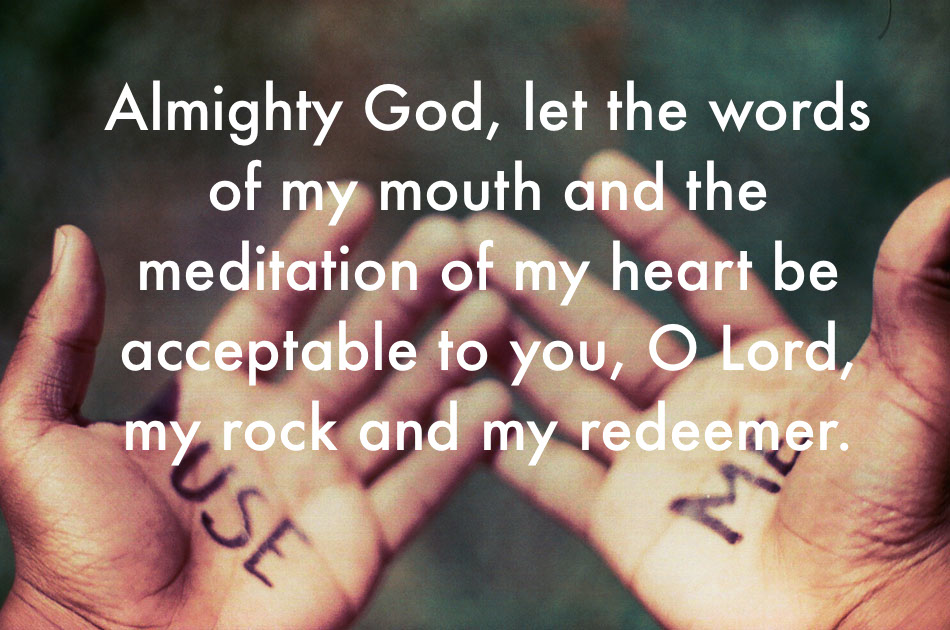
The law of the Lord is perfect, reviving the soul; the decrees of the Lord are sure, making wise the simple; the precepts of the Lord are right, rejoicing the heart; the commandment of the Lord is clear, enlightening the eyes; the fear of the Lord is pure, enduring forever; the ordinances of the Lord are true and righteous altogether. More to be desired are they than gold, even much fine gold; sweeter also than honey, and drippings of the honeycomb. Moreover by them is your servant warned; in keeping them there is great reward. But who can detect their errors? Clear me from hidden faults. Keep back your servant also from the insolent; do not let them have dominion over me. Then I shall be blameless, and innocent of great transgressions. Let the words of my mouth and the meditation of my heart be acceptable to you, O Lord, my rock and my redeemer.
use-me

There were two men. The first lived his life perfectly and blamelessly; everything was coordinated and examined. He never wasted a moment and did his utmost to plan for every contingency and minor catastrophe. If he could live his life in consistent repetition, he believed he could achieve perfection. Every morning he awoke to eat the same breakfast and spend precisely 15 minutes reading from his bible, offering up the same lifeless prayer. He wasn’t sure that he actually believed in God, but he wanted to be safe. He took the same roads to work, ordered the same lunch, used the same pencil brand. Everything was accounted for. He made his money, invested in the right companies, provided for his family. On the surface he had everything you could want. Except he did not have life.

The second man lived a life of apparent chaos as he tried desperately to cling to something solid as the world continued to spin around him. Every morning was a new and exciting, though sometimes terrifying, adventure. He would often oversleep leading him to rush off to work without his breakfast or morning coffee. He was a faithful Christian, he somehow was able to make it to church every week, his bible was often found in different places throughout his house with ear marks and underlined passages in the Old and New Testament. He believed deeply that God was a living and loving presence in his life and looked forward to his moments of silence during the day when he felt he could best commune with the divine. Speaking with God was not about rhythm or repetition, but a life-giving and humbling experience. He made his money, tried to invest, but believed that spending time with his family would be more rewarding than a large portfolio. On the surface he was missing some of the things that make up the American dream. But he had life.

It has taken me a long time to learn how to pray; and I’m still not satisfied with my prayer life. I go through waves of devoting time everyday to sitting in silence and talking with God, and then there are days when I have realized that I felt too busy to pray. I have spent weeks praying prayers that have been written in books, and I have spent months praying extemporaneous prayers from my heart and soul. I have experimented with numerous spiritual disciplines, and I’m not sure that I have found the one that is just for me, perhaps I never will.

Prayer is one of those things in the life of Christian discipleship that we expect, but rarely talk about. Whenever we get together as a church, before an activity begins, all eyes fall on me to lead us in prayer so that we can start. Sometimes those prayers feel life-giving, but oftentimes they feel like an expectation. When I am asked to pray before a meal, there are times that I feel truly genuine in expressing my thankfulness to the Lord, but there are also times when I feel that I am just going through the motions.

prayer

There was a long period in my life where I felt like the first man. I would wake up early and ride my bike to Duke Divinity School just so that I could be there for Morning Prayer with the Anglicans and Episcopalians. I even started to lead the daily worship service. But there was a time when in meant very little to me. It became so routine that I stopped listening to the words, and felt that it was more important for me to be there in body, than it was for me to be there in heart and soul.

Last week I asked us to examine a simple, yet profound, question: What is the point of Church? Why do we spend time each week gathering in this place? I attempted to proclaim God’s Word in such a way that we could begin to move away from a maintenance model of Church, to a missional model where we live as Christ’s body for the world.

Today I would like to ask an equally simple, yet profound, question: Why do we pray and read scripture? Why do we take the time to halt the busyness of our lives to read God’s Word and commune with him?

The psalmist writes that the law of the Lord is perfect, it revives the soul, it makes us wise, it allows us to rejoice in our hearts. The commandments are clear, they open our eyes. The fear of the Lord is pure and endures forever. The ordinances of the Almighty are true and righteous. The psalmist even goes on to claim that the Word of the Lord is to be desired more than gold and sweeter than honey.

You could give me a biscuit with honey on it right now, and I would tell you that is the sweetest thing in the world. Yet, as I have grown older, as I have spent more time deep in God’s Word, its sweetness has been revealed to me. In a conversation with someone during bible study, or deep in prayer about someone’s life and suffering, a new vision and understanding is presented to me out of God’s Word. It truly is a sweet gift, one that speaks to us, even today, from God.

The difference between the two men, is that the first saw his responsibility to prayer and scripture as simply that – a responsibility. He sets aside the time to read and pray, but the words on paper and the words on his lips are lifeless. He believes the first part of the psalm but expects that so long as he maintains his regular practice it will be enough. The second man, however, recognizes that he can do more, that speaking with God can be different and casual and faithful.

Psalm 19 begins to answer our question: Why do we pray and read scripture? It refreshes our souls.

When we spend time reflecting on God’s Word and going to him with our thoughts, desires, hopes, and fears we honor the living Lord who refreshes our souls for a new day. It simplifies the way we envision the world, and reminds us who we are following and why. It humbles us and rewards us.

However, even with the benefits and warnings in scripture, we cannot completely avoid hidden sins and mistakes nor can we control others around us and prevent them from doing the same.

God’s Word operates as a warning about the transgressions of life. It has not only the green light of “allowed”, and the red light of “forbidden,” but also the yellow light of “caution.” Ordinary and humble people do not normally go plowing through the red lights of life. Deliberate and precise sins come with practice and committed degeneracy. But we are all constantly taking chances with the yellow lights of behavior.

That is why the end of the psalm is so important: Who can detect all of their own errors? Who can look at their life and faithfully say I was wrong? Great God, cleanse me from my hidden faults, keep me from those who would do harm to my soul.

The greatest test of our faith is found in our willingness to seek forgiveness from our sins, particularly those no one knows about except us. When we have committed a wrong against someone, and everyone else knows about it, I believe we are more inclined to seek forgiveness. But when we do something wrong in secret, when we sin while no one is watching, I believe we are less inclined to ask for forgiveness, because it is entirely on us. God’s word and a life of prayer are therefore the ways by which we might have the strength to admit our faults, as we read about so many who have sinned before us, and seek forgiveness as we commune with the Lord in prayer. Reading and praying are as essential for us as are eating and breathing – they all give us life.

If you want to become a United Methodist Pastor, there are a number of requirements you have to meet. One of the most stressful is planning a full worship service, leading it, preaching, and having the entire thing videotaped. I was still in seminary when I asked my home church if I could “take over” for one Sunday in order to film the service and send it off to the people who would determine whether I should become a pastor or not.

I fretted about the service, overanalyzed the bulletin, worried about the hymns I selected, stressed about the scripture, and never felt the sermon was good enough. After all the weeks of planning and communication I showed up at my home church Sunday morning, and prepared to put it all on the line. I remember standing in the back, and giving my father the “thumbs up” to start recording when Jason, my friend and pastor, walked ahead of me to address the congregation.

“For those of you that don’t know,” he began “we have one of our very own here this morning to lead us through worship. Taylor is applying to be considered for an appointment in the United Methodist Church and everything we do this morning is being filmed. You and I all know that he is not really that funny, but if you could try to laugh at his jokes, I’m sure that it will help him out with the Board of Ordained Ministry.

The service was oriented around a reading from the end of James about sharing our sufferings with one another. The role of disciples in the church is to rejoice with one another at times of happiness, and weep together during times of sorrow. We are called to love one another through the good times and the bad, but we can only begin to find healing and reconciliation if we share our struggles.

When I was finally able to offer the benediction at the end of the service I breathed out a huge sigh of relief, a sigh that was so loud that you can hear it in the recording! I had made it through the whole thing without tripping and embarrassing myself, without stuttering through the scripture reading, and I even got a few laughs during the sermon though I could never tell whether they were genuine or not…

I made my way out of the sanctuary proud of the service and hopeful that it was good enough for the Board that would be viewing it. But while my mind was caught up in my own selfish reflections about the service, I saw a member of the church, someone I knew very well, crying in her pew.

She shared with me that her daughter had been suffering with bulimia through the last six months and she had refused to share it with anyone. She was embarrassed that she had failed as a mother and she felt as if she was carrying the whole world on her shoulders. She said that after hearing the scripture read, and the words of the sermon, she prayed in her pew, and she realized (for the first time) that the church was the place that she could share her burden. And while others were preparing to leave she reached out to the stranger in her pew and asked if she could share with him her struggles and pray together. With tears flowing down her face she said that this was the best she had felt in months.

prayer-bible

The Word of the Lord is greater than gold and sweeter than honey. In the moments of our reading and praying we are opened up to the strange new world of the bible and of faithful living that can change everything.

We pray and read to cleanse our souls and to give us life. It is not something that has to be strictly observed with militaristic expression, but instead something that we believe can change our lives.

The final line of the Psalm 19 is a beloved and permanent aspect of worship; they are the words I pray before preaching every single Sunday. If our words and thoughts are acceptable in the Lord’s sight we are on the path toward renewed spirits and discipled living. When those words become our truest prayer and hope then we are speaking and thinking as if Jesus was at our elbow which, after all, is the whole point of prayer.

Amen.

Devotional – Psalm 119.135

Devotional:

Psalm 119.135

Make your face shine upon your servant, and teach me your statutes. 

Weekly Devotional Image

St. Augustine once wrote, “There are three types of life: the contemplative, the active, and the contemplative-active. People can live the life of faith in any of these but everyone must make time both to seek the truth through contemplation and perform the actions that charity demands” (City of God, 19.19) I would slightly change Augustine’s language to say that there are three types of life for Christians: the prayerful, the server, and the prayerful-server. It is a tremendous element of our faith that we get to be in communion with God not only through our prayer, but also in our service of others.

St. Augustine

St. Augustine

Even with this threefold understanding of faithful living there is a temptation to elevate one over the other without seeking a balance of both. No one should be so totally committed to prayer that they neglect the needs of the community and no one should be so absorbed in serving others that he/she gives up praying to the Lord.

Both serving and prayer are intimately connected in the life of discipleship. Throughout my years of faith I have met delightful prayer-warriors that are committed to bring their joy and concerns to the Lord but as soon as they are asked to serve those in need they quickly receded into the shadows. Likewise I have had the pleasure of going on a number of mission trips with young and old Christians alike who worked tremendously hard for the kingdom but as soon as they were asked to pray about their experience they also quickly receded into the shadows.

It is a difficult challenge to keep both types of life together in such a way that we can be prayerful-servers. A balance of the two allows us to avoid burnout, on the one hand, and self-indulgence on the other. It is through the love and commitment of prayerful-servers that the kingdom of God becomes real and experiential for Christians.

When the psalmist calls for God to shine upon the servant and teach the statues they are calling for God to help them with their life of prayer (face shining) and service (teach me your statutes). It is a difficult challenge, but one worthy of our focus.

As the St. John’s mission team spends this week in Raleigh County, West Virginia it is my hope and prayer that we can balance both of these callings in all that we do. Moreover I hope that we can continue to keep both of these in tandem when we return back to Staunton.

As you embark on a new week I ask you to consider whether you are more attracted to a life of prayer, or a life of service. What could you to do to start living as a prayerful-server?

Ten Things I Learned My First Year of Ministry

I recently celebrated the completion of my first year of ministry for St. John’s UMC in Staunton, VA.  Throughout my first year I experienced numerous mountaintop experiences as well as deep spiritual valleys. I baptized infants and adults into the body of Christ, I presided over the table and shared the body and blood with the people of God, I brought couples into holy matrimony, and I gave witness to the life and death of faithful Christians. I have learned a lot and am continuing to grow. Below are 10 of the biggest lessons I learned from my first year in ministry.

stained-glass-569x379

1. Every Church Is Different 

I was blessed to grow up (theologically) under the tutelage of great mentors in Dennis Perry and Jason Micheli. Until I left for college I worshipped at Aldersgate UMC for the majority of my life and had very little experience outside of my home church. I learned very quickly throughout seminary, and particularly while serving at St. John’s, that all churches are different. What I preached at Aldersgate would never work at St. John’s and vice versa. Every church has its own context and collective narrative that must be learned before the rhythm of worship and preaching can begin to be fruitful for both the pastor and the congregation. It takes time, but it is time well spent to learn the story of the people.


2. Being New Can Go A Long Way

When I was commissioned last summer I became the youngest pastor in the Virginia Annual Conference and would become the youngest pastor to serve at St. John’s since 1955. The church had grown accustomed to their pastors retiring from this appointment and were excited to receive a new and fresh-from-seminary pastor. Being new has gone a long way. I have been given certain freedoms to explore different ways of worship, teaching, and discipleship purely because I am still new to this. The laity have been particularly forgiving of my preaching because, I hope, they recognize that I am continuing to learn our collective narrative every Sunday from the pulpit. The atmosphere in church has been exciting over the last year which has encouraged our members to invite others to worship, something that all churches need in order to share the Good News.


3. It Can Be Lonely

Jason Micheli has previously written about the loneliness he experienced in his first church because there were very few people around his age. In a similar way  my wife and I have had a difficult time in Staunton meet and making new friends outside of church. Part of this stems from the fact that there are simply not very many young people in Staunton. However it is challenging to make friends outside of the church when some people immediately put up a wall when they learn that I am a pastor. It is remarkably important to maintain friendships that began in, and before, seminary but it is challenging when the geographic divide makes it difficult to stay in touch. All pastors need community; their church and people outside of it.


4. Committee Meetings Are Hard

Seminary cannot prepare you for committee meetings. I was never asked to serve on a committee before I became a pastor so I had to quickly learn the functions of each and their patterns of serving the church without any prior experience. Though the Book of Discipline outlines the roles of the committees, every church lives out these responsibilities in different ways. There have been many nights where I come home thrilled about the direction of the church I serve, and other nights where I have felt defeated by what had taken place during a committee meeting. It is so important to remember that all of this, doing church and being the body of Christ for the world, it about God and not myself.


5. It’s Important To Be Involved In The Community

When I met with the SPRC for the first time I asked what they wanted most from their pastor. The collective response was that they wanted a pastor who would be known in the community. I made a concerted effort to make that come true during my first year. For example: I have been quick to introduce myself to people in town as the pastor of St. John’s, I joined the Stonewall Brigade Band (performing continuously since 1855!) and play drums with them every Monday night as we perform free concerts in Gypsy Hill Park, and I sent hand written letters to the immediate community surrounding the church introducing myself and asking if there was anything I could do for them. The church is not just the people who gather on Sunday mornings; we are intricately connected with the people in the community. It is therefore important to establish a presence within the community outside of the church.


6. My Vision Is Not The Same Thing As The Church’s Vision

I have come up with a lot of new ideas over the last year and a number of them have become very fruitful for our church. Recently however, I have begun to realize that my vision is not necessarily synonymous with the church’s vision. The people of St. John’s have been doing church a lot longer than I have; they have an established wisdom about what can and can’t work for our faith community. It has been good for me to lead with a passionate vision, but then at other times it has been even better for me to take a step back and let the lay leadership’s vision guide us.


7. Workaholism Is Just One Step Away

Every church has many needs from the pastor: visiting the shut-ins, preparing and leading worship on a weekly basis, ordering the church, etc. Though many might assume that being a pastor is a one-hour-a-week job, it is so much more than that. As someone who is regularly at the church facility there are a number of other jobs that I never imagined would be regular parts of my ministry. I have been a plumber, carpenter, Preschool teacher, preacher, mower, snow-shoveler, counselor, teacher, accountant, therapist, etc. For pastors there is a temptation to let the needs of the church dictate every aspect of your life. It is vitally important to maintain a regular sabbath and share the responsibilities of church with the body of Christ.


8. Less And Less People Know Their Bibles

I often take for granted how much scripture is known by the people of church. There are, of course, the prayer warriors and bible study leaders who know their bibles better than I do, but over the last year there have been a number of experiences that had demonstrated a staggering amount of biblical illiteracy. For example: One Sunday I casually mentioned Jacob wrestling with the angel on the banks of the Jabbok river with a bible study class when they all looked up at me and one of them said, “that’s definitely not in the bible.” Or after preaching about the last supper and then going through the entire communion liturgy a longtime church member said, “I never knew that what we do with communion comes from the Jesus’ last supper!” As the greater church looks to the future of the Christian faith we need to be particularly careful about how we return to a love of the bible and nurture scripturally shaped imaginations.


9. Reading Makes For Better Preaching

Soon after arriving in Staunton I had more free time on my hands than I had initially anticipated. I was able to make all my visits, have the sermon written by Wednesday and take care of my other responsibilities which freed me for having time to read from both the bible and theological works. By the time the fall rolled around I found myself incredibly busy and lost the time to read outside of what I needed on a weekly basis; my preaching suffered during this time. I relied too heavily on commentaries and personal anecdotes because my own faith walk was suffering under the weight of weekly ministry. Only when I had come to a realization of the way my work was affecting my faith was I able to re-focus and re-prioritize in such a way that I found time to feed my soul outside of my regular responsibilities. We become better writers and better preachers by actively reading and responding to God’s Word beyond the weekly sermon or lesson in our lives.


10. I Have The Best Job In The World

A professor of mine from seminary once said, “If you can do anything else outside of ministry then stop right now. Ministry can be one of the least rewarding vocations: spiritually, monetarily, and socially. But if you can’t do anything else, which is to say if you feel so called to ministry that you can’t do anything else, then it will be the most rewarding thing you’ll ever do.” For some this was a big wake up call and a few eventually dropped out of school, but for me it only refueled my fire. And he was right. Ministry is the greatest job in the world. Where else could I spend my time deep in God’s Word? What job would give me the ability to preside over something as precious as the water dripping on a child’s head in baptism or offering the gift of bread and wine to the weary travelers of faith? It is a privilege to serve God’s kingdom as the pastor of St. John’s UMC and more rewarding than I could have ever imagined.


(Originally written for the Tamed Cynic blog)

Devotional – Isaiah 55.10-11

Isaiah 55.10-11

For as the rain and the snow come down from heaven, and do not return there until they have watered the earth, making it bring forth and sprout, giving seed to the sower and bread to the eater, so shall my word be that goes out from my mouth; it shall not return to me empty, but it shall accomplish that which I purpose, and succeed in the thing for which I sent it. 

Weekly Devotional Image

In church life we love to talk about “planting seeds of faith.” I have heard countless professors, theologians, pastors, and Christian leaders all convey something akin to “you never know how the seeds you plant might grow into beautiful lives of faith.” The point being that we must choose our words carefully because they contain enormous power; at times our words can help nurture someone in their faith, and at other times our words can destroy someone’s faith.

Dick Dickerson, a beloved man in our congregation, once told me a story about a particular Christmas Eve that he experienced while fighting in World War II. Dick had spent the previous days at the front lines frightened for his life and for the lives of his friends. Through the bitter cold they continued to push forward into enemy territory unsure of what they would discover. Without realizing it they serendipitously found themselves sleeping in the comfort of a church sanctuary on Christmas Eve enjoying a welcome reprieve from the fighting.

Dick describes that evening with vivid details: the wax from the candles spilling over onto the wooden pews, the hole in the roof letting in the tiniest snow flakes, and the huddled soldiers staying close to one another for warmth. Though he cannot explain what prompted him to speak up, he asked the young military men around him whether they would like to pray for anything. To him he seemed like the right thing to do on Christmas eve while gathered in a church sanctuary, regardless of the circumstances. One soldier prayed for his family and friends back home, another prayed for the weather to warm up, and another prayed for his fellow comrades in the fight against oppression.

The praying went on for sometime, but after a rather long pause one of the youngest soldiers spoke up: “I seem to remember Jesus saying something about praying for our enemies,” he began, “so tonight I would like to pray for the men we’re fighting against, I pray that God would be them as He is with us.” Upon hearing this man’s words Dick was worried that an argument or fight would break out between the men but he was surprised to discover that everyone was silent with their heads bowed down. With tears beginning to form in his eyes he joined his brothers and prayed for his enemies.

raining-on-yellow-daisies-natural-selection-craig-tuttle

God’s Word is mysterious, strange, and powerful. There are times when we hear or read something from scripture that will not become relevant or real for us until a later time. But like the prophet Isaiah said, “my word will not return to me empty, but it will accomplish that which I purpose.” The scriptures from both the Old and New Testaments are life-giving; they are like the blessed rain that fall from the sky in order to give new life from the earth.

Today let us all reflect on the ways that God’s Word has affected our lives.

Let us ask ourselves: What scriptures have transformed the way we see the world?

On Regretting My Vote

Psalm 13.1-2

How long, O Lord? Will you forget me forever? How long will you hide your face from me? How long must I bear pain in my soul, and have sorrow in my heart all day long? How long shall my enemy be exalted over me? 

psalm-13

Annual Conference always elicits an assortment of emotions for me. At one moment I can feel renewed spiritually and theologically as I listen to some of the great preachers from our conference/denomination as they proclaim the Word of the Lord. At other moments I can feel socially fulfilled as I rekindle friendships with other clergy and laity from Virginia. And still at other times I can feel elated and jovial as I did recently when I witnessed our bishop dancing to Pharrell’s “Happy” after we voted to support “Imagine No Malaria.”

However, at other times I can feel deflated and frustrated with our church. Traditionally Annual Conference has been a time of Holy Conferencing when the leaders of the church gather together to have their faith reignited for the kingdom of God. In the beginning of our denomination’s history annual conferences were held to maintain the theological convictions of our connection as the circuit riders were spread other a vast geographical area. It also served to maintain the relationships with fellow disciples as well as a dynamic and life-giving relationship with God. As the decades passed, annual conferences began to focus more on the polity of our church while still providing avenues for spiritual growth. In our contemporary period annual conference is a time when we hear about the focus of the denomination, recommit ourselves to spiritual disciplines, and vote on resolutions that have been put forth for our consideration.

After spending Saturday afternoon deeply entrenched in the reports from various agencies within the church (Report from the Common Table, Report of the Site Selection Committee, etc.) it was time to begin our holy conferencing around the resolutions. We were running behind schedule, as is typical at Annual Conference, and only began speaking about the resolutions at 4:30 pm (thirty minutes before a recess for dinner until the Service for the Ordering of Ministry at 7:30 pm).

It has been no secret that Resolution 1 was one of the most anticipated conversations to take place this year (as was also made evident via the conference hashtag #vaumc14 where many people were anxiously awaiting the resolutions). Resolution 1 was as follows:


Resolution 1: “Change Book of Discipline Reference to Homosexuality”

Whereas, as stated in the opening sentence of ¶161F in The Book of Discipline of The United Methodist Church, “We affirm that all persons are individuals of sacred worth, created in the image of God.” Whereas we declare that the following statement found later in ¶161F in the Book of Discipline “The United Methodist Church does not condone the practice of homosexuality and considers this practice incompatible with Christian teaching” is inconsistent with the first statement. Whereas medical science has established that homosexuality is a state of being and not a choice and therefore homosexuals are part of God’s creation. [See Amicus Brief filed by American Medical Association, American Psychological Association, American Academy of Pediatrics and other related organizations, Hollingsworth vs Perry.] Whereas Scripture is not referring to the loving, consensual, victimless relationships we speak of today. Whereas the words used by Paul as applied to homosexuality are the result of translations and interpretations, these passages are therefore open to alternative interpretations. Whereas Christian marriage is offered to sinners, even when the sin is extreme, but we do not offer it to homosexuals who are living out their lives in love as created by God. Whereas the General Conference has failed to explain why a loving, monogamous relationship is inconsistent with Christian teaching. Whereas the current policies, laws, doctrine and practices of the United Methodist church as documented in the Book of Discipline relating to homosexual relationships creates a double standard thereby promoting discrimination and creating the circumstances that lead to the very behaviors among homosexuals that are abhorred in the Bible, both of which are in direct conflict with Jesus’ teachings. [“Judge not lest you be judged” (Matthew 7:1); “Let the one without sin among you cast the first stone” (John 8:7); “Love the Lord your God with all your heart and with all your soul and with all your mind. This is the first and greatest commandment. And the second is like it: Love your neighbor as yourself. All the Law and the Prophets hang on these two commandments.”(Matthew 22: 37-40); and many other references.] Therefore, be it resolved that the Virginia Annual Conference petition the 2016 General Conference of The United Methodist Church to expunge the sentence “The United Methodist Church does not condone the practice of homosexuality and considers this practice incompatible with Christian teaching” and the attendant references to and penalties for homosexuality detailed in ¶¶341.6, 2702.1 and 304.4 from the Book of Discipline and all people be accepted into The United Methodist Church to truly embrace “Open Hearts. Open Minds. Open Doors.” as Christ would have us live.


When it came time to hear the resolution, a representative stood before the Annual Conference and explained their position in a way that accurately reflected the above written resolution. As is commonly practiced, the bishop then inquired if anyone would like to speak for or against the resolution. In response a leading elder from our conference offered a motion suspending conversation on Resolution 1 indefinitely so that we, as a conference, could gather in small groups over the next year to begin having conversations about how to move forward regarding this “issue.” Two people then spoke in favor of the motion, and two spoke against it.

When the bishop called for us to vote on suspending the conversation, I raised my hand.

As I sat there listening to the murmuring of the crowds while various lay leaders and clergy spoke into the microphones I was overwhelmed by the vitriolic responses from the people both for and against the resolution. It frightened me to see and hear Christian disciples speak so harshly against one another publicly and privately as we gathered to be the body of Christ for the world. When it came time to vote on whether to suspend the conversation or not, I believed that the right and true and faithful thing to do was vote to have the conversation stop. In so voting, I was implicitly hoping and praying that over the next year we, as a church, can faithfully respond to this resolution in such a way that it represents the will of God, not just to be decided by the people gathered at conference (who, in my opinion, disproportionately represent the church).

However, over the last two days I have begun to regret the vote I cast. While reading from the lectionary texts this morning I was struck by the first two verses of Psalm 13: “How long, O Lord? Will you forget me forever? How long will you hide your face from me? How long must I bear pain in my soul, and have sorrow in my heart all day long? How long shall my enemy be exalted over me?” It seems to me that, as a church, we have been having a conversation about homosexuality for a very long time. People have raised their opinion for the continued language in our Book of Discipline, and others have spoken against it. Moreover, Annual Conference is supposed to be the time that we gather for holy conferencing to experience the will of God and attempt to make it incarnate in the way we live our lives. I have begun to regret my vote because I now believe that I participated in a continual and perpetual denial of the value of the LGBTQ community by putting the language of homosexuality from our Book of Discipline on the back-burner.

This week the Presbyterian Church (USA) voted to allow gay marriages. While we methodists continue to ignore the need to address the growing concern of the LGBTQ community, debating whether or not we can officially (which is to say “by Discipline”) regard homosexuals as fully Christian or not, the Presbyterians have moved to grant homosexuals the theological and sanctifying grace we understand as marriage. We have continued to ignore the issue over and over again to the point that we are now more aligned with the Southern Baptists than we are with the Presbyterian and Episcopalian traditions from which we came (more on this at: http://tamedcynic.org/are-methodists-really-mainline-anymore/).

I regret my vote. I believe the time is now for the UMC to faithfully and finally address the language regarding homosexuality in our Book of Discipline. But, as a conference, we voted to push the decision back, yet again.

It is my prayer that the Holy Spirit abides in us over the coming year as we continue to have holy conferences. And it is my deepest and sincerest prayer that soon, we, along with the LGBTQ community, will no longer have to cry out like the Psalmist: “How long, O Lord?”


How Did You Two Meet? – Pentecost Sermon on Acts 2.1-13

Acts 2.1-13

When the day of Pentecost had come, they were all together in one place. And suddenly from heaven there came a sound like a rush of a violent wind, and it filled the entire house where they were sitting. Divided tongues, as of fire, appeared among them, and a tongue rested on each of them. All of them were filled with the Holy Spirit and began to speak in other languages, as the Spirit gave them ability. Now there were devout Jews from every nation under heaven living in Jerusalem. And at this sound the crowd gathered and was bewildered, because each one heard them speaking in the native language of each. Amazed and astonished, they asked, “Are not all these who are speaking Galileans? And how is it that we hear, each of us, in our own native language? Parthians, Medes, Elamites, and residents of Mesopotamia, Judea and Cappadocia, Pntus and Asia, Phyrgia and Pamphylia, Egypt and the parts of Libya belonging to Cyrene, and visitors from Rome, both Jews and proselytes, Cretans and Arabs – in our own languages we hear them speaking about God’s deeds of power.” All were amazed and perplexed, saying to one another, “What does this mean?” But others sneered and said, “They are filled with new wine.”

Acts 2:1-4. When the day of Pentecost came. Pastel & pen. 26 May 2012.

I had spent an entire week with countless young Christians from all over the world at a monastery in Burgundy, France. For most weeks during the summer, Taize attracts upwards of 5,000 young Christians dedicated to exploring their faith through prayer, service, and singing. Waking up in a tent every morning, I would trudge across the dew filled grass passing neon tents filled with 20-somethings snoring away as the sun came up over the horizon. Each little campsite held clues as to the nationality of the residents: the occasional German flag, a water bottle covered in French writing, an abandoned tee-shirt with a hispanic wrestler flexing on the front, I even saw a cricket bat one morning. As the crowds made their way to the sanctuary, it was impossible to eavesdrop or understand what anyone was talking about because no one was speaking English.

Just past the interior door to the incredibly large sanctuary, there were buckets filled with hymnals organized by language. On our first morning I was surprised to discover that there were more “English” hymnals left in the buckets than any others, because Americans were part of the minority of the gathered body.

Taize Altar

Taize Altar

We sat on the floor surrounded by other young people who were still half asleep fumbling through our hymnals before the service began. Suddenly, up at the front of the massive building, a simply lit sign displayed three numbers “312” and as if we were being controlled by a single operator we all flipped our pages to the corresponding hymn. Without any musical accompaniment, without any choral direction, the hymn began. I, of course, sang the hymn in English as the words were displayed on the page, but when I made my way to the end of the song, everyone continued singing. We were not told how many times to repeat the hymn, but it went on and on until in ended naturally at the same moment. It was unlike anything I had ever experienced. When I had finally caught on to the rhythm of our singing, I closed my eyes and began to hear all of the other voices singing faithfully in their native tongue. Without a doubt, that moment as I sat on the floor of a enormous sanctuary in France, was the closest I have ever been to experiencing the day of Pentecost in my own life.


The community of faith had recently witnessed Jesus’ ascension into heaven and then retreated to the upper room in Jerusalem to devote themselves to patience and prayer. For ten days they waited, as they had been told to do, waiting for something to happen. We are given very little in Acts about what they did those ten days but we do know that rather than taking matters into their own hands, instead of getting organized and venturing forth with pamphlets about “what God can do for YOU”, they waited for God to make the next move.

The day of Pentecost, what we celebrate and remember today here in church, was the first big thing to happen to the disciples after Jesus had left them. Like the start of any life or story, the beginning has major ramifications for how the rest will turn out. Just as with Jesus’ birth in the manger in Bethlehem to a virgin, so too the details surrounding the birth of the church would come to define the rest of the story for Jesus’ followers.

CELPentecost[1]

As the morning broke, while the disciples were all together in one place, an eruption of sounds and a wind from heaven filled the entire house. Things were coming loose and breaking open, new realities were taking shape, and the life of discipleship was changed forever. The wind swirled around the gathered people, the same wind which on the very first morning swept across the dark waters and brought order out of chaos. The wind of Genesis was again bringing something new to life.

Divided tongues, as of fire, appeared among them and each of them were filled with the Holy Spirit and began to speak in other languages, as the Spirit gave them ability. What a strange and profound moment this must have been! After days of waiting in prayer God had showed up and quickly put things into action. Though the Spirit brought order out of chaos in Genesis, this must have felt like the opposite. I imagine the disciples running about within the house exclaiming great things in languages they themselves had never heard before. Something this incredible and inexplicable could not be contained to one house alone, and a crowd quickly gathered and was bewildered by the indescribable moment.

Jews from all over had gathered in Jerusalem when this took place and they began to hear these nobody disciples speaking in the native languages of all the people. Amazed by this, they questioned how it was possible, and quickly decided to blame it on an excessive use of alcohol.

The crowd’s demand for an answer was a cue for one of the disciples to stand and speak. And who, among the disciples, could have imagined that Peter would have been the one to do so? Peter is the first, the very first to lift up his voice and proclaim proudly and faithfully the word that he was unable to when Jesus had been arrested. The man who had been so quick to deny Christ three times, is the one who stepped forward to share the glory of God’s kingdom with all who questioned this miracle.

Peter preached a sermon, he shared the story of God in Christ, all by the power of the Spirit: “listen to what I have to say: Jesus of Nazareth, a man attested to you by God with deeds of power, winds, and signs that God did through him among you, and you yourselves know — this man, who was handed over to be crucified and killed, was raised by God, having been freed from death because it was impossible for him to be held in its power…” Peter told the story that he had witnessed and thus helped give birth to the church that we now participate in today.


I have been here at St. John’s for almost a year. The last twelve months have been filled with changes, excitement, new life, and joy. I give glory to God for sending me to a place with such faithful people who have helped me to see God in new and wonderful ways, while also allowing me to do the same. 

I knew that, upon arrival, one of the most important things I could do would be to learn the collective story of the church. I have met with many of you to learn about your lives and your stories in such a way that I could learn about our community that gathers here for worship. When I meet with couples I almost always ask the same question: How did you two meet? I ask this question because how two people met says a considerable amount about their relationship, and most people love to tell that particular story.

I can tell you with joy this morning, that many of you met in wonderful and joyful ways. I have had the privilege to hear about a couple who met on a Greyhound bus traveling to Radford, VA over 65 years ago. We have a couple who met at a brewery when the young woman complimented the young man on his beard. Or there’s the couple who met in a spousal grief group after having both been divorced. We even have a couple who met here in church and the boy asked his brother to the get the number of the girl so he could ask her out later.

I love asking how a couple met because people can tell the story with all the important details. They can remember the outfits they were wearing, the weather outside, and the other people who were present. They can describe with vivid clarity that first smile they saw, or the way their fingers felt when they wove them together for the first time. And frankly, I love asking the question because it is hilarious to watch men and women argue about the details of a meeting from their own perspectives.

(Photo Credit: Jill Nicole Photography)

(Photo Credit: Jill Nicole Photography)

But sometimes I think about the gospel story and I wonder how that connects us. I freely admit that when I ask couples about how they met I am not expecting anyone to start talking about Moses or Abraham or the Holy Spirit. But the Gospel story is one that we should know just as well. Many of you have been attending church for your whole lives, and even those of you who have recently started to attend, have heard the story of God in Christ week in and week out. The story that we find in scripture is inescapable because it is ours. 

I ask people about who they met because it teaches me about whom they are. It helps to reveal parts and aspects of personality that would otherwise remain hidden, it sheds light on what brings people joy and how they connect with others. But in the same way, the Gospel is who we are. It is as much a part of our personalities and joy and interconnected as the story about how we met our spouses.

When Peter stood in front of the crowd on the day of Pentecost he told the story of God in the world through Jesus, his friend and Lord. With confidence and bravery he proclaimed the same story that we tell here in church every week. We should know the story that Peter shared, we should be able to tell it with the same clarity and detail and faithfulness. Imagine how powerful the gospel story would be, if you knew it and believed it and experienced it in the same way you met your spouse.

The gospel is something worth sharing. I don’t mean in the sense that you should start knocking on people’s doors to ask: “Have you heard about our Lord and Savior Jesus Christ?” But I want to question our willingness to keep telling this wonderful and life-giving story.

After all, how would anyone know whether or not you’re a Christian?

Maybe you wear a cross around your neck, or you pray before your meals at restaurants, or you tell people about what fun activities are going on at your church… But seriously, how would anyone know if you’re a Christian?

We can tell the story of God’s interaction in the world through ways that are both faithful and fruitful. Like those first disciples the Holy Spirit has been poured on to us in such a way that we are now filled with the Spirit and have been given gifts. The disciples were given the power to speak in numerous languages in order to convey the gospel to the multitudes. Today we have been given the power to meet people where they are in order to be Christ’s body for the world.

Imagine the next time someone started to tell you about a recent tragedy, you responded by asking to pray for them. Or the next time you hear about a family thats having a difficult time adjusting to a new life in Staunton, you invite them over for dinner out of kindness rather than expectation. Or the next time you believe that someone has been treated unjustly, you speak up for them rather than expect someone else to do it. And when you’re asked why you have done these things, answer truthfully and confidently: “I am a disciple of Jesus.”

The Spirit that empowered those disciples still empowers us. Like the cacophony of languages that were all singing to the Lord at Taize, we are called to raise our voices, to go public with the good news. As we see with the way Peter proclaimed the story on behalf of the church, we also have something to say, we need only the courage to stand up, open our mouths, and begin.

Amen.

Devotional – Psalm 18.1-2

Devotional:

Psalm 18.1-2

Protect me, O God, for in you I take refuge. I say to the Lord, “You are my Lord; I have no good apart from you.”

Weekly Devotional Image

5 days. In 5 days I will be waiting at the altar of my home church, watching a beautiful bride walk down the center aisle to stand next to me as we enter holy matrimony. It has been more than a year since I asked for her Father’s blessing and placed a ring on her finger; I cannot believe the wedding weekend is so close. Words do not do justice to the love and joy that Lindsey has blessed me with, and I am so excited for us to stand before God, our families, and our friends, as we covenant together.

741111_4136006929474_543179185_o

Our journey to the wedding has been filled with both wonder and trials. At first, Lindsey did not like me nearly as much as I liked her. My planned and executed dates were met with platonic affection. As I began to back away, she stepped forward and the tables had turned. Our relationship began out of a willingness to be honest with one another and find harmony in our time spent together.

We dated throughout our time in Durham, North Carolina surrounded by friends who helped to cultivate and nourish our relationship. We were spoiled rotten by our peers from work and school who went our of their way to include us and make us better than we were.

431201_673719668650_364622628_n

When we moved to Staunton we lost the familiarity of seminary/work in addition to our social network of friends. For months Lindsey and I had to live into a community that was very different than what we left. Lindsey had to find work, and I had to adjust to the work of St. John’s. Learning and appreciating the culture of our new home has been difficult, but with the wedding so close in sight I can say, without a doubt, that we are exactly where we are supposed to be.

1012326_10151692266377840_921328894_n

From the very beginning of our relationship we have tried to keep God at the center of our focus. Some of our first conversations were about how God has revealed himself in our lives and we have strived to keep that at the forefront of our minds. As I prepare to join Lindsey in wedded life I believe that I am only where I am because God is my Lord, and I recognize that the good in my life has come from Him.

This week I encourage each of you to take a look at your lives. When have you had your trials and tribulations? When has God been revealed to you? Do you take refuge in the Lord? Do you see the goodness of your life as a gift from God?

If we are an Easter people, a people of resurrection, then God can make all things new. No matter where you are, may God bless you as he has blessed us.


Just Like Me – Lenten Reflection on Mark 14.32-36

Mark 14.32-36

They went to a place called Gethsemane, and he said to his disciples, “Sit here while I pray.” He took Peter and James and John, and began to be distressed and agitated. And he said to them, “I am deeply grieved, even to death; remain here, and keep awake.” And going a little farther, he threw himself on the ground and prayed that, if it were possible, the hour might pass from him. He said, “Abba, Father, for you all things are possible; remove this cup from me; yet not what I want, but what you want.”

christ-in-gethsemane-p

I’ve always been fascinated by the story of Jesus in the garden of Gethsemane, and I love this little detail about how the disciples are so tired that they fall asleep. One of the problems with reading small bits of scripture in worship is that we fail to pay attention to what happens immediately before a particular narrative. Now I know that we here are all good United Methodists, and therefore we would not know what it was like to stay up all night drinking wine with our Lord. But I can imagine that they must have been very tired after that celebration. After all this was to be Jesus’ last evening with his closest friends and companions. They shared wine and bread together and eventually made their way to the garden.

Upon arrival Jesus begged his disciples to keep awake with him. But they didn’t. So Jesus went off to the side, threw himself on the ground, and cried out to God, “For you all things are possible, remove this cup from me, don’t let me die tomorrow. But in the end it’s not about what I want, its about what you want.” Thats the story of Jesus in the garden.

I graduated from Duke last May, I haven’t even been in the ministry for an entire year. But while I was at Duke, I took a class on the Greek Exegesis of the Gospel according to Mark. My professor, Joel Marcus, knows more about the gospel of Mark than Mark knew about Mark. Throughout the course of the semester we translated the entire gospel from Greek into English, we would dissect every verse looking at the grammar and discussed the depth of the Word of God.

On one such occasion we found ourselves translating the story of Jesus in the garden. We discussed certain grammatical options when my professor finally asked a question, (He could never remember my name, Taylor, so instead he often called me Tinker) “Tinker, why does Jesus pray for the cup to be passed from him. This is a very troubling verse. On the eve of his execution he calls out to God to save him from death. So, Tinker, why does Jesus pray for the cup to pass from him?”

One of the saddest things about seminary is that everything became a competition; I tried to explain why Jesus prayed this, “Im sure he knew what he was doing, he prayed this for our benefit in the future, so that we would know about prayer.” “No Tinker,” one of my peers interrupted, “Jesus did this to help us recall the Psalmists words of prayer to be delivered from the pit, Jesus wanted us to understand his command over the Old Testament Scriptures…” This went on and on. We showed off in front of our professor explaining and rationalizing why Jesus said what he said. Our answers got better and better, we began to yell at one another across the room when all of the sudden my professor slammed his hands on the table. He said, “I am so sick and tired of hearing young seminarians like you, try to explain away what Jesus said. This verse in Mark is one of my favorites. Do you know why? Because in this scripture Jesus is just like me.” Then it was silent. Though we still had thirty minutes left in class, my professor packed his belongings and walked out of the room.

For days it was all I could think about, and even now I think about it all the time. That in the garden, in this precious moment we have recorded, we see Jesus just like us. You can bet that if I was in the garden and I knew what was going to happen to me I would’ve shouted out, “Please God don’t let it happen!” If I found myself hanging on the cross I would’ve shouted out, “My God, my God, why have you forsaken me?” Jesus is just like me.

10259904_489659981160333_3090239055232866872_n

If Jesus was to restart his ministry today in Staunton, VA He would not walk up and down Beverley St. with a three piece pinstripe suit and italian leather shoes. He would be wearing worn out Carhartts, dirty and used. He would be wearing a plaid shirt and hiking boots. He would walk up and down our streets seeking out the last and the least and the lost. Jesus is just like you.

We don’t come to worship to pretend to be someone we’re not. We come together just like this to learn exactly who we are and whose we are. We are just like Jesus praying in the garden of Gethsemane.

But at the same time, Jesus is completely unlike me. My prayer would have stopped with, “God take this cup from me.” But thats not where Jesus’ prayer ended. Jesus continued on to say, “not what I want, but what you want.” For as many ways as Jesus can be just like us, he is completely unlike us because he knew the Father’s will and marched up to the top Calvary to hang and die on a cross for you and me.

So I wonder; what are your prayers like? Are they like mine: O God please deliver me from this and that… Or are your prayers like Jesus’? “God I know I’m in a tough spot right now, I know that you can fix me and heal me, you can make my son or daughter well, but, in the end its not about what I want, its about what you want.” You know that great part of the Lord’s prayer? Thy Will Be Done. Many of us say it everyday. Do we really want God’s will?

Its not about what I want, its about what you want.


The Temptation of Temptation – Sermon on Genesis 2.15-17, 3.1-7

Genesis 2.15-17, 3.1-7

The Lord God took the man and put him in the garden of Eden to till it and keep it. And the Lord God commanded the man, “You may freely eat of every tree of the garden; but of the tree of the knowledge of good and evil you shall not eat, for in the day that you eat of it you shall die.

Now the serpent was more crafty than any other wild animal that the Lord God had made. He said to the woman, “Did God say, ‘You shall eat from any tree in the garden’?” The woman said to the serpent, “We may eat of the fruit of the trees in the garden; but God said, ‘You shall not eat of the fruit of the tree that is in the middle of the garden, nor shall you touch it, or you shall die.’” But the serpent said to the woman, “You will not die; for God knows that when you eat of it your eyes will be opened, and you will be like God, knowing good and evil.” So when the woman saw that the tree was good for food, and that it was a delight to the eyes, and that the tree was to be desired to make one wise, she took of its fruit and ate; and she also gave some to her husband, who was with her, and he ate. Then the eyes of both were opened, and they knew that they were naked; and they sewed fig leaves together and made loincloths for themselves.

tree_of_life

The Lord God commanded the man, “You may freely eat of every tree of the garden; but of the tree of the knowledge of good and evil you shall not eat, for in the day that you eat of it you shall die.”

In the entire range of the world’s writings, it would be immensely difficult to locate any passage so brief that has had such immense influence on human thought. I have heard this scripture preached upon countless times, I can remember learning about it in confirmation class years ago, and I can vividly remember struggling with the text as I attempted to explain it to pre-school age children during a particular Vacation Bible School. The story of Eden is so well known and discussed that even most self-affirmed “non-religious” people can even explain what took place in the Garden. 

This passage has been debated, ripped apart, examined, micromanaged, and exegeted for centuries. Generations of Christians have dwelt upon these verses unlike any others to explain the introduction of sin into the world through the one man, Adam.

07-04-012

I know a family that had it all together. The husband and wife always sat next to one another in church, fingers wrapped together as they listened to the sermons week after week. The children were all attractive, known in the community for their well-behaved manners, regular fixtures on the honor roll at school. Because of their wide interests and pursuits the family was known throughout many of the segmented areas of the community; sports, music, drama, politics, faith, etc. On the surface they were that perfect family. Others families would often hold them up on a pedestal and compare their own flawed family to this ideal one. Why can’t my children work harder like theirs? Why don’t our parents love us as much as theirs do?

What no one realized, was that underneath the exposed public appearance, the family was about to fall apart. I don’t know all the details about what happened leading up to the great schism, I don’t know who was to blame for the many rumors than began to spread around town, but I do know that it began with the husband.

He felt unfulfilled. There was a constant nagging sensation that he deserved more than what he had. Though he had that ideal wife, and the ideal children, with the ideal house, and the ideal job, he believed he deserved more.

Thats when a younger woman appeared in his life. He knew that it was wrong to flirt with her, he knew that it was wrong to lie to his wife about spending time with her, but he did it anyway. As time went on, casual get-togethers became more frequent, the conversations moved from flirting to romance, and soon they were engaged in an affair.

I don’t know if this is true, but I imagine that late at night, when laying awake in his bed he would rationalize what he had done: If she makes me happy how can it be wrong to be with her? I deserve her love. I deserve this kind of happiness in my life.

Eventually he could no longer continue to live the lie. He told his wife what he was doing, without remorse he left her and the children, and started a new life.

Europe_a_Prophecy,_copy_D,_object_1_(Bentley_1,_Erdman_i,_Keynes_i)_British_Museum

In the beginning God created the heavens and the earth. He gave meaning to existence, brought forth light and life, and populated the earth with his creations. The paramount of this creative work were our first parents, Adam and Eve, made in God’s image. They were given everything they needed: life, land, food, companionship, and purpose. At the beginning of our scripture this morning Adam and Eve were content with all they needed, but they did not have everything. 

Enter the serpent; crafty and wise. He said to Eve, “Did God tell you that you could eat from every tree in the garden?” and she replied, “Of course we may eat the fruit of the trees in the garden, but God told us not to eat the fruit of the tree in the middle of the garden, not even to touch it, because if we do we will die.” But then the serpent said, “Surely you will not die! God knows that when you eat of that tree your eyes will be opened, and you will be like God, knowing good and evil.” At that moment Eve saw the tree in a new light, she believed that it was good for food, a delight to the eyes, and that it would make her wise. So, she took the fruit from the tree and ate, gave some to Adam who also ate, and their eyes were opened. For the first time they realized they were naked and they sewed fig leaves together and made loincloths for themselves.

Real temptation is never an offer to fall, but instead it comes as an offer to rise. Notice: the question was not, “Do you wish to be like the serpent?” but instead, “Do you want to be like God?” The truest forms of temptation are indications of strength, not weakness. We are not tempted to do what we cannot do, but what is within our power. The greater our strength, the greater the temptation.

This is how the seductions of sin and temptation present themselves: Want to know a little bit more about life? Want to be a little bit greater than you are already?

The serpent of life, the deepest part of our imaginations, plays on our condition and places the seed of doubt: I know this is wrong, but if the fruit of it is good, what sense can there be in not enjoying it? The way the serpent tempted our first parents in the garden comes to us still this very day, presenting us the idea that we can know better than God.

Reinhold Niebuhr once asked, “Do we belong to God, or do we belong to the devil? We most certainly belong to God, but we are in danger of becoming the devil by imagining that we are God.” That is true temptation at its most frightening degree; you can be like God! In our pride and lust for power, we begin to define our own understanding of good and evil. We become masters of rationalization for the sins and the wrongs we commit.

Thats what happened to the man from that perfect family. Its what happens to each of us when the temptation of temptation dangles before us. We rationalize ourselves out of making the right choice. We instantly become the center of our own universe, our own god; we become the only thing we worship.

And its not just us. This has been going on throughout the entirety of human history, particularly through what has been revealed in scripture. When God told Adam and Eve not to eat from the tree of knowledge of good and evil, they reached out for the dangling fruit and consumed it. When God commanded the wandering Israelites to have no others gods before him, they created their own golden calf and began to worship themselves instead. When Jesus called Peter to follow him, Peter was quick to deny Jesus three times as he was being led to the cross. When temptation strikes, it hits us in the very core of our beings, and once it enters the realm of possibility it can be dangerous and evenly deadly.

But the fact remains that we live in a universe which God controls, not us. When God gave each of us the breath of life to exist in this world, to live, laugh, and love, he did not intend that we should take over the school and change the expectations to suit ourselves.

Temptation will confront us whether we ask for it or not, it hangs out like fruit begging to be plucked and consumed. In order to confront our temptations we are called to recognize that we live in a created world where we must accept reality and not believe that we can indulge in every single wayward fantasy. There are some things in life that we are not to have, some prizes we shall not win, and some ambitions that the grace of God will not let us gratify. When our consciences tells us, as it told Adam and Eve, that some particular temptation is not for us, we do well to not rationalize our curiosity or our appetite into an justification for reaching out to take it.

We live in a risky world full of temptations. Some of us are strong enough on our own to resist the constant bombardment of sinful choices, but most us will give into temptation when it appears before us. As Christian disciples we recognize that God means for us to grow in this difficult world, surrounded by influences clamoring for our allegiance. Our call is to not shift our responsibility onto someone or something else, but to make our own creative choices for the good.

Oscar Wilde said, “I can resist everything except temptation.” Many people act as if no one could reasonably be supposed to resist temptation. Temptation is a present element in every life and it comes to everyone. But it is possible to confront our temptation and not yield to their alluring powers. Just because a choice exists, that doesn’t give us reason for choosing the wrong one.

In my experience, one of the best ways to resist the temptation of temptation is to speak them aloud and confess them to our trusted friends or loved ones. The cost of this honesty is a remarkable amount of vulnerability. To confess our weaknesses requires a fundamentally strong trust with others.

So, confession time. One of my greatest temptations is to believe that I deserve this. That somehow I have been blessed with such an incredible community, church, and vocation because I have earned it. That the reason so many new people have been coming to church is because of ME. Now on some level this is true, I have worked hard to be where I am, but there is a remarkable temptation to believe that I have achieved this all on my own. There is a power that comes with the pulpit, a tempting power to become the center of my own universe, to preach myself, to be the shining example for all of you to follow.

The truth, however, is that I am called to proclaim Jesus Christ, and him alone. I am a flawed and weak creature, guilty of sin and falling short of God’s glory. I want all of you to know about this temptation in my life, so that in speaking it aloud I might confront it, and that by making it known all of you can help me battle against it.

For some of us, though, speaking aloud a temptation is too difficult. The amount of vulnerability required to admit a temptation is so staggering that we cannot even imagine sharing it with someone else. Thats okay. There is another way that we can begin to address our temptations. Before sharing it with someone else, we do well to admit our temptations to ourselves. 

WoodFire

In each of your bulletins you will find a blank piece of paper. I encourage you to take it out, and in the next few moments prayerfully consider the temptations in your lives; the true and deep temptations that you wrestle with. Write one of them down on that piece of paper. Admit the temptation to yourself so that you can begin to resist it. When our service ends this morning there will be a fire (in a fire pit) on the front lawn of the church. Throw your confession of temptation into the fire. Let God take that temptation from you. Let the God who was revealed in Jesus Christ, help carry your burden. Watch you paper burn in the fire knowing that God is with you in this life, walking beside you, loving you in spite of your temptations.

(Pause to write down the temptations)

My friends, here we are taking our first steps into the season of Lent. This liturgical journey is always tough. But it gives us an opportunity to confront the different sins and temptations in our lives. Over the next six weeks we can begin to reconcile our broken relationship with God, with others, and with creation. As you prepare to leave from this place, watch your temptation burn in the fire. Repent and believe the Good News of Jesus Christ. Witness the flame of the Holy Spirit consume that temptation in your life knowing that nothing will ever separate you from the love of God in Jesus Christ our Lord.

Amen.

Ordination – A Reflection on Interviewing for the UMC

In the next few weeks, a number of United Methodist seminarians will sit before their respective Board of Ordained Ministry to determine whether or not they are prepared for, or effective in, ministry. The interviews can be a terrifying process; for years these students have studied diligently and now they are being asked to demonstrate their ability to articulate their theology. After going before the Virginia Conference’s Board last year, I have been asked by a number of friends/peers to reflect on the journey and offer advice. Below I have copied my response to one such friend. Though the the reflections are largely geared toward those interested in ministry, I believe they also function to help encourage theological reflection in all forms of Christian discipleship.

bom


1) Prepare yourself to be surprised. For as much as our fellow peers have gone through the ringer of these interviews, you can never prepare yourself for EVERY question. There will come a moment that you are asked to respond and you will be completely lost for a moment because you never though they would have asked that question. So, (heres the advice part) do NOT try to just memorize particular answers to particular questions. Most of these people have read through more papers than they can count and they’ve heard all the same answers over and over. Calm yourself and let your answers be more organic than regimented. Instead of answering everything in three points (or through every avenue of the so-called “Wesleyan Quadrilateral”) try instead to relate it to YOUR experience of God in the world. The committee will then know that you are answering from Truth rather than truth. Be God’s Yes and No to the world at the same time. (which is to say: be dialectical, without confusing the committee members)


2) Scripture scripture scripture. If there is any technique or trick to help with the interviews, its to read the bible before you go. It will rest in the fabric of your being as a well from which you can draw the living water of theological and liturgical reflection. When possible, use examples from scripture to answer any of the questions you are asked. Not only will it demonstrate your commitment to the Word, but it will also show how you have a scripturally shaped imagination. For example: you might not be familiar with terrible suffering in your own life, but the lives remembered from the biblical corpus certainly have and they can be your examples to answer the questions.


3) Be Methodist (but not too Methodist). Use Wesley’s life and teaching to inform your answers, but don’t isolate yourself to ONLY thinking in a Wesleyan way. We have all been trained by a wide variety of theologians, we’ve read from the greats in church history, and we’ve experienced churches beyond the UMC. Ecumenism is not just some idealistic practice, but should instead be one of the great aims of the church. Use sources outside of your church family to answer questions, yet make sure they match up with the Theological and Doctrinal Standards of our faith.


4) Baptism, Eucharist, Sacraments (Oh MY!) – Sacramental theology is at the heart of what it means to be Christian (particularly United Methodist). Though some sacramental functions have been downplayed in the contemporary church they were CENTRAL to Wesley’s approach. Also, sacraments are what separates the laity from the clergy; they are our responsibility to maintain and provide for the people.


5) Remember: you are intimidating. (I mean this as a compliment) Most of the people in your interviews (in fact, probably all of them) will be older than you, and have a lesser theological education. You will do well to remember this. As a young and confident person, you will be viewed with suspicion by some members of the committee (I wish this wasn’t the case, but it is). Show a command of the material, but don’t overdo it. One of the things I’ve heard from a lot of our peers in different conferences was that the committees were bothered with their lack of translation between seminary and the normalcy of church life. They want to hear what you have to say IN A WAY THAT THEY CAN UNDERSTAND. For example: for as much as I love Barth, be very careful with his language and conceptions of God. They will mean little to the members on the committees.


6) Pray. Seriously. Pray before you interview. Pray between each committee room. Remember why you’re doing this and for whom (The answer is God)


7) Materials can be important. Bring your papers with you, but don’t anchor yourself to them. You might be asked to clarify a specific response that you wrote. If this is the case, don’t worry about what you wrote, but carefully respond to their question in the moment. They want to give you as many chances as they can to clarify what you mean.


8) Take your time. Before jumping to answer their questions, make sure you know what they’re asking. If they’re unclear, ask them to rephrase. Better for you to get the question right before you give a wrong answer.


9) Be humble. I know you will have an answer to every question, but showing that you still have room for growth will go a long way in reaching the hearts of the committee members. I remember being asked about death and instead of just throwing out a response I said something to the effect of “You know, thats a really difficult question. Death is one of those many things that we do not have a black and white answer to, death is something caught up in the mystery of God. Its hard for me to respond to hypothetical responses regarding death, but I can tell you that scripture says…” Owning up to the fact that you don’t have all the answers reinforces the reasons that Jesus had to come in the first place. If we had it all figured out, we never would’ve needed God to come in flesh to die, and live, for us.


10) Be yourself. Be authentic to who you are. If you’re pushed out of your comfort zone by a question, make them know they have done so. If you feel like your integrity might be compromised by giving them the answer they want to hear, rather than the one you believe, I say be true to yourself more than them. (this is debatable regarding the question) However, in my experience, they would rather see YOU answer the question as YOU perceive and understand rather than handing them over the perfectly crafted three sentence response they have been hearing all day. Theology is alive. New ideas and concepts and faith-struggles occur everyday. If we only reuse the same theologies over and over than we will never grow as a church, and the kingdom of God will remain tacit, fruitless, and stale. The Church needs imagination now, perhaps more than ever before.

1013431_4988882970842_513748431_n