Devotional – Psalm 50.3

Devotional:

Psalm 50.3

Our God comes and does not keep silence, before him is a devouring fire, and a mighty tempest all around him.

Weekly Devotional Image

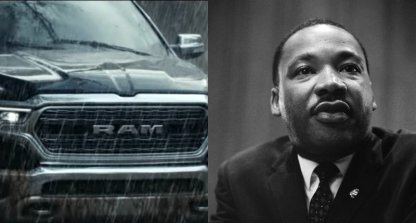
During the Super Bowl on Sunday, there was a commercial for Dodge Ram trucks. The advertisement began in darkness, and then text appeared on the screen announcing that the following words were spoken by Martin Luther King Jr. exactly fifty years ago to the day. The audio playback started, while the viewers witnessed a collage of pure Americana: construction workers, a student studying, a man doing push ups, and a cattle rancher all interposed with quick shots of a Dodge truck driving through mud. All the while you could hear Dr. King in the background saying these words:

“If you want to be important — wonderful. If you want to be recognized — wonderful. If you want to be great — wonderful. But recognize that he who is greatest among you shall be your servant. That’s a new definition of greatness. … By giving that definition of greatness, it means that everybody can be great … by giving that definition of greatness, it means that everybody can be great. … You don’t have to know about Plato and Aristotle to serve. You don’t have to know [Einstein’s] theory of relativity to serve. You don’t have to know the second theory of thermodynamics in physics to serve. You only need a heart full of grace, a soul generated by love. And you can be that servant.”

The recording was taken from one of Dr. King’s final sermons prior to his assassination. And, inexplicably, the advertisers failed to recognize, that part of King’s sermon [not quoted in the ad] was about the evils of advertising. Dr. King said:

“The presence of this instinct explains why we are so often taken by advertisers… you know those gentlemen of massive verbal persuasion. They have a way of saying things that get you in a bind: ‘In order to be a man of distinction you must drink this whisky’ ‘in order to make your neighbors envious you must drive this type of car’ ‘in order to be lovely to love you must wear this kind of lipstick or this kind of perfume’ and before you know it your just buying this stuff… And I am sad to say that the nation in which we live is the supreme culprit.”

Even from beyond the grave, Dr. King will not remain silent about the injustices and tragedies of the world. His words are still a rallying cry for those who wish to see God’s vision made into a reality. But some, with untold power, continue to manipulate his words for their own gain.

rammlk2-800x430

The Psalmist says, “Our God comes and does not keep silence.” The Word from the Lord blasts forth from the pages of our bibles, like the words of Dr. King’s sermon, and they beckon us to open our eyes to the truth. We live in a world that is still terribly broken and in need of divine healing. The marginalized are being pushed even further into the margins while the powers and principalities rule with an iron fist.

God will not keep silence, and neither should we.


You can read more about the Dodge Ram Commercial controversy here: MLK Jr. Sermon Used In A Ram Trucks Super Bowl Commercial Draws Backlash.

Shiny

strangely-warmed-spreaker-header

This week on the Strangely Warmed podcast I speak with Tommie Marshell about the readings for Transfiguration Sunday [Year B] (2 Kings 2.1-12, Psalm 50.1-6, 2 Corinthians 4.3-6, Mark 9.2-9). Tommie recently started the Backsliding Podcast which seeks to produce lay drive conversations about theology and faith (it’s really good and you should subscribe here: Backsliding). Our conversation covers a range of topics including womanist theology, mentorship, covenant separation, naked prophets, giving voice to the voiceless, the positivity of fire, Moana, the blindness of unbelievers, lightning bugs, and the Messianic Secret. If you would like to listen to the episode or subscribe to the podcast you can do so here: Shiny

TM

Devotional – Isaiah 40.25

Devotional:

Isaiah 40.25

To whom then will you compare me, or who is my equal? Says the Holy One.

Weekly Devotional Image

We live in the land of similes. No matter who we are, and no matter what we do, our days are filled with seemingly endless comparisons. We hear people say things like “My husband is like a couch potato” or “Baby you’re as bright as a firework” or “Ogres are like onions.” A simile is any figure of speech that describes an object, or action, in a way that isn’t literally true, however it conveys something we can understand through comparisons.

In the realm of the church, we use metaphors for God all the time, and the practice is problematic.

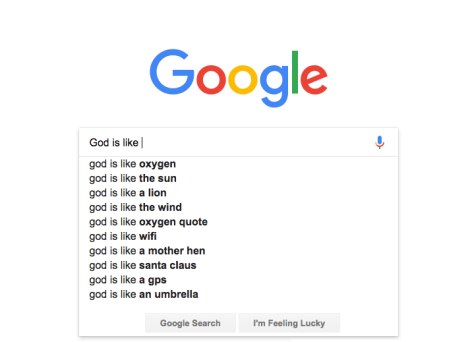
Just type, “God is like…” into a Google search bar and you’ll find all sorts of things. God is like oxygen, the sun, a lion, the wind, wifi, a mother hen, santa claus, a gps, an umbrella… And of course there are ways in which God is like those things, but at the same time God is totally unlike those things.

Screen Shot 2018-01-29 at 2.39.04 PM

The prophet Isaiah knew the challenge of making comparisons to unravel the truth of God’s identity. The people, in some ways, were blind to what God had done, because they forgot that God was the author of all things. And instead of experiencing God as totally other, they were elevating people and objects in their lives to be equated with the realm of the divine.

We, of course, do this today as well. We circle around our televisions and computers to catch up on the latest celebrity craze, and political drama. We make finite people and experience into more than they really are. And when we want to figure our what God is like, we use earthly comparisons like the sun, the wind, and even wifi.

And here is the beauty of the incarnation; God is at once exactly like us, and totally different from us. God in Christ is both human and divine. God is paradox, unreachable and yet experiential. There is nothing we can compare God to, however God chose to take on flesh and dwell among us such that we can know God’s character. God is beyond anything we can possibly imagine, and at the same time God is in the bread we break at the table. God’s understanding is unsearchable, and at the same time God reveals God’s identity to us in the waters of baptism.

And so Isaiah can say, with paradoxical certainty: “Have you not known? Have you not heard? The Lord is the everlasting God, the Creator of the ends of the earth. He does not grow faint or weary; his understanding is unsearchable. He gives power to the faint, and strengthens the powerless. Even youths will faith and be weary, and the young will fall exhausted; but those who wait for the Lord shall renew their strength, they shall mount up with wings like eagles, they shall run and not grow weary, they shall walk and not faint.”

What Must We Do To Be Saved?

Psalm 111

Praise the Lord! I will give thanks to the Lord with my whole heart, in the company of the upright, in the congregation. Great are the works of the Lord, studied by all who delight in them. Full of honor and majesty is his work, and his righteousness endures forever. He has gained renown by his wonderful deeds; the Lord is gracious and merciful. He provides food for those who fear him; he is ever mindful of his covenant. He has shown his people the power of his works, in giving them the heritage of the nations. The works of his hands are faithful and just; all his precepts are trustworthy. They are established forever and ever, to be performed with faithfulness and uprightness. He sent redemption to his people; he has commanded his covenant forever. Holy and awesome is his name. The fear of the Lord is the beginning of wisdom; all those who practice it have a good understanding. His praise endures forever.

In 1962 one of the greatest theological minds of the 20th century visited the United States on a lecture tour. Karl Barth was a product of Western Theology who actively spoke against the Nazi regime and rejected their un-Christian allegiance to Adolf Hitler. His writings and influence spread throughout the world to a degree beyond his ability to comprehend, such that (for instance) I have an entire shelf in my office dedicated to his books.

But long before I heard about Barth, he toured the US in the early sixties, lecturing to both the young and old about the importance of God being God.

And for as much as I love Barth, he can be remarkably dense. During his tour he was approached by a young theologian who declared, “Professor Barth, you’re my hero! I’ve read everything you’ve ever written.” To which Barth responded, “Son, I haven’t even read everything I written.”

That particular tour had him stopping at the leading theological institutions like Princeton, the University of Chicago, and Union Theological Seminary. And after one such lecture, not doubt filled with deep theological affirmations beyond reasonable comprehension, a young woman decided to bravely ask a question.

Now, at the time, evangelical theology was beginning to take off in the US. Churches were pushing hard for “personal relationships with Jesus Christ.” Altar calls were all the rage. And every wanted to know when everybody got saved.

So, this young woman, with her hand shaking in the air, patiently waited to ask her question. Barth lectured on and on about who knows what and then he finally called on her.

She said, “Well, Professor Barth, I was wondering, when were you saved?”

After no doubt responding to questions about the immutability of God, the diminishing role of the third member of the trinity, and the self-unveiling of God who cannot be discovered by humanity, Barth was finally asked a simple question with a simple answer.

And this is what he said, “Hmm, when was I saved? Of yes, that’s easy, it was… 2,000 years ago on the cross.”

What must we do to be saved?

salvation-0

In many churches, being “saved” is equated with a moment when an individual accepts Jesus Christ as their “personal Lord and Savior.” We look at it as an item on a check-off list, an accomplishment to be met in order to get into heaven. These moments of willed salvation often take place in the midst of an altar call, that time when the pastor calls for people like you to come to the throne to give your lives to Jesus. Sometimes it takes place in baptism, when water is used to cleanse a child or an adult from their broken ways and saved them. Sometimes it takes place in the bread and cup of communion, nourishing someone’s faith to the point of everlasting reward.

In many places, being “saved” like this is worth celebrating as a total rebirth, such that individuals will celebrate two birthdays each year. Their actual birth day, and their new-birth day. Some, believe it or not, will even bring out a birthday cake and presents, for BOTH of the days.

But is that what it takes to be saved? Is that part of God’s requirements to pass through the pearly gates?

            This is what I do know: The saving of anyone is something is not within our own power, it is exclusively God’s. No one can be saved – by virtue of what he/she can do. But everyone can be saved – by virtue of what God can do.

Great are the works of God, and we delight in what God has done, is doing, and will do. God’s work is full of majesty and God’s righteousness endures forever. The psalmist covers all the bases, buttering God up with all of God’s attributes. We know of God from all of God’s wonderful deeds. The Lord is gracious and merciful. He offers and provides food to those who fear, and God is always mindful of the covenant.

But among these buttery and complimentary verses, there is one that shines bright and is somehow often overlooked: God sent redemption to God’s people.

Perhaps it’s a product of coming of age in a culture where we always hear about the need to pull yourself up by your bootstraps, that we assume salvation is up to us. We read these books about how to be the better me, thinking that if I only add this discipline, or get on this diet, that it will fix everything. We surround ourselves with people who often think like us, to embolden our own beliefs, rather than spending time with people who will challenge what we think we know.

But God sent redemption to us!

cropped-signweblogo

Can you think of a more profoundly beautiful sentence? God sent redemption to us. Not a five steps process to becoming the true you, not an outline of a daily schedule to practice piety, not a pill or product that can fix our problems. God sent redemption. To us.

We have been redeemed. But from what? In the beginning of scripture there is a story about a man and a woman who had a choice. They could have stayed within God’s loving and beautiful embrace, or they could taste the fruit, the forbidden fruit. All was theirs, and then all was lost, because they chose to govern themselves rather than obey God. They believed in the boot-strap model more than the grace-filled reality of God. They wanted power, and they received punishment.

But, God sent redemption to us.

In the United Methodist World, we call redemption grace. And it begins with prevenient grace. It is something offered to us without price or cost. It is free. And we can choose to respond to the grace, but we cannot do anything to earn it.

And then there’s God’s justifying grace, the act of Jesus’ death on the cross and resurrection from the dead that reconciled the divisions that took place in the Garden of Eden. Again, it is something God did for us, without our having earned it.

And finally there’s God’s sanctifying grace. It is the power of God’s grace working in us toward a better and more perfect understanding of who we are and whose we are. Sanctification is a life-long process where we grow daily in our Christlikeness.

We experience God’s grace through a number of means, like communion and baptism, reading scripture, daily prayer, and even sometimes through a sermon. They are the tools and mechanisms by which we are reminded what God has done, so that we might respond.

Our lives are made up of holy sanctified moments, those strange and powerful moments where the earthly and the divine come close together.

We are all in the process of sanctification. And, as someone once noted, sanctification is nothing more than getting used to our justification.

When I was in seminary learning about all the stuff pastor’s are supposed to learn, we took a class on the New Testament. Every time we gathered we looked at a different book in the New Testament and we unpacked the theology. We talked about who Jesus was, and where Jesus went, and what Jesus said. And one day, in the middle of the lecture, my professor projected an image on the board of the crucified Jesus. It looked like a painting from the Renaissance and Jesus was the perfect specimen of humanity, almost glowing while dangling without pain. But then my professor went to the next slide, and it was another crucifixion scene. This time it was more abstract with strange colors and shapes but it was still clearly Jesus on the cross. And again and again, the slides came and went with different portrayals of Jesus’ death.

And the longer it went on the more uncomfortable I felt.

Instead of looking at the images from the perspective of a student studying lines and meaning, I began looking at them like a Christian. And with each passing image I saw the immense suffering of the one we call Lord, dying on the cross. I noticed the fragility of the One born in the manger, I saw the struggle of the Savior, I experienced the labor of the Lord.

And it was too much.

Before I knew it I was walking out of the room as if I couldn’t breathe, and I sat down in the hallway by the door. One of my friends promptly followed me outside and picked me up, looked me in the eyes, and said, “What in the world is going on with you?”

I said, “I don’t deserve it. Seeing Jesus on the cross, for me, I just don’t deserve it.”

And with complete sincerity he said, “You idiot, that’s the whole point. You don’t deserve it. Neither do I. That’s why we call it grace.”

God sent redemption, to us. We did not receive God’s redemption, God’s grace, because we finally mastered the faithful life, and because we finally put all our ducks in a row, and because we finally paid off our credit card debt, and because we finally lost those ten pounds. God sent redemption to us. Period.

No matter what you do, God will never love you any more, or any less. You have been saved, and are being saved. As you get used to your justification, God is sanctifying you. There is nothing we can do to be saved because God is the one saving us.

That’s why the psalmist can say, “Praise the Lord!” Because God’s works are indeed great, God is full of majesty and righteousness. The Lord is gracious and merciful. Holy and awesome is the name of God. He has sent redemption to us.

However, lest we become “couch potato Christians”, we are not sitting around passively waiting for God to do something. God’s grace is such that it propels us to respond in ways we can scarcely imagine. We are always moving on to a greater understanding of what it means to love God and neighbor.       

God’s grace, prevenient, justifying, and sanctifying is a gift. We can receive the gift and pack it away in the closet and it will never do a thing. Or we can receive the gift and use it each and every day in the ways we commune with God, the ways we interact with our fellow brothers and sisters, and the ways we experience God’s creation.

Additionally, grace is not a get out of jail free card, nor is it a protective talisman that saves us from ever suffering. The life of God in Christ, the redemption sent to us, is the penultimate reminder that you cannot have resurrection without crucifixion. That those who wish to gain their lives must lose them. And that if we want to call ourselves disciples of Jesus, we have to take up our own crosses to follow him.

So we praise the Lord! We give thanks to Lord with our whole hearts, in the company of the congregation, because God sent redemption to us. Amen.

It’s A Curse To Speak Without Some Regard

strangely-warmed-spreaker-header

This week on the Strangely Warmed podcast I speak with Josh Munnikhuysen about the readings for the 5th Sunday After Epiphany [Year B] (Isaiah 40.21-31, Psalm 147.1-11, 20c, 1 Corinthians 9.16-23, Mark 1.29-39). Our conversation covers a range of topics including the folly of using metaphors for God, functional atheism, church democracies, living east of Eden, the “meaning” of scripture, the Avett Brothers, arresting verses, and women serving the Lord. If you would like to listen to the episode or subscribe to the podcast you can do so here: It’s A Curse To Speak Without Some Regard

HeatherPhoto2

Wasting Time With God

strangely-warmed-spreaker-header

This week on the Strangely Warmed podcast I speak with Wil Posey about the readings for the 4th Sunday After Epiphany [Year B] (Deuteronomy 18.15-20, Psalm 111, 1 Corinthians 8.1-13, Mark 1.21-28). Our conversation covers a range of topics including gift-giving, the terrible responsibility of preaching, You-Who prayers, temptation, and how food CAN bring us closer to God. If you would like to listen to the episode or subscribe to the podcast you can do so here: Wasting Time With God

230865_3866247818098_342475955_n


Devotional – Jonah 3.1-2

Devotional:

Jonah 3.1-2

The word of the Lord came to Jonah a second time, saying, “Get up, go to Nineveh, that great city, and proclaim to it the message that I tell you.”

Weekly Devotional Image

Sometimes, we don’t want to say what God wants us to say. All of us have a little Jonah in us, and all of us have faced a Nineveh at some point and decided to run in the opposite direction.

However, there are times when God gives us the strength, courage, and wisdom to say what God commands us to say.

On Saturday morning 600 United Methodists from all over the Northern Virginia area gathered for a day of spiritual renewal and theological reflection. At the beginning of the event, the District Superintendent from the Alexandria District stood up and said, “By now you have all heard what our President said about the kinds of people he doesn’t want coming to our country. Well, last night I was driving home from church and I was listening to the radio when person after person denounced what the President said and the words he used. But there were three people in support of the President’s message: A member of the KKK, a member of the Neo-Nazi movement, and a pastor. Thank goodness it wasn’t a United Methodist Pastor, but most people outside the church do not differentiate between us.”

FUMCLogoWritten

The DS then went on to express his gratitude for our denomination, and in particular for our Council of Bishops, who publically condemned President Trump’s recent remarks against immigrants.

It’s not easy saying what God wants us to say. There are always people who will be angered by what the church has to say, and frustrated by the path of discipleship that calls for others to be better. But our Ninevehs are always waiting, and God has given us something to say.

Below is the statement from Bishop Bruce Ough, president of the Council of Bishops, on behalf of the whole council:

“We are appalled by the offensive, disgusting words attributed to President Donald Trump who is said to have referred to immigrants from African countries and Haiti, and the countries themselves, in an insulting and derogative manner.  According to various media accounts, President Trump made the remarks during a White House discussion with lawmakers on immigration.

As reported, President Trump’s words are not only offensive and harmful, they are racist.

We call upon all Christians, especially United Methodists, to condemn this characterization and further call for President Trump to apologize.

As United Methodists, we cherish our brothers and sisters from all parts of the world and we believe that God loves all creation regardless of where they live or where they come from.  As leaders of our global United Methodist Church, we are sickened by such uncouth language from the leader of a nation that was founded by immigrants and serves as a beacon to the world’s “huddled masses yearning to breathe free.”

Thousands of our clergy, laity and other highly skilled, productive citizens are from places President Trump has defamed with his comments.  The fact that he also insists the United States should consider more immigrants from Europe and Asia demonstrates the racist character of his comments.  This is a direct contradiction of God’s love for all people.  Further, these comments on the eve of celebrating Martin Luther King Day belies Dr. King’s witness and the United States’ ongoing battle against racism.

We just celebrated the birth of Jesus Christ, whose parents during his infancy, had to flee to Africa to escape from the wrath of King Herod.  Millions of immigrants across the globe are running away from such despicable and life-threatening events. Hence, we have the Christian duty to be supportive of them as they flee political, cultural and social dangers in their native homes.

We will not stand by and allow our brothers and sisters to be maligned in such a crude manner.  We call on all United Methodists, all people of faith, and the political leadership of the United States to speak up and speak against such demeaning and racist comments.

Christ reminds us that it is by love that they will know that we are Christians. Let’s demonstrate that love for all of God’s people by saying no to racism; no to discrimination and no to bigotry.”

Devotional – 1 Samuel 3.1

Devotional:

1 Samuel 3.1

Now the boy Samuel was ministering to the Lord under Eli. The word of the Lord was rare in those days; visions were not widespread.

Weekly Devotional Image

It’s mean, but one of my favorite games to play is called, “Is it in the bible, or not?” I could be in the middle of a mission trip with middle school students, or in a nursing home with residents, or in a preschool surrounded by 4 year olds, when I will start the game and relish in the responses.

I’ll usually start with something tame like, “Can anything good come out of Nazareth?” and the participants will nod their heads in affirmation. But then I’ll up my game a little bit with something like, “With your utensils you shall have a trowel; when you relieve yourself outside, you shall dig a hole with it and then cover up your excrement.” People will usually scratch their heads wondering why I brought out something so unpleasant, but it’s there in Deuteronomy 23. By the end of the game I usually drop something like, “God helps those who help themselves.” To which people often express their agreement when in fact it’s definitely not in the bible.

mar6

We no longer know the story of God like we once did. I don’t mean to sound overly harsh, but it’s true. During the time of Jesus, young men grew up having most (if not all) of the Psalms memorized. Today we’re lucky if we can get through the 23rd Psalm. John Wesley, the founder of the Methodist movement, was able to quote scripture left and right. Today we need bible apps and Google searches to find the right verse. Even preachers like me fail to love the Word of the Lord in a way that is comparable with the preachers of the past.

Perhaps our lack of love for scripture is due to the fact that we have other things to distract us constantly, or that we have tools that can give us scriptural answers whenever we need them, or that we no longer revere the text for what it is. It’s impossible to particularly pinpoint the reason for the bible’s fall from grace in our contemporary world, but it’s something we are called to combat.

Because, unlike the days of Samuel, the Word of God is not rare today.

We live on the other side of the resurrection, we have churches with more bibles than they know what to do with, and we can jump into the strange new world of the bible whenever we would like to.

If you want to hear the Word of the Lord, if you want to receive a vision about what is to come, if you want to encounter the living God, you need not look further than the bible.

Keep The Mystery

strangely-warmed-spreaker-header

This week on the Strangely Warmed podcast I speak with Teer Hardy about the readings for the 2nd Sunday After Epiphany [Year B] (1 Samuel 3.1-10, Psalm 139.1-6, 13-18, 1 Corinthians 6.12-20, John 1.43-51). Our conversation covers a range of topics including Wesley Theological Seminary, the need for repetition, submissive liturgical postures, the rarity of the Word, mystery, metafiction, baptism, communion, sex and fornication, and the challenge of preaching on difficult passages. If you would like to listen to the episode or subscribe to the podcast you can do so here: Keep The Mystery

TH

A One Hundred and Fifty-Fold Cord

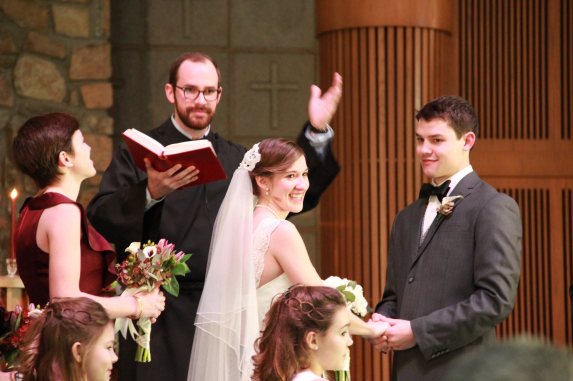
4 years ago, today, I presided over one of my first weddings, and it was for my sister and my (now) brother-in law. I don’t know if I’ve ever been more nervous leading worship than I was that day (so nervous that I forgot to invite my then fiancé (now wife) to offering one of the scripture readings), but we all made it through to the other side. I am grateful for my sister and her husband, I am grateful they asked me to participate in their holy ceremony, and I am grateful that God has so blessed their marriage. Below is the homily I offered 4 years ago…

1 John 4.9-12

God’s love was revealed among us in this way: God sent his only Son into the world so that we might live through him. In this is love, not that we loved God but that he loved us and sent his Son to be the atoning sacrifice for our sins. Beloved, since God loved us to much, we also ought to love one another. No one has ever seen God; if we love one another, God lives in us, and his love is perfected in us.

Ecclesiastes 4.9-12

Two are better than one, because they have a good reward for their toil. For if they fall, one will lift up the other; but woe to one who is alone and falls and does not have another to help. Again, if two lie together, they keep warm; but how can one keep warm alone? And though one might prevail against another, two will withstand one. A threefold cord is not quickly broken.

1498071_10151977138149016_1228625660_o

28 years. 28 years ago my parents, JT and Sarah Lynn Mertins, stood in the same position as both of you. Haley, I don’t know if you will remember all of this, but we used to watch their wedding VHS tape when we were growing up. Truly I tell you, it is a miracle that the wedding ceremony happened at all. When we would watch the tape, it appeared as if the cameraman had decided to smother vaseline all over the lens in order to achieve some sort of effect that left the viewers nauseous and confused. As my Aunt Laura made her way up the steps toward the altar she stepped on, and ripped, her dress. My uncle Bill Hanff and a friend stood over by piano the prepared to sing a wonderful rendition of “On the Wings of Love” though the pianist started the song in the wrong key and uncle Bill had to match accordingly. And then there was the hair and the dresses. There must have been enough hair spray in this church to light the whole thing on fire, but somehow, by the grace of God, our mother and father were married on this exact day 28 years ago.

And here we are now, ready for the two of you to enter into the holy state of matrimony. As I have looked back over the totality of your relationship, and all of the little steps that led you to this altar on this day, I am convinced that I will never marry a couple that I know as well as both of you for the rest of my life. So before I continue I want to show you something.

(Turn around, look out at the sanctuary. Gathered together in this room are the people who have made you, you. Family, friends, both the foolish and the fun, but more importantly, when you look out I hope you see faith. So soak up this view for a moment, you rarely get to see anything as glorious as this)

Faith, the people gathered together today are indicative of the kind of faith-lives that both of you are living. Everyone here has faith in both of you as individuals, and also as the married couple you are about to become. They have been there for you in every aspect of your lives, and today two families are joining together as a testament to the faith that you have in each other. They say a threefold cord in not quickly broken? Well neither is a one hundred and fifty fold cord.

However, for as much as everyone gathered together in this room are responsible for your relationship, no one can take more credit than God.

21427285_10209512982332426_5944900731650115605_o

When I found out that Matthew was moving to Africa for a year, I knew that the only thing that would be able to sustain your relationship was a resounding faith in the triune God. I know it wasn’t easy. Even with the notebook Matthew left behind, even with the commitment to read through the entire bible while you were apart, even with the advantages of technological communications such as Skype and email, you would not be standing here today unless you had tremendous faith in God, but more importably God has faith in you.

1490681_600936009974464_683923270_o

One of the things that I love most about you two is that, even with all the planning and the suits and dresses and decorations, today will not be the greatest day of your lives. Both of you strive to discover all of the joy in life and share it with one another. You earnestly love the lives that God has given to you, and you hope to share that love with everyone with ears to hear and eyes to see. Thats what it means when we say, “If we love one another, God lives in us.” The two of you have made a commitment to loving one another so that God abides and manifests himself in the world.

Matthew Logan, I have waited 23 years for a brother, and today I’m finally getting one! You are a remarkable man with compassion, faith, and hope. I have been privileged to watch you grow up, in a way, I’ve seen the way that you create and nurture friendships, I’ve seen the way that you have selflessly served others, and I have seen the many ways that you have committed yourself to my sister. Marriage will not be easy. There will be mornings that you wake up and wonder how such a beautiful woman can drive you so crazy. There will come a time when all the love that Haley can give you will not be enough, but you will never be alone. Beyond the multitudes that have gathered here today, God almighty is with you in all that you do. As a husband, literally, you have been called to love Haley with all that you are, live into the life that God is calling you toward, and to have your relationship shine as a beacon of hope and love to all the world. I have nothing but profound respect, enduring faith, and unending love for you, my brother.

Haley Lynn, precious sister of mine, you are a beautiful woman who has truly come into her own. I have been privileged to watch you mature into your truest self as you now prepare to enter into marriage with Matthew. I love how your willingness to serve others is so central for understanding who you are and what you do. Whether its helping out your students at school, or volunteering your time and energy for church, or helping your idiot brother match his clothing when we were in high school, serving and loving others is what you do. What a blessing you are to all of us, and what a blessing you will be to all the lives you touch in the future. Marriage will not be easy. There will be mornings when you wake up and wonder how such a funny man can drive you so crazy. There will come a time when all the love that Matthew can give you will not be enough, but you will never be alone. Your family, your friends, and your father in heaven are with you in all that you do. As a wife, you have been called to love Matthew with all that you are, to live into the life that God is calling you toward, and to have your relationship shine a beacon of hope and love to all the world. I have nothing but immeasurable respect, enduring hope, and unending love for you, my sister.

Matthew and Haley, God’s love was revealed to all of us through the incarnation in Jesus Christ. In his willingness to take on human flesh, God humbled himself to be just like us, in order to help transform us. God did not mount the hard wood of the cross because we loved him, but instead he came to die and live because he first loved us. Above all things, your marriage should, and will be, a testament to God’s love in the world through the redemptive acts in our Lord Jesus Christ.

In giving yourselves to each other, you are mirroring that great act of God coming to be with us.

And so, as you prepare to take these first steps into wedded life, I call both of you to hold fast to the people that love and support your relationship, hold fast to the faith and hope that you have in one another, but most importantly, hold fast to the good God whose joy knows no bounds, whose grace extends beyond our imaginations, and whose love was made known to all of us in the gift of his Son.