Don’t Worry, God’s Got This

strangely-warmed-spreaker-header

This week on the Strangely Warmed podcast I speak with Drew Colby about the readings for the Fourth Sunday of Easter [C] (Acts 9.36-43, Psalm 23, Revelation 7.9-17, John 10.22-30). Drew serves as one of the associate pastors at St. Stephen’s UMC in Burke, VA. Our conversation covers a range of topics including James Taylor, the paralysis of analysis, the best biblical name, terrific tunics, living parables, the great ordeal, Queer Eye, the theology of atheism, and the gospel as repetition. If you would like to listen to the episode or subscribe to the podcast you can do so here: Don’t Worry, God’s Got This

Screen Shot 2019-05-06 at 11.20.57 AM

We Did Everything We Could

strangely-warmed-spreaker-header

This week on the Strangely Warmed podcast I speak with Drew Colby about the readings for the Third Sunday of Easter [C] (Acts 9.1-6, Psalm 30, Revelation 5.11-14, John 21.1-19). Drew serves as one of the associate pastors at St. Stephen’s UMC in Burke, VA. Our conversation covers a range of topics including charcoal fires, Damascus road experiences, reluctant discipleship, the soul from Sheol, heaven & hell parties, learning Revelation, The OK Computer Passion Play, being naked and ashamed, and hope in the face of death. If you would like to listen to the episode or subscribe to the podcast you can do so here: We Did Everything We Could

Screen Shot 2019-04-29 at 9.50.53 AM

Holy Week Hangover

strangely-warmed-spreaker-header

This week on the Strangely Warmed podcast I speak with Teer Hardy about the readings for the Second Sunday of Easter [C] (Acts 5.27-32, Psalm 118.14-29, Revelation 1.4-8, John 20.19-31). Teer serves at Mt. Olivet UMC in Arlington, VA. Our conversation covers a range of topics including life on the other side of the resurrection, the best kind of hangover, The Sorting Hat, subversive obedience, gimmicky teasers, the most important psalm, proper agency, death breath, and doubt. If you would like to listen to the episode or subscribe to the podcast you can do so here: Holy Week Hangover

Screen Shot 2019-04-23 at 9.40.55 AM

A Bad Foundation – A Wedding Homily

Psalm 118.1-2, 19-24

O give thanks to the Lord, for he is good; his steadfast love endures forever! Let Israel say, “His steadfast love endures forever.” Open to me the gates of righteousness, that I may enter through them and give thanks to the Lord. This is the gate of the Lord; the righteous shall enter through it. I thank you that you have answered me and become my salvation. The stone that the builders rejected has become the chief cornerstone. This is the Lord’s doing; it is marvelous in our eyes. This is the day that the Lord has made; let us rejoice and be glad in it. 
29342825_10158122404803990_6894900876477988864_o

For some strange reason we treat the Bible like a textbook – as something to be mastered. It’s why people are forever starting these foolish campaigns to “Read the whole Bible in a year.” I mean, good for you if you want to try it, but reading through the Bible in the year mostly guarantees that we will either resent it in the end, or we will have forgotten most of what we discovered.

Instead, the Bible begs to be considered, slowly, delicately, and above all, faithfully. 

When we encounter scripture this way, as servants of the Word rather than masters of the text, we begin to see things we never saw before.

It’s like the way you two can look at a building and see things that most of us miss. You have taken the time, slowly, delicately, and faithfully to appreciate what might appear insignificant to the rest of us. And yet you know, without very particularly important elements, this room would not exist, nor would it have stood the test of time as it has.

But I’ll get back to this room a little later.

For now, I want to keep our minds firmly planted in the strange new world of the Bible. For it is a strange new world, one that opens up to us something new whenever we enter it. Whether we’re standing on the banks of the Red Sea with Moses or we’re walking around Jerusalem marveling at the buildings and stones with Jesus, we find ourselves in this book and sometimes we’re not sure if we like what we see.

Of course, there are those good and holy moments of profound beauty and clarity, but the strange new world of the Bible is equally coarse, and broken, and flawed.

It is all of those things precisely because we are in it.

The writer of Psalm 118 has been steeped in the strange new world. The writer knows that God’s steadfast love endures forever even say, in the midst of exile, or persecution, or marginalization. 

It requires a willingness to believe in, or hope for, things not yet seen to keep a faith like that.

Which makes things all the more complicated when the Psalmist, inexplicably, declares the stone rejected by the builders has become the chief cornerstone. 

It’s probably better to let the two of you speak of such architectural language, but for the sake of your wedding I will just make the point that there is good reason to reject certain stones. The cornerstone, after all, is the one upon which the entire building will stand. Any imperfection or crack warrants a plain dismissal because it is simply not up to snuff.

And yet, we learn that the stone rejected for its brokenness is precisely the chosen cornerstone!

Or, to put it in frighteningly applicable words, your marriage has a bad foundation.

I, of course, do not mean to imply that there is something wrong with either of you. You’re just plain old sinners like the rest of us. However, you have come to this place, with these people, to stake your claim on a marriage upon which Christ is the broken foundation.

Marriage is strange; two people willing to make a covenant into something they cannot possibly comprehend. 

I like to put it this way: we always marry the wrong person.

Not because you two aren’t right for each other, but more so that we never really know who we’re marrying; we just think we do. Or even if we marry the right person, whatever that means, part of what makes us who we are is that we change.

56945024_10155981683886712_2820690312467316736_n

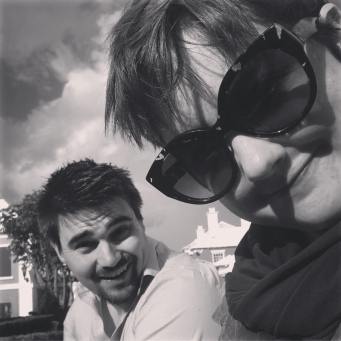
Brent, turn to your beloved bride and take in her beautiful glow. Jane is better than you deserve – she calms all anxieties, and keeps your life together, which we all know is a herculean task. Moreover, Jane adores your incredible family, and I promise she will be the most fiercely kind person you will ever meet.

But she will change. And yet, Brent, you are making a covenant to be for her knowing full and well that she can and will change.

Your turn Jane – take a good look at your handsome soon-to-be husband. Brent is better than you deserve – he regularly puts your needs before his own. He is filled with what appears to be a never ending amount of love to give. Moreover, he goes out of his way, particularly with his crazy travel habits, to make sure that you two always have time to be together. 

But he will change. And yet, Jane, you are making a covenant to be for him knowing full and well that he can and will change.

Marriage, being the remarkable and confusing thing that it is, means we are not the same person after we enter it. The primary challenge of marriage is learning how to love and care for the stranger to whom you find yourself married. 

That is why, at the heart of what we are doing here, is the formation of a holy covenant binding you two, and all of us with you, together.

So take a moment now, and turn to take in this room. One of the reasons churches and chapels used to be designed this way is that the room is cruciform, it takes the shape of the cross. And to have everyone facing each other is a theological witness that we are to look upon one another through the cross. 

Sadly, this type of worship structure is all but gone. We’ve decided that its better to all stare at someone like me instead of looking through the cross at one another.

And so now I ask you two to look out on all who are here. Look at them through the broken cornerstone that is the cross. Your marriage is about more than just the two of you. Everyone here has already promised, they have covenanted, to hold you to your covenant. Their presence and promise is a testament to what they see, know, and believe about the two of you, and it is not something you can take for granted.

But now eyes and ears back on me.

When the three of us talked about today I asked you to consider what you thought you were getting into. And you said that marriage is a sacred thing to share in which we become totally bound to and with one another. Moreover you described it as a complete promise and connection to the person with whom you are now standing. And finally, you described marriage like a history: it holds and ties everything together.

Theologically speaking, those were pretty good answers. In fact, they might be the best. In the church we call it something like the diachronic witness – it is a declaration that moves through time in such a way that we are connected to the past, present, and future all at the same time. 

I’ve done a lot of weddings, and for the longest time I believed that where people got married didn’t matter. In a church? That’s fine. Out in a vineyard? Sure. But then you two invited all of us here.

Not only does it has this theologically intriguing style, it is also within the oldest college building still standing in the U.S. 

And, I should knock on wood, it has caught fire three separate times in its long history, and yet the exterior walls remained after each fire such that they were able to build again.

Thats a pretty good metaphor for a marriage!

What I mean to say is that at the cornerstone of your marriage, is the person of Jesus Christ was was rejected by those with whom he encountered for a great number of reasons. And yet it is precisely because of his brokenness, his humanity amidst his divinity, that he rests at the foundation of all of our lives and your marriage.

This bad foundation is thus what can and will sustain you through the journey of discovering the stranger to whom you find yourself married, because there is no such thing as a perfect marriage. Just as there is no perfect building. 

The broken foundation of the one who mounted the hard wood of the cross frees you from the marital expectations of the world and instead invites you into the mysterious covenant you are about to make. 

Marriage is strange but it is at the same time wondrous. It is wondrous because it is less about us and more about what God does in and through us. Which is why the psalmist has the confidence to declare that this is the Lord’s doing and it is marvelous in our eyes.

Only a God of impossible possibility could have stitched your stories together into one. 

Only a God of reckless grace could look upon your flaws and all of ours and still say we are enough.

Only a God who sees perfection in imperfection would lay Jesus as the cornerstone of your marriage. 

This truly is the day that the Lord has made, which is why we can rejoice and be glad in it, with you.

And so, may the God of grace and glory, God of the beginning and the end, God of life, death, and resurrection sustain you in your marriage, knowing full and well that the foundation is bad, but that’s what makes it good. Amen. 

Hope Rages or: All Y’all Get To Be Eastered

strangely-warmed-spreaker-header

This week on the Strangely Warmed podcast we have three episodes for Holy Week and we end with Easter [C] (Isaiah 65.17-25, Psalm 118.1-2, 14-24, 1 Corinthians 15.19-26, John 20.1-18). Joanna Marcy Paysour was kind enough to join me for this episode. Our conversation covers a range of topics including proclamation by subtraction, redeeming the season, theologically complicated hymns, moving from Friday to Sunday, confetti eggs, dust-ness, women preachers, naked gardening, and seeing the Lord. If you would like to listen to the episode or subscribe to the podcast you can do so here: Hope Rages or: All Y’all Get To Be Eastered

easter-sunday1120-1024x576

The Cross Is Not Optional

strangely-warmed-spreaker-header

This week on the Strangely Warmed podcast we have three episodes for Holy Week and we continue with Good Friday [C] (Isaiah 53.13-53.12, Psalm 22, Hebrews 10.16-25, John 18.1-19.42). Teer Hardy was gracious enough to join me for two of the episodes. Our second conversation covers a range of topics including long passages, bad Good Friday services, speed balls, Fleming Rutledge, theological claims, pole-vaulting, the work of the cross, and sitting in the mystery. If you would like to listen to the episode or subscribe to the podcast you can do so here: The Cross Is Not Optional

GoodFriday

There’s Nothing Sexy About Palm Sunday

strangely-warmed-spreaker-header

This week on the Strangely Warmed podcast I speak with Joanna Marcy Paysour about the readings for Palm Sunday [C] (Psalm 118.1-2, 19-29, Luke 19.28-40). Joanna serves at Cave Spring UMC in Roanoke, VA. Our conversation covers a range of topics including proper pronunciations, BBT’s Leaving Church, debates about Passion Sunday vs. Palm Sunday, the spiderweb of the Bible, the craziness of faith, joyful obedience, giving palms to children, being an ass in church, King Jesus, and scaring people for the Lord. If you would like to listen to the episode or subscribe to the podcast you can do so here: There’s Nothing Sexy About Palm Sunday

Screen Shot 2019-04-08 at 10.11.53 AM

Nothing New

Devotional:

Isaiah 43.19

I am about to do a new thing; now it springs forth, do you not perceive it? I will make a way in the wilderness and rivers in the desert. 

Weekly Devotional Image

On Saturday morning I will meet with a small group of people to baptize the daughter of one of my oldest friends. It will be its own worship service with scripture and prayer, song and sermon, and sacrament and silence. The occasion has been in the works for quite a long time and I count myself blessed for being invited into the midst of it.

As I hold that precious baby girl in my arms on Saturday, I know that I will have to hold back the emotions that will undoubtedly well up within me and I will be immediately transported back to a year and a half ago when I stood in a very different place, but doing a very similar thing, when I married that girl’s parents together. It’s no accident that the movements and vows of baptism are intricately tied together with the covenant and celebration of marriage. And for me to know that I was there, and will be there, for these two holy events is nothing short of a miracle.

And yet, for all the newness of the occasion(s), I am reminded that God really doesn’t do anything new. At least, not in the way we think about it. Sure, there will be a newish child, she will enter a new period in her life, her parents will (have to) come to grips with the fact that their daughter will be baptized into the resurrection and death of Jesus. 

But that’s not actually new.

All that truly matters has already happened, once and for all, by the Lamb slain before the foundation of the cosmos. The baptized, and those who gather with her, might be unable to believe this or even faintly grasp it, but it doesn’t really matter. 

Baptism isn’t about what we do. It’s not about what we believe. It’s not even really about the person being baptized.

It’s about what has been done for us.

baptism

In baptism, we affirm that through the water, and through the work of Christ, that we’ve already been forgiven for the sins we’ve committed. The thing done for us also conveys the forgiveness of the sins we’re committing right now. And it even forgives us for a whole lifetime of sins to come!

To me, baptisms have to be one of the strangest and most beautiful things we do within the work of the church because they powerfully proclaim the gift of grace and all of its unmerited qualities. We currently live in a world so consumed by what we consume that we fool ourselves into believing that all the stuff we’re doing earns us something – both tangible and intangible. 

And yet God, in all of God’s wondrous knowledge, chose to make a way where there was no way, chose to do the one last new thing, through the person of Christ in whose baptism we share.

And, best of all, it’s true whether we perceive it or not. 

We’re All Living In Paul’s World

strangely-warmed-spreaker-header

This week on the Strangely Warmed podcast I speak with Grace Han about the readings for the Fifth Sunday of Lent [C] (Isaiah 43.16-21, Psalm 126, Philippians 3.4b-14, John 12.1-8). Grace is the pastor of Trinity UMC in Alexandria, VA. Our conversation covers a range of topics including Luke for Lent, preaching patterns, being bored to death, the Bible in a sentence, divine reversal, perfection, abandoning self-righteousness, the myth of progress, and Jesus Christ Superstar. If you would like to listen to the episode or subscribe to the podcast you can do so here: We’re All Living In Paul’s World

Screen Shot 2019-04-01 at 9.37.32 AM

Dis/grace

Devotional: 

Joshua 5.9

The Lord said to Joshua, “Today I have rolled away from you the disgrace of Egypt.” And so that place is called Gilgal to this day. 

Weekly Devotional Image

Those who do not know their history are doomed to repeat it.

Or do the saying goes.

The Israelites have wandered and wandered and they finally make it to the Promised Land. An entire generation has passed and even Moses himself is buried in the ground before God’s people make it to the land of milk and honey. Joshua, ever mindful of faithful leadership, marks the place of their transition from the past into a new future, and the Lord said, “Today I have rolled away from you the disgrace of Egypt.”

Not when the horse and the rider where overwhelmed by the rushing waters of the sea.

Not when the plagues rained down upon the Egyptians.

Not when Moses struck the rock in the wilderness and brought forth water.

The stone of disgrace is rolled away only when they finally make it to where they were going.

history-matters-logo1

And even in this powerful moment of newness, they are reminded of what took place back in Egypt. This is a reoccurring theme in the biblical witness, not just what happened in Egypt, but reminding God’s people what God did for them. 

We are tied to our histories whether we like it or not.

And in this moment God says, you are bound to your history, but you are not defined by it; today I roll away the disgrace.

Ten years before the Civil War took place in the US the Methodist Church split over differing theologies about slavery. Many/Most of the Methodist churches in the north believed that it was ungodly to maintain the institution of slavery where many/most of the Methodist churches in the south believe that slavery was instituted by God. 

The Methodist Church did not come back together until the 1930s.

That is part of the history of Methodism, a history that many of us would rather ignore or forget. Particularly in the state of Virginia, there are a good number of churches that were around when the split took place and they proudly display which version of the church they chose to identify with. 

We are bound to that history, but we are not defined by it. God is still pushing us into new places with new ideas and new theologies. Some of our Moseses will be buried in the past and new Joshuas will have to stand to lead us into places unknown. 

But we cannot forget who we were, otherwise we are doomed to return.