We Are The Songs We Sing

Revelation 5.11-14

Then I looked, and I heard the voice of many angels surrounding the throne and the living creatures and the elders; they numbered myriads of myriads and thousands of thousands, singing with full voice, “Worthy is the Lamb that was slaughtered to receive power and wealth and wisdom and might and honor and glory and blessing!” Then I heard every living creature in heaven and on earth and under the earth and in the sea and all that is in them, singing, “To the one seated on the throne and to the Lamb be blessing and honor and glory and might forever and ever!” And the four living creatures said, “Amen!” And the elders fell down and worshiped.

“Were you crying during the first hymn?”

She asked me with a raised eyebrow out on the front lawn two weeks ago.

We worshiped the Lord with glory and splendor. The lilies surrounded the altar, the pews were packed, Easter! And then a stranger walked up and wanted to know whether or not I cried.

The truth? I did cry. In fact, I cried a lot. So much so I had to take my glasses off for fear that the tears would smudge my lenses and I wouldn’t be able to read the sermon.

But I couldn’t tell from her tone what she was trying to get at with her question. Had I been too emotional for her liking? Was she embarrassed to see such a handsome pastor blubbering up at the front?

I smiled and considered how I might respond. And then she interjected with a whisper, “It’s okay, I did too.”

John the Revelator sees a vision, and what a vision it is. Myriads of thousands, singing with a full voice, “Worthy is the Lamb!” 

John shares his sights with a dispirited and anxiety ridden church. Easter has come and gone. The tomb is empty, the Lord is risen, but what happens next? The people called church run afoul of the powers and the principalities because they now know where real power can be found. They are persecuted, forsaken, punished.

And what does God have to say and show to the people called church?

A song.

A song that spreads wider and wider until the entirety of the cosmos sings praise to the One who is, who was, and who is to come.

Most of Revelation is music. As a book it is quoted among our hymnody and liturgy more than any other part of scripture. And for good reason. It is filled with such wild and wondrous images, it literally talks of music and singing over and over again. 

And, if you spend enough time among the people called Methodist, you start to think in hymns/music.

Listen to this: My sin, oh the bliss, of this glorious thought. My sin, not in part but the whole, is nailed to the cross, and I bear it no more, praise the Lord, praise the Lord, O my soul.

That’s the faith we sing, in one verse.

And so it has been since the beginning. The earliest disciples devoted themselves to the breaking of bread, the singing of songs, and the sharing of scripture.

We are the songs we sing.

The Gospel lection for today, the one that is meant to be paired with our text from Revelation, finds Jesus broiling up some fish along the sea with Peter. The infamous tripartite questioning, “Do you love me?”

Peter is questioned three times, just as Peter denied Jesus three times. Do you love me?

In some sense, it doesn’t matter how Peter answers because Jesus loves Peter whether or not the love is returned. Its grace, all of it. Jesus will remain steadfast whether Peter does or not. Whether we do or not.

Love, in the Christian context, means to be possessed by something else. We love only in the sense that we are beckoned, compelled, drawn to the Lamb who was slaughtered and is therefore the one worthy to receiving power, wealth, wisdom, might, honor, glory, and blessing.

It is a strange love. 

Like the cross, the love of God is both a reminder of what God does and what we do to God.

That is, the cross is our salvation and is also a proclamation of our complicity in the death of Christ.

Love, therefore, is our freedom, and also a declaration about our unworthiness of that very freedom.

And yet God loves us anyway.

To respond to God’s love means, oddly enough, doing exactly what we’re doing right now – gathering week after week with people we love, people who drive us crazy, and even people we hate because God in Christ calls us his friends.

To respond to God’s love means, oddly enough, even when we’ve sung these songs ten thousand times and feasted on the bread and cup ten thousand more, that we are still overwhelmed by the God who is love and loves us.

Revelation, and in particular this bit in chapter 5, is all about worship. We come to the altar of God to be met by the One who makes a way where there is no way. We worship the only way we know how – we sing, we read, we preach, we offer, we receive. This is worship and it is who we are.

We come to this place in this way with the conviction that we are in the presence of God. Every week there is an air of excitement, or at least there should be, in which we gather here thinking to ourselves, “I wonder what God is going to do next?”

And yet, to those outside, what we do here is indeed very strange.

They see people singing unpopular songs, someone who reads from an old dusty book, someone else making remarks about the book that may or may not interest those listening, and then everyone stands up to eat and drink really small portions of bread and juice.

Worship IS strange and worship changes things. And sometimes the thing that worship changes is us.

A prayer is offered that strikes us to the center of our hearts and we know that we can never be what we once were. A sermon is delivered and we receive it as if it was written for me and me alone. And still yet other times its less clear what it is that happens, but we leave not the same as we arrived.

And sometimes we are changed in spite of worship.

C.S. came up with the idea for his remarkable book The Screwtape Letters during what he described as “one very boring sermon.”

I myself learned of the beauty of the Bible because I grew disinterested in parts of worship when I was a child, and I reached for the old book attached to the pew ahead of me to pass the time.

More than a few of you have shared stories about sermons you heard that brought you not to the throne of God, but to the realization that you needed to join a different church!

At its best, and I mean at its very best, worship reminds us, and begs us to realize, that we, even us, we are included in the myriads of the thousands in John’s vision. Worship tells us over and over again that there is nothing we can do for good or ill that can stop God from getting what God wants. 

Worship gives us Jesus.

There’s a story of an old seminary professor who used to interview candidates for the ministry, and in all the interviews he did over the years he would always as the same question, “Why should I join your church?”

Candidates would wax lyrical about the value of community, and the professor would say, “I’m in AA and I have all the community support I need.”

Then the candidates would mention something about outreach. And the professor would say, “I’m a member of Rotary and I already help the needy.”

And then the candidates would make a point to emphasize the beauty of the music at church. And the professor would say, “I have season tickets to the local symphony.”

For years and years he recruited for the seminary and not a single candidate ever mentioned anything specially about Jesus

The church is not in the business of societal rearrangement, we are not paragons of community service, and we certainly don’t hoard all the musical prodigies. We may have some of those gifts, to be sure, but if we’re serious about really being the church then we only have one thing to offer at all: The Lamb of God who takes away the sins of the world.

We don’t have to have impeccable fellowship gatherings, or world transforming service opportunities, or even perfectly pitched singers because what we do here is already the difference that makes all the difference in the world. And that difference has a name: Jesus.

Here’s the shortest version of the longest story: Jesus the one whom we tried to push out of our world by hanging him on a cross, shall reign, and shall gather every living creature in, the last, least, lost, little, and dead, and even we ourselves will rejoice with the myriads. We will sup at the meal that goes on without end and we shall worship with song and voice.

Singing is who we are and what we do. And we’ve been doing it since the beginning. Moses, Miriam, Deborah, David, Mary, the Angels, Jesus, Paul, all of them sing in the strange new world of the Bible. 

John Wesley was transfigured by the singing chorus of a group of Moravians. His brother Charles wrote the songs that we, and a whole bunch of other churches, sing all the time. 

And that is why we sing even now. We sing when we are up and when we are down, when all is well and when all is hell. We sing.

The last word in worship is “Amen.”  Every living creature in heaven and earth sings, “To the one seated on the throne and to the Lamb be blessing and honor and glory and might forever and ever!” And we all say, “Amen!”

Amen means “Yes.” It is our decisive declaration about who we are, what we are doing, and what is being done to us.

We respond to God’s great Amen with our own.

A few years ago I was in Raleigh, NC for a week-long mission trip with a group of youth from the church I was serving. We were tasked with helping out at the Hillcrest Nursing Center. Every morning we traveled to the facility in order to help in the activity center where residents could play bingo, exercise, and generally enjoy one another’s company. And yet, when we arrived, we discovered that the Activity Center was, perhaps, misnamed. 

The residents sat in abject silence day after day.

We pulled out the bingo cards, but we didn’t get any takers. The youth put together a workout routine to a Michael Jackson song, that receive not even a toe tap. No matter what we did, it was as if we weren’t even there.

I remember one of the employees saying, “Don’t worry about it. The residents are always like this.”

And then, one morning, one of the girls found a dusty hymnal in the corner, she flipped to a familiar hymn, and started humming the melody.

It was Amazing Grace.

Without giving it much thought, all of our youth surrounded her and started singing together:

Amazing Grace! How sweet the sound that saved a wretch like me! I once was lost but now am found; was blind but now I see.

All the eyes in the room, previously locked onto the walls and the floor, turned toward the center where the youth stood surrounding the hymnal.

’Twas grace that taught my heart to fear, and grace my fears relieved; how precious did that grace appear the hour I first believed.

The residents started perking up in their wheel chairs, and some of them started mouthing the words.

Through many dangers, toils, and snares, I have already come; ’tis grace hath brought me safe thus far, and grace will lead me home.

Aides and employees started gathering in the doorways, witnessing this strange and wondrous sight, and more than a few of them joined in:

The Lord has promised good to me, his word my hope secures; he will my shield and portion be, as long as life endures.

Everyone in the room was now singing or humming along, even residents who were labeled as non-communicative were making a joyful noise:

Yea, when this flesh and heart shall fail, and mortal life shall cease, I shall possess, within the veil, a life of hope and peace.

With tears streaming and voices ringing, we all joined for the final verse:

When we’ve been there ten thousand years, bright singing as the sun, we’ve no less days to sing God’s praise, than when we’d first begun.

We are the songs we sing. Amen. 
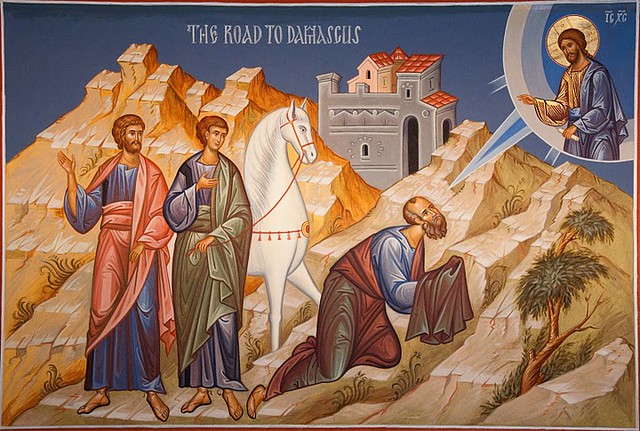
Flipped-Turned Upside Down

Acts 9.1-4

Meanwhile Saul, still breathing threats and murder against the disciples of the Lord, went to the high priest and asked him for letters to the synagogues at Damascus, so that if he found any who belonged to the Way, men or women, he might bring them bound to Jerusalem. Now as he was going along and approaching Damascus, suddenly a light from heaven flashed around him. He fell to the ground and heard a voice saying to him, “Saul, Saul, why do you persecute me?”

When I was in seminary I made myself available to friends who were serving churches if they ever needed someone to preach on a Sunday morning. I wish I could say the offer was purely altruistic, but it was mostly born out of a desire to get some experience before serving my own church one day. It was always exciting to arrive on a Sunday morning, to a church full of strangers, and stand up to preach the Word.

But it usually went poorly.

On one occasion I forgot to take up an offering and the congregation was more than happy to not pass around the plates. I preached at one church that had no bathrooms and I was encouraged to “use a tree out back” so I bounced back and forth behind the pulpit until the end of the service and quickly drove to the nearest gas station. And there was one particular Sunday when I got lost on my way to the church, and by the time I arrived they had already gone through two hymns and I was told they figured someone would show up to preach eventually.

But perhaps the most indelible memory took place one Sunday after worship during which a man in a handsome business suit approached me in the narthex and declared, “That Paul sure was in a heap of trouble. It’s a good thing Jesus was there to set him straight!” 

The conversion of Saul, the so-called Damascus Road Experience, has penetrated the thoughts and imaginations of Christians for centuries. It’s one thing to question Jesus’ decision to enlist the help of a bunch of (not even very good) fishermen to spread the Good News, it’s another thing entirely to consider the Lord choosing Saul, the persecutor of the faith, to become the chief evangelist for the faith.

I cherish that narthex comment about Paul because, up to that point, I always thought of Paul being good and fine until Jesus showed up to complicate his life. Which, to be fair, isn’t necessarily wrong. He had power and prestige, he even had a calling in his life, and then everything got flipped-turned upside down. It’s also true in our lives that things seem to be well and good until the Lord encounters us and we cannot remain the same.

But, as that man so wonderfully put it, Paul was in a heap of trouble until the Lord changed him. Things might have felt and looked good in life, but what kind of life is it to spend all of your time persecuting others? Jesus said, “I have come to give life, and to give it abundantly.” Whatever Paul’s life was before Damascus, it could not compare at all to what it was after.

And so it is with us. 

For some the Lord uses a bright wake up call to the life of faith. For others we know no other way because we’ve been part of the church for as long as we can remember. And for others it’s somewhere in between. But the Lord gets what the Lord wants. God is in the business of transformation. We, all of us, were in a heap of trouble until the Lord came to set us free. And now, like Paul, we live in the world turned upside down.

Who’s In Charge Here?

Revelation 1.4-8

John to the seven churches that are in Asia: Grace to you and peace from him who is and who was and who is to come, and from the seven spirits who are before his throne, and from Jesus Christ, the faithful witness, the firstborn of the dead, the ruler of the kings of the earth. To him who loves us and freed us from our sins by his blood, and made us to be a kingdom, priests serving his God and Father, to him be glory and dominion forever and ever. Amen. Look! He is coming with the clouds; every eye will see him, even those who pierced him; and on his account all the tribes of the earth will wail. So it is to be. Amen. “I am the Alpha and the Omega,” says the Lord God, who is and who was and who is to come, the Almighty.

There’s a moment that happens every single Sunday without fail. It doesn’t matter what the context is, or what music is offered, or even what scripture is read. 

It happens right before I stand right here.

There’s a silence.

An eerie silence.

Perhaps it sounds different to me than it does to all of you. Your experience of the strange silence might be born out of discomfort or awkwardness.

But as far as I can tell that moment happens every week and its special; there is true attention and silence. And in that silence there is hope.

People like you and me hope, even for but a moment, that this time we will hear an answer to the question: Is it true?

Sadly, more often than not, that hoped for question isn’t even addressed. And if it is, it is only done so indirectly. There’s an assumption that, just by being here, we all assume all of it to be true.

But that’s not right. I think we’re all here, the tall and the small, the first and the last, the believer, half-believers, and unbelievers, because we want to have our question answered.

Is it true?

Today is the second Sunday of the season we call Eastertide. It stretches all the way from Easter Sunday up to Pentecost Sunday, its the great 50 days. Every Sunday in this season is a little Easter in which we re-celebrate the most amazing thing ever to take place in the cosmos.

And let me tell you: you all are a special bunch. There is something remarkable about those in worship for the second Sunday of Easter. You’re here because you know that following the Lord is more than just being present for the big moments. You’re clued in to what takes place behind the curtain of the cosmos. You’ve experienced the Lord in such a way that you can’t imagine being anywhere else doing anything else.

But, we must confess, we of the second Sunday of Easter crowd, that the promises of Easter are not yet fully realized.

We need only turn on the television, or scroll through Twitter, to be reminded that not all is as it should be.

I, myself, riding the incredible wave of Palm Sunday worship was deeply grieved to receive a phonemail the Monday of Holy Week that my oldest friend in the world took his own life the night before.

We sang some good old gospel hymns down in Memorial Hall on Maundy Thursday, we shared the body and the blood of our Lord, and my family and I had to jump in the car to drive up to Alexandria so that I could speak at my friend’s service of death and resurrection the next day.

Not all is as it should be.

Easter Sunday, exactly one week ago, it was remarkable! First sunrise service in 100 years, the First Light Band had the whole sanctuary clapping, even our children shouted out the Good News in song and shakers. 

All told we had more than 300 people in worship last Sunday! Truly remarkable.

And, I’m no mathematician, but I don’t see 300 today.

Why is that? Why are there those who only darken the doors of the church twice a year? 

Much has been made of the so-called Chreasters, the C and E crowd. They come because of familial obligation, or guilt, or tradition. There’s a hope, even if people like me refuse to admit it, that one year they will actually all return the next Sunday. 

But the longer I do this, the more I understand that the church swells at Christmas and Easter because those who don’t normally attend know they have a better than good chance of hearing nothing but Good News: “The hopes and fears of all the years are met in thee tonight,” and “Christ the Lord is risen today!”

Part of the challenge is that we always proclaim the joy of the resurrection, in song, sacrament, and sermon, to people who, admittedly, feel like those two on the road to Emmaus. We know something has happened, but life beckons us elsewhere. 

It is true?

John the Revelator certainly seems to think so.

I don’t know what you know of John of Patmos and his epistle of Revelation. It is, perhaps, the most misunderstood book in the Bible and yet, at the same time, the most important. It, like the concluding chapter of any good book, ties everything together. But to drop in at the very end, without knowing the beginning or the middle is a recipe for disaster.

There are some wild bits to this book, some that we will encounter over the next few weeks, but, as GK Chesterton noted, “John saw many strange monsters in his vision, but he never saw a creature so wild as those who try to explain it all.”

John, whoever John was, wrote for a people living in a time in-between. They were stuck squarely between the already but the not yet, planted in the time before the end time.

You know, people just like us.

Easter people, while all is not as it should be.

Oddly enough, even with its bizarre images and confounding cassations, Revelation is an odyssey of encouragement. It tells us who we are, who God is, and what is the world is going on in the world.

To put it simply, it tells us the truth.

John begins, rather abruptly, with the decisive declaration that Jesus is Lord and King of the cosmos. He was, he is, and he will be. 

Jesus Christ is the faithful witness, the one who remains steadfast even when we don’t, he points to the real things that matter in this life, and he is committed to doing so no matter what.

Jesus Christ is the firstborn of the dead, he is the one who, by death and resurrection, makes possible an impossibility, that in our deaths we are raised to new life. 

Jesus Christ is the ruler of the kings of the earth, he is the one in charge.

I wonder though, if we actually believe that, or if we trust that to be true. I think, all things considered, it’s not difficult to affirm that Jesus is faithful, and that Jesus is risen. If it looks like Good News and it sounds like Good News. But Jesus being the ruler of the kings of the earth?

Its like a church meeting I remember attending long ago, certainly not something that would ever happen here, where we gathered for an important conversation, debate, decision making, and as we gathered voices were raised, accusations were made, and when finally came to the end of our appointed time, fists clenched, no wiser than we were when we stared, someone present had the audacity to ask if we might end our time in prayer.

I thought, “What for? We certainly didn’t behave like God was in the room, why invite the Lord in now?”

You see, when Jesus is in charge everything changes. And that doesn’t necessarily mean that it gets better. Have you read about the stuff he got up to the in the backwater towns of Galilee?

Are we sure we want Jesus to be in charge?

From the very beginning he predicted that those in power would reject him, and they did. I would say that’s strike one. Jesus has the gall to call all kinds of people who have no business being in the kingdom business. I mean, fishermen for disciples? Tax collectors for apostles? What’s next, bankers for Sunday school teachers? Lawyers on the mission committee?

Jesus is risky and foolish, spending all of his time among the last, least, lost, little, and dead. If we ever want to make the world a better place, we need a leader who’s going to spend time with the first, the best, the found, the big, and the lively.

What kind of leader forgives betrayers? What kind of ruler leaves ninety-nine behind to find the one who is lost? What kind of king hosts a banquet and invites everybody to attend?

Jesus.

John reminds us, across the centuries, through the power of words that Jesus is the one in charge, and in his infinite and confounding wisdom, he loves us, he has freed us from our very worst mistakes, and he has made us into a new people who will always feel like strangers in a stranger land. 

And, to be clear, being in charge doesn’t mean being in control. If God in Christ is the author of every war, cancer diagnosis, and car crash then God isn’t worthy of our worship. But as the one in charge it means that God in Christ is the one we follow. He leads the way.

It is to Jesus, John says, that we owe our allegiance because he does for us what we cannot do for ourselves – he makes a way where there is no way. He, himself, is Easter for us.

The key according to the Revelator, the important truth that will be brought up again and again, is that it’s all up to Jesus. We can absolutely respond to what Jesus has done, we can even take up our crosses to follow, but he’s the one in charge, he gets all the good verbs. He, to put it plainly, is the Alpha and the Omega, the A and the Z.

Jesus came to raise the dead. He did not come to reward the rewardable, or improve the improvable, or correct the correctable; he came simply to be the resurrection and the life for people like you and me, the good and the bad and the ugly. 

The message of Revelation, of the one who is, and was, and is to come, is that it isn’t over yet. Easter is still happening. Until we all feast at the Supper of the Lamb, we will live in the in-between – the place where we vacillate between mourning and dancing, crying and laughing. 

Every Easter we make the same declaration – Christ is risen! But that’s a little deceptive. It is true, but we have more to say: Christ is risen, and he’s in charge. Amen. 

Trading My Sorrows

This week on the Strangely Warmed podcast I speak with Bryant Manning about the readings for the Third Sunday of Easter [C] (Acts 9.1-6, Psalm 30, Revelation 5.11-14, John 21.1-19). Bryant is the director of the Wesley Foundation at FSU. Our conversation covers a range of topics including seminary salutations, campus ministries, silent retreats, the call of Saul, humbling humility, praying the psalms, divine anger, hand motions, nooma, the eschaton, choral singing, good worship, and texts for tweenagers. If you would like to listen to the episode or subscribe to the podcast you can do so here: Trading My Sorrows

It’s Better Than You Think It Is

This week on the Strangely Warmed podcast I speak with Drew Colby about the readings for the Second Sunday of Easter [C] (Acts 5.27-32, Psalm 118.14-29, Revelation 1.4-9, John 20.19-31). Drew is the lead pastor of Grace UMC in Manassas, VA. Our conversation covers a range of topics including strange intros, short sermons, eating in Eastertide, Raymond Brown, good trouble, Stanley Hauerwas, codas, timelessness, the firstborn of the dead, real peace, and the gift of faith. If you would like to listen to the episode or subscribe to the podcast you can do so here: It’s Better Than You Think It Is

A Strange New World

Luke 24.1-12

But on the first day of the week, at early dawn, they came to the tomb, taking the spices that they had prepared. They found the stone rolled away from the tomb, but when they went in, they did not find the body. While they were perplexed about this, suddenly two men in dazzling clothes stood beside them. The women were terrified and bowed their faces to the ground, but the men said to them, “Why do you look for the living among the dead? He is not here, but has risen. Remember how he told you, while he was still in Galilee, that the Son of Man must be handed over to sinners, and be crucified, and on the third day rise again.” Then they remembered his words, and returning from the tomb, they told all this to the eleven and to all the rest. Now it was Mary Magdalene, Joanna, Mary the mother of James, and the other women with them who told this to the apostles. But these words seemed to them an idle tale, and they did not believe them. But Peter got up and ran to the tomb; stooping and looking in, he saw the linen cloths by themselves; then he went home, amazed at what happened. 

Here we are for the strange and bewildering day we call Easter. All of the Bible, all of the church, all of Christianity hinges on this day: Easter, resurrection, out of death into life. If this story were not in scripture, we would’ve thrown our Bibles away a long time ago. 

If the Bible does not tell us this story, it tells us nothing.

Easter is the one day when all the hopes of the past are made manifest in the present. Some of you are here because you can’t imagine being anywhere else. Some of you are here because you desperately want and need to hear Good News amidst a world drowning in bad news. Some of you were dragged here against your will.

So, no matter who you are or even why you’re here, hear the Good News: He is risen! Hallelujah! 

No one saw the resurrection of Jesus.

There’s plenty of art and films and even songs that attempt to describe the event that we are here to celebrate, but the strange new world of the Bible tells us, in all four gospels, that no one saw it. Not Peter, not Mary Magdalene, not anyone.

Jesus was already gone from the tomb when the stone was rolled away.

And perhaps, oddly enough, that’s a good thing. For the resurrection is beyond our ability to understand or comprehend – it comes to us from an entirely different sphere of reality.

It breaks all the rules.

The women wake up on the third day knowing full and well what to expect. They travel to the tomb with spices to anoint Jesus’ body for burial. They’ve run out of tears since Friday, perhaps they even travel in silence, the real and terrible sound of grief. But when they arrive the stone is moved and the body is gone.

And behold two men in dazzling clothes appear and the women fall to the ground in fear and reverence. “Why do you look for the living among the dead?” They say, “He is not here, he is risen!”

Their rebuke reverberates through the centuries. To this day we still look for new life in all the wrong places, hoping to gain control over something that is fundamentally out of our control.

We still set our minds on earthly things, we seek the living among the dead, but we rarely notice it. We cling to various things in life because life is so uncertain – tomorrow is never promised. So we hold desperately to those things we think give us life. Our jobs, spouses, children, on and on. But things largely stay the same.

So we flip through the never-ending abyss of Netflix searching for a momentary reprieve in a life of monotony, we listen to podcasts at 1.5x speed because we don’t feel like we have enough time between all of our timely events, all while we go from day to day knowing not what we are doing or why we are evening doing it. 

We know longer no what it means to be surprised.

And then BAM Easter!

Easter is the great disruption, the exodus for the rest of us, the beginning of a strange new world.

Kurt Vonnegut said that most good stories occur when a character gets unstuck in time. Our lives, therefore, only really become interesting when the time of our lives is disrupted and unstuck from its normalcy.

The women in Luke’s gospel travel to the tomb with predictable expectations – the dead stay dead. They knew that everything was out of their control, until they heard the announcement that Christians have been shouting throughout the centuries: He’s not here, he’s risen!

No wonder the story ends so strangely – the women just go home, amazed. Easter sets them, and us, on a course from which we leave provoked, unsettled, disoriented. Life will not, and cannot, be the same. But how can we possibly respond to the most unexpected thing in the world?

The tomb was empty, the body was gone. He is risen.

This is the proclamation of Easter and yet, proclaiming the resurrection is so difficult and so challenging because the resurrection cannot be made into a metaphor; it cannot be reduced into a charming story.

Easter is not the celebration of spring, it is not new life shooting up from the soil. It is not a quaint little tale of how love is stronger than death. It is, instead, something completely unlooked for, something without any precedent, and something that leaves us truly amazed. 

Easter proclaims that God is the Lord of disruption. It is among the roads of life, the traveling among the dead while looking for the dead, that Jesus shows up, becomes time itself for us, takes our time, and transforms the cosmos.

All these centuries later, with our sanctuaries and our lilies and our songs and our sermons, it can all feel like Easter is just one more thing that happens to Jesus. But that’s not right. Easter is the happening of Jesus to all things. Jesus doesn’t change on Easter – everything is changed because of him.

Any attempt, therefore, to find a way to make Easter relevant or new or relatable is a fool’s errand because Easter is unlike anything else and the best we can ever hope to do is point toward it. 

The proclamation of Holy Week, the entry into the city, the meal on Thursday, the cross on Friday, the empty tomb on Sunday, they run counter to just about everything else in life – they don’t give us ways to be better human beings, they aren’t commandments about how to make the world more bearable. They are not about what we do, but are instead about what is done to us. And that what has a name: Jesus Christ. 

The amazing part of Easter is that we don’t have to do anything for it to happen.

Jesus does for us what Jesus does whether we deserve it or not. God in the flesh comes to dwell among us and we return the favor by nailing Jesus to the cross. And, three days later, God gives him back to us.

You see – Jesus doesn’t wait behind the stone until his disciples have just the right amount of faith before breaking forth.

Jesus doesn’t tell them that he will be raised only when they’ve evangelized the right number of people.

Jesus doesn’t even given them a to do list to do before Easter happens.

We, the good and righteous folk that we are, we’re in church on Easter after all, we might’ve thought the story was over – that the shadow of the cross was the final word.

But in the strange new world made possible by God, only Jesus gets the final word because he, himself, is the Word incarnate.

On Easter God took the cross, a sign of death to the world, and made it the means of life. 

The promise of the resurrection is that nothing can ever separate us from God’s love, not even death. Jesus’ pronouncement from the cross, “Father forgive them for they do not know what they’re doing” frees us from all of our sins, past, present, and future. Easter means that one day we too will rise to join in the feast at the supper of the Lamb.

Can you imagine anything more wonderful than this?

The first disciples were amazed by what they saw and heard that first Easter morning.

We still are. 

The promise of the resurrection for people like you and me is wild beyond all imagining. It is the gift of life in the midst of death, it is a way out simply by remaining in, it is everything for nothing.

It is, to put it simply, amazing. 

Nothing more, nothing less, and nothing else.

He is risen! He is risen indeed! Hallelujah! Amen. 

The Living Daylights

Mark 16.1-8

When the sabbath was over, Mary Magdalene, and Mary the mother of James, and Salome bought spices, so that they might go and anoint him. And very early on the first day of the week, when the sun had risen, they went to the tomb. They had been saying to one another, “Who will roll away the stone for us from the entrance to the tomb?” When they looked up, they saw that the stone, which was very large, had already been rolled back. As they entered the tomb, they saw a young man, dressed in a white robe, sitting not he right side; and they were alarmed. But he said to them, “Do not be alarmed; you are looking for Jesus of Nazareth, who was crucified. He has been raised; he is not here. Look, there is the place they laid him. But go, tell his disciples and Peter that he is going ahead of you to Galilee; there you will see him, just as he told you.” So they went out and fled from the tomb, for terror and amazement had seized them; and they said nothing to anyone, for they were afraid. 

I hid in the tomb for what felt like hours but was only 30 minutes. It was Easter Sunday half of my life ago, and I had been volunteered to participate in the sunrise service. Out on the front lawn was a fake tomb and a fake stone that we set up every year. The idea was that, on Holy Saturday, you would drive by and see the stone blocking the entrance to the tomb and then, on Easter Sunday, you would arrive at church to see the stone rolled away like all those centuries ago.

But this particular year the associate pastor had a plan to give the people an Easter they’d never forget. He conscripted me to arrive before everyone else, don an angelic costume, and wait inside the tomb with a fog machine until the perfect moment to proclaim the resurrection. 

So I sat crumpled up in the corner with my cherubic wings folding in on themselves. Neither of us had anticipated how cramped the space would be, not did we think about how difficult it would be to hear my cue from inside the tomb.

Therefore, after the congregation arrived, and the service began, and I heard what I thought was my first cue, I turned on the fog machine and waited to make my dramatic entrance.

But the space filled with the smoke very quickly and I couldn’t see or hear anything. 

I began coughing in the tight space and tried my best to stay hidden until I could no longer stand it and I kicked down the papermache stone and stumbled onto the front lawn.

As the smoke dissipated, I took in the scene around me. Genteel Christian folks were arranged in a semi-circle of fold up camping chairs, the pastor was standing by a podium no doubt only halfway through his sermon, and everyone was starring at me.

I don’t know quite what I looked like, but I certainly looked more like someone who accidentally slept in the tomb overnight than I did an angelic messenger of the Lord.

For the briefest of moments I panicked, unsure of what to say or do. I had memorized a monologue to proclaim but it completely evaporated from my mind. Instead, I shouted “The Lord is risen!” And I ran for my life.

To this day I don’t know what everyone made of that moment. We tacitly agreed to never speak of it, though I’m sure more than a few walked away that Easter afraid.

Much has been made about the women fleeing from the tomb in fear that first Easter morn. Some say that Mark did not intend to end the gospel in such a way, that perhaps he died mid sentence, or the earliest manuscript was torn in that exact spot, on and on the speculations run wild.

We don’t why Mark ends the Gospel this way, only that the first of us to experience the resurrection walked, actually ran, away from it with fear.

I’ve always found that detail to be rather staggering every time the liturgical calendar comes around. For, in a few hours, most of us will be inside our actual churches with lilies, and pastelcolor outfits, and peppy hymns, and smiling congregants.

Nothing about Easter screams fear.

Except for the strange new world of the Bible. 

It is good and right for us to be here in worship in a cemetery. It’s the same kind of place where the first Easter happened, and it reminds us of the stark promise of salvation. That is, no one ever goes to a cemetery expecting to encounter a resurrection.

We go to cemeteries to commune among the dead.

It’s also good to be here this early, because Easter, resurrection, it happened in the dark.

New life always starts in the dark, whether it’s a seed in the ground, a baby in the womb, or Jesus in the tomb, new life starts in the dark.

In addition to the dead, and the darkness, I think the other reason is is good to be afraid on Easter is because it has little, if anything to do with us.

We aren’t the ones who makes Easter possible. God is the one who makes a way where there is no way, God is the God of impossible possibility, God is the God of resurrection.

It’s why we can call the Good News good.

But if the Good News is in fact, good news, then why do the women run in fear? 

All life ends in death, the bell will toll for us all. How else, then, could anyone respond if the one certainty in life was no longer certain?

Easter confronts us with the scary reality that we aren’t in control, because God is.

That’s a frightening thing to accept because God truth means our obsession with earthly things really amount to nothing. All of the things we fret over most, life, beauty, security, wealth, power, careers, property, even our families cannot hold a flame to the promise of the resurrection. 

Jesus does for us what Jesus does whether we deserve it or not. God in the flesh comes to dwell among us and we return the favor by nailing God to the cross. And, three days later, he is resurrected.

You see – Jesus doesn’t wait behind the stone until his disciples have just the right amount of faith before breaking forth.

Jesus doesn’t tell them that he will be raised only when they’ve evangelized the right number of people.

Jesus doesn’t even given them a to do list to do before Easter happens.

The promise of the resurrection for people like you and me is wild beyond all imagining. It is the gift of life in the midst of death, it is a way out simply by remaining it, it is everything for nothing.

And it just might scare the living daylights out of us.

Easter isn’t perfect. For some it creates more questions than answers. For the women at the tomb it was scary and astonishing. For the church folk gathered when I bumbled out of the fake tomb it was strange and a bit bizarre. Easter can both excite and terrify. And thats because is shatter all of our expectations about how the world is supposed to work. Easter means everything is changed forever.

The end of Mark’s gospel, this weird and wonderful detail about the women running away in fear, it’s no ending at all. It is the great ellipsis in which the story continues through us. The women at the tomb, all of us in this cemetery, we are now caught up in God’s great story of salvation. We are here not because of what we’ve done or left undone, but because something was done to us. That something has a name: Jesus Christ.

Hear the Good News: The end has no end.

He is risen. Hallelujah! He is risen indeed! Amen.

The Divine Ellipsis

This week on the Strangely Warmed podcast I speak with Drew Colby about the readings for the Resurrection of the Lord [C] (Isaiah 65.17-25, Psalm 118.1-2, 14-24, 1 Corinthians 15.19-26, John 20.1-18). Drew is the lead pastor of Grace UMC in Manassas, VA. Our conversation covers a range of topics including McDonalds, Easter songs, champagne, ecclesial delight, the super psalm, good verbs, lectionary podcasts, Adam’s helpless race, commandment keeping, the destruction of death, All Things Beautiful, skepticism, and brevity. If you would like to listen to the episode or subscribe to the podcast you can do so here: The Divine Ellipsis

Jesus Saves

Psalm 118.1-2, 19-29

O give thanks to the Lord, for he is good; his steadfast love endures forever! Let Israel say, “His steadfast love endures forever.” Open to me the gates of righteousness, that I may enter through them and give thanks to the Lord. This is the gate of the Lord; the righteous shall enter through it. I thank you that you have answered me and have become my salvation. The stone that the builders rejected has become the chief cornerstone. This is the Lord’s doing; it is marvelous in our eyes. This is the day that the Lord has made; let us rejoice and be glad in it. Save us, we beseech you, O Lord! O Lord, we beseech you, give us success! Blessed is the one who comes in the name of the Lord. We bless you from the house of the Lord. The Lord is God, and he has given us light. Bind the festal procession with branches, up to the horns of the altar. You are my God, and I will give thanks to you; you are my God, I will extol you. O give thanks to the Lord, for he is good, for his steadfast love endures forever. 

Every pastor has a favorite Palm Sunday story.

Like the year when the palm branches were delivered way too early and dried out so much that when the gathered congregation shook them over their heads in worship, palm branch particles went flying in every direction resulting in sneezing and coughing fits among the people of God.

Or the time when the pastor thought it would be a great idea to dress up like a donkey and preach the sermon from the perspective of the animal that carried Jesus into Jerusalem, to which the pastor received perhaps the greatest Sunday morning comment of all time: “You know, you’re not the first donkey we’ve had in that pulpit.”

Only they used a different word for donkey.

Or the time when the children of the church processed in waving their palm branches and lifting up their hosannas only to begin smacking one another in the face with their aforementioned palms until a nearby parent had to jump in to break up the melee and mutter, a little too loudly, “Lord, save me from these kids!”

And I think the reason preachers like me like to tell a cute or funny little story about Palm Sunday is because the actual story of Jesus’ triumphal entry into Jerusalem is rather confounding.

Put another way: Palm Sunday is perhaps the strangest Sunday of the year.

For, it begins in celebration and ends in catastrophe. It starts with “Hosanna” but it finishes with “Crucify.” It begins with life and it ends with death.

At they are approaching Jerusalem Jesus sends two of his disciples to procure a colt for his entry into the holy city. He rides in a cartoonish way, with his feet nearly dragging on the ground on either side of the animal, and the people of Jerusalem comes out in droves to see the would-be Messiah. They are overcome with reverence, so much so that they begin to take their own clothing, and spread it on on the road only to be trampled upon by the colt. They make a royal carpet as they worship the King of kings.

They take leafy branches from the fields and they wave them to and fro and they shout, “Hosanna! Blessed is the one who comes in the name of the Lord! Blessed is the coming kingdom of our ancestor David! Hosanna in the highest heaven!”

Hosanna. I’ve always loved that word. It’s such a churchy word. It makes me think of my own childhood and parading around the sanctuary. It makes me things of the musical masterpiece Jesus Christ Superstar and the crowds singing, “Hey sanna Hosanna, sanna sanna Hey, sanna ho sanna hey sanna.”

Hosanna is a wonderful word. And, every Palm Sunday, we reach into the vault of churchy words, we dust off this old familiar declaration, and we proudly put it on display. We shout it in our hymns, we put the word on the lips of our children, we hear it read in the scriptures. And then, at the conclusion of worship, we wrap it up and place it back into the church vault with our other special words only to come back one year from now.

We are familiar with this word. It conjures memories and songs. Churches everywhere will join us in our shouts of Hosanna today.

But do we know what it means?

Save us.

It is a declaratory pleading. It is an emphatic demand.

Save us. Now!

Saved?

That’s a word you don’t hear much in churches like ours. We’re Methodists. We sing and we eat and we sing some more. We try to love each other. Really, we do. 

Love, peace, grace, mercy, forgiveness. Those are our words.

But saved?

How many got saved on Sunday? We don’t talk like that. 

We might make fun of those other types of church that talk in such a way. 

I remember someone once asking me if I was saved, and I said something like, I suppose so, and he said he’d been saved no less than 9 times.

Hosanna! Save us!

Really? 

Well, perhaps we should go look in the Bible for this word, where else does it appear besides Jesus’ triumphal entry into the city that will kill him?

There’s a woman, suffering from a hemorrhage for 7 years. She’s among the crowd one day and she says to herself, “If I but touch the hem of his garment I will be saved.” 

Well, in our Bible’s it says, “made well.” 

But it’s the same word for saved. The same word the crowds cry out as Jesus’ enters Jerusalem. 

And she suffers from more than just her bleeding. She’s isolated, outcast, thrown away by the likes of her family and her friends. She is a nobody with no hope in the world. Until the hope of the world walks past one day and she reaches out. She’s got nothing until she gets saved.

Jesus saves.

There’s a blind beggar sitting by the roadside. Like the woman he is unseen by all because of his inability to see. Forgotten and abandoned. And when the Lord walks by he shouts out, “Son of David have mercy on me.” The disciples are quick to shut him up. The Lord has more important things to do than to waste his time on you.

But the Lord comes anyway and says, “What do you want me to do?” 

I want to see. 

And Jesus says, “You faith has saved you.”

He has nothing to show for anything. He’s desperate. And in a moments notice, he is in the parade of the faith. Dancing and shouting for joy. 

Jesus saves.

There’s a rich man, well to do, Mr. Z they call him behind his back. While his fellows get poorer and poorer he gets wealthier and wealthier. He’s a tax collector. One day he climbs a tree to see Jesus. And the Lord calls him down and says, “Got any plans for lunch?”

They go to Zacchaeus’ house and the crowds are incensed. How dare the Lord go to eat with that sinner! What do they talk about over lunch? We don’t know. We only know that as they leave the house the tax collector is changed. He says, “I will give back everything that I have taken with interest.” 

“Salvation” Jesus says, “has come to this house.”

Jesus saves.

It’s no wonder the crowds grew and grew and grew. It’s no wonder the strange new world of the Bible talks of people leaves their plows in the field and their bread in the oven when the Messiah shows up. 

Because the Messiah is the one who saves.

And there’s no such things as being a little bit saved, or partially saved. It means a total and complete salvation. 

So when they wave their palm branches, when they place their cloaks on the road, they scream for salvation from the only one who can bring it.

Hosanna! Save us Jesus!

Save us, from what?

Jerusalem is occupied, the Roman garrison enters the holy city on the other side. Pontius Pilate comes riding in on a war course while Jesus enters on a donkey. The people of God, therefore, are living as strangers in a strange land in the very land God had promised. Their way of life is fracturing, their faith is under scrutiny, they have no bright hope for tomorrow. 

And here comes the Messiah! The one who makes everything right! He’s saved others and now he’s going to save us. He’s going to give us our city back. He’s going to bring back our way of life. He’s the new king!

The crowds grow and grow, and the shouts of Hosanna echo through the city streets, until they see the cross.

It is strange and not so strange to know that those same people who shouted Hosanna at the beginning of the week were shouting crucify by the end.

It’s all too easy for us to cast Jesus into role of our own choosing.

It’s all too easy for us to put words, our words, into Jesus’ mouth.

We would still like to see him parade around into the madness of our circumstances to champion our hopes and dreams, to disrupt and frustrate the plans of our enemies.

But Jesus doesn’t come to bring us more of the same.

Jesus comes to save us.

He doesn’t enter the holy city to establish yet another political machine that result in one group lording it over everyone else.

He doesn’t pass out swords and shields to storm the temple walls.

He doesn’t even offer programs of personal morality that will make the world a better place.

One of the craziest parts of Palm Sunday is that, according to the strange new world of the Bible, Jesus doesn’t say anything.

He merely rides into the city that will kill him.

But it’s Palm Sunday. We don’t want to have to think about Friday yet. We like the images and the sounds of our children waving palm branches high in the air. But there is no jumping from today to Easter Sunday.

Put another way, we do well to remember there is no resurrection without crucifixion.

It’s in our hymns and in our creeds and even in our prayers, but we try to stay away from the crucifixion as much as possible. And for good reason – it is the sign of our total and utmost depravity. But it’s also the heart of God. 

God, the creator of the cosmos, lays aside almightiness to come and dwell among us in the muck and mire of life, to be one of us.

God becomes vulnerable for us.

And how do we return the favor?

Crucify, Crucify!

Why? Because we want salvation on our own terms. We want to take matters into our own hands. We want to save ourselves. 

We don’t want to be saved in our sins, we’d rather lord it over other sinners who are worse than us. The only problem with that is, according to the kingdom of God, none of us is righteous, no, not one. 

You see, we crucified Jesus not because he was God, but because he was God and then failed to come up to our standards in doing so. It’s not that we weren’t looking for the Messiah; it’s just that he wasn’t the one we were looking for.

We’re fine with being saved only so long as it fits neatly into our expectations of what it means to be saved. 

The crowds wave their branches and they shout their hosannas. Save us Jesus, save us! And, by the end of the week, that’s exactly what he does, whether we deserve it or not, whether we like it or not.

Jesus saves.

O give thanks to the Lord, for he is good, for his steadfast love endures forever.

Even on the cross.

Jesus saves. Amen. 

One Week

Luke 19.28

After he had said this, he went on ahead, going up to Jerusalem. 

Fleming Rutledge, patron saint of the Crackers & Grape Juice podcast, has often waxed lyrical about the need for preachers to proclaim the Word rather than explain the Word. Explanation often leads to exhortation; the Bible says this so we have to do that. But the Good News is an announcement that God has come into the world and we now live in the light of that in-breaking.

In other words, the gospel is a story – it is the story of God’s people Israel which culminates in the life, death, and resurrection of Jesus Christ. The gospel is not a program, or a set of beliefs, or a collection of rules, or an explanation of how to wind up in the right place when you die.

The gospel is a story, in fact it is the story. 

And preachers do well to tell the story, rather than explain it.

Therefore, here just a few days before Palm Sunday and Holy Week, here is one preacher’s attempt to tell the story of Jesus’ last days before the cross and resurrection…

It was early in the morning when Jesus sent two of his disciples to a village to find a suitable farm animal: a donkey. The time had come to enter the holy city of Jerusalem for Passover, a time when the city’s population would balloon up to 200,000 for the celebration. On a Sunday morning, the crowds gathered with palm branch and shouts of “Hosanna!” they placed their cloaks on the road as a sign of their devotion to the arriving king, and Jesus entered Jerusalem. 

At the same time, on the other side of the city, Pontius Pilate (the Roman Governor of Judea) entered with at least 1,000 soldiers demonstrating the power of the empire. 

One arrived on a donkey, the other arrived on a battle horse.

With the city coming into focus, Jesus began to cry. He looked over the temple and the people of God and he wept. 

And there was evening and there was morning, the first day.

On Monday Jesus made his way to the Temple with countless other Jews. With the triumphant and parodic entry the day before, all eyes were on this so-called Messiah. As his feet walked over holy ground, Jesus encountered the moneylenders and changers who set up shop in the temple courtyard. They were profiting off those who traveled great distances to make their ritual sacrifices and boosted their prices in anticipation of economic gain.

Jesus, who spent the better part of three years berating the elite for taking advantage of the last, least, lost, little, and dead, became incensed when he saw the poor being ripped off in the name of God. He therefore walked straight over to the tables, lifted them off the ground, and went into a full blown temple tantrum. He declared for all to hear: “This is my Father’s house and you’ve made it into a den of robbers!”

The elite and the powerful now had their eyes set on Jesus. It was one thing to have a crowd with palm branches welcoming a poor rabbi into the city, but it was another thing entirely when he disrupted the status quo particularly when it came to the economic practices of the Temple. The leaders started looking for a way to discredit him, or remove him completely. 

And there was evening and there was morning, the second day.

On Tuesday, Jesus once again entered the Temple and he began to teach. If people were excited to see him enter the city, they were now even more eager for a chance to hear and see the One who had been making waves in Galilee, the One who flipped the tables the day before.

While he was teaching the Pharisees and the religious leaders began interrupting and demanded to know from whom Jesus received such authority.

And Jesus, who used parables to teach his disciples and followers, responded to their accusations with head scratching stories about mustard seeds and prodigal sons and kingly banquets. Over and over he used examples to show how those in the places of authority had lost sight of their responsibility and he labeled them hypocrites, snakes, and broods of vines.

They tried to trap him in his words, but he continued to point to the in-breaking kingdom of God.

And there was evening and there was morning, the third day.

On Wednesday Jesus left the arena of the Temple and continued his teaching on the Mount of Olives. Some of his disciples made comments about the glory of the Temple and Jesus responded with talk of destruction. He revealed images of God’s cosmic plan for the world made manifest in himself, and he called for his disciples to stay vigilant.

He continued to speak his parabolic utterances and even offered a sermon describing the great inversion of all things. 

His presence and proclamations continued to threaten those in power and they grew afraid.

And there was evening and there was morning, the fourth day.

On Thursday Jesus continued his preaching and teaching until he retreated away with the twelve for their observance of Passover. While sitting at the table they remembered God’s mighty acts for the people Israel as they were delivered from slavery to sin and death into the Promised Land. But before the supper was finished, Jesus did something rather radical. He took a loaf of bread, gave thanks to God, broke it, and gave it to his friends while saying, “This is my body, I’m giving it for you.” Later, he took the cup, gave thanks to God, and gave it to his friends while saying, “This is my blood, and I’m pouring it out for you and the world.”

He knew one of his disciples at the table would shortly betray him to the authorities, and he offered him his body and blood anyway.

Later in the evening they went to the garden of Gethsemane, and Jesus urged his disciples to stay awake while he prayed. He knelt on the ground and ended his prayer by saying, “Lord, with you all things are possible; remove this cup from me; yet, not what I want, but what you want. Let your will be done.”

At the conclusion of the prayer, Judas arrived with soldiers. They grabbed and arrested Jesus while the disciples fled into the distance. 

And there was evening and there was morning, the fifth day.

On Friday Jesus was brought to the Roman leader Pontius Pilate. The religious authorities demanded Jesus’ execution by crucifixion, but Pilate could find no fault with Jesus. Pilate then gave the gathered crowds a choice: they could free a rabble rouser named Barabbas or the messianic Jesus of Nazareth.

They chose Barabbas.

Soldiers whipped and beat Jesus nearly to the point of death and then, to mock him, they placed a robe on his shoulder and a crown of thorns on his head. They forced Jesus to carry a cross, his own instrument of death, up to a place called The Skull.

The crowds berated him from either side of the road, “If you really are the Messiah, save yourself!” “Where are all your disciples now!” “Some King of the Jews you are!”

When he made it to the top of Golgotha, the soldiers nailed his hands and feet to the cross and they hung him high to die. With some of his final breaths Jesus offered a prayer that has haunted the world ever since, “Father, forgive them, for they do not know what they are doing.” 

With two thieves on either side hanging from their own cross, while some of his disciples watched from a distance, Jesus died.

And there was evening and there was morning, the final week.

And then, three days later, God gave him back to us. But that’s another story for another day.