The End of Questions

strangely-warmed-spreaker-header

This week on the Strangely Warmed podcast I speak with Kenneth Tanner about the readings for the 21st Sunday after Pentecost (Deuteronomy 34.1-12, Leviticus 19.1-2, 15-18, 1 Thessalonians 2.1-8, Matthew 22.34-46). Ken pastors the Church of the Holy Redeemer in Rochester Hills, Michigan and is a good friend of the podcast. The conversation covers a range of topics including the role of the theologian-pastor, why we should think about Moses when we think about MLK Jr., thoughts on the awesomeness of the BCP, and why we should spend less time trying to please people. If you would like to listen to the episode or subscribe to the podcast you can do so here: The End of Questions

books-of-common-prayer

Why Do We Give?

Matthew 22.15-22

Then the Pharisees went and plotted to entrap him in what he said. So they sent their disciples to him, along with the Herodians, saying, “Teacher, we know that you are sincere, and teach the way of God in accordance with truth, and show deference to no one; for you do not regard people with partiality. Tell us, then, what you think. Is it lawful to pay taxes to the emperor, or not?” But Jesus, aware of their malice, said, “Why are you putting me to the test, you hypocrites? Show me the coin used for the tax.” And they brought him a denarius. Then he said to them, “Whose head is this, and whose title?” They answered, “The emperor’s.” Then he said to them, “Give therefore to the emperor the things that are the emperor’s, and to God the things that are God’s.” When they heard this, they were amazed; and they left him and went away.

When I was in my final year of seminary, I had a friend who asked me to fill in and preach at his church one Sunday morning. He had labored for the previous years as a full time student and a full time pastor and needed a little break. Also – he was given tickets to a Carolina Panthers football game, though I was forbidden from telling his church that where he was instead of with them on a Sunday morning for worship.

The tiny United Methodist Church was in the middle on nowhere North Carolina, and I was nervous about leading worship for a congregation that I had never met. However, I figured God is good and that God would show up even if my sermon fell flat.

The sanctuary was simple and charming with white walls and florescent lights hanging from the ceiling, there was a cross above the altar that was draped with an American flag, and it was so quiet I actually thought that maybe I had showed up at the wrong church.

However, within a couple minutes, the lay leader of the church arrived and greeted me enthusiastically as if I was a first time visitor of the church, only to later realize that I was the stand-in pastor for the day. He quickly guided me through the sanctuary, gave me the grand tour (he even showed off the recently renovated bathroom) and then informed me that he was the head usher, the liturgist, the organist, and the treasurer.

From what I can remember the service went fairly well, through most of the congregation was utterly bewildered by academic deconstruction of an apocalyptic prophecy from the book of Daniel (something I thank gave up doing that day), and there was an infant who wailed throughout the entirety of the sermon. I like to think that she liked my preaching so much that it drove her to tears.

When the service ended, I finally had a better chance to look around the sanctuary and I noticed a list on the wall behind the pulpit for the hymns of the day, the offering brought in from the week before, and the deficit regarding the annual budget. There in big numbers for everyone to see was how far away they were from keeping up with their plan, and it was a staggering amount of money.

On my way out I thanked the lay-leader/usher/organist/treasurer for the opportunity to preach and asked why the church felt the need to display the deficit for everyone to see every Sunday.

I’ll never forget how casually he shrugged his shoulders and said, “Guilt is the only way to get them to give.”

Offering

Why do we give? Taking time to talk about financial giving in the church is about as awkward and uncomfortable as it gets. Money, in general, is one of the taboo topics of normal conversations. We don’t ask how much someone makes in a year, even if we’re curious. We avoid asking for financial assistance or help because it requires too much vulnerability. But then we take the taboo subject of money, and put it together with religion (another taboo) and we get the double whammy of things we don’t like talking about.

It seems some things never change.

The Pharisees and the Herodians wanted to trap Jesus in his words. “Tell us,” they said, “should we pay our taxes to the emperor, or not?” There’s no good answer to the question. If Jesus said, “Yes, you must pay your taxes” it would cause a rift among those who suffered under the weight of dictatorial Roman rule. And if Jesus said, “No, you don’t owe the government anything,” his critics could have charged him with insurrection and he would have been executed.

And it was all about money.

Jesus however, answered in a way that has captured the hearts and minds of Christians for millennia: “Bring me a coin… whose head is this and whose title?” The people responded, “The emperor’s.” And Jesus said, “Give therefore to the emperor the things that are the emperor’s, and to God the things that are God’s.” And when the crowds heard his response they were amazed and they went away.

2000 years later and taxes and money and giving still drive us crazy. It’s a hard subject to talk about. I certainly don’t enjoy it. We, and by we I really mean you and we, we would rather have a service about grace and mercy than one about sin and sacrifice. Which is strange when we consider the fact that Jesus talked about money more than just about anything else during his earthly ministry. For Jesus, money was a subject worth confronting because it had taken over the lives of his peers and it was leading them on a path of disappointment, regret, and fear.

We don’t like talking about money because what we do with our money is personal and private right?

collection-plate-money-hands

A UMNS photo illustration by Mike DuBose. Accompanies UMNS story #099. 3/20/12.

To talk about giving in the church, to address the subject of why we give, we have to get personal. It would be shameful for me to stand here each and every week calling for the gathered body to give your gifts to God if I, myself, was afraid to talk about my own giving. If we want to be a church of gifts, then we must first be a church of vulnerability and honesty.

Before I became a pastor, I rarely gave to the church. I have vivid memories of sitting in church throughout my adolescence, and feeling waves of guilt as I passed the offering plate over my lap to whomever else was in the pew. It helped that I was a kid and had no money to give in the first place but the guilt was still there.

It is a powerful thing here at Cokesbury when the children come up for their message and they place their offering in the plate. They are creating a habit of generosity that was largely absent from my childhood.

By the time I made it to college and seminary, I still attended church but rarely gave to the church. I certainly volunteered my time, led mission trips, and taught bible studies, but giving money to the church was not on my radar.

Then I was appointed to my first church. I had a steady income, and Lindsey and I started to tithe. And honestly it was really hard. We were a young married couple with seminary debt, and then we had a baby. Yet, we covenanted with God and one another to give 10%. In the first months it was harder that I thought it would be. I would find myself thinking about those thousands of dollars that I could have spent on other things, but we got into the habit and we kept giving. And after a while it became pretty easy because I just withheld the 10% from my paycheck and after time I stopped thinking about it at all.

But then we came here. We had to move and buy a house. It was easy when the money was taken out automatically, but now we needed to write a check and place it in the plate. There is a place of power and privilege that comes with being a pastor of the church, particularly when it comes to money. I get to sit up here while the offering plates make their way throughout the sanctuary. But the covenant to give is not one for pastors alone, nor is it for laypeople alone. The covenant to give is one made by all Christians, one that is challenging, but one that is ultimately what faith is all about.

My conversion toward tithing did not happen in a big shiny moment, but was a gradual transformation. The more I give, the longer the habit continues, the better it becomes, and things start to change.

            Instead of imagining what I could do with the money I’ve given to church, I’ve started tangibly witnessing what the money I give is doing for the church and for the kingdom.

Give, Donate, Charity

Giving to the church requires a conversion; it is built on a vision where we recognize how our blessings can be used to bless others. It is built on the knowledge that we give because so much has been given to us. It is built on the call to give not out of guilt, but out of generosity.

We are called to give because we have a shared vision and are invited into the mission of God through the church. Even a seemingly small act of generosity can grow into something far beyond what we could ever imagine – The creation of a community of love in this world.

Our generosity helps God build the kingdom here on earth.

But, we should not be expected to give, nor feel inclined to give without knowing why or to what we are giving. To just stand before you and say, “give give give” or to have a sign on the wall about out finances prevents us from developing strong relationships with the people and programs we serve. So, here are just three aspects of what our church does with our gifts.

At Cokesbury we believe in providing meaningful, fruitful, and life changing worship every week of the year. We plan months in advance, connect messages with the music, and look for imaginative ways to respond to God’s Word in the world. This means that we keep our sanctuary in the best shape possible for the worship of God, and use the great gifts of all involved in the church to make it happen. As a church we regularly welcome first-time visitors to discover God’s love in this place and help to develop professions of faith in Jesus Christ.

At Cokesbury, we believe in nurturing those in the midst of their faith journeys. We spend a significant amount of time and resources to help disciples grow in their faith and love of God and neighbor. We have numerous classes and opportunities to study God’s Word, whether its through Sunday School, Thursday Night Bible Studies, or Vacation Bible School. Everyone that participates in any of our groups is able to take what they learn and apply it to their daily lives whether they’re eight or eighty.

And at Cokesbury, we believe in witnessing to our faith in service beyond ourselves. We strive to serve those in need through a mosaic of opportunities in order to be Christ’s body for the world. Every year we have apportioned giving that directly impacts people in our local community and across the world. We provide support to agencies in our area like Hilda Barg and ACTS, and others. We help people with acute needs through discretionary accounts. And we have a great number of other missional activities that are all focused on helping other experiences God’s love through the work of the church.

We give from our abundance to bless others. Whether it’s the people in the pews next to us who gather for worship, kids from the community who show up for church events, or the countless people around the world who need help. We give out of generosity because so much has been given to us.

Sometimes when we read the story about Jesus’ response to the question of taxes, we liable to water it down to something like: Jesus leaves the choice up to us. Rather than falling into the trap of the Pharisees or the Herodians, rather than siding with the empire or inciting insurrection, Jesus breaks down the question and put the ball in our court.

But that leaves the passage without saying much of anything and prevents it from ringing out the stinging truth: We can put all of our trust in our money, we can use it to do all sorts of things in the world, but if we think that it all belongs to us, or has come to us simply because we deserve it, then we’ve failed to recognize the One from whom all blessings flow.

This passage about money isn’t so much about whether or not we should pay our taxes. Instead, it calls into question what we are doing with our money, and why we are doing what we are doing. It forces us to confront whether or not we believe God is the source of our being, or if we believe material objects can bring us satisfaction in this life. It begs us to reconsider what we’ve spent our money on, and if it helped the kingdom at all.

Give therefore to the emperor the things that are the emperor’s, and to God the things that are God’s. Yet, as Christians, we believe that we, and everything we hold dear, belong to God. Amen.

God’s Backside

strangely-warmed-spreaker-header

This week on the Strangely Warmed podcast I speak with Kenneth Tanner about the readings for the 20th Sunday after Pentecost (Exodus 33.12-23, Isaiah 45.1-7, 1 Thessalonians 1.1-10, Matthew 22.15-22). Ken pastors the Church of the Holy Redeemer in Rochester Hills, Michigan and is a good friend of the podcast. The conversation covers a range of topics including how God responds to prayer, reflections on people worshipping the nation more than the living God, why the old hymns are the good hymns, and thoughts about David Bentley Hart’s new translation of the New Testament. If you would like to listen to the episode or subscribe to the podcast you can do so here: God’s Backside 

KT

Many Are Called But Few Are Chosen


strangely-warmed-spreaker-header

This week on the Strangely Warmed podcast I speak with Teer Hardy about the readings for the 19th Sunday after Pentecost (Exodus 32.1-14, Isaiah 25.1-9, Philippians 4.1-9, Matthew 22.1-14). Teer currently serves as an associate pastor at Mt. Olivet UMC in Arlington, VA. The conversation covers a range of topics including what it means to be a “grass” church, how Christians are supposed to read the bible; wedding invitations, and consuming our golden calves. If you would like to listen to the episode or subscribe to the podcast you can do so here: Many Are Called But Few Are Chosen

many-are-called-few-are-chosen

The Ten Commandments vs. The Bill of Rights

strangely-warmed-spreaker-header

This week on the Strangely Warmed podcast I speak with Teer Hardy about the readings for the 18th Sunday after Pentecost (Exodus 20.1-4, 7-9, 12-20, Isaiah 5.1-7, Philippians 3.4b-14, Matthew 21.33-46). Teer currently serves as an associate pastor at Mt. Olivet UMC in Arlington, VA. The conversation covers a range of topics including why the West Wing was such a good show, the ten commandments becoming our golden calf, suffering, and discipleship. If you would like to listen to the episode or subscribe to the podcast you can do so here: The Ten Commandments vs. The Bill of Rights

TheWestWing-AboutImage-1920x1080-KO

God Isn’t Fair

strangely-warmed-spreaker-header

This week on the Strangely Warmed podcast I speak with Lindsey Baynham about the readings for the 17th Sunday after Pentecost (Exodus 17.1-7, Ezekiel 18.1-4, Philippians 2.1-13, Matthew 21.23-32). Lindsey is an elder in the Virginia Annual Conference of the United Methodist Church and currently serves as the Associate Director for Call, Candidacy & Discernment in the Center for Clergy Excellence. The conversation covers a range of topics including the prevalence of complaining, the differences between equality and equity, identity, and whether or not God is fair. If you would like to listen to the episode or subscribe to the podcast you can do so here: God Isn’t Fair

21199453_873285013490_6485396214584115227_o

Worthy of the Gospel

strangely-warmed-spreaker-header

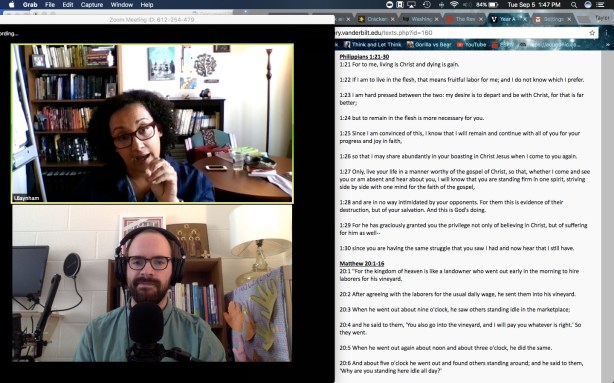
This week on the Strangely Warmed podcast I speak with Lindsey Baynham about the readings for the 16th Sunday after Pentecost (Exodus 16.2-15, Jonah 3.10-4.11, Philippians 1.21-30, Matthew 20.1-16). Lindsey is an elder in the Virginia Annual Conference of the United Methodist Church and currently serves as the Associate Director for Call, Candidacy & Discernment in the Center for Clergy Excellence. The conversation covers a range of topics including what it means to be “called”, the overabundance of arrogance, justice-oriented ministry, and the joy of serving the church. If you would like to listen to the episode or subscribe to the podcast you can do so here: Worthy of the Gospel

LB image

An Inconvenient Truth

Matthew 18.21-35

Then Peter came and said to him, “Lord, if another member of the church sins against me, how often should I forgive? As many as seven times?” Jesus said to him, “Not seven times, but, I tell you, seventy-seven times. For this reason the kingdom of heaven may be compared to a king who wished to settle accounts with his slaves. When he began the reckoning, one who owed him ten thousand talents was brought to him; and, as he could not pay, his lord ordained him to be sold, together with his wife and children and all his possessions, and payments to be made. So the slave fell on his knees before him, saying, ‘Have patience with me, and I will pay you everything.’ And out of pity for him, the lord of that slave released him and forgave him the debt. But that same salve, as he went out, came upon one of his fellow slaves who owed him a hundred denarii; and seizing him by the throat, he said, ‘Pay what you owe.’ Then his fellow slave fell down and pleaded with him, ‘Have patience with me, and I will pay you.’ But he refused; then he went and threw him into prison until he would pay the debt. When his fellow slaves saw what had happened, they were greatly distressed, and they went and reported to their lord all that had taken place. Then his lord summoned him and said to him, ‘You wicked slave! I forgave you all that debt because you pleaded with me. Should you not have mad mercy on your fellow slave, and I had mercy on you?’ And in anger his lord handed him over to be tortured until he would pay his entire debt. So my heavenly Father will also do to every one of you, if you do not forgive your brother or sister from your heart.”

I don’t know what it is about weddings, but people really let themselves go when they gather to celebrate two individuals joining together. Maybe it’s the beauty of a ceremony focused on love, or perhaps it’s the atmosphere of family members and friends rejoicing together, or maybe its just the abundance of free alcohol, but weddings are a rare moment where people appear to be the truest selves.

If you were here last week you’ll know that I wasn’t. While Michael was bringing the Word I was flying back from Maine where I had just presided over a wedding ceremony for one of my best friends. And I want you all to know that I missed you. I missed being here in this place worshiping together, I missed the choir, I missed seeing all of your beautiful faces.

That’s not to say that I had a bad time at the wedding. On the contrary, I had a great time. People were so over-the-top with their compliments about the wedding sermon and ceremony, perhaps because of the libations, or maybe because many of the people in attendance had bad experiences of weddings in the past and I offered something different. I don’t know what it was, but people seemed to like it.

Now, I want to share with you all that I made a few mistakes at the wedding. During the prayer before the dinner at the reception I made an offhand comment about how people needn’t hide their wine glasses behind their backs when they talk to me because, after all, Jesus’ first miracle was turning water into wine. I even prayed about how we should celebrate together and learn to party like Jesus.

If only I hadn’t used those last three words. Because, throughout the rest of the evening, a slew of people who were really enjoying themselves would wander over, slap me with a high five and scream, “Party like Jesus!”

Another mistake: I never quite know what to do when the bride and groom kiss for the first time. I mean, I’m right up there next to them and that moment is a favorite for photographers. So, right before I said, “You may kiss the bride” I took a step back and bowed my head so as not to appear too creepy in any photographs. However, what I didn’t anticipate was how my baldhead would appear like a shining beacon in the photos that are now all over Facebook.

But all in all, it was a remarkable celebration and I count myself blessed to have been part of it.

21458112_10155713151057840_9203595134897334660_o

During the reception, while I was milling about and striking up conversations with people, there was a youngish man who approached me and outstretched his hand. He made a few kind comments about the ceremony and as if he felt guilty due to my presence he said, “You know, I haven’t been to church in a long time.” I hear that kind of thing all the time and I never know how to respond so I just don’t.

And then he continued, “But,” he said, “If church was like that ceremony I’d be there every Sunday.”

I should’ve said “Thanks” and politely walked away. But instead I opened my big mouth: “Church shouldn’t be like that every week.”

“Why not?” he asked.

            “Because, if church was like that every week, we wouldn’t need it.”

I’m not sure what has happened over the last few decades in the church, at least in the United Methodist Church, but there was a time when one could expect to hear just about the same sort of message every Sunday: we are sinners.

But no more. Instead of confronting that rather inconvenient truth, we want to make believe that the church is full of saints. We’d rather hear about grace than sin, we want to talk about mercy and not sacrifice, we want to be built up and not broken down.

We want our Sunday services to look more like celebratory wedding ceremonies than the confrontational and convicting services of the past.

It’s as if, because we want to appear so perfect on the outside, we have forgotten who we really are on the inside.

Peter said to Jesus, “Lord, how many times should I forgive someone in the church who has sinned against me? Seven times?” And Jesus said, “You’ve got to forgive seventy-seven times.”

Forgive-Me

Notice the context of Peter’s question, because it’s important. Forgiveness is often used in this overwhelming sense of totality. If someone gossips about me at work, should I forgive them? If someone cuts me off on the highway should I forgive them? But Peter doesn’t ask about anyone sinning against him, he asks about people who sin against him in the church.

Forgiving someone from the church is very different than just forgiving an individual from the community or even someone on the other side of the world. Frankly, its easier to forgive someone you’ll never see again than it is to forgive someone you’re going to see every Sunday for the rest of your life.

And notice the fact that Peter assumes he will be the one in a position to forgive. Which is to say, Peter assumes he will be the one who has the power to forgive.

Peter was a sinner, just like the rest of us. And, just like the rest of us, his chief sin was being blind to the fact that he was a sinner.

The inconvenient truth of our sinful and broken identities is that we expect the world, and others, to be perfect. Peter listens to Jesus and wants to know how many times he should forgive another person. A man goes to a wedding and wishes that church services could be filled with joy and happiness every single week. We want to know how many times we have to forgive someone because we are so convinced that others will sin against us and we forget that we sin against others as well.

Jesus’ response to Peter probes and prods us to ask ourselves, “How can we be at peace with one another?” But more than that, even more than forgiving one another seventy-seven times, Jesus’ words are all about how God has first forgiven us.

please_forgive_me

The man at the wedding just stared at me while people were gyrating on the dance floor. He thought about my comment for what seemed like a mini-eternity and then finally said, “Well, I think more people would go to church if it were like that every week.”

“Perhaps,” I said, “but the church isn’t in the business of growing for the sake of growing. The church is about telling the truth. And sometimes, offering and receiving the truth hurts.

I don’t like preaching about forgiveness because I’m so bad at it. I don’t like having to stand it this place and talk to people like you about it, because in doing so it’s like I’m holding up a mirror and realizing, all over again, that I’m a sinner.

Maybe you’re like me and you hold grudges, or you get frustrated with people, or sometimes you just can’t imagine forgiving someone for what they’ve done.

Maybe you’re like me and you want to put conditions on forgiveness.

Maybe you’re like me and sometimes the golden rule of, “do unto others as you would have them do unto you” turns into “do unto others as they have done unto you.”

Offering forgiveness isn’t easy.

            Receiving it might be even worse.

Jesus doesn’t leave Peter and the disciples with the seventy-seven times of forgiveness. He goes on to tell them a story.

A king forgives the debt of one of his slaves, who then berates a fellow slave for a much smaller debt. When the king receives word of what happened, he confronts the first slave about his inability to be merciful and orders him to be tortured. And then Jesus ends with this: “so it will be with you if you do not forgive your brother and your sister.

Jesus’ story, this parable meant to shed light on the virtues of forgiveness, is purposely intense. It is meant to be shocking. There is no way a slave could ever owe a king so much money, there’s no way the slave would ever be able to pay it back, nor would a king ever forgive such an outrageous debt.

But that’s what forgiveness is really like. It feels impossible and out of touch with reality.

Someone can do something that seems so small to others, but to us it can feel like a debt that is unachievable. We can be so fueled with anger over what people have done to us that we might want them to be tortured for what they’ve done.

Jesus’ response to Peter, to be honest, is pretty irresponsible. I mean, how logical is it to grant unlimited forgiveness? What kind of community can be sustained where individuals will be forgiven over and over and over and over?

But Jesus’ parable isn’t about us! It’s about God.

God is the one who first forgives our debt that we can never repay. Our sin, who we really are on the inside, our prejudices and our judgments and our mistakes, the things that are only known to us are such that we should never be forgiven. If we took the time to lay out all of our sins on the altar, if we listened to one another confess who we really are, we might not be able to look at one another ever again.

My friends, hear this inconvenient truth: You and I, we’re sinners. We’re broken. Some of us more than others, but all of us are sinners.

            That’s not something that’s easy to hear: I know it. I don’t like holding the mirror up to who I really am either.

Jesus knew that those who chose to follow him would wrong one another, that the disciples then and now would sin against each other, that there would be conflict. Therefore Jesus doesn’t offer a way to eliminate or avoid conflict, instead Jesus tells Peter and us what to do with it: We must remember who we really are.

If we are to be peacemakers capable of forgiving one another, we have to remember that God first forgave us.

If we are to take seriously Jesus’ command to forgive over and over again, we can only do so when we remember how God first forgave us.

If we are to be the church, then we have to know and believe that church is going to be messy sometimes. We’re going to hear and receive things in this place that will be hard to hear and receive.

The church cannot be a never-ending wedding feast.

Earlier in the service each of you were given an index card and you were asked to write down the name of someone from whom you need forgiveness.

I think it would’ve been all to easy to write down someone’s name you need to forgive and say, “when you leave church today, call them or text them and let them know they are forgiven.” But that would be too easy.

What’s harder is to look at the name of the person you wrote down and think about how, today, you can get in touch with them and ask them to forgive you. I promise it’s going to be hard to do, and it might actually make the situation worse than it is right now. When you have to ask someone for forgiveness you’re forced to recognize that you’re not as perfect as you think you appear to be.

This isn’t going to fix everything; it’s not going to make all the problems in your life disappear. And for that I am sorry. But we have no business, at all, talking about forgiving someone else unless we are willing to ask someone to forgive us for what we’ve done. Amen.

The God We’re Stuck With

strangely-warmed-spreaker-header

This week on the Strangely Warmed podcast I speak with Rev. Jason Micheli about the readings for the 15th Sunday after Pentecost (Exodus 14.19-31, Genesis 50.15-21, Romans 14.1-12, Matthew 18.21-35). The conversation covers a range of topics including the possibility that Episcopalians might listen to the podcast, violence, church arguments, forgiveness, and why O Brother, Where Art Thou? is so quotable. If you would like to listen to the episode or subscribe to the podcast you can do so here: The God We’re Stuck With

37867_1409543449591_1562302_n

Lift High The Doorpost

strangely-warmed-spreaker-header

This week on the Strangely Warmed podcast I speak with Rev. Jason Micheli about the readings for the 14th Sunday after Pentecost (Exodus 12.1-14, Ezekiel 33.7-11, Romans 13.8-14, Matthew 18.15-20). The conversation covers a range of topics including Jason’s Judaic roots, why its hard to talk about blood, the morality of Christianity, and how Ezekiel is like the Jethro Tull of the Old Testament. If you would like to listen to the episode or subscribe to the podcast you can do so here: Lift High The Doorpost

10399274_1026151385029_5270_n