The Future Present

Luke 9.28-36

Now about eight days after these sayings Jesus took with him Peter and John and James, and went up on the mountain to pray. And while he was praying, the appearance of his face changed, and his clothes became dazzling white. Suddenly they saw two men, Moses and Elijah, talking to him. They appeared in glory and were speaking of his departure, which he was about to accomplish at Jerusalem. Now Peter and his companions were weighed down with sleep; but since they had stayed awake, they saw his glory and the two men who stood with him. Just as they were leaving him, Peter said to Jesus, “Master, it is good for us to be here; let us make three dwellings, one for you, one for Moses, and one for Elijah” — not knowing what he said. While he was saying this, a cloud came and overshadowed them; and they were terrified as they entered the cloud. Then from the cloud a voice that said, “This is my Son, my Chosen; listen to him!” When the voice had spoken, Jesus was found alone. And they kept silent and in those days told no one any of the things they had seen. 

He was a fisherman, and not even a very good one, when the Lord showed up and made him into a fisher of people.

And Pete, he’s seen some things, witnessed moments he can’t explain. First it was the teacher calling him to follow. That’s all it took. He and his coworkers, his fellow fishermen, left it all behind on the shore, including nets full of recently caught fish.

Then it was the episode with his mother-in-law. She was busy trying to meet the needs of the Teacher and his new disciples when he touched her and made her well.

And there was the time when the crowds grew so large, and stuck around so long, that they need to eat something and the Teacher turned scarcity into abundance, and everyone left with their bellies full.

And the stories! Mustard seeds and prodigal sons and wayward vineyard workers. That’s what Pete liked best, the stories.

It’s no wonder then, having seen all he’s seen and heard all he heard, that when the Teacher asked, “Who do you say that I am?” Pete was the first to shout, “The Messiah!”

But it’s also why, having confessed the truth of the incarnation, when the Teacher told him and the others that he was going to die, Pete was the first to rebuke him for saying what he said.

“JC, I don’t think you get it. The Messiah can’t die! You’re here to restore all the promises to Israel, which is something you can’t do from the grave.”

And do you know what the Teacher said to Pete? “Get behind me Satan, for your head is stuck on human things, and I’m here for heavenly things.”

And now, 8 days later, they’re walking up a mountain to pray. They arrive at the top, bending in humble adoration, lifting up their prayers to the Holy One, when the Teacher’s appearance changes drastically. His face isn’t the same and his clothes are whiter than the brightest light anyone of them can handle. 

Suddenly, two other figures appear, its Moses and Elijah and they’re talking with the Teacher. They are glorious and they talk about his coming departure in Jerusalem, his exodus for the rest of us. 

Moses and Elijah are making movements as if they’re going to leave and Pete shouts out, “Lord, it is good and right for us to be here! Let’s make dwelling places here on the mountain so that we might never leave.”

As the words leave his mouth, a cloud overshadows them completely, and the disciples are full of terror. But from the cloud comes a voice, a voice unlike any other, “This is my Son, my Chosen; listen to him!”

Suddenly they are alone again, and the Teacher says, “Say nothing to anyone about what you have seen and heard.”

The Transfiguration.

Today is a major turning point in the church year. The transfigured Jesus turns his blazing and radiant face toward a violent fate in Jerusalem at the hands of roaring crowds. This week, the church turns away from the light of Epiphany and toward the shadows of Lent.

Not all churches mark this occasion, but to ignore the Transfiguration is to miss out on the future made manifest in the present. It is a moment of transcendence that lifts the veil of all the good, true, and beautiful in the world.

The Transfiguration is part of what makes the strange new world of the Bible so new and so strange.

And it is indeed a strange story, so strange that as I referenced it with and among individuals from our church this week, more than a few confessed that they were unfamiliar with this moment in the Gospel. 

Which makes sense! This story, even among the strangeness of the Bible, is quite bizarre. Jesus has just rebuked his chief disciple for missing the mark, yet again, they go up on top of a mountain during which Jesus is flanked by two of the most important figures from Israel’s history, only to have it all stop just as soon as it started.

And, notably, this is the only instance in any of the Gospels when Jesus doesn’t respond at all to something that someone has said to him. 

He completely ignores Pete’s request for a motel franchise on top of the mountain.

There are so many things at stake in this triumph of transfiguration, but most of all it is a preview of the Gospel. It is the future present.

And we can’t really wrap our heads around it! Because, we confess, we don’t know what to make of moments that we can’t explain.

Our default mechanism for living in the world today is living in and by the natural and explainable rather than, and at the expense of, the supernatural.

The challenge of our being is that we are stuck living in an unthought way – we are addicted to certainty in a world that is inherently unstable and uncertain.

Our comprehension of events is such that we are convinced we no longer need a religious or mystical explanation for things that happen, or don’t happen. And yet, we are equally obsessed with self-justification, which is inherently a mystical adventure.

Put simply: We’re all on a journey for meaning in the world and more often than not we derive our sense of meaning out of what we can accomplish. Which, if we’re honest with ourselves, never amounts to much. But we keep trying and trying and trying anyway. We add new habits or we drop bad ones. We set out to create some permanence in a world that works only through impermanence. We try and try and try and find ourselves disappointed whether we work harder or not.

We, in some way, shape, or form, are looking for transcendence, but we can’t find it.

Which is odd when you consider how often, in church of all places, we try to take the strangeness of the gospel and turn it into something practical. We take the impossible possibility of God’s grace and we transform it into a list of three things to do to become a better version of yourself. We take the mount of Transfiguration and turn it into some form of moralism about what we should, or shouldn’t, be doing in the world today.

But the Transfiguration isn’t about what we are supposed to do – it’s about being in the presence of God.

Christian art is an endlessly fascinating phenomenon. And the Transfiguration has, for centuries, commanded the imagination of artists. 

Here is the Transfiguration as portrayed by the Renaissance painter Raphael. It was the last painting he created before his death, and it was conceived as an altar piece for a cathedral in France. 

The top of the painting depicts the scene we encounter in scripture and notably, the bottom half conveys the next part of the story when Jesus and the disciples descend from the mountain to heal a young boy. 

Notice how the light of Christ’s Transfiguration is juxtaposed with the darkness of the lower scene.

And here is a modern and abstract depiction of the Transfiguration by an artist named Jaison Cianelli. Like Raphael’s, the painting conveys a hyper focused change that is wrought with lasting consequences.
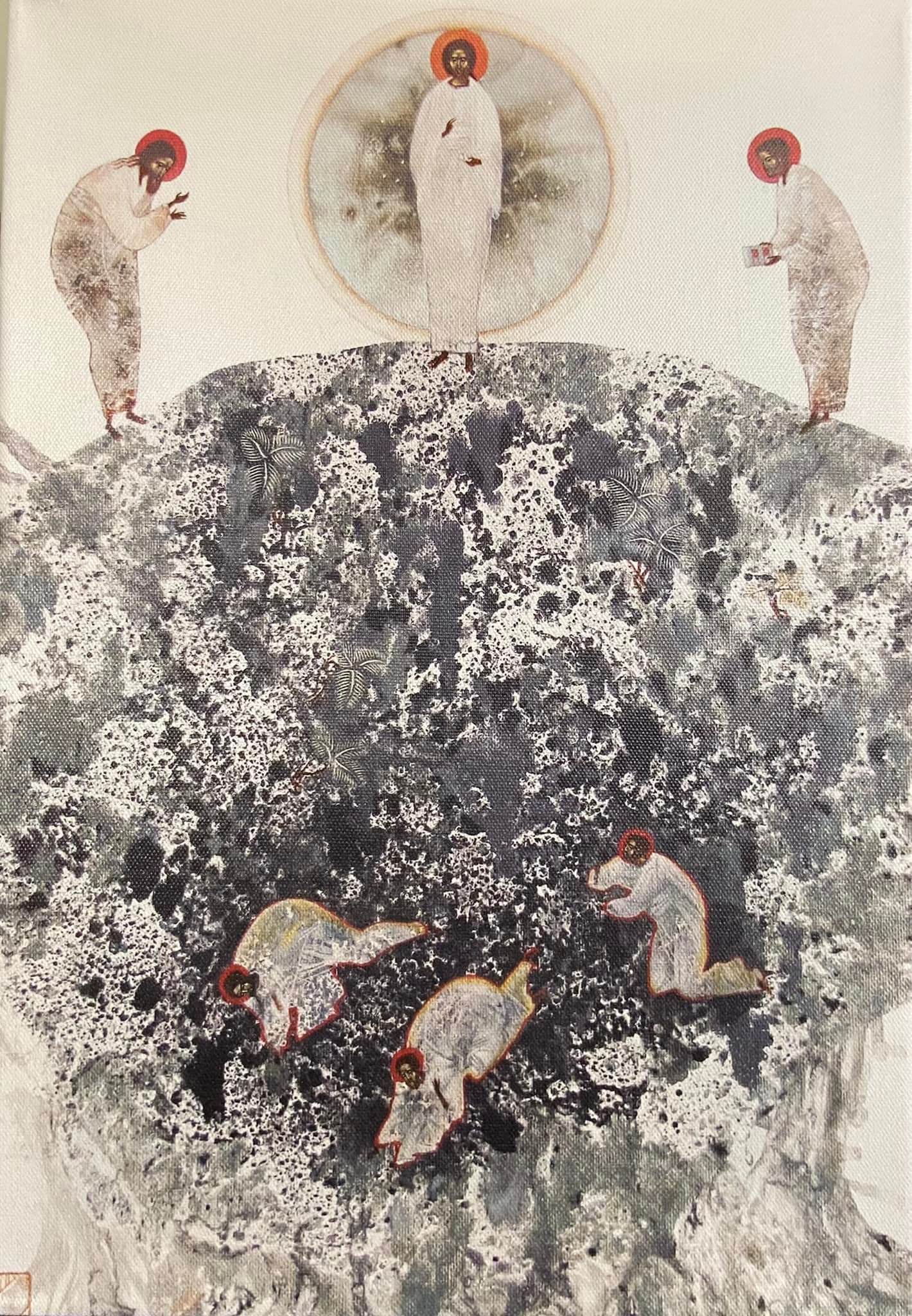
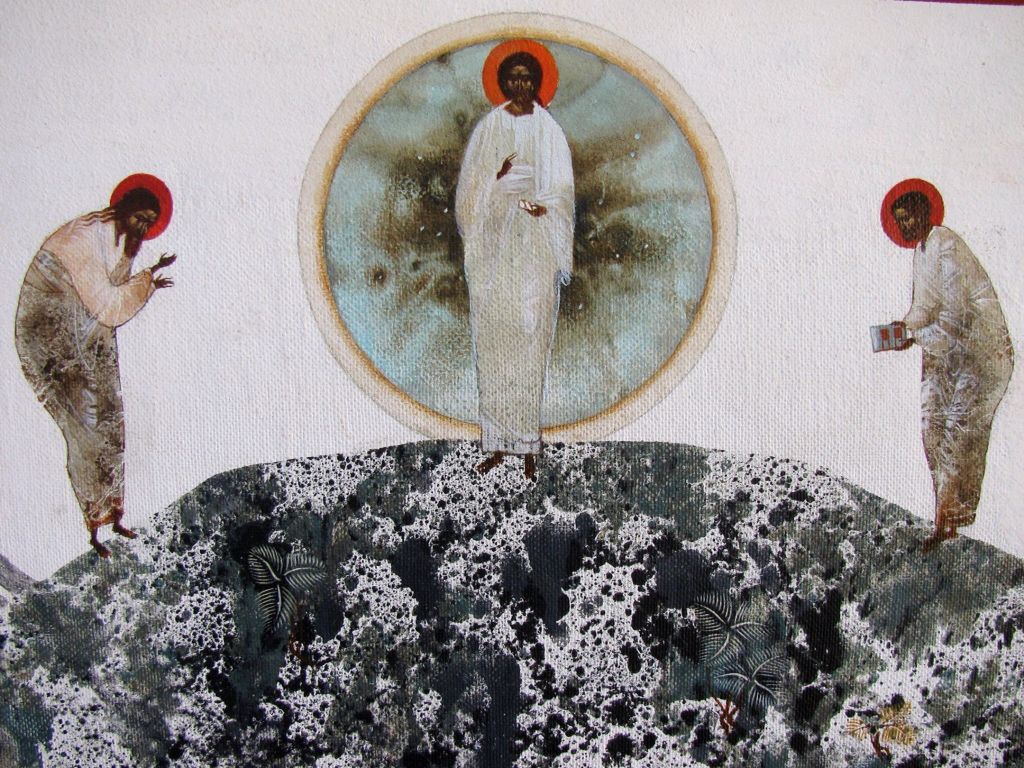
And finally, this is a modern icon created by a Ukrainian artist named Ivanka Demchuk. The cowering disciples in the bottom portion stand in for all of us, who when encountered by the One who encounter us, can’t help but tremble in fear. 

The Transfiguration is one of those moments in the Bible that we can never fully wrap our heads around. It’s one that we need art and music and other aspects of expression to help us come to grips with this bewildering proclamation. 

It is beyond our ability to explain and certainly beyond our ability to comprehend because it transcends all modes of our being.

Without the supernatural, without transcendence, without mystery, the church becomes nothing more than a country club, or the next best self-improvement clinic, or a sub par social services agency. 

And to be clear, there is nothing inherently wrong with seeking out fellowship, or trying to better one’s self, or providing needs to the last, least, lost, little, and dead. But if that’s all we have, if that’s all the church is, then we have no business calling ourselves the church.

There will always be plenty of other institutions that can bring us better friends, or help us get from where we are to where we want to be, or make substantive changes in the world. But they don’t have the one thing that we do: Jesus Christ and him crucified.

The wonderful and weird witness of the Transfiguration is that the only thing we’re told to do is listen to Jesus. From this point forward, Jesus is going to do what Jesus is going to do. He will still stir up the crowds with stories of treasure in a field, and proclamations about the signs of the times, but when push comes to shove Jesus will mount the hard wood of the cross regardless of all our goodness or lack thereof.

We can point to all these bewildering details on top of the mountain, but it’s important that we don’t miss out on the timelessness of the scene. The Transfiguration, a moment indelibly in the past, shows us a glimpse of the future.

Tell no one what you have seen or heard until the Son of Man is raised from the dead. 

This moment is made indelible only by the ending that the disciples can scarcely imagine, even though Jesus just hit them up over the head with it.

They are sworn to silence because they are not yet ready for the transcending truth. They have not made it from their reality to God’s reality. They witness something remarkable and inexplicable, but it is not yet the resurrection, the great transfiguration of all things.

Today we, like the disciples, are called to live according to the wondrous nature of the Transfiguration – we can stumble around like fools grasping out in fear for comfort – and then we will hear the words, the only words we need to hear: “This is my Son, the chosen; listen to him.”
But, and it’s a big but, if we’re honest with ourselves, we don’t want to listen to Jesus. We’d rather listen to ourselves. 

We’d rather listen to ourselves because we are downright addicted to control. Or, at least to thinking we’re in control.

Do you know how God responds to those who think they’re in control?

Laughter.

It is humbling to be laughed at by anyone, but when God’s laughs at us it’s another thing entirely. But perhaps we need to hear that laughter, particularly when we wake and sleep believing that it’s up to us to make the world turn out right.

The world has already turned out right. We know the future in the present. The tomb is empty!

We don’t have to be the hope of the world because Jesus already is. The only thing we have to do is live accordingly.

And that’s why Lent beckons us. It’s why Christians, for centuries have marked and observe the season that starts on Ash Wednesday because it reminds us of our inconvenient truth – we can’t make it out of this life alive. But, like the Lord in the tomb, God refuses to leave us that way.

We are a people desperate to be in control of our lives and we’re living in a world in which we are not in control. Moreover, we can scarcely imagine what it would look like to live in the light of Jesus’ transfiguration. It leaves us quaking and bewildered like those three disciples.

But if we do not reflect the glory of the One transfigured, then the world has no light to see that all is not darkness. Amen. 

Lost In A Cloud

This week on the Strangely Warmed podcast I speak with Andrew Whaley about the readings for Transfiguration Sunday [C] (Exodus 34.29-35, Psalm 99, 2 Corinthians 2.12-4.2, Luke 9.28-43a). Andrew is the lead pastor of Raleigh Court Presbyterian Church in Roanoke, VA. Our conversation covers a range of topics including Sufjan Stevens, Because Of Winn-Dixie, theological sunburns, the necessity of community, rediscovering the sacred, freeing freedom, stained glass language, Transfiguration challenges, and dissonance. If you would like to listen to the episode or subscribe to the podcast you can do so here: Lost In A Cloud

Winning By Losing

Luke 6.17

He came down with them and stood at a level place, with a great crowd of his disciples and a great multitude of people from all Judea, Jerusalem, and the coast of Tyre and Sidon. 

Blessed are you who are poor, hungry, weeping, hated, excluded, reviled, and defamed for yours is the kingdom of God. Woe to you who are rich, full, laughing, and respected for you will mourn. 

Love your enemies, pray for those who persecute you, turn the cheek, give to everyone who begs, on and on.

Jesus’ Sermon on the Plain in Luke 6 is filled with wonder and with confusion. It has attracted and bewildered Christian for centuries and centuries. For as many answers as it provides, it leaves us with even more questions.

Like the parables, the Sermon is designed to pop every circuit breaker in our minds; it doesn’t explain things to our satisfaction, but instead calls to our attention the unsatisfactoriness of all our previous explanations and understandings. 

Basically, we can help but walk away from Jesus’ sermon with our minds abuzz.

In the realm of the church, explanation is not the same thing as proclamation – though most of us prefer the former rather than the latter. We like things to be nice and orderly, we want things tied up neatly in a bow.

And Jesus rejects that desire completely.

Jesus, in his Sermon, isn’t telling us what works – he’s telling us what the Kingdom of God is like

One of my professors from seminary, Stanley Hauerwas, puts it this way:

“A common interpretation is that the Sermon is a law that presents an impossibly high ideal to drive us to a recognition of our sin. It is meant to drive us to grace. In other words, it is not really meant to tell us what to do but rather to remind us that Christian moral life is about love. This internalizes the Christian life so that what it means to be a Christian is to do whatever we do from the motive of love. “Love and do what you will” — bad advice if I have ever heard it! It has an even worse effect on christology; why would anyone ever have put Jesus to death if it is all just a matter of being loving?” – Stanley Hauerwas, A Sermon On The Sermon On The Mount

We are so very tempted to read all of Jesus’ words in his Sermon as a list of virtues that good people ought to have. We walk away thinking we’re supposed to be poor, or hungry, or persecuted because of our faith. We convince ourselves that turning the other cheek or praying for our enemies will make us righteous or blessed.

Yet, what we miss is the fact that Jesus’ words assume there are already people in the community called church who find themselves in such positions. 

Being blessed, according to Jesus, does not mean, “If you do this, then you will be rewarded.”

Being blessed, according to Jesus, means, “If you find yourself in a position like this, you are blessed because you are part of a community that makes all the difference in the world.”

Again, Jesus doesn’t promise his disciples, or us, that if we just muster up the courage to love our enemies then we will no longer have enemies. He doesn’t offer these words as a formula for how to prevent bad things from happening. In fact, loving our enemies and turning the other cheek generally guarantees that we will continue to have enemies who delight in hitting us on the cheek.

Christians don’t win by winning – we win by losing.

Remember, we worship the crucified God.

Jesus offers this Sermon to us, these descriptions and admonitions not because they will change the world. He proclaims all of it because the world has been changed by Christ forever, and we can no longer act as we once did.

We Christians are a weird bunch, in the end. We believe in impossible possibilities, and we pray for people the world never would, and we refuse to believe that anyone is a hopeless case.

And yet, without us living in such strange and faithful ways, the world will have no way of ever knowing what grace, peace, and mercy actually look like.

Woe and Woah

This week on the Strangely Warmed podcast I speak with Andrew Ware about the readings for the 5th Sunday After Epiphany [C] (Jeremiah 17.5-10, Psalm 1, 1 Corinthians 15.12-20, Luke 6.17-26). Andrew is the pastor of Beech Grove UMC in Suffolk, VA and he is the host of the Active Faith podcast. Our conversation covers a range of topics including active self-care, rooted trust, burnout, vital nutrition, vague preaching, contentedness, scripturally shaped imaginations, ecclesial axioms, blessed (re)assurance, and compliments. If you would like to listen to the episode or subscribe to the podcast you can do so here: Woe and Woah

Hooked

Luke 5.8

But when Simon Peter saw it, he fell down at Jesus’ knees, saying, “Go away from me, Lord, for I am a sinful man!”

Jesus shows up by the lake of Gennesaret and crowds begin to gather to hear whatever it is he has to say. He starts teaching, if that’s what we want to call it – he tells stories, some of them make the folk scratch their heads, some of them make the people mad.

Talk of the first being last and the last being first always sounds like good news to those on the bottom rungs of life, but it sounds like unmitigated bad news to those with everything to lose.

Anyway, Jesus amasses such a crowd that, while standing by the seashore, the Lord decides to amplify his proclamations.

Down the way he stops a few boats and men who had been out all night fishing. They are busy cleaning their nets and Jesus decides to hop into one of their boats and says, “Hey, let’s get out on the water.”

And without giving it much thought, a nobody named Simon Peter pushes the boats out, and starts oaring the Lord back toward the crowds.

“Thanks Pete,” Jesus says, “This’ll do fine. Keep it steady will ya?”

And then Jesus teaches some more. Perhaps talk of fig trees and mustard seeds, maybe some more of that “all things being made new,” perhaps he ended with a particularly probing parable.

And then Jesus looks back to his conscripted fisherman and says, “Pete, since we’re out here already, what do you think about going deeper and let’s see if we can’t find ourselves some breakfast?”

“No offense, Lord,” Peter replies, “But I’ve been out all night fishing. You see, fishing is what I do. And there ain’t no fish to be caught. However, you seem to be on a roll today, so why not?”

15 minutes minutes pass and they catch more fish than they can safely bring aboard their aquatic vessel and they call out to the other fishermen to come help.

Pretty soon they have so many fish that the boats start sinking into the lake from which their plunder came.

Peter, with his arms burning from pulling in net after net, falls to the bottom of the boat and he says, “Get away from me Lord! I am not worthy of this!”

Jesus calmly replies, “No one is. But that’s the whole point. And you needn’t be afraid my friend, from now on you’ll be catching people.”

And Peter, along with his brother and their fishing partners, leave everything at the shore and they follow Jesus. 

I love this story.

Every time I enter the strange new world of the Bible to this little tale by the sea I am bombarded by Peter’s reaction to Jesus. He falls before the Lord with a feeling of complete unworthiness. He, somehow, understands that God is near in the person of Jesus in a way that is more tangible and palpable than he can comprehend. And it is in the presence of God that Peter feels his sin.

Does Jesus call Peter a sinner? Does Jesus list all of Peter’s faults and failures? No.

Instead, the experience of God’s wonderful presence leads Peter to a recognition of his unworthiness. And then, lo and behold, Jesus wants to have a sinner such a Peter in his service!

“C’mon Pete! It’s time to start catching people!”

It’s hard to know exactly when it happens, but somewhere along the line Jesus catches us. That’s what Jesus does, in the end. It’s not just the telling of tales, and the proclamations of parables, and the making of miracles. Jesus delights in gathering us, all of us, into the great net that, in the church, we call salvation.

And Jesus is very good at what he does.

Life, as we often perceive it, is little more than going through the motions and doing one thing after another. But Jesus doesn’t come to bring us more of the same. That’s the great witness and proclamation of the church – Jesus comes that we might have life and life abundant. Jesus shakes up the monotony of our daily existence, sets us free from the chains of sin and death, and invites us to the Supper of the Lamb that has no end.

Jesus’ divine fishing charter, his conscription of Peter, is not merely about gathering in whoever he can whenever he can – it’s about bringing us to a place we could never arrive on our own.

Hear the Good News, the very best news: The tall and the small, the good and the bad… Jesus’ net is wide enough for all of us.

Clearly Confounding

This week on the Strangely Warmed podcast I speak with Andrew Ware about the readings for the 5th Sunday After Epiphany [C] (Isaiah 6.1-13, Psalm 138, 1 Corinthians 15.1-11, Luke 5.1-11). Andrew is the pastor of Beech Grove UMC in Suffolk, VA and he is the host of the Active Faith podcast. Our conversation covers a range of topics including self-care, holy terror, calls to confusion, last paragraphs, physical faith, congregational singing, gospel repetition, storying the story, and fearful fishing. If you would like to listen to the episode or subscribe to the podcast you can do so here: Clearly Confounding

The End Has No End

Ezekiel 37.1-6

The hand of the Lord came upon me, and he brought me out by the spirit of the Lord and set me down in the middle of a valley; it was full of bones. He led me all around them; there were very many lying in the valley, and they were very dry. He said to me, “Mortal, can these bones live?” I answered, “O Lord God, you know.” Then he said to me, “Prophesy to these bones, and say to them: O dry bones, hear the word of the Lord. Thus says the Lord God to these bones: I will cause breath to enter you, and you shall live. I will lay sinews on you, and will cause flesh to come upon you, and cover you with skin, and put breath in you, and you shall live; and you shall know that I am the Lord.”

Luke 23.32-43

Two others also, who were criminals, were led away to be put to death with him. When they came to the place that is called The Skull, they crucified Jesus there with the criminals, one on his right and one on his left. Then Jesus said, “Father, forgive them; for they do not know what they are doing.” And they cast lots to divide his clothing. And the people stood by, watching; but the leaders scoffed at him, saying, “He saved others; let him save himself if he is the Messiah of God, his chosen one!” The soldiers also mocked him, coming up and offering him sour wine, and saying, “If you are the King of the Jews, save yourself!” There was also an inscription over him, “This is the King of the Jews.” One of the criminals who were hanged there kept deriding him and saying, “Are you not the Messiah? Save yourself and us!” But the other rebuked him, saying, “Do you not fear God, since you are under the same sentence of condemnation? And wended have been condemned justly, for we are getting what we deserve for our deeds, but this man has done nothing wrong.” Then he said, “Jesus, remember me when you come into your kingdom.” He replied, “Truly I tell you, today you will be with me in Paradise.” 

The first church I served after seminary had a preschool and I made it a point to be at the doors every morning welcoming the children, and their parents, to the building. I would teach a “chapel time” lessons once a week in the sanctuary, helping to convey stories from the Bible to a group of kids, many of whom had never heard of the Bible in the first place.

It was awesome.

It’s awesome teaching kids about scripture because they enter into the strange new world of the Bible with wonder and delight. They ask all the questions that adults are too afraid to ask, and they rest in the bewildering rather than dismissing it away.

Over the years I served that church I got to know a lot of those preschool families and would run into people all over the community. There’s nothing quite like walking down the aisle in a grocery store and hearing a 4 year old scream, “Pastor Taylor! What are you doing here?”

As if I wasn’t allowed out of the church or something.

Anyway. One morning, while I stood by the doors to the preschool, one of the moms approached me with mascara streaming down her face and her daughter completely oblivious.

The mom ushered the girl into the school and then asked if we had a moment to talk. We retreated into the reading room outside of earshot from everyone else and she said, “My husband died yesterday, and I don’t know how to tell our daughter. Will you tell her for me?”

Death is the one thing that guaranteed for each of us, and it also happens to be the one thing most of us deny all the time. It’s why all the ads we come across online, or the commercials we watch on tv, are all designed at selling us the idea that we get to stick around forever. 

Take this pill and you’ll lose the weight you never really meant to gain.

Wear these clothes and you’ll appear like you did in high school.

Go to this vacation destination and you can look like the models in these images enjoying their time on the beach.

But the heart of the matter is this: The bell will toll for us all. We know not when, only that it will happen. 

Some of us get to live good long lives. Some of us don’t. Some of us make it to the end of our days with no regrets. Some of us won’t. 

When we’re dead, we’re dead.

Which is why the language of death and dying is so important, whether you’re talking to a preschooler or not.

We say things like, “so and so passed away.”

What does that mean? Where did they pass to? What does that mean about their body? 

We say things like, “God just wanted another angel in heaven.”

Which makes God into a monster and the author of all suffering in the world.

After the mother retreated to her car, I walked into the sanctuary and prayed for a good long while before I went back into the preschool. I waited until they went out onto the playground and I called the little girl over to talk.

I said, “Your mom and I talked this morning and,”

“My daddy died” she interrupted.

“Yeah… but she told me you didn’t know…”

“He was sick, and he told me he was going to die. And now he’s dead.”

“How are you feeling?” I asked.

“I’m sad, I think. But it’s okay. Daddy told me that when he died he was going to be with Jesus, the guy you talk about all the time. So, it’s okay. But I am sad.”

Christian truths are delivered in Scripture through images and stories. Most of us, however, are literalists. We want clarity above all else. But that doesn’t stop us from consuming all sorts of media designed to keep us guessing. Because for as much as we might we addicted to certainty, the world, and the kingdom of heaven for that matter, run on mystery.

What happens in the end? The strange new world of the Bible has all sorts of answers about life after death, some of which we will explore shortly, but let me tell you this: that little preschool girl proclaimed the one thing we can say with certainty about death. When we die, we are with Jesus.

Everything else is a mystery. 

And yet, if we’re asked to imagine what heaven is like, we will conjure in our minds all sorts of ideas and images that, frankly, come from Hallmark more than they come from scripture. 

St. Peter hanging by the pearly gates discerning who makes it in or not is the center point of a good many jokes, but it’s not in the scriptural witness.

Gobs of folks clothed in robes relaxing on puffy clouds might show up in movies and television shows, but it’s not in the scriptural witness.

Among the many images for the kingdom of heaven in scripture, one of the most predominant is that heaven will be like a never ending worship service. Which, to some people, probably sounds more like hell than it does heaven.

So other than being with Jesus at the end, what else can we say about it?

What’s at stake in our two scriptures today is that the resurrection of the dead is precisely that, the bodily resurrection, the reconstitution of our bodies after our deaths. And that our experience of it will be immediate – hence Jesus’ words to the thief on the cross: today you will be with me in Paradise.

Our bodies are good gifts given to us by God and they aren’t just vessels for our souls during earthly life. This proclamation is important for the ways we experience our bodies here and now and how we treat others. 

Christianity isn’t a spiritual faith, it’s an embodied one.

It’s why we baptize with water and we break bread and share from the cup.

When scripture talks about the new heaven and the new earth, they are not replacements for the old ones. We are not beamed away from here to go somewhere else. The strange new world of the Bible says that, in the eschaton, God transfigures what we have and what we are. The redeemed order is not the created order forsaken. God doesn’t look at us and all we’ve done and say, “meh, it wasn’t good enough.” Instead God will take the created order, all of it, and raise it in glory.

And for us, in our deaths, we go to be with the Lord. Our dead bodies will be cremated or buried in the ground, but our experience of it is such that, when the bell tolls, we arise. 

There’s no waiting room for the kingdom of heaven with an endless supply of People magazines from the 1990’s. We don’t pull off a tab and wait for our turn like we do at the DMV. 

Today, Jesus says, today you will be with me in paradise.

Robert Farrar Capon used to tell this story about how, for years, his local fire house would run the siren at exactly five minutes to 5 pm every Friday afternoon. For a while he thought it must be part of the weekly test of the system, but it was a rather odd time to do so. And then, one day, it dawned on him – rather than run the risk that the festivity of the weekend be delayed even one minute beyond the drudgery of the work week, some gracious soul had decided to proclaim the party of the weekend from the top of the fire house, five minutes ahead of schedule.

That, Capon says, is heaven. 

Heaven is the party of the streaming sunlight of the world’s final afternoon. Heaven is when all the dead beats and all the success stories, all the losers who never got anything right and all the winners who finally give up on winning, simply waltz over to the judgment seat called the Kingdom of God, with nothing to show for their lives except an eternal invitation from the host of the party that goes on forever.

Heaven is a bash that has happened, that insists on happening, and will happen forever and ever.

And the celebration is so good and so loud and so fun that it drowns out all the party poopers in the world.

Which is why we should take seriously the words we say week after week in the Lord’s Prayer – thy will be done on earth as it is in heaven.

It’s also why the sharing of the Good News is really the most important thing we can ever do. Being a part of the community called church means living into the reality that we have a role to play in making people experience heaven on earth rather than hell. It’s why we sing the songs we sing and pray the prayers we pray. We received the witness and the testimony of the end, which frees us to live fully now in anticipation of the Supper of the Lamb.

We can do all sorts of wild and wonderful things right here and right now because the end has no end.

Heaven, in short, is fun.

What is, of course, the question at hand today, but the question of who is just as important. Lots of people, even Christians, think that only good people make it to heaven, whatever heaven may be. But, as I’ve noted on numerous occasions, it’s important for us to remember that the only people in heaven are forgiven sinners. You don’t go to hell for being bad, or not being good enough. You go to heaven by being bad and accepting forgiveness.

Now, does that mean that we have permission here and now to be bad? If you want to stick you hand in a meat grinder you are free to do so, but the only thing it accomplishes is making your life into one heck of a mess. 

God doesn’t run the universe as a system of punishment or reward.

God has consigned all to disobedience that God might be merciful to all.

In the end, our ends aren’t up to us. That’s reason enough to rejoice because it frees us to freely live here and now. Jesus came not to reform the reformable, or teach the teachable, or fix the fixable. Jesus came to raise the dead. 

That’s not just great news, its Good News. Amen. 

There’s No Place Like Home

Luke 4.24

And he said, “Truly I tell you, no prophet is accepted in the prophet’s hometown.”

Most preachers have a good “first sermon story.” 

There’s the tension of having gone from one side of the pulpit to the other, the expectations of all the people in the pews being somewhat responsible for the first time preacher, and the confounding hope that this call is, in fact, real.

I have a friend who was so nervous to prepare and preach his first sermon that he bought a book of “famous sermons” and decided to preach one of them rather than his own.

I have another friend who got up into the pulpit, poured her heart out, and was asked if she would consider being the next pastor of the church she had just preached in right in front of the current preacher!

I was a teenager when I preached for the first time. I felt called by God to the work and when I told my pastor he immediately put me on the schedule to get up in the pulpit. The assigned text was from 1 Corinthians about the body having many members each with their own responsibility. And afterward, I had people tell me again and again, “That’s the best sermon I’ve ever heard!”

Let the reader understand: they all lied. But at least they were kind in their falsehood.

For a long time I’ve thought about the impulse of that congregation to compliment my homiletical efforts despite the fact that it was terrible, and I eventually realized that they loved it not because of what I said, but because I was the one who said what I said.

That is, in me they were seeing themselves – they witnessed God working through one of their own. And they loved it.

And yet, Jesus’ first sermon, and the response from the gathered people, was completely different.

Jesus does all the things any good student of the scriptures would do – he takes the scrolls, reads the text, and sits to teach.

But he doesn’t offer exposition, he doesn’t give the gathered people three ways to be better adherents to the Law, he doesn’t even give them a good joke to cut through the tension of the air.

Instead, Jesus says, “Today this scripture is fulfilled in your hearing it.”

As in, “The Messiah is here and he is me.”

And the people don’t rush forward to congratulate Jesus on his preaching, they don’t offer him a position as the new rabbi in town. No, they say, “Who the heck does he think he is?”

Jesus applies the prophet’s words to himself; he is the herald who announces a transformation of grace, freedom from sin and suffering, and impossible possibility.

The people, having heard this word, demand a sign. “Prove it, you son of a carpenter!”

Jesus rebukes their desire, noting that “no prophet is accepted in their hometown.” And the sleepy little gathering of the faithful turn into a lynch mob. They march Jesus to the edge of a cliff to end his life, but he mysteriously and miraculously makes his way through the crowd and he leaves.

Jesus is rejected, not for preaching about better behavior, not for strict commands, but because he proclaims the gospel. The gospel is offensive to those who hear it because it runs counter to just about everything else in life – it is everything for nothing, it is the proclamation that we can’t save ourselves but someone can and will, it is the announcement that things are changing for good and we aren’t the ones who are doing the changing.

And we can’t stand it! When God in the flesh comes to us and offers us the greatest gift of all, we chase him to the edge of the cliff and eventually we nail him to the cross. But the Good News is that, three days later, God comes back to us.

The gospel is one of the strangest things around: God does what God does for you and me without us having to do anything in return. But that’s also why we call the Good News good. 

Homecoming

This week on the Strangely Warmed podcast I speak with Todd Littleton about the readings for the 4th Sunday After Epiphany [C] (Jeremiah 1.4-10, Psalm 71.1-6, 1 Corinthians 13.1-13, Luke 4.21-30). Todd is the lead pastor of Snow Hill Baptist Church in Tuttle, OK. Our conversation covers a range of topics including flyover country, James Spader, prophetic calls, wordy words, faithful funerals, re-construction, seasons of refuge, Jurassic Park, wedding requests, unfamiliar preaching, and the condition of our condition. If you would like to listen to the episode or subscribe to the podcast you can do so here: Homecoming

Take It Up And Read

This week on the Strangely Warmed podcast I speak with Todd Littleton about the readings for the 3rd Sunday After Epiphany [C] (Nehemiah 8.1-3, 5-6, 8-10, Psalm 19, 1 Corinthians 12.12-31a, Luke 4.14-21). Todd is the lead pastor of Snow Hill Baptist Church in Tuttle, OK. Our conversation covers a range of topics including good books, age differences, textual reverence, liturgical moments, the gift of rediscovery, the equity of the Law, restoration and reconciliation, new gifts, pulpit shadows, and Martin Luther. If you would like to listen to the episode or subscribe to the podcast you can do so here: Take It Up And Read