Devotional – Ephesians 3.16

Ephesians 3.16

I pray that, according to the riches of his glory, he may grant that you may be strengthened in your inner being with power through his Spirit.

Weekly Devotional Image

Pre-marital counseling is the best. It is one of the few places where I am actually allowed to ask the questions I have racing in my head: What was your last fight about? How do you feel about your soon-to-be in-laws? Why do you deserve to marry each other? Similarly, it is one of the few places I feel comfortable being completely candid about the church’s role in marriage and how the covenant is not just between the couple, but it also incorporates the gathered body and the Lord.

At some point during the pre-marital counseling, I challenge each couple to go back to scripture and pick a passage that reflects their relationship for the wedding ceremony. My one caveat is that (unless they can demonstrate how necessarily important it is to them) they are not allowed to pick the part in 1st Corinthians about love being patient and kind, nor are they allowed to pick the part from Ephesians about wives being subject to their husbands. So it is with those few directions that couple have been forced to go back to their bibles and find something indicative of their relationship.

A few months ago I had the privilege of bringing together Chris and Chelsea Frumkin into the joy of marriage. I challenged them to pick their scripture and they quickly replied with Ephesians 3.16: “I pray that, according to the riches of his glory, he may grant that you may be strengthened in your inner being with power through his Spirit.” This verse had a particularly special meaning to the couple, because Chris has Ephesians 3.16 etched into the inside of Chelsea’s engagement ring.

11221675_10204258142484714_1762300626060138752_o

What a dynamic and perfect scripture for a wedding ceremony! When we stood together before their family, friends, and the Lord I made mention of the fact that their relationship had led to such a beautiful wedding precisely because they had prayed for one another. As a couple they were not content with the status quo. Instead, they consistently went to the Lord to discover renewed strength in their relationship.

The longer I spend time in ministry, the more I realize that scripture no longer holds the great value that it once did. Instead of a people defined by the Word of the Lord, many of us are content with knowing a handful of verses that make us smile, or would be worthy of a print that we could hang on our wall or Facebook page.

As we prepare to take steps into a new week, let us reflect on the great gift that scripture is for us: What stories from the bible have shaped who we are? Is reading the bible a priority in our lives, or a last resort? If we had to pick a verse that defined our character, what would it be and why?

monkimage

The Upside-Down Kingdom – Sermon on Mark 6.30-34

Mark 6.30-34

The apostles gathered around Jesus, and told him all that they had done and taught. He said to them, “Come away to a deserted place all by yourselves and rest a while.” For many were coming and going, and they had no leisure even to eat. And they went away in the boat to a deserted place by themselves. Now many saw them going and recognized them, and they hurried there on foot from all the towns and arrived ahead of them. As he went ashore, he saw a great crowd and he had compassion for them, because they were like sheep without a shepherd; and he began to teach them many things.

251121425_640

Last Sunday our mission team gathered in the parking lot after worship, prayed together, and then set out for the beautiful bounty of West Virginia. I don’t know how the rest of the team felt as we made our way west, but I was excited; we were committing ourselves to a community, we were going to be Christ’s hands and feet, and we were going to experience God’s upside-down kingdom.

McDowell County, West Virginia is nothing short of beautiful. While the roads twist back and forth and the topography ebbs and flows, you are constantly bombarded by the beauty of God’s creation. Sitting behind the wheel, the scenery flies past the window and all evidence of humanity’s presence is gone except for the occasional roadside house and the road beneath the wheels.

By the time we finally made it to Welsh, WV we were ready to work, and we were ready to get out of the cars. But the scenery had drastically changed from the journey; when we arrived in Welsh it felt as if time had stopped. At one time Welch was one of the ten most populated places in the United States. More coal has been found and produced in McDowell County than nearly every other coal mining venture in the rest of the country. The community grew rapidly as the industry boomed, but now it is a ghost town.

IMG_0228

The final moments as we drove up to where we would be staying for the week were met with silence as we absorbed our surroundings. Countless empty buildings littered the streets, handwritten signs adorned the windows begging people and businesses to consider renting the space, and for the longest time we drove without seeing another human being.

The apostles, those first ragtag disciples, had gathered all around their teacher to share with him all they had done and taught. They went on and on about the lives they had changed, the miracles they were able to perform, and moments they had experienced God’s presence. But then Jesus said to them, “Come away to a deserted place all by yourselves and rest awhile.” For many were coming and going, and they had no leisure even to eat.

Our mission team had arrived in our deserted place, but we would find little rest. Our church team was divided into two different work groups; the first would be working in a local food pantry, helping them to organize different donations before the weekly distribution on Saturday, the other would be working on painting the floors of house in the small town of War. The time before and after working would be spent in prayer, bible study, fellowship building, and learning about the local community.

From the Food Pantry group we learned that 100% of the children in McDowell County are on Free/Reduced lunch and that more than 50% of the children are considered homeless. From a former coal miner we learned that for a long time McDowell County was one of the wealthiest in the nation thanks to their coal mining, but that now the mines are being shut-down, and more and more people are without work and purpose.

11145167_10204335886108256_7977281946266719389_o

It would have been easy to show up in McDowell, roll up our sleeves, work hard, and leave feeling good about the work we had done. It would have been easy to make a few friendships, pray for the people we met, and return to our lives in Staunton. It would have been easy to return to the pace of life here without being affected by what we had seen and experienced, but Jesus calls us to live in the Upside-Down Kingdom where our lives are flipped around.

When the crowds were gathering to see this special man named Jesus, many were coming and going and the had no leisure even to eat; what a perfect description of the lives that many people are living today. Far too many of us rush through the mundane aspects of daily living without taking the time to reflect on what we are actually doing.

Kids grab Pop-tarts on their way out the door in the morning, young professionals order the same cup of coffee with urgency before their daily commute, families sit down at a communal table to eat but each member has their nose down in a smart phone in order to connect with others, while actually disconnecting from the people in their midst.

Many of us Christians spend our faith lives just like the crowds so long ago. We treat church not like the precious gift that it is, but like any other commodity in our lives. Instead of seeing it as a vital and life-giving space, we see it as another item on the never-ending check-list of existence. Some of us have so much to do, that church has become an occasional venture, rather than a regular necessity. So many of us are coming and going at such a tremendous speed that we no longer have the time to feast on God’s Word in prayer and in worship.

The mission team, however, abandoned the fast pace regularity of life, and were forced to adjust to God’s schedule. Every morning we woke up to eat and begin our devotions; How were we experiencing God’s Upside-Down Kingdom? Where had we seen brokenness in the community? What is God trying to do through us this week? We began and ended every single activity with prayer, and we devoted ourselves to the people we were serving.

PPT-UpsideDownKingdom

Now many saw the disciples and Jesus, so they hurried there on foot from all the nearby towns and arrived ahead of them. As Jesus went ashore, he saw a great crowd and had compassion for them, because they were wandering like sheep without a shepherd; and he began to teach them many things.

Jesus loved to teach people about the kingdom of God, and he did so with parables. The Kingdom of God is like a mustard seed; though tiny and small, it grows into one of the greatest plants providing shade and offering life. The Kingdom of God is like a wedding-feast where the least of society are invited to eat at the head table. The Kingdom of God is like a sower who goes out to sow, he knows not how the seeds grow but provides rich soil for the seeds to settle in.

While we settled into the rhythms of mission work in McDowell County, we started to  experience what God’s Upside-Down Kingdom is really like.

The Kingdom of God is like a group of privileged folk from Staunton, Virginia who gave up a week of their lives to serve a community of people they had never met. Time and time again they were questioned by the people about their work. No one could understand why a group such as ours would give up their precious time, give up their vacation, to get down on their hands and knees to change a person’s life. We did not go in order to earn our own salvation, we did not go to make ourselves feel better about our faith, we went because God’s Kingdom is one that has been flipped upside-down by the work of Christ, one that compels us to go and love when the world stands bewildered at our actions.

The Kingdom of God is like a house with plywood floors. Rough around the edges, with splintered pieces jutting out all over the place, in need of a few good coats of paint. The pieces of plywood met in different angles and sizes with the grain of the wood running in different directions, requiring dedicated attention while painting. God invites all to participate in this Kingdom, and we are not meant to be all alike. In fact God calls us to celebrate the things that separate us, so that we can learn to live in harmony with one another in the midst of differing grains.

The Kingdom of God is like a child laughing while running around a tiny yard in the middle of West Virginia with a 6 week old puppy. While adults slaved away in the house painting the floors, young children were laughing in a way that helped us to remember why God called us here in the first place; not to just help someone with their material needs, but share in the joy that comes with recognizing God’s grace in something as simple as a puppy, or as profound as a young family moved to tears because of our sacrifice.

The Kingdom of God is like a foot-washing the night before Jesus died, and the last night of a mission trip. Each of us took a turn in the chair and were prayed over by the rest of the church group. Every person was lifted up to God and we gave thanks for all that they had given, praised God for the witness they were discovering in their life, and asked God to be with them as they were sent forth into new places. Each person was valued, appreciated, and celebrated. In God’s Upside-Down Kingdom, even the smallest of servants, even the tiniest bits of effort, are embraced and lifted up for the true value they contain.

The Kingdom of God is like leaving a mission field, to return home only to realize that everywhere we go is a mission field. That whether we are serving the needs of a community in West Virginia, or living into a new reality of love right here in Staunton, God’s Upside-Down Kingdom is everywhere.

The people we served in West Virginia we hungry for something greater than themselves. Though desperately in need of things like food, clothing, and shelter, they actually hungered for something much more precious: value and worth.

The challenge of the story of Jesus with the crowds, is that we read about a people who were hungry while so many of us are full. We are not like the people who gathered to discover Jesus, we are not like the desperate crowds rushing to meet the Lord ahead of the disciples. Nobody here is so eager to find God that they beat me to this sanctuary on Sunday mornings.

For many of us, church is just one of the many activities that fills our modern lives, rather than the one place where we discover lives worth living.

11745349_10207136174344490_769335585716666659_n

Like many mission trips, I think we got more out of it than the people we served. We thought we were going to help them in the midst of suffering, only to discover that we needed to be healed just as much. We needed to stop viewing ourselves as better than the people we were serving, we needed to learn to love them in spite of their behavior and past experiences, we needed to start looking at them the ways God looks at the world: with love.

We went all the way to West Virginia to learn about God’s Upside-Down Kingdom only to realize that we are part of it as well.

When the crowds gathered at the feet of Jesus, when he had compassion on them because they were like sheep without a shepherd, he taught them about things like the Kingdom of God. When we get together every week for worship, we are just like those crowds resting at the feet of the Lord eager and ready to learn. It is through our prayers and hymns, through the people in the pews next to us, and through the words of scripture and a sermon that we discover ourselves in the midst of God’s Upside-Down Kingdom, and we begin living accordingly.

What a blessing to know then, that every day is an opportunity to serve God’s kingdom from the beauty of McDowell, West Virginia to the beauty of Staunton, Virginia. We are called to be Christ’s hands and feet for the world, so let’s get out there and do it. Amen.

Ready To Die – Sermon on 2 Samuel 1.17-27

2 Samuel 1.17-27

David intoned this lamentation over Saul and his son Jonathan. (He ordered that the Song of the Bow be taught to the people of Judah; it is written in the Book of Jashar.) He said: Your glory, O Israel, lies slain upon your high places! How the mighty have fallen! Tell it not in Gath, proclaim it not in the streets of Ashkelon; or the daughters of the Philistines will rejoice, the daughters of the uncircumcised will exult. You mountains of Gilboa, let there be no dew or rain upon you, nor bounteous fields! For there the shield of the mighty was defiled, the shield of Saul, anointed with oil no more. From the blood of the slain, from the fat of the mighty, the bow of Jonathan did not turn back, nor the sword of Saul return empty. Saul and Jonathan, beloved and lovely! In life and in death they were not divided; they were swifter than eagles, they were stronger than lions. O daughters of Israel, weep over Saul, who clothed you in crimson, in luxury, who put ornaments of gold on your apparel. How the mighty have fallen in the midst of battle! Jonathan lies slain upon you high places. I am distressed for you, my brother Jonathan; greatly beloved were you to me; your love to me was wonderful, passing the love of women. How the mighty have fallen, the weapons of war perished!

maassen_resurrection_sml

Funerals are strange, difficult, and at times, beautiful. I usually receive the phone call from someone in the family, or from a funeral home, that someone has died and they were hoping that I would preside over the service. No matter who the person is, I am immediately filled with sadness knowing that someone, anyone, is now gone. Regardless of my personal connection to the individual, there is a sense of loss that comes with death and not even I can avoid it.

But then I have to get to work. I have to take that grief and hold it for a moment while I help others properly grieve their loss. I have to balance the proper amount of mourning with hope, sadness with peace, and death with resurrection.

When I receive that first phone call I have to start taking care of the logistics: Where will the funeral take place and when? Do they want someone to play the organ? Are they hoping for a particular soloist? Does anyone from the family want to speak on behalf of the dead? And only after the plans are made can we begin talking about the person, making sure that I know everything I can in order to properly proclaim their life, death, and resurrection.

Most of the time funerals take place in the middle of the day in the middle of the week. Friends and family have to take time off from work, or take their children out of school, in order to attend the service. Yet, funerals are not meant for immediate friends and family alone. The entire community of faith is called to witness to the life of those who have died so that we can continue to live out their witness regardless of how well we knew them, or not.

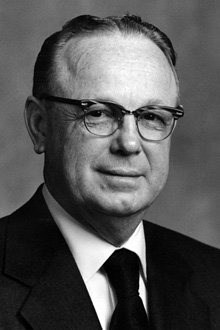
So, this morning, as I mentioned before, we are doing something a little different. A few weeks ago one of our church members named Dick Dickerson passed away. He had only been coming for a few years, but he was a staple in worship. He always sat in the back of the church on the right side, he flirted with every female that crossed his path, and he was incredibly sweet.

When I found out that his family would be having a private service in Kentucky at a later date I knew that we still needed to do something here in order to say goodbye. I knew that we needed to praise God for putting Dick in our lives. And I knew that we were going to have our own little funeral for him on a Sunday morning.

Dick Dickerson

Dick Dickerson

Dick Dickerson called me “honey.” I know that this might’ve bothered other young pastors, but to me it was endearing and precious. I would walk over to visit Dick next door at Brightview/Baldwin Park and the moment I entered his room he would always say something like “Come on honey and sit down with me.” For months I cherished this identification, it made me feel special that Dick felt so connected to me. It was only later that I learned he called most of the people in his life “honey”!

My wife Lindsey would stop by to say hello before a church service started and he would hug her while calling her “honey,” Grace Daughtrey would smile and politely nod her head as he greeted her with a “good morning honey,” and even Marshall Kirby would start to blush when Dick would refer to his Sunday driver as “honey.”

Dick Dickerson was a man of profound love, who deeply appreciated all that God had given him from the very beginning till the very end.

Dick grew up in Kentucky with a family in the midst of financial struggles. Living through the depression was, as he put it, one of the hardest things to witness. But at some point there was a family in the community who saw Dick’s potential, and they brought him under their wing and helped to provide for his education. He always maintained a connection with his biological family, but in his quasi-adoptive family he saw the Christian commitment to loving others, something that would affect the rest of his life.

Dick was a man of stories, stories that shaped his life and the lives of others. When he served as a quartermaster in Patton’s army during World War II he used to offer whisky to his fellow soldiers so long as they affirmed the beliefs of the Republican party. He told me that at the beginning of the war most of his friends were Democrats, but by the time they got home (and enjoyed the whisky) they had become staunch conservatives!

He, unlike others who served in World War 2, was ready and willing to share reflections on his experiences precisely because he did not want anyone to have to experience what he did. He often told a story about an evening that took place in the middle of the war on Christmas Eve when he found himself resting for the night in a bombed out church building. He could remember the wax dripping from the candles, the hole in the roof letting in the tiniest of snowflakes, and all the soldiers huddling together for warmth.

He asked a question of the men that night that he only later attributed to the Holy Spirit. He asked if the men wanted to pray for anything. One soldier prayed for his family back home, another prayed for warmer weather, but one of the youngest said something that would stay with Dick the rest of his life: “I seem to remember Jesus saying something about praying for our enemies, so tonight I would like to pray for the men we’re fighting against. I pray that God would be with them as He is with us.” Dick said that while other men might have grown angry or dismissed the prayer, all of the men joined together in that tiny church on Christmas eve, and prayed for their enemies.

Prayer was at the heart of Dick Dickerson’ life. He spent most of his free time going through a list of people that he lifted up to the Lord and regularly invited me to join him in his prayers. He once told me that prayer was the only thing that got him through the war, and that prayer was the only thing that kept him together once he returned home.

Dick lived a wonderful and blessed life. He married his sweetheart Mildred, had two children, and eventually began working for Madison College in Harrisonburg. Dr. Dickerson, as he was known to his students, made himself available to everyone all all times because he saw the value in other people. Whether in the classroom or at home, you knew that he would make time for you no matter what.

I spent a lot of time with Dick over the last two years, we talked about a great number of things, but the one thing we talked about the most was death. In fact during our very first and our very last conversations he said the same thing to me: “Honey, I’m ready to die.

In the beginning of 2 Samuel we have a song that David wrote in memory of Saul and Jonathan. After giving their lives for the Lord and the people, David called the nation to weep for their loss: “O how the mighty have fallen.” In life David and Saul were seemingly opposed, but in the experience their death David wept and mourned.

ProgramPage_MightyFallen

Many of us take the people in our lives for granted. We grow so accustom to their presence and persistence, that we rarely think about what life would be like without them. It is only when someone is truly gone that we can really appreciate what they always meant to us. It happened to David after Saul died. It happened to the disciples during those three days before Jesus rose again. And it has happened to me with nearly every person that I have buried while I have served this church.

But friends, resurrection comes into its fullest meaning when we lose someone we love.

Can you imagine the exultation the disciples experienced when they saw their Lord again after he broke free from the chains of death? Can you picture the joy on their faces when they were able to sit again with their teacher and friend? Can you imagine how David would have felt if he knew that one day someone from his family tree would eventually hang in a tree for the sins of the world so that we could all rise again in the resurrection?

Dick Dickerson was ready to die because he trusted the Lord. His trust was evident in our many conversations, and in is interactions with others, but it was most present while he prayed at this altar.

Dick rarely missed a communion Sunday. Even while his bone cancer was spreading throughout his body, he would make the long and slow journey to the front of this sanctuary to pray on his knees to the Lord. After feasting on the body and the blood, Dick would lay all the worries of his life out for the Lord, he would pray for God’s forgiveness over his sins, and he would thank the Almighty for surrounding him at every moment throughout his blessed life.

Are we ready to die? Every death in this church community is a constant reminder that the bell will toll for us all, and that tomorrow is never guaranteed. Are we ready to die? What kind of faith would it take to be ready to give our lives over to the Lord?

Dick Dickerson certainly had that kind of faith, a faith born out of prayer, presence, and praise, a kind of faith shaped by World War 2, and a kind of faith made real through the witness of Christ’s church.

lord__s_supper_by_bclary-d37hhzp

As we prepare to take steps toward this altar, to feast at Christ’s table, we do well to remember all who have gone before us to eat and pray. We remember Dick Dickerson and his willingness to lift us up. We remember the saints before us, in our midst, and those who will come after and discover God’s grace in a moment like this. And we remember that Jesus came to die so that we would all live, so that death would be defeated, so that the resurrection would be offered to us all.

So, thanks be to God for the great gift at this table and for the life of Dick Dickerson, a man who lived by faith, prayed with every fiber of his being, and was ready to die. Amen.

Devotional – 2 Corinthians 4.16

Devotional:

2 Corinthians 4.16

So we do not lose heart. Even though our outer nature is wasting away, our inner nature is being renewed day by day.

Weekly Devotional Image

One day I’m going to write a book about all the hilarious, remarkable, frightening, and life-giving things that have taken place during my ministry. Being a pastor is, in my opinion, one of the greatest vocations because it is a privileged responsibility. Pastors are invited in the depth of brokenness, the height of celebration, and everything in between. Some of the stories I have accrued over the last two years who never be appropriate from the pulpit, but one day I’ll get the good ones written down.

Dick Dickerson was a source of great moments. When I received a phone call about his passing away on Saturday, I gave God thanks for putting him in my life and helping me to discover what grace really looks like. But his death did not fully hit me until I announced it from the pulpit yesterday morning and I realized that I would no longer get to see his smiling face, hear his endearing laugh, or listen to one of his great stories.

For instance: When he served during World War 2 as a Quarter-Master he would lie to his superiors when requesting certain supplies saying they were for General Patton just so he could get the equipment necessary to support his troops. Or the story about how he not so subtly attempted to make conservatives out of his friends by offering them whisky only so long as they declared allegiance to the Republican Party. His life was one great story worth telling over and over.

DoNotLoseHeart

A few weeks ago we were sitting in his apartment talking about the end. Death was not far away and Dick’s bone cancer was getting worse and worse everyday. Yet, he was completely prepared for it. He kept saying, “I’m ready for the Lord to take me.” While the pain was striking deep in his bones he kept such tremendous faith because he knew the Lord was with him and waiting to take him home.

When we lose the people we love, we are caught in a dilemma. On some level we are thankful that they are finally at peace and have gone to be with God, but at the same time we mourn losing them in our lives. Yet Dick was a witness to the kind of faith we are called to have: His outer nature was wasting away, but his faith was growing each and every day. The last thing Dick ever said to me was this: “I never knew God could love me this much.”

This week, let us reflect on what it means to keep the faith. Not a blind faith without doubt, but a willingness to see how our inner nature is being renewed even while our outer nature wastes away. Let us give thanks to God for all who have gone on before us, and pray that the Lord would give us the strength to be better witnesses for those who will come after us.

Devotional – Psalm 104.33

Devotional:

Psalm 104.33

I will sing to the Lord as long as I live; I will sing praise to my God while I have being.

Weekly Devotional Image

Our service yesterday was filled with music: We began with the wonderful hymn “For the Beauty of the Earth” as we praised God for the many blessings of life. Our Preschoolers offered wonderful renditions of “This Is My Commandment” and “He’s Got The Whole World In His Hands” all with corresponding hand gestures. Our Youth Choir faithfully proclaimed the words to “You Are My All In All.” And as a congregation we all joined together for “Savior, Like a Shepherd Lead Us” and “Leaning on the Everlasting Arms.”

Out of the numerous responsibilities that come with being a pastor, selecting the hymns for Sunday morning is one of my favorite privileges. I love spending time deep in God’s Word to begin crafting a sermon, but spending time in the hymnal and choosing songs to complement the thrust of worship is incredible. I grew up learning to sing my faith out of the hymnal and I believe hymns are vitally important for us to continually learn what it means to be faithful today.

After worship, while we were celebrating our preschoolers with a reception, I had a couple come up to me to thank me for worship. We talked about how cute the children were and how wonderful it was to see them in church. We exchanged stories about what we remember from our days in Preschool (not a lot). But before I was going to thank them for their words and pick up some more food from the table they had one more thing to say: “We heard God in the songs today.”

Boston_Avenue_Methodist_Episcopal_Church,_Tulsa,_OK,_Interior,_Hymnal

Have you ever been in the middle of a hymn during worship when you started to really understand it for the first time? You might’ve known all the words to something like “Leaning on the Everlasting Arms” but one Sunday it finally clicked? Or you’ve heard children sing “He’s Got The Whole World In His Hands” but when you saw them pointing at you during the service you realized, for the first time, that God has you in his hands?

“I will sing to the Lord as long as I live; I will sing praise to my God while I have being.” Singing our faith is at the heart of what it means to be faithful because our words, and the music, help us to grasp who we are and whose we are.

This week, let us all reflect on the meaning of the hymns we sing.

What is your favorite hymn? What has it taught you about faith and discipleship?

The Problem With Kids Today – Sermon on John 10.11-18

John 10.11-18

“I am the good shepherd. The good shepherd lays down his life for the sheep. The hired hand, who is not the shepherd and does not own the sheep, sees the wolf coming and leaves the sheep and runs away – and the wolf snatches them and scatters them. The hired hand runs away because a hired hand does not care for the sheep. I am the good shepherd. I know my own and my own know me, just as the Father knows me and I know the Father. And I lay down my life for the sheep. I have other sheep that do not belong to this fold. I must bring them also, and they will listen to my voice. So there will be one flock, one shepherd. For this reason the Father loves me, because I lay down my life in order to take it up again. No one takes it from me, but I lay it down of my own accord. I have power to lay it down, and I have power to take it up again. I have received this command from my Father.”

IMG_0088

Happy Preschool Sunday! This morning we conclude our sermon series on our stained glass. These sermons were born out of a desire to recapture the importance of our windows and how the continue to speak into our lives. We began with The Methodists to my right: Susanna Wesley, John Wesley, and Francis Asbury. Last week we looked at The Johns: John the Evangelist, John the Presbyter, and John on Patmos. We now finish with the window behind me above the altar: Jesus as the Good Shepherd.

pg-iamshepherd-570x194

Why St. John’s?” I asked. We were sitting in the living room and going over our respective histories when I finally turned to one of my favorite questions: “Why St. John’s?” With the overwhelming abundance of churches in our community what made you choose this one?

Her answer was familiar and sounded similar to the other responses I had heard: It was where all our friends were going; it was the closest church to our neighborhood; it just made sense; it was a place our kids felt welcome. But then her answer took on a life of it’s own in a way I didn’t expect.

“But we haven’t always been here,” she said. “There was a time that we no longer wanted to come to St. John’s.” Of course my curiosity was caught and I wanted to know all the details behind their departure, but as if she was reading my mind she continued, “The ‘why’ is not important. What is important is how we came back.

“We were invited back for a particular Sunday, and though it hurt me to enter the doors of the sanctuary, I reluctantly sat down in one of the back pews. Before I knew it my mind was  flooded with all of the friendships that we cultivated in the sanctuary, all the children I had vowed to raise in the faith during their baptisms, all of the good sermons and all of the bad. But at the same time my mind was flooded with all the old arguments, the disagreements, and the frustrations.”

“But then something happened. I looked up and I saw the Good Shepherd window and everything felt right. It was like all of my worry started to slowly dissipate, and I knew that I had to come back. This was my home, because this is where I discover how the Good Shepherd watches over me.”

People and situations had driven her away. The old arguments were enough for her to leave the church behind. But miraculously enough it wasn’t people that brought her back, there were no justifications or rationalizations that would have changed her opinion. It was this window. It was Jesus as the Good Shepherd that brought her back, and it is the Good Shepherd who watches over all of us.

More often than not, the Good Shepherd stained glass window is the first thing that people notice when they enter our sanctuary. Its colors and vibrancy draw our attention and captivate us even when the sermons make us want to sleep.

It shows Jesus at his finest: leading, nurturing, and loving. The sheep are at peace knowing their shepherd is there to guide them through life. Even the abundance of blue helps to convey the deep sense of calm that comes with Jesus’s presence.

Whenever our eyes fall upon this window we are called to remember how much the Good Shepherd loves us. It shows how comforting it is to know that the Lord will hold us, and protect us, when necessary. The window exemplifies the power of the one who gave all that he had for his friends and for strangers.

Yet, even for as much as this window conveys the faith, it also muddies the waters. During the time of Jesus’ life the role of a shepherd was anything but picturesque. Shepherds were often the outcasts of society and were ignored by the masses. Jesus saying, “I am the good shepherd” would have bewildered the religious elite and the powerful. It had a certain edge to it.

This week I gathered all of our preschoolers into the choir loft to teach them about Jesus as the Good Shepherd. Like we all do, they noticed how beautiful Jesus looks in the image and how he cares for the sheep. “The sheep is like a baby” one of the kids yelled out. I remember thinking: “Yes yes, thats all good and true, but there is so much more to what it means to shepherd.”

I-am-Series_Shepherd

When describing himself as the good shepherd Jesus uses the hired hand as a comparison. The hired hand is someone who is only concerned with monetary gains, expends the minimum amount of work necessary, and will not risk life or limb for the sake of others. The hired hand is like the person who is so selfish that they ignore the needs of others.

Jesus, however, lays down his life for the sheep and promises to never let them, us, go. His voice will always draw us back because we belong to him. 

I love our preschoolers and this time of the year is always bittersweet for me. We are preparing for the end of year program, and our eldest class will be heading off to kindergarten in the fall. I spend enough time with them in the basement that I know the ins and outs of their little personalities, I know who to separate during chapel time for optimal focus, I know what jokes they will laugh at, and I know what to do and what to say to stop them from crying. I love them and I believe that I would be willing to lay my life down for them. I would do whatever it takes to protect them because each of them is a child of God.

But then I wonder if I would do the same thing for the adults in my life… I mean I love all of you too, but there’s just something about the desire to protect children that makes us stronger and braver than we normally are. For some reasons we value them as being more important than those who are older, and we prioritize their needs over others. We would do things for children that we would never do for others.

The problem with kids today, is that they are better than us.

After we looked at the window this week, I brought the preschoolers outside to demonstrate what it means to be a shepherd. I gathered a group in the middle of the yard, and I pulled four kids out to be the shepherds. I explained that I would be a wolf trying to get at the sheep in the middle, and the shepherds had to do whatever they could to protect the sheep.

It worked brilliantly. Every time I rushed forward the shepherds converged on me and pushed me back, and when I tried to run around and juke them they rearranged and protected their friends; no matter what I did, the little shepherds were going to do whatever they could to protect the sheep.

But that’s when I noticed something remarkable: The group of sheep in the middle had been holding hands the entire time. Now let me be clear, I did not instruct them to hold hands or to watch out for each other, but they did it on their own. Even more remarkable is the fact that the older kids placed the younger ones in the middle to protect them even more while they held hands. It was easily one of the most beautiful things I have ever seen.

The problem with kids today, is that they are better than us.

In our little preschool rooms, and in our community, kids are the ones who are acting more like Jesus than the adults. While we complain and groan about those who are different than us, people who do not look, think, and talk like us, kids are going out to meet them where they are. Jesus sought out the lost, the ones who needed to be rescued, the ones who are forgotten in our society. In our preschool rooms the children do whatever they can to involve everyone and show them they are loved.

11209625_10203918612636680_1355383082406316117_n

If you want to know what Jesus was really like, spend just 5 minutes with one of our preschoolers. During snack time they are willing to give up their food for the person who mentions they are still hungry. When they are playing with different objects in different stations they will include everyone in the activity no matter what. When they work on art projects they pay one another the nicest compliments regardless of how well the finger painting actually turns out. And when we were outside this week, the shepherds took care of the sheep while the sheep took care of one another.

The problem with kids today, is that they are better than us. 

We should start looking to them more often about what it means to be faithful, than expecting them to learn everything from us.

We all hunger to know and be known. Many of us (adults) create virtual communities on the internet because forming real and authentic connections is hard work. It requires face to face intimacy, a willingness to listen, and vulnerability all at the same time in a way that a phone and computer screen can never allow. Kids don’t have the benefit of social networking to create friendships, they have to do it the old fashioned way, and they’re better at it than we are.

God’s community is open and inclusive. Jesus not only cares for the sheep but gathers them into the flock. Those who are curious about what it means to be a disciple are invited into Jesus’ community no matter what: the door is always wide open to the outcasts: You know, the people whose lives are messy, whose families are not the perfect “husband-wife-2.5-children” scenario, who live in fear between paychecks, and who wonder if anyone knows how they really feel.

Today Jesus is still welcoming and inviting people who are often excluded based on the standards of our time. Kids don’t have the benefit of immediately recognizing someone’s socio-economic status, they aren’t concerned with where their parents went to college or even if they didn’t, they aren’t worried about the color of their skin or the shape of their bodies: they just want to love and be loved. 

So how can we create an authentic and life-giving community? We begin by following the example of our kids…

Imagine, if you can, what it would look like if we stopped excluding people based on our warped standards: wealth, status, race, sexual orientation, and physical condition. What if we started treating people with respects regardless of who they were and what they had done? What do you think would happen if we really started to take care of one another without judgment or expectation of reciprocation?

It wouldn’t be easy, but it would be more like the kingdom than the way we are living right now. Amen.

What Is Love? (Jesus Don’t Hurt Me) – Sermon on 1 John 3.16-24

1 John 3.16-24

We know love by this, that he laid down his life for us – and we ought to lay down our lives for one another. How does God’s love abide in anyone who has the world’s goods and sees a brother or sister in need and yet refuses help? Little children, let us love, not in word or speech, but in truth and action. And by this we will know that we are from the truth and will reassure our hearts before him whenever our hearts condemn us; for God is greater that our hearts, and he knows everything. Beloved, if our hearts do not condemn us, we have boldness before God; and we receive from him whatever we ask, because we obey his commandments and do what pleases him. And this is his commandment, that we should believe in the name of his Son Jesus Christ and love one another, just as he has commanded us. All who obey his commandments abide in him, and he abides in them. And by this we know that he abides in us, by the Spirit that he has given us.

tumblr_lcd0x7hrio1qectnco1_500_large1

1 John is a letter written by a wise, old, veteran Christian leader who continues to help those who are new and young to the faith by addressing the challenges of discipleship. What we have read this morning encompasses John’s understanding of love, Christ’s love, and the need for Christians to find this same love in their lives. Now, to be clear, I am not like John. I am not a mature Christian leader, with years of experience to rely upon. I cannot pull from the wisdom of leading churches throughout the decades to help those who are struggling. I am not like John. In fact, I’m the kind of person that John wrote this letter to in the first place.

Yet, knowing I am not qualified, I decided to write my own letter this week as if I were John to our contemporary church…

tumblr_nlfp9qcFN51u06rnxo1_500

Dear St. John’s,

What is love? Do you ever find yourself asking that very question? Love seems to be one of those things, those words, that we tend to just throw around without really thinking about what it means. I love your outfit! I love what you’ve done with the place! I love eating frozen Kit Kats! I love you!

Love, as a word, has the power to mean everything and nothing. For instance: when we start dating and we grow closer and closer to someone else and they say for the first time: “I love you” it can mean everything in the world. Time can slow down and we can remember the way we felt when we heard it for the first time. However, years later, “love” can become routine, that word we use to end conversations rather than to declare how we feel in our heart of hearts. Love becomes a filler rather than a feeling.

What is love? Is it something that we can only experience in a romantic way? Can we love our friends and family? Can we love our church? Can we love the Lord?

This is how we know what love is: that Jesus laid down his life for us – and we ought to do the same for one another. Now, stay with me if you can, I know that as you read this letter you might already start to grow weary of this thing called love. How willing are we to really lay down our lives for other people? Frankly, most of us will never have to come that far, we will never be martyred for our faith. For as much as we talk about lifting up our cross to follow Christ, it is unlikely that we will ever find ourselves hanging on that cross for what we believe.

Yet, as Christians, this is how we know what love looks like. That a man, fully God and fully human, delivered himself to die for us even when we did not deserve it.

St. John’s, how can the Lord’s love abide in us when we are filled with the world’s goods, but we refuse to help our brothers and sisters in need? Is it possible to love without sacrifice?

Most of us want to love and be loved so long as it doesn’t hurt. We want to know all about love, and we are ready to follow the Lord’s commands so long as it won’t cost us anything.

Love is never really love unless it has the power to harm us.

Discipleship is never holy unless we are willing to sacrifice and be deeply honest with ourselves and others. Trust is never fully possible until we know what’s its like to have our trust broken. Love is what it is because it can both build us up and tear us down.

We might never have to die for somebody else like Jesus did for us, but to love others implies a willingness to lay down our needs and desires for someone else’s needs and desires. What is love if not a willingness to be vulnerable with another?

So, if we want to love, let us do so not with words or speeches, but in truth and action. Anybody can say “I love you”; it is far harder for our lives to match our words. Do we practice what we preach? Are our feet and tongues in alignment? Do our actions match our professions?

Love is hard. It requires dedication and commitment, vulnerability and sacrifice, honesty and attention. We would rather love with our words because we do not have the strength to love with our actions. This is why we pray; We pray for the Lord to give us the strength to love the unlovable because we cannot do it on our own.

Have you ever noticed the covenants made at a wedding? The couple consents and promises to love one another in the sight of God and witnesses, but then the entire congregation makes a promise to nurture that couple in love. Romantic love and a promise between two people is not enough to sustain a life-long marriage. We need others to hold us accountable to the promises of love, and in particular to the love between partners.

Have you ever noticed that sometimes, in fact many times, the Lord does not answer our prayers? Or at least not the way we would want to the Lord to answer them? We know that the Lord is greater than our fickle hearts and that he answers our prayers, but sometimes we ask for the wrong things.

How often do we pray for the Lord to fix this or that, to make our children better, to rid us of our sickness when we could be praying for the Lord to give us the strength to address our own problems, the courage to be honest with our kids, and the endurance to bear the pain?

The Lord is greater than all of our selfish desires and trite fixations. The Lord’s love knows no bounds and continues to seek us out even when we turn away. This is the truth of the Good News, that God’s love remains steadfast even as ours falters. We will never be able to love others in the exact same way that God does, but our challenges is to strive for it nonetheless.

tumblr_m9ho7dWZYb1rcmqo9o1_500

St. John’s, our church needs some encouragement so despair will not take root. We need to love and feel loved. We need to lift one another up with this sacrificial love so that we might know and experience God’s love right now through each other.

If we fail in our own eyes, if we feel that we have been a disappointment, be assured that God knows our hearts better than we do. We might look in the mirror every morning and see regrets, failures, and short-comings, but the Lord sees hope, beauty, and wonder. We might replay in our minds the hateful words that have been shouted at us by our bosses, friends, and spouses, but the Lord wants us to hear only one thing: you are loved.

Do we know that we are loved? Do we feel it in our lives on a regular basis? Do we experience a feeling of worth from the Lord through others?

The Lord has given us a worthy commandment: we should believe in the power of his Son Jesus Christ, and we should love one another. 

I asked the children of our preschool about love and they were able to describe it in a way that many of us forget by the time we grow up. They want to love because it makes them happy, they feel love through hugs and snuggles and time well spent. Yet, when I asked one particular boy if he feels loved, this is what he said: “I feel loved by my mommy and daddy whenever they hug me and sit with me. But I don’t know why they love me.

It is so sad that we believe love can only exist when it is deserved or warranted. We live in such a commodified society, that we expect that love only accompanies good behavior.

God’s love is unconditional, and ours should be to.

You might not know it, or even believe it, but I have seen this love made real and tangible through the people in our pews.

When we learned about the needs of a community in West Virginia, men from our church volunteered to shave their faces just so we could raise money for the mission trip. They literally put their faces on the line for God’s kingdom. At the same time, everyone that contributed financially sacrificed from their lives so that we might bless and love on others in need. We responded in love not because of what people deserve, but simply as a reaction to need.

When we learn about someone’s recent diagnosis or loss of a loved one, we gather together to nurture them and surround them with care. We write cards and offer prayers, we drive to homes and cemeteries, we sit and we listen. We respond in love not because they once did the same for us and we believe that we owe it to them, but we do so because living by loving is the only way that makes sense as Christians.

If love is real, there is no “why?”

What is love? God is. We love others because God loves us. God was willing to humble himself to the form of flesh, to know what we know and feel. God was willing to walk among the people and listen to their needs and hopes, to lift them up and offer them worth. God was willing to carry death on his back and hang there for all to see. God was willing to die for you and the world. God was willing to love us, and continues to through every moment of our lives.

Do you know that you are loved? Whenever you look at a cross, remember that Jesus died on one for you. Whenever you look at a loaf of bread, remember that Christ’s body was given so that you could live. Whenever you look at another person, remember that Christ died for them just as much as he died for you. 

When we love we abide in the Lord and he abides in us. Loving others is the closest we can ever get to really being Christ’s body for the world. When we love with our actions we allow the Holy Spirit to live and move through us. Whether we love with a hug or a letter, a smile or a sacrifice, a commitment or a vow, we are abiding in the Lord.

St. John’s, loving is the greatest thing in the world, but it can also be the hardest. Love can build us up and break us down. Love can inspire majesty and travesty. Love can bring us closer to God and drive us away.

Love is hard, but if it wasn’t, it wouldn’t be worth it. Amen.

Washing With Tears – Maundy Thursday Homily on John 13.12-20

John 13.12-20

After he had washed their feet, had put on his robe, and had returned to the table, he said to them, “Do you know what I have done to you? You call me Teacher and Lord – and you are right, for that is what I am. So if I, your Lord and Teacher, have washed your feet, you also ought to wash one another’s feet. For I have set you an example, that you also should do as I have done to you. Very truly, I tell you, servants are not greater than their master, nor are messengers greater than the one who sent them. If you know these things, you are blessed if you do them. I am not speaking of all of you; I know whom I have chosen. But it is to fulfill the scripture, ‘The one who are my bread has lifted his heel against me.’ I tell you this now, before it occurs, so that when it does occur, you may believe that I am he. Very truly, I tell you, whoever receives one whom I send receives me; and whoever receives me receives him who sent me.”

bbo_ob_mcmca_40_slide

The disciples had already finished their food, they had passed around the bread and the cup, and Jesus had told them it was his body and blood. For many of them these words might’ve gone in one ear and out the other; after all Jesus was known for saying all sorts of the things that didn’t make sense right away. Perhaps some of them were picking up the crumbs from the bread when Jesus got up from the table. Others might have been refilling their cups with wine when Jesus tied a towel around his waist. But by the time he started to wash their feet the room must have been silent. 

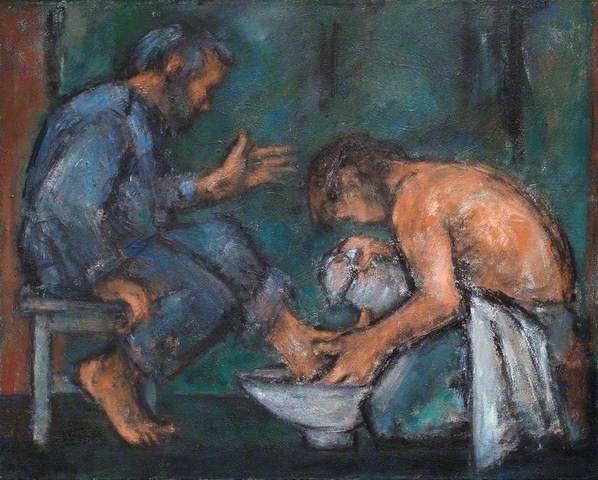
Imagine how profound it would have been to see Jesus kneeling on the floor and using water to wash away the grime of Jerusalem. Even more amazing is the fact that Jesus doesn’t waste time explaining what he’s about to do, he just gets down on the ground and goes to work.

However, Peter, the ever vocal disciple interrupts the serene mood with a question: “Lord, are you going to wash my feet?

“Right now it won’t make sense my friend, but soon it will all come together. If you want to be in this with me, you must let me wash your feet.”

Jesus went from one disciple to the next taking as much time as necessary, holding their feet in his hands, letting the water drip upon them, until he finished.

I took a group of middle-schoolers on a mission trip a number of years ago to Winchester, Virginia. We worked in trailer parks building wooden steps up to the doors, we worked on a wheel chair ramp that took up an entire yard, and we worked on clearing out areas that had been long forgotten. All week we did everything we could to serve the needs of the people from the nearby community, and every night we gathered to sing songs and praise our Lord.

At the end of the week we were invited into the fellowship hall for a foot-washing ceremony. I don’t know if any of you have had the chance to spend a week working outside with middle-schoolers, but it begins to smell pretty bad pretty fast; the prospect of washing one another’s feet was not high on my list of priorities. The leader explained that long ago Jesus washed his disciples feet and we would be doing the same thing. Everyone was invited to participate, but if you were uncomfortable you could simply ask for a prayer instead.

A few chairs and basins were set in the middle of the space, and when the music began we were on our own.

In my work group there was a precious young girl who had worked so incredibly hard all week and there was a young boy that annoyed her every chance he had. He would begin by playfully flicking paint onto her clothes, but when she asked him to stop he became relentless. He called her names behind her back, and schemed to turn the other kids against her. Even after I pulled him aside to set him straight he continued to prey on her at every opportunity. 

As we sat in the room waiting for the first people to go forward for the foot washing, I watched the young girl stand up, and bee-line across the room for the annoying boy. For a fleeting moment I was afraid that she had finally had too much and she was about to sock him in the face, but instead she leaned over and asked if she could wash his feet.

While other people started to do the same, my gaze was transfixed on the boy and girl from my group. The boy had gone over the line time and time again yet there she was holding his foot in her hand and washing it. When I looked closer I saw that she was crying and her tears were falling on his feet. And when I looked even closer I saw that he was crying and his tears were falling in her hair.

Foot washing is a service among equals in a company where no one’s status stands out. When Jesus finished with his friends, he called them to do the same to one another. We wash and are washed by our Lord through our brothers and sisters in Christ. When we kneel before a fellow Christian and hold their feet in our hands we make our way back to the upper room so long ago. We aren’t just called to wash the feet of those whom we love, but even the ones who drive us crazy and fill us with anger. Remember: Jesus washed Judas’ feet knowing full and well what he was about to do. 

Sometimes the people we need to reconcile with most are the ones in the pews next to us. We tend to sweep under the rug all of the proverbial problems we have with our friends and family and are far more inclined to complain about strangers. If we are filled with stress regarding the closest people in our lives than this might be the best place to embark on a new beginning. Perhaps the water can bring new life for us and for the ones we love and hate.

Jesus took time after breaking bread with his friends to wash their feet. He humbled himself to the floor and showed them what faithful love looks like. With each foot he equipped them for bringing the peace of God into the world. He washed away their insufficiencies and doubts. He rid them of labels and assumptions. He showed them how important they were for the kingdom of God.

If you want to know what faithful love looks like, look no further than this time when we follow the example of Jesus and wash one another. Amen.

IMG_2100

Living in Harmony – Sermon on Romans 12.9-18

We tried something different in church this week. Instead of the typical ~15 sermon, I broke the church up into 6 groups (each bulletin contained a number between 1-6) and sent them to different rooms throughout the building. Below I have included the directions for the group leaders in addition to the questions used for discussion. After the groups had spent a significant amount of time together, I invited them back into the sanctuary for a brief homily to connect the scripture with our activity.

get_to_know_your_audience

Living in Harmony

Directions for Group Leaders:

Thank you for agreeing to help facilitate conversation during worship. Below you will find step-by-step instructions to guide each group through their time together. In light of your willingness to help lead I will share with you the reason for our activity, but I ask that you do not share it with your group: Many of us attend church on a regular basis, we see the same familiar faces, and yet we don’t have an intimate knowledge about those we call our brothers and sisters in Christ. Each group will be asking and answering questions in order to learn more about our community. My hope is that we will begin to know more about one another than just where everyone sits in the sanctuary. The quality of the answers should be emphasized over quantity. I would rather you only get to one of the questions and really learn about each other than getting to answer all of them without really soaking up the answers.

  1. Reread the following scripture to set up the activity:
    1. Romans 12.9-18
    2. Let love be genuine; hate what is evil, hold fast to what is good; love one another with mutual affection; outdo one another in showing honor. Do not lag in zeal, be ardent in spirit, serve the Lord. Rejoice in hope, be patient in suffering, persevere in prayer. Contribute to the needs of the saints; extend hospitality to strangers. Bless those who persecute you; bless and do not curse them. Rejoice with those who rejoice, weep with those who weep. Live in harmony with one another; do not be haughty, but associate with the lowly; do not claim to be wiser than you are. Do not repay anyone evil for evil, but take thought for what is noble in the sight of all. If it is possible, so far as it depends on you, live peaceably with all. 
  2. Ask everyone to share their name.
  3. Say: “For the next 15-20 minutes we will be speaking casually with one another about our interests. This is not going to be a densely theological conversation about “the last time you experienced God’s presence” or “sharing moments of great sinfulness from your lives.” Instead it will be focused on what makes you, you. By no means is this mandatory, and if there is a question that you do not want to answer, all you have to say is “pass” and let it move on to the next person. However, if you can answer the questions, it will allow for greater growth and fruitfulness in our church and in our community.
  4. Below are a list of questions to ask of the group. You may read one aloud and then ask everyone to respond in a circle, or at random (the choice is yours). I have written more questions than you will probably be able to answer in the time allowed but that’s okay. I trust you to know what questions are working and which ones need to be left behind. Emphasis should be placed on giving everyone ample time to respond so that everyone will learn a little bit about everyone else. If a natural conversation begins in response to an answer please allow it to continue so long as it fits with the general nature of the activity. However, if someone becomes long-winded please ask them to conclude so that we can move on to the next person.
  5. Questions:
    1. What was the last good movie you saw (on TV or in the Theaters) and why?
    2. What is your “go-to” restaurant in Staunton, and what do you usually order?
    3. What is one of your most memorable birthday presents? How did you feel when you opened it?
    4. If you could have one super-power what would it be, and why?
    5. If you could recommend one book for all of your friends to read, what book would it be and why?
    6. When was the last time you felt pure joy and what were the circumstances behind it?
    7. When you were a child what did you want to be when you grew up?
    8. What is your favorite thing to do in the summer and why?
    9. If they made a movie of your life, which actor would you want to play you?
    10. If you could have an endless supply of any food, what would you get?
    11. Who is your hero (a parent, celebrity, writer, etc.) and why?
    12. What is one thing that you are extremely proud of?
    13. If you had a time machine, where and when would you travel?
    14. If you could have a conversation with one person from the entire history of the world, who would it be and why?
    15. If you had an entire vacation paid for, where would you go and why?
    16. What do you think is the greatest invention from your lifetime and why?
  6. Wrapping Up
    1. At 11:50 we need everyone back in the sanctuary. When your group comes to a time that naturally allows for a conclusion I ask that you pray the following words out loud, and then lead your group back to the sanctuary:
      1. Prayer: “Almighty God, you know us and have called us by name. In the midst of this community, we give you thanks for everyone in this group. We praise you for providing interests, opinions, and observations. We pray, Lord, that you might instill in each of us the beauty of community. Give us the strength to live in harmony with one another, and allow us to be people who can extend hospitality toward strangers. Amen. 

Screen-shot-2012-09-28-at-12.39.31-PM1

Homily:

I have wanted to do this activity since I arrived at St. John’s. We do such a good job at welcoming and connecting with one another on Sunday mornings, and during other church activities, but I’m not sure how well we really know one another.

I once knew a man who said the loneliest times in his life occurred at 11am every Sunday morning when he was sitting in our packed sanctuary. For years he was a regular worshipper, and for year no one bothered to reach out; no one knew his name, where he was from, or what was going on in his life. Ever since I was appointed here I thought about breaking us into groups to combat the exact type of loneliness that man described.

I waited and waited and then last week something happened that made me realize how desperately we needed to do what we just did.

Our secretary discovered a man standing in our parking lot in the middle of the afternoon and approached to ask if there was anything she could help with. Without intending to, the man began to cry. He said, “I lost my wife a few months ago and today would have been our 49th wedding anniversary. 49 years ago we were standing in this church with hope for the future. These last few months have been the loneliest in my life.

I don’t want to be part of a church that does not know about a man’s 49th wedding anniversary. I don’t want our sanctuary to be the loneliest place on Sunday mornings. We did not ask and answer the questions today to just learn superficial facts about one another; we did so with the hope that these facts would spark new and lasting relationships. This church should be the place where we combat the terrible forces of loneliness. Amen.


Devotional – John 2.16

Devotional:

John 2.16

He told those who were selling the doves, “Take these things out of here! Stop making my Father’s house a marketplace!” 

Weekly Devotional Image

“Now let us exchange signs of Christ’s peace,” the pastor bellowed from the pulpit. In quick and succinct fashion people rotated 360 degrees and shook hands with those closest and muttered, “peace of Christ.” Though it was something we did one a month, the passing of the peace was finished within 20 seconds, and people were ready to get on with the rest of the communion liturgy. For months I attended worship in that church, sitting in the same pew, but I never learned anyone’s name nor did I know anything about what was going on in their lives. I felt invisible even while I was surrounded by people.

That summer I was appointed to help a small church in the shadow of the Great Smokey mountains in western North Carolina. Passing the peace was something they did every week and it took forever. The pastor would casually invite us to greet one another with the love of Christ and before I knew it I was getting hugs from people I had never seen before and others wanted to know my life story. I overheard men making plans to go golfing in the afternoon, women sharing the latest bits of gossip from the community, and kids making fart jokes.

To go from one extreme to the other while passing the peace was difficult. Each week, when we hit the 10 minute mark during the peace, all I could think about was Jesus turning over the tables and rebuking the money-lenders and dove-sellers. Had we turned God’s house into a space no better than a marketplace? Where was the solemn respect for the divine, where was the recognition of God’s holiness?

The weeks passed throughout the summer and I continued to walk throughout the entire sanctuary during the passing of the peace and I began to learn about the people who called that church “home.” I got invited to dinner parties, people prayed for me and my calling while others moved around us, I even had a woman begin to confess her most recent sinful behaviors. I felt confused about what we were doing and how it fit into the worship of God in a church until an older gentlemen spied my discomfort and whispered in my ear: “this is how we build community; we don’t get many chances to check in on one another and this time, for us, is sacred.”

Jesus threw out the money-lenders because they were making a mockery of the temple. In that tiny rural church we shared our lives with each other during the passing of the peace, and it felt like what the church was really all about. Instead of just sitting down and facing the front without interacting with our brothers and sisters, that church made a point to pass the peace by building their community.

What is church like for you? Do you gather each week with the expectation of hearing a few prayers, listening to a sermon, singing a couple hymns, and going back to your regular life? Or do you see church as an opportunity to build your community by getting to love on, and communicate with, your brothers and sisters in Christ?

peace-dove-web2