Devotional – Galatians 1.13

Devotional:

Galatians 1.13

You have heard, no doubt, of my earlier life in Jerusalem. I was violently persecuting the church of God and was trying to destroy it.
Weekly Devotional Image

“Would you ever prevent someone from receiving communion?” The probing question was asked during a clergy-training event I attended a few years ago. The discussion leader pushed the question back to each of our tables for debate before offering his answer. At my table an older woman made it clear to all of us that children should not be able to receive communion because “they can’t understand it.” A middle-aged man declared that he would not give communion to anyone living in sin, particularly if they were gay. And a younger man shyly offered that he didn’t think it was his responsibility to allow, or prevent, anyone from coming to God’s table.

Each of the tables debated who should be able to receive communion, and the longer we discussed… the louder the room became. Theological and scriptural references were flung back and forth regarding the power clergy hold over God’s table; stories were shared about the merits of refusing to serve communion and the power of offering it to everyone; relational bridges were broken and walls were erected.

The leader let us duke it out amongst ourselves for some time before patiently raising his hand for silence. After waiting for a moment for our attention to move from our argumentative vantage points he said, “Remember this: Even Peter perjured and Paul murdered. God’s love knows no bounds.”

Do we get so caught up with Paul’s letters and his travels that we forget how horrible he was before he encountered Christ on the road? Do we respect his theology so much that it blinds us to the vital narrative of his life?

In his letter to the church in Galatia, Paul specifically addresses his sordid past in order to demonstrate the power of God’s revelation. Only in the transformative and redemptive power of God’s divine love could a man like Paul be moved from murdering Christians to baptizing Christians.

lord__s_supper_by_bclary-d37hhzp

All of us are broken by the powers of sin and selfishness; no one is free from the temptations to take the easy path and neglect to follow the road that Jesus prepared for us. Therefore, it is vital for all of us to remember that church is meant to a hospital for sinners. No matter who we are, and no matter what we’ve done, there will always be a space for us at God’s table. The challenge is to remember that beautiful and graceful truth when we encounter people we deem less than worthy.

Love Hurts

John 13.31-35

When he had gone out, Jesus said, “Now the Son of Man has been glorified, and God has been glorified in him. If God has been glorified in him, God will also glorify him in himself and will glorify him at once. Little children, I am with you only a little longer. You will look for me; and as I said to the Jews so now I say to you, ‘Where I am going, you cannot come.’ I give you a new commandment, that you love one another. Just as I have loved you, you also should love one another. By this everyone will know that you are my disciples, if you have love for one another.”

2012-04_LT-TrueLoveHurts


Two weeks ago I stood before all of you and preached about love. I said, “Here we are, just like the disciples, a few weeks on the other side of Easter. For us the normalcy of life has returned. The shadow of the cross has crept back into our daily lives. We turn on the television and we want to know why we live in such a broken world. We confront people who drive us crazy. We grow tired of the seemingly endless race for the White House. We clench our fits with frustration over our lack of control. We worry about our bank accounts, and our children, and our futures.

“And then Jesus has the nerve to show up in our lives and ask, “Do you love me?If we love Jesus, then we have to love one another.”

I think the message was pretty straightforward. Jesus loves us so we should love each other. In fact, none of you complained about the service while shaking hands afterwards, I received zero emails regarding the content of the sermon, and after singing the hymn “Lord, I Want To Be a Christian” most of us left with smiles on our faces.

Today we are here in church reading about another example of Jesus calling us to love. We love this story. It repeats for us our assumption that whatever it means to be Christian, whatever creeds we affirm, whatever beliefs we proclaim, it at least means we are supposed to be nice and loving toward other people.

The fact that we often boil Jesus down to a guy preaching love makes sense. Jesus talks about love all the time in the gospels, toward all people regardless of circumstances. Love, in fact, seems to be what Jesus is all about. And in this story, during his final night with his friends, in his concluding remarks, he tells them to love one another just as he loved them.

Loving one another like Jesus sounds pretty nice. Don’t you think the world really would be a better place if we could all just get along?

Love is lovely, but it also gets us into trouble. If Jesus really was all about love in the Hallmark sense of the word, if we can whittle the entirety of the gospel down to “love one another” then why did Jesus have to die? Why would you put someone to death who is recommending that we love each other?

Jesus says, “I give you a new commandment, that you love one another. Just as I have loved you, you also should love one another.”

loveoneanother

Just as I have loved you…

A couple months ago I was sitting at a coffee shop downtown working on a sermon. As I often do, I was wearing a clergy collar and sitting near the door with a cup of coffee and my computer. For the overwhelmingly majority of my sermon writing coffee shop experiences, everyone ignores the pastor in the corner, but not this day.

A guy walked in, looking pretty disheveled, and immediately bee-lined over to me. His eyes were locked onto my collar and, before I knew what he was doing, he fell to his hands and knees and started to kiss my feet. Embarrassed, I tried to get him to stop, and when he could tell that everyone was staring at us, he asked to speak to me outside.

We sat down on a bench and he began to tell me about his troubles. He was down on his luck, no money, no job, no home. He had been kicked out of a couple local homeless shelters, but heard a rumor that he could get better help in Charlottesville. As he went on I caught myself preparing my response in my head rather than really listening to his dilemma. And as I often do I offered him a few dollars and suggested that he try SACRA or any number of other places in town.

He looked at me blankly and said, “Man, I just need a ride to Charlottesville.”

I don’t remember exactly what I said in response but I’m sure that I made excuses about how much work I had to do, or that I really needed to get back to the church. And as I went on listing my justifications he stood up while I was talking and he left me there sitting on the bench. My voice trailed off as he walked away, and before he turned the corner he said, “A man was going down from Jerusalem to Jericho…

Jesus loved people so much, that he was willing to correct them when they were wrong. When Peter tried to tell him that he was not supposed to die on a cross, Jesus quickly replied, “Get behind me Satan, for you are setting your mind not on divine things, but on human things.” Jesus was unwilling to sit idly by while people continued to miss signs of the kingdom and regularly corrected others when necessary.

And once, while I sat stunned on a bench, Jesus lovingly used the words from the story of the Good Samaritan through a homeless man to correct my understanding of what I was doing. That’s the kind of love that Jesus had for people, correcting them with love when they fell from the path

Just as I loved you…

A friend of mine was vexed when someone from his church continued to cheat on his wife. They all lived in a small community where everyone knew everyone’s business. And this particular man would get in his truck, drive to the other side of town, and cheat on his wife. Of course, the wife remained faithful and steadfast, even through she was traumatized by his infidelity.

Friends tried to convince the man that he needed to stop, and he even admitted that he knew what he was doing was wrong and against God’s will, but he couldn’t help himself. They tried getting him in therapy, they tried calling him everyday to remind him to remain faithful, but no matter what they did, it continued.

One day my friend grew so frustrated with the infidelity of the man that he showed up at his house and demanded the keys to the truck. He said, “It doesn’t seem like you can stop yourself, but you’ll have a hard time getting over there without your truck.”

And you know what? It worked.

Jesus loved people so much, that he was willing to disrupt their lives and sensibilities when they were wrong. He once gathered people together and said, “If your arm causes you to sin, cut it off. If your eye causes you to stumble, tear it out.” Jesus was unwilling to sit idly by while people committed horrendous sins against other people and neglected to honor God through their behavior.

And once, through a demand for car keys, Jesus lovingly disrupted a man’s adulterous tendencies. That’s the kind of love that Jesus had for people, disrupting them with love when they fell from the path.

Just as I loved you…

Back in June a young white man entered Emanuel AME Church in Charleston, South Carolina for bible study. The group gathered together to study God’s Word, and the man listened while they discussed scripture. However, when they bowed their heads in prayer, he took out a gun and killed nine of them.

After he was arrested, the family members of the nine victims were able to speak directly to the shooter during his first court appearance. One by one, each person addressed the murderer and offered him forgiveness.

“I acknowledge that I am very angry,” said the sister of one of the deceased. “But one thing my sister taught me what that we are the family that love built and we don’t have no room for hating, so we have to forgive. I pray for God to have mercy on you.”

“I forgive you,” said the daughter of one of the deceased. “You took something very precious from me. I will never talk to her again. I will never, ever hold her again. But I forgive you. May God have mercy on your soul.”

Near the end, the granddaughter of one of the victims stood up and said, “Although my grandfather and the other victims died at the hands of hate, this is proof, everyone’s plea for your soul, is proof that they lived in love and their legacies will live in love. So hate won’t win.”

Jesus loved people so much, that he was willing to forgive their faults and transgressions even at the point of his death. While the crowds gathered at the foot of the cross, while the crown of thorns dug into his skin, while he felt his life slipping away he prayed, “Forgive them Father, for they do not know what they are doing.” Jesus was unwilling to let anger, and aggression, and hatred get the better of him. He witnessed the abandonment of his disciples and followers, he experienced the people’s movement from “hosanna” to “crucify” and he still forgave them.

And once, while a murderer sat in a courtroom surrounded by the families of his victims, Jesus lovingly forgave him through their willingness to forgive. That’s the kind of love that Jesus had for people, forgiving them with love when they fell from the path.

Jesus didn’t get killed for loving too much. At least not in the way that many of us belittle the kind of radical love Jesus had for the people around him. Jesus got killed because his way of loving challenged the status quo and upset sensibilities. Jesus got killed because his love hurt.

On his final night with his friends, the very people that would be responsible for continuing his message of salvation and love, Jesus offered them a final commandment. “You have to love one another. Just as I loved you, you also should love one another.”

Jesus loved people so much that he was willing to confront others in the midst of their wayward behavior. He knew that time is a fleeting thing and that love, God’s love, demands confrontational action when we act selfishly rather than selflessly.

He was also willing to disrupt actions and attitudes that led to brokenness and abuse. He saw all people for their fundamental worth and he challenged others to seek holiness in every way, shape, or form.

And Jesus was convinced by the power of forgiveness when he was betrayed, broken, and even killed. He lived his life as God in the flesh to point others toward the power of grace and mercy.

To love like Jesus will hurt. It will put us in positions we would rather avoid, it will call our kind of behaviors and practices into question, and it will force us to confront the brokenness in one another. But this is the way everyone will know that we are his disciples, if we love each other just as he loved us. Amen.


Let’s Talk About Heaven

Revelation 7.9-17

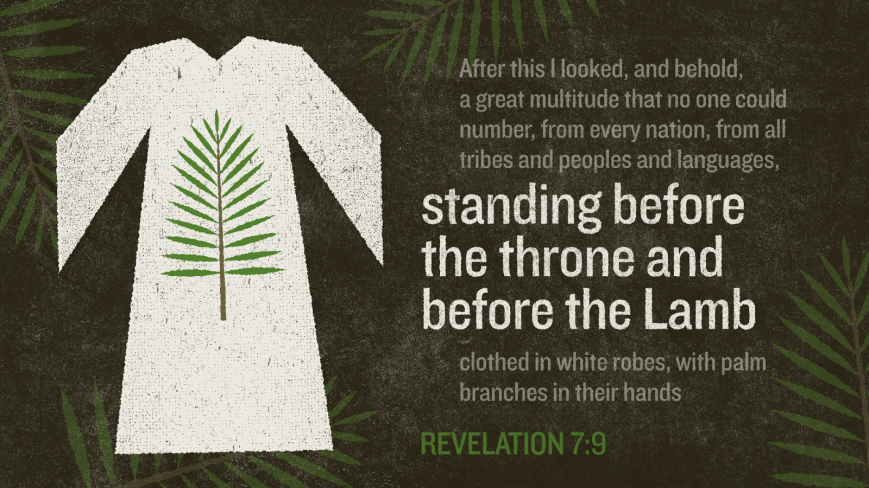
After this I looked, and there was a great multitude that no one could count, from every nation, from all tribes and peoples and languages, standing before the throne and before the Lamb, robed in white, with palm branches in their hands. They cried out in a loud voice, saying, “Salvation belongs to our God who is seated on the throne, and to the Lamb!” And all the angels stood around the throne and around the elders and the four living creatures, and they fell on their faces before the throne and worshiped God, singing, “Amen! Blessing and glory and wisdom and thanksgiving and honor and power and might be to our God forever and ever! Amen.” Then one of the elders addressed me, saying, “Who are these, robed in white, and where have they come from?” I said to him, “Sir, you are the one that knows.” Then he said to me, “These are they who have come out of the great ordeal; they have washed their robes and made them white in the blood of the Lamb. For this reason they are before the throne of God, and worship him day and night within his temple, and the one who is seated on the throne will shelter them. They will hunger no more, and thirst no more; the sun will not strike them, nor any scorching heat; for the Lamb at the center of the throne will be their shepherd, and he will guide them to springs of the water of life, and God will wipe away every tear from their eyes.”
agnus-dei-window-1024x768

The couple had recently celebrated their 60th wedding anniversary when they tragically died in a car crash. They were in relatively good health at the time, mainly due to the wife’s dedication to their diet and forcing them to both get exercise, but when the crash occurred they were immediately brought before St. Peter and the pearly gates.

After a quick check-in, much like the first minutes at a tropical resort, St. Peter volunteered to give them a tore of their heavenly abode. The mansion they would be calling home for eternity was filled with more rooms than they could count with a beautiful kitchen, swimming pool, and movie theater in the basement. As the wife squealed in delight with every passing accommodation, the husband grew skeptical and finally leaned over to Peter and asked, “So how much is this going to cost?”

Peter, flabbergasted, replied, “It’s free, this is Heaven.”

Later, they toured the endless golf course that started in their backyard. With perfect rolling hills that they could only have imagined on earth, they took in the beauty that was available whenever they wanted. The old man, again, asked Peter, “So what are the green fees?

Peter replied, “This is Heaven and you play for free.”

Finally Peter brought the couple to the clubhouse that was filled with people from their lives that they had loved and lost. The joyful reunions went on for some time until Peter motioned for the couple to go through the lavish buffet that had been prepared. The old man, still skeptical, quietly asked Peter how much the food would cost.

Peter, now growing frustrated, said, “Don’t you understand yet? This is Heaven, it’s all free!

The old man stood still and then asked, “Well where are the fat free and low cholesterol tables?”

Peter then began to lecture, “That’s the best part. You can eat as much as you like of whatever you like, and you never get fat or sick. This is Heaven!

Immediately the old man went off with a fit of anger, throwing down his hat and stomping out of the clubhouse.

Peter and the wife both tried to calm down the old man and asked what was wrong. The old man looked at his wife and said, “This is all your fault! If it wasn’t for your diet and exercise, I could have been here ten years ago!

What’s heaven like? I get asked this question on a pretty regular basis. I might be in my office with a grieving family who just lost someone they loved and someone will ask what the person is now “doing” in heaven. Or I’ll be here in the sanctuary teaching a lesson to the preschoolers when the subject of heaven comes up and one of them will say something like: My mommy told me that heaven is full of your favorite candy, and you can have as much of it as you want!

What’s heaven like? There are a decent number of times when scripture is descriptive about the beyond, but it is a far stretch from the jokes and movies many of have experienced on the subject. John caught a glimpse of the heavenly glory of God’s presence in a vision and described it like the grandest worship service to have ever occurred. Countless beings that have made it through the great tribulation surround the throne of the Lord where the Lamb is in the center. They sing with full voices and praise the Lord unceasingly for his majesty is beyond comprehension.

Rev 7v9

The problem with talking about heaven is that whatever we say, it is speculative at best. We can point to scripture where it is described, but the descriptions are made in such a way that heaven is beyond our comprehension. The whole point of heaven after all, is that it is totally other from earthly life. It is beyond life. It is glory and wisdom and thanksgiving and honor and power and might in a way that is impossible for us to understand during our earthly lives.

And even though we can only hint at what heaven might be like, it has become the pinnacle concern for many churches and Christians. What do I have to do to make it to heaven? Or what do we have to do in order to get other people to heaven? These questions dominate our thoughts and we grow anxious about whether or not we, and the people we love, will go on to our heavenly reward.

When talking about heaven, there is a strong temptation to make it so appealing with comparisons to earthly beauty that we neglect to think about the fact that we are called to exist here on earth until our deaths. But this text, this worshipful understanding of heaven, lets us know that God never promised we would not suffer. In fact the opposite is true. Suffering has always been part of our story, and even we here in the blessed region of Western civilization are not immune.

Only in death can we receive the gift of resurrection. It was only through Christ’s crucifixion that he could one day be raised again. The same holds true for us. Only when the bell tolls for us will we share in Christ’s victory over death.

And yet we still talk about it all the time. It is good and right for us to celebrate Christ’s resurrection, but when daydreams about our everlasting reward later prevent us from serving the needs of others right now it becomes cheap grace.

In many churches, like the ones most concerned about whether others are going to heaven or hell after they die seem less concerned with the hells on earth right now. Here in scripture John is confronted with the suffering of the great multitude before they arrive at the throne. They are granted a peace they did not have on earth: they will not hunger, nor thirst, the sun will not strike them, nor any scorching heat because the Lamb of God has shepherded them to the springs of life where God wipes away all tears. But before we can rejoice with the Lord in his divine kingdom, we will endure tribulations in our earthly lives.

Imagining that our lives will be free from suffering is what often leads people to leave the church when something goes wrong. I know too many people my age who were forbidden from attending funerals as children, and then when they finally attended a funeral for the first time when they were older they fell away from the church. I also know too many people who lived such perfect and sheltered lives that when they encountered true poverty for the first time they were overwhelmed by the brokenness of the world and have been unable to return to church.

The church is supposed to be the alternative to this overly rosy view of the world. We have the church to help us remember exactly what God has promised, and what God has not. The church is the place where we confront the hardships of life and rely on the people in the pews next to us to help us through the great tribulations we experience. We are not here to prance around pretending that we have perfect lives without suffering, but instead to proclaim that in trusting the Lord we will find the strength and courage to sustain us until that time when we will join Jesus in the victory over death.

The church is the means by which we combat the hells we experience on earth by attempting to give people hope and faith in something greater than earthly life can offer.

bigstock-Cross-against-the-sky-24690071-panorama

In this church, at St. John’s, we strive to help guide and nurture one another through a variety of means. We have bible studies for the young and the old to help us wrestle with how scripture can speak into our everyday experiences. We collect food and clothing and money for others who are desperately in need. We send people on mission trips to build and plant new foundations and relationships for people who really feel like they are living in hell right now.

But we also have a woman here in the church who has made it her calling to help nurture people in the midst of suffering in the best way she knows how. I believe that Dianne Wright is keeping Hallmark in business through the countless cards she sends out to the community. If you’ve been coming to this church for any regular period of time, and have had so much as a cold, you’ve probably received a card from Dianne Wright. They are always thoughtful, they are always written with purposeful words, and they are always filled with love.

I have the added benefit of not just receiving cards when I need them, but I visit enough of you and our shut-ins to know how prized these letters have become. I was visiting someone at King’s Daughters recently when I saw the familiar script sticking out of the cards adorned in a row on the window sill. The woman I visited described them as the most precious gift she had received since she went in to rehab.

Time and time again I will find myself visiting someone and the subject of Dianne’s cards will come up. They might appear to be a simple and casual gesture, but they speak volumes in the realm of how we are sustained by God’s grace through our neighbor Dianne.

As Christians, we are called to combat the countless hells on earth that plague people through our love and presence. For Dianne Wright, this has meant a ceaseless commitment to communicating through cards the love, depth, and peace of God.

Each of us, in some way shape or form, has gifts that we use to share God’s love with others. Perhaps we have the freedom to visit with people who can no longer visit us. Maybe we, like Dianne, have a penchant for penning letters. Perhaps we have been blessed with lucrative careers that allow us to give charitably to help others. Maybe God has molded us with a spirit of prayer and we can lift up the world through our clasped hands. Perhaps we have become familiar with a particular need in the world and all we need is a little nudge to start serving God by serving others. Maybe we have toyed with the idea of a calling to the ministry and we just need to take a step in faith that God can use us to spread the gospel. Perhaps we have the gift of carpentry like Jesus only we’ve been too nervous to ask someone we know if they need any repairs. Whatever our gift might be, God is calling us to use them to draw people into moments of heaven on earth.

When our time comes God will do with us what God wants. In God’s infinite wisdom and glory we will surround the throne and join in one voice with the saints who came before us, and with the saints who will come after us. We will be washed with the blood of the lamb and God will wipe away every tear from our eyes.

We know not when we will gather with the great multitude, but each day God gives us is a gift. A gift we should celebrate by being a gift for others. Amen.

Naked and Afraid

John 21.1-17

After these things Jesus showed himself again to the disciples by the Sea of Tiberias; and he showed himself in this way. Gathered there together were Simon Peter, Thomas called the Twin, Nathanael of Cana of Galilee, the sons of Zebedee, and two other of his disciples. Simon Peter said to them, “I am going fishing.” They said to him, “We will go with you.” They went out and got into the boat, but that night they caught nothing. Just after daybreak, Jesus stood on the beach; but the disciples did not know that it was Jesus. Jesus said to them, “Children, you have no fish, have you?” They answered him, “No.” He said to them, “Cast the net to the right side of the boat, and you will find some.” So they cast it, and now they were not able to haul it in because there were so many fish. That disciple whom Jesus loved said to Peter, “It is the Lord!” When Simon Peter heard that it was the Lord, he put on some clothes, for he was naked, and jumped into the sea. But the other disciples came in the boat, dragging the net full of fish, for they were not far from the land, only about a hundred yards off. When they had gone ashore, they saw a charcoal fire there, with fish on it, and bread. Jesus said to them, “Bring some of the fish that you have just caught.” So Simon Peter went aboard and hauled the net ashore, full of large fish, a hundred fifty-three of them; and though there were so many, the net was not torn. Jesus said to them, “Come and have breakfast.” Now not of the disciples dared to ask him, “Who are you?” because they knew it was the Lord. Jesus came and took the bread and gave it to them, and did the same with the fish. This was now the third time that Jesus appeared to the disciples after he was raised from the dead. When they had finished breakfast, Jesus said to Simon Peter, “Simon son of John, do you love me more than these?” He said to him, “Yes, Lord; you know that I love you.” Jesus said to him, “Feed my lambs.” A second time he said to him, “Simon son of John, do you love me?” He said to him, “Yes, Lord; you know that I love you.” Jesus said to him, “Tend my sheep.” He said to him the third time, “Simon son of John, do you love me?” Peter felt hurt because he said to him the third time, “Do you love me?” And he said to him, “Lord, you know everything; you know that I love you.” Jesus said to him, “Feed my sheep.”

do-you-love-me-pic


Jesus asks, “Do you love me?”

On the first Easter Sunday, Jesus rose from the dead. The angel at the tomb shared the Good News with the disciples and with the Marys, and later that day Jesus appeared in the room with the disciples. He commanded them to “Go” and spread the Good News to all the earth. But Thomas was not there. Thomas doubted his friends, and their stories about the risen Lord. So a week later Jesus appeared again before the disciples and offered his hands and his side to Thomas to prove the resurrection. He concluded the moment by saying: “Blessed are those who have not seen and yet have come to believe.”

After these incredible moments of resurrected existence, Jesus revealed himself to the disciples for a third time at the sea of Galilee when they returned to their former lives. What a fitting reading for the second Sunday after Easter. Just two weeks ago we were gathered in this sanctuary shouting “Hallelujah!” and praising the Lord for Jesus’ resurrection from the grave. We were living in the light of the resurrection, and boy was it bright! The scent of blooming lilies punctuated the air and invaded our nostrils. No matter what was happening in our lives, God bombarded us with the Good News, death defeated, and we left church feeling filled by the Spirit to be Christ’s hands and feet for the world.

And here we are two weeks later. The lilies are gone, the hallelujahs are still are our lips but they don’t have the same power, and the darkness of life has crept back in. Every year we experience Easter like a mountaintop, but at some point we have to travel back down to the valley of existence.

The disciples, after literally witnessing the resurrected Christ, decide to return to their old lives. Peter says to the boys, “I’m goin’ fishing!” and they reply, “We’re coming with you.”

Do you love me?

It seems strange from our vantage point that the disciples should return to their former occupations, even though Jesus told them to go and spread the news. It feels bizarre to hear about them going back to their boats and nets after their friend transformed the meaning of life and death. Yet, this is how people usually respond to an emotional overload. In the weeks after a baby is born, the new parents wonder about when they will be able to sleep again. After a wife loses her husband she wonders when it will be okay to laugh again. When something deeply and fundamentally transformative occurs, it is only natural to ponder about life before the change.

This story of a reunion by the sea is a reminder that there is no escape from the Lord. Wherever the disciples went, and wherever we go, Jesus is with us.

They were out all night fishing but didn’t catch a thing. Jesus stood on the beach watching the disciple row in to shore, but they did not recognize him. He commanded them to cast out their nets one more time and promised they would catch something. Three years earlier he had said the same thing to Peter and Andrew while they were fishing before they left everything to follow him.

They immediately caught so many fish that they were unable to haul in the net because it was so heavy. In that moment, as the pieces finally came together, Peter recognized who was standing on the shore, put on some clothes and jumped into the sea.

There are many details in this epilogue to John’s gospel: the mention of a charcoal fire draws us back to the charcoal fire around which Peter denied Jesus. The appearance of fish and bread to feed the disciples hunger propels us back to the time when Jesus fed the multitudes with bread and fish. Jesus even asks Peter three times, “Do you love me?” which connects with the three times he denied Jesus.

But this simple note that Peter was naked on the boat while catching fish, and decides to put his clothes on before swimming to Jesus, really stands out. It would have been easier to fish under the oppressive heat of the climate without the baggage of clothing, but instead of immediately jumping in (as he had done once before) Peter puts on clothes before he see the resurrected Lord for a third time.

Peter was naked and afraid. Not just physically naked without clothing, but maybe he was afraid of making himself completely vulnerable to Jesus. Perhaps he did not want to address the emotional denial of Jesus prior to his death. Maybe he didn’t want to admit his fallibility, or he did not want his life to be altered. But the resurrection changes everything.

Like we all do when we feel vulnerable, we put on the armor of denial and ignorance in order to protect ourselves from others. Afraid of the inevitable confrontation we sweep things under the rug and pretend that everything has gone back to normal. And then Jesus shows up with his question:

Do you love me?

Sure I do Jesus! I come to church nearly every Sunday, I listen to the pastor up in the pulpit, and I even try to sing the hymns in harmony.

Feed my lambs.

Do you love me?

Of course I do Jesus! I wear a cross around my neck, I always have my check written and ready for the offering, and I post pictures of prayers on Facebook for everyone to see.

Tend my sheep.

Do you love me?

Jesus, you’re making me a little uncomfortable… you know everything and you know that I love you. I’m a good person, I pay my taxes, I give a little money to charity, I try to pray before I eat my meals… what more could you want?

Feed my sheep.

Most of us have probably never faced a time like Peter did when he denied Jesus outright. We’ve never really had to suffer for our faith, and we’ve never really been afraid for following Jesus. But all of us have had moments where we denied him; we just might not realize it.

We might be in our car driving down the road, and perhaps we’re even listening to a Christian radio station, when we stop at a red light and we see someone standing in the median right next to us with a sign asking for money. Perhaps we reach out our hands to lock our doors, or we make judgments about how they got themselves into whatever trouble their in, and before we know it the light turns green and we are able to get on with our lives without being bothered by the panhandlers.

Jesus asks, “Do you love me?”

We might be having a cup of coffee with a friend and the topic of the recent Panama Papers comes up in conversation. We can feel our fists tightening as we complain about the ultra wealthy evading the taxes that all the rest of us have to pay. Perhaps we start drawing connections between the economically elite with criminals who prey on the weak and underprivileged and we wish someone would do something about it. But before too long the conversation moves on to another topic and we finally feel the tension start to slip away as we talk about something else.

Jesus asks, “Do you love me?”

We might be having dinner with our family when someone goes on a tirade about a particular political party. We keep our mouths shut because we’ve heard them go off like this but we can’t help but shake our heads in disappointment over their opinion. How could someone be so backward in their thinking? If they believe their candidate can fix all of our problems, then they are going to be sorely mistaken…

Jesus asks, “Do you love me?”

The conclusion to John’s gospel is like epilogue in its willingness to address many of the elements that made Jesus’ ministry what it was. As we read it, as we smell the fish cooking on the open fire, and we try to dry ourselves off after swimming in the sea, and as we listen to Jesus’ questions it reminds us of darkness.

do-you-love-me

Through this text we are forced to confront the darkness of our hunger for meaning in our lives, or our failure to recognize Jesus in our midst, or the fact that we have denied him by denying others. But at the same time, this story reminds us that none of the darkness has overcome the light. Christ still died for us while we were yet sinners. God still sent his Son into this broken world to start putting the pieces back together. The Holy Spirit still moves among us and calls us to love one another even when it feels impossible.

Christianity, at its best, is not about what we think or feel about Jesus – it’s about what Jesus does to us. Not a technique for how we can use him to accomplish our goals, but rather his plans for using people like us to transform the world by feeding and tending to the sheep.

Here we are, just like the disciples, a few weeks on the other side of Easter. For many of us, the normalcy of life has returned. The darkness of the cross has crept back into our daily lives. We turn on the television and we want to know why we live in such a broken world. We confront people who drive us crazy. We grow tired of the seemingly endless race for the White House. We clench our fits with frustration over our lack of control. We worry about our bank accounts, and our children, and our futures.

            And then Jesus has the nerve to show up in our lives and ask, “Do you love me?”

If we love Jesus, then we have to start loving one another. Which means that we have to feed Jesus’ sheep by encountering the person on the side of the road asking for money. And not by just addressing their financial situation, but also by treating them with worth and respect. It means that we have to tend to Jesus sheep by helping those trapped by the power of greed to see how their greed affects all of God’s creation. It means that we have to feed Jesus’ sheep when they argue and bicker about politics by listening and loving rather than ignoring and judging.

It is here at the lakeshore of life, that we discover what a strange Messiah we follow. A man who came and was hung on a cross only to forgive his murders; a man who went back to the friends who betrayed him, and ate breakfast with them by the sea; a man who got killed for calling people to serve the last, least, and the lost; a man who expects us to love him by loving others. Amen.

Why The Cross? – Good Friday Homily

John 19.28-30

After this, when Jesus knew that all was now finished, he said (in order to fulfill the scripture), “I am thirsty.” A jar full of sour wine was standing there. So they put a sponge full of the wine on a branch of hyssop and held it to his mouth. When Jesus had received the wine, he said, “It is finished.” Then he bowed his head and gave up his spirit.


ethereal-finished-still-p3

I get asked a lot of questions. I’ll be in a bible study when the conversation moves to an area of confusion and all eyes will turn to me and someone will inevitably say, “What does this mean?” Or I’ll be in my office and someone will walk in to share about all of the trials and tribulations they’ve experienced and finish by asking, “So where is God in all of this?” Or, like after the atrocity in Brussels this week, I’ll receive an email that says, “How could God let this happen?” People are looking for answers.

On Wednesday morning I gathered all the little preschoolers into the sanctuary to talk about the cross. I wanted to show them the cross we have here in the sanctuary and eventually have them march outside in a line while I carried the cross. For most of them, Easter is about the bunny and the candy so anything I can do to make it more about Jesus is important.

They were all sitting nice and quiet in the pews as I explained Jesus’ final week, and that he died on a cross to help us get to heaven, and most of the kids nodded along. But one sat in the back pew with her eyebrows in an expression of “huh?” I tried to keep moving us forward but I could tell it wasn’t connecting with her so when I saw her shoot her hand up with a question I wasn’t surprised.

She asked, “But why did he have to die on a cross?”

In the moment I tried to answer her question in a way that only a four year old could understand, but the question has stayed with me nonetheless. Why did Jesus have to die on a cross?

Well, he had to die on a cross because that’s the way the Romans executed those who they regarded as a threat. Today we have drones and missiles that we can fire from far away in order to remove ourselves from death, but during the time of Jesus, they were hung high in the air so that all could see what happened when you challenged Rome. The cross was a sign of death and fear.

But that answer is not good enough for those, few, of us who gather in a place like this on Good Friday. If you’re here right now, you get that discipleship is more than just Easter. You get that Jesus was more than just a nice guy. You get that there is something more to this cross than symbolic remembrance.

Jesus died on a cross to reveal the heart of God.

The cross is where God’s grace crosses our life to create a new way of living.

We’ve got crosses everywhere and sometimes we forget how terrifying they were and should be. It is our central icon and we have them displayed in our sanctuary, some of us have crosses around our necks, and some of us even have them tattooed on our bodies. But notice: our crosses are empty. It would disrupt our Protestant sensibilities to have a murdered and graphic Jesus hanging on the cross for everyone to see. We would rather have the clean empty cross to remind us of the resurrection. But if we lose sight of the fright and discomfort of the crucifixion, the empty grave becomes cheap grace.

So, to be here on Good Friday implies a willingness on our part to confront the cross and we also want it explained. We want to know ‘why.’

But Jesus doesn’t offer us an explanation.

Whenever the religious elite, or the crowds, or his disciples questioned him, he would respond in cryptic parables that left them more confused than in the beginning. Jesus doesn’t offer simple explanations. Instead he offers love.

Explanations will never calm our anxieties in regard to suffering and tragedy. The people who try to explain the death of a young child by saying that “God wanted another angel in heaven” transform God into a murderer for the sake of an explanation. The people who try to explain a disabled child as “God’s way of punishing the mistakes of the parents” make God in a torturer for the sake of explanation. The people who try to rationalize terrorist attacks with “God is using them to show us its time to go to war” morph God into a selfish, violent, and manipulative entity for the sake of explanation.

Love, not explanation, is required when we are faced with tragedies. Instead of telling a grieving mother that God wanted her baby, we are supposed to show up with love and not answers. Instead of blaming sinful or faithless behavior for the disabilities in a child, we are supposed to love them with every fiber of our being. Instead of dropping bombs and sending drones to wipe out the Middle East we are supposed to see them as our brothers and sisters.

To be Christian is to enter into suffering. We do not look away from tragedies, we do not abandon those who are alone, and we do not isolate ourselves from the ways of the world. Instead, because of the cross, we are tasked with showing up for others when there is literally nothing we can do to save ourselves from suffering.

So, we could take the time to outline the connections between Jesus hanging on a tree with the first sin of Adam and Eve taking fruit from the tree of knowledge of good and evil. We could go deep into rationalizing the cross through theories like God used Jesus as bait to hook the devil from hell. But the truest response to the cross, the way we are called to go forth from Good Friday, is to look at the cross and take up our own to follow Jesus. Amen.

12042644_10205705206780417_2916230849357888646_n

Devotional – Psalm 118.24

Devotional:

Psalm 118.24

This is the day that the Lord has made; let us rejoice and be glad in it.
Weekly Devotional Image

The topic of “blessings” occurs regularly in our Bible studies at St. John’s. We can be reading from the Old or the New Testament, we can be reading a Psalm or an Epistle, we can be reading a genealogy or one of the miracles of Jesus, and the conversation almost always turns to how we take out blessings for granted. There is something inherent in scripture that works like a mirror, forcing us to confront ourselves in the text.

Yesterday morning, while we were reading about the episode of Jesus with the woman at the well, we started off by praying over the text, and before long one of our group members started to reflect on her blessings: “I am so blessed. I’ve got a great family and home. I have a church that cares about me. But I am even more blessed than that. I wish I could realize that every single day, every single breath, is a gift. And I wish I could stop taking these gifts for granted.”

this-is-the-day-360x450

For many of us, life feels like a train that keeps moving in one direction and we barely have time to admire the scenery passing out windows. Time rolls like a blur and we neglect to be thankful for the present because we are always looking toward the future. The psalmist’s words then confront us in our fast-paced lifestyles: “This is the day that the Lord has made; let us rejoice and be glad in it.”

I use these words to mark the beginning of worship at St. John’s because gathering in our sanctuary is a gift that God has given. It is not something we should take for granted. But can you imagine how differently we would live if we started every morning with these words? Can you picture how wonderful it would be to contemplate the blessing of your life every morning rather than just once in a while?

This week, let us use the words of Psalm 118 to mark our mornings. Instead of waking up and rushing to catch up with the train of life, let us take a slow breath and say: “This is the day that the Lord has made; I will rejoice and be glad in it.” If we do this, we will begin to stop taking our lives for granted, and we can give God thanks for all of our many blessings.

Sinners, Outcasts, and the Poor

John 4.3-10

But he had to go back through Samaria. So he came to a Samaritan city called Sychar, near the plot of ground that Jacob had given to his son Joseph. Jacob’s well was there, and Jesus, tired out by his journey, was sitting by the well. It was about noon. A Samaritan woman came to draw water, and Jesus said to her, “Give me a drink.” (His disciples had gone to the city to buy food.) The Samaritan woman said to him, “How is it that you, a Jew, ask a drink of me, a woman of Samaria?” (Jews do not share things in common with Samaritan.) Jesus answered her, “If you knew the gift of God, and who it is that is saying to you, ‘Give me a drink,’ you would have asked him, and he would have given you the living water.”

kathleen-mcguffin-rivers-of-living-water-at-arts-alive


If you want to know about Jesus, this is the story to read. We can read about his remarkable birth in a manger in Bethlehem, we can read about him feeding the multitudes by the sea, we can even read about him turning water into wine, but this little episode by the well is quintessential Jesus.

At the time, Jews avoided Samaritans. If they had to travel from the northern area of Galilee to the southern area of Jerusalem, most Jews would go hours or days out of their way to avoid passing through the region of Samaria that separated the two. Like Apartheid in South Africa or segregation in the United States, the people were separated in all things. This kind of negative and polarized relationship between the groups of people had gone on for centuries to the point where, even though they had many things in common, they believed the divide was irreparable.

And yet Jesus shows up in this Samaritan city, and under the heat of the sun at noon, he goes to the well to rest. While resting, a Samaritan woman came to draw water, and Jesus said, “Give me a drink.”

In this simple moment, a lot is going on. To begin, the unnamed woman coming to the well at the hottest part of the day is strange. Most women would have gone to the well early in the morning when it was still cool outside. The well was the area for local gossip and fellowship; it was a site for the community. And she came to the well all alone. We learn later in the scripture that she had gone from one man to another, and was now living with a man who was not her husband. It doesn’t take a lot of imagination to picture why she was separated from the other Samaritan woman, it doesn’t take a lot of imagination to picture how lonely she must have felt, and it doesn’t take a lot of imagination to picture what the people in the village would have called her: “sinner.”

The woman could not believe that this Jewish man was speaking to her, a Samaritan woman. And Jesus responds by saying, “If you knew the gift of God, and who it is that is saying to you, ‘Give me a drink,’ you would have asked him, and he would have given you the living water.

Jesus loves sinners. Here in this little story by the well we confront Jesus’ love for the marginalized, and his belief in the inherent worth of all people. When we imagine the depth of her thirst for acceptance, and the relief of the living water offered to her without cost, it compels us to ask: Do we see all people as children of God? Or do we see them as society sees them – sinners, outcasts, and poor?

Water bucket being raised from a well

There is a church in Virginia that is located right across the street from a major university. For years they have explored numerous ways to get “the young people to come to church” but they have continued to decline. They thought that by offering lectures on the importance of abstinence, or the effects of excessive drinking, or how to be political and faithful, droves of the coming generations would fill the pews on Sunday mornings.

Next to the church is a row of college housing that becomes loud and filled with debauchery on the weekends. Even though the church parking lot has numerous signs saying: “Church Parking Only” certain members were known for driving by on Saturday evenings with the explicit purpose of calling the tow company to have the party goers’ cars removed.

On one particular Friday evening, while one of the committees was meeting in the social hall, a loud and sinful party was happening right across the parking lot. The members, though tasked with discussing something like the new color for the parlor, focused their time and effort on how to fix the problem next door. They finally decided to march across the parking lot and demand that the college students stop their partying and remove their cars from the parking lot.

As they knocked and knocked on the doors the sound of their knuckles disappeared into the thundering boom of the bass and they decided they had had enough and they called the police.

With satisfied smiles across their faces, the committee stood proudly in the parking lot while tow trucks removed the vehicles, and while the police escorted those who were too young to be legally drinking in handcuffs to their cruisers.

And they still wonder why no young people attend church.

Notice: in the episode with Jesus by the well he does not say to the woman, “I know you’re a sinner, and you need to be punished for your sins.” He does not call the religious authorities for her transgressions against the law. And he does not stand by with a smug look on his face when he confronts her sinful past. Instead he says, “I can offer you living water.”

There is another church in Virginia that is located right across the street from another major university. Like the first church they struggled to get the college age population to attend their church, they struggled with the sinful behavior that was happening so close, and they wondered how they could be Jesus for these young people. One night, after a steady stream of weeks when empty beers cans were found every Sunday morning on the lawn, the pastor and a group of leaders gathered in the church to pray for the community and prayerfully discern how to move forward. They contemplated calling the police, they weighed the outcome of going over to the house and knocking on the door, but an older woman suggested that they go to the Greek life council and ask how they could help.

When the president of one of the fraternities heard their question, he laughed in response and said jokingly, “If you want to help us… we could use some food and a place to hang out in the middle of the night after a party.” Without missing a beat the same older woman from the church said, “Okay. What time?”

The following weekend, a group of faithful volunteers arrived at the church at midnight and fired up their grills. They cooked hot dogs and hamburgers, set up bean bags in the social hall, and placed signs on the lawn welcoming any college student in, regardless of inebriation, for free food. The first night only a handful of students bravely entered with puzzled looks on their faces in regard to a church that was not condemning them for their behavior, but was just trying to offer food and fellowship. But over the following weeks, more and more people arrived in the social hall every weekend thankful for the love they were experiencing.

And the strangest thing started to happen. On Sundays, when church members arrived for worship, the lawn was free of empty beers can, and though some members came in with bags under their eyes, they were thrilled to discover that many of the students who had sat on the bean bags with hamburgers in their hands the night before were sitting in the pews next to them on Sunday morning.

Who are the Samaritans to us? Our church is not located next to a large university where partying behavior can be experienced through empty beer cans on our front lawn, but there are plenty of people that we want to avoid or ignore. Many of us find that the longer we’re Christian, the more likely it is that all our friends are Christians too. Following Jesus however, means building relationships with people outside the church. We, like Jesus, are called to encounter the Samaritans and show them the love of Christ, whether they ever come to church or not.

Samaritans, therefore, are the people we ignore or avoid. That neighbor who insists on letting his dog use our lawn as a toilet; that coworker who incessantly complains about everything wrong with the business without doing anything about it; that in-law who tells us how to raise our family; that homeless man who sits on the corner of the street asking for money; that college student who plays the music in his car way too loud; that woman who has gone from man to man without finding love.

Where can we find them? We don’t have a well on the front lawn of our church, and frankly it is nearly impossible to discover our Samaritans at church. They, like the college students with churches right across the street, will not come to us; we have to go to them. We can find them in the communal spaces of life: our workplaces, our neighbors, our families. Remember that Jesus did not wait in Galilee for the Samaritans to come to him; he left the comfort and convention of the day and went to meet them where they were.

How can we give them living water? We don’t have to bring a bottle of water to everyone that exists outside of the church to share with them the love of Jesus, but’s that’s not necessarily a bad place to start. That one church found that by offering food and fellowship to their local community of college students they were offering the living water that is the love of Jesus. When we host our community cook-outs on our front lawn we are offering living water to the community through bouncy houses and free food. But finding the Samaritans in our lives, and offering them living water should be a regular occurrence and not just a once a year activity.

We give Samaritans living water by loving them no matter what. Instead of wagging our fingers in judgment against their sins or strange ways, we open our ears and listen to their struggles. Instead of looking down on others and trying to fix their problems, we share with them the crazy truth that we are broken just like them. Instead of ignoring people and leaving them to their own devices, we find them where they are and offer them the living water.

This great and powerful story is a reminder, now and always, that people who are nobodies to us are usually somebodies in the eyes of Jesus. The people we ignore are often the ones Jesus would seek out. The people we would deem sinners are the ones Jesus would spend time with.

We often think of God and Church in these big and sweeping images. We read about God’s overpowering magnificence and we experience God’s presence in majestic churches like this one. So we ask: Can a little thing like a cup of cool water, like a cheeseburger in the middle of the night, like an invitation to worship, offered in love, be the beginning of a salvation journey? The answer is yes; and we will never know what the living water can transform until we meet the Samaritan where they are and offer it in the first place. Amen.

Devotional – Psalm 63.3

Devotional:

Psalm 63.3

Because your steadfast love is better than life, my lips will praise you.
Weekly Devotional Image

When we saw the article in the newspaper we knew we had to do something; the local Valley Mission was in desperate need of items for young children and babies. They were thankful for all of the food and adult clothing they had received over the years, but what they really needed were diapers, toys for toddlers, and an assortment of other items.

Two couples at St. John’s are currently pregnant and we decided to harness the excited energy the church is feeling about new life and channel it into blessing the children at the mission. For weeks we have talked about the items needed during worship, we have sent out email reminders, and it has been an integral part of our prayers. Yesterday was the conclusion of the “baby shower” drive and we encouraged everyone to bring their items into the social hall and enjoy some food and fellowship as we prayed over the items before dropping them off.

Honestly, when we make pleas like this from the pulpit, they can often fall flat. It’s not that the congregation is unwilling to bless others; it just falls in among the many needs the community faces. When we hear about how much someone needs something on a weekly basis, it is very easy to just assume that someone else will take care of it.

Therefore, when I entered the social hall after worship yesterday and saw the tremendous amount of items donated I was shocked: Diapers were falling off the tables, crayons and coloring books were stacked on the floor, baby clothes were neatly arranged, in addition to all the other things that were brought in. It was a holy moment seeing all of the material that had been generously donated to bless others.

IMG_0783

When we can connect a need with something tangible, (when we see pregnant women in the sanctuary and imagine how badly other people might need baby supplies) it encourages a profound generosity within us. When we can remember how badly we needed those types of items for our children, it encourages us to do more than usual. When we can truly proclaim that God’s steadfast love has changed our lives, it encourages us to use our lips and our lives to change others.

God’s steadfast love is revealed in the people around us. Whenever we need something and a friend steps up to help out, that is God’s love in action. But God’s steadfast love is also revealed in scripture through the life, death, and resurrection of his Son Jesus Christ. This week, as we continue on the way that leads to life, let us look for ways to act like Jesus so that others may experience God’s steadfast love through us.

Transfigured Moments

Luke 9.28-36

Now about eight days after these sayings Jesus took with him Peter and John and James, and went up on the mountain to pray. And while he was praying, the appearance of his face changed, and his clothes became dazzling white. Suddenly they say two men, Moses and Elijah, talking to him. They appeared in glory and were speaking of his departure, which he was about to accomplish at Jerusalem. Now Peter and his companions were weighed down with sleep; but since they had stayed awake, they saw his glory and the two men who stood with him. Just as they were leaving him, Peter said to Jesus, “Master, it is good for us to be here; let us make three dwellings, one for you, one for Moses, and one for Elijah” – not knowing what he said. While he was saying this, a cloud came and overshadowed them; and they were terrified as they entered the cloud. Then from the cloud came a voice that said, “This is my Son, my chosen; listen to him!” When the voice had spoken, Jesus was found alone. And they kept silent and in those days told no one any of the things they had seen.

sunrise-over-the-mountains


On Monday morning, before I departed for my ordination interviews, I came by the church to print off my papers and spend some time in prayer. Full disclosure: I was very anxious. Months of effort and focus had led to up to this week. Many of you have been here throughout this whole ordination process: you have endured sermons that went into my papers and some of you were here when we had to record an entire worship service. A number of you participated in the bible study I wrote on the book of James and offered feedback about what went well and where it could’ve been better.

The sanctuary was nice and quiet when I first entered to pray for God’s will to be done over the following days, but the longer I prayed, the louder the preschoolers were down in the basement. I continued to lift up my concerns to God until I felt that I had fully expressed myself, and then I went downstairs to say “hello” to the kids.

Like most of you, they were also aware of the interviews I would have this week. Yet, even knowing this, I was not prepared for what happened when I entered the first classroom. The teacher quickly motioned to the kids and while I was trying to kneel to speak with one of them they promptly surrounded me in a circle, grasped hands, and started to sing: “Thank you God for giving us Pastor Taylor, thank you God for giving us Pastor Taylor, thank you God for giving us Pastor Taylor, right where are. Amen.

The Transfiguration is an important moment in the life of Christ, and it really bears witness to the identity of the Messiah. Up to this point in scripture, Jesus has performed lots of miracles; he has healed the unwell, embraced the outcasts, preached in the synagogues, and started a revolutionary movement. But all of these particular moments were a crescendo to the brilliance on the mountaintop.

Jesus took with the inner circle of disciples up to the peak to pray. And while Jesus was in the depth of his prayers his face began to change and his clothes became dazzling white. Suddenly, the disciples saw two men standing on either side of Jesus, one of them was Elijah, and the other was Moses. The disciples listened intently as the three shining men talked about Jesus’ departure that would soon take place in Jerusalem.

After they had discussed this for some time, and the two men started to depart from Jesus, Peter interrupted and begged Jesus to let them build three dwellings for this holy moment. He wanted to establish a degree of permanence in this brilliantly shining experience. But he, as scripture tells us, had no idea what he was talking about.

Then a cloud came and overshadowed all of them on the mountain and they were utterly terrified. But a voice cried out from the cloud saying, “This is my Son; my chosen. Listen to him!” When the voice finished, the disciples noticed that they were alone with Jesus, and they did not speak about this moment for a long time.

Shortly before this passage in scripture Peter was able to confess Jesus as the Christ; he understood that Jesus was the Messiah that the Hebrew people had heard about for centuries. Yet, this story of the Transfiguration is a reminder that even those disciples in the inner circle had gaps in their understanding. Professing deep and true faith requires something more than just knowing the stories from the past and connecting the dots. Professing deep and true faith requires transfigured moments that change everything.

transfiguration-abstract-e1360464424741

While the preschoolers sang their prayer around me, I felt like I was up on the mountaintop of Transfiguration. In their tiny voices and clasped hands I experienced the profound power of prayer in their willingness to lift me up in a holy moment. And like Peter, I didn’t want to the moment to end. Like Peter, I thought about setting up a dwelling place in that space to stay happy and comfortable.

When the kids finally shouted “Amen!” to conclude the prayer they immediately sprinted into the middle of the circle and started hugging me to the point that I fell over on the floor. It was a transfigured moment while I collapsed to the ground under the weight of laughing preschoolers, but I knew that I would have to eventually leave the mountaintop and make my way down to the valley of ordination interviews.

The next 24 hours were a blur. I made it to Blackstone, I spent the night, I woke up and interviewed all morning, and before I knew it I was back in my car heading west toward Staunton. The entire car ride was filled with more anxiety than before the interviews because now all I could do was wait. I spent far too much time rehashing questions in my mind and coming up with better answers than the ones I offered. But now the only thing I could do was pray patiently.

By the time our youth meeting rolled around on Wednesday evening, I had spent most of the day checking my phone every 5 minutes waiting for the call about whether I had been approved or not. I tried to be as present for the youth at the Circle but I know that my thoughts were elsewhere. With every minute that passed it felt like my heart rhythm was increasing one beat per minute. But still the call did not come.

I eventually brought the youth into the social hall and had them sit by the fireplace. I got a fire going and handed each of them a palm branch from our last Palm Sunday service and I explained our activity.

I said, “Every year churches take their used and dried-out palm branches and burn them. We do this in order to collect the ashes and use them for Ash Wednesday. Lent, which starts on Ash Wednesday, is a time to reflect on ways we could be better. It is a whole season for us to confront the mistakes we’ve made and start living like disciples of Jesus. I want each of you to take a couple minutes to think about one mistake you made in the past year, a moment you wish you could take back. I want you to imagine that failure as you throw your palm branch into the fire. And while you watch it burn, I want to you to remember that God can take our mistakes and make them into something holy. These palm branches will become the ashes that mark our foreheads next week. We will walk around with ashes signifying for everyone to see that we are broken people in need of grace. These ashes are a reminder that even though we mess up, God still loves us.

One by one we each took a turn throwing our palms into the fire and we watched them burn. We took our mistakes and watched them become ashes. We concluded by praying for God to make things new in our lives, to use the season of Lent to transfigure us into better disciples of his Son. When we said the final “Amen” I looked up and saw our District Superintendent standing in the room with a giant smile across his face and he told me that I passed my interviews.

Transfiguration-3

The Transfiguration is such a powerful moment because it is about transformation. Yes Jesus is changed into a glowing figure in dazzling white clothes, yes the appearance of Moses and Elijah reshaped the narrative of Jesus’ journey toward the cross, but when the disciples had to walk back down from the mountain their lives were forever changed.

Whereas they might’ve understood their friend to be a powerful speaker and leader, they were now confronted with the fact that he really was divine. Whereas they might’ve believed he was special, they were now confronted with the fact that he had real power. Whereas they might’ve believed he was capable of great things, they were now confronted with the fact that he was the Son of God. Jesus’ transfiguration transfigured their lives.

Standing by the fire on Wednesday night, as I let the knowledge that I will be ordained sink into my soul, and the youth started to jump around and yelp in celebration, I was reminded of how powerful those transfigured moments in life can be. I thought about how blessed we are to have a God who is so merciful and forgiving of our mistakes. I thought about how blessed we are to be surrounded by people in this church who pray for us and care about us. That moment by the fire reshaped my understanding of ministry and the church. In that transfigured moment I felt God’s love moving in this church through all of the connections we have made.

Transfigured moments always remind us how dependent we are on one another and the divine. When we encounter the true glory of the Lord it leaves us staggering in comparison. But God did not abandon the disciples on that mountaintop, and God has not abandoned us here and now. Instead God spoke through the cloud, and speaks to us today: “Jesus is the Son of God, listen to him!”

So what does it mean for us to listen to God’s Son here at St. John’s?

Do you feel loved? In your daily lives do you experience moments of joy that you can only equate with feeling loved? Do you have friends and family that care about who you are and what you’re experiencing? Are you connected with individuals you make you laugh and thankful for the gift of life?

This week, for me, has been an experience of love. Love of God and neighbor through all of you in this church.

In this church we have listened to Jesus speak to us, and we have responded to his command: “Love one another.” We have covenanted through baptism to love and support all those around us in the pews. We have gathered together to mourn during funerals and reach out to remind individuals of their worth. We have met here at God’s table to partake in the bread and the cup as a reminder that God’s love knows no bounds. We have opened our eyes and ears to the great witness of scripture that points toward God’s unfailing love for people like us.

So hear this from Jesus, and embrace it in your lives: “You are loved.”

No matter what you are currently experiencing, no matter how far you feel divided from the people around you, no matter how afraid you might be, you are loved. God has gathered all of us here in this place to build a new community of love.

When we lift up our hymnals to sing our faith we do so as a complete community in harmony with our relationship and our voices.

When we pray from our pews we do so as a new family who can faithfully say God is OUR Father.

When we are invited to this table to receive the bread and the cup we are invited as a community to a feast. There is a spot for us at God’s table where we can grow closer to the people in church next to us while growing closer with the Lord.

This is the place of transfigured moments that cut through the monotony of life. This is the place where we encounter the revealed Lord. This is the place where we hear Jesus saying to us, “You are loved.” Amen.

What Does The Bible Say About Divorce?

Mark 10.2-12

Some Pharisees came, and to test him they asked, “Is it lawful for a man to divorce his wife?” He answered them, “What did Moses command you?” They said, “Moses allowed a man to write a certificate of dismissal and to divorce her.” But Jesus said to them, “Because of you hardness of heart he wrote this commandment for you. But from the beginning of creation, ‘God made them male and female.’ For this reason a man shall leave his father and mother and be joined to his wife, and the two shall become one flesh.’ So they are no longer two, but one flesh. Therefore what God has joined together, let no one separate.” Then in the house the disciples asked him again about this matter. He said to them, “Whoever divorces his wife and marries another commits adultery against her; and if she divorces her husband and marries another, she commits adultery.”

Le divorce

This morning we continue our sermon series on Questions. After polling all of you about your queries regarding faith, scripture, and the church, I compiled three of the most prevalent questions: What Are Angels? What Does The Bible Say About Divorce? And How Can We Be Biblically Wise? Though there are no simple, black and white, answers to any of these questions, we will strive during this series to bring clarity to our wonder. This morning we continue with “What Does The Bible Say About Divorce?”


Good morning. It is so nice to see and be with both of you for this premarital counseling session. I am really excited about your wedding and I considerate it a privilege that you’ve asked me to preside over the service.

Before we really get started, let’s pray… Amen.

So, tell me about your last fight… Uh huh, interesting. And would you agree? … Okay. So let me get this straight, your mother keeps offering her unsolicited opinion about what you two should do with your money, and then your mother keeps inserting herself into wedding plans? But the fight really started when you began arguing about where you would be spending your first Christmas as a married couple. You think you should be with your parents and family? And you think you should be with your parents and family?

This is going to be a great session!

Marriage is a strange thing. Out of all the people in the world, out of all the conversations and friendships and relationships, you two have been brought together (somehow or another) and you are now about to make a public covenant that you want to be together for the rest of your lives.

Let’s talk about why you want to be married. Everything in your relationship seems to be going fairly well, so why do you want to move toward marriage?

Because you love each other… How precious. We’ll talk more about love later. What else? What makes you feel like the person next to you in the one you want to wake up next to forever?

You trust each other… nice. You feel complete when the other one is around… good. You want to start your own family together… great.

Marriage is a public union ratified by God in heaven. In gathering together before your friends, families, and the Lord you will make a covenant to embody Christ’s love for us with the person sitting next to you. It is just about the most serious decision and commitment that you will ever make.

So you know why you want to get married. The next question, then, is why do you want to get married in the church? Because the three of us could get in the car and head down to the courthouse right now and you could be married within the hour. It would be a legal marriage in the eyes of the state and it would probably cost a whole lot less. So, why get married in the church?

I love that answer: You believe that marriage is bigger than just the two of you, and you want to the community of faith to be there with you. Wow.

Have you all thought about what scripture you want to use in the service? I encourage all couples to spend time in the bible and search for a verse or a passage that has special meaning for you. My only caveat is this: I will not preach on 1 Corinthians 13. Do you know it? “Love is patient; love is kind; love is not envious or boastful or arrogant or rude. It does not insist on its own way; it is not irritable or resentful; It does not rejoice in wrongdoing, but rejoices in the truth. It bears all things, believes all things, hopes all things, endures all things. Love never ends”

Why won’t I preach on 1 Corinthians 13? Love is not enough to make a marriage work.

A successful marriage will never be contingent on your whims or your romantic feelings for one another. There will come a day, I promise, that you will not look or feel as good as you do right now. Love is not enough to carry you through the changes and the frustrations that will occur. Marriage requires more than love.

Between this session and the next, take the time to dive deeply into your bibles and find a scripture you want to use in the service and we’ll go from there. Just stay away from 1 Corinthians 13.

Have you thought about any hymns you would like to use in the service?

Number 408. Wait… is that “The Gift of Love”?

Were you not listening to anything I just said? Love is not enough. A successful and faithful marriage is based on qualities like endurance, patience and hope, conversion and renewal, forgiveness and reconciliation. (sigh)

Anyway. Have you all considered the seriousness of your marriage? Which is to say, have you talked about divorce?

Both sets of parents are currently divorced? And it happened when you were a child, and when you were in college? How do you feel about divorce?

Interesting. You believe this covenant is so important that you will never get divorced? That’s rather admirable.

But here’s a dose of reality. 50% of all marriages end in divorce. In our country there is one divorce every 36 seconds. That’s nearly 2,400 divorces per day, 16,800 divorces per week and 876,000 divorces per year. Divorce is so remarkably prevalent in our culture and society to the degree that we have become numb to it.

For too long the church has refused to confront divorce. We’d rather talk about every other controversial subject under the sun, but bring up divorce and you start making people really uncomfortable.

Bride and groom figurines standing on two separated slices of wedding cake

And let me be clear, there are circumstances that occur in marriage where divorce is probably the best possible solution. Situations like physical abuse or traumatic adultery, but people get divorced for the most mundane reasons. “Our interests have grown apart” “We no longer effectively communicate” “We’re not in love anymore.”

As a society, we no longer take the covenant of marriage seriously. Some of us are too quick to end the relationship whenever we feel those first hiccups. As Christians, however, we are called to hear the bible and Jesus who are quite clear in their reflections on divorce.

The pain and complications of divorce cast a great shadow across almost every family and congregation, yet we fail to talk about it. Jesus once told his followers “What God has brought together, let no one separate.” God is the one who does the joining; it is we, with our fallen and broken natures, who do the separating. Marriage is a serious thing, perhaps the most serious, and we need to start taking it seriously. Divorce will always be a possibility, but it should be a last resort.

I have some tips for you. They’re not full-proof ways to avoid having your marriage fall apart. But they are practices that you can initiate now in order to help when things get rocky.

Accept the fact that you two are different. Opposites tend to attract and each of you are not only physically different, but have different backgrounds and outlooks to particular situations. God designed these differences for a reason. The more you learn to celebrate the things that make you different, the stronger your marriage will become.

Leave and cleave. Don’t let either set on in-laws dictate how you will lead your new family. Decide in advance that no one will become a wedge between the two of you. Every couple has lots of other relationships, including the possibility of children at some point, but none of them should be allowed to interfere with the oneness God will create in your marriage.

Make a commitment to the marriage no matter what. Couples usually assume that everything in their marriage will work out, when the reality is that many couples only commit until it becomes difficult or until the love starts to fade. If, and when, you struggle, you need to learn to ask for help. Remove the fear of asking for professional counseling if necessary. It would be better to get help early than to see your marriage disintegrate beyond repair.

Model after the right couples. I encourage both of you to find a couple whose marriage you admire, and follow them closely. If they are as good as you think they are, the probably have stories to share about how they got there. Things may not have been as wonderful throughout their marriage as it is right now.

Put Christ first. This is the one that you were probably expecting me to say, but it’s not just the preacher in me talking, it’s the best way to ensure a lasting marriage. Your individual and collective relationship with Christ will enable you to move through the toughest days in marriage. When I stand with you before all of your friends and family, you will make a vow, but it is not a private one. In marriage, the two of you will enter into a union that is not your own, but will be received in participation with Christ and properly lived out in the church.

Are you still feeling like you want to get married? I know I’ve made it sound like one of the hardest things in the world, but that’s because it is. If you are serious about committing to your marriage, then you have to recognize that the only way it can be done well is with the grace of God. There will come a day when you wake up next to the person you are sitting next to right now, and you will have no idea how it happened. You will move through tragedies and hardships, you will celebrate on the mountaintops of joy, and if you are still married it is because you have found the true nature of marriage through the God of hope.

Marriage, and I mean Christian marriage, is committed and covenanted. Marriage, seen this way, is about as counter-cultural as can be. Marriage can only be sustained in a community, like the church, which understands itself as something strange compared to the world. Marriage is one of the ways the community of faith embodies the surprising hope of new creation.

If you want to know the real secret to a successful marriage, is begins with discipleship. As disciples, you learn about how God’s commitment to us is so strong that God will never divorce himself from us; God will never abandon us. As disciples, you learn about the sacrifice Christ was willing to make for us and therefore we are able to sacrifice for one another. As disciples, you learn that the only way to make it through this thing called life is to have a community around you to support you through it all.

I want to thank both of you for taking the time to meet with me in preparation for your wedding. Over the coming weeks and months we will meet again to talk more about marriage, the church, and your actual ceremony. It’s going to be great. Throughout his ministry, Jesus loved comparing the kingdom of heaven to a wedding feast. This means that your wedding will be one of the rare times that we can experience a little bit of heaven here on earth. Thank you foe inviting me into this holy and remarkable moment in your lives. But I have to warn you, if you chose to invite me to the reception following the ceremony, I will dance the entire time. Amen.


10882177_10203170202006882_2656540029380569957_n

1498071_10151977138149016_1228625660_o

1559323_10204258156845073_4982157524832909104_o