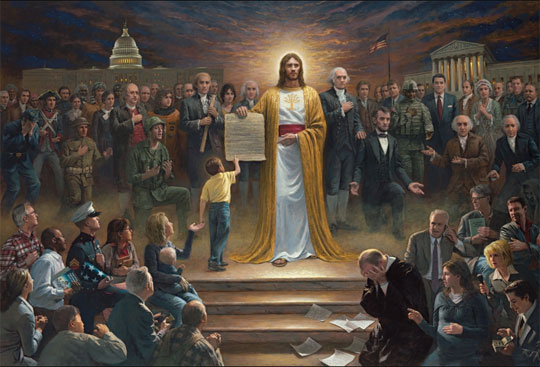
On The Lordship Of Jesus or: How To Preach For Memorial Day Weekend

strangely-warmed-spreaker-header

The team from Crackers & Grape Juice recently spent an afternoon interviewing Brian Zahnd (founder and lead pastor of Word of Life Church, a nondenominational congregation in St. Joseph, Missouri) for our lectionary podcast Strangely Warmed. During our time together we talked about the readings for the season of Easter during year A from the Revised Common Lectionary. For the seventh Sunday of Easter (Ascension Sunday), Brian challenged us to make it all about joy (again) while the world struggles under the weight of the current political climate. If you want to hear the conversation and learn more about preaching Memorial Day weekend, how Jesus is Lord and everything else is B@#$%^&*, identity, clapping in worship, Lee Greenwood, and why Ascension Sunday might be the most important Sunday of the year (even more than Easter???) you can check out the podcast here: Ascension Sunday – Year A

jesus_constitution

Devotional – Psalm 145.1

Psalm 145.1

I will extol you, my God and King, and bless your name forever and ever.

Weekly Devotional Image

On Saturday afternoon, the United Methodist Churches of Staunton, Virginia hosted our 2nd Trunk or Treat at Gypsy Hill Park. Over the last few months we collected monetary donations and countless bags of candy in order to distribute candy to all the children who would come to the park. Each trunk was uniquely decorated and when it was time to begin you could see the excitement in the volunteers and the children snaking in a long line around the lot.

For the better part of 2 hours we gave out candy to over 2000 children. I saw Annas and Elsas, at least 7 Marshalls (from Paw Patrol), a bunch of Darth Vaders, every princess you can imagine, and enough football players to make two full teams. Most of the children were remarkably polite, thanking each and every person as they made their way from trunk to trunk. And through it all we, as the church, lived into the reality of the body of Christ and loved our community through candy and fellowship on Saturday afternoon.

img_1982

When the line finally dwindled down to the last few families, we started to clean up our respective areas and prepared to leave. I had a few bags of candy left and my wife suggested bringing them over to the older boys who were skateboarding in the park. Too old to trunk or treat, most of them had watched us over the last two hours and were still skating as we were leaving. So I drove the car over to the skate area, and carried the largest bag of candy right up to who I imagined was the leader of the group (FYI I was still wearing my Hagrid costume). I handed the bag over and said, “Hey, I’m a pastor from town and we just finished this big trunk or treat and I’ve got some extra candy. I know you don’t know me, but I want you to know that God loves you.” To which the skater replied, “That’s like, righteous, man.” And I said, “You have no idea how appropriate that word is in this situation.”

How often do we extoll our God and King? Many of us are willing to take an hour out of our busy weeks to sit down in a sanctuary to praise the Lord, but how do we praise the Lord from Monday to Saturday? Some of us proclaimed the love of the Lord in each little piece of candy we distributed on Saturday afternoon, and even some skateboarders experienced our willingness to praise the Lord. After all, we learn to be generous from the One who is ultimate generosity. But extolling the Lord does not, and should not, be a rare occasion.

If we extoll the Lord, we do so knowing that the Lord is the giver of all gifts, including the gift of life. We praise the Lord because the Lord is the one rightly to be praised. We bless the name of the Lord forever and ever because the Lord has blessed us again and again.

Candy and Trunk or Treats, in and of themselves, can never bring us closer to God. Only when we extoll the name of the Lord, only when we realize that we are making the Word incarnate by becoming the body of Christ for our local communities, will those ordinary things become extraordinary avenues by which others can experience the powerful grace and mercy of the living God.


img_1985

On Suicide

Isaiah 43.1-2

But now thus says the Lord, he who created you, O Jacob, he who formed you, O Israel: Do not fear, for I have redeemed you; I have called you by name, you are mine. When you pass through the waters, I will be with you; and through the rivers, they shall not overwhelm you; when you walk through fire you shall not be burned, and the flame shall not consume you.

Romans 8.35-39

Who will separate us from the love of Christ? Will hardship, or distress, or persecution, or famine, or nakedness, or peril, or sword? As it is written, “For your sake we are being killed all day long; we are accounted as sheep to be slaughtered.” No, in all these things we are more than conquerors through him who loved us. For I am convinced that neither death, nor life, nor angels, nor rulers, nor things present, nor things to come, nor powers, nor height, nor depth, nor anything else in all creation, will be able to separate us from the love of God in Christ Jesus our Lord.

suicide


It was 2003 and I was a freshman in High School. And like most High School freshman, I spent many an evening on my computer typing to my friends on Instant Messenger. This was long before Facebook’s wild popularity, Twitter’s terse communication style was far away from coming into reality, and none of us even had cameras on our cell phones. But night after night we would sit in front of our computer screens typing away about what we thought were the most important things in the entire world.

One night in the spring, I waited for my parents to go to bed and then I snuck downstairs to get back on the computer. Most of the conversations were frivolous and limited by the speed at which our fingers could move over the keyboard. I can’t remember what the topic was that evening, but I do remember a new box appearing on the screen that changed everything.

At the time, my best friend was dating a girl and things were less than perfect. They fought about all kinds of stupid things and were the epitome of every high school relationship cliché. She, the girlfriend, was the one who sent me a message that night. All it said was, “We got in a really bad fight, he told me he was going to kill himself, and I don’t know what to do.

Suicide is ugly. It leaves families and friends reeling in whiplash, it creates guilt and unanswered questions, and it produces feelings of morbidity and fear.

Suicide is controversial in the church for a number of reasons. Many churches and Christians believe that suicide is ultimately sinful and worthy of eternal damnation. To have suicidal thoughts is to not have enough faith. Some pastors will even refuse to preside over funerals for those who have committed suicide.

If you look through the entirety of scripture, both Old and New Testaments, you will not find a passage that condemns suicide. None of the prophets, or priests, or kings have anything to say about suicide or what happens to those who commit suicide. However, Augustine (an important theologian from the early church) read the commandment “thou shall not kill” as a prohibition against suicide. And from Augustine’s reflection on the topic, suicide became the black sheep of sins in the church.

For a thousand years, suicide was a mortal sin and an affront against God’s goodness. Those who committed suicide were treated as criminals and refused Christian burials. By the 1500s those who attempted suicide were excommunicated by the church and were punished by the civil authorities.

And still today, suicide carries an awful stigma in the realm of the church and is one that is either referred to with eternal damnation or complete silence.

            That silence, the utter and complete darkness of a topic that is remarkably relevant for our time and reflection, is a controversy worth confronting.

According to the Center for Disease Control (CDC), on average, one person dies by suicide in the state of Virginia every 8 hours. It is the 11th leading cause of death in our state, and it is the 2nd leading cause of death for people ages 10-34.

Among high school students across the country, 17% seriously considered suicide in the last 12 months. And 8% attempted suicide one or more times in the last year.

If you’re like me, you tend to think about young people being the most susceptible to suicide attempts, but suicide rates are actually highest among people middle aged and older, by a lot. In fact, middle aged and older adults are nearly twice as likely to commit suicide as young people.

And right now, suicide has surged to its highest levels in thirty years.

yqecn1ygjymjb3igsiev

When I received that message on my computer back at the beginning of high school, I grabbed my things and was out the door before I even had a chance to really think about what I was doing. All I knew was that my friend would not just make an empty threat about suicide like that, and I had to do something about it. So I grabbed my bicycle out of the garage and I started riding as fast as I possibly could in the middle of the night. He lived a couple miles away and when I screeched into his driveway I was drenched in sweat.

I dumped the bike right there and I ran to the front door and started banging with my fist and I started yelling. Within a minute his parents were coming down the stairs in their pajamas with tired and angry looks on their faces. When they opened the door and saw me standing and sweating in the dark they were utterly bewildered and then I told them why I was there.

We immediately went to check on him in his bedroom, but he wasn’t there. We searched the house from top to bottom and we finally found him in the basement. He was sitting on the couch with tears in his eyes and he had just swallowed an entire bottle of ibuprofen.

They wound up taking him to the hospital and had his stomach pumped. They sat there and held their son while he cried and cried. And they saved his life.

Suicide is not the way any human life should end. The church, this church, has an obligation to see that all persons are grafted into a community of love and are cared for in the midst of isolation, depression, and despair.

Life is a gift, plain and simple. It is a gift from God and therefore we are called to be good stewards of this gift: our lives and the lives of others.

We cannot ignore this topic as if it has nothing to do with us. The statistics confront us with a stark reality about the prevalence of suicide in our culture. With the advent of the Internet and instant communication, young people are being bullied and attacked at a degree that few of us can even fathom. With an economy that moves up and down like a roller coaster, people in the middle of life are undergoing identity crises and are wondering how they can provide for their families. Older people who receive a grim diagnosis or the loss of a spouse struggle to justify living with such a horrible outlook for the days ahead.

We know that we are supposed to be present for and with one another, like being there for friends and family at a moment of tragedy. We rarely know what to say on such occasions, but we know we should be there. We, above all things, are called to be present for others in the midst of suffering and loneliness and depression that often lead to the contemplation of suicide. To be part of the faithful community requires us to be for one another.

i_m_fine_by_black_avenger-d60mqnl

We live because life is a gift. We are not our own creators. We Christians are the people who must learn to live by the fact that life is a gift. We therefore can live each and every day not as a survival technique, but through recognizing that each and every day is an opportunity to live and love in the service of our Lord.

When we talk about suicide, we say it is “the taking of one’s life.” But even the way we talk about suicide shows how much a problem we have with it. Our lives are not our own. As the Lord says through the Prophet Isaiah: “Do not fear, for I have redeemed you; I have called you by name and you are mine.” We belong to the Lord and to one another. God tells us to not be afraid because God will be with us as we pass through the waters, and the rivers of life shall not overwhelm us, we shall not be burned by the fires of frustration. Not because they won’t hurt or be terrifying, but because we belong to the Lord and the Lord is with us.

If we’re here in the sanctuary this morning, we have some sense of this in our lives. We know that God is with us, we feel God’s presence in this place and we know that we are not alone. It is through encountering the divine love of God in worship that we are given the strength to be God’s presence for others who sink under the waters of life and who feel burned by the world. It is our charge to be shaped and called by God’s love and to reach out to those who contemplate ending their days. We have the challenge of showing all people, even those who see no value to their lives, how our lives are not defined by what we have done with them, but by what God will do with them.

Six months after my friend had his stomach pumped, he attempted to commit suicide again. This time he did it with a hose running from his exhaust pipe into his car. But his little brother heard the car door close and it woke him up, and then he woke up his parents. In the strange and quiet time of the darkness of night they pulled their son out of the car and they got him help. It took a long time for him to move on. It took counselors and therapists, it took friends and family, it took the power of God’s grace to show him that his life could get better, that there was hope for the future, that there was something worth living for. And because people in his life were brave enough to confront his suicide attempts, he still lives today.

But there will always be some that we cannot reach. There will be people who feel so suffocated by the weight of the world that they will make that dreadful decision to end the life that God’s has given to them. And for them, for those who will die by their own hand, what will happen to them? For centuries the church saw suicide as an unpardonable sin, something that eternally damns those who do it. Will God abandon them for making such a choice? Will God refuse to love the people who felt no love in their lives? Will the God of mercy punish them until the end of time?

           No. In all these things we are more than conquerors through him who loved us. For I am convinced that neither death, nor life, nor angels, nor rulers, nor things present, nor things to come, nor powers, nor height, nor depth, nor anything else in all creation, will be able to separate us from the love of God in Christ Jesus our Lord. Amen.


Controversy Original

Devotional – Hebrews 13.8

Devotional:

Hebrews 13.8

Jesus Christ is the same yesterday and today and forever.

Weekly Devotional Image

I try hard to read some theology every week that has nothing to do with the sermon for Sunday. I do this in order to learn more about what it means to follow Jesus without it being intimately connected with whatever will be proclaimed from the pulpit; discipleship is something I need to work on outside of the work required for the vocation.

Last week I opened up Tripp Fuller’s Homebrewed Christianity: Guide to Jesus – Lord, Liar, Lunatic… Or Awesome? and started to read. (I discovered the book through a podcast that mentioned the title and I decided to check it out.) The premise is straightforward in that Fuller wants the reader to confront the totality of Jesus’ identity, but I had a hard time getting through the first few pages. Fuller writes, “The full humanity of Jesus is something every Christian affirms, but when it comes to discussing his journey through adolescence, we like to keep it vague – “He grew in wisdom and stature” is the only mention in the Bible of his teen years. Of course, we don’t spend much time thinking about Jesus having lice in his hair or pooping, even if he did such things in the holiest of ways.”[1]

img_6935

I understand that Fuller wants the reader to encounter the depth of Jesus humanity, but today we seem to emphasize his humanity over and against his divinity. In church and in theology we hear so much about how Jesus is just like us that we sometimes forget he is also completely unlike us. We want to know that Jesus knows our struggles and is there alongside us when we are going through the valleys of life. But in so doing, we’ve made Jesus out to be a good teacher or an ethical leader, and not God in the flesh.

In Hebrews we read about how “Jesus Christ is the same yesterday and today and forever.” Jesus remains steadfast to love and forgiveness and Jesus remains committed to grace and mercy. We, on the other hand, neglect to love and forgive others. We forget what it means to give and receive grace and mercy. We change each and every day like the blowing of the wind. But Jesus is the same yesterday and today and forever.

Jesus is like us and totally unlike us. Jesus is fully human and fully God. Jesus went through his own angst-filled teenage years and shows us the light of the Lord in the midst of the darkness.

For as much as we want to identify with the humanity of Christ, we also do well to remember that Jesus, like God, never changes.


[1] Fuller, Tripp. Homebrewed Christianity: Guide to Jesus – Lord, Liar, Lunatic… Or Awesome? (Fortress Press: Minneapolis. 2015), 2.

Devotional – Psalm 5.1

Devotional:

Psalm 5.1

Give ear to my words, O Lord; give heed to my sighing.
Weekly Devotional Image

To breathe is to live. And yet, how often do we actually think about our breathing? Unless we’ve been sick with pneumonia, or have climbed to a high elevation, breathing in and out is something we all take for granted. All day, everyday, we take about 26,000 breaths. It happens naturally without our having to really do anything to make it happen. Yet without it, we cannot live.

A few weeks ago I was in the hospital room when my son took in his first breath. Like the rush of a mighty wind, he filled his lungs for the very first time, his skin began to change color, and the remarkable rhythm of his breathing began. I held my breath waiting for him to breathe knowing full and well how necessary it is for life. And yet, during the last 6 weeks, I have grown accustomed to his breath, and am no longer bending over to place my ear near his mouth in the middle of the night.

We all know that we cannot live without breath. Just ask anyone who has been with someone at the moment of death and they will tell you about the profound change that occurs when someone’s breathing comes to a conclusion. But in addition to breath being a necessity for life, it is also a necessity for prayer.

page_breathe

Every breath is a prayer. As the psalmist cries out, “Give ear to my words, O Lord; give heed to my sighing.” When we sigh, when we breathe, when we fill our lungs with air, we are participating in the great and cosmic birth of creation over and over again. In the beginning of scripture we learn about God breathing life into the first human and for every one of us that has ever lived since, we have received that same gift at the beginning of our lives.

If we are in a time in our lives when we do not know what to pray, if we are at a loss for words, there is comfort in knowing that every breath is a prayer. To breathe is to remember the paradox of our existence; we’ve been created in the image of God with immense beauty, power, and strength while at the same time our lives are incredibly vulnerable and fragile. Our lives hinge on our breath.

So too, our spiritual lives hinge on our breathing in and out, over and over again, remembering that every breath is a gift from God.

Make the Church Great Again

Psalm 146

Praise the Lord! Praise the Lord, O my soul! I will praise the Lord as long as I live; I will sing praises to my God all my life long. Do not put your trust in princes, in mortals, in whom there is no help. When their breath departs, they return to the earth; on that very day their plans perish. Happy are those whose help is the God of Jacob, whose hope is in the Lord their God, who made heaven and earth, the sea, and all that is in them; who keeps faith forever; who executes justice for the oppressed; who gives food to the hungry. The Lord sets the prisoners free; the Lord opens the eyes of the blind. The Lord lifts up those who are bowed down; the Lord loves the righteous. The Lord watches over the strangers; he upholds the orphan and the widow, but the way of the wicked he brings to ruin. The Lord will reign forever, your God, O Zion, for all generations. Praise the Lord!

Psalms-Series-graphic


In the beginning, we met in people’s homes. The church wasn’t even called the church; it was called “ecclesia” which means a gathering. The earliest disciples of Jesus gathered together in homes to retell the story, break bread together, and engage in prayer.

As the centuries passed and the Good News spread across the world, gathering spaces called churches were erected in certain communities. Through this period, we met for worship in whatever church was closest. In didn’t matter if we didn’t agree with what the person at the front said, or even if we hated the people in the pews next to us, we only really had one option for church and it was good enough.

Today, in the American context, we have every possible flavor of church you could ever want. In our town alone there are at least 87 different churches within the city limits. We are no longer bound to attend church based on proximity; instead we attend church based on denominational affiliation, pastoral performance, and opportunities for youth. Whereas we once gathered as a truly diverse community of faith, we now tend to gather with people who make us comfortable and appear just like us. Whereas we used to be stuck with the church in our neighborhood, now there are websites dedicated to church reviews and helping people find the church that fits them best.

This week, I got online and I started reading church reviews from all over the country. After all, it could only help to see what people think of other churches to get an idea about what many of you might think about St. John’s. And, I’ve got to be honest; most of them are awful…

“Absolutely doumbfounded. Checked this church out for the first time today, and really wish I had read some of the other reviews first. It was creepy how strangers kept smiling and maintaining eye contact even after the service started. I lost track after 15 people introduced themselves. And the sermon was about nothing more than tithing. The ushers passed around cards talking about a “90 day challenge” … giving 10% of your income to that church for three months, but that’s not all folks, it said, “if you don’t feel blessed after those 90 days, there is a money back guarantee!!!” It felt more like an infomercial than a worship service. But they did share how they are giving away a free cruise on Father’s day weekend… The thing I regret most is not walking out of there in the middle of the service.

“Young people ruined the church. God used to be the foundation of our community and members got to know each other until they came and everything went downhill. The new young families came in wearing blue jeans and tee shirts; they were disrespectful of what it means to be holy. My heart is heavy that my church has become just another soulless generic space in hipsterland.”

“This was the worst restaurant ever. First of all, their bread was terribly sweet, and they make you literally stand in line for it. Then, you wait in line to dip your bread into a cup of what tastes like decades old grape juice. There was no main course. I sat in a stiff wooden bench for an hour before I was able to eat and there was a man wearing a dress who shouted the whole time. It was free however, though they asked for donations near the end and passed around a plate. I give it 1 star, and do not recommend it to anyone.”

However, I found one review that was so positive that I had to share it:

“In my life, I have never been with a group of people who were so fired up to make positive changes in the world. The entire experience was surreal, in the best way possible. There was a lady near me who came up at the beginning and wanted to know all about me. I honestly didn’t know it could be this exciting. I loved that the speaker didn’t need to use notes while he was talking. It felt genuine and meaningful and he even encouraged us to shout back when we felt the need to do so. Other people might make comments about how the parking lot was crowded but I think that’s a good thing! I’ve gone to gatherings like this my whole life, and for the first time I feel like we’re moving in the right direction and I left feeling charged up for action. It’s time to make America great again!”

15154070

That last review was a mash-up of descriptions from two recent political rallies centered on presidential candidates Hillary Clinton and Donald Trump. After reading negative church reviews for an hour, it shocked me that gatherings in support of the next president of the United States were garnering better reviews than households of God. And even more than their positive language, what they described appears like a perfect worship service; except for the fact that they are worshipping politicians rather than almighty God.

From the beginning we have looked for other people to take care of our needs. Whether it was in the Garden, or just the other day in Staunton, it is part of our human condition to rely on the “other” to help us. This is even more prevalent when it comes to our modern days “princes” otherwise known as politicians.

Now there isn’t anything inherently wrong with politicians: they stand before us and tell us what they will do for us. We vote for them and they represent our interests. Our failure is in our tendency to look for politicians to be our saviors.

The psalmist knew this basic fact of the human condition. The Hebrew people wanted kings just like all the other gatherings of people and so they got what they wanted. But in raising political leaders to be saviors they committed the ultimate sin that we still commit today: believing that we can save ourselves.

Praise the Lord! Do not put your trust in politicians, in feeble and broken individuals. When their breath departs, when their days come to an end, their plans perish. However, the Lord endures forever. Happy are those whose hope is in the Lord, who keeps faith forever, who executes justice for the oppressed; who gives food to the hungry.

God is the one from whom our help will come. God is a nurse who opens the eyes of those who refuse to see. God is a social worker who lifts up those who are bowed down under the weight of the world. God is a political activist who sets the prisoners free and watches over all foreigners. God is the one who reigns and remains steadfast forever.

The question for us, the question the psalm begs us to ask is this: Who do we really worship?

A few weeks ago the General Conference of the United Methodist Church met in Portland, Oregon, and among other things, they voted on a global annual budget. From now until 2020 the global United Methodist church projects needing and spending $604 million dollars. This money will be used in a variety of ways to support the denomination’s mission of making disciples of Jesus Christ for the transformation of the world.

The number, I’ll admit, is staggering. However, it pales in comparison to the 1 billion dollars that has been raised and spent in the 2016 presidential race. Add that to the countless hours we have spent glued to the television during debates, or the infinite number of Internet articles that support the candidate of our choosing, or just the mind-boggling number of bumper stickers and yard signs in Staunton alone and you will start to realize who we really worship.

The-Church-and-Politics-Sermon-Title-sm-535x428

It’s time to make the church great again. Not by going back to the days of old to be what we once were, but to look boldly to the future and believe that God can save us, not politicians, not public leaders, not even pastors. Can you imagine how much good the church could do if it was supported like a presidential campaign? Can you picture how many lives could be changed for the better if we worshipped the Lord the way we worship our politics?

God can use politicians to bring about God’s will on earth, but there is a limit to what they can accomplish. Moreover, the longer we wait for our politicians to save us, the longer we pass the buck on to someone else, the longer we will prevent God from using people like us to make the kingdom come here on earth. Believe it or not, God uses people like us to work for justice, feed to the hungry, love the outcasts; watch over strangers, orphans, and widows. As disciples of Jesus Christ our work is to act like Jesus.

If you get online and search for reviews of St. John’s, you won’t find any. Trust me, I looked. Either we haven’t offended people enough, or we haven’t inspired people enough to write a review of a “worship experience.” But maybe, just maybe, there are no reviews of St. John’s because we know the church is not something to be done and reviewed. We know the church isn’t like a restaurant or business that we can experience at our leisure. We know the church isn’t like a political party that makes promises that cannot be kept. We, after worshipping in these pews – offering these prayers – eating this bread and drinking from this cup, we understand that church isn’t about what we get out of it, but instead it’s about what God gets out of us.

If we really want to make the Church great again, then we need not look further than this table and the meal that has been prepared for us. For it is here, where heaven and earth meet for a brief moment, where we confess and are reconciled, that we remember how the Lord is the one who lifts us up when we’re down; how the Lord opens our eyes when we are blinded by the world; how the Lord reigns forever. Praise the Lord! Amen.

Devotional – Psalm 30.4

Devotional:

Psalm 30.4

Sing praises to the Lord, O you his faithful ones, and give thanks to his holy name.

Weekly Devotional Image

How often are we really thankful for the people God has placed in our lives? Sadly, it usually takes a profound moment of loss or grief before we are able to recognize how fortunate we were to spend time with them. I can’t tell you the number of times I’ve sat with a family while planning a funeral when someone breaks down in tears as they begin to wrestle with how shaped they were by the person now dead. It is a frightening moment when we recognize how blessed we were to have them, and their loss leaves a gaping hole.

On Saturday night I received an email from my home church containing the news that a man by the name of Bud Walker had passed away. As my eyes read over the lines in the email it was impossible to not let my emotions get the better of me as I realized that one of the greatest men I’ve ever been privileged to call my friend is now gone.

I met Bud Walker on a Sunday morning when I was 13 years old. I was responding to a volunteer opportunity from the church bulletin about learning how to run the sound system for Sunday services and Bud was going to teach me how it worked. For a month he stood behind me and looked over my shoulder as I twisted nobs and raised levels so that the whole congregation could hear the choir and the pastors, and for that whole month I was terrified of messing up. And yet, even after I passed my training month, Bud continued to stand with me at the back of the church before and after worship just to talk. I learned about his life and his family, I heard stories from his youth, and I saw what it meant to be faithful. During those incredibly formative years of my youth, I learned about God from the sermons, but I learned what it meant to follow Jesus from Bud Walker.

20120730-f0002-D8

At the time, my experience of church was that the adults got to do their thing and the youth got to do their thing. We might all sit in the same sanctuary on Sunday mornings, but there was a clear divide between our activities. Bud never saw that divide. He was one of the first people who pushed me to pursue a calling to the ministry, and he always made me feel like I mattered. And now he’s gone.

Today I sing praises to our Lord for having placed Bud Walker in my life; I am a better person for having spent time with him. As we continue to take steps on the path that leads to following Jesus, let us not take for granted the people God has given to us. Let us find the time this week to reach out to the people who helped to shape us and, if they are no longer living on earth, let us sing praises for the time we had with them.

Devotional – Holy Week

Devotional:

Psalm 118.1

O give thanks to the Lord, for he is good; his steadfast love endures forever!

Weekly Devotional Image


Prayers for Holy Week:

Maundy Thursday

O Lord, we confess that when we pray before meals, we do so out of habit rather than faith. We look out over out tables filled with food and we forget to remember those for whom such a meal is rare. We feel the presence of our friends and families in the seats next to us and we forget to remember people who are alone. We eat our fill and we are content. God of Life, afflict our comfort in our meals so that we will really remember that all of these gifts come from you. Work in our hearts to remember that whenever we eat, and whenever we drink, we are called to give thanks for the great gift of your Son so that we can be more like him between our meals. Use the bread and cups of our tables to make us appreciate the Bread and the Cup at your table. Amen.

Maundy-Thursday1


Good Friday

Great God, why did Jesus have to die on a cross? Why do bad things happen to good people, and why do good things happen to bad people? What will happen to us when we die? Where are you in the midst of the suffering in our lives and in the world? We ask questions like this, O God, because we want explanations. We see our churches like courtrooms and we want to hear your justification. We believe that we are entitled to know the ‘why?’ to every question we could possibly ask. So Lord, replace our selfish desires for explanation with ears to hear proclamation. That instead of looking for the meaning behind every little thing, we might be content with giving thanks for what you have done whether we can understand it or not. After all, how could we possibly comprehend, with our finite minds, the infinite wonder of your grace? Amen.

ethereal-finished-still-p3


Easter Sunday

God of Grace and God of Glory, we give thanks to you for you are good, and your steadfast love endures forever. We remember this day that you have not abandoned us to our own devices, you have not abandoned us in the midst of trials and tribulations, and you have not abandoned us in death. Through the resurrection of your Son, Jesus Christ, we see a glimpse of our future resurrection with you in the new kingdom. So Lord, as we gather with friends and strangers alike to celebrate your victory over death in Jesus, give us glad and generous hearts to rejoice in the knowledge that your love truly knows no bounds. Shake our sensibilities like you shook the earth when the tomb was opened. And resurrect us here and now to walk in the ways of Jesus and transform the world. Amen.

resurrection-Easter-edit[1]

Devotional – Psalm 32.5

Devotional:

Psalm 32.5

Then I acknowledged my sin to you, and I did not hide my iniquity; I said, “I will confess my transgressions to the Lord,” and you forgave the guilt of my sin.

Weekly Devotional Image

There is a shop in Alexandria, VA called “The Variety Store” that truly contains a variety of items. Some of my earliest memories are of walking up and down all the aisles with my mother struggling to take in all the strange things I was seeing. There was an aisle full of ribbons, an aisle of ceramic dinnerware, an aisle of candy, and much more. It was a treat to witness the enormity of “The Variety Store” as a child, though it feels a lot smaller now than it did then.

Once, when my mother brought me into the store for some light shopping, I made my way to the toy aisle and just stood in awe of everything. And, as was my custom, I picked up a yellow smiley-face bouncy ball and bounced it all around the store with my her while she collected her items for purchase. We went through all the necessary aisles, my mother waited in line to pay for everything she found, and then we got in the car to go home. All in all, it was a relatively uneventful journey to the store until I put my hand into my pocket and discovered the bouncy ball. I can remember my entire disposition changing in an instant when I realized that I (accidentally) stole the yellow smiley-face bouncy ball.

ar120274857936808

For the next few minutes, which felt like hours, it burned a whole in my pocket as I walked around my house. Were the police on their way to arrest me for shoplifting? How severely was my Mother going to punish me for stealing a plastic ball that cost a quarter? The fear I experienced was palpable and when I finally mustered up the courage to confess my transgressions to my mother I’m sure that I was in tears.

But the strangest thing happened: As I explained my predicament, and I confessed my wrongdoing, the fear and terror faded away. My mother’s calm demeanor and response comforted me as she forgave me for what happened. Even when we returned to the store and I handed the smiley-face bouncy ball back over to the cashier I experienced forgiveness in a way that I would never forget.

When we can muster up the courage to confront and acknowledge our sins, it relieves us from the burden that comes with the weight of sin. When we have those opportunities to express our shortcomings to one another and to God it allows us to start moving in the right direction in discipleship. This week, let us take time to properly and faithfully acknowledge our sins to God, let us repent our transgressions, and let us rejoice in the forgiveness of our sins.

Praise The Lord!

Psalm 150

Praise the Lord! Praise God in his sanctuary; praise him in his mighty firmament! Praise him for his mighty deeds; praise him according to his surpassing greatness! Praise him with trumpet sound; praise him with lute and harp! Praise him with tambourine and dance; praise him with strings and pipe! Praise him with clanging cymbals; praise him with loud clashing cymbals! Let everything that breathes praise the Lord! Praise the Lord!

00033674_h


I am a creature of habit. I like routines, I like order, and I like preparation. I asked Lindsey to give me three examples of how I am a creature of habit and her response was: “only three?” I like my coffee a certain way, I enjoy sitting in a particular chair to read books, and I have rhythms for most of the events in my life. Sundays are no exception.

Most Sundays I arrive here in the sanctuary hours before some of you are even awake. Of course I start with the practical things like turning on the lights and unlocking the doors, but then I make my way back to the sanctuary to prepare for worship. First I pray on my knees from the third pew on the right hand side and confess where I have fallen short and how I have sinned. I pray for God’s forgiveness, and ask God to show up in my words in worship, even if I don’t deserve it. I then make my way up to the altar and praise God for the mighty acts revealed in scripture and in my life.

When I turn around I walk down the center aisle and I pray over every single pew asking for God to turn them into avenues of connection rather than walls of division. My hand touches every pew and I pray for God transform all of the people who will inhabit them through our worship.

From the Narthex I pray for the ways that we greet people on their way into the church, and I even go out onto the front lawn to give thanks for Staunton, and ask for God to send to us all who need to feel God’s love.

All in all it takes some time to prayerfully prepare for worship, but it’s worth it. When I finish praying, I make my way into the pulpit and read over the bulletin one last time. I check to make sure that the theme of worship is present throughout the entire worship service and, before I read my sermon out loud, I pull out my hymnal.

Like I said, I am a creature of habit. Every Sunday before any of you get here, I pray in this sanctuary and I sing through the hymns by myself. When I’m alone in the church I can belt out the hymns without the deep sighs from our organist Rick in response to me not keeping the pitch, I can let my emotions get the best of me without being judged by some of you from the pews, and I can just be myself up here jamming.

One Sunday, after going through my whole prayer routine, I stood up in the pulpit and looked at the bulletin to the hymn number for “Have Thine Own Way, Lord.” And I did what I always do. And I got really into it: (sing Have Thine Own Way)

Of course, when I sing, I often close my eyes and just let the words flow. So here I was singing from the top of the lungs from the pulpit, and you can imagine my surprise and terror when I finished the last note and someone shouted, “sounds okay from back here!

A visitor to the church had arrived hours early, walked in through the narthex, picked up a bulletin, and sat down in the farthest back pew, and was listening to my solo. I stood up here in shock without knowing what to say and I fumbled through trying to explain myself when the man raised his hand to stop me and said, a little too sarcastically, “I’m sure other pastors do this kind of stuff all the time.”

I am a creature of habit and, even though I was embarrassed that one morning, I still sing all the hymns before you get here. Singing the hymns and reading over the lyrics is incredibly important, because when we sing from this hymnal, we are articulating our faith. When we sing from this hymnal we are reentering the world of scripture. When we sing from this hymnal we are praising the Lord.

So let’s go to that hymn that I embarrassingly belted from the pulpit; number 382 Have Thine Own Way, Lord. (Sing together.)

Is this a familiar tune for you? Can you remember singing it when you were younger? Maybe you’ve heard the version that Johnny Cash performed. This is a beautiful hymn. The words quote Jeremiah 18.6 about clay in the potter’s hand. The tune is easy to follow and the theology behind it is great: It is an honest and prayerful desire for God’s will to be done in our lives.

I have always enjoyed singing this hymn, but when I learned the story behind the hymn it became that much more precious. If you look to the bottom left hand corner of the page, you will see that Adelaide Pollard wrote the hymn in 1902. The story goes that Adelaide was going through a rough period in her life and was unsuccessful in raising enough funds to make a trip to Africa for missionary work. In the depth of her struggle, she went to a tiny prayer meeting one night for the local community. She listened to person after person make their prayer requests for medical issues, material possessions, and a slew of other things when an old woman stood up to make her prayer request. Bucking with the trend of the evening the old woman simply said, “Have thine own way with me, Lord.” Impressed by the faith of the old woman, Adelaide went home that night and wrote the words to the hymn.

Psalm 150, the final one of the entire psalter, compels us to praise the Lord through music. Praise God with trumpets, lutes, harps, tambourines, dance, strings, pipes, and cymbals. Toward the beginning of the hymnal, we can find John Wesley’s directions for singing, that pair so well with Psalm 150:

“Above all sing spiritually. Have an eye to God in every word you sing. Aim at pleasing him more than yourself, or any other creature. In order to do this attend strictly to the sense of what you sing, and see that your heart is not carried away with the sound, but offered to God continually; so shall your singing be such as the Lord will approve here, and reward you when he cometh in the clouds of heaven.”

So we are going to follow the words of Psalm 150 and the words of John Wesley, we are going to praise the Lord. I would like all of us to take out our hymnal and turn to our favorite song. When you find the one you love shout out the number and we will sing the first verse. (We’ll probably do this for five hymns) Together we will praise the Lord. And as we do, take the time to soak up the words and the let the tune flow over you so that the Lord will approve our singing and reward us when God comes in the clouds of heaven. Amen.