Devotional – Psalm 95.6

Devotional:

Psalm 95.6

O come, let us worship and bow down, let us kneel before the Lord, our Maker!

Weekly Devotional Image

Do you ever have times in your life that feel spiritually dry? You hear all the words in Sunday worship, you read your bible during the week, but when you pray it feels empty and lacking life? Before I entered seminary I felt that I had a robust spiritual life and was committed to daily prayer and the reading of scripture; I felt most alive when I was reminded of God’s Word during the week and when I was in communion with the Lord. However, after entering Duke Divinity and being bombarded with the amount of work I was required to do, I stopped praying and reading scripture outside of my weekly requirements. Reading the Bible went from being a life-giving experience, to a tedious chore.

Around that time my best friend, Josh, encouraged me to start attending Morning Prayer with the Anglicans and Episcopalians. Every morning before classes started a faithful group would gather in Goodson Chapel and go through the Book of Common Prayer in order to orient themselves for the day ahead. In the beginning I reluctantly made my way into the sanctuary every morning with Josh by my side and we went through the motions of Morning Prayer. As the token Methodists, we were not used to the constant physical movements of worship but we quickly caught on: We knelt on the floor during the confession, we stretched our palms facing upwards during the pardon, and we made the sign of the cross whenever the trinity was mentioned. For months we were there everyday and before I recognized it, Morning Prayer became essential to my way of life; I needed to pray with others to start my day, I needed to commune with the Lord before I dove into his Word for class. Additionally, Morning Prayer began to manifest itself in my life outside of that early service — I found myself making the sign of the cross at church on Sunday mornings and I was the only one at my United Methodist Church who would kneel on the floor during confession before communion (I got a lot of stares for that).

books-of-common-prayer

Sometimes the physical routines of prayer, the embodiment of time with God, can help us through those times of dry spirituality. Even if I can sense that I am not fully invested in my prayers, when my knees hit the ground and I kneel before the Lord I am drawn back to the importance of what I am doing. Even if I can sense that I am distracted during worship, when my fingers make the sign of the cross I am drawn back to the intense gravity of all who have crossed themselves in reverence throughout the centuries. There is just something incredible about physically embodying our prayers that helps to keep me focused and thankful for the Lord our Maker.

This week I encourage you to try something new in your prayer life. Instead of sitting in the same chair at your home, or kneeling by your bed, trying praying in a new way. Experience kneeling on the ground to praise the Lord, or bow down and physically move in a way that helps to enhance your spirit. Try to live out your prayer life in a way that is different, faithful, and physical.

Devotional – Amos 5.23-24

Devotional:

Amos 5.23-24

Take away from me the noise of your songs; I will not listen to the melody of your harps. But let justice roll down like waters, and righteousness like an ever-flowing stream.  

Weekly Devotional Image

For me, music makes the worship service. I can listen to a mediocre sermon, but if the organist has been hitting all the notes perfectly I can walk away feeling filled with the Spirit. I can be ignored as a first time visitor, but if the gathered body sings with full vigor I can leave the service feeling that I have encountered the living God. I can witness borderline heretical theology in a bulletin, but if the musicians are truly glorifying the Lord through their instruments, I can believe that the service has been redeemed.

I started playing drums for contemporary worship services when I was in 9th grade. I played all through high school, college, and seminary for a variety of churches in a variety of places. It is difficult to describe the doxological feeling that I experience when playing drums during a service, but suffice it to say that I feel closer to God in those moments than many others. Contemporary services are not for everyone, even I will admit that I enjoy playing for those services rather than experiencing them in the pews, but they help connect a large portion of Christians to the living God in a way that shapes, molds, and grows their faith.

2885_1103206311354_8091672_n

When I was in college I began playing for the Crave service that was a part of the Wesley Foundation at James Madison University. Every Sunday afternoon the band would get together at Asbury UMC to practice for a few hours before the service began in the evening. We would play songs that got people placing their hands in the air and praising God. We would play songs that got people dancing in the pews. We would play songs that were so familiar and catchy that I could actually hear people singing the words over the volume of the drum-kit.

However, even when we were playing at our best, our music paled in comparison with the one night that we left the church and wandered around downtown Harrisonburg. Instead of gathering for the typical service (3-4 songs, prayer, sermon, communion, 1 song, benediction) we met on the steps of the church and walked downtown to pray for our city. We stopped at specific locations and joined hands to prayerfully lift up our community, and in particular we prayed over the local courthouse so that “justice might roll down like waters, and righteousness like an ever-flowing stream.”

You can have the best music in the world at your church, but when the music becomes the only life-giving part of your discipleship formation, when acts of justice and righteousness have gone missing, we limit the depth and beauty that we can experience. Music is most powerful when it points away from ourselves to God, and when it inspires us to be righteous outside of worship.

This week, let us look for the moments when we can let justice roll down like waters for others around us. Let us truly listen to the words of our Christian songs and live them out so that our righteousness can be like an ever-flowing stream.

Devotional – Exodus 20.1-3

Devotional:

Exodus 20.1-3

Then God spoke all these words: I am the Lord your God, who brought you out of the land of Egypt, out of the house of slavery; you shall have no other gods before me. 

Weekly Devotional Image

I love football. Every fall I look forward to the change of seasons with particular excitement because football becomes an exciting, and weekly, obsession. During the week I check up on certain players and decide who to start, and who to bench, on my fantasy football team. Before I leave for work I rely on the updates from ESPN to keep me informed for the coming conversations about football that I will have on a regular basis. After church on Sundays I quickly put on my throwback Redskins jersey and prepare to scream and cheer for a team that has recently left me disappointed.

2014-05-23-football

Football season is fun, thrilling, and all encompassing. Before worship starts on Sunday mornings I can count on having at least 5 conversations with particular church folk about college and professional football. It has created allegiances that people are proud to display via jerseys, hats, bumper stickers, flags, and even tattoos. The obsession with football is so prevalent that it has now become nearly impossible to do anything in our culture with football sneaking its way in.

I love football, but sometimes I worry that I love football too much. When God gave the Ten Commandments to the Israelites in the wilderness, he commanded them to have no other gods. Today, many of us worship other gods with greater vibrancy and devotion than we worship the triune God. Football is just one example of how we begin to worship other gods in our lives to the point that we lose sight of the incarnate God in Christ who still moves and speaks in the world today.

Can you imagine what the church would look like if people supported, adored, and loved it as much as they love football? Think about how many conversations you would have on a daily basis about what God has done for you, how visible your faith would be if all your jerseys were replaced with shirts covered in scripture, how church would be the true highlight of Sundays rather than a football game.

For me, football is a god that I sometimes put before our God. I catch myself having more conversations about how my team played last week than I do about the abundant grace and mercy of the Lord our God.

What gods have you put before the Lord? How different would your life look if you put the Lord of heaven and earth above all things?

Interrupted Salvation – Sermon on Mark 5.21-43

Mark 5.21-43

When Jesus had crossed again in the boat to the other side, a great crowd gathered around him; and he was by the sea. Then one of the leaders of the synagogue named Jairus came and, when he saw him, fell at his feet and begged him repeatedly, “My little daughter is at the point of death. Come and lay your hands on her, so that she may be made well, and live.” So he went with him. And a large crowd followed him and pressed in on him. Now there was a women who had been suffering from hemorrhages for twelve years. She had endured much under many physicians, and had spent all that she had; and she was no better, but rather grew worse. She had heard about Jesus, and came up behind him in the crowd and touched his cloak, for she said, “If I but touch his clothes, I will be made well.” Immediately her hemorrhage stopped; and she felt in her body that she was healed of her disease. Immediately aware that power had gone forth from him, Jesus turned about in the crowd and said, “Who touched my clothes?” And his disciples said to him, “You see the crowd pressing in on you; how can you say, ‘Who touched me?’” He looked all around to see who had done it. But the woman, knowing what had happened to her, came in fear and trembling, fell down before him, and told him the whole truth. He said to her, “Daughter, your faith has made you well; go in peace, and be healed of your disease.” While he was still speaking, some people came from the leader’s house to say, “Your daughter is dead. Why trouble the teacher any further?” But overhearing what they said, Jesus said to the leader of the synagogue, “Do not fear, only believe.” He allowed no one to follow him except Peter, James, and John, the brother of James. When they came to the house of the leader of the synagogue, he saw a commotion, people weeping and wailing loudly. When he had entered, he said to them, “Why do you make a commotion and weep? The child is not dead but sleeping.” And they laughed at him. Then he put them all outside, and took the child’s father and mother and those who were with him, and went in where the child was. He took her by the hand and said to her, “Talitha cum,” which means, “Little girl, get up!” And immediately the girl got up and began to walk about (she was twelve years of age). At this they were overcome with amazement. He strictly ordered them that no one should know this, and told them to give her something to eat.

hemorrhagingwoman 6-26-12

This Sunday marks the conclusion of our sermon series on Women of Faith. Over the last few weeks we have focused on women from the Old Testament who lived our their faith in such a way that it continues to speak to us in our faith journeys. The point has been to explore some of the great females from scripture, particularly those who are not regularly mentioned from the pulpit. We began by looking at Rahab the harlot before the fall of Jericho and talked about how our pasts do not define our lives. Last week we looked at Deborah and Jael from Judges and talked about how women are powerful and being faithful is complicated. Today we conclude by looking at the unnamed hemorrhaging woman from Mark 5. So, here we are, may God bless out time together as we look at one more woman with profound faith.

The loneliness is getting unbearable. She lives in Staunton, has a full time job, while also maintaining the aspects of home life. Her husband largely ignores her, never asks about her day, and expects dinner and the laundry to have been taken care of by the time he gets home. The children are involved in such a high number of activities throughout town that she can barely keep track of who is supposed to be where and when. Though she won’t admit it to anyone, her life feels empty, as if its being drained from her slowly and decisively.

Twice a day she finds herself driving up and down Augusta street and whenever she passes St. John’s she struggles to keep her eyes glued ahead. She has admired the witty marquee in the past, and she feels something drawing her to the building, but church is the last thing she wants in her life.

For months this goes on, and every time she passes she catches herself glancing more and more at our building. She sees the children during preschool walking on the front lawn looking for insects and leaves for projects, she observes the Christmas tree sales with families giggling as they explore the various options, she witnesses a number of older adults laughing manically as they fall down the 18 ft. inflatable slide during the Community Cook-Out. On certain Sundays she finds herself getting in the car and driving to the parking lot but she never leaves the vehicle; she can’t explain why she’s here and she’s too afraid to come inside.

One morning, when the emptiness and loneliness has become so frighteningly palpable she drives to St. John’s on a typical Sunday and bravely makes her way from the car to the sanctuary. She hopes against hope that something incredible can happen here.

But we’re in the middle of something else, worship has already started and I’m up here in the pulpit going on and on about the grace of God, or the service has yet to start but most of us are greeting our friends and asking them about their weekends, or worship is already over but most of us are solidifying plans for lunch. We might not even notice the woman who risked it all to be here with us.

—————————

Jesus was beckoned by Jairus, the leader of the synagogue, to come and heal his daughter. “Please Lord. My little daughter is at the point of death. Come and lay your hands on her, so that she may be made well and live.” So Jesus, doing his Jesus thing, went with Jairus to heal his daughter. Like worship on a Sunday morning, Jesus going to heal someone is typical and part of his routine. He is prepared to meet the young girl and heal her as he has done so many times before.

However, on the way to Jairus’ house a strange thing happens. A woman who had been suffering from hemorrhages for twelve years, who had been isolated from her family and community, sees the Messiah that she had heard so much about. Building up her courage she stepped forward, reached out her hand and touched his clothes, hoping that it would cure her. And immediately she felt in her body that she had been healed. But Jesus will not leave it at that; feeling the power go out from him he turns to the crowd and demands to know who touched his clothes. With fear and trembling the woman stepped forward and told Christ the whole truth, and he responded by saying “Daughter, your faith has made you well; go in peace, and be healed of your disease.”

healing-of-the-woman-thumb-300x3861

Jesus was interrupted on his journey to heal Jairus’ daughter by a hemorrhaging woman, and in so doing the young girl died at home. He took too much time with the other woman’s problems, and now an innocent girl has passed away when Jesus could have done something about it.

—————————

The woman sits in one of the pews of our church alone and afraid to speak to anyone. She has never been in a church before and so much of what we are doing is strange and bizarre to her. She is thankful for the bulletin directing her to the hymnal with tunes she has never heard, and prayers that she has never uttered. Most of it means nothing to her but she continues to worship with the hope that something will help. 

Our service ends and she follows the people around her as they file out toward the back of the sanctuary. She keeps her head low and whispers thank you as I shake her hand, I thank her for being with us today, and she walks out, perhaps never to return again. She came looking for something life-changing, hoping for something to heal her and make her well, and all she got was a strange youth message, a mediocre sermon, and more loneliness.

—————————

When Jesus arrived at Jairus’ house, even with the young girl dead, Jesus comforts the father, “Do not fear, only believe. Your daughter is not dead but sleeping.” And the people in the house laughed at him, but he put them all outside and took Jairus and the child’s mother and went to the girl. He took her by the hand and said to her, “Little girl, get up!” and she immediately got up and began to walk around, hungry for something to eat.

Jesus allowed the interruption in the street by the unnamed woman knowing that he would be able to still make it to Jairus’ house and bring about the healing and salvation that was needed. He might have been content with merely allowing her to touch his clothing and be healed but he took the extra time for personal touch and contact.

—————————

When the woman comes to St. John’s we could happy with letting her experience worship on her own, free to return to the life of loneliness and emptiness, but if we are to act like Christ we have to go one step farther. The terrible disease of loneliness is something that we have the power to fight against, we just have to be open to interrupted salvation.

Mark 5 is an incredible reminder for all of us, for the teachers who are so often interrupted by students, parents harried by the demands of their children, and even preachers that are stopped while working on a sermon, that interruptions are important. Someone once said, “You know… my whole life I have been complaining that my work was constantly interrupted, until I discovered that my interruptions were my work.

I was having lunch on Thursday with a clergy friend, talking about the ways that we are trying to serve our churches, when a man casually mentioned something about his cancer and we invited him to join us for lunch. He interrupted our conversation to share with us his struggles and fears. I was preparing for worship two weeks ago, running around the building just trying to make sure that everything would be ready, when Steve Wisely scared me half to death. He interrupted me in the midst of my work to tell me that his father, Russ, was dying. Every Sunday I stand at the back of the church, thanking all of you for being with us in worship when I am often dealt a hard and frightening truth about someone’s struggles, I am interrupted while doing my job with a difficult diagnosis, a struggling marriage, or a lonely woman.

What do we do with our interruptions? When the stranger arrives at church, sitting alone in the pew near us while we are in the middle of a conversation, how do we respond? Are we content with introducing ourselves, shaking hands, and then going back to our routine, or do we act like Christ and take the extra step to offer them not only a smile, but wholeness? When your child struggles with a decision in their life, do you offer a few bits of wisdom, or do you drop what you are doing to demonstrate that you deeply love them? Do you see interruptions as interruptions, or do you see them as opportunities for salvation?

That woman with the hemorrhage has more faith than I’ll ever have. She, in the deep recesses of fear and disappointment, reached out to the Lord with the hope of receiving something so improbable, that we would mock it today. Her faith is so real and palpable because she lived it out, she took those frightening steps to the Lord and believed that he could do something incredible with, through, and for her.

That unnamed woman who arrives at our church and sits in her car unsure of whether to enter has more faith than I’ll ever have. Though deeply rooted in the fear of her own loneliness and emptiness, she bravely enters the church with the hope that the Lord, with the people inside, can do something so improbable that we often ignore it. Her faith is so real and palpable because she lives it out, she takes those humbling steps to the sanctuary and believes that the God of Christ can do something incredible through us for her.

Showing up to church is wonderful. When it becomes part of the routine of life it begins to habituate us toward a new understanding of discipleship where we can truly act as Christians without having to overthink what we are doing.

But believing that God can actually do something for you, that the church can bring about a sense of salvation in your life is what faith is really all about. 

The woman walks out the main doors and makes her way toward the parking lot. Frustrated by her foolishness in believing that the church could actually change anything about her circumstances she is surprised when she hears a person hurrying up behind her. Someone from St. John’s, one of you, tries to catch up with her to apologize for not introducing yourself earlier. You tell her that you saw her sitting by herself and you felt God pushing you to do something more and you ask if she would like to get a cup of coffee sometime this week, just so that you can get to know her better. “I would love that” she says with a shy smile.

The final few steps to her car are filled with the brightness of hope, something she has not experienced for a long time. Still smiling from the invitation she hears a soft voice, as light as the wind, “Daughter, your faith has made you well.

Amen.

This Is NOT Appropriate For Church – Sermon on Joshua 2.1-14

Joshua 2.1-14

Then Joshua son of Nun sent two men secretly from Shittim as spies, saying, “Go, view the land, especially Jericho.” So they went, and entered the house of a prostitute whose name was Rahab, and spent the night there. The king of Jericho was told, “Some Israelites have come here tonight to search out the land.” Then the king of Jericho sent orders to Rahab, “Bring out the men who have come to you, who entered your house, for they have come only to search out the whole land.” But the woman took the two men and hid them. Then she said, “True, the men came to me, but I did not know where they came from. And when it was time to close the gate at dark, the men went out. Where the men went I do not know. Pursue them quickly, for you can overtake them.” She had, however, brought them up to the roof and hidden them with the stalks of flax that she had laid out on the roof. So the men pursued them on the way to the Jordan as far as the fords. As soon as the pursuers had gone out, the gate was shut. Before they went to sleep, she came up to them on the roof and said to the men: “I know that the Lord has given you the land, and that dread of you has fallen on us and that all the inhabitants of the land melt in fear before you. For we have heard how the Lord dried up the water of the Red Sea before you when you came out of Egypt, and what you did to the two kings of the Amorites that were beyond the Jordan, to Sihon and Og, whom you utterly destroyed. As soon as we heard it, our hearts melted, and there was no courage left in any of us because of you. The Lord your God is indeed God in heaven above and on earth below. Now then, since I have dealt kindly with you, swear to me by the Lord that you in turn will deal kindly with my family. Give me a good sign of faith that you will spare my father and mother, my brothers and sisters, and all who belong to them, and deliver our lives from death.” The men said to her, “Our life for yours! If you do not tell this business of ours, then we will deal kindly and faithfully with you when the Lord gives us the land.”

Today we begin our Sermon Series on Women of Faith. Last Advent I asked all of you to submit questions or topics for preaching that you have always wanted to hear about from the pulpit. I received so many questions and comments that I was unable to address all of them during our January series on Questions, so I decided to save this particular series for later. It was incredible for me to discover how many of you wanted to hear about the women from scripture. I remember one card said, “I hear there are these great women from the Bible, but no one ever preaches on them.” So, here we are, may God bless our time together as we explore dynamic and feminine faith.

6-rahab1

Sometimes we read stories from the bible that are not appropriate for church. A few weeks ago we did just that as we remembered Elisha and the she-bears, and Isaiah getting naked for three years. Every once and a while we come across that passage that is so daring and vulgar that we would rather ignore it, and most of all, we would not read it aloud in church.

Rahab the harlot. A woman of ill-repute. From the Red Light district becomes the savior for a few spies.

Why in the world would God use her to save his people? Rahab the harlot? I mean I would understand if God chose Rahab the UMW president, or Rahab the Sunday School teacher, but Rahab the prostitute? This is not appropriate for church.

Moses has died. He led his people to the brink of the Promised Land, and handed over God’s people to Joshua. Joshua in turn takes care of the nomadic nation and sends spies ahead of them to survey the land and, in particular, Jericho.

Two men, hand-picked by their leader, sneak their way into the city, and as it sometimes happens to young men close to the edge of death, they arrive at Rahab’s place in the bad part of town.

The king catches wind that some spies had entered the city and he sent his own men to capture them. When the foot-soldiers arrive at Rahab’s place, she listens to their questions, and she lies! Perhaps as only women of the night can do, she peaked from behind the door, offered that dynamite smile, and said with confidence, “Sure, there were two Jewish guys here earlier, but they paid for everything, and went on their way. I’m sure if you start after them right now, you’ll be able to catch them.

While the king’s men traveled down the road, sure their bounty was just ahead of them, Rahab returned to the roof where she had hidden the Hebrews. She explains that she had heard of the mighty acts of their God, how they were delivered from Egypt, and defeated their enemies. In return for saving their lives, she asks for them to repay the favor when they return to Jericho to destroy the city.

I can imagine what some of you are thinking right now: Seriously Taylor? You told us you were going to preach on women of faith and this is who you picked for us? Rahab? She’s a conniving and lying harlot! 
god-heard-rahab1

However, the Old and New Testaments are filled with saintly characters who have both enviable and regrettable characteristics. Noah gets drunk and passes out naked after landing the Ark, King David lusts after Bathsheba and plots to have her husband killed, Peter denies Christ three times after his arrest. What becomes important, what sets them apart, is that God wants them to do something holy, not that they were holy to begin with.

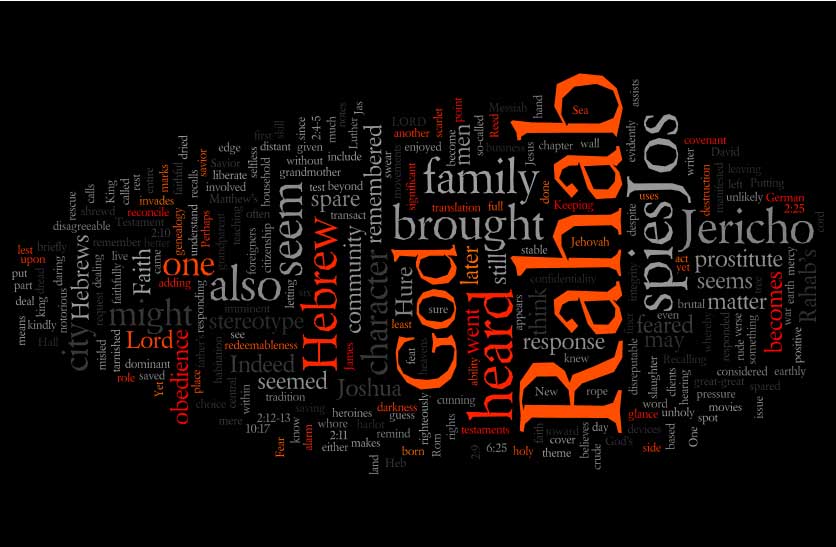
Rahab, full of faith, heard about how the Lord delivered his people, and Rahab believes and embraces God as supreme. Her declaration and acts of salvation towards the spies are more than actions and words; she is worshipping the Almighty. Even with her scandalous background, something not appropriate for church, Rahab experienced the greatest wonder of all – God’s limitless love and power to use and save the least likely of people. 

After church last week Lindsey and I left Staunton and we traveled to Alexandria to be with my family. Not only were we planning to enjoy the Labor Day holiday, but we were going to surprise one of my grandmothers for her 81st birthday.

I love my grandmother tremendously. Ever since I was a child she has referred to me as “precious lamb of Jesus Christ,” she has been there for every major moment of my life, and still shouts out with great joy every time I call her or visit her.

On Monday evening, after surprising her, we sat around my parents’ dining room table to enjoy a home cooked meal and celebrate my Gran. One of the more wonderful qualities that I inherited from her is the ability to ask questions that lead to conversation. I began with: “I want everyone to go around the table and share a story about Gran that brings you joy or made you laugh.

My mother told the story about how when she was a child, my grandmother would dress up like a waitress, sit my mother and her friends down at the table, and would take their order for lunch. The options were obviously limited, but it made the girls feel special, and I can just imagine them giggling as my grandmother scribbled away the orders for Grilled Cheese sandwiches.

I told the story about how my grandmother was always trying to teach us something new. When I was quite young, she used to require my sisters and I to learn a new word from the dictionary whenever we stayed the night at her house. The only word I can remember learning was “Taxidermy.” But not only were we required to learn a new word, but we had to use it in a sentence when our parents returned! I can only imagine the kind of sentence I came up with when I was 8 years old with the word taxidermy in it!

189334_3821512455734_514614209_n

But my favorite story is the one that Lindsey told. Gran had come over for dinner one night while we were all together, and when the evening came to a close she could not find her keys anywhere. We searched all over that house; taking off the couch cushions, crawling on the carpets while sweeping our hands, we even emptied out the trashcan just in case. But as it would happen, the keys were nowhere to be found. I eventually drove her home in my own car and used the spare key to let her into her house, with the hope of finding her car key sometime soon. Thirty minutes later my grandmother called. “I was just getting ready for bed,” she said, “and wouldn’t you know it, but I found my keys in my bosom!

Some things are not appropriate for church.

While I sat there listening to the hilarious stories from my grandmother’s life I was struck with the sensation of awe and love. My grandmother has embodied, for me, a life of faith and dedication, one that I try to emulate daily. But I also realized, that I know nothing negative about her. In my experience, coupled with all the stories I have heard, everything about her life is positive. Yet I know that she could not have lived a perfect life. That, like me, she has sinned, she has fallen short of God’s glory, she has made mistakes, she has regrets.

Everyone has something from their past that they are not proud of. What I believe Rahab, and my grandmother, have to teach us this morning is that we are not defined by the mistakes and shortcomings and judgements from the past.

By the time the New Testament was written, Rahab is remembered among the ancestors of Jesus (Matthew 1.5), regarded as an example of living faith (Hebrews 11.31), and justified by her works (James 2.25). By the time I was born my Grandmother had become the sweet woman full of life and laughter that I have always experienced. Whatever they did in the past matters little to the Lord. He did not judge them for their lives, but called them to respond to the grace poured out on their lives.

Can you imagine how strong Rahab’s belief and faith must have been? To sell her body the way she did, to be powerless and insignificant, and then she grabbed hold of her own destiny and lived faithfully. Two strangers had appeared that night, just like everyone else that walked through her doors, but her fear and faith propelled her into hiding them. She saw an opportunity to change her life, to save the lives of her family, and she did so.

Rahab, thinking of all that she had heard about the Lord, lied to the king’s men and came to terms with the spies. She refused to let her status and place in life limit her power for saving others. She was convinced that the city would fall at the hands of the Hebrews, but she was not simply motivated by fear; she was profoundly impressed with the news and strength of the God of Israel. “The Lord your God is indeed God in heaven above and on earth below.”

Her profession might not be appropriate for church, but her faithfulness is something we can all admire.

If you take a moment to look around the sanctuary, what do you see? Do you see perfect couples sitting shoulder to shoulder, hand in hand? Do you see loving families with children all sitting neatly in their pews? Do you see men and women who are full of faith and grace, capable of love and mercy? Do you see grandparents who adore their grandchildren?

I see a church full of Rahabs. I see people sitting in the pews with pasts they would prefer to remain hidden and untouched. I see families that are broken and full of disappointment. I see careers that have floundered, former decisions that have derailed lives, and regrets about choices that changed everything.

The beauty of the church is that it is full of Rahabs, people like you and me, that have been brought together to be the body of Christ for the world. The immense wonder and joy of the church is that in spite of our dark pasts we have been called to a brilliant present. That like Rahab we can become saintly by responding to the tasks and call that God places on our lives.

If we kept out everything that was not appropriate for church, then we would have an empty building. All of us, with our brokenness and disappointments, with our sins and temptations, have moments from our lives that are not appropriate for this place. However, that is precisely why we are here.

God’s sees us, knows us, calls us by name, and recognizes our potential in spite of our faults. God looks on all the Rahabs of the world, people like us, and beckons us to the Table, to the feast that we do not deserve simply because he loves us.

Look around at one another my friends, do not cast the first stone in judgement, do not sit high and look down on your brothers and sisters in faith. Instead, rejoice; give thanks to the Lord of heaven and earth who loves you, the God who calls on harlots to be helpers, sinners to be saints, and Christians to act like Christ.

Amen.

With Buttocks Uncovered – Sermon on Isaiah 20.1-6 & Mark 14.51-52

Isaiah 20.1-6

In the years that the commander-in-chief, who was sent by King Sargon of Assyria, came to Ashdod and fought against it and took it – at that time the Lord had spoken to Isaiah son of Amoz, saying, “Go, and loose the sackcloth from your loins and take your sandals off your feet,” and he had done so, walking naked and barefoot. Then the Lord said, “Just as my servant Isaiah has walked naked and barefoot from three years as a sign and a portent against Egypt and Ethiopia, so shall the king of Assyria lead away the Egyptians as captives and the Ethiopians as exiles, both the young and the old, naked and barefoot, with buttocks uncovered, to the shame of Egypt. And they shall be dismayed and confounded because of Ethiopia their hope and of Egypt their boast. In that day the inhabitants of this coastland will say, ‘See, this is what happened to those in whom we hoped and to whom we fled for help and deliverance from the king of Assyria! And we, how shall we escape?’ “

Mark 14.51-52

And a certain young man was following him, wearing nothing but a linen cloth. They caught hold of him, but he left the linen cloth and ran off naked.

081910-barefeet

This morning we conclude our sermon series on Strange Stories from Scripture. As I have mentioned previously, this series came to fruition through a desire to proclaim some of the more bizarre texts in church, particularly those that are rarely discussed. There is a wealth of biblical treasure just waiting to be uncovered; this series is our attempt to begin unearthing some of the great moments from the Bible. Our first week we talked about a young man named Eutychus who fell asleep while Paul was preaching, last week we learned about the incident with Elisha and the she-bears, today we conclude by looking at the prophet Isaiah’s naked faith.

Prayer

The Lord spoke to Isaiah son of Amoz, saying, “Go, and loose the sackcloth from your loins and take your sandals off your feet, “ and he had done so, walking naked and barefoot.

On the outside it looks like your typical chapel: painted white with a perfectly trimmed and manicured lawn. When Sunday morning comes the parishioners lazily make their way to the pews in order to prepare their hearts and minds for worship. Located in Ivor, Virginia worship attendance has steadily increased over the last few years as the church has taken very seriously its commitment to “come as you are.” No judgments are made as people enter the sanctuary, they see one another as God’s children, and the community has benefited from this focused ministry.

Whitetail Chapel rests as an example for other churches. They continue to serve the Lord their God with all their hearts, minds, and souls, while other churches are just trying to figure out how to stay open. The people who attend the church are excited and jazzed up about their faith, and are known for their willingness to invite anyone they meet to attend.

If any of you were privileged enough to attend one Sunday I believe that it would be a tremendous experience. The preaching would open your hearts to God’s kingdom in the world, the fellowship with other parishioners would cement your importance and vitality to the body of Christ, and you would have a new vision of what the church can be.

However, even with all these accolades, I am positive that the one thing you would remember most about attending Whitetail Chapel is the fact that they worship in the nude…

whitetailresort04

Those in attendance in worship do not have to worry about finding something special to wear on Sunday mornings because they strut their stuff in their birthday suits. “Come as you are,” indeed. When asked about why they choose to worship in the nude, the pastor replied, “Some of Jesus’ most important moments happened when he was naked: he was born naked, he died naked, and when he arose he lefts his clothes in the tomb so that he could be naked. If God made us that way, how can that be wrong?”

Some churches take the ministry of the prophet Isaiah a little too seriously.

During a time of revolt, when the people began to act our against the imperial ruling of Assyria, the prophet Isaiah was called to do something very dramatic. Ashdod, a city of strength, began the internal campaign against Assyria and urged for support from the surrounding nations including Judah with the promise that Egyptian and Ethiopian forces would soon come to help. As is common throughout scripture, and even in our lives today, the will and desire of the people did not match up with the ways of the Lord.

The Lord spoke to the prophet Isaiah, “Go, and loose the sackcloth from your loins and take your sandals off your feet,” and he did so, and began to walk around naked and barefoot. For three years Isaiah rid himself of the clothing and footwear that he had grown accustomed to and continued to embody, nakedly, the calling of the Lord.

December-Series-Image

Then the Lord said, “Just as my servant Isaiah has walked naked and barefoot for three years as a sign and a portent against Egypt and Ethiopia, so shall the king of Assyria lead away the Egyptians as captives and the Ethiopians as exiles, both the young and the old, naked and barefoot, with buttocks uncovered. And when that day comes to pass the inhabitants of the land will say, ‘See, this is what happened to those in whom we hoped and to whom we fled for help and deliverance from the king of Assyria! And we, how shall we escape?’”

During the timespan of the revolt, Isaiah walked around naked to symbolize the captivity that would soon overtake Egypt and Ethiopia, thus warning his people not to trust these allies nor join in the rebellion.

I know we’ve talked about some strange stories recently: A young man falls asleep under the warm glow of lanterns during a late night church service, only to fall out a window, die, and then be brought back to life. A young bald prophet overreacts to a group of young hoodlums and curses them in the name of the Lord to which 2 females bears maul 42 of the young men from the crowd. But today’s reading takes the cake for one of the strangest examples of faith in the bible.

From our modern sensibilities we find it difficult to imagine and believe that a prophet of the Lord, particularly one like Isaiah, would ever do something such as this. Certainly today, no members of the contemporary church would expose themselves to such embarrassing tactics.

This week, in preparation for the sermon, I asked a simple question of the Christians in my life: What’s the craziest thing you’ve ever done for your faith? At first I heard nothing, a fearful sign that perhaps we are not pushing the boundaries for our faith, but eventually some people began to respond. One woman on twitter said, “I took a sabbatical, packed up all my “stuff,” became homeless, and traveled the world for a year following Jesus daily. My mother answered with, “I received Ecoli poisoning while on a mission trip to Guatemala.” And still yet another man said that he had to spend two and a half years in prison before figuring out that God loved him, and had a plan for him.

The craziest thing I have ever done for my faith was carry our confirmation cross over my shoulder throughout Staunton on Good Friday. I arrived at the church around noon, picked up our cross, and began walking. For 3 hours I explored our town by foot with the hope of marking our hallowed day and reminding those in Staunton what Christ did for us. I will freely admit that part of my desire was to upset people, to disrupt the common expectations of a normal Friday afternoon, and to challenge the vision of the church simply being a place where you gather for one hour every week.

IMG_1279

However, I will also admit that I was being selfish while carrying the cross around Staunton. I know that I felt led and called to do so by God, but I recognize that it was something I had been thinking about for a long time, and looking forward to for a number of years. Some small part of me desired that people would recognize that I was the one carrying the cross.

Notice however that the prophet Isaiah had a complete lack of self-consciousness. He was a man with a mission and did not hesitate to accept scorn or derision in following his duty. When the Lord called upon Isaiah to do something bizarre and strange, he did not wait for awhile and weigh the pros and cons of his calling. He did not wait to see if any other opportunities came knocking at his door. He did not fret over what his reputation would look like after his prophetically naked embodiment. Instead, he immediately stripped off his clothing and began to do what the Lord required.

The counter to our story this morning takes place at the end of the scene in the Garden of Gethsemane. Jesus has already been arrested and is being brought to Pilate for questioning, the disciples have all fled for their own safety, when the captors discover a young man who was following them. Wearing nothing but a linen cloth the young man continued to follow Christ even after his closest friends had abandoned him, but when the guards caught hold of him, he left the linen cloth and ran off naked.

The young man was sharing in the experience of Jesus. Even when the disciples had left, the young man remained. Yet when the calling got too dangerous, he was ready to run off completely naked. It seems to make sense for the young man and the disciples to flee in order to preserve their own lives, but the followers of Christ are called to lose life for the sake of Jesus and the Gospel.

The nude dude from Mark’s gospel is naked and afraid. Isaiah, in stark contrast, is naked and prophetic. Rather than run away from the situation, instead of merely looking out for his life alone, Isaiah was willing to go to extreme measures in order to warn God’s people against putting too much faith in the other nations, rather than the almighty God.

Even with this dramatic and captivating imagery from the life of Isaiah, I believe we can ask about Isaiah’s effectiveness. Remember: we’re talking about a man who walked around naked and barefoot for three years. Isaiah, to all the people, must have appeared crazy and deranged. He must’ve looked like one of those people we are often tempted to ignore in our lives, people who are so zealous and outspoken to the degree that we can pretend they do not exist. But he did what the Lord required.

Even with all the dramatic and captivating elements of our worship service, I believe we can ask about the church’s effectiveness. I am comfortably standing behind a protective barrier surrounded by people who chose to be here this morning. In worship we are caught up and part of the body of Christ who willingly woke up this morning, who decided to come to church, and who yearned to hear God’s Word spoken.

Isaiah’s ministry confronted the fundamental elements of peoples’ lives, he shook everything up with his prophetic vision, and left them with something they would never forget.

Proclaiming the Word of the Lord is not something that can be left up to church worship and preachers alone. This space is sacred for us to gather and be reinvigorated for living out our faith until next Sunday. True transformative ministry takes place out there.

Isaiah’s actions, his willingness to remain naked and barefoot for three years to protect God’s people, ought to shame us into wanting to do more and live out our faith in strong and incredible ways. If we are passionate for Christ to be known, for the kingdom of God to reign, then we must ask how far we are willing to go for our faith.

Not let me be very, very, very clear: I am not saying that we need to loose the sackcloth from our loins and take the sandals off our feet. I am not saying that we need to roam around the hills of Staunton naked and barefoot for the next three years. That was Isaiah’s calling, not ours.

But if Isaiah was willing to go that far for his Lord, how far are we willing to go? Perhaps this morning we are being poked and prodded to be naked with our faith, to be vulnerable with those around us about what the Lord has done for and through us.

What would it look like this week if you asked one person if you could tell them about your faith? Who would you share your faith with? I’m not talking about trying to save someone, or trying to tell them the whole story of both the Old and New Testaments. But what if you sat down and told them what God has down for your life?

I know that for some of us to share our faith in that way would be very uncomfortable. We might rather walk around naked and barefoot for three years than sit down and be vulnerable and open about how God has changed us. 

But if God could save his people from making a terrible alliance through Isaiah, if God could save us from death through Christ on the cross, just imagine what God can do through you.

Amen.

Devotional – Psalm 133.1

Devotional:

Psalm 133.1

How very good and pleasant it is when kindred live together in unity!

Weekly Devotional Image

I prayed all week for the weather to cooperate. We had been planning the Community Cook-Out for weeks and the weather forecast kept pointing toward tremendous amounts of rain to fall during the scheduled event. As a church we had already procured a considerable amount of food, dedicated volunteers, and three bouncy houses. Yet, as the days passed and we came closer to the celebration, I became worried that it would not take place at all.

10556430_266797316847904_6460753775368326310_n

After many prayers, Saturday came and the weather wound up being perfect for the Cook-Out! The clouds provided a cool atmosphere for the children to play on the bouncy houses and allowed for us to celebrate on the lawn without having to worry about too much sunshine or rain. When people began to arrive for the event I prayed and thanked God for providing such a wonderful day for our community and was thrilled for our church to serve the folk of our neighborhood.

I spent most of the afternoon grilling more hamburgers and hot-dogs than I could possibly count. Every time I thought I could take a break, more people arrived and lined up for food! From my vantage point I was given a clear line of sight of everyone and all of the activities that were taking place: children (and adults) playing on the bouncy houses, families sitting at tables while enjoying food and fellowship, young people lining up to have their faces painted, frisbees and footballs being thrown through the air, and conversations taking place between people who had never met. While standing behind the grill I was overcome with a sense of wonder at how our church was living out its call to participate in God’s kingdom by being the body of Christ for the world.

10304431_10204425795911698_6731480664290185266_n

The psalmist wrote “how very good and pleasant it is when kindred live together in unity!” During our Cook-Out we had different people from all over the community present to join together in fellowship: parents and families from the pre-school, neighbors who attend different church, friends who do not attend church at all, and people from St. John’s. As we enjoyed the afternoon together I was given a glimpse of how wonderful and joyous it can be when a neighborhood lives in unity; I experienced Christ’s presence through the conversations and outpouring of love between strangers.

This week let us all seek opportunities to live together in unity. Let us look for those around us who are still strangers and do whatever we can to foster new friendships.

How can you live out Psalm 133 this week?

Devotional – Romans 6.8

Devotional:

Romans 6.8

But if we have died with Christ, we believe that we will also live with him.

Weekly Devotional Image

Starting Friday afternoon, I will gather with thousands of United Methodists from all over the Virginia Conference. This is our annual meeting to discuss current challenges facing the church, celebrate the ordination of new pastors, and grow in our faith and love of God. Holy Conferencing sits at the foundation of what it means to be part of the UMC and traces back to the time of John Wesley.

To be perfectly honest, Annual Conference has its ups and downs. There is nothing quite like the Service of Ordination that will take place on Saturday evening; ordinands will kneel before the Bishop and take the vows of serving our church will all that they have and we will sing those great and familiar hymns as we pray over these new ministers and their churches. The episcopal address, made by our Bishop, seeks to encourage the lay and clergy leaders of our conference while at the same time faithfully address the concerns and challenges of the future.

2014ACLogo

But there will come a time when the Annual Conference will descend into petty arguments, oversimplified generalizations, and frustrated ramblings. We will be asked to vote on resolutions regarding a wide-variety of issues facing the church including the possibility of changing the language regarding homosexuality in our Book of Discipline. The roller-coaster of Annual Conference will move up and down and many of us will have our faith restored in the church, only to have it completely erased after a few arguments break out.

As I reflect back on the previous Annual Conferences I have attended, and prepare for this coming weekend, I wonder if our Holy Conferencing is more about us, or more about Jesus. We need to ask ourselves why we gather in the first place: Are we here to pat ourselves on the back and congratulate one another on a productive year in ministry? Or are we here to learn more about God, nourish ourselves through worship, and find renewed energy to be Christ’s body for the world as we return to our churches?

Sometimes, things must be crucified in order for resurrection to take place. We have to be prepared to let something die and end so that we can find new life and discover new opportunities for our great church to be what God has called us to be. Paul wrote to the church in Rome, “But if we have died with Christ, we believe that we will also live with him.” Annual Conference is a perfect opportunity to remember that all of this (the church, ministry, serving the community) is not about me but its about God. If we let our old selves die and put on Christ we will be able to faithfully participate in a weekend dedicated to the renewal of our church. However, if we continue to talk and act as if Jesus isn’t in the room with us we will fail to grow and be fruitful for the world around us.

So, as you prepare to enter a new week I challenge you to confront the areas of your life where Christ is not at the forefront of your being. How are you still holding onto the old self? How can you let a part of your life be crucified so that something new and beautiful and wonderful can be resurrected?

Devotional – 1 Corinthians 12.4-7

Devotional:

1 Corinthians 12.4-7

Now there are varieties of gifts, but the same Spirit; and there are varieties of services, but the same Lord; and there are varieties of activities, but it is the same God who activates all of them in everyone. 

Weekly Devotional Image

After responding to a call of ministry, the United Methodist Church requires candidates to be examined by the Board of Ordained Ministry before they are placed at a church/agency. This is done to ensure that candidates are properly prepared for the many demands of local ministry and that they are able to articulate the doctrines and principles of our church in such a way that it can be conveyed to a variety of congregations.

While many of us prepared for our interviews we heard horror stories about the difficulty of some questions that might await us: “Pretend that I just walked to your office and found out my husband had been cheating on me. How would you respond?” Or “Name the Old Testament justifications for infant baptism…” Or (one of my personal favorites) “How would you explain the Trinity (Father, Son, Spirit) to a middle school student?”

Shield-Trinity-Scutum-Fidei-English.svg

I was blessed to not have to answer the Trinitarian question, one that regularly knocks candidates out of their comfort zone while interviewing. I know of at least one person who was delayed from passing their board because they were unable to answer the question in a way that satisfied the board. How would you answer the question? If a young Christian happened to approach you after church and ask about the trinity, what would you say?

One of the ways that I have explained it in the past is as follows: “The Trinity is like a band playing music. There are three distinct and unique elements necessary for music to be created. You need musicians, instruments, and written music. Without one the whole thing falls apart. Though they are different, they are all necessary for music to be played and enjoyed.” However, this example, for as much as I like it, is inherently flawed.

I have heard others attempt to explain the trinity as 1) a stool with three legs; with all three the chair can stand upright, but if you remove one the chair will not stand; 2) a woman who is at different times a mother, a daughter, and friend to different people; 3) a bicycle that has gears, brakes, and wheels, in order to propel itself forward. Yet all of these do not do justice to the incredible blessing and mystery that is the Trinity.

thinking_about_trinity_med1

Perhaps we’ve become so concerned with being able to explain how the Trinity works, that we no longer know how to affirm the trinity as mystery. We elevate definitions and details over and against beauty and reverence. I cannot explain the trinity, I cannot explain the infinite wonder of God because I am a finite human being. But, like Paul, I can say, “There are a variety of gifts, but the same Spirit; there are varieties of services, but the same Lord; and there are varieties of activities, but it is the same God who activates all of them in everyone.”

What do you think is more important: Being able to explain the trinity? Or recognizing that the One God has blessed us with different gifts in different ways so that we can be the body of Christ for the world?

Today, let us strive to be people who recognize the gifts that we have been given by the Triune God. Let us look at those gifts to see the beauty of God’s mystery in our lives.


Devotional – 1 Peter 5.6

Devotional:

1 Peter 5.6

Humble yourselves therefore under the mighty hand of God, so that he may exalt you in due time. 

Weekly Devotional Image

I got the phone call on Thursday afternoon letting me know that Mrs. Betty Lancaster had passed away. Sitting on my couch at the parsonage I realized that I have been at St. John’s for nearly a year and this phone call meant that I was going to preside over my first funeral. I got to the Lancaster’s room at Brightview Baldwin Park as quickly as I could and I sat with the grieving family as they accepted the fact that Betty was gone.

Betty Lancaster

Betty Lancaster

Over the weekend I met with the family on different occasions learning more about the kind of life Betty lived in order that I might do justice to her life during the funeral service on Monday afternoon. The family shared with me particular stories about her life; her love to travel, her expertise in the kitchen, and her dedication to instilling important family values. I heard about how she and Ray met on a Greyhound bus on their way to Radford/Blacksburg, and how their marriage of 63 years began in a service station here in Staunton when a clerk from the court met with them to preside over their martial vows.

I made phone calls to a few of Betty’s friends that still live in the community who confirmed the family’s belief that she was one incredible woman, ready to do whatever it took for others. The more I learned about her life, the more I wished I had been able to spend more time with her myself. 

But the one thing that stuck out among all the other details was a simple comment that Ray made as soon as I made it to his room after Betty died. Sitting in his chair, barely looking up from his lap, he softly said, “To us, Betty was always a star, but she never went in for all the glitz and the glamour.

submission-to-God-500x333

Humility is a lost art in our current culture. With the need and the drive to outshine everyone else (whether for employment, college applications, or just selfish desire) we no longer appreciate the importance of remaining modest. Life, at times, seems like one giant competition where we have to make sure that we come in first place. However, the kingdom of God is not like the world we live in. Instead of cutthroat competition dominating everything we do, we are called to humble ourselves under the mighty hand of God, so that he may exalt us in due time. In life we will have opportunities to shine for God, but we must remember that when we do our best, we do so for the kingdom of God and not ourselves.

The call of discipleship today is to live like Betty Lancaster did, which is to say we are called to live like Christ did; ready to listen, prepared to love, and humble in all that we do.