From Diapers to Diplomas

Psalm 46

God is our refuge and strength, a very present help in trouble. Therefore we will not fear, though the earth should change, though the mountains shake in the heart of the sea; though its waters roar and foam, though the mountains tremble with its tumult. There is a river whose streams make glad the city of God, the holy habitation of the Most High. God is in the midst of the city; it shall not be moved; God will help it when the morning dawns. The nations are in an uproar, the kingdoms totter; he utters his voice, the earth melts. The Lord of hosts is with us; the God of Jacob is our refuge. Come, behold the works of the Lord; see what desolations he has brought on the earth. He makes wars cease to the end of the earth; he breaks the bow, and shatters the spear; he burns the shields with fire. “Be still, and know that I am God! I am exalted among the nations, I am exalted in the earth.” The Lord of hosts is with us; the God of Jacob is our refuge.

graduation-sunday


Kurt Vonnegut Jr. once said that true terror is waking up one day and realizing your High School senior class is running the country. It’s a great quote, and one often used this time of year during graduation speeches. In fact, ten years ago, it was used by one of my friends at the beginning of her address during my graduation from High School: True terror is waking up one day and realizing your High School senior class is running the country.

Time can be terrifying. We, as human beings, are deeply rooted in time and when it feels like its going too fast, it leaves us shaking. It shakes us because we can wake up and wonder where it all went. I feel like I just graduated from High School; I can still remember the uncomfortable polyester graduation gown that created a frightening amount of static electricity. I can still picture the girls wearing too high high heels and attempting to walk across the stage without toppling over, and I can still remember the beginning of the speech and how true those words are.

We change all the time. It’s at the heart of what it means to be human. We’re born, we grow in size and knowledge, we move, we develop, we transform, we graduate from preschool to kindergarten, and then all the sudden we graduate from high school, and then with the blink of an eye our generation is running the country.

Things change, our lives change, our situations change, and when they do, it feels like the earth shakes under our feet.

Upon graduating from preschool we move on to Kindergarten. After a number of years with the same classmates and the familiarity of one school and one program, we have to move on to a new location, with longer hours, with a whole new set of expectations. I can still faintly remember my first day in kindergarten and wondering where to sit, and if anyone was going to sit with me. And the change that takes place for the parents is even more severe!

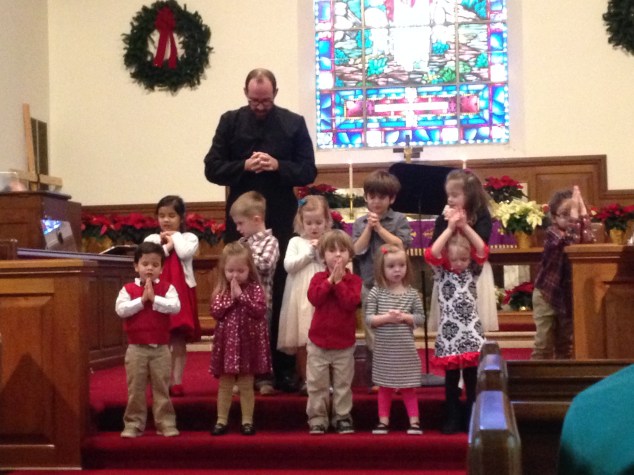
During the final months of Preschool here at St. John’s, we ask the parents to wait in the parking lot so that the children can get used to walking to their own classroom by themselves. This is one way of preparing them for Kindergarten. And honestly, on that first day, the children bound up and down the hallway without a care in the world, and it is the parents in the parking lot who are undergoing an existential crisis.

I’ve seen tears well up in the eyes of fathers, and mothers nervously pacing back and forth while their children enter into a new realm of being. I imagine they felt like the world was shaking under their feet and they needed something solid to hold on to.

After graduating from high school we go off to college and enter a whole new strange world. We often pack our belongings and start living with a stranger and won’t be home until the first break at Thanksgiving. For the student it is a time of great excitement and opportunity, whereas for the parents it can be downright terrifying. Will they be okay? Will they get enough food to eat? Are they going to be able to make new friends? Who is going to wake them up for class in the morning? Who is going to do their laundry? It shakes the parents to their core to watch their beloved child go from diapers to diploma in a blink of an eye.

Every graduation leads to a time of change and fear; Preschool to Elementary School, High School to College, Singleness to Marriage, Health to Death. We enter these periods of unknown, and that’s what makes us really afraid.

13434733_10154269000690536_1434707530486525089_n

When these changes occurs, when we graduate from one thing to another, we often respond in one of two ways; they either push us closer to God, or farther away.

A young couple has a baby and once the new domestic rhythm is established they realize they have no idea what it means to raise a child to be a decent human being so they start going to church it hopes of answers and direction. Or a recent graduate enters a university and is invited to a worship service filled with people who genuinely care about her well-being and she discovers who she is and whose she is. Or a recent widower listens while the church proclaims his deceased wife’s promised resurrection during the funeral and it gives him the strength to discover God’s love in church.

But change can also push us away. We convince ourselves that we can raise a child without the help of a larger community, we believe there is no place for the church in our lives while we are in college, or we grow cynical toward the words proclaimed when someone we love dies.

The church is bold to proclaim the words of the psalmist, the enduring truth, that even though the earth should change, even though the mountains shake and the seas tremble, even though kindergarten can be overwhelming (for children and parents), though the unknown of college stands like an undefined horizon, even though people die and we grieve till the end of our days, there is a river whose streams make glad the city of God. This city cannot be moved, because God dwells in the city forever.

God is the solid rock upon which we can stand when the world shakes underneath our feet. When we are filled with sorrow and doubt, God is the source of joy and light. While people push us to and fro with differing opinions, God speaks the truth in love. As we receive our identities in the hurtful comments of friends and foes, God tells us that we are beloved.

There is a great comfort that comes in knowledge that even though our lives will change, God will stay the same. That is the great story of scripture; God remains steadfast even when we fall away. In the wilderness journey of Exodus, while the people chose to worship idols and other gods, the Lord remained with them. After David fell into the clutches of sin, God was with him. After the exile, God called the people back to their homes and back to lives of faithfulness. Even after delivering Jesus Christ to the cross to die, God’s arms remained open to all of God’s children.

God stays the same.

psalm-46-1

A few months ago I asked one of our youth who just graduated from high school to share what kind of difference St. John’s has made in her life. Danielle was baptized in this sanctuary, was enrolled in our preschool, and has been in worship nearly every Sunday for 18 years. That kind of commitment to the church shaped her into the remarkably wonderful young woman she is today, and it gives me hope for the role of the church in all of our lives.

This is what she had to say:

“Since I was born, I have been coming to St. John’s UMC. It has always been there for me. Even when I was a small child, and unable to truly comprehend the grace of God, I still had a strong and living faith because of the church. As I grew up, I made many friendships at St. John’s that mean a great deal to me. And honestly, “friendship” doesn’t even do justice to what it has really been like. I grew up with these people, and they took the time to raise me in the faith. Without this church I never would have found God and the power of God’s word. I am blessed because I have a church that loved me the way God calls us to love. Moreover, this church has helped me not only find God, but find myself as well. No matter where I might end up in the future, I will always cherish the memories, family, spiritual growth, and prosperity that I experienced at St. John’s.”

I believe Danielle was able to craft those words because of God working through you. Danielle feels blessed because this church loves her the same way God calls all of us to love: without judgment or assumption, without malice or prejudice. From diapers to diploma, you and the other great saints of this church have nurtured her. You have shown her what it means for God to be our strength and refuge, a very present help in trouble.

When someone from the church died she could have fallen to the temptation of fear and trembling. But you showed up for the funerals, you rejoiced in the promise of salvation, you embodied the hope we have in the Lord who is with us.

When she moved from school to school, while life changed around her each and every day, this place was like the river whose streams mad glad the city of God. Here in this church she learned about the God of creation who brought forth order out of chaos, who called Abraham into a covenanted relationship, who wrestled with Jacob on the banks of the Jabbok river, who delivered the people out of slavery in Egypt, who called prophets and priests to bring the people back, who became incarnate in Jesus Christ and dwelt among us, who died on a cross, who was raised three days later.

Throughout Danielle’s life this church has said every Sunday, “Come, behold the works of the Lord!” Her eyes have been opened to the way God moves in the world, she found her identity as a child of God; she experienced God’s magnificent power and might.

Change can be a terrifying thing. But the God of Abraham, Isaac, and Jacob, the God of Jesus Christ, is our refuge and strength. Because we can do all things through Christ who strengthens us, therefore we will not fear even though our lives change. This church’s work propels a river whose streams make glad the city of God. Through our worship and our work, through our prayers and our presence, through our faith and our fellowship, we remember that God is in the midst of our lives. God will help when a new day dawns. The nation might be in an uproar, kingdoms will totter, but the Lord of hosts is with us.

So come, behold the works of the Lord. God makes wars cease, and peace reign. God makes the weak mighty, and brings down the principalities. God breaks the bonds of slavery, and opens up the doors to freedom. God brings hope to the poor and calls upon the wealthy to serve. God comforts the afflicted and afflicts the comfortable.

Be still and know that God is with us. From diapers to diplomas and even to death, God is with us. Amen.

Why The Cross? – Good Friday Homily

John 19.28-30

After this, when Jesus knew that all was now finished, he said (in order to fulfill the scripture), “I am thirsty.” A jar full of sour wine was standing there. So they put a sponge full of the wine on a branch of hyssop and held it to his mouth. When Jesus had received the wine, he said, “It is finished.” Then he bowed his head and gave up his spirit.


ethereal-finished-still-p3

I get asked a lot of questions. I’ll be in a bible study when the conversation moves to an area of confusion and all eyes will turn to me and someone will inevitably say, “What does this mean?” Or I’ll be in my office and someone will walk in to share about all of the trials and tribulations they’ve experienced and finish by asking, “So where is God in all of this?” Or, like after the atrocity in Brussels this week, I’ll receive an email that says, “How could God let this happen?” People are looking for answers.

On Wednesday morning I gathered all the little preschoolers into the sanctuary to talk about the cross. I wanted to show them the cross we have here in the sanctuary and eventually have them march outside in a line while I carried the cross. For most of them, Easter is about the bunny and the candy so anything I can do to make it more about Jesus is important.

They were all sitting nice and quiet in the pews as I explained Jesus’ final week, and that he died on a cross to help us get to heaven, and most of the kids nodded along. But one sat in the back pew with her eyebrows in an expression of “huh?” I tried to keep moving us forward but I could tell it wasn’t connecting with her so when I saw her shoot her hand up with a question I wasn’t surprised.

She asked, “But why did he have to die on a cross?”

In the moment I tried to answer her question in a way that only a four year old could understand, but the question has stayed with me nonetheless. Why did Jesus have to die on a cross?

Well, he had to die on a cross because that’s the way the Romans executed those who they regarded as a threat. Today we have drones and missiles that we can fire from far away in order to remove ourselves from death, but during the time of Jesus, they were hung high in the air so that all could see what happened when you challenged Rome. The cross was a sign of death and fear.

But that answer is not good enough for those, few, of us who gather in a place like this on Good Friday. If you’re here right now, you get that discipleship is more than just Easter. You get that Jesus was more than just a nice guy. You get that there is something more to this cross than symbolic remembrance.

Jesus died on a cross to reveal the heart of God.

The cross is where God’s grace crosses our life to create a new way of living.

We’ve got crosses everywhere and sometimes we forget how terrifying they were and should be. It is our central icon and we have them displayed in our sanctuary, some of us have crosses around our necks, and some of us even have them tattooed on our bodies. But notice: our crosses are empty. It would disrupt our Protestant sensibilities to have a murdered and graphic Jesus hanging on the cross for everyone to see. We would rather have the clean empty cross to remind us of the resurrection. But if we lose sight of the fright and discomfort of the crucifixion, the empty grave becomes cheap grace.

So, to be here on Good Friday implies a willingness on our part to confront the cross and we also want it explained. We want to know ‘why.’

But Jesus doesn’t offer us an explanation.

Whenever the religious elite, or the crowds, or his disciples questioned him, he would respond in cryptic parables that left them more confused than in the beginning. Jesus doesn’t offer simple explanations. Instead he offers love.

Explanations will never calm our anxieties in regard to suffering and tragedy. The people who try to explain the death of a young child by saying that “God wanted another angel in heaven” transform God into a murderer for the sake of an explanation. The people who try to explain a disabled child as “God’s way of punishing the mistakes of the parents” make God in a torturer for the sake of explanation. The people who try to rationalize terrorist attacks with “God is using them to show us its time to go to war” morph God into a selfish, violent, and manipulative entity for the sake of explanation.

Love, not explanation, is required when we are faced with tragedies. Instead of telling a grieving mother that God wanted her baby, we are supposed to show up with love and not answers. Instead of blaming sinful or faithless behavior for the disabilities in a child, we are supposed to love them with every fiber of our being. Instead of dropping bombs and sending drones to wipe out the Middle East we are supposed to see them as our brothers and sisters.

To be Christian is to enter into suffering. We do not look away from tragedies, we do not abandon those who are alone, and we do not isolate ourselves from the ways of the world. Instead, because of the cross, we are tasked with showing up for others when there is literally nothing we can do to save ourselves from suffering.

So, we could take the time to outline the connections between Jesus hanging on a tree with the first sin of Adam and Eve taking fruit from the tree of knowledge of good and evil. We could go deep into rationalizing the cross through theories like God used Jesus as bait to hook the devil from hell. But the truest response to the cross, the way we are called to go forth from Good Friday, is to look at the cross and take up our own to follow Jesus. Amen.

12042644_10205705206780417_2916230849357888646_n

The Gifts of God – Hope

Isaiah 12.2-6

Surely God is my salvation; I will trust, and will not be afraid, for the Lord God is my strength and my might; he has become my salvation. With joy you will draw water from the wells of salvation. And you will say in that day: Give thanks to the Lord, call on his name; make known his deeds among the nations; proclaim that his name is exalted. Sing praises to the Lord, for he has done gloriously; let this be known in all the earth. Shout aloud and sing for joy, O royal Zion, for great in your midst is the Holy One of Israel.

hope-hero

Over the last few weeks we have been going through a sermon series on The Gifts of God. This has been particularly fitting considering the fact that Advent is usually a time when we fret about what we will be purchasing for everyone else. However, this Advent, we have been reflecting on what God has given us. Today we continue the sermon series with God’s gift of Hope.

When I was a kid, even when I was as young as some of our preschoolers, I loved Star Wars. We had the old VHS versions of “A New Hope” “The Empire Strikes Back” and “Return of the Jedi.” The covers were so worn from use that you could barely read the writing, and the film inside the VHS tapes was starting to crackle from excessive usage. But I loved them nonetheless.

Some of the themes were lost on me as a child but I loved the light saber fights, the fundamental battle of Good vs. Evil (The Darkside vs. The Light), and that a kid from a Tatooine moisture farm could go from bulls-eyeing womp rats in T-16 to saving the entire galaxy.

Star Wars taught me that, with the right cause, even the weak could triumph. Star Wars taught me that we are not defined by our past and are given opportunities to change. And Star Wars taught me about hope.

In the beginning of Episode IV, aptly titled “A New Hope”, the galaxy is in disarray and the evil Empire continues to exert its power over the powerless. For a generation, people of all shapes and sizes cowered under the rule of the emperor and started to forget the way things used to be. However, a group of people held onto the hope of a new future, they called themselves The Rebel Alliance, and they believed that things could change.

Isaiah 12 is about hope for the future. Like the rebels from the Star Wars universe, Isaiah fundamentally believed that a day would come when everything would be turned upside down and salvation would be delivered.

With confidence, Isaiah declared a profound trust in the Lord, a trust without fear. With hope, Isaiah envisioned that future day when all of God’s people would give thanks to the Lord and make God’s deeds known among the nations. With joy, Isaiah could hear the songs of the future praising the mighty works of the Lord, for he would have done gloriously.

And on that day, God’s people will draw water from the wells of salvation.

IMG_4568

The man felt empty; like something was missing from his life. He had parents who loved him, he had gone to the right school, he had a good job, but things didn’t feel right. Whenever the holiday seasons came around he did not have the energy the call his parents, he resented the happy families at department stores purchasing gifts, and he abstained from the holiday radio channels.

He couldn’t explain it but one day he lost his patience with his family when they kept asking him about whether or not he was happy. One day at work he screamed at a customer after losing his patience. And one night, while he sat in his apartment, he realized how empty and lonely he felt.

He continued like this for some time. Living a dry and empty life, until he met her. She was everything he could have hoped for; smart, pretty, funny. They immediately hit it off, and in her he believed he found the solution for his emptiness, in her he thought he found the one thing that could fill him again.

The beginning of their marriage was wonderful; they saw the world with hope and expectation. They both were not filled, but they had more than they had in a long time. But it started to fade. Arguments with the in-laws, shouting matches in the living room, and nights spent sleeping in other rooms emptied them of the joy and hope they once felt.

They were at a crossroads in their relationship and were unsure of how to move forward. Both of them were too proud to try counseling, and definitely too proud to apologize, so they just continued with the thinly veiled frustration with one another. But then they had an idea: “Maybe if we have a child, it will fix all our problems, it will bring us closer together.”

They had some stability after the first, but when things reverted back to the pre-baby days, they decided to have a second child, and then a third. What they didn’t know, but what many of should know, is that even the perfect child cannot fill the emptiness within us. No child should be expected to make up for our baggage, and no child should be expected to heal our brokenness.

But this habit and rhythm in the family didn’t stop. After the kids, the parents tried to fill themselves with experiences and material possessions. They went on vacations they couldn’t afford, they took out a loan on a house they could never pay back, and every Christmas had to be better (and filled with more gifts) than the last. But all of these things failed to fill the emptiness they felt.

And on that day, God’s people will draw water from the wells of salvation.

IMG_4571

Jesus once met a woman at a well and confronted her emptiness. She had attempted to fill her life with man after man and yet there was something missing. Jesus said to her, “Everyone who drinks of this water will be thirsty again, but those who drink of the water that I give them will never be thirsty. The water that I will give will become in them a spring of water gushing up to eternal life.

Many of us are broken. Actually, the truth is, we are all broken. Most of us just don’t want to admit it. We have good days, but there are times that we feel dry and empty inside. We seek out the wrong objects to validate our lives: a spouse, a career, a child. And none of those things are strong enough to hold our identity together.

Yet, God offers us this living water, water from a well that never runs dry. When we start to see the hope that God has given us, when we rest our identity on the fact that we are first a child of God, when we drop our buckets into God’s well of salvation things starts to change.

God knows our thoughts and minds. God witnesses our brokenness and sinfulness. And God still loves us anyway. God’s love is truly unconditional. God’s love is unmerited. God’s love is filled with hope for our futures.

I’ve only been doing this whole pastor thing for two and a half years, but two and a half years is long enough to know that most of us, if not all of us, are looking for love and validation in all the wrong places. We expect our children to makes our lives better, we expect the presents under the tree to make our lives fuller, and we expect our spouses to fix all of our problems.

Jesus offers us something totally and wonderfully different. Jesus offers us hope from the well of salvation. A hope in a future not defined by our past. A future not limited by the mistakes we make here and now. A future not corrupted by the powers of death.

Jesus offers us hope, a hope unlike any other, a hope that can truly fill us.

An-so-Lord-where-do-it-put-my-hope

When we find our hope in the Lord, we can stand up to the intolerance and injustice in our midst because we know God’s sees the world differently.

When we find our hope in the Lord, the presents under the tree will not leave us looking for the next fix because we will know that the greatest gift we’ve ever received is Jesus.

When we find our hope in the Lord, we can confront the brokenness in the world and know that life here on earth is not the end.

Isaiah had hope, hope for a day when God would show up, hope for a time when God would make all things new. Isaiah prayed for a future where people would sing praises for the glorious power of the Lord. Isaiah dreamed about a day when God would offer the wells of salvation to the world.

That hope became real on the first Christmas, and that hope is still real and available to you and to me.

Jesus calls to each of us today and says, “I can fill you. I can fill you with the living water that never runs dry. I can bring you to the well of salvation. I can fill you with hope, and love, and validation. I can fill you with joy, and peace, and purpose. I can fill you and turn your life around.

Amen.


(With thanks to the Tamed Cynic, Jason Micheli, for inspiring parts of this sermon)

Devotional – Philippians 4.4

Devotional:

Philippians 4.4

Rejoice in the Lord always, again I will say, Rejoice.

Weekly Devotional Image

Advent is a strange time for Christians. While we patiently wait through the weeks leading up to Christmas, people around us are moving at remarkable speeds to get anything and everything they need for the holiday. I was at Target yesterday and I saw a couple arguing about how many gifts they should be purchasing for their respective in-laws. In the parking lot I witnessed a man struggling to fit his bags of presents into the back of his car. And while I was leaving the shopping center I saw someone blow through a red light and the immediate response of one driver screaming obscenities from her car.

Advent is a strange time for Christians. While we strive for patience, the world rushes on. And while we strive to remember the reason for the season, we get caught up with the anger and impatience the holiday brings with it.

Children, on the other hand, are somehow able to maintain the sense of joy that comes this time of year.

This morning, shortly after the preschoolers arrived, we gathered in the sanctuary to practice for the upcoming Christmas pageant. For weeks the students have worked on memorizing their lines and delivering them clearly into a microphone, their costumes have been altered and cleaned, and they have learned to keep from fidgeting while standing in place.

After we went through the theatrical side of the production, we then reorganized the kids to practice singing six songs about the real meaning of Christmas. Our Preschool director quieting counted “1-2-3” in order to start the song and then they started to belt out the words to “We Wish You A Merry Christmas.” It was loud and powerful. They took in as much air as possible to sing with full gusto, they had accompanying hand motions to mirror the words, and every one of them had a huge smile on their face. In fact, they were so loud that our secretary left her office just to make sure that everything was okay in the sanctuary.

IMG_0566

Near the end of his letter to the Philippians, Paul commands the disciples of Jesus to “Rejoice in the Lord always, against I will say, Rejoice.” There are plenty of Sundays in worship when it really feels like we are rejoicing in the Lord, but many of them pale in comparison to the joy I heard echoing from our Preschoolers this morning. They believe in rejoicing in the Lord always.

This week, let us strive to rejoice in this season rather than resent it. Let us pray for God to give us patience while we prepare for the holiday. And let us recapture the joy of this time in the same spirit as preschool-age children.


Devotional – Mark 9.37

Devotional:

Mark 9.37

“Whoever welcomes one such child in my name welcomes me, and whoever welcomes me welcomes not me but the one who sent me.”

Weekly Devotional Image

I just finished welcoming all of the preschoolers into St. John’s for the first day of school. Many of the students and their parents were eagerly waiting in the parking lot holding their cameras in anticipation of some precious photographs. When I finally opened the door, tears immediately began to fall (though mostly from the adults) as everyone approached the building.

From my vantage point I had the privilege of witnessing some profoundly beautiful moments as children reached up to their mothers and fathers for a final hug and kiss before the day began. I saw all the new and perfectly coordinated outfits that you would expect for the first day. I experienced God’s holiness in the children reconnecting with their friends as they walked down the hallway toward their classrooms.

As much as I enjoyed watching the children and their parents this morning, what I really enjoyed was watching the preschool teachers. From the moment they arrived early this morning, they had permanent smiles stretched across their faces in anticipation of the new school year. They expressed a deep and profound love for all the children returning, and they welcomed them with open and joyful arms.

995085_833137600095889_2723574813095297781_n

From my office I can hear all the students laughing and playing in the preschool and I know they are going to have another incredible year. Yet, I can’t help but ponder about this beautiful morning in connection with the way we all interact with one another. Jesus once said “whoever welcomes one such child in my name welcomes me, and whoever welcomes me welcomes not me but the one who sent me.” When I saw the preschool teachers welcoming their students, I experienced God’s presence and love in the preschool.

Why is this feeling so unique and rare? Why do we only feel this kind of excitement and love on the first day of school? If we can experience God’s love by welcoming the people in our lives like the way we welcome children, then why don’t we do that all the time?

This week, as we continue to wrestle with what it means to be disciples of Jesus Christ, let us strive to welcome all people in our lives the way the preschool teachers welcomed their students. Let us reject our false assumptions about those who are different from us. And let us remember that when we rejoice in love, we are making God’s kingdom incarnate here on earth.

12002989_878596355550013_2054279923538527080_n

What’s The Point? – Sermon on 1 John 1.1-4

1 John 1.1-4

We declare to you what was from the beginning, what we have heard, what we have seen with our eyes, what we have looked at and touched with our hands, concerning the word of life – this life was revealed, and we have seen it and testify to it, and declare to you the eternal life that was with the Father and was revealed to us – we declare to you what we have seen and heard so that you also may have fellowship with us; and truly our fellowship is with the Father and with his Son Jesus Christ. We are writing these things so that our joy may be complete.

Joy-1

Graveside services makes me nervous.

If we have a funeral at the church, most things can be taken care of and are under control. We can set the temperature, clear the parking lot, and witness to the ways that God moved through the person who we are celebrating.

But when you’re at the grave, things are often out of your control. You might be driving in the sunshine to the cemetery but the minute you arrive clouds appear and rain begins to fall. You might have your bible opened to a particular passage and the wind will begin to howl and when you look down you’ve gone from John to Nehemiah. And personally, I’m usually pretty nervous about getting lost so I always make sure to arrive exceptionally early.

A young pastor was once asked to do a graveside service for an older man from the community who had no friends and no family. The pastor was unable to speak with anyone about the man’s life, but he wrote a funeral sermon nonetheless, and when the appointed day arrived he got in his car and headed out for the country cemetery out in the middle of nowhere.

He drove and drove, and though he did not want to admit it to himself he was lost. He tried searching for the address on his GPS device, and he even stopped at a gas station to ask for local directions and he eventually arrived an hour late.

As he drove across the open landscape the hearse was nowhere in sight, the backhoe was next to the open hole, and he was a group of men under the shade of a nearby tree. The young pastor parked his car and walked to the open grave and discovered the the lid was already in place and dirt had already been sprinkled across the top.

Feeling incredibly guilty for being late the young man began preaching a sermon like he had never done before. He put every ounce of his faith into his words to proclaim all that God had done in the world from creation to resurrection.

When he returned to his car, sweating from his passionately delivered sermon, he overheard one of the men under the tree saying to the others, “I’ve been putting in septic tanks for years and I ain’t never seen anything like that.

When you laugh in church does it feel joyful? Does anything about worship make you experience joy?

When I read through the beginning of 1 John this week I felt particularly convicted by the final verse: We are writing these things so that our joy may be complete. I started wondering about how we experience joy in our faith, and if we experience it at all.

So I decided to pick up my phone and start calling people to ask them about church, worship, and joy. I started by calling friends of mine who no longer attend church and I was not surprised to discover that most of them explained that they stopped attending because church stopped bringing them joy. Many of them said that they often left church feeling bad about themselves and they had a harder and harder time going back each week. At some point church was joyful, but now the joy was gone.

Next I picked up our church directory and started making other phone calls asking everyone the same question: What is the most joyful part of worship for you? From the moment you arrive on Sunday morning till you go home, when do you feel joy? Here are some of the responses I received:

“I feel joy when I see people that I know and love. It’s the fellowship, I guess, but at the same time I can be joyful during the music, whether its the choir or when we are all singing a hymn together.”

“There is nothing more joyful than receiving communion and praying at the altar afterwards. Whatever I have going on in my life is remarkably replaced with a feeling of joy when I feast at God’s table and pray at God’s altar.”

“Having a community makes me feel joyful, when someone takes the time to come find me and seek me out to check on me. That’s when I experience joy in church.”

“When I see children in line for communion I am struck by the joyfulness of God’s grace. I remember that Jesus called the children to himself, and when they are invited to the table it makes me so happy.”

“I absolutely love hugging all the people who come to church, if I can make them happy I am filled with nothing but joy.”

“The height of joy for me happens when I get to serve communion. I love to receive it, but when I get to hold the cup I am actually sharing Jesus with another person and we become connected.”

“Taylor, you know that I can’t sing worth a bean, but when we sing hymns together I feel joyful, I find myself smiling simply because I am singing my faith.”

Now, I have to admit that I was a little disappointed when, after polling a number of people from our community, no one said that they experienced joy during the sermon! But then again, the point of a sermon is not to just make us feel joyful but it is to proclaim God’s Word and sometimes we need to leave feeling convicted, but that’s for another sermon.

joy-of-worship

If John was writing to a community for the purpose of making their joy complete, then we should be doing church and discipleship in such a way that our joy may be complete with one another. The church can be many things for many people but if there is no joy in our faithfulness then it will become harder and harder to give ourselves to Jesus.

While phoning people this week I also asked them a second question: Where have you seen God’s majesty?: Here are some of the responses I received:

“The natural beauty in the world. Like, if I’m walking through the woods and I start to see the trees swaying together, it feels like God’s majesty.”

“In creation. Walking outside and looking up at the stars or the clouds. When I run my fingers through a cold stream or drag them across rough bark.”

“When I hold a child in my arms and look into the depth of their eyes I catch a glimpse of God’s majesty.”

“In the sunrise every morning. When I see greenery and new life during the spring. I see God’s majesty through the beauty of the earth.”

Most of the responses were completely beautiful and inspiring. But not a single person said they saw or felt God’s majesty in church.

At first I was frightened by this realization. If people are not experiencing God’s majesty in a place like this then we are in trouble. But the more I thought about it, it began to make sense…

Holy_Living

Most of the time that I discover God’s majesty it is in the world outside of this building at 11am on Sunday mornings. However, it is precisely at a time and place such as this that I learned to speak the language of faith, to look at the world through a faithful perspective, and use my hands and feet to experience God’s majesty. Church, at its best, is the place where we learn a new language to speak truthfully about God’s majesty in the world. If and when we experience joy in our discipleship we begin to remember that God is the one from whom all blessings flow perfecting the saints below.

The whole point of 1 John is to proclaim the message of the reality of God revealed in Christ. As a church we proclaim all that God has done so that we can recognize God’s signature and handiwork in the world around us. Faithful worship equips us to feel God’s majesty during our lives. 

Whatever messages and proclamations we make on Sunday mornings are meant to be felt and experienced on a personal level if it is to bear fruit in the world. If what we do here does not take hold in the days in between services than we are no better than words on a piece of paper. It is our personal experience of God’s majesty that seals the truth of what we hold dear and claim as truth.

I experience God’s majesty whenever I work with youth, and particularly during mission trips. The first days are usually filled with painfully shy teenagers who are wrestling with their own identities and what it means to be in relationships with others. They work and work and by the end of the week they are scattered throughout the larger community with all of their new brothers and sisters in faith. I see how far they move from the first forced conversations to the natural dialogue that flows from their souls.

Yet, I can only claim that as God’s majesty because scripture and worship have taught me to see it that way. I read stories about the Israelites leaving Egypt and growing into a new nation together. I hear about the disciples embarking in a new community after the resurrection of Jesus Christ. And then I realize I am seeing the same thing happening again, and that God is the one who makes all of this possible.

I feel the greatest amount of joy during worship when we celebrate communion with each other. For years I dreamt about what it would mean to be a pastor, from the hospital visits, to the funerals, to the weddings, and to worship. But the thing that I was most excited about was breaking bread at the table together. When I see people lining up with their hands outstretched I am overfilled with joy because I see faithful people living out their faith. From those who are young in their faith to those who have journeyed to the table many times before, I feel the greatest sense of joy when we feast together.

Yet, I can only claim that as joyful because scripture and worship have taught me to see it that way. I read about the disciples gathering in the upper room with Jesus the night before he was betrayed. I hear about the new community of faith gathering together to break bread after Jesus was resurrected to continually remember all he was willing to do. And then I realize that I am seeing the same thing happen again, and that God is the one who makes all of this possible.

Joy is supposed to motivate our lives as Christians. Christ sought out people in Galilee who were lost and alone and brought them a sense of newness and joy. It is with thankful and joyful hearts that we may enter into the world to be Christ for others.

Joy is that tingling sensation we feel when we begin to grasp our part in God’s cosmic plan. Whether in the midst of a hymn or a hug we live into the Lord’s divine reality and we witness his kingdom on earth.

Joy is that beautiful moment when our cheeks begin to hurt because we have been smiling so much. As we gather for worship we can reach out to strangers and friends to demonstrate how wonderful they are to us and to God.

We spend time together as a community every week to worship so that our joy may be complete.

Joy is worth working for because if we’re not feeling joy in our discipleship, then what’s the point? Amen.

Devotional – Psalm 147.1

Devotional:

Psalm 147.1

Praise the Lord! How good it is to sing praises to our God; for he is gracious, and a song of praise is fitting. 

Weekly Devotional Image

Selecting the hymns for worship on Sunday mornings is a pastoral privilege. Each week I pray over the words for the sermon and seek to find hymns that fit with the general direction of worship. Our hymnal is an invaluable resource that helps us to discover God’s majesty in ways that are powerful and beautiful.

Growing up as a United Methodist, I cherished our hymnal and learned to “sing my faith” on a weekly basis. Though I regularly listened to secular music, is was the tunes from the likes of “O For a Thousand Tongues to Sing” and “Be Thou My Vision” that I found myself whistling and humming during the day. When I became a pastor, and therefore received the responsibility of selecting our hymns, I was very thankful that some of the previous pastors at St. John’ penciled in the dates for hymn selections in the office copy. I immediately knew which tunes were familiar, and which hymns would be a little harder to sing.

hqdefault

Yesterday our worship service was focused on the importance of love being greater than knowledge. I went through my usual sermon preparation and then went to the hymnal and decided that #617 “I Come with Joy” would be a great way to start our worship service (particularly since we would also be feasting at the Lord’s Table). I processed down the center aisle with an acolyte as the organ moved along and the gathered body was singing, but when we arrived at the 4th verse, perhaps by a push from the Holy Spirit, our organist stopped playing and allowed for us to sing a cappella. The words resonated throughout our sanctuary in such a way that I felt shivers in my body: “And thus with joy we meet our Lord. His presence, always near, is in such friendship better known; we see and praise him here, we see and praise him here.”

The psalmist writes that is good for us to sing praises to our God for he is gracious. When the gathered body is together and we can sing the hymns with every fiber of our being, we are truly praising the Lord! However, singing praises to God is not something that is limited to Sunday morning alone; every day is a new opportunity to sing praises to our gracious God. We can do this through our actions, our prayers, and our conversations with others. So long as we remember that God is the source of goodness in life, singing God’s praise will be as natural as breathing.

This week, as we seek to love God and neighbor, let us explore the many different ways we can sing our praises to the Lord. It can be as easy as humming one of your favorite hymns, and it can be as simple as thanking God for something wonderful in your life. Let us praise the Lord!

Devotional – Psalm 139.4

Devotional:

Psalm 139.4

Even before a word is on my tongue, O Lord, you know it completely. 

Weekly Devotional Image

I was in the middle of wrapping Christmas presents when my cell phone began to ring. My fingers were covered in tape and I fumbled with answering the phone while keeping the paper pulled tight over the box. Frankly, I’m not a very good wrapper, so I welcomed the distraction of the call with hopes that it would somehow result in me taking enough time away that I would return with perfect wrapping capabilities. The season of Advent and Christmas can be very lonely for pastors as they seek to serve the needs of others so I was greatly pleased when I saw that my friend, and best man, was calling me out of the blue.

Josh and I met in seminary, and when we graduated he went out to Wichita, KS to work for the Apprentice Institute at Friends University while I became a pastor in the UMC. Josh and his wife recently welcomed their first daughter into the world (Isla Rose) and I specifically tried to not overburden him with phone calls and video-chats, even though I wanted to hear and see everything about his family and time as a father. I have known for a long time that he would be a great Dad and I was excited to hear about how things were going for him when he called. However, the phone conversation focused on a topic of conversation that I was not necessarily prepared for.

1959582_10202693843378214_739260359549815304_n

We spent the first few minutes catching up about the typical things when Josh’s tone suddenly changed and I knew he was calling for a specific reason. Instead of piling up the preliminary excuses and attempting to justify his decision he put it simply: “I am leaving my work with Apprentice, and going to work in the secular world.” At first I was completely shocked; Josh is one of the greatest disciples I have ever met, he ministered to me while we were in school together, and he would no longer be working for the church. He shared with me his reasons (all valid) and my shock quickly changed to compassion. He told me that he had been wrestling with the decision for a long time but was afraid to share it with me. He was worried that I would be disappointed or react in such a way that it would change our friendship.

I am disappointed that the Church has lost such a great and promising leader, but at the same time I recognize that the Spirit moves in mysterious ways and perhaps Josh can now be even more fruitful for the kingdom of God. I believe that God has moved in Josh’s life for this specific change and it will bring glory to the triune God here on earth. My only wish is that Josh would not have feared about my reaction, and would have known that nothing could change our friendship.

God knows our words and thoughts even before they are on our tongues and minds. God’s love remains steadfast toward us regardless of our decisions and actions. Can you imagine how differently we would interact with others if we trusted them the same way that we trust God? Can you picture what that kind of love and forgiveness would look like in your life?

This week, let us show our friends how much we love them. All it might take is a phone call, an email, or a text message, but it could make all the difference in the world.

Devotional – Isaiah 9.2

Devotional:

Isaiah 9.2

The people who walked in darkness have seen a great light; those who lived in a land of deep darkness – on them has light shined. 

Weekly Devotional Image

This Wednesday (at 3pm and 7pm) our church will welcome a number of people for whom church attendance is limited to Christmas Eve and Easter. In the church community these people are often referred to as “Chreasters” or the “C and E crowd.” I can remember as a child how wonderful it felt to be at church on Christmas Eve and see all sorts of people from the community worshipping together who never attend for any other occasion. Christmas Eve is one of the profound worship experiences that brings all sorts of people together to praise God for coming into the world as a baby in a manger.

flat,550x550,075,f.u2

One of my friends, and former pastor, Jason Micheli has this to say about the “Chreasters” who only attend church on a limited basis: “The dirty little secret is that often the way preachers and church people talk about ‘Chreasters’ makes them sound like the bad guys, like we want to make them feel guilty for not being regular church-going people. Which doesn’t make any sense to me because I gotta think ‘Chreasters’ are exactly the sort of people Jesus would prefer to hang out with… So rather than looking down on them with guilt-inducing contempt. We should, like the Lord we adore, simply welcome them in the thrill to be with them.” (you can read more of Jason’s thoughts about ‘Chreasters’ here: Tamed Cynic)

For this one night, we have the privilege to sit beside weary travelers on the roads of life who, for whatever reason, have decided to worship the Lord. It is nothing short of a blessing to find churches filled with people on Christmas Eve because it is a time for us to proclaim that wonderful and great truth: God is with us. Many will come because they feel suffocated by the darkness of life’s burdens, and we will be there with them as they experience the light of the world.

This Christmas Eve, wherever you worship, I encourage you to open your eyes to ALL who gather to celebrate the new born king. Do not look down on the “Chreasters” with contempt for their limited worship, but instead give thanks to God for putting them in your life. Above all, be fully present with those around you and rejoice knowing that the light of the world shines in the darkness.

Merry Christmas.

Devotional – 1 Corinthians 15.57

Devotional:

1 Corinthians 15.57

But thanks be to God, who gives us the victory through our Lord Jesus Christ.

Weekly Devotional Image

Favorite Thanksgiving food? Mashed Potatoes (or as we call them in my family: Mashed-for-Taylors). Favorite Thanksgiving tradition? Getting together with a number of friends and family the day after thanksgiving for a giant kickball tournament (Kids vs. Adults, and I’m still young enough to be considered for the kid team!). Strange Thanksgiving memory? The year my grandmother kept praying for God to take care of the people in Siberia, when she really meant to say Syria, and none of us could figure out why she was so adamant with her prayers. Favorite Thanksgiving pastime? Standing outside with my Dad in the cold while he prepares to fry one of our turkeys.

I love Christmas and I love Easter, but Thanksgiving is equally wonderful in my opinion. There is just something so special about all the traditions coming into focus with incredible people on an annual basis. I look forward to this week with eager anticipation because I will get to see family for the first time in a long time, I will get to laugh with my sisters at the expense of our parents, and I will get to enjoy my mother’s incredible cooking.

Of all the Thanksgiving traditions, my favorite is the moment after the prayer, once we have finally sat down in our seats, when I have the privilege of inviting everyone to go around the table and share what they are most thankful for this year. At our house, tears are always inevitable. During the time of thankfulness I witness my cousins maturing to an age when they can truly appreciate some of the blessings in their life, I witness family members break down in the recognition of how wonderful their lives really are, and I witness friends and acquaintances truly become part of the family. Expressing our thankfulness at the table is, without a doubt, my favorite moment during the Thanksgiving experience because you get to share in God’s glory made manifest in the lives of those gathered together.

e7c80227417cbf56f73bfd47c64f9541

Over the last few months we have had too many funerals at St. John’s. Too many times have I stood in the pulpit and proclaimed the life, death, and promised resurrection of someone in our community while friends and family wept in the pews. For every funeral I have used the words from Paul: “But thanks be to God, who gives us the victory through our Lord Jesus Christ.” Even in the midst of horrendous suffering and loss we give thanks to God for the gift of those persons we have lost, we give thanks to God for His continual and abiding presence, and we give thanks to God for the great victory over death through Jesus Christ.

No matter who we are and no matter where we are, we have something to be thankful for this year. It might not be a new job, or a loving spouse. It might not be a lucrative career, or perfect children. But there is one thing that we can all be thankful for: the gift of God in Christ.

May God’s grace and presence be with all of you this week as we give thanks back to God for our blessings.