Water In The Desert

Isaiah 35.1-10

The wilderness and the dry land shall be glad, the desert shall rejoice and blossom; like the crocus it shall blossom abundantly, and rejoice with joy and singing. The glory of Lebanon shall be given to it, the majesty of Carmel and Sharon. They shall see the glory of the Lord, the majesty of our God. Strengthen the weak hands, and make firm the feeble knees. Say to those who are of a fearful heart, “Be strong, do not fear! Here is your God. He will come with vengeance, with terrible recompense. He will come and save you.” Then the eyes of the blind shall be opened, and the ears of the deaf unstopped; then the lame shall leap like a deer, and the tongue of the speechless sing for joy. For waters shall break forth in the wilderness, and streams in the desert; the burning sand shall become a pool, and the thirsty ground springs of water; the haunt of jackals shall become a swamp, the grass shall become reeds and rushes. A highway shall be there, and it shall be called the Holy Way; the unclean shall not travel on it, but it shall be for God’s people; no traveler, not even fools, shall go astray. No lion shall be there, nor shall any ravenous beast come up on it; they shall not be found there, but the redeemed shall walk there. And the ransomed of the Lord shall return, and come to Zion with singing; everlasting joy shall be upon their heads; they shall obtain joy and gladness, and sorrow and sighing shall flee away. 

It’s a thing that takes place, more often than I would like. Someone wanders into my office and before long they say, “Why did this happen?”

Why do Russian forces continue to attack civilians in Ukraine, killing innocents daily?

Why did my cells mutate into a cancer that is trying to kill me?

Why would my husband hurt me so much?

Those are worthy Advent questions.

Why? 

We’ve got the lights and the cocoa, some of us already have presents wrapped under the tree and are putting together the menu for when the relatives arrive. We’ve got all this other stuff going on and yet we know that not all is as it ought to be.

Even if you feel like you’ve got it all figured out, spend one minute watching the nightly news and you are likely to be bombarded with stories and images of all that is wrong with this world. 

Why is this world so broken? What can we, the church, say about all the sorrow, the waste, the vengefulness that populates the evening news and keeps us awake at night?

John the Baptist had the same questions. Sure, he prepared the way out in the wilderness, he called for the baptism for the repentance of sins, he talked about the One to follow. But his talk was incendiary, downright revolutionary, according to the powers and the principalities, and it got him locked up.

And from prison John starts to wonder about his cousin Jesus. “He sure seems like the Messiah. He walks like the Messiah, he talks like the Messiah. And yet, where is all the grand and Messianic stuff to inaugurate this time? Why isn’t Jesus more like me?”

So John sends word by way of his disciples, “Hey cuz, are you the real deal? Or are we to wait for another?”

And Jesus, in typical Jesus fashion, responds in his own weird way. He says to his own disciples, “Tell my cousin what you have seen and heard: the blind see, the lame walk, the deaf hear, the poor have good news.”

Jesus, notably, quotes the prophet Isaiah, the very text we read this morning. A text from 700 years before Jesus arrived on the scene and John got locked up.

Jesus is saying to John, by way of his disciples, that he is, indeed, the One to come and the time has already arrived. “The kingdom is breaking in, J the B, you’ve set your sights too low. You want to defeat the empire called Rome. Well, I’ve come to vanquish the empire of sin and death. It’s already begun because I am here. I am the kingdom in the flesh.”

This proclamation, this promise, of the blind seeing, the lame walking, the deaf hearing, it’s a recurring theme in scripture. Isaiah has a glimpse of it. Jesus preaches on it in his first sermon. The disciples witness it. 

It’s the ministry of divine inversion. It’s no different than Isaiah talking about streams in the desert and the hills being brought low. The work of the Lord makes a way where there is no way.

And yet, Jesus’ answer to his cousin, his pointing to the work made manifest in the flesh, is somewhat incomplete. The rugged Advent faith compels us to admit that something is amiss. Yes, Jesus did heal a few blind people, but only a few. Yes, he did feed the hungry and cure the sick. But how many?

The signs of the in-breaking kingdom, the work of the Lord then and now, is left undone.

That’s the strange tension of Advent – of living between the already but not yet, of being stuck in the time being.

The kingdom of God is mysterious. 

Mysteries are fundamentally unsatisfying. We are not content to rest under the shadow of the unexplained. So we bring our expectations and questions to Jesus over and over again, not unlike John did from behind bars, and Jesus, more often than not, gives us mystery.

Preachers like me are always looking for stories, these moments of impact where the Gospel hits us in the heart. And sometimes the stories arrive from unexpected places.

Rob Delaney is an actor and comedian, known for bit parts in various films and a short-lived British series titled Catastrophe. He’s made a career out of making people laugh. And this week Delaney has been making the day-time and late-night tv circuit promoting his new memoir titled A Heart That Works. The title comes from a song lyric: A heart that hurts, is a heart that works.

That’s a strange title for a memoir from a comedian.
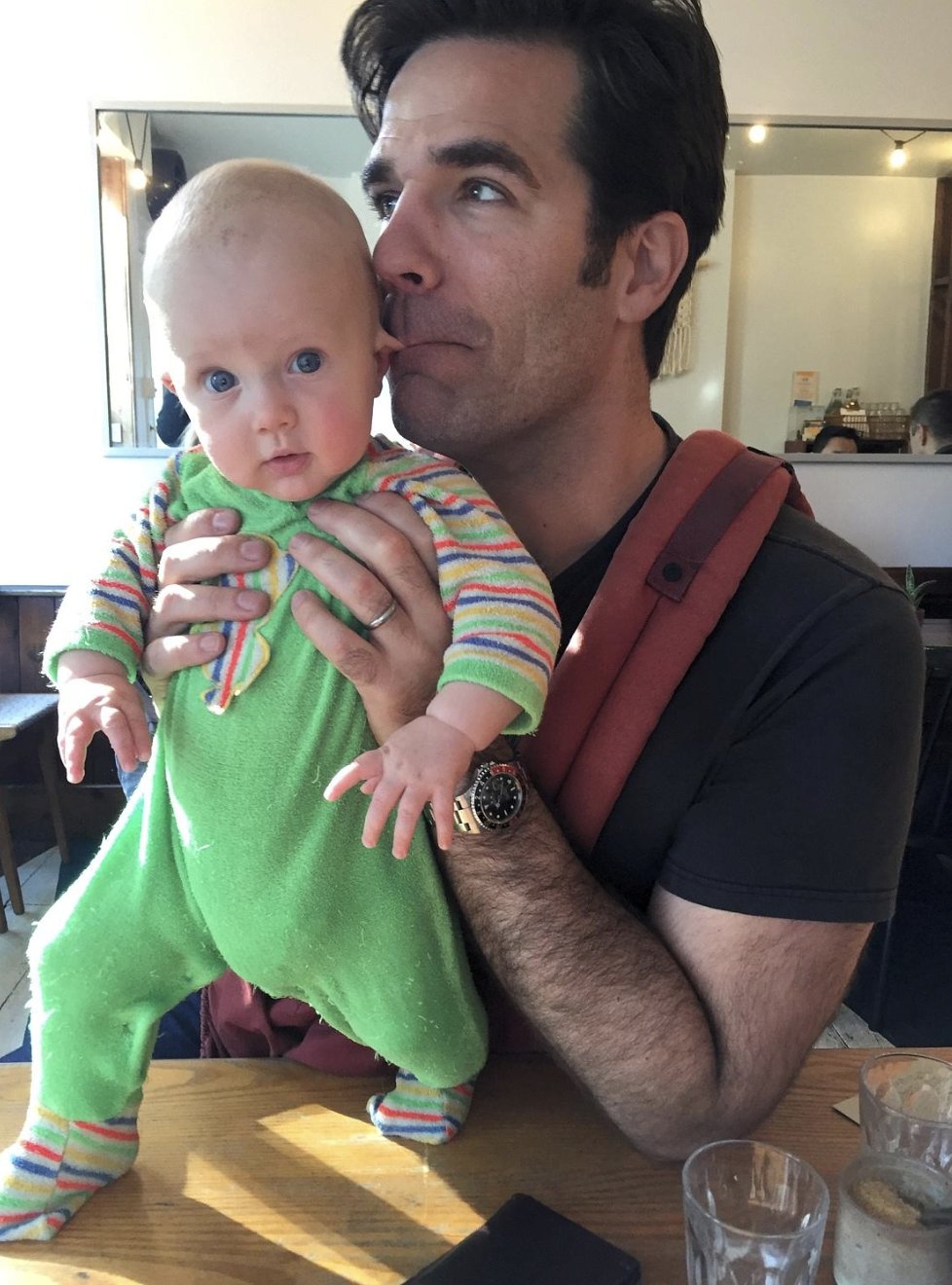
The book tells of Delaney’s experience of profound loss and pain. His third son, named Henry, around the time of this 1st birthday got sick. Very sick. It took a long time to figure out what was going on, and they eventually discovered that Henry had a brain tumor. He had extremely invasive surgery and chemotherapy that left him disabled. After a year and a half of time in and out of the hospital, the tumor returned and he died.

When asked about why Delaney chose to write the memoir, again and again he has responded, “I wanted to return to humanity, and I didn’t know how other than to write about it.”

And so, day after day, Delaney has sat down for interview after interview, being forced to relive something that no one should ever have to experience. 

And this week, while sitting down for a conversation on CBS, Delaney interrupted the program and looked across the table to Gayle King and said, “Gayle, you came up to me this morning before we came out here in front of the cameras and you hugged me, and asked me genuine questions, and you cried. You offered me a beautiful and human response. And I want you to know it’s the best thing that’s happened to me in days.”

Gayle King, unflappable Gayle King, stared back at him with this bewildered look and said, “How can that be the best thing?”

And Delaney said, “You had a genuine response. I don’t want people to ask these perfunctory questions, and say ‘Oh, your grief,’ and then move on as if nothing happened. I want people to cry. My boy is dead. I won’t hold him again. I hold him in my heart and I think about him all the time. But you had a response like that and that was like water to me in the desert. It was beautiful.”

“It was like water in the desert.” The prophet Isaiah speaking through a comedian, on CBS. 

And what makes that interaction even all the more extraordinary, is that Delaney is an atheist. Except, later in the week, this time while on The Late Show with Stephen Colbert, Delaney was pushed by the host to reflect on what his grief has done to him and he said, “It’s a big problem for me that, as an atheist, my faith organ has been growing in the years after my son’s death.”

Water in the desert. 

We tend to treat grief like a plague. We stay away from it. We close our doors to it. And if we have it, we do whatever we can to get rid of it. But you know, grief is actually good. 

Grief is just unexpressed love. Grief is how love perseveres.

It’s Advent. It’s that time of year when we pull our the greenery and we sing the songs and we light the candles. Today, the pink candle is lit. It’s Gaudete Sunday, rejoice, the Sunday for joy, pink is the liturgical color for joy. It’s a bit odd, I think, that we keep lighting this pink candle year after year.

Because, how can we be joyful in a time like this?

How can someone like Rob Delaney be joyful?

Grief is like a hole that cannot be filled no matter how hard we try. No number of presents can make up for the pain that we too often encounter in this life. And yet we are bold to light that candle.

We light it not as a denial of the harsh realities of life, but because joy is something that is done to us.

Joy is what happens when we dare to trust the Lord to do for us that which we cannot do on our own.

Joy is what happens when we are able to look at what we have, and had, and know that all of it, the good and the bad, came as a gift. Something rather than nothing.

Joy is what happens whenever we encounter water in the midst of the deserts of our grief.

When we weep with others, or even rejoice with others, does it fix everything? Does it set everything right? 

What good is a cup of water in the desert? It doesn’t get rid of the desert!

And yet, the mystery of God’s activity in the world is that even the tiniest signs of faithfulness and love and mercy and hope are the pointers to the glory that will come when the Lord comes to make all things new. 

The hope of Advent, of all time really, is possible precisely because what we have now is not all there is. We have these lights, and prayers, and songs because the point us to the greater reality that beats upon our lives ever day: God loves us, and this is not the end. 

I don’t know if this was the sermon you expected to hear this morning. I can assure you, this is not the sermon I thought I would be preaching at the beginning of the week. And yet, we worship the God of the unexpected. The God who provides water in the desert. The God who lifts the valleys up and brings the mountains low. The God who takes on flesh to dwell among us. The God who mounts the hard wood of the cross for us. The God who breaks forth from the empty tomb and returns to us. 

The proclamation of the gospel is that God comes to us in the brokenness of our health, in the shipwreck of our family lives, in the loss of all possible peace of mind, even in the thick of our sins. God, oddly, saves us in our disasters, not from them. 

Isaiah says the redeemed of the Lord shall return, and come to Zion with singing; everlasting joy shall be upon their heads; they shall obtain joy and gladness, and sorrow and sighing shall flee away.

That is God’s promise to us. And until it comes to fruition, the least and the best we can do, is be water in the desert for others. Amen. 

The Love That Is The Cross

Isaiah 11.1-10

A shoot shall come out from the stump of Jesse, and a branch shall grow out of his roots. The spirit of the Lord shall rest on him, the spirit of wisdom and understanding, the spirit of counsel and might, the spirit of knowledge and the fear of the Lord. His delight shall be in the fear of the Lord. He shall not judge by what his eyes see, or decide by what his ears hear; but with righteousness he shall judge the poor, and decide with equity for the meek of the earth; he shall strike the earth with the rod of his mouth, and with the breath of his lips he shall kill the wicked. Righteousness shall be the belt around his waist, and faithfulness the belt around his loins. The wolf shall live with the lamb, the leopard shall lie down with the kid, the calf and the lion and the fatling together, and a little child shall lead them. The cow and the bear shall graze, their young shall lie down together; and the lion shall eat straw like the ox. The nursing child shall play over the hole of the asp, and the weaned child shall put its hand on the adder’s den. They will not hurt or destroy on all my holy mountain; for the earth will be full of the knowledge of the Lord as the waters cover the sea. On that day the root of Jesse shall stand as a signal to the peoples; the nations shall inquire of him, and his dwelling shall be glorious. 

“I’m going to keep this short.”

That’s an incredible way to start a speech, or even a sermon.

And 99% of the time, it isn’t true. 

To start with such a declaration puts people at ease because they’ve been duped into thinking they only have to pay attention a little. For, brevity leads to clarity, doesn’t it?

“I’m going to keep this short,” is usually the prelude to a lot of pontificating that often leaves us no wiser than when we began.

It’s usually an indication that whatever follows wasn’t thought through, and is usually off the cuff.

Which, in a place like this, is a bad idea. Who knows what kind of random theological riff-raff might come forth from a short stump speech.

And, to be clear, I’m not railing against the strange promise of a short declaration just because Fred Sistler started his sermon that way last week.

I would never do something like that.

I’m a Christian!

Stump speeches. They are a regular occurrence in the political fabric of our reality. They trace back to the 19th century during which politicians would go about from town to town “stumping” – offering brief highlights on what they planned to do in office should they get elected, usually with key words and phrases that they repeated over and over and over again.

A stump speech is like having one sermon and using it week after week.

And, of course, the “stump” part of “stump speech” comes from the practice of standing on a tree stump to get high enough for better visibility and greater oration. 

Other stumpy items from the 19th century included tables, chairs, and even whiskey barrels.

John Wesley, founder of the Methodist movement, rather famously stood on his father’s gravestone in order to proclaim the gospel since he was no longer welcome to preach in churches.

I, myself, prefer preaching from a ladder.

But even here, right in the middle of the chancel area, slightly elevated, this is somewhat of an ecclesial stump where I, and plenty others, have stumped for Jesus.

We might call it our sanctified stump for salvation.

And stump speeches, though often short and repetitive, really can make all the difference in the world. Sometimes all it takes is one story, one word even, for the skies to open up, and all of God’s grace comes pouring down.

When the Good News actually sounds like good news, it changes everything.

Even us.

My former professor Stanley Hauerwas is known for his stump speeches. He has these recurring quotes and proclamations that he goes back to over and over again. I remember a classmate asking him why he said the same thing so many times, and he said, “Because they’re true.”

Some years ago, while lecturing in Scotland, using those same stumpy proclamations, Dr. Hauerwas was asked to preach at the cathedral of Edinburgh. Massive building with a huge pulpit, hardly a stump. The pulpit there is so large, in fact, that it has its own staircase that the preacher has to ascend in order to preach. And, when the appointed time arrived, Hauerwas marched up the stairs but right before he made it to the top, he heard a small door close behind him as well as a key turning in the lock. 

Hauerwas, bewildered by the turn of events, demanded to know what was happening, when someone on the other side of the pulpit door said, “It’s a tradition in this church, dating back to the days of the Reformation. We lock the preacher in the pulpit, and we keep the preacher there until they give us the Gospel.”

Stumping for Jesus.

And yet, a stump is no glorious thing.

A stump, after all, is only possible if a tree has been chopped down. Stumps are signs of death. 

By the time the prophet Isaiah rolls around, the Davidic kingdom is nothing but a stump. All the promise, all the hope, all the dreams had fizzled out. The holy city was sacked again and again, people were sent to live in exile. There was no bright hope for tomorrow.

And Isaiah says, “A shoot shall come out from the stump of Jesse, and a branch shall grow out of his roots!”

How strange. It’s as if the prophet has lost his ever-loving mind. He looks out on failed promises, idolatry, ruin, and yet he sees something more.

Feeling stumped is, sadly, all too familiar for God’s people even today, particularly during Advent. We might rejoice in memories from years ago, but we know that things can never really be like they once were. We might sit comfortably in these pews, but there’s a better than good chance that we’re also feeling the anxiety that is all to common during this season. We might sing the songs, and purchase the presents, and drive around looking at lights, but that doesn’t automatically make this the most wonderful time of the year.

We know what it means to be stumped, to feel as if nothing good is left.

And what do we do when we’re stumped? To whom do we turn? What relief can we find?  

Netflix with the never ending assortment of holiday movies that follow the exact predictable formula over and over? Discounts at the ABC store? Scrolling through instagram seeing perfect people with their perfect lives?

Kurt Vonnegut once opined that no one should read beauty magazines because they will only make us feel ugly.

The same could be said of Instagram.

And yet, when Isaiah sees the stump, he sees hope! The roots are still pulling nutrients from the soil, a new shoot will sprout forth bringing life and life abundant. The new shoot from Jesse’s stump is the promise that God isn’t done with God’s people. 

That’s what happens when you worship the God of impossible possibility, even stumps can bring about something new.

And that something new is a person.

Listen – the Spirit will rest upon him and he will know the fear of the Lord. He will even delight in his fear! He will come with judgment and righteousness and he will make all things right.

Sounds pretty good. This new shoot will be the difference maker, a warrior. But what strange weapons! He shall slay the enemy with the Word, not with swords. He will destroy all opponents with the Spirit, not by slaying. He will wear a belt of righteousness for the battle, not Batman’s belt with gadgets and gizmos aplenty.

And with the victory comes even stranger results! The wolf will live with the lamb, the calf and the lion and the fatling together. The cow and bear shall graze. And a little child shall lead them.

Everything about this proclamation is unexpected. The line of David is nothing but a stump, forsaken and dead. And yet, from it the ruler of the cosmos will come. Animals that have no business being together shall live in peace. And a child shall lead them. 

It sounds so good and so perfect. And yet, 700 years after Isaiah’s announcement, John the Baptist arrives on the scene, preparing the way of the Lord, announcing a baptism for the repentance of sins. He calls the religious elite broods of vipers because they have lost sight of Isaiah’s vision.

John says, “Even now the ax is lying at the root of the trees!” 

The stump of Jesse, the ax at the roots. John and Isaiah together see a reality that no one else does. They see the sign of the time. “On that day the root of Jesse shall stand as a signal to the peoples.”

What is the sign?

Have you ever wondered what became of the tree that was chopped down in order to make the stump? Have you ever seen the connection between Isaiah’s proclamation and John’s declaration?

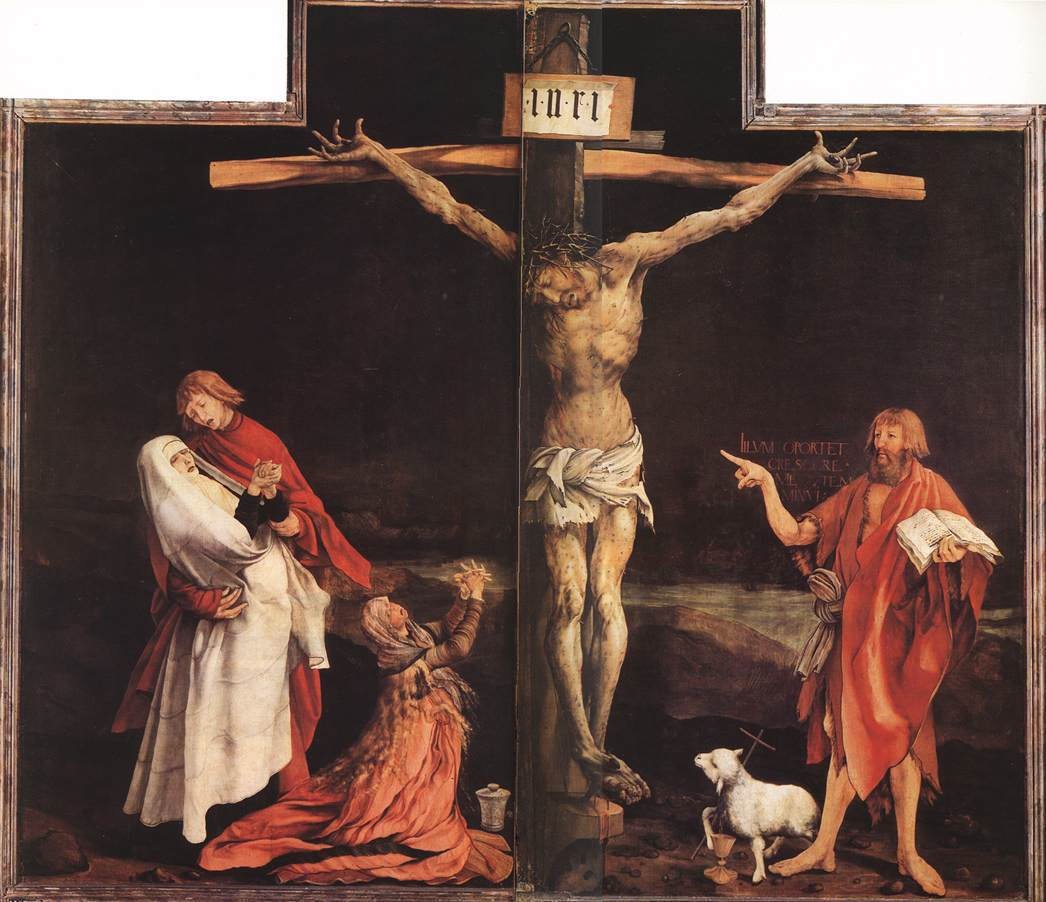
The stump is only possible because a tree was brought down. And do you know what we did with the tree? We nailed Jesus to it.

The root of Jesse is the cross. It stands on a hill far away, the emblem of suffering and shame. And it is glorious. 

Some will say, this time of year, that we need to keep Christ is Christmas. Sure. That’s fine. But if we’re going to keep Christ in Christmas, we should also consider what it might mean to keep the Cross in Christmas. 

It’s Advent. This is the time of year when we hear the most difficult, demanding, bad news to ever be called good – The Cross. Every Advent we have our worlds’ rocked, tables turned, foundations shaken, demons put to rot, and dead dreams brought back to life. 

All things are possible in Advent because we worship the God of impossible possibly. The God who delights in upending all of our expectations of how the world is supposed to work.

Jesus really is the reason for the season, as is his cross. And lest we domesticate the Lord to mere flannel graphs and perfectly manicured manger scenes, Jesus was and is still so provocative that the powers and principalities are forever trying to shut him up. But nothing can stop Jesus. He’s going to say and do things that change everything.

Not even the cross can stop him.

In fact, the cross is our salvation. It’s a stump that brings forth new life. That’s why we can call it glorious.

Therefore, whenever someone stands in this place and stumps for Jesus, we are called to do exactly that – We point to Jesus Christ, the pioneer and perfecter of our faith, the shoot from the stump of Jesse, the one who makes a way where there is no way.

The promise of Advent is that no matter what stumps us in this life, God is going to get what God wants. Predator and prey will dwell together. Peace will reign. And a child will lead us. 

The promise of Advent is that Jesus is the shoot, the branch that grows into a cruciform tree bearing the fruit that is salvation because Jesus is always stumping on our behalf, even when it costs him his life. 

The promise of Advent is that new life always starts in the dark, whether in the womb or the tomb, whether underground or the lost being found; new life starts in the dark.

Therefore, the next time you encounter a stump, take a good look at it, because you may be looking at your salvation. Amen. 

A Liturgy For Thanksgiving

Philippians 4.4-5

Rejoice in the Lord always; again I will say, Rejoice. Let your gentleness be known to everyone. The Lord is near.

Thanksgiving is not a liturgical holiday. 

But it could be.

For, what could be more faithful than breaking bread with family (and foes) knowing that Jesus spent his entire ministry doing the same?

And yet, there is a sense in which what happens around the Thanksgiving table is more determinative over our lives than the One who gives us life. Rare is the family that is immune to the political pandering that happens over turkey and mashed potatoes. Gone are the days we could sit back and rejoice without worrying about who will say what and ruin the holiday mood. We, then, approach the table of blessings without feeling like it’s much of a blessing at all.

But what if God is the one calling us together for the explicit purpose of redeeming our Thanksgiving tables? What if this is the year to let forgiveness reign over judgment? What if we took seriously the claim that, as Paul put it, “The Lord is near,” even at the holiday table?

There’s no guarantee that anything good can come out of our Thanksgivings this year, save for the fact that we worship the God of impossible possibility! So keep your eyes and ears open, let your gentleness be known, and rejoice! The Lord is near!

And, in the spirit of bringing a little holiness to a moment that is sometimes devoid of holiness, I’ve put together a little “Thanksgiving Liturgy” that anyone can use. You may say it privately to yourself, or you may read it corporately with others, but the hope is that it will bring a sense of faithful clarity to an otherwise bewildering experience…

A Liturgy For Thanksgiving

Prayer:

Almighty God, Father of all mercies, we your unworthy servants give you humble thanks for all your goodness and loving-kindness to us and to all whom you have made. We bless you for our creation, preservation, and all the blessings of this life; but above all for your immeasurable love in the redemption of the world by our Lord Jesus Christ; for the means of grace and for the hope of glory. And, we pray, give us such an awareness of your mercies, that with truly thankful hearts we may show forth your praise, not only with our lips, but in our lives, by giving up ourselves to your service, and by walking before you in holiness and righteousness all our days; through Jesus Christ our Lord, to whom with you and the Holy Spirit, be honor and glory throughout all ages. Amen.

Scripture:

Psalm 100

Make a joyful noise to the Lord, all the earth. Worship the Lord with gladness; come into God’s presence with singing. Know that the Lord is God. It is God that made us, and we are God’s; we are God’s people, and the sheep of God’s pasture. Enter God’s gates with thanksgiving, and God’s courts with praise. Give thanks to God, bless God’s name. For the Lord is good; God’s steadfast love endures forever, and God’s faithfulness to all generations. 

Meditation:

The delight of Thanksgiving is both in the thing itself, and what it anticipates. So many other holidays come and go and leave us feeling vacant. And yet, upon the conclusion of Thanksgiving, while we put away all the dishes and say our goodbyes, we do so with the knowledge that Advent is knocking at the door, and with it: Christmas! 

Advent is the season of waiting and watching, but what we’re waiting and watching for is already present at our Thanksgiving tables. The splendor of Advent is made manifest in the One who breaks bread with us whenever we break bread: Jesus. 

Therefore, let us rejoice in our Thanksgivings, much like we do when we come to the Lord’s Table in church. Advent is already around us, hiding in the basement, laughing upstairs, and dancing in the living room. The unknown day and hour of it bursting into our reality is something worth celebrating, not fearing. 

Put another way: God is not our mother-in-law who comes over once a year checking to make sure we’ve kept the house in order and that we haven’t chipped her wedding-present china. Instead, God is like our delightful uncle, who barges in unannounced (and perhaps uninvited!) with a baguette under one arm, and a bottle of wine in the other. We do need to wait and watch for God, but only because it would be such a pity to miss all the fun. 

Prayer:

Lord, free us from fear and worry that, trusting in your goodness, we may always praise your mighty deeds and give you thanks for the bounty of your gifts. Amen. 

The First Word

Luke 23.33-43

When they came to the place that is called The Skull, they crucified Jesus there with the criminals, one on his right and one on his left. Then Jesus said, “Father, forgive them; for they do not know what they are doing.” And they cast lots to divide his clothing. And the people stood by, watching; but the leaders scoffed at him, saying, “He saved others; let him save himself if he is the Messiah of God, his chosen one!” The soldiers also mocked him, coming up and offering him sour wine, and saying, “If you are the King of the Jews, save yourself!” There was also an inscription over him, “This is the King of the Jews.” One of the criminals who were handed there kept deriding him and saying, “Are you the not the Messiah? Save yourself and us!” But the other rebuked him, saying, “Do you not fear God, since you are under the same sentence of condemnation? And we indeed have been condemned just, for we are getting what we deserve for our deeds, but this man has done nothing wrong.” Then he said, “Jesus, remember me when you come into your kingdom.” He replied, “Truly I tell you, today you will be with me in Paradise.” 

“Jesus for President.”

That’s what the sign said. I saw it when I was going for a run during a particularly contentious election season (aren’t they all?). In just about every yard there was a red sign or a blue sign, with one name or the other.

I’ve always found political yard signs to be problematic.

I mean, why do we put them up? Do we honestly think anyone has ever changed their vote because of a yard sign?

I think we put those signs up in our yards, and attach them to our bumpers, and post them on Facebook, not because we want to change anyone, but because we want everyone to know where we stand. 

We want everyone to know what side we’re on.

And so seeing yard signs is fairly normative. In fact, its the houses without signs that seem strange. Until I saw, “Jesus for President.”

It was so shocking I remember stumbling over my feet and nearly wiping out on the sidewalk.

Jesus for President?

Perhaps someone thought it fitting to cut through the political paraphernalia that year with some sort of prophetic pronouncement. Maybe they really thought Jesus presiding in the Oval Office would be a good idea. 

Except, “take up your cross” doesn’t poll well. Turn the other cheek is a strange campaign slogan. And that’s not even mentioning the first will be last, and the last will be first. That doesn’t sound like a milk toast soundbite from a politician, it sounds like a threat.

Jesus for President. It could never work. Particularly since Jesus is already our King – Jesus is Lord. 

Today is Christ the King Sunday. A remarkable offering on the liturgical calendar. With Advent hovering on the horizon, churches across the globe gather today with proclamations about the Lordship of Christ. And yet, this is a recent addition to our liturgical observances, as far as those things are concerned. We’ve celebrated Christmas for centuries and marked Easter for millennia, but Christ The King only started in 1925.

Why? Nearly 100 years ago, Pope Pius XI looked out at a world in which Mussolini had been in charge of Italy for 3 years, Hitler had just published his autobiographical manifesto Mein Kampf, and the economic frivolity the led to the Great Depression was in full effect. And bearing witness to the world at that moment led the Pope to announce a new liturgical holiday – Christ the King Sunday would round out the year to remind Christians across the globe that we have our own King, and it is to him alone we owe our allegiance.

Over the last year we’ve read from Genesis to Revelation, we’ve encountered the living God who encounters us, we’ve been transformed by the Lord who transforms bread and cup, and all of it, all of the Sundays all of the studies all of the sacraments, they all pointed to one thing: Jesus Christ is Lord.

That’s the thing about us Christians, everything starts and ends with Jesus. He is the first word and the last word.

And yet, we do well to remember that this King of ours is strange…

Listen, there was a man named Jesus who hailed from the town of Nazareth. He was poor and had no real standing in the world but he preached about the kingdom of God, and he usually drew a pretty good crowd. For centuries the people Israel had suffered hardship after hardship, persecution after persecution, and they waited for the One who was promised. And Jesus said, “I am he.” 

Many signs and wonders were done, healings happened, bellies were filled, and the crowds grew until they didn’t. The more he talked the more he was rejected. The more he did the more people grumbled. And he was betrayed, arrested, and condemned to death.

By us.

Those two words are tough to admit, or even fathom. But they’re true. At the heart of the Christian witness is the fact that, when push comes to shove, we nail the Son of God to the cross. And, incidentally, it’s why we sing, every Good Friday, “I crucified thee.” The strange new world of the Bible refuses to let us walk away with our hands clean.

The soldiers place a purple robe on his shoulders, a crown of thorns upon his head, a cross on his back, and they force him to march to The Skull.

Jesus is painfully quiet in this moment. The gifted preacher and parable teller has no words left to share. The crowds, of course, are loud. Sick with anticipation. Hungry for blood.

And he’s nailed to the cross.

Only here, hung high for all to see, does Jesus speak his first words as king. Make no mistake, this is when Jesus is crowned our king and Lord. And what is his first decree?

Father, forgive them, for they do not know what they are doing.

How odd of God.

With all the possible words of recrimination, condemnation, accusation, the first thing Jesus says is, “Father, forgive.” 

Earlier he commanded us to forgive our enemies and pray for those who persecute us. Easy to preach, hard to practice.

On the cross, Jesus dares to pray for his worst enemies. Us.

It’s rather strange that God units ignorance with forgiveness. We usually act and behave as if ignorance is the enemy of forgiveness. We want people to know they’re wrong before we forgive them. We want repentance before mercy.

And yet, for God in Christ, it is always preemptive forgiveness. Forgiveness is the first word.

Jesus doesn’t hang up on the cross until we realize we made a mistake. He doesn’t wait until someone from the crowds shouts, “Um, maybe we went a little too far this time. Sorry Jesus.” Jesus doesn’t forgive after we come to our senses, but right in the thick of our badness, Jesus’ offers his goodness.

Oddly enough, forgiveness is what it costs God to be with people like us who, every time God reaches out in love, beat God away.

Perfection in the Garden – We reject it for the taste of a little knowledge dangling from a tree.

Unified Community – We reject for selfish desires of power.

Covenanted Relationship – We reject it in favor of other hopes and dreams.

The story of the Bible is the story of our rebellion and foolishness. We worship at the altars of other gods, moving from one bit of idolatry to the next, over and over and over again.

And then, in the midst of our muck and mire, God arrives in the flesh. 

Jesus Christ, the incarnate One, fully God and fully human, comes to make all things new, with promises of hope and peace and grace and mercy.

God looks at our miserable estate and condescends to our pitiful existence, God’s attaches God’s self to us sinners, and what happens? We nail God to the cross!

And look at us, with all the means at our disposal, with power and prestige, with sin and selfishness, what happens? We are forgiven.

The first word from the cross, from the throne, is forgiveness.

It’s strange! But then again, it should come as no surprise even though its the most surprising thing in the history of the cosmos. Jesus was forever walking up to people and, without warning, saying to those whom he met, “Your sins are forgiven.”

Have you ever noticed that almost none of them ever asked to be forgiven?

I’ve heard it said, and perhaps you have too, that this moment, when Jesus hangs on the cross, is when God is in total solidarity with humanity. The suffering crucified God. 

And yet, that forgiveness is the first word is completely contrary to us. For us, if we forgive, it is almost always with conditions. 

We wait around for an apology, we wait for amends to be made, and then (and only then) will we forgive.

Forgiveness is the currency of God’s kingdom. Forgiveness, as Dolly Parton notes, is all there is.

And it’s also the the hardest thing to do.

St. Augustine, theologian and preacher from the 4th century, once preached a sermon on forgiveness, and in the sermon he admonished his congregation because some of them, if not all of them, were omitting the phrase from the Lord’s prayer that said, “Forgive us our trespasses as we forgive those who trespasses us.” 

They would let those words remain silent every time they came around, and they would just skip to the next phrase. They refused to say those words, according to Augustine, because they knew they’d be lying if they said them out loud.

Forgiveness is hard, and it always has been. 

Perhaps that’s why Jesus preached about it so much, told so many stories about grace, and tossed around forgiveness every where he went. Even on the cross! With nails in his hands, with thieves at his sides, abandoned by his closest friends and disciples, before asking anything for himself, he asks something for us, Father, forgive them, for they do not know what they are doing.

Our King rules not with an iron fist, but with an open hand. The first word of the kingdom is forgiveness.

And if that were all, it would be enough to pop every circuit breaker in our minds, it would leave us scratching our heads bewildered at the outcome. We don’t deserve it one bit. Frankly, we deserve nothing. And instead we get everything.

But the story isn’t over!

The first word is forgiveness, a prayer within the Trinity, and then Jesus speaks to the criminal on his side.

The One who was forever accused of consorting with sinners now hangs next to one. The One who ate with sinners now dies with them.

One of the criminals looks at Jesus and says, “C’mon King of the Jews, it’s miracle time! Save yourself and us!”

But the other replies, “Are you not afraid? We deserve what we’re getting, but this guy has done nothing wrong.” And then he looks over to Jesus and says, “Remember me when you come into your kingdom.”

“Truly I tell you, today you will be with me in Paradise.”

Is the thief confessing his sin? Perhaps. At the very least, he owns up to getting what he deserves. But confession has nothing to do with getting forgiven. It is not a transaction, it is not a negotiation. Confession is nothing more than the after-the-last gasp we offer when we know the truth of who we are and whose we are.

We don’t confess to get forgiven. We confess because we are forgiven.

Forgiveness surrounds us, beats upon our lives constantly. Preachers proclaim it. We sing about it. We pray for it. And, miracle of miracles, we receive it.

When we confess, we confess only to wake ourselves up to what we already have.

Perhaps the thief is bold to ask Jesus to remember him because he was the first person to hear Jesus’ first word from the cross, “Father, forgive.”

It was almost 100 years ago when Christians across the globe needed the first Christ the King Sunday. They needed a day set apart to reflect on how the Lordship of Christ outshines even the most powerful of dictators and the most devastating of depressions.

Today, we need it just as much. We need Christ the King Sunday because it reminds us, beats upon us, that Jesus’ kingdom is not of this world. It forces us to confront the strange reality that our King rules from a cross. It compels us to hear the Good News, the very best news, the strangest news of all: Christ died for us while we were yet sinners; that proves God’s love toward us. In the name of Jesus Christ, you are forgiven! Amen. 

What Kind Of King Is Jesus?

Psalm 46.10-11

Be still, and know that I am God! I am exalted among the nations, I am exalted in the earth. The Lord of hosts is with us; the God of Jacob is our refuge.

Christ the King Sunday started in 1925 when Pope Pius XI instituted it through a papal encyclical. Mussolini had been in charge in Italy for three years, a certain rabble rouser named Hitler had just published his autobiographical manifesto Mein Kampf, and economic frivolity that led to the Great Depression was in full effect. And it was at that moment the Catholic Church decided they needed a Sunday, every year, to remind the Christian community that we have our own King and it is to him alone that we owe our allegiance.

Today, nearly one hundred years after the institution of Christ the King Sunday, it is usually overlooked on the liturgical calendar in order to celebrate themes of Thanksgiving. Instead of reading about the lordship of Christ, churches talk about the blessings made manifest through turkeys and potatoes. And, to be clear, that’s all good and fine. However, Christ the King Sunday is a rare and blessed opportunity for the church to be unabashed in our convictions about power, allegiance, authority, and a host of other aspects of our discipleship.

It is the perfect time to be reminded that Jesus Christ is Lord, and everything else is bologna.

The first time I traveled to Guatemala for a church mission trip, we stopped briefly in the town of Chichicastenango, known for its traditional K’iche Mayan culture. We were told to explore for a few hours before returning to the various vans that were taking us to our final destination. And, after only a few minutes of wandering down a variety of streets, I realized I was completely lost.

So I did what anyone else would do: I looked for a higher vantage point to get my bearings. Eventually I found myself on the steps of a very old church. I trudged upward and yet, before turning back to look over the town, something (read: the Holy Spirit) drew me inside the church.

The sanctuary was damp, dark, and devoid of just about anything. The ground under my feet felt like soft soil, the walls were covered with black soot from centuries of fires, and the paintings of the walls were so smudged that I couldn’t even tell what they were portraying. The smell of melted candle wax filled my nostrils and I crept closer and closer to what I imagined was the altar.

Frankly, it was one of the least churchy churches I had ever experienced.

Without the help of lighting, I stumbled over a rickety wooden pew and fell on the floor right in front of the Lord’s Table. And there, hovering above my head, was the most pristine sculpture of Jesus that I had ever seen. The Lord stood in complete contrast with everything else in the space. Jesus stood with robes draped over his shoulders, his hand was outstretched as if inviting me closer, and upon his head rested a crown of thorns.

Christ the King.

What kind of king is Jesus? In that Guatemalan church I was confronted with the stark reality of what it means to confess Jesus as Lord. For, while I was surrounded by decay, desolation, and even disregard, Christ stood firmly in front of me as the King of the cosmos. Just as the psalmist proclaimed, I was still before the Lord, and saw God’s exaltation above all things; even death.

Our King reigns from a throne not made by the blood of his enemies, but with his own blood spilled on the cross. 

Our King wears a crown not of gold, but of thorns. 

Our King rules not by the power of judgment, but through the gift of mercy. 

On Christ the King Sunday we confess the truly Good News that our King reigns not above us, but for us, beside us, and with us. Thanks be to God.

Chosen By The Word

This week on the Strangely Warmed podcast I speak with Mikang Kim about the readings for the 23rd Sunday After Pentecost [C] (Isaiah 65.17-25, Isaiah 12, 2 Thessalonians 3.6-13, Luke 21.5-19). Mikang is the pastor of Epworth UMC on the Eastern Shore of Virginia. Our conversation covers a range of topics including itinerancy, the prophet Isaiah, pandemic preaching, joy, skepticism, Pauline discomfort, deadly sins, apocalyptic imagery, ecclesial hatred, and the difference Christ makes. If you would like to listen to the episode or subscribe to the podcast you can do so here: Chosen By The Word

Praying Our Goodbyes

This week on the Strangely Warmed podcast I speak with Mikang Kim about the readings for All Saints’ Sunday [C] (Daniel 7.1-3, 15-18, Psalm 149, Ephesians 1.11-23, Luke 6.20-31). Mikang is the pastor of Epworth UMC on the Eastern Shore of Virginia. Our conversation covers a range of topics including proper pronunciation, perseverance, communal reading, saintliness, the difference Christ makes, directions for singing, courage, blessings and woes, sermon introductions, and Kingdom work. If you would like to listen to the episode or subscribe to the podcast you can do so here: Praying Our Goodbyes

Nuts & Bolts

Mark 2.1-12

When he returned to Capernaum after some days, it was reported that he was at home. So many gathered around that there was no longer room for them, not even in front of the door; and he was speaking the word to them. Then some people came, bringing to him a paralyzed man, carried by four of them. And when they could not bring him to Jesus because of the crowd, they removed the roof above him; and after having dug through it, they let down the mat on which the paralytic lay. When Jesus saw their faith, he said to the paralytic, “Son, your sins are forgiven.” Now some of the scribes were sitting there, questioning in their hearts, “Why does this fellow speak in this way? It is blasphemy! Who can forgive sins but God alone?” At once Jesus perceived in his spirit that they were discussing these questions among themselves; and he said to them, “Why do you raise such questions in your hears? Which is easier, to say to the paralytic, ‘Your sins are forgiven’, or to say, ‘Stand up and take your mat and walk’? But so that you may know that the Son of man has authority on earth to forgive sins” – he said to the paralytic – “I say to you, stand up, take your mat and go home.” And he stood up, and immediately took the mat and went out before all of them; so that they were all amazed and glorified God, saying, “We have never seen anything like this!”

“They didn’t teach me that in seminary,” is a favorite line among clergy-types. When the pandemic came in earnest, I heard countless colleagues make that remark with regard to moving church online. It shows up turning denominational turns as we’re tasked with communicating bizarre elements of our polity with our laity. And it’s the go-to expression whenever something goes wrong with a church building and all the eyes turn the pastor for direction.

And yet, the irony is, there is no type of schooling that fully prepares someone for their vocation. Imagine how boring our lives would be if we knew everything we needed to know the day we graduated.

However, I must confess, the words “they didn’t teach me that in seminary” left my mouth the very first time I was tasked with a committal to the grave. 

Grief counseling? Services of Death and Resurrection? Theological proclamation in Bible study? No problem. But then, after my first funeral service, I found myself driving to the cemetery without knowing what I was supposed to do.

When we all arrived, we stood around the casket of the recently departed, and all the eyes turned to me. And then, because God provides, a story from the scriptures appeared in my mind.

Listen: Jesus returned to Capernaum shortly after calling the disciples to follow him. It was reported among the community that he was home and crowds began to gather. Rumor had it that this particular son of a carpenter could make the impossible possible. 

Soon, so many people arrived that they were spilling out onto the road, waiting for their turn.

And, it came to pass, that a group of friends caught word of the Word’s arrival and they put together a plan. Their friend was paralyzed, and so they carried him through the streets of Capernaum until they arrived at the house. Upon discovering the size of the crowd, the climbed up on top of the house, used shovels to dig through the roof, and they lowered their friend to the Lord.

When Jesus saw their faith… notice, not the faith of the paralytic… when he saw their faith, he said to the man, “Son, your sins are forgiven.”

If the story ended there, it would already be radical enough for the Gospel. It’s got all the markings of a remarkable tale: friendship, hope, overcoming adversity, and a delightful conclusion. And yet, Jesus forgives the man his sins. 

Isn’t that strange?

If this were a proper story, Jesus would’ve reached out to the man, and healed his legs. 

But instead, Jesus forgives his sins.

Of course, the story keeps going because some scribes were near by, the do-gooding religious types. Perhaps they couldn’t help but hope for a glimpse of heaven on earth, even if they didn’t really believe everything they heard. And they grumbled.

“Who does this guy think he is? It’s blasphemy I tell you! No one can forgive but God alone.”

And Jesus said, “Check this out: Which is easier, to tell him he’s forgiven or to tell him to walk. But so that you may know heaven is standing here right in front of you, I’m going to do both.”

He looked over at the forgiven paralytic and said, “Go home.” And the man stood up and left.

Everyone was amazed and glorified God, saying, “We have never seen anything like this!”

The family stood staring at me, pondering why this story, of all stories, was the one I proclaimed at the grave. And then I said, “Gathering here, we are like those friends who carry the one we love to Jesus. With our faith, we witness to the promised truth that this is not goodbye, this is, “until next time.” Until we gather together at the Supper of the Lamb that goes on without end. 

And then I reached down to the dirt, laid it on the casket, and I sang: Softly and Tenderly…

It is a strange thing to be a Christian. There was a time, of course, when it was expected or assumed that Christianity was a normative experience for people. But now, today, the church is a rather radical witness to the work of God in the world. In short, we approach the throne of God with a trembling hope because we know that we cannot take any of this for granted.

To be a Christian is to know that time is now fleeting the moments are passing. It is to know that we are defined not by our mistakes but by the grace of God. It is to know the great Good News that Jesus Christ is the pioneer and perfecter of our faith.

Those descriptors might not sound strange to our ears, but to the world they are as confounding as can be. The world tells us that, so long as we purchase certain products, and dress a particular way, that we can hang around forever. The world hangs our mistakes around our necks and compels us to carry them everywhere. And the world forces us to believe that we are completely alone and can only ever depend on ourselves.

To be a Christian is to be different. 

We worship a God who became one of us, who arrived in the muck and mire of our lives, to be the difference that makes us different! We follow the Lord Jesus who is not only capable of forgiving our sins, but also of raising the dead!

The fundamental difference between the world and the church, is that the world assumes we can earn or achieve everything we need, whereas the church reminds us that the everything we really need has already been finished for us in Jesus Christ.

Therefore, the church exists to mediate Christ to us through sermon, song, and sacrament. The church teaches us who we are. The church proclaims the Good News to a world drowning in bad news. 

Notice, the friends from scripture today bring their friend to Jesus and they won’t let anything stand in their way. The do something wild and reckless: They trust that this 1st century rabbi can make a way where there is no way, and they’re willing to dig through a roof to see it happen!

And then, when Jesus does his Jesus thing, the crowds glorify God and say, “We have never seen anything like this!”

When the church is at her best, we all depart with those same words, either aloud or in our hearts, and we can’t help ourselves from living differently because of the Good News.

Today we’re talking about, and thinking about, witness, the final aspect of church membership. When someone joins a United Methodist Church they make a vow to support the church with their prayers, presence, gifts, service, and witness. It’s all too easy to take the theme of witness and boil it down to something like a church growth strategy.

Put another way, we often confuse witness with evangelism. 

There’s a church, not too far from here, that is busting at the seams. Each week they have to pull out more and more folding chairs to make space for people. And, when the pastor was asked to what he could attribute the increase, he said, “It’s our iPad giveaway program.”

You see, at this particular church, they raffle off an iPad every single Sunday, and you receive more raffle tickets depending on the number of people you bring to church with you.

Those people are being converted to something, but I don’t think we can call it the kingdom of God. 

Notably, in our denominational neck of the woods, there’s a rather sobering statistic that haunts me: Today, the average United Methodist invites someone else to worship once every 38 years.

And even so, the location of the church today is a great gift! For, it gives us the space and opportunity to rediscover how unusual it is for us, Methodists of all people, to be the church of Jesus Christ. 

The early church grew, despite all the reasons it shouldn’t have, not because they gave away tablets, or went door to door, or handed out tracks in downtown Corinth. 

The early church grew because the witness of Christ in the world was life-changing.

Rich Mullins, who I’ve been quoting a lot recently, once said, “I am a Christian, not because someone explained the buts and bolts of Christianity, but because there were people willing to be nuts and bolts.”

In other words, people carried him to Jesus.

The God we worship is a healer of broken things. And yet, the brokenness that God heals is not just our broken bodies. God heals broken hearts, broken spirits, broken promises. 

In the cross and resurrection of Jesus we see how the one who said, “Your sins are forgiven,” had the power to do exactly that.

Notice, the paralytic did absolutely nothing to earn his forgiveness. Save for the fact that he had some good friends. And those good friends were already living according to the difference that Christ makes. 

All of us this morning are here, whether we know it or not, because someone or some people carried us to Jesus. We are products of those who made Jesus real for us, those who were willing to be nuts and bolts.

And, in the end, that exactly what it means to witness. It’s living according to the Good News of God in the world as if our lives depended on it, because they do.

Whatever Christianity is, it is at least the discovery of friends we did not know we had. Friends who are possible only because Jesus has gathered us in for God’s great parable to the world we call the church. Friends who are willing to carry us to Jesus over and over again because Jesus is the difference that makes all the difference. Amen.

Lunch with Jesus

Luke 19.1-2

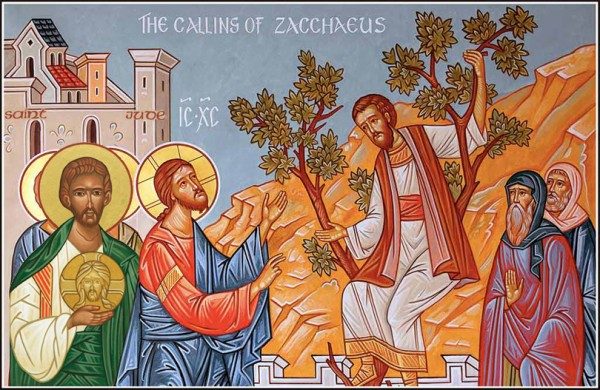
Jesus entered Jericho and was passing through it. A man was there named Zacchaeus; he was a chief tax collector and was rich. 

We love the story of Zaccheaus. And by we, I mean the church. We tell Z’s story to children in Sunday school, we use it in VBS curricula, and we even have a nice little song that conveys the whole thing:

Zacchaeus was a wee little man and a wee little man was he / He climbed up in a sycamore tree for the Lord he wanted to see / And as the Savior came that way he looked up in the tree / And he said, “Zacchaeus, you come down, cause we’re going to your house today.

The song, and the ways we tell the story, make Zaccheaus out to be this smaller than life character (pun intended) who just wanted to catch a glimpse of heaven on earth, and how God in Christ chose him to be the vehicle of an internal transformation, particularly as it regards money.

But one of the things we miss, or downright ignore, is how horrible Zaccheaus was. He was a tax collector, someone who stole from his fellow Israelites and kept a fat portion for himself before passing the rest of the money up the chain. He was a traitor to his people, and to his God, and he stood for everything that was wrong during the time of Jesus.

And Jesus picks this no good dirty rotten scoundrel out from the tree and says, “Hey, let’s get something to eat.”

And, in a way that could only happen in the Gospel, Zacchaeus reacts to this strange man with an even strange proclamation. After a couple sandwiches, and a glass of lemonade on the front porch, Zacchaeus says, “Wow, the only way I know how to respond to you is to give back half of my wealth to the poor and pay back the people I cheated four time over.”

And Jesus responds, “Now that’s what salvation looks like! Let’s have a party!”

It’s a confounding story, and one that we often water down. Zacchaeus doesn’t deserve to be in the presence of God and God shows up for lunch. Zacchaeus has swindled countless people and Jesus has the gall to give him salvation.

And yet, his story is precisely why we can call the Good News good. 

We are happy with a Jesus who forgives the tame sins of the nearly righteous. We are content to hear about the need to love one another a little bit more. But it’s another thing entirely to encounter the radical nature of Jesus’ proclamation of grace. Jesus’ willingness to cancel sins, big sins, is downright scandalous.   

Which is why we sing of Zacchaeus but keep him at a distance. For, to approach the wee little man is to admit the truth of who we are and whose we are: Sinners in the hands of a loving God. 

All of us are like Zacchaeus. We all hurt people close to us, we all ignore the needs of strangers, and we all focus on our wants, needs, and desires at the expense of others. We distance ourselves from true unabashed goodness, though we don’t mind taking a peek from the vantage point of a tree (or a pew). But be warned! All it takes is a glimpse for the Lord to see us and say, “Want to grab some lunch?”

And the rest, as they say, is Gospel. 

No Condemnation Now I Dread

Luke 18.2-6

Jesus said, “In a certain city there was a judge who neither feared God nor had respect for people. In that city there was a widow who kept coming to him and saying, ‘Grant me justice against my opponent.’ For a while he refused; but later he said to himself, ‘Though I have no fear of God and no respect for anyone, yet because this widow keeps bothering me, I will grant her justice, so that she may not wear me out by continually coming.’” And the Lord said, “Listen to what the unjust judge says.”

Jesus says that’s what God is like. Not like a widow who persistently goes looking for justice. Not like a bailiff dutifully following orders. Not even like a stenographer observing and recording every little detail of a trial.

God is like the unjust judge.

Jesus is saying to us here, in ways both strange and captivating, that God is willing to do for us what we need for no other reason than the fact that it will get all of us off of God’s back. 

Jesus spins the tale and we are left with the bewildering knowledge that God is content to fix all of our mess even while we’re stuck in the midst of it.

In other words: While we were still sinners, Christ died for the ungodly.

There are few sentences in scripture as unnerving and beautiful as that one. It’s beautiful because its true and it includes all of us. But it’s unnerving precisely because it includes all of us! 

We might like to imagine that God is waiting around hoping to dispense a little bit of perfection like manna from heaven if we just offer the right prayer or rack up the right amount of good works. 

But Jesus’ story about the unjust judge screams the contrary. It’s as if Jesus is saying, “Do you think it makes the least bit of difference to God whether or not you are right, or if your case is just? Truly I tell you, God isn’t looking for the right, or the good, or the true, or the beautiful. God is looking for the lost, and you are all lost whether you think you are lost or not.”

Jesus tells this parable as Golgotha and the cross get clearer and clearer on the horizon. The cross is God’s mercy made most manifest. Just like the unjust judge, God hung up the ledger-keeping forever while Jesus was hung up on the cross. The cross is God, as the judge, declaring a totally ridiculous verdict of forgiveness over a whole bunch of unrepentant losers like the widow, like me, and like you. 

The cross is a sign to all of us and to the world that there is no angry judge waiting to dispense a guilty verdict on all who come into the courtroom – there is therefore no condemnation because there is no condemner.

The old hymn has it right: “No condemnation now I dread; Jesus, and all in him, is mine; alive in him, my living Head, and clothed in righteousness divine, bold I approach the eternal throne, and claim the crown, through Christ my own!”

Thanks be to God.