I will sing of your steadfast love, O Lord, forever; with my mouth I will proclaim your faithfulness to all generations.
The words of the dreadful Christmas song “Santa Claus Is Coming To Town” sum up perfectly how we all too-often imagine the Lord in our minds: “He’s making a list, he’s checking it twice; he’s gonna find out who’s naughty or nice…” We take those words to be Gospel truth and we believe that it will be like this into the dark night of all the tests that our broken world will never ever pass.
We do it with children this time every year with threats of the Elf On The Shelf returning to the North Pole to report certain behaviors to Mr. C.
We have it reiterated to us over and over again with movies and shows and songs asking us to discern whether or not we’ve behaved in such as way as to make it on the Nice or the Naughty list.
But Jesus (thanks be to God) ain’t Santa Claus.
Jesus will come to the world’s sin with no list to check, no test to grade, no debts to collect, and no scores to settle. He has already taken all of our sins, nailed them to the cross, and left them there forever.
Jesus saves not just the good little girls and boys, but all the stone-broke, deadbeat, sinful children of this world who He, in all of his confounding glory, sets free in his death.
Grace, as Robert Farrar Capon so wonderfully reminds us, cannot prevail until our lifelong certainty that someone is keeping score has run out of steam and collapses away forever.
But it all sounds just a little too good, doesn’t it?
In a world run by meritocracy, the Good News of grace sounds ridiculous if not inadvisable. If we don’t have eternal punishment to hold over the heads of those who follow Jesus Christ, what will possibly keep them in line?
Part of the problem stems from the fact that most of us have our theological wires crossed. We assume that we’ve got to do something in order to get God to do something for us. We believe that so long as we show up to church (or watch worship on Facebook) and read our Bibles and say a few prayers and volunteer every once in a while that it will be enough to justify life everlasting.
And yet, so many of Jesus’ parables, and teachable moments, and healing miracles have nothing AT ALL to do with the behavior of those blessed prior to their blessing.
They’re not about how we justify ourselves, but about how God in Christ justifies us.
God, in all of God’s confounding wisdom, runs out to the prodigal in the street before he has a chance to apologize, offers the bread and wine to Judas knowing full and well what he will do, and chooses to forgive (rather than condemn) the world from the cross.
We don’t strive to change ourselves to get God on our side, but we are transformed by God who chooses to be for us when we deserve it not one bit.
That’s what grace is all about – the unmerited, unwarranted, undeserved gift from God.
And, when we see grace for what it really is, then Christmas can really come into its own. Like the gifts under the tree that are (hopefully) given not as a response to good works or as an expectation that good works will come from them – we can celebrate the great gift of God in Christ Jesus who comes to do what we could not do for ourselves.
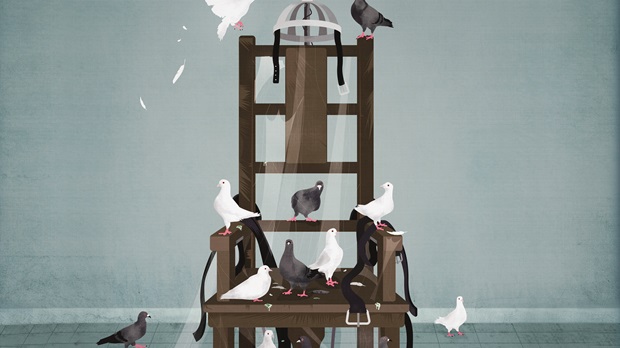
The Justice Department executed Brandon Bernard by lethal injection on Thursday for his part in a 1999 double murder-robbery when he was 18 years old.
Bernard was the ninth man killed by the federal government since July and he spent more than half of his life waiting on death row.
While public support for capital punishment has decreased, it is still advocated for in the Christian church and this is a problem.
Though denominations like the United Methodist Church have opinions against the death penalty clearly spelled out in governing documents like the Social Principles (“We believe the death penalty denies the power of Christ to redeem, restore and transform all human beings.”) the day to day experience and support for the death penalty is felt and experienced differently throughout the American church.
Capital punishment, killing someone in response to a crime, is as old as civilization itself. Some of the earliest archaeological discoveries of law codes contain the ramifications for shedding blood or taking someone’s life and, more often than not, it comes down to “An eye for an eye, a tooth for a tooth, a limb for a limb, a life for a life.” It’s there in Hammurabi’s code from ancient Babylon, and it is present in the Christian Bible.
The Death Penalty has been around for a very long time, and it is still employed for a lot of reasons, though it has only recently come back into practice by the Federal Government. Some advocate for the death penalty because it is the only way to guarantee that someone will never recommit a violent crime, others claim that it helps as a deterrent to influence others away from committing similar crimes, and still yet others say it brings closure to families who grieve the loss of someone murdered.
There are roughly 2,620 people on death row right now in the United States. And the state of Virginia, where I live, has executed more prisoners than almost any other state.
And again, for Christians, this is a problem because Jesus was killed by the Death Penalty.
The main reasons that people use to justify the death penalty can just as easily be used from a different perspective. Deterrence? In the south, where 80% of all death penalty convictions occur, it is the only part of the country where crime rates continue to increase. Closure? Statistics has shown that there is benefit for the families in the short term, but in the long term they tend to experience bouts of depression and grief from another person’s death.
And, since 1976, about 1 in every 9 death row inmates have been exonerated, usually after decades of living in a prison cell.
And even among these statistics and facts, for Christians it is inconceivable to support the death penalty when the Lord we worship was killed by the same means.
Christians love crosses. We put them up in our sanctuaries and in our living rooms, we tattoo them on our skins and wear them around our necks. But many of us have become desensitized to what the cross means: death.
Let me put it this way: If Jesus died 100 years ago, Christians would be wearing nooses around our necks. If Jesus died 50 years ago, Christians would bow before electric chairs in our sanctuaries on Sunday mornings. If Jesus died today, Christians would hang hypodermic needles in our living rooms.
The cross was the electric chair for the Romans. The cross is like the hangman’s nooses of lynching mobs. The cross is like the lethal injections in modern prisons. It is the way people were killed by the state as a punishment for their crimes.
And, I’ll admit it, there are scriptures in the Bible that justify the practice of capital punishment. But there are also people in the Bible who committed capital crimes and God still used them for the kingdom.
We like the think about Moses talking to the burning bush, and leading God’s people to the Promised Land, but we don’t like to think about the fact that Moses murdered an Egyptian in cold blood before he met God in the wilderness.
We like to think about David defeating Goliath, and dancing in front of the Ark of the Covenant, but we don’t like thinking about the fact that David ordered one of his soldiers to die so that he could sleep with and rape his wife.
We like to think about Paul being knocked to the ground on the road to Damascus, and writing his letters to the churches by candlelight, but we don’t like thinking about the fact that Paul murdered Christians before his conversion.
One of the tenants of Christian theology is that nothing is impossible for God. But when we kill people for killing people, then we effectively remove all possibility of change in that person’s life. If we Christians really believe in the resurrection of Christ and the possibility of reconciliation coming through repentance, then the death penalty is a denial of that belief.
The beginning and the end of theology is that with God’s help and grace all things are possible. An alcoholic can kick the bottle, an atheist can discover faith, and a sinner can receive forgiveness. Why then do we keep slinging our nooses? Who do we keep sending people to the electric chair? Why do we strap people down for lethal injections? Why do we keep nailing people to crosses?
The message of Jesus’ ministry, of the cross, is mercy. And mercy triumphs over judgment.
That doesn’t mean that people who commit horrendous crimes get to walk away scot-free, nor does it mean that we should break down the walls of our prisons and let everyone run wild, but it does require us to fundamentally reshape our imagination regarding the so-called justice system.
For centuries the death penalty was something that took place in public – crosses on a hill, nooses in a tree. The state used the death penalty to publicly frighten potential criminals from committing crimes. But now capital punishment takes place in hidden rooms with minimal witnesses. It has retreated from the public arena and can happen without disrupting our daily lives such that when Brandon Bernard was killed yesterday, it was merely a blip on the radar in terms of our collective response.
But we are murdering people for murder.
Jesus once said, “You have heard that it was said an eye for an eye and a tooth for a tooth.” Interestingly, President Trumps has made it known on more than one occasion that this is his favorite verse from the Bible. But Jesus doesn’t stop there: “But I say to you, Do not resist an evildoer. But if anyone trikes you on the right cheek turn the other also.”
Violence only begets violence.
An eye for an eye leaves everyone blind.
God sent God’s son into the world to transform the world. Not with the ways of the world, not with power and prestige, nor with armies and aggression, but with mercy and sacrifice.
God in Christ ministered to the last, least, lost, little – people like those who are waiting for the end of their days on death row.
And Jesus carried death on his back to the top of a hill to die so that we might live.
So long as we employ the death penalty, we will deny the power of God to redeem, restore, and transform all of us. As long as we sling our nooses, and prepare our needles, we will prevent grace from making new life in those who have sinned. As long as we murder murderers, we will never give God the chance to make the impossible possible.
Rejoice always, pray without ceasing, give thanks in all circumstances; for this is the will of God in Christ Jesus for you.
My son has a penchant for exaggeration.
(He probably gets it from his Father)
We decided to get him a Lego Star Wars Advent calendar in which, every day, he gets to open a new (tiny) lego set that he gets to build after consuming his breakfast. The first week of December resulted in a miniature Razorcrest (from The Mandalorian), Poe Dameron wearing a BB-8 holiday sweater, and many more.
And this morning, after scarfing down his pancakes, he ripped through the package and put together a red Sith Trooper in 7.5 seconds and triumphantly declared, “This is the best Advent ever!” while grinning from ear to ear.
When was the last time you felt truly joyful?
It’s a worthy question for Christian reflection, particularly in a time such as ours – a global pandemic, economic uncertainty, and the familiar no longer a possible reality.
“Rejoice always!” So Paul implores the church in Thessalonica. Notably, Paul’s call to joy is not a suggestion not merely an opportunity for contemplation, it is a command.
But how can we rejoice (always) when it feels like there’s nothing to rejoice about?
Joy, as we often speak about it, is a feeling. Like my son with his legos, it is a moment of bliss or happiness that leads to some sort of physical reaction like him smiling so much his mouth started to hurt.
But joy, properly understood, is also an expression, a kind of communication. However, it is not simply telling others that you are happy – it is a telling that is also an invitation to share in the telling.
Joy, to put it another way, is meant to be infectious.
At her best, the church is a people who invite each other to rejoice together. It’s why the covenants of marriage and baptism and not for the people getting married or baptized alone – they are a promise made by the community for the community.
We, that is the church, rejoice always, we pray constantly, and we give thanks in all circumstances. Interestingly, for Paul, joy comes first. Unless we are filled with joy we cannot pray and unless we pray we cannot give thanks.
Now, there’s (of course) a potential for a horrendous reading of this command in which Christians, “stay on the sunny side” despite all evidence of the contrary through their lives – like the meme of the dog drinking coffee in a house on fire saying “this is fine.” Rejoicing always, in that way (which is to say: improperly), can be used as the means by which we reject responsibility for others and even for ourselves.
Remember, however, Jesus did not ignore the truth and the brokenness of life – he wept for Lazarus, he turned the tables in the temple, and he was even afraid in the Garden of Gethsemane.
Christians are a people commanded to rejoice not in spite of the world, but simply because we know how the story ends. We can rejoice because we have found what was lost, ourselves.
Our joy is in the cross – a sign to us and to all that God chose to suffer for the sake of the world.
The strange new world of the Bible reveals God’s strange and confounding love for us in spite of us – we open up the pages to discover that God had joy in being one with us and that God took on all the consequences of being one of us; God incarnated love in the person of Jesus Christ for a people not good at loving in the first.
Our joy is inherently Adventen because it holds two seemingly-opposed things together at once – like the already but not yet, the once and future king, the cross and the empty tomb.
Joy, Christian joy, is the joy of knowing what awaits us even in death. And that joy gives us the strength to pray without ceasing and the courage to give thanks for a gift we simply do not deserve.
We have a joy to express and to share because God is coming again, bursting onto the scene like our favorite uncle with a salami under one arm and a bottle of wine under the other with no other hope in the world other than to party (read: rejoice) forever and ever.
Comfort, O comfort my people, says your God. Speak tenderly to Jerusalem, and cry to her that she has served her term, that her penalty is paid, that she has received from the Lord’s hand double for all her sins. A voice cried out: “In the wilderness prepare the way of the Lord, make straight in the desert a highway for our God. Every valley shall be lifted up, and every mountain and hill be made low; the uneven ground shall become level, and the rough places a plain. Then the glory of the Lord shall be revealed, and all people shall see it together, for the mouth of the Lord has spoken.” A voice says, “Cry out!” And I said, “What shall I cry?” All people all are grass, their constancy is like the flower of the field. The grass withers, the flower fades, when the breath of the Lord blows upon it; surely the people are grass. The grass withers, the flower fades; but the word of our God will stand forever. Get you up to a high mountain, O Zion, herald of good tidings; lift up your voice with strength, O Jerusalem, herald of good tidings, lift it up, do not fear; say to the cities of Judah, “Here is your God!” See the Lord God comes with might, and his arm rules for him; his reward is with him, and his recompense before him. He will feed his flock like a shepherd; he will gather the lambs in his arms, and carry them in his bosom, and gently lead the mother sheep.
“A hopeless situation.”
That’s how she described herself while sheltering against the church from the wind. Above her mask I could see a tiredness in her eyes, a tiredness that was further echoed in her story. No job, no family, no food, no money, no hope.
Meanwhile, a van full to the brim with a family drove by and, even though all the windows were up, we could still hear all of them singing at the tops of their lungs, “It’s the hap-happiest season of all!”
I handed her a bag of food, offered to pray with her, and when she walked away I couldn’t tell if it had made any difference at all.
Can you imagine anything worse than being in a situation without any hope? Being forced so strongly to the margins of life that there was no one you could call to bail you out, no family that would welcome you in?
Hopelessness can derail individuals and families. And even though, at this time of year, we light candles and string up sparkly things, and decorate Christmas trees, and talk about hope in places like this, the sting of hopelessness can still hit harder than just about anything else.
God’s people Israel knew hopelessness. During the Babylonian Exile, the time in which Isaiah speaks his confounding word of comfort, they were a people who knew no comfort.
It’s challenging for people like us, today, to imagine, at all, what that time was like for God’s people – they had lost their homes, their nation, their possessions, their worship, their status, roots, stories, identity, and just about everything else.
They were truly strangers in a strange land.
They were swallowed up by their oppressors and compelled to adopt a way of life that ran counter to all they had ever known.
They were in a hopeless situation.
And, to make matters worse, the Lord of their ancestors had commanded them again and again to take no other gods save for the Lord God. Their idolatry, their wanton disregard for the commandments resulted in an exilic punishment.
To put it plainly, they brought it upon themselves.
And they were hopeless to do anything about it.
But it is precisely here, to a hopeless people, that God speaks through Isaiah:
Comfort, O comfort my people! Speak kindly to my people, remind them that the penalty for sin has been paid. A voice is crying out – Prepare the way of the Lord! The valleys will be lifted up, the hills will be brought down, God’s divine leveling will come to fruition. God’s glory will be revealed and all will see what God can do. A voice cries out – People are like grass, they wither and float away. But God stands forever and ever! So do not fear! God is coming with might! He will feed his flock like a shepherd; he will gather the lambs in his arms and carry them in his bosom.
Chances are, some of us are familiar with at least part of this proclamation from the prophet – In the wilderness prepare the way of the Lord. We hear those words every Advent in reference to John the Baptist who, spoiler warning, prepares the way of the Lord.
And J the B, as I like to call him, was no ordinary fellow.
He is rather alarming, coming straight out of the desert dressed in animal skins while eating insects and yelling about repentance. And, according to Mark’s Gospel, its precisely J the B showing up on the scene in ancient Palestine that marks the beginning of the gospel of Jesus Christ, the Son of God.
J the B has never been fully understood, and for good reason.
He shows up out of nowhere, and before we really get to learn much of anything, he is beheaded for crimes against the state. So for two thousand years he has stood in the midst of this season, with his strange sense of fashion and bewildering diet and discomforting theology completely out of sync with his age, our age, and just about any age.
Advent, for better or worse, is a time set apart in the church when we make a conscious effort to recover some of the strangeness from the strange new world of the Bible – and John embodies it all. Because, like J the B, Advent is rather peculiar. It’s out of sync with time.
As we talked about last week, Advent is about the time between time, the already but not yet, the pause between the once and future king.
To put it in musical terms: Advent is God’s great caesura…
The best parts of Advent are those that give us the courage and the conviction to rest in the tension of who we are, and what God has done for us in spite of who we are. We take time Sunday after Sunday to look toward the darkness into which, and for which, Jesus arrives.
Advent, in a way, is actually a lot more like Lent than we often make it out to be. We take stock of who we really are in order to come to grips with what it is, exactly, that Jesus does for us.
J the B arrives, confused for Elijah, proclaiming a baptism of repentance for the forgiveness of sins. He does so, to take the hint from Isaiah, to prepare the way of the Lord. There’s something about recognizing the condition of our condition that enables God to do the work that we so desperately need because all of us, whether we like to admit it or not, are hopeless cases.
It takes quite the Christian constitution to affirm the truth of Isaiah’s words: we are like grass and flowers that wither and blow away. Sin isn’t just something we do, it’s who we are. In ways big and small we regularly (like the Israelites before us) rebel against the Law of God, we insist on laying down at the altars of countless idols, and we are forever determined to be the masters of our own destinies.
Just take a look around – Covid cases spiking yet again, economic uncertainty as jobs are not rebounding, evictions are piling up as rents can’t be paid, and there’s no sign that any of it will slow down any time soon.
Obviously, some of this is out of our control, but some of it lies squarely with us and our unwillingness to love our neighbors as ourselves.
I know it might not seem like it, but confessing our sins is actually very good news for us. There’s a reason the Catholics have been doing it for millennia. There is a documentable psychological benefit to confessing our faults and failures, we literally release endorphins in the brain when we do so. But confessing our sins also benefits us by putting us squarely in an Adventen frame of reference.
Light is only light because of the darkness it shines in.
Grace is only grace because it cancels the power of sin.
Resurrection is only resurrection because it refuses to let death be the final word.
That’s a stark and frightening thing to admit but it’s part of the Christian witness. The message of John to a hopeless people, the message of Isaiah to an exiled people, is better for us than all the trimmings and the trappings that this season usually holds. All of the advertisements and pressures and assumptions only provide a shadow version of our own reality.
That’s not who we are.
We’re Christians! We’re sinners!
We’ve come to worship today, albeit in a way none of us quite imagined back before the pandemic struck, we’ve come to worship in some part because we know we need these words from Isaiah and from John more than we need the mall, and the wrapping paper, and the light shows, and the curated Christmas playlists, and the never-ending holiday-themed Lifetime Movie marathons.
We know we need these words from the prophets because we know we need Jesus – he’s the only hope we’ve got.
Without Jesus, we’re just a people in exile stuck in a hopeless situation. But Isaiah and John show up to prepare us for the appearance of God’s own self in the person of the Messiah. They remind us that God is active in the world in ways seen and unseen and it is upon the work of the Lord that the universe hinges.
But, how might we prepare for this? It was one thing to wander around during the days of J the B and find ourselves dunked into the Jordan river repenting our sins. But we are a people stuck in Advent between the once and future king – we already know what awaits us in the manger and on the cross.
What, then, is the right response to the triumph of God showing up?
The Beyonce of the Episcopal Church, Fleming Rutledge, makes the case that, during Advent, we should keep the tune O Holy Night stuck in our gray matter because when God shows up, the only proper response is to Fall On Your Knees!
Think about it: when the reality of God breaks in on from on high, the only thing we can do is recognize the great chasm across which God chose, and chooses, to traverse for us. When we see how God is God and we are not, we can’t help ourselves but fall to our knees in reverence.
J the B stands at the edge of time. He, in himself, holds the words of the prophets while pointing to the One who transfigures the cosmos. Advent, then, looks not just to the birth of a baby in the manger, but also to the long-awaited day of the Lord when rectification reigns supreme.
In Jesus Christ, the once and future King, the new day of righteousness is made incarnate. The old age of sin and death is crumbling away and in the coming kingdom of God there is the divine shepherd who gathers the sheep into his bosom.
That’s what J the B came to declare – our deliverance is nigh!
And how shall we respond? Fall On Our Knees!
God is going to level out all things. The mountains are coming down and the valleys are moving up. Creation will be reknit and all of us along with us.
Despite the language we might hear about in church about how it’s our job to prepare the way of the Lord – God is doing this work regardless of whether or not we participate in the divine clearing project.
And, frankly, its not going to be easy for people like us. For, God’s work of divine leveling means laying ourselves open and vulnerable to a vision of reality that is God’s will be done and not necessarily our own.
It means living every moment of our lives in anticipation of God’s bringing down the mighty and lifting up the lowly.
It means relinquishing our most cherished (and therefore flawed) understanding of what we have earned and deserved.
It means being ready to give up all of our privileges and advantages in the world on behalf of those who are stuck down in the valleys of life.
Again, this isn’t going to be easy. Particularly for a people drunk on our own self-righteousness.
We don’t like admitting our faults and failures.
We don’t like confessing our privileges and advantages.
We don’t like repenting of our wrong-doings.
In the time between time, Advent, we can (with the help of the Spirit and the church) take a good hard look in the mirror and confess the condition of our condition. That’s how repentance works – it is a change of life, a reorientation, a turning back. And we can’t turn without admitting that we need to turn in the first place.
But even if we can’t bring ourselves to confess the truth. God is still in the business of making something of our nothing.
For God does not desire the immense brokenness that surrounds us. God in Christ is reconciling all things to himself. The old age of Sin and Death was run by death and division. But in God’s kingdom, what we are preparing for and are being prepared for, is run on reconciliation, grace, and mercy.
So hear the Good News: Christ died for us while we were yet sinners, not before or after, but in the midst of our sin. And this proves God’s love for us. In the name of Jesus Christ, you are forgiven. The Kingdom of God is near. Amen.
The beginning of the good news of Jesus Christ, the Son of God. As it is written in the prophet Isaiah, “See, I am sending my messenger ahead of you, who will prepare your way; the voice of the one crying out in the wilderness: ‘Prepare the way of the Lord, make his paths straight.’”
In Advent, we begin again.
It’s notably strange that we, Christians, continue to repeat ourselves year after year with this bewildering season. We pull out the purple paraments, we decorate our Advent wreaths, and we start singing tunes about “ransoming captive Israel.” Advent, for better or worse, is a season all about waiting – waiting for the birth of Jesus in the manger AND waiting for his return at the end of all things.
And, every year, we spend this season living into the tension of the already but not yet.
It’s just the best.
And yet, Advent can feel like a drag. We hear, week after week, about preparation, but it’s not altogether clear what we are preparing for. Sure, we’ve got to get the lights up on the house and purchase all the perfect presents and send out the color-coordinated family picture, but what does any of that have to do with Jesus?
The beginning of Mark’s gospel starts with the beginning. John the Baptist is out in the wilderness preparing the way of the Lord proclaiming a baptism of repentance for the forgiveness of sins.
He, prophetically, points to the sinfulness within each of us to make sure we know what it is that Jesus is showing up for. He calls us to look into the darkness inside of us, and then points us toward the One who will rectify the cosmos, including us.
This is no easy task.
Therefore, Advent can be a little frightening as we prepare our hearts, minds, and souls for the One who shows up to cancel out our sins. But Advent is equally a time for celebration! We celebrate because Jesus has already done the good work of rewriting reality, and we now simply wait for his return and the knitting of the new heaven and the new earth.
Advent is a time in which we balance out both the beginning and the end all while looking straight into the darkness knowing that the dawn will break from on high. Advent is both convicting and celebratory. It is the church at her very best.
Robert Farrar Capon puts it this way:
“Advent is the church’s annual celebration of the silliness (from selig, which is German for “blessed”) of salvation. The whole thing really is a divine lark. God has fudged everything in our favor: without shame or fear we rejoice to behold his appearing. Yes, there is dirt under the divine Deliverer’s fingernails. But no, it isn’t any different from all the other dirt of history. The main thing is, he’s got the package and we’ve got the trust: Lo, he comes with clouds descending. Alleluia, and three cheers…What we are watching [waiting] for is a party. And that party is not just down the street making up its mind when to come to us. It is already hiding in our basement, banging on our steam pipes, and laughing its way up our cellar stairs. The unknown day and hour of its finally bursting into the kitchen and roistering its way through the whole house is not dreadful; it is all part of the divine lark of grace. God is not our mother-in-law, coming to see whether he wedding present-china has been chipped. God is, instead, the funny Old Uncle with a salami under one arm and a bottle of wine under the other. We do indeed need to watch [wait] for him; but only because it would be such a pity to miss all the fun!” – (Capon, The Parables of Judgment)
So here’s to the season of repentance and celebration where we begin, again! Amen.
O that you would tear open the heavens and come down, so that the mountains would quake at your presence — as when fire kindles brushwood and the fire causes water to boil — to make your name known to your adversaries, so that the nations might tremble at your presence! When you did awesome deeds that we did not expect, you came down, the mountains quaked at your presence. From ages past no one has heard, no ear has perceived, no eye has seen any God besides you, who works for those who wait for him. You meet those who gladly do right, those who remember you in your ways. But you were angry, and we sinned. Because you hid yourself we transgressed. We have become like one who is unclean, and all our righteous deeds are like a filthy cloth. We all fade like a leaf, and our iniquities, like the wind, take us away. There is no one who calls on your name, or attempts to take hold of you; for you have hidden your face from us, and have delivered us into the hand of our iniquity. Yet, O Lord, you are our Father; we are the clay, and you are our potter; we are all the work of your hand. Do not be exceedingly angry, O Lord, and do not remember iniquity forever. Now consider, we are all your people.
In most churches there are two types of people:
There are those who, seeing the purple paraments and the tree and the wreath and hearing the scriptures about sin, judgment, and wrath think to themselves, “Thank God! It’s finally Advent again!”
And there are those who, seeing and hearing the same things think to themselves, “What is happening? Where’s the Christmas spirit? I thought this was supposed to be the most wonderful time of the year…”
Advent, for better or worse, is a habit. And it takes a whole lot of courage and consideration to get used to this season.
Because outside of the Christian community, Advent is just an excuse to speed up toward Christmas – the decorations have been on sale since before Halloween, Black Friday begins before Friday, and just about every online retailer is constantly bombarding all of us with reminder to purchase our presents now before its too late!
Advent, in the church at least, teaches us to delay Christmas in order to rejoice in it fully when it finally arrives.
Advent habituates us into seeing how the message of Christmas vanishes if we are not willing to walk toward the shame and pain that is all around us.
Advent reminds us that we need the light of the world because we’re stuck in the darkness.
Which is why Advent always begins in the dark…
Isaiah, appropriately, depicts the stark nature of this liturgical season with a perceived absence of God.
God, can’t you just come down here and start shaking things up! We could do for some trembling mountains and boiling rivers! We remember the mighty deeds with which you delivered us from the snares of death. And yet, for years and years no one has heard or seen or experienced anything divine except for you, and work in and through those who know what it means to wait. But you were angry with us and our miserable estate. You looked down upon our sinfulness, our wanton disregard for the last, least, lost, little, and dead. We’re unclean. All of our supposedly good deeds are like a filthy rag. Yet, O Lord, you are the Father; we are the clay, and you are our potter. We are the work of your hand. So don’t be exceedingly angry with us Lord, and do not remember our sins forever. We belong to you.
The language in our appointed scripture passage is not for the faint of heart, and it is certainly not what most of us are used to this time of year. We’d prefer to hear about hope, and love, and joy or maybe reflect on the theological value of The Grinch, It’s A Wonderful Life, and Home Alone.
And, to be fair, even though it’s not what we would necessarily prefer, the words of Isaiah are already echoed in our living in the world…
Tables were set this week for Thanksgiving with empty seats either because people could not travel in light of the Coronavirus, or because they are part of the quarter of million people who have died in this country because of the pandemic. Our holidays have the potential to both bring out our gratitude and our anger. We can be thankful for what we have while, at the same time, be filled with rage because of how the world continues to spin while we suffer.
In spite of travel restrictions and warnings about gatherings with too many people, airports across the country swelled as they always do during this time of year which has led many epidemiologists to intone – “It’s fine to have a big family gathering right now so long as your prepared to bury someone by Christmas…”
And it’s not just the pandemic that brings all these things into focus. More people suffer from depression at this time of year, more people end their own lives at this time of year, more couples get divorced at this time of year, more car accidents happen at this time of year, I could go on and on and on.
So here, in the midst of a world drowning in bad news, it’s not hard to imagine raising our clenched fist to the sky and shouting, “God! Where the hell are you?”
That is an Advent question.
It is perhaps the Advent question.
This isn’t the easiest stuff to contemplate and mull over at this time of year. I rejoice in setting up the lights on my house, and tuning the radio to the old familiar Christmas hits, and quoting along with all my favorite holiday movies. And yet, to so engage in this festive atmosphere can be a denial of the reality of this life.
Advent, fortunately or unfortunately depending on how you look at it, requires us to look straight into the heart of darkness. Particularly when we are afraid that we might see ourselves in the darkness.
Isaiah reminds us today that even the best of us are distorted and unclean – all that we do can be compared to a filthy old rag. We, all of us, chose to do things we know we shouldn’t and we avoid doing things we know we should. Whether it’s leaving a nasty comment on social media, or dropping a scathing critique of a family member, to avoiding the apology and reconciliation we know, deep in our bones, that we need to do.
To confess the condition of our condition requires a constitution made possible only by the community called church in which we are reminded who we are over and over again.
We are, of course, beloved children of God, crafted in the image of the divine, fearfully and wonderfully made. And, at the same time, we, all of us, are sinners desperately in need of grace.
That is why we begin the church year with Advent, a season that begins in darkness. We, unlike the crowded ways of life, know the truth of ourselves, that there is nothing good in us, that we all fade away like leaves.
Therefore, the authentically hopeful Advent spirit is not looking away from the darkness, it is not filling our lives with fluff in order to deny the truth.
It is, instead, praying for Holy Spirit to give us the courage and the conviction to look straight into the muck and mire of this life.
For, in the end, that’s exactly where God chose, and still chooses, to show up for us.
Jesus Christ, for whom our hearts long for and are prepared for, is the One who identifies not with the people who’ve got it all figured out, and have the perfect decorations on the house, and have all the presents already wrapped under the tree.
Jesus comes for the last, least, lost, little, and dead. Who, if we’re honest, also includes all the people who seem like they have it all together on the surface. But under our masks, we are all the same – sinners in need of grace.
Jesus, thanks be to God, comes to take on our shame and pain by being born into this world, he shows up in the midst of our darkness, and gives himself up to die the brutal and dehumanizing death of a slave.
There’s a reason Jesus spent his earthly ministry among the marginalized, because they were those who had been crying out for rectification.
There’s a reason we nailed Jesus to the tree after all his healing and teaching – no one wants to be told they’re a sinner.
So we killed God, or at least we thought we did. Despite our best efforts, the grave could not contain the Lord, and he rose on the third day in order to save us from ourselves. He taught the disciples about the way, the truth, and the life, and then ascended to the right hand of the Father.
But that is not the end of the story. In fact, it is the beginning of the end. For as much as we are Easter people, we are also Advent people. The church lives in Advent and we are stuck in it. We are a people between, and out of, time. We worship the once and future King Jesus Christ. We live in the light of his resurrection while anticipating his return to transfigure the cosmos into a new heaven and a new earth.
We, to put it bluntly, are a people who know what it means to wait.
We are ripe with bad news in the world right now. Between the never-ending political in-fighting and civil unrest and an extremely communicable virus, there’s plenty of horrible things happening. And it always seems to coincide with this season we call Advent. But we also have the benefit of knowing the story behind the story. When we pick up the paper, or flip through the news, or doom-scroll on Twitter, we can rightly observe, “No wonder God had to send his Son into the world.”
Because Jesus is the only hope we’ve got.
Our hope won’t come from the world. It will never come from the next political candidate, or the next policy initiative, or the next fiscal plan, or the next diet, or the next pharmaceutical breakthrough. If our hope could come from the world it would’ve happened a long long time ago. We don’t have the power on our own to fix what is in us, despite what every commercial tries to sell us.
No peloton, no diet, no queer eye makeover can transform us into our dream-selves.
No job, no paycheck, no material possession can fill the hole we feel in the depths of our souls.
No gift under the tree, no light on the house, no curated Christmas carol playlist can cover up the truth about who we really are.
The comfort we so need and seek must come from somewhere else – in a burst of power breaking upon us from beyond us altogether.
The joy of Advent then comes from a different place. It comes from the Lord who chose to do the inexplicable for a people undeserving. It comes from the Son who chose to live by forgiveness rather than vengeance. It comes from the Spirit who chooses to move in and through us even though we’re nothing but a bunch of filthy rags.
God will come again, God’s justice will prevail over all that is wrong in this life, God will fully destroy evil and pain forever and ever.
Advent, this blessed and confounding season in the church, is all about looking straight into the darkness, its about seeking solidarity with those whose lives are nothing but darkness, all while living in the unshakable hope of those who expect the dawn to break in from on high.
To follow Jesus it to recognize that we are a people stuck in Advent, and the only way out is through the Lord who delights in making a way where there is no way. Amen.
I will seek the lost, and I will bring back the strayed, and I will bind up the injured, and I will strengthen the weak, but the fat and the strong I will destroy. I will feed them with justice.
Christ The King Sunday started in 1925 when Pope Pius XI instituted it as a day in the liturgical calendar. Mussolini had been in charge in Italy for three years, Hitler had been out of jail for a year, and the Great Depression had rippled effects across the globe. So the Catholic Church decided they needed a Sunday, every year, to remind the (Christian) world that we have our own king and its to him that we owe our allegiance.
Today, across mainline protestantism, Christ the King Sunday is usually overlooked in order to celebrate themes of Thanksgiving. Instead of reading about the lordship of Christ, we reflect on gathering at the tables and all of our blessings. And, to be clear, that’s all good and fine. However, Christ the King Sunday is a rare opportunity for churches to be unabashed in our convictions about power, allegiances, authority, and a host of other worthy aspects of discipleship.
It is the perfect time to be reminded who we are and, more importantly, whose we are.
The first time I traveled to Guatemala for a mission trip, we stopped briefly in the town of Chichicastenango, known for its traditional K’iche Mayan culture. We were told to explore for a few hours before returning to the van and after I traveled down one too many streets without keeping track of my location, I realized I was lost.
I decided to try to find a high vantage point in order to get my bearings and I wandered around until I found myself in front of a very old church. The stone steps leading to the sanctuary were covered with people resting, and I had to weave my way back and forth until I was at the top.
I should’ve turned around to look back over the town, but something (read: Holy Spirit) drew me inside the church.
The sanctuary was damp, dark, and devoid of anyone else. The ground under my feet was soft like soil, the walls were covered with black soot from centuries of fires, and the paintings on the wall were nearly impossible to decipher. The smell of melted wax filled my nostrils as I crept closer and closer toward what I imagined was the altar.
It was one of the least churchy churches I had ever experienced.
Without the help of lighting, I stumbled over rickety wooden seats until I stood before the Lord’s Table. And there, poised in front of me, was perhaps the most pristine sculpture of Christ I had ever seen. In complete contrast with the rest of the space, this Christ was unblemished, beautiful, and brilliant. He stood with robes draped over his shoulders with an outstretched hand and a crown of thorns resting on his head: Christ the King.
What kind of king is Jesus?
In that Guatemalan church I was confronted with what it really means to confess Jesus as Lord. For, while I was surrounded by decay, desolation, and disregard, Christ stood firmly before me as King of the cosmos. In that moment, I saw the paradox of the crucifixion – the King of kings hung on a cross to die.
The prophet Ezekiel reminds us that God (in Christ) is the one who seeks the lost, brings back the strayed, and binds of the injured. God strengthens the weak and destroys the strong. That is the God we worship, that is the King to whom we owe our allegiance.
And on Christ the King Sunday we confess the truly Good News that our King reigns not above us, but for us, beside us, and with us.
Then the kingdom of heaven will be like this. Ten bridesmaids took their lamps and went to meet the bridegroom. Five of them were foolish, and five were wise. When the foolish took their lamps, they took no oil with them; but the wise took flasks of oil with their lamps. As the bridegroom was delayed, all of them became drowsy and slept. But at midnight there was s shout, “Look! Here is the bridegroom! Come out to meet him.” Then all those bridesmaids got up and trimmed their lamps. The foolish said to the wise, “Give us some of your oil, for our lamps are going out.” But the wise replied, “No! There will not be enough for you and for us; you had better go to the dealers and buy some for yourselves.” And while they went to buy it, the bridegroom came, and those who were ready went with him into the wedding banquet; and the door was shut. Later the bridesmaids came also, saying, “Lord, lord, open to us.” But he replied, “Truly I tell you, I do not know you.” Keep awake therefore, for you know neither the day nor the hour.
Advent traditionally starts the Sunday after Christ the King Sunday.
Which is basically the Sunday after Thanksgiving.
And, as God’s people in the world, who live and speak his praise, we know well enough to keep holidays, holy days, in their place.
It’s why we sigh and lament when we see Halloween decorations in the store in the middle of the summer, and Christmas decorations adorning homes before Thanksgiving.
And yet, as Christians, we’re always living in Advent. That is, the time in between the first arrival of Christ and his second coming.
There’s never really been a time for the church that wasn’t Advent – and Advent is its best when we see it as the season of waiting.
So today, despite the power of proper liturgical location, we’re going to have a little Advent. Because if Jesus’ parable is about anything, it’s about waiting.
Listen – Then the kingdom of heaven will be like this…
The biggest wedding in a century is about to take place, and the whole community has been abuzz. Did you see her dress? Can you believe all the imported decorations? Is that a real band we hear warming up for the reception?
Ten bridesmaids are waiting from the groom, because what good is a wedding feast if one of the wedding partners is missing?
The wedding is scheduled at 2pm, but the bridesmaids have arrived with plenty of time and with all of their lamps. You see, it was a tradition in this town to welcome the groom with a festival of lights upon his arrival but, seeing as how the wedding was supposed to start in the middle of the afternoon, just as the sun prepares to set, they only brought what they thought they needed.
At least, that’s what half of the bridesmaids did.
The other half, inexplicably, showed up with a couple barrels of kerosene to keep those lamps going even though they wouldn’t need it.
But, unexpectedly, the groom is behind schedule. Hours pass and the bridesmaids can scarcely keep their eyes open when finally, at midnight and with trumpet sound, someone declares, “Behold! The groom is here! The time has come to light the lamps!”
The half with the kerosene barrels are dancing and giggling with excited expectation while the other half start bargaining for more oil.
But there’s not enough to go around.
Therefore, the reasonably unprepared crew sets off for the nearest 7-11 in hopes of procuring the necessary flammable liquids.
By the time they return, however, the doors to the reception have been closed, and despite the girls’ best puppy dog eyes and earnest pleadings, the doors remain closed and they hear the groom’s voice from the other side, “Truly I do not know you.”
Therefore stay awake, because you don’t know what you don’t know.
So much for Jesus being a kind and fair Lord, right?
So much for open hearts, open minds, and open doors, right?
So much for a crowded kingdom of heaven, right?
If we’re honest, this parable rubs us the wrong way. We’re fine with a little nudge toward Good-Samaritan-like behavior, we can even handle the subtle hints about the need for forgiveness in the story of the Prodigal family, but who does Jesus think he is telling us that some don’t get in to the wedding banquet?
Notably, the central figure in this confounding little parable is absent. There’s no miraculous gift of talents, or the prophecy of a coin in a fishes mouth, or even the chopping down of a fig tree – The bridegroom is missing and the bridesmaids are waiting.
It’s an Advent story.
But notice, dear friends, before Jesus reigns down judgement upon the foolish and sleepy bridesmaids, the total inclusion of the wedding feast prior to the party’s beginning.
All ten are part of the wedding party waiting for the party from the very start.
They’ve done nothing to earn their invitation, we learn nothing of their miraculous morality or their gobs of good works, we don’t even know if they were kind to the bride, they’re simply the people for whom an invitation arrived in the mail.
Contrary to how we so love to talk about it in church, good behavior doesn’t save or damn anyone, God has thrown out the ledger book forever, the invitation have been sent out indiscriminately.
What we do with those invitations, however, is something different.
Because, in this parable, there is condemnation. But the condemnation only comes for those who trusted in themselves and in the world more than the Lord.
And, though this certainly ruffles feathers, it’s sound theology.
After all, when salvation by faith alone is proclaimed (when we say things like we don’t have to do anything because Jesus has done everything) it feels like salvation has been made too easy. It means that anybody could get in for nothing.
Faith, then, is belittled to mere mental assent, and we can’t help ourselves from wondering, “If the real work is already done, if we’re already saved, then why should we try to be good, or kind, or loving?” And “If the world is saved in its sin, then why shouldn’t we keep on sinning?”
But, faith isn’t just some decision we make in our brains. Faith is all the intricacies within a trust-relationship with a person – Jesus. And being in relationship means we will always be doing something, not just thinking some things.
Therefore, the question would be better positioned like this: “Since Jesus, through his life-death-resurrection, has already invited me to the Supper of the Lamb, why shouldn’t I live as if I’m already at the party?”
We don’t have to do anything to get in, that’s Jesus department. But as invited members to the wedding feast, it’s good and right for us to live into that joyous celebration now in anticipation of then.
As to the question of continuing in sin, part of the problem is, no matter what, we’re going to keep on sinning. Sin is not really something we have any choice about. Sin is very much who we are.
Sure, we might be able to kick some of our bad habits, but we won’t be able to ditch the root of the problem. No matter how good or bad we are, all of us choose to do things we shouldn’t, and we all avoid doing things we know we should do.
The expression “nobody’s perfect” is meant to comfort us when we mess up. But it’s also just true – nobody’s perfect.
And yet, in spite of our imperfection, God sees fit to hand us a new creation gratis and invites us to live as if we trust that gift.
That trust is what we, in the church, call faith. And faith is a gift – there’s no easy answer as to why some of us trust the Lord better than, or more than, others. Except, perhaps, by what Jesus offers us in the parable in question. But faith is a gift, offered freely to all. God, however, will not force us to accept this gift.
And its here, in recognition of the gift of God, that we start to squirm in our seats. Because, apparently, in spite of God’s total desire for salvation for the cosmos, there is a moment when the present will come into contact with God’s divine reality and the party will begin.
But there is no space at the party for party poopers.
All of the parables point to God’s graceful and grace-filled actions in the world. And here, in a parable of judgment, God will triumph in bringing the party to fruition while also separating those who rejoice in the mystery from those who are hellbent on keeping things the same.
Which leads us back to the parable.
Ten girls are on their way to a party, tickled to death for having been invited in the first place.
Five of them are wise, five of them are foolish.
Pause – let us consider, “God has made foolish the wisdom of the world.”
Okay, the foolish bridesmaids are those who are wise according to the ways of the world. And the wise bridesmaids represent the wisdom of faith which means trusting in the foolishness of the cross.
But for now, they all have what they need – an invitation.
The foolish, though, took lamps with them but no oil. They are those who live according to the logic of the world and what should happen. They are a bunch of happy winners, rejoicing in their win streak, who believe that their good fortune will always hold out because it always has.
These five foolish bridesmaids, knowing its a daytime wedding, reasonably assume they have no need of extra oil – they are rather sensible in their preparation.
The the other five, the so-called wise bridesmaids, insist on lugging around a bunch of kerosene, just in case – nothing could be more dumb. They have complicated their lives by preparing for nothing. They’ve packed their parka for a trip to the beach, and a bathing suit for their trip to the arctic.
And this is when the parable becomes a parable – something goes wrong.
The bridegroom is late, so late that the bridesmaids fall asleep.
BOOM the clock strikes 12, and Behold, the Bridegroom, finally, arrives!
The unexpected happens, just like it does in life and in the strange new world of the Bible.
The bridesmaids, even in their dozing off, have done what all Christians do – they wait.
For as much as we are Easter people, we are also Advent people – We wait, in faith, and it is in our waiting that all the good work of the kingdom comes to fruition.
Because waiting is all we have to do – whether we’re like Peter or Judas, if God really does take away the sins of the world, then all we need is faith to accept the invitation of waiting for the party.
The bridesmaids wake up, and they get to work. However, half of them discover they don’t have enough oil for their lamps. They don’t have enough because they never believed they would need it.
In the end, it comes down to trusting in something that is foolish to the world and wise in the Kingdom of God.
The foolish girls run off to buy more oil, at midnight no less, but it is too late. When they return, the door to the party is closed.
The shut door is an image that us well-meaning Christians don’t particularly enjoy, but it is God’s answer to the foolish wisdom of the world. For, in the death of Jesus, God closed forever the ways of winning and rightness.
But the wise bridesmaids, those who are foolish in the eyes of the world, who were willing to trust God more than themselves, were found in their lastness, leastness, lostness, and even deadness to rejoice and celebrate at the party.
And all of the do-gooders who were so sure they could save themselves when it really came down to it, they’re stuck out in the dark with an unusable invitation.
God is a God of judgment, but it is not a judgment based on the political meritocracy that we find in the world, it’s not a judgment of who is good enough, it is a judgment of trust.
Are we willing to rejoice in the knowledge that we get invited even though we don’t deserve it?
Or, do we want to believe that we can make the case for our own deserving even though we deserve nothing?
“Keep alert,” Jesus says at the end, “Because you don’t know when the waiting will end.”
This parable can frighten, and it can confound, but when we come to the conclusion the most appropriate response is, strangely, to laugh (if we can).
We laugh because the thing we’re waiting for is a party!
And that party is not some exclusive club in the hippest part of town with a giant bouncer holding a tiny list of VIPs. The party is already here in Christ who delights in bringing the party to us rather than waiting for us to earn our way in.
I then end with these all too important words from Robert Farrar Capon, “God is not our mother-in-law coming to see if her wedding-present china has been used, or if it has been chipped. God is our funny old uncle who shows up with a salami under one arm and a bottle of wine under the other. We do indeed need to watch for him; but only because it would be such a pity to miss all the fun.”
Jesus is the life of the party and he wants a big crowd – the only thing we need to do is trust in him, nothing more, less, or else. Amen.
Then Jesus said to the crowds and to his disciples, “The scribes and the Pharisees sit on Moses’ seat; therefore, do whatever they teach you and follow it; but do not do as they do, for they do not practice what they teach. They tie up heavy burdens, hard to bear, and lay them on the shoulders of others; but they themselves are unwilling to lift a finger to move them. They do all their deeds to be seen by others; for they make their phylacteries broad and their fringes long. They love to have the place of honor at banquets and the best seats in the synagogues, and to be greeted with respect in the marketplaces, and to have people call them rabbi. But you are not to be called rabbi, for you have one teacher, and you are all students. And call no one your father on earth, for you have one Father — the one in heaven. Nor are you to be called instructors, for you have one instructor, the Messiah. The greatest among you will be your servant. All who exalt themselves will be humbled, and all who humble themselves will be exalted.
Jesus wasn’t a very good politician.
At least, he did not seem to understand that there are some things you don’t do or say if you want to create more followers and supporters.
Perhaps things would’ve been better for the Lord had he been a little more careful with his words, or if he had hired the right campaign manager, or, at the very least, if he had a better social media presence.
But speaking directly, without equivocation, seemed to be Jesus’ favorite thing to do.
At times he told the crowds that they would have to hate their mothers and brothers and fathers and sisters if they wanted to follow him. He waxed lyrical about how his way of running things included going the extra mile, turning the other cheek, and even praying for one’s enemies.
But now he sets his sights on the opposition.
Listen – You see all these people in positions of power? The religious elites and the judges and the leaders? The sit in place of authority so you can listen to them all you want, but don’t you dare do what they do. Look at how they place undue burdens on the last, least, lost, little, and dead all while they refuse to lift a finger for anyone. All they care about is being seen by others, that’s why they dress the way they do and smile the way they do. Have you ever noticed how they pick the places of honor for themselves while in public? Don’t be like those fools! You already have one teacher. Don’t bow down to worship those who desire your allegiance. You already have a Messiah. The greatest among you will be your servant. And all who seek to exalt themselves will be brought low, and all who humble themselves will be exalted.
That Jesus could speak so radically and truthfully to power is a profound indication that he was not hoping to win over the so-called undecideds.
Jesus, our Lord, held offices of power from the people called Israel – Prophet, Priest, King.
The notable things about prophets, priests, and kings is that no one become those thing by winning an election, or by getting enough people on their side, or by convincing folk that they’re the lesser of two evils.
The authority from which Jesus speaks in this passage (an authority that those around him were constantly questioning) comes from simply being who he is, and not from climbing up all the different rungs on all the political ladders.
If Jesus sounds like anything here, he sounds like a revolutionary – calling out those in the places of power for abusing their power.
However, rather than taking the traditional route of revolutionary revolts by equipping the masses to overthrow their overlords, he puts everyone in their place – form the top to the bottom and from the bottom to the top.
And this is who Jesus is – he is truth and he speaks truth.
The uncomfortable truth from truth is this: in the end, no one will be more humbled than Jesus and no one will be more exalted than Jesus.
So we can take the Lord’s words and we can string them around however we want to knock people down for being too high, or bring people up who have been to low. But ultimately these words are not about us, they’re about Jesus.
Jesus is the greatest among us having been humbled by our rejection, only to be exalted in the resurrection.
And this is how the Lord rules – not from the politics of parliament, not from overtures in the Oval Office, but from the Cross.
Jesus, unlike us, never had the benefit of reading How To Win Friends And Influence People, he didn’t take classes at the local junior college on proper public speaking, he didn’t submit an op-ed to the Jerusalem Times about the need for new leadership.
Jesus is different.
He doesn’t work in the art of persuasive discourse, nor does he roll out all the relevant statistics about policy initiatives, he doesn’t even rely on simple and easily explainable stories to demonstrate why he should be the Messiah.
Instead, Jesus is who he is and he trusts that those in the know will see and hear him because he is truth incarnate.
Oddly enough, compared with how we so often assume power is supposed to work these days, Jesus never really tells the crowds what they, or we, want to hear.
Instead of promising to defeat all of our enemies, Jesus tells us to pray for them,
Instead of offering us health and wealth, Jesus tells us that if we lose our lives we will gain them.
Instead of pointing to a day in the future when things will finally be fixed, Jesus tells us the Kingdom of God is already here in him.
This weeks sees yet another presidential election in the United States. When all is said and done we, as a country, will have spent more than 10 billion dollars during this particular election cycle.
That’s billion with a b.
Which is a 50% increase over the election in 2016 and there’s no sign that our political spending will be slowing down any time soon.
And with all of that money, we’ve been told again and again and again that this is the more important election in history. It’s all we can see and read on Twitter and Facebook, it’s all the talking heads will talk about on TV, and we’ve even been told to use those words to insure that as many people as people head to the polls this week because, after all, this is apparently the most important election in history.
Its notable that, strangely enough, every election becomes the most important election in history – it is an absolute truth in the US, and one we repeat to ourselves every election cycle.
And when scores of people gather at their voting locations this week, and all the early votes are tallied, we will be told that this is America at its best – elections remind us that we are in charge of our own destinies.
And yet, for Christians, we cannot forget that the only democratic moment in the Gospels is when the people choose Barabbas instead of Jesus.
But, of course, we’re taught from infancy that voting is at the heart of what it means to be who we are in this country. I mean, at my last church we had a preschool in which voting was part of the educational curriculum!
Picking and choosing leaders is what makes our democracy democratic.
And for as much as that’s true, it overlooks how frighteningly coercive our voting can be. Lest we forget, democratic voting makes it possible for 50.1% of people to tell the other 49.9% of people what to do.
That’s not to say that democracy is inherently evil, or bad, or that we should get rid of it. I, for one, am grateful to be a Christian in this country where my Christian identity is not persecuted simply for me being me. But, it’s worth taking the time to reflect on how willing we are, as Christians, to worship our democracy when it results in what we’ve seen the last few months and, more likely than not, we will continue to see over the next few months.
Now, lest we walk away from this service today thinking it has more to do with politics than with faith – let me be clear: It is all too easy to blame politicians for the coercive nature of politics, for the increasingly vitriolic behavior we feel toward those of different political persuasions. But the problem is far deeper and widespread.
The problem, quite simply, is us.
Or, to put it another way, we get the politicians we deserve.
They are us and we are them.
Which brings us back to Jesus.
We did not elect Jesus to be our leader.
We did not elect Jesus to be the second person of the Trinity.
We did not elect Jesus to be the Lamb of God who takes away the sins of the world.
There was never a time when the church got together to take a majority vote about whether or not there should be a group of people called church who gather together to worship Jesus. Notably, in the beginning, we decided the best way to choose our leaders was by casting lots!
And, sure, the church today votes on all sorts of stuff but, when we do make decisions, we tend to use the methodology for deciding the future based of a governmental system more than from the revealed Word of God in the strange new world of the Bible.
Jesus’ authority, the power from which he was able to speak to truth to power, comes not from the people, but from God. Elections will always be with us, but they are no substitute for the hard work of the church – we are a people constituted and bound by the Lord who is and speaks the truth.
At her very best, the church is the place for Truth.
And part of the truth we affirm, much to the chagrin of just about everyone, is that Jesus will still be Lord no matter who is elected this week. Jesus still reigns from the right hand of God regardless of who sits behind the desk in the Oval Office. Jesus is still Lord of the living and dead which includes people who identify as red, blue, or purple.
Another part of the truth we affirm, much to the chagrin of just about everyone, is that the greatest among us will be our servant – those who exalt themselves will be humbled, and those who humble themselves will be exhausted. We can confess all of that as Good News because it means the ways of the world are not the ways of God.
In a world drunk on meritocracy, the Lord offers an alternative politic.
The Kingdom of God is run not on earning and deserving, but on grace and mercy.
That’s what Jesus’ election is all about – it’s not us choosing him, but him choosing us.
Jesus is Lord and we are not.
Lord, importantly, is not a democratic title. We confess Jesus as Lord because he is the One to whom we owe our fullest and truest allegiance.
And this, the lordship of Christ, is a fundamental challenge to the status-quo.
It means that our assumptions about power and prestige are all messed up.
It forces us to reckon with a world of our own design rather than the Kingdom wrought on earth in the incarnation.
It compels us to open our eyes and ears to the people we would otherwise ignore.
But it really is Good News, because the most important election in history isn’t happening this week. It already happened a long time ago.
O give thanks to the Lord, for he is good; for his steadfast love endures forever.
On Sunday countless churches across the world (at least those who follow the Revised Common Lectionary) were treated to the Gospel reading when Jesus reminds those with ears to hear that the greatest commandment is to love God and neighbor.
Jesus does so in the Gospel of Matthew as a response to a lawyer who was seeking to trap him in his words. And Jesus, being Jesus, not only responds with an answer that left everyone speechless (“No one dared ask him another question”) but he stole his answer from other parts of the Bible.
Which is to say, Jesus’ pronouncement about loving God and neighbor isn’t unique to Jesus.
“You shall love the Lord your God with all your heart, with all your soul, and with all your might,” come straight from Deuteronomy 6:5. And “You shall love your neighbor as yourself,” is from Leviticus 19:18.
The more you read the scriptures, the more you enter the strange new world of the Bible, the more you realize that it is indeed strange because it is constantly repeating and re-interpreting itself. Karl Barth put it this way: “The Old Testament does not end in the New Testament but continues in it, just as the New Testament is already present in the Old Testament.”
The whole of the revealed Word of God is a living and confounding witness to the repetition of God with God’s people.
A few days ago, after putting the finishing touches on my sermon about Jesus’ treatise on love, I came across an image that I haven’t been able to get out of my head. Some enterprising Christians took the time to diagram out all the chapters in the Bible (from Genesis 1 to Revelation 22) and draw connections backwards and forwards between all the cross-references. In the end, they produced an image with 63,779 connections throughout the entirety of the scriptures and, in God’s strange and wonderful way of doing things, the image came out looking like a rainbow.
How perfect.
The sign of the first rainbow in Genesis after the flood was and is a sign for us of the covenant God has made with God’s creation. And now, seeing another rainbow connecting scriptures, we are reminded of God’s promise to dwell among us, to redeem us, and to love us in spite of us.
The Bible is complex and diverse. It is not something to be consumed just like any other book from front to back. It is a mine that never stops producing incredible gems.
The Bible also contains just about every kind of literary genre from poetry to pose to genealogies to aphorisms and on and on. It can remind us of the same things over and over again or it can smack us in the head with a new insight for the very first time.
The Bible is alive and ever new even though the canon was finished a long time ago. That it is alive and ever new is indicative of the Spirit’s power to bring forth light on something previously shadowed.












 think and let think