Devotional – Isaiah 9.2

Devotional:

Isaiah 9.2

The people who walked in darkness have seen a great light; those who lived in a land of deep darkness – on them has light shined. 

Weekly Devotional Image

This Wednesday (at 3pm and 7pm) our church will welcome a number of people for whom church attendance is limited to Christmas Eve and Easter. In the church community these people are often referred to as “Chreasters” or the “C and E crowd.” I can remember as a child how wonderful it felt to be at church on Christmas Eve and see all sorts of people from the community worshipping together who never attend for any other occasion. Christmas Eve is one of the profound worship experiences that brings all sorts of people together to praise God for coming into the world as a baby in a manger.

flat,550x550,075,f.u2

One of my friends, and former pastor, Jason Micheli has this to say about the “Chreasters” who only attend church on a limited basis: “The dirty little secret is that often the way preachers and church people talk about ‘Chreasters’ makes them sound like the bad guys, like we want to make them feel guilty for not being regular church-going people. Which doesn’t make any sense to me because I gotta think ‘Chreasters’ are exactly the sort of people Jesus would prefer to hang out with… So rather than looking down on them with guilt-inducing contempt. We should, like the Lord we adore, simply welcome them in the thrill to be with them.” (you can read more of Jason’s thoughts about ‘Chreasters’ here: Tamed Cynic)

For this one night, we have the privilege to sit beside weary travelers on the roads of life who, for whatever reason, have decided to worship the Lord. It is nothing short of a blessing to find churches filled with people on Christmas Eve because it is a time for us to proclaim that wonderful and great truth: God is with us. Many will come because they feel suffocated by the darkness of life’s burdens, and we will be there with them as they experience the light of the world.

This Christmas Eve, wherever you worship, I encourage you to open your eyes to ALL who gather to celebrate the new born king. Do not look down on the “Chreasters” with contempt for their limited worship, but instead give thanks to God for putting them in your life. Above all, be fully present with those around you and rejoice knowing that the light of the world shines in the darkness.

Merry Christmas.

Devotional – Isaiah 25.1

Devotional:

Isaiah 25.1

O Lord, you are my God; I will exalt you, I will praise your name; for you have done wonderful things, plans formed of old, faithful and sure.

Weekly Devotional Image

I felt very stressed during church yesterday. When I arrived in the morning I was dismayed to discover that the boiler was not working properly and we had no heat in the sanctuary. I must’ve gone into the basement five times in order to figure out what was wrong before the worship service began. Instead of taking the proper time to be in prayer and rested for worship, I spent the morning running around with thoughts of pilot lights and water pumps rather than Psalm 19 and God’s presence. Moreover, as the service began I noticed that the sound system was not functioning and I realized I was going to have to use my big preacher voice; instead of entering the sanctuary and singing the opening hymn faithfully, I worried about the lay people who rely on hearing assisted devices that would not be working.

When our service ended I felt drained. Carrying the burden of worship is often enough on its own, but to have the added stressors yesterday was almost too much. (Both the boiler and the sound system have now been fixed, in case any of you were worried). After shaking hands with everyone as they left, my wife, Lindsey, wrapped her arms around me, and told me that she was taking me out to lunch. Without having to explain to her everything that I had been through in the morning, without even mentioning how drained I felt, she read me like a comic book and offered to take care of me.

1977132_10202693858978604_8994329491928179368_n

We all have many blessings, even when we feel like we are in one of the deep valleys of life. While Lindsey and I drove to lunch yesterday I thanked and praised God for having done so many wonderful things for me: for bringing Lindsey and I together, for appointing me to a church with such loving and caring people, for bringing us to Staunton, for being present with me even when I let the stress of church overpower me. There are times when I find myself praying for others in our church and community, and I forget to thank God for all that he has done for me. It is sad how often I take for granted the incredible grace and mercy of the Lord that has been poured onto my life and I would do better to remember the words of Isaiah while I pray: “O Lord, you are my God; I will exalt you, I will praise your name; for you have done wonderful things, plans formed of old, faithful and sure.”

What are some of the wonderful things that God has done for you? Have you thanked God today for the blessings in your life?

Let us be thankful people who praise the Lord for his faithful presence.

With Buttocks Uncovered – Sermon on Isaiah 20.1-6 & Mark 14.51-52

Isaiah 20.1-6

In the years that the commander-in-chief, who was sent by King Sargon of Assyria, came to Ashdod and fought against it and took it – at that time the Lord had spoken to Isaiah son of Amoz, saying, “Go, and loose the sackcloth from your loins and take your sandals off your feet,” and he had done so, walking naked and barefoot. Then the Lord said, “Just as my servant Isaiah has walked naked and barefoot from three years as a sign and a portent against Egypt and Ethiopia, so shall the king of Assyria lead away the Egyptians as captives and the Ethiopians as exiles, both the young and the old, naked and barefoot, with buttocks uncovered, to the shame of Egypt. And they shall be dismayed and confounded because of Ethiopia their hope and of Egypt their boast. In that day the inhabitants of this coastland will say, ‘See, this is what happened to those in whom we hoped and to whom we fled for help and deliverance from the king of Assyria! And we, how shall we escape?’ “

Mark 14.51-52

And a certain young man was following him, wearing nothing but a linen cloth. They caught hold of him, but he left the linen cloth and ran off naked.

081910-barefeet

This morning we conclude our sermon series on Strange Stories from Scripture. As I have mentioned previously, this series came to fruition through a desire to proclaim some of the more bizarre texts in church, particularly those that are rarely discussed. There is a wealth of biblical treasure just waiting to be uncovered; this series is our attempt to begin unearthing some of the great moments from the Bible. Our first week we talked about a young man named Eutychus who fell asleep while Paul was preaching, last week we learned about the incident with Elisha and the she-bears, today we conclude by looking at the prophet Isaiah’s naked faith.

Prayer

The Lord spoke to Isaiah son of Amoz, saying, “Go, and loose the sackcloth from your loins and take your sandals off your feet, “ and he had done so, walking naked and barefoot.

On the outside it looks like your typical chapel: painted white with a perfectly trimmed and manicured lawn. When Sunday morning comes the parishioners lazily make their way to the pews in order to prepare their hearts and minds for worship. Located in Ivor, Virginia worship attendance has steadily increased over the last few years as the church has taken very seriously its commitment to “come as you are.” No judgments are made as people enter the sanctuary, they see one another as God’s children, and the community has benefited from this focused ministry.

Whitetail Chapel rests as an example for other churches. They continue to serve the Lord their God with all their hearts, minds, and souls, while other churches are just trying to figure out how to stay open. The people who attend the church are excited and jazzed up about their faith, and are known for their willingness to invite anyone they meet to attend.

If any of you were privileged enough to attend one Sunday I believe that it would be a tremendous experience. The preaching would open your hearts to God’s kingdom in the world, the fellowship with other parishioners would cement your importance and vitality to the body of Christ, and you would have a new vision of what the church can be.

However, even with all these accolades, I am positive that the one thing you would remember most about attending Whitetail Chapel is the fact that they worship in the nude…

whitetailresort04

Those in attendance in worship do not have to worry about finding something special to wear on Sunday mornings because they strut their stuff in their birthday suits. “Come as you are,” indeed. When asked about why they choose to worship in the nude, the pastor replied, “Some of Jesus’ most important moments happened when he was naked: he was born naked, he died naked, and when he arose he lefts his clothes in the tomb so that he could be naked. If God made us that way, how can that be wrong?”

Some churches take the ministry of the prophet Isaiah a little too seriously.

During a time of revolt, when the people began to act our against the imperial ruling of Assyria, the prophet Isaiah was called to do something very dramatic. Ashdod, a city of strength, began the internal campaign against Assyria and urged for support from the surrounding nations including Judah with the promise that Egyptian and Ethiopian forces would soon come to help. As is common throughout scripture, and even in our lives today, the will and desire of the people did not match up with the ways of the Lord.

The Lord spoke to the prophet Isaiah, “Go, and loose the sackcloth from your loins and take your sandals off your feet,” and he did so, and began to walk around naked and barefoot. For three years Isaiah rid himself of the clothing and footwear that he had grown accustomed to and continued to embody, nakedly, the calling of the Lord.

December-Series-Image

Then the Lord said, “Just as my servant Isaiah has walked naked and barefoot for three years as a sign and a portent against Egypt and Ethiopia, so shall the king of Assyria lead away the Egyptians as captives and the Ethiopians as exiles, both the young and the old, naked and barefoot, with buttocks uncovered. And when that day comes to pass the inhabitants of the land will say, ‘See, this is what happened to those in whom we hoped and to whom we fled for help and deliverance from the king of Assyria! And we, how shall we escape?’”

During the timespan of the revolt, Isaiah walked around naked to symbolize the captivity that would soon overtake Egypt and Ethiopia, thus warning his people not to trust these allies nor join in the rebellion.

I know we’ve talked about some strange stories recently: A young man falls asleep under the warm glow of lanterns during a late night church service, only to fall out a window, die, and then be brought back to life. A young bald prophet overreacts to a group of young hoodlums and curses them in the name of the Lord to which 2 females bears maul 42 of the young men from the crowd. But today’s reading takes the cake for one of the strangest examples of faith in the bible.

From our modern sensibilities we find it difficult to imagine and believe that a prophet of the Lord, particularly one like Isaiah, would ever do something such as this. Certainly today, no members of the contemporary church would expose themselves to such embarrassing tactics.

This week, in preparation for the sermon, I asked a simple question of the Christians in my life: What’s the craziest thing you’ve ever done for your faith? At first I heard nothing, a fearful sign that perhaps we are not pushing the boundaries for our faith, but eventually some people began to respond. One woman on twitter said, “I took a sabbatical, packed up all my “stuff,” became homeless, and traveled the world for a year following Jesus daily. My mother answered with, “I received Ecoli poisoning while on a mission trip to Guatemala.” And still yet another man said that he had to spend two and a half years in prison before figuring out that God loved him, and had a plan for him.

The craziest thing I have ever done for my faith was carry our confirmation cross over my shoulder throughout Staunton on Good Friday. I arrived at the church around noon, picked up our cross, and began walking. For 3 hours I explored our town by foot with the hope of marking our hallowed day and reminding those in Staunton what Christ did for us. I will freely admit that part of my desire was to upset people, to disrupt the common expectations of a normal Friday afternoon, and to challenge the vision of the church simply being a place where you gather for one hour every week.

IMG_1279

However, I will also admit that I was being selfish while carrying the cross around Staunton. I know that I felt led and called to do so by God, but I recognize that it was something I had been thinking about for a long time, and looking forward to for a number of years. Some small part of me desired that people would recognize that I was the one carrying the cross.

Notice however that the prophet Isaiah had a complete lack of self-consciousness. He was a man with a mission and did not hesitate to accept scorn or derision in following his duty. When the Lord called upon Isaiah to do something bizarre and strange, he did not wait for awhile and weigh the pros and cons of his calling. He did not wait to see if any other opportunities came knocking at his door. He did not fret over what his reputation would look like after his prophetically naked embodiment. Instead, he immediately stripped off his clothing and began to do what the Lord required.

The counter to our story this morning takes place at the end of the scene in the Garden of Gethsemane. Jesus has already been arrested and is being brought to Pilate for questioning, the disciples have all fled for their own safety, when the captors discover a young man who was following them. Wearing nothing but a linen cloth the young man continued to follow Christ even after his closest friends had abandoned him, but when the guards caught hold of him, he left the linen cloth and ran off naked.

The young man was sharing in the experience of Jesus. Even when the disciples had left, the young man remained. Yet when the calling got too dangerous, he was ready to run off completely naked. It seems to make sense for the young man and the disciples to flee in order to preserve their own lives, but the followers of Christ are called to lose life for the sake of Jesus and the Gospel.

The nude dude from Mark’s gospel is naked and afraid. Isaiah, in stark contrast, is naked and prophetic. Rather than run away from the situation, instead of merely looking out for his life alone, Isaiah was willing to go to extreme measures in order to warn God’s people against putting too much faith in the other nations, rather than the almighty God.

Even with this dramatic and captivating imagery from the life of Isaiah, I believe we can ask about Isaiah’s effectiveness. Remember: we’re talking about a man who walked around naked and barefoot for three years. Isaiah, to all the people, must have appeared crazy and deranged. He must’ve looked like one of those people we are often tempted to ignore in our lives, people who are so zealous and outspoken to the degree that we can pretend they do not exist. But he did what the Lord required.

Even with all the dramatic and captivating elements of our worship service, I believe we can ask about the church’s effectiveness. I am comfortably standing behind a protective barrier surrounded by people who chose to be here this morning. In worship we are caught up and part of the body of Christ who willingly woke up this morning, who decided to come to church, and who yearned to hear God’s Word spoken.

Isaiah’s ministry confronted the fundamental elements of peoples’ lives, he shook everything up with his prophetic vision, and left them with something they would never forget.

Proclaiming the Word of the Lord is not something that can be left up to church worship and preachers alone. This space is sacred for us to gather and be reinvigorated for living out our faith until next Sunday. True transformative ministry takes place out there.

Isaiah’s actions, his willingness to remain naked and barefoot for three years to protect God’s people, ought to shame us into wanting to do more and live out our faith in strong and incredible ways. If we are passionate for Christ to be known, for the kingdom of God to reign, then we must ask how far we are willing to go for our faith.

Not let me be very, very, very clear: I am not saying that we need to loose the sackcloth from our loins and take the sandals off our feet. I am not saying that we need to roam around the hills of Staunton naked and barefoot for the next three years. That was Isaiah’s calling, not ours.

But if Isaiah was willing to go that far for his Lord, how far are we willing to go? Perhaps this morning we are being poked and prodded to be naked with our faith, to be vulnerable with those around us about what the Lord has done for and through us.

What would it look like this week if you asked one person if you could tell them about your faith? Who would you share your faith with? I’m not talking about trying to save someone, or trying to tell them the whole story of both the Old and New Testaments. But what if you sat down and told them what God has down for your life?

I know that for some of us to share our faith in that way would be very uncomfortable. We might rather walk around naked and barefoot for three years than sit down and be vulnerable and open about how God has changed us. 

But if God could save his people from making a terrible alliance through Isaiah, if God could save us from death through Christ on the cross, just imagine what God can do through you.

Amen.

Devotional – Isaiah 55.1-2

Devotional:

Isaiah 55.1-2

Ho, everyone who thirsts, come to the waters; and you that have no money, come, buy and eat! Come, buy wine and milk without money and without price. Why do you spend your money for that which is not bread, and your labor for that which does not satisfy? Listen carefully to me, and eat what is good, and delight yourselves in rich food. 

Weekly Devotional Image

I stood behind a table filled with enough food for a feast. We had completed our service and work in Beckley, West Virginia and now we were hosting a community meal for the many families that we had worked with during the week. The room was full of exhausted middle-schoolers sitting next to the children they had been reading with all week in addition to the parents and relatives that were invited as well. The meal was free for all in attendance and there was a steady line for 45 minutes as we served and ate together.

Offering food and drink without a cost is a remarkable gift that the church has to offer to our communities. In two weeks our church will be hosting a Community Cook-Out for the people in our neighborhood for free. Like the prophet Isaiah we are inviting everyone who thirsts to come to drink from our waters, to eat what is good, and delight themselves in rich food.

isaiah_55_1_by_sweetlysouthern-d5i6t2r

However, we recognize that (as Paul said) “food will not bring us close to God” (1 Corinthians 8.8). Without a willingness to build relationships with the people we serve and dine with, food will remain an ordinary element of life. When we served the food to the people in Beckley, West Virginia it would have remained a simple and nice gesture unless we were willing to sit side by side with our brothers and sisters and foster new relationships. Even with all the greatest and most delicious food it would have meant very little without our youth sitting down and laughing with their new friends. It is my hope and prayer that everyone in attendance that night will remember the joy of conversation rather than the food that we provided.

Offering food and drink is a wonderful thing to do as Christians. Hosting a meal at our homes for neighbors and friends reflects the goodness and abundance that God has provided in our lives. Yet, if we are not willing to offer our friendship with our food than we have neglected to take the necessary step to live out God’s Word in the world.

This week I challenge you to think about someone in your life who could benefit from receiving a free and delicious meal. Perhaps you have someone that you could take out to lunch, or invite over for dinner. But more than that I encourage you to think of how your willingness to love them and offer your sincere friendship will have a greater impact than any food or drink you could ever offer.

Devotional – Isaiah 55.10-11

Isaiah 55.10-11

For as the rain and the snow come down from heaven, and do not return there until they have watered the earth, making it bring forth and sprout, giving seed to the sower and bread to the eater, so shall my word be that goes out from my mouth; it shall not return to me empty, but it shall accomplish that which I purpose, and succeed in the thing for which I sent it. 

Weekly Devotional Image

In church life we love to talk about “planting seeds of faith.” I have heard countless professors, theologians, pastors, and Christian leaders all convey something akin to “you never know how the seeds you plant might grow into beautiful lives of faith.” The point being that we must choose our words carefully because they contain enormous power; at times our words can help nurture someone in their faith, and at other times our words can destroy someone’s faith.

Dick Dickerson, a beloved man in our congregation, once told me a story about a particular Christmas Eve that he experienced while fighting in World War II. Dick had spent the previous days at the front lines frightened for his life and for the lives of his friends. Through the bitter cold they continued to push forward into enemy territory unsure of what they would discover. Without realizing it they serendipitously found themselves sleeping in the comfort of a church sanctuary on Christmas Eve enjoying a welcome reprieve from the fighting.

Dick describes that evening with vivid details: the wax from the candles spilling over onto the wooden pews, the hole in the roof letting in the tiniest snow flakes, and the huddled soldiers staying close to one another for warmth. Though he cannot explain what prompted him to speak up, he asked the young military men around him whether they would like to pray for anything. To him he seemed like the right thing to do on Christmas eve while gathered in a church sanctuary, regardless of the circumstances. One soldier prayed for his family and friends back home, another prayed for the weather to warm up, and another prayed for his fellow comrades in the fight against oppression.

The praying went on for sometime, but after a rather long pause one of the youngest soldiers spoke up: “I seem to remember Jesus saying something about praying for our enemies,” he began, “so tonight I would like to pray for the men we’re fighting against, I pray that God would be them as He is with us.” Upon hearing this man’s words Dick was worried that an argument or fight would break out between the men but he was surprised to discover that everyone was silent with their heads bowed down. With tears beginning to form in his eyes he joined his brothers and prayed for his enemies.

raining-on-yellow-daisies-natural-selection-craig-tuttle

God’s Word is mysterious, strange, and powerful. There are times when we hear or read something from scripture that will not become relevant or real for us until a later time. But like the prophet Isaiah said, “my word will not return to me empty, but it will accomplish that which I purpose.” The scriptures from both the Old and New Testaments are life-giving; they are like the blessed rain that fall from the sky in order to give new life from the earth.

Today let us all reflect on the ways that God’s Word has affected our lives.

Let us ask ourselves: What scriptures have transformed the way we see the world?

Weekly Devotional – 1/6/14

Devotional:

Isaiah 42.1-4

Here is my servant, whom I uphold, my chosen, in whom my soul delights; I have put my spirit upon him; he will bring forth justice to the nations. He will not cry or lift up his voice, or make it heard in the street; a bruised reed he will not break, and a dimly burning wick he will not quench; he will faithfully bring forth justice. He will not grow faint or be crushed until he has established justice in the earth; and the coastlands wait for his teaching.

picture-1

To live is to change. One of the lost difficult elements in life is the fact that we are constantly in a state of flux while we seek to be still. During the next few weeks, many of us will continue to strive toward our New Year’s Resolutions; maintaining that new diet, exercising regularly, watching less TV, seeking to stay in touch with family and friends. As we all attempt to maintain these disciplines, many of us will fall short and our new habits will come to a halt. Creating new and sustainable practices in life can be quite difficult, and without an incredible amount of discipline and faith, they often fade before they can become routine.

One of the great problems is that as soon as we create a regime, or find a healthy balance of new habits and practices, everything changes. We try to stay healthy only to become sick. We attempt to maintain meaningful relationships only to have people move away, and eventually leave us in death. We hope to hold fast to our careers, to the rhythm that gives us meaning, only to be told one day that we are no longer needed. We strive to drop bad habits only to have them flow back in as soon as the stress becomes insurmountable. To live is to change.

Change is inevitable and inescapable. For all of the preparation we can muster, we can never fully prepare ourselves for the surprises that life throws our way.

In the 42nd chapter of Isaiah, the prophet speaks about the unchanging ways of the Lord. Whereas our lives can never rest in perfect stability, the servant of the Lord will bring forth justice without changing; he will not cry or lift his voice, he will not break a bruised reed, or quench a dimly burning wick. The servant of the Lord will remain steadfast in his willingness to achieve God’s justice in the world.

Christ is that stable root that we can hold fast to when everything else in the world starts to change. As the river of life keeps propelling us forward, Christ is the solid rock upon which we can anchor our hope and faith. If we fail to maintain the new directions of our lives, Christ will still be waiting for us and calling out to say, “I am here. Come to me.”

So, if you feel down over the next few weeks as you see your consistency start to crumble, do not fear. Christ is the solid rock of our lives, willing to wait for us and be the anchor to which we so desperately need to cling. Do not worry about what tomorrow will bring for Christ will be there with open arms, ready to bring you within his embrace. Do not beat yourself up for whatever may come for Christ’s love is unending and all powerful.


To read more about Resolutions and Faith, I strongly recommend Josh’s Luton post on the subject here: http://apprenticeinstitute.org/new-years-resolutions-its-not-too-late/

Worship in God’s Church – Sermon on Isaiah 1.10-20

Isaiah 1.10-20

Hear the word of the Lord, you rulers of Sodom! Listen to the teaching of our God, you people of Gomorrah! What to me is the multitude of your sacrifices? says the Lord; I have had enough of burnt offerings of rams and the fat of fed beasts; I do not delight in the blood of bulls, or of lambs, or of goats. When you come to appear before me, who asked this from your hand? Trample my courts no more; bringing offerings is futile; incense is an abomination to me. New moon and Sabbath calling of convocation – I cannot endure solemn assemblies with iniquity. Your new moons and your appointed festivals my soul hates; they have become a burden to me, I am weary of bearing them. When you stretch out your hands, I will hide my eyes from you; even though you make many prayers, I will not listen; your hands are full of blood. Wash yourselves make yourselves clean; remove the evil of your doings from before my eyes; cease to do evil, learn to do good; seek justice, rescue the oppressed, defend the orphan, plead for the widow. Come now, let us argue it out, says the Lord: though your sins are like scarlet, they shall be like snow; though they are red like crimson, they shall become like wool. If you are willing and obedient, you shall eat the good of the land; but if you refuse and rebel, you shall be devoured by the sword; for the mouth of the Lord has spoken.

isaiah-1

When I was in college I tried to attend as many different worship experiences as I could. At times I gathered with high church Presbyterians, Free Church Pentecostals, non-denominational evangelicals, and southern Baptists. After having already begun to wrestle with a call to ministry, and knowing that I was a Methodist through and through, I thought it would be helpful to experience many forms of Christian liturgical worship, and discover the individual strengths and weaknesses.

There was one campus Christian organization that met every a week in one of the lecture halls at JMU in order to have their worship service. Now this group was one of the most talked about throughout the university and people always raved about the spirit, vigor, and excitement of the services. A few of my friends from the Religion department regularly attended, so one week I decided to give it a shot.

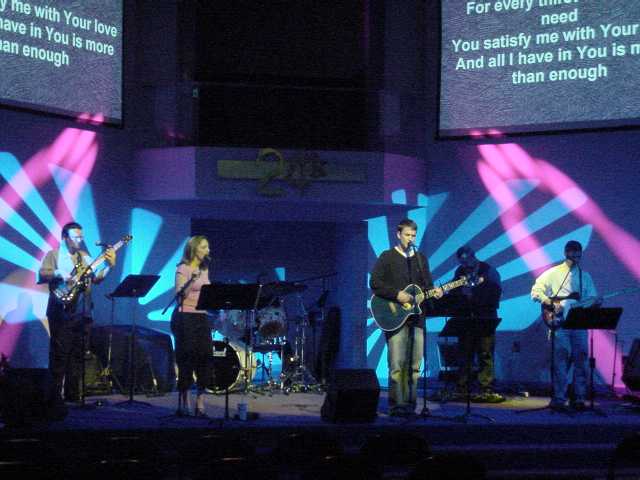
Let me tell you: those people knew how to worship. If you can imagine a full band: drum kit, 3 guitarists, bass, keyboard, and multiple singers. They had stage lighting set up that would change dramatically during the songs, and even during the sermon. They had giant projectors that displayed lyrics, prayers, and even sermonic notes. When the band was playing, everyone had their hands in the air praising. When the preacher was praying, everyone had their heads bowed in submission. It was an experience. The energy in the room was so palpable that I felt on fire for Jesus when I left.

CrossTalk_PCBC_050403

About a week later, after spending way too many hours in the library, I found myself walking back across the quad late at night toward my locked up bicycle. Across the perfectly mowed grass I saw a young man stumbling and trying desperately to maintain his balance. As our paths inevitably drove us closer and closer I recognized him from the worship service I had been in the week before, this young inebriated college student was the bass player for the worship band. It was obvious that he needed help, and remembering that I was a Christian and thinking that this would be a Christian thing to do, I offered him my arm and began to walk him back to his dorm.

“I loved your service the other night,” I said, “The music was particularly moving.” He met my statements with a suspicious eyebrow, so I awkwardly continued “It was really powerful for me.” “Look man,” he slurred, “I don’t believe in God. I just play in the band because they pay me to.”

Worship is important. As Christians we have gathered together for the last 20 centuries first in synagogues, then basements and homes, eventually we started to build churches, and then cathedrals. Worship is at the heart of what it means to be Christian because we participate in the kind of life that Jesus led with his disciples in the 1st century. You might not realize it, but the basic pattern of our worship service has its roots in the ancient practices of the Israelites, and have been handed down to Christians ever since.

First we gather together: we are brought into this place as a community, the body of Christ. We assemble together from the outside world preparing ourselves to be launched into the realm and praise of God almighty.

Second we proclaim the Word of God. We read from the scriptures of the Old and New Testaments. We remember the mighty acts of God in the world as recorded in the Bible and then a sermon is given in order to let the Word become incarnate in our hearing and living.

Third we respond to the proclaimed Word. After hearing about and remembering God’s actions in our lives and the lives of others we return to God with our own participation. Sometimes this response takes place in the form of Communion where we recommit ourselves and are welcomed to God’s table. Other weeks we respond with affirmations of our beliefs such as the Apostles’ Creed.

Finally, we conclude by being sent forth. We re-enter the world bringing with us the light of Christ. As a gathered community we recommit ourselves to life outside of the church being the body of Christ for the world.

Here’s the frightening part: All of that is meaningless unless our lives are transformed.

One of the things that we definitively learn from scripture, particularly the Old Testament is this: the children of God, the objects of divine grace, are not in any way worthy of it. Time and time again in the scriptures we learn about the people of Israel who, by way of their faithlessness, were transgressors of the commandments given to them by almighty God. Just think of some of the so-called “heroes” of the Old Testament: Noah – saved his family and all the animals in his ark and then got drunk and cursed one of his sons for all eternity. Abraham – entered into the holy covenant with God and then pretended to be his wife’s brother and nearly murdered his son. David– delivered the Israelites from the Philistines by killing Goliath, and then stole Bathsheba from her husband and tried to have him murdered. I could go on and on.

The normal sermonic response to these stories of failure and sin is that the children of God are corrupted children. However, in time, God came to dwell among his people and came in the form of a baby named Jesus, the one Israelite who took the place of the disobedient children, the faithless people, and their faithless priests and kings. The Word made flesh. It is only in the light of who Jesus is and was that we see how far humanity had fallen from the grace of God.  What we miss though is the fact that this type of behavior, this faithlessness, does not only apply to the Israelites and the people of Isaiah’s critique, but in fact acts as a mirror for all of us.[1]

Its very easy to read this passage from Isaiah and assume that the Israelites were the one’s who got it wrong, but us enlightened folk in the 21st century, we United Methodists, we’ve got our worship lives together, we are appropriately liturgical. But the Word of God has a most perturbing way of disregarding dates and making truth contemporary.

Isaiah begins, “Hear the word of the Lord, you rulers of Sodom! Listen to the teaching of our God, you people of Gomorrah!” He continues by pointing out all of the failures of their worship: “What to me is the multitude of your sacrifices? I have had enough burnt offerings!” It’s as if God were looking at us today and saying: “I don’t care about your opening Hymn, I have heard enough of the scriptures read aloud.” All these elements of worship, the types of things we take for granted every week are relatively meaningless to God unless what we do in this place translates into the way we live our lives.

“Wash yourselves, make yourselves clean, remove the evil of your doings from before my eyes; cease to do evil, learn to do good, seek justice, rescue the oppressed, defend the orphan, plead for the widow.” These are the things that are important to God. The Hebrew prophets Isaiah, Amos, Micah, Hosea, and Jeremiah each denounce worship practices that have no influence on the way we handle our lives. The prophets try again and again to demonstrate that God is far more concerned with the relationships between people than with the details of public worship.

“Wash yourselves, make yourselves clean.” It is precisely at this moment that the voice of God, through the prophet Isaiah reaches us across the centuries and bids us to look into our own hearts before we come to God. Sometimes we don’t like to admit it, but there is a relationship between corporate worship and individual character. What we believe shapes how we behave.

When I ran into the young man on campus, the bass player for the worship service, I got a glimpse into what Isaiah is getting at in this passage. You can have the “perfect” worship service, we could get the lights going with the projectors and the band and the PowerPoint and the over the ear microphones. We could get people to wave their hands in the air and sing at the top of their lungs. But, worship ceases to be true worship unless our lives are changed when we re-enter the world. Worship becomes just a routine for us if we treat it like that bass player did: just a gig.

We here, good Christian United Methodists, we might not be guilty of the same hypocrisy in our worship, but we need to face the truth that to raise no voice against the evils and injustices of the world, to remain silent in the shadow of corruption and sin, is to leave a fatal gap between the type of Worship we offer to a righteous God, and the attitudes we have toward the wrongs of the world. Throughout history there has been a deep inconsistency between the faith we proclaim on Sunday mornings in the fatherhood, justice, and holiness of God and the type of ethics and moral decisions to which we consent in our lives and particularly in our dealings with other people.

book_of_isaiah

We should ask ourselves: Is our worship changing the way we live our lives? Are we heeding the call to love the oppressed? Are we content to remain almost Christians, or are we fully embodying what it means to be disciples of Jesus Christ? Why do we gather together once a week?

All of this, gathering, proclaiming, responding, being sent forth, remains empty until we are transformed. They will continue to act only as a routine for us unless we enter the strange new world of the Bible and realize that our world has been turned upside down. We gather weekly to turn ourselves back toward God so that we can live lives that follow the teachings and practices of God in Jesus Christ. What we do in this place can function to help transform our lives if we continue to learn the grammar of discipleship and speak that new language when we go back into the world.

The only true worship worthy of God, the worship that God seeks from his people, is the time and space that reveals God’s character through justice, righteousness, unselfishness, and purity. What we are must ratify what we say. Or as one of my professors used to say: We can only live in a world we can see, and we can only see in a world we have been taught to speak. When we learn the stories of scripture, let the tunes and words of the hymns resonate deeply in our lives, we can then learn to be a new people for the world.

It is the responsibility of this church to make the love of God known and to comfort all people with the Good News of our Lord Jesus Christ. This cannot be done through worship alone, through singing hymns alone, through preaching alone, or by any other institutional method we can come up with, but only through living lives which reflect God’s loving spirit. When you walk out of church this morning I encourage you to remember that God has already transformed you through the life and death of Jesus Christ. As you interact with others remember that we have been called to love the oppressed, and seek justice in the world. I challenge you to do something this week that is truly worthy of God’s worship.

Worship in God’s church takes place right here in this space, but the results of our worship should be manifest in the way we live our lives here and in the world. Amen.


[1] Barth, Karl. Church Dogmatics V.1. (Peabody, Mass.: Hendrickson Publishing, 2004), 523.