A Drop In The Ocean – Election Reflection

Isaiah 12.1-6

You will say in that day; I will give thanks to you, O Lord, for though you were angry with me, your anger turned away, and you comforted me. Surely God is my salvation; I will trust, and will not be afraid, for the Lord God is my strength and my might; he has become my salvation. With joy you will draw water from the wells of salvation. And you will say in that day: Give thanks to the Lord, call on his name; make known his deeds among the nations; proclaim that his name is exalted. Sing praises to the Lord, for he has done gloriously; let this be known in all the earth. Shout aloud and sing for joy, O royal Zion, for great in your midst is the Holy One of Israel.

imrs

The line was long when I arrived at my voting location. I sauntered along with the others who were shivering in the cold until we made it to the door and the warmth. We listened to three different people explain the process of voting, we were shifted like a herd of cattle from one side to the other, and then one by one we had to hand over our driver’s licenses to prove our identities.

The woman holding my license (with a picture of me at 20 years old) brought it right up to her face in order to examine every fine detail. Without looking at me she said, “state your name and address.” So I did. And only when handing the card back did she look up over her glasses to say, “you’ve changed.” Which actually sounded more like “you look older than the card says you are.”

Like a sheep, I was then shepherded over to a separate table where I filled in four bubbles, took the card over to the machine, waited for it to beep, and was given my sticker. All told, I was there for ten minutes. 18 months of anger and political outrage, 18 months and nearly 5 billion dollars spent on advertising and campaigns slogans, 18 months and national turmoil all came to fruition in a ten-minute dance in a church social hall for four votes.

If I’ve heard one thing as a pastor more than anything else about this election over the last year and a half, it was this: “God is punishing us.” “God is punishing us for our sinful ways and making us choose between the lesser of two evils.” “God is punishing us for electing a black president 8 years ago.” “God is punishing us for not getting faith back in schools.” “God is punishing us for our lack of faith.” “God is punishing us and the world is going to end with this election.”

Want to know a secret that shouldn’t be a secret? The world is not going to end tonight when all is said and done.

God has been God a whole lot longer than this world has had democratic elections. God has been God through every presidency. God has been God long before America existed. God has been God, and will be God, long after we’re gone.

We Christians believe that Jesus is Lord which means we believe that God is in control. We believe that God spoke the whole of creation into being and has called each of us by name. We believe that God is almighty regardless of who sits in the Oval Office. And perhaps most importantly, we believe that God calls us to love and pray for our enemies, which today means we are called to love and pray for the people who voted for the other candidate.

Can you imagine? Christians praying for people they disagree with? Sadly, that’s at the heart of what it means to follow Jesus and it has been so absent during this cycle. Instead, political offices have been bombed, churches have been burned, and voters have been intimidated at the polls.

And perhaps we want to blame Donald Trump or Hillary Clinton for this tumultuous season. But the problem goes far deeper than whoever will become the next president. The problem is us. We get the people we deserve running for office. Instead of seeing one another and brothers and sisters in Christ, we have adopted the world’s identification system and see one another as liberal or conservative. Instead of listening to those with different opinions, we just shout louder. Instead of believing that Jesus is Lord, we have fallen prey to the belief that the world hinges on this election.

But this election pales in comparison to God’s willingness to elect us. Not by a show of hands, not by absentee ballots, not by filling in a circle on a form, but electing us to salvation through his Son.

For it is Jesus Christ who humbles us to pray for those we hate. Jesus, though scorned and ridiculed by the people, does not call for votes to be cast, but says, “Follow me.” Jesus leads us on the path that leads to life, not prosperity and political prestige, but life eternal. Jesus places the uncomfortable yoke around our necks and says the burden is light. Jesus invites us to feast at the table and we do not deserve it. Jesus, high in the air with the nails in his hands and feet, says, “Forgive them Father, for they do not know what they are doing.”

If we’re honest, we don’t know what we’re doing. We don’t know what it means to be a Christian in America, we don’t know how to hold our political identities and Christian identities in tandem with one another, and we don’t know how to love the people we hate.

But we do know the truth: Jesus is Lord.

So we give thanks, for even though the Lord has been angry with us, he comforts us. Surely we know and believe that God is our salvation. We will trust, and not be afraid, for the Lord God is our strength and our might. Through the immeasurable gift of his Son we have been elected into a strange new way of life. With the knowledge of this joy we draw water from the wells of salvation. As we remember and contemplate our own baptisms we remember who we are and whose we are.

So we give thanks to the Lord, and call upon God’s name. We proclaim God’s mighty acts from the beginning of time until this moment. We sing praises to the Lord, for he has done gloriously.

Though some will say that our faith is fruitless, that to gather here at this moment, while the party lines are being heavily fortified for future derision, is pointless; that to pray for, and love, the very people who drive us crazy is a waste of time. Some will even be so bold as to believe that gathering at the table while the country is in chaos is no more than a drop in a limitless ocean, that it can never transform the world. Yet, what is any ocean but a multitude of drops? Amen.

On Suicide

Isaiah 43.1-2

But now thus says the Lord, he who created you, O Jacob, he who formed you, O Israel: Do not fear, for I have redeemed you; I have called you by name, you are mine. When you pass through the waters, I will be with you; and through the rivers, they shall not overwhelm you; when you walk through fire you shall not be burned, and the flame shall not consume you.

Romans 8.35-39

Who will separate us from the love of Christ? Will hardship, or distress, or persecution, or famine, or nakedness, or peril, or sword? As it is written, “For your sake we are being killed all day long; we are accounted as sheep to be slaughtered.” No, in all these things we are more than conquerors through him who loved us. For I am convinced that neither death, nor life, nor angels, nor rulers, nor things present, nor things to come, nor powers, nor height, nor depth, nor anything else in all creation, will be able to separate us from the love of God in Christ Jesus our Lord.

suicide


It was 2003 and I was a freshman in High School. And like most High School freshman, I spent many an evening on my computer typing to my friends on Instant Messenger. This was long before Facebook’s wild popularity, Twitter’s terse communication style was far away from coming into reality, and none of us even had cameras on our cell phones. But night after night we would sit in front of our computer screens typing away about what we thought were the most important things in the entire world.

One night in the spring, I waited for my parents to go to bed and then I snuck downstairs to get back on the computer. Most of the conversations were frivolous and limited by the speed at which our fingers could move over the keyboard. I can’t remember what the topic was that evening, but I do remember a new box appearing on the screen that changed everything.

At the time, my best friend was dating a girl and things were less than perfect. They fought about all kinds of stupid things and were the epitome of every high school relationship cliché. She, the girlfriend, was the one who sent me a message that night. All it said was, “We got in a really bad fight, he told me he was going to kill himself, and I don’t know what to do.

Suicide is ugly. It leaves families and friends reeling in whiplash, it creates guilt and unanswered questions, and it produces feelings of morbidity and fear.

Suicide is controversial in the church for a number of reasons. Many churches and Christians believe that suicide is ultimately sinful and worthy of eternal damnation. To have suicidal thoughts is to not have enough faith. Some pastors will even refuse to preside over funerals for those who have committed suicide.

If you look through the entirety of scripture, both Old and New Testaments, you will not find a passage that condemns suicide. None of the prophets, or priests, or kings have anything to say about suicide or what happens to those who commit suicide. However, Augustine (an important theologian from the early church) read the commandment “thou shall not kill” as a prohibition against suicide. And from Augustine’s reflection on the topic, suicide became the black sheep of sins in the church.

For a thousand years, suicide was a mortal sin and an affront against God’s goodness. Those who committed suicide were treated as criminals and refused Christian burials. By the 1500s those who attempted suicide were excommunicated by the church and were punished by the civil authorities.

And still today, suicide carries an awful stigma in the realm of the church and is one that is either referred to with eternal damnation or complete silence.

            That silence, the utter and complete darkness of a topic that is remarkably relevant for our time and reflection, is a controversy worth confronting.

According to the Center for Disease Control (CDC), on average, one person dies by suicide in the state of Virginia every 8 hours. It is the 11th leading cause of death in our state, and it is the 2nd leading cause of death for people ages 10-34.

Among high school students across the country, 17% seriously considered suicide in the last 12 months. And 8% attempted suicide one or more times in the last year.

If you’re like me, you tend to think about young people being the most susceptible to suicide attempts, but suicide rates are actually highest among people middle aged and older, by a lot. In fact, middle aged and older adults are nearly twice as likely to commit suicide as young people.

And right now, suicide has surged to its highest levels in thirty years.

yqecn1ygjymjb3igsiev

When I received that message on my computer back at the beginning of high school, I grabbed my things and was out the door before I even had a chance to really think about what I was doing. All I knew was that my friend would not just make an empty threat about suicide like that, and I had to do something about it. So I grabbed my bicycle out of the garage and I started riding as fast as I possibly could in the middle of the night. He lived a couple miles away and when I screeched into his driveway I was drenched in sweat.

I dumped the bike right there and I ran to the front door and started banging with my fist and I started yelling. Within a minute his parents were coming down the stairs in their pajamas with tired and angry looks on their faces. When they opened the door and saw me standing and sweating in the dark they were utterly bewildered and then I told them why I was there.

We immediately went to check on him in his bedroom, but he wasn’t there. We searched the house from top to bottom and we finally found him in the basement. He was sitting on the couch with tears in his eyes and he had just swallowed an entire bottle of ibuprofen.

They wound up taking him to the hospital and had his stomach pumped. They sat there and held their son while he cried and cried. And they saved his life.

Suicide is not the way any human life should end. The church, this church, has an obligation to see that all persons are grafted into a community of love and are cared for in the midst of isolation, depression, and despair.

Life is a gift, plain and simple. It is a gift from God and therefore we are called to be good stewards of this gift: our lives and the lives of others.

We cannot ignore this topic as if it has nothing to do with us. The statistics confront us with a stark reality about the prevalence of suicide in our culture. With the advent of the Internet and instant communication, young people are being bullied and attacked at a degree that few of us can even fathom. With an economy that moves up and down like a roller coaster, people in the middle of life are undergoing identity crises and are wondering how they can provide for their families. Older people who receive a grim diagnosis or the loss of a spouse struggle to justify living with such a horrible outlook for the days ahead.

We know that we are supposed to be present for and with one another, like being there for friends and family at a moment of tragedy. We rarely know what to say on such occasions, but we know we should be there. We, above all things, are called to be present for others in the midst of suffering and loneliness and depression that often lead to the contemplation of suicide. To be part of the faithful community requires us to be for one another.

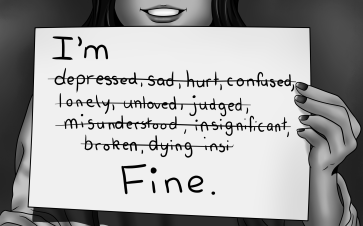
i_m_fine_by_black_avenger-d60mqnl

We live because life is a gift. We are not our own creators. We Christians are the people who must learn to live by the fact that life is a gift. We therefore can live each and every day not as a survival technique, but through recognizing that each and every day is an opportunity to live and love in the service of our Lord.

When we talk about suicide, we say it is “the taking of one’s life.” But even the way we talk about suicide shows how much a problem we have with it. Our lives are not our own. As the Lord says through the Prophet Isaiah: “Do not fear, for I have redeemed you; I have called you by name and you are mine.” We belong to the Lord and to one another. God tells us to not be afraid because God will be with us as we pass through the waters, and the rivers of life shall not overwhelm us, we shall not be burned by the fires of frustration. Not because they won’t hurt or be terrifying, but because we belong to the Lord and the Lord is with us.

If we’re here in the sanctuary this morning, we have some sense of this in our lives. We know that God is with us, we feel God’s presence in this place and we know that we are not alone. It is through encountering the divine love of God in worship that we are given the strength to be God’s presence for others who sink under the waters of life and who feel burned by the world. It is our charge to be shaped and called by God’s love and to reach out to those who contemplate ending their days. We have the challenge of showing all people, even those who see no value to their lives, how our lives are not defined by what we have done with them, but by what God will do with them.

Six months after my friend had his stomach pumped, he attempted to commit suicide again. This time he did it with a hose running from his exhaust pipe into his car. But his little brother heard the car door close and it woke him up, and then he woke up his parents. In the strange and quiet time of the darkness of night they pulled their son out of the car and they got him help. It took a long time for him to move on. It took counselors and therapists, it took friends and family, it took the power of God’s grace to show him that his life could get better, that there was hope for the future, that there was something worth living for. And because people in his life were brave enough to confront his suicide attempts, he still lives today.

But there will always be some that we cannot reach. There will be people who feel so suffocated by the weight of the world that they will make that dreadful decision to end the life that God’s has given to them. And for them, for those who will die by their own hand, what will happen to them? For centuries the church saw suicide as an unpardonable sin, something that eternally damns those who do it. Will God abandon them for making such a choice? Will God refuse to love the people who felt no love in their lives? Will the God of mercy punish them until the end of time?

           No. In all these things we are more than conquerors through him who loved us. For I am convinced that neither death, nor life, nor angels, nor rulers, nor things present, nor things to come, nor powers, nor height, nor depth, nor anything else in all creation, will be able to separate us from the love of God in Christ Jesus our Lord. Amen.


Controversy Original

Too Busy For Sabbath – Isaiah 58.9b-14

Isaiah 58.9b-14

If you remove the yoke from among you, the pointing of the finger, the speaking of evil, if you offer your food to the hungry and satisfy the needs of the afflicted, then your light shall rise in the darkness and your gloom be like the noonday. The Lord will guide you continually, and satisfy your needs in parched places, and make your bones strong; and you shall be like a watered garden, like a spring of water, whose waters never fail. Your ancient ruins shall be rebuilt; you shall raise up the foundations of many generations; you shall be called the repairer of the breach, the restorer of the streets to live in. If you refrain from trampling the Sabbath, from pursuing your own interests on my holy day; if you call the Sabbath a delight and the holy day of the Lord honorable; if you honor it, not going your own ways, serving your own interests, or pursuing your own affairs; then you shall take delight in the Lord, and I will make you ride upon the heights of the earth; I will feed you with the heritage of your ancestor Jacob, for the mouth of the Lord has spoken.

sababth


Whenever you get a group of pastors together, competition breaks out whether we want it to or not. So much of what we do take place on Sundays and therefore we never get to see our peers at work. So when we gather for a meeting or a conference, we tend to show off in order to make ourselves feel better.

At Annual Conference this year, the time when all of the United Methodists from Virginia get together to talk about the state of the denomination, I had lunch with a few clergy colleagues and the sizing up started almost immediately. We asked questions like, “What’s the best sermon you preached in the last year?” and “How is God blessing your ministry?” which is code for “How many people do you have in worship?” We listened as each person tried to demonstrate how their work was bearing more fruit than the other people at the table. And as the meal came to its conclusion someone asked, “If you could change one thing about your church without any consequences, what would it be?”

What a great question! The table was strangely silent for a few moments while each of us prepared our answers. I immediately pictured all of you sitting in worship and I started whittling down my list to the number one change.

My first thought was practical: If I could change one thing without consequence I would force everyone to tithe. It would demonstrate our trust that the Lord will provide, it would help us bless others in this community through financial support, and it would help remove a lot of stress from my life. But then I realized that was a selfish change, and frankly one that wouldn’t make me sound very pastoral in front of my peers.

My second thought was simple: If I could change one thing without consequence I would force everyone who sits in the back of the sanctuary to move up to the front of the sanctuary! It would make our church closer, it would create a fuller sense of connection, and it would save me from having to yell all the way to the back of the church. But then I realized that was a selfish change, and frankly one that wouldn’t make me sound very Christian in front of my peers.

So I settled for something like: I would help the church to see that we are all in this together. That we have a responsibility to open our eyes to the community around us and believe that its more about serving them, and less about the church serving us.

The group nodded in silent affirmation. And then we listened to the next answer and the next answer. With each successive response we heard more and more ideas that could reshape the entire identity of the local church. Someone said that she would force her congregation to spend time each week serving the poor. Another said that he would require every person to go on at least one mission trip a year. And so on.

But my friend Drew remained silent. Sitting at the edge of the table he listened intently as each pastor put forth his or her opinion, and I could tell that he was really thinking through his response. And when all of us had finally finished, when we had all laid out our best to impress, we all turned our heads to Drew to hear his answer.

He sighed and said, “I would make everyone rest.”

lord-of-the-sabbath

The Lord speaks to Isaiah and is perfectly clear: If you refrain from trampling the Sabbath, from pursuing your own interests on my holy day; if you call the Sabbath a delight and the holy day of the Lord honorable; if you honor it, not going your own ways, serving your own interests, or pursuing your own affairs; then you shall take delight in the Lord.

Today, we are a far cry away from the type of Sabbath observance that took place in the time of the Old Testament. We barely even have a conception of what it means to be sabbatical on a regular basis. For Jews, to this day, the Sabbath happens every week, beginning on Friday night. For 24 hours everything changes. They gather together as families and friends. They remember who they are and whose they are. They experience God in time set apart.

For the Jews, Sabbaths are their greatest cathedrals and the holiest of holies is something that no one can take away. Instead of placing their hope and faith in things like buildings and ministry programs, they believe in the power of time that is different. They remember that the Lord created the world in six days and called each day “good.” But when the Lord came to the seventh day, the day of rest, God called it “holy.” In the holiness of the Jewish Sabbath they discover that time, not a place, but a time of difference makes all the difference.

We, on the other hand, don’t know what the Sabbath is any more. For those of us of the more mature-in-faith persuasion can remember a time with blue laws, when Sundays were different than the other days during the week. There was no going to the super market after church. There was no matinee showing of a movie on Sunday afternoon. No little league sports had games scheduled on the Lord’s Day.

But that time is long gone.

Now Sunday is likely the busiest day of the week. We frantically wake up on Sunday morning and get breakfast going, we wrestle with the kids to get out of bed and get dressed. We plead with them to find some article of clothing not covered in wrinkles. We jam into the car and arrive in the parking lot as the first hymn is being offered. We try to pay attention during worship, but whenever the pastor is foolish enough to call for times of contemplative silence, we can’t help ourselves from listing all of the things we need to get done this afternoon in our head. When worship ends we pile up in our cars and head out for lunch or back to the house to finish all the chores we neglected during the week. And before we know it we have to start working on dinner, we have to berate the children to finish their homework, we have to pack the lunches for Monday morning, and (if we’re lucky) we have time to all sit down in front of the television until our eyes dry up and we head to bed.

How hard is it to do anything these days, and in particular on Sunday? With our frantic and overly programmed schedules we find it harder and harder to find the time to do anything. By way of example, it took us months to figure out a time for our revamped youth group to meet. We debated meeting on Sunday evenings but that interfered with homework and family time. Fridays were out because of football games and other sport activities. Mondays were out because of band performances. Tuesdays we out because Scouts. And so on. It took a frightening amount of time to find the right time for our Youth, and even though we identified 7pm on Wednesday nights as the best time, it still prevents some of our Youth from attending on a regular basis.

And this isn’t just about youth. We adults are just as guilty about over-stuffing our daily lives with activities to the point that when the Sabbath arrives, we need to use it to make up for all the time we lost from Monday through Saturday.

We fill our lives with activities and programs because we are so desperate to find meaning in our lives. We assume that we must have something to do in order to make good on the time we’ve got. We use our busyness to feel confident that we are not wasting time. We go and go and go, and without Sabbath we fail to be who God is calling us to be.

sabbath

For six days every week we live under the tyranny of to-dos and the empire of expectations, for six days every week we try to dominate our duties and lasso our lives. Can you imagine what your life would feel like if, on the Sabbath, you gave up the temptation to control every moment? Can you picture how it would look to treat our time as the gift that it really is?

John Wesley was fond of telling a story about a young Christian who was extremely committed to observing the Sabbath. On one Saturday evening, as the sun was preparing to set, the young man sat down at his kitchen table and began shining his shoes for worship the next morning. He shined and shined, but ran out of polish and had to start looking through the house until he found another container. And as he prepared to start polishing the second shoe he looked out the window and discovered that the sun had set and evening had started. So he put his shoes away, one perfectly shined and the other scratched and dirty. And the next morning at church he wore those two seemingly different shoes for everyone to see, because he would not “work” on the Sabbath.

Is that the kind of Sabbath that God calls us to observe? Is it strict obedience to a principle, no matter what, that will make us ride upon the heights of the earth?

Observing the Sabbath is less about avoiding certain behaviors and more about being intentional about what we do with the time God gives us. It is far too easy to fill our Sundays with menial work that was neglected during the week. There is too great a temptation to use the Lord’s Day to serve our own interests. Many of us would consider ourselves too busy for Sabbath.

The Sabbath is supposed to be about joy! It’s not about sitting in a stuffy room listening to a preacher telling you that you’re a sinner and you need to repent. It’s not about neglecting to serve others in need. It’s not a legalistic absolute.

The Sabbath is a time apart, a time of thankfulness and joy. It is the one day a week we are called to break free from the oppression of our stifling work. It is a time to gather with the family of God to give thanks for all that we have. We are called to fill our Sabbaths with the kind of behaviors and activities that give us the strength to face the other days of the week. It is a time of rest. It is a time of holiness. It is a time where we can use recreation for our re-creation.

Creation is not an act that happened once, long ago, in the past. The act of bringing the world into existence is a continuous process. We rest once a week, because every week is a repeat of God’s creative and imaginative work. We rest because God rested. Every Sabbath is an opportunity to be recreated by the Spirit to be who God is calling us to be.

If we refrain from abusing the Sabbath, from using it as another day to get everything done; if we call the Sabbath a joy and if we honor it, not to serve our own interests; then we shall take delight in the Lord. We shall be able to faithfully sing, “it is well with my soul.” We shall be fed with the heritage of all who have come before us, for the mouth of the Lord has spoken. Amen.

Karl Barth and The Strange New World Within The Bible

When I was in seminary, Dr. Stephen B. Chapman told a remarkable story about a survey that had been done in past. All of the faculty and doctoral candidates at Duke Divinity School were once asked to name the top 3 books or articles that had shaped their call to ministry or academia. Though many were quick to respond with something like “The Bible” or “1 Corinthians” the survey challenged people to think more specifically about works outside of the bible that had shaped their lives.

Some of the greatest works from Christian History were all named such as Calvin’s Institutes, Aquinas’ Summa Theologica, Wesley’s Sermons, and Augustine’s Confessions. Others were quick to name works from more contemporary writers like Schweitzer, Bonhoeffer, Merton, Yoder, Hauerwas, and Nouwen. The survey demonstrated that there were an abundance of texts from a variety of traditions that had shaped the minds of those called to serve the church. However, even with all the variations of answers and all the different denominations that were represented, there was one article that was mentioned more than any other: Karl Barth’s “The Strange New World Within The Bible.”

barth-bw

Barth’s article can be found in chapter 2 of his seminal work The Word of God and The Word of Man originally written in 1928. When I read the article for the first time I underlined so many sentences that it was difficult to read it a second time. The margins are now covered with thoughts, exclamation points, and asterisks. It is nothing short of transformative.

1101620420_400

In it, Barth attempts to answers the following questions: What is there within the Bible? What sort of house is it to which the Bible is the door? And What sort of country is spread before our eyes when we throw the Bible open?

Like most of Barth’s writing, it cannot be explained but only proclaimed. The best way to experience it is by reading the thing itself. Therefore, I have attached a PDF of the chapter to end of this post for anyone to read.


But after rereading the article again this week, and looking through all my old notes and markings, I decided to write my own version of the chapter relying on Barth’s original to guide my thoughts…


The Strange New World Within The Bible

We are to attempt to find an answer to the questions, What is there within the Bible? What sort of house is it to which the Bible is the door? What sort of country is spread before our eyes when we throw the Bible open?

We are with Adam and Eve in the Garden. We hear the Lord warn them about the tree of knowledge of Good and Evil. We hear the slithering serpent calling them (and us) to rebel against the One who loves us. And Adam and Eve reach for that forbidden fruit inevitably driving them away from the Lord and into the unknown. We can feel that there is something of ourselves in these two standing at the edge of Eden looking back to what they once were and unsure of what would come in the days ahead.

We are with Noah kissing the ground after the Flood. We see the rainbow cast across the sky and we feel the colors reflecting off the pools of water around Noah’s feet. We hear the promise from the Lord to never abandon creation again. We believe that Noah is the new beginning, another chance for humanity to get things right. But then we see him tilling the ground, preparing the vines, and eventually getting drunk from the wine. In him we see the failures of the past reaching forward into the present and we know that there is something behind all of this.

We are with Abraham in a strange land. We hear a call from the Lord, which commands him to go to a land that has been prepared. We hear a promise to Abraham: “I will make of you a great nation and your descendants will be more numerous than the stars.” And we see that Abraham believed the promise! We feel the Spirit moving through the space as the story moves ever forward.

We are with Moses on a rocky hillside. We feel the warmth of a bush burning but not being consumed. We hear the voice of the Lord speak to the wandering shepherd: “Tell them I AM sent you.” We experience the calling that will forever define an entire nation of people, a delivery from slavery to Egypt, and freedom in the Promised Land. We hear these strange words and promises and we know that they are unlike anything else we have ever read. We know that it is a story, but it is a story about us.

We are with Joshua at the edge of the new land. We remember the painful journey and the years of struggle that led to this moment. We experience fear and excitement with the other sojourners, as they are about to cross the threshold into God’s promise. We hear about Rahab and what she was willing to do for God’s people and it gives the people confidence to actually be God’s people.

We are with Samuel asleep on the floor. Again we hear a call three times “Samuel, Samuel!” We see the young man run to the priest Eli to share his experience and we begin to connect this call with others. We know that Samuel has heard the Lord and that he must obey. We know the journey will not be easy, but it will be good.

We read all of this, but what do we experience? We are aware of some greater power beneath the word, a faint tremor of something we cannot know or fully comprehend. What is it about this story that makes our hearts beat with such tempo? What is opening up to us through the words on the page?

We are with David when he puts the rock into the sling and takes down the mighty Goliath.

We are with Solomon when he prays for the Lord to give him the gift of wisdom.

We are there when Isaiah feel the coal being placed on his lips.

We are with Elijah when he hears the Lord not through the wind, not the storm, nor the fire, but through the still small voice.

Then come the incomprehensible days when everything changed; that strange and bewildering moment in a manger in Bethlehem when the Word became flesh. When a man and a woman fled to save their child’s life. When that baby grew to be a man who was like no other man. His words we cause for pause and alarm and delight and fear. With unending power and resonating grace he calls out: Follow me. And they do.

Through him the blind begin to see. The lame begin to walk. The hungry are fed. The powerful are brought low. The poor are made rich. The deaf hear. The blind see.

And then we are there when the sky turns black. We hear his final words and we feel a faint echo from those first words so long ago. But that echo continues for three days until it reaches a triumphant crescendo in an empty tomb, in resurrection.

We are there with the disciples in the upper room. We watch the Holy Spirit fill their mouths with the words to proclaim. We go with them across the sea and over the dry land. We watch them use water and word to bring new disciples into the faith. We smell the bread being broken and we can taste the wine being shared at the table. We can feel the parchment of letters sent to church far away in our fingers.

And then it ends and The Bible is finished.

Open-Bible-Religious-Stock-Photos

What is it about scripture that makes it different from everything else we read? What is so important about the connections from Adam to Jesus? What are we to make of the prophets and the apostles? What do we do with statements like “In the beginning God created the heavens and the earth” and “Forgive them Father, for they do not know what they are doing”?

These are difficult and dangerous questions. It might be better for us to stay clear of the burning bush and the coal for our lips and the call to the cross. Perhaps we would do well to not ask because in our asking is the implication that The Bible has an answer to every question. Yet it does provide something just as the Lord provided for Abraham.

It is not merely a history or a genealogy.

It is neither a myth nor a fable.

What is there within The Bible? The answer is a strange, new world, the world of God.

We want The Bible to be for us. We want to mine it for all its precious metals. We want it to answer our questions. We want to become masters of the text.

But The Bible is itself and it drives us out beyond ourselves to invite us into to something totally other. We are invited regardless of our worth and our value, regardless of our sin and failures, to discover that which we can only barely comprehend: a strange new world.

Reading The Bible pushes us further through the story that has no end. In it we find the people and places and things that boggle our thoughts. We read decrees that shatter our understanding of the real. We experience moments of profound joy and profound sorrow. We find ourselves in the story when we did not know we had a story.

And it causes us to ask even more questions: Why did they travel to this place? Why did they pray this way? Why did they speak such words and live such lives? And The Bible, for all its glory, rejects answers to our Why.

The Bible is not meant to be mastered; instead we are called to become shaped by the Word. And this is so happen in a way we cannot understand. For the heroes of the book are seldom examples to us on how to live our daily lives. What do David and Amos and Peter have to teach us except to show us what it means to follow God?

The Bible is not about the doings of humanity, but the doings of God. Through the Bible we are offered the incredible and hopeful grain of a seed (as small as a mustard seed), a new beginning, out of which all things can be made new. This is the new world within the Bible. We cannot learn or imitate this type of new life, we can only let it live, grow, and ripen within us.

The Bible does not provide us with simple tools on how to live like a disciples, or what to do in a particular situation. It does not tell us how to speak to God, but how God speaks to us. Not what we need to do to find the Almighty, but how he has found they way to us through Jesus Christ. Not the way we are supposed to be in relationship with the divine, but the covenant that God has made with God’s creation.

The strange new world within the bible challenges us to move beyond the questions that so dominate our thoughts. Questions like “What is within the Bible?” and “Who is God?” Because when we enter the strange new world within the Bible, when we discover ourselves in the kingdom of God, we no longer have questions to ask. There we see, we hear, and we know. And the answer is given: God is God!


Strange+New+World

Devotional – Isaiah 43.18-19

Devotional:

Isaiah 43.18-19

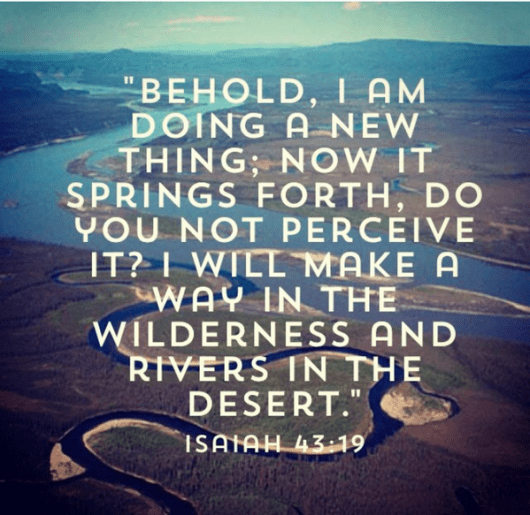
Do not remember the former things, or consider the things of old. I am about to do a new thing; now it springs forth, do you not perceive it? I will make a way in the wilderness and rivers in the desert.

Weekly Devotional Image

On Saturday morning I gathered with a few hundred United Methodists from all over the Virginia Conference for the Bishop’s Convocation on prayer. I was asked to teach a class on spiritual disciplines, but before we broke off into small classes we all met in the sanctuary to hear from our plenary speaker Dr. Fred Schmidt (Reuben P. Job Associate Professor of Spiritual Formation at Garrett-Evangelical Theological Seminary in Evanston, Illinois.)

Dr. Schmidt’s lecture was focused on the need to reclaim a sense of prayerful discernment. He admitted that countless churches will often use prayer in worship, or at the beginning of committee meetings, but rarely do churches actually strive to discern the will of God through their prayers. He set up this distinction by comparing the church of the 50s and 60s to the contemporary church; a half-century ago the church was comfortable with its role in society but as the church has diminished over the decades we have tried to reclaim that popularity. He mentioned that we now have things like “Ashes-to-go” on Ash Wednesday, we hand out coffee in our narthexes, and we fill worship with things like “how to be a better you.” Year after year we initiate new programs in the hope that they will bring us back to the heyday of the church. Then Dr. Schmidt brought the whole point home: “Part of our problem is that we’ve been seeking to rebuild our attendance and influence instead of rebuilding the body of Christ.”

Bc8l84xCAAA2R7Y

The Lord once spoke through the prophet Isaiah and said, “Do not remember the former things, or consider the things of old. I am about to do a new thing;” Many of us fall prey to the temptation to make things “just like they once were” and we want the church to be as popular as it once was. However, God does not call us to be popular. God calls us to be faithful.

This week, let us consider how we can discern God’s will in our lives and in our churches. Instead of just assuming that if we water down our ministries more people will show up in the pews on Sundays, let us earnestly pray and wait for God’s will to be revealed. Instead of limiting our faith to “how to be a better person,” let us earnestly live out our faith and pray for God to make us more like Jesus.

Devotional – Isaiah 43.1

Devotional

Isaiah 43:1

But now thus says the Lord, he who created you, O Jacob, he who formed you, O Israel: Do not fear, for I have redeemed you; I have called you by name, you are mine.

Weekly Devotional Image

Names are important. Ever since my wife became pregnant we have discussed possible names for the baby arriving this spring. We have experimented with family names as well as biblical names. We have searched online for popular baby names (in order to avoid them). We’ve even gone so far as too imagine how possible names could be used to make fun of the child in the future.

Names are intimate and help to demonstrate how connected we are with one another. For instance, most of us can remember a time and the feeling of guilt that comes when we cannot remember the name of someone we supposed to know. When we call one another by name we are entering in a privileged moment of connectivity with another human being.

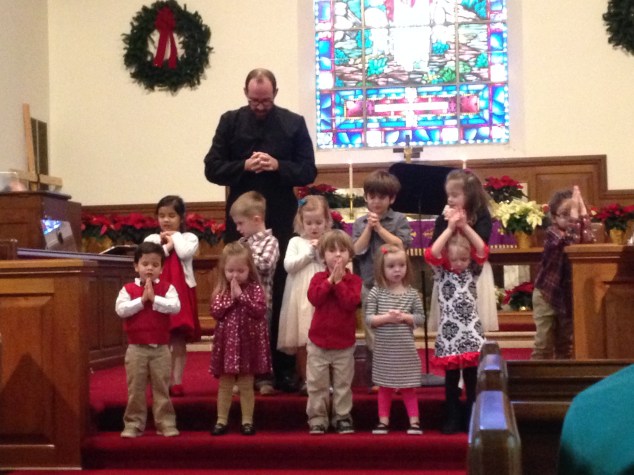
This morning, while the preschoolers were entering the school for the first time since breaking for the holidays, I stood by the door and welcomed each of them. I got down on my knees to look at most of them on a level plane and asked about their Christmas presents and celebrations. It was a joyful time as we all reconnected.

shutterstock_97916309

One of the last children to arrive was a new student about to begin his first day. Unlike the other kids, this was a completely new and strange experience. All around him were the friendships that have started this year and he stood all by himself. Because I had the chance to meet his parents before this morning, I knew who he was and bent down to greet him by name. The shy young boy looked up at me and started to beam as he declared, “You know me?!”

Within minutes he was in his new classroom playing with new friends. All of the nerves were gone and were replaced with the joy of playing with blocks at 9 o’clock in the morning. Such is the power of being called by our names.

Many of us wrestle with our own identities. We wonder about who we are and what we are being called to do. Yet, God knows who we are and calls us by name. The kind of joy that our new preschool student felt this morning is available to us when we recognize how God has called us and knows us. Sometimes it happens in the words of a hymn we sing in church, sometimes it happens in a devotional we read to start our day, and sometimes it happens in the still small silence of our prayers. God knows us. God loves us. God calls us by name.

This week, let us look for the moments when God calls us, let us rejoice in the knowledge of whom we belong to, and let us give thanks for all of the blessings that God has given us.

Devotional – Isaiah 9.2

Devotional

Isaiah 9.2

The people who walked in darkness have seen a great light; those who lived in a land of deep darkness – on them light has shined.
Weekly Devotional Image

When I was preparing my Christmas Eve sermon last year, I was struck by the importance of God’s light shining in the darkness. During the weeks leading up to Christmas I read over the differing texts, and explored different hymns, but the image of God’s light stayed at the forefront of my mind. So when it came time to conclude my thoughts on God’s greatest gift from the pulpit, this is what I said:

“For me, Christmas is at it’s realest when we light our candles as we sing Silent Night. Some of my earliest memories are standing in a dark sanctuary on Christmas Eve while people around me are singing. In mere minutes the darkness is replaced by a brilliant light, made remarkable by the God who took on our flesh to dwell among us, to be God with us.

Jesus is the light of the world who shines in the darkness. Whatever that darkness might look like for you, whether it be an uncertain future, fears about your children, frustrating family members, the loss of a loved one, a heavy diagnosis, or the lack of love in your life, Jesus stands in stark contrast as the one who brings the light into our lives.

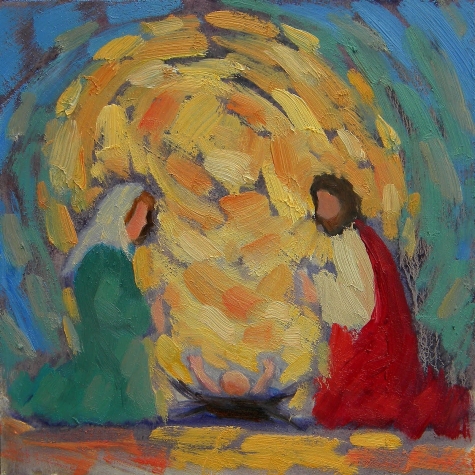
_the_holy_family__nativity_scene___another_commiss_f6de659b784c8c14ecc1ee8b95fa4fa8

Christmas Eves always mean the most and convey the most when we feel the depth of the darkness. Because new life always starts in the dark. Whether it is a seed in the ground, a baby in the womb, or Jesus in the tomb, new life starts in the dark.

At the end of our service we will turn out all the lights, from the one candle, the Christ candle, we will light all others as we sing Silent Night. As we do so let us open our eyes the different forms of darkness in our lives and give thanks to the light of the world who shines in the darkness.

It will feel like Christmas in the room, when we hear the familiar words that have been sung for centuries exclaiming the great joy of the newborn king.

It will feel like Christmas in the room, when we gather as God’s table to feast on the bread of life and drink from the cup of salvation.

It will feel like Christmas in the room, when we see the light of Christ shining in one another.”

It is my hope and prayer that no matter where you are, or who you’re with, God’s light will shine in your lives. Merry Christmas.

The Gifts of God – Hope

Isaiah 12.2-6

Surely God is my salvation; I will trust, and will not be afraid, for the Lord God is my strength and my might; he has become my salvation. With joy you will draw water from the wells of salvation. And you will say in that day: Give thanks to the Lord, call on his name; make known his deeds among the nations; proclaim that his name is exalted. Sing praises to the Lord, for he has done gloriously; let this be known in all the earth. Shout aloud and sing for joy, O royal Zion, for great in your midst is the Holy One of Israel.

hope-hero

Over the last few weeks we have been going through a sermon series on The Gifts of God. This has been particularly fitting considering the fact that Advent is usually a time when we fret about what we will be purchasing for everyone else. However, this Advent, we have been reflecting on what God has given us. Today we continue the sermon series with God’s gift of Hope.

When I was a kid, even when I was as young as some of our preschoolers, I loved Star Wars. We had the old VHS versions of “A New Hope” “The Empire Strikes Back” and “Return of the Jedi.” The covers were so worn from use that you could barely read the writing, and the film inside the VHS tapes was starting to crackle from excessive usage. But I loved them nonetheless.

Some of the themes were lost on me as a child but I loved the light saber fights, the fundamental battle of Good vs. Evil (The Darkside vs. The Light), and that a kid from a Tatooine moisture farm could go from bulls-eyeing womp rats in T-16 to saving the entire galaxy.

Star Wars taught me that, with the right cause, even the weak could triumph. Star Wars taught me that we are not defined by our past and are given opportunities to change. And Star Wars taught me about hope.

In the beginning of Episode IV, aptly titled “A New Hope”, the galaxy is in disarray and the evil Empire continues to exert its power over the powerless. For a generation, people of all shapes and sizes cowered under the rule of the emperor and started to forget the way things used to be. However, a group of people held onto the hope of a new future, they called themselves The Rebel Alliance, and they believed that things could change.

Isaiah 12 is about hope for the future. Like the rebels from the Star Wars universe, Isaiah fundamentally believed that a day would come when everything would be turned upside down and salvation would be delivered.

With confidence, Isaiah declared a profound trust in the Lord, a trust without fear. With hope, Isaiah envisioned that future day when all of God’s people would give thanks to the Lord and make God’s deeds known among the nations. With joy, Isaiah could hear the songs of the future praising the mighty works of the Lord, for he would have done gloriously.

And on that day, God’s people will draw water from the wells of salvation.

IMG_4568

The man felt empty; like something was missing from his life. He had parents who loved him, he had gone to the right school, he had a good job, but things didn’t feel right. Whenever the holiday seasons came around he did not have the energy the call his parents, he resented the happy families at department stores purchasing gifts, and he abstained from the holiday radio channels.

He couldn’t explain it but one day he lost his patience with his family when they kept asking him about whether or not he was happy. One day at work he screamed at a customer after losing his patience. And one night, while he sat in his apartment, he realized how empty and lonely he felt.

He continued like this for some time. Living a dry and empty life, until he met her. She was everything he could have hoped for; smart, pretty, funny. They immediately hit it off, and in her he believed he found the solution for his emptiness, in her he thought he found the one thing that could fill him again.

The beginning of their marriage was wonderful; they saw the world with hope and expectation. They both were not filled, but they had more than they had in a long time. But it started to fade. Arguments with the in-laws, shouting matches in the living room, and nights spent sleeping in other rooms emptied them of the joy and hope they once felt.

They were at a crossroads in their relationship and were unsure of how to move forward. Both of them were too proud to try counseling, and definitely too proud to apologize, so they just continued with the thinly veiled frustration with one another. But then they had an idea: “Maybe if we have a child, it will fix all our problems, it will bring us closer together.”

They had some stability after the first, but when things reverted back to the pre-baby days, they decided to have a second child, and then a third. What they didn’t know, but what many of should know, is that even the perfect child cannot fill the emptiness within us. No child should be expected to make up for our baggage, and no child should be expected to heal our brokenness.

But this habit and rhythm in the family didn’t stop. After the kids, the parents tried to fill themselves with experiences and material possessions. They went on vacations they couldn’t afford, they took out a loan on a house they could never pay back, and every Christmas had to be better (and filled with more gifts) than the last. But all of these things failed to fill the emptiness they felt.

And on that day, God’s people will draw water from the wells of salvation.

IMG_4571

Jesus once met a woman at a well and confronted her emptiness. She had attempted to fill her life with man after man and yet there was something missing. Jesus said to her, “Everyone who drinks of this water will be thirsty again, but those who drink of the water that I give them will never be thirsty. The water that I will give will become in them a spring of water gushing up to eternal life.

Many of us are broken. Actually, the truth is, we are all broken. Most of us just don’t want to admit it. We have good days, but there are times that we feel dry and empty inside. We seek out the wrong objects to validate our lives: a spouse, a career, a child. And none of those things are strong enough to hold our identity together.

Yet, God offers us this living water, water from a well that never runs dry. When we start to see the hope that God has given us, when we rest our identity on the fact that we are first a child of God, when we drop our buckets into God’s well of salvation things starts to change.

God knows our thoughts and minds. God witnesses our brokenness and sinfulness. And God still loves us anyway. God’s love is truly unconditional. God’s love is unmerited. God’s love is filled with hope for our futures.

I’ve only been doing this whole pastor thing for two and a half years, but two and a half years is long enough to know that most of us, if not all of us, are looking for love and validation in all the wrong places. We expect our children to makes our lives better, we expect the presents under the tree to make our lives fuller, and we expect our spouses to fix all of our problems.

Jesus offers us something totally and wonderfully different. Jesus offers us hope from the well of salvation. A hope in a future not defined by our past. A future not limited by the mistakes we make here and now. A future not corrupted by the powers of death.

Jesus offers us hope, a hope unlike any other, a hope that can truly fill us.

An-so-Lord-where-do-it-put-my-hope

When we find our hope in the Lord, we can stand up to the intolerance and injustice in our midst because we know God’s sees the world differently.

When we find our hope in the Lord, the presents under the tree will not leave us looking for the next fix because we will know that the greatest gift we’ve ever received is Jesus.

When we find our hope in the Lord, we can confront the brokenness in the world and know that life here on earth is not the end.

Isaiah had hope, hope for a day when God would show up, hope for a time when God would make all things new. Isaiah prayed for a future where people would sing praises for the glorious power of the Lord. Isaiah dreamed about a day when God would offer the wells of salvation to the world.

That hope became real on the first Christmas, and that hope is still real and available to you and to me.

Jesus calls to each of us today and says, “I can fill you. I can fill you with the living water that never runs dry. I can bring you to the well of salvation. I can fill you with hope, and love, and validation. I can fill you with joy, and peace, and purpose. I can fill you and turn your life around.

Amen.


(With thanks to the Tamed Cynic, Jason Micheli, for inspiring parts of this sermon)

Confronting Conflict – Sermon on Isaiah 6.1-8

Isaiah 6.1-8

In the year that King Uzziah died, I saw the Lord sitting on a throne, high and lofty; and the hem of his robe filled the temple. Seraphs were in attendance above him; each had six wings: with two they covered their faces, and with two they covered their feet, and with two they flew. And one called to another and said: “Holy, holy, holy is the Lord of hosts; the whole earth is full of his glory.” The pivots on the thresholds shook at the voices of those who called, and the house filled with smoke. And I said: “Woe is me! I am lost, for I am a man of unclean lips, and I live among a people of unclean lips; yet my eyes have seen the King, the Lord of hosts!” Then one of the seraphs flew to me, holding a live coal that had been taken from the altar with a pair of tongs. Then seraph touched my mouth with it and said: “Now that this has touched your lips, your guilt has departed and your sin is blotted out.” Then I heard the voice of the Lord saying, “Whom shall I send, and who will go for us?” And I said, “Here am I; send me!”

6292687510_a9b81d37f4_z

Tell me about your last fight.” So began one of my recent premarital counseling sessions. The couple danced around the question for a few moments, claiming they couldn’t remember the last time they had a fight, but when I started to ask more specific questions the answers started pouring out. Their conflict could be boiled down to a lack of communication, and when I sat there with them I saw them begin to share things with one another for the very first time. Before we went on, I couldn’t help myself from asking, “Why haven’t you talked about this stuff before?”

The woman sat in my office with her head hung low. It took her a few minutes to muster the courage to begin telling her story, and when she started it came out like the floodgates were opening. She felt invisible to her husband, no matter what she did, he would brush it off and continue to focus on the task before him. She was afraid that she had done something wrong and didn’t know where else to turn so she came to me. We talked together about her situation, but I couldn’t help myself from wondering, “Why hasn’t she told her husband how he makes her feel?

We were sitting on the edge of a property in West Virginia after nearly a week on our mission trip. The young boy was from a different church, but I could tell something had sent him over the edge. His tears fell slowly and deliberately as he confided in me about his struggles. He could not longer stand being treated like an infant or a child. He had important ideas and things to share but everyone brushed him aside instead of treating him with worth. Rather than being supported in his discipled journey, he felt like he was all alone and he was worried. I listened, but I also knew that when the end of the trip arrived he would be going home to a different community and a different church so I asked, “Is there someone from home that you can share all of this with?” And he said, “I don’t know, I’m afraid.

In each of your bulletins you will find a piece of paper about the size of an index card and I would like you to hold it in your hand. We’re going to have some time for silence, and during that time I want everyone to write down the name of one person that you are currently in conflict with.

Maybe your mother-in-law has been driving you crazy with her relentless need to tell you how to raise your family. Perhaps your boss continues to heed your advice, but then takes all the credit when things go right. Maybe your son has made some poor choices and you can’t remember the last time you had a decent conversation about anything. Perhaps one of your best friends is letting their backwards political opinions isolate them from what it means to be a decent human being. Maybe your pastor has been preaching all sorts of sermons that you definitely do not agree with.

So take a moment, and write down a name. No one will see it but you. When you’ve finished, I want you to hold the card in your hand for the rest of the sermon.

In the year King Uzziah died, Isaiah saw the Lord sitting on a throne. God encountered the soon-to-be prophet in the midst of something important. Uzziah was an arrogant ruler, and his arrogance led to his death. Even though his reign brought economic prosperity, he neglected to respect the temple and the worship of God. It was at this particular time, in the wake of Uzziah’s death that Isaiah was called to speak.

The call is frightening. The Lord is high and lofty with the hem of his robe filling up the entirety of the temple. Seraphs, winged creatures, were flying above the Lord, each with six wings. One of them called out to another and declared, “Holy, holy, holy, is the Lord of hosts; the whole earth is full of his glory!

Everything around Isaiah began to shake and tremble and the room filled with smoke. Only then does Isaiah muster up the courage to say anything at all, “Woe is me! I am lost, for I am a man of unclean lips, and I live among a people of unclean lips; yet my eyes have seen the King, the Lord of hosts!

Isaiah was confronted with the utter and radical holiness of the Lord. With wind spinning, floors shaking, and voices trembling, Isaiah is struck with the realization of his own unworthiness and the unworthiness of his people. Have you ever felt unworthy when confronted by something greater than yourself?

When I saw my wife Lindsey walking down the aisle at my home church to meet me at the altar for the covenant of marriage, I felt completely unworthy. When I held Archer and Abram Pattie in my arms above the baptismal font and brought them into the fold of God’s kingdom, I felt completely unworthy. Every month when I serve communion here at the front of the church, I am met with eyes of Christians who have lived far more faithfully than I ever will, and I feel completely unworthy.

God’s majesty, whether through the beauty of creation, a call vision, or the people in our lives often leaves us feeling pretty feeble. When we discover the divine we can only feel that much more mortal. When we encounter the infinite, we are reminded of our finitude. When we meet the living God, we can’t help but wonder about the lives that he gave to us.

God’s call is frightening. God calls the young and old, men and women, to abandon their former and sinful ways to live fully in Christ. God called a young prophet to speak harsh truths to a community that had grown far too complacent. God continues to call all of his children to be prophetic with our words and our actions.

The call is frightening and scary enough. But when we respond, when we answer the call, the real trouble begins.

hereami2

Then one of the seraphs flying high above the Lord came down to Isaiah with a live coal that had been taken from the altar with a pair of tongs. The seraph touched his mouth with the burning coal and said, “Now that this has touched your lips, your guilt has departed and your sin is blotted out.” Then Isaiah heard the voice of the Lord saying, “Whom shall I send, and who will go for us?” and Isaiah said, “Here am I; send me!

Isaiah was dramatically changed through his encounter. The flaming coal not only cleansed him, but it also gave the him the power to speak on behalf of the Lord. In a matter of moments he went from crying out, “Woe is me! I am lost” to “Here am I; send me!

This whole story about Isaiah’s call is a lot like what we do in worship. We come together to praise the almighty God, we pray and confess our unworthiness, and then seek forgiveness. We pray for God to give us the grace and strength to hear the Word with faith so that we can respond accordingly.

How we worship matters because it shapes us into the disciples we are called to be. Every Sunday is like Isaiah’s call. We meet the Lord in the words from scriptures, prayers, hymns, and our brothers and sisters. Through that encounter we are called to live out our faith as soon as we depart in a way that will make God’s kingdom reign. All of these things that we do on a weekly basis, they are done to attune us to the voice of God who speaks into our lives.

Isaiah’s call, this dramatic and overpowering moment in the temple, reminds us that when we encounter the living God, there is not way to know God without being changed. Like a coal coming from the altar to our lips, we are tasked with speaking words like fire. Like a frightened prophet we are given the power to cry out “Here am I; send me!

The prophet was called to speak during a particular time, to sinners in the midst of sin. If we hear something from God’s Word today it should be a similar call. We should not be afraid to names the sins of our time, just as Isaiah did when he confronted the people’s political arrogance, spiritual pride, and economic injustice.

Abraham had to confront the Lord who promised to make his descendants more numerous than the stars. Jacob had to confront his twin brother Esau who sought to kill him for stealing his blessing. David had to confront King Saul who was jealous of the Lord’s favor. Isaiah had to confront a people who neglected to thank God for being the source of all their blessings. Jesus had to confront a religious elite who no longer practiced what they preached. Peter had to confront the gentiles and welcome them into the fold of the church. Paul had to confront his own sinfulness and call others to do the same.

Christians, for centuries, have been called by God to confront the conflict in their lives. To be faithful is to meet the outcasts where they are and show them love. To be a disciple means a willingness to forgive people when they have done something wrong. To follow Jesus means having the courage to ask for forgiveness when we have done something wrong.

What situation are you in right now that God is calling you to confront? I believe the holy Lord of hosts is personally addressing each and every one of us in the scripture today. Who do we need to call out? Where are the conflicts in our lives?

In each of our hands we have a name that represents a conflict in our life. Some of them can be confronted with a phone call or a conversation. Some of them can be confronted with our willingness to forgive a wrong that was done toward us. Some of them can be confronted with the simplest of gestures.

It might not go well. If we take the first step to confront one of our conflicts, it might blow up in our faces. But the longer we let these names stay on paper, the longer the conflict will keep us from fully living out our identities as disciples. The longer we let the conflict simmer, the longer we will be people of unclean lips living amidst unclean lips. The longer the conflicts remain, the harder it will be to hear the living God speaking into our lives.

The voice of the Lord is saying to all of us, “Whom shall we send, who will go for us to confront the conflict?” Our answer should be the same as Isaiah’s, “Here am I, send me!” Amen.

00021958_h

Believing > Understanding – Sermon on Isaiah 40.21-31

Isaiah 40.21-31

Have you not known? Have you not heard? Has it not been told you from the beginning? Have you not understood from the foundations of the earth? It is he who sits above the circle of the earth, and its inhabitants are like grasshoppers; who stretches out the heavens like a curtain, and spreads them like a tent to live in; who brings princes to naught, and makes the rulers of the earth as nothing. Scarcely are they planted, scarcely sown, scarcely has their stem take root in the earth, when he blows upon them, and they wither, and the tempest carries them off like stubble. To whom then will you compare me, or who is my equal? says the Holy One. Lift up your eyes on high and see: Who created these? He who brings out their host and numbers them, calling them all by name; because he is great in strength, mighty in power, not one is missing. Why do you say, O Jacob, and speak, O Israel, “My way is hidden from the Lord, and my right is disregarded by my God”? Have you not known? Have you not heard? The Lord is the everlasting God, the Creator of the ends of the earth. He does not faint or grow weary; his understanding is unsearchable. He gives power to the faint, and strengthens the powerless. Even youths will faint and be weary, and the young will fall exhausted; but those who wait for the Lord shall renew their strength, they shall mount up with wings like eagles, they shall run and not be weary, they shall walk and not faint.

Isaiah-40-31

I have witnessed, read, and heard lots of sermons. From as far back as I can remember I was in church on a regular basis listening to people like me stand at the front of church and talk all about the bible. During seminary, I learned about the importance of attending different churches to hear from a variety of preachers. Listening to different pastors helped to cultivate my own sermonic style, and show me what not to do.

I once heard someone preaching about the wonderful story of David and Goliath. He read the corresponding scripture, prayed for God to be with him in his preaching, and then began the sermon with these words: “The stench of war hung in the air like a pungent fart…

There was a time where I heard a young woman preach on the sacrifice of Isaac from Genesis. As a sweet and endearing theologian, she frightened everyone in the room by continuing to beat on the pulpit in rhythm; first the rhythm of Abraham’s heart as he pondered the fact that God called him to sacrifice his son, second the rhythm of Abraham’s axe falling on the wood to prepare for the fire, and then latter the frightening sound of the blade falling in Abraham’s imagination. It shook everyone to their cores.

Right before I was appointed here at St. John’s I heard a pastor from the Eastern Shore preach a sermon on one of the psalms. He stood up before the gathered body and explained that he had felt convicted by the Spirit that week to rewrite the psalm as if he was one of those slam poets, and then proceeded to perform his new rendition for all of us. I can’t remember precisely what he said, but it sounded like this: “My heart beats beats beats, O God my heart beats beats beats. I will sing along to the beat, and make the beat my melody. Awake to the rhythm of my heart beat beat beat. Give thanks for the beating heating sleeting of my heart. For his steadfast love, is like a perfect dove, in the heavens so high, up in the air where the birds fly. Listen to the beat beat beat…” He went on like that for twenty minutes.

Sermons, at their best, make the Word incarnate again so that we can live it out in the world. There are as many styles as there are preachers, but hopefully we all ground what we say in God’s Holy Word. A common rule of thumb for preaching is that the text from scripture should determine the style of sermon. For instance: If the scripture lesson is a letter from Paul to one of the early churches, the sermons should function in a similar way to the church that is listening. If the scripture is a narrative, then a story should be used to help reveal the Good News from the text. If the passage is a parable, then the sermon should leave the people scratching their heads in the same way that the first Christians probably did when Jesus said something like the kingdom of God is like a mustard seed.

Is40.28-31

Our scripture today, though from a prophet, is a poem.  The Babylonians had scattered the Israelites throughout the region and they feared for their existence. They continued to grumble about their situations and constantly blamed God for their misfortunes. Like Jesus praying before his crucifixion, the exile was their Garden of Gethsemane, in which they would pray for the cup to pass from them.

Instead of telling a harrowing tale from Israel’s past, instead of offering a parable about their situation, Isaiah speaks into their situation as a poet. It is now my challenge to do the same.

—————————

Have you not known? Have you not heard? Have you not read about this in your bibles? Have you not experienced it in worship and in your daily prayers? Has it not been told to you week after week since the very beginning of your faithful journeys?

God is the one who sits above all things, He is the one who reigns over us. All of us, the people and inhabitants of the earth, we are like insects who come and go.

God is the author of salvation, he has opened up creation for us, dwells besides us, and hopes with us. God is the one who tears governments down, and makes the rulers of the earth fall away like leaves in autumn.

Like flowers in a field they are rarely planted, their roots descend but to not take hold, and when God blows upon them they float away. Crops come and go like the seasons, new plants reach up to the heavens only to disappear, flowers bloom only to wither, but God remains everlasting.

To what, then, shall we compare the Holy One? What kind of associations, experimentations, delineations shall we use to understand the one on high? What kind of metaphor will bring God to light? What kind of story points to his glory?

Lift up your eyes and see!

Look around you at the people in your life, at the blessings of food, function, and faith, at the wonders of God’s creation. God is the author of salvation, the teller of your tale, the sower of your seeds. He brings about life for all creatures then and now. It is only because of God’s great strength and glory that not one thing is missing from your story. 

So, people of God, why do we say and believe that “God does not care about my life!” How can we even utter such an abominable accusation about the author of salvation?

Have you not known? Have you not heard? Have you not read about this in your bibles? Have you not experienced it in worship and in your daily prayers? Has it not been told to you week after week since the very beginning of your faithful journeys?

The Lord is the everlasting God, the creator of the ends of the earth. Strength will rise as we wait upon the Lord as we wait upon the Lord as we wait upon the Lord. Our God reigns forever, our hope, our strong deliverer. He will not faint. He will not grow weary. His understanding is unknowable.

The Lord is the everlasting God. He gives strength to those who are weak, he empowers the powerless, and loves the unlovable. When we look out and see destruction, God sees incarnation. When we experience death, God sees life. When we believe God is missing, He is the one carrying us through our shadow of darkness.

Even the young people, with their strength and vision for the future, they will fall and be weary. The people in church and society that we so admire will crumble. They believe that life is a sprint instead of a marathon. But those who wait for the Lord, those who believe in the power of patience, shall have their strength renewed. They shall mount up with wings like eagles, they shall soar from the highest of heights, they shall run and not be weary, they shall walk and not faint.

If you can’t fly, then run. If you can’t run, then walk. If you can’t walk, then crawl. If you can’t crawl then pray and pray and pray. But whatever you do you have to keep moving forward.

The Lord is the everlasting God.

—————————

Believing is greater than understanding. I’m not talking about the simple belief that God exists, I’m not talking about believing in God. I’m talking about believing God. Believing that He is everlasting, that he creates and commands that stars in the sky, and hopes for us when all things feel hopeless.

The captives were afraid that what they held so dear would disappear to the sands of time. Many of us fear the same thing about what we believe is precious: values, morality, ethics, the church, society, love, hope, patience. But why should we be frightened? God the everlasting remains when all others things are swept away. Kings will reign, politicians will run for office, we will live, grow, and die, but God is the one who remains.

tumblr_nfmkc6gBLv1s91yx0o1_500

We are so tempted to get caught up in the here and now that we are unable to see things from God’s perspective. Our humanity prevents us from seeing God’s divinity. We look around and see all the failures of life around us and we fling our “why?” at God; but we should first challenge ourselves. What can I do to make this world better? How can I serve the needs of my brothers and sisters? What can I do to help show people a little glimpse of heaven on earth?

To wait for the Lord requires patience. We will all spend so much of our lives in vain trying to understand all that God has done when all we are called to do is believe.

“What is the text saying?” My professor asked of our class. We had our bibles open to the corresponding verses and began to argue about what it meant.

Some people, who desperately liked hearing the sound of their own voices, waxed lyrical about the historicity of the text and mentioned elements like fragments of papyrus and the corresponding dates of discovery.

Some people, who were more evangelical than others, went on and on about the infallibility of God’s Word and declared that we must take every single word literally and live them out.

Some people, who clearly were not paying attention, skirted around the issues in the text and talked about broad subjects so as to make it appear as if they had done their reading, when in fact everyone could tell they had not.

My professor practiced his patience and let us all argue it out for a while before he raised his hand to indicate silence. “You’re all wrong,” he began, “because you are operating from a false assumption. All of you believe the bible is about you.” He then said something that I will never forget: “The bible is always primarily about God, and only secondarily about us.

This poem from Isaiah is a humbling reminder that we are not nearly as important as we think we are. We are not the center of the universe. We can strive to work as hard as we can for our church and our community, but ultimately God is the one who brings about true transformation here on earth. What we pray for and work toward is worthy of our time, we just have to learn to trust that God will bring it about according to his will. Only an everlasting God could have the patience necessary to see the world turned upside down.

We are people of faith. We are people of belief. Let us not give in to the temptations of the world’s expectations of immediate gratification, and instead believe that God is the everlasting perfecter of patience, now and forever. Amen.