Devotional – Romans 7.15

Devotional:

Romans 7.15

I do not understand my own actions. For I do not do what I want, but I do the very thing that I hate. 

Weekly Devotional Image

While I was in seminary I became fascinated with the way particular theologians lived their lives. I would read the great treatises and reflections from the likes of Augustine, Aquinas, Calvin, Luther, Wesley, and Barth and have my mind opened to the great wonders of God’s interaction with creation. Their words became life-giving for me as I found myself persuaded by how they understood the world and their critiques of human behavior. However, for as much as I loved their writing I became frustrated with the ways they lived out their faith. With every wonderful theologian I discovered a dark and dangerous life of sin that appeared incompatible with what they were writing about.

Church Dogmatics

Church Dogmatics

For example: Karl Barth, my theological mentor, wrote the massive collection of Church Dogmatics which have slowly become earmarked and absorbed throughout my brief career in ministry. Barth engaged a new theological perspective focused on the paradoxical nature of divinity while at the same time opposing the rise of the Nazi party and Adolf Hitler in Germany. Barth’s thoughts have greatly shaped my understanding of God and church and I am thankful for his witness to the divine in the realm of theology. But like all Christians, Barth was both a saint and a sinner.

vonk

In 1924 Karl Barth met the young and gifted Charlotte von Kirschbaum after he had been married for 12 years. They quickly hit it off and became enamored with one another to the degree that she was invited to live with the Barths beginning in 1929; a relationship that would last for 35 years. They worked together on Barth’s work and were indispensable to one another while creating the Church Dogmatics. While Barth’s wife, Nelly, took care of the children, he and Charlotte would take semester break vacations together. The relationship caused incredible offense among many of Barth’s friends and colleagues and Barth’s children suffered from the stress of the relationship.

After I learned about Barth’s academic and perhaps physical affair, it was hard for me to respect his writings. The dialectic theology that had been so compelling quickly collected dust on my shelf. It took a long time for me to return to Barth’s work, only after I reflected about the sins in my own life.

Sin is unavoidable. Paul reflected on his journey of faith and the temptation of sin in his letter to the church in Rome: “I do not understand my own actions. For I do not do what I want, but I do the very thing that I hate.” What an incredible reflection on sin. We know, those of us who have been raised in the faith, what not to do. We have been taught how to recognize the sinful temptations in our lives. We want to be good and make the right choices. But sin is unavoidable. We choose they very thing we hate and sin continues to creep into our lives with disastrous consequences.

I wonder how often we reflect on our sinfulness. We might hear about what to avoid from the pulpit or from scripture but do we admit our sins to ourselves? I will freely admit that for me it is far easier to reflect on the good things of my life than to admit my short-comings. Perhaps today is the day that we should join Paul and begin to wrestle with our sins. We can begin by admitting the inner conflict within us and then recognize that, like with Barth, God has come in the form of Christ to redeem even our greatest sins so that we can live into a new life of faith and forgiveness.


On Regretting My Vote

Psalm 13.1-2

How long, O Lord? Will you forget me forever? How long will you hide your face from me? How long must I bear pain in my soul, and have sorrow in my heart all day long? How long shall my enemy be exalted over me? 

psalm-13

Annual Conference always elicits an assortment of emotions for me. At one moment I can feel renewed spiritually and theologically as I listen to some of the great preachers from our conference/denomination as they proclaim the Word of the Lord. At other moments I can feel socially fulfilled as I rekindle friendships with other clergy and laity from Virginia. And still at other times I can feel elated and jovial as I did recently when I witnessed our bishop dancing to Pharrell’s “Happy” after we voted to support “Imagine No Malaria.”

However, at other times I can feel deflated and frustrated with our church. Traditionally Annual Conference has been a time of Holy Conferencing when the leaders of the church gather together to have their faith reignited for the kingdom of God. In the beginning of our denomination’s history annual conferences were held to maintain the theological convictions of our connection as the circuit riders were spread other a vast geographical area. It also served to maintain the relationships with fellow disciples as well as a dynamic and life-giving relationship with God. As the decades passed, annual conferences began to focus more on the polity of our church while still providing avenues for spiritual growth. In our contemporary period annual conference is a time when we hear about the focus of the denomination, recommit ourselves to spiritual disciplines, and vote on resolutions that have been put forth for our consideration.

After spending Saturday afternoon deeply entrenched in the reports from various agencies within the church (Report from the Common Table, Report of the Site Selection Committee, etc.) it was time to begin our holy conferencing around the resolutions. We were running behind schedule, as is typical at Annual Conference, and only began speaking about the resolutions at 4:30 pm (thirty minutes before a recess for dinner until the Service for the Ordering of Ministry at 7:30 pm).

It has been no secret that Resolution 1 was one of the most anticipated conversations to take place this year (as was also made evident via the conference hashtag #vaumc14 where many people were anxiously awaiting the resolutions). Resolution 1 was as follows:


Resolution 1: “Change Book of Discipline Reference to Homosexuality”

Whereas, as stated in the opening sentence of ¶161F in The Book of Discipline of The United Methodist Church, “We affirm that all persons are individuals of sacred worth, created in the image of God.” Whereas we declare that the following statement found later in ¶161F in the Book of Discipline “The United Methodist Church does not condone the practice of homosexuality and considers this practice incompatible with Christian teaching” is inconsistent with the first statement. Whereas medical science has established that homosexuality is a state of being and not a choice and therefore homosexuals are part of God’s creation. [See Amicus Brief filed by American Medical Association, American Psychological Association, American Academy of Pediatrics and other related organizations, Hollingsworth vs Perry.] Whereas Scripture is not referring to the loving, consensual, victimless relationships we speak of today. Whereas the words used by Paul as applied to homosexuality are the result of translations and interpretations, these passages are therefore open to alternative interpretations. Whereas Christian marriage is offered to sinners, even when the sin is extreme, but we do not offer it to homosexuals who are living out their lives in love as created by God. Whereas the General Conference has failed to explain why a loving, monogamous relationship is inconsistent with Christian teaching. Whereas the current policies, laws, doctrine and practices of the United Methodist church as documented in the Book of Discipline relating to homosexual relationships creates a double standard thereby promoting discrimination and creating the circumstances that lead to the very behaviors among homosexuals that are abhorred in the Bible, both of which are in direct conflict with Jesus’ teachings. [“Judge not lest you be judged” (Matthew 7:1); “Let the one without sin among you cast the first stone” (John 8:7); “Love the Lord your God with all your heart and with all your soul and with all your mind. This is the first and greatest commandment. And the second is like it: Love your neighbor as yourself. All the Law and the Prophets hang on these two commandments.”(Matthew 22: 37-40); and many other references.] Therefore, be it resolved that the Virginia Annual Conference petition the 2016 General Conference of The United Methodist Church to expunge the sentence “The United Methodist Church does not condone the practice of homosexuality and considers this practice incompatible with Christian teaching” and the attendant references to and penalties for homosexuality detailed in ¶¶341.6, 2702.1 and 304.4 from the Book of Discipline and all people be accepted into The United Methodist Church to truly embrace “Open Hearts. Open Minds. Open Doors.” as Christ would have us live.


When it came time to hear the resolution, a representative stood before the Annual Conference and explained their position in a way that accurately reflected the above written resolution. As is commonly practiced, the bishop then inquired if anyone would like to speak for or against the resolution. In response a leading elder from our conference offered a motion suspending conversation on Resolution 1 indefinitely so that we, as a conference, could gather in small groups over the next year to begin having conversations about how to move forward regarding this “issue.” Two people then spoke in favor of the motion, and two spoke against it.

When the bishop called for us to vote on suspending the conversation, I raised my hand.

As I sat there listening to the murmuring of the crowds while various lay leaders and clergy spoke into the microphones I was overwhelmed by the vitriolic responses from the people both for and against the resolution. It frightened me to see and hear Christian disciples speak so harshly against one another publicly and privately as we gathered to be the body of Christ for the world. When it came time to vote on whether to suspend the conversation or not, I believed that the right and true and faithful thing to do was vote to have the conversation stop. In so voting, I was implicitly hoping and praying that over the next year we, as a church, can faithfully respond to this resolution in such a way that it represents the will of God, not just to be decided by the people gathered at conference (who, in my opinion, disproportionately represent the church).

However, over the last two days I have begun to regret the vote I cast. While reading from the lectionary texts this morning I was struck by the first two verses of Psalm 13: “How long, O Lord? Will you forget me forever? How long will you hide your face from me? How long must I bear pain in my soul, and have sorrow in my heart all day long? How long shall my enemy be exalted over me?” It seems to me that, as a church, we have been having a conversation about homosexuality for a very long time. People have raised their opinion for the continued language in our Book of Discipline, and others have spoken against it. Moreover, Annual Conference is supposed to be the time that we gather for holy conferencing to experience the will of God and attempt to make it incarnate in the way we live our lives. I have begun to regret my vote because I now believe that I participated in a continual and perpetual denial of the value of the LGBTQ community by putting the language of homosexuality from our Book of Discipline on the back-burner.

This week the Presbyterian Church (USA) voted to allow gay marriages. While we methodists continue to ignore the need to address the growing concern of the LGBTQ community, debating whether or not we can officially (which is to say “by Discipline”) regard homosexuals as fully Christian or not, the Presbyterians have moved to grant homosexuals the theological and sanctifying grace we understand as marriage. We have continued to ignore the issue over and over again to the point that we are now more aligned with the Southern Baptists than we are with the Presbyterian and Episcopalian traditions from which we came (more on this at: http://tamedcynic.org/are-methodists-really-mainline-anymore/).

I regret my vote. I believe the time is now for the UMC to faithfully and finally address the language regarding homosexuality in our Book of Discipline. But, as a conference, we voted to push the decision back, yet again.

It is my prayer that the Holy Spirit abides in us over the coming year as we continue to have holy conferences. And it is my deepest and sincerest prayer that soon, we, along with the LGBTQ community, will no longer have to cry out like the Psalmist: “How long, O Lord?”


Devotional – Romans 6.22

Devotional:

Romans 6.22

But now that you have been freed from sin and enslaved to God, the advantage you get is sanctification. The end is eternal life. 

Weekly Devotional Image

Over the past few years our church has made a concerted effort to welcome first time visitors to worship with radical hospitality. I stand outside and introduce myself to anyone here for the first time, we have greeters waiting by the entrance to the sanctuary, we send around a pew pad to gather addresses/phone numbers to follow up with people later, and we give away a travel coffee mug with our name, address, and phone number. All of these things are done in a hospitable way in order to demonstrate our love for others, and our desire to continually share the message of the Lord with them.

welcome-first-time-visitor

Some churches go far above and beyond what we do to entice first time visitors to return; I have heard of churches that give away bags of candy, others welcome visitors with coupons to local restaurants, still others give away books, DVDs, and further promotional material. Some churches have committees dedicated to training members on how to speak to first time visitors and invite them to return for another aspect of church life. In the last few years “radical hospitality” has been a major focus of the mainline and non-denominational churches to retain worship numbers.

radical-hospitality-2-web

Yet, sometimes, when I read scripture I am reminded of how unappealing Christianity can be. When Christ went ou among the multitudes he did not say: “here is some promotional material about what our movement is doing, we hope to see you next week!” Instead he brought people into his fold with some of the worst PR I have ever read: “let the dead bury the dead; but as for you, go and proclaim the kingdom of God… whoever loves father or mother more than me is not worthy of me; and whoever loves son or daughter more than me is not worthy of me… whoever wishes to be great among you must be your servant, and whoever wishes to be first among you must be slave of all…”

I fear that today we attempt to make the gospel so appealing that, according to the ways of the world, we water it down. It is a joyous and wonderful thing to have been freed from the power of sin, but we must not forget that we are now enslaved to God. The advantage of discipleship is our own sanctification and eternal life but it comes at a cost. Christianity is not some other wonderful way of thinking about life, it is a demanding and difficult call to live radically transformed lives where the ways of God are more important than the ways of the world.

So, this week I challenge us to reflect on our faith and the ways that we try to share it with others. Are we inviting people to church because it makes us feel good, because a full sanctuary looks better than an empty one? Or are we willing to admit the paradox that being enslaved to God is is the most wonderful and powerful thing we can do with our lives?

Go and Lo – Sermon on Matthew 28.16-20

Matthew 28.16-20

Now the eleven disciples went to Galilee, to the mountain to which Jesus had directed them. When they saw him, they worshiped him; but some doubted. And Jesus came and said to them, “All authority in heaven and on earth has been given to me. Go therefore and make disciples of all nations, baptizing them in the name of the Father and of the Son and of the Holy Spirit, and teaching them to obey everything that I have commanded you. And remember, I am with you always, to the end of the age.

with-you-always---web

I disliked the orthodontist. Every month I would see the appointment on the calendar and I dreaded moving closer and closer to the date. I often thought of excuses that could get me out of going, but I would inevitably have to return at some point to have my braces examined, shifted, and adjusted. Going to the orthodontist was dreadful because I knew, no matter what, I would walk out with my mouth hurting. Going to the dentist was fine, you get you teeth checked and cleaned, but the orthodontist… he was going to put pliers into my mouth and adjust all the little metal bits that were stretching all over my teeth.

When I think back on the orthodontist, it wasn’t so much the pain that I dreaded, but the entire experience. I can vividly recall the frighteningly exaggerated images of people smiling with dreadful teeth in a “before” image alongside of the perfectly straight and whitened smile in the “after” picture. I remember the orthodontist doing magic tricks in the waiting room in order to calm down the terrified children that only went to further their anxieties. But most of all, I remember the poster on the wall by the chair I sat in every month.

When it was my turn to take the seat, I would be propped back and told to wait for a few moments. From that position I could only see one thing, month after month, mocking me from the wall: The popular poem “Footprints

I am sure that many of you are familiar with the poem; the text is often set above an image of a beach or a sunset. But in case you’ve never been lucky enough to experience the poem I will share it with you now…

footprints-in-the-sand

Footprints-

One night a man had a dream. He dreamed he was walking along the beach with the Lord. Across the sky flashed scenes from his life. For each scene, he noticed two sets of footprints in the sand; one belonging to him, and the other to the Lord. When the last scene of his life flashed before him, he looked back at the footprints in the sand. He noticed that many times along the path of his life there was only one set of footprints. He also noticed that it happened at the very lowest and saddest times in his life. This really bothered him and he questioned the Lord about it, “Lord, you said that once I decided to follow you, you’d walk with me all the way. But I have noticed that during the most troublesome times of my life, there is only one set of footprints. I don’t understand why, when I needed you most, you would leave me.” The Lord replied, “My precious, precious child. I love you and I would never leave you. During your times of trial and suffering, when you saw only one set of footprints, it was then that I carried you.”

I disliked the orthodontist, but I loathed this poem. Month after month it sneered down from the wall as if it was mocking me and challenging me to accept my fate. What kind of twisted orthodontist places a poem about being carried through suffering on the wall by the chair with knobs, pliers, and wires with a bright light hanging above as if to interrogate you? But there was the poem. Even when I closed my eyes I could still see the text, the badly cropped image of the footprints in the sand, never leaving me alone.

As I grew older I continued to resent the poem, perhaps because of my mental association of the words with the orthodontist, but I also came to dismiss the poem in light of its cliche and trite claims. To me, it always sounded like the type of thing that an incompetent and bored pastor would offer a grieving family in the wake of a loss.

I can’t stand the poem. But what drives me craziest about it, is the fact that its true. Even with its overly simplistic explanation, with its trite metaphorical conclusions, with its cliche affirmations, it is absolutely true. In the midst of our sufferings it can be very difficult to experience God’s presence, but when we look back, when we reflect on the troublesome moments of life, we can see that it was God who carried us through. “My precious, precious child. I love you and I would never leave you. During your times of trial and suffering, when you saw only one set of footprints, it was then that I carried you.”

Make-Disciples

The end of the gospel according to Matthew. Mark ends abruptly with the women running from the tomb say nothing to anyone because they were afraid. Luke ends with the people constantly praising in the temple for all they had seen and witnessed. John ends saying the gospel could not contain everything that Christ said and did. But Matthew’s gospel ends with the promise of the never-failing presence of Christ. 

The eleven disciples went to Galilee, as they had been told to do, and there on the mountain the saw the risen Christ and they worshipped him, though some doubted. And Jesus told his friends, “All authority in heaven and on earth has been given to me. Go therefore and make disciples of all nations, baptizing them in the name of the Father and of the Son and of the Holy Spirit, and teaching them to obey everything that I have commanded you. And lo, I am with you always, to the end of the age.”

Even though they were in the presence in the resurrected Christ, even though many of them worshipped him, some doubted. There will always be those who question what they worship. Faith is never as perfect and clear as we like it to be; our ways our cloudy and the ways of God are a great and deep mystery. With worship and reverence, doubt is almost always waiting in the shadows, prepared to creep in at our most vulnerable moments.

However, doubt is not the opposite of faith. Show me a person without doubt and I will show you their lack of faith. Doubt helps fuel our faith because it encourages us to question and ponder. Doubt cannot be overcome with arguments, logic, speech, sermons, and reason; the best bible studies and preaching cannot erase our most fundamental doubts. Instead, we need to bring our doubts out of the shadowy recesses of our minds, and venture with them toward God in prayer.

And while some doubted, Jesus gave them their final commandment: Go therefore and make disciples. The church that is not going out, the church that is not on the move sharing the story, is not the trinitarian and believing church that Christ is talking to. We were not told to build a nice and beautiful church in the Shenandoah valley, show up for an hour on Sunday mornings, remember the same story over and over, surround ourselves with people who look, act, and talk just like us, and then return home until the following week. We have been told to GO! Share this incredible story with people who have ears to hear and eyes to see.

We often treat this building/sanctuary like our home. We find comfort here. I cannot tell you how many times I have heard some of you say, “When I sit in these pews, when I see the Good Shepherd stained glass, it feels like I’m home.” But my friends, if we hear anything that God is saying today it is this: home is on the go, home is where we meet God in others outside of this place. 

55896

Even when you feel like God is gone, when you feel lonely and abandoned by your Creator, God is still there. There are always days of faith, and days of doubt; days of peace, and days of war; days of joy, and days of sorrow. The end of Matthew reminds us that Jesus is still Emmanuel, “God with us.” Even when we share the story with someone and feel as if we have failed to convey the gospel, we are not alone. God is with us, even to the end of the age. We have been baptized into the Father, Son, and Holy Spirit, we have been brought into the protection and possession of God, we are incorporated into the church and have been surrounded by a new family that has vowed to keep us close, raise us in faith, and nurture us in love.

The disciples’ journey to share the good news with the nations was not an easy adventure. The books of Acts reminds us again and again how often the disciples were harassed, ignored, and persecuted. I am sure that, at the ends of their lives, many of them wondered why God had abandoned them at their worst moments. Perhaps some of them were fortunate enough to hear those familiar words: “My precious, precious child. I love you and I would never leave you. During your times of trial and suffering, when you saw only one set of footprints, it was then that I carried you.”

Many years ago a man named Samuel Morrison spent 25 years of his life as a Christian missionary in Africa. Maybe, while a younger man, he had heard the words that we read today: Go therefore and make disciples of all nations, baptizing them in the name of the Father, Son, and Spirit and teaching them to obey everything that I have commanded you. Maybe he felt the call of God to do exactly that and left behind the familiarity of home to be Christ’s body for the world.

After 25 years of giving it his all, it was time to return home. There had been days of great success where Samuel had brought many to the knowledge and love of God, but there were also days of great suffering and fruitlessness. When it came time to go home, he boarded his ship and bid farewell to his missionary field of Africa.

And so it came to pass that Teddy Roosevelt was on the same ship with Samuel Morrison returning from a three-week hunting adventure in Africa. Whether they knew about one another’s presence or not, they both sailed across the Atlantic back to the United States.

When the boat arrived in New York City, Samuel was thrilled to discover countless individuals who had gathered at the port with banners and signs echoing cries of “welcome home!” He even noticed a band playing on the dock in celebration of a successful voyage. Samuel’s spirits were high and he truly felt the love of God in his soul.

However, when Samuel made his way down the steps off of the ship, he was disappointed to discover that the crowds, and the signs, and the band were all for Teddy Roosevelt. Thousands had gathered to welcome home a man who had been hunting and killing animals for three weeks; Samuel Morrison had spent 25 years sharing the Word of God, and no one was waiting for him.

He weaved his way in and out of the crowd, disappearing into the shadows, and was quickly lost in the multitudes. Samuel Morrison felt abandoned by God. He found himself walking through the empty streets and alleys of New York praying and disappointed in God. “Why God? Why have you left me alone? Where are you now? I did what you called me to do. I left everything behind to follow your Son and this is what happens when I return home? I gave 25 years of my life for your kingdom! Where are you!?”

Silence. Samuel Morrison walked in silence after screaming out to the Lord and demanding to know what had happened. He continued to walk alone until he heard a small voice, as light as the wind: “I am right here my Son, and you are not home yet.

Amen.

Devotional – Romans 6.8

Devotional:

Romans 6.8

But if we have died with Christ, we believe that we will also live with him.

Weekly Devotional Image

Starting Friday afternoon, I will gather with thousands of United Methodists from all over the Virginia Conference. This is our annual meeting to discuss current challenges facing the church, celebrate the ordination of new pastors, and grow in our faith and love of God. Holy Conferencing sits at the foundation of what it means to be part of the UMC and traces back to the time of John Wesley.

To be perfectly honest, Annual Conference has its ups and downs. There is nothing quite like the Service of Ordination that will take place on Saturday evening; ordinands will kneel before the Bishop and take the vows of serving our church will all that they have and we will sing those great and familiar hymns as we pray over these new ministers and their churches. The episcopal address, made by our Bishop, seeks to encourage the lay and clergy leaders of our conference while at the same time faithfully address the concerns and challenges of the future.

2014ACLogo

But there will come a time when the Annual Conference will descend into petty arguments, oversimplified generalizations, and frustrated ramblings. We will be asked to vote on resolutions regarding a wide-variety of issues facing the church including the possibility of changing the language regarding homosexuality in our Book of Discipline. The roller-coaster of Annual Conference will move up and down and many of us will have our faith restored in the church, only to have it completely erased after a few arguments break out.

As I reflect back on the previous Annual Conferences I have attended, and prepare for this coming weekend, I wonder if our Holy Conferencing is more about us, or more about Jesus. We need to ask ourselves why we gather in the first place: Are we here to pat ourselves on the back and congratulate one another on a productive year in ministry? Or are we here to learn more about God, nourish ourselves through worship, and find renewed energy to be Christ’s body for the world as we return to our churches?

Sometimes, things must be crucified in order for resurrection to take place. We have to be prepared to let something die and end so that we can find new life and discover new opportunities for our great church to be what God has called us to be. Paul wrote to the church in Rome, “But if we have died with Christ, we believe that we will also live with him.” Annual Conference is a perfect opportunity to remember that all of this (the church, ministry, serving the community) is not about me but its about God. If we let our old selves die and put on Christ we will be able to faithfully participate in a weekend dedicated to the renewal of our church. However, if we continue to talk and act as if Jesus isn’t in the room with us we will fail to grow and be fruitful for the world around us.

So, as you prepare to enter a new week I challenge you to confront the areas of your life where Christ is not at the forefront of your being. How are you still holding onto the old self? How can you let a part of your life be crucified so that something new and beautiful and wonderful can be resurrected?

Devotional – Psalm 8.4-6

Devotional:

Psalm 8.4-6

What are human being that you are mindful of them, mortals that you care for them? Yet you made them a little lower than God, and crowned them with glory and honor. You have given them dominion over the works of your hands; you have put all things under their feet.

Weekly Devotional Image

I was sitting on an elevated deck looking out over the Great Smokey Mountains when I read the words: “Dominion is not the same thing as domination.” I had been placed in Bryson City, North Carolina for my first field-education placement during seminary and most of my ministry that summer took place outdoors. Whenever I met with a congregant for counseling I suggested that we take a hike around Deep Creek, we celebrated worship on Sunday mornings on the banks of the Nantahala River near the Appalachian Trail, and I was staying with a couple who lived on the ridge line of a mountain that overlooked Fontana Lake.

241741_1859435776618_6188631_o

During the summer, many of us seminarians stayed in contact through email and phone calls as we found ourselves in remarkably different ministerial settings. My best friend, Josh Luton, had been working on a sermon about the creation from Genesis for his field-placement and asked me to read through his first draft before he proclaimed the words. Right there on my computer screen I saw the words that I will never forget: “Dominion is not the same thing as domination.”

703913_4014919294792_1770045152_o

Josh’s sermon would go on to discuss how far we have fallen from the idea that we have been called to be good stewards of God’s creation, because we feel entitled to dominate that which God has given to us. Domination would imply that we have the right to control and have influence over creation. Instead God called us to have dominion over the works of his hands, “human dominion over the earth should contribute to the preservation and benefit of God’s creation. Dominion seeks to preserve and even benefit all of creation; not just humanity.”

Up until that point of my summer I had truly taken God’s creation for granted. I was constantly surrounded by the majesty and artistry of the created world, but my vision was limited by my selfish expectations. Creation is not just for us, but it is for all things. We have been called to be responsible for the remarkable gift so that all of creation benefits from our dominion, not just ourselves.

So, in the words of Josh Luton, “Let us recognize our own place within the divinely created world and let us take on the responsibility that comes with it so that we, with our Creator, may see that it is truly good.” Take a look around at God’s creation today, be thankful, be mindful, and be responsible; dominion is not the same thing as domination.

Eyes On The Sky – Sermon on Acts 1.6-14

Acts 1.6-14

So when they had come together, they asked him, “Lord, is this the time when you will restore the kingdom to Israel?” He replied, “It is not for you to know the times or periods that the Father has set by his own authority. But you will receive power when the Holy Spirit has come upon you; and you will be my witnesses in Jerusalem, in all Judea and Samaria, and to the ends of the earth.” When he had said this, as they were watching, he was lifted up, and a cloud took him out of their sight. While he was going and they were gazing up toward heaven, suddenly two men in white robes stood by them. They said, “Men of Galilee, why do you stand looking up toward heaven? This Jesus, who has been taken up from you into heaven, will come in the same way as you saw him go into heaven.” Then they returned to Jerusalem from the mount called Olivet, which is near Jerusalem, a sabbath day’s journey away. When they had entered the city, they went to the room upstairs where they were staying, Peter, and John, and James, and Andrew, Philip and Thomas, Bartholomew and Matthew, James son of Alphaeus, and Simon the Zealot, and Judas son of James. All there were constantly devoting themselves to prayer, together with certain women, including Mary the mother of Jesus, as well as his brothers.

MenofGalilee

I was sitting in the congregation at Trinity United Methodist Church in Lexington, VA for my first district event as a pastor. The room was filled, as you would expect, with older Christians (lay and clergy) dedicated to the kingdom of God as made manifest in the UMC. We listened to our District Superintendent discuss the challenges facing the church in our contemporary period and how similar they are to the problems that John Wesley faced in England when he initiated the Methodist movement of scriptural holiness.

All of the districts that make up our Annual Conference are required to gather annually for the purposes of restoring our souls for the adventure of doing church, and to discuss business matters as they pertain to our locality. Reports are filed annually for our review and approval as well as a new budget that needs to be considered by the body of Christ gathered together.

As far as I was concerned, the budget appeared fine. Sure, there were a few minor changes; some programs needed more money, and some programs had been receiving too much without being fruitful for the church. The only noticeable and significant change was found regarding the budgetary needs for “district youth.” I can’t remember the exact figures but it was a noticeable decline in funding for the young people of the district.

One representative present noticed this significant change and decided to make it abundantly clear to everyone how upset she was that the money had been decreased. She said, “I want to know why we lowered the district youth budget. The youth are the future of the church, and if we don’t invest in the them, the church will disappear.

youth

A worthy comment, don’t you think?

Our District Superintendent then calmly responded to her comment: “I appreciate what you are saying. We do need to invest in our youth. But I want to be clear about something; the youth are not the future of the church, they are very much a part of the church right now. The mentality that “the youth are the future of the church” prevents us from treating them as the church in the present. We will gladly restore money to the youth district budget, but for the last few years we have done nothing with and for them. I would love to hear ideas about what we can do right now for them, and then we can responsibly apply money to the District Youth.”

youth-ministry

After Jesus’ resurrection, he spent 40 days with his beloved disciples speaking about the kingdom of God. This forty day period was a great pause in the dynamic actions of God in the world; after the resurrection but before the day of pentecost, Christ had fellowship with his brothers and sisters to teach them about the coming days of ministry and service.

When they had come together after Jesus had completed his teaching, some of the disciples asked the question that was still on everyone’s mind: “Lord, is this the time that you will restore the kingdom to Israel?” Even after the resurrection, they were so caught up in the drama of Roman occupation that their vision of God’s kingdom was limited to political ramifications alone. So Jesus did what all great teachers do, he ignored their question: “It is not for you to know the times or periods that God has set by his own authority. But you will receive power when the Holy Spirit comes and you will be my witnesses in Jerusalem, in all Judea and Samaria, and to the ends of the earth.” When he had finished saying this, he was lifted up toward heaven and a cloud took him out of the disciples presence.

ascension

The disciples stood transfixed, as any of us would have, with their eyes on the sky, perhaps held is disbelief. Suddenly two men in whites robes appeared and said, “Why do you stand looking up toward heaven? This Jesus who has been taken up to heaven will return in the same way” So, the disciples returned to Jerusalem and devoted themselves to prayer.

Jesus made three promises to his disciples before he ascended into heaven: the gift of the Holy Spirit would come, they would spread their witness to the ends of the earth, and Jesus himself would eventually return. They had been given a job to do before he left: wait for the Spirit in Jerusalem and then spread the gospel, but when he was lifted up the disciples stood paralyzed with the eyes on the sky. Can you blame them? Jesus had come back from the grave, resurrected and clothed in the glory of God to teach them about the kingdom, and now he had left again. Their friend and Lord had departed, entrusting the future of the church and the kingdom to this group of uneducated, poor, and often ignorant community.

While standing with their necks craned backwards two men appear to remind the disciples of their purpose, a reminder that we need to hear as well: “Why are you looking up to the heavens?” You have a job to do. There is work to be done.

When the woman stood up to question the budget as the District Conference I could understand where she was coming from. Reducing the money from the youth budget sounds like a bad thing to do. But her notion of “youth as the future of the church” is just like the disciples stuck with their eyes on the sky. One of the greatest problems facing the present church is our inability to see the present. We become so consumed with the future of the church that we lose sight of our mission right here and now. 

It astounds me how often people ask me about the future of the church. And I don’t mean what the church will be doing next year. People want to know the long term hope for the church of the distant future. The questions I hear are regularly oriented to a future that is beyond our ability to grasp or imagine: Where are all the young people? How can we convince the millennials to attend church? How can we build 250 churches in the next 30 years? …

This is how many of us live our lives, consumed by the distant future of all things, not just the church: we think about the next war, the next financial rise or decline, the future of democracy in America and abroad, the survival of the “perfect” family model of a husband, wife, 2.5 children, a dog, and a white picket fence. We no longer look at the horizon, instead we want to look over the mountains and imagine the great fields and grasses beyond our vision.

Jesus, however, was of a different mind. Begin now! Get your eyes out of the sky and start focusing on the present. Right here and now our task is to transform the present by witnessing to Christ, to the kingdom, and to his Word. This is not to say that we are forbidden from planning for the future; we can, but not at the expense of the present. Do not worry about tomorrow, for tomorrow will bring worries of its own. Today’s trouble is enough for today.

When the angels reproved the disciples for their transfixed gaze on the heavens, how did the disciples respond? They waited and and they prayed.

In an age of activism and instant gratification, we would expect the disciples to something a little more “useful” than wait and pray. We would expect them to meet together in different committees to implement action plans like: creating contemporary worship services. To ask questions such as:“how can we build 250 churches in the next thirty years?” or “how can we convince the young people to start coming to church?” Yet, when they were told to witness to the ends of the earth, when they were tasked with spreading the Word of the Lord, their first response was prayer. While the world was ready to keep spinning, to forget about the political problem that was squashed when they crucified Jesus, ready to get back to life as usual, the disciples met in the upper room and devoted themselves to prayer.

Gathering to wait and pray are often depicted as the two primary actives of a faithful church. It amazes me how far I, and we, have fallen from this blueprint. When the church encounters a crisis we treat it as such and we immediately implement plans and programs to fix it. When I am asked about how I intend to get more people to start attending church, people want to know what I’m going to change in order to make church appealing immediately. Imagine, if you can, how people would react if, after they asked the question, I responded, “I should pray about it.

tumblr_lkmfiz50eV1qesq39o1_500

We don’t want to wait. We want things to happen immediately. Thats why people still ask, whenever I introduce myself as the Pastor of St. John’s, “how many people do you have in worship?” We want numbers, and figures, and diagrams, and growth, and tangible results as soon as possible. Christ, on the other hand, wants patience and prayer.

Waiting and praying is a heavy burden for those of us caught up in the technically impatient world of the present. We live in an age of instant everything, and so many want the church to be exactly the same way. One of the toughest tasks that will face us as a church, and I really mean us, the people of St. John’s, will be to be a people of prayer, when the world expects us to be a people of instant results.

In life, all things come and go. Where there is life there is always death, where there is love there is loss, where there is hope there is sorrow, where there is joy there is pain. So too, Jesus came to be with his people, and then he left; he ascended into heaven. Sometimes, not always, but sometimes there is an unrecognized good that comes with the going.

Jesus wants persons, not puppets. We are not here to be controlled by the great puppet master in the sky who moves us to where we are supposed to go. Instead Jesus has left us to be his body for the world, to be true and full persons who are prepared to go and be witnesses to the ends of the earth. Sometimes we have to be left on our own to really learn who we are, and whose we are.

A parent can never be there for every single thing their child ever does. If they were, the child would never learn how to grow, blossom, and mature into their true nature. A boss can never oversee everything their employees do, otherwise the business would lack the great imaginative capabilities of numerous minds, rather than a solitary and isolated vision. A pastor can never lead as a perfect disciple for everyone else to follow, because all pastors are like everyone else, sinners who have fallen short of the glory of God.

Christ ascended into heaven so that the church could become his body for the world, so they we could become his witnesses in Jerusalem, in all Judea and Samara, and to the ends of the earth.

So, how do we begin? How do we live into this call that Christ has placed on our lives? How can we start being his body for the world and have a vibrant and life-giving church?

We begin by waiting and praying.

Like the disciples, we need to be patient before we jump into “fixing” all of the “problems” that we see. Imagine a church that prayed fervently for the needs of our faith community in the hope of meeting the needs of so many on a regular basis. Imagine what this place would look like if we spent the first fifteen minutes of worship every Sunday in silence, waiting and praying to the God who calls us and knows us by name. Imagine what our family lives would look like if we spent five minutes with our children praying for them and their friends every morning before they left for school. Imagine a faith life where we prayed not just for what we want, but for the needs and hopes of the people who bother us the most.

It would be strange. For many it would be uncomfortable. Waiting and praying are no longer natural habits for the people who live in the world today. We have become so habituated into expecting “instant everything” that we rarely relish in the joy that is patience and prayer.

Today, let us become a people of waiting and prayer. As we take the steps to this table we are reminded that even though Jesus ascended to heaven, he never really left us. For he is here with us in the bread and the wine. He becomes manifest in our lives when we participate in his kingdom on earth. Do not let yourselves be burdened by the worries of the future, instead let us all get our eyes out of the sky and start doing the work of the Lord here and now, work that begins with prayer.

Devotional – 1 Corinthians 12.4-7

Devotional:

1 Corinthians 12.4-7

Now there are varieties of gifts, but the same Spirit; and there are varieties of services, but the same Lord; and there are varieties of activities, but it is the same God who activates all of them in everyone. 

Weekly Devotional Image

After responding to a call of ministry, the United Methodist Church requires candidates to be examined by the Board of Ordained Ministry before they are placed at a church/agency. This is done to ensure that candidates are properly prepared for the many demands of local ministry and that they are able to articulate the doctrines and principles of our church in such a way that it can be conveyed to a variety of congregations.

While many of us prepared for our interviews we heard horror stories about the difficulty of some questions that might await us: “Pretend that I just walked to your office and found out my husband had been cheating on me. How would you respond?” Or “Name the Old Testament justifications for infant baptism…” Or (one of my personal favorites) “How would you explain the Trinity (Father, Son, Spirit) to a middle school student?”

Shield-Trinity-Scutum-Fidei-English.svg

I was blessed to not have to answer the Trinitarian question, one that regularly knocks candidates out of their comfort zone while interviewing. I know of at least one person who was delayed from passing their board because they were unable to answer the question in a way that satisfied the board. How would you answer the question? If a young Christian happened to approach you after church and ask about the trinity, what would you say?

One of the ways that I have explained it in the past is as follows: “The Trinity is like a band playing music. There are three distinct and unique elements necessary for music to be created. You need musicians, instruments, and written music. Without one the whole thing falls apart. Though they are different, they are all necessary for music to be played and enjoyed.” However, this example, for as much as I like it, is inherently flawed.

I have heard others attempt to explain the trinity as 1) a stool with three legs; with all three the chair can stand upright, but if you remove one the chair will not stand; 2) a woman who is at different times a mother, a daughter, and friend to different people; 3) a bicycle that has gears, brakes, and wheels, in order to propel itself forward. Yet all of these do not do justice to the incredible blessing and mystery that is the Trinity.

thinking_about_trinity_med1

Perhaps we’ve become so concerned with being able to explain how the Trinity works, that we no longer know how to affirm the trinity as mystery. We elevate definitions and details over and against beauty and reverence. I cannot explain the trinity, I cannot explain the infinite wonder of God because I am a finite human being. But, like Paul, I can say, “There are a variety of gifts, but the same Spirit; there are varieties of services, but the same Lord; and there are varieties of activities, but it is the same God who activates all of them in everyone.”

What do you think is more important: Being able to explain the trinity? Or recognizing that the One God has blessed us with different gifts in different ways so that we can be the body of Christ for the world?

Today, let us strive to be people who recognize the gifts that we have been given by the Triune God. Let us look at those gifts to see the beauty of God’s mystery in our lives.


Let God Speak – Sermon on Genesis 1.1-5

Genesis 1.1-5

In the beginning when God created the heavens and the earth, the earth was a formless void and darkness covered the face of the deep, while a wind from God swept over the face of the waters. Then God said, “Let there be light”; and there was light. And God saw that the light was good; and God separated the light from the darkness. God called the light Day, and the darkness he called Night. And there was evening and there was morning, the first day.

The20Creation23123

I was sitting in a room full of pastors and priests when I made a promise to myself: Before I finish my first year of ministry I will preach on Genesis 1. Today is the day that I make good on that promise.

I had been helping a church in Bryson City, North Carolina when I was invited to participate in a weekly lectionary group. Every Monday morning the clergy people of Bryson City would get together to talk about the readings for the following Sunday. We met at the large local Baptist Church, ordered breakfast to be delivered, and then we would take turns reading the scriptures and share what we thought we would preach about.

Without a doubt, this was one of the most profoundly rewarding experiences of my life. Week after week I heard from clergy of all different denominations (Presbyterian, Baptist, Catholic, Methodist, etc.) as they wrestled with God’s Word and how to proclaim it from very different pulpits to very different people.

0f0f0f-uzz5pn

It came to pass that one hot morning in the middle of July I found myself surrounded by pastors as we read the texts out loud. The lectionary always has four prepared readings for each Sunday on a three year cycle: a reading from the Old Testament, the Psalms, an Epistle, and a Gospel. I don’t remember what the other readings were that morning, but I do remember that I was asked to read Genesis 1. In the beginning God created the heavens and the earth…

When I finished, as was our custom, we waited for individuals to speak up about what they planned to do with the text during worship. Silence filled the room. So I decided to ask the obvious question, “Is anyone preaching on Genesis 1 this week?” The silence remained. I remember thinking “How strange is this? We’re talking about the first lines of scripture in the bible and no one is preaching on it in Bryson City this week.” It was clear that some of the clergy wanted to move on to a different reading but I felt compelled to ask another question, “Have any of you ever preached on Genesis 1?” One by one they confirmed my suspicion; not one of those pastors, priests, ministers, or preachers had ever delivered a sermon on the beginning of Genesis.

Now I know that they quickly propelled the conversation in another direction but I silently began calculating from my chair. In that room we had over 100 years of preaching represented. Over 100 years of preaching, more than 5,200 sermons, and not one of them had ever proclaimed the beauty of God’s creation from Genesis.

So I made a promise to myself that very morning: Before I finish my first year of ministry I will preach on Genesis 1.

Why do you think they chose to ignore Genesis 1? What makes this text so unappealing to proclaim in church?

557046

The main thrust of the text is contained within these first words: In the beginning God. Here we discover our faith in the foundation of all life, that God and God’s creation are bound together in a distinctive and delicate way. This profoundly simple yet unimaginable claim is the bedrock for everything that follows throughout the rest of the Bible. God and his creation are connected powerfully together for all time.

How does God bind creation together? The text is clear: In the beginning the earth was formless and darkness covered the face of the deep while a wind from God swept over the face of the waters. Then God said, “Let there be light”; and there was light. And God saw that the light was good; and God separated the light from the darkness. God called the light Day, and the darkness he called Night. And there was evening and there was morning, the first day.

Notice: with this description of creation we need to see that this text is NOT a scientific description, but instead a theological affirmation. It has been urged for centuries that Genesis 1 is a historically analytical account of what “actually happened.” But that kind of scientific, descriptive, and forever definitive reporting is foreign to the text and to the world of the Bible.

God’s Word is not a textbook. The bonding of creation cannot be explained or analyzed. It can only be affirmed and confessed.

Many who have struggled with their faith want to know the answer to “how?” But, when reading from Genesis, we discover that the convictions expressed in the scripture did not come from sight, recordings, and measurements. Whoever wrote about the creation in Genesis 1 was not standing by when God created. Our Lord is not an object to be perceived and measured like other objects in the world. It is by faith that we affirm this creation, not because we saw it and observed it and measured it, but that our lives and relationships with God affirm that goodness and interconnectedness of our lives with the God who created life.

Perhaps the pastors reluctance toward preaching this text was born out of the fear that comes with reconciling Genesis 1 with scientific claims about the beginning of the universe. Maybe they ignored this text because they were unsure how to explain the way God created. However, the job of preaching is not to explain, but to proclaim

At the heart of Genesis 1 is mystery, and sometimes mysteries cannot be explained. Yet, in proclaiming the mystery, in faithfully acknowledging the text, we can have our eyes and ears opened to the great question not of “how?”, but of “why did God create?”

The words ‘create’ and ‘make’ are used prevalently here in Genesis 1. God created the heavens and the earth, God made the dome and separated the waters, God created the creatures in the water and the birds of every kind, God made the wild animals of earth, God created humankind in the image of God, etc. The actions are important but the dominant mode of creation takes place in speech. God spoke creation into existence. The way of God with his world is the way of language. God speaks something new that never was before. God is the author and orator of life.

God speaking life into existence cannot be explained by the ways of the world, yet we are all here because God spoke life into all of us. Genesis 1 makes the great and wonderful theological claim that a new word has been spoken that transforms reality. The word of the Lord that shaped creation is an action which alters reality forever.

God created all things through God’s word, and his creation did not stop with the creation of humankind. God continues to speak new words into existence every single moment. Every infant child is a word spoken by God, every new blooming flower, every river that flows, every sun rise and sunset are caught up in God’s continued commitment to speak to us, through us, and for us.

God is always speaking something new and fresh into the world, we need only stop and listen to let God speak.

5613583932_e7cb9a3bbc1

276 years ago yesterday, John Wesley’s life was changed forever. Wesley spent most of his young life believing that nothing could save him from God’s wrath other than strict obedience and keeping all of God’s commandments constantly. He read voraciously, served unconditionally, loved immeasurably, and somehow he never felt or experienced God’s love in his own life. He traveled to the British colony of Georgia to serve the needs of the Anglican church and wrote about his experience later saying that after two years of spreading Christianity he still was no closer to discovering the love of God. He wrote: “Why that I went to America to convert others, was never myself converted to God?”

When Wesley returned to England he was no closer to finding what he had been searching for. He continued to fill his life to the brim with service and preaching to the point that he shut out any other influence.

However, on May 24th, 1738 Wesley unwillingly attend a Moravian society meeting in the evening when Martin Luther’s preface to the letter of Romans was being read. While the reader was describing the change which God works in the heart through faith in Christ, John Wesley felt his heart strangely warmed. He experienced for the first time a trust in Christ, Christ alone for salvation. An assurance was given to Wesley that Christ had taken away his sins and saved him from death.

Wesley had a difficult time explaining exactly was happened to him that day; it was beyond his ability to describe in such a way that it could be measured and known. But to him, it was as real as life could get. From that moment everything changed in his life and his commitment to the love of God in the world was the seed that blossomed into what we now call the United Methodist Church.

9373

When I was in Boy Scouts I had the opportunity to hike throughout northern New Mexico at a place called Philmont. Toward the end of our 100 mile hiking adventure we gathered one evening in a white pine forrest near the top of Mount Phillips. We spread apart to spend time in silence to reflect on our time in the wilderness. As I sat there with the wind blowing the grass I was overwhelmed by the sheer beauty and wonder of God’s creation. I had already witnessed perfect sunsets and flowing rivers, but for whatever reason that night was the first time that I began to witness the depth of God’s love through his creation. 

Like Wesley, I believe that I was opened to the wonder of God because I had finally stopped trying to fill my life with so many other distractions. It was only when I stopped to let God speak, that I heard God’s calling of creation.

We can fill our lives with distractions and information. We can read all the magazines and books that explain how God created the world, whether in seven literal days or in seven ages of time. We can listen to pastors and preachers explain away the creation of life with simple metaphors and memorable one liners. But the truth of God’s creation can only be discovered in letting God speak.

Creation was not a one time, one moment, event. Creation continues to take place every moment of every day. God’s word is alive and filling all things with glory around us.

In the beginning, God. Can you think of anything more comforting than the fact that God has been at the beginning of all things? Not just the creation of life, but God was there when you came into being, God sits at the very beginning of each and every one of us. At the inception of every relationship, every idea, every belief, every smile, and every laugh God is there.

God is, and because God is, we are.

It took me a long time to learn to let God speak. And frankly, I’m still not very good at it. But until I began to try to quiet myself, to learn to listen, God’s Word was limited to words on paper. Creation came alive for me when I stopped long enough to realize that God’s love for us, in creation, is beyond my ability to fully grasp, comprehend, or explain. There is an immeasurable beauty in standing before something that you cannot fully know. There is wonder in letting God speak something new and fresh into your life. There is peace that comes in hearing the Word become incarnate in the way we live.

Genesis 1 is powerful and beautiful. It is strange and unknowable. It conveys the depth of God’s love in a way that we can never explain. It refuses to be compartmentalized, rationalized, and sterilized. Instead, its delightfully mysterious, curious, and glorious.

In the beginning God spoke life into creation, and God continues to do so every moment.

Amen.


Getting Stoned With Stephen – Sermon on Acts 7.54-60

Acts 7.54-60

When they heard these things, they became enraged and ground their teeth at Stephen. But filled with the Holy Spirit, he gazed into heaven and saw the glory of God and Jesus standing at the right hand of God. “Look,” he said, “I see the heavens opened and the Son of Man standing at the right hand of God!” But they covered their ears, and with a loud shout all rushed together against him. Then they dragged him out of the city and began to stone him; and the witnesses laid their coats at the feet of a young man named Saul. When they were stoning Stephen, he prayed, “Lord Jesus, receive my spirit.” Then he knelt down and cried out in a loud voice, “Lord, do not hold this sin against them.” When he had said this, he died.

the-stoning-of-stephen

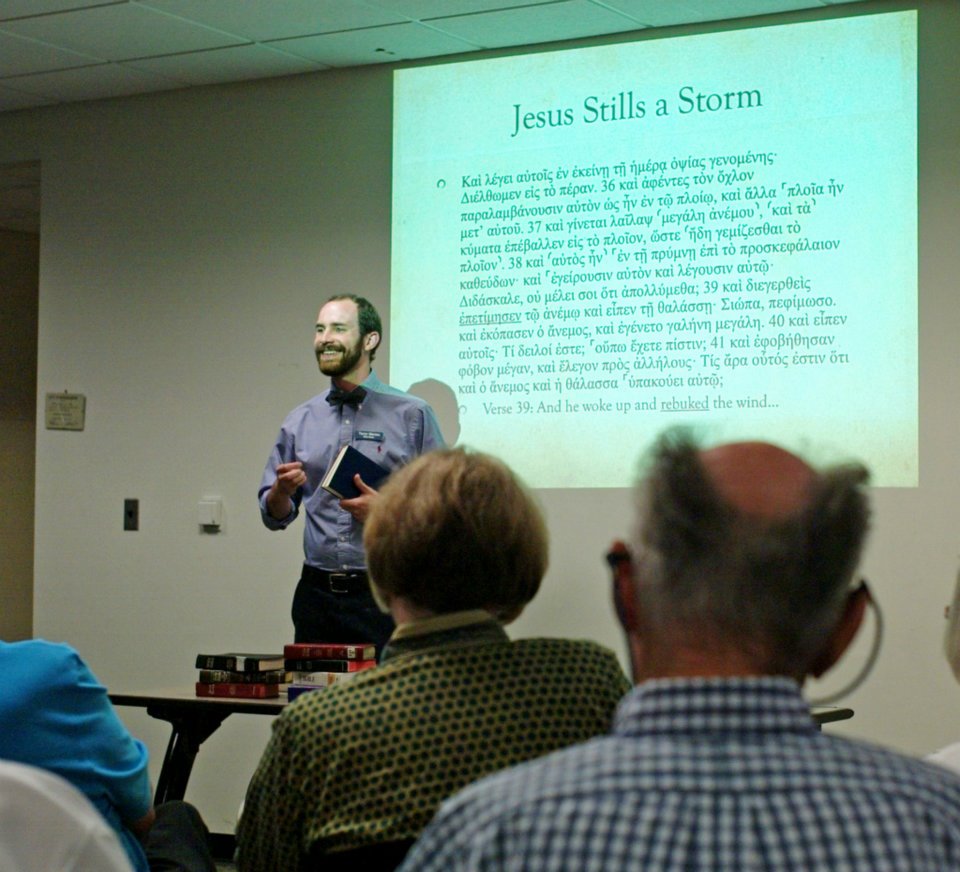
I was standing in front of a packed lecture hall, talking about Jesus according to the gospels, when I began to notice that the crowd was turning against me. For the previous three weeks I had stood in the front of that same room, a brilliantly bright powerpoint displayed on the screen behind me, making my way through the original Greek text of the gospel according to St. Mark. Each week we focused on a different element of Mark’s writing, comparing his gospel with the others, and generally reflecting on how this gospel still speaks fresh and new words into our lives.

It had seemed as if everyone was on board with what I was talking about, until the conversation moved to the cost of discipleship. I recognize now that I probably went to far, but at the time I felt the truth was worth exploring.

531711_3548371078945_1217125254_n

This is what I said: “In the gospels, particularly Mark, Jesus makes it very clear that following him, taking up our own crosses, being a disciple, will cost us our very lives.” Many people in attendance nodded. But then I continued, “Most of us here have no idea what that means. We sit in the comfort of our homes here in Michigan, sure we hear about all the bad things happening in the world, and even the bad things happening down the road in Detroit, but our lives will never be taken for our faith. We exist in such comfort with our faith that we can no longer even imagine what it would mean to give our lives for Christ, the cost of discipleship for us doesn’t cost very much at all.” “Well excuse me young man,” one of the women began, “but I go into downtown Detroit every week to serve food and give away clothing. My life is on the line for Christ every seven days. Don’t lecture me about the cost of discipleship.” This is when I should have stopped, apologized, and moved on, but I couldn’t help myself. So I asked her, “Do you go downtown every week because you believe thats the most and the best you can do as a disciple? Or do you go downtown with food and clothing every week because you feel guilty?


The early church had a problem. While the disciples were increasing in number, an argument developed over the distribution of food. Like us modern Methodists, a major conflict erupted not over proper theology, or reverence, but instead who was getting the appropriate amount of food. The twelve got together and asked for seven leaders to come forward in order to help with the organization of the early church, and to faithfully distribute the food among all the people. Stephen, described as a man full of faith and the Holy Spirit, was one of those chosen seven. 

In a short amount of time Stephen began to do great wonders and produce signs among the people. Once he stepped into the limelight of the early church, he rested under the microscope of many leaders and elders of the synagogues who argued with him. The leaders instigated some others to raise charges of heresy against Stephen and he soon found himself standing before the high-priest in order to defend his words and actions.

What followed is one of the most concise and deliberate retellings of the entire salvation story of God with God’s people. Stephen’s speech contains remembrances of Abraham, Isaac, Jacob, Joseph, Moses, and the prophets. He weaves the story in and out of the major moments; the beginning of the covenant, the flight to Egypt, Moses’ calling, the delivery from slavery to the Promised Land, the commandments being given on Sinai. In just a few short paragraphs Stephen perfectly encompassed the Old Testament for the high priest.

Though very descriptive, Stephen committed no blasphemy in his speech. He fairly repeated that which we have detailed for us in the scriptures, but before he finished speaking he had one final message to deliver: “You stiff-necked people, uncircumcised in heart and ears, you are forever opposing the Holy Spirit, just as your ancestors used to do. Which of the prophets did your ancestors not persecute? They killed those who foretold the coming of the Righteous One, and now you have become his betrayers and murderers. You are the ones that have received the law as ordained by angels, and yet you have not kept it.

It was only after hearing these words that the people became enraged and ground their teeth at Stephen. While they began to torment him, he looked up and saw the glory of God and Jesus standing along the right side, and he declared this triumphantly to the people. But instead of listening, instead of looking up to see what he could see, they covered their own ears and with a loud shout rushed forward to grab him and take him out of the city. While they stoned him, he prayed, “Lord Jesus, receive my spirit.” And with his final breath he cried out in a loud voice, “Lord, do not hold this sin against them.” When he had said this, he died.

saint-stephen-the-martyr-23

Stephen’s speech to the high priest and those gathered sealed his doom. Did he speak the kind of blasphemy against Moses and God like he was accused of? Nope. But Stephen went too far when he claimed that Jesus was at the right hand of the Lord, ready to rule. Stephen merely affirmed the same thing we claim every week when we stand and affirm the Apostles’ Creed, yet when he did it, it cost him his life. 

Some scholars and theologians claim that the climax of this episode in the book of Acts is Stephen’s death, when in fact the defining moment is the exaltation of Christ. Surrounded by his accusers and killers, Stephen continues to assert that Jesus is sitting at the right hand of God, that he is the long awaited Messiah already changing the world.

Jesus is there with Stephen at the final moments of his life, and how fitting considering the fact that Stephen utters the same words that Christ did at his own death. While the stones were flying through the air, Stephen’s prayer was not for deliverance, but a declaration of trust. Not, “Lord, save me!” but “Lord, receive my spirit.” His prayer is one that looks forward, not backward. His prayer was for his enemies, and not himself.

At his death, Stephen did what all of us are called to do in every moment of our lives: he acted like Jesus. He was serene while everyone else was going crazy; he was forgiving while the crowds were vindictive; he prayed while the people acted as if God was not among them; he loved when he saw nothing but hate; he trusted the Lord when everything was claiming the contrary; he kept on hoping when there seemed nothing left to keep hope alive. All of this to tell the truth to the high priest and the crowd. All of this to die for what he believed in. All of this as the cost for his own discipleship.

What happened to Stephen is paradigmatic for what the church was like. Thousands upon thousands of Christians have given their lives in order to speak the truth of God’s reign in the world.

In the United States we have “freedom of religion.” This was instituted during the foundation of our nation and has secured the right to practice religion, regardless of orientation or denomination. For Christians, the freedom of religion means that we are free to exercise our faith in whatever ways necessary so long as we do so within certain limits, as long as we do not become fanatical. We can pray as a family at public restaurants so long as it is not too loud to disrupt the other patrons. We can teach our children to turn the other cheek and love their enemies so long as we are still willing to let them serve in the military. We can talk about controversial issues in church so long as we limit those conversations to this building.

Yet the story that we read today, the remembrance of Stephen’s final moments, reminds us practitioners of polite, civil, and calculated religion that once there were Christians who readily and joyfully parted with possessions, family, friends, even life itself to remain faithful.

Some might call Stephen fanatical and crazy (after all he was willing to give his live for his faith) but he is presented as a very rational person who died for the same faith by which he lived.

When I stood in front of that crowded lecture hall, talking to the Methodists of Birmingham, Michigan, I could sense their desire to be affirmed in their faith. They wanted me to believe that they were willing to give their lives for Jesus, but the truth is, most of them, and most of us here, will never be in a situation like Stephen’s. Christianity has become so complacent and accepted within our culture that we no longer feel the need to be radical and controversial when considering the ways of the world versus the ways of God.

Our faith used to be a movement. The early church used to be attacked, arrested, and silenced for their dedication to the Word. The first methodists used to be ridiculed for their methodical dedications to spiritual disciplines, feeding the poor, and befriending the outcasts.

What would it take for someone to ridicule you in your faith? I’m not saying that we are all called to stand trial for our God and give our lives like Stephen, but instead we need to ask ourselves if we are living up to the potential of faith that God sees in us.

Not all of us can be Stephens, but we can all be Christians. We can all speak the truth of what God has done for us. We can reclaim our commitment to changing the world for the kingdom of God. We can discover our faith in God by opening our eyes to the kind of faith that he has in us. How far would you go to demonstrate your faith in the world? What would it take to start ruffling people’s feathers here in Staunton by living as Christ’s body?

Speaking the truth can be the most difficult thing in the world, but at the same time it can also be the most faithful thing in the world. Perhaps you know someone who has, for too long, relied on alcohol to fill an emptiness in their lives but you’re too afraid to saying anything. Maybe you know someone who treats their spouse horribly and you’re unsure how you can help the situation. Perhaps you’ve seen someone embarrass or harass their children in public. Or maybe you need to be honest with yourself about something you need to change in your own life.

Stephen was willing to speak the harsh truth to a people who desperately needed to hear it. Stephen was prepared to give his own life for a man he barely knew that died on a cross and was raised again. How far are you willing to go? Amen.