Devotional – Ezekiel 27.1-2

Devotional:

Ezekiel 37.1-2

The hand of the Lord came upon me, and he brought me out by the spirit of the Lord and set me down in the middle of the valley; it was full of bones. He led me all around them; there were very many lying in the valley, and they were very dry.

Weekly Devotional Image

I love challenging couples to pick their own wedding scripture beyond the cliché of 1 Corinthians 13 (Love is patient, love is kind…). In between premarital counseling sessions, I ask them to dive deep into their bibles in order to final a passage or a verse that really speaks to them, and I have been deeply impressed with the scriptures they’ve picked. I’ve been blessed to bring couples together into holy marriage with the stories of David being anointed by Samuel, Paul’s description of what it means to be a Christian, a prayer to the church in Ephesus, and more.

The scripture passage a couple chooses for their wedding says a lot about what their relationship is like, and what their marriage will be like.

Years ago, two of my friends from Durham were married at a local Presbyterian church that was known for the preaching of the pastor. To start the wedding homily, the pastor described the sanctity of marriage and what it means for two individuals to make this covenant, but then he began shaking his head and said, “You know that these two standing before us are devoutly faithful, because when I asked them to choose their wedding scripture, they picked the valley of the dry bones from Ezekiel.”

1509747_10155231246960627_1383507341785953622_n

I can remember sitting with my back against the pew and wondering what in the world he was going to do with the text. The valley of the dry bones is a remarkably beautiful passage, but it doesn’t naturally lend itself to a wedding sermon.

So the pastor continued on with bits of wisdom and advice, he shared stories about successful marriages and what to emulate as well as terrible marriages and what to avoid. But for the better part of ten minutes, he completely avoided the Ezekiel passage. And then, out of nowhere, the Spirit start blowing and he said, “James and Jennifer, I think you two can have a good marriage, but if you think that you can do it without the help of your friends, family, and the Lord, it will never be more than a dry valley filled with old bones. Only your friends, family, and the Lord can breathe the Spirit back into those bones and give them life.”

It was a simple sermonic twist, but it’s one that I think everyone it attendance will never forget.

What does your life look like? Is it filled with vibrancy and energy? Do you feel the Spirit moving in your midst? Or is your life like a deep valley filled with dry bones?

Thanks be to God who calls us into relationship with the Spirit, with our friends, and with our families who can breathe life into the dry bones of our lives.

The End Of The Beginning – Ash Wednesday

Genesis 3.19

By the sweat of your face you shall eat bread until you return to the ground, for out of it you were taken; you are dust, and to dust you shall return.

If you’re here in this place, with these people, on this occasion right now, you are blessed. You are blessed because you understand, you grasp, what the church is really all about. We are a people called church, who follow Jesus and take upon ourselves the sins of the world.

However, we don’t take upon the sins of the world in the way Jesus did. We are told to take up our own crosses, but we don’t drag them up to a place called The Skull, and we don’t wait for people to nail us to them. We take upon the sins of the world in confession, a confession that God is our judge and has every right to be. Because we have failed to be the people God has called us to be over and over and over again.

The United Methodist Church has a document to help us whenever we gather together. The Book of Worship outlines the ways to serve the Lord for just about every occasion, including funerals.

The Service of Committal is brief and is reserved for the graveside. And in our Book of Worship you can find these directions for clergy: “Stand at the head of the coffin and while facing it, cast earth upon it as it is lowered into the grave. The pastor then says, ‘Almighty God, into your hands we commend your son/daughter, in sure and certain hope of resurrection to eternal life through Jesus Christ our Lord. This body we commit to the ground, earth to earth, ashes to ashes, dust to dust.’”

The last time I did a graveside burial, I held the Book of Worship in my hands like I’ve done too many times before, I read the all too familiar words, and when it came time to cast dirt upon the coffin, I couldn’t find any. I frantically looked at the area around the hole, and they had covered it with a frighteningly sharp bright green carpet of AstroTurf. So I bent down in my robe onto my knees, and I started ripping up the perfectly manicured grass on the edge of the fabricated lawn. I needed some dirt. I needed to dirty this pristine and picturesque committal service because death is ugly and disruptive. I clawed the ground and threw the grass to the side until I scraped enough bare earth with my hands to have a solid mound to drop onto the coffin.

It was a holy thing.

dirt-placeholder

I took my dirt covered hands and placed them on the coffin, I prayed the words from the Book of Worship, and then I slowly walked away giving the family time to grieve before leaving. And just as I began backing away, the funeral director motioned for the pall bearers to come forward. But they did not bend down to the hole in the ground I had just revealed. No, they took roses, the boutonnieres, from their lapels and laid them silently on the recently dirt covered coffin.

It is, of course, much nicer to throw roses than dirt. But like almost everything in the tradition of the church regarding worship, the dirt has important theological significance.

I wound venture to guess that many Christians, though they hear the words about ashes to ashes and dust to dust at funerals and at Ash Wednesday services, they have no idea where those words come from. But you do. You know where they come from because you just heard it. It is the final announcement from God to Adam and Eve as they are kicked out of the Garden of Eden.

By the sweat of your face you shall eat bread until you return to the ground, for out of it you were taken; you are dust, and to dust you shall return.

            For us humans, this is the end of the beginning.

Much has been made about the Genesis story of eating from the tree of knowledge of Good and Evil. The slithering serpent who manipulates Eve’s desire; Eve’s treachery through inviting Adam to join her in the prohibited act; Adam hiding his shame and nakedness from God when the Lord returns to the Garden. And its all pretty harsh.

By this act sin was brought into the world. Because of our ancestors’ choice, we were banished from the paradise of God’s created order and were punished. Women must suffer through childbirth. Humans must work and sweat over the earth in order to glean enough produce to survive. Families are torn apart by an individual’s choice that has ramifications far greater than they can ever imagine.

And then we come to a place like this to have ashes smeared across our foreheads in an effort to remember what happened long ago, and what will happen to all of us one day.

We will die.

But we’re content with spending the rest of our days prettying everything that we can. We bring roses to place on the coffins at graveyards. Politicians bump up statistics to make things appear better than the actually are. We do our best to cover our scars, both physical and emotional, as if they were never there. And some churches spend Ash Wednesday not in sanctuaries confessing their sins with their brothers and sisters in faith, but in their parking lots presenting “Ashes to God with a cup of Joe.”

We would rather cover the harsh realities of truth than look at them in the eye.

God’s pronouncement to Adam and Eve, that terrifying moment when they were expelled and told that they will suffer until they return to the ground, that strange and all too familiar expression you are dust and to dust you shall return, they strike fear in the hearts of us mortals.

Sometimes its good to be afraid because it reminds us what a tremendous blessing it is to be alive at all. Sometimes its good to get down on our knees and confess our sins before the Lord because it reminds us that we are not God. And sometimes we need to catch a glimpse of ourselves in the mirror on Ash Wednesday to remember who we are, and whose we are.

This day, this Ash Wednesday, is a moment for us to confess our sins, and for all the sins of the people who are not here. We bow our heads and are adorned with a sign of death, not just as a reminder to us and to others that we will die, but that God will not let death be the final Word.

And here is the hope, my brothers and sisters, the hope we need on a day like today. We know how the story ends. We know that the pronouncement at the edge of the Garden was not the final word. We know the final word is not suffering, nor death, nor dirt, nor even dust. We know that the final Word is Jesus Christ.

The ashes that will soon be on our skin are not our crosses to bear, but Christ’s who carried it to The Skull and was nailed to it for the world. Jesus Christ is God’s greatest and final Word because in him the fullness of the Lord was pleased to dwell. In Him the sin of Adam and Eve were reconciled unto the Lord. In Him we are brought back into the dwelling of God’s grace where the light always shines in the darkness.

So wear the ashes with fear and trembling, let them dirty your lives a little bit, but also remember the hope that has been available to us in the one who hung on the cross, and rose again. Amen.

maxresdefault-2

Too Busy To Welcome – Advent Homily on Romans 15.7

Romans 15.7

Welcome one another, therefore, just as Christ has welcomed you, for the glory of God.

too-busy-for-christmas-1

When Bob Sharp was sent to Marquis Memorial, I know that he was welcomed because it didn’t take long for the church to paint his office burgundy and gold in honor of his dedicated devotion to the Washington Redskins.

When Courtney Joyner started at St. Paul’s, I know she was welcomed because she is a triple-threat: She can sing, she can jam, and she can preach.

When John Benson first preached at Augusta Street, I know he was welcomed because his people haven’t stopped shouting “Amen!” since his first sermon.

When Won Un showed up at Central, I know he was welcomed because their entire church community has developed an affinity for Kimchi and they know that if they can’t find Won on a nice day, it’s because he’s out riding his bike.

When Janet Knott arrived at Jollivue, I know she was welcomed because she preaches with gifts, and who doesn’t love presents?

When Clayton Payne began at Cherryvale, I know he was welcomed because people keep showing up week after week even though he keeps preaching the same sermon over and over again.

When Bryson Smith was appointed to St. Paul’s, I know he was welcomed because they know if the sermon falls flat, he can always sing a solo and get the people to shout “Praise the Lord!” and “Mercy!”

When Sarah Locke was sent to Christ, I know she was welcomed because people started showing up in her kitchen while she was still unpacking boxes. I know that because I was there!

I know the United Methodist churches of Staunton are a welcoming bunch because you have so warmly welcomed your pastors. But I wonder, do we welcome everyone to our churches in the same way we welcome the pastor when he or she first arrives? Do you really welcome one another just as Christ welcomed us?

When I arrived in Staunton, Won and I got together and thought it seemed about time to resurrect the Lenten and Advent luncheons. We were not here when they used to happen and so we were able to tweak the schedule and the organization a little bit. Important for us was the shifting of host churches and guest speakers so that everyone got a chance to welcome, and every preacher got a chance to preach.

Fun fact: As of Christmas day, I will have preached in every single United Methodist Church in Staunton. And it only took me three and a half years!

Anyway, we got the Lenten luncheons started again, and the first time I was invited to preach we were gathering at Central UMC. At the time, I was young and naive, and I thought it would be a good idea to wear my Carharrt Overalls when I preached from the pulpit in order to really drive home the message. Maybe you were there. Maybe you even remember some of the things I said.

I poured out my heart and soul from the pulpit at Central UMC and I did my best to make the people of St. John’s as proud as possible. Afterwards, during lunch, after the tenth or so person made a comment about my attire, an older woman came up to me and asked if we could talk (I won’t say which church she was from).

So we moved to the corner of the social hall, and she gingerly placed her hand on my shoulder and said, “I understand that you’re new to town you might be looking for a church home, so we’d love to have you join us for worship on Sunday.”

I remember just standing there stunned. I mean, it was a kind gesture for her to invite me to church (particular when the average person in a United Methodist Church invites someone to worship once every 33 years). But going to another church on Sunday is impossible.

She welcomed me, but she didn’t listen to me. I suspect that she was more concerned with having people in the pews, than with knowing who the people are in the pews.

Welcome one another, therefore, just as Christ welcomed you, for the glory of God.

How did Jesus welcome? Well, he certainly didn’t wait for people to just show up because he was having a service on a Wednesday afternoon, or a Sunday morning, or even on Christmas Eve. Jesus welcomed others by showing up in their lives, he met them where they were and ministered to them in terms and in ways they could understand. He told stories that connected with their daily living, stories about the soil and the birds of the air. He welcomed them in the midst of their suffering and isolation. He welcomed the very people who would abandon him to a table without cost.

At St. John’s we have a Preschool and I spend time every week leading the kids in what we call chapel time. I’ll take a lesson from scripture and try to rework it in ways that can understand and apply to their life.

Last week, after practicing the Christmas pageant for what felt like the thousandth time, I set up a small table near the altar and I invited the kids to come sit and listen. The thirty minutes prior to chapel time were filled with pushing and tripping and laughter and debauchery, but when they sat down around the table I started speaking in a soft voice, and they all started to listen.

I said, “My friends, I have something I want to share with you. This is bread and grape juice, but it is about to me much more than that. For this is a gift that Jesus gives to us. Some of you might do this in your church on Sundays, and whenever we sit at the table we are remembering Christ’s love for us. At this table, all of us are welcome no matter what. So let’s pray… God thank you for loving us so much that you welcome us no matter what we’ve done and no matter who we are. I pray that you would pour out your Spirit on us and make us more like Jesus so we can love others. Amen.”

And then one by one I called them by name, I gave each of them a piece of the bread, they dipped it into the cup, and the received communion.

Unlike us, the preschoolers have the benefit of not rushing around through this season of Advent endlessly crossing items off our to-do lists. Unlike us, the preschoolers don’t feel burdened by the tyranny of things and can sit quietly for a moment to receive a gift better than anything under the tree.

It often happens around this time of year that we feel too busy to welcome. We become more concerned with the wrapping paper and the ornaments and appearance of things than with the welcoming love of the Lord who was born into an unwelcoming town. When our sanctuaries fill up with more people than usual on Christmas Eve we are more often burdened by making sure everything is in the right place, than we are by making sure we are in the right place to welcome and be welcomed by the Lord.

And it is at the meal, the Lord’s Supper, the thing that most of us do on the first Sunday of the month, where we learn what it really means to welcome like Jesus. For Jesus is the one inviting you to the table, not merely hoping that you will show up to fill an empty place in a pew, but earnestly and truly yearning for your presence. You are invited because you are unique, you are wonderful, and you are a child of God. There is a place for you at the table no matter what.

Can you imagine what our churches would really look like if we welcomed others as Christ welcomed us?

Amen.

A Drop In The Ocean – Election Reflection

Isaiah 12.1-6

You will say in that day; I will give thanks to you, O Lord, for though you were angry with me, your anger turned away, and you comforted me. Surely God is my salvation; I will trust, and will not be afraid, for the Lord God is my strength and my might; he has become my salvation. With joy you will draw water from the wells of salvation. And you will say in that day: Give thanks to the Lord, call on his name; make known his deeds among the nations; proclaim that his name is exalted. Sing praises to the Lord, for he has done gloriously; let this be known in all the earth. Shout aloud and sing for joy, O royal Zion, for great in your midst is the Holy One of Israel.

imrs

The line was long when I arrived at my voting location. I sauntered along with the others who were shivering in the cold until we made it to the door and the warmth. We listened to three different people explain the process of voting, we were shifted like a herd of cattle from one side to the other, and then one by one we had to hand over our driver’s licenses to prove our identities.

The woman holding my license (with a picture of me at 20 years old) brought it right up to her face in order to examine every fine detail. Without looking at me she said, “state your name and address.” So I did. And only when handing the card back did she look up over her glasses to say, “you’ve changed.” Which actually sounded more like “you look older than the card says you are.”

Like a sheep, I was then shepherded over to a separate table where I filled in four bubbles, took the card over to the machine, waited for it to beep, and was given my sticker. All told, I was there for ten minutes. 18 months of anger and political outrage, 18 months and nearly 5 billion dollars spent on advertising and campaigns slogans, 18 months and national turmoil all came to fruition in a ten-minute dance in a church social hall for four votes.

If I’ve heard one thing as a pastor more than anything else about this election over the last year and a half, it was this: “God is punishing us.” “God is punishing us for our sinful ways and making us choose between the lesser of two evils.” “God is punishing us for electing a black president 8 years ago.” “God is punishing us for not getting faith back in schools.” “God is punishing us for our lack of faith.” “God is punishing us and the world is going to end with this election.”

Want to know a secret that shouldn’t be a secret? The world is not going to end tonight when all is said and done.

God has been God a whole lot longer than this world has had democratic elections. God has been God through every presidency. God has been God long before America existed. God has been God, and will be God, long after we’re gone.

We Christians believe that Jesus is Lord which means we believe that God is in control. We believe that God spoke the whole of creation into being and has called each of us by name. We believe that God is almighty regardless of who sits in the Oval Office. And perhaps most importantly, we believe that God calls us to love and pray for our enemies, which today means we are called to love and pray for the people who voted for the other candidate.

Can you imagine? Christians praying for people they disagree with? Sadly, that’s at the heart of what it means to follow Jesus and it has been so absent during this cycle. Instead, political offices have been bombed, churches have been burned, and voters have been intimidated at the polls.

And perhaps we want to blame Donald Trump or Hillary Clinton for this tumultuous season. But the problem goes far deeper than whoever will become the next president. The problem is us. We get the people we deserve running for office. Instead of seeing one another and brothers and sisters in Christ, we have adopted the world’s identification system and see one another as liberal or conservative. Instead of listening to those with different opinions, we just shout louder. Instead of believing that Jesus is Lord, we have fallen prey to the belief that the world hinges on this election.

But this election pales in comparison to God’s willingness to elect us. Not by a show of hands, not by absentee ballots, not by filling in a circle on a form, but electing us to salvation through his Son.

For it is Jesus Christ who humbles us to pray for those we hate. Jesus, though scorned and ridiculed by the people, does not call for votes to be cast, but says, “Follow me.” Jesus leads us on the path that leads to life, not prosperity and political prestige, but life eternal. Jesus places the uncomfortable yoke around our necks and says the burden is light. Jesus invites us to feast at the table and we do not deserve it. Jesus, high in the air with the nails in his hands and feet, says, “Forgive them Father, for they do not know what they are doing.”

If we’re honest, we don’t know what we’re doing. We don’t know what it means to be a Christian in America, we don’t know how to hold our political identities and Christian identities in tandem with one another, and we don’t know how to love the people we hate.

But we do know the truth: Jesus is Lord.

So we give thanks, for even though the Lord has been angry with us, he comforts us. Surely we know and believe that God is our salvation. We will trust, and not be afraid, for the Lord God is our strength and our might. Through the immeasurable gift of his Son we have been elected into a strange new way of life. With the knowledge of this joy we draw water from the wells of salvation. As we remember and contemplate our own baptisms we remember who we are and whose we are.

So we give thanks to the Lord, and call upon God’s name. We proclaim God’s mighty acts from the beginning of time until this moment. We sing praises to the Lord, for he has done gloriously.

Though some will say that our faith is fruitless, that to gather here at this moment, while the party lines are being heavily fortified for future derision, is pointless; that to pray for, and love, the very people who drive us crazy is a waste of time. Some will even be so bold as to believe that gathering at the table while the country is in chaos is no more than a drop in a limitless ocean, that it can never transform the world. Yet, what is any ocean but a multitude of drops? Amen.

Why The Cross? – Good Friday Homily

John 19.28-30

After this, when Jesus knew that all was now finished, he said (in order to fulfill the scripture), “I am thirsty.” A jar full of sour wine was standing there. So they put a sponge full of the wine on a branch of hyssop and held it to his mouth. When Jesus had received the wine, he said, “It is finished.” Then he bowed his head and gave up his spirit.


ethereal-finished-still-p3

I get asked a lot of questions. I’ll be in a bible study when the conversation moves to an area of confusion and all eyes will turn to me and someone will inevitably say, “What does this mean?” Or I’ll be in my office and someone will walk in to share about all of the trials and tribulations they’ve experienced and finish by asking, “So where is God in all of this?” Or, like after the atrocity in Brussels this week, I’ll receive an email that says, “How could God let this happen?” People are looking for answers.

On Wednesday morning I gathered all the little preschoolers into the sanctuary to talk about the cross. I wanted to show them the cross we have here in the sanctuary and eventually have them march outside in a line while I carried the cross. For most of them, Easter is about the bunny and the candy so anything I can do to make it more about Jesus is important.

They were all sitting nice and quiet in the pews as I explained Jesus’ final week, and that he died on a cross to help us get to heaven, and most of the kids nodded along. But one sat in the back pew with her eyebrows in an expression of “huh?” I tried to keep moving us forward but I could tell it wasn’t connecting with her so when I saw her shoot her hand up with a question I wasn’t surprised.

She asked, “But why did he have to die on a cross?”

In the moment I tried to answer her question in a way that only a four year old could understand, but the question has stayed with me nonetheless. Why did Jesus have to die on a cross?

Well, he had to die on a cross because that’s the way the Romans executed those who they regarded as a threat. Today we have drones and missiles that we can fire from far away in order to remove ourselves from death, but during the time of Jesus, they were hung high in the air so that all could see what happened when you challenged Rome. The cross was a sign of death and fear.

But that answer is not good enough for those, few, of us who gather in a place like this on Good Friday. If you’re here right now, you get that discipleship is more than just Easter. You get that Jesus was more than just a nice guy. You get that there is something more to this cross than symbolic remembrance.

Jesus died on a cross to reveal the heart of God.

The cross is where God’s grace crosses our life to create a new way of living.

We’ve got crosses everywhere and sometimes we forget how terrifying they were and should be. It is our central icon and we have them displayed in our sanctuary, some of us have crosses around our necks, and some of us even have them tattooed on our bodies. But notice: our crosses are empty. It would disrupt our Protestant sensibilities to have a murdered and graphic Jesus hanging on the cross for everyone to see. We would rather have the clean empty cross to remind us of the resurrection. But if we lose sight of the fright and discomfort of the crucifixion, the empty grave becomes cheap grace.

So, to be here on Good Friday implies a willingness on our part to confront the cross and we also want it explained. We want to know ‘why.’

But Jesus doesn’t offer us an explanation.

Whenever the religious elite, or the crowds, or his disciples questioned him, he would respond in cryptic parables that left them more confused than in the beginning. Jesus doesn’t offer simple explanations. Instead he offers love.

Explanations will never calm our anxieties in regard to suffering and tragedy. The people who try to explain the death of a young child by saying that “God wanted another angel in heaven” transform God into a murderer for the sake of an explanation. The people who try to explain a disabled child as “God’s way of punishing the mistakes of the parents” make God in a torturer for the sake of explanation. The people who try to rationalize terrorist attacks with “God is using them to show us its time to go to war” morph God into a selfish, violent, and manipulative entity for the sake of explanation.

Love, not explanation, is required when we are faced with tragedies. Instead of telling a grieving mother that God wanted her baby, we are supposed to show up with love and not answers. Instead of blaming sinful or faithless behavior for the disabilities in a child, we are supposed to love them with every fiber of our being. Instead of dropping bombs and sending drones to wipe out the Middle East we are supposed to see them as our brothers and sisters.

To be Christian is to enter into suffering. We do not look away from tragedies, we do not abandon those who are alone, and we do not isolate ourselves from the ways of the world. Instead, because of the cross, we are tasked with showing up for others when there is literally nothing we can do to save ourselves from suffering.

So, we could take the time to outline the connections between Jesus hanging on a tree with the first sin of Adam and Eve taking fruit from the tree of knowledge of good and evil. We could go deep into rationalizing the cross through theories like God used Jesus as bait to hook the devil from hell. But the truest response to the cross, the way we are called to go forth from Good Friday, is to look at the cross and take up our own to follow Jesus. Amen.

12042644_10205705206780417_2916230849357888646_n

Why Remember? – Maundy Thursday Homily

Mark 14.22-25

While they were eating, he took a loaf of bread, and after blessing it he broke it, gave it to them, and said, “Take; this is my body.” Then he took a cup, and after giving thanks he gave it to them, and all of them drank from it. He said to them, “This is my blood of the covenant, which is poured out for many. Truly I tell you, I will never again drink of the fruit of the vine until that day when I drink it new in the kingdom of God.”

Maundy-Thursday1

Why is this night different from all other nights?; A worthy question for any of us who took the time to gather in this place to remember Jesus’ final night. But the question is also asked of Jewish children who gather together for the celebration of Passover. Why is this night different from all other nights?

In the beginning God created the heavens and the earth. God brought forth all forms of life, which culminated in the creation of humankind. God made a covenant with Abraham to be his God, and for his descendants to be more numerous than the stars in the sky. Abraham eventually fathered Isaac who grew to father Jacob. Jacob wrestled with an angel of the Lord on the banks of the Jabbok river and was renamed Israel, which means: “you have struggled with God and prevailed.” Israel fathered Joseph who was sold into slavery in Egypt by his other brothers. But during his time in Egypt he became prosperous and eventually brought the gathering of Abraham descendants to live in the new and strange place.

At first everything was great in Egypt, the Hebrews lived comfortably, they had food to eat, homes to live in, and opportunities abounded. But over time, as it happens, the Egyptians grew jealous of the Hebrews and began to subjugate them. They were forced into labor, and eventually every male child born to a Hebrew woman was killed for fear that they would grow to rebel against the Egyptians.

Moses was born during this time and was saved by his mother by placing him in a basket to float down the Nile River. Moses grew in strength and wisdom and was called by God to lead God’s people out of captivity in Egypt to the Promised Land.

God commanded Moses to have the people to slaughter lambs and use the blood to mark their doors; this was to be a sign for the Lord to pass over their homes while slaughtering the firstborn males of Egypt. While waiting in the night, God implored the people to gird their loins and prepare to depart because their time of delivery had come near.

Passover is a night different from all other nights because it is a time set aside to remember the sacred and holy moment when God delivered God’s people out of slavery.

Jesus had gathered in the upper room with his friends to celebrate Passover. They sat around the table to remember what God had done long ago and be thankful. While they were eating Jesus took a loaf of bread, and after blessing it he broke it, gave it to them, and said, “Take; this is my body.” Then he took a cup, and after giving thanks he gave it to them, and all of them drank from it. He said to them, “This is my blood of the covenant, which is poured out for many.”

While they were remembering God’s actions from the past, Jesus said, “I am doing a new thing. I am delivering my body and my blood for you and the world.”

He took the Passover celebration, and assigned it to the great sacrifice he was about to make. Not only would the meal be a remembrance of God’s mighty acts, but also a testimony to God’s actions in Jesus Christ. The disciples would remember God delivering the people out of bondage in Egypt, and would now remember Jesus delivering the people out of bondage to sin and death. Whereas God brought the people into the holy land through the waters, God was now about to bring the people into resurrection through Christ’s sacrifice.

bread-and-wine

This is Good News for us, but it is also heavy news. Many of us buckle under the weight of knowing that Christ would give his life for us, but then we remember that Peter and Judas were at the table that night as well. We remember that in short time, the disciples who received the bread and cup would abandon Jesus to his cross and death. But he gave his life for them and us anyway.

So here we are, millennia later, remembering Jesus’ give of body and blood in the bread and cup. We remember God’s mighty acts of deliverance for the Hebrew people. But God’s power is not limited to the distant past. It is made available to each of us here and now.

At our tables, we are going to remember what God has done for us before we feast. With the people next to you I want you to discuss the following questions: What has God done for you? How have you seen God at work in your life recently? And what has God delivered you from?


I have seen God at work with our youth. Each week the youth of our church gather for an hour to share communion, fellowship, and bible study. We have examined some of the great moments from both the Old and New Testaments, we have learned about one another’s lives, and we always take time to remember Jesus’ final night with his disciples. Over the last year I have seen the youth transformed by the grace of God. Whereas they began meeting sheepishly and nervous to share about their lives, we now know each other well enough to check in on everyone without have to be prompted. Whereas they might have giggled during the first time we celebrated communion, they now respectfully and faithfully outstretch their hands to receive the bread and the cup.

Through the work of this church, God has delivered our youth from lives of selfishness to lives of appreciation. They have been delivered out of isolation into a community that genuinely cares about their well-being. They have experienced God’s love and it will stay with them forever.

Whenever we gather at God’s table, and particularly on Maundy Thursday, it is a time for us to confess where we have fallen short, recognize our forgiveness, share peace with one another, and give thanks to God for our deliverance. We remember where God has showed up in our lives, and the lives of others, because it retunes us into God’s frequency. We remember Jesus sharing the bread and the cup because he has shared it with the world. We remember in order to transform the world. Amen.

Unity in the UMC

Psalm 133

How very good and pleasant it is when kindred live together in unity! It is like the precious oil on the head, running down upon the beard, on the beard of Aaron, running down over the collar of his robes. It is like the dew of Hermon, which falls on the mountains of Zion. For there the Lord ordained his blessing, life forevermore.

12495241_10153458160651297_8700736706336599235_n

I love meeting people in our community and introducing myself as a pastor for the United Methodist Church. I love doing this because I never know what people will say in return.

“Oh, you must be that pastor who encouraged his church to start wearing hardhats to worship because God has a knack for tearing down walls…”

“No, you’re thinking of Clayton Payne at Cherryvale UMC.”

“Oh, you must be the pastor who loves shouting things like ‘Mercy!’ and ‘Praise the Lord!’ in the pulpit”

“No, you’re thinking of Bryson Smith at St. Paul’s UMC

“Oh, you must be the pastor who is forever mentioning apple butter and its many uses and applications.”

“No, you’re thinking of Sarah Locke at Christ UMC.”

“Oh, you must be the pastor who is absolutely obsessed with the Washington Redskins and even had the office painted burgundy and gold.”

“No, you’re thinking of Bob Sharp from Marquis Memorial UMC. Though I wish my office looked like his.”

“Oh, you must be the pastor who loves using objects in sermons, like handing out mirrors for people to remember the need to shine Jesus’ light.”

“No, you’re thinking of Janet Knott at Jollivue UMC.”

“Oh, well you don’t look Korean…”

“No, you’re thinking of Won Un at Central UMC.”

“Oh, you must be the pastor everyone raves about with a particular gift for preaching, handsome features, and can get congregations to shout ‘Amen!’ with feeling.”

(Sigh) “No, you’re thinking of John Benson at Augusta Street UMC.

“Oh, well then who are you?”

All of us pastors, and all of our churches are known for a variety of things. We’re known for our community engagement: Fish Fries, Apple Days, and Christmas Tree Sales. We’re known for the ways that our pastors like to preach and pray. We are known for a variety of things. We are known for how different we are from one another.

But the one thing I wish all people in Staunton knew about the United Methodist Church is that we love and worship the living God.


How very good and pleasant it is when kindred live together in unity!

The psalmist is right. We all know, on some level, the beauty of a community in unity. When we are working in one accord, when we harmonize with one another, it is very good and pleasant. But then we grimace at the way the psalmist talks about the beauty of unity. Can you imagine what would happen if I pulled John Benson up to the front of the sanctuary and poured extra virgin olive oil all over his head? And what is it about heavy dew that it supposed to elevate the blessing of unity?

Well, in the world of the psalmist, oil and dew were signs of God’s blessing. Like manna in the wilderness and the anointing of the prophets, these images speak to something greater at work than mere mortals. Yet, we are so removed from the time of the psalmist that these images no longer carry the weight they once did. Perhaps we need a new way of imagining the beauty of unity in community.

About a year ago, we started putting plans together for a community wide Trunk-or-Treat. Many of our churches had participated in some sort of Halloween celebration over the last few years, but we began imagining how much of an impact we could have if we worked together.

By the time October came around, all of the pieces were set and we were ready to host the Trunk-or-Treat at Gypsy Hill Park. On the day of the event I arrived super-early with hopes of setting the area up and organizing volunteers. We really had no idea how many people would show up but we were prepared for whatever would happen.

We handed out extra candy to all of the trunks, we set up safe areas for children to wander around, and we passed out orange vests to volunteers. The whole afternoon honestly felt like a whirlwind as we were trying to get everything together.

At the height of our preparations I noticed a small family off to the side of the parking lot watching us run around. They must’ve been standing there for ten minutes when I finally walked over to introduce myself.

What are you all doing?” the mother asked while keeping her three young boys close.

I said, “We’re calling it a Trunk-or-Treat, it’s a safe way to celebrate Halloween. We’ll be finished setting up in about an hour and we’d love it if you’d come through.” And with that she smiled shyly smiled and left the park.

Hours later, after 3,500 people came through the Trunk-or-Treat I was exhausted. Some of the last families were making their way through the few trunks that still had candy when I noticed the small family from earlier standing by the edge of the lot. The boys were not wearing costumes, but each of them held a bag full of candy with huge grins across their faces. I started walking over to find out if they had enjoyed themselves, but as I got closer I realized that even though the children were smiling, the mother was crying.

Is everything okay?” I asked.

With a wipe of her sleeve she tried to cover her tears and then said, “My boys have never had a Halloween before. All these people gave them candy and talked to us and asked us questions and they don’t even know us. You invited us to come earlier and you don’t even know us.

I replied, “You’re right. I don’t know you. But God does. And God loves you.

12182395_10204873871677559_710633466728393275_o (1)

How very good and pleasant it is when kindred live together in unity. It is like a mother all on her own, trying to raise her boys, who is treated with love and dignity by a strange community called the church. It is like the tears of a young mother rolling down her cheeks in recognition that she is not alone, and that she is loved no matter what.

How very good and pleasant it is when kindred live together in unity. It is like a group of people striving to be Christ’s body for the world through acts of grace and mercy. It is like volunteers giving out candy to countless children for no other reason than the fact that they too are children of God.

How very good and pleasant it is when kindred live together in unity. It is like a church that no longer treats other churches as competition, but instead sees them as brothers and sisters in Christ. It is like a group of people who believe that need trumps greed, that there can be unity in community, and that by the power of God’s grace the world can be transformed.

How very good and pleasant it is when kindred live together in unity. Amen.

Return to the Lord – Ash Wednesday Homily

Joel 2.12-17

Yet even now, says the Lord, return to me with all your heart, with fasting, with weeping, and with mourning; rend your hearts and not your clothing. Return to the Lord, your God, for he is gracious and merciful, slow to anger, and abounding in steadfast love, and relents from punishing. Who knows whether he will not turn and relent, and leave a blessing behind him, a grain offering and a drink offering for the Lord, your God? Blow the trumpet in Zion; sanctify a fast; call a solemn assembly; gather the people. Sanctify the congregation; assemble the aged; gather the children, even infants at the breast. Let the bridegroom leave his room, and the bride her canopy. Between the vestibule and the altar let the priests, the ministers of the Lord, weep. Let them say, “Spare your people, O Lord, and do not make your heritage a mockery, a byword among the nations. Why should it be said among the people, ‘Where is their God?’”

Ash_Wednesday (1)


While I was growing up, I remember being jealous off all the Christians with ashes on their foreheads every year. I grew up in a church that did not celebrate Ash Wednesday and so it always came as sort of a shock when I would get to school on a Wednesday morning and a whole bunch of people were walking around with smudges on their skin. Part of my jealously stemmed from the fact that they were excused from being on time in the morning and got to miss part of a class. But the depth of my envy came from the fact that they stood out for what they believed.

Of course, at the time, I had no idea what the crosses stood for or why they used ashes, I just thought they looked cool. I can vividly recall the feeling of spiritual inadequacy I experienced because I felt like, even though I went to church every week, I would never compare with the Ash Wednesday Christians. For years I witnessed their piety and was jealous.

When I finally got to an age and a church that celebrated Ash Wednesday, and I sat down in front of a pastor like all of you are doing right now, I was shocked by the words I heard: “You are dust, and to dust you shall return.

12711025_10205393920598457_5324242656613500482_o

For centuries Christians like you and I have gathered to mark the beginning of Lent with this solemn and holy service. Lent is a season set apart for renewal and repentance. Lent is a time for us to confront our brokenness. Lent is a time to give thanks for our blessings and stop taking them for granted.

These ashes convey our willingness to confront mortality. We hear, “You are dust, and to dust you shall return” as a reminder that the bell will toll for us all. This moment is a public witness to our need to return to the Lord.

The prophet Joel describes our need for repentance and renewal through the voice of the Lord: “Return to me with all your heart, with fasting, with weeping, and with mourning. Return to me, for I am gracious and merciful, slow to anger, and abounding in steadfast love.”

We know not when our days will end, and because of this we need to embrace each and every day for the gift that it is. I’m not saying we should spend the next 40 days contemplating death every single moment, but instead this season should be a time filled with gratitude for all of our blessings.

Ashes are a reminder for all of us, young and old alike, that life is precious. Because when we hear the words, and when we feel ashes crossed against our foreheads, we confront our limited time on earth. These ashes should prevent us from moving through each day without reflection, they should caution us against rehashing the old arguments and frustrations, they should shock us into giving thanks right here and right now.

God encourages us to use this season, a time that begins right now, as an opportunity to return to the Lord with our hearts, with outwards signs like fasting, praying, and reading. Take this time and embrace the gift that it is by doing things like reconcile with people that you have been arguing with, open up your bibles and discover the richness of God’s Word, and resist the temptation to believe that you are invincible.

I’ve been a pastor long enough now to have placed ashes on individual’s foreheads and then eventually place dirt on their coffins as they are lowered into the ground. I have stood in this sanctuary and made the sign of the cross with ashes on people who have returned to the dust from whence they came. So take this sign, take these ashes, and make good with the life you’ve been given. Stop taking your blessings for granted. Love one another. Give thanks for what you have. And return to the Lord. Amen.


The Shadow of the Cross – Good Friday Homily on Luke 23.32-46

Luke 23.32-46

Two others also, who were criminals, were led away to be put to death with him. When they came to the place that is called The Skull, they crucified Jesus there with the criminals, one of his right and one on his left. Then Jesus said, “Father, forgive them; for they do not know what they are doing.” And they cast lots to divide his clothing. And the people stood by, watching; but the leaders scoffed at him, saying, “He saved others; let him save himself if he is the Messiah of God, his chosen one!” The soldiers also mocked him, coming up and offering him sour wine, and saying, “If you are the King of the Jews, save yourself!” There was also an inscription over him, “This is the King of the Jews.” One of the criminals who were hanged there kept deriding him and saying, “Are you not the Messiah? Save yourself and us!” But the other rebuked him, saying, “Do you not fear God, since you are under the same sentence of condemnation? And we indeed have been condemned justly, for we are getting what we deserve for our deeds, but this man has done nothing wrong.” Then he said, “Jesus, remember me when you come into your kingdom.” He replied, “Truly I tell you, today you will be with me in Paradise.” It was now about noon, and darkness came over the whole land until three in the afternoon, while the sun’s light failed; and the curtain of the temple was torn in two. Then Jesus, crying with a loud voice, said, “Father, into your hands I commend my spirit.” Having said this, he breathed his last.

8812217-good-friday

Religious people aren’t supposed to fail, or suffer, or get arrested. They’re not supposed to hang out with vagrants, and criminals, and failures. Religious people are supposed to live good lives, surrounded by good people, doing good things. They’re supposed to have life all figured out, to be content, and to be filled with joy.

Jesus was beaten, dirtied, and was marched to his death with two criminals. While they walked along the way, the few disciples who had yet to abandon him must’ve lost all their hope; their Messiah was carrying a cross to the place called The Skull where he was to be crucified. Yet while the crowds screamed and threw their complaints into the air, Jesus calmly forged ahead with his eyes on the ground and the cross digging into his shoulder.

When they arrived on the hill, the guards nailed Jesus and the two thieves to their crosses and hung them in the air. The crowds must have grown larger the closer they came to the place and they hurled insults at the man in the air, ridiculing him for all that he had said and done. With the chaos erupting around him, Jesus bowed his head to speak with his Father: “Forgive them, for they don’t know what they’re doing.” 

In the entirety of the Christian year, Ash Wednesday and Good Friday are the least attended services. Christmas Eve and Easter are big days in the life of the church because we celebrate the incarnation and Jesus’ resurrection from the dead. But Ash Wednesday and Good Friday are all about death; “You are dust and to dust you shall return,” “Father, into your hands I commend my spirit.”

We don’t want to talk about death, we don’t want to talk about our own suffering, we don’t want to “bring other people down.

One of the things that surprises me most about funerals is our inability to confront death. When I preside over services of death and resurrection I am tasked with talking about, and affirming, the one thing that most people are afraid of: death being real. The juxtaposition between a funeral and the reception afterwards is sometimes nauseating.

Here in the sanctuary we speak the truth about death, we begin the process of grieving, we talk about what the person did with their lives and we acknowledge the void we now feel. But then I go to a reception and everyone wants to talk about everything else: March Madness brackets, the latest movies, new restaurants, and children’s activities. I’m not saying that we need to wallow in the sadness of death, but it is clear that we want to avoid death because it stinks.

goodfriday

By the time Jesus made it to the cross, the disciples had all cleared out. They had abandoned him for the same reasons that we avoid death today, it is too frightening, too heavy, and too sad.

The people began to mock the messiah in the tree: “he saved others; let him save himself if he really is the Messiah!” The soldiers taunted him with sour wine and scream out: “If you are the King of the Jews, save yourself.” And above his head they hung a sign containing his conviction: “This is the King of the Jews.”

Verbal attacks kept pouring in from the ground, but the scene now moves to the air. One of the criminals rebuked Jesus: “If you are the Messiah, save yourself and us!” But the other criminal spoke up, “we are getting what we deserve, but this man has done nothing wrong. Jesus please remember me when you come into your kingdom.

Jesus replied, “Truly I tell you, today you will be with me in paradise.

For the next three hours darkness came over the whole land and the temple curtain was town in two. Then Jesus, crying out with a loud voice, said, “Father, into your hands I commend my spirit.And he died.

For a long time I always inserted myself into the story as the forgiven criminal. I believed that even at the end I would’ve understood what Jesus was doing. As I grew older I started seeing myself as one of the disciples who abandoned the Lord and was nowhere to be found. I recognized that my faith isn’t as strong as I would like it to be, and that I would’ve been more concerned with my safety than with Jesus on the cross. But now, now I see myself as one of the bystanders who was there on Palm Sunday screaming “Hosanna” and then quickly began to scream “crucify!” a few days laters.

We sinners are lousy and fall short of God’s glory. We avoid people who are not like us, we want to shy away from common criminals, we want our lives to be perfect, and organized, and clean, and comfortable. And more often than not we enjoy witnessing the suffering of others.

But there is no shade in the shadow of the cross.

It is vitally important for us to remember that Jesus Christ was executed as a criminal among criminals! His death was made real on a cross because it warned the people about crimes agains the state and it added shame, pain, and public ridicule.

From the cross Jesus had no anger, only peace. He did not save himself, instead he saved a criminal. He did not thrash about with frustration, instead he was filled with serenity. He did not doubt God’s presence, he only trusted and kept faith.

Death is messy and ugly. I have been in enough hospitals, and stood over enough caskets to know how frightening death can be. Jesus’ death was likewise ugly. It was filled with shame and embarrassment. How did this prophetic Messiah go from the crowds cheering his name to being killed on a cross? How did he go from having faithful disciples to spending his finals moments with two criminals?

Jesus’ crucifixion was dirty and shameful. Yet, the hardest thing to comprehend is his willingness to forgive. More than the physical suffering and his literal death, his forgiving spirit is what stops us in our tracks when we read these words from so long ago.

From the cross Jesus announces forgiveness – this is the heart of the Gospel, it is the crux of the story, and it is what we are called to do if we are to follow him.

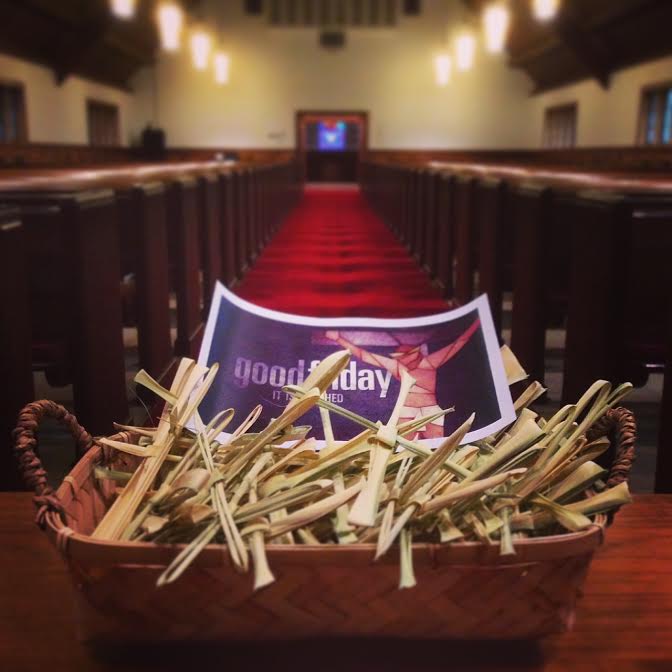
Last year I asked us to look at the cross and live. I implored us to give thanks to God for dying in Christ on our behalf to save us. I handed out crosses so that we might ponder the kind of divine love that was made real for us. I asked us to look at the cross and live.

This year I want to ask us to look at the cross and forgive. If Jesus was willing to use some of his final breaths to forgive the crowds for betraying him and bringing him to the cross, why are we so unwilling to forgive? If Jesus was so filled with love, shouldn’t we do the same?

Being a Christian is messy, ugly, and frightening if we are willing to follow Jesus. If we really want to be like him, then we have to start by forgiving others, and forgiving ourselves.

Amen.

unnamed

Washing With Tears – Maundy Thursday Homily on John 13.12-20

John 13.12-20

After he had washed their feet, had put on his robe, and had returned to the table, he said to them, “Do you know what I have done to you? You call me Teacher and Lord – and you are right, for that is what I am. So if I, your Lord and Teacher, have washed your feet, you also ought to wash one another’s feet. For I have set you an example, that you also should do as I have done to you. Very truly, I tell you, servants are not greater than their master, nor are messengers greater than the one who sent them. If you know these things, you are blessed if you do them. I am not speaking of all of you; I know whom I have chosen. But it is to fulfill the scripture, ‘The one who are my bread has lifted his heel against me.’ I tell you this now, before it occurs, so that when it does occur, you may believe that I am he. Very truly, I tell you, whoever receives one whom I send receives me; and whoever receives me receives him who sent me.”

bbo_ob_mcmca_40_slide

The disciples had already finished their food, they had passed around the bread and the cup, and Jesus had told them it was his body and blood. For many of them these words might’ve gone in one ear and out the other; after all Jesus was known for saying all sorts of the things that didn’t make sense right away. Perhaps some of them were picking up the crumbs from the bread when Jesus got up from the table. Others might have been refilling their cups with wine when Jesus tied a towel around his waist. But by the time he started to wash their feet the room must have been silent. 

Imagine how profound it would have been to see Jesus kneeling on the floor and using water to wash away the grime of Jerusalem. Even more amazing is the fact that Jesus doesn’t waste time explaining what he’s about to do, he just gets down on the ground and goes to work.

However, Peter, the ever vocal disciple interrupts the serene mood with a question: “Lord, are you going to wash my feet?

“Right now it won’t make sense my friend, but soon it will all come together. If you want to be in this with me, you must let me wash your feet.”

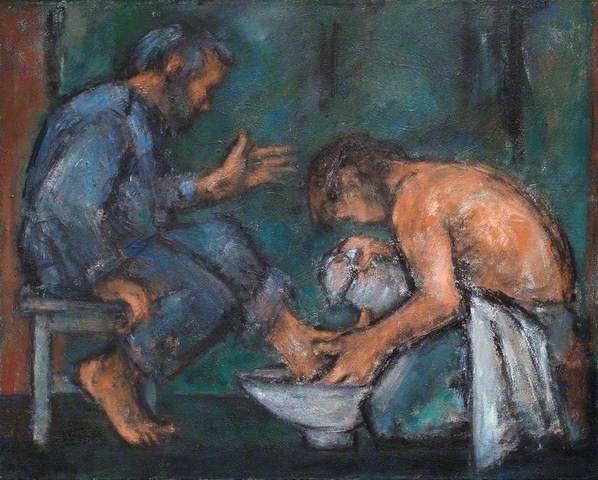
Jesus went from one disciple to the next taking as much time as necessary, holding their feet in his hands, letting the water drip upon them, until he finished.

I took a group of middle-schoolers on a mission trip a number of years ago to Winchester, Virginia. We worked in trailer parks building wooden steps up to the doors, we worked on a wheel chair ramp that took up an entire yard, and we worked on clearing out areas that had been long forgotten. All week we did everything we could to serve the needs of the people from the nearby community, and every night we gathered to sing songs and praise our Lord.

At the end of the week we were invited into the fellowship hall for a foot-washing ceremony. I don’t know if any of you have had the chance to spend a week working outside with middle-schoolers, but it begins to smell pretty bad pretty fast; the prospect of washing one another’s feet was not high on my list of priorities. The leader explained that long ago Jesus washed his disciples feet and we would be doing the same thing. Everyone was invited to participate, but if you were uncomfortable you could simply ask for a prayer instead.

A few chairs and basins were set in the middle of the space, and when the music began we were on our own.

In my work group there was a precious young girl who had worked so incredibly hard all week and there was a young boy that annoyed her every chance he had. He would begin by playfully flicking paint onto her clothes, but when she asked him to stop he became relentless. He called her names behind her back, and schemed to turn the other kids against her. Even after I pulled him aside to set him straight he continued to prey on her at every opportunity. 

As we sat in the room waiting for the first people to go forward for the foot washing, I watched the young girl stand up, and bee-line across the room for the annoying boy. For a fleeting moment I was afraid that she had finally had too much and she was about to sock him in the face, but instead she leaned over and asked if she could wash his feet.

While other people started to do the same, my gaze was transfixed on the boy and girl from my group. The boy had gone over the line time and time again yet there she was holding his foot in her hand and washing it. When I looked closer I saw that she was crying and her tears were falling on his feet. And when I looked even closer I saw that he was crying and his tears were falling in her hair.

Foot washing is a service among equals in a company where no one’s status stands out. When Jesus finished with his friends, he called them to do the same to one another. We wash and are washed by our Lord through our brothers and sisters in Christ. When we kneel before a fellow Christian and hold their feet in our hands we make our way back to the upper room so long ago. We aren’t just called to wash the feet of those whom we love, but even the ones who drive us crazy and fill us with anger. Remember: Jesus washed Judas’ feet knowing full and well what he was about to do. 

Sometimes the people we need to reconcile with most are the ones in the pews next to us. We tend to sweep under the rug all of the proverbial problems we have with our friends and family and are far more inclined to complain about strangers. If we are filled with stress regarding the closest people in our lives than this might be the best place to embark on a new beginning. Perhaps the water can bring new life for us and for the ones we love and hate.

Jesus took time after breaking bread with his friends to wash their feet. He humbled himself to the floor and showed them what faithful love looks like. With each foot he equipped them for bringing the peace of God into the world. He washed away their insufficiencies and doubts. He rid them of labels and assumptions. He showed them how important they were for the kingdom of God.

If you want to know what faithful love looks like, look no further than this time when we follow the example of Jesus and wash one another. Amen.

IMG_2100