Devotional – Isaiah 25.1

Devotional:

Isaiah 25.1

O Lord, you are my God; I will exalt you, I will praise your name; for you have done wonderful things, plans formed of old, faithful and sure.

Weekly Devotional Image

I felt very stressed during church yesterday. When I arrived in the morning I was dismayed to discover that the boiler was not working properly and we had no heat in the sanctuary. I must’ve gone into the basement five times in order to figure out what was wrong before the worship service began. Instead of taking the proper time to be in prayer and rested for worship, I spent the morning running around with thoughts of pilot lights and water pumps rather than Psalm 19 and God’s presence. Moreover, as the service began I noticed that the sound system was not functioning and I realized I was going to have to use my big preacher voice; instead of entering the sanctuary and singing the opening hymn faithfully, I worried about the lay people who rely on hearing assisted devices that would not be working.

When our service ended I felt drained. Carrying the burden of worship is often enough on its own, but to have the added stressors yesterday was almost too much. (Both the boiler and the sound system have now been fixed, in case any of you were worried). After shaking hands with everyone as they left, my wife, Lindsey, wrapped her arms around me, and told me that she was taking me out to lunch. Without having to explain to her everything that I had been through in the morning, without even mentioning how drained I felt, she read me like a comic book and offered to take care of me.

1977132_10202693858978604_8994329491928179368_n

We all have many blessings, even when we feel like we are in one of the deep valleys of life. While Lindsey and I drove to lunch yesterday I thanked and praised God for having done so many wonderful things for me: for bringing Lindsey and I together, for appointing me to a church with such loving and caring people, for bringing us to Staunton, for being present with me even when I let the stress of church overpower me. There are times when I find myself praying for others in our church and community, and I forget to thank God for all that he has done for me. It is sad how often I take for granted the incredible grace and mercy of the Lord that has been poured onto my life and I would do better to remember the words of Isaiah while I pray: “O Lord, you are my God; I will exalt you, I will praise your name; for you have done wonderful things, plans formed of old, faithful and sure.”

What are some of the wonderful things that God has done for you? Have you thanked God today for the blessings in your life?

Let us be thankful people who praise the Lord for his faithful presence.

Who Is This? – Sermon on Matthew 21.1-11

Matthew 21.1-11

When they had come near Jerusalem and had reached Bethphage, at the Mount of Olives, Jesus sent two disciples, saying to them, “Go into the village ahead of you, and immediately you will find a donkey tied, and a colt with her; untie them and bring them to me. If anyone says anything to you, just say this, ‘The Lord needs them.’ And he will send them immediately.” This took place to fulfill what had been spoken though the prophet, saying, “Tell the daughter of Zion, Look, your king is coming to you, humble, and mounted on a donkey, and on a colt, the foal of a donkey.” The disciples went and did as Jesus had directed them; they brought the donkey and the colt, and put their cloaks on them, and he sat on them. A very large crowd spread their cloaks on the road, and other cut branches from the trees and spread them on the road. The crowds that went ahead of him and that followed were shouting, “Hosanna to the Son of David! Blessed is the one who comes in the name of the Lord! Hosanna in the highest heaven!” When he entered Jerusalem, the whole city was in turmoil, asking, “Who is this?” The crowds were saying, “This is the prophet Jesus from Nazareth in Galilee.”

Christ's Entry into Jerusalem by Hippolyte Flandrin c. 1842

When Jesus tells you to do something, you do it. Sometimes it takes us a long time to figure this out, but for the disciples it must have been second nature. Two disciples were told to enter the next village and there they would find the necessary transportation; a donkey and a colt. “If anyone asks what you are doing, don’t worry about it, just tell them, ‘The Lord needs them.’

So the disciples went into the village, found the animals, and brought them back to Jesus. The rest of the disciples took off their cloaks and placed them on the donkey for Jesus to sit on. As they approached Jerusalem crowds of people took off their own cloaks, gathered palms from the fields, and placed them on the road for Jesus’ donkey to trample on. The people were shouting “Hosanna (Save us now!) to the Son of David! Blessed is the one who comes in the name of the Lord! Hosanna in the highest heaven!

Finally, when he entered Jerusalem, the whole city was in turmoil, asking, “Who is this?” The crowds were saying, “This is the prophet Jesus from Nazareth in Galilee.”

Hosanna_988

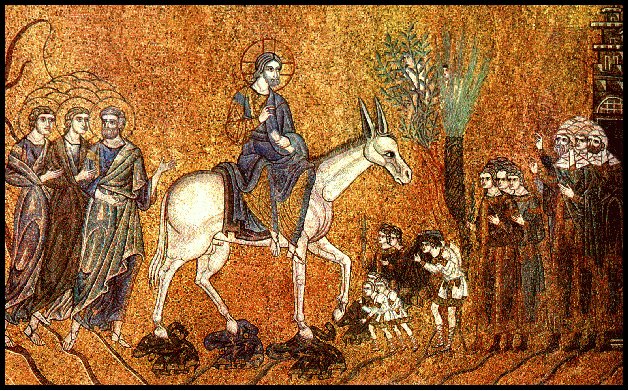
This story opens up for us Jesus’ royal status in a public setting. Rather than entering the holy city with an army wielding swords and shields, this king of kings entered Jerusalem humbly and gently on the back of a donkey. This was, of course, to fulfill what had been spoken through the prophet, “Tell the daughter of Zion, Look, your king is coming to you, humble, and mounted on a donkey.” Yet, you have to wonder, what did the crowds make of this prophet entering Jerusalem the way he did?

Matthew tells us that the crowds rejoiced to such a degree that they took off their clothes to place them on the road. They were so enamored by this coming prophet that they took it upon themselves to adorn the dirty roads with their cloaks as a symbol of royalty. They shouted “Hosanna Hosanna” while waving the palms branches just as we did this morning. But, at the end of the scripture, the whole city of Jerusalem is apparently in turmoil, as if an earthquake had happened, and they begin to ask, “Who is this?

The irony that follows our particular story is tragic. Within a week’s time the crowds that were shouting “Hosanna!” began to shout “Crucify!” The disciples that were so willing to find the donkey and use their own clothing as a saddle, would fall asleep on their Lord in the garden of Gethsemane. The people who walked before Jesus announcing his triumphant entry in the holy city, would follow behind him as he dragged his own cross to the top of calvary. In Jesus’ last pilgrimage to Jerusalem, the son of David reenters David’s city, but the only throne he will find is on a cross.

Is is frighteningly easy for us to think that by celebrating Palm Sunday we are acknowledging Jesus as a king in the way that Jerusalem failed to do! We need to be constantly reminded of how easy our shouts of “Hosanna” can change to “Crucify.”

Over the course of Lent this year, our confirmation class has been gathering together every week after church to learn more and more about this thing we call discipleship. Every time we gathered we shared a meal, just like Jesus would have with his disciples, and then we jumped right into the lesson. We focused on how Jesus is the vine, and we are the branches; to follow Christ we need to bear fruit in our lives.

The weekly lesson always had activities paired with them in order to flesh out what we had been talking about. When we looked at God the Father we discussed creation, sin, and redemption. We cut out pictures from magazines that reminded us of sin and discussed ways to avoid the temptations of our lives. When we focused on the Holy Spirit we all took turns wearing blind folds and walked around the church property helping to guide one another the way that the Spirit guides us. When we talked about Paul we wrote letters to our church about things we do well, and things that we need to change. I gave the youth old dinner plates and a permanent marker, inviting them to write down any negative memories, disappointments, or frustrations, and then we took the plates into the parking lot and smashed them into a hundred pieces. The following week we used those broken pieces to adorn our cross that now stands here in the sanctuary.

IMG_1279

One of my favorite actives from confirmation this year occurred when we talked about God the Son, Jesus Christ. I invited each of the confirmands to take 10 minutes to walk around our church building and look for Jesus. They were told to find words, phrases, or pictures that reminded them of their Lord and then write it down. Once we gathered back together, we shared what we had found and then I asked them the same question that the people in Jerusalem asked after Jesus entered on the back of a donkey: “Who is Jesus?”

The room was silent. Even though they had walked around the building and shared their discoveries with one another, they were reluctant to even attempt to answer the question.

As I stood there before our confirmands, uncomfortably waiting in the silence, I realized how difficult that question is: Who is Jesus?

I have often heard people remark that the youth are the future of the church. Logically speaking, this is true. One day we will return to dust and those who are younger than us will remain. But they are also very much the church right now. So, young people, listen to me very carefully: Confirmation is just like taking those first steps into Jerusalem. All of the adults here are looking at you to save them and the church. But, be careful, because their cries of hosanna can change to crucify before you even realize it.

We all do it. We look at the promise of youth, thanking God for their lives and imaginations, but as soon as they step too far we are ready to chastise them. So, as an example, here are some of the things that our confirmands wrote to our church:

Dear St John’s… I love the way that you greet everyone when they enter church. I love how our church feels like one big family. I love the way you care about me.

All wonderful and positive affirmations about what we do. Hosanna indeed.

But each letter also had to include things that we could change, ways that we could be better:

I wish we had younger people in church on Sundays. I think that we need actually start doing something for those in need. Maybe we can start a garden and give all of the produce away. I think we should start clapping for the choir after they sing a really wonderful song, rather than just sit in silence.

Not terribly offensive, but certainly different. I imagine that these young minds have countless suggestions of how we can do church differently, how we can embody the will of God in what we do, how we can make the Word incarnate in our lives. But, if it makes us uncomfortable, if it pushes us too far, how are we going to react? Will we still look at them with “hosannas” on our mind, or will we dismiss these new innovative ideas just as Jesus was dismissed by the crowds?

So, to the more mature gathered here at St. John’s this morning: I encourage you to look on these bright young confirmands with hope and respect. Do not jump to conclusions about their ideas simply because they are young and inexperienced, they could be closer to the will of God than any of us. Their answer to the question, “Who is Jesus?” might be completely different than yours, but if you ask them, they can show you a side of our Lord that you’ve never known.

And to the confirmands I say this: Remember that Jesus entered Jerusalem in a humble way, without a sword, vulnerable to whatever his enemies wished to do to him. As Albus Dumbledore once said, “the truth is a beautiful and terrible thing, and should therefore be treated with caution.” We want to hear your ideas, we want to see the world and the church through new perspectives, but be humble in the way you share what you see with us. Be kind in your sharing, and we will return that kindness in our hearing. Their answer to the question, “Who is Jesus?” might be completely different than yours, but if you ask them, they can show you a side of our Lord that you’ve never known.

entry-into-jerusalem-12th-century-mosaic2

Today, Jesus’ triumphant entry into Jerusalem is a cautionary tale reminding us of how quickly our opinion can sway; how quickly we can be divided; how quickly we can forget that we are one body in Jesus Christ. Young or old, experienced or recent to the faith, we are in this church together. We join together for worship week after week learning to speak and act and think and live and love as Christians.

This message isn’t just for our confirmation class; its for each and every single one of us gathered here today. We have a choice, we can choose to follow our own path, ignore the needs of those who bother us, and learn to take care of ourselves alone. We can move with the crowds and let our shouts from “hosanna” quickly change to “crucify” whenever we so choose. Or, we can march up to Calvary with our Lord carrying our own crosses. We can work together to bear fruit in God’s kingdom on earth. We can love the unlovable because God loves us.

“Who is this?” the crowds asked. Who is this strange man entering into the holy city to turn the world upside down? Who is this prophet who knows our innermost desires and listens to us when we feel alone? Who is this king who sits on the throne of a cross? Who is this priest that shares his bread and wine, body and blood, with and for us? Who is this incarnate God who died for the sins of the World? Who is this man that healed the sick, fed the hungry, and clothed the naked? Who is this teacher that shares all of his parables with us? Who is this Lord that humbles himself to be just like us? Who is this Savior that is completely unlike us?

If someone asked you, “Who is this?” how would you respond?

Amen.


But I Say…2 – Sermon on Psalm 119.33-40 & Matthew 5.43-48

Psalm 119.33-40

Teach me, O Lord, the way of your statutes, and I will observe it to the end. Give me understanding, that I may keep your law and observe it with my whole heart. Lead me in the path of your commandments, for I delight in it. Turn my heart to your decrees, and not to selfish gain. Turn my eyes from looking at vanities; give me life in your ways. Confirm to your servant your promise, which is for those who fear you. Turn away the disgrace that I dread, for your ordinances are good. See, I have longed for your precepts; in your righteousness give me life.

Matthew 5.43-48

“You have heard that it was said, ‘You shall love your neighbor and hate your enemy.’ But I say to you, Love your enemies and pray for those who persecute you, so that you may be children of your Father in heaven; for he makes his sun rise on the evil and on the good, and sends rain on the righteous and on the unrighteous. For if you love those who love you, what reward do you have? Do not even tax collectors do the same? And if you greet only your brothers and sister, what more are you doing than others? Do not even the Gentiles do the same? Be perfect, therefore, as your heavenly Father is perfect.

257760778642631661_Ag9PBVg2_c

Be perfect, therefore, as your heavenly Father is perfect.

Annual Conference is that one time of the year that all the diehard Methodists get together for a weekend of facts, faith, and fellowship. Representatives from each church gather in an effort to discuss contemporary issues facing the church, learn from various speakers, and celebrate the ordination and retirement of particular clergy.

A few summers ago, while serving a church outside of Detroit, Michigan, I was invited to attend the Detroit Annual Conference session. I listened to members of the conference debate whether or not to give more money to fight against malaria in Africa, how to address concerns over our pension system, and arguments about what it means to pray for physical healing in the church. Toward the end of the session, we came to my favorite part of every Annual Conference, The Service of Ordination. People, young and old alike, who felt the call of God on the lives to pursue a life of ministry, folk who have worked and sacrificed for years to be standing in front of all the people, were preparing to be commissioned and ordained for work in the church.

Detroit Annual Conference

Detroit Annual Conference

As the small group of adults stood shoulder to shoulder on the stage I wondered about their backgrounds, where they might be appointed, and what kind of ministerial careers they would have. Dressed in their robes, the candidates prepared to answer the traditional Wesleyan questions that thousands of Methodist clergy have had to answer over the last two centuries.

“Have you faith in Christ?”

The candidates definitively responded with a resounding “Yes!”

“Do you believe in the ordinances of the United Methodist Church?”

“Yes!”

“Are you going on to perfection?” 

Most of the responses we completely in sync, except for one woman toward the end. Instead of answering like her fellow peers, she shook her head as if to say no, while her voice said yes. 

YES

YES

Be perfect, therefore, as your heavenly father is perfect.

For that one clergy candidate, achieving perfection was something that she was clearly unsure about. I imagine that she understood her own fallibility, her sinfulness, as preventing her from ever being perfect. Moreover she probably thought that only Christ could be perfect and that it would never be possible for her.

Be perfect, therefore, as your heavenly father is perfect.


Here we are again, caught up in Jesus’ Sermon on the Mount. It was hard enough that he told his disciples to not lose their tempter, to not lust, and to renounce the right to retaliate; but now Jesus is instructing us to love those who hate and harm us. Really? Jesus is like that boss or parent that knowingly give us a list of things to do that we can never accomplish. Why does Jesus expect the impossible from those who follow him?

Using the same formula that we talked about last week, Jesus establishes the current expectations of the law and then he enhances them: “You have heard that it was said, ‘You shall love your neighbor and hate your enemy.’ But I say to you, Love you enemies and pray for those who persecute you, so that you may be the children of your Father in heaven; for he makes his sun rise on the evil and the good, and sends rain on the righteous and the unrighteous. For if you love those who love you, what reward do you have? Do not even tax collectors do the same? And if you greet only your brothers and sisters, what more are you doing than others? Do not even the Gentiles do the same? Be perfect, therefore, as your heavenly Father is perfect.”

Two important questions arise from Jesus’ declaration: Who is my enemy?; Why am I supposed to love them? 

Enemy number 1: Those who are evil. Anyone who takes advantage of the weak, anyone who promotes violence in power struggles, and anyone who exhibits evil in the world is my enemy. They are the ones who actively seek to work against God’s love and kingdom in the world. They are the people who participate in destructive tendencies toward others and are fans of violence, subjugation, and selfishness.

Enemy number 2: My friends and family. In many ways, some of our greatest enemies are those who are closest to us. Our friends and family are the ones who set expectations for what our lives are supposed to look like. They are the ones who know whether or not we are living up to our potential. They see our truest sides, they know about our weaknesses, they remember our history. When we create walls between ourselves and those who are close to us, we often do so because we are afraid of being too vulnerable with them, we fear what they can do to us.

Enemy number 3: Ourselves. I am my own worst enemy. I am the commander of my life. I am responsible for the choices and decisions I make. I know my own weaknesses better than anyone else, I hold myself to a standard that, when not met, leaves me feeling down and blue. I have more power than I should regarding the hearts, minds, and souls of so many people in my life, and if I abuse that power, I become an even greater enemy than anyone else in my life.

When we hear that Jesus calls us to love and pray for our enemies we do well to not relegate our enemies to far away and distant peoples. Our worst enemies might be sitting here with us in church this morning. We all have enemies in ways, that sometimes, we cannot even imagine. That neighbor who always trims your bushes, or that acquaintance who always takes advantage of your hospitality, or that stranger who belittles people at the supermarket are just as much our enemies as those who bring and promote terror across the world. For the Christian, the words neighbor and enemy are synonymous and are remarkably far reaching.

And Jesus tells us to love them, and to pray for them.

So, why? Why are we supposed to love those who hate and persecute us? Why does Jesus call us to love the people who often make our lives miserable?

We are not called to love them in order to change them. Thats not the point. Certainly the conversion of an enemy to a trusted friend can be the result of our discipleship and call to love, but it is not necessary, nor should it be our motivation for loving our enemies. Love is not a weapon or a tool. Genuine love has not ulterior motive; its purpose is simply to benefit the one being loved, regardless of the response. We are called to love unconditionally.

If you love someone, enemy or not, in order to change them, they will never change. Our love for others should not come with baggage but must be the same as the free and unconditional love and grace that comes to us from God.

We love others because God first loved us. Elsewhere in the world, it is normal to return love for love and hate for hate. Christians who do no more than this fade into the background of life. They cannot be the light of the world and salt of the earth.

Love your enemies and pray for those who persecute you so that you may be children of your Father in heaven. This kind of love is less about feelings and more about actions. For the early Christians to love the Roman oppressor or the face slapping persecutor was not about having “warm and fuzzy feelings” but to react in a positive way. I know that we have been trained to think of love as a feeling, particularly in the wake of Valentine’s day, but love is something you DO. That why Jesus calls his disciples to go the extra mile and turn the other cheek; physical embodiments of love for our enemies. Whatever else you can do to love your enemy, Jesus leaves it up to our imaginations as to how we can do so. Our love for others is called to be abnormal, above and beyond what the world would be satisfied with.

In addition to the embodiment, the DOING, of love, we are also called to pray for our enemies. You have heard it said that if you do this its enough, well to Jesus we can always do more, we can always be better. Loving our enemies is one thing, it is difficult and taxing, but praying for our enemies is another thing altogether.

love-your-enemies_dvd.original

Praying for our enemies requires us to seriously attempt to see them from God’s point of view. The sun rises on the evil and the good, and God sends rain on the righteous and the unrighteous. We cannot truly pray for our enemies without acknowledge our common humanity; our enemies have been created in the image of God, just as we were. And no matter how bad they are, no matter how nefarious, no matter how sinful, nothing can ever erase God’s image from their lives, nor from ours.

The call to pray for our enemies is like being a parent who can earnestly say to their child, “I love you, but I don’t like what you’re doing.” Praying for our enemies will always fall short unless we remember that God love us just as much as our enemies. Seeing them in the light of God’s love is the first step toward loving them, and praying for them.

So, is this even possible? Are we capable of loving and praying for our enemies? Can we be perfect? If we try to do it on our own, it is impossible. Only by the grace of God, only with God’s help, can we heed Jesus’ call to love and pray for our enemies. Truly I tell you, this is one of the most difficult aspects of being a Christian. We are called to an impossible life, if we try to do it on our own. Christ is not asking us to simply “like” everybody, but rather to act and pray in love toward those we like and those we do not like.

Be perfect, therefore, as your heavenly Father is perfect. 

At our Lectionary Bible Study this week, we sat in one of the Sunday school rooms and read this text out loud. As usual, many of the comments and questions were quite profound leading toward a greater understanding of the text for all of us. As we were coming to the end of our time together, Betty Hairfield offered a story regarding this idea of perfection.

Years ago, while Betty was in college, she began worshipping at a United Methodist Church because it was closer to campus than the denomination she grew up with. One day Betty was told about the question of perfection that all ministerial candidates were asked about. Like the woman who shook her head while saying “yes,” Betty kept the words close to her heart and she began to understand the depth of the question: “Are you going on to perfection?” For Betty, this was a transformative moment. If perfection is not our goal, then whats the point? Why should we continue to worship a God who loves unless we try to live better lives. That realization, that question of perfection, is what led Betty to join the United Methodist Church.

We are not called to be content with the mediocrity of discipleship but instead we are called to live radical and abnormal lives. Like the psalmist we need to pray for God’s wisdom and grace to be the kind of people who can change the world. We need to strive to be better than good, to live into the new reality that Jesus established with his life, death, and resurrection. Love and pray for those who are evil, for your friends and family, and for yourselves!

Are we going on to perfection? Yes, but only with God’s help.

Amen.

Questions: In the End… – Sermon on John 14.5-6, 1 Timothy 2.1-4, and John 13.34

(Instead of a typical ~15 minute sermon from the pulpit, I broke the following sermon up into 3 homilies. I preached the first from the pulpit, the second from the lectern, and the third from the middle)

John 14.5-6

Thomas said to him, “Lord, we do not know where you are going. How can we know the way?” Jesus said to him, “I am the way, and the truth, and the life. No one comes to the Father except through me.

1 Timothy 2.1-4

First of all, then, I urge that supplications, prayers, intercessions, and thanksgivings be made for everyone, for kings and all who are in high positions, so that we may lead a quiet and peaceable life in all godliness and dignity. This is right and is acceptable in the sight of God our Savior, who desires everyone to be saved and to come to the knowledge of truth.

John 13.34

I give you a new commandment, that you love one another. Just as I have loved you, you should also love one another.


Today we conclude our sermon series on “Questions.” After requesting responses from all of you regarding your questions about God, faith, and the church, we have, again, come to the time when I attempt to faithfully respond to those questions. Over the last two weeks we have looked at what it means to be “saved” and how the Old and New Testaments relate to one another. Today we are talking about other faiths and how they relate to Christianity. So, here we go…

xlba-00052

John 14.5-6: Thomas said to him, “Lord, we do not know where you are going. How can we know the way?” Jesus said to him, “I am the way, and the truth, and the life. No one comes to the Father except through me.

For nearly an entire semester I sat in the front row for my class on “Hindu Traditions” at JMU. My professor was a practicing Hindu and regularly lectured from the front, pacing back and forth as we covered history, beliefs, and habits. Dr. Mittal was remarkably passionate about the subject and as we came to the conclusion of the class, I was thankful for his ability to open my eyes to the wonders of a great religion.

It was during our last class session that Dr. Mittal asked if there were anything remaining questions before the Final Exam. A few hands raised, mostly questions about the actual exam; Would it be multiple choice? Would it contain essays? But, one young woman, prominently displaying her “Campus Crusade for Christ” sweater, asked a question that I’ll never forget: “If you know you’re going to hell for being a Hindu, why wouldn’t you become a Christian to save yourself?”

The room was silent. 

Dr. Mittal, having been calm and collected all semester, began to clench his fists together and flare his nostrils. “How dare you speak to me that way! I am so tired of you young foolish Christians trying to tell me what to believe in. Get out of my class!”

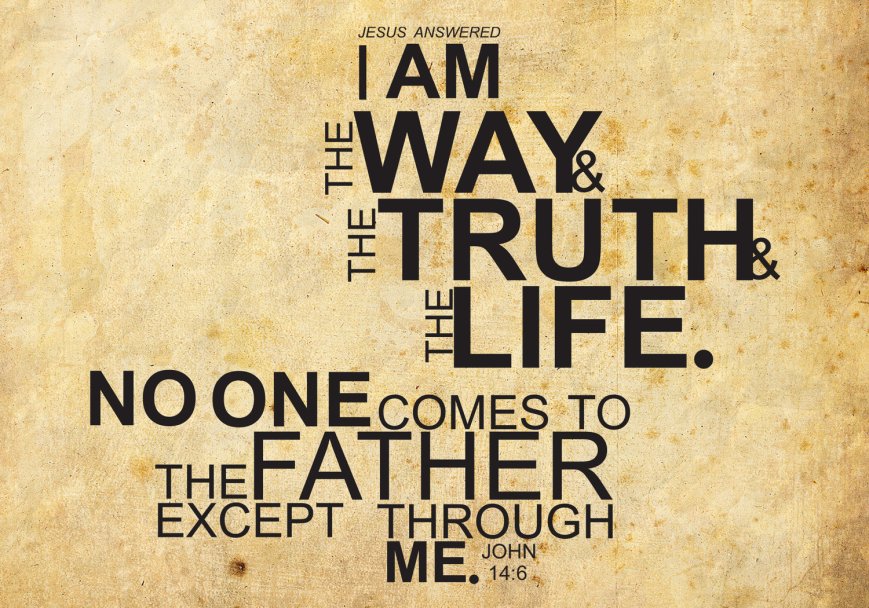
The disciple Thomas, ever concerned about what Jesus is really saying, questioned his Lord about the truth of where they were going. And Jesus replied, “I am the way, and the truth, and the life. No one comes to the Father except through me.” Jesus does not know the way, truth, and life; rather, he is all of these. And he is not merely a way, but THE way. Jesus is the unique and visible manifestation of God on earth. 
il_fullxfull-288241452

From the beginning of the church, this statement has been axiomatic for Christianity. If you desire to know God, to find salvation, and to experience grace in your life, you can only find it through Jesus Christ; hence the strong push for evangelism over the last 2 millennia. Not only did Jesus command the disciples to go to all the nations baptizing everyone in the name of the Father and the Son and the Holy Spirit, but we have been steeped in our tradition that affirms salvation can only come through Jesus Christ.

In the first few centuries the church agreed that outside of the church, there is no salvation. In order to experience the forgiving pardon of God you had to be taught the ways of the church, engage in acts of kindness and mercy, and be baptized in order to find your identity within the body of Christ. Even with the rise of other religions, and the interaction between them and Christianity, we affirm that the only way to God is through his Son, our Lord, Jesus Christ.

I remember feeling so uncomfortable that day in class because of what my fellow student had said to Dr. Mittal. In the moment I thought she just wanted to frustrate him, or illicit some sort of reaction from him. However, perhaps she was being remarkably genuine, concerned about his salvation, and wanted to know why he would continue on a path that would separate him from God.

After all, no one can come to the Father except through Jesus Christ.

Amen.


1 Timothy 2.1-4: “First of all, then, I urge that supplications, prayers, intercessions, and thanksgivings be made for everyone, for kings and all who are in high positions, so that we may lead a quiet and peaceable life in all godliness and dignity. This is right and is acceptable in the sight of God our Savior, who desires everyone to be saved.”

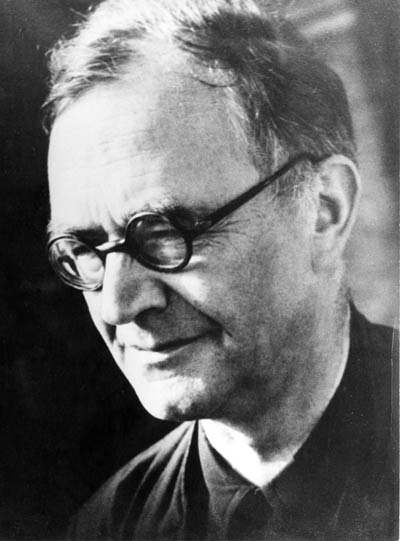
Karl Barth, the dialectic theologian of the 20th century (who I have mentioned a number of times from the pulpit) was often vague regarding his understanding of the totality of salvation. In his lectures and publications there are examples where he almost affirms a universalist understanding of God’s redemptive work. He dances around the claim that all have been, and will be, saved through Christ’s death and resurrection.

Karl Barth

Karl Barth

Once, after a series of lectures, a young theologian bravely raised his hand to ask a question. “Professor Barth, I would like to know once and for all: are you a universalist? Do you believe that everyone will go to heaven?” Barth probably crossed his arms and thought deeply about his response. After contemplating the implications of what he was about to say, Barth answered the young theologian: “That is a great question. Let me put it this way: I will not be disappointed if heaven is crowded.”

The question of universalism is remarkably relevant considering the great range of thought regarding faith and discipleship. Our world is becoming more and more diverse, with differing understandings of Christianity springing up all over the world. Was Christ’s sacrifice on the cross only for those who believe in him, or was it for all of creation?

We might think of the often quoted John 3.16: “For God so loved the world that he gave his only begotten Son” or the number of instances in scripture where individuals outside the realm of Israel (such as Rahab from Jericho, Nebuchadnezzar from Babylon, and the unnamed centurion who declared, “Truly this man was God’s Son” at the moment Christ died on the cross) who played remarkable roles in the story of God’s interaction with God’s people.

We might think of the fact that humankind was created in the image of God. Every individual has been molded from God’s image and given life through the Spirit regardless of their religious affiliation.

We might think of examples from Christ’s ministry where he did not come for the religious elite, but for the last, the least, and the lost. Jesus shared meals with the sinners, the vagrants, and the outcasts. Jesus said, “Those who are well have no need of a physician, but only those who are sick. Go and learn what this means, “I desire mercy, not sacrifice,” For I have come to call not the righteous but sinners.”

If we believe that nothing can ever separate us from the love of God in Jesus Christ, neither death, nor life, nor angels, nor rulers, not things present, nor things to comes, nor powers, nor height, nor depth, nor anything else in all creation, then God’s mercy truly knows no bounds. God’s love is so magnificent and unconditional that it extends not only to all of us gathered here, but to all creation. God’s love has been poured out through Christ’s death and resurrection onto the church, and to everyone outside of the church. Jews, Muslims, Christians, Atheists, Agnostics, and everyone in between have been caught up in God’s great cosmic victory over death.

In Barth’s response to the young theologian, he deliberately avoided answering the specific question, yet he embodied the kind of hope that all Christians should have; that God’s love is so powerful that he came to die for us, while we were yet sinners; that God’s mercy is so strong that nothing will ever separate us from God; and that God’s grace is so abundant that heaven will be crowded.

After all, “This is right and acceptable in the sight of God our Savior, who desires everyone to be saved.” Amen.


John 13.34: “I give you a new commandment, that you love one another. Just as I have loved you, you should also love one another.”

During my final year of seminary I served as an on-call chaplain at Duke University hospital. We were required to stay on the hospital property for 24 hours attending the numerous pages, calls, and deaths that occurred throughout our shift. One night, after sitting with numerous families who had just learned that someone had died, after talking with patients just diagnosed with inoperable cancer, after pacing up and down the sterile halls for hours, I found myself in the chapel. A tiny room, no bigger than our narthex, it contained numerous religious materials, a piano, an altar, and a notebook for prayers. Whenever I had a moment I would stop in and pray the prayers out loud, and most of the time it was empty. It became a place of solace for me, a space where I could remove myself from the chaos of the hospital.

Burning Bush in Duke Hospital's Chapel

Burning Bush in Duke Hospital’s Chapel

Every once and awhile I would encounter a Muslim praying on his knees in the corner. We would always politely nod toward one another and continue on with our religious responsibilities. But that night, the night that felt like it would never end, everything changed.

I was standing at the altar, while my companion prayed in the corner, we both spoke in a whisper so as to not disturb the other, when all of the sudden he stopped, stood up, and walked to my side. “Let us pray together” he said. And without discussing the details, without organizing our thoughts, without debating the theological differences and implications, we both began to pray, shoulder to shoulder, for the people we were serving. When our prayers naturally came to their conclusion, we met eye to eye, nodded, and went on our separate ways.

In compiling all of the questions for this sermon series, “What happens to people of other faiths?” appeared more than any other. Without a doubt, the existence of and interactions with other religions is, perhaps, the most significant challenge to, and opportunity for, the Christian church today. Moreover, the rise of atheism further complicates the picture into a varied mosaic whereby the church is challenged to address both those who do not believe and those who do believe, but who believe differently from us.

So, what happens to people of other faiths? I don’t know. We can take Jesus words from John, or other affirmations from scripture and receive very different answers. One of the struggles with being a Christian is that we have to paradoxically affirm both responses, that salvation can only come through the church, and that through Christ all have been saved. “What happens to people of other faiths?” is an interesting question, but in the end, God is the only one who holds the answer. However, a question that strikes at our hearts today is: “How do we relate to people of other faiths?”

Jesus commands all of us to love one another, this is the new commandment. If there is any command from Jesus to obey in our lives regarding other faiths it is this: love one another. In my own life God has used a number of people from outside the church to help teach me about what it means to be a discipleship of Jesus Christ: questions from my secular friends about why I believe, the love expressed by indigenous Mayan women in the highlands of Guatemala, one of the Muslim doctors at Duke Hospital who met me in the depth of suffering for prayer.

What has been revealed for us through Christ’s life, death, and resurrection is that God desire us to be in relationship with others. This means that we have to be willing to be vulnerable with people different from us, people whose beliefs contradict our own, and people with no beliefs at all. We are called to love one another just as God has loved us. We are not here just to minister to other Christians, but to the whole world. We are called to seek justice and mercy in the world for ALL who are oppressed regardless of age, race, sexual orientation, gender, economic status, and religious affiliation.

And so, in the great adapted words of John Wesley: Though we may not think alike, though our differences of opinion and religious understanding may vary considerably, though we may not agree on the scope of salvation, though we may not have the same opinion about the role that Jesus plays in the cosmic victory over death, may we not love alike?

Without all doubt, we may. Amen.

Weekly Devotional – 1/27/14

Devotional:

Psalm 15.1-4

O Lord, who may abide in your tent? Who may dwell on your holy hill? Those who walk blamelessly, and do what is right, and speak the truth from their heart; who do not slander with their tongue, and do no evil to their friends, nor take up a reproach against their neighbors; in whose eyes the wicked are despised, but who honor those who fear the Lord; who stand by their oath even to their hurt.


“Being a Christian must be so easy,” a friend of mine once said, “You can do whatever you want, just so long as you confess right before you die, you’ll still go to heaven.”

Responding to those kind of comments has always been difficult for me. Yes, we do believe that God’s forgiveness will always come because nothing can ever separate us from the love of God in Jesus Christ. Yes,  you could live your whole life in ignorance of God’s love and mercy, only to discover it in your last days and God would still be there waiting to receive you. However, upon later reflection, I wish I could have responded to that particular comment in the way that Augustine did in the fourth century:

703“Some delude themselves because of God’s mercy. They say: “I still have a little time left to live how I like. Why shouldn’t I live how I like as much as I like and then turn to God later? After all, God has promised to pardon me.” I respond, “True, but he has not promised that you are going to be alive tomorrow.” – St. Augustine, Sermon 339

When Christianity is compartmentalized into “what happens to me after I die?” then all respect and concern for the present is lost. In Psalm 15 we learn about what it means to be welcomed to God’s holy hill, to abide in God’s tent; our faithfulness is far less concerned with our ability to accept God in our last days, than it is about living a life of service and holiness.

A professor of mine once said, “The question should not be, ‘If I die tonight, what will happen to me?’ but instead, ‘If I live for another day, what will I do with it? How will I love God and my neighbor?’”

So, let us all seek to live holy lives in the present. Let us not put off for tomorrow what we can, and should, do today. Let us look at our own lives and ask “am I walking blamelessly, doing what is right, and speaking the truth?”


In Those Days… – Christmas Eve Sermon on Luke 2.1-20

Luke 2.1-20

In those days a decree went out from Emperor Augustus that all the world should be registered. This was the first registration and was taken while Quirinius was governor of Syria. All went to their own towns to be registered. Joseph also went from the town of Nazareth in Galilee to Judea, to the city of David called Bethlehem, because he was descended from the house and family of David. He went to be registered with Mary, to whom he was engaged and who was expecting a child. And she gave birth to her firstborn son and wrapped him in bands of cloth, and laid him in the manger, because there was no place from them in the inn. In that region there were shepherds living in the fields, keeping watch over their flock by night. Then an angel of the Lord stood before them, and the glory of the Lord stood before them, and they were terrified. But the angel said to them, “Do not be afraid; for see – I am bringing you good news of great joy for all the people: to you is born this day in the city of David a Savior, who is the Messiah, the Lord. This will be a sign for you: you will find a child wrapped in bands of cloth and lying in a manger.” And suddenly there was with the angel a multitude of the heavenly host, praising God and saying, “Glory to God in the highest heaven, and on earth peace among those whom he favors!” When the angels had left them and gone into heaven, the shepherds said to one another, “Let us go now to Bethlehem and see this thing that has taken place, which the Lord has made known to us.” So they went with haste and found Mary and Joseph, and the child lying in the manger. When they saw this, they made known what had been told them about this child; and all who heard it were amazed at what the shepherds told them. But Mary treasured all these words and pondered them in her heart. The shepherds returned, glorifying and praising God for all they had heard and seen, as it had been told them.


Do not be afraid; for see — I am bringing you good news of great joy for all the people: to you is born this day in the city of David a Savior, who is the Messiah, the Lord.

lord-jesus-christ

In those days Augustus ruled over everything. The emperor of the powerful Roman empire had true and frightening power. His authority was known from the British Isles to Asia and into Africa. His very name meant wealth, rule, and power. His face and title was printed on currency, his decrees spread throughout the lands, and he was known by all. So, in those days, in the days of Augustus, our story begins.

And then one night in a tiny and seemingly obsolete town, part of Rome’s conquest, a baby was born. It was a tucked away village of little consequence to which the mother and her soon-to-be husband were traveling, not by choice, but because Augustus wanted the world to be registered. Both of them were poor, and when they arrived in the town no one took notice of their coming, no one offered to help them find a place to stay, no one even spoke to them. They went looking for space at the Inn, but there was no room, so the only place they could find to stay was a stable; that was where their child was born, a child named Jesus.

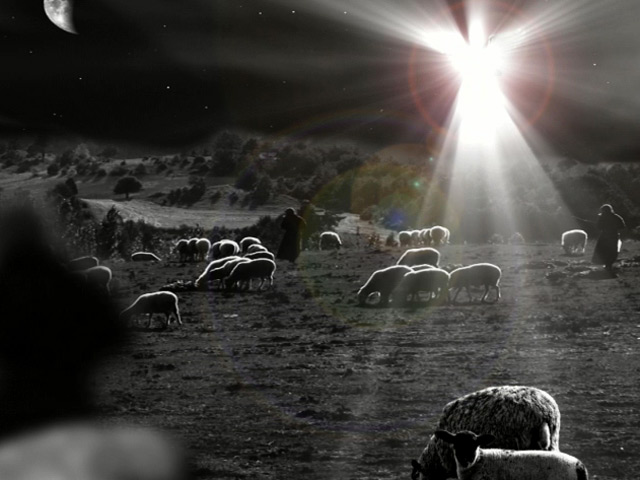
We learn then that within the region there were shepherds living in the fields who were confronted by an angel of the Lord. The angel brought great tidings of this new child’s birth, calling him a Savior, the Messiah, the Lord. And so these unnamed shepherds traveled into the city of Bethlehem to meet this child face to face, coming into contact with the incarnate God almighty. They shared their story with anyone who would listen and continuously glorified and praised God for all they had seen.

In those days, when everyone knew and feared the power of Augustus, a baby was born. And somehow, that tiny child born in the most unlikely of places and circumstances transformed the world forever. Augustus is only remembered in history books and lecture halls, whereas that baby grew into the man that embodied hope for the world from the day he was born to this very night. Augustus had all the power and money and influence to do whatever he wanted, yet Rome still fell. But of God’s kingdom there will be no end. Why? Because the power of Christ lives on, his light and love reaches into our very hearts and changes us into something new, different, and wonderful.

This story has been told for millennia. Gatherings of the faithful have taken place over and over again to remember this particular story, this radical moment that changed the fate of the world forever. It has been dramatized in countless films, books, songs, and plays. We, whether we come to church or not, hear this story as children and again and again as we grow older.

When you think of the manger, what do you see? Do you picture the animals lying silently with adoring eyes at the baby comfortably resting in the hay? Do you envision the wise men bringing their gifts of gold, frankincense, and myrrh? Do you imagine the warmth and the glow from the angelic presence as the incarnate God was brought into the world?

I know this might not be the Christmas message you want to hear, but Luke would have us imagine a very different scene.

Nativity

The story, as was read for us, is remarkably simple. Besides the appearance of the angels in the fields there is no great miracle or display of God’s power. The manger scene is quite stark, empty, and even frightening. Mary and Joseph were completely alone after traveling to Bethlehem while Mary was pregnant. They had to retreat to a stable at the back of, or underneath, the house (perhaps even in a small cave). When Jesus was finally born he was placed inside of a feeding trough, not the comfortable and clean version we often seen depicted on the mantle. There is a bare and frightening emptiness at Jesus’ birth, while two adults crouched in a cave feeling more alone than ever before.

Luke keeps the story clean of any decorations that would remove it from the lowly, the poor, and the marginalized — the people just like Mary and Joseph.

Sadly, in many Christmas celebrations we have not resisted the temptation to run to Matthew’s gospel where the royal visitors arrived with their gifts, or imagine a soft glow coming from the manger straw, and with the air filled with cherubs and angels. Luke has a glow in the story, but it is shining somewhere else.

angelandshepherdsloop

So where does the story move? To shepherds who are living in the fields in order to watch over their flock at night. Shepherding was a despised occupation during the time of Jesus’ life. They were a homeless group of ragtag sheep watchers, worse off than even Mary and Joseph in their difficult manger. And for whatever reason the angel of the Lord appears to them in the wilderness — Not Augustus in his palace in Rome, not the chief scribes and the temple priest in Jerusalem, but the lowly shepherds in a field.

“Do not be afraid,” The angel bellowed. “for see – I am bringing you good news of great joy for all the people: to you is born this day in the city of David a Savior, who is the Messiah, the Lord. This will be a sign for you: you will find a child wrapped in bands of cloth and lying in the manger.” And without warning a multitude of the heavenly host appeared praising God and singing, “Glory to God in the highest heaven, and on earth peace among those whom he favors!”

And so the homeless shepherds traveled to Bethlehem to see this Savior, Messiah, and Lord waiting for them in a feeding trough born to an unwed couple.

So you see, Mary and Joseph were left alone that night — it was from the shepherds that they learned of the angel and the heavenly host. The two new parents, busy with the chores of childbirth in the most inhospitable of places under the most difficult of circumstances, did not get to experience heaven’s visit but instead heard about it from a group of homeless and wandering sheep watchers.

This is an unusual story, but it is precisely because of its strangeness, that it has made all the difference.

“I am bringing good news of great joy for all the people: for you is born this day in the city of David a Savior, who is the Messiah, the Lord.”

For whom is the child born? Not Augustus with all of his power, not the priests and the scribes who ruled the religious practices, not the super elite and fabulously powerful, but for those shepherds in the field, for all of you. For YOU this child has been born.

In that tiny dark manger God was born of the flesh in the baby Jesus. God became incarnate, took on our humanness. Jesus was both human and divine. Born into two worlds, from above and below, Jesus came as a new being in order to reconcile the world back to God. Though he carried the glories of God with him everywhere that he would eventually travel, he never ceased to care for our most basic needs: food, water, relationships. Wherever he went he ate with his friends and the marginalized, all of the shepherd types within the community, nurtured relationships so that all would come to know more about the love of God.

He knew that we could not truly live by earthly things alone… Do you have a Christmas tree at home filled with presents underneath but you cannot find pure joy in your life? Have you raised the perfect family with 2.5 children, a dog, a cat, and a white picket fence, but you feel like something is missing in your life? Do you find yourself searching for meaning, and even when you fill your life with all of the things that the world tells us we need, you never feel completely satisfied? Christ knows our emptiness, God came in the form of flesh to bear our emptiness, so that he could help fill us in a way that we never could on our own.

Haven’t we all had a Bethlehem moment in our lives? A time where it felt that no one knew us, no one understood what we were going through, no one reached out to help us? A period where we carried the weight of the world on our shoulders unable to share the burden with anyone else. A moment where it felt as if the darkness was too powerful for any light to shine forth. In many different ways, we have all traveled to our own Bethlehem.

How perfect is it then, that Bethlehem means “town of bread”? From a tiny manger, from an unwed couple, from the town of bread comes the incarnate God who is the bread of life. It is in this meal he came to bring us the bread of life that can and will sustain us in all things.

00029400_h

Because at this table, at Christ’s holy banquet, we are all invited into that tiny unlit manger, into the darkness and loneliness that Mary and Joseph must have felt. We are incorporated into this story because Jesus has welcomed us in. We are there, but more importantly Jesus is with us here. Christ is with us in all of our brokenness, in all the failed attempts to live perfect lives, in our fears and our frustrations, he is here because God came to be like us to help transform us.

That is Christmas! That is hope! That is grace!

That is the story worth telling over and over again, because the greatest thing to ever be, came to be with us.

Amen.