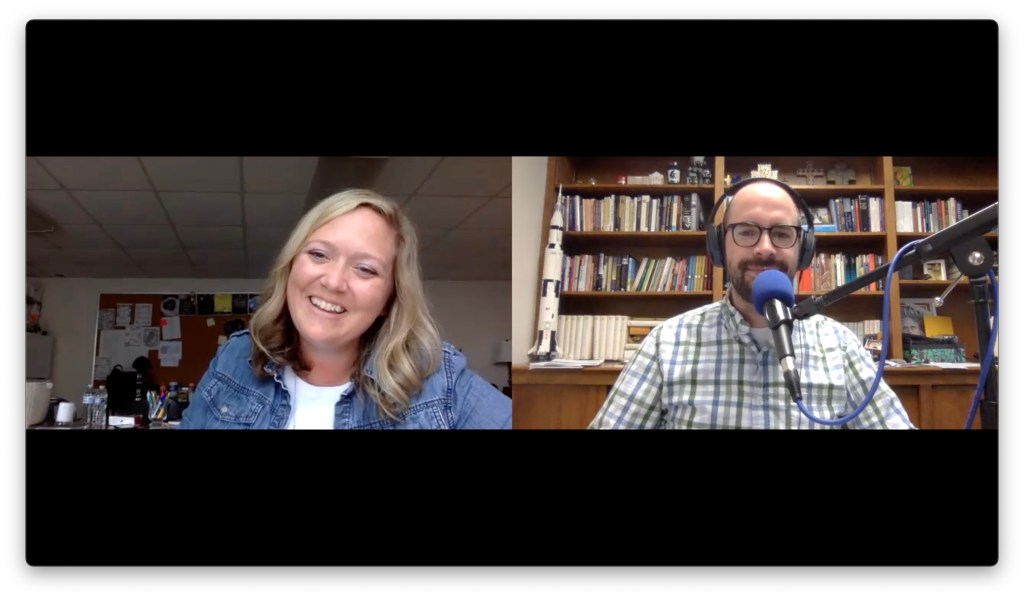
This week on the Strangely Warmed podcast I speak with Chelsea Morse about the readings for the 15th Sunday After Pentecost [B] (Proverbs 22.1-2, 8-9, 22-23 , Psalm 125, James 2.1-10, 14-17, Mark 7.24-37). Chelsea serves Micah Ecumenical Ministries where she is the Community Ministries Chaplain in Fredericksburg, VA. Our conversation covers a range of topics including radio jokes, extension ministries, vacation reads, library organization, meme material, complex personalities, do goodery, collective homilies, partiality, crumbly faith, and the little things of life. If you would like to listen to the episode or subscribe to the podcast you can do so here: People Are People Are People
How lovely is your dwelling place, O Lord of hosts! My soul longs, indeed it faints for the courts of the Lord; my heart and flesh sing for joy to the living God. Even the sparrow finds a home, and the swallow a nest for herself, where she may lay her young, at your altars, O Lord of hosts, my King and my God. Happy are those who live in your house, ever singing you praise. Happy are those whose strength is in you, in whose heart are the highways to Zion. As they go through the valley of Baca they make it a place of springs; the early rain also covers it with pools. They go from strength to strength; the God of gods will be in Zion. O Love God of hosts, hear my prayers; give ear, O God of Jacob! Behold our shield, O God; look on the dace of your anointed. For a day in your courts is better than a thousand elsewhere. I would rather be a doorkeeper in the house of my God than live in the tents of wickedness. For the Lord God is a sun and shield; he bestows favor and honor. No good thing does the Lord withhold from those who walk uprightly. O Lord of hosts, happy is everyone who trusts in you.
What’s right with the church?
That’s what it said at the top of a word document on my laptop this week while I was working on this very sermon in a coffee shop.
The flashing cursor mocked me with every passing second as I sought to answer my own question: What’s right with the church?
Because, of course, all I could think about was what’s wrong with the church.
It’s archaic, it doesn’t meet my needs, it’s not relevant, it’s full of hypocrites.
Or so I’ve been told.
There’s this statistic that haunts me, and I shared it with this congregation on my first Sunday – The average person in a Methodist Church invites someone else to worship once every 38 years. Now, there are plenty of reasons why that’s the case. It’s not easy inviting someone to church, it can feel uncomfortable, we don’t want others to think we’re making assumptions about them. But I think it’s also uncomfortable because we’ve become consumed by what’s wrong even though we, who are here right now, are the very people who go to church.
Anyway, I was sitting in the coffee shop, staring at my non-existent sermon, when I overheard behind me the beginnings of a conversation about, of all things, what’s wrong with the church!
Now, I tried to be a good person, a good Christian, and mind my own business, but they were talking about my business so I made it my business to hear more about their business.
Here’s the first thing I heard: “Can you believe he had the nerve to say something like that, from the pulpit? And he calls himself a preacher!”
Friends, I prayed it that moment, “Lord, please don’t let them be mine!”
And, thanks be to God, when I looked over my shoulder I didn’t recognize them.
So I tried to refocus, get back to the sermon, but I was hooked.
“And the people are so judgmental,” the other person responded, “They only care about themselves and their own problems.”
It went on like that for some time and eventually they went outside to sit at their own table.
I tried, I promise, I tried to work on this sermon but I couldn’t get their words out of my head and before I knew what I was doing, I packed up my things, walked out the door, and went straight over to their table.
I said, “I apologize, I shouldn’t have been listening to your conversation. But I’m a pastor myself and I just have to ask: If there are so many things wrong with the church, then why do you keep going?”
And without missing a beat one of them said, “Because it’s where I hear Jesus.”
What’s right with the church? It’s a far more interesting question than what’s wrong. All of us have examples of what’s wrong – a time we’ve been hurt, a sermon that went too far, on and on.
The church is broken because it is filled with broken people.
And yet, listen to the psalmist – How lovely is your dwelling place, O Lord! My heart and flesh sing for joy to the living God! Blessed are those who sing to the Lord. I would rather be a doorstop in the house of God than live in the land of wickedness!
There must be something right with the church, otherwise none of us would be here.
I never really had a choice about being a Christian. My earliest memories are synced up with the rhythms of church life from standing on pews during worship, to dressing up for Christmas pageants, to hunting for Easter eggs on the lawn.
As a kid, my answer to the question at hand would have been: The church is fun! Where else do we get to spend time on a regular basis hearing about the remarkable stories of God with God’s people? Where else will adults willingly make fools of themselves for the sake of sharing the Good News? For me, the church has always been the nexus of faith and joy in which I learned about who and whose I am in ways that were fun and exciting.
I am a product of the church. That is, I am who I am because of the liturgies and the scriptures and the songs and the prayers and the people who make the church what it is. The continued presence of the church in my life, and its influence over my actions and my choices is an ever present reminder that the choices made for us and in spite of us are often of more lasting consequences than the choices made by us.
In other words, we like to think that we choose God, when in fact God is the one who chooses us.
The church is the place where people discover the truth that God is on the move searching in the bushes of life for those who are lost. Which, to be clear, includes each and every one of us. Sure, we might experience the divine in all sorts of other spaces and places, but it is here where we learn the language to articulate those experiences.
It might take one Sunday, it might take a lifetime of Sundays, but at some point we realize that God is the one who found us, and not the other way around.
As I got older, I might’ve answered the question about what’s right with the church by saying: the music! We’re Methodists! We sing our faith! The words and the melodies of our music are transcendent and they tune us into God’s frequencies in the world. It is a rare Sunday that I am not bowled over by some part of church music whether its because I’m connected to a memory of the past or I’m casting vision of a future in which whether or not I’m around these songs will endure.
Music gives us the space to experience what we believe and how we pray when we don’t know how to put those things into words – music gives us the opportunity to feel whatever it is that we are feeling without feeling like we’re not allowed to feel what we feel.
Recently, my answer might’ve been something along the lines of how the church is an alternative community in and for the world. We’re different. We’re different because we believe God’s future, what we call the kingdom, is already intermingling with the present and we’re different because we believe we’ve been given a new past in which we are no longer defined by what we’ve done or by what has been done to us.
But most of all we are different in terms of story. The story called Gospel is not something we own, or control, or earn, but is simply a gift we’ve received. The Gospel tells us we’re more than our mistakes and that there’s more in store because we know how the story ends.
But if you asked me today, “What’s right with the church?” My answer would be: Jesus.
Jesus is what’s right with the church.
It is because of Jesus that we have hope and we have community. And hope and community are rather counter-cultural words and ideas these days. They might not seem very different, but the world provides us with the opposites: doom and isolation.
The pandemic has only furthered our division from one another, while terrifying us about whatever might come around the corner next, while we sequestered ourselves into bubbles.
But, in Jesus, we are given hope and community because the church embodies hope and community.
We call the Good News good because it is, in fact, Good News. Despite a rather sordid history, the church doesn’t exist to wag its finger at Christians for doing certain things or not doing certain things enough.
The church exists to tell the truth! God, author of the cosmos, came to dwell among us through the least likely of families, in order to teach and live and heal and preach and provide a vision of a new reality that, when push came to shove, led to our rejection of the truth through the cross, but then Jesus was given back to us three days later and his resurrection is now our promised resurrection.
That truth gives us both the courage and the conviction to live not for ourselves, but for the sake of others. When we consider God’s humility (read: humiliation) for us, it starts to change the way we see and interact with each other. We start to do all sorts of strange things like give away food to people who are hungry, and provide friendships to the lonely, and hope to the hopeless.
The church can be, and is, the place for life-altering blessings because the church is Jesus Christ’s body for the world.
We, today, have the blessed and remarkable opportunity to be what we’ve always been called to be: different. We, the church, model God’s future in the present. We don’t see one another through the lens of cultural controversies but instead through the mercy, grace, and love of God.
We can do this because we have the scriptures and the songs and the psalms and even the sermons that do not exist as a brief reprieve from the harsh realities of life but instead they make our lives intelligible in the first place.
In short, the church is called to be a community of ordinary virtues – that is, we live by grace.
Thus, we are not just a group of people who get together for an hour once a week who happen to believe in love, and peace, and liberation, or any other abstraction.
Instead, we are a complicated people complicated by a complicated story of a young Jesus from Nazareth who lived, taught, suffered, died, and rose for us and for the world.
Church, contrary to how we might imagine it, isn’t a noun – it’s a verb. Church is something we do and it is something done to us.
What’s right with the church? In spite of all its weaknesses and shortcomings, it is the church where we get to hear Jesus remind us about the love of God that refuses to let us ago, about the waves of mercy that never stop coming, about the grace to flourish into who God has called us to be.
This is the place where we hear Jesus tell us the things we need to hear most of all: You have value – you have worth – you are more than your mistakes – you are forgiven.
So, to those of you who love the church – make more room for it, bring to it your best and highest devotion. Pray fervently for its renewal and commitment toward being Christ’s body in the world. In short, love because you are loved.
And to those of you are still unsure about the church – we are not yet what we can be without you. Help us make the church better. Encourage us to open our eyes to the ways in which God is living and moving and speaking in the so that we can really be the church God is calling us to be.
How lovely is the dwelling place of the Lord of hosts! My soul longs, indeed it faints for the courts of the Lord; my heart and flesh sing for joy to the living God because this is where we hear Jesus! Amen.
Be careful then how you live, not as unwise people but as wise, making the most of the time, because the days are evil. So do not be foolish, but understand what the will of the Lord is. Do not get drunk with wine, for that is debauchery; but be filled with the Spirit, as you sing psalms and hymns and spiritual songs among yourselves, singing and making melody to the Lord in your hearts, giving thanks to God the Father at all times and for everything in the name of our Lord Jesus Christ.
The priest sat in the deep of the ship as the storm raged above. He tried his best to remain steady as the ship rocked back and forth with every gust of wind and the waves were relentless. Supplies and cargo rolled in every direction and panic was grabbing hold of the passengers.
A nearby mother with a tiny infant nestled in her arms begged the priest to baptize her baby right then and there in fear that they would not survive the storm. Everywhere he looked all he saw was terror and fear.
And then, strangely enough, he heard singing coming from a group of Moravians, German Christians. Meanwhile the main mast split in two but the sound of the tiny little choir reverberated and resonated deeply in the wooden hull of the ship.
Days later, when the sun finally returned in the sky, the priest found the group of singers and asked why they were not more afraid during the storm.
They replied, “We are not afraid to die. We are prepared because we know God will never let us go.”
Afterward the priest was deeply moved and wrote in his journal: This was the most glorious day that I have yet seen.
It was 1736 and the priest’s name was John Wesley.
Music had always been a part of Wesley’s life but something in him changed that day. Today, the people called Methodists are those who know what it means to sing our faith in large part because of what took place on a ship long ago.
Music is a truly remarkable thing. It can make us laugh, it can make us cry, it can bring forth emotions we didn’t even know we had access to.
If someone puts on the Vince Guaraldi Trio I am immediately transported to Christmas Time Is Here, Charlie Brown, and all the other things that make that season the most wonderful time of the year.
If someone starts spinning some Supertramp or Queen or Fleetwood Mac then my entire extended family will start flipping tables and chairs until we’ve made enough space for a dance floor.
Even Karl Barth, the great Swiss theologian of the 20th century, when asked by a student what he learned after an entire career in theology he responded: “Jesus loves me this I know for the Bible tells me so.”
Music is powerful stuff, and Paul tells us that being filled with the Spirit necessarily results in the making of melody.
Years ago, while on a mission trip to New Orleans, I was tasked with spending the afternoon in a nursing home and proctoring a session of Bingo. The youth and I tried our best to liven up the place a little bit but the whole thing was tragic. Residents of the memory care unit were staring off into space, using the laminated cards to fan themselves, and totally unconnected from just about anything.
Until we found a forgotten and worn out hymnal on a shelf in the corner. I pulled the youth close and we started singing all the great hymns we knew without even really needing to look at the hymnal.
By the time we made it halfway through The Old Rugged Cross, every eye in the room was on us, and when we rounded the second to last verse of Amazing Grace some of the residents were singing with us, and when we landed the last note of Great Is Thy Faithfulness, more than a few people had tears in the eyes.
Including the orderlies and assistants who later told us that it was the first time they heard many of the residents actually say anything at all.
The science is all there about how our neural pathways change, literally rewrite themselves, whenever music is performed or consumed. Music changes things and gives us access to things we otherwise wouldn’t have.
But this is nothing new.
Again and again in the strange new world of the Bible we discover how music rests at the heart of what it means to be connected with the divine. Moses and the Hebrew people sing songs of praise after being delivered from slavery to the Promised Land, David plays the lyre in order to calm the anxieties of King Saul, and Paul and Silas are in the middle of singing when an earthquake sets them free from captivity.
Music is often the gateway to unanticipated blessings.
Paul writes near the conclusion of his letter to the church in Ephesus about being careful about how they live and to make most of the time they’ve been given. This is not merely a call to “seize the day” but more a recognition that life is a gift and that we have much to be grateful for.
When the Moravians were singing on the boat – they weren’t being fools living in denial of the situation they found themselves in, they were not naive. Instead they held fast to the promise made to them in Christ that nothing in this life, not even a storm upon the sea, can ever separate us from the love of God.
It’s all too easy to take most of Paul’s letters and turn them into an exhortative exercise. As in, someone like me will stand in a place like in order to get people like you to start behaving yourselves. Which is all good and fine, but that’s not actually what the letter is doing.
Paul doesn’t tell the Ephesians to do this that and the other in order to be Christians, but rather he tells them to do all these things because they are Christians. And that’s an important distinction. Paul urges them to make the most of their time, and put away foolishness, and sing with one another not to become Christians but because they are Christians.
All of the stuff we do as Christians, from praying to singing to serving isn’t to get somewhere with God, or to earn God’s favor; we do these things because, in Christ, we already belong to God. Living like this is just what kind of happens when grace grabs hold and refuses to let go; we can’t help but make melody together.
So lets do it…
The first music was percussive. Drums were used to tell stories and eventually communicate over distances of space and time. But somewhere along the line, it was discovered that if you changed the tightness of a drum it would create different pitches – pitches that could eventually become a melody.
Strictly speaking, a melody is a sequence of single notes that are musically satisfying. What makes the connection between the notes satisfying is how they relate to one another, something we might call harmony – which is exactly what we’re going to try to produce right now…
[We broke the sanctuary into four quadrants and gave each section a note to sing C-E-G-C in order sing a harmonic chord)
As we come to the conclusion of our series on Paul’s letter to the Ephesians, it’s notable that Paul didn’t start that particular church. In fact, they were strangers to one another when he shows up in the book of Acts.
In other words, they didn’t pick him.
Sound familiar?
And yet, what wildly wonderful good news! God delights in gathering together people who otherwise have nothing in common save for the fact that Jesus calls them friends. Paul reminds us again and again and again that we, with all our differences, can actually make melody and harmony together because God is in the business of making something of our nothing.
In many ways, God is the great conductor of an orchestra we call the church in which we are all given instruments to play however we see fit, all while God keeps us in rhythm with each other. When we begin to see, and to hear, how we make music together, it starts to reshape everything else about our lives.
Strangers become sisters and others become brothers.
We, who were once far off are brought near by the life, death, and resurrection of Jesus Christ.
We, who have no business being close to God at all, are incorporated into Christ’s body to be Christ’s body for the world.
And it’s because of all this work done by God for us that we can give thanks to God the Father at all times and for everything in the name of our Lord Jesus Christ.
Gratitude, like music, changes things.
We can certainly go about day to day complaining about particular individuals who drive us crazy, we can lament the need to mow our lawns, we can even grumble about having to help our kids with their homework.
Or, with gratitude, we can reframe it such that we get to be connected with the strange and wondrous and confounding human beings around us, we get to spend time outside communing with creation, and we get to sit down with our kids and watch their minds grow and change before our very eyes.
Music and gratitude are not distractions from the harsh truths of life. Instead, they give us the means by which we can experience all that life offers knowing all the while that God is, in fact with us.
In the end, Paul is right – it is not only possible, but even necessary, that we should “always and for everything” give thanks. God transforms the darkest night and the most frightening storms into glorious day and beautiful seas.
God can even take a ragtag group of people called church and make a melody. Amen.
So then, putting away falsehood, let all of us speak the truth to our neighbors, for we are members of one another. Be angry but do not sin; do not let the sun go down on your anger, and do not make room for the devil.
There was a man who liked to mow his lawn early in the morning. It was a welcome reprieve from his busy life to just drive back and forth with his riding lawn mower week after week. And, one morning, after finishing the lawn, the man maneuvered the mower back toward the garden when, out of nowhere, he was tackled off the mower and onto the ground.
The man and his assailant rolled down the driveway exchanging blows until concerned neighbors rushed forward to stop the scuffle.
Hours later, the formerly mowing man was resting in the hospital with five broken ribs.
The man, as it turns out, was Rand Paul, the junior Republican Senator from the state of Kentucky. And for months the media speculated as to why the attack took place. In our heightened and frenetic political atmosphere, tensions running rampant, there was immense suspicion that the attacker was an avid opponent of Paul’s political proclivities and that he felt the only recourse for their disagreements was violence.
It was a frightening moment for lawmakers across the country as they each wondered if the same thing could happen to them.
Months later, when the assailant was finally brought before a judge, the truth came out: The attacker was Rand Paul’s neighbor, and he was tired of Rand Paul’s lawn clippings getting blown into his yard.
So then, putting away falsehood, let all of us speak the truth to our neighbors, for we are members of one another. Be angry but do not sin; do not let the sun go down on your anger.
Every week the Christian church is compelled and downright forced to rediscover the strange new world of the Bible. And it sure is a strange new world. Jesus (and Paul the apostle) is forever going on about loving our neighbors as ourselves and about speaking the truth in love.
Which are decisively difficult when we don’t even know our neighbors, let alone what the truth might be that we can express toward them.
So, instead, we practice silence and we call it love.
Sometimes that silence turns into bitterness, and then the bitterness turns into anger, and then before we know it we’re tackling our neighbor for not taking better care of his lawn.
And yet, in the church, we are called to speak the truth in love and we know what real love looks like – it looks like the cross.
The Jesus we encounter in the strange new world of the Bible understands that to love God and neighbor is demanding and risky. Following the path of love, at least for Jesus, means jumping into debates, it means calling into question the powers and principalities, it means not letting the world continue on down the drain.
And that kind of love got Jesus killed.
We, of course, are not the Lord (thanks be to God). In the end God does what we wouldn’t and couldn’t. And that’s the whole point.
We are called to a love that we regularly fail to do.
Contrary to all of its complications, neighborly love is at the heart of the life of the church and every single person who claims to follow Jesus. To love rightly, that is faithfully, is to recognize the hard demands of love made manifest in Christ who, from the hard wood of the cross, still pronounced a word of love and forgiveness over a world hellbent on hatred and retribution.
Or, to put it another way, when we begin to see how much God loves us in spite of all the reasons why God shouldn’t, it actually starts to change the way we interact with others, even our neighbors.
Love, the kind that God has for us and the kind we are called to have for God and neighbor, is way more strange than we often make it out to be. But without it, we would be lost.
And, because I believe music often does a better job at expressing the faith than mere words alone, here are some tunes to help us wrestle with what it means to speak the truth:
Jonathan Richman’s “That Summer Feeling” from 1992 is deceptively simple with the singer-songwriter and his acoustic guitar. And yet, the lyrics invite the listener into a wave of nostalgia that should come with a warning – the refrain is all about being haunted by a feeling, of being caught up in things we can’t quite explain. To me, it rings true of the ways we can be haunted by previous interactions.
Molly Tuttle is an award-winning guitarist with a penchant for insightful songwriting. And yet, it’s her cover of Neil Young’s “Helpless” that really lets her shine. With the backing help of Old Crow Medicine Show she brings a welcome nuance to the well known song while making it sound hopeful and hopeless at the same time.
Madeline Kenney’s new EP Summer Quarter recently compelled me to return to her 2018 single “Cut Me Off.” She sings with such raw honesty, an honesty all but absent in the world today, that I find myself getting lost in her lyrical sonic wonder. The song’s disjointed melody, ripe with surfer guitar strumming and syncopated drumming, really conveys a sense of what it means to be cut off literally and figuratively.
I, therefore, the prisoner in the Lord, beg you to lead a life worthy of the calling to which you have been called, with all humility and gentleness, with patience, bearing with one another in love, making every effort to maintain the unity of the Spirit in the bond of peace. There is one body and one Spirit, just as you were called to the one hope of your calling, one Lord, one faith, one baptism, one God and Father of all, who is above all and through all and in all. But each of us was given grace according to the measure of Christ’s gift. There it is said, “When he ascended on high he made captivity itself a captive; he gave gifts to his people.” (When it says, “He ascended,” what does it mean but that he also descended into the lower parts of the earth? He who descended is the same one who ascended far above all the heavens, so that he might fill all things.) The gifts he gave were that some would be apostles, some prophets, some evangelists, some pastors and teachers, to equip the saints for the work of ministry, for building up the body of Christ, until all of us come to the unity of the faith and of the knowledge of the Son of God, to maturity, to the measure of the full stature of Christ. We must no longer be children, tossed to and fro and blown about by every wind of doctrine, by people’s trickery, by their craftiness in deceitful scheming. But speaking the truth in love, we must grow up in every way into him who is the head, into Christ, from whom the whole body, joined and knit together by every ligament with which it is equipped, as each part is working properly, promotes the body’s growth in building itself up in love.
The prevailing wisdom is that, when a newish preacher arrives in town, he or she should avoid controversial topics at all costs. At least, in the beginning.
You don’t want to burn any bridges before they have a chance to be built in the first place.
But some things can’t be ignored – some topics demand our attention whether we want them to or not.
I don’t know if you know this, but the church is on the brink of schism.
On either side people, lay and clergy alike, keep flinging their disappointments and their differing theologies at one another and it really truly seems as if there is no future in which we stay united.
One pastor put it this way: “I have spent twenty of the best years of my life serving the church in which I have grown closer to more people than I can count… But for the sake of a high and holy cause, I can let all of those friends go. I can no longer live for myself, nor for the present age alone, but only for God for eternity. I have prayed and I have waited, and I must either submit myself to the ways things are, or to leave. I have chosen the latter.”
Another said this: “It is not just for the great number of Methodists across the world that we plead, not even the millions we have yet to reach, but simply for the church herself. We wish to speak the truth in love. Treating people the way we have is simply wrong, cruel, and unjust in all parts and principles because we have denied freedoms, numbed the mind, and killed the soul. How we have belated particular individuals must cease now and forever.”
And still yet another said this: “It matters not how we treat people – this is the way it has been and it is the way it shall continue. The matters of individual liberties belong to Caesar, and not to the church – otherwise God would have intervened.”
Have you heard people talk like that about the church? Or perhaps you’ve read an article in the newspaper about our irreconcilable differences?
Great and powerful leaders in the church are looking through the legalities of separation because it seems like we can no longer hold onto a common cause.
And, lest we grow apathetic about the possibility of ecclesial schism, lives are at stake.
If you don’t know what I’m referring to, you should. So, let me try to break it down a little bit. There is a sizable portion of the church that believes in the institution of slavery is a right given by God Almighty while the other side of the church believes that slavery and the ownership of human beings runs counter to the Good News of the Gospel.
So, friends in Christ, what should we do?
Or, to put it another way, which church should we align ourselves with?
Oh, I seem to have misplaced the notes for my sermon… I think I grabbed the one from 1844 instead of the one for 2021…
You see, the quotes I just read from different pastors were not shared on various social media accounts over the last few years – they didn’t come from the bitterness of recent denominational meetings in which theological dueling has become a favorite pastime. No, all of those are real quotes from pastors in 1844 when the Methodist Church was fighting about whether or not to stay together. And the matter at hand then, the decisive claim that actually split the church until 1939, was slavery.
I beg you to lead lives worthy of the calling to which you’ve been called.
We don’t know all the details that required the writing of the epistle to the Ephesians, but it’s clear that not all of those who were part of the gathering, the ecclesia, were getting along.
There’s a good chance that it had something to do with Gentile Christians making claims about what the faith really looked like now that they were part of the covenant whereas Jewish Christians were holding on to the faith that had first grabbed hold of them.
Or, it could’ve been a little more like the church in Corinth that was constantly bickering about the nuts and bolts of community meals and how the unified church broke into different factions led by different leaders.
Or, maybe they were arguing about who was and who wasn’t compatible with Christian teaching.
We’re not entirely sure but, taking a step back for a moment, it doesn’t really make that much sense. How could a community founded on radical inclusion descend into rampant division? Why would a people who are commanded to love their neighbors have so much trouble actually doing it? What happened such that brothers and sisters in Christ had to be told to bear with one another in love?
Strange, isn’t it?
What we do know about the church in Ephesus is that Paul felt compelled to write this letter, a letter we refer to as Holy Scripture, and Christians like us have been gathering together to proclaim these words for centuries.
I beg you to live with humility and gentleness, with patience, and bearing with one another in love, making every effort to maintain the the unity of the Spirit in the bond of peace.
Wow.
Who would’ve imagined that a scripture text could ever have so much to say to our current context…
And here’s the rub: Paul can exhort us all he wants to be worthy of the Gospel, he can list off in rapid fire detail all of the practical habits that define what the church can be. But, at the end of the day, we will never be worthy of the Gospel.
Never ever.
At least, not on our own.
We’re fickle and selfish little creatures, we humans. It doesn’t matter whether its the first century, or the 19th century, or today, we are consumed by, and addicted to, dividing ourselves into who is in and who is out, who is right and who is wrong.
And yet, the church touts itself as a bastion of inclusiveness: open hearts, open minds, open doors. Ever heard of it?
Is the Gospel really for all?
I mean, what about those real sinners (let you imaginations run wild)? How would we feel if they started showing up on Sunday mornings?
We might bristle at the thought, but making the outsiders into insiders was exactly Jesus’ cup of tea. Which, when you think about it, is actually really Good News because the Gospel is the most inclusive thing around: At the right time Christ died for the ungodly.
To be clear: that includes each and every one of us.
And that’s the difference that makes all the difference.
Consider the seven ones that Paul rattles off: There is one body and one Spirit, just as you were called to the one hope of your calling, one Lord, one faith, one baptism, one God and Father of all, who is above all and through all and in all.
We who we far off and we who were near have been brought together by the life, death, and resurrection of Jesus Christ.
Christ is the reason, and the only reason, we can be one.
Warring cultures divided by heritage, and traditions, and moral codes, and even ethical expectations have collided into a new order, a community we call the church.
Paul’s prayer from last Sunday’s passage transforms today into a call to preserve the peace made possible in Christ. Paul literally begs us to see that even our myriad differences, great though they may be, they pale in comparison to the vast gulf between God and us. And yet God chose us!
Think about that for a moment. God, knowing full and well that we are a bunch of dirty rotten scoundrels, that we will regularly look out for our own interests instead of those in need, that, when push comes to shove, given the choice between life and death, we would choose to nail God to a cross, God still chooses to be for us!
In Christ, we encounter the incomparable new reality of God which both humbles us and exalts us, which knocks us down and builds us up, and that is our peace.
You see, peace, at least peace as defined by the Gospel, comes when we recognize our universal incompetence and our total need for someone to do for us that which we cannot do on our own.
God has claimed us. And, as Karl Barth put it, unity is the consequence of belonging to God.
However, there is a difference between the now and the not yet. Our sin-sick souls are stuck in this terrifying cycle of division and antipathy. But, as Christians, we are called to look beyond and, in so doing, reframe the now.
There are walls of division that threaten to divide the church, to literally break up the body of Christ. They existed in Ephesus, they were there in 1844, and they’re still around today.
Paul, across the ages, pleads with us to live lives worthy of the calling to which we’ve been called, something we can’t actually do on our own, but that doesn’t mean we shouldn’t try.
And, notably, the strange new world of the Bible reminds us again and again that if the steps to a better church or a better life are easy, then they are completely bogus.
The most challenging things in life, namely change, require communities of people willing to sustain us through something as difficult as transformation.
Faith is always a journey.
Paul likens it to the way a body grows – it happens, in time, and it can be painful. And we can try all we want to resist it, but God is going to get what God wants.
It is therefore in the knowledge of the hope that is beyond our current circumstances that we find our peace. Peace is upon the mountain. We have not yet reached the mountain. But we can lift our eyes to the hills, from whence our help comes.
I don’t know about you, but I’ve always been particularly struck by this little moment in the Gospel right before Jesus’ crucifixion. Abandoned by his followers, betrayed by his disciples, condemned by the religious elites, Jesus carries his own instrument of death to the place called the skull, and what does he say?
“Father, forgive them, for they do not know what they are doing.”
The truth is, we still don’t know what we’re doing.
The United Methodist Church, the body of Christ for the world, is at war with itself over who can marry who and who can do what I do. But we’re also on the brink of schism in our community over politics, and education, and a variety of other subjects.
It’s terrifying how content we are to cut off our hands and our feet.
We still identify who is in and who is out based on categories that make absolutely no sense in the Kingdom of God. We view one another through names on bumper stickers, and through ill-advised Facebook posts, and through late-night ramblings on twitter.
And today scripture grabs us by the collar and says, “Listen! God has made us beautifully different! Unity isn’t uniformity! We bring together all of our differences and that what makes the one body we call church so amazing. So stop acting like children for God’s sake, literally. You move about with every new headline, and you give into to such shameful divisions. Listen! Speak the truth in love. IN LOVE! You don’t deserve to be part of the body of Christ. No one does. And yet God chose you anyway! We are not what we can be without you, and neither can we be who God is calling us to be if we keep cutting off our arms and our legs!”
At the end of the day, whether we like to admit it or not, what we really want is to be told that we are right and they, whoever the they are, are wrong.
But again, the Gospel tells us something different – the Gospel tells us we’re all wrong! That’s why the Gospel is more inclusive than anything in existence! We don’t stand on our accomplishments or on our righteousness – none of us are righteous, no not one.
The only thing we stand on is the grace and love of God freely given to us in Christ Jesus.
Or, in other words, we’re stuck with each other because God has decided to be stuck with us. So be it. Amen.
They said to him, “What must we do to perform the works of God?” Jesus answered them, “This is the work of God, that you believe in him whom he has sent.”
I know of a Bishop (thankfully from another denomination) who used to be in charge of recruiting candidates for a local seminary. He would seek out those who felt called to ministry and he would end each and every single interview the same way: with a role play.
He would say, “Pretend I’m not someone from the seminary, but that everything else about my life is true – I’m a 50 something, over-educated, occasionally kind, straight white male. Now… tell me why I should go to church…”
Throughout the years every candidate would mention something about the value of community. But the Bishop would say, “I attend AA and I have all the community support I need.”
Then the candidates would bring up something about reaching out to those in need. But the Bishop would say, “I’m an active member of Rotary and I already help the needy.”
Finally the candidates would make a comment about the power and priority of music in the church. But the Bishop would say, “I have season tickets to the local symphony.”
He recruited for a long time and not a single candidate ever mentioned anything, specifically, about Jesus.
Contrary to how we might imagine it, the church is not in the business of societal rearrangement, we are not the paragons of community service, and we certainly don’t hoard all of the community’s musical prodigies. We may have those gifts, but if we’re serious about being the church then we really only have one thing to offer at all: God’s grace in Jesus Christ.
Which is just another way of saying: the only thing we have to do is trust (believe) Jesus.
If the church is a business, then it is in the Jesus business. That is: we exist to proclaim the Good News, frankly the best news, that God has seen fit to rectify all we have wronged, that we are loved in spite of all the reasons we shouldn’t be, and that, in the end, we know how the story ends.
And that last claim is important. For, if we already know how the story ends, then we are freed from whatever fears and faults that terrify us.
We are not the main thing in the church. The main thing is Jesus Christ and him crucified, God in the flesh born to live, die, and live again. And Jesus comes to do for us what we can’t, and won’t, do on our own.
It’s why we can call the Good News good. Thanks be to God.
The earth is the Lord’s and all that is in it, the world, and those who live in it.
I stood up on Sunday morning and led worship for a new church. At least, it’s a new church for me. Methodists are, usually, used to pastors moving around to serve different appointments, but it’s always a little jarring going from one pastor to another in the matter of a week.
When the service was over we all milled about on the front lawn sharing lemonade and I received my first round of Sunday morning comments: “We’ve got some great weather today!” “Got any plans for the afternoon?” and so on.
But there was one comment that really stood out. A woman old enough to be my grandmother waited patiently for an opportunity to step forward, she grabbed me by the hand, and said, “It’s nice to know that God is still God no matter who stands in our pulpit.”
That’s some good theology.
While certain United Methodists are starting over because of new pastoral appointments, we’re all in the process of starting over because, in ways big and small, we’re transitioning to a time called life after Covid. It means we have to relearn what it means to be in physical spaces with one another. It means we have to be cognizant of those who are not ready to return to the way things were. It means the church has the challenge and the opportunity to be the church in a time that is so unknown.
But we’re also all in the process of starting over because that’s what the liturgy does to us. No matter what we have going on in our lives, no matter what we’ve done or failed to do, God speaks truthful words through our worship about who we are and whose we are.
On Sunday, I got to look out at an entirely different congregation than the one the week before and yet I was able to say, with assurance, the same thing: “Now hear the Good News: Christ died for us while we were yet sinners; that proves God’s love toward us. In the name of Jesus Christ, you are forgiven!”
Forgiveness is the beginning to which we return to over and over again and it’s what makes the life of faith so exciting in the first place.
And, because I often feel like music does a better job at conveying theological claims than mere words alone, here are some tunes to help us think about what it means to start over:
Chris Stapleton’s “Starting Over” is a song made for couples along the road of a relationship. The singer-songwriter’s baritone is met, beautifully, by his wife’s accompanying harmonies as they proclaim a beautiful chorus about holding on to something while everything else seems to change.
Lucy Dacus’ music haunts me. Her voice sounds like she just consumed a cup of cream and her lyricism paints these landscapes of memory. “VBS” is her reflection on growing up in the church and coming to grips now with what it all meant. If nothing else, stick around for the face-melting guitar riff near the end of the song.
This week on the Strangely Warmed podcast I speak with Alan Combs about the readings for the 6th Sunday After Pentecost [B] (2 Samuel 5.1-5, 9-10, Psalm 48, 2 Corinthians 12.2-10, Mark 6.1-13). Alan is the lead pastor of First UMC in Salem, VA. Our conversation covers a range of topics including terrible Netflix shows, comedic criticism, Bo Burnham, knowing the whole story, kingship, omitted texts, liturgical habits, humble bragging, and faithful interactions. If you would like to listen to the episode or subscribe to the podcast you can do so here: Artifice On The Inside
For I am not ashamed of the gospel; it is the power of God for salvation to everyone who has faith, to the Jew first and also to the Greek. For in it the righteousness of God is revealed through faith for faith; as it is written, “The one who is righteous will live by faith.”
Well, I finally did it! I managed to please everyone! Some of you were happy when I was appointed here, some were happy while I was here, and the rest of you are happy now that I’m leaving!
It was more than a decade ago that I entered seminary in hopes that I would, one day, get to do exactly what I’m doing right now. I was persuaded that the church was already the better place God had made in the world and I wanted to be part of that. And when I was in school for this, I didn’t learn about the virtues of nicety. That is, I didn’t go to seminary in order to learn how to make people feel better about themselves. That’s certainly not what I felt God had called me to do.
And yet, more often than not, it’s exactly what I, other clergy, and most Christians do all the time.
Rather than speaking the truth, in love, we are far more inclined to sweep things under the rug.
Rather than taking seriously the Biblical commandments of discipleship, we are content with letting our faith be something that happens for one hour each Sunday.
Rather than hoping against hope for things not yet seen, we rest in the presumed knowledge that things will, largely, stay the same.
But none of that is very compelling, and it certainly doesn’t have anything to do with Jesus.
Which makes me wonder, as I often do at times like this, why are you here?
For some of you, you can’t imagine being anywhere else. You’ve grown up in the church, or it has become so much of a fixture in your life that this is just what you do.
Meanwhile, some of you are here because you have more questions than answers and you want that to change. Maybe life has dealt you a raw hand, or you’ve experienced one too many hardships, or you’re frightened about what tomorrow might offer and you look to the church to help.
And some of you are here against your will. Perhaps a friend or a family member, in the name of love, brought you here and there isn’t anything you can do about it.
But chances are, no matter why we think we’re here, we’re actually here because we want to know more about Jesus.
I mean, people still keep calling me and sending me emails with rather specific questions about a first century carpenter-turned-rabbi, the Discovery Channel is forever producing new documentaries about the person in question, and people like you drive to places like this on Sunday mornings!
But here’s the truth, a truth not often discussed: we know nothing about Jesus whatsoever except what we read in the New Testament. That’s the rather bizarre part of Christianity. Sure, I’ve been to seminary and committed my life to this and study daily, but all of you have just as much access to the Lord as I do. It’s all right there in scripture.
As Paul says elsewhere: I determined to know nothing among you, except Jesus Christ and him crucified. On this, my last Sunday, I hope the same can be said of me. That is: throughout these last four years, I have endeavored to do one thing and one thing only: proclaim the Good News of God made manifest in Jesus Christ.
But the story of Jesus Christ is fundamentally a story of scandal. It is, to use another Pauline expressing, shameful.
Consider the story, for a moment: A child born under extraordinary circumstances to entirely ordinary parents, raised in the forgotten town of Nazareth, propelled into a ministry of teaching and healing, surrounded by would-be followers who, when things got tough, abandoned him to the fate of death all on his own.
If the story of Jesus had ended with the crucifixion, none of us would be here. He would simply have been one of many who died at the hands of the state for causing too much of a ruckus.
But that’s not where the story ends.
In fact, it’s really where the story kicks off: Resurrection! He is risen!
And yet, that’s not often what we hear about Jesus. Instead, we’re inclined to lift him up as some moral exemplar or ethical genius. Neither of which are really true. Jesus broke all sorts of rules and it’s not a very good idea to tell people to turn the other cheek and go the extra mile unless (UNLESS) the one saying those things happens to be God in the flesh raised from the dead!
Now, take a gander at any of the epistles and you will see that there was, and perhaps always will be, an awareness that disciples are going to be tempted to retreat from Jesus in embarrassment, fear, or downright confusion. It happened prior to the crucifixion (See Peter) and it continues to happens.
And no one know this better than Paul.
Notice how he begins his letter to the church in Rome: “I am not ashamed of the Gospel!”
Those are strong words to the early church.
They’re strong words for the church today.
And right at the heart of Paul’s proclamation, and all of his letters, is the Cross.
For the centrality of the Cross to be so prominent in the Pauline epistles is rather odd considering how little it is mentioned or considered in the life of faith today.
There are new churches budding up in all sorts of places that have removed the cross from all worship services.
There are plenty of Christians who have settled with describing Jesus as a nice guy but never dare refer to him as the Lord.
There are loads of churches who envision themselves as yet another version of a boring civic organizing and nothing more.
And, you can’t really blame the church or Christians for doing so. In so many ways we’ve watered down the complete and confounding radicality of Christ’s death for the ungodly (that’s how Paul will refer to it in just a few chapters).
Jesus died an ungodly death for ungodly people.
That’s the scandal of the cross.
But, are we scandalized?
Most Sundays, whether online or in a parking lot or inside a sanctuary, we look like we’ve got it together. Or, at least that’s what we want others to think. But we certainly don’t consider ourselves ungodly or, at the very least, sinful.
In many ways, Paul’s proclamation is a terrifying declaration of knowing the condition of his condition. “I am not ashamed of the Gospel” is but another way of saying, I am not ashamed of needing the Lord to do for me what I cannot and could not do on my own!
Do you see? Paul was at a place of recognizing how God is the one who meets us in Christ Jesus, God is the one who acts on and in our lives, God is the one who makes a way where there is no way.
Or, to put it another way, the Gospel is all about Jesus.
It’s all about what Jesus does for us.
Consider the thieves on the cross next to Jesus. One of them mocked the Lord just as much as the crowds did, but the other asked to be remembered.
Nothing else.
Think on that. He did nothing else. But Jesus says to him, “Today, you will be with me in paradise.”
I can’t wait to talk to that criminal in the eschaton. I want to ask him about his experience and what happened next.
I can see him walking around with the saints in glory and they’re all saying, “How did you get in?! You never went to church! You never sat through Sunday school! You don’t even know the Apostles’ Creed! How did you get in?”
And the criminal replies, “The guy on the center cross said I could come.”
I am not ashamed of the Gospel; it is the power God for salvation to everyone!
I am not ashamed of the Gospel – I’m sticking with Jesus, I’m sticking with the church!
I know it might feel like we’ve got nothing to hold on to, but Jesus holds on to us!
The world will tell us many things, but the Gospel tells us something different – we are sinners beloved by the one we crucified. The Lord is risen from the dead and there ain’t nothing that can stop him. Jesus is Lord, God of all things past, present, and future.
Jesus does not work according to the ways of the world. He does not say, “Bring to me your perfect lives and your perfect jobs and your perfect families.” Instead, he says, “Bring to me your burdens and I will give you rest.”
Jesus does not look at our choices and our actions in order to weigh out whether or not we’ve done enough to make it through the pearly gates. Instead, he says, “I have come to save sinners and only sinners!”
Jesus does not write us off for our faults and our failures. Instead, he says, “You are mine and I am thine!”
No matter what happens, Christians are people of hope. We are people of hope because the Gospel is the Good News of God for the world. We need not worry over this, that, and the other because our hope isn’t in us. It’s not in me, or in Pastor Gayle. It’s not in the local community or even in the United Methodist Church. Our hope is in Jesus Christ and him crucified!
Hear the Good News, the Gospel: Nothing can take us away from the Love that refuses to let us go. God is in the business of salvation and resurrection which means that no matter how bad we are or how good we are God can and will do what we cannot. Everybody, even the worst stinker in the world, is somebody for whom Christ died.
We need not be ashamed of the Gospel, it’s the only Good News for a world drowning in bad news and it is ours, for free, for nothing.
While we were yet sinners, not before or after, but in the midst of our sins, Christ died for us. He has taken the responsibility of salvation squarely on his shoulders. He has just gone and done it all without us having to do anything. And he invites us to simply trust that he has done this for us, and to proclaim that trust by acting as if we really believe it. Amen.
This week on the Strangely Warmed podcast I speak with Todd Littleton about the readings for the 6th Sunday of Easter [B] (Acts 10.44-48, Psalm 98, 1 John 5.1-6, John 15.9-17). Todd is the pastor of Snow Hill Baptist Church in Tuttle, Oklahoma. Our conversation covers a range of topics including pastoral pandemic pandering, vacation, disco and disc golf, the serendipity of the Spirit, songs meant for singing, virtuous obedience, conquered faith, unadulterated joy, and divine apprehension. If you would like to listen to the episode or subscribe to the podcast you can do so here: Overwhelmed By Joy






 think and let think