Weekly Devotional – 12/9/13

Devotional:

Psalm 146.5-10

Happy are those whose help is the God of Jacob, whose hope is in the Lord their God, who made heaven and earth, the sea, and all that is in them; who keeps faith forever; who executes justice for the oppressed; who gives food to the hungry. The Lord sets the prisoners free; the Lord opens the eyes of the blind. The Lord lifts up those who are bowed down; the Lord loves the righteous. The Lord watches over the strangers; he upholds the orphan and the widow, but the way of the wicked he brings to ruin. The Lord will reign forever, your God, O Zion, for all generations. Praise the Lord!


I love to ask questions. For years I have always been “that guy” at dinner or at a party who can orchestrate the direction of the conversation just by asking a few well placed questions. Depending on the season, or company present, some of my favorite questions include: How did you two meet? What was your favorite halloween costume as a child? What was the last best book you read? All of these questions are geared toward opening up a conversation for all people to respond accordingly. It allows for everyone present to reflect on something and then share it with everyone present. My favorite question to ask during Advent has always been: What was the best Christmas present you ever received?

stxmco001christmas_tree_and_presents1

Its a perfect question. Everyone loves to take a few moments to go through the catalogue in their memory banks of all the presents they received as children, you can detect a positive change in the atmosphere because the memories elicit such joy, and the discussion will continue from that first question toward a full and fruitful conversation.

What was the best Christmas present you ever received? What memories do you have of gathering around the Christmas tree with your family preparing to rip apart the wrapping paper?

I love to ask that question, but recently I’ve begun to wonder whether I should be asking it at all. The celebration of Christmas (according to the ways of the world) has so trumped the theological convictions of Advent that Santa Claus has become frighteningly synonymous with Jesus Christ. Moreover, practices like “The Elf on the Shelf” have led children (and some adults) to grossly misunderstand the depth and breadth of God’s prevenient grace in the world.

When I read from the 146th Psalm I wonder if instead of asking everyone about their favorite present, I should instead ask: “When was the last time you gave food to the hungry?” Or “How are you keeping your faith?”

I know those questions are tougher to swallow, even for me, but I believe they really get at the heart of the Christmas message. How are we living out our faith, particularly during this season of giving? How are we reaching out to those in our community who need to feel the love of Christmas more than anyone else?

So, as we all gather in the shops to find the perfect present, and even as we sit around our perfectly lit and decorated Christmas trees, let us remember the true depth of Christmas. Let us recall that Christ came not to be served but to serve. Let us ask ourselves the difficult and life-changing questions in order that we might live fruitful lives in God’s kingdom.

Wake Up! – Sermon on Romans 13.11-14

Romans 13.11-14

Besides this, you know what time it is, how it is now the moment for you to wake from sleep. For salvation is nearer to us now than when we became believers; the night is far gone, the day is near. Let us then lay aside the works of darkness and put on the armor of light; let us live honorably as in the day, not in reveling and drunkenness, not in debauchery and licentiousness, not in quarreling and jealousy. Instead, put on the Lord Jesus Christ, and make no provision for the flesh, to gratify its desires.

00036884_h

On April 4th, 1742, Charles Wesley came up for appointment as university preacher in St. Mary’s in London. Charles preached from Ephesians 5.14 which reads, “Awake, thou that sleepest, and arise from the dead, and Christ shall give thee light.”

Now, just for context sake, Charles Wesley was the younger brother of John Wesley, the primary founder of the Methodist renewal movement that eventually led to the formation of the United Methodist Church. Both brothers believed that, at the time, the Church of England was losing a sense of purpose and needed to be renewed. They were strongly rooted within their church structure, but they considered their ministries to be caught up in spreading scriptural holiness throughout the land. While John was known for his organization and preaching, Charles was known for his ability to write hymns; some of his more celebrated hymns are sung on a regular basis in many churches: Christ the Lord is Risen Today, Come Thou Long Expected Jesus, Hark! the Herald Angels Sing, O for a Thousand Tongues to Sing, to name a few.

So, Charles found himself invited to preach in front of a university audience that he largely believed had lost sight of what it meant to be Christian in the world. Those in attendance that day were far more consumed with the “academic pursuits” of Christianity rather than a deep and inward sense of what it meant to be forgiven and loved.

Like many young and naive pastors, Charles preached a sermon filled with a barrage of frightening assumptions and left many in attendance frustrated, angry, and ignorant.

ArtMuseum-Awake-thou-that-sleepest

Here are a few of his lines, adapted for our contemporary period: Wake up! Everyone of you, wake up out of your dreams of worldly happiness. What is the state of your soul? If God required you to die right now while I am preaching, are you ready to meet death and judgement? Have you fought the good fight and kept the faith? Have you secured the one thing needful? Have you recovered the image of God, even righteousness and true holiness? Are you clothed in Christ? Do you know that God dwells in you by his Spirit that he has given to you? Have you received the Holy Spirit? Or do you even know if there is a Holy Spirit at all? If any of these questions offend you, be assured that you are not a Christian nor do you desire to be one. Indeed, your very prayers have been turned into sin; and you have definitively mocked God this very day by praying for the inspiration of his Holy Spirit when you did not even believe that such a thing existed!

Needless to say, this was Charles’ first, and very last, occasion for preaching there.

Though Charles chose to preach from Paul’s letter to the church in Ephesus, Paul also wrote in a similar vein to the church in Rome: “Besides this, you know what time it is, how it is now the moment for you to wake from sleep!” What is the “this” that he is talking about? Love is the fulfillment of the Law. So, besides knowing that love is the fulfillment of the law, it is now time for us to wake up! For salvation is nearer to us now than when we became believers; the night is far gone, the day is near. Let us then lay aside the works of darkness and put on the armor of light; let us live honorably as in the day, not in reveling and drunkenness, not in debauchery and licentiousness, not in quarreling and jealousy. Instead, put on the Lord Jesus Christ, and make no provision for the flesh, to gratify its desires.

A-Thanksgiving-meal-has-at-least-3000-calories

Coming off of a major holiday weekend where we have all gratified our desires with mountains of mashed potatoes, rivers of gravy, quarries of cranberries, and seas of stuffing, where many of us were filled with debauchery and quarreling as we competed for the best holiday shopping prices on Black Friday, where we are now more focused on Santa Claus than Jesus Christ… it is very difficult for a young foolish pastor like myself to preach this text without ruffling some feathers. I used to laugh when I read Charles Wesley’s sermon “Awake, thou that sleepest” but now I’m beginning to understand how important it was for him to preach those words.

ap_black_friday_21_dm_121123_wg

Today is the first Sunday of Advent, the beginning of the Christian year. Just as we came to a conclusion with Christ the King Sunday last week, today we begin by looking forward, with expectation, to the birth and arrival of our King. But here’s the great paradox, even though we are looking forward to Christmas, it feels like we’re stuck looking to the past. In many areas of church life this is a plague that has permeated throughout a multitude of ministries, relationships, and conversations. We talk about where we are as a church, what we want to do, but far too many of our imaginations are trapped by the past. 

If, as Paul argues, love is the fulfillment of the law in he past, then love is most assuredly also the appropriate mode of action in the present.

Being Christian is all about love in action; not just a reflection on the past, but also a waking up to the present and the future. 

For disciples of Jesus Christ, one of the hardest things to wrap our heads around is “time.” We are a people who regularly remember the past, in order to live into the present, while also looking forward to God’s promises. We are a people rooted in time, removed from time, and unaware of God’s time. Our past is constantly invading the present, and the future has already met with the present in the presence of the Holy Spirit within the faithful community.

If your head is spinning, don’t worry. It should be.

God-in-time

God’s future casts a light into the present and provides the illumination of the reality by which we are all called to live. Because God has promised to come again and make all things new, a new heaven and a new earth where death will be no more, death will die, then we are called to live into God’s future reality in the present. We are called to love in order to fulfill the Law.

What makes us unique as a people is precisely the fact that God has invaded our present with the Spirit, with his Son who walked among us, with his Word, with his sacraments, that we are a distinctive people with expectations of how the world needs to be.

For us, the time is now! Wake up! 

As Christians we are not to be content with passively accepting injustices and evils in the world. Our faith demands that we reach out in love to combat the sinfulness of the world. How often do we think about our obligations to love outside of our families and our church community? What could this world look like if we seriously considered loving all, and all means ALL, of God’s creatures?

We are creatures of the present, though we are so consumed with our pasts. Our text today encourages us to look to the future in order to know how to act. As Paul wrote elsewhere in Romans, do not be conformed to this world, but be transformed by the renewing of your minds. Discover newness in your lives which the future will bring.

Wake up! We are no longer burdened by living for ourselves, but we are privileged to live for God, we are a people who obey his will for our lives. That is what Paul means when he says we are to clothe ourselves in the Lord Jesus Christ. Its what he means by putting off the darkness and putting on the armor of light!

Because of Christ’s redemptive act on a cross in a place called The Skull we have all been liberated from the burdens of a sinful past. We strive forth with confident steps into a future that is always bringing us closer and closer to the fulfillment of God’s redemptive plan for the entirety of creation. We are here as a people of anticipation, here the first Sunday of advent, remembering while anticipating Christ’s in breaking in the world in order to bring about God’s kingdom on Earth.

Wake up! This moment is the eternal moment – the now – when the past and the future stand still, when the past ceases its going, and the future its coming. This moment is not a time that comes and goes, it is God’s eternal moment, a spot of clarity amidst the ridiculous chaos of our lives.

This passage from Paul, read for us this first Sunday of Advent, deepens our understanding of the future whose coming we celebrate both in the birth and in the return of Jesus Christ.

So, how can we wake up from the sleep that we are caught up in? How can we love in such a degree so as to fulfill the law?

Love is always the essentially revolutionary action.

We love the way that Christ loved, and still loves us…

We can reach out to the lonely in our community, those who do not have a family to share this holiday season with. We can gather together in the front of the church selling Christmas trees while demonstrating Christ’s love in the world through the way we reach out to those who stop by. We can participate in quilt for a cause, letting our fingers and needles and thread create a tangible sense of love for individuals in our community. We can donate money for the Children from Social Services who we have adopted for Christmas presents this year, reminding them that nothing will ever separate them from the love of God in Jesus Christ.

We can open our eyes to the injustices within our local community, and abroad, and be willing to speak out against the disparity present. We can love the unlovable, reconcile with friends and family from whom we have been separated, and we can provide a little warmth this coldest time of the year.

Our love for others, creation, and God is never just a concrete act, something that once began and continues on a course. Our love is the Beginning, the Miracle, the Creation in every moment of time, it sets our hearts aflame for Christ Jesus and allows us to be his body for the world.

And so, though paradoxical, what we are doing, the ways that we embody love, can be no more than point to the victory which has occurred, does occur, and will occur in Jesus Christ. Love directs us to the one whose very birth we now await and anticipate. Love awaits the ends of darkness which is the Beginning of the light of the world.

Wake up! You all know what time it is, and it is time for us to wake from our sleep. This is the beginning, another chance to start again. Whatever baggage you are carrying, whatever sin you believe is too harsh to be forgiven, whatever frustration you are dealing with in your life, today is a new beginning. We have gathered together as a community to rid ourselves of the darkness in our lives. We are here to care for one another. You are not alone. You are part of a community of faith that loves you because God loves us. Put on the armor of light. Prepare yourselves to be surprised by God’s grace in the world.

Wake up! Put on the Lord Jesus Christ. Do not be consumed by your past, but with excited expectation live in the present and anticipate God’s future for you.

This table is our Beginning. For it is here that we gather to confess our faults, receive forgiveness, reconcile with our community, and feast at Christ’s table. This place is where past, present, and future all wind themselves together. Christ’s table is the matrix of time; it is where we remember God’s mighty acts, anticipate his birth and coming again, and live into the new reality of love, mercy and forgiveness.

Wake up! God is waiting for you.

Amen.

00036884_h

Weekly Devotional – 12/2/13

Devotional:

Psalm 72.1-7

Give the king your justice, O God, and your righteousness to a king’s son. May he judge your people with righteousness, and your poor with justice. May the mountains yield prosperity for the people, and the hills, in righteousness. May he defend the cause of the poor of the people, give deliverance to the needy, and crush the oppressor. May he live while the sun endures, and as long as the moon, throughout all generations. May he be like rain that falls on the mown grass, like showers that water the earth. In his days may righteousness flourish and peace abound, until the moon is no more.

Youth Band at a Fat Tuesday Celebration

Youth Band at a Fat Tuesday Celebration

When I was in High School I was fortunate to help form a youth band at my home church. A number of us would gather on a weekly basis in the sanctuary playing contemporary Christian music with guitars, bass, drums, and singers. We always had an adult present in order to fulfill the Childcare Protection Policy, but we largely did everything on our own; we picked the music, practiced accordingly, and planned performances throughout the year.

Though I had been attending church my entire life, it was during this period that I began to have a serious appreciation for worship, scripture, and prayer. We would talk about the lyrics of the songs regarding their connection with biblical verses, we debated about how songs should be played in order to indicate the mood of a service, and we began and ended every practice with prayer.

169_1010929764498_9857_n

One of my best friends growing up was a regular for leading prayer at the end of practice. He was often filled with joy (and by the Spirit) and would wave his arms back in forth while we stood hand in hand in a circle. His way of prayer was unlike anything else I had experienced. Whereas many would pray in some sort of elevated way (“Oh Great and Holy Majestic God who knows no bounds, commit thyself to mercy” etc) Will always sounded as if he was talking to another one of his friends. God, for Will, was a constant companion, a trusted friend, and a exciting partner on this journey of life. Will’s prayers were life-giving for all of there because he made God so much more approachable for all of us. Moreover, the prayers were never limited to our specific needs as teenagers, or even as a band, but they flowed over every element of life. Will would pray for the weather (every week), the other people of our church and school, our futures, and justice in the world. He might not know it, but Will taught all of us how to be in relationship with God, and with one another.

The psalmist writes regarding the coming Messiah, “May he be like rain that falls on the mown grass, like showers that water the earth. In his days may righteousness flourish and peace abound, until the moon is no more.” Our relationship with God through Jesus Christ is one that meets us at every moment of our lives, the glorious and the mundane. God confronts us in magnitude and in simplicity. As we continue to shape ourselves into disciples of Jesus Christ, our prayers should always be for the one who falls like rain on the mown grass of our lives.

And so, in this holiday season filled with reunion and sacrifice, remember that Christ is a living presence in your life. When you go to God in prayer, let the words of Psalm 72 help to anticipate God’s coming reign, and our responsibility to live into God’s kingdom of justice on earth here and now. Let us all pray like Will, pray for God to reign abundantly in our hearts so that we might all come within his warm and peaceful embrace.


Jesus Said What? – A Thanksgiving Sermon on John 6.25-35

(preached at Cherryvale UMC in Staunton, VA on 11/27/13)

John 6.25-35

When they found him on the other side of the sea, they said to him, “Rabbi, when did you come here?” Jesus answered them, “Very truly, I tell you, you are looking for me, not because you saw signs, but because you are your fill of the loaves. Do not work for the food that perishes, but for the food that endures for eternal life, which the Son of Man will give you. For it is on him that God the Father has set his seal.” Then they said to him, “What must we do to perform the works of God? Jesus answered them, “This is the work of God, that you believe in him whom he has sent” So they said to him, “What sign are you going to give us then, so that we might see it and believe you? What work are you performing? Our ancestors ate the manna in the wilderness; as it is written, ‘He gave them bread from heaven to eat.’” Then Jesus said to them, “Very truly, I tell you, it was not Moses who gave you the bread from heaven, but it is my Father who gives you the true bread from heaven. For the bread of God is that which comes down from heaven and gives life to the world.” They said to him, “Sir, give us this bread always.” Jesus said to them, “I am the bread of life. Whoever comes to me will never be hungry, and whoever believes in me will never be thirsty.”
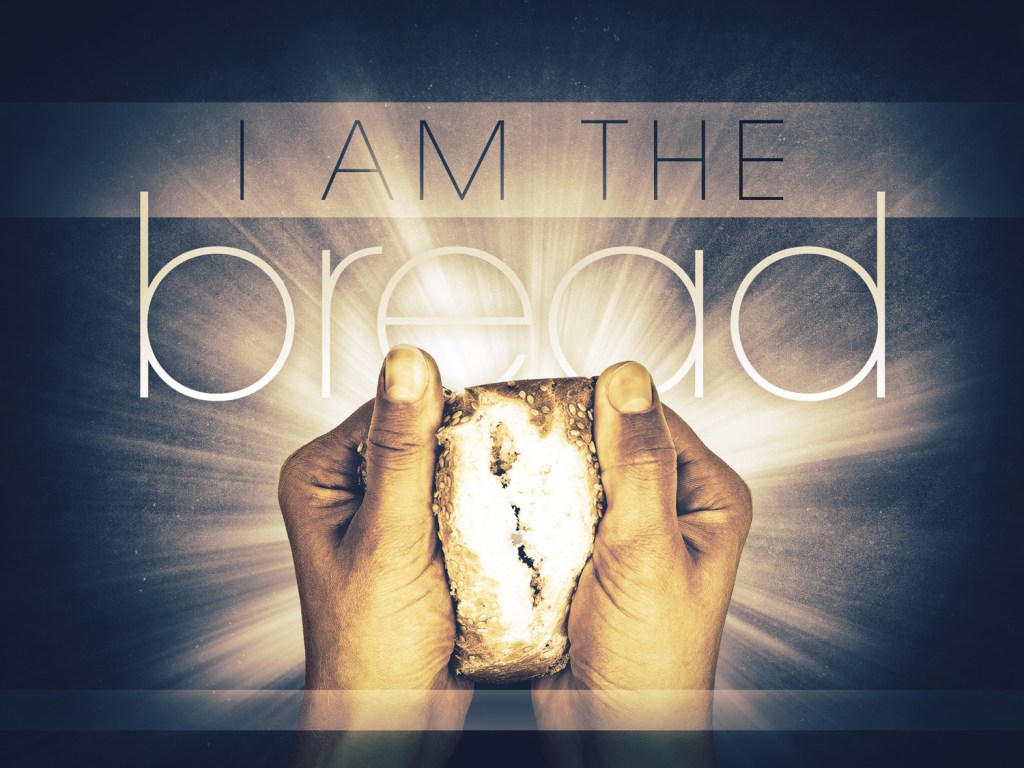
Jesus said to them, “I am the bread of life. Whoever comes to me will never be hungry, and whoever believes in me will never be thirsty.”

00029400_h

After miraculously feeding 5,000 people, the crowd stayed on the other side of the sea. Though they had been properly fed by the Word, the loaves, and the fishes, when they discovered that this miracle man was nowhere to be found, they got into the boats and went to Capernaum looking for Jesus.

When they finally caught up with him on the other side, they called out, “Teacher, where did you come from?!?” Jesus responded, “Very truly, I tell you, you are looking for me for the wrong reasons, you came here not looking for signs, but because I gave you enough to eat yesterday. Do not work for the food that spoils, but instead for the food that endures for eternal life, which the Son of Man will give you. For it is on him that God the Father has set his seal.”

“Okay, okay, so what do we have to do in order to perform the works of God?

Jesus answered simply, “This is the work of God, that you believe in him whom he has sent.”

“Well, who do you think you are Jesus of Nazareth? What sort of sign are you going to perform? Why should we listen to you? How can you prove what you are saying to us? Sure, yesterday you fed all of us, made something out of nothing, but so did Moses in the wilderness. Why should we turn away from him, to you?”

“Very truly, I tell you, it wasn’t Moses who gave you the bread from heaven, the manna, but it is my Father who gives you the true bread from heaven. For the bread of God is that which comes down from heaven and gives life to the world.”

“Now Jesus that sounds pretty good to us, we would like some of that bread!”
jeswelcom

“No, you don’t get it. I AM THE BREAD OF LIFE. Whoever comes to me will never be hungry, and whoever believes in me will never be thirsty.”

One of the great paradoxes of what it means to be Christian, is that we already know the end of the story while we’re stuck in the middle of it. Because we read from God’s word in order to remember the mighty acts of God in the world, we are all well versed on what happens in conclusion. Therefore it becomes nearly impossible for us to imagine the depth and meaning of these narratives in and of themselves.

Try with me, if you can, to imagine that you are there among the crowd. Yesterday you were blown away by this nothing of a man who made something out of nothing. As you stood in line with your stomach rumbling, you were given more fish and bread than you had ever seen in your life. Now, you were so hungry that you ate until your stomach was about to explode, (just like many of us will do tomorrow…) and the next day, the miracle man was gone. As your hunger started to creep back up, you agreed with those around you to go looking for this Jesus.

So here you are, gathered together to hear him speak once again. Some of the people in the front challenged him about Moses’ miracle in the wilderness, something about Manna, but you just want him to provide some more food. So as Jesus begins to describe this true bread from heaven that gives life to the world, your mouth begins to water. You imagine a glowing loaf cooked perfectly, warm and moist on the inside, with just enough crust on the outside. You join the chorus around you, “Give us some of that bread Jesus! We want that always!” And Jesus responds, “I am the bread of life.”

For us, the temptation to jump to the end of the story is great. We hear “bread of life” and we think about Holy Communion, we think about the last supper that Jesus shared with his disciples, we think about the crucifixion and the resurrection. And though it is important to know the end of the story, we’re not there yet.

I imagine that many who had gathered together that day were very confused. “What did he say? He’s the bread of life? What in the world could that mean?”

They don’t get it. The crowds that had witnessed Jesus’ miracle the day before knew exactly what they wanted, but thats not what Jesus is offering.

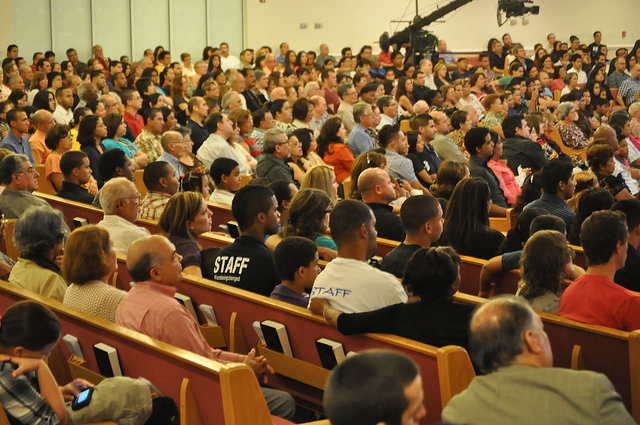
Today too many of us give the impression that numbers and popularity and packed pews are all important and sufficient in themselves. Many churches seem willing to accept people on any terms, if only they will come at all. How interesting is it then, that Christ would only accept the crowds on his terms, and would not want them upon any others. It hurt and frustrated him that they were merely interested in his ability to provide an easing of material difficulties or an increase in their comforts. “You came to me only for the chance of loaves and fish.”
8105338460_5b6fa706bf_z

Similarly, in our contemporary culture people are hugely interested in the by-products of Christianity, but hardly at all in Christianity itself. Crowds of folk are constantly looking for whatever they can get out of church and worship. They are primarily interested in the kind of faith that will give them bread and fish, bigger homes, shorter hours, better health, happier families. Today Christ looks into the depth of our hearts and triumphantly declares, “there are far better and more satisfying things within your reach than you have realized.”

The whole exchange begins with an accusation by Jesus regarding the crowds’ overwhelming desire and interest in full stomachs, instead of the power of theologically oriented signs. Jesus proposes to give them enduring food and not the kind they consumed the day before. The exchange then elicits a question from the crowd about the “works of God” which Jesus reduces to one, namely belief; belief “in him whom he has sent.”

What is belief? What does belief mean for each of you? Are we called to believe in God, in Jesus Christ, in the Holy Spirit? Is belief about accepting the bible as truth? Can we boil down our belief to something like the Apostles’ Creed?

Often times belief in Christian living is compartmentalized into believing that God simply exists.

The kind of belief that Jesus talks about with the crowds in John 6 is a different kind of belief. Belief is more than mental affirmation, belief is a world view, belief is a paradigm shift, belief is about a redefinition of reality.

What we believe, shapes how we behave.

Everything about what we do begins with belief; we believe in Jesus Christ and the things for which he stands, the way and the truth and the life he teaches us, the God whom he reveals to us, the grace and faith he came to offer us, the victory over death which he makes possible even for the least likely of us, the kingdom of God that he inaugurates for us. 

Okay Jesus, you want us to believe, to drop everything, to change our lives, to pick up our own crosses, to follow you. But why? Moses fed us with the manna in the wilderness, what can your belief offer us?

Moses was Moses, a mighty servant and steward of the Lord. Yet what Moses gave to the wandering Israelites was not the bread from heaven; it is God the Father who gives you the bread from heaven, and that is being offered to you this day. What Moses provided, rather what God provided through Moses, was merely food. What Jesus offers the crowd is the almighty God.

Tomorrow, millions will gather together with friends and family to celebrate the wonderful holiday of Thanksgiving. Crowds will develop in all of the airports, the roads will be filled with traffic, and kitchens will be teaming with individuals trying to concoct the perfect mashed potato – turkey – gravy – cranberry – stuffing combination of all time. After exchanging pleasant and cliche reflections on what we are most thankful for this year, most of us will partake to ridiculous degrees on the food set before us. Mountains of mashed potatoes will be eroded with rivers of gravy. Quarries of cranberry salad will rival seas of stuffing.

A-Thanksgiving-meal-has-at-least-3000-calories

Perhaps most frightening is the fact that within 24 hours, we can go from thanking God for all the blessing in our lives, to fighting one another at Best Buy in order to purchase something to fill our insatiable appetite.

ap_black_friday_21_dm_121123_wg

We know what we want, but thats not what Jesus is offering.

I like to think that, as the church, we have matured from our fragile days of discipleship in the first century. I like to believe that because we know the end of the story, we are better prepared to heed Jesus’ call to a life in the kingdom. I like to imagine that, as moderns, we are ready to take up our crosses in brilliant fashion and follow Jesus into glory.

But the truth is, we are still standing in that crowd asking Jesus for the bread.

We struggle so desperately to find meaning in our lives through failed relationships, the accumulation of material possessions, and vocational discernment. We hear the word of the Lord in scripture, and then quickly fall back away into the shadow of our lives. We thank God for our families and then bicker and fight as if they were not precious gifts in our lives.

Just as He did that day in the crowd, Christ looks out to all of us this thanksgiving season and offers us something more fulfilling than anything else. “I am the bread of life, whoever comes to me will never be hungry, and whoever believes in me will never be thirsty.”

“I am the bread of life”; search throughout the scriptures, I challenge you to find something equally simple and profound in summarizing the Good News. This the gospel of Jesus Christ at its very finest! How ample in its sweep, how generous in its description, how impossible to evade. This is a passage to which we can all cling in the darkest moments in our lives. With this one sentence we discover an everlasting hope that will endure all things.

“I am the bread of life”; Jesus Christ is as important to us as the very food we eat. Indeed, Christ is more important to us than food. No amount of food or drink or any material thing will ever fill us the way that Christ does. Through the bread of life that Christ offers we receive strength to live out our faith, we are sustained and nurtured and loved in all things.

“I am the bread of life”; The triune God is an end to all the craving and discontent in our lives. The bread of life roots our identities in the one from whom all blessings flow, the maker in whom we live and move and have our being.

lord__s_supper_by_bclary-d37hhzp

In a few moments all of you will be invited to Christ’s table to partake of him through the bread and the wine. Just as Jesus stood before the crowd to proclaim his identity as the bread of life, Jesus once gathered with his disciples to remember the stories of God in the world and share one final meal.

What are you thankful for this year? How have you been trying to fill the voids in your life? If you want to be filled, if you want to find a sustenance in your life, if you desire to have your life transformed, if you need to be made whole, if you want to discover purpose and faithfulness in your life, if you desire to know God, if you hope to find peace in your lives, then come. Come to Christ’s table. Feast on the true bread from heaven, believe in Jesus Christ, and be filled by the Spirit.

Amen.

00029400_h

Apocalypse When? – Sermon on Luke 21.5-19

Luke 21.5-19

When some were speaking about the temple, how it was adorned with beautiful stones and gifts dedicated to God, he said, “As for these things that you see, the days will come when not one stone will be left upon another; all will be thrown down.” They asked him, “Teacher, when will this be, and what will be the sign that this is about to take place?” And he said, “Beware that you are not led astray; for many will come in my name and say, ‘I am he!’ and, ‘The time is near!’ Do not go after them. When you hear of wars and insurrections, do not be terrified; for these things must take place first, but the end will not follow immediately.” Then he said to them, “Nation will rise against nation, and kingdom against kingdom; there will be great earthquakes, and in various places famines and plagues; and there will be dreadful portents and great signs from heaven. But before all this occurs, they will arrest you and persecute you; they will hand you over to synagogues and prisons; and you will be brought before kings and governors because of my name. This will give you an opportunity to testify. So make up your minds not to prepare your defense in advance, for I will give you words and a wisdom that none of your opponents will be able to withstand or contradict. You will be betrayed even by parents and brothers, by relatives and friends; and they will put some of you to death. You will be hated by all because of my name. But not a hair on your head will perish. By your endurance you will gain your souls.


            The disciples have gathered together with Jesus. They’ve probably shared some bread, fish, and wine while sitting around and talking about the latest news from Galilee and the recent happenings in Jerusalem. Peter, ever extraverted, decides to change the conversation to the majesty of the temple: “Oh how lovely it was, adorned with remarkable stones and the gifts dedicated to God. Have you ever seen such gold in your lives?” The other disciples nod in approval, while Jesus remained silent. Bartholomew furthers Peter’s claim: “The temple of God is indeed a witness to God’s majesty in the world. Only the God of Abraham, Isaac, and Jacob could have such a place!” They all begin to agree with one another, affirming the glory and might of their God, the God of Israel, worthy of such a temple.

            But then, in sharp contrast to their excited exclamations, Jesus speaks up, “All of these things that you see, the temple in all its glory, the days will come when not one of these stones will be left upon another; all of them will be thrown down.

            The disciples have been around Jesus long enough to know that when he says something like this, its important to pay attention. “But how could this be?” they wondered; the temple was a sign of God’s glory. So then one of the disciples, perhaps Peter, asked on behalf of the whole group, “Teacher, when will this be, and what will be the sign that this is about to take place?”

apocalypse-when

            What a question. Its stories like this one that help to remind me how similar we all are to the disciples. Because that question is the same one I would’ve asked. Okay Jesus, things are going to get rough, when? What will happen to let us know that this is about to take place?

            How appropriate and funny is it that Jesus’ first warning about the apocalypse is directed toward the would-be-prophets who predict the end of the world? Just within my lifetime I can think of a number of examples of the self-affirmed prophets who claim to know the exact date of the approaching end of the world. And even though Jesus has clearly warned us against them, when they come forth with their predictions, they never fail to get a hearing, media presence, and air time.

61786025


And people listen to them! Droves of people go to the bank and withdraw their life savings, bunkers are dug and filled with emergency supplies, and some even take their own lives rather than accept the coming doom and gloom predicted by these would-be prophets. Jesus looks out at his disciples, and therefore every one of us, and declares, “Beware that you are not led astray; for many will come in my name and say, ‘I am he,’ and, ‘The time is near!’ Do not go after them.

            There always seems to be some other form of allegiance in the world that appears better than what we learn to live into from God’s Word. Some affiliation more fruitful, some path through the trials of life that seems more certain and secure. We would rather rely on reason than faith. We would prefer to deal with material possessions than with spiritual growth. The tragedy of the history of God and God’s people is that we have continually been a people running off like that, generation after generation, in pursuit of other, perhaps easier, gods.

            After this first warning, Jesus continues his diatribe regarding the eschaton: “When you hear of wars and insurrections, do not be terrified; for these things must take place first, but the end will not follow immediately. Nation will rise against nation, and kingdom against kingdom; there will be great earthquakes, and in various places famine and plagues; and there will be dreadful portents and great signs from heaven. But before all this occurs, they will arrest you and persecute you; they will hand you over to synagogues and prisons; and you will be brought before kings and governors because of my name.”

tumblr_lxqyysSSQ61qlvp8so1_500

            I have often heard non-Christians remark about how easy it is to be Christian. Those with a limited knowledge of what it means to be a faithful people often charge the church as being a means of escape from the harsh realities of the world. “It must be so easy to be Christian, you don’t have to worry about what really goes on in the world, just waiting for your heavenly reward.” However, in sharp contradiction to these claims Jesus very bluntly puts forth how very difficult it is, and will be, to be Christian. In a way, being Christian, is in some sense, an escape, not our of life, but right into the depth of it; from meaningless into meaning, from futility into purpose, from bondage into freedom.

            The Good News of Jesus Christ has always been paradoxical in its ability to disturb the ways of the world. Those with privilege look on it with suspicion, those with power look at it with disappointment. The Jewish leaders were shaken by it and fearful. Rome outlawed it. The first disciples all suffered persecution and condemnation. Jesus did not get killed for loving too much, but for turning the world upside down; for changing the perspective of what it means to be first and last, for defeating death, and removing power from the powerful.

            “This will give you an opportunity to testify. So make up your minds not to prepare your defense in advance, for I will give you words and a wisdom that none of your opponents will be able to withstand or contradict.”

            When Jesus addresses the disciples, describing for them the very trials and tribulations that they were to face he makes it clear that these are the hours of opportunity. When the world shouts No, the church responds with a resounding Yes!

            Our faith is not a creed, not a way of thinking about life, not 5 steps to make a better you; it is the I and Thou of a God who calls us by name, addresses us, seeks us, a moment of meeting, the time for hearing and becoming. Our faith is about confronting the problems of the world, living into them, and transforming the world for God’s kingdom. The Bible, God, and our faith is never on pause. The time is now!

            What Jesus describes in this passage is what we often call the apocalypse. What kinds of images come to your mind when you think about the apocalypse? Death? Destruction? Zombies? Though these are the popular images often associated the apocalypse, apocalypse deals with a revelation, which discloses the realm of God behind the world of historical and interpretable events.

            Timing is important when we talk about revelation from God. What Jesus describes, the events surrounding the suffering of his followers will happen in the future. There will come a time when Christians are called to testify to their faith when everything around them will argue the contrary. The apocalypse is coming in the future.

            However, most of the events that Jesus described took place within the 1st century of the church. The temple was destroyed in 70 AD, the disciples were called before synagogues and governors to witness to their faith. They were rejected by the world and suffered because of their association with Jesus Christ. Nations rose against nations and wars took place. The apocalypse happened in the past.

            What becomes real for us today, though, is that God’s revelation, the apocalypse, is happening right now! What Jesus described in his apocalyptic descriptions helps to show how what is going on is mixed with what is really going on. Events set in the larger context of God’s purposes in the world. We have been caught up in God’s great cosmic victory and therefore we are surrounded by symbols, signs, and mysterious elements regarding what is really taking place. As strange as this may seem to us as enlightened, modern, and rational people, it is a dramatic witness to the tenacity of faith and hope among the people of God.

            “You will be betrayed even by parents and brothers, by relatives and friends; and they will put some of you to death. You will be hated by all because of my name. But not a hair on your head will perish. By your endurance you will gain your souls.”

            How easy is it to be Christian? Apparently, its not. What is at stake for us in this passage is the commitment and call to be faithful witnesses under unusual stress and frustration. For us, here in Staunton, it might be hard to imagine suffering for our Christian identities. But faithfulness and endurance under threat and disapproval (and even penalty of death) are the qualities of discipleship during the time of witnessing. Disciples, and that means all of us here, are not exempt from suffering. If there is any doubt of this period of testing and testimony is still present, you need only look to what recently happened in the Philippines, or the dozens of Christians who were recently executed in North Korea for having Bibles, or the suffering of members within this church right now. Some of you might know of the suffering within the church, perhaps its even happening to you, just look around.

            Jesus’ address to the disciples regarding the apocalypse, the revelation of God, calls us to reflect on our own discipleship. I have been told again and again that if people are not complaining about me in the church I serve, than I am not doing my job. Being Christian implies a willingness to be pushed into the discomfort of discipleship in order to live into the new reality that Christ initiated with his death on the cross.

            Are we almost Christians? Are we content to arrive on Sunday mornings in order to go back to work on Monday without any change in our lives? Are we comfortable with seeing all of the suffering around us and letting it pass by our vision without stopping to question why? Are we ready to witness God’s kingdom transform the world without our participation?

            Or are we fully Christian? Have we felt the love of God in our hearts and we are ready to respond to that love with our commitment to faithfulness? Do we sit in the shadow of the cross while awaiting the glory of the resurrection? Are we ready to witness to the goodness of God even amidst our own suffering?

            I love the question the disciples ask: “When is this going to happen?” But there’s another question I feel compelled to ask: “Why is it going to happen?” If our Christian lives are comfortable and easy, perhaps we’re not doing enough. If the amount of suffering the first disciples went through was part of God’s revelation, then maybe we should be going far enough to disrupt the powers of the world. What would it take for us to believe so fervently, that we would live such faithful lives worthy of persecution from those around us?

            We have to know that what Christ is talking about is the end. And we have to know with equal knowledge that it is also the beginning. That the God of grace and glory is bent on rescuing his own from the misery that finds us in life, and continually working toward that salvation. That God is committed to saving us with the Good News according to Christ, and eagerly doing it by means of every life that will give itself away to him and his kingdom.

            Teacher, when will this be, and what will be the sign that this is about to take place? The apocalypse, the revelation of God, is now.

            Amen.

Weekly Devotional – 11/18/13

Devotional:

Psalm 46.1-3

God is our refuge and strength, a very present help in trouble. Therefore we will not fear, though the earth should change, though the mountains shake in the heart of the sea; though its waters roar and foam, though the mountains tremble with its tumult.


John_Wesley-3

In 1735 John Wesley, the founder of the Methodist renewal movement of the Church of England, made his way from England to the New World having been called to be a minister for the new colony of Georgia. Wesley prayed over this invitation for some time and eventually came to the conclusion: “My chief motive, to which all the rest are subordinate, is the hope of saving my own soul.” Though he had lived a devout life, and was ordained as a deacon in the Anglican Church, he felt that his own soul had yet to be saved.

During the voyage across the Atlantic, Wesley experienced a new kind of faith, one that he had yet to find in his own life. He recorded it as such in his journal: “There was now an opportunity of trying whether they (The German Moravians) were delivered from the spirit of fear, as well as that of pride, anger, and revenge. In the midst of the psalm wherewith their service began, the sea broke over, split the mainsail in pieces, covered the ship, and poured in between the decks, as if the great deep had already swallowed us up. A terrible screaming began among the English. The Germans calmly sung on. I asked one of them afterwards, ‘Was you not afraid?’ He answered, ‘I thank God, no.’ I asked, ‘But were not your women and children afraid?’ He replied mildly, ‘No; our women and children are not afraid to die.’”

This profound experience would follow Wesley throughout the rest of his life, inevitably leading to the discovery of his own profound faith in the God who had faith in him, despite his sinfulness.

The psalmist sings out, “God is our refuge and strength… therefore we will not fear, though the earth should change, though the mountains shake in the heart of the sea; though its waters roar and foam…” That kind of faith is remarkable, one that takes years to cultivate and nurture. Just as Wesley was surprised by the faith of the Moravians on the ship, so too, it is often difficult for us to maintain our faith in the midst of tragedy and fear. Yet, every Sunday the church gathers together to remember our God, to remember that God came in the form of flesh and mounted the hard wood of the cross for us.

So, the next time you’re confronted with the seas and mountains in your life shaking and spilling over remember the faith that God has in you. That time and time again God went after you, to find you, to call you by name, and to embrace you. How would your life change if you had the faith to look at death and suffering in the face and simply remark, “I am not afraid”?

God of the Living – Sermon on Luke 20.27-38

Luke 20.27-38

Some Sadducees, those who say there is no resurrection, came to him and asked him a question, “Teacher, Moses wrote for us that if a man’s brother dies, leaving a wife but no children, the man shall marry the widow and raise up children for his brother. Now there were seven brothers; the first married, and died childless; then the second and the third married her, and so in the same way all seven died childless. Finally the woman also died. In the resurrection, therefore, whose wife will the woman be? For the seven had married her.” Jesus said to them, “Those who belong to this age marry and are given in marriage; but those who are considered worthy of a place in that age and in the resurrection from the dead neither marry nor are given in marriage. Indeed they cannot die anymore, because they are like angels and are children of God, being children of the resurrection. And the fact that the dead are raised Moses himself showed, in the story about the bush, where he speaks of the Lord as the God of Abraham, the God of Isaac, and the God of Jacob. Now he is God not of the dead, but of the living; for to him all of them are alive.”


The Sadducees know exactly what they’re doing. They are not standing before Jesus truly desiring an answer to their question. They are not like the student whose paper is no longer decipherable because they have used their entire eraser while trying to answer a question. They are in Jesus’ presence for the purpose of embarrassment. Their aim is to argue, frustrate, and force Jesus into a particular way of thinking. The question that formed on their lips is not genuine. They are simply attempting to bait Jesus with one of their classic “what if” questions, a question on which their minds were settled long ago.

Haven’t all of us resorted to this kind of questioning at some point? The militarist asks the pacifist, “what if someone was attempting to rob you and your family, would you fight back?” or the child asks the mother, “what if the world ended tomorrow, would you really make me do my homework tonight?” or the skeptic asks the believer, “what if there is no God, would you still pray?”

“So, Jesus, Moses wrote for us about how to handle a situation if a married man dies without producing children. The wife is to remarry one of her brothers-in-law in order to have a child. But, what if this happened, and a woman remarried 7 brothers and never had any children with them, who would she be married to in the resurrection?”

resurrection


I knew a man who had a wonderful family life. He was a pastor, occasionally moved throughout his conference, but he had established roots in certain parts of the state. He enjoyed his work, but he loved coming him to his wife and children every afternoon. It was when everything seemed perfect that tragedy struck; his wife was killed in a car accident. In the wake of her death, the children were old enough to take care of themselves and when the pastor returned to work he no longer had the energy to serve the local church and so he retired. It was not for a lack of conviction or faith, but the loss of his wife struck him so deeply that he felt it would be irresponsible to try and serve others.

Time passed. The wound from his wife’s death remained open. He mourned. But after awhile he started to find a different rhythm in this new time of his life. The seasons passed and even though he still missed her, he was taking steps toward finding joy again.

He met his second wife later in life through mutual friends. It was clear that they had a connection but neither realized how deeply they cared for one another. When they married it was a joyous celebration and they spent the following decade together.

I got to know the husband and wife in their later years, visiting with them, hearing their story, and breaking bread together. They were meant for each other, and I don’t just mean finishing each others sentences kind of thing. They were adorable in their connection, in their refusal to be separated, and in their faithfulness when the former pastor developed a brain tumor.

I was unable to attend the funeral but I received a phone call from the new widow that evening. Through the abundant tears landing on the telephone I was barely able to make out her words but I could tell that something was worse than the emotions that come with attending the funeral service for your spouse. “I just don’t know what to think, Taylor,” she said while sobbing, “Today, during the service, my step-daughter, my husband’s daughter from his first marriage, delivered part of the eulogy. She stood before that crowded church and lamented the loss of her Daddy. But before she finished, she looked up in the air and said, ‘I’m so happy that Dad is back together with Mom now.”

I was silent.

“What does that mean about me?” she continued. “What will happen when I die? Will he be waiting for me?”

How could anyone speak into that situation? What could you say to help fill the void that her husband left, while remaining faithful to the God who has faith in us.

For a few moments I waited silently on the phone unsure of what to say. But then I remembered that Jesus had been asked a similar question…


Jesus was asked a question that would’ve typically elicited a pastoral response. After all, this story comes toward the end of Luke’s gospel; Jesus has already traveled all over Galilee proclaiming the Good News, healing the sick, feeding the hungry, and pastorally caring for his flock everywhere that he traveled. His answer to the Sadducee’s question is important and vital to our lives not only as Christians but also to all people who reflect on life and death.

Jesus begins his response to the Sadducees’ loaded question rather directly: “People who belong to this age marry and are given in marriage, but to those who are considered worthy of a place in that age and in the resurrection from the dead neither marry not are given in marriage. Indeed they cannot die because they are like angels and are children of God being children of the resurrection.”

In this first part of his response Jesus pointed out the inappropriateness of their question. There is a difference between this age, and the age to come. In this present age the reality of death makes marriage and the perpetuation of life essential. In order to continue the cycle of life, new lives need to be brought into the world. However, in the age to come, in the resurrection, death will be no more, death will die, and those who are blessed enough to attain the resurrection will be as children of God. There is no marriage in the resurrection because it is no longer needed, God’s purposes for life after life after death will be so glorious and inexplicably remarkable that marriage will be no more. 

heaven

There is a difference here between what we commonly imagine about heaven and life after death regarding the immortality of the soul and the resurrection. Many would have us believe that to be Christian means that we have immortal souls, but there is an important distinction between immortality and resurrection. Immortality is based on a doctrine of human nature that denies death; resurrection is based on a doctrine of God which says that even though we die, God gives life to the dead.

In the second part of his response Jesus relies on the teaching of Moses to help undermine the question from the Sadducees. The Sadducees believed that a teaching, belief, practice, or habit was not authentic unless it could be found in the Pentateuch, the first five books of the Bible, the so-called “Mosaic Law.” They would search through those books and unless it was there, it was not relevant or viable for their faith. So Jesus draws on the teaching of Moses, particularly the incident of the burning bush, to further defend his answer.

Do you remember the story? Moses, a shepherd for his father-in-law Jethro is out in the wilderness tending the flock. In the midst of his work he is confronted by a bush that is burning, but the flames refuse to consume the bush. In this interplay between human and the divine Moses is commissioned by God to deliver God’s people, the Israelites, out of slavery in Egypt to the Promised Land. Reluctant to undertake such a task, Moses questions, “Who am I to say sent me?” And God responded, “Tell them I AM sent you, I am the God of Abraham, of Isaac, and of Jacob.”

So when Jesus responds to the Sadducees he remembers this story for them. God is not a God of the dead, but of the living. What we do in the here and now is important, and God will take care of us when our time comes. You may think of Abraham, Isaac, Jacob, and Moses as being dead, but God is their God, they are alive through him.

The Sadducees, in their strict conformity to their theological persuasion were unable to comprehend that standing before them was God in the flesh, that Jesus himself was the Word, the new law, and the new covenant. He not only brought a new teaching, but he himself was the new teaching.

Just as during the time of Jesus’ interaction with the Pharisees, there has been confusion over the implications of the resurrection throughout the history of the church. Resurrection has often been understood in one of two ways: Experientially or Eschatologically.  (bear with me here)

An experiential resurrection would allow for all of us here to achieve a newness in our lives in the here and now on earth; “we have been raised to new life in Jesus Christ.” An eschatological resurrection would mean that God will give life to our bodies after we die to live and reign in the new heaven and the new earth; “Behold I am making all things new.”

What is important for us, what Christ conveyed to that crowd of doubters, is that both of these resurrections contain truth. There is a beauty in the experiential resurrection that we discover when we find ourselves caught up in the mission of God and there is an indescribable fulfillment in the eschatological resurrection that will come when God makes all things new.

Last-Judgment-(Fra-Angelico)-774816


So I stood there silent on the other end of the phone while the new widow cried out of frustration and fear. “What does that mean about me?” she pleaded “What will happen when I die?”

I took a deep breath before speaking into her reality.

“I don’t know whether or not this will bring you peace right now, but a long time ago somebody asked Jesus a really similar question about marriage in the resurrection. I can never tell you for sure what will happen, but I can tell you what Jesus says. In the next life, in the resurrection, there will be no marriage. God will wrap us up in such a way that marriage will no longer be necessary to convey the deep sense of love and connection that it does in this realm. Your husband will not be married to anyone but we will all belong to one another. I know that right now this probably isn’t the most helpful or pastoral response, but isn’t there something beautiful about the fact that when we go on to greater glory we will all be equal before everyone?”


The way Jesus confronted the question of the Sadducees is so relevant for us today as people of grace who contemplate both life and death. What will happen to us in the resurrection? Who will be belong to? Many of these questions trouble us because we are so desperately clinging to the material world here and now. In our families, marriage, and relationships we find fulfillment and purpose. If we lose someone that we root our identity in, what happens in the age to come?

God will take care of us. God will lead us through the loss of our loved ones and hold them within his warm embrace until that time that all the saints will be reunited; not as brothers, sisters, husbands, wives, but as children of God. 

Jesus’ response to the Sadducees is the way that God responds to our questions – not with answers which flatter us, or make the world simpler than it really is, but with his life given for us, that we might more fully give our lives to him.

As we prepare to go forth into the world remember that God is with you in the mundane and in the radiant. God is with you in life and in death, in marriage and divorce, in fear and joy. God is with us in all things here now and forevermore; he is not a God of the dead but a God of the living.

Amen.


Weekly Devotional – 11/11/13

Devotional:


2 Thessalonians 3.6-

Now we command you, beloved, in the name of our Lord Jesus Christ, to keep away from believers who are living in idleness and not according to the tradition that they received from us.


He had attended church throughout his life, but his faith was basically idle. He listened to the sermons, put money in the offering plate when it came by, and even attended a few bible studies. However, the extent of his belief, participation, and discipleship was lacking. It was clear that nothing excited him about church and he was simply attending because it was the “right thing” to do.

The pastor took notice of this and decided to invite the young man on a mission trip to build stoves for indigenous Mayans in the highlands of Guatemala. Though perhaps initially reluctant, the young man thought it might be a nice little vacation and he would get to work on his spanish.

37663_1409538169459_2274604_n

For 5 days he was worked to the bone. The food and coffee were often cold, the air was too thin for proper working conditions, he kept finding dried cement between his fingers, and he was perpetually exhausted. But something happened. Something changed within his disposition while in that remote village of the Highlands; his faith caught on fire. Though he felt run down by the physically exhaustion, for the first time in his live his faith was no longer idle. He was working for the kingdom of God and (as if the blindfold had been removed from his eyes) he began to see the importance, joy, and depth of what it means to be a disciple of Jesus Christ.

Paul wrote to the church in Thessalonica regarding the idleness present in the worshipping church. Clearly, there were people that were not participating to the degree that Paul would have liked and their behavior was detrimental to the greater church. While reading his words about isolating the idle believers it seems too drastic and definitely unchristian. Though it is perhaps extreme, the point that Paul makes is remarkably important: Christianity is dependent on the character of its disciples. If idleness is present throughout the church, the excitement and joy of what it means to the be the body of Christ for the world will disappear. Paul encouraged the Christians in Thessalonica to keep away from idle believers, but perhaps what we really need to do is help build up their faith, invite them to participate in ways that will light their faith on fire, so that the kingdom can become real for them.

So, if you know someone idle in their faith, reach out to them. Invite them to participate in new and exciting ways. Help them to see the glory and joy of what it means to be a follower of Jesus Christ.

If you feel that your faith is idle, find ways to engage in the local church. How can you serve those in need? Where can you be Christ’s body for others? What would it take to set your faith ablaze?

Faith is only faith when it is being practiced.

Then and Now – Sermon on Ephesians 1.11-23

Ephesians 1.11-23

In Christ we have also obtained an inheritance, having been destined according to the purpose of him who accomplishes all things according to his counsel and will, so that we, who were the first to set our hope on Christ, might live for the praise of his glory. In him you also, when you had heard the word of truth, the gospel of your salvation, and had believed in him, were marked with the seal of the promised Holy Spirit; this is the pledge of our inheritance toward redemption as God’s own people, to the praise of his glory. I have heard of your faith in the Lord Jesus and your love toward all the saints, and for this reason I do not cease to give thanks for you as I remember you in my prayers. I pray that the God of our Lord Jesus Christ, the Father of glory, may give you a spirit of wisdom and revelation as you come to know him, so that, with the eyes of your heart enlightened, you may know what is the hope to which he has called you, what are the riches of his glorious inheritance among the saints, and what is the immeasurable greatness of his power for us who believe, according to the working of his great power. God put his power to work in Christ when he raised him from the dead and seated him at his right hand in the heavenly places, far above all rule and authority and power and dominion, and above every name that is named, not only in this age but also in the age to come. And he has put all things under his feet and has made him the head over all things for the church, which is his body, the fullness of him who fills all in all.

allsaintsday

Today is All Saints’ Sunday, a particular fixture in the Christian liturgical calendar, often celebrated the first Sunday of every November. All Saints is a time and opportunity to name the death of our saints over the last year. And for us, as United Methodist in particular, “saints” refers to all Christians past and present, so we celebrate the church universal as well as those we have lost. Today is a day about remembrance and honor.

Paul writes to the church in Ephesus, “In Christ we have also obtained an inheritance, having been destined according to the purpose of him who accomplishes all things according to his counsel and will, so that we, who were the first to set our hope on Christ, might live for the praise of his glory.” What is this inheritance that he is referring to?

Bob Foley. Bob Foley was a long time usher at the church where I grew up. As a kid I can remember Bob handing me some of the children’s bulletins that I doodled over throughout the church services, and I can remember him patiently waiting on Christmas Eve’s services with candles in his hands. The first time I ever talked to Bob was when I was fourteen, the first Sunday that I ever ran the sound-system for our services. Bob fulfilled his usher obligations, handing out bulletins, helping new visitors and families find a pew, when he finally stood behind me looking over my shoulder. Now imagine with me if you will, a fourteen year old standing in front of a mixing board with hundreds of knobs, lights, and volume controls, at a church with a large sanctuary with hundreds of people prepared for worship. So with fear and trepidation defining my inner struggles Bob leaned forward and whispered in my ear, “good luck.”

soundboard01_big

I’m sure I messed something up that morning, perhaps I forgot to turn off our minister’s microphone so everyone wound up hearing him horribly attempt to keep the tune to “Be Thou My Vision,” or I turned the volume too high and there was feedback in the sanctuary, or no one heard the prayer over the Tithes and Offerings because I forgot to turn the microphone back on. I’m sure I messed up, but Bob walked over to me after the service ended, shook my hand, told me to call him Bob, and smiled while telling me how proud he was.

Thus started an incredible friendship that played itself out every Sunday morning as Bob and I would joke around in the back. He was old enough to be my grandfather but he never treated me like a child; he was encouraging, and respectful, but above all he was a happy man. Whereas many people would drag themselves into church on Sunday mornings, wiping away the sleep from under the eyes and trying to find a trash can for their coffee they had just chugged, Bob was always standing by the door with a smile because he genuinely cared about the church, he loved being there, and he loved God.

When Bob passed away it crushed me. I’ll never forget the feeling in the pit of my stomach when my mother called me during college to let me know what had happened, and I’ll never forget the awful feeling of walking back into the church for the first time without having Bob there with his customary smile.

Paul talks about an inheritance from Christ, something we receive through his mighty acts in the world. There is something special about getting to share the stories of the bible with someone, young or old, to talk about what God did with God’s people, but there is something indescribable about the way God is working in the world right now.

Bob Foley was a saint in my life. But what Bob offered for me and my Christian life was more than the typical church friendship. Bob never sat me down with scripture or told me how to live my life. He never criticized my decisions or offered unwarranted advice. What Bob did for me, was demonstrate how important faith is in the now. He might’ve loved to hear those old stories from scripture, but Bob felt God living in the world in the immediate, thats why he committed to being in church and sharing his smiles with everyone else; to him there was nothing better than being a Christian because he felt God’s presence.

When we read from Paul’s letter to the Ephesians, its as if he’s saying “It is such a great thing to be a Christian!” But, I wonder if that is the first thought that comes to our minds when we think about our Christian heritage today. May it be that the joy and excitement of the gospel has grown stale for many of us? Is living out our Christianity filled with images of too many commitments and disappointments? Have we grown complacent with what it means to be the church in the world? Perhaps a lot of us here are like the elder brother from Christ’s great parable, we see our wayward younger brother return home for a celebration and we are envious. Maybe we hear the words from our Father saying, “You are always with me, and all that I have is yours,” but the thrill and glory of these words have seemed to vanish.

Why are we here? Why did we wake up this Sunday morning and come to church? What brought us, what drove us to ever join together in the first place?

All of us are here because someone loved us enough to bring us, to invite us, to nurture us. Who was that person for you? Who was that saint in your life?

Paul writes about a “love toward all the saints” present in the community in Ephesus. That same love may, in fact, be half-present today in our lives through the casual “hello” at the Food Lion, in the wave as a car drives by in the neighborhood, and in the church fellowship activities in which we participate. But there is a temptation to take all of these things for granted, to live into them everyday, and never value them for what they really are.

I’m not proud to admit that I never realized how important Bob Foley was to my life until after he died. It was only in his absence that I began to appreciate the joy that he taught me every Sunday morning. I took my relationship with Bob for granted and I wish that I had lived into our friendship more while he was still here with us.

Like our relationship, it has taken me some time to discover what made Bob’s faith so worthy of emulation. I have wondered what it was that made him excited about the church, when so many others arrived more out of obligation than expectation.

Have you ever noticed that Paul almost never writes about the actual life of Jesus in his letters? Do you find it interesting that as a leader for the blossoming church in the first century, Paul rarely referenced the exciting life of Jesus Christ? He paid little attention to the Sermon on the Mount, the parables, the miracle stories, or other moving elements from the gospels. It seems, therefore, for the first Christians, what was most important was not what had happened in the past, but how Christ was living in and through them in the present. They most certainly remembered the words and actions of Christ in their worship, but their Christianity was exciting because Christ was still moving in their world.

Paul wrote to the church, “I pray that the God of our Lord Jesus Christ, the Father of glory, may give you a spirit of wisdom and revelation as you come to know him, so that, with the eyes of your heart enlightened, you may know what is the hope to which he has called you, what are the riches of his glorious inheritance among the saints, and what is the immeasurable greatness of his power for us who believe, according to the working of his great power.” The key word in this whole passage is “power.” When the first Christians appealed for conversion to the new faith they did not just talk about what had happened on a hill outside of Jerusalem in the year 33, but they witnessed to what Christ had done for them in their own lives.

Christ is a present power, rather than simply being an admired person from history, Christ transcends time and is with us in the present; that was the paramount miracle for the early church.

On this All Saint’s Day we are called to remember the saints of our lives, the Bob Foleys of the world, to be thankful for what they did for us, but to also live in the present. Be grateful for what they did, and live out our faith today. The saints and Christ are not just some historical influences in our lives but continually live and move through us in the ways that we continue to be faithful in the world.

Do you know God? I don’t mean some sort of dense theological knowledge, but real and tangible and simple. Do you know God in your life? We cannot have knowledge of a person until we see them in action and we shall not have faith in God until we trust and experience his divine love in the world.

There is a difference between the Word of God (Jesus Christ) and the word of God (scripture). Our knowledge of God in this community rests upon God’s Word as Jesus Christ. The Bible is not a textbook in the ordinary sense as a collection of facts that need to be checked and memorized but it is instead a story. In contains the majestic drama of God’s interaction with God’s people. The climax of the story is God’s coming down to dwell among us in the form of flesh, dying for us on a cross, rising again from the grave, returning to glory, and leaving behind a people of God endowed with knowledge of him.

When we remember the saints, when we gather together to read and proclaim scripture, it is important for us to remember God’s mighty acts in the world. However, what makes church and faith compelling, what moves us toward excitement, is God’s present power in the world! Today is the day that we can celebrate the lives that we have lost while also living into the exciting faith of what it means to be Christ’s body for the world.

Today we are called to remember those saints from our lives who shaped us into the people we are now. It is the time to remember disciples like Bob Foley who lived out his faith in his relationships with others, who felt the joy of Christ in his own life and in his own heart.

We remember those who have gone on with joy and with longing, for they are being held in the arms of our great Lord and we anticipate with joy the great reunion of all the saints of the church in God’s time.

Christians are not called to be motivated by the question: “what happens to me when I die?” but rather ”what am I doing with my life right now?” What we do in the here and now, how we live out our faith in the world, is what makes being the body of Christ an exciting and wonderful thing.

Jesus Christ is not a man of the past, a person to be remembered and recorded in history. Christ is alive! Christ is with us here and now in the gifts of bread and wine. Christ continues to live and breathe and change the world because we partake of him when we gather at his table.

If you are looking to find Christ in your life, if you want your faith to move from remembrance to lived reality, and if you want to find a joy worthy of celebration, then come. Come to Christ’s table and discover the inheritance that will change your life forever.

Amen.

Communion

Weekly Devotional – 11/4/2013

Devotional:


Psalm 17.6-9

I call upon you, for you will answer me, O God; incline your ear to me, hear my words. Wondrously show your steadfast love, O savior of those who seek refuge from their adversaries at your right hand. Guard me as the apple of the eye; hide me in the shadow of your wings, from the wicked who despoil me, my deadly enemies who surround me.

psalm-17-8

In the midst of suffering and disappointment in our lives, faith can be very difficult to hold on to. When we hear someone say, “life just isn’t fair,” we want to cry out, “Well, it should be!” Life is full of ups and downs, valleys and mountain tops, trials and accomplishments. Psalm 17 is a prayer of deliverance from those moments in our lives where we feel that life is no longer fair. It is a prayer for freedom to live into God’s righteousness and for God to come and surround us with his wings of protection and grace. While life is not fair all the time, it is right at all times to pray for God to deliver us from the wrong doings in our lives and the suffering we endure.

Additionally, there is something else in this psalm that can help us in our daily lives:

Once, while reading through some of the psalms with a few peers, a friend of mine remarked that there is often a lot of language about enemies in the psalms and he was unsure what to make of it. What does the psalmist mean with “my deadly enemies who surround me?” And then he made a statement that I will never forget: “We often read the psalms as if they were written for us individually and we forget about others who need to pray these words. Maybe we need to remember that we might be the enemies that the psalm prays about for other people.”

So, the next time you find yourself in a valley of your life, come back to Psalm 17. Read the words and pray them aloud. Know that it is a good and wonderful thing to be able to call out to the God who loves you to help deliver you out of troubling circumstances. But, the next time you find yourself on a mountaintop, ask yourself if you have been living faithfully according to God’s holy word. Is there someone praying for deliverance from an enemy that may in fact be you?