I AM WHO I AM

Exodus 3.1-15

Moses was keeping the flock of his father-in-law Jethro, the priest of Midian; he led his flock beyond the wilderness, and came to Horeb, the mountain of God. There the angel of the Lord appeared to him in a flame of fire out of a bush; he looked, and the bush was blazing, yet it was not consumed. Then Moses said, “I must turn aside and look at this great sight, and see why the bush is not burned up.” When the Lord saw that he had turned aside to see, God called to him out of the bush, “Moses, Moses!” And he said, “Here I am.” Then he said, “Come no closer! Remove the sandals from your feet, for the place on which you are standing is holy ground.” He said further, “I am the God of your father, the God of Abraham, the God of Isaac, and the God of Jacob.” And Moses hid his face, for he was afraid to look at God. Then the Lord said, “I have observed the misery of my people who are in Egypt; I have heard their cry on account of their taskmasters. Indeed, I know their sufferings, and I have come down to deliver them from the Egyptians, and to bring them up our of that land to a good and broad land, a land flowing with milk and honey, to the country of the Canaanites, the Hittites, the Amorites, the Perizzites, the Hivites, and the Jebusites. The cry of the Israelites has now come to me; I have also seen how the Egyptians oppress them. So come, I will send you to Pharaoh to bring my people, the Israelites, out of Egypt.” But Moses sais to God, “Who am I that I should go to Pharaoh, and bring the Israelites out of Egypt?” He said, “I will be with you; and this shall be the sign for you that it is I who sent you: when you have brought the people out of Egypt, you shall worship God on this mountain.” But Moses said to God, “If I come to the Israelites and say to them, ‘The God of your ancestors has sent me to you,’ and they ask me, ‘What is his name?’ what shall I say to them?” God said to Moses, “I AM WHO I AM.” He said further, “Thus you shall say to the Israelites, ‘I AM has sent me to you.’” God also said to Moses, “Thus you shall say to the Israelites, ‘The Lord, the God of your ancestors, the God of Abraham, the God of Isaac, the God of Jacob, has sent me to you’: This is my name forever, and this my title for all generations.


I have always loved churches. But before I loved the church for the people in the church, I loved churches because of their sanctuaries. Ever since I was a young child I felt a since of awe and wonder and peace whenever I entered a sanctuary. When I got my driver’s license I would drive myself over to the church in the middle of the week just to spend some time in the sanctuary. And it’s not like I would always kneel at the altar and pour out my soul to God, though I did, I just loved the feeling of being in the sanctuary.

When I was in seminary I was part of a church worship band, and I would drive to the church really early every week just to sit in the sanctuary before the rest of the group arrived. On one such occasion, I was sitting in a random pew and looking at a stained glass window when a man ran into the sanctuary screaming for help.

I immediately rushed to him and we met in the middle of the center aisle and before I had a chance to ask what was wrong he mumbled something out about being afraid and needing help and wanting prayer. I took him by the arm and tried to calm him down but the more I soothed the louder he wailed. Finally I grabbed him by the shoulders and said, “What’s your name?”

He stopped.

“I’m Marcus,” he said almost as if he was asking a question.

“Well then, Marcus, tell me what’s going on.”

Over the next fifteen minutes I listened to him as he described his fear and shock. His wife was pregnant and they had gone to the doctor that morning and heard the heart-beat for the first time. And instead of it filling him with joy, it terrified him. Not because of the responsibilities that were about to fall into his lap, but a terror about what would happen to his baby if he, as a father, died. He told me about how he had never been in a church before, that he never even wanted to go to church, but that he had been walking through the neighborhood crying, and before he knew it he started running. He told me about how he ran and he ran, and all the sudden he wound up in the sanctuary with me.

I listened as he shared his fears, and then I prayed for him. After the “amen” he hugged me and he left almost as quickly as he arrived.

Two weeks later I was driving near the church when I saw him walking down the road and before I knew what I was doing I pulled over, got out of my car and jogged up to him. “Marcus, Marcus!” I yelled, when he turned around it was like I was looking at a different person. He talked and he told me about how he was feeling better and that he was excited about the baby, and that he didn’t know who that God was I kept talking to that night but he felt like something changed. And then, as we were getting ready to say goodbye, he grabbed me by the arm and said something I’ll never forget: “Thanks for remembering my name.”
exodus 3-2_905

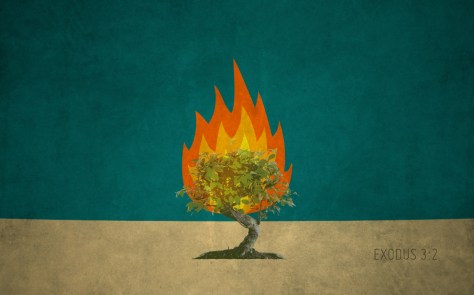
Moses was keeping the flock for his father-in-law when he came upon a burning bush. Moses saw the strange and wonderful sight and chose to turn toward it. And that’s when the Lord declared, “Moses, Moses!”

What follows is perhaps one of the most well known stories from the Bible. God speaks to Moses through the burning bush and calls him to help deliver God’s people out of Egypt. But Moses, like almost everyone encountered by God in scripture, feels unsure of the call. “Well, when the Hebrew people ask about you, who should I tell them you are?” And God said, “I AM WHO I AM.”

            The Tetragrammaton: I AM WHO I AM. YHWH. Yahweh.

For many Jews, the name of God revealed to Moses is so holy, so precious, that it cannot be uttered by the lips of mere mortals. Instead, there are other names for God like Adonai and Lord. In the Christian tradition, we will call God Yahweh, but the name of God revealed by God is unlike anything else and demands a respect and holiness that is rarely seen.

The passage about Moses in the wilderness with the burning bush is usually interpreted in such a way that it is all about Moses. Moses is walking, Moses is given a command, Moses responds. But there’s more to the story than Moses; it is the revealing of God’s holiness.

We could not have found this name, this Yahweh, by ourselves. Even if we entered into a long and passionate search through prayer or any other spiritual discipline we are not capable of finding out whom God is on our own. God’s name had to be revealed. God alone can tell us who God is.

And what does God say, “I AM WHO I AM.”

The divine name is a non-name in the best sense. Can you imagine Moses returning to the land of Egypt, mixing and mingling with the Hebrew slaves and saying, “Don’t worry, I AM WHO I AM sent me to set us free.”

What’s the purpose of a name? Do we name individuals to distinguish them from others? Do we give names to children in order to stroke our egos in attempts to live forever? Do we give names to people in order to build them up or break them down? What’s in a name?

I’ve been in enough hospitals to hear doctors refer to their patients not by Mrs. Smith or Mr. Jones, but by a room number (or worse: by their disease).

There are plenty of people who are judged simply because of the color of their skin, or their political persuasion, or their sexual orientation without their names ever being mentioned.

Names are important.

They are important in our everyday lives whether it’s learning the names of our neighbors, or our classmates, or our coworkers, or even the people in the pews next to us right now. Learning the name of the other, and actually using it, breaks down the walls and barriers that often lead us to judge rather than listen. Learning the name of the other prevents them from remaining a stranger. Learning the name of the other builds a bridge into something new instead of moving in the opposite direction.

God reveals God’s name to Moses in such a way that it bridges the divide but it also keeps the mystery. And I mean mystery in the most beautiful and theological way possible. We finite creatures cannot understand the infinite wonder that is I AM WHO I AM. There is a mystery to who God is simply because God is completely unlike us, but knowing how God reveals God’s name is important.

holyground_web (1)

If God is not given a proper name, God becomes a faceless unknown god with no story or history. But our God is a God of the story; our God has a name and is known by connections with other names.

God said to Moses, “I AM WHO I AM” and God also said so much more. God said, “I am the God of Abraham, of Isaac, and of Jacob.” Over and over again we are reminded in scripture that our God knows God’s people by their right names; God calls them and us by such: Abraham, Isaac, Jacob, Joseph, Hannah, Samuel, Saul, David, Mary, Martha, Peter.

God knows our names, and we should know God’s name as well.

If you’ve turned on your television or opened a newspaper this week you’ve seen some of the horrific and awful images coming out of Houston in the wake of hurricane Harvey. While some have taken to the internet to chastise and ridicule those in leadership about their lack of preparation or their delay in response, normal (and not-so-normal) people have done some heroic things so bring safety, life, and hope to the people who feel no hope.

And as I watched videos from Houston this week, as I saw boat after boat traveling up and down streets in attempts to bring people to safety, I was struck by one thing. In every instance of rescue, the rescuer began with the same question, “What’s your name?”

Think about that for a moment. While surrounded by signs of terror and fear, instead of commanding a person to leave their belongings or throw them over the shoulder, every rescuer looked in the eyes of the fearful other and asked the one question that would remove their otherness.

“What’s your name?”

From the burning bush God called Moses by name. Through words and flames Moses was changed through learning the name of God. I AM WHO I AM shows up in our lives at all kinds of strange moments, we could be shepherding, or sitting in a sanctuary, or waiting for rescue in a flooded house when the Lord calls out to us.

And we can trust I AM WHO I AM for the very same reason that Moses could. Because I AM WHO I AM is the God of Abraham, of Isaac, and of Jacob. Yahweh is the God who made a covenant with out ancestors, who delivered God’s people out of captivity in Egypt, who delivered us out of our captivity to sin and death. I AM WHO I AM is the God who was revealed to us in the person of Jesus Christ. I AM WHO I AM is the Spirit that lives and moves among us.

I AM WHO I AM is as mysterious as it is intimate. I AM WHO I AM comes to us in the intimacy of a piece of bread, and through the mystery of is being the flesh of Christ. I AM WHO I AM is as close as the person next to us and is as mysterious as the person sitting next to us. I AM WHO I AM is the name of our God who calls us by name. Amen.

Discerning the Devil

strangely-warmed-spreaker-header

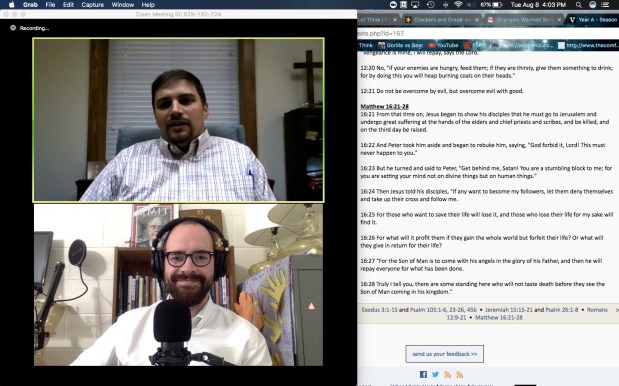
This week on the Strangely Warmed podcast I speak with Rev. Drew Colby about the readings for the 13th Sunday after Pentecost (Exodus 3.1-15, Jeremiah 15.15-21, Romans 12.9-21, Matthew 16.21-28). Drew is an ordained elder in the Virginia Annual Conference of the United Methodist Church and currently serves as an associate pastor at St. Stephen’s UMC in Burke, VA. The conversation covers a range of topics including beef tubes, identifying with biblical characters, nudity, kinship analogies, sleep, and knowing the devil. If you would like to listen to the episode or subscribe to the podcast you can do so here: Discerning the Devil 

Drew


Out Of The Water

strangely-warmed-spreaker-header

This week on the Strangely Warmed podcast I speak with Rev. Drew Colby about the readings for the 12th Sunday after Pentecost (Exodus 1.8-2.10, Isaiah 51.1-6, Romans 12.1-8, Matthew 16.13-20). Drew is an ordained elder in the Virginia Annual Conference of the United Methodist Church and currently serves as an associate pastor at St. Stephen’s UMC in Burke, VA. The conversation covers a range of topics including the kiss cams, the importance of names, how to remember the past, and what makes a holy kiss holy. If you would like to listen to the episode or subscribe to the podcast you can do so here: Out Of The Water

217387_578604105493543_912821730_n

On The Real Miracle Of Pentecost

strangely-warmed-spreaker-header

Jason Micheli and I recently sat down for a conversation about the celebration of Pentecost and what it means to preach about the Holy Spirit. Our podcast Strangely Warmed is dedicated to addressing the reading from the Revised Common Lectionary without using stained glass language and our recent episode brought forth some great topics such as the connections between Exodus and Acts, what it takes to be able to confess Jesus as Lord, and and the real miracle of Pentecost. If you want to listen to the episode (or subscribe to the podcast) you can find it here: Pentecost – Year A

img_mouseover3

Eucharist as Exodus

Exodus 12.1-14

The Lord said to Moses and Aaron in the land of Egypt: This month shall mark for you the beginning of months; it shall be the first month of the year for you. Tell the whole congregation of Israel that on the tenth of this month they are to take a lamb for each family, a lamb for each household. If a household is too small for a whole lamb, it shall join its closest neighbor in obtaining one; the lamb shall be divided in proportion to the number of people who eat of it. You lamb shall be without blemish, a year-old male; you make take it from the sheep or from the goats. You shall keep it until the fourteenth day of this month; then the whole assembled congregation of Israel shall slaughter it at twilight. They shall take some of the blood and put it on the two doorposts and the lintel of the house in which they eat it. They shall eat the lamb that same night; they shall eat it roasted over the fire with unleavened bread and bitter herbs. Do not eat any of it raw or boiled in water, but roasted over the fire, with its head, legs, and inner organs. You shall let none of it remain until the morning; anything that remains until the morning you shall burn. This is how you shall eat it: your loins girded, your sandals on your feet, and your staff in your hand; and you shall eat it hurriedly. It is the Passover of the Lord. For I will pass through the land of Egypt that night, and I will strike down every firstborn in the land of Egypt, both human beings and animals; on all the gods of Egypt I will execute judgments: I am the Lord. The blood shall be a sign for you on the houses where you live: when I see the blood, I will pass over you, and no plague shall destroy you when I strike the land of Egypt. This shall be a day of remembrance for you. You shall celebrate it as a festival to the Lord; throughout your generations you shall observe it as a perpetual ordinance.

Death is inescapable. We know this to be true because we go to the funerals for the people we love. We know this to be true because we sit in church and listen to people like me talk about it. We know this to be true because just a few weeks ago we were walking around with ashes on our foreheads, and the words you are dust and to dust you shall return were stuck in our minds.

I talk about death a lot because it seems like the rest of the world is hell-bent on denying it. Movie stars and pop icons and even politicians do everything that can to ignore the inevitability of their own finitude; they’ll get the Botox, the facelift; they’ll even participate in culturally relevant memes like dabbing now, or planking a few years ago.

Even in church we like to deny death at times. That’s why far more people will be here on Easter than the rest of our Holy Week Services combined. But if Easter is all about new life, then why should we keep talking about death?

Here in the United States, millions of people gathered in churches like this one on Sunday for the Liturgy of the Palms. Christians, like us, lifted up their palm branches and said those all-too familiar words like “Hosanna!” and “Blessed is the one who comes in the name of the Lord!” Here at St. John’s I tried my best to impart upon all of us the staggering nature of being able to shout “Hosanna!” on Sunday and “Crucify!” on Friday.

Maybe you were here and heard the gospel. Maybe you didn’t.

But by now I’m sure that most of us heard what happened in Egypt on Sunday. While we American-Christians sat comfortably in our khakis and color-coordinated cardigans, while we shook our nursery grown palm branches, two Coptic Christian churches in Egypt were bombed. Two men strapped explosives to their bodies, walked up to the respective altars, and detonated.

Dozens of people were murdered.

They died doing the same thing most of us were doing: worshipping the living God who rode into Jerusalem on the back of a donkey.

The only difference between them and us, is that they live in a world far more like Christ’s than we do.

What we’re doing here tonight is not a normal thing; it defies conventional wisdom. We could be anywhere doing anything, but instead we came to this place to share the Lord’s Supper. Being Christian is weird, it is strange, it is different. And in a lot of places, that’s enough to get you killed.

And so it was with the first disciples, who sat in a small room surrounded by their friends long ago. We are here tonight to remember what Jesus said and did in that room. The disciples were there that night to remember what God said and did on the first Passover.

The time had come to break free from the tyrannical and dictatorial rule of Egypt and to go to a strange new land. The Hebrew people were enslaved and worked to the death. And, as if that wasn’t enough, Pharaoh ordered the murder of every first-born male in every Hebrew family. Can you imagine the terror of the powers-that-be coming for your baby boy? But these were their lives, living under the shadow of subjugation.

And the time had come to break free.

God spoke to Moses and gave him explicit instructions on what to gather together, how to cook it, and even how to eat it. With specifics like an overly heavy cookbook, God laid out the plans for their deliverance: Every household shall cook and eat and lamb. Blood from the lamb shall be taken and adorned on the doorposts of the house where they eat it. You shall eat it hurriedly, with your loins girded, sandals on your feet, and staff in your hands. This will be the Passover, for the Lord will pass over the homes marked with blood and strike down every firstborn in Egypt, including the animals. But the blood shall be a sign, and nothing evil will come to you. You must remember this day every year, tell the story to your children, and your children’s children, for this is the day you will be delivered from slavery.

That’s the story the disciples gathered to remember. It’s a strange one, but they, like the generations before them, were a product of that story and it shaped everything about their lives.

And while they were sitting at the table, Jesus reached for a common loaf of bread; he gave thanks to God, and shared it with his friends. As they passed the bread around the table, Jesus said, “I am going to do a new thing, I am giving my body for you.”

And then, before the supper was over, Jesus took a cup, gave thanks to God, and shared it with his friends. As they passed the cup around the table, Jesus said, “This cup is my blood of the new covenant. I’m pouring out my blood for you, and for the world.”

In the frame of the blood of the lamb from the first Passover, Jesus poured out his blood as the Lamb of God.

christ-our-passover

Whenever we share this meal, we like to talk about forgiveness; being forgiven by God for what we’ve done. And this is good, and right, and true. But the first Passover wasn’t about God forgiving the Hebrew people for anything they had done… Passover was about God making a way out of no way; it was about freedom from tyranny and slavery; it was about the journey to a strange new land.

The Hebrew people took blood from the lamb and it was a sign for them to be saved.

Jesus took the cup and told his friends that his blood was to be their freedom from a different form or slavery, far worse than any power in Egypt then, or now. Through the Lamb of God’s blood, we are freed from death.

While sitting at the table with his friends, it’s as if Jesus is telling them that when they see him hanging on the cross, they should see a door with blood. It’s as if Jesus is telling them that his sacrifice, his death, is our exodus.

It might not feel like it at times, like when we gather in the sanctuary for a funeral or when we turn on the news and see what’s happening in Egypt or Syria or any number of places, but death no longer holds any control over us. For centuries the Hebrew people remembered how God delivered them out of Egypt, and for centuries Christians have remembered how Jesus delivered us out of the slavery to sin and death.

            Jesus is our Passover Lamb.

His blood has been spilled in the cup at our table and it covers the doors of our souls.

Tonight, Coptic Christians in Egypt will gather in their churches to remember Jesus’ final night with his friends, just like we are. They will remember God delivering God’s people out of Egypt, and God delivering them out of the bondage of death.

And we might wonder: Why stay in Egypt? As Christians, why don’t they just leave and go to a place where they can worship without the threat of death? Why not come to a place like the United States where they can be free to worship how they please?

Perhaps they will stay because they’ve already had their exodus. They’ve already been delivered from the reign of death into a strange new land we call the Kingdom of God. Maybe they’ve been shaped by the knowledge and faith that Jesus is their Passover Lamb.

I don’t know what you’re wrestling with tonight, whether you’re feeling God’s presence or it’s been a long time since you’ve felt anything remotely holy. I don’t know what sins you need to confess, or who you need to seek reconciliation with. But what I do know is that this meal is the beginning of our exodus; it is our journey to a strange new land.

So come and see that the Lord is good, let this be a moment of remembrance, and look to the cross as a door covered with blood. Amen.

God’s Top 10 – Sermon on Exodus 20.1-17

Exodus 20.1-17

Then God spoke all these words: I am the Lord your God, who brought you out of the land of Egypt, out of the house of slavery; you shall have no other gods before me. You shall not make for yourself an idol, whether in the form of anything that is in heaven above, or what is on the earth  beneath, or that is in the water under the earth. You shall not bow down to them or worship them; for I the Lord your God am a jealous God, punishing children for the iniquity of parents, to the third and the fourth generation of those who reject me, but showing steadfast love to the thousandth generation of those who love me and keep my commandments. You shall not make wrongful use of the name of the Lord your God, for the Lord will not acquit anyone who misuses his name. Remember the sabbath day, and keep it holy. Six says shall you labor and do all your work. But the seventh day is a sabbath to the Lord your God; you shall not do any work – you, your son or your daughter, your male of female slave, your livestock, or the alien residents in your towns. For in six days the Lord made heaven and earth, the sea, and all that is in them, but rested the seventh day; therefore the Lord blessed the sabbath and consecrated it. Honor your father and your mother, so that your days may be long in the land that the Lord your God is giving you. You shall not murder. You shall not commit adultery. You shall not steal. You shall not bear false witness against your neighbor. You shall not covet your neighbor’s house; you shall not covet your neighbor’s wife, or male or female slave, or ox, or donkey, or anything that belongs to your neighbor.

ten-commandments-set-free-to-live-free_27594_banner_img

As a kid, I always preferred worship to Sunday School. Sunday School meant we had to wake up earlier in order to make it on time, it rushed us as a family to get things ready, and the classrooms were filled with all of those strangely adult renditions of biblical stories. The lesson might’ve been on David fighting Goliath, but all I could ever remember was how buff and old David appeared in the pictures rather than the young and innocent version from the story. The lesson might have been focused on the importance of sacrifice, but the imagery of Abraham preparing to kill his son left most of us utterly terrified of God, rather than ready to give our lives to him. The lesson might have been about Jesus and Mary Magdalene, but the story fell a little flat when our teacher kept calling Mary a “lady of the night” which made her sound more like a vampire than a prostitute.

On the other side, worship was awesome. I loved sitting near the front and watching all sorts of different people come together for this one thing. It amazed me that old men and women would take the time to talk to me and ask me questions about my life. Oh the joy that I remember experiencing when I was invited to the front for the children’s message; we were the special ones, all the adults had to sit in their pews but we, the kids, got to go all the way to the front and get closer to God.

My adolescent faith and love for church was like a roller-coaster. I looked forward to the hymns, the bread and cup, the communal act of praying together, but I dreaded the Sunday School classroom, the 25 year old cut-out flannel-graphs, and the seemingly endless amount of Old Testament arts and crafts.

But, if I’m honest, the thing that really drove me crazy about Sunday School was the fact that it felt way too much like regular school. We had a teacher who took attendance, put us in assigned seats, gave out homework, and even proctored pop-quizzes. Now, don’t get me wrong, there is an importance to the education that comes in Sunday School, but the way that it was done for me resulted in my desire to read the bible not for its knowledge, but for the promise of receiving a piece of candy if, for instance, I was the first person who could turn to the book of Isaiah.

Sunday-School_t

I could go on and on about the things I experienced in those Sunday School classrooms, but the one that stands out the most was the day we were quizzed on the 10 Commandments. At the time I knew they were a thing, but I certainly had no idea what they were. Up to that point in my life I could not remember ever hearing them preached about in church, I had no idea where they were in the bible, but I knew you could find them in framed cross-stitch patterns at older people’s homes.

My sheet of paper remained blank for a long time. However, the teacher took pity on me and tried to help encourage some answers: “What are the ten things God wants us to do?” My mind raced through different sermons and scriptures; I tried to remember what the pastor always said about God… I think God wants us to love Him, I’m pretty sure we are supposed to do unto others as we would have them do unto us… What else? God calls us to lift up our crosses. Oh, and God wants us to give Him our money!

I don’t remember what I eventually wrote down for the quiz, but I do remember that I failed, and I did not receive a piece of candy.

Can you recite the Ten Commandments from memory? What do you imagine when you hear about the Ten Commandments? Do you think about how the law was established to protect and bind us together? Or do you just picture Charlton Heston from the movie version of the Ten Commandments?

ten_commandments

Sadly, in our modern world we are more likely to hear about the Ten Commandments as they relate to controversies surrounding public displays than how they were written to help shape, guide, and mold our lives. Even as a child I was implicitly taught that it was more important to memorize God’s Top 10, than it was to understand them, and live accordingly.

The beginning of the commandments sets up an individual address, but the concern is not just about our private lives and welfare. The focus and thrust of the list is on protecting the health of the community in which the individual plays a pivotal role.

God graciously provided these guidelines as a way to open up our lives rather than limit them. It might not appear that way at first, but upon closer inspection they describe the outer limits of conduct rather than focusing on countless specific behaviors for every situation. At the foundation of the Ten Commandments is God’s desire for us to be protected from behaviors that have the potential to destroy.

In addition, the Ten Commandments are not a once-and-for-all declaration about the limitations of the Law. Throughout the history of Israel and the New Testament, faithful people struggled with these guidelines and amended them to be as fruitful as possible. This gives the people of God, in every age, the right and warrant to expand upon the laws.

If we can begin to see and imagine the commands as opportunities for fruitful living and malleable for our time, then they will no longer remain the stagnant list from our Sunday School memories.

I am the Lord your God, and you shall have other gods before me. You shall not create idols, nor shall your worship them

In our lives there are countless other gods fighting for our allegiances. From political parties to celebrities to businesses, it is next to impossible to be in the world without outside influences calling for us to worship them. When we find ourselves bowing to the powers in life, we neglect to honor the first two commandments. Honoring them encourages us to keep perspective about who is really in charge and the kinds of things that should be important in our lives. If we continue to worship what the media tells us, we will forget our call to love our enemies. If we spend more time catching up on all our favorite television programs, we will no longer catch up on what God is doing in our lives.

You shall not take the Lord’s name in vain

This is less about using curse words than it is about not claiming that we are doing something in the “name of the Lord” when we are really doing it in the name of ourselves. Perhaps some of us give time to serve the poor and homeless in Staunton, but if we do it to feel good about ourselves than we are taking the Lord’s name in vain. This command pushes us to commend and praise God for all the blessing of our lives, particularly when we can bless others.

Remember the Sabbath and keep it holy

Honoring the sabbath allows us to be our fullest. God rested on the sabbath, and we need rest in our lives. If we spend our days rushing through the familiar patterns of life, if we work without rest, then we will no longer be living. Or, as Ferris Bueller puts it, “Life moves pretty fast. If you don’t stop and look around once in a while, you could miss it.” Enjoying life and resting was not some external thing handed down for us to abide by, but a way in which we can be the truest form that God hopes for.

Honor your mother and father

Having parents is a gift. More and more children grow up without the vitally important guidance of parents and have to learn to live according to the tests and trials that are thrown at them. Our parents, whether biological or situational, made the choice to love us in spite of us. They gave and provided when we could not do so for ourselves. Loving our parents encourages us to be people of gratitude, instead of imagining that we are the source of all good things in our lives.

You shall not murder

Instead we should protect the innocence of life. We are called to value every single life whether belonging to someone famous, or someone nearly invisible in Staunton living on the streets. Every life has value, and God wants us to cherish the beauty in all people.

You shall not commit adultery

Instead we should love and embrace our commitments. When we covenant to be in relationship with those whom we love, we are asking for God (and others) to hold us accountable to that promise. Fighting against the temptations of adultery results in us valuing the needs and wants of the other, more than ourselves.

You shall not steal

No one should have to steal to live in our world. Instead of stealing we are called to give with glad and generous hearts. Whether through the offering in church, or to any charitable organizations, when we give we help to prevent the need for people to steal to survive. God will provide, it just might not be the way we are anticipating.

You shall not bear false witness

Instead we should speak well of our brothers and sisters. Gossip and deception only serve to destroy our community. Just imagine how we might start loving and treating and trusting each other if we believed that no one would speak falsely about anyone else. Think about how beautiful a town and a church such as ours could be if people took this commandment seriously and worked hard for it to become manifest. When we begin to speak well of others at all times, we start seeing the world through God’s perspective and not just our own.

You shall not covet

Instead we should be grateful. It is too easy to look around at all the sources of blessings in other people’s lives and begin desiring to take them for ourselves. How quickly do we begin to resent our coworkers when they are given a raise, how quickly do we begin to ignore our classmates when they receive a better grade, how quickly do we avoid our fellow church folk when everything starts going well in their lives as ours fall apart? God has given all of us gifts, large and small, seen and unseen, they are there we only need a change in perspective to realize them in our midst. God will provide in ways that are miraculous and beautiful. We need not covet what our neighbors have when we remember that God has chosen to be with all of us.

The Ten Commandments are a gift, they open up life for us rather than restrict, they call us to do more rather than simply obey, and they help to build and foster our community rather than destroy it. God’s Top 10 are part of the basics of faith, from them we learn how to grow as disciples and serve others. If we can move them from a memorized list to a practiced way of life, everything will begin to change for the better.

Amen.

Devotional – Exodus 20.1-3

Devotional:

Exodus 20.1-3

Then God spoke all these words: I am the Lord your God, who brought you out of the land of Egypt, out of the house of slavery; you shall have no other gods before me. 

Weekly Devotional Image

I love football. Every fall I look forward to the change of seasons with particular excitement because football becomes an exciting, and weekly, obsession. During the week I check up on certain players and decide who to start, and who to bench, on my fantasy football team. Before I leave for work I rely on the updates from ESPN to keep me informed for the coming conversations about football that I will have on a regular basis. After church on Sundays I quickly put on my throwback Redskins jersey and prepare to scream and cheer for a team that has recently left me disappointed.

2014-05-23-football

Football season is fun, thrilling, and all encompassing. Before worship starts on Sunday mornings I can count on having at least 5 conversations with particular church folk about college and professional football. It has created allegiances that people are proud to display via jerseys, hats, bumper stickers, flags, and even tattoos. The obsession with football is so prevalent that it has now become nearly impossible to do anything in our culture with football sneaking its way in.

I love football, but sometimes I worry that I love football too much. When God gave the Ten Commandments to the Israelites in the wilderness, he commanded them to have no other gods. Today, many of us worship other gods with greater vibrancy and devotion than we worship the triune God. Football is just one example of how we begin to worship other gods in our lives to the point that we lose sight of the incarnate God in Christ who still moves and speaks in the world today.

Can you imagine what the church would look like if people supported, adored, and loved it as much as they love football? Think about how many conversations you would have on a daily basis about what God has done for you, how visible your faith would be if all your jerseys were replaced with shirts covered in scripture, how church would be the true highlight of Sundays rather than a football game.

For me, football is a god that I sometimes put before our God. I catch myself having more conversations about how my team played last week than I do about the abundant grace and mercy of the Lord our God.

What gods have you put before the Lord? How different would your life look if you put the Lord of heaven and earth above all things?

Barefoot Basics – Sermon on Exodus 3.1-6

Exodus 3.1-6

Moses was keeping the flock of his father-in-law Jethro, the priest of Midian; he led his flock beyond the wilderness, and came to Horeb, the mountain of God. There the angel of the Lord appeared to him in a flame of fire out of a bush; he looked, and the bush was blazing, yet it was not consumed. Then Moses said, “I must turn aside and look at this great sight, and see why the bush is not burned up.” When the Lord saw that he had turned aside to see, God called to him out of the bush, “Moses, Moses!” And he said, “Here I am.” Then he said, “Come no closer! Remove the sandals from your feet, for the place on which you are standing is holy ground.” He said further, “I am the God of your father, the God of Abraham, the God of Isaac, the God of Jacob.” And Moses hid his face, for he was afraid to look at God.

HolyGround_web

I love churches. I’m not sure when my affection for worship spaces began, but for as long as I can remember I have always loved Christian buildings. Whenever I travel somewhere new, and have an opportunity to explore a local church – I do so.

The first time I went to Guatemala, while all my friends were bargaining with the local artisans for a blanket, or a sweater, or a bowl, I found myself walking around the village peaking in on the churches. When I was younger I would arrive early for youth band at my home church just so I could walk around the building, sit in the different pews, and even stand up in the pulpit to pretend I was the preacher. In fact, when I came to St. John’s for the first time, Good Friday evening of 2013, I was introduced to the Staff-Parish Relations Committee, and when they inquired if there was anything I needed to know about the church, I asked to see the sanctuary.

When I enter a church for the first time, I have made it a habit to walk to the front near the altar, kneel on the floor, and pray. Sometimes the prayers have been about the safety of the mission trip, or for God to bless the people and preacher who call this space home, or even for God to bless me with a church of such beauty in the future.

One summer, when I was provided the opportunity to lead a group of college students to Taize, France, I found myself walking with my friends and exploring the local town. Between the three daily worship services with 5,000 other twenty-somethings, we had the freedom to do as we pleased, so we hiked around Burgundy, France.

1934569_1139874788043_6304071_n

When we entered the small chapel, I was overcome by its opulence. The stained glass was filled with such vibrant colors, letting in just the right amount of light through the scenes of scripture. The crucifix at the front had a triumphant Christ hanging on the cross above the altar. The pews were made of well-worn wood that conveyed a deep sense of time and care. While my friends examined the fine details of the space I walked to the front, fell to my knees, and I prayed.

I must have been there for some time, because when I opened my eyes it took them a moment to readjust to the light. Below my knees, I noticed some writing on the marble stones that made up the floor. While my eyes began to focus on the crude letters, I was gripped with a sense of fear and awe – the floor was made of old gravestones.

With all the beauty surrounding me on the walls, and ceiling, with an altar worthy of a king, and a pulpit raised high in the air, I neglected to notice the most sacred and holy element of the church. The floor and foundation of the worship space was made possible through the saints that have gone on before us, a constant and beautiful reminder that this was holy ground.

Burning bush 1

Just like every other day, Moses was tending to the flock. The morning was typical, calm, and cool with the dew hanging on the leaves while Moses walked along the path. Perhaps while walking in the still silence, Moses thought back upon his life, and what had led him here. He had grown up around the inner circle of Pharaoh’s cohort, raised by the princess as her own, but when he saw an Egyptian beating a Hebrew he could not contain his rage and committed murder. Moses fled from the comfort, power, and prestige of Egypt because he was afraid. He eventually settled in Midian and married Zipporah, the daughter of Jethro the priest.

Moses was tending the flock that belonged to his father-in-law when he led them beyond the wilderness and came to Horeb (“wasteland”), the mountain of God. Walking along the path, filled with thoughts form the past, Moses discovered a bush on fire, and even though it was blazing, it was not consumed. Rather than continue on his journey, Moses turned aside to look at the great sight, to see why the bush was not being burned up. Then God called out from the bush, “Moses, Moses!” And he replied, “Here I am.” The Lord commanded Moses to stay put, and remove the sandals from his feet, for the place where he was standing was holy ground. “I am the God of your father, the God of Abraham, the God of Isaac, the God of Jacob.” And Moses hid his face, for he was afraid to look at God.

It was just an ordinary, everyday journey for Moses. A normal routine with no “religious” intentions. He was not going out to seek the perfect modern preacher or guru to learn about what God was calling him to do with his life, he was not sitting in the great temple of Jerusalem, he was just doing his job.

God chose the mountain in the wilderness as the place of revelation and change for Moses’ life. The encounter took place far and away from the sights and sounds of the religious community, this holy moment takes place in the least likely of situations and locations.

A burning bush appeared in the wasteland, but the fire did not consume it. Moses was not frightened away from the bush, nor was he repelled by the sight of something strange, but instead he was drawn toward it. His curiosity propelled him forward, not for religious reasons, but because it was unknown.

God, the God of Abraham, Isaac, and Jacob, loves to make use of human curiosity for his own purposes. Curiosity often leads to discovery, new life, and new vision.

Moses was the one who ran away from familiarity into the unknown. He had left behind his family and calling in Egypt because he feared for his life. He escaped to the place of Midian, found a wife, and a new calling and was settled. It happened in the ordinary and mundane moment of routined life that Moses was jolted into a new reality.

God is the one with the initiative in the situation. Moses was not begging on his knees for God to enter his life, instead it is God who confronts Moses and calls him to a task.

We gather in this space for worship with expectations. We come to church to sing, to pray, to live, to love, and to encounter the living God. It is our hope and belief that in so doing we will come into contact with the divine in such a way that we can be filled and transformed for the coming week. However, if the story of Moses and the burning bush is to come alive for us today, then we must prepare ourselves to be encountered by the living God when we least suspect it.

wedding-11

Years ago, Zig Volskis was preparing to preside over a wedding for a beautiful couple. He had done the necessary pre-marital counseling, he had met with the families to discuss the needs of the wedding ceremony, frankly- he had taken care of everything he needed to for the wedding to be perfect. Like with all weddings he stood at the front with the wonderful couple and began to speak about the holy covenant of marriage, of Christ’s role in bringing two people together as one, and the responsibility to live into this new identity with faithfulness.

Zig had done a lot of weddings. He knew that at some point the bride would start crying, and if he really worked it, the the groom would cry as well. He knew that some of the people in the congregation no longer believed in marriage, but believed in the young people enough to show up. He had done enough weddings to know the routine. But this was to be no ordinary wedding…

I can’t do this,” the bride blurted without warning. Zig, the great pastor that he was, immediately took over the situation, escorting the young woman out the congregation to have a serious conversation. Thinking that it might just be wedding jitters and nervousness, he invited the young woman to speak. “I can’t do this,” she said, “I’ve had my doubts, of course. But it just hit me right before we walked in. We were waiting for my grandmother to arrive and she was running late. The longer we waited, the more angry my fiancee became. When she finally made it he began yelling at her for ruining this moment, for making us wait on her. The entire time I walked down the aisle and saw him standing at the front, I realized for the first time, that I was making a terrible mistake.” So Zig re-entered the sanctuary, and as calmly as possible, informed everyone that the wedding would no longer take place.

God shows up in the most unexpected times and places. In the midst of a beautiful wedding ceremony the Spirit moved in such a way to give a dose of reality to a young bride about the mistake she was about to make. In the midst of a cold December evening when I was sixteen, God brought me down to my knees and propelled me on a path toward church ministry. In the midst of a leading a flock God appeared in the burning bush to call Moses into something difficult and holy.

I knew a pastor who, every Sunday morning, would kick off his shoes at the back of the sanctuary before entering during the opening hymn. When I finally asked him about this strange practice he casually replied, “this is holy ground.” I think he was right; this space, the inside of our sanctuary, this room where we gather to meet the living God is holy ground. But I also think he was wrong; the ground is only holy because of God’s appearance, not because we say it is.

I love worship, and I love churches. I have had some incredible moments in my life where I have heard a preacher proclaim words from a pulpit as if he or she was speaking to me, and to me alone. I have been in the middle of singing a hymn only to realize that tears were flowing down my face because of the depth and beauty of a God who could love me in spite of my sinfulness. I have prayed at the altar after receiving communion and experienced even just a foretaste of what God’s kingdom is all about. But some of the most transformative and life-giving moments of my life have taken place when I least suspected them, in places far removed from the religious center of the church.

Being called by God into a new life is not something that applies only to clergy, nor is it something that happens exclusively in worship. We are all called in one way or another to live faithful lives for God’s kingdom, whether we are clergy or lay, teachers or students, engineers or musicians, writers or mathematicians. We are given incredible opportunities to respond to God’s calling in manifold ways in our daily lives by loving our neighbors as ourselves, by asking the hard questions that other people are afraid to mutter, by looking at the world through Christ’s perspective.

We are not abandoned and left alone. We see how God is really gracious toward us in the fact that God confronts us in his incredible holiness. The fact that God does not permit his people, the righteous, or the church to perish, means that He refuses to let us go our own way when we act and behave as if we were people who do not need to hear the Good News.

We stand on holy ground, here at church and out in the world, confronted by the Holy One, who searches deep into our souls and knows what we think, what we feel, and what we believe. God cannot allow us to wander off and be left to our own perspectives, but meets us in the ordinary, when we least expect it, and calls us by name: Moses, Moses; Taylor, Taylor, etc.

When God confronts you in the midst of life, how will you respond? Will you continue your journey and ignore the unexpected call? Or will you say, “Here I am”?

Amen.

Divine Irony – Sermon on Exodus 2.1-10

Exodus 2.1-10

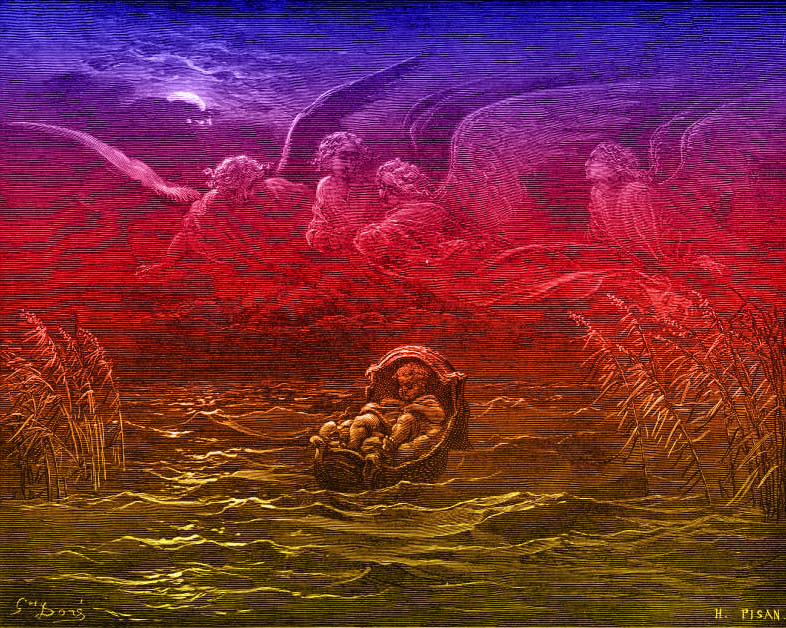
Now a man from the house of Levi went and married a Levite woman. The woman conceived and bore a son; and when she saw that he was a fine baby, she hid him three months. When she could hide him no longer she got a papyrus basket for him, and plastered it with bitumen and pitch; and she put the child in it and placed it among the reeds on the bank of the river. His sister stood at a distance, to see what would happened to him. The daughter of Pharaoh came down to bathe at the river, while her attendants walked beside the river. She saw the basket among the reeds and sent her maid to bring it. When she opened it, she saw the child. He was crying, and she took pity on him. “This must be one of the Hebrews’ children,” she said. Then his sister said to Pharaoh’s daughter, “Shall I go and get a nurse from the Hebrew women to nurse the child for you?” Pharaoh’s daughter said to her, “Yes.” So the girl went and called the child’s mother. Pharaoh’s daughter said to her, “Take this child and nurse it for me, and I will give you your wages.” So the woman took the child and nursed it. When the child grew up, she brought him to Pharaoh’s daughter, and she took him as her son. She named him Moses, “because,” she said, “I drew him out of the water.”

newjudaicia4

Can you imagine what was going through the mother’s mind when she placed her little son in the papyrus basket? Can you see her tears flowing down on to the boy who would change the course of history because she was forbidden to let him live?

Everything had changed in Egypt. Joseph had been sold into slavery but saved the Egyptian people by storing up food for the coming famine. He was widely respected and his people were held in safety because of his actions. But eventually a new king arose over Egypt and he did not know Joseph. He feared the Israelites, their power, and their numbers.

The Israelites quickly went from being a powerful force within another nation, to a group of subjugated slaves who feared for their lives. They were forced to work in hard service in every kind of field labor, they were oppressed and belittled, and their family lives were slowly brought into jeopardy. Pharaoh commanded the Hebrew midwives to kill all the males born to Hebrew women, but when they resisted, he changed the decree so that “every boy that is born to the Hebrews shall be thrown into the Nile, but every girl shall live.

Once a prosperous and faithful people, the Israelites had lost everything. Yet, even in the times of greatest distress, people continue to live and press forward… A Levite man married a Levite woman and she conceived and bore a son. When he was born and she saw that he was good, she kept him hidden for three months. But a time came when she could no longer hide the child and she found herself making a basket to send her baby boy into the Nile.

Kneeling on the banks of the river, she kissed her son goodbye, placed him in the crude basket, and released him to the unknown. The boy’s sister, who was allowed to live in this new regime, sat along the dunes and watched her baby brother float down the river toward where a group of women we beginning to gather.

Exodus-Chapter-2-The-Child-Moses-on-the-Nile

Pharaoh’s daughter saw the basket among the reeds, and when she opened it she saw the boy, and took pity on him. She recognized that he was one of the Hebrew boys but she was compelled to be compassionate toward him. The sister, with a stroke of genius, realized that she had the opportunity to save her brother and stepped forward from her hiding place to address the princess. “Shall I go and find a nurse from the Hebrew woman to nurse the child for you?” Pharaoh’s daughter said to the young slave, “Yes.” So the girl went and found her mother, the mother of the child she had just released into the Nile, and brought her to the princess. Pharaoh’s daughter charged her, “Take this child and nurse it for me, and I will give you your wages for doing so.” So the mother received back her own son and nursed him. However, when the child grew up, she brought him back to Pharaoh’s daughter, and she adopted him as her son, and she called him Moses because “I drew him out of the water.”

This story about the birth and the childhood of Moses is one of the most familiar texts from the Old Testament. It has just the right amount of suspense, intrigue, serendipity, divine irony, human compassion, intervention, and it concludes with a happy ending. Moses’ birth has captivated faithful people for millennia and offers hope even amidst the most hopeless situations.

One of the greatest pastors I have ever known serves a new congregation in Northern Virginia. Jason Micheli has inspired countless Christians to envision a new life of faithfulness previously undiscovered. He played a pivotal role in my call to ministry, we have traveled on countless mission trips together, he presided over Lindsey’s and my wedding, but above all he is my friend.

1934842_1140098793643_1336612_n

Jason and his wife Ali embody, for me, what a Christian relationship looks like. They support one another in their different ventures without overstepping their boundaries, they challenge each other to work for a better kingdom, and they believe in the Good News.

For a long time Jason and Ali knew that they wanted to adopt a child and they traveled to Guatemala when Gabriel was 15 months old to bring him home. As a young pastor and lawyer, Jason and Ali had busy schedules that were filled with numerous responsibilities that all dramatically changed the moment Gabriel entered their lives. They went from understanding and responding to the rhythms of one another to having a 15 month old living with them, a child who they were responsible for clothing, feeding, nurturing, and loving. I know that the first months must have been tough, but Ali and Jason are faithful people, they made mistakes and learned from them, they loved that precious child, and they continued to serve the needs of the community the entire time.

Jason and Gabriel

Jason and Gabriel

A year and a half later, just when the new patterns of life were finally becoming second nature, a lawyer who helped them find Gabriel contacted them. There was another family in the area who had adopted a 5 year old Guatemalan boy named Alexander, but they no longer wanted him. The lawyer recognized that Jason and Ali had recently adopted a child but wanted to find out if they would adopt another. However, the lawyer explained that this 5 year-old was supposedly very difficult, his adoptive family was ready to get rid of him, and he didn’t speak any English. Jason and Ali had a choice: lift this child out of the Nile, or let him continue to float down the river?

The story of Moses’ adoption by the Egyptian princess is filled with irony:

Pharaoh chose the Nile as the place where all Hebrew boys would be killed, and it became the means of salvation for the baby Moses.

The unnamed Levite mother saves her precious baby boy by doing precisely what Pharaoh commanded her to do.

The daughters of the Hebrews are allowed to live, and they are the one who subvert the plans of the mighty Pharaoh.

A member of the royal family, the Pharaoh’s daughter, ignores his policy, and saves the life of the one who will free the Hebrew people and destroy the Egyptian dynasty.

The Egyptian princess listens to the advice of the baby’s sister, a young slave girl.

The mother gets paid to do exactly what she wants to do most of all.

The princess gives the baby boy a name and in so doing says more than she could possibly know. Moses, the one who draws out, will draw God’s people out of slavery and lead them to the Promised Land.

Divine Irony! God loves to use the weak and the least to achieve greatness and change the world. God believes in using the low and despised to shame the strong and the powerful. God, in scripture and in life, works through people who have no obvious power and strengthens them with his grace.

How fitting that God’s plan for the future and the safety of the Hebrew children rests squarely on the shoulders of a helpless baby boy, a child placed in a basket, an infant released into the unknown. How fitting that God promised to make Abraham, a childless man with a barren wife, a father of more nations than stars in the sky? How fitting that God chose to deliver Noah from the flood on an ark, and young Moses from death in a basket floating on a river? God inverts the expectations of the world and brings about new life and new opportunities through the most unlikely of people and situations.

Jason and Ali prayed and prayed about the five-year old Guatemalan boy named Alexander. What would happen to them if they brought him into their lives? Everything was finally getting settled with Gabriel and they believed they had their lives figured out. They had planned everything perfectly, yet they we now being asked about bring a completely unknown, and perhaps devastating, element into their lives.

What would you have done? If you knew that there was a child, even with an unknown disposition, that was being abandoned by his adoptive family how would you react? Would you respond with open arms?

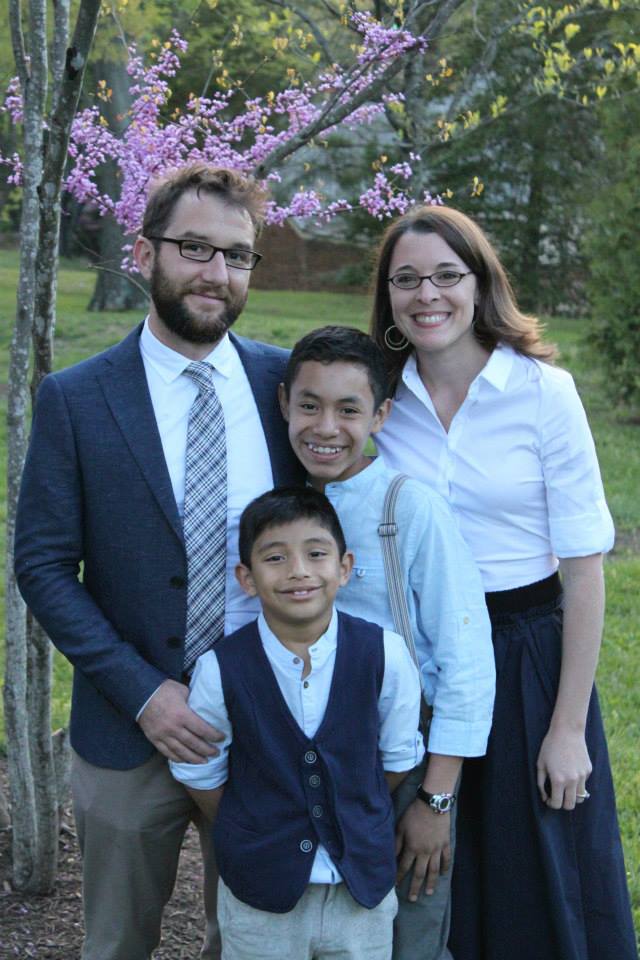
Alexander is now 11, soon to turn 12, and is without a doubt one of the most mature and incredible human beings I have ever met. After Jason and Ali met him for the first time they knew that God was calling them to bring him into their family, to love him with all that they had, and they responded like the faithful people they are, with open arms.

Jason, Ali, Alexander, and Gabriel

Jason, Ali, Alexander, and Gabriel

When Alexander arrived at Jason and Ali’s home, he came with the clothes on his back and nothing else. A five year old Guatemalan boy with little English was dropped off at their home; I can’t even imagine what it must have felt like for him. Yet, Jason and Ali brought him into their family and they never looked back. 

In the beginning, they had to sleep with him in his bed night after night, in attempts to comfort him and let him know that they were never going to leave him. That no matter what he did, no matter how far he fell, there was nothing that would ever separate their love for him. For a child that had been passed from person to family to family, Alexander had no roots, he had little comfort, and he had not experienced love.

Jason and Ali stepped into his life just as Alexander stepped into theirs. Perhaps filled with fear about what the future would hold for their little family Jason and Ali’s faithfulness shines brilliantly through the life of a young man named Alexander who I believe can, and will, change the world.

I imagine that for some time Jason and Ali believed that they, like Pharaoh’s daughter, had drawn Alexander out of the river of abandoned life. But I know that now when they look back, when they think about that fear of the unknown, they realize that Alexander was the one who drew them out of the water into new life. Divine Irony. 

In the story of Moses’ adoption out of the Nile, God is never mentioned. There are no divine moments when God appears on the clouds commanding his people to do something incredible, there are no decrees from a burning bush (not yet at least), and there are no examples of holy power coming from the heavens. Yet, God is the one working in and through the people to preserve Moses’ life and eventually the life of God’s people. God, like a divine conductor, orchestrates the music of life with changing movements and tempos that bring about transformation in the life of God’s people.

I believe that most of you, if not all of you, would take up a new and precious child into your lives. Whether you feel that you are too young, too old, too poor, too broken, you would accept that child into your family and raise it as your own. We are people of compassion, we are filled with such love that we can do incredible and beautiful things.

But it becomes that much harder when you look around and understand what we have become through baptism. Every child, youth, or adult, that it baptized into the body of Christ has been lifted out of the Nile of life into a new family. The people in the pews have truly become your brothers and sister in the faith through God’s powerful baptism. The Divine Irony is that we might feel we are called to save the people in church, when in fact they might be the ones called to save us. 

The story of Moses’ birth and childhood is beloved. It contains just enough power to elicit emotional responses from those of us lucky enough to know the narrative. It is a reminder of God’s grace and love through the powerful and the powerless. But above all it is a reminder that like a great and loving parent, Moses has been taken into the fold of God’s merciful love and grace. That we, through our baptisms and commitments to being disciples of Jesus Christ, have been brought out of the frightening waters of life into the adoptive love and care of God almighty. That we, though unsure of our future and plans, are known by the God of beginning and end.

Just as Jason and Ali held Alexander every evening, just as Pharaoh’s daughter cradled Moses in her arms, we have a God who loves us, who holds us close, and will never let us go. 

Amen.


Gabriel and Alexander in 2009

Gabriel and Alexander in 2009