Devotional – John 20.30

Devotional:

John 20.30

Now Jesus did many other signs in the presence of his disciples, which are not written in this book.

Weekly Devotional Image

My favorite piece of scripture is Mark 10.45: For the Son of man came not to be served but to serve, and to give his life a ransom for many.” I love the idea that, like Jesus, we are called to serve the needs of others rather than focusing on ourselves all the time. One of the verses that has made the most impact in my life is from Matthew 27.46: “And about three o’clock Jesus cried with a loud voice, “Eli, Eli, lema sabachthani?” that is, ‘My God, my God, why have you forsaken me?’” Through it I began to realize the depth of Jesus’ humanity and what he went through on our behalf.

There are plenty of verses that make me laugh, like Acts 20.9: “A young man named Eutychus, who was sitting in the window, began to sink off into a deep sleep while Paul talked still longer. Overcome by sleep, he fell to the ground three floors below and was picked up dead.” And there are some passages that leave me scratching my head in confusion, like Mark 9.50: “Salt is good; but if salt has lost its saltiness, how can you season it?”

th

Last Easter my friend Jason Micheli preached his sermon on what he called “the biblical verse that really ticks [him] off, the scripture verse that irritates the you-know-what out of [him] is John 20.30: Now Jesus did many other signs in the presence of his disciples, which are not written in this book.”

And I have to agree with him.

Why in the world would John omit other stories about Jesus’ life? If there were other miracles, other teachings, other divine moments, why wouldn’t he include them in the gospel? Most of the time I read from the bible I feel very fulfilled, but when I read John 20.30 I feel like I got short-changed.

Yet, on some level, I feel like it’s quite appropriate. If Easter tells us anything it’s that the living Lord is still on the move meeting us on the roads of life. John’s gospel could never contain all of Jesus’ miracles because he is still making them happen here and now. Sometimes we believe that we can only find and discover the Lord in the sacred texts of scripture, but that’s when we need to open our eyes to the wonders around us and see how God is still moving in the world.

When was the last time you felt the presence of God? Hopefully you experienced the Spirit of the Lord during your recent Easter service, or maybe you discovered God in the breaking of bread during communion. This week, let us all take heart knowing that we can find God in the words of scripture and in our experiences in the world.

Devotional – 1 Corinthians 15.3-4

Devotional:

1 Corinthians 15.3-4

For I handed on to you as of first importance what I in turn had received: that Christ died for our sins in accordance with the scriptures, and that he was buried, and that he was raised on the third day in accordance with the scriptures. 

Weekly Devotional Image

Worship had come to a conclusion and people were lining up on their way out of the sanctuary. While I shake hands with those who have come to worship the living God, I attempt to  really connect with them as they leave but I also listen to the conversations going on in the line a few people away. Yesterday I overheard a man saying to the person behind him, “I just don’t understand why we need to have services in the middle of holy week. Can’t we just show up for Easter?” With every fiber of my being I resisted the temptation to explain, in detail, the importance of Maundy Thursday and Good Friday when he came to shake my hand; without them, the resurrection loses it’s meaning.

A similar episode occurred last week when I was teaching our Preschoolers about Palm Sunday. I told the story about Jesus entering Jerusalem on the back of the donkey because he was preparing himself for the beauty and wonder of Easter. I was in the middle of a sentence when one of our 4 year olds shouted out, “I love Easter Pastor Taylor!” I said, “I do too, it’s my favorite day in the entire year.” She replied, “I love Easter because the bunny is going to bring me lots of candy and toys!”

400px_JesusBunny_xlarge

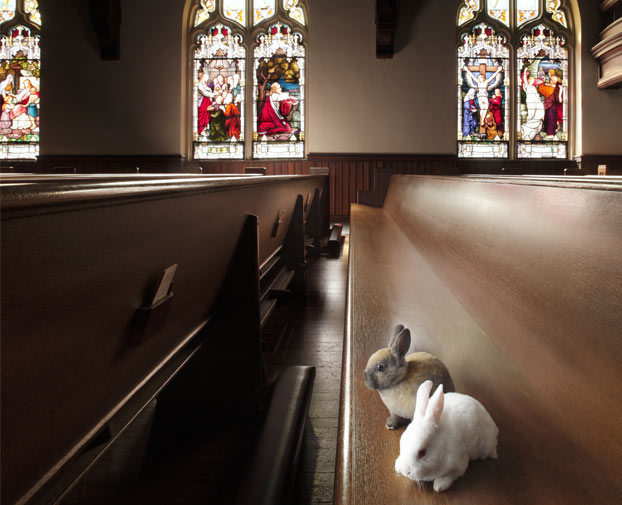
Chocolate, games, and Easter eggs are all important for the celebration of Easter in the way they fill us with joy and excitement, but they are not fundamental to the story. Paul wrote to the church in Corinth about what he handed on to them. As a new and budding Christian community they were tasked with hearing, remembering, and retelling the fundamental aspects of Christ’s incredible gift: Jesus died for our sins, he was buried, and then he was raised on the third day.

If Easter is just another Sunday that we come to church to hear a message, if Easter is just about searching the yard for plastic eggs and having a meal with our families, then we are not properly handing on what we have received.

God came in the form of Jesus to dwell among us, fully God and fully human. Jesus ministered to those in need throughout Galilee and proclaimed the year of the Lord’s favor. He went to the places where people needed to feel loved and he gave everything he had to serve others rather than himself. When the time came he made his way to Jerusalem and spent a final night with his friends feasting on bread and wine and washing their feet. That night he was betrayed, arrested, and sent to his death. He carried his cross with a crown of thorns adorned on his head and was hung in the air next to two thieves. Jesus died. But three days later he rose again and the the world was changed forever.

The story of Easter is one that was handed to us, and now we have the privilege to hand it to others. This week, this final week of lent, let us all remember to tell the whole story, to live through Jesus’ final days, so that we might live with him forever in the resurrection.

6a00d8341bf67c53ef016764ba8953970b-800wi

Devotional – Psalm 118.22

Devotional:

Psalm 118.22

The stone that the builders rejected has become the chief cornerstone. 

Weekly Devotional Image

We were in the middle of the woods during a Boy Scout camping trip. Our leaders were known for coming up with activities that would help us to grow our wilderness skills, but this particular challenge was driving me crazy. Scattered throughout the clearing were areas with dry wood, tinder, and two stakes connected by a string holding up a water balloon. The challenge was to create a fire under the dangling water balloon using the natural elements until the balloon would pop and put out the fire.

The leaders separated us into groups of four and sent us to our different areas. I don’t remember everyone from my group but there was one boy who was known more for his love of books than his love of the great outdoors. Without intending to I basically ignored his presence while trying to organize the other two boys to begin working on our fire. We collected the tinder in a pile and tried rubbing sticks together. We went searching for some rocks that would hopefully create a spark when we slammed them together. Throughout the wooded area audible frustrations could be heard from each group as they struggled in vain to pop their balloon.

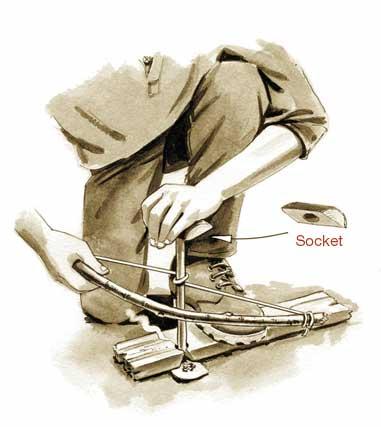
We must have worked for thirty minutes before I noticed the book-boy offering me a piece of advice. He was remarkably shy and I could barely make our what he was trying to say, though I could tell that he was serious. He quickly took off one of his hiking boots, removed a shoe-lace, curved a long stick, and created a make-shift bow. He then demonstrated that if we wrapped another stick around the string, we could move the bow like a saw and it would spin the stick for us with an incredible amount of friction. We quickly went to work and within 10 minutes we were the only group with a fire at all, and a few moments later the balloon popped and put out the fire that we had struggled to ignite. After congratulating ourselves I made a point to thank the boy for his idea and asked where it came from. He said, “I read about it in the Wilderness book that we were all supposed to read before this weekend.”

startafirewithabowdrill

The palmist writes about a stone that builders rejected becoming the chief cornerstone. Those who are familiar with the New Testament will quickly identify Jesus as someone rejected by the elders who then became the foundation for the church. Yet, this is not something that can be applied to Jesus alone. I quickly rejected the help from a boy in the woods because I made a ridiculous assumption about his inability to help. In him I saw little value worth assessing. However, without his help we would probably still be in the woods trying to pop our balloon. God can, and does, use some of the least likely people to change the world. Everyone has value and worth, we need only a new perspective to realize it.

In the remaining days of Lent let us open our eyes to value in people around us. Instead of making quick and unjustified assumptions, let us take a moment to reflect and remember that those who we reject are often the ones who are here to save us.

Devotional – Mark 14.36

Devotional:

Mark 14.36

He said, “Abba, Father, for you all things are possible; remove this cup from me; yet, not what I want, but what you want.” 

Weekly Devotional Image

“Let us now pray the prayer that Jesus taught his disciples: Our Father, who art in heaven…” The familiar introduction to the Lord’s Prayer is a regular occurrence in most churches. At some point during worship there is an opportunity to pray the same words that countless Christians have prayed together since the days of Jesus’ ministry. Through a simple, yet profound, prayer we are connected with the church universal as we pray according to the way that Christ taught his disciples to pray.

At St. John’s we print all the words to the prayer in the bulletin for anyone who might not be familiar with it. Most of the time, however, the gathered body prays without having to look down; whether they were here the week before, or it had been years since they entered a church, the Lord’s Prayer is something that most people remember forever.

The familiarity of the prayer is a blessing and a curse. For centuries it has brought Christians closer to the Lord, though sometimes the more familiar we are with the prayer, the less we think about the actual words we are praying. To sit amidst the body of Christ and pray “thy will be done” is one of the most profound acts in a discipled life.

Wendell Berry

Wendell Berry

Wendell Berry, the gifted essayist and writer, makes a similar point in his incredible novel Jayber Crow: “This, I thought, is what is meant by ‘thy will be done’ in the Lord’s Prayer, which I had prayed time and again without thinking about it. It means that your will and God’s will may not be the same. It means there’s a good possibility that you won’t get what you pray for. It means that in spite of your prayers you are going to suffer.”

On Jesus’ final night, after he shared an incredible meal with his closest friends, he prayed alone in the garden of Gethsemane. In many ways one of his last prayers to the Lord was simply “thy will be done.”

The season of lent is an incredible reminder that life does not become perfect and easy for us the moment we become Christians. With the current abundance of Prosperity Preachers/Churches it is important to remember, as Berry puts it, praying the Lord’s Prayer means that our will and God’s will might not be the same thing.

As we come closer and closer to Holy Week, let us take time to be with God in prayer. If you find yourself at a loss for words during your time with the Lord, follow the example of Jesus and offer up one of the most profound statements you can ever utter: “thy will be done.”

Devotional – Psalm 107.1

Devotional:

Psalm 107.1

O give thanks to the Lord, for he is good; his steadfast love endures forever. 

Weekly Devotional Image

“I’m post-racial” he said. “I am color blind to racial differences and I have no prejudices.” At the time we were discussing racial inequality in Durham, North Carolina (a still very pertinent topic) and the man claimed that if more people could see the world the way he did, everything would be fixed. He proudly claimed his lack of prejudice for anyone with ears to hear but I had a hard time taking him seriously. I did not know him well enough to begin arguing against his so called “prejudice free lifestyle” so I decided to let him him wax lyrical about himself. However, while he continued to go on and on, a friend muttered next to me under his breath, “Show me someone without prejudice, and I’ll show you a liar.”

One of the hardest tasks of following Jesus Christ is to try to live without prejudices precisely because many of us aren’t aware of how deeply rooted our prejudices are. We may think that we are “color blind” or that we relate to people who are different from us in religion, sexual orientation, or political persuasions, but in many circumstances our involuntary thoughts, uncensored words, and knee-jerk reactions often demonstrate that our prejudices are still there.

If we’re driving in our cars and we see two women holding hands walking down the side-walk, what are our first thoughts? If we are at a restaurant and we witness a black woman and a white man kissing one another across the table, how do we immediately respond? If we’re flipping through news channels and come across a political campaign of a different perspective, how do we initially react?

diversity-hands1-400x266-copy

Strangers, anyone who is unlike us, stir up fear and discomfort. They break down our sense of security and well being by simply being “different.” We can puff ourselves up all we want with claims of living with a post-whatever lifestyle, but most of us, if we’re honest, are prejudice in ways big and small, seen and unseen.

As Christians, we give thanks to the Lord for he is good. Only when we learn to fully believe that God loves each of us unconditionally and see others as equally loved can we begin to behave according to God’s goodness. The great variety in the world is a sign of God’s immense wonder and beauty. Living with a non-judgmental frame of mind is exceptionally difficult, but it is worth working toward.

This week, while we continue to journey through the season of Lent, let us admit our own prejudices. When we have those knee-jerk reactions toward those who are different from us, let us immediately go to the Lord in prayer and ask for Him to create in us clean hearts so that we might become people of love rather than prejudice.

Devotional – John 2.16

Devotional:

John 2.16

He told those who were selling the doves, “Take these things out of here! Stop making my Father’s house a marketplace!” 

Weekly Devotional Image

“Now let us exchange signs of Christ’s peace,” the pastor bellowed from the pulpit. In quick and succinct fashion people rotated 360 degrees and shook hands with those closest and muttered, “peace of Christ.” Though it was something we did one a month, the passing of the peace was finished within 20 seconds, and people were ready to get on with the rest of the communion liturgy. For months I attended worship in that church, sitting in the same pew, but I never learned anyone’s name nor did I know anything about what was going on in their lives. I felt invisible even while I was surrounded by people.

That summer I was appointed to help a small church in the shadow of the Great Smokey mountains in western North Carolina. Passing the peace was something they did every week and it took forever. The pastor would casually invite us to greet one another with the love of Christ and before I knew it I was getting hugs from people I had never seen before and others wanted to know my life story. I overheard men making plans to go golfing in the afternoon, women sharing the latest bits of gossip from the community, and kids making fart jokes.

To go from one extreme to the other while passing the peace was difficult. Each week, when we hit the 10 minute mark during the peace, all I could think about was Jesus turning over the tables and rebuking the money-lenders and dove-sellers. Had we turned God’s house into a space no better than a marketplace? Where was the solemn respect for the divine, where was the recognition of God’s holiness?

The weeks passed throughout the summer and I continued to walk throughout the entire sanctuary during the passing of the peace and I began to learn about the people who called that church “home.” I got invited to dinner parties, people prayed for me and my calling while others moved around us, I even had a woman begin to confess her most recent sinful behaviors. I felt confused about what we were doing and how it fit into the worship of God in a church until an older gentlemen spied my discomfort and whispered in my ear: “this is how we build community; we don’t get many chances to check in on one another and this time, for us, is sacred.”

Jesus threw out the money-lenders because they were making a mockery of the temple. In that tiny rural church we shared our lives with each other during the passing of the peace, and it felt like what the church was really all about. Instead of just sitting down and facing the front without interacting with our brothers and sisters, that church made a point to pass the peace by building their community.

What is church like for you? Do you gather each week with the expectation of hearing a few prayers, listening to a sermon, singing a couple hymns, and going back to your regular life? Or do you see church as an opportunity to build your community by getting to love on, and communicate with, your brothers and sisters in Christ?

peace-dove-web2

Devotional – Mark 8.31-32

Devotional:

Mark 8.31-32

Then he began to teach them that the Son of Man must undergo great suffering, and be rejected by the elders, the chief priests, and the scribes, and be killed, and after three days rise again. He said all this quite openly. And Peter took him aside and began to rebuke him.

Weekly Devotional Image What character from the bible do you identify with the most?

I love asking that question. Whether in the middle of painting a house surrounded by middle-schoolers on a mission trip, or in the midst of a counseling session with a member from the community, identifying with people from the bible can be eye-opening. For instance: Middle-school age boys almost always say they identify with David (during the fight with Goliath) probably because of their current physical changes and the pressures of school and social developments. Middle-school girls often identify with Esther probably because they want to establish their independence and unique responsibilities for taking care of others.

bibleheroeswJesus

The question was first asked of me during a Clinical Pastoral Education session. Our group leader wanted us to begin understanding our own limitations and strengths when it came to meeting people in the midst of suffering, so we began with acknowledging our perceived biblical counterparts. At the time I was getting used to seeing the world through a scripturally shaped imagination and had already paired up my group members with people from the bible. I was therefore thrilled when some of them identified with the characters I had imagined for them. When it came time for me to answer, I responded without hesitation: “Peter”

Ever since I was a kid I have been fascinated by the stories involving Peter from the New Testament. I loved imagining Peter mending the nets on the boats to then being brought to his knees in humble reverence for the Lord in his midst. I loved picturing him jumping off the boat to meet Jesus walking on the water. I loved his willingness to speak up and act first while the other disciples remained quiet in the background.

As I have grown older my identification with Peter has taken truer form when I spent time with the more embarrassing stories of his life. I truly fear that if I was placed under the same kind of pressure I would deny Jesus three times. I wonder how similarly I would have responded if I had been on top of the mountain during the transfiguration. And I am ashamed knowing that if Jesus had explained the need for his death prior to resurrection, I probably would have pulled him aside to rebuke him for making such claims.

I identify most with Peter. I see myself in him when I read from the New Testament and therefore have learned how to respond to God’s grace in my life in a way so as to not make the same mistakes that Peter once did.

Who do you identify with in scripture? Are you going through something in your life right now that aligns with a particular story from the bible? How can you use the living Word to help shape and mold the direction your life is heading?

Devotional – Psalm 25.4

Devotional:

Psalm 25.4

Make me to know your ways, O Lord; teach me your paths. 

Weekly Devotional Image

The air was pure and undisturbed. It was early enough that most of the neighbors were still asleep and the dog and I were the only ones about to roam the neighborhood. Snow covered everything in sight and I hesitated before taking my first step; until my foot hit the snow, all was still and smooth.

IMG_1949

When I typically walk our dog (Tennessee), in the mornings, we follow the same path. She has to hit the familiar spots and soak up all the smells, and only when we’ve gone everywhere on that path, is she ready to return home for food. The routine is repeated each day and I know that we both fall into the familiar rhythms each morning. And, if I ever forget something, Tennessee is quick to remind me with a quick bark or nudge.

Today, however, as soon as we hit the snow, everything changed. The familiar path was covered under inches of powder and Tennessee was so excited to walk that she began running in circles. I struggled to get her to the familiar spots while she was far more concerned with shoving her nose into the deep snow and turning to look at me as if saying, “This white stuff is awesome!”

10950725_10203503805826769_1322183989877696279_n

When it became clear that the familiar and routined walk was not going to take place, I decided to give in to her newfound excitement and began running around with her in the snow. Between shoveling mounds of snow up into the air, and Tennessee running around in circles, we were both quickly out of breath and at least one of us was laughing. By the time we returned to the parsonage it no longer mattered whether she hit all the same spots like most mornings; for us we simply enjoyed God’s creation in the beautiful snow.

The familiar routines of life often bring us stability and comfort: we wake up and drink the same coffee and read from the same sections of the newspaper; we listen to the same radio station while making the same commute to work; we pray the same prayers over meals with our family. Routines are important because they help to habituate us into faithful and fruitful patterns (We say the Lord’s Prayer every week in church because it helps to shape our lives around the Lord to whom we pray). However, life is not always so neat and tidy.

Changing the typical routines and patterns of life help to prepare us for the days when unforeseen circumstances change our plans. Taking the dog on different paths helps her, and her walker, to experience God’s creation in new environments. Learning to pray in different ways helps to keep our faith alive in new and vibrant ways. We need not wait for a snow day to change our rhythms and patterns; new opportunities are available every single day.

As we all prepare to take our first steps into the season of Lent, let us pray for God to reveal new paths in our lives. Let us see this season as an opportunity to rediscover that which makes our discipleship so exciting: a loving God whose paths are always open for new discoveries.

Devotional – 2 Corinthians 4.5

Devotional:

2 Corinthians 4.5

For we do not proclaim ourselves; we proclaim Jesus Christ as Lord and ourselves as your slaves for Jesus’ sake. 

Weekly Devotional Image

Have you ever listened to someone discuss a topic only to realize that you learned more about the speaker than you did about the subject?

There were many times in college that I would leave a lecture knowing more about my professor’s interpretation of an event than I did the actual event. Similarly, there have been church services that taught me more about what the pastor was doing in his/her life than what I should be doing to live out God’s Word in mine. The temptation, for all of us, is to point at ourselves rather than the subject at hand.

Brian Williams, the anchor for NBC’s Nightly News, recently fell into controversy regarding comments he made about his experiences during the US invasion of Iraq. Williams stated that he was on an helicopter that was hit by an RPG and forced to land. However, reports have subsequently come to light that call his memory into question; a flight engineer who was on board one of three helicopters that were hit, reported that William’s helicopter arrived at the scene nearly an hour later to interview the crew members about the attack.

1343751252634_2x1_overlay_590_295

In the days that followed William’s false report, he has been scrutinized by a number of media outlets and veterans about his claims. He has taken a leave from his regular Nightly News  broadcast, and executives from NBC have announced there would be an internal investigation into William’s reports on Iraq and other issues. Moreover, debates are taking place regarding whether or not he will be replaced in relation to his newscast.

When we share information with our friends and family about issues facing the world, there is a strong temptation to point at our relation to the subject rather than the subject itself. Instead of talking about the issue of poverty we talk about how we have interacted with people begging on the streets. Instead of talking about what we can do to help our education system, we share stories about what we experienced in school. Instead of talking about what Jesus did for us, we talk about the many ways we are living out our Christianity on a regular basis.

Paul wrote to the church in Corinth as a reminder about who was truly at the center of the church: “We do not proclaim ourselves; we proclaim Jesus Christ as Lord and ourselves as your slaves for Jesus’ sake.” As Christians, we are called to the same proclamation.

When we feel the temptation to point to ourselves and what we have done, Paul helps us to remember to point to Jesus. We can certainly celebrate our accomplishments in our faith journeys, but we are called to serve one another as slaves for Jesus’ sake.

This week, let us point away from ourselves to Christ, and seek new ways to serve those around us.

Devotional – Psalm 147.1

Devotional:

Psalm 147.1

Praise the Lord! How good it is to sing praises to our God; for he is gracious, and a song of praise is fitting. 

Weekly Devotional Image

Selecting the hymns for worship on Sunday mornings is a pastoral privilege. Each week I pray over the words for the sermon and seek to find hymns that fit with the general direction of worship. Our hymnal is an invaluable resource that helps us to discover God’s majesty in ways that are powerful and beautiful.

Growing up as a United Methodist, I cherished our hymnal and learned to “sing my faith” on a weekly basis. Though I regularly listened to secular music, is was the tunes from the likes of “O For a Thousand Tongues to Sing” and “Be Thou My Vision” that I found myself whistling and humming during the day. When I became a pastor, and therefore received the responsibility of selecting our hymns, I was very thankful that some of the previous pastors at St. John’ penciled in the dates for hymn selections in the office copy. I immediately knew which tunes were familiar, and which hymns would be a little harder to sing.

hqdefault

Yesterday our worship service was focused on the importance of love being greater than knowledge. I went through my usual sermon preparation and then went to the hymnal and decided that #617 “I Come with Joy” would be a great way to start our worship service (particularly since we would also be feasting at the Lord’s Table). I processed down the center aisle with an acolyte as the organ moved along and the gathered body was singing, but when we arrived at the 4th verse, perhaps by a push from the Holy Spirit, our organist stopped playing and allowed for us to sing a cappella. The words resonated throughout our sanctuary in such a way that I felt shivers in my body: “And thus with joy we meet our Lord. His presence, always near, is in such friendship better known; we see and praise him here, we see and praise him here.”

The psalmist writes that is good for us to sing praises to our God for he is gracious. When the gathered body is together and we can sing the hymns with every fiber of our being, we are truly praising the Lord! However, singing praises to God is not something that is limited to Sunday morning alone; every day is a new opportunity to sing praises to our gracious God. We can do this through our actions, our prayers, and our conversations with others. So long as we remember that God is the source of goodness in life, singing God’s praise will be as natural as breathing.

This week, as we seek to love God and neighbor, let us explore the many different ways we can sing our praises to the Lord. It can be as easy as humming one of your favorite hymns, and it can be as simple as thanking God for something wonderful in your life. Let us praise the Lord!