Devotional – Acts 2.42

Devotional:

Acts 2.42

They devoted themselves to the apostles’ teaching and fellowship, to the breaking of bread and the prayers.

Weekly Devotional Image

“Why don’t you offer the prayer?” This is one of my favorite questions to ask in order to make someone uncomfortable when they least suspect it. I’ll be out at dinner, or some sort of communal function, and the moment right before the host inevitably asks me (as the pastor) to pray, I’ll lean over to someone and say, “Why don’t you offer the prayer?”

The question is often met with a blank expression that quickly morphs into terror. Some people feel like they can’t say no when a pastor asks them to do something so they start to pray; others begin to quake under the anxiety of publically praying though they muster something together; and others just sit there silently waiting (and perhaps praying) for me to start saying something instead.

But the more I’ve done this, the more I’ve realized how harmful it can be. And not just on an interpersonal level regarding the manipulation of the pastor over and against a lay person, but also because it leaves people feeling like they have to be able to make up a prayer and offer it on the spot in order to be a Christian.

Spontaneous and extemporaneous prayers can be difficult and problematic things. Instead of sitting silently and listening for the Spirit we often fill the void with our own words that may have nothing to do with what it means to pray in the first place. We assume that praying has to be original and new every time it happens, but it was not so for the first Christians.

lightstock_4192_small_diana_hapsari

In the wake of Pentecost, the new coverts “devoted themselves to the apostles’ teaching and fellowship, to the breaking of bread and the prayers.” Notice the definite article: the prayers. They were given prayers to pray and this is entirely different than assuming that everyone can and should be able to make up their own prayers on the spot.

It is a great gift in the church to have prayers from the saints, to be able to look back and use the words that have been used so many times (and will continue to be used long after we’re gone) because sometimes we don’t have the right words to pray. Rather than struggling to come up with something on our own we can use the words from the Psalms, or reach for the Book of Common Prayer, or even read the words from a beloved hymn. Those words are our prayers, they are the prayers, and they have been given to us. Thanks be to God for providing the words of prayer when we cannot find them on our own.

Devotional – Luke 17.5

Devotional:

Luke 17.5

The apostles said to the Lord, “Increase our faith!”

 Weekly Devotional Image

4 years ago I received the phone call about being appointed to St. John’s. And over the last 4 years I learned what it really means to love God through the people of St. John’s. Through every rolled sleeve to clean dishes, through every casserole provided for a family in grief. Through every committee meeting, bible study, and Circle gathering. Through every mission trip, hospital visit, and church picnic.

St. John’s UMC has increased my faith.

While here I have watched people who were spiritually dead be resurrected into new life through the faithfulness of the church. I have seen people surrounded in the midst of sorrow and grief when they needed it most. I have seen tears spilt over the precious sacrament of baptism, and in recognition of the incredible gift of communion.

In the United Methodist Church clergy people like me make a vow to go where the Spirit leads us. When I was finishing seminary I lived into the promise when I received the phone call about coming here and I embraced it. I came to St. John’s not knowing what it would look like, how it would feel, or whether or not it would be fruitful.

And I can say today that serving St. John’s has been the greatest privilege of my life.

PC_grownupnew

But the Spirit is moving. Over the last few months the leadership of the church and I have been praying for God’s will to be done and we have discerned that the time has come for me to respond to the Spirit yet again in a new place, and that the Spirit is calling a new pastor to serve St. John’s. And in response to that prayer and discernment, our Bishop has projected to appoint me to serve as the Pastor of Cokesbury UMC in Woodbridge, VA at the end of June.

I am grateful beyond words for the community of Staunton, VA and for the people of St. John’s for increasing my faith. I have nothing but hope and faith that the church will continue to pour out God’s love onto the last, the least, and the lost. I rejoice in the knowledge that our God makes all things new.

This is a time of new life for St. John’s: a new pastor, a new chapter, and new beginning.

In the coming weeks of transition I ask that you please keep my family in your prayers and I encourage you to continually seek out new ways to increase the faith of the people around you like you’ve done for me.

Devotional – John 20.19

Devotional:

John 20.19

When it was evening on that day, the first day of the week, and the doors of the house where the disciples had met were locked for fear of the Jews, Jesus came and stood among them and said, “Peace be with you.”

Weekly Devotional Image

The doors were locked because the disciples were afraid. Jesus broke forth from the chains of death in the morning, but by the evening the disciples were locked up at the house. And John is quick to tell us that they did so for fear of the Jews. Perhaps the disciples were afraid that the fate of crucifixion was coming for them next, or at the least they would be attacked and driven from the city. But nevertheless, the Word become flesh is resurrected and the closest followers of Jesus are hidden in a room.

Were they really afraid of the Jews? Or was there something else that drove them to lock the doors and cower in the corner?

I think that the disciples were certainly afraid of the Jewish leaders, particularly in light of what they had done to Jesus, but I also think the disciples were afraid of the risen Jesus. These disciples, these followers of the Messiah, had all abandoned him at the end, they had denied him, and now he’s back! I would be hiding too.

How often do we fail our friends only to cower in fear as we wait for their response? I know far too many people (myself included) who will ignore that email, text message, or phone call from a particular individual not because of anything he/she did, but because of what we did.

Thanks be to God that Jesus did not leave the disciples hiding in fear behind locked doors. Thanks be to God that the gospel was too important to remain hidden. Thanks be to God that Jesus came in, stood among them, and said, “Peace be with you.”

682086_1_e9135b

Do we believe that Jesus could show up in our lives when we are ashamed for something we’ve done? How often do we hide (literally or figuratively) behind locked doors when we have failed our friends or families? What would it look like to live like we believed in the resurrection of Jesus from the dead?

As Easter people we are committed to practicing resurrection here and now in anticipation of our promised resurrection. This means that we cannot take the people around us for granted, it means we cannot stay hidden in shame, it means that we have to be brave and courageous people willing to say “peace be with you” to the people with whom we feel no peace.

Devotional – Matthew 6.28-29

Devotional:

Matthew 6.28-29

Consider the lilies of the field, how they grow; they neither toil nor spin, yet I tell you, even Solomon in all his glory was not clothed like one of these.

Weekly Devotional Image

In a few hours I will gather with members of the community for a Service of Death and Resurrection for one of St. John’s long-time members, Gracie Jackson. During my first two months serving at St. John’s (almost 4 years ago), I tried to visit as many people as possible from the church community, particularly those who could no longer attend worship on Sundays. I want them to know that the church still cared about them and that they were in our prayers regardless of their presence.

Throughout those first months I was welcomed into a great number of homes and learned so much about Staunton and the impact St. John’s has had throughout the decades. One of my first visits was to the Jackson home where I sat and talked with Lenard and Gracie Jackson. But we didn’t sit for long. Instead, they wanted to give me the grand tour including the basement workshop and the green house in the backyard. There were plants everywhere but one in particular was striking and unlike anything I had seen before. Lenard explained that it was a Night-Blooming Cereus, and like the name implies, it only blooms at night. At the time, I casually mentioned my interest in the plant and we continued the door.

However, a couple days later Gracie told Lenard that he HAD to invite me over to witness the Night-Blooming Cereus in all it’s glory. (Lenard recently told me that in his life there were always two ways to doing things, and both of them were Gracie’s!). So at 10pm Lindsey and I drove over to the Jackson house and the four of us sat in their living room in our pajamas patiently waiting for the plant to do its magic.

When the right time arrived, we huddled in the green house with the dark sky coming through the windows and the cactus bloomed right in front of us. It produced the most exquisite scent and filled the room with its glory. And in that moment I was struck by the holy space we were sharing and was reminded of Jesus’ words from Matthew 6: “Consider the lilies of the field, how they grow; they neither toil nor spin, yet I tell you, even Solomon in all his glory was not clothed like one of these.”

6e7f0caa6dfe8f6541d5babc77c32ecf

That Night-Blooming Cereus was one of the most spectacular things I have ever seen and I never would’ve experienced if it weren’t for Gracie’s insistent invitation. Similarly, our faith is something that is offered to us as an invitation. We can read all about the Lord in Scripture, we can pray privately on our own time, but when we share our faith with another person it can bloom in the most exquisite of ways.

I am so remarkably grateful for the time I got to spend with Gracie, and for the many ways she embodied God’s grace for me.

Devotional – Job 19.23-25

Devotional:

Job 19.23-25

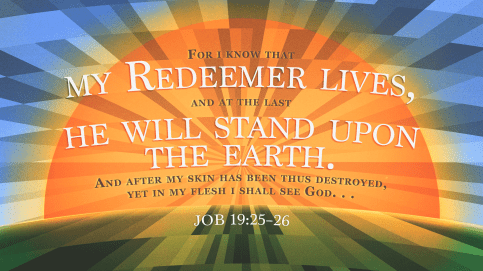
O that my words were written down! O that they were inscribed in a book! O that with an iron pen and with lead they were engraved on a rock forever! For I know that my Redeemer lives, and that at the last he will stand upon the earth.

Weekly Devotional Image

Last Thursday, while my wife, son, and I were visiting family in Alexandria, I received a phone call about one of St. John’s long-time members having died. Ruth Cassidy joined the church weeks after it formally began back in 1954 and while it was still meeting in a basement down the road. Ruth was easily one of the kindest people I ever had the chance to spend time with, and she will be greatly missed by our church community, and by her family.

A couple years ago I received a phone call about Ruth’s husband Howard, and it was clear that he was close to the end of his life. And so, I made my way over to their retirement home and when I walked into the room Ruth was sitting next to her husband, she was lovingly holding his hand in hers, and he had just taken his final breath. I, not wanting to intrude on the holiness of the moment, slowly started to back away but Ruth insisted on me sitting down with her on the couch. She immediately started asking me questions about my family and St. John’s and I was still in a state of shock; I was overwhelmed by the totality of the moment, and the fact that Howard had literally just died. Ruth continued to ask me questions, but I wanted to acknowledge what had just happened. It took a couple minutes, but I finally mustered the courage to ask: “Ruth, are you okay? I mean, Howard just died…”

She looked right into my eyes, smiled, and said, “Oh, everything is fine; I know where he really is.”

Rarely have I encountered such faith, such hope, and such love as what I regularly experienced through Ruth Cassidy. Like the biblical character of Job, she had an assurance about the way things really are. In that holy and profound moment immediately after her husband died, I could almost hear the words of scripture floating in the room with us: “I know that my Redeemer lives, and that at the last he will stand upon the earth.”

job-19-25-26

Ruth’s assurance, her blessed assurance, was one worthy of our emulation.

Do you know that your Redeemer lives? What words or thoughts would you want to engrave on a rock forever? Can you feel the Holy Spirit moving and breathing into your life? Are you filled with an assurance about who you are and whose you are?

O that my words were written down and engraved forever! I know that my Redeemer lives! And that at the last he will stand upon the earth!

Devotional – Ephesians 5.14

Ephesians 5.14

Therefore it says, “Sleeper, awake! Rise from the dead, and Christ will shine on you.”

Weekly Devotional Image

On April 4th, 1742 Charles Wesley, the musically inclined younger brother of John Wesley, was invited to preach at St. Mary’s in Oxford. It was his first, and last, occasion for preaching there. His text was Ephesians 5.14 (“Sleeper, awake! Rise from the dead, and Christ will shine on you.”), and his message most likely caused a significant amount of resentment among those in attendance.

Throughout the sermon, Charles Wesley interprets the “sleep” from Ephesians as the natural state of humanity; it is the place where we are in light of Adam’s sin that has passed on to the world. But God calls each human to wake up from this dreadful sleep, repent, and live into the fullness of holiness made possible through the life, death, and resurrection of Jesus Christ.

In a sense, it did what all sermons are supposed to do: it faithfully proclaimed God’s revealed word in a way that was applicable and approachable to all with ears to hear. However, Charles made plain the point that those in attendance, the religious elite of the day, had fallen asleep to God’s commands and that it was time for them to wake up.

airbnb_wake_up_call_0

To paraphrase: “In what state is your soul? If God required you to die right now for the sake of the Gospel, would you be ready? Have you fought the good fight and kept the faith? Have you put off the old life and put on the new? Are you clothed with Christ? Do you have oil in your lamp and grace in your heart? Do you love the Lord your God with all your heart, with all your soul, with all your mind, and with all your strength? Do you believe that God is moving in a through you in all that you do? Are you really a Christian? If any of these questions offend you, be assured that you are not a Christian, nor do you desire to be one. The time has come to wake up!”

It’s no wonder he was never invited back to preach.

However, Charles’ questions still ring through the centuries and resonate in our hearts today. Are we alive to our faith? Are we clothed with Christ? Do we really love God and neighbor? Are we Christians at all?

Lent is the time to confront our true natures and ask if we have fallen asleep in our faith, or if we have been raised from the old life into the new. For Christ, the one in whom we live and move and have our being, is calling us to wake up. Christ compels us to leave the old life behind, the life defined by death and sin. Instead, Christ pushes us to clothe ourselves in our baptisms, live into the reality of resurrected life here and now, and wake up!

Devotional – Genesis 12.1

Devotional:

Genesis 12.1

Now the Lord said to Abram, “Go from your country and your kindred and your father’s house to the land that I will show you.”

 Weekly Devotional Image

And that’s how it all began. The Lord said to Abram, “Go.” In the entirety of the Old Testament, there are few passages as important and theologically profound as God’s calling of Abram to go to a strange new place. We can talk about Jacob wrestling with the emissary from God by the banks of the Jabbok river, we can talk about Joseph saving the Egyptian people from certain starvation, we can even talk about Moses’ trials and tribulations with the Hebrew people in the wilderness, but this moment with Abram, this call, sets in motion the great narrative of God with God’s people.

The sheer magnitude of such a call cannot be overlooked. During the time of Abram’s life, almost everything was dependent on staying in one’s country and with one’s family. Most people spent their entire lives, from birth to death, within a handful of miles and rarely explored anything outside the normal and comfortable dwelling of “home.” And yet God had the audacity, the boldness, and the faithfulness to call Abram to do the unthinkable: go to a strange new place and leave it all behind.

This, in a sense, is akin to the call of all Christians. We might not be asked to leave our home country, we might not be asked to leave our families, but we are certainly compelled to enter into strange relationships and moments around us. It is easy to stay within a certain bubble throughout our lives and never stretch too far into the unknown. We can develop rhythms and habits that actively prevent us from encountering anything out of the ordinary. But God is extraordinary.

go

Lent is a time for us to reflect and repent. We reflect on the many ways God’s has so graced us, and we repent for the many ways we have failed to positively respond to that grace. Lent is a time for us to all recognize the Abram within us, and wonder where God is calling us to go. What place are we avoiding because it makes us uncomfortable? What relationship have we let fall apart because it just felt like too much work? What frustrating behavior in a friend or a spouse or a child have we let percolate for far too long?

In some way, shape, or form God is calling each and every one of us to “go.” God calls us to “go” because our God is a God on the move. God cannot be relegated to a sanctuary on Sunday mornings at 11am, God is not absent until we pray for God’s presence, God is not sitting on a throne up in heaven watching us through a telescope. God moves, and so should we.

Devotional – Matthew 4.1-2

Devotional:

Matthew 4.1-2

Then Jesus was led up by the Spirit into the wilderness to be tempted by the devil. He fasted forty days and forty nights, and afterwards he was famished.

Weekly Devotional Image

In a few days churches across the globe will begin the season of Lent through Ash Wednesday services. Countless disciples will have ashes in the shape of the cross on their foreheads at school, at work, at the gym, and everywhere in between. The season of Lent marks our journey with Jesus’ journey toward Jerusalem that culminates in the empty tomb on Easter.

For a long time, Lent has been a season in the life of the church focused on personal piety and repentance. It is an opportunity for Christians to confess their sins and spend a number of weeks turning back to the Lord in spite of their previous choices. And this emphasis on repentance has been made manifest in the popular decision to “give something up for Lent.”

We are told that it is good and right to give up a temptation during the season because it allows us to focus more on God and because it allows us to mirror Jesus’ temptation in the wilderness by the devil. When done faithfully, giving something up can be a truly fruitful activity; fasting has always had a place in the life of disciples. However, the season of Lent is about a lot more than personal piety, and when we limit our participation in this important season to “giving something up” we neglect to remember that Jesus’ temptation is not our temptation.

577342031dea80418edd74d681006901

When Jesus was hungry the devil challenged him to turn stones into bread and yet Jesus refused. When the devil enticed Jesus to jump from the pinnacle of the temple to put God to the test, Jesus refused. And finally, when the devil offered Jesus all the governments of the world in exchange for Jesus worshipping the devil, Jesus refused.

The devil offers things to Jesus that only the devil can offer to the Son of man. We, like Jesus, can be tempted by hunger, contractual prayers with God, and with a desire to control our lives through things like government, but they are not offered to us in the way that they are offered to Jesus. Jesus’ temptation marks the beginning of a ministry that will upset the expectations of the world and eventually result in his death on a cross. As the Son of God, Jesus is offered, and tempted, with the devil’s way out but he refuses. He refuses because he is God incarnate and cannot deviate from the path that leads to resurrection.

If we want to give something up during Lent in order to grow closer to God, by all means we can. However, perhaps a better thing to give up is not a physical and tangible item like chocolate or watching TV, but instead we can give up the false notions that we are the central characters of scripture, that we can earn our salvation, that we are more important than we really are.

Instead, maybe this Lent we give thanks to the Lord our God who came to walk among us, be tempted like us, yet be totally unlike us, and save us from sins, from death, and from ourselves.

Devotional -Leviticus 19.1-2

Devotional:

Leviticus 19.1-2

The Lord spoke to Moses, saying: Speak to all the congregation of the people of Israel and say to them: You shall be holy, for I the Lord your God am holy.

Weekly Devotional Image

Before I became the pastor of St. John’s, I had a meeting with other clergy from the Virginia Conference who were all about to start at their first appointments. We represented a number of different seminaries and all of us were nervous in some way, shape, or form about what we were about to embark upon. A few of us were about to serve as deacons connecting the church to the world through youth ministry positions and hospital chaplaincy, a few of us were going to large churches as associate pastors, and a few of us were being sent to serve a church all by ourselves.

After a few ice-breakers designed to build bridges between us, we were all asked to answer the question: “What are you most worried about?” I remember someone jumping right in to say, “I am terrified of having to do funerals.” Another person said, “I have no idea what it takes to create and implement a church budget.” Another person said, “I’m nervous about being single and whether or not people will respect me for who I am.” And my friend Drew ended with, “I just want to be holy.”

217387_578604105493543_912821730_n

We all listened and offered advice to one another, but Drew’s comment has always stuck with me. While the rest of us were nervous and anxious about specific and practical matters, Drew was thinking about his holiness. How in the world can pastors lead people to holiness when they feel unholy? What does it even mean to be holy in the first place?

Some might say that to be holy means going to church every Sunday. Others might say that holiness comes with reading the bible every morning. And still yet others might say that you can only be holy if you pray to God every night before you fall asleep.

Holiness, however, is about living a life of total devotion to God. That might manifest itself in showing up to church, and reading the bible, and talking to God, but it also entails a fundamental commitment to the Lord in everything we do.

It means that when we encounter the stranger we see them as a brother and sister in Christ. It means that when we spend our money we reflect on whether or not it is bringing harm to someone else. It means that we strive to take nothing for granted because tomorrow is never promised.

Being a Christian is not a hobby, or something to be turned on and off whenever we choose. Being a Christian is about living a life of holiness and being totally devoted to God.

So then we must ask ourselves: What am I currently doing that is unholy? What relationships are preventing me from being totally devoted to God? What idols am I being consumed by instead of committing myself to the Lord? How can I be holy?

Devotional – Matthew 5.23-24

Devotional:

Matthew 5.23-24

So when you are offering your gift at the altar, if you remember that your brother or sister has something against you, leave your gift there before the alter and go; first be reconciled to you brother or sister, and then come and offer your gift.

Weekly Devotional Image

“I want you to write down the name of someone who is currently driving you crazy.” That’s how I chose to begin a sermon more than a year ago. Each bulletin had a blank piece of paper inside, and after writing down the name I asked everyone to crumple it up and hold it in their hands until the end of the sermon.

The sermon was focused on Isaiah 6.1-8 and I talked about how Christians, for centuries, have been called by God to confront conflict. I said that to be faithful is to meet the outcasts where they are and show them love, that to be a disciple means a willingness to forgive people when they have done something wrong, and that to follow Jesus means having the courage to ask for forgiveness when we have done something wrong.

I concluded the sermon by asking everyone to look at the names crumpled up in their hands, and seriously consider making the first move to confront the conflict with that person. I warned everyone that it might not go well, and that it might blow up in our faces, but that the longer the conflict remains, the harder it would be to hear the living God speaking in our lives.

1be9b5bd635fbd64716dbb286ad38d4d

Like a lot of sermons, I preached it and hoped the people of St. John’s took the challenge seriously. Over the next few months I occasionally heard about what happened when certain individuals confronted the conflict in their lives, but a few people told me that it was too hard and they were too afraid to face the person whose name they wrote at the beginning of the sermon.

Jesus, in the Sermon on the Mount, takes the art of reconciliation very seriously: Before you bring a gift to the altar (before you place your tithe in the offering plate during worship) you need to leave; first be reconciled to your brother or sister, and then come back to offer your gift.

I’ve often thought about what this would look like in the middle of a worship service: How would people respond if we told them to leave the church right then and there to be reconciled with the people they are quarreling with before giving their gifts to the church? Would any of them come back the next Sunday? Would anyone walk straight up to me because I’m the person they’re frustrated with?

It is easy to show up to church every week as if we have everything in our lives figured out and squared away, when the truth is that we are quarreling with people in our lives and that we don’t have everything figured out. Church, however, is the place where we learn what it means to be broken, and how God is working through us to put the pieces back together.

So, if we took Jesus’ words seriously, who would we need to reconcile with before we show up to church next Sunday?