Beware of the Church

Mark 12.38-44

As he taught, he said, “Beware of the scribes, who like to walk around in long robes, and to be greeted with respect in the marketplaces, and to have the best seats in the synagogues and places of honor at banquets! They devour widows’ houses and for the sake of appearance say long prayers. They will receive the greater condemnation.” He sat down opposite the treasury, and watched the crowd putting money into the treasury. Many rich people put in large sums. A poor widow came and put in two small copper coins, which are worth a penny. Then he called his disciples and said to them, “Truly I tell you, this poor widow has put in more than all those who are contributing to the treasury. For all of them have contributed out of their abundance; but she out of her poverty has put in everything she had, all she had to live on.”
5415274279_d581c23043_b

The story of the Widow’s gift of the two small copper coins is a favorite among pastors for their stewardship sermons. All of the perfect details are there to entice, and guilt, a congregation into giving more money as they follow the example of the widow. It does not matter how much you make, but what you do with what you make! Pastors will be clear about thanking the rich for making their offering, but they will emphasize how even the poor have money to give.

But the story is much more complicated than that.

Jesus was teaching in the temple when he warned everyone with ears to hear about the religious elite. “Watch out for those scribes and priests. You know the ones who like to walk around in long robes and get all the respect in the marketplaces? You know those ministers and preachers who love to get the seats of honor at banquets? They are the type of people who prey on the widows and for the sake of appearance will fill their prayers with big and long words. They are not praying out of faithfulness but out of expectation and perception. Watch out for them.”

Then he immediately gathered around the treasury and watched as people filed in line to drop off their donations. Many rich people lined up, proud of the donation they were about to make publicly, but then a poor widow came up and put in two small copper coins, coins that amounted to a penny. Jesus pulled the disciples close and said, “This poor widow has put in more than all those who are contributing to the treasury. For all of them have contributed out of their abundance; but she out of her poverty has put in everything she had: her whole life.”

Is the widow an example of profound faith? Of course she is. She embodies the call to witness to God’s faithfulness by returning her gifts to the Lord, recognizing that the Lord will truly provide. She sacrifices deeply and stands as a worthy saint to be modeled after.

But does Jesus point her out to the disciples because of her worthy example of sacrifice, or does he point her out as a tragic example of how religious institutions can fail the people they are supposed to protect?

St. Mary’s Cathedral is a beautiful church in San Francisco that stands as a beacon of beauty and power to the people of the local community. For years its steeple has cut across the horizon as a worthy witness to God’s power. It is the kind of church that is filled with wealthy and put together people who want to hear about God’s love and grace. The parking lot is filled with expensive cars Sunday after Sunday. And they rarely worry about the future of the church because they believe God has a plan for them.

The church is also known for its beautiful and gothic architecture. The alcoves have been carved with deliberate care and focus and you can’t help but marvel when you see the structure. However, the beautiful alcoves create a problem for the church because homeless men, women, and children like to sleep in them to stay out of the rain. For some time the church attempted to turn a blind eye to the homeless who would gather on the property every night, but it got to the point where the lingering smell was so strong on Sunday mornings that the leaders of the church were worried about losing some of their strongest financial givers.

The church decided to install a sprinkler system in the ceilings of the three major alcoves in order to deter the homeless population from staying in them. Every night, from the time the Sun goes down until the early morning, the sprinklers will turn on for 75 seconds every 30 minutes for the pure and simple purpose of removing the people from where they gather. This church, in a state suffering from a tremendous drought, believed that installing the sprinkler system was the right thing to do.

Is that church an example of faithfulness? Or is it a tragic example of how the church has failed the people its supposed to protect?

Can you imagine how strange it would be to hear about this story from the gospel of Mark on a Sunday when the preacher asks for you to give more? I wrestle with how difficult it is to encourage generosity, particularly from those who are already sacrificing so much to the church. To be perfectly frank, the poor and vulnerable are often the strongest givers to the church and if the church fails to be good stewards of their gift, then we are failing our purpose.

Throughout the bible, both the Old and New Testaments, most of God’s anger is kindled against people who preserve their own wealth and power at the expense of the widow, the orphan, the stranger, and the poor. God commands the Israelites to not pick up the crops they drop in the fields so that the sojourner has something to eat. Just about every prophet addresses how the wealthy leaders neglected their responsibility to the poor and underprivileged. Even in the gospels, Jesus specifically references money and the care of it in regard to the last, least, and lost, more than almost any other ethical claim.

What we do with our money is incredibly important, particularly because we are supposed to use our blessings to bless others.

The church can only be a faithful place for the giving of gifts when we heed Jesus’ call to care for the outcast. If we were the kind of church that installed a sprinkler system to remove homeless people from sleeping under our bell tower, then we would have no right to ask for people to give generously because we would have failed to be the church.

RNitcfC

The church has little use for hypocrites; the world already has enough. For far too long we have missed the value of this story from scripture and have perpetuated a system whereby the pretentious and powerful show off their status only to draw more attention to themselves at the expense of the less fortunate.

I know it sounds strange to hear someone, particularly a pastor who wears a long robe, talk about hypocrisy in the church, when I am standing in this high pulpit for everyone to see. I know that it sounds strange to hear a sermon entitled “Beware of the Church,” while you are sitting in a church. But if we aren’t willing to be generous for the sake of God and others (more than ourselves), then we have no business calling ourselves “the church” in the first place.

There was once another church in the midst of a stewardship drive and the finance committee could not stop arguing. They gathered in one of the Sunday school rooms and bickered back and forth about who they could hit up for more money this year. They debated about how much money they would need to bring in in order to buy new brass flower holders next to the altar. They argued about whether the pastor should know who gave what and how much.

The meeting got to such a boiling point that they never came to any conclusions about what to do, and the argument spilled into the parking lot as they prepared to leave. However, sitting on the front steps of the church was a homeless man holding out a cup for donations. He had been there for most of the afternoon, hopeful for any gift, and he could not help from overhearing the church folk arguing in the parking lot.

After some time had passed he stood up from the steps, walked over to one of the older women, grabbed her by the hand, dumped the few dollars and spare change he had received and said, “You clearly need this more than I do.”

In the story from scripture, the widow’s gift is great because of her sacrifice. She is worthy of our attention and focus, but her sacrifice would not have been as much of a struggle if the wealthy and religious elite had done what they could to comfort the afflicted. The whole religious system had become perverted during the time of Jesus. It did not protect the widows, the poor, and the vulnerable. Instead, it lived off of them.

po9rbwd

Giving money and sacrificing to the church is a good and righteous thing to do, but only when the church uses the gifts as Jesus commands us. Feeding the hungry and providing clothing to the poor is an important thing to do, but we have to see that not as just a program or opportunity, but see it as the very life that flows from our worship.

This church is not perfect. After all, it’s filled with broken people like you and me. But we strive for transparency in our finances and a commitment to serving those in need. We believe in the power of the blessings God has given us to bless others. We believe that God can use us to change this community and the world.

Because the truth is, we can’t take our money with us to heaven. But we can use it here and now to make people feel a little bit of heaven on earth. Amen.

Devotional – Hebrews 7.23-24


Devotional:

Hebrews 7.23-24

Furthermore, the former priests were many in number, because they were prevented by death from continuing in office; but he holds his priesthood permanently, because he continues forever.
Weekly Devotional Image

Full disclosure: There is temptation in ministry. There is the temptation to believe that you are the only one with the ability to save others. There is the temptation of power to control every single little element in the life of the church. And there is the temptation of becoming more important than the Lord you serve.

It happens a lot.

After weeks of a particular strong sermon series, a pastor’s ego can swell from all the compliments she hears. During the reception following a wedding, a pastor’s pride can cast a huge shadow over the guests. The habits of worship can lead to a pastor pointing to himself far more than he points to the cross. Temptation affects pastors just as much as everyone else.

Yet, pastors/priests/ministers come and go. I can remember hearing a couple of the ushers from my home church arguing about a particular pastor’s sermon and their frustration with how much longer he would remain “in charge of the church.” For weeks they spent time during every worship service venting their frustrations and they began to compare him to all of the “better pastors from the past.” They would say things like “he used to do it this way,” and “he made me feel better when I left church,” and “he used to tell the best stories.” This went on and on until one of the ushers could no longer stand to hear all of this take place during church and said, “We’re not supposed to be here for the pastor; we’re supposed to be here for Jesus.”

9.6.IsJesusSeniorPastorOfChurch_464334126

The writer of Hebrews rightly shows the difference between priests and Jesus. Ministers/Priests/Pastors are many in number because we eventually come to the end of our time, but Jesus holds his priesthood permanently and continues forever. This one line from Hebrews is a sobering reminder for all who have been called to the ministry to remember that we are called to point to the Lord who reigns forever and ever. We can do a lot of wonderful and marvelous things for the churches we serve, but we are only as good as we are willing to remember the one from whom all blessings flow.

Similarly, this passage from Hebrews is a reminder to everyone in the church about who is really “in charge.” If we are serious about the commitments and covenants we have made as Christians we will remember that Jesus is the King of kings and Lord of lords. We will listen to the words of our pastors but will always remember the distinction between their words and God’s Word. And we will remember that even minister are broken by the powers of temptation and are in need of God’s divine grace.

Why We Do What We Do: Give – Sermon on Luke 12.22-34

Luke 12.22-34

He said to his disciples, “Therefore I tell you, do not worry about your life, what you will eat, or about your body, what you will wear. For life is more than food, and the body is more than clothing. Consider the ravens: they neither sow nor reap, they have neither storehouse nor barn, and yet God feeds them. Of how much more value are you than the birds! And can any of you by worrying add a single hour to your span of life? If then you are not able to do so small a thing as that, why do you worry about the rest? Consider the lilies, how they grow: they neither toil nor spin; yet I tell you, even Solomon in all his glory was not clothed like one of these. But if God so clothes the grass of the field, which is alive today and tomorrow is thrown into the oven, how much more will he clothe you – you of little faith! And do not keep striving for what you are to eat and what you are to drink, and do not keep worrying. For it is the nations of the world that strive after all these things, and your Father know that you need them. Instead, strive for his kingdom, and these things will be given to you as well. Do not be afraid, little flock, for it is your Father’s good pleasure to give you the kingdom. Sell your possessions, and give alms. Make purses for yourselves that do not wear out, an unfailing treasure in heaven, where no thief comes near and no moth destroys. For where your treasure is, there you heart will be also.

church

The receiving line following worship is vastly underrated. A lot of people make their way out of the sanctuary as quickly as possible, whereas others will wait in line just to ask that one question that popped up during the service. It never ceases to amaze me that some of the most profoundly theological and spiritual moments that take place at St. John’s happen in that line after worship on Sunday mornings.

This month’s sermon series “Why We Do What We Do” has its roots in those conversations. Week after week I will hear some of you wonder about the purpose of an acolyte carrying in the flame for worship, or you ask about the value and importance of having a time for offering and collection, or you question why we talk so much about bible study, or you remark about how difficult it is to pray. If you’ve ever left church with a question on your heart and mind, this sermon series is for you.

Today we will explore why we give.

I was in my final year of seminary when my friend asked me to preach at his church. He had labored for the past few years as a full time student and full time pastor at the same time and needed someone to fill-in. He had received tickets to a Carolina Panthers football game, though I was forbidden from telling his church that’s where he was instead of with them on a Sunday morning for worship.

When Lindsey and I arrived at the tiny United Methodist Church in the middle of nowhere North Carolina, I was a little nervous about leading worship for a congregation that I had never met, but I figured God would show up even if my sermon fell flat. The sanctuary was tiny, with white walls and bright florescent lights hanging from the ceiling, there was a cross above the altar that was draped with an American flag, and it was so quiet that I was worried we had arrived at the wrong church.

However, the lay leader was waiting by the door and greeted us as if we were first-time visitors, only to later realize that I was supposed to be the pastor for the day. He quickly led me into the sanctuary, gave me a quick and grand tour, and then informed me that he was the head usher, liturgist, organist, and treasurer.

From what I remember the service went well, though most of the congregation was utterly bewildered by my academic deconstruction of a prophecy from the book of Daniel (something I thankfully gave up doing that day), and there was an infant who wailed the entire service. I like to think that she loved my preaching so much that it drove her to tears.

When the service ended, I finally had a chance to actually look around at the sanctuary and I noticed a list on the wall behind the pulpit of the hymns for the day, the offering brought in last week, and the deficit regarding the annual budget. There in big numbers for everyone to see was how far away they were from keeping up with their plan, and it was a staggering amount.

On my way out I thanked the lay-leader/usher/organist/treasurer for the opportunity to preach and asked why they felt the need to display their deficit for everyone to see every Sunday. I’ll never forget how casually he shrugged his shoulders and said, “Guilt is the only way to get them to give.

page44_picture0_1338615554

Talking about giving, and in particular financial giving is about as awkward as it gets in the church. Money, in general, is one of the taboo subjects of normal conversations. We don’t ask how much someone makes in a year, even if we are curious. We avoid asking for financial help because it means admitting too much vulnerability. But then if we take the taboo subject of money, and put it together with religion (or the church) we have the double whammy of things we’re not supposed to talk about.

After all, money and religion are personal and private subjects aren’t they? What I do with my money and what I do with my faith should be of no concern to anyone else other than myself…

To talk about giving in the church, to address the subject of why we give, we have to get personal. It would be shameful for me to stand here each and every week calling for the gathered body to give their gifts to God if I, myself, was afraid to talk about my own giving. If we want to be a church of gifts, then we must first be a church of vulnerability and then conversion.

Before I became a pastor, I rarely gave to the church. I have vivid memories of sitting in church throughout my adolescence, and feeling waves of guilt as I passed the offering plate over my lap to whomever else was in the pew. It helped that I was a teenager and had no money to give in the first place but the guilt was still there.

By the time I made it to college and seminary, I still attended church but rarely gave to the church. I certainly volunteered my time, led mission trips, and taught bible studies, but giving money to the church was not on my radar.

Then I was appointed here to St. John’s. Now that I had a steady income, Lindsey and I decided to start tithing to the church, and honestly it was really hard. We are a young married couple with debt to the federal government for paying for my seminary education, and we are going to have a baby in April. Yet, we covenanted with God and one another to give 10%. In the first months it was harder than I thought. I would find myself thinking about those thousands of dollars that I could be spending on other things, but we got into the habit and we kept giving.

blog.the.offering

My conversion toward giving did not happen in a big shiny moment, but was a gradual transformation. The more I gave, the longer the habit continued, the easier it became, and my perspective started to change.

Instead of imagining what I could’ve have done with the money I gave to church, I started to tangibly witness and experience what the money I gave was doing for the church and the kingdom.

Giving to the church requires a conversion; it is built on a vision where we recognize how our blessings can be used to bless others. We are not called to give to St. John’s out of guilt, but out of generosity.

As John Wesley once said: “Having, first, gained all you can, and, secondly saved all you can, then give all you can.

We are called to give because we have a shared vision and are invited into the mission of God through the church. Even a seemingly small act of generosity can grow into something far beyond what we could ever ask or imagine – The creation of a community of love in this world. If we act generously, we are helping God build the kingdom here on earth.

However, we should not be expected to give, or feel inclined to give without knowing why or to what we are giving. To just stand before you and say “give give give” prevents us from developing strong relationship with the people and programs we serve. So here are just three aspects of what our church does with our gifts:

At St. John’s we believe in providing meaningful, fruitful, and life changing worship every week of the year. We plan months ahead, connect messages with the music, and look for imaginative ways to respond to God’s love in the world. This means that we have to keep our sanctuary in the best shape possible for the worship of God, and use the great gifts of all involved in the church to make it happen. As a church we regularly welcome first-time visitors to discover God’s love through this place and help to develop professions of faith in Jesus Christ.

At St. John’s we believe in nurturing those in the midst of their faith journeys. We spend a significant amount of time and resources to help disciples grow in the faith and love of God and neighbor. We have numerous classes and opportunities to study God’s Word, but one of the most profound things we offer is weekly Chapel Time to our Preschoolers. Not only do we help to provide a wonderful facility for them to learn and grow, but we also welcome them into this sanctuary every week to learn about God, Jesus, and the Holy Spirit. The Preschoolers discover how much God loves them, and they take those stories home to the families and subsequently teach them about God’s love.

And at St. John’s we believe in witnessing to our faith in service beyond ourselves. We strive to serve those in need through a mosaic of opportunities in order to be Christ’s body for the world. For the first time in a long time we have paid our Apportionments in full to benefit the greater church, and the world. Some of that money goes to pay for clergy healthcare, some of it goes to domestic and international benevolences funds, and a number of other places. Moreover, we are able to provide a tremendous amount of financial resources to SACRA (Staunton-Augusta Church Relief Association) who then distribute the money to acute needs in the local community.

thumb

We give from our blessings to bless others. Whether it’s the people in the pews next to us who gather for worship, the preschoolers who gather to be nurtured and educated, or the countless people in the local and global community who need our help. We give out of generosity, because so much has been given to us.

However I don’t want to make it sound as if giving is the easiest thing in the world, because it does require sacrifice. Living a spiritual life of generosity requires a change of heart, a conversion. It might happen in a moment, or throughout a lifetime of faith, but when the transformation occurs, we become people of generosity.

We all have blessings to offer. Some of us have been blessed by God with incredibly lucrative careers and vocations, God has clothed us with more splendor than Solomon and all his temples, and we can give back to God through our financial giving. Some of us have been blessed by God with powerful relationship skills, God has given us personalities that bring out the best in others, and we can give back to God through our willingness to serve others. And God has blessed all of us with the gift of time, which is the most precious thing we can ever offer to the church and others.

Are we grateful for what God has done for us through this place? Do we appreciate all the blessings we have receiving throughout our lives? Do we want to bless others as we have been blessed?

We give because we have a common yearning for God’s kingdom to reign on earth, and when we give we join a new communion with the people of God. We give because it is the way by which we live out our love toward the church and our brothers and sisters in faith. We give because God first gave to us.

Where our treasure is, there are hearts will be also. Amen

Devotional – Psalm 51.1

Devotional:

Psalm 51.1

Have mercy on me, O God, according to your steadfast love; according to your abundant mercy blot out my transgressions.

Weekly Devotional Image

When I am asked to preside over a wedding, I take full advantage of the opportunity to share the beauty of God’s love. During pre-marital counseling I encourage couples to find a bible verse that relates to their relationship, we discuss what it looks like to pray for our spouse, and we use God’s love as a lens by which we view the love we have for our partner. During the actual wedding ceremony I am unashamedly open about God’s love being at the center of this relationship, and that only with God’s power can all couples live in harmony and peace with one another.

This past Saturday I stood before a gathered community outside under the hot sun for a wedding. With sweat beading on my forehead I shared reflections on the joy of marriage and how God plays an integral role in all of our relationships. I used stories from the couple’s history in order to make the homily approachable, and I even included a number of lines from famous movies because the groom is a self-avowed movie buff. (For example: “Enjoy this time because life moves pretty fast, and if you don’t stop to look around once in a while, you could miss it” –Ferries Bueller’s Day Off)

11781683_10153086252896267_3300763643978016391_n

Following the ceremony I was mingling among the wedding guests when a young woman approached me and said, “I wish my pastor was like you.” Startled by the compliment, I asked her to explain and she described how her pastor “never connects the scripture with regular life” and that she leaves church feeling like she “listened to a lecture.” Our conversation continued for a few minutes, and before we went our separate ways she asked where I was a pastor and told me that she would be joining the church for worship sometime soon.

As I stood there taking in the complimentary conversation, feeling affirmed in my words, and hopeful about a new person coming to church, I was struck with the sensation that I had lost my focus. I let myself get puffed up by her kinds words and I recognized that I selfishly wanted her and her family to start attending the church I serve. I like the idea that she wanted to come to the church because of me. It only took a few words to stroke my ego to such a degree that I forgot my place in the kingdom.

So before she had a chance to walk away and disappear into the crowd I asked her to do me a favor and I said, “Before you come to St. John’s, I think you need to pray for the pastor you have. Maybe God wants you to help him grow and learn what it means to serve your church rather than leaving to just try something different.”

The psalmist calls for God to “blot out my transgressions.” In our daily prayers we thank God for our blessings, and we ask God to intervene in our lives and in the lives of others, but rarely do we pray for God to make us clean, to rid us of our selfishness and false pride. This week, let us take time to be honest about our sinfulness, pray for God to transform us, and begin taking steps into a new way of life.

How The Dishwasher Taught Me To Pray – Sermon on Ephesians 3.14-21

Ephesians 3.14-21

For this reason I bow my knees before the Father, from whom every family in heaven and on earth takes its name. I pray that, according to the riches of his glory, he may grant that you may be strengthened in your inner being with power through his Spirit, and that Christ may dwell in your hearts through faith, as you are being rooted and grounded in love. I pray that you may have the power to comprehend, with all the saints, what is the breadth and length and height and depth, and to know the love of Christ that surpasses knowledge, so that you may be filled with all the fullness of God. Now to him who by the power at work within us is able to accomplish abundantly more than all we can ask or imagine, to him be glory in the church and in Christ Jesus to all generations, forever and ever. Amen.

pray

I loved my college roommates. Some of us knew each other from high school, and others were grafted in along the way, but nevertheless, when we lived together it felt like a little family. We tried our best to communicate needs within the domicile, we kept it quiet when someone had a midterm the next morning, and we quickly learned to share common appliances for the betterment of the entire living situation.

Between us we would come to earn Bachelor degrees in Philosophy, Religion, Biology, Communications, and History. I always kind of imagined that we would be a awesome group Jeopardy team with the wealth of knowledge spread between us. Living together in college was great, but it wasn’t always easy.

There was the time we discovered mice in the house. We did our best to keep the kitchen clean, and spread mouse traps throughout the house, but during the cold winter months they came back like clockwork.

There was the time a huge snow storm came through, trapping all of our cars, and we ran out of heating oil to keep the house warm.

There was the time that we all contracted swine flu at different intervals. As one person became sicker and sicker, those of us who were well shared the responsibility of caretaker, until we started displaying our own symptoms.

Part of the beauty of living with other people was the sharing of life experiences. We celebrated each others successes, and grew to really rely on one another. Part of the challenge of living with other people was learning how to change our habits and needs based upon the habits and needs of other people.

Ephesians 3.14-21 is a prayer. Paul is writing to this new faith community in the hopes that his prayers will be answered by the Lord of hosts. He prays for the congregation because he knows that he cannot give them what they need in order to grow, but through prayer the church will learn to fully rely upon God.

The beginning of the prayer establishes the main focus: Paul prays for the church to be strengthened in its inner being, from the inside out, by the power of God. He hopes that the individuals that make of the community will see the vital importance of letting Christ into their lives and then change accordingly.

If Christ dwells in the hearts of the people, if they are rooted and grounded in love, then they may have the power to comprehend what is the breadth and length and height and depth of Christ’s love that surpasses all knowledge.

During college, I was the only person from the house that went to church. While my roommates enjoyed the comfort of their beds on Sunday mornings, I was making my way out the door to worship the Lord. I learned to accept their priorities, and on some level they learned to accept mine.

For instance: I made them pray with me whenever we ate dinner that I had prepared. I felt that if I was willing to go through all of the steps necessary to make a dinner for all of us, then they could bow their heads with me in prayer. So once a week, we would sit in our living room, eating on paper plates with plastic silverware, and they would listen to me pray.

prayer (1)

It is difficult for many of us to hear about God’s unending love, particularly a group of college-age men who just wanted to eat. It may seem so obvious to us that it no longer strikes at the core of our being. We hear “God is love,” and “love is patient, love is kind,” and “Love you neighbor as yourself,” and “God’s love knows no bounds” and instead of that love becoming clearer, it just floats around in the air.

Faithful love is even harder to grasp for those of us who do come to church because we hear about all these beautiful and wonderful things, we look around at a church filled with people who appear to have their lives figured out, when in reality we are all struggling with a myriad of secrets, private disappointments, lost hopes, and frustrations.

It’s hard to hear about love, when we don’t feel love in our lives.

Paul’s prayer for the church in Ephesus is all about letting Christ in to change lives: I pray that, according to the riches of his glory, he may grant that you may be strengthened in your inner being with power through his Spirit, and that Christ may dwell in your hearts through faith, as you are being rooted and grounded in love.

Letting Christ into our hearts is like moving in with a new roommate. At first, we spend a lot of joyful time getting to know one another, discovering common likes and interests. We do a great job putting all the dishes away and keeping the house clean, but then we have to start making compromises, whether we want to or not.

I learned about this type of faithful living the right way through my wife Lindsey. When we were dating, and I was getting ready to ask her to marry me, I dreamed about what it would be like to live together. I imagined the way we would set up our living room, where we would put the record player, and even where we would dance to all of our old jazz 33s.

After the wedding, while we were still giddy from the honeymoon, we decided to tackle the challenge of combining all of our possessions in the kitchen. We debated the value of keeping our plates in one cabinet versus putting the coffee cups near the coffee pot. We worried about the safety of keeping our knives in a drawer or right on the counter top. And we experimented with the location of the microwave in relation to the toaster and whether or not we would blow the fuse if they were both on at the same time.

praying_hands_clean_dirty_dishwasher_magnet-rcfdd698c86904ddaa1e6594a1d17e547_x7qgu_1024

The real challenge came to the precipice over the dishwasher. I was of the opinion that it did not matter where dishes and cups were placed in the dishwasher, so long as we could fit as many things as possible. Lindsey was not of the same opinion. For the first few weeks, whenever I put a plate away, she would come behind me and rearrange the dishwasher. It got to a point that I started purposely putting items wherever I wanted because I didn’t think it mattered, but sweet Lindsey would watch me live out my frustration, and then when I left the room, she would bring order to the dishwasher.

I don’t know how long this continued, but I do know when it stopped. Lindsey was working late one night, and the dishwasher was almost full. I saw my opportunity to prove that the dishwasher works fine no matter where the dishes are placed. So with a mischievous grin on my face I rearranged the order into chaos, I started the dishwasher. I couldn’t wait to see her face when she got home, I imagined the apology she would offer me regarding her wrong interpretation of dishwasher etiquette, it was going to be something beautiful.

But when the dishwasher cycle finished, I knew I was in trouble.

How could this have happened? Whenever Lindsey ran the dishwasher, everything came out all nice and clean and ready to use. But this time, there was still food on a few of the dishes, and some of the utensils looked worse than when I put them in!

I was wrong, and I learned to change. Now I will freely admit that sometimes I still place something in the wrong place, but after my passive-aggressive experiment, I have learned to alter my focus because Lindsey was right.

prayer_2014_02_07-13

The incident with the dishwasher taught me that prayer is about change. When I forced my roommates to pray in college, was I doing it because I was concerned about them, or was I doing it because I thought I was better than them? Did I earnestly pray to the Lord during that time, or did I just want them to hear the sound of my voice?

The beauty of prayer comes to fruition when we let Christ in to change us, and when we are willing to give up some of our space for the Lord. The dishwasher taught me that if prayer is only about myself, that if I am only concerned with my thoughts and actions, then I am neglecting to let God in to make some important changes.

Faithful living is about giving up those habits and behaviors that are no longer fruitful, reprioritizing and reorganizing our lives, so that God can make us clean.

In a few moments we are going to end our service not here in the sanctuary, but outside on the front lawn. We are going to gather in a group and we are going to pray.

First we will pray for God to give us the strength to give up some room, and let Christ in. That instead of focusing on just our needs and wants that we will begin to comprehend the love of Christ and the fullness of God.

Then we will face the sanctuary and we are going to pray for our church. So many of us, myself included, get caught up in such a tunnel-visioned view of prayer that we neglect to pray, like Paul did, for the community of faith.

And finally we will turn to face the community around us and pray once more. Prayer is not just about you and me, and it is not just about the church, prayer is about communing with the Lord about the very fabric of life.

If we want our lives to change, if we want our church to change, if we want to let God’s love reign, then we have to be willing to give up some space. We have to learn to rearrange the dishwashers of our lives so that everything can be made clean.

Amen.

God Is God And We Are Not – Sermon on Psalm 24

Psalm 24

The earth is the Lord’s and all that is in it, the world, and those who live in it; for he has founded it on the seas, and established it on the rivers. Who shall ascend the hill of the Lord? And who shall stand in his holy place? Those who have clean hands and pure hearts, who do not lift up their souls to what is false, and do not swear deceitfully. They will receive blessing from the Lord, and vindication from the God of their salvation. Such is the company of those who seek him, who seek the face of the God of Jacob. Lift up your heads, O gates! and be lifted up, O ancient doors! that the King of glory may come in. Who is the King of glory? The Lord, strong and mighty, the Lord, mighty in battle. Lift up your heads, O gates! and be lifted up, O ancient doors! that the King of glory may come in. Who is this King of glory? The Lord of hosts, he is the King of glory.

P-019-w_I_Am_Not_God.37205641_std

Be careful.” That’s what they kept saying when they found out I was invited to preach at a church in the heart of Detroit. I had been living in Birmingham, Michigan (a rather wealthy suburb north of Detroit) helping serve a church for the summer when I received the opportunity to fill in at another church one Sunday. And as soon as I was asked, all the warnings started coming in: “Be careful” “Park as close as possible to the church” “Keep your wallet in your front pocket.

I remember thinking these people were crippled by fear, how bad could it really be? We were talking about driving into Detroit on a Sunday morning to preach at a church…

When the morning arrived I was filled with excitement. I picked out the perfect bow tie to go with my blazer, hoping to assert my authority regardless of my young age, I had a prepared a theologically profound manuscript sermon, hoping that it would get people to shout “amen!” from the pews, and I spent the long drive down Woodward Avenue in silence, hoping to boost my holiness before the service began.

The closer I got to the church, the stranger I began to feel. I hadn’t noticed it at first, but the longer I drove, the less people I saw on the streets. The buildings went from inviting homes and businesses to abandoned shells of carpentry. The streets went from well maintained to pot holes that required a car to drive up on the sidewalk in order to avoid.

In a matter of minutes I had gone from “Pleasantville” to a post-apocalyptic movie set, and my excitement was quickly replaced by fear.

By the time I pulled in the parking lot, I realized that I hadn’t seen another human being for at least ten minutes. The streets had been largely deserted leading up to Cass UMC, and it was strangely silent when I stepped out of my car.

So here I was, standing in the heart of Detroit, in a bowtie and blazer, with a bible and sermon tucked under my arm, completely alone on a Sunday morning.

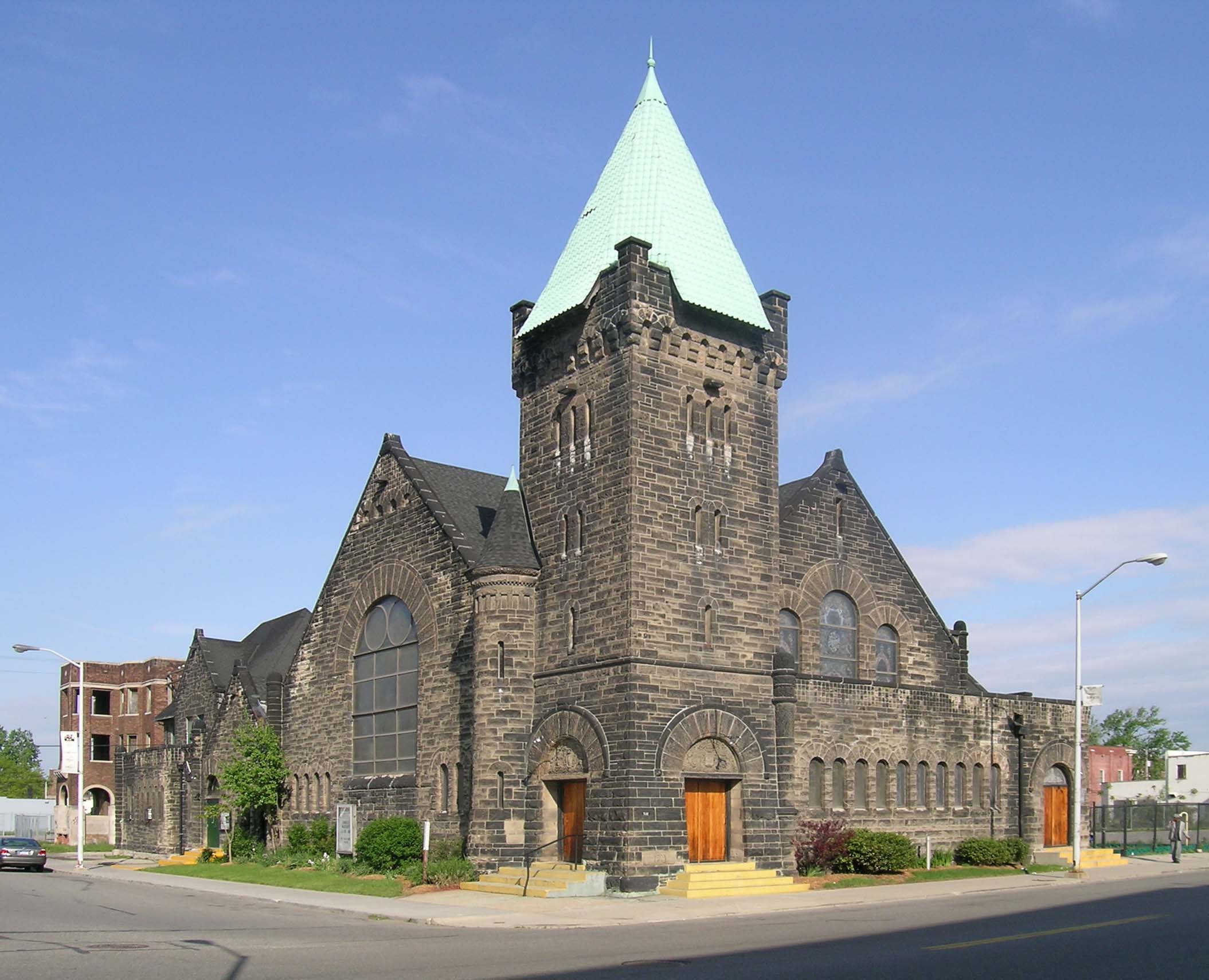
My footsteps across the concrete reverberated in echoes through the abandoned buildings flanking the church and even though it was a bright sunny day, I felt like I was walking down a dark alley in the middle of the night. The building itself was an architectural masterpiece having been built in 1883 with Tiffany’s stained glass windows, though I could tell from the street that bullet holes had cut through the once remarkable windows.

When I reached out my hand to open the doors, the height of my new fears were realized: It was locked.

Cass_Avenue_Methodist_Episcopal_Church_-_Detroit_Michigan

I knew no one from the church, I had no way to contact anyone, and all of the warnings started to really flow through my mind. But I did what any good pastor would do, I sat down on the front steps and waited for someone to open the door.

30 minutes later, a disheveled looking old man, the first person I had seen in a long time, peeked from around the corner, walked up the steps, and unlocked the front door without saying a word. I wandered around the building until I found the sanctuary, searched in vain for a worship bulletin, and resigned myself to sit down in a chair by the altar.

During the next hour, the most random assortment of people started flowing in through the sanctuary doors. The church, once renown in the heart of Detroit, was being filled with people who slept outside the night before, people who had no money to put in the offering plate, and people who were having conversations with themselves at a volume loud enough for everyone else to experience.

A group of 7 older black women arranged themselves on folding chairs near the front, and without really discussing it they all flipped their hymnals to the same page and started to sing. A man with wrinkled fingers was hunched over a piano in the corner struggling to keep up with the singing, and a young man had seated himself behind a drum-set hidden in the corner, and was wailing away to a song that only he could hear.

When the first hymn ended, the women huddled together to pick another hymn and began singing. At some point in the middle of their fourth hymn, with the pianist still planking away, and the drummer smashing the cymbals, a gentleman stood up in the middle of the sanctuary with his eyes trained on me. He walked down the main aisle slowly and deliberately until he was towering over me and then declared, “Son, if you don’t start talking, they ain’t liable to quit singing.

The earth is the Lord’s and all that is in it, from the sea to the mountains, from the rivers to the deserts, from the people to the animals; for the Lord has founded life upon the earth. Who then shall worship the Lord in holiness? And who shall stand with the Lord in the holiest of places? Only those who have clean hands, and pure hearts, those who do not lift up their souls to what is false, who do not break their promises. They will receive a blessing from the Lord, and vindication from the God of their salvation. Such is the company of those who seek the Lord.

I stood up after the end of the next hymn, and grabbed the hand held microphone to start participating in worship. I felt like a fool standing in my khakis and blazer, with my bowtie tilted just slightly to the side. I felt ridiculous with my over examined sermon under my arm, and bible in my hand. I felt like I didn’t deserve to stand before the congregation, but all of their eyes were on me. (just like all of yours are right now)

I took off the jacket and tie, rolled up my sleeves, ditched the sermon on my chair, and let the Holy Spirit go to work.

Let us pray” I began, and before I could start praying for our service, the people started shouting out their own prayers. “O Lord, help this boy to preach.” “Yes Lord, show us your mercy.”My God show me your glory!” “Remove our sins, give us your Spirit, clean our hearts!” “Your will be done!” “Have thine own way Lord!” “Help this boy preach, preach preach.

It was only after a few moments of silence that I finally said “amen” without having added any of my own prayers.

I preached on the apostle Paul’s second letter to the church in Corinth, about the new creation that comes in knowing Christ. I talked about moments that transform our lives. I said things like “there is a new life in Christ, but just because we find Christ it doesn’t mean our life will get better, but that we are called to make other lives better.” And instead of the typical, and silent, congregation I was used to, the people kept shouting at me while I preached. “Ain’t that the truth!” “Yes Lord!” “We know it, we know it” “Lord, give him strength to preach.” “Speak through him God.

When I got around to the close of the service, when I offered a benediction to the congregation, when the final amen was uttered, I heard them say in return, “Thank you Jesus.”

be-still-and-know-that-i-am-god-960x250

Lift up your heads, O gates! Open up you ancient doors! the King of glory is coming. Who is the King of glory? The Lord, strong and mighty, merciful and majestic, the Lord. Jesus Christ the author of salvation, the Good News, the Messiah. The Holy Spirit full of wisdom and truth, giver of life, and partner to our prayers. Lift up your heads, O gates! Open up you ancient doors! The King of glory is coming! Who is the King of glory? The Lord of hosts, he is the King of glory.

We can dress the part, we can read all the right books, we can memorize all the hymns and prayers, but unless we are looking for holiness in our lives, unless we are ready to bow down to the King of glory, then we are forgetting the truth: God is God and we are not.

Many of us are good Christians, we pray for our friends and family, we come to church, we put money in the plate, but there is a profound difference between believing we are holy, and wanting to be holy.

When I arrived at that church in Detroit years ago, I foolishly thought I was bringing something to them. With my well prepared outfit and sermon, I made the assumption that I was bringing God with me, nice and shiny, like a school project. I became my own main character in the story of worship, and it prevented me from seeing the King of glory.

When I stood up in the pulpit to proclaim the words, the people did not see a young man with a seminary education, they did not see some white fool trying his best to not pass out, they saw a vessel for the Lord. Their prayers were not to me, but for the Lord to work through me. The recognized the great division between God and me, and knew that Jesus was the bridge between the two.

They knew that God is God and we are not.

In our contemporary American culture, we tend to view ourselves as the center of the universe.

We assume that everything revolves around us, and that so long as our needs are being me, then everything else should be fine.

We believe that if we wear the right clothes, and get the right education, that holiness will follow accordingly.

We feel holy for giving up an hour every week to sit in a place like this and sing hymns, offer prayers, and listen to a sermon.

That church in Detroit had something that I never knew I needed: They believed that God was the center of the story, that God had the power to transform their lives, and that God really was the King of glory.

Too many of my friends have left the church because they “didn’t get anything out of it.” They might try different styles of worship and different denominations, but if they don’t get anything out of it, they will rarely return. However, church isn’t about what we get out of it, its about what God gets out of us.

Believing we are already holy limits God’s power to make us holy.

It is in the recognition of the great divide between humanity and the Lord that we can let Jesus get to work on our hearts and souls. It is in the great admission of Jesus as the King of glory we start to see ourselves, not as the center of the universe, but instruments for God’s love to be heard in the world. It is in the words of our worship that we recognize the Holy Spirit’s movement in our midst and our lives start to change.

If we remain in the assumption of our holiness, then our lives will stay the same.

But if we truly desire for the Lord to make us holy, then our lives will be transformed. Amen.

Devotional – Psalm 85.12

Devotional:

Psalm 85.12

The Lord will give what is good, and our land will yield its increase.

Weekly Devotional Image

When I was appointed to serve St. John’s UMC two years ago I asked a number of people about the goals of the church: What do we want to look like in five years? What ministries need greater attention? Where is the church heading? I asked and asked and was surprised to discover that our collective vision did not extend past next Sunday; so long as our doors stayed open, and we had people sitting in the pews, we would be content.

For two years this limited vision permeated everything we did as a church and we have been far more concerned with maintenance than mission. Yet at the same time our church has grown in numbers and faithfulness as we continue to discern the will of God for our lives and for the church. In light of this, I grew so accustomed to the status quo, and the consistent growth, that I neglected to start looking toward the future until I heard a sobering statistic at Annual Conference this year: The average person in a United Methodist Church invites someone to worship once every 38 years.

grow

In the wake of discovering this frightening statistic, I felt convicted by the Lord so start looking further than next Sunday and create goals for our church.

1) We grow in faithfulness by giving time every day to God in prayer.

2) We grow in attendance by inviting people to discover the love of God.

3) We grow in stability by offering our gifts and talents to the Lord.

If the mission of the church is to form disciples of Jesus Christ for the transformation of the world, then it is our responsibility to pray faithfully, invite lovingly, and give generously. We are called to be Christ’s body for the world and are equipped by the Lord to do so.

Our first goal is to grow through prayer so that we might be transformed into better disciples. By giving time to God every day in prayer we will start to see how true the psalmist really was: “The Lord will give what is good, and our land will yield its increase.” The Lord will grow our faithfulness, attendance, and stability so long as we are willing to play a part in this mission as well.

As we prepare to take steps into a new week, let us take time to reflect on the church that God has so graciously given to us. How can we be better stewards of this place? Where is God calling us to serve within the community? What goals do we have for the church?

Devotional – Ezekiel 2.3

Ezekiel 2.3

He said to me, Mortal, I am sending you to the people of Israel, to a nation of rebels who have rebelled against me; they and their ancestors have transgressed against me to this very day.

Weekly Devotional Image

God loves to send people where they least expect. Moses was shepherding when God spoke to him through the burning bush and told him to go back to Egypt in order to lead the people out of captivity. Jonah was minding his own business when the Lord told him to go to Nineveh. Paul was in the middle of his campaign against the early Christians when God told him to go see Ananias in Damascus.

In the United Methodist Church pastors are appointed (sent) to serve different churches. Rather than being interviewed and examined by every individual placement, a bishop (and cabinet) discern God’s will and send pastors accordingly. This style of appointments allows for churches to be challenged by their pastors (and pastors by their churches) because neither of them have a choice in the matter. Yet, I can’t help but imagine that some UM pastors feel like they are being sent to “a nation of rebels” whenever they are reappointed.

Yesterday marked the completion of my second year serving the needs of St. John’s UMC in Staunton, Virginia. I can still recall the first phone call I received detailing my appointment, and I will freely admit they I felt a little uncomfortable about where I was being sent. After all, I knew nothing about the town, the people, or the church.

I can also recall the feeling in the pit of my stomach two years ago when I approached the pulpit to preach for the first time (Between the nerves and the excitement we were lucky that I even made it through a sermon at all). I looked out from my vantage point and saw the people of God gathered together to hear the Word and respond accordingly. To this day I still thank God for blessing us with the Holy Spirit that morning who allowed us to listen, laugh, and love.

jesus-is-lord-graphic

In the beginning of my time at St. John’s I foolishly thought I was bringing something to the church that they previously lacked. I believed that I was the one who could turn the ship around. I expected that I would grow the church, have us start paying our apportionments (in full), and preach in the midst of the rebels. For a time I thought I could be the savior.

I quickly realized that my expectations were way off. Instead of being a prophet sent to the rebels, I myself was a rebel in the midst of rebels. To believe that I could save the church meant that I was putting faith in myself, rather than the Lord. To believe that I had the power to make the church start paying its apportionments meant that I did not trust God to provide. To believe that I could be the savior meant that I forgot that only Jesus is our savior.

If we have done anything to please the Lord over the last two years, it has only come because God gave us the power to do so, and only secondarily because of us (me).

We are all called to go and be Christ’s body for the world in different ways, but it is vitally important for us to remember that we have just as much to learn as we have to teach; that no matter where God’s sends us, we will be transformed just as much as we transform others; and that in the end Jesus is Lord, and we are not.

This week, let us reflect on the places the Lord has sent us to be Christ’s body, and on the people who have been sent to be Christ’s body for us.

Devotional – Psalm 130.1

Devotional:

Psalm 130.1

Out of the depths I cry to you, O Lord.

Weekly Devotional Image

When I heard about the shooting at Emanuel AME Church in Charleston, South Carolina I was shocked. The initial details conveyed a frightening scene: a lone gunman had attacked and killed 9 individuals who had gathered together for prayer. But perhaps the most frightening detail is the fact that he had participated in their prayer meeting for an hour before he began shooting. The attack at Emanuel AME is harsh reminder of the powers of evil that are manifest in our world.

The day following the shooting I knelt in the sanctuary at St. John’s and tried to pray but the words would not come. What good are words in the midst of such tragedy? How can we pray to our God when our emotions are so devastated by the events swirling around us? How can we be faithful and angry at the same time? So, when I was invited to a prayer vigil that evening at Allen Chapel AME in Staunton I knew I needed to go.

When the service began, the pastor invited all of his fellow clergy to surround him in the pulpit because “the only way we can get through this is in community.” While he prayed for the Good Lord to strike our hearts and calm our fears and frustrations, he was surround by pastors from a myriad of denominations, the sanctuary was filled with faithful disciples spanning the great mosaic of Christianity, and we all struggled to pray in the midst of such tragedy.

There was no order of worship. There was no list of scriptures to be read. There was no attendance pad being passed through the pews. Instead we called for the Holy Spirit to guide us, shape us, and nurture us throughout our vigil. As the Spirit led us we read words from the psalms and each pastor took a turn leading the congregation in corporate or silent prayer. Our responses ranged from lifting our fists in angry frustration to singing together “Thank You Lord.” At times we stood and held one another and at others we prayed on our hands and knees. We did as the Spirit commanded and we discovered the Lord in our midst.

hear_my_cry_o_lord_wide_t_nv

One of the most faithful prayers we can ever utter starts with the words from Psalm 130: “Out of the depths I cry to you, O Lord.” Prayer is not something that has to be precise and perfect, it does not need to be all lovey-dovey, and it does not have to be filled with theological and academic language. The truest prayers are the ones that come naturally and really affirm where we are while we pray. It was from the depths of human suffering that we all prayed to the Lord that night, and the Lord listened.

This week, as we pray for the people in South Carolina, let us all remember that it is good for us to pray from the depths of our souls, that it okay for us to be angry with God while venting our frustrations, and that the only way we can get through this is in community.

If you would like to know more about the prayer vigil that took place at Allen Chapel you can watch a video about it here: Staunton Prayer Vigil

10 Things I Learned From My Second Year Of Ministry

Last year my friend, peer, colleague, and theological-hero Jason Micheli (The Tamed Cynic) asked me to write a post on ten things I learned my first year of ministry. Next week marks the beginning of my third year as a United Methodist pastor so I decided to write another post on ten things I learned during year two.

10872995_835432513146512_7937253830158410370_o

1.       The Church Is Huge

How do you measure the size of a church? Is the church as large as the Sunday worship attendance? The membership role? Throughout the last two years I have realized that the church is almost always larger than I think it is. I’ll be out somewhere with my wife when a stranger will ask if I am the pastor of St. John’s. Between our preschool and missional involvement, the community of faith (also known as the church) has connections with people all over the place. It is always important for me to remember that I have been called to serve the needs of the community, which is usually larger than I think it is.

2.       Praying Is As Important As Breathing

The Bishop for the Virginia Annual Conference, Young Jin Cho, is known for saying “No spiritual vitality, no vital congregations.” And he’s right. Prayer, and other spiritual disciples, are immensely important for the work of ministry and the local church. I strive to begin every morning in the sanctuary with time dedicated to prayer. If I neglect this discipline it has a negative impact on the rest of my day. Like feeling short of breath, I am not as active nor am I as attuned to the Spirit’s work in my midst. Regular prayer is as important to discipleship as breathing is to living.

3.       Collaboration > Competition

There are a lot of churches in the community I serve (I can see four different steeples from my front yard). I have heard on a number of occasions that there are more churches in Staunton per capita than anywhere in the United States. I have no way to confirm whether or not this is true, but just driving around town leads me to believe that it could be true. Over the last two years I have had the privilege of working with other pastors to help live into the kingdom of God here on earth. When we work in collaboration, and stop seeing each other as competition, we participate in Jesus final prayer: “I in them and you in me, that they may become completely one, so that the world may know that you have sent me and have loved them even as you have loved me.” (John 17.23) If the church wants to thrive, then we need to realize that we are all in this together, regardless of our denominational affiliations.

4.       Weddings Are Hard

Compared to some of my colleagues I have done a high number of weddings during my short time in ministry. At the age of 27 I meet a lot of people who are nearing their wedding and I am often asked to officiate. I love celebrating the covenant of marriage, but it can be very hard. What an average person experiences during a wedding is a beautiful thing, but it requires a tremendous amount of planning and work to go well. Not only do I have to take the time to meet with the couple ahead of time for premarital counseling, but I want to make sure that I give them all that I can to make their day worthy of God’s blessing. The metaphor of a shepherd with sheep finds its fullest meaning during weddings when I feel like I am primarily a people-mover. Weddings are great, but they can be hard.

5.       Funerals Are Harder

I once heard a pastor say, “I would take a funeral over a wedding any day.” That comment confused me when I heard it for the first time, and still confuses me to this day. During my first year of ministry no one passed away within the community of faith, and I therefore was not required to preside over a funeral. During my second year of ministry I had 14 funerals. Most of the people had lived long and full lives, but that does not diminish the amount of grief that our community has experienced over the last year. It is such a privilege to be invited into the midst of such uncertainty in people’s lives, but it is also incredibly difficult. I spend a tremendous amount of time preparing for every funeral because I believe in the incredible importance of celebrating every life, death, and resurrection.

6.       Trust Happens

Over the last two years I have lost track of how many times I have heard someone say, “You’re the first person I’ve ever shared that with.” It happens on a regular basis that an individual will come to my office, share a vulnerable story, and then slowly realize that they had never shared that with anyone. Regardless of what I say of Sunday mornings, or even how I pray, people trust the office of pastor. There is an acceptance of confidentiality and a comfort of confession that takes place in my office that I am rarely prepared for. Trust happens all the time and it is at the heart of what it means to be in relationship with others.

7.       Change Happens

11070416_10203768021631999_8256385505868925548_n

Just because something worked the first year, it doesn’t mean that it will work the second. And just because something failed the first year, it doesn’t mean that it won’t succeed during the second. For example: During my first Good Friday I carried a cross on my shoulder through the greater Staunton community and received almost no response. People avoided me on the streets, averted their eyes, and acted as if I was invisible. This year I did the same thing on Good Friday and people would not stop talking to me! People wanted to know what I was doing, offered to pray with me, and I even shared the story of Jesus with a woman who started crying when she saw me on the street. Change happens in ministry and that is a good thing! If doing church was just about maintaining the status quo year after year, we would cease to be fruitful for God’s kingdom.

8.       I Am My Own Worst Enemy

I know of few vocations where someone has to produce something on such a regular basis and is met with immediate feedback. In two years I have written and preached more than 104 sermons. Every Sunday, within 30 minutes of preaching, everyone lines up to shake my hand and tell me what they thought. I have discovered that the sermons I worried about the most are the ones that were the most life-giving to the congregation, and the sermons I was most confident about meant very little to the gathered body. I am my own harshest critic when it comes to ministerial responsibilities and I have to constantly remind myself of who I am, and whose I am. If I put too much weight on my inner-monologue, I neglect to remember that I am working for the kingdom, and not for myself.

9.       Numbers Are Important [And Dangerous]

Every week churches in United Methodism are required to log their statistical data and send it along to the conference. Though I actively worry about how the measuring of statistical data is negatively affecting God’s church, it is important because numbers represent people. Whether we like to admit it or not, Jesus commanded his disciples to “go and make disciples.” If we are serious about being disciples of Jesus Christ, then we have to be willing to go outside of our comfort zones to welcome people into our church and help to grow the kingdom. However, even though numbers are important, they are also dangerous. I have caught myself, on a number of Sunday mornings, counting the number of heads in worship before the opening hymn. And sometimes I let that number have too much of an impact of what takes place after the opening hymn (both positively and negatively). Doing ministry is about living in the tension between growing the vineyard, and nurturing the vines. Numbers are important, but they are also dangerous.

10.   I Still Have The Best Job In The World

Stanley Hauerwas once said that “doing ministry is like being nibbled to death by ducks.” There are days in ministry that affirm his comment, but most of the time it is the greatest job in the world. Where else could I spend time deep in God’s Word? What job would give me the opportunity to preside over something as precious as the water dripping on a child’s head in baptism or breaking off a piece of bread for a faithful disciple? What vocation would bring me to the brink of life and death on such a regular basis? It is a privilege to serve God’s kingdom as the pastor of St. John’s and more rewarding than I could have ever imagined.