Comprehending The Incomprehensible

Ephesians 3.14-21

For this reason I bow my knees before the Father, from whom every family in heaven and on earth takes its name. I pray that, according to the riches of his glory, he may grant that you may be strengthened in your inner being with power through his Spirit, and that Christ may dwell in your hearts through faith, as you are being rooted and grounded in love. I pray that you may have the power to comprehend, with all the saints, what is the breadth and length and height and depth, and to know the love of Christ that surpasses knowledge, so that you may be filled with all the fullness of God. Now to him who by the power at work within us is able to accomplish abundantly far more than all we can ask or imagine, to him be glory in the church and in Christ Jesus to all generations, forever and ever. Amen.

“Tell me about your prayer life…” has got to be some of the most ridiculous pastor lingo I’ve ever heard. I mean, who else would ask someone a question like that? I am rarely, if ever, happy about my “prayer life.” I consistently feel like I could be a better prayer, that I could spend more time in prayer, and that I could get more out of prayer than I usually do.

And, to be honest, I’m not even sure how I learned to pray in the first place. Maybe prayer is like learning to read. I know that at one point in my life I didn’t know how to read, and now I do, and I’m not really sure about the magic that made it possible.

Tell me about your prayer life… How would you feel if I asked that question, right now, right here in the sanctuary and made you stand up to answer? Exactly.

And yet, for all of the difficulty and frustration and confusion that surround prayer, it might be the most important thing the bible has to offer us.

For this reason I bow my knees before the Father and I pray. Paul here in Ephesians is no longer offering sound ethical advice, he’s not providing visions for the organization and structure of the church, he is simply describing his prayers. For the church. For us!

ephesians-1038x576

I think, like reading and so many other things, we learn how to pray by observing other people pray.

Maybe you pray like Paul… You get down on your knees and you use all the right language to elevate the divine qualities of God. You earnestly yearn for the people around you that Christ might dwell in their hearts. And that, above all, you pray for the world to know the breadth and height and depth of Christ’s love.

Or maybe you pray like my buddy Will: Woah God, how great was the weather today? Thanks! I mean, like, really awesome stuff. The way you had the clouds moving and the Sun! The Sun! It was like just bright enough but not too bright. You know what I mean? Of course you do! You’re God! Well, anyway, thanks.

There is no wrong or right way to pray, though there are certainly things that are better to pray for than others. The point isn’t so much how we pray, but that we pray at all.

Years and years ago I was helping a church in North Carolina and one of my responsibilities was visiting some of the older and retired members of the church. Many of them were what we call shut-ins, in that they could no longer make it to church for worship or fellowship, but they still felt very connected to the church.

So I would bring a copy of the latest bulletin and sit down with someone for an hour for nothing more than a conversation, and we would always end our time in prayer.

One of my regular visits was to a retired pastor, and he was easily my favorite. We got to know each other pretty quickly, and every time we got together he would offer me a sage piece of advice regarding my future vocation in the ministry. He told me story after story about his successes and failures. He told me what passages to avoid in the bible, and he even told me about the time a police officer had to drive him home after a funeral wake because he didn’t know the punch had alcohol in it.

Anyway, one afternoon I went to go visit him and our relationship had grown to such a degree that I regularly walked into his room at the retirement home without knocking. And as soon as I stepped through the threshold I saw him kneeling by his bed in a posture of prayer.

What a holy sight to behold! This man, after all the years of praying and serving the church, was still just as dedicated to communing with the divine. But the more I took in the scene the more uncomfortable I felt. I didn’t want to just leave without saying anything, and I didn’t want to just keep standing their awkwardly by the door, so after a minute or two I decided to join him by the edge of the pray and start praying too.

            I slowly crept across the room and lowered my knees to the floor and centered myself before I overheard the prayer of the retired pastor… he was snoring.

And, of course, I tried not to laugh, but then again I found myself at a loss for what to do. What would happen if he woke up while I was trying to slide out of the room? What would he do if he opened his eyes and saw me kneeling on the floor right next to him? I decided to very gently rub his back and he immediately opened his eyes and said, “Amen!”

Tell me about your prayer life…

Paul wrote to the church in Ephesus because he was filled with joy that all followers of Jesus Christ are part of God’s family. No longer is there “us” and “them.” There is no “insider” or “outsider.” All have been made part of the new family in Christ Jesus. And Paul’s response to this profound revelation is to get down on his knees and pray! He knew that trying days were ahead, that it would not be an easy thing for the church to accept, the incomprehensibility of a new family made up of all, and he knew that he could not give the church what it needed to be sustained by himself.

The church relies on God, not itself.

That’s a tall order in today’s world and in today’s culture. We are told from childhood to pull ourselves up by our bootstraps, that we can be anything we want to be, and that it’s all up to us. But the message of the gospel is in fact the opposite. You cannot pull yourself up by your bootstraps, you can’t be anything you want to be, and it is not all up to us.

We cannot do this thing we call life on our own. And we certainly cannot pray on our own.

36496-praying-together-1200.1200w.tn

Paul prays for the church to comprehend the incomprehensible. This is no easy thing! But Paul prays that we might comprehend the incomprehensible WITH the saints. It is something we can only do in community, and not in isolation.

The more time I spent with the retired pastor, the one praying in his sleep (or sleeping through his prayers), the more I learned what he was really like. Because for the first few months he was what I would call his Sunday morning self, the person he used to become on Sunday morning for everyone that once showed up at his church. He was able to keep the smile for the hour we were together and send me on my way with what felt like a benediction.

But after a couple months I saw behind the curtain and I learned about his loneliness, his broken family, his fears and failures. I encountered who he really was as I discovered his inner self. And the hardest discovery of all was learning that he felt as if he had moved beyond the love of God.

The great theme of Paul’s letter to the Ephesians is the fact that there is no nation, no tribe, no family, and no person who is beyond the love of God. This may sound obvious, but it can be very difficult to believe. Particularly if you’ve lost the community, or family, or church that helped to make that love feel manifest.

Even on our best Sundays here at Cokesbury, we, the gathered people of God, bring together a myriad of secret hurts, private humiliations, and lost hopes.

After only being here for a little more than a year I can stand behind this altar and look out at the truths many of you have shared with me. I see the broken families and the betrayals, I see the terror and fear about unknown futures, and I see the pain and loss of people who used to sit in these pews. I know so many of the secret shames and private failures that are contained in isolation and I know that the ultimate fear is about what happens if any of it gets out.

And yet we keep showing up. We keep carrying our own weights and disappointments. We put on our Sunday selves, we keep the smile for the hour we are here and then we are sent away with a benediction.

But what would happen if we revealed our truth to the church? Now, I don’t mean we take turns standing up at the front and airing out all of our dirty laundry. But think with me for a moment… how could this church change if we treated it like the church Paul prays for, rather than just a place where we hang out for an hour on Sundays?

Paul prayed for the church to know, above all else, the love of God in Christ that surpasses all knowledge. Paul prayed for Christ to so dwell in our hearts and minds that we might be filled with all the fullness of God. Paul prays for us to imagine the unimaginable, to know the unknowable, and to comprehend the incomprehensible.

If we pray for our church, if we pray for Cokesbury like Paul prayed for the Ephesians, then we do so by praying for a communal experience of the love of God in heart, soul, mind, and strength. And then we pray for the church to come to grasp the truth of grace; a truth that is utterly massive and beyond all earthly reason.

            God loves us, and there’s nothing we can do about it.

And so it is for that reason, that we bow our knees before God the Father, and we pray that according to the riches of God’s glory, God may grant that we may be strengthened in our inner beings, that Christ may dwell in all of our hearts, as we are being rooted and grounded in love. We pray for the power to comprehend, with all the saints, what is the breadth and length and height and depth, and to know the love of Christ that surpasses all knowledge, so that we may be filled with all the fullness of God.

_

We pray this so that all of us might know that no one, NO ONE, is beyond God’s love. Not even us. Amen.

Reimagining the Church

strangely-warmed-spreaker-header

This week on the Strangely Warmed podcast I speak with Daniel Burch about the readings for the 9th Sunday After Pentecost (2 Samuel 7.1-14a, Psalm 89.20-37, Ephesians 2.11-22, Mark 6.30-34, 53-56). Daniel is a Licensed Local Pastor and he serves in Warsaw, VA. Our conversation covers a range of topics including cracking foundations, getting outside the church, movements vs. institutions, unrealized hope, footprints in the sand, Johnny Appleseed, citizenship, and refilling the cup. If you would like to listen to the episode or subscribe to the podcast you can do so here: Reimagining the Church

db

Also – The Crackers & Grape Juice team is excited to announce our first book! I Like Big Buts: Reflections on Romans (you can find the ebook and paperback on Amazon).

We Don’t Know What We Don’t Know

In the world of United Methodism, a number of churches received their new pastors on Sunday. They were paraded in front of a new congregation and asked to offer God’s Word without really knowing anything about the local church.

Having moved twice, I can attest to the strangeness of the occasion.

maxresdefault (4)

In anticipation of the great annual migration, Teer Hardy and I got together to record a podcast episode about pastoral transitions. However, we also covered a number of topics including steep learning curves, the challenges of preaching weekly, intersections between politics and theology, faithful hospitality, proper boundaries, ecclesial whiplash, sleeping in church, and what it’s like to work with the Tamed Cynic, Jason Micheli. If you would like to listen to the episode, or subscribe to the podcast, you can do so here: We Don’t Know What We Don’t Know


Make The Church Weird Again

Jeremiah 31.31-34

The days are surely coming, says the Lord, when I will make a new covenant with the house of Israel and the house of Judah. It will not be like the covenant that I made with their ancestors when I took them by the hand to bring them out of the land of Egypt – a covenant that they broke, though I was their husband, says the Lord. But this is the covenant that I will make with the house of Israel after those days, says the Lord: I will put my law within them, and I will write it on their hearts; and I will be their God, and they shall be my people. No longer shall they teach one another, or say to each other, “Know the Lord,” for they shall all know me, from the least of them to the greatest, says the Lord; for I will forgive their iniquity, and remember their sin no more.


I’ve been in ministry for roughly 5 years and I’ve finally figured it out. After all the sermons and all the meetings, after all the prayers and preparation, I know how to fix all the church’s problems.

It’s time to do a new thing.

Now, before we get to the solution, we need to talk a little bit about the problem that needs fixing. Churches everywhere, not just here at Cokesbury, are suffering under what I will call the paralysis of analysis. We spend far too much time looking at what we’ve done, evaluating past strengths and weaknesses, such that we don’t spend enough time looking forward. We don’t even ask if God is doing a new thing. Instead we assume that God did all the things God was going to do, and if it worked in the good ol’ days then it should certainly work now.

Here’s an example: Communion

Two weeks ago, on the first Sunday of the month, we had communion like we usually do. I stood here at the front of the sanctuary, and I prayed for God’s anointing on the bread and the cup. We all prayed together, we stood together, and we began feasting together.

One by one you came forward with outstretched hands recognizing the incredible gift that you were receiving. I took the bread, placed it in your hands, you dipped it in the cup, partook of the meal, and returned to your pews.

It was a holy thing.

However, there was a young family with us in worship two weeks ago, a family who has never ever been to church. They sat patiently during the service, though I’m sure that a lot of what we did must’ve sounded and felt strange. But nevertheless, when the time for communion arrived, they stood up like everyone else, walked to the front, and prepared to celebrate the joy of the Lord’s Supper.

I reverently handed a piece of bread to the mother, who bowed penitently before dipping the bread in the cup. I then knelt down close to the floor to hand a piece of bread to her son, but the longer I held it in front of him the longer he stared at it. I motioned for him to take it, which he eventually did, but before dipping it in the cup he frantically looked between his mother’s eyes and the brim of the chalice back and forth, back and forth.

When finally I said, with every bit of pastoral bravado, “My son, this is Jesus’ gift for you.” To which he said, “Yeah, but you said this is his blood, and I don’t know how I feel about drinking it.”

            And he promptly swallowed the un-dipped piece of bread, and jogged back to his pew.

communion_elements

            We have been doing what we do for so long that many of us neglect to think, at all, about what we are doing.

We, in many ways, are exactly like the Israelites during the time of the prophet Jeremiah. The days are surely coming, says the Lord, when I will make a new covenant with the house of Israel and the house of Judah. It will not be like the covenant I made with their ancestors when I took them by the hand to bring them out of the land of Egypt – a covenant they broke.

God had to do a new thing, not because there was anything inherently wrong with the first covenants, but there was something wrong with the participants within the covenant. Their faithfulness, their days of living as the people of God, had become so repetitive, that the Law God offered them was nothing more than a clanging cymbal, instead of the lifeforce it was meant to be.

Many of them followed the Law, they ate the right food at the right times in the right places, they abstained from foreign worship, and they wore clothes without mixing fibers, but it was done simply because that’s what they were supposed to do.

They were going through the motions.

They, to use God’s analogy, were like a spouse who no longer remembered what drew him or her to the marriage in the first place. They were waking up every morning to make breakfast, rushing to get the kids out the door, and maybe even stopping to give their beloved a kiss on the cheek, but without love, without intention, without grace.

For the people of God during the time of Jeremiah, it was all about the external and rarely about the internal. It was assumed that if you did all the right things, life would work out accordingly. Day to day experience was rationalized through objective realities – children exist to help the family, the community exists to maintain order, the worship of God exists to move life along.

There was no “why?”

But this is the covenant that I will make with the house of Israel after those days: I will put my law within them, and I will write it on their hearts; and I will be their God, and they shall be my people. No longer shall they teach one another, or say to each other, “Know the Lord,” for they shall all know me, from the least of them to the greatest, says the Lord; for I will forgive their iniquity, and remember their sin no more.

God looked out on the people, a people for whom the law was written on stones and parchment, a people who did what they were told without it providing life, and decided the time had come for a new thing.

The days of laws written on stone came to an end. There would be no need to write them down for all to see and few to follow.

Instead of attempting to adhere to a code of do’s and don’ts, instead of the Law being the thing they worshiped, instead of the marriage dissolving into routine rather than romance, God writes the law on their hearts, on our hearts.

No longer would the people need to shout at one another until they were blue in the face, “Know the Lord!” No longer would the marriage partner scream at the spouse, “Do your duty!” No longer would the people walk around as if God wasn’t there with them all the while.

This was the beginning of a new day, one in which all people would no longer know about God, with the right words and right theology. Instead they would know God, with all the intimacy needed, in which the “why” would become more important than the “what,” in which a new covenant was established.

            So now to the solution… The time has come to embrace the weird.

WEIRD

If you take a step back from all of this, from the pageantry and the pedagogy, from the liturgy and the lighting, being the church is a pretty weird thing. We take time out of our schedules every week to sit in a strangely decorated room, to listen to somebody wearing a dress talk about texts that are far older than even the country we’re in, and then we do the even weirder practice of pouring water on people’s heads and eating a poor Jewish man’s body and drinking his blood.

We are pretty weird.

But, because Christianity has become so enveloped by the world, we often see and experience what we do as being normative. We make assumptions about ourselves and others based on the fact that this is “what we do.”

But if we only focus on “what we do” instead of “why we do it” then we neglect to encounter the weirdness of who we are.

The time has come to make the church weird again. To embrace all that separates us from the expectations of the world. In no other place, in no other gathering, do we willfully consider how far we have fallen from what we could be. In no other arena of our lives do we say, and believe, that there is something inherently powerful about gathering even just to sit in silence for a few moments. In no other community can we find the power and the bravery to tear down injustice and overthrow corruption and evil.

28575700_10155147927847797_2581309506758064640_n

The time has come for us to re-evaluate our “whats” and begin to shore up our “whys.” Instead of going through the motions of our faith, instead of taking the church for granted, we have to ask ourselves “Why are we doing all of this?” “What does this have to do with the kingdom of God?” “How does the church make tangible the new covenant of God?”

If we can’t answer those questions, then we need to dive deep into the “why.”

            Better yet, we should, at the very least, start with our “why.”

Why are we here? Are we here because we don’t have certainty about anything else and we’re looking for answers? Are we here because we’ve always gone to church and we don’t know how to live any other way? Are we here hoping to get something out of church?

Or, are we here because we know God is getting something out of us? Are we here not for ourselves, or our families, but for the Almighty Father, Son, and Holy Spirit? Are we here because God found us when we were lost and showed us a better way?

The people during the time of Jeremiah were lost. They were lost in themselves, lost in their exile, even lost in the Law. They were a people of “what.”

            God saw their suffering, God saw their heartless practices, God saw their injustices, and ultimately saw it fit to do a new thing. The new covenant was inscribed on the hearts of God’s people, such that they would remember the “why.”

Perhaps God’s Spirit is moving again in such a way that the new covenant will break our hearts of stone and we might know that God is ours, and we are God’s. Maybe the time has come for us to question every little thing we do as a church so that we break free from our bondage to doing what we’ve always done such that we can ask why we do what we do and start over with God’s new covenant.

Perhaps the time has come to make the church weird again. Amen.

Do Pastors Fail?

Yep.

TGC_Pastors_Fail_To_Be_Jesus-1

I was recently invited to join the one and only Todd Littleton on the Patheological podcast to discuss the strange, and often avoided, subject of pastoral failure. Many of us are all too familiar with the failure made manifest in places of church leadership like adultery and embezzlement. Those I would categorize as moral failures. But there are other failures as well.

During our conversation Todd and I cover a number of the mistakes I’ve made over the last few years, and how I’ve grown from them. I fundamentally believe our mistakes make us better pastors/Christians AND that we need communities to help us see our failures and push us toward better solutions. Otherwise we pastors run the risk of falling into a frightening statistical category: 1,500 pastors leave the ministry every month in this country never to return again.

If you would like to listen to our conversation, you can do so here: Pastors Fail?

I highly suggest subscribing to Todd’s podcast – he strives to provide conversations for the pastor/theologian and it has been a tremendous help to me in the past.

The Case Against “Ashes To Go”

Over the last few years there has been a phenomenal rise in a liturgical practice called “Ashes to Go.” And I think it needs to end.

This is what it typically looks like: On Ash Wednesday, a pastor (or pastors) will gather in the parking lot of his/her respective local church, and a drive thru line will allow people to wait their turn for a ten second interaction where ashes are hastily smeared on a forehead while the traditional words are uttered, “You are dust and to dust you shall return.”

Or a group of clergy will gather in a public space (like a park or fast food restaurant or a coffee shop) with a simple sign encouraging people to stop in for their “Ashes to Go.” Lines will development during peak hours, people will hear the right words, and they will leave with a reminder of their mortality on their foreheads.

AshestoGo4

Now, I recognize that the current pace of our culture makes participating in an actual Ash Wednesday service challenging. I understand the difficulties of a frenetic existence where we are habitually running from one thing to the next. Moreover, I know people for whom the “Ashes to Go” is a sign of the church’s willingness to catch up with the times and start digging itself out of its ditch of irrelevancy. But offering ashes devoid of a liturgy in which the practice is made intelligible, is the equivalent of clanging cymbal without love (to steal an expression of Paul).

To those who love “Ashes to Go”: I mean no offense. I only want to call into question the faithfulness and the efficacy of doing so. I have heard about the beauty of meeting people where they are, and the reclaiming of evangelism that happens with “Ashes to Go” but I wonder if there are better occasions to share the gospel without watering down the holiness of Ash Wednesday to fit into other peoples’ schedules.

yY623rKO

Last year, my friends and I had the privilege of interviewing Fleming Rutledge for an Crackers & Grape Juice episode about Ash Wednesday and she had thoughts on the subject of “Ashes to Go” as well. This is what she said:

“It’s pathetic. I know people who do it (people I admire), but people don’t know why they’re doing it. There’s no message involved. Christianity is not just about forgiveness. Forgiveness is not enough; there has to be rectification of evil… When I grew up nobody had ashes, only the Roman Catholics did it, and we all thought it was superstitious. I personally don’t like the ashes very much unless it is done within the context of an entire worship service with a full and faithful homily. Remember: the gospel says wash your face. It’s really weird to listen to that passage on Ash Wednesday and then leave with a cross on your forehead after Jesus just told everyone to wash up.”

I agree with Fleming insofar as without taking place within a full liturgy, Ashes merely become another idol, another popular display of religious affection, and it fails to embody what the occasion is all about. Ash Wednesday is not supposed to be easy or convenient; that’s kind of the whole point. It is a disruption of our way of being, a reminder of our finitude in a world trying to convince us that we can live forever, and because the practice is not self-interpreting, it requires the context of a liturgy in which we can begin to understand what we are doing and why.

And I use the term “we” purposely. I use “we” because Ash Wednesday is not about individual introspection and reflection. It is a practice of the community we call church.

While the world bombards us with the temptation to believe we can make it out of this life alive, the world is also trying to convince us that we don’t need anyone else to make it through this life at all. According to the world, the individual triumphs. But according to the church, no one can triumph without a community that speaks the truth in love.

Therefore, for me, “Ashes to Go” completely loses its connection with Ash Wednesday and the beginning of Lent because it just becomes another individualized consumer driven model of the church rather than being the incarnational and rooted practice of joining together to remember who we are and whose we are.

All Things To All People

1 Corinthians 9.19-23

For though I am free with respect to all, I have made myself a slave to all, so that I might win more of them. To the Jews I became as a Jew, in order to win Jews. To those under the law I became as one under the law (though I myself am not under the law) so that I might win those under the law. To those outside the law I became as one outside the law (though I am not free from God’s law but am under Christ’s law) so that I might win those outside the law. To the weak I became weak, so that I might win the weak. I have become all things to all people, that I might by all means save some. I do it all for the sake of the gospel, so that I may share in its blessings.

All of us have questions. We have questions about what it means to be a Christian, what the bible is all about, and how to make sense of it all in the ways we live. In November I compiled a list of questions from the congregation and created this sermon series in which I will attempt to answer some of the questions that vex us in regard to our faith. Today we continue the series with, “How do we share the Good News?”

“When did you last speak to someone about your faith?” Throughout John Wesley’s ministry, this was a question to be answered by all people within the Methodist movement. And it’s a question most of us would rather avoid today.

It we’re honest, we don’t want to appear too evangelical (whatever that means). We don’t want to be confused with the kind of bible toting people who seek to win others for Jesus. We don’t want to leave church with tracts to pass out to people in public warning them about their imminent doom unless they accept Jesus as their Lord.

And yet, that question, the one we want to avoid, the one that makes us squirm in our pews, is perhaps one of the most important questions we can ever ask.

When I was in college, I became the de facto cook for my house. There were five young men all living under the same roof, and I tried my best to make a home cooked meal once a week so that we could all sit down and break bread with one another. When we sat around the table for the first time, with our assortment of hand-me-down plates and silverware, I asked my friends to pray with me, and they just stared at me as I bowed my head and asked for God to bless the meal and us.

Week after week we sat around that table, and the longer I prayed for them, the more they adapted to it. Such that, one night, when I inexplicably forgot to pray, they stopped me from eating and said, “Aren’t you forgetting something?!”

Around that same time I was invited to guest preach at one of the local United Methodist Churches. I, of course, invited all of my roommates to attend and they all sat together in the furthest back pew.

The service was fairly typical, and the sermon was a definite B-, but then we moved to the communion table and the pastor prayed for the Holy Spirit to make the bread and cup into the body and blood of Jesus Christ. And while the whole congregation began lining up in the center aisle, my roommates did as well with bewildered looks on their faces.

I realized, as they were walking closer to me, that none of them had received communion before, nor did they have any idea what they were doing.

When they made it to the front they all stood in front of me with wide eyes and nervous ticks. I quietly whispered, “take the bread, dip it in the cup, eat it, and I’ll explain everything at home.”

And so, they did.

There was a time in the life of the church, when we could expect new people to show up on Sunday mornings no matter what. When Christianity was Christendom, which is to say, when Christianity was normative, the majority of people in a community could be found in church on Sunday morning. This meant that for generations, great scores of people were born into, and raised through a church, such that things did not have to be explained or proclaimed, and the work of evangelism was nothing more than standing in front of one’s own church to share what God had done.

But that time is long gone.

And because churches can no longer expect that, “if you build it they will come,” the work of evangelism has increased sharply. Congregations are told that they are in the business of saving souls, and that they must do everything within their power to share the Good News. But more often than not the good news sounds like bad news.

1Corinthians9.22-660x371

Fear mongering tactics with threats of hell and eternal damnation are hung over individual heads with hope that it will scare them into church.

            The bible is used as a weapon to attack people for the way they are living in order to shame them into coming to church.

            People are treated as numbers and objects to be placed on a worksheet and empty promises about heavenly rewards are used to get people to come to church.

            And people wonder why the church is shrinking…

When I asked for questions in November, a lot of people asked about ways to share the Good News. Behind those questions was the desire to grow the church. Growth is a good thing, I mean: Jesus sends the disciples out to make disciples of all nations, but growth for the sake of growth is problematic.

If we want to fill the sanctuary up every Sunday we could do raffles, and giveaways, we could provide financial incentives to get people to invite more people to church, but it wouldn’t be faithful. The only way the church grows is when we believe the church has something so incredible to offer that we’re willing to invite others to discover it.

The point is this: we can no longer just wait for people to magically appear on Sunday morning.

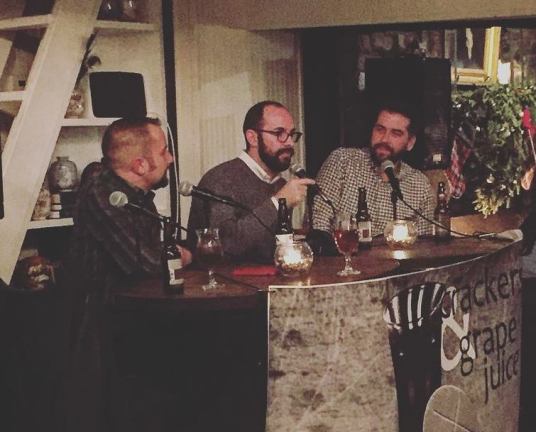
In addition to the questions we received about sharing the good news, there were an equal number of questions about why I participate in a podcast. For the last year and a half I’ve been working with two other United Methodist pastors to produce weekly podcasts (a podcast is a downloadable audio file that you can listen to on your phone and computer). We started it as a way to have conversations about theology and scripture, and as we made the episodes public, they started reaching a lot of people. And by a lot, I mean A LOT. By the end of the month, we should hit our 200,000th download.

But we didn’t start the podcast to become popular. We started it to reach the people who no longer felt comfortable in church. We wanted to provide conversations with zero commitment on behalf of the people listening so that they could encounter the church from a new perspective. Because for as much as this thing we do called worship is what being the church is all about, for some people it’s not enough.

DearChurch

We were taking a break from a live podcast event back in December when an older man walked across the room and stood right in front of me. He stared at me with a curious look and said, “You sound different in person.” Unsure of whether or not he meant it as a compliment, I inquired as to how. He said, “You sound a little more confident on the podcast than you did tonight. But I think that’s a good thing. I appreciate your vulnerability.”

We talked for a little bit about the guests we had that night, and the challenges of doing a live recording, and then before returning to his seat he said, “I left the church years ago because I felt burned. Too many sermons about what I had done wrong, too many people suffering without anything changing; too many pastors abusing their privileges. But then I discovered the podcast, and I started listening. And the more I listened, the more I heard God, and the more I realized I needed to give the church another chance…”

We live in an ever-changing world where people consume information so quickly that the church can appear archaic and irrelevant. But I believe this is a sad misjudgment. Rather, I believe church has the most important thing to offer of all, the Good News of Jesus Christ.

Therefore, like Paul, we do well to do whatever we can, by whatever means we can, to share the Good News of Jesus Christ. For Paul that meant being a Jew to the Jews, and outside the law to those outside the law, and all things to all people.

For us today, that might take on different meaning, we might be tasked dropping our political identities in order to reach people across the political spectrum, or crucifying our prejudices in order to reach people who do not look like us, or repenting of our judgmental attitudes in order to reach people who frighten us.

As Christians, we are necessarily evangelical. Evangelism means, by definition, sharing the Good News. So much of what we do and who we are is wrapped up in the story of Jesus, recognizing how the story has changed our lives, and the hope that it can change the lives of those around us.

            But, sadly, being evangelical these days often comes off like being a bad and annoying used car salesperson. When the tactics of fire insurance, and bombarding strangers is the best we have to offer others, when winning souls becomes more important than loving others, we cease to be evangelical, at least the way the word is meant to be used.

Last year, I drove up to Cokesbury on a Sunday afternoon to meet a handful of people from the church before it was announced that I would be your new pastor. We sat down in the conference room upstairs, exchanged pleasantries over fruit and cheese, and then we went around the table to introduce ourselves and describe how we are connected to the church. One by one I learned about some of you for the first time, how long you’ve been here, what you like, what you want to change, all of that stuff. And one of the last people to share was Emmett Wright, and all he said was, “I’m an evangelist.”

And, because being evangelical can be so misconstrued these days, all I could think was, “that’s just great [sarcasm].” So I asked him to elaborate and he said something memorable like, “just wait and see.”

On any given week Emmett will invite a score of people to come to experience God’s presence at our church. But he does not evangelize by attacking strangers with threats or empty promises. He meets people where they are and he gets to know them. He sees his evangelism first as a call to friendship, with all people, long before inviting them to church. And because he fosters friendship first, the people he invites to church always want to see what it’s all about.

Emmett is a lot like Paul in that he becomes all things to all people. He never presents the gospel in some stuffy forgotten way; it is always alive and exciting and friendly. Emmett meets people where they are, instead of sitting around waiting for them to show up.

Paul’s ministry was one of evangelism. Over and over again he won people for the sake of the gospel. Not to fill pews, not to frighten them, not to shame them, but because he believed the story of Jesus Christ was the most important story they would ever hear. He believed the message of salvation would change everything about the way they lived. He believed that following Jesus would make all the difference.

Paul became all things to all people because that’s precisely what God was willing to do for us. God became all things to all people in Jesus Christ. God humbled himself in the manger and took on flesh. Though God was free to as God pleased, God made himself a slave to all in Jesus in order to free us from slavery to sin and death.

            Evangelism always begins in friendship, in the intimacy of two people sharing life together. Evangelism takes place in the trust when listening becomes more important than talking. Evangelism comes to fruition when saving and winning others is more about them than us. Amen.

Q&A with Tripp Fuller and Diana Butler Bass [Live]

Crackers-Banner-1

The Crackers & Grape Juice team recently hosted a live podcast event in Alexandria, VA where we invited Tripp Fuller and Diana Butler Bass to offer their reflections about the first and second Advents. Tripp is the founder of Homebrewed Christianity which produces podcasts and publishes books and Diana is an author, speaker, and scholar specializing in American religion and culture. In the final part of the evening, we invited Tripp and Diana to respond to questions from the audience including: Why is the second Advent necessary? What about Advent is important for white people in a world full of racial inequality? and What’s right with the Church? Also – The episode ends with a Christmas sing-a-long led by Tripp… If you would like to listen to the live recording, or subscribe to the podcast, you can do so here: Diana Butler Bass & Tripp Fuller – Q&A [Live]

25438854_905456293047_8493091450013579252_o

The Church Is The Better Place or: Why Did Jesus Come?

Tim Keller, pastor of Redeemer Presbyterian Church in NYC, broke the internet recently with the following tweet:

“Jesus didn’t come primarily to solve the economic, political, and social problems of the world. He came to forgive our sins.”

And people went crazy.

Some reacted by strongly affirming Keller’s point, and others rejected it completely as a dismissal of the social/justice orientation of the church’s mission.

IMG_3422

And so, the team at Crackers & Grape Juice teamed up with Scott Jones to dissect the tweet and offer our theological reflections to it.

If you want to listen to the recording or our conversation, you can do so here: Why Did Jesus Come?


Billboards In The Kingdom

1 Thessalonians 5.1-11

Now concerning the times and the seasons, brothers and the sisters, you do not need to have anything written to you. For you yourselves know very well that the day of the Lord will come like a thief in the night. When they say, “There is peace and security,” then sudden destruction will come upon them, as labor pains come upon a pregnant woman, and there will be no escape! But you, beloved, are not in darkness, for that day to surprise you like a thief; for you are all children of light and children of the day; we are not of the night or of darkness. So then let us not fall asleep as others do, but let us keep awake and be sober; for those who sleep sleep at night, and those who are drunk get drunk at night. But since we belong to the day, let us be sober, and put on the breastplate of faith and love, and for a helmet the hope of salvation. For God has destined us not for wrath but for obtaining salvation through our Lord Jesus Christ, who died for us, so that whether we are awake or asleep we may live with him. Therefore encourage one another and build up each other, as indeed you are doing.

I have a love-hate relationship with church signs and billboards.

Every once in a while I’ll pass by a church with a sign that just knocks me back with laugher. I’ll never forget the time I was driving, soon after receiving my driver’s license, and I passed a local Presbyterian church with a sign that said, “The Church isn’t full of hypocrites… there’s always room for more!”

And then there are the witty signs that are biblically accurate and memorable. For instance: I was lost driving through the middle of nowhere Virginia and I saw a handwritten sign in the front yard of a very small chapel that said, “Quick, look busy, Jesus is coming!”

Or there are those that just hit a little too close to home: “Having trouble sleeping? We have sermons. Come hear one!” or the equally pastoral: “Do you know what hell is? Come hear our pastor.”

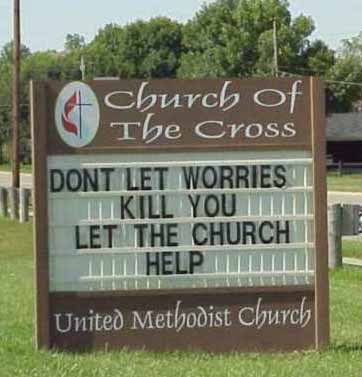
And then there’s those signs where you can’t help but wonder what led someone to put that up for everyone in the world to see. Like: “Don’t let worries kill you, let the church help” and “God answers our kneemail” and “Can’t take the heat outside? This church is prayer conditioned.”

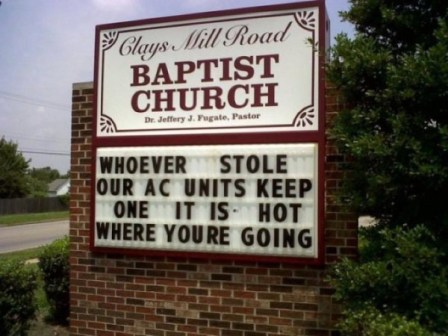
But there is one church sign that takes the cake, one sign that was so poignant that it has stuck with me over the years. In big blocky letters it said, “To whomever stole our AC unit. Keep it. You’ll need it where you’re going…”

ayFBmy2

And for every funny, and witty, and strange church sign, there are an equal number of terrible, shameful, and problematic church signs.

I can remember driving with my family years and years ago when I saw a church with a sign that said, “No gay marriage: it was Adam and Eve not Adam and Steve.”

There was quite a controversy a few years ago in a small southern community where a few teenagers died in a car accident and a local church put up a sign the next day that said: “Honk if you love Jesus! Text while driving if you want to meet him!”

And last weekend, while I was driving down to Durham, NC, we passed a huge billboard in Richmond that said, “The End is near! Accept Jesus or go to Hell.”

These billboards and church signs shout at passing cars and pedestrians about the brokenness of the world and the desperate need to change here and now. They play into our fears and frustrations, they tap into our emotions, and they make it all about us.

Notice, the signs I described, they’re almost all about our experience, and our need to change, and our sin. Very few church signs are actually about God.

How strange.

1_churchKill

And, because we take our lessons from the world around us rather than from God’s Word, we’ve let this slip off the billboards and into the church. So much of what we do on Sunday mornings has become primarily focused on our experience.

We ask questions like, “What did you get out of church today?” when it’s actually about what God gets out of us.

We preach and hear sermons that end with “let us now go and do likewise” instead of reflecting on how God is the one moving in and through us.

We make church all about us, instead of about God.

Our text from Paul’s letter to the church in Thessalonica is apocalyptic. Apocalyptism is one of the frightening words we tend to avoid at all costs. When we hear the word our minds immediately flock to frightening movie scenes, and fire raining from the sky, death and destruction all around. We think about the people wearing signs on street corners or the not-so-subtle church billboards near the highway.

But apocalyptic writing is nothing more than the revelation of God. It is an experience of the presence of the divine that breaks down every barrier for humans in the universe.

These kind of writings and reflections rise to the surface whenever Christians feel pressured by the world; when oppressive regimes like Rome, or slavery, or the system itself rises to power, they put all of life’s choices into the binary of God or the devil. And hope for God’s in breaking, God’s revelation, may be all that keeps us going when everything feels like it’s falling apart.

It should come as no surprise that considering what has taken place across the American landscape over the last year, many people, Christians in particular, believe we are in the end times.

Evangelicals feel attacked and belittled by the federal government for just about everything under the sun.

Pastors lament from the pulpit about the so-called war on Christianity or the war on Advent and they strive to frighten their people into recognizing the apocalypse at hand.

Even Roy Moore, the current Alabaman Republican candidate for a Senate seat, in light of all the accusations coming in for sexual harassment and misconduct, he has denied them vehemently and labeled them an attack on his Christian identity and virtue.

Fear is a very powerful tool. Manipulation always takes place when individual fears are tapped into.

That’s why political races are won by showing what’s wrong with the other candidate rather than addressing what a particular candidate wants to see happen.

It’s also why children are experiencing the highest levels of anxiety in modern history because they feel pressured to perform well, rather than being celebrated for what they’ve accomplished.

And it’s why churches put up big billboards with slogans like “Accept Jesus or Suffer The Consequences” rather than “Jesus loves you.”

Today, there is so much going on that there is plenty of pressure for us to forget that we are citizens of the age yet to come.

Fear is powerful.

And even here in Paul’s letter to the Thessalonicans, he appeals to their fear:

You all of all people know that the day of the Lord will come like a thief in the night. The world might seem nice and good, but that’s exactly when the sudden destruction will arrive, like labor pains in a pregnant woman, and there will be no escape!

            But unlike the billboards that speckle our American landscape, unlike the 24-hour news cycle that is almost entirely devoted to political fears, Paul raises the issue of revelation not for fear mongering, but for encouragement.

1Th5

The world might be falling apart, but we are not in darkness. We are children of the light and children of the day. We cannot become blind to who we are and whose we are, we must remember our truest identities and what has been done for us. So, let us clothe ourselves with the breastplate of faith and love, and for a helmet we shall wear the hope of salvation. For God has destined us for greater things; not for wrath, but for obtaining salvation through Jesus Christ our Lord. Therefore, do the good and right work of encouraging one another, and build up each other.

Paul, throughout the centuries, fills our ears with the very words we need to hear: Stay the course, remember we belong to the light, trust God and trust God’s promises, build the kingdom, love one another.

All of those things would be far better on a church billboard than most of the stuff we see on a regular basis.

On Sunday afternoon, shortly after most of us left the church, I received a phone call from our Secretary, Louise. Now, to be clear, Sunday afternoons are holy times for clergy people as they struggle to keep awake after struggling to keep people like you awake during church. So when I receive a phone call on a Sunday afternoon, right after being in this space with all of you, I know it’s important.

I answered my phone and Louise quickly filled me in one what had taken place right after I left… A drunk driver had crashed into our church sign.

When he came down the road he was traveling at such a high speed that when he smashed into the brick and mortar sign, it flipped the vehicle and it flew another 30 feet before it finally came to stop.

Police officers were on the scene and the driver had already been rushed in an ambulance to the hospital. He thankfully only suffered a few cuts and bruises, but when I got on the phone with the first officer he kept saying the same thing over and over again, “He’s lucky to be alive.”

IMG_1123

Thankfully, our sign that now stands broken and cracked on the corner of our property is not filled with any of the hateful rhetoric found on some other billboards. I say that with gratitude because the guy who crashed last Sunday easily could’ve died. He was going fast enough to end his life. And as I thought about what happened this week, as I read through Paul’s letter, I kept thinking about how terrible it would’ve been if those kinds of words were the last he ever saw.

Friends, life is far too short to be filled with negativity and fear and belittling attacks meant to manipulate. There is enough anxiety already in the world today. And when we think that all of this church stuff is up to us, and to us alone, we only increase the pessimism that so controls the world.

Paul writes to the church, and to us, and boldly declares that we have received a great gift in the death and resurrection of Jesus Christ. We have been awakened to God’s movements in the world, we have the privilege of living as God’s people in the light, and we get to experience the profound and wonderful mystery of resurrection here and now in and through one another.

We can, like others, spend our days worried about what will happen to us when we die. We can fall prey to the fearful signs that fill the horizons. But Christ died so that we may live.

Therefore, instead of breaking one another down, we build one another up. Instead of using fear to manipulate others, we give thanks for the love of God that has no end. And instead of cowering in the shadow of the cross, we rejoice in the light of the resurrection. Amen.