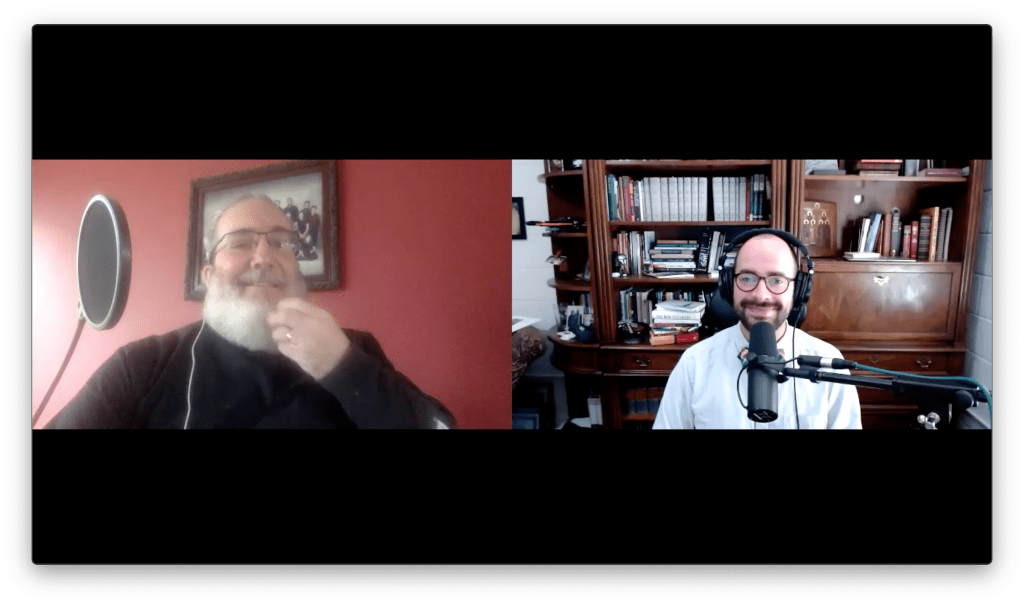
This week on the Strangely Warmed podcast I speak with Matt Benton about the readings for the 10th Sunday After Pentecost [A] (Genesis 37.1-4, 12-28, Psalm 105.1-6, 16-22, 45b, Romans 10.5-15, Matthew 14.22-33). Matt is the pastor of Bethel UMC in Woodbridge, VA. Our conversation covers a range of topics including Coronatide, NOVA, the case for Karl Barth, narrative theology, dreamers of dreams, church leadership as evangelism, different righteousnesses, exegetical grammar, and God’s oddness. If you would like to listen to the episode or subscribe to the podcast you can do so here: The Hardest Part Of Being A Christian
We know that all things work together for good for those who love God, who are called according to his purpose. What then are we to say about these things? If God is for us, who is against us? He who did not withhold his own Son, but gave him for all of us, will he not with him also give us everything else? Who will bring any charge against God’s elect? It is God who justifies. Who is to condemn? It is Christ Jesus who died, yes, who was raised, who is at the right hand of God, who indeed intercedes for us. Who will separate us from the love of Christ? Will hardship, or distress, or persecution, or famine, or nakedness, or peril, or sword? As it is written, “For your sake we are being killed all day long; we are accounted as sheep to be slaughtered.” No, in all these things we are more than conquerors through him who loved us. For I am convinced that neither death, nor life, nor angels, nor rulers, nor things present, nor things to come, nor powers, nor height, nor depth, nor anything else in all creation, will be able to separate us from the love of God in Christ Jesus our Lord.
Everything happens for a reason. We say something like that to bring comfort to people in the midst of uncertainty, or tragedy, or difficult circumstances mostly because we don’t know what else to say. It is a remarkably common expression among Christian-types and it’s not in the Bible.
Years ago I received a phone call that a woman in my church was in her final moments. She had been suffering from a great number of chronic problems for the better part of two decades and most of her family had not expected for her to live as long as she did. We all stood around her bed together praying and sharing those final moments before she died.
A few days later, on the eve of her funeral, her now widower husband fell down the steps in front of their house after returning from the wake and was rushed to the hospital. He needed a few days to recover and we delayed his wife’s funeral until he was better. Eventually he sat in the pews with surrounded by his family and worshipped with the rest of us as we gave thanks to God for his wife.
After the burial and reception he returned to his now empty house complaining of our tired he was and after he went to bed, he never woke up again.
A husband a wife dead less than a week apart.
When I got the call about his death, having only seen him the day before, I rushed to the house to meet with the family who were still in town from the wife’s funeral. And one by one I watched and listened as every single family member exchanged a version of “everything happens for a reason.”
“God just needed another angel in heaven.”
“God wanted them to be married in heaven just like they were married on earth.”
“This was all part of God’s plan.”
And the more I heard it the more my blood boiled. But before I had a chance to blurt out something pastors aren’t supposed to say, one of the couple’s daughters beat me to it.
“That’s BS” she stammered.
Though she didn’t use the acronym.
“If this was all part of God’s plan, then why did God take away my Mommy and Daddy so quickly? Why would God do that to me?”
And that’s when the whole room turned to me, the pastor, the so-called expert on God.
So I said, “If there is a reason for everything, if God killed both of them on purpose, then God isn’t worthy of our worship.”
When we throw out trite and cliche sentences like, “everything happens for a reason” it puts all of the responsibility of every single little thing entirely upon God.
It makes God into a monster.
The author of car crashes, incurable childhood cancers, and unending wars.
And yet, more often than not, it is our go-to expression when we don’t know what else to say.
If there are two things that we, as human beings, just can’t stand they are mystery and silence. It’s no wonder therefore that when we face a situation that has no explanation we get as far away from mysterious silence as we possibly can by saying something we think is helpful. We both want to have an answer for every question and we want to be able to get out of uncomfortable moments when we don’t know what to say.
The problem with all of that is we think we’re helping someone when we’re actually making things worse.
Anyone who claims that everything happens for a reason are those who believe God wills every single horrific death, every incurable diagnosis, and even something like the Coronavirus. They see and imagine God as some great puppeteer in the sky instituting every possible contingency such that it must be this way at all times no matter what.
And if that’s true, then every rape, every murder, every act of child abuse or neglect, every war, every storm or earthquake, are all part of God’s plan.
To those who believe that is the case, the response from the daughter whose parents died should suffice.
In his book The Doors of the Sea, David Bentley Hart recalls reading an article in the New York Times shortly after the unimaginable tsunami that wrecked South Asia back in 2015. The article was focused on a Sri Lankan father, who, in spite of all his efforts, which included swimming in the rolling sea with his wife and mother-in-law on his back, was unable to save his wife or any of his four children from drowning in the waters. The father recounted the names of his children and then, overwhelmed by his grief, sobbed to the reporter, “my wife and children must have thought, ‘Father is here… he will save us” but I couldn’t do it.”
David Hart wonders, in his book, If you had the chance to speak to the father in the moment of his deepest pain, what would you say? Hart then argues that only idiots would have approached the father with trite and empty theological expressions like: “Sir, your children’s deaths are part of God’s cosmic plan” or “It’s okay this was God’s design” or “Everything happens for a reason.”
Most of us, Hart believes, would have the good sense not to talk like that to the father. And then he takes it one step forward. “And this should tell us something. For if we think is shamefully foolish and cruel to say things in the moment when another’s sorrow is most real and irresistibly painful, then we ought never to say them.”
And to take it one step even further, if we mustn’t say things like that to such a father, then we ought never to say them about God.
St Paul wrote to the early church in Rome: “We know that all things work together for good for those who love God, who are called according to his purpose.” Which, for many, justifies the desire to say “everything happens for a reason.”
And yet we so often forget that this verse is the beginning of Paul’s big crescendo to one of the texts we use most often at funeral – nothing can separate us from the love of God in Christ Jesus.
What we miss in that profound and powerful declaration is that there are powers and principalities contending against God in this life.
That is, death is something that is trying to separate us from God, but God wins in the end.
The Good News of Jesus Christ is that death is God’s ancient enemy, whom God has defeated in Christ Jesus, and will ultimately destroy forever in the New Jerusalem.
That is, to put a fine note on it, the whole point of the Gospel in the first place.
It would then be nothing but ridiculous for God to delight or even ordain the deaths of those whom he loves for it would run counter to the life, death, and resurrection of Jesus Christ.
“We know that all things work together for good for those who love God and are called according to his purpose.”
God does not want bad things to happen to us. But bad things do happen in this fallen and fallible world we find ourselves in. We, all of us, make choices we know we shouldn’t and we avoid doing things we know we should. We contribute in ways both big and small to the tremendous suffering in the world. From delighting in being able to purchase a banana whenever we want from the grocery store (a banana that requires low waged work, an absurd amount of fossils fuel, and harmful chemicals to make it to our plate) to texting while we drive (which distracts us from the kid running into the street to grab his wayward basketball) to a great number of other scenarios.
Some of the suffering of the world is willed, but not by God. It is willed by us in our relentless pursuit of whatever we think we deserve.
And yet a fair amount of suffering in the world exists not because of us or God, things just happen without explanation.
And when those things occurs, whether willed by human beings or random events in creation, we do well to close our mouths and rest in the knowledge that God has defeated death.
Does that erase death’s sting here and now? Of course not, death always hurts.
But as Christians, we know how the story ends, we know that those we lose in life will be waiting for us at the Supper of the Lamb surrounded by the great cloud of witnesses that have gone on before us.
The “for good” that God works to achieve is the proclamation that nothing can ever separate us from the love of God in Christ Jesus. That even in our suffering, even in our deaths, God is with us.
Look, I hear it a lot in my line of work, people showing up at the church or calling me on the phone to ask, “Why is God doing this to me?”
The loss of a child. The loss of a job. The loss of health.
And for as many times as I have heard questions about God’s purposes behind the purposeless moments in life, I’ve heard from just as many people wondering, “What can I possibly say to someone in their suffering, in their loss?”
Sometimes the best thing to say is absolutely nothing. As hard as it might be to sit with someone else in their pain and in their suffering, just listening to them is far better than trying to fill the time with trite and meaningless aphorisms. At the very least, it’s the most faithful thing we can do.
Life is hard and all sorts of things happen without explanation. I know that might not sound very pastoral, but it’s true. Can you imagine how you would feel if you came to the church one morning in your grief or suffering or pain, and you got down on your knees to pray to God when all of the sudden you heard a voice booming from the heavens declaring, “I”M DOING THIS TO YOU ON PURPOSE! THIS IS PART OF MY PLAN!”
If that’s who God is, then God isn’t worthy of our worship.
Thankfully, that’s not who God is. God is whoever raised Jesus from the dead having first raised Israel out of Egypt. God is the author of salvation and not the dictator of death. God is the one who would do everything, and already did, to make sure that nothing, truly nothing, could ever separate us from the his divine love.
Our hope is not contingent on finding reasons to explain everything that happens – instead our hope is built on Christ who shows us in his life, death, and resurrection that God is with us, always.
And there’s nothing we can do about it.
For I am convinced, like Paul, that neither death, nor life, nor angels, nor rulers, nor things present, nor things to come, nor powers, nor height, nor depth, nor anything else in all creation, will be able to separate us from the love of God in Christ Jesus our Lord.
That’s the gospel.
Jesus is the reason that even when things happen, we are not abandoned.
When it was evening, the disciples came to him and said, “This is a deserted place, and the hour is now late; send the crowds away so that they may go into the villages and buy food for themselves.” Jesus said to them, “They need not go away; you give them something to eat.” They replied, “We have nothing here but five loaves and two fish.” And he said, “Bring them to me.”
I might appear cheerful in my Sunday morning streamed services on Facebook and YouTube, but I can assure you that recording those services is anything but cheerful. There is the never-ceasing dread that the internet will cut out or I’ll lose my train of thought or no one will actually watch or etc. And yet, week after week I stand inside of an empty sanctuary, staring into a camera, hoping that it will result in faithful worship.
But there have been plenty of mistakes.
One week I was 3/4 of the way through the services when my computer went completely dark signifying that the live-stream had stopped. So I made my way over to the device thinking I could get it back on, all while muttering un-pastoral words under my breath, without realizing that the live-stream had somehow continued in the madness.
One week, I tried recording the service early so that I could premiere the video on Sunday morning when a supercell thunderstorm rolled in and the sanctuary shook with every thunder clap leaving me to cower a little more with each successive burst (I decided to wait that one out and record a few hours later).
And last week, I set up the camera up via my iPhone and talked for 45 minutes straight only to realize that none of it recorded because someone called me in the first five minutes and my phone switched apps.
What can you do but laugh?
I mean, these really are crazy times and we preachers are trying crazily to keep the Word fresh and faithful in a time when we cannot gather together in-person.
I confess that, on more occasions than I care to admit, I have fallen down to the floor in the sanctuary with nothing but crazed laughter knowing how many mistakes I’ve made throughout the pandemic when it comes to being a pastor.
Laughter, to put it another way, has saved me.
If Jesus’ original disciples weren’t able to laugh at themselves, I’m not sure how they were able to make it as disciples at all.
Jesus laid it all out at least three times about his whole death and resurrection and they still abandoned him on the cross.
Jesus went on and on about the Kingdom of heaven and they never stopped asking him when it was going to happen and what it was going to look like.
Jesus performed countless miracles and one day, when the crowds were especially large, the disciples thought it would be better for the people to be sent home because they didn’t have enough food. How, in the world, could they not have known that Jesus would be able to feed the crowds that day? Had they not been paying attention at all???
It’s not in scripture, but I am convinced that those days after the resurrection and before the ascension were filled with the disciples laughing at themselves for having been so obtuse the entire time.
Karl Barth, the greatest theologian of the 20th century, wrote “Having a sense of humor means not being stiff but flexible. Humor arises when we have insight into the contradiction between our existence as children of God and as children of this age, and we become conscious of our actions in a lively way… Those who laugh at themselves are also allowed to laugh at others and will joyfully also pass the ultimate test of being laughed at themselves – a test that much alleged humor usually fails miserably.”
It is good and right for us to laugh at ourselves, particularly in the light of our discipleship, for we are nothing more than people stumbling around in the darkness hoping that God can make something of our loving.
And if we are able to laugh at ourselves then we are in good shape. For, laughter is the closest thing to the grace of God.
This week on the Strangely Warmed podcast I speak with Kenneth Tanner about the readings for the 9th Sunday After Pentecost [A] (Genesis 32.22-31, Psalm 17.1-7, 15, Romans 9.1-5, Matthew 14.13-21). Ken is the pastor of Holy Redeemer in Rochester, Michigan. Our conversation covers a range of topics including Biblical character identification, new names, God’s marks, pentecostal prayers, divine time, false witness, Pauline anguish, faithful food, better education, and bigger tables. If you would like to listen to the episode or subscribe to the podcast you can do so here: Don’t Lie
Again, the kingdom of heaven is like a net that was thrown into the sea and caught fish of every kind; when it was full, they drew it ashore, sat down, and put the good into baskets but threw out the bad. So it will be at the end of the age. The angels will come out and separate the evil from the righteous and throw them into the furnace of fire, where there will be weeping and gnashing of teeth.
We’ve come to the end.
Both the end of our series on the parables of the Kingdom and to Jesus’ proclamation, parabolically, about the end of all things.
The Kingdom is like a net that catches everything so that the angels can sort out the evil from the righteous.
This is a story about judgment.
And we don’t like judgement.
You know, judge not lest ye be judged and all that…
But I think it’s more that we like to talk about not being judgmental while actually being addicted to the judgments we make against ourselves and others.
Consider this: How many conversations have you had recently about people and their willingness or unwillingness to wear masks?
It’s notable that, having talked at length about the Kingdom, yeast and seeds and weeds, Jesus ends the entire sequence of these parables with a story about fishing.
It is an ending about the end.
Jesus has been laying it on thick for the crowds and for the disciples. But then we encounter, “So it will be at the end of the age” – the Eschaton, a final period on the whole kit and caboodle.
This is the moment in which all of the stories about the Kingdom are summed up by the Lord of lords.
Listen – The Kingdom is like a net thrown into the sea that catches everything. And, only when the net is full, is it brought ashore and the good are put into baskets while the bad are left on the sand. So it will be at the end of the age. My angels will come and separate the evil from the righteous and throw them into the furnace of fire where there will be weeping and gnashing of teeth.
Sounds like a party, right?
The Kingdom is like a net. Strangely enough the net, SAGENE in Greek, is what we call a hapax legomenon, a word that only appears once in the entirety of the New Testament.
It’s very very rare.
Nevertheless, the net here is one dragged through the water indiscriminately taking up everything in its path.
It is not the tiny net I carry on my fly fishing bag to help collect the one solitary fish I’ve been trying to reel in for fifteen minutes.
It’s more like a trawler that picks up everything.
And everything means everything. Not only fish but also seaweed, trash, and other oceanic items.
This, of course, runs counter to how we often imagine the fishing stories from Jesus and the way we portray them in Children’s Bibles.
Jesus says, “If I be lifted up I will draw all to myself!”
Which is all to say, just as the net fetches out everything it meets in the sea, so too the Kingdom fetches out everything in the world. When Jesus proclaims that a new heaven and a new earth are coming, they are not replacements for the old ones, we don’t get zapped from one to the other – they are transfigurations of them.
Jesus doesn’t abandon planet earth to go stake out a claim somewhere else, he raises creation and glorifies it.
The totality of the net might sound like an overstatement, but the word for fish doesn’t actually appear in the Greek – even though plenty of translators have opted to stick it in.
Its just says the the net was tossed into the sea and caught everything.
This means, parabolically speaking, that everything and everyone gets swept up into it, the good and the bad, the tall and the small, the poor and the powerful.
There is a sorting to come, we cannot ignore that, but not before the net draws everything in. While the net is being dragged behind the boat, doing its work, judgment is nowhere to be found. Which is a reminder for those of us called the church that the kingdom, while still in this world, does nobody any good while remaining in the judgment business.
But judgement, of course, is what we do best!
It’s been one of the favorite pastimes of the church since the very beginning. The practice of tossing out the bad apples while the net is still int he ate drawing everything in has been everybody’s preferred method of “furthering the Kingdom.”
Everybody’s, that is, except Jesus.
Sometimes it takes weeks and weeks of sitting in the parables to realize how much of a miracle it is that the church has made it this far all the while confusing the words of the divine Word incarnate.
We have heaping examples how how judgmental the church has been, all while Jesus has been doing his best to drag the net of the kingdom across the ocean floor of our existence.
Consider how adulterers, murders, and philanderers have been paraded out of both pulpit and sanctuary. But its not even just the really bad sins we hold over the heads of others: we dismiss the liars and the cheats, the questionable and the bizarre.
Throughout the centuries we have picked our particular flavors of allowable and unallowable all under the auspices of keeping the good in and the bad out.
And what do we have to show for it?
Now, if we talk about sin in church at all, we do so in a way that denies our sinfulness while highlighting the sins of others. We’ve taken down the mirror of the Gospel, the law that accuses us dead in our sins, and instead we wag our fingers at those who don’t align with what we think is good and right and true.
And, I must confess, I’m guilty of this just as much as anyone else. I mean: Do you know how much fun it is to belittle and bemoan televangelists for the wildly inappropriate theology they drop on their dozing congregations? Do you know why it’s so fun? Because it makes me feel better about myself!
We love to point out the sins in others all the while ignoring our own.
But Jesus? Jesus didn’t shy away from sinners. So why should we?
Of course, we might think that the church welcomes sinners. But we don’t. At least, not really. We’re only inclined to welcome the sinful so long as their sins aren’t of much consequence and their willing to repent and never fall back into their sinfulness.
Should we let people get away with their sins? Is that what Jesus wants? A church full of worthless sinners failing in their inability to be good?
Yeah, kind of.
It’s not so much about letting people get away with it, but recognizing the real condition of our condition such that we see salvation isn’t possible on our own. We don’t have the capacity, on our own, to turn it all around. It’s only ever possible because of the Spirit working in us and through us.
Consider Paul’s argument in his letter to the Galatians: If there had been a law, a rule, that could have saved us then it should have already happened.
We can change, we can get better. But it’s God who does that work and, like the Kingdom, it’s rather mysterious. There’s no good answer to why one person is better at dropping a bad habit than someone else. There’s no good answer to why someone gets through grief faster than someone else.
God works and we know not how. It is, to make the point even finer, a mystery.
The church, at her best, is merely a sacrament of God’s Kingdom, an outward sign of the mystery in the world. It is like a version of the net, doing its best to sweep through the dark waters of life, collecting anything and everything.
What happens next is entirely up to God.
And thats when the real judgement begins…
The plunder is brought to shore to sort out, in Jesus’ words, the good from the bad. What makes the good good and the bad bad? Jesus doesn’t give us much to work with here, but its entirely in the eyes of the one who tossed out the net in the first place. That is: Jesus is the one who decides what goes in the basket and what get left on the sand.
Notice, again, that the separation only occurs after the net has already done its job, only after the mystery of the Kingdom has come to fruition, only after the power of Jesus’ reconciling work.
Everyone who comes before the divine sorting, if we want to call it that, has already been judged by the Judge who came to be judged in our place.
The whole world, the all the Jesus draws into himself, is accepted in the Beloved.
The forgiveness of wrongs, the rectification of sins, pronounced from the cross and the empty tomb is for all.
What we choose to do with that forgiveness is tricky business.
Think about the older bother from the parable of the prodigal. His Father, rather recklessly, forgives the younger son from his squandering ways, throws him a party and then insists that the older son comes into the cut up the rug. But we never find out whether or not the older brother joins the party.
Does he enter the room, grab a drink, and head for the dance floor?
Or does he stay in the outer darkness while weeping and gnashing his teeth?
In the end, God is throwing a party, the Supper of the Lamb, and we’re all invited, no matter what.
The question isn’t what constitutes a life worthy of the Kingdom, but instead, what are we going to do with out invitation?
Notice: nobody goes to hell because they made too many bad choices in this life anymore than someone goes to heaven because they made enough right choices. Everyone meets Jesus in the mystery of his death and resurrection, they are swept up in the great net whether we think they deserve it or not.
Counter to many of our church ramblings throughout the centuries, and even today, we are not judged by the Lord in the light of our previous proclivities. If we were, none of us would go anywhere but hell.
Instead we are judged by what Jesus does for us on the cross. He announces a forever and all encompassing forgiveness that transfigures us into his kingdom in ways that are hidden and right here among us.
Let me put it this way: Everybody, even the worst of the worst, is someone for whom Christ died. Whenever the church goes around kicking people out for missed and poor choices, we fail to live into the netted-ness of Christ’s salvific work.
Sinners are the church’s business for God’s sake, literally.
We worship a Lord who came not to condemn the world but to save it. Until the end of the age, the only thing we can do is rest is the Good News that Jesus delights in catching us and everybody else.
But back to the judgment reserved for the Lord.
So it will be at the end of the age, Jesus says, my angels will come and separate the evil out of the midst of the righteous.
How did the righteous ones get to be righteous? Well, scripture tells us that Jesus makes us righteous and we can’t do it on our own.
To whom is the gift of Jesus’ righteousness offered? Well, scripture tells us that Jesus came for the whole world, the good and the bad, the right and the wrong.
But then how can some of them be judged as evil?
And that, dear friends, is the question of all questions.
Is it because not one of us is righteous, no not one (to steal an expression from Paul)?
Is it because, even though Jesus told us not to judge, it’s still our favorite thing to do?
Is it because we’re all dead in our sins and in desperate need of a Savior who can save us from ourselves?
The angels of the Lord will separate the evil out of the midst of the righteous. This is God’s good work, for there will be no evil in the end of the age – there will be no death, no mourning, and no crying, for God will make all things new.
Even us.
Do you see? Even at the end, God in Christ is hellbent on getting every single one of us into his Kingdom, even if it means separating the evil out of us so that we can feast at the Supper of the Lamb forever and ever.
There is to be joy in heaven! Not just over one found by the Lord but over the ninety nine as well.
There is to be joy over a whole New Jerusalem populated entire by forgiven sinners whose citizenship is based on nothing but their forgiveness. Not their good works of perfect report cards. Only by the forgiving and reconciling work of God. So be it. Amen.
You are the light of the world. A city built on a hill cannot be hid. No one after lighting a lamp puts it under a bushel basket, but on the lampstand, and it gives light to all in the house. In the same way, let your light shine before others, so that they may see your good works and give glory to your Father in heaven.
Dear Lucia,
You’re not going to remember today.
In the church we call what we do to you today a sacrament, an outward sign of an invisible grace. It is a way in which God communicates something to us about us. And, you’re too young to have any idea what any of this means.
So I’m writing you a letter.
Hopefully one day your parents will sit you down and explain what happened to you, perhaps they will even apologize for the unenviable course this set you on (at least according to the world), and if you’re really lucky they’ll let you in on the secret of all secrets: It’s not just you who can’t understand what happened, none of us really do.
Baptism, at its best, is a people called church fumbling around in the darkness hoping God can make something of our nothing.
And, to make matters even stranger, getting baptized is a whole lot like getting married: A bunch of people gather together to hear promises exchanged knowing full and well that, as humans, breaking promises is precisely our cup of tea.
No matter how good we are or how bad we are, we never quite live up to the expectations we place on ourselves.
And yet God remains steadfast to us precisely when we don’t return the favor.
But, I’m getting ahead of myself.
Today we baptize you into the Good News of Jesus Christ which, upon first glance, might actually seem like bad news. You know, the whole turn the other cheek and love your neighbors as yourself stuff. I promise you will discover moments when turning the cheek seems like the worst possible decision and I guarantee you’re going to find a neighbor with whom love appears impossible. And, contrary to how you will probably see baptisms in your own future, whether in the church in some movie, it’s not a picture perfect rainbows in the sky moment of bliss.
You are baptized into the death of Jesus so that you, to use the language of Paul, might become the gospel.
It’s actually quite strange.
Lucia, decades ago, when your great-grandparents and even grandparents were baptized into the faith, it was done so under the cloud of what we call Christendom – a time in which Christians thought they knew how to identify the difference it meant to be Christian. Those differences were often defined by what the church said you could or couldn’t do. But those differences were relatively indistinguishable from what the country or community thought would be best anyway.
It was a time when it was assumed that just about everyone went to church on Sunday morning, that to be a good person was synonymous with being Christian, and that so long as you said your prayers and put the right amount of money in the offering plate and made sure you did more good things than bad things everything would work out in the end.
That time is long gone and its not coming back.
And that, my dear niece, is truly Good News. What makes it Good News is the fact that you are being baptized into a radically different time for God’s church, a time of rediscovery for how unusual it is for us to be the church in the world.
It is not an overstatement to say that what happens to you in baptism makes you different from other people. What I hope you come to know and see and believe is that the difference has little to do with you and everything to do with Jesus who is the difference who makes all the difference.
In time you will come to discover that we who call ourselves Christians are a weird bunch – After all, we worship a God who became one of us, a Lord both fully human and divine, who rather than beating the world into moralistic submission, died on the cross and was resurrected three days later.
Even your baptism, this solitary moment in the life of faith, is a pretty bizarre endeavor. Should someone have walked by when I held you in my arms dumping water on your head they might’ve thought, “Is he trying to drown her?” And the truth is, yes, in a sense. Baptism is about drowning you in the Holy Spirit that you might arise different, because of Jesus.
Lucia, according to the strange new world of the Bible, Jesus says you are the light of the world. If that’s true it is only and forever because Jesus is the light of the world first. He shines in the darkness, he is the Good News in a world drowning in bad news, he is the divine Word dwelling among us.
The best we can hope to do is reflect that light.
For, the more we think we’re the light of the world, the more we screw everything up. That I used “we” in that sentence is indicative of your baptism incorporating you into the church, a church that will forever be fallibly messing up the words from the Word.
And we’ve certainly messed this one up from Matthew’s gospel.
For years, centuries even, this little bit of the story has been used to defend the example that Christians are supposed to make for the world to follow. Which is to say, you shine as a light for others to see the errors of their ways.
Just as a city on a hill can be seen by all, so too will your faith shine gloriously in order to transform the world.
But that’s a little backwards. For one thing, as I already noted, Jesus is the light of the world, not us. And secondly, the proclamation of the Lord here actually calls into question the very habits and practices that have so hindered the faith.
Let me put it this way: You are like a city on a hill, like a lamp in full view. The desire to appear perfect as an example for others is all good and fine, but you’re going to fail. We all do. That’s the reason we need Jesus.
Therefore, instead of self-righteously proclaiming that you, or any other Christian for that matter, is the perfect example to follow, perhaps we should consider how visible we are to the world and to God. That is, God already sees and knows you better than you will ever know yourself. And knowing that you won’t live up to the promises made in your baptism and in the proclamation of the gospel, God already nailed to the cross every one of your sins before you even had a chance to make them.
Or, to put it another way, God has imprisoned all to disobedience in order that God might be merciful to all.
Lucia, when you read this one day and you wonder why I rambled on and on about all of this, don’t blame me – your parents picked this text for your baptism. I think it’s rather notable that, right before this passage, Jesus offers what we in the church call the Beatitudes.
And, I must confess Lucia, I’m not sure why the baptized are not included in the list. Surely it would’ve been better for the Lord to say, “Blessed are the baptized for they will be surprised by what God has in store for them.”
Perhaps Jesus did not include what is done to you and for you today because the baptized either make the choice for themselves or, as in your case, the choice is made for them. Whereas the poor, those who mourn, the meek, those who hunger and thirst for righteousness, the merciful, the pure in heart, the peacemakers, and the persecuted name the different states of life that happen to those who are baptized.
Today, your baptism, is not a choice that you, or frankly even your parents, made. That Jesus has to the gall to call you a city on a hill is indicative of it. The only decision possible for you was made on another hill 2,000 years ago on top of which stood a cross.
The only thing you have to do Lucia, is be what you are. How you live and move in the body of Christ called the church will be a visible act that will forever separate you from the rest of the world.
Today you are made different. Not because of me, or your parents, or Godparents, or even the church. You are different because Jesus is the difference that makes all the difference.
So welcome precious lamb to the strange new world of the baptized in which in spite of your worst, and even best intentions, God loves you and there’s nothing you can do about it. Amen.
“The church has become so fully identified with the ‘American Project’ that our writers have had little cause to heed any unique and distinctively Christians witness in the churches.”
So wrote Stanley Hauerwas in response to his perceived lack of a (decent) Christian corpus of fiction. And, frankly, I agree with him. Take a look at the “Christian” section in a bookstore and you’re likely to find a various assortment of pseudo-romance-theological novellas, a selection of “How To Get Closer To God” self-help books, and a handful of leftover seminary textbooks.
All of which don’t tell us much about faith, let alone the object of our faith: God.
An exception to this rule is/was Flannery O’Connor.
O’Connor’s fictive tales are some of the most “Christian” pieces of fiction I’ve ever read because they don’t hold any punches. They are, to put it in theological terms, decisively Pauline in that they affirm the depravity of humanity while also pointing to the unrelenting grace of God.
Hauerwas puts it this way: “Just as baptism resembles nothing so much as drowning and eucharist appears as a kind of cannibalism – while both events are the very means of life temporal and everlasting – so will Christian fiction be characterized by a necessary alterity, since the central Christian premise is that the world made and redeemed by God is constantly interrupted and transfigured by revelation.”
This week on the Strangely Warmed podcast I speak with Kenneth Tanner about the readings for the 8th Sunday After Pentecost [A] (Genesis 29.15-28, Psalm 105.1-11, 45b, Romans 8.26-39, Matthew 13.31-33, 44-52). Ken is the pastor of Holy Redeemer in Rochester, Michigan. Our conversation covers a range of topics including Athanasius’ On The Incarnation, keeping the Cross in Christmas, weddings beds, the canon, family trees, the importance of liturgy, the Romans Argument, buying the whole field, and baking bread. If you would like to listen to the episode or subscribe to the podcast you can do so here: Remember Who(se) You Are!
The kingdom of heaven is like treasure in a field, which someone found and hid; then in his joy he goes and sells all that he has and buys that field. Again, the kingdom of heaven is like a merchant in search of fine pearls; on finding one pearl of great value, he went and sold all that he had and bought it.
When I get to heaven, I’m gonna shake God’s hand
Thank him for more blessings than one man can stand
Then I’m gonna get a guitar and start a rock-n-roll band
Check into a swell hotel, ain’t the afterlife grand?
And then I’m gonna get a cocktail, vodka and ginger ale
Yeah, I’m gonna smoke a cigarette that’s nine miles long
I’m gonna kiss that pretty girl on the tilt-a-whirl
‘Cause this old man is goin’ to town
Then as God as my witness, I’m gettin’ back in show business
I’m gonna open a nightclub and call it “The Tree of Forgiveness”
And forgive everybody ever done me any harm
Well, I might even invite a few choice critics, those syphilitic parasitics
Buy ‘em a pint of Smithwick’s and smother ‘em with my charm
Yeah when I get to heaven, I’m gonna take that wristwatch off my arm
What are you gonna do with time after you’ve bought the farm?
Those are some of the lyrics from John Prime’s last recorded song before his recent death. And, I haven’t been able to get them out of my head. For one, the chorus is pretty catchy and I feel just the right amount of naughty for singing about drinking Moscow Mules and smoking cigarettes. But mostly because of the bit about watches in heaven.
I mean, what good is knowing what time it is when you’ve already bought the farm?
Buying the farm, incidentally, is an expression that came into existence around the time of World War II during which the insurance payout on a soldier’s death often afforded the opportunity for a surviving widow to pay out the mortgage on the homestead – ie. Buying the farm.
Jesus says the kingdom of heaven is like treasure hidden in a field which a man found and then subsequently hid again. Jesus, in all of his parabolically paradoxical wonder, does some of his best work in hiddenness, in the not-yet-to-be-understood.
It’s why the parables leaves us scratching our heads instead of really understanding the subject at hand.
Even the earliest disciples struggled with the stories. After Jesus prophesied his death and resurrection for the third time, not the second nor the first, scripture tells us that the disciples did not understand any of these things, and they did not know what Jesus was talking about.
The mystery of the kingdom, even when its most literal details are all spelled out remains inaccessible to their understanding.
Which means we’re in good company with the disciples.
God is God and we are not.
Or, as the psalmist puts it, “such knowledge is too wonderful for me, it is so high that I cannot attain it.”
But Jesus is hellbent on bringing us closer to the hidden mystery, even if it means we’re none the wiser on the other side.
Ultimately, Jesus says, the mystery of the kingdom is like treasure hidden in a field; it is something worth selling anything we must in order to enjoy having it at all.
Most of the time when we read these two brief parables in tandem with one another, the treasure in the field and the pearl of great price, we think of them as proxies for our individual responses to Jesus’ kingdom. That is, each of us have the ability and the responsibility to go out seeking the kingdom and must be willing to pay whatever price for it.
But, it’s more than that.
Because the two who are so willing to go and sell everything for the mystery is just as much about the whole church as it is about the individuals within in.
It’s about the church’s relationship to the world in which it finds itself, and how in the world they relate to one another.
Right now, in the midst of a pandemic that is keeping us from gathering in-person with one another, the lines have become more blurred than ever about where the world ends and where the church begins.
And this is Good News.
What makes the advent of our current time such Good News for the church is the reminder that the church is not a club of insiders who happen to have a monopoly on the mystery that is the kingdom made incarnate in Jesus Christ. The church is not about our respective identities, or good behavior, or particular income brackets.
The church is a sign to the world of the mystery by which the light of the world has already shined upon all of creation.
Let me put it another way: For far too long the church has operated as if it’s this specific enclave that has access to salvation that the world does not, that people outside the church have to come inside and be just like us in order to have access to the one we call the Lord.
And there’s some truth to it – “there is no salvation outside the church” is a prevailing theological understanding across the church. But that language implies that everything is already perfect inside these walls and everything is damned outside. It leads churches to believing we are the paragons of virtue, the arbiters of everything that is good and right and true. And therefore we believe that evangelism, whatever it is, is all about making outsiders look like insiders – its all about getting people out there, in here, so that they can look, act, and speak like us.
What that ignores is the fact that the church isn’t full of perfect people – its full of sinners!
But that’s not how we act.
Instead we put up signs about how welcoming we are, and we’re only really welcoming so long as people start assimilating the moment they join the club we happen to call church.
Or we take the latest buzzwords and create slogans for our websites about tolerance, but we don’t tolerate anything outside what we consider worthy.
Or we invite people to church implicitly assuming that it’s our job to fix our friends/neighbors/co-workers so they can have perfect lives just like us!
All of that is false advertising.
It’s like putting a cake in the window of a running store – it only confuses people about what our business really does.
Similarly, whenever we market the church as a bunch of perfect people only getting more perfect, we deceive people as to what we are all about.
Notice – the discoverer of the treasure in the field goes and buys the whole thing. He doesn’t bury the treasure off in the best corner of the lot only to purchase that small portion. He buys the whole thing!
The church doesn’t exist as an a priori negation of the world, nor does it stand off as an exclusive country club for only the best of the best – the church is filled with the world whether we like it or not.
And the sooner we start liking it the better off we’ll be, because without it none of us would cut it.
The church is not perfection here on earth because its filled with a random sampling of all the broken people the world has to offer, the very people for whom Christ died, people wading through the waters of baptism to live in the light of the resurrection recognizing that we deserve not a single beam of it.
Rather than only procuring the best part of the field, the man buys the whole thing complete with sink holes, poison ivy, weeds, and thorny bushes.
The same then holds true for the church – if we can’t bring ourselves to buy, that is: bring in, every different condition of our condition, the smart and the stupid, the good and the bad, the holy and the unholy, then we can’t even pretend we’re the church at all.
But why all this insistence of the all-ness of the mystery of the kingdom? Why isn’t it just for the choice and select few who maintain moral purity at all times?
Well, in addition to the totality of the field purchased by the parabolic figure, and the willingness of the merchant to sell all he had to buy the pearl, the power of the mystery is hidden in the most universal of all things: death.
Now, bear with me for a moment: I know we don’t want to have to think about death any more than we already do. Though, I will note that just about every single product in the world is designed and advertised to make us think we can live forever.
But Jesus does his work, his best work, in the mystery of his own death, its in the darkness of a seed buried in the ground or treasure in a field or a man in the tomb, that the world is forever turned upside down.
And, for what its worth, though Matthew tells us that man bought a field, there’s no reason to think the field wasn’t a farm. And, in the end, we all buy the farm.
Some of us get stupidly rich, some of us get horribly sick, some of us lose people we love, some of us write book, some of us teach others how to read or write books, some of us lose ourselves, and some of us throw it all away because of one foolish mistake, but every last one of us dies in the end.
Every single person, whether Christian or not, whether good or bad, will someday come into possession of the field of death in which Jesus has hidden the treasure of his salvific work.
As has been said from this pulpit on a number of occasions, the kingdom of Heaven will only and forever be populated by forgiven sinners. Hell, whatever it may be, exists only as a courtesy for those who want no part of forgiveness.
The entire world will buy the farm.
And the best news, the Good News, is that we are saved by meeting the Lord in his death.
Some of us participate in Jesus’ death here and now in the deadening of ourselves in the waters of baptism, whereas others experience it only at the end of their days, but Jesus comes to raise the dead. That’s his mysterious work. And there’s nothing on this earth that can stop him from doing it.
But, that’s not how we often talk, as the church, as Jesus’ body, in the world right now. Instead, we take this profoundly powerful and mysterious Kingdom and make it out as if there are only two types of people in the world – the completely right and the dead wrong.
And, again, the purchaser doesn’t buy only the best looking parts of the field. He procures the whole thing!
Which leads us to the parable of the pearl of great price.
The merchant is looking for something and he knows not quite what he is looking for until he finds it.
Or, perhaps, it finds him.
All of us, in different ways, are merchants of our own desires – shopping day and night for that which we don’t quite know or even understand.
We adopt the latest culturally relevant habit because we believe it will make us whole.
We go and buy the latest Apple product because we convince ourselves it will finally bring order to the chaos of our lives.
We look for the greener grass over the next hill because surely life must be better than whatever this is.
And then, if the miracle of miracles occurs and people stumble into the church (or online during a streamed service) looking for something, what does the church offer in turn?
Hey, um, here’s the mystery of Jesus Christ all wrapped up nice and neat for you, the in-dwelling or his kingdom, but… if you want any part of it, you’re gonna need to shape up. So, uh, write this down, you need to work on your racism, sexism, classism, ageism, ethnocentrism, STOP USING STYROFOAM, go vegan, gluten free, eat locally, think globally, fight against gentrification, DON’T DRINK SO MUCH, practice civility, mindfulness, inclusiveness, take precautions on dates, keep sabbath, live simply, practice diversity, do a good deed daily, love your neighbors, give more, complain less, make the world a better place, YOU DRINK TOO MUCH.
If people have ever been evangelized by fear mongering or higher ethical stands, they might be converted from something, but not to the Gospel.
I mean, who the hell would sell everything to buy all of that?
That whole list is undoubtedly filled with good things, things that we should probably all work on, but Jesus comes not to make us struggle under the weight of additional expectations. He says, “Come to me all of you with heavy burdens and I will give you rest.”
The work of Christ, the hidden mystery of the kingdom, frees us from the sins that shackle us to a world in which we will never really feel home in.
Our home, instead, is in the kingdom. It is the kingdom – a kingdom built on love, freely offered and given to each and every single person past, present, and future, and the only thing anyone ever has to do to have it is buy the farm.
Because purchasing gladly at whatever cost is the heart of these two brief parables.
It is an utterly precious and priceless mystery – something to be enjoyed.
At the very least, there should be smiles in the church, not grimaces. We should be hearing Good News, not bad news. We should relish in our freedom, not in our burdens.
For, Jesus as the mysterious kingdom is already buried and hidden in the world. The church just as the good fortune of sharing that Good News with anyone and everyone whenever we can. Church, at its best, is nothing less that joyful discovering the truth that’s always been there, the truth that meets us where we are, that Jesus has already done for us far more than we could ever do for ourselves.
In the end we don’t have to sell everything we have for the field or for the pearl because, as the old hymn goes, Jesus paid it all.
Therefore, the grace of Jesus Christ is actually free. It’s not expensive, it’s not even cheap, it’s free.
And that’s exactly what makes the Good News so good. Amen.
So then, brothers and sisters, we are debtors, not to the flesh, to live according to the flesh — for if you live according to the flesh, you will die; but if by the Spirit you put to death the deeds of the body, you will live.
I did a funeral a while back for an older woman, and during the service people stood up to talk about how amazing she was how she always cared for everyone in her midst and how she was the paragon of virtue. We heard from grandchildren, co-workers, neighbors, it went on and on.
When the funeral was over, I mingled among the gathered people, offering condolences and so on until I met the recently dead woman’s caretaker. She was wearing scrubs, having already moved on to a new client and was only able to get away for the funeral. We chatted briefly exchanging pleasantries until she said, “You know what’s strange Preacher? Having to sit there and to listen to all these people talk about how perfect she was. Because she was the meanest woman I’ve ever met in my life. She treated me worse than dirt.”
I stood there silently stunned unsure of how to respond.
And then she said, “It’s a good thing we worship a God of forgiveness, right Preacher?”
I have a great sign in my office that says, “Live your life so that the Preacher won’t have to lie at your funeral.”
I used to love how it would hang over the heads of those who came to confess yet another one of their sins. I hoped that it would convince them to shape up and start behaving accordingly without me having to say it.
But the longer I’ve been a pastor, the more I’ve realized how strange of a theology the sign portrays. For, it implies that there are some people who have lived such good, and true, and virtuous lives that preachers don’t have to lie at their funerals.
But, that denies the real truth: Not a one of us is righteous, no, not one. We all fail to love God and neighbor with our hearts, souls, minds, and strengths. We avoid doing things we know we should, and we do plenty of things we know we shouldn’t.
And yet, how often have we gone to a funeral to listen to someone like me, a preacher, wax lyrical about the now dead’s holy life when we all know that all of our lives are more complicated than that?
For, the real truth is that all of us are the ungodly, we are the ones for whom Christ died. And that’s good news, because it means not a one of us is outside the realm of God’s forgiveness.
Which is just another way of saying that the only way any of us make it to the Kingdom of Heaven is because we worship a King of forgiveness.






 think and let think