The Currency of the Kingdom

Matthew 6.12

And forgive us our debts, as we also have forgiven our debtors.

Matthew 18.21-22

Then Peter came and said to him, “Lord, if another member of the church sins against me, how often should I forgive? As many as seven times?” Jesus said to him, “Not seven times, but, I tell you, seventy-seven times.”https://open.spotify.com/embed/episode/6ujBfwQuoszssG53ZLfVEG

Lord, teach us to pray.

Okay, when you pray, pray this way:

Our Father, who art in heaven, hallowed be thy name. 

Thy kingdom come, thy will be done, on earth as it is in heaven.

Give us this day our daily bread.

And forgive us our trespasses, as we forgive those who trespass against us.

We begin this prayer, the Lord’s Prayer, with talk of God and heaven and holiness. We get partisan with politics, calling for the Lord’s will to be done, and for God’s kingdom to come.

Next, we get all down and dirty with a plea for our daily bread.

And then this already strange prayer becomes even stranger: Forgive us Lord, as we forgive others.

Stanley Hauerwas and Will Willimon claim this line is the most difficult part of the prayer to pray, and I think most of us would agree. It’s all good and fine to talk about hallowing God’s name, it’s not even all that hard to ask for God’s will to be done, and who wouldn’t mind having some daily bread? But then, all of the sudden, the prayer takes a turn and we, ourselves, are caught up in it. 

It’s the place where Jesus asks us not just to pray by saying something, but by actually doing something. And the something we are asked to do might be the hardest thing any of us ever do. 

Forgiveness is absolutely and completely outrageous. It runs counter to everything the world ever teaches us. You can’t just forgive someone. That’s lets them get away. It means you’re soft on sin. Forgiveness doesn’t work.

There’s something in us, some of us, I won’t speak for all of us, but there is something, this idea, that people should get what they deserve. And whenever we read stories in scripture like the parable of the prodigal, the parable of the publican and the pharisee, they sound offensive because they deal with the strange thing we call forgiveness, in which many of us don’t believe even though we pray for it.

Subscribed

Why is forgiveness so hard? Have you ever tried to forgive someone who did something unspeakable to you? Have you ever wronged someone so bad that you cut them out of your life completely rather than ask for their forgiveness?

Forgiveness is one of the most difficult things we can ever do. It comes at a cost, a steep cost. It’s foolish and difficult and painful. Forgiveness hurts.

It also happens to be the currency of God’s kingdom.

In other words: without forgiveness, none of this makes any sense. 

a scrabble type block spelling out the word forgiveness
Photo by Alex Shute on Unsplash

Notice: Before there is any consideration for our forgiving others, we are compelled to ask for forgiveness ourselves. This prayer we pray assumes that we all have need for forgiveness. That all of us have trespassed, sinned, or indebted ourselves to God.

Perhaps you noticed that, as the scriptures were read, Jesus taught us to pray “forgive us our debts” whereas, we pray, “Forgive us our trespasses.” There is a difference, of course, between those words. I don’t know anyone who has taken out a loan from the divine bank, and yet all of us are living on the gracious gift offered to us by God. Similarly, we’ve been handed the keys to this created world, and what do we have to show for it?

Have you watched the news recently?

As the old prayer book says, “We have left undone those things which we ought to have done; we have done those things which we ought not to have done; and there is no health in us.”

When it comes to our relationship with God, we’re all in the red. So much so that no amount of pious prayers, or righteous good works, or anything else really, can tip the scales back. In fact, the only thing we can do, is ask for the Lord to forgive us.

However, asking for forgiveness takes control away from us. And if there’s anything we hate, it’s losing control. We don’t like admitting that we have done things, or failed to do things, for which we need to ask forgiveness. We don’t want anyone, not even God, to have power over us. But being out of control is at the heart of discipleship.

Remember, we pray: let thy will be done.

Prayer, therefore, and in particular this prayer, is the essential habit and practice that God has given us to help us rediscover the joy of being creatures, or being out of control, of relying on someone else. Namely, God.

That is what is meant by being graced. Even in our sin, even in our worst choices and decisions, God refuses to abandon us. And not only that, God keeps seeking after us no matter what we do or how far we fall.

“You are forgiven.” It is not easy to receive those words because we all know we don’t deserve it, and those words make it sounds like it’s too easy.

But, again, forgiveness is anything but easy.

Consider, for a moment, what happens when someone unexpectedly gives you a gift. Chances are your first inclination is, oddly, not to enjoy the gift, but to begin scheming how to repay the person for the unexpected gift. We don’t like feeling indebted to someone so we grin and say our thanks but our thoughts move to tipping the scales back and returning the favor.

And when it comes to God, we can’t do it.

The only person who can right the relationship between us and the Lord, is the Lord. But that’s exactly why we call the Gospel, the Gospel, it’s good news.

Have you ever noticed how often Jesus forgives people, even when they don’t ask for it?

Some friends catch word that Jesus is in town, they’ve got a paralyzed friend and they drag him all the way to Jesus. Can’t get close, the crowd has grown too large, they hoist their friend on the roof, dig through the ceiling, and lower him to Jesus.

And what does Jesus say to the paralytic? By their faith your sins are forgiven.

Who said anything about sins? This guy needs to walk! What does forgiveness have to do with anything?

Forgiveness isn’t just anything, it’s everything.

The man does walk eventually, but only after being forgiven.

It’s God’s nature to forgive, and not just through Christ. The whole canon of scripture is ripe with stories of God’s unrelenting forgiveness. Again and again we, the people of God, turn away from God, and God remains steadfast no matter what. 

person raising arms
Photo by Amaury Gutierrez on Unsplash

We know that we can pray to the Lord to forgive because that’s what God does even up to the cross! “Father, forgive them, for they do not know what they are doing.”

It’s a joy to know we can pray these words. Truly. And, I think most of us would be happier with the Lord’s prayer if, at this moment, we jumped ahead to “and lead us not into temptation.”

But no. Jesus says pray like this: “Forgive us our trespasses as we forgive those who trespass against us.

It was like any other afternoon with the Lord when Peter raised his hand in the middle of a lesson. 

“Yes Pete.”

“Well, you’ve been using the F word a lot and I think we would all do well to have some clarity on the matter. Exactly how many times are we supposed to forgive someone?”

“How’s your math Pete? I’d say 70×7 times, but for the sake of clarity, let’s just say there’s no limit.”

“But, if that’s the case, then we’ll go to our graves forgiving!”

“Indeed Pete, you will.”

That’s when the other disciples chime in: “Increase our faith! What your asking it more than we can do!”

Remember – Jesus wasn’t talking about going the extra mile, or turning the other cheek, or feeding the hungry. No, he was talking about forgiveness.

Thankfully, after the “increase our faith” episode, Jesus gave the disciples a story to help bring it all home. 

There was a king who wanted to settle accounts with his slaves. One by one they were called before the throne and the great ledger-keeper read off their debts. Some owed a little, while others owed much more. And there was one slave in particular who owed the king ten thousand talents.

For what it’s worth, one talent equated to 6,000 denarii, a day laborers were paid one denarii per day. So, for those of you keeping score, it would take the slave 60,000,000 days of work to pay back the king. 

Immediately the story screams scandal. I mean, what kind of kingdom was this king running? No leader would ever let a slave run up that kind of debt. 

“Please,” the slave begs, “I promise I’ll pay it all back.”

And there’s no way he can ever do it. The slave knows it. The king knows it. The whole kingdom knows it. And yet, the king, moved by pity, releases the slaves of his debt, and lets him walk away scot free.

He dances around town, light as a feather, having just experienced the impossible. And then he comes upon a friend, one he had loaned some money to recently, probably the king’s money for what it’s worth. But he just tasted grace, so he says to the friend, “Remember that money you owe me. Don’t worry about it!”

That would be a great story, but it wouldn’t be a parable, and certainly not one from Jesus. No, in the story Jesus tells the recently forgiven slave lords it over his fellow friend for a measly loan.

Of course, everyone in the kingdom catches word, including the king, and he calls the unforgiving servant back to the throne, accosts him in front of everyone for being such a nincompoop, places the previously forgiven debt back on his shoulders, and hands him over to be tortured forever and ever. The end. 

It’s one thing to pray, “Forgive us our trespasses,” and another thing entirely to add, “As we forgive those who trespass against us.”

Forgiveness always comes at a cost – it’s not cheap and it isn’t easy. The hurt we experience is consequential. Therefore, when Jesus teaches us to pray this way, he’s not implying that we should shrug things off as if they don’t mean anything. It’s just that Jesus, through his life, death, and resurrection, refuses to let sin be the first and last word in our story.

Instead, the first word is forgiveness.

If you have ever been forgiven by someone you know how it feels like an indescribable freedom, a gift you don’t deserve. Similarly, if you have ever forgiven someone who wronged you greatly, you know the steep cost but also how it breaks a chain that is wrapped around your life.

But forgiveness isn’t natural. We have to be taught to forgive. We share stories of forgiveness such that others might know it is actually possible. A life of discipleship requires training and a community to support us in our willingness to forgive and receive forgiveness. That, after all, is why we pray for it. We need God’s help in this forgiveness business. We can’t do it on our own.

So hear the Good News: Christ died for us while we were yet sinners, and that proves God’s love toward us. In the name of Jesus Christ, you are forgiven.

And because you are forgiven, you can forgive others.

It won’t be easy, but nothing important ever is. Amen. 
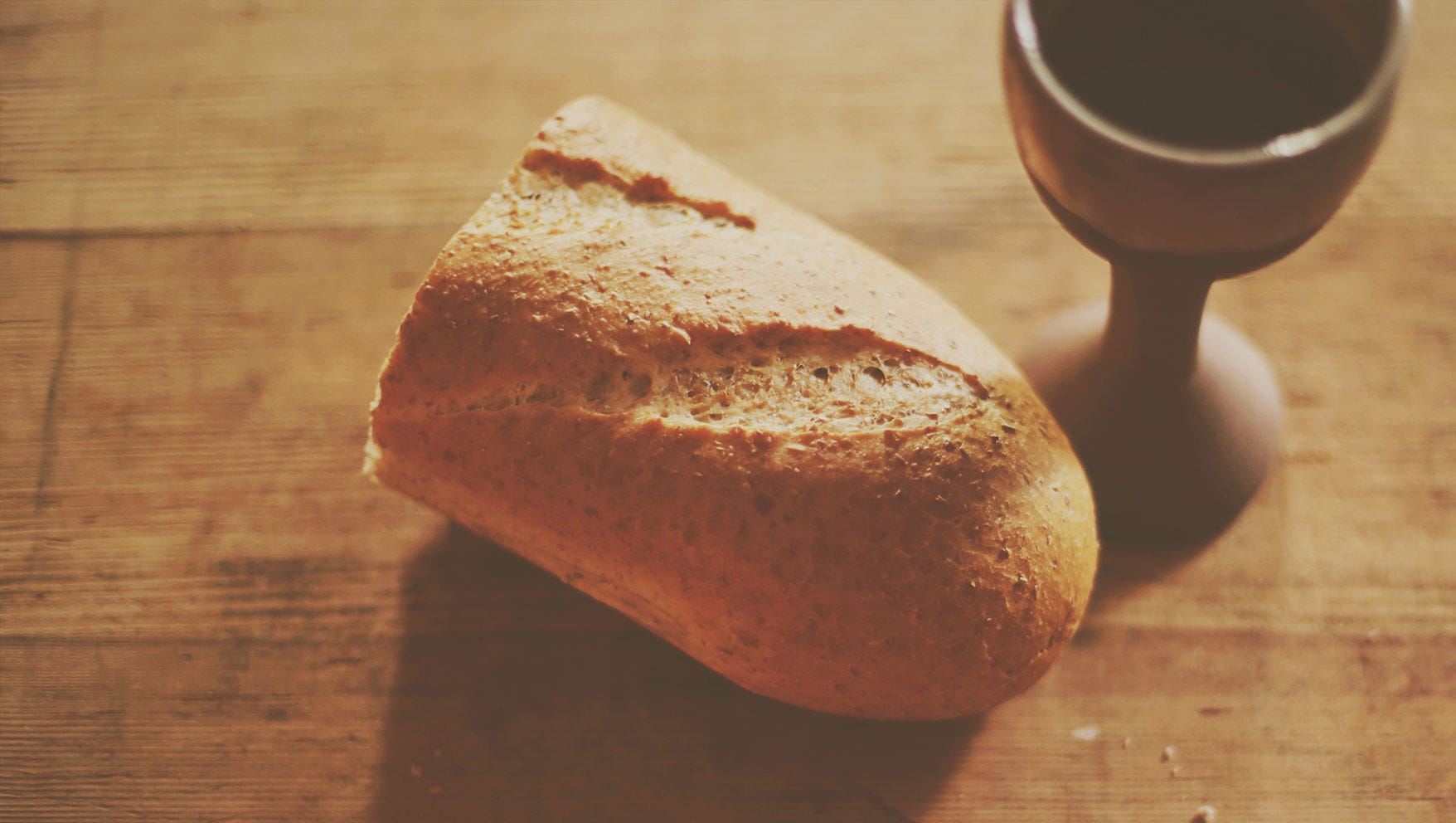
We Are What We Eat

Matthew 6.11

Give us this day our daily bread.

Mark 6.34-42

As he went ashore, he saw a great crowd; and he had compassion for them, because they were like sheep without a shepherd; and he began to teach them many things. When it grew late, his disciples came to him and said, “This is a deserted place, and the hour is now very late; send them away so that they may go into the surrounding country and villages and buy something for themselves to eat.” But he answered them, “You give them something to eat.” They said to him, “Are we to go and buy two hundred denarii worth of bread, and give it to them to eat?” And he said to them, “How many loaves have you? Go and see.” When they had found out, they said, “Five, and two fish.” Then he ordered them to get all the people to sit down in groups on the green grass. So they sat down in groups of hundreds and fifties. Taking the five loaves and the two fish, he looked up to heaven, and blessed and broke the loaves, and gave them to his disciples to set before the people; and he divided the two fish among them all. And all ate and were filled. https://open.spotify.com/embed/episode/1FSNOJcSP0WDsXCcFoILod

Lord, teach us how to pray.

Okay, when you pray, pray like this:

Our Father in heaven, hallowed be thy name. Thy kingdom come, thy will be done, on earth as it is in heaven. Give us this day our daily bread.

It’s such a peculiar prayer – The Lord’s Prayer. 

And, because we’ve prayed it so many times in so many places with so many people, we often no longer think about what we say when we pray.

We begin with talk of heaven and holiness. Then things get all political with calls for God’s kingdom to come and God’s will to be done. And then this already strange prayer gets even stranger – give us this day our daily bread.

What is Christianity? Why are we here doing all of this?

Worthy questions for our consideration. And, frankly, questions we rarely consider at all. We simply do what we do because that’s what we do. Which is actually good, at times. We are habituated by our habits. You do something long enough it becomes part of who you are.

But Christianity, whatever it may be, is not something relegated to creeds and doctrines. It’s not some otherworldly ephemera floating our there some where that one day we will encounter.

Christianity is materialistic

It is something we can touch and see and hear and smell and taste. If, on the other hand, Christianity is a retreat from the material world, then it’s not a very good retreat. We’re still stuck in a building, in somewhat comfortable pews, listening to old (and sometimes new) music, with the smells of carpet, perfume, and (if we’re lucky) casseroles from the social hall wafting around, and the taste of grape juice and day old bread sticking to the roof of our mouths.

Christianity, therefore, is not about getting away from all of this. Instead, Christianity is all about how God transfigures this.

Give us this day our daily bread. 

Why is this what Jesus teaches us to pray for? Perhaps, the act of asking for our bread is a regular reminder that our lives, like our food, are gifts that come to us from God, gifts without which we would perish.

And, thankfully, we worship the Lord who loves to feed.

Subscribed

Have you ever noticed how much food there is in the strange new world of the Bible? It’s all over the place! At the very beginning our first parents eat from the tree of knowledge of good and evil, Abraham entertains strange guests with curds and milk and a roasted calf, the Israelites prepare lamb as their meal for the Passover, on and on.

Here’s a sampling of the foods in scripture: apples, almonds, dates, figs, grapes, melons, cucumbers, leeks, lentils, onions, barley, corn, millet, wheat, fish, quail, goats, lambs, sheep, butter, cheese, honey, coriander, cinnamon, dill, garlic, mint, mustard, salt, and, of course, bread.

Through this prayer, and this petition in particular, it’s as if God is reminding us about the fragility of life, that we are dependent on creation, and that we are caught up in all of it together. 

In other words, the essentials to life are part of the essentials of our faith. 

Listen – Jesus is doing his Jesus thing, and it garners a crowd. He looks on them with compassion because they are like sheep without a shepherd, so he speaks to them about the kingdom of God. And yet, the sermon goes a little long, and the crowds grow hungry.

“Hey Jesus,” Peter starts, “You might want to wrap it up. It’s getting late. Give them a final ‘Amen’ so they can all swing by Chic Fil A on their way home.”

But Jesus says, “Nah. You should give them something to eat.”

“Lord, we’re done have that kind of cash! Have you seen the size of the crowd today? Not even the Golden Corral could satisfy their hunger!”

“Well,” Jesus says, “What’ve we got to work with? A couple loaves of bread? Some fish? Let’s see what I can do.”  

Jesus takes the bread and the fish, blesses it, and starts sharing it without everyone. 

And no one leaves hungry.

It’s an amazing story, the feeding of the multitudes. Jesus is the one who has compassion for the hungry, the savior for whom hunger runs counter to the kingdom, the Lord who, oddly enough, experiences hunger and thirst.

It’s important that the God we worship knows what it means to be hungry and thirsty. 

The incarnation is the declaration that Jesus is fully God and fully human. There is nothing in the human experience that God is unaware of, which is why the prayer for daily bread is all the more compelling. 

Yes, we hallow God’s name, and we pray for the in-breaking of the kingdom, but when it comes to us, we begin by praying for bread.

Bread is old.

God gave plants for cultivation that we might bring forth bread to strengthen our bodies. In scripture, Melchizedek the king offers bread to Abraham, the Israelites bake unleavened bread for their exodus out of Egypt, Jesus feeds the multitudes with bread, calls himself the bread of life, and is notably born in Bethlehem which means town of bread. 

And, in one of the most wild, and often overlooked, parables, Jesus compares the God to a female baker who puts the yeast of her kingdom into the dough of creation and makes bread of the world. 

Bread is everywhere, and without bread we’re dead.

And yet, the bread at either end of our sandwiches, the bread left haphazardly on our restaurant tables, even the bread many of us learned to bake during the pandemic is different than the bread of the Eucharist.

At the Lord’s Supper we are consumed by that which we consume – we are what we eat.

We are made participants in God’s body so that the story of the Gospel might be made manifest in the ways we live and move and have our being.

The bread and cup at God’s table incorporate us into the adventure of God’s salvation of the world.

I’ve been saying this the last few weeks, in fact I said it just a few minutes ago, we’ve said the Lord’s Prayer so many times in so many places with so many people that we often no longer think about what we say when we pray. And I think a similar sentiment is true of the Lord’s Supper. How many times have we come forward with our hands outstretched? How many times have we received the grace of God through food and drink? 

Enough that we know what we’re doing when we do so?

The truth of the matter is that we do not know what we are doing. Not even the most theologically sophisticated among us knows what we’re doing. And that’s actually fine. The disciples surely had no idea what they were getting into, and what was getting into them, when Jesus said this is my body and this is my blood.

photo of brown church
Photo by Akira Hojo on Unsplash

In the Eucharist we are confronted with a reality that confounds our speech. These things are more real than real. They cannot be contained by our words because they are the grace of God.

Which is another way of saying, our most important business as a church happens at this table. 

If someone were to ask you what you believe about God, or what it means to be a Christian, you need not point anywhere except to this group of strangers called church who eat together at a table that transcends everything.

Bread is a familiar thing, common even. Go to Kroger after church and you have more choices of bread than you can handle. The table is also familiar and common. We eat at our tables daily – alone, or with family, or with friends. 

But the Lord delights in taking our ordinary things and making them extraordinary. The Lord loves to intrude upon the familiar, claiming it and reimagining it. The Lord rejoices in the everyday occurrences that point to the ways in which time is unleashed in the person of Jesus.

You see, when we are beckoned to God’s table, we feast not only with those in our midst, but we are united and even reunited with those from the past, those in the present, and those who will be here when we no longer are. This table cuts through the fabric of time and becomes something more sacred than we can speak. 

As Christians, if we want to meet God, we don’t have to hike to the top of Mill Mountain. We don’t have to fast for forty days in the wilderness. We don’t have to become hermits living in isolated cabins. If we want to meet God, all we have to do is get together and break bread in Jesus’ name.

And, notably, we are commanded to pray for our daily bread. It would’ve been a very different prayer if the Lord called us to pray for my bread. But instead, it’s our bread.

It might not seem like much of a distinction, but words matter. Our words matter. Particularly in a time in which depending on anyone or anything else is considered a failure.

The truth of the matter is that we are all dependent on one another, we either just don’t want to admit it or acknowledge it. 

No bread comes to our table without the work, the sacrifice, and the gift of strangers whom we do not know, and cannot properly thank. And that’s true for more than just bread. To be totally and completely self-sufficient is nearly impossible. We, all of us, are products of other people who, in ways big and small, make our lives possible. 

Just as we are products of the Lord who gives life to the dead and calls into existence the things that do not exist. 

None of us ever really know what we’re getting into when the Lord shows up in our lives, and we certainly don’t know what will happen when we pray this prayer. And yet, we do know that the Lord calls us to share this meal, this bread, together.

In a time when sharing is all but gone, it’s all the more important for us to be gathered in, the lost and forsaken, that we might awaken to the truth in bread and cup. For, in eating and feasting with Jesus, we are offered this strange and wondrous community we call church.

Jesus is the bread of life, born in the town of bread, who calls us to pray for our daily bread. Which, of course, means whenever we pray, we are also praying for our daily dose of the Lord.

On Easter, a pair of disciples were making their way toward a town called Emmaus…

What Is Jesus Doing In Your Life?

Romans 5.1-2

Therefore, since we are justified by faith, we have peace with God through our Lord Jesus Christ, through whom we have obtained access to this grace in which we stand; and we boast in our hope of sharing the glory of God. 

turned on headlight bulb
Photo by Zach Lucero on Unsplash

“How is it with your soul?”

That’s a Wesleyan question that we Methodists still throw around occasionally. It comes from John Wesley himself and was the central question for historic Methodist class meetings, these small and intimate gatherings of Christians who were concerned with what it actually meant to be Christian. The question confronts us in our faith such that we must reckon with what God’s grace is doing to us.

And yet, we don’t ask that question, or questions like it, anymore. Sure, in the context of a Bible study or a small group ostensibly gathering in the name of Christ, you might hear a question like it but in our day to day discipleship, it’s nowhere to be found.

The relativization of the faith to the private sphere has resulted in a form of discipleship that is largely divorced from Christ’s call to take up our cross and follow. Put another way, if our faith is merely something we do on Sundays then it doesn’t really have anything to do with the One who makes our faith intelligible.

In Paul’s letter to the church in Rome he confronts the embodied nature of the faith with physical language about “standing in grace” and “boasting in our hope.” Something has been done to us and, as such, we have an assurance that we can live differently because of it. And that something has a name: Jesus.

Frederick Buechner, author/pastor/theologian once said:

“Nice people don’t talk about religion. Or so the thinking goes. That’s why, when I taught at Wheaton College, it was so refreshing. There were people there who talked about it ALL THE TIME. It was almost too much and hard to take. It was as if they had Jesus in their hip pocket, and all they had to do was take him out and he would tell them where to find a parking space. But, on the other hand, they were able to ask, “What is Jesus doing in your life this week?” Marvelous! I believe God is doing something in everyone’s life every moment! But the idea of asking that question in certain places with certain people, it’s like the sky would fall in, the house would catch fire, and I would never be asked out again. In other words, people don’t ask about our experiences of grace, but perhaps they should.”

I wonder, therefore, how differently the church would look were we willing to ask that all too important question, “What is Jesus doing in your life this week?” If the faith we proclaim on Sundays is indeed the faith revealed to us in the person of Christ, then there are manifold implications for how Christ is guiding, shaping, and moving in our midst. Particularly since worship isn’t as much about what we do, but more about what we do in response to all that God has done, is doing, and will do.

Basically, it comes down to a matter of agency: Do we believe that God is active in our lives, or do we consider ourselves the primary movers and shakers?

Perhaps asking the question is the way in which we can open our eyes and ears to Christ’s actions in our lives. And maybe, being able to ask the question at all is what makes faith, faith.

And so, what is Jesus doing in your life this week?

What’s In A Name?

Genesis 32.22-31

The same night he got up and took his two wives, his two maids, and his eleven children, and crossed the ford of the Jabbok. He took them and sent them across the stream, and likewise everything that he had. Jacob was left alone; and a man wrestled with him until daybreak. When the man saw that he did not prevail against Jacob, he struck him on the hip socket; and Jacob’s hip was put out of joint and he wrestled with him. Then he said, “Let me go, for the day is breaking.” But Jacob said, “I will not let you go, unless you bless me.” So he said to him, “What is your name?” And he said, “Jacob.” Then the man said, “You shall no longer be called Jacob, but Israel, for you have striven with God and with humans, and have prevailed.” Then Jacob asked him, “Please tell me your name.” But he said, “Why is it that you ask my name?” And there he blessed him. So Jacob called the place Peniel, saying, “For I have seen God face to face, and yet my life is preserved.” The sun rose upon him as he passed Penuel, limping because of his hip.

The strange new world of the Bible is, indeed, quite strange.

It constantly subverts our expectations, no matter how many times we come to it. It reveals things about ourselves that we didn’t even know about ourselves. And it points to an ever-present reality that runs counter to how we think the world works.

Listen – Jacob is the worst.

We all know that plenty of figures from the scriptures have problems – nobody’s perfect. But Jacob? Jacob is a loser.

Prior to his birth Jacob wrestles his twin brother Esau in the womb, a perfect foreshadowing of his life to come. 

And when Esau is born, he comes out with his twin brother grabbing at his leg, so his parents name the second-born Jacob, which means heel-grabber. 

What kind of name is heel-grabber?

Jacob, hustler, scoundrel, liar, cheat, fool, faithless son of Isaac and Rebekah.

Long story short:

Two decades before the infamous battle royal on the banks of the Jabbok river, Jacob swindles his brother Esau out of his birthright. 

Esau comes in from the field, having hunted and collected food for the rest of the family, and with hunger he asks his brother for some red stew from the stove. Does Jacob willingly hand it over to his twin brother knowing full and well that the firstborn contributes more to his wellbeing than the other way around? No. 

Jacob prepares the plate, lets the scent waft in front of his brother’s nose, and says, “I’ll give you this only if you give me your birthright in return.”

And Esau, famished from working for the family, willingly agrees. After all, what good is a birthright in comparison with the deep hunger of your belly?

But it doesn’t stop there.

Later, Isaac in his old age, eyes weary and poor of sight, near death, asks for Esau to come and to receive his blessing, AKA his inheritance. Isaac wants to pass on all of his wealth to his eldest twin son. 

Esau, come bring me some of my favorite food that I might hand over the goods.

But the heel-grabber is quick to act. 

He walks in with the aforementioned food, and boldly lies to his father. He covers himself in fur to appear harrier like his brother. He leans forward to receive the kiss that conveys it all, and takes it without remorse.

For what it’s worth, that’s three of the ten commandments broken in as many verses.

Esau’s fury in response to his heel-grabbing brother heel-grabbing his blessing leads Jacob to flee for his life. 

Jacob becomes a stranger in a strange land, wandering about, and during this time he has a dream, a dream from God. In the dream there is a ladder stretching up into the heavens, angels are going up and down, and the Lord says, “Jacob, know that I am with you and I will never leave you.”

Which, considering what happened and what’s about to happen sounds more like a threat than a promise.

When Jacob wakes from the dream he sets up an altar to the Lord and he is afraid. 

His fear leads him to prayer. Does he pray for forgiveness? Does he offer the Lord a contrite heart?

No. He bargains with the divine: “Lord, if you will stay with me, and keep me, and make sure that I have food to eat and clothing to wear, then you can be my God.”

Jacob encounters the divine through the dramatic vision of the ladder, is still no better than he was before! 

Soon, Jacob has nowhere left to go. Esau’s fury remains on the back horizon. So he reaches out to his uncle, Laban, who takes him in, provides the food and shelter that Jacob demanded from God. Jacob meets Rachel, bargains with Laban to marry her, works seven years, and then, on his wedding night, is duped by his uncle into consummating the relationship with Leah, Rachel’s sister.

More bargaining ensues, and with another 7 years of labor he is finally granted the wife he wanted from the beginning.

Soap operas aren’t even this good. But wait, there’s more!

After 14 years of labor, and after receiving untold wealth and wives, Jacob returns the hospitality of his uncle turned father-in-law by cheating him out of his wealth hiding away the best of the livestock for himself.

Again, not to make too fine a point of it, that’s a few more commandments broken.

Jacob is a no good dirty rotten scoundrel. He runs from all his problems all while making more problems for himself and his family. He’s a liar, and a thief, and a cheat. There’s nothing holy about this heel grabbing son of a, Isaac. 

Why then do we read of this man and his wandering heart? Why do we lift these verses from the strange new world of the Bible and say, “Thanks be to God”? Why does God promise to remain with Jacob even though he has nothing to show for his so-called life?

Because Jacob isn’t his real name.

On the run from his mistakes, from his failures, and perhaps even from himself, Jacob catches wind that Esau is looking for him. So he divides up his family and all of his possessions, assuming that at least half will make it to safety. And, all alone, he sleeps by the bank of the Jabbok river.

A strange figure appears in the middle of the night. Perhaps the consequences of his actions made manifest in the flesh. They wrestle until the sun begins to rise. The stranger knocks Jacob on the hip, dislocating it forever, and demands for the fight to end. Jacob refuses, “I will not let you go, unless you bless me.”

Still looking for blessings.

“Who are you?” The figure asks.

“My name is Jacob.”

“No it’s not,” the stranger replies, “Your name is Israel because you have striven with God and humans and you’ve made it to the other side.”

Israel then returns the same question to the nighttime wrestler, “Who are you?”

But he receives no answer. And as mysteriously as the figure arrives, he disappears. 

Israel names the place Peniel, which means the face of God, because in the wrestler he met the divine.

The morning comes and Israel sees Esau coming, with four hundred men flanking him on the right and left. Israel goes ahead and bows to the ground seven times until he stands before his brother.

And Esau runs forward and tackles his good for nothing brother to the ground and finally exacts his revenge. And yet, instead of pummeling him with punches, Esau embraces his twin brother and covers him with kisses and tears. 

The end.

What a strange tale.

Jacob, Israel, is deeply flawed learns nothing except for the fact that he deserves nothing and receives everything. We read his story, we can call it Good News, because grace prevails! 

His actions catch up with him, all of the hurt and all of the pain. He is caught and there is no escape. And only then is he known fully for the first time, and is loved. 

Here, at the end, after a life of failure and betrayal, vulnerable and at his brother’s mercy, he discovers an acceptance which he never could have earned or deserved.

Which leads us backward, slightly. Decades before the battle royal at the river, long before he had a taste of forgiveness, Israel had a vision, a dream, of a ladder extending into the heavens. Israel knows, after all is said and done, that God is indeed at the end of that ladder, but more importantly he knows that the Good News, the gospel, is not that God is up there waiting for him to journey up – instead God comes down to meet him where he is.

And he has the scars to prove it.

The Good News of the Gospel for Israel, for each and everyone of us, is that God meets us in the midst of our sins, not our successes.

For some reason we’ve got it stuck in our heads that, like Jacob, we’ve got to do whatever it takes to win the game we call life. We’ll deceive our parents, lie to our spouses, betray our families. We’ll dig deep pits from which we can’t escape all while thinking we’re getting better and better and better. We’ll make horrible decisions and choices all in the name of progress.

But the life of faith isn’t about how we need to get good for God.

It’s about how God comes to us.

And God’s been doing it since the beginning.

From “Adam, Adam, where are you?” To a midnight brawl at the river to the sleepy little town of Bethlehem, God comes to us.

And when God comes to us and we expect to be clobbered with guilt, we actually get clobbered by grace.

Years ago, at a different church, I was sitting in my office one day, day dreaming about a sermon, when an older parishioner barged in through the door. She was older and getting on in years, but she had this youthful glow that I had never seen.

She shouted, “Preacher you are never going to believe what happened to me.”

My favorite stories always start like that.

So without saying a word I mentioned for her to continue.

“Well you know how you keep preaching about forgiveness? Well, I don’t know what came over me, but I finally decided to tell my husband that I cheated on him.”

“What?” I blurted out as I fell out of my chair.

“It was 30 years ago, and it was only once, but I never told anybody. So after we drove home from church last Sunday and as soon as we walked into the house I told him the truth about what I’d done and with whom and when.”

“What does this have to do with forgiveness?”

“That’s just the thing! I told him all I had done and I waited for him to start hooting and hollering and raising hell. All he said was, ‘I know you cheated on me, and I forgave you a long time ago.’ The nerve of that man. Here I am, carrying this guilt around all these years, and he forgave me long ago. Can you believe it?”

Can you believe it?

This story captivates our hearts and minds because it doesn’t end according to the way it is supposed to. Any good consumer of tales knows that Jacob is supposed to get his comeuppance; whether by violent revenge from Esau, or judgment from God almighty. He is nothing but a loser through and through.

But grace works for losers and only losers.

You know, people like us.

No matter how hard we try, and try hard we do, we can’t save ourselves, we can’t make ourselves right. We can try, and we can make a heck of a mess along the way, but the Lord has a way of reminding us, all of us, that we are not as we ought to be, that we’re up the creek without a paddle. We do nothing and we deserve nothing, and yet God forgives us anyway. Can you believe it?

The story of Israel, of the forgiven heel-grabber, reminds us that God comes to us in our weariness and woundedness. God, ultimately, rules not from a throne of glory, but from the arms of the cross. God’s power is revealed in the weakness of Christ, and God’s grace comes to us in our weakness. 

We don’t have the strength, nor do we have the power, to save ourselves. We are as helpless as Jacob, hobbling around with our hips out of joint. We can run away as far as we can for as long as we can, but one day God will catch up with us. God will grab hold of us. And God will tell us who we really are.

What kind of name is Israel? It means we have striven with God and one another and we’ve made it to the other side. Amen. 

So Be It

Isaiah 60.1

Arise, shine; for your light has come, and the glory of the Lord has risen upon you. 

I was sitting in a basement office somewhere on the campus of Duke Divinity School with an administrator who was explaining the ins and outs of “Field Education.” She shared the convictions of the institution, the valuable and positive research of such endeavors, and (finally) she told me where I would be spending ten weeks my first summer of seminary: Bryson City, North Carolina. Every student would also be spending their summers working for various churches and para-church organizations so that we could take what we learned in the classroom and apply it to the field. 

Before I had a chance to properly come to grips with the information shared with me, the administrator handed me a piece of paper and she said, “It’s covenant time.”

She watched me diligently as I weaved my way through the wording:

I am no longer my own, but thine.

Put me to what thou wilt, rank me with whom thou wilt. 

Put me to doing, put me to suffering.

Let me be employed by thee or laid aside for thee,

exalted for thee or brought low by thee.

Let me be full, let me be empty.

Let me have all things, let me have nothing.

I freely and heartily yield all things

to thy pleasure and disposal.

And now, O glorious and blessed God,

Father, Son, and Holy Spirit,

thou art mine, and I am thine. So be it.

And the covenant which I have made on earth,

let it be ratified in heaven. Amen. 

I only later learned that the words I used can be found in every United Methodist Hymnal because they are part of “A Covenant Prayer In The Wesleyan Tradition.” And, I also learned that countless Methodists have come back to these words at the start of new years, new jobs, new relationships, and a whole assortment of other new endeavors.

It can feel a little daunting to “freely and heartily yield” all things to God’s disposal but, according to the strange new world of the Bible, that’s exactly what God did and does for us.

Looking back, I am profoundly grateful for the covenant I made that day because I carried those words with me to the people of Bryson City, North Carolina and together we encountered the Lord who encounters us. 

Therefore, wherever you and and whatever you’re encountering, I encourage you to read through the words of the Wesleyan Covenant, let them sink deep into the fabric of your being, and know that “so be it” might be the most faithful words we can ever speak. 

The Naughty List

Hebrews 10.10

And it is by God’s will that we have been sanctified through the offering of the body of Jesus Christ once for all.

On Sunday I stood up and addressed the crowd present for the church’s Christmas Concert and attempted to make the case that we are the stories we tell and the songs we sing – The stories we tell are reflections of how we understand ourselves in the world and the same is true of the songs we belt out. I then suggested (read: demanded) that we know longer sing “Baby It’s Cold Outside” because it only reinforces an extremely problematic understanding of how we relate to one another. 

I mean, it’s basically a date rape song. “Say, what’s in this drink?” 

Go listen to it and I promise you’ll walk away feeling all sorts of gross and uncomfortable.

Had I been a little more bold, I would’ve also suggested (read: demanded) that we also no longer sing “Santa Claus Is Coming To Town.” 

The words to the song sum up how we all too often imagine the Lord in our minds: “He’s making a list, he’s checking it twice; he’s gonna find out who’s naughty or nice…” And then, whether we know it or not, we take these words to be Gospel truth and we believe that God is keeping a ledger against us and only if we have more ticks in the Good column than the Bad column will we receive an everlasting reward.

The same thing is true of how Elf on the Shelf has become such a popular pastime – the purpose of the Elf is to spy on the good and bad behaviors of children and then to report them to Mr. Claus so that the children will be rewarded, or punished, accordingly.

The same thing is true of so many movies and shows and songs that ask us to discern whether or not we, ourselves, have behaved in such a way as to make it on the Nice list or on the Naughty list.

But, according to the strange new world of the Bible, we’re ALL on the naughty list.

That is: all of us do things we know we shouldn’t do and we all avoid doing things we know we should do. 

Paul puts it this way: None of us is righteous. No, not one. 

And yet, that’s Good News. It’s Good News because, thankfully, Jesus isn’t Santa Claus.

Jesus encounters the world’s (read: our) sins with no list to check, no test to grade, no debts to collect, and no scores to settle. Jesus has already taken all of our sins, nailed them to the cross, and left them there forever

Jesus saves not just the good little boys and girls, but all the stone-broke, deadbeat, sinful children of the world who He, in all his confounding glory, sets free in his death and resurrection

Grace, as Robert Farrar Capon so wonderfully put it, cannot prevail until our lifelong certainty that someone is keeping score has run out of steam and collapses away forever.

But, of course, it sounds too good to be true!

In a world run by meritocracy, the Good News of grace sounds ridiculous if not irresponsible. If we don’t have eternal punishment to hang over the heads of those who follow Jesus, how else can we possibly keep them in line?

Perhaps we have our theological wires crossed. We so often assume that we have to do something in order to get God to do something for us. We believe that so long as we show up to church (online or in-person), and read our Bibles, and say a few prayers, and volunteer every once in a while that it will be enough to punch our ticket to the great beyond. 

And yet, so many (if not all) of Jesus’ parables, proclamations, and pronouncements have nothing at all to do with the behavior of those blessed prior to their blessing.

The Gospel is not about how we justify ourselves – The Gospel is about how God in Christ justifies us. 

God, in all of God’s confounding wisdom, runs out to the prodigal in the street before he has a chance to apologize, offers the bread and the cup to Judas knowing full and well what he will do, and returns to Peter with outstretched arms after his denials.

God chooses to forgive, rather than condemn, the world from the cross.

That’s what grace is all about – it is the unmerited, unwarranted, and undeserved gift from God.

And if we can see grace for what it really is, then Christmas can really come into its own. Like the gifts under the tree that are (hopefully) given not as a response to good works/behavior or the expectation that good works/behavior will come from them – we can celebrate the great gift of God in Christ Jesus who comes to do what we could not do for ourselves.

Or to put it another way: we are all on the Naughty list and God still gives us the present of Jesus’ presence anyway. 

The Grammar of Christian Faith

This week on the Strangely Warmed podcast I speak with Carsten Bryant about the readings for the 2nd Sunday of Lent [B] (Genesis 17.1-7, 15-16, Psalm 22.23-31, Romans 4.13-25, Mark 8.31-38). Carsten serves as the Director of the Youth Collective of the Orange Cooperative Parish in Hillsboro, NC. Our conversation covers a range of topics including Dogmatics in Outline, covenants, proper fear, Taize worship, the coming generations, hoping against hope, flipping expectations, and Robert Farrar Capon. If you would like to listen to the episode or subscribe to the podcast you can do so here: The Grammar of Christian Faith

(Almost) Leaving Church

Psalm 25.1

To you, O Lord, I lift up my soul. 

We were sitting inside a nearly empty McDonalds for breakfast.

He was a pastor a few weeks away from retirement with decades of experience.

I was a seminary student with no real idea of what I was getting myself in to.

We exchanged small talk over Egg McMuffins and stale coffee wondering aloud about the weather for the rest of the day when I asked the question that all pastors ask one another at some point.

“So, how did God call you to all of this?”

It’s a good inquiry, for the expectation is that all of us, that is pastors, have an answer. 

And I’ve heard them all.

Pastors who felt the call of God on their lives in the middle of an AA meeting, or while standing on the top of a mountain, or after dropping off their last child at college.

Pastors who felt the call of God on their lives inside a slow moving elevator, or after their daughter died in a car accident, or while suffering through a terrible sermon in their home church.

I was therefore prepared for whatever story might come from the nearly retired pastor’s lips.

Or, at least I thought I was.

Because he didn’t answer my question.

Instead he replied, “How about I tell you the story of how I almost left the church?”

“Back when our kids were young,” he began, “I was serving a mid-size church and doing my best to keep everything going the way it was supposed to go. We had the same problems that all other churches had, and I started working longer hours and making more visits. When one day I came home to the parsonage, and I could hear the kids playing upstairs, but my wife was gone. I looked and looked until I found a note addressed to me on the kitchen counter. My wife had, apparently, fallen in love with one of the ushers at the church, a man with his own family, and they had decided to run off together leaving their spouses and children behind.”

“In the weeks that followed, I had to adjust to the new normal of solo-parenting while leading a church. And within the first month a meeting was called by the leaders. I was grateful expecting that the church would start cooking meals, or helping to find childcare, or any other number of things. But that’s not what the meeting was for.”

“It took place in our sanctuary and the congregation met and decided that I was no longer fit to serve as the pastor. They believed had I been a better pastor, my wife wouldn’t have left me and my kids, and that it was time for them to find new pastor.” 

“Within a few months I lost my wife, lost my job, and just about lost my calling.”

Unsure of how to respond, I sat there in silence waiting for him to continue.

He said, “The strangest thing happened though. I felt abandoned by my wife, and my vocation, but I never felt abandoned by God. I kept praying, I kept preaching (albeit in a different church). And no matter what occurred I experienced grace. Sometimes it was through a family who unexpectedly offered to watch my kids, at other times it was through the still small silence in the morning when I was the only one awake in the house, and sometimes it happened when I escaped to the strange new world of the Bible to prepare for a Sunday school lesson.”

“And that’s the thing I’ve come to discover about a life of faith – people can be real fickle, and even terrible. But God? God remains steadfast even when we don’t.”

A Necessary Alterity

“The church has become so fully identified with the ‘American Project’ that our writers have had little cause to heed any unique and distinctively Christians witness in the churches.”

So wrote Stanley Hauerwas in response to his perceived lack of a (decent) Christian corpus of fiction. And, frankly, I agree with him. Take a look at the “Christian” section in a bookstore and you’re likely to find a various assortment of pseudo-romance-theological novellas, a selection of “How To Get Closer To God” self-help books, and a handful of leftover seminary textbooks.

All of which don’t tell us much about faith, let alone the object of our faith: God.

An exception to this rule is/was Flannery O’Connor.

O’Connor’s fictive tales are some of the most “Christian” pieces of fiction I’ve ever read because they don’t hold any punches. They are, to put it in theological terms, decisively Pauline in that they affirm the depravity of humanity while also pointing to the unrelenting grace of God.

Hauerwas puts it this way: “Just as baptism resembles nothing so much as drowning and eucharist appears as a kind of cannibalism – while both events are the very means of life temporal and everlasting – so will Christian fiction be characterized by a necessary alterity, since the central Christian premise is that the world made and redeemed by God is constantly interrupted and transfigured by revelation.”

The team from Crackers & Grape Juice got together (online) last week to talk through some of these things and if you would like to listen to the episode, or subscribe to the podcast, you can do so here: A Christian Reading of American Literature

Eve Was Framed!

HTB1XkmnNVXXXXXhXXXXq6xXFXXXw

This week on the Strangely Warmed podcast I speak with Sara Keeling about the readings for the 1st Sunday of Lent [A] (Genesis 2.15-17, 3.1-7, Psalm 32, Romans 5.12-19, Matthew 4.1-11). Sara is a United Methodist pastor serving Good Shepherd UMC in Dale City, VA. Our conversation covers a range of topics including lenten practices, the frustration of Facebook, dismantling the patriarchy, obedience, cosmic plans, one man to ruin them all, death’s dominion, funeral feelings, and the futility of resistance. If you would like to listen to the episode or subscribe to the podcast you can do so here: Eve Was Framed!