Devotional – Amos 5.23-24

Devotional:

Amos 5.23-24

Take away from me the noise of your songs; I will not listen to the melody of your harps. But let justice roll down like waters, and righteousness like an ever-flowing stream.  

Weekly Devotional Image

For me, music makes the worship service. I can listen to a mediocre sermon, but if the organist has been hitting all the notes perfectly I can walk away feeling filled with the Spirit. I can be ignored as a first time visitor, but if the gathered body sings with full vigor I can leave the service feeling that I have encountered the living God. I can witness borderline heretical theology in a bulletin, but if the musicians are truly glorifying the Lord through their instruments, I can believe that the service has been redeemed.

I started playing drums for contemporary worship services when I was in 9th grade. I played all through high school, college, and seminary for a variety of churches in a variety of places. It is difficult to describe the doxological feeling that I experience when playing drums during a service, but suffice it to say that I feel closer to God in those moments than many others. Contemporary services are not for everyone, even I will admit that I enjoy playing for those services rather than experiencing them in the pews, but they help connect a large portion of Christians to the living God in a way that shapes, molds, and grows their faith.

2885_1103206311354_8091672_n

When I was in college I began playing for the Crave service that was a part of the Wesley Foundation at James Madison University. Every Sunday afternoon the band would get together at Asbury UMC to practice for a few hours before the service began in the evening. We would play songs that got people placing their hands in the air and praising God. We would play songs that got people dancing in the pews. We would play songs that were so familiar and catchy that I could actually hear people singing the words over the volume of the drum-kit.

However, even when we were playing at our best, our music paled in comparison with the one night that we left the church and wandered around downtown Harrisonburg. Instead of gathering for the typical service (3-4 songs, prayer, sermon, communion, 1 song, benediction) we met on the steps of the church and walked downtown to pray for our city. We stopped at specific locations and joined hands to prayerfully lift up our community, and in particular we prayed over the local courthouse so that “justice might roll down like waters, and righteousness like an ever-flowing stream.”

You can have the best music in the world at your church, but when the music becomes the only life-giving part of your discipleship formation, when acts of justice and righteousness have gone missing, we limit the depth and beauty that we can experience. Music is most powerful when it points away from ourselves to God, and when it inspires us to be righteous outside of worship.

This week, let us look for the moments when we can let justice roll down like waters for others around us. Let us truly listen to the words of our Christian songs and live them out so that our righteousness can be like an ever-flowing stream.

Sinners and Saints – Sermon on Psalm 34.1-8

Psalm 34.1-8

I will bless the Lord at all times; his praise shall continually be in my mouth. My soul makes its boast in the Lord; let the humble hear and be glad. O magnify the Lord with me, and let us exalt his name together. I sought the Lord, and he answered me, and delivered me from all my fears. Look to him, and be radiant; so your faces shall never be ashamed. This poor soul cried, and was heard by the Lord, and was saved from every trouble. The angel of the Lord encamps around those who fear him, and delivers them. O taste and see that the Lord is good; happy are those to take refuge in him.

All-Saints-Day-candles

Tomorrow will be my 6th funeral. Betty Lancaster, Georgeanna Driver, Brandy Garletts, Russ Wisely, Dick Markley, and now Chris Harris. I can remember the way my heart raced when I got the phone calls when each of them passed, I can still see their families in tears during the funeral, and I can still remember the sensation of the dirt in my hand when I dropped it on the caskets at the cemeteries. Without a doubt, preaching and presiding over funerals is one of the greatest privileges, and most difficult challenges, that I have as a pastor.

I am invited into one of the most sensitive aspects of a family’s life when I find out that someone has died. Those moments in the car on my way to a home or hospital, are filled with prayerful silence as I ask God to use me as a vessel of his grace and peace with a family who is in the midst of grief. You never know what to say, because there is nothing to say. You sit and listen, you provide the loving comfort of presence, and you pray for everyone you can think of.

Today is All Saints’; a day for us to remember those who have gone on to glory over the last year from our church, and from all of our families and friends. It is a hallowed time where we reflect on the ways that our friends and families shaped us into who we are today. It is that precious day when we give thanks to God for putting them in our lives, and then welcoming them back into his eternal arms. All Saints’, like funerals, is a time for us to speak truths about the lives of those close to us, with the hope of the promised resurrection.

green-funerals-green-resting-place

No matter what, funerals are always difficult. Funerals are a remarkably sensitive time for families and you have to be very careful about what you say, and how you say it. Yet even with the fear and trembling that comes with proclaiming someone’s life and death, I do look forward to sharing stories that help to reveal the character of the person’s life that we are remembering.

For instance:

The first time I met Brandy Garletts was early in my time here at the church. She was older and had been moved to a rehabilitation center when I went to visit her. I spent way too much time worrying about what I would say to this stranger for the first time, what her impression of me would be, and how could I speak words of hope in her situation. When I made my way to the facility, after finally finding her room, she motioned for me to sit across from her to lean in closer. Before I could even open my mouth to begin speaking all the prepared thoughts that I had, Brandy asked me a question that I was completely unprepared for: “Are you a registered voter?

There I was sitting across from an incredibly sweet woman, someone that many people from our church have admired and looked up to, prepared to talk about God, faith, and grace, and she wanted to find out if I was a democrat or a republican.

Brandy was a fiercely strong woman and fought for what she believed in. Asking me about my political ideology was indicative of the life she lived; always looking for new opportunities to make the world better for others.

Or I could tell you about a story that Russ Wisely shared with me in my office: “Many years ago,” he began, “we had another young pastor. Fletcher Swink had just graduated from Duke Divinity School and was sent to Staunton for his first appointment, just like you. In the beginning everything was great. Fletcher provided strong leadership, the church was growing, and we started to build the property that we are now sitting in. However, one day, Fletcher called me because he had a problem and had no idea what to do. He had performed a wedding for a young couple in Staunton, his very first, and only after signing the marriage certificate did he realize that he had not filled out the proper paperwork to legally marry people in the state of Virginia. He was at a loss for what to do, so I told him to come with me to the courthouse; I knew the judge and figured we might be able to work something out. When we brought the matter to the judge he looked at me and he asked ‘Russ, what do you think we can do?’ and I told him that we could sign the paperwork and just change the date to have happened before the wedding, to which he replied, ‘sounds like a good idea to me.

I sat there in my office stunned. Here was this older man telling me a story about how he had manipulated the legal system just to cover for a young pastor who had made a mistake. Was he telling me this story to make sure that I didn’t make any mistakes? Was he trying to scare me about the responsibilities of leading the church? I sat there in my chair, unsure of how the story would conclude. Russ then looked at me right in the eyes to finish, “That happened nearly 60 years ago. I helped Fletcher because it was important. I want you to know, young man, that I am here to help you as well. If you need anything I want you to call me.” And with that he stood up and prepared to leave my office. Only then did I realize that I never said a word. 

Russ Wisley sacrificed for others and was willing to work behind the scenes to make things happen. Whether here at church or in the community, Russ would help anyone he could, because he believed in the importance of supporting others.

What has struck me most about the lives we have celebrated over the last year, the people who we are remembering today, is that they understood the words from Psalm 34; their lives were a reflection of God’s goodness and they lived as saints for others to follow.

I will bless the Lord at all times; his praise shall continually be in my mouth.” Saints are those who can speak and live in such a way as to point to the Lord in all that they do. They give thanks to the Lord their God for the blessings they have received and give back to others from their abundance. Saints recognize the presence of God and do whatever they can to share that experience with others because they know how life-giving it can be.

O magnify the Lord with me, and let us exalt his name together.” Saints do what they can to benefit the greater community and not just their own lives. They are not content with having a “personal relationship with Jesus Christ,” but see the great gift that the community of faith can be. They worship together to praise the Lord of hosts, and exalt his name. At church they sing from the depth of their being, and greet others in Christian love. At home they pray fervently for their lives, for their friends and family, for their enemies, and for their church. They strive to magnify the Lord in all that they do so that others can know how life-giving it can be.

I sought the Lord, and he answered me, and delivered me from all my fears.” Saints understand that God has continued to seek them out throughout the years, and take the time to respond to God’s great calling. Instead of remaining complacent with their faith journeys, they seek out the God of Abraham, Isaac, and Jacob with the knowledge that in doing so, the Lord will answer. Instead of just hoping for good things to happen because they live good lives, they take leaps of faith to encounter the living God who will deliver them from fear. Saints believe that going to the Lord reorients all expectations and priorities and they encourage others to go to the Lord because they know how life-giving it can be.

Look to him, and be radiant; so your faces shall never be ashamed. This poor soul cried, and was heard by the Lord, and was saved from every trouble.” Saints know that life is not always easy, and that there will be times of suffering. To follow the commands of God, to live by the beatitudes, implies a willingness to see the world turned upside down where the first will be last and the last will be first. They do not let their sufferings get the best of them, but instead they remember that suffering produces endurance, endurance produces character, character produces hope, and hope does not disappoint. They encourage others to not give in to the suffering in their lives but to firmly place their hope in Jesus Christ because they know how life-giving it can be.

Our saints have lived lives worthy of emulation. The more I learned about their discipleship as I prepared for their funerals, the more I wanted to live like them. I was struck over and over again by how deeply rooted they were in their faith, and how much they worked to live like Jesus. However, that’s not to say that our saints have been perfect; even Jesus’ family tree is filled with broken and battered branches.

On All Saint’s Sunday, we remember the saints, and let us be sure to remember all of them. Not just the wonderful and psalm-like moments from their lives, but the bruised and blemished moments as well. Not just the saints from our church family that have died, but all the saints who have witnessed to God’s love for us.

Who do you think of when you hear the word “saint”? Do you picture Mother Teresa, Augustine, or John Wesley? Do you think about people who lived perfectly pure lives? Or do you think about the people in your life who have simply encouraged you in your faith?

SinnerSaint-2

Those who we remember today were both sinners and saints. There were times that they fell short of God’s expectations, there were times that they did not practice what they preached. There were moments that they neglected to praise and and magnify the Lord. But God has a crafty way of turning sinners into saints.

God almighty, maker of heaven and earth, has done, and will continue to do, some incredible things through the sinners in our midst. You might remember those that have died for all the negative, bad, and embarrassing things that they did, but God saw them in their sinfulness and saw potential. God has used our saints to change our lives for the better by shaping us into the disciples we are today.

The pulpit is a wonderful vantage point. From where I stand I can look out on the gathered body of Christ and take in the view in one fell swoop:

When I look out from here I see a church full of sinners. I see the brokenness that many of you have shared with me, but have refused to share with anyone else. I see the fights, frustrations, and failures that haunt so many of you on a regular basis. I look out and see the doubts that cloud your faith, the temptations that draw you away from God, and the selfishness that drives you away from one another.

But at the same time, when I look out from here I see a church full of saints. I see the body of Christ praising the Lord through prayer and song. I see the humble souls that are thankful for the blessing of life. I see the love, life, and vitality that invigorates so many of you toward wholeness. I look out and see the radiant faces that shine with God’s glory. I see a church that is full of people willing and excited to work for God’s kingdom.

So, like the psalmist says, let us come to the God’s table; see and taste how the Lord is good. Remember all of those who have gone before us to a table such as this, to take refuge in the Lord.

Let us also give thanks to the Lord for putting the saints we remember into our lives. For helping to shape and mold them out of their sinfulness and into saintliness. For their desire to share the Good News with us so that we might know what grace is really all about.

And let us hope and pray that God would continue to give us the strength to be saints for others in spite of our sinfulness. So that one day, God willing, the church will get together to worship the Lord and give thanks for us after we die.

Amen.

Devotional – Leviticus 19.18

Devotional:

Leviticus 19.18

You shall not take vengeance or bear a grudge against any of your people, but you shall love you neighbor as yourself: I am the Lord. 

Weekly Devotional Image

A few weeks ago I found myself sitting at a table in a buffet style restaurant surrounded by other Methodist clergy from the local district. We had been called to meet that morning to discuss challenges facing the local church and a group of us had decided to get lunch immediately following the gathering. With mounds of mashed potatoes, fried chicken, and gravy spread out between us, we began to converse and enjoy one another’s company.

For a little while we talked about the meeting and some of the comments from our peers. Later on we talked about the change in season and how beautiful it was starting to look in the valley. But, as with all clergy gatherings, the conversation moved toward a discussion of metrics:

“How many did you have in worship last Sunday?”

“Is you church paying their apportionments?”

“Are you receiving any new visitors?”

These questions drive me crazy. The commodification of the church is sinful temptation that many Christians, particularly clergy, cannot resist. I was sitting with my peers, fellow shepherds for the kingdom of God, when a string of questions immediately put up divisions between us. Instead of viewing one another as colleagues and peers, we saw competition and comparison. The questions were divisive, but the answers were even worse:

“We hit 130 most Sundays.”

“We’re not even close to paying our apportionments, we can barely keep the lights on.”

“We’ve had a lot of young families start to try out our church.”

We could have spent a wonderful time of food and fellowship discussing different ways to be Christ’s body for the world, we could’ve prayed for our peers and their ministries. However, our lunch was focused on numbers and many of us left either feeling defeated about our dying church, or high and mighty about our growing church.

church-numbers

For the budding nation of Israel, God was insistent on calling them to work together and not bear grudges against any of the people; “you shall love your neighbor as yourself.” In a sense they needed to know they they were in this together and to stop putting up walls between themselves. Similarly, we all fall to the temptation of holding grudges against people in our lives, and in particular with those who are closest to us. Clergy often compare their churches and ministries with their peers and forget that they are all working for God’s kingdom. Others will compare their marriages, jobs, children, salaries, families, etc. with the people around them instead of loving their neighbors as themselves.

Who are you holding a grudge against because of numbers? Which neighbor, friend, or family member do you need to start loving as you love yourself?

Devotional – Isaiah 25.1

Devotional:

Isaiah 25.1

O Lord, you are my God; I will exalt you, I will praise your name; for you have done wonderful things, plans formed of old, faithful and sure.

Weekly Devotional Image

I felt very stressed during church yesterday. When I arrived in the morning I was dismayed to discover that the boiler was not working properly and we had no heat in the sanctuary. I must’ve gone into the basement five times in order to figure out what was wrong before the worship service began. Instead of taking the proper time to be in prayer and rested for worship, I spent the morning running around with thoughts of pilot lights and water pumps rather than Psalm 19 and God’s presence. Moreover, as the service began I noticed that the sound system was not functioning and I realized I was going to have to use my big preacher voice; instead of entering the sanctuary and singing the opening hymn faithfully, I worried about the lay people who rely on hearing assisted devices that would not be working.

When our service ended I felt drained. Carrying the burden of worship is often enough on its own, but to have the added stressors yesterday was almost too much. (Both the boiler and the sound system have now been fixed, in case any of you were worried). After shaking hands with everyone as they left, my wife, Lindsey, wrapped her arms around me, and told me that she was taking me out to lunch. Without having to explain to her everything that I had been through in the morning, without even mentioning how drained I felt, she read me like a comic book and offered to take care of me.

1977132_10202693858978604_8994329491928179368_n

We all have many blessings, even when we feel like we are in one of the deep valleys of life. While Lindsey and I drove to lunch yesterday I thanked and praised God for having done so many wonderful things for me: for bringing Lindsey and I together, for appointing me to a church with such loving and caring people, for bringing us to Staunton, for being present with me even when I let the stress of church overpower me. There are times when I find myself praying for others in our church and community, and I forget to thank God for all that he has done for me. It is sad how often I take for granted the incredible grace and mercy of the Lord that has been poured onto my life and I would do better to remember the words of Isaiah while I pray: “O Lord, you are my God; I will exalt you, I will praise your name; for you have done wonderful things, plans formed of old, faithful and sure.”

What are some of the wonderful things that God has done for you? Have you thanked God today for the blessings in your life?

Let us be thankful people who praise the Lord for his faithful presence.

Why Do We Pray? – Sermon on Psalm 19.7-14

Psalm 19.7-14

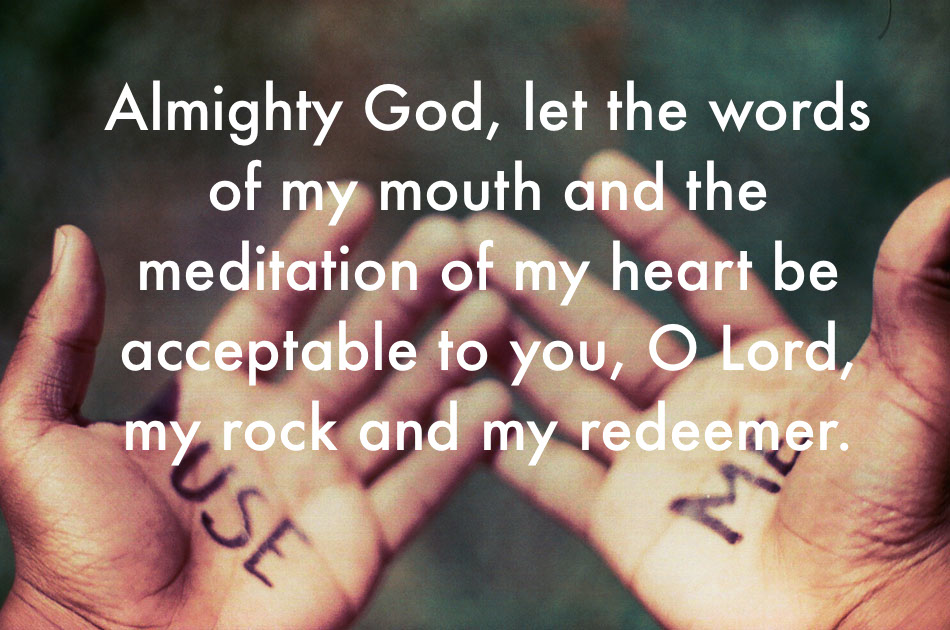
The law of the Lord is perfect, reviving the soul; the decrees of the Lord are sure, making wise the simple; the precepts of the Lord are right, rejoicing the heart; the commandment of the Lord is clear, enlightening the eyes; the fear of the Lord is pure, enduring forever; the ordinances of the Lord are true and righteous altogether. More to be desired are they than gold, even much fine gold; sweeter also than honey, and drippings of the honeycomb. Moreover by them is your servant warned; in keeping them there is great reward. But who can detect their errors? Clear me from hidden faults. Keep back your servant also from the insolent; do not let them have dominion over me. Then I shall be blameless, and innocent of great transgressions. Let the words of my mouth and the meditation of my heart be acceptable to you, O Lord, my rock and my redeemer.

use-me

There were two men. The first lived his life perfectly and blamelessly; everything was coordinated and examined. He never wasted a moment and did his utmost to plan for every contingency and minor catastrophe. If he could live his life in consistent repetition, he believed he could achieve perfection. Every morning he awoke to eat the same breakfast and spend precisely 15 minutes reading from his bible, offering up the same lifeless prayer. He wasn’t sure that he actually believed in God, but he wanted to be safe. He took the same roads to work, ordered the same lunch, used the same pencil brand. Everything was accounted for. He made his money, invested in the right companies, provided for his family. On the surface he had everything you could want. Except he did not have life.

The second man lived a life of apparent chaos as he tried desperately to cling to something solid as the world continued to spin around him. Every morning was a new and exciting, though sometimes terrifying, adventure. He would often oversleep leading him to rush off to work without his breakfast or morning coffee. He was a faithful Christian, he somehow was able to make it to church every week, his bible was often found in different places throughout his house with ear marks and underlined passages in the Old and New Testament. He believed deeply that God was a living and loving presence in his life and looked forward to his moments of silence during the day when he felt he could best commune with the divine. Speaking with God was not about rhythm or repetition, but a life-giving and humbling experience. He made his money, tried to invest, but believed that spending time with his family would be more rewarding than a large portfolio. On the surface he was missing some of the things that make up the American dream. But he had life.

It has taken me a long time to learn how to pray; and I’m still not satisfied with my prayer life. I go through waves of devoting time everyday to sitting in silence and talking with God, and then there are days when I have realized that I felt too busy to pray. I have spent weeks praying prayers that have been written in books, and I have spent months praying extemporaneous prayers from my heart and soul. I have experimented with numerous spiritual disciplines, and I’m not sure that I have found the one that is just for me, perhaps I never will.

Prayer is one of those things in the life of Christian discipleship that we expect, but rarely talk about. Whenever we get together as a church, before an activity begins, all eyes fall on me to lead us in prayer so that we can start. Sometimes those prayers feel life-giving, but oftentimes they feel like an expectation. When I am asked to pray before a meal, there are times that I feel truly genuine in expressing my thankfulness to the Lord, but there are also times when I feel that I am just going through the motions.

prayer

There was a long period in my life where I felt like the first man. I would wake up early and ride my bike to Duke Divinity School just so that I could be there for Morning Prayer with the Anglicans and Episcopalians. I even started to lead the daily worship service. But there was a time when in meant very little to me. It became so routine that I stopped listening to the words, and felt that it was more important for me to be there in body, than it was for me to be there in heart and soul.

Last week I asked us to examine a simple, yet profound, question: What is the point of Church? Why do we spend time each week gathering in this place? I attempted to proclaim God’s Word in such a way that we could begin to move away from a maintenance model of Church, to a missional model where we live as Christ’s body for the world.

Today I would like to ask an equally simple, yet profound, question: Why do we pray and read scripture? Why do we take the time to halt the busyness of our lives to read God’s Word and commune with him?

The psalmist writes that the law of the Lord is perfect, it revives the soul, it makes us wise, it allows us to rejoice in our hearts. The commandments are clear, they open our eyes. The fear of the Lord is pure and endures forever. The ordinances of the Almighty are true and righteous. The psalmist even goes on to claim that the Word of the Lord is to be desired more than gold and sweeter than honey.

You could give me a biscuit with honey on it right now, and I would tell you that is the sweetest thing in the world. Yet, as I have grown older, as I have spent more time deep in God’s Word, its sweetness has been revealed to me. In a conversation with someone during bible study, or deep in prayer about someone’s life and suffering, a new vision and understanding is presented to me out of God’s Word. It truly is a sweet gift, one that speaks to us, even today, from God.

The difference between the two men, is that the first saw his responsibility to prayer and scripture as simply that – a responsibility. He sets aside the time to read and pray, but the words on paper and the words on his lips are lifeless. He believes the first part of the psalm but expects that so long as he maintains his regular practice it will be enough. The second man, however, recognizes that he can do more, that speaking with God can be different and casual and faithful.

Psalm 19 begins to answer our question: Why do we pray and read scripture? It refreshes our souls.

When we spend time reflecting on God’s Word and going to him with our thoughts, desires, hopes, and fears we honor the living Lord who refreshes our souls for a new day. It simplifies the way we envision the world, and reminds us who we are following and why. It humbles us and rewards us.

However, even with the benefits and warnings in scripture, we cannot completely avoid hidden sins and mistakes nor can we control others around us and prevent them from doing the same.

God’s Word operates as a warning about the transgressions of life. It has not only the green light of “allowed”, and the red light of “forbidden,” but also the yellow light of “caution.” Ordinary and humble people do not normally go plowing through the red lights of life. Deliberate and precise sins come with practice and committed degeneracy. But we are all constantly taking chances with the yellow lights of behavior.

That is why the end of the psalm is so important: Who can detect all of their own errors? Who can look at their life and faithfully say I was wrong? Great God, cleanse me from my hidden faults, keep me from those who would do harm to my soul.

The greatest test of our faith is found in our willingness to seek forgiveness from our sins, particularly those no one knows about except us. When we have committed a wrong against someone, and everyone else knows about it, I believe we are more inclined to seek forgiveness. But when we do something wrong in secret, when we sin while no one is watching, I believe we are less inclined to ask for forgiveness, because it is entirely on us. God’s word and a life of prayer are therefore the ways by which we might have the strength to admit our faults, as we read about so many who have sinned before us, and seek forgiveness as we commune with the Lord in prayer. Reading and praying are as essential for us as are eating and breathing – they all give us life.

If you want to become a United Methodist Pastor, there are a number of requirements you have to meet. One of the most stressful is planning a full worship service, leading it, preaching, and having the entire thing videotaped. I was still in seminary when I asked my home church if I could “take over” for one Sunday in order to film the service and send it off to the people who would determine whether I should become a pastor or not.

I fretted about the service, overanalyzed the bulletin, worried about the hymns I selected, stressed about the scripture, and never felt the sermon was good enough. After all the weeks of planning and communication I showed up at my home church Sunday morning, and prepared to put it all on the line. I remember standing in the back, and giving my father the “thumbs up” to start recording when Jason, my friend and pastor, walked ahead of me to address the congregation.

“For those of you that don’t know,” he began “we have one of our very own here this morning to lead us through worship. Taylor is applying to be considered for an appointment in the United Methodist Church and everything we do this morning is being filmed. You and I all know that he is not really that funny, but if you could try to laugh at his jokes, I’m sure that it will help him out with the Board of Ordained Ministry.

The service was oriented around a reading from the end of James about sharing our sufferings with one another. The role of disciples in the church is to rejoice with one another at times of happiness, and weep together during times of sorrow. We are called to love one another through the good times and the bad, but we can only begin to find healing and reconciliation if we share our struggles.

When I was finally able to offer the benediction at the end of the service I breathed out a huge sigh of relief, a sigh that was so loud that you can hear it in the recording! I had made it through the whole thing without tripping and embarrassing myself, without stuttering through the scripture reading, and I even got a few laughs during the sermon though I could never tell whether they were genuine or not…

I made my way out of the sanctuary proud of the service and hopeful that it was good enough for the Board that would be viewing it. But while my mind was caught up in my own selfish reflections about the service, I saw a member of the church, someone I knew very well, crying in her pew.

She shared with me that her daughter had been suffering with bulimia through the last six months and she had refused to share it with anyone. She was embarrassed that she had failed as a mother and she felt as if she was carrying the whole world on her shoulders. She said that after hearing the scripture read, and the words of the sermon, she prayed in her pew, and she realized (for the first time) that the church was the place that she could share her burden. And while others were preparing to leave she reached out to the stranger in her pew and asked if she could share with him her struggles and pray together. With tears flowing down her face she said that this was the best she had felt in months.

prayer-bible

The Word of the Lord is greater than gold and sweeter than honey. In the moments of our reading and praying we are opened up to the strange new world of the bible and of faithful living that can change everything.

We pray and read to cleanse our souls and to give us life. It is not something that has to be strictly observed with militaristic expression, but instead something that we believe can change our lives.

The final line of the Psalm 19 is a beloved and permanent aspect of worship; they are the words I pray before preaching every single Sunday. If our words and thoughts are acceptable in the Lord’s sight we are on the path toward renewed spirits and discipled living. When those words become our truest prayer and hope then we are speaking and thinking as if Jesus was at our elbow which, after all, is the whole point of prayer.

Amen.

Devotional – Exodus 20.1-3

Devotional:

Exodus 20.1-3

Then God spoke all these words: I am the Lord your God, who brought you out of the land of Egypt, out of the house of slavery; you shall have no other gods before me. 

Weekly Devotional Image

I love football. Every fall I look forward to the change of seasons with particular excitement because football becomes an exciting, and weekly, obsession. During the week I check up on certain players and decide who to start, and who to bench, on my fantasy football team. Before I leave for work I rely on the updates from ESPN to keep me informed for the coming conversations about football that I will have on a regular basis. After church on Sundays I quickly put on my throwback Redskins jersey and prepare to scream and cheer for a team that has recently left me disappointed.

2014-05-23-football

Football season is fun, thrilling, and all encompassing. Before worship starts on Sunday mornings I can count on having at least 5 conversations with particular church folk about college and professional football. It has created allegiances that people are proud to display via jerseys, hats, bumper stickers, flags, and even tattoos. The obsession with football is so prevalent that it has now become nearly impossible to do anything in our culture with football sneaking its way in.

I love football, but sometimes I worry that I love football too much. When God gave the Ten Commandments to the Israelites in the wilderness, he commanded them to have no other gods. Today, many of us worship other gods with greater vibrancy and devotion than we worship the triune God. Football is just one example of how we begin to worship other gods in our lives to the point that we lose sight of the incarnate God in Christ who still moves and speaks in the world today.

Can you imagine what the church would look like if people supported, adored, and loved it as much as they love football? Think about how many conversations you would have on a daily basis about what God has done for you, how visible your faith would be if all your jerseys were replaced with shirts covered in scripture, how church would be the true highlight of Sundays rather than a football game.

For me, football is a god that I sometimes put before our God. I catch myself having more conversations about how my team played last week than I do about the abundant grace and mercy of the Lord our God.

What gods have you put before the Lord? How different would your life look if you put the Lord of heaven and earth above all things?

Devotional – Psalm 25.7

Devotional:

Psalm 25.7

Do not remember the sins of my youth or my transgressions; according to your steadfast love remember me, for your goodness’ sake, O Lord! 

Weekly Devotional Image

When I was in seminary Will Willimon used to talk a lot about how strange it was to serve communion to the parishioners of his church when he truly knew what was going on in their lives. He told a story once about how he was asked by the police to help settle a domestic dispute between some of his parishioners. Apparently the couple would have a big brawl and fight every spring and the police were used to the annual fight and debauchery. Will did his best to bring about a calm solution but he was shocked to discover the couple sitting in the pews the following morning, as if nothing happened.

Since the beginning of the church broken families, miserable relationships, and struggling sinners have gathered at the table and received the body and blood of Christ. What became important for Will was the understanding that he was not the one to judge their pasts, but that Christ “invites to his table all who love him, who earnestly repent of their sin, and seek to live in peace with one another.”

bread-and-wine

Some of the most precious conversations I have on a regular basis are with people who have not been to church in a very long time, or they have never entered a church at all; everything is new, exciting, and mysterious. I remember in particular a Sunday evening during college when a number of my friends, including non-church goers, came to support me when I preached at a local church. They listened carefully to the sermon, struggled to sing along with the songs, but when it was time for communion they sat there stunned. I motioned for them to go up to the front, if they felt comfortable, but they looked at me as if they were unworthy. In their faces I could tell that even though they did not fully grasp the significance of the table, they held a respect for it and were worried that the sins of their youth negated their invitation to receive the body and blood. In my life there have been few moments as wonderful as when I was able to look at my friends and tell them that they were invited, that God loved them no matter what they had done, and that God goodness knows no bounds.

It is an incredible thing that God does not judge us by the sins of our youth or the transgressions of our pasts, but remembers us according to God’s steadfast love. As we prepare to take steps into a new week, let us give thanks to the God whose love is beyond all things, to the God who remembers us for who we truly are, to the God whose table is always open.

The Tent Peg of Doom – Sermon on Judges 4.4-9

Judges 4.4-9

At that time Deborah, a prophetess, wife of Lappidoth, was judging Israel. She used to sit under the palm of Deborah between Ramah and Behtel in the hill country of Ephraim; and the Israelites came up to her for judgment. She sent and summoned Barak son of Abinoam from Kedesh in Naphtali, and said to him, “The Lord, the God of Israel, commands you, ‘Go, take position at Mount Tabor, brining ten thousand from the tribe of Naphtali and the tribe of Zebulun. I will draw out Sisera, the general of Jabin’s army, to meet you by the Wadi Kishon with his chariots and his troops; and I will give him into your hand.’” Barak said to her, “If you go with me, I will go; but if you will not go with me, I will not go.” And she said, “I will surely go with you; nevertheless, the road on which you are going will not lead to your glory, for the Lord will sell Sisera into the hand of a woman.” Then Deborah got up and went with Barak to Kedesh.

Jael and Sisera

Today marks the second part of our Sermon Series on Women of Faith. Throughout the last year or so I have been excited to hear questions in, and outside of, church regarding the role women play in both the Old and New Testaments. This series is focused on exploring some of the great women of faith from the Bible, particularly those who are not regularly mentioned from the pulpit. So, here we are, may God bless our time together as we explore two more women with dynamic and powerful faith.

Deborah was a judge over Israel. She had a wide range of responsibilities with her position; deciding controversies, announcing verdicts, and implementing judgments. For her to have been given, and honored with, this responsibility is exceptionally rare for a woman in the Old Testament. Moreover, she is remembered as one of the finest rulers: she is sought out for her counsel, she is referred to as a prophetess and mother of Israel, she boldly proclaims the Word of the Lord, and there are no controversies surrounding her rule.

The Israelites are once again in bondage in their own land, and they beg God to deliver them from oppression. For the past 20 years the people have suffered under the vicious hand of Jabin and his general Sisera. The Lord then moved Deborah to call upon Barak, an Israelite general, to go to war with 10,000 men against the mighty Sisera. Barak, however, is reluctant to do so, even with the promise of the Lord’s presence, he knows the kind of weaponry and army that Sisera has, and feels that this might be a suicide mission. Barak refuses to go to war unless Deborah goes with him. 

One of the great generals of God’s people is afraid to follow the Lord’s command unless a woman goes with him.

So Deborah agrees to travel with Barak but warns him that the battle will not bring him glory, because the Lord will deliver the evil Sisera into the hands of a woman.

Thats where out scripture reading ends for the day, but of course that is not the end of the story. If you keep reading Judges 4 you learn that Barak summoned the 10,000 warriors and traveled to Mount Tabor. When Sisera learned of Barak’s movement he called out all his chariots of iron and all of his troops to go to war. The battle ensues and the Lord threw Sisera and all his army into a panic before the Israelites. Sisera retreated from the battle, but the entirety of his army fell at the hand of Barak and the Israelites.

Sisera fled to a nearby village and was met by a woman named Jael outside of her tent. She implored him to come inside where she would hide him and take care of him. In the tent she covered him with a rug and offered him milk to drink. After he fell asleep she took a tent peg in one hand and a hammer in the other, went softly to Sisera, and drove the tent peg into his temple, until it went down into the ground and he died. Only later did Barak arrive in the village surprised to discover that Sisera had been killed, still stuck to the ground by the tent peg.

It would seem to me, therefore, that the message from our scripture today is to be very careful about accepting invitations into the tents of strange women, particularly if they have extra tent pegs lying around.

I offer this in the name of the Father, the Son, and the Holy Spirit. Amen…


Just kidding.

What a crazy and awesome story. It plays out like a movie; Barak is told that he will receive no glory but he heads into battle anyway. Deborah promises him that the Lord will deliver Sisera into the hands of a woman, and we assume that means the Lord will hand the evil general over to Deborah.

The scene then shifts from the giant battlefield to the interior of a small tent with the candles burning in the corner. Perhaps still nursing his wounds from the battle Jael offers Sisera comfort and safety. Under the warmth of the carpet, filled with the cool milk from the caring woman, Sisera drifted off to sleep.

When suddenly Jael drives the tent peg through his skull leaving his lifeless body stuck to the ground like a tent in a wind storm.

So what are we to make of these dynamic women of faith, both Deborah and Jael? What do they teach us about our faith today?

we_can_do_it___remastered_by_thedrifterwithin-d56rqh1

Women are powerful.

The story begins with Deborah and Barak, the female is obviously stronger than the male. As I mentioned before, the assumption of leadership by a woman is extraordinary during this time and something that we should not overlook. Deborah is a priestess and a judge over God’s people, she contained insight, perspective, and knowledge far beyond the average person, and held an awareness of the movements of God’s spirit. Though it is not written in scripture, she appears to be a woman of prayer, regularly in communion with the divine, someone who let her faith lead her, rather than the other way around.

Deborah was not the domestic type of woman that so many women are made out to be today. Yes she was married, but she committed herself to God’s people, to helping, guiding, leading, and shaping them. She was not relegated to a sphere of domicile power, but was intimately involved in the lives of others, respected for her wisdom, and sought after for judgment. It is no small thing that when she tells Barak to fight for God’s people, he was unwilling to do so without her. Women are powerful, and therefore deserve more respect than is often given. 

Without Deborah, Barak would never have had the confidence and courage to lead the army into battle. This is not the same thing as “behind every great man is an even greater woman.” Deborah was a great woman. Her role was not to make men look better, or stay hidden at home to take care of other responsibilities, she was a profound individual full of power and glory, one who stands as an example for how we should view women today.

In ministry women are still facing challenges to be taken seriously and respected in their vocation. In saddens me to hear stories from my female peers who are often neglected and ignored because they are women. Too often I hear about church attendance declining significantly on the Sundays that the female pastor is slated to preach, or funeral directors refusing to believe that a female pastor has been called to proclaim someone’s life, death, and resurrection, or men making inappropriate comments to women in the ministry.

In particular I can remember receiving a page from one of my female colleagues at Duke University Hospital that a patient wanted a different pastor to visit. The patient was an older woman who had recently arrived and when I entered her room I wanted to find out why she needed a different chaplain. Had my friend said something inappropriate? Did she offend the woman laying in the hospital bed? The patient’s response was simple and sweeping: “Women are not meant to be pastors!

Deborah stands in stark contrast to the negative perspectives of women in ministry, and outside of service in the church. Women can be, and are, just as powerful as men. They can live and lead like Deborah with power, respect, and wisdom. We just need to have our eyes opened to the ways that God would have us see one another, neither male nor female, but made one in Jesus Christ.

In addition to the call to see women in a new light, the stories of Deborah and Jael remind us that having faith is complicated. We cannot compress what we believe into a tweet or an announcement on the marquee in front of church. The Good News cannot be compartmentalized onto a bumper sticker or a tee-shirt logo. Our faith is dynamic, organic, and complicated.

Jael striking Sisera dead with a tent peg is a frightening end to an otherwise typical story in the Old Testament. It had astounded faithful people for centuries; even John Wesley expressed his ethical qualms about Jael’s murderous actions in Judges 4 and wondered if this was divinely inspired, or written by someone who was subject to mistake.

However, God’s ways are sometimes like that; they are beyond explanation and justification. Considering the calls to love our neighbor and turn the other cheek, this story from Judges 4 seems contradictory compared with Christ’s commands in the New Testament. Yet we affirm this as God’s Word, that even in this story we receive an element of God’s ways with God’s people.

God, in scripture and in life, works in ways that surprise us. God delivers the people from the murderous Sisera with a tent peg from a deceitful woman. God calls a young shepherd to defeat the mighty Goliath and lead his people, only to fall to the temptation of lust in Bathsheba. God saved the two spies who entered Jericho through a harlot named Rahab who hid them on her roof. And God chose to save all of us through a carpenter who was nailed to the cross.

We affirm many things about God through worship. But one of the things that we neglect to mention, is that God is strange. God’s ways are not our ways. We cannot, and should not, presume to know why God does what God does. 

1010170_10200106510816517_20363525_n

A year and a half ago, I thought I was supposed to be an associate pastor at one of the larger churches in the Virginia Conference. After going straight from college to seminary and then into the ministry I believed it might be a good thing for me to follow under the leadership of a seasoned senior pastor who could help me learn the most fruitful ways of doing church. Knowing that I was going to propose to Lindsey, and hoping she would say yes, I figured that working in a larger area would give her a greater opportunity for finding a job in social work. I had it all planned out in my head, exactly how I would follow God’s call on my life.

And then I received a phone call: “Taylor, we’re taking your name off the associate list. We believe that your gifts and graces fit best with serving as the pastor of St. John’s United Methodist Church in Staunton, Virginia. The bishop has appointed you, and we are praying for your ministry.”

As a 25 year old coming straight out of seminary, I never imagined that this would be the church that I was serving. I thought that I had it all figured out.

But God’s ways are not my ways. Our God loves to surprise us and save us in ways that we cannot imagine. I’m still trying to work out why God chose to send me here, but every day that I serve as the pastor of this church is a constant reminder that I am exactly where I am supposed to be. Because whether you know it or not, you have saved me in ways that I cannot even begin to describe.

Women are powerful and being faithful is complicated. Deborah and Jael remind us that the ways of the world are not the ways of God. That we are called to a new perspective on how to view one another: male-female, black-white, gay-straight, young-old, we are all God’s children full of value and worth. That God works in ways that are unexplainable and bizarre, calling people like you and me to serve our community side-by-side.

I’ll admit that its frightening and disconcerting, but sometimes God needs a tent peg to jolt, shock, and knock some sense into us.

Amen.

This Is NOT Appropriate For Church – Sermon on Joshua 2.1-14

Joshua 2.1-14

Then Joshua son of Nun sent two men secretly from Shittim as spies, saying, “Go, view the land, especially Jericho.” So they went, and entered the house of a prostitute whose name was Rahab, and spent the night there. The king of Jericho was told, “Some Israelites have come here tonight to search out the land.” Then the king of Jericho sent orders to Rahab, “Bring out the men who have come to you, who entered your house, for they have come only to search out the whole land.” But the woman took the two men and hid them. Then she said, “True, the men came to me, but I did not know where they came from. And when it was time to close the gate at dark, the men went out. Where the men went I do not know. Pursue them quickly, for you can overtake them.” She had, however, brought them up to the roof and hidden them with the stalks of flax that she had laid out on the roof. So the men pursued them on the way to the Jordan as far as the fords. As soon as the pursuers had gone out, the gate was shut. Before they went to sleep, she came up to them on the roof and said to the men: “I know that the Lord has given you the land, and that dread of you has fallen on us and that all the inhabitants of the land melt in fear before you. For we have heard how the Lord dried up the water of the Red Sea before you when you came out of Egypt, and what you did to the two kings of the Amorites that were beyond the Jordan, to Sihon and Og, whom you utterly destroyed. As soon as we heard it, our hearts melted, and there was no courage left in any of us because of you. The Lord your God is indeed God in heaven above and on earth below. Now then, since I have dealt kindly with you, swear to me by the Lord that you in turn will deal kindly with my family. Give me a good sign of faith that you will spare my father and mother, my brothers and sisters, and all who belong to them, and deliver our lives from death.” The men said to her, “Our life for yours! If you do not tell this business of ours, then we will deal kindly and faithfully with you when the Lord gives us the land.”

Today we begin our Sermon Series on Women of Faith. Last Advent I asked all of you to submit questions or topics for preaching that you have always wanted to hear about from the pulpit. I received so many questions and comments that I was unable to address all of them during our January series on Questions, so I decided to save this particular series for later. It was incredible for me to discover how many of you wanted to hear about the women from scripture. I remember one card said, “I hear there are these great women from the Bible, but no one ever preaches on them.” So, here we are, may God bless our time together as we explore dynamic and feminine faith.

6-rahab1

Sometimes we read stories from the bible that are not appropriate for church. A few weeks ago we did just that as we remembered Elisha and the she-bears, and Isaiah getting naked for three years. Every once and a while we come across that passage that is so daring and vulgar that we would rather ignore it, and most of all, we would not read it aloud in church.

Rahab the harlot. A woman of ill-repute. From the Red Light district becomes the savior for a few spies.

Why in the world would God use her to save his people? Rahab the harlot? I mean I would understand if God chose Rahab the UMW president, or Rahab the Sunday School teacher, but Rahab the prostitute? This is not appropriate for church.

Moses has died. He led his people to the brink of the Promised Land, and handed over God’s people to Joshua. Joshua in turn takes care of the nomadic nation and sends spies ahead of them to survey the land and, in particular, Jericho.

Two men, hand-picked by their leader, sneak their way into the city, and as it sometimes happens to young men close to the edge of death, they arrive at Rahab’s place in the bad part of town.

The king catches wind that some spies had entered the city and he sent his own men to capture them. When the foot-soldiers arrive at Rahab’s place, she listens to their questions, and she lies! Perhaps as only women of the night can do, she peaked from behind the door, offered that dynamite smile, and said with confidence, “Sure, there were two Jewish guys here earlier, but they paid for everything, and went on their way. I’m sure if you start after them right now, you’ll be able to catch them.

While the king’s men traveled down the road, sure their bounty was just ahead of them, Rahab returned to the roof where she had hidden the Hebrews. She explains that she had heard of the mighty acts of their God, how they were delivered from Egypt, and defeated their enemies. In return for saving their lives, she asks for them to repay the favor when they return to Jericho to destroy the city.

I can imagine what some of you are thinking right now: Seriously Taylor? You told us you were going to preach on women of faith and this is who you picked for us? Rahab? She’s a conniving and lying harlot! 

god-heard-rahab1

However, the Old and New Testaments are filled with saintly characters who have both enviable and regrettable characteristics. Noah gets drunk and passes out naked after landing the Ark, King David lusts after Bathsheba and plots to have her husband killed, Peter denies Christ three times after his arrest. What becomes important, what sets them apart, is that God wants them to do something holy, not that they were holy to begin with.

Rahab, full of faith, heard about how the Lord delivered his people, and Rahab believes and embraces God as supreme. Her declaration and acts of salvation towards the spies are more than actions and words; she is worshipping the Almighty. Even with her scandalous background, something not appropriate for church, Rahab experienced the greatest wonder of all – God’s limitless love and power to use and save the least likely of people. 

After church last week Lindsey and I left Staunton and we traveled to Alexandria to be with my family. Not only were we planning to enjoy the Labor Day holiday, but we were going to surprise one of my grandmothers for her 81st birthday.

I love my grandmother tremendously. Ever since I was a child she has referred to me as “precious lamb of Jesus Christ,” she has been there for every major moment of my life, and still shouts out with great joy every time I call her or visit her.

On Monday evening, after surprising her, we sat around my parents’ dining room table to enjoy a home cooked meal and celebrate my Gran. One of the more wonderful qualities that I inherited from her is the ability to ask questions that lead to conversation. I began with: “I want everyone to go around the table and share a story about Gran that brings you joy or made you laugh.

My mother told the story about how when she was a child, my grandmother would dress up like a waitress, sit my mother and her friends down at the table, and would take their order for lunch. The options were obviously limited, but it made the girls feel special, and I can just imagine them giggling as my grandmother scribbled away the orders for Grilled Cheese sandwiches.

I told the story about how my grandmother was always trying to teach us something new. When I was quite young, she used to require my sisters and I to learn a new word from the dictionary whenever we stayed the night at her house. The only word I can remember learning was “Taxidermy.” But not only were we required to learn a new word, but we had to use it in a sentence when our parents returned! I can only imagine the kind of sentence I came up with when I was 8 years old with the word taxidermy in it!

189334_3821512455734_514614209_n

But my favorite story is the one that Lindsey told. Gran had come over for dinner one night while we were all together, and when the evening came to a close she could not find her keys anywhere. We searched all over that house; taking off the couch cushions, crawling on the carpets while sweeping our hands, we even emptied out the trashcan just in case. But as it would happen, the keys were nowhere to be found. I eventually drove her home in my own car and used the spare key to let her into her house, with the hope of finding her car key sometime soon. Thirty minutes later my grandmother called. “I was just getting ready for bed,” she said, “and wouldn’t you know it, but I found my keys in my bosom!

Some things are not appropriate for church.

While I sat there listening to the hilarious stories from my grandmother’s life I was struck with the sensation of awe and love. My grandmother has embodied, for me, a life of faith and dedication, one that I try to emulate daily. But I also realized, that I know nothing negative about her. In my experience, coupled with all the stories I have heard, everything about her life is positive. Yet I know that she could not have lived a perfect life. That, like me, she has sinned, she has fallen short of God’s glory, she has made mistakes, she has regrets.

Everyone has something from their past that they are not proud of. What I believe Rahab, and my grandmother, have to teach us this morning is that we are not defined by the mistakes and shortcomings and judgements from the past.

By the time the New Testament was written, Rahab is remembered among the ancestors of Jesus (Matthew 1.5), regarded as an example of living faith (Hebrews 11.31), and justified by her works (James 2.25). By the time I was born my Grandmother had become the sweet woman full of life and laughter that I have always experienced. Whatever they did in the past matters little to the Lord. He did not judge them for their lives, but called them to respond to the grace poured out on their lives.

Can you imagine how strong Rahab’s belief and faith must have been? To sell her body the way she did, to be powerless and insignificant, and then she grabbed hold of her own destiny and lived faithfully. Two strangers had appeared that night, just like everyone else that walked through her doors, but her fear and faith propelled her into hiding them. She saw an opportunity to change her life, to save the lives of her family, and she did so.

Rahab, thinking of all that she had heard about the Lord, lied to the king’s men and came to terms with the spies. She refused to let her status and place in life limit her power for saving others. She was convinced that the city would fall at the hands of the Hebrews, but she was not simply motivated by fear; she was profoundly impressed with the news and strength of the God of Israel. “The Lord your God is indeed God in heaven above and on earth below.”

Her profession might not be appropriate for church, but her faithfulness is something we can all admire.

If you take a moment to look around the sanctuary, what do you see? Do you see perfect couples sitting shoulder to shoulder, hand in hand? Do you see loving families with children all sitting neatly in their pews? Do you see men and women who are full of faith and grace, capable of love and mercy? Do you see grandparents who adore their grandchildren?

I see a church full of Rahabs. I see people sitting in the pews with pasts they would prefer to remain hidden and untouched. I see families that are broken and full of disappointment. I see careers that have floundered, former decisions that have derailed lives, and regrets about choices that changed everything.

The beauty of the church is that it is full of Rahabs, people like you and me, that have been brought together to be the body of Christ for the world. The immense wonder and joy of the church is that in spite of our dark pasts we have been called to a brilliant present. That like Rahab we can become saintly by responding to the tasks and call that God places on our lives.

If we kept out everything that was not appropriate for church, then we would have an empty building. All of us, with our brokenness and disappointments, with our sins and temptations, have moments from our lives that are not appropriate for this place. However, that is precisely why we are here.

God’s sees us, knows us, calls us by name, and recognizes our potential in spite of our faults. God looks on all the Rahabs of the world, people like us, and beckons us to the Table, to the feast that we do not deserve simply because he loves us.

Look around at one another my friends, do not cast the first stone in judgement, do not sit high and look down on your brothers and sisters in faith. Instead, rejoice; give thanks to the Lord of heaven and earth who loves you, the God who calls on harlots to be helpers, sinners to be saints, and Christians to act like Christ.

Amen.

Barefoot Basics – Sermon on Exodus 3.1-6

Exodus 3.1-6

Moses was keeping the flock of his father-in-law Jethro, the priest of Midian; he led his flock beyond the wilderness, and came to Horeb, the mountain of God. There the angel of the Lord appeared to him in a flame of fire out of a bush; he looked, and the bush was blazing, yet it was not consumed. Then Moses said, “I must turn aside and look at this great sight, and see why the bush is not burned up.” When the Lord saw that he had turned aside to see, God called to him out of the bush, “Moses, Moses!” And he said, “Here I am.” Then he said, “Come no closer! Remove the sandals from your feet, for the place on which you are standing is holy ground.” He said further, “I am the God of your father, the God of Abraham, the God of Isaac, the God of Jacob.” And Moses hid his face, for he was afraid to look at God.

HolyGround_web

I love churches. I’m not sure when my affection for worship spaces began, but for as long as I can remember I have always loved Christian buildings. Whenever I travel somewhere new, and have an opportunity to explore a local church – I do so.

The first time I went to Guatemala, while all my friends were bargaining with the local artisans for a blanket, or a sweater, or a bowl, I found myself walking around the village peaking in on the churches. When I was younger I would arrive early for youth band at my home church just so I could walk around the building, sit in the different pews, and even stand up in the pulpit to pretend I was the preacher. In fact, when I came to St. John’s for the first time, Good Friday evening of 2013, I was introduced to the Staff-Parish Relations Committee, and when they inquired if there was anything I needed to know about the church, I asked to see the sanctuary.

When I enter a church for the first time, I have made it a habit to walk to the front near the altar, kneel on the floor, and pray. Sometimes the prayers have been about the safety of the mission trip, or for God to bless the people and preacher who call this space home, or even for God to bless me with a church of such beauty in the future.

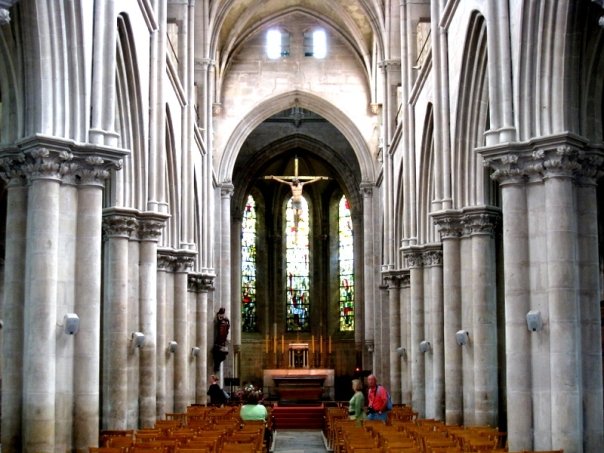
One summer, when I was provided the opportunity to lead a group of college students to Taize, France, I found myself walking with my friends and exploring the local town. Between the three daily worship services with 5,000 other twenty-somethings, we had the freedom to do as we pleased, so we hiked around Burgundy, France.
1934569_1139874788043_6304071_n

When we entered the small chapel, I was overcome by its opulence. The stained glass was filled with such vibrant colors, letting in just the right amount of light through the scenes of scripture. The crucifix at the front had a triumphant Christ hanging on the cross above the altar. The pews were made of well-worn wood that conveyed a deep sense of time and care. While my friends examined the fine details of the space I walked to the front, fell to my knees, and I prayed.

I must have been there for some time, because when I opened my eyes it took them a moment to readjust to the light. Below my knees, I noticed some writing on the marble stones that made up the floor. While my eyes began to focus on the crude letters, I was gripped with a sense of fear and awe – the floor was made of old gravestones.

With all the beauty surrounding me on the walls, and ceiling, with an altar worthy of a king, and a pulpit raised high in the air, I neglected to notice the most sacred and holy element of the church. The floor and foundation of the worship space was made possible through the saints that have gone on before us, a constant and beautiful reminder that this was holy ground.

Burning bush 1

Just like every other day, Moses was tending to the flock. The morning was typical, calm, and cool with the dew hanging on the leaves while Moses walked along the path. Perhaps while walking in the still silence, Moses thought back upon his life, and what had led him here. He had grown up around the inner circle of Pharaoh’s cohort, raised by the princess as her own, but when he saw an Egyptian beating a Hebrew he could not contain his rage and committed murder. Moses fled from the comfort, power, and prestige of Egypt because he was afraid. He eventually settled in Midian and married Zipporah, the daughter of Jethro the priest.

Moses was tending the flock that belonged to his father-in-law when he led them beyond the wilderness and came to Horeb (“wasteland”), the mountain of God. Walking along the path, filled with thoughts form the past, Moses discovered a bush on fire, and even though it was blazing, it was not consumed. Rather than continue on his journey, Moses turned aside to look at the great sight, to see why the bush was not being burned up. Then God called out from the bush, “Moses, Moses!” And he replied, “Here I am.” The Lord commanded Moses to stay put, and remove the sandals from his feet, for the place where he was standing was holy ground. “I am the God of your father, the God of Abraham, the God of Isaac, the God of Jacob.” And Moses hid his face, for he was afraid to look at God.

It was just an ordinary, everyday journey for Moses. A normal routine with no “religious” intentions. He was not going out to seek the perfect modern preacher or guru to learn about what God was calling him to do with his life, he was not sitting in the great temple of Jerusalem, he was just doing his job.

God chose the mountain in the wilderness as the place of revelation and change for Moses’ life. The encounter took place far and away from the sights and sounds of the religious community, this holy moment takes place in the least likely of situations and locations.

A burning bush appeared in the wasteland, but the fire did not consume it. Moses was not frightened away from the bush, nor was he repelled by the sight of something strange, but instead he was drawn toward it. His curiosity propelled him forward, not for religious reasons, but because it was unknown.

God, the God of Abraham, Isaac, and Jacob, loves to make use of human curiosity for his own purposes. Curiosity often leads to discovery, new life, and new vision.

Moses was the one who ran away from familiarity into the unknown. He had left behind his family and calling in Egypt because he feared for his life. He escaped to the place of Midian, found a wife, and a new calling and was settled. It happened in the ordinary and mundane moment of routined life that Moses was jolted into a new reality.

God is the one with the initiative in the situation. Moses was not begging on his knees for God to enter his life, instead it is God who confronts Moses and calls him to a task.

We gather in this space for worship with expectations. We come to church to sing, to pray, to live, to love, and to encounter the living God. It is our hope and belief that in so doing we will come into contact with the divine in such a way that we can be filled and transformed for the coming week. However, if the story of Moses and the burning bush is to come alive for us today, then we must prepare ourselves to be encountered by the living God when we least suspect it.

wedding-11

Years ago, Zig Volskis was preparing to preside over a wedding for a beautiful couple. He had done the necessary pre-marital counseling, he had met with the families to discuss the needs of the wedding ceremony, frankly- he had taken care of everything he needed to for the wedding to be perfect. Like with all weddings he stood at the front with the wonderful couple and began to speak about the holy covenant of marriage, of Christ’s role in bringing two people together as one, and the responsibility to live into this new identity with faithfulness.

Zig had done a lot of weddings. He knew that at some point the bride would start crying, and if he really worked it, the the groom would cry as well. He knew that some of the people in the congregation no longer believed in marriage, but believed in the young people enough to show up. He had done enough weddings to know the routine. But this was to be no ordinary wedding…

I can’t do this,” the bride blurted without warning. Zig, the great pastor that he was, immediately took over the situation, escorting the young woman out the congregation to have a serious conversation. Thinking that it might just be wedding jitters and nervousness, he invited the young woman to speak. “I can’t do this,” she said, “I’ve had my doubts, of course. But it just hit me right before we walked in. We were waiting for my grandmother to arrive and she was running late. The longer we waited, the more angry my fiancee became. When she finally made it he began yelling at her for ruining this moment, for making us wait on her. The entire time I walked down the aisle and saw him standing at the front, I realized for the first time, that I was making a terrible mistake.” So Zig re-entered the sanctuary, and as calmly as possible, informed everyone that the wedding would no longer take place.

God shows up in the most unexpected times and places. In the midst of a beautiful wedding ceremony the Spirit moved in such a way to give a dose of reality to a young bride about the mistake she was about to make. In the midst of a cold December evening when I was sixteen, God brought me down to my knees and propelled me on a path toward church ministry. In the midst of a leading a flock God appeared in the burning bush to call Moses into something difficult and holy.

I knew a pastor who, every Sunday morning, would kick off his shoes at the back of the sanctuary before entering during the opening hymn. When I finally asked him about this strange practice he casually replied, “this is holy ground.” I think he was right; this space, the inside of our sanctuary, this room where we gather to meet the living God is holy ground. But I also think he was wrong; the ground is only holy because of God’s appearance, not because we say it is.

I love worship, and I love churches. I have had some incredible moments in my life where I have heard a preacher proclaim words from a pulpit as if he or she was speaking to me, and to me alone. I have been in the middle of singing a hymn only to realize that tears were flowing down my face because of the depth and beauty of a God who could love me in spite of my sinfulness. I have prayed at the altar after receiving communion and experienced even just a foretaste of what God’s kingdom is all about. But some of the most transformative and life-giving moments of my life have taken place when I least suspected them, in places far removed from the religious center of the church.

Being called by God into a new life is not something that applies only to clergy, nor is it something that happens exclusively in worship. We are all called in one way or another to live faithful lives for God’s kingdom, whether we are clergy or lay, teachers or students, engineers or musicians, writers or mathematicians. We are given incredible opportunities to respond to God’s calling in manifold ways in our daily lives by loving our neighbors as ourselves, by asking the hard questions that other people are afraid to mutter, by looking at the world through Christ’s perspective.

We are not abandoned and left alone. We see how God is really gracious toward us in the fact that God confronts us in his incredible holiness. The fact that God does not permit his people, the righteous, or the church to perish, means that He refuses to let us go our own way when we act and behave as if we were people who do not need to hear the Good News.

We stand on holy ground, here at church and out in the world, confronted by the Holy One, who searches deep into our souls and knows what we think, what we feel, and what we believe. God cannot allow us to wander off and be left to our own perspectives, but meets us in the ordinary, when we least expect it, and calls us by name: Moses, Moses; Taylor, Taylor, etc.

When God confronts you in the midst of life, how will you respond? Will you continue your journey and ignore the unexpected call? Or will you say, “Here I am”?

Amen.