No One Is Illegal On Stolen Land

strangely-warmed-spreaker-header

This week on the Strangely Warmed podcast I speak with Kenneth Tanner about the readings for the 8th Sunday After Pentecost (2 Samuel 6.1-5, 12b-19, Psalm 24, Ephesians 1.3-14, Mark 6.14-29). Ken pastors the Church of the Holy Redeemer in Rochester Hills, Michigan and is a good friend of the podcast. Our conversation covers a range of topics including biblical beards, The Apostles’ Creed, the awful fonts Comic Sans and Papyrus, losing yourself in church, worshiping with more than one congregation, multiracial realities, weddings as heaven on earth, and heads on a platter. If you would like to listen to the episode or subscribe to the podcast you can do so here: No One Is Illegal On Stolen Land

Also – The Crackers & Grape Juice team is excited to announce our first book! I Like Big Buts: Reflections on Romans (you can find the ebook and paperback on Amazon).

k

https://www.spreaker.com/user/crackersandgrapejuice/8th-sunday-b


The Cost of Victory

2 Samuel 5.1-5, 9-10

Then all the tribes of Israel came to David at Hebron, and said, “Look, we are your bone and flesh. For some time, while Saul was king over us, it was you who led out Israel and brought it in. The Lord said to you: It is you who shall be shepherd of my people Israel, you who shall be ruler over Israel.” So all the elders of Israel came to the king at Hebron; and King David made a covenant with them at Hebron before the Lord, and they anointed David king over Israel. David was thirty years old when he began to reign, and he reigned forty years. At Hebron he reigned over Judah seven years and six months; and at Jerusalem he reigned over all Israel and Judah thirty-three years. David occupied the stronghold, and named it the city of David. David built the city all around from the Millo inward. And David became greater and greater, for the Lord, the God of hosts, was with him.

Early in the morning on the 4th of July, a young woman and a group of friends made their way to Liberty Island where the Statue of Liberty looks out across the waters. Like countless people gathering to celebrate Independence Day, they looked like everybody else ready to enjoy the day. However, upon arrival, they quickly unfurled a banner over a railing near the base of the statue that said, “Abolish ICE!” and they boosted the young woman up onto the statue.

For nearly three hours she made her way around the statue while police attempted to bring her down. Whenever they got close she shouted out her intention, “I will stay here until all the children are released!”

But after three hours of evasion, the police eventually arrested her, and brought her down off of Lady Liberty.

A spokesperson for the protestors said the demonstration was thematically charged by the belief that Lady Liberty weeps over how the country is treating children and families at the border.

The main protestor, the young woman, was eventually identified and taken in to custody. She clearly violated a number of state and federal laws, and will be prosecuted in the not too distant future.

            So what will be the cost of her victory? Prison? Steep financial fines?

            And was she even victorious? What was she hoping to accomplish?

ICE_Protestor_Caught_After_Scaling_Statue_of_Liberty

All the tribes of Israel came together to speak with David. Echoing the profound words of their first ancestor “bone of my bones and flesh of my flesh,” they said, “Look, we are your bone and flesh. Saul was once king but you are the one who led Israel.” And they anointed David king. He was thirty years old.

After thirty years of serving the Lord, from striking down Goliath, to attending the needs of the mad king, to lamenting over his death, David finally became the king.

When you imagine David, what do you picture? Do you see the little shepherd boy with curly hair running through the fields? Do you think of David dancing before the Ark of the Covenant with nothing but a loincloth? Do you see the humble king walking among the people of God?

David is the de facto king figure of scripture. From this point forward he, even more than Moses, is the archetype for what it means to lead God’s people. Solomon will ask God to make him a leader like his father David, the prophets will remember the faithful times of David’s reign when looking out at idolatry. Even during the days of Jesus, the people of God will look for a new David to lead the revolt against the imperial power of Rome.

And we might like the version of David often handed to us: the Goliath killer, the lute player, the psalm scribers, the king who united Israel. But it all came with a cost.

            Every great victory leaves a loser in the ditch, and David is no exception.

I’ve brought this up before, but it’s helpful to know that someone like me does not pick the scriptures we use on Sunday morning at random. Years ago a group of ecumenical Christians compiled a three-year cycle of four readings for every Sunday called the revised common lectionary. It was designed to bring congregations through the great narrative of scripture without being constrained by the choice of the preacher.

Depending on the season we might spend weeks going through one of Paul’s letters, or we can jump around the psalter, or just follow the narrative of Jesus’ life from the gospel. Regardless of what we hear in church, it was almost always decided for us.

Today is no exception.

The Lectionary says that the Old Testament reading today should be 2 Samuel 5.1-5, 9-10. It’s a brilliant little vignette in David’s rise to the throne of Israel. But notice: there are three verses missing.

            Why?

Sometimes verses are omitted because we are brought to the conclusion of a story without being weighed down by superfluous details. Sometimes the narrative is interrupted and it makes logical sense to jump from one place to another.

But sometimes the lectionary omits verses because they are difficult to handle, they make people like you and me uncomfortable, and we don’t know what to do with them.

I don’t often ask you to do this, but I would like all of us to pick up a pew bible and turn to 2 Samuel 5 (OT page 218). We read earlier that all of the elders joined together, and they anointed David king. We read about how David was thirty years old when he began to reign. We read about how long he ruled. But before we jump to verse 9, where we learn he occupied Jerusalem, let’s read about what he had to do to achieve that victory…

6 – The king and his men marched to Jerusalem against the Jebusites, the inhabitants of the land, who said to David, “You will not come in here, even the blind and the lame will turn you back” – thinking, “David cannot come in here.”

7 – Nevertheless David took the stronghold of Zion, which is now the city of David.

8 – David had said on that day, “Whoever would strike down the Jebusites, let him get up the water shaft to attack the lame and the blind, those who David hates.” Therefore it is said, “The blind and the lame shall not come into the house.”

The Lectionary, which thousands of churches follow, omits those three verses. And those three verses completely change the emotional impact of the story. Because without those three verses all we learn about is David becoming king. And with the three verses, we learn what kind of king David would be.

            Victory comes with a cost.

David sent his warriors on a surprise attack into the city through the water shaft. However, they would not only sneak through to shock the enemy combatants, but David also ordered the massacre of the blind and the lame.

And after the carnage, they occupied the stronghold and named the place the city of David. A great and decisive victory for the people of God, one in which even the blind and lame were left bloodied in the streets.

Scripture is no joke my friends. In this crazy and bewildering assortment of poetry, prose, and pragmatism, we discover the incredible mountaintop moments of God’s glory, and the deep valleys of humanity’s shame.

It is said that the winners write the history books, and this is true. Where might we find the details from the Jebusites perspective? Where can we read about the plight of the blind and lame left to die in the city of David?

We can’t, because they lost.

And yet when we look back on the life of David, we know and remember that his first act as king from taking the city of Jerusalem and uniting the people called Israel. But if we follow the lectionary, we lose sight of how far he was willing to go to do so.

On Wednesday morning my family and I piled up our supplies in our Radio Flyer wagon and we made our way down to our neighborhood’s 4th of July parade. We sat in the limited shade with great anticipation as we heard the sirens and marching bands in the distance. And for more than an hour we cheered and celebrated as all sorts of people from the community walked past us in celebration of our country’s independence.

Hours later, we gathered with neighbors for a backyard barbeque and watched as our children splashed around in a kiddie pool. We exchanged stories of 4th of Julys past, and offered thoughts about future celebrations.

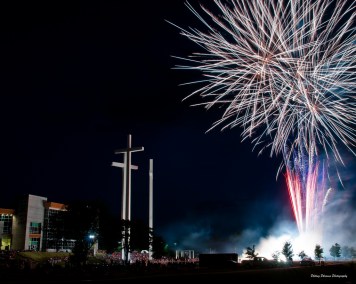
In the evening, I rocked my son to sleep with the faint smell of gunpowder wafting up from his hair, still holding on to the firework displays in our front yard, and the distant pops of fireworks echoed in his room.

plan-your-4th-of-july-weekend-houston-2017-696x407

It was a great day, one for which I am grateful. I love living in this place we call the United States, for the freedoms I experience to worship the God I love, and to gather with people like you to do so.

            But throughout the sea of red, white, and blue, between hot dogs and hamburgers, surrounding the bright colors in the sky was the constant and ringing reminder: What price did we pay for this?

            Or, better put, what price did others pay for this?

This country, and our love of it, flirts very closely with what Jesus called idolatry. When the country we live in becomes more important than the God who created us, when the lights in the sky on the 4th of July shine brighter than the bread and cup on this table, when we care more about what’s happening in Washington DC than what’s happening in our local community, then we have a problem.

And part of the problem is that, like David, we forget the tremendous cost of our victory.

We don’t take the time to repent for the millions of lives that have been taken in order for us to form a more perfect union. We ignore the stories and plights of the native peoples from whom we stole this land. We dismiss the broken systems of racial inequality that are still very much manifest in ways that began when black and brown bodies were stolen and forced into slave labor. We overlook how women were, and still are, mistreated and disrespected for no reason other than their difference in genitalia.

What we have here, it’s pretty good. Better than most places in the world, if not the best. But it all came with a cost.

People matter. Regardless of whether they are blind or lame, native or immigrant, black or white, male or female, people matter.

And for David, some people didn’t matter.

David occupied the city Jerusalem with the bodies of his own people, by showing up in flesh and blood and bone – By sneaking through the water shaft to kill the blind and the lame.

Centuries ago, this country was occupied with bodies by those who showed up in flesh and blood and bone – By stealing land from those who were here before, by breaking the bones of those forced to work the land, by belittling those who bore the next generations in their wombs.

David occupied Jerusalem with violence, with the threats against the blood and bones of others. So too, America is occupied with violence, with threat against the blood and the bones of others.

2dd04d97c664a4970b539f317ea19633--jesus-painting-prophetic-art

That same violence was present in the city of Jerusalem centuries after David stormed through the city, when the gathered people shouted the name of a different shepherd boy, though this time they demanded for him to be crucified on a cross. With every hammer and nail through his bones and flesh, echoes of the past, present, and future rang for everyone to hear. With his cross hanging high in the sky, all of the bodies whose blood rolled through the streets of Jerusalem, and every broken body that would pave the way for this country were also held high for all to see.

In Jesus we discover the true victory, a triumph that came at the cost of God’s own life. At this meal, in this bread and cup, we find the peace of Jesus that occupies us when we feast. In these pews, in the space between us filled by the Spirit, we experience the beginning of a new reality in which victory is defined not by violence, but by grace.

David is a far more complex character than we ever give him credit for, and America is far more complicit with the violence and brokenness of the world than we often remember, but that does not mean that both of them should be dismissed or broken down. We can still rejoice in the shepherd boy who united Israel, and we can still celebrate the country in which we live. But we cannot forget the cost of their victories, nor can we forget the blood that has been spilled in both of their names.

Because in Jesus’s life, death, and resurrection we encounter the end of sacrifices, the end of violence as a means by which we change the world. Jesus has already changed the world, Jesus occupied our place on the cross, and God is with us. Amen.

We Don’t Know What We Don’t Know

In the world of United Methodism, a number of churches received their new pastors on Sunday. They were paraded in front of a new congregation and asked to offer God’s Word without really knowing anything about the local church.

Having moved twice, I can attest to the strangeness of the occasion.

maxresdefault (4)

In anticipation of the great annual migration, Teer Hardy and I got together to record a podcast episode about pastoral transitions. However, we also covered a number of topics including steep learning curves, the challenges of preaching weekly, intersections between politics and theology, faithful hospitality, proper boundaries, ecclesial whiplash, sleeping in church, and what it’s like to work with the Tamed Cynic, Jason Micheli. If you would like to listen to the episode, or subscribe to the podcast, you can do so here: We Don’t Know What We Don’t Know


Christianity and the Fourth of July

2 Corinthians 12.10

Therefore I am content with weaknesses, insults, hardships, persecutions, and calamities for the sake of Christ; for whenever I am weak, then I am strong.

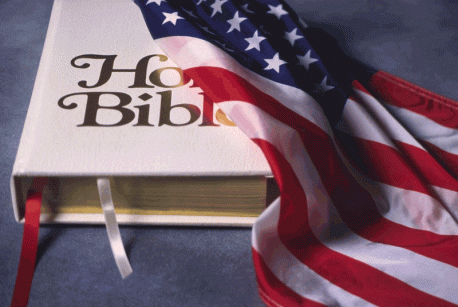
Bible-and-Flag

On the 4th of July, Americans bring out all the red, white, and blue we can muster and we fill the sky with fireworks. It is always a spectacle to behold. The day encapsulates so much of what America stands for: freedom, festivities, and food!

And behind the colorful outfits, and backyard barbeques, and displays of pyrotechnical achievements, the 4th of July is all about strength. So much of what Americans do on the 4th points to the country’s strength in the realm of economics and militaristic might and total freedom.

However, on the 4th of July, while many of us will be out in our communities celebrating America’s independence, it is important for Christians to remember that the day doesn’t really belong to us.

Can we wear red, white, and blue? Of course, though we should oppose forms of nationalism that result in xenophobia and violence.

Can we support our military? Of course, but we must not forget that America is an imperial power that often uses violence indiscriminately and disproportionately throughout the world.

Can we kick back and enjoy the fireworks? Of course, though we cannot let them blind us to the injustice that is taking place each and every day within our borders.

7517979204_12c9890879_b

The 4th of July does not belong to us not because Christians are against America, but simply because our hopes, dreams, and desires have been formed by the Lord. What we experience across the country as we mark the independence is fun and full of power, but it will never compare to the weakness that is true strength in the bread and wine at the communion table and the water in the baptismal font.

Americans might bleed red, white, and blue, but Jesus bled for us such that we wouldn’t have to.

Therefore, should we avoid the practices that make the 4th of July what it is? Should we abstain from the hot dogs, and pool parties, and fireworks?

Of course not.

But if those things are more compelling and life-giving that the Word of the Lord revealed through Jesus the Christ, then we have a problem.

In Jesus Christ we discover the end of all sacrifices, particularly those demanded by countries of their citizens.

In Jesus Christ we meet the one in whom we live and move and have our being such that we can rejoice in the presence of the other without hatred, fear, or even bitterness.

In Jesus Christ we find the incarnate Lord whose resurrection from the dead brought forth a light into this world that overshadows all fireworks.

In Jesus Christ we begin to see that weakness is actually strength.

God Can Handle Our Unbelief

strangely-warmed-spreaker-header

This week on the Strangely Warmed podcast I speak with Kenneth Tanner about the readings for the 7th Sunday After Pentecost (2 Samuel 5.1-5, 9-10, Psalm 48, 2 Corinthians 12.2-10, Mark 6.1-13). Ken pastors the Church of the Holy Redeemer in Rochester Hills, Michigan and is a good friend of the podcast. Our conversation covers a range of topics including the weather in Michigan, David’s vulnerable leadership, being killed by Jesus, God as refuge, being afraid in worship, pondering love, Mr. Rogers’ Neighborhood, the third heaven, thorns in the church, and weakness as strength. If you would like to listen to the episode or subscribe to the podcast you can do so here: God Can Handle Our Unbelief

kt

We Always Marry The Wrong Person – A Wedding Homily

Ecclesiastes 4.9-12

Two are better than one, because they have a good reward for their toil. For if they fall, one will lift up the other; but woe to one who is alone and falls and does not have another to help. Again, if two lie together, they keep warm; but how can one keep warm alone? And though one might prevail against another, two will withstand one. A threefold cord is not quickly broken.

IMG_4107

From my perspective, which is to say the Pastor’s perspective, weddings are better when you really know the couple. Worshiping and celebrating together is always joyful and full of excitement when you’ve taken the time to get to know the people who are entering into the wedded covenant.

But when you know the couple as well as I know the two of you, it becomes that much harder.

What can I possibly say to the two of you that I have not already said before! I know the two of you too well to make the language of love and commitment intelligible because I cannot look at either of you with unbiased perspectives. I have memories of both of you stretching back so far that standing here before you, tasked with speaking the truth about what you are about to do, feels like an impossible assignment.

However, unlike so many weddings where you might hear the fluff about how love is all you need, I can be more vulnerable and honest with both of you, and everyone else here, because I’m actually going to see you again!

I told both of you months ago that regardless of whatever scripture you picked for your wedding, that I reserved the right to chose my own as well. This was not meant as a slight, I know you two know the scriptures well enough to pick a proper wedding text, but I also know both of you enough to what another scripture that gives light and life.

Luke 5.1-11

“Once while Jesus was standing beside the lake of Gennesaret, and the crowd was pressing in on him to hear the word of God, he saw two boats there at the shore of the lake; the fishermen had gone out of them and were washing their nets. He got into one of the boats, the one belonging to Simon, and asked him to put out a little way from the shore. Then he sat down and taught the crowds from the boat. When he had finished speaking, he said to Simon, “Put into the deep water and let down your nets for a catch.” Simon answered, “Master, we have worked all night long but have caught nothing. Yet if you say so, I will let down the nets.” When they had done this, they caught so many fish that their nets were beginning to break. So they signaled to their partners in the other boat to come and help them. And they came and filled both boats, so that they began to sink. But when Simon Peter saw it, he fell down at Jesus’ knees, saying, “Go away from me, Lord, for I am a sinful man!” For he and all who were with him were amazed at the catch of fish that they had taken; and so also were James and John, sons of Zebedee, who were partners with Simon. Then Jesus said to Simon, “Do not be afraid; from now on you will be catching people.” When they had brought their boats to shore, they left everything and followed him.”

The Three-Fold is not quickly broken and Jesus Gone Fishing.

Jesus and fishing are like a match made in heaven, on earth. Throughout the New Testament people go fishing all the time and they never, ever, catch a single fish unless Jesus is with them. Fishing was so important to the early Christians not only as a way to survive, but they also carved out the sign of a fish in the secret catacombs to let fellow disciples know it was a place of worship.

It’s clear, at least in the witness of scripture, that Jesus liked fish: the first disciples were called after a night of fishing, Jesus fed the 5,000 with just a handful of fish, and Jesus first meal after the resurrection was broiled fish over a charcoal fire.

It’s only fitting that Forrest proposed to Katie while on a fishing trip. And, Jesus was definitely with you, because you actually caught her.

That’s when everyone’s supposed to say “Aww.”

And for as much as Jesus liked fish, and fish have become inextricably connected with the Christian faith, fishing has also become the de facto metaphor for romantic relationships. People say things like “You caught her” or “Don’t worry, you just need to work on your moves and maybe you’ll get a few bites” or “Of all the fish in the sea, I’m so glad you swam to me.”

We’re stuck with that language whether we like it or not. And the truth is, relationships, and in particular marriage, is much more like fishing than we give it credit for. However, it cannot be boiled down to a nice and cute and cliché Etsy print that you could hang on the wall.

The deep and profound truth of marriage is this: We always marry the wrong person.

Now, lest you two run away from me for saying something so heinous in the midst of your wedding, lest you scratch your heads as to how that relates to fishing… Let me explain.

So much of what the world tells us about marriage is destructively caught up in the lie that in marriage you will find happiness. I hope and pray that you two are happy in your marriage, but marriage itself is not indicative, or predictive, of happiness. We are told again and again that there is a soul mate for us out there, and that if we fish long enough we will find the “right” person.

We never really know whom we marry; we just think we do. Or even if we marry the “right” person, just give it a little while and he or she will change.

Forrest, take a good look at Katie: Beautiful, intelligent, fierce. We both know that she loves you more than you love yourself. And I don’t mean that as a bad thing, she’s just deeply in love with you. But she’s not going to be like this forever. She’s not going to even be like this tomorrow. You, Forrest, are about to make a crazy promise – to love and share life with Katie knowing that you do not know how she is going to change.

And Katie, take a good look at Forrest. I know he’s as handsome as they come, but he’s not going to look like this forever. Sike, whom am I kidding, Forrest is going to look like he’s 18 forever! But really, he’s kind and committed and knows way too many random factoids that only make for good conversation when you meet strangers. He can tell you what state produces the highest number of toothpicks each year, and where are the best places to go urban fly fishing in the DC metro area. But he’s going to change. It is inescapable. And you, Katie, are about to make the same crazy promise – to love and share life with Forrest knowing that you do not know how he’s going to change.

            Marriage, being the remarkable and confusing thing that it is, means we are not the same person after we have entered it. The primary challenge of marriage is learning how to love and care for the stranger to whom you find yourself married.

Marriage is only made possible when you know who you are such that you are willing to enter into the mystery of the other with your whole self.

8 years ago the three of us traveled to Guatemala together. We spent the majority of our time in Chiquisis, a small and remote village in the Highlands. We slept on old bunk beds, and woke up every morning to coffee as thick as porridge before we went out to work on building our stoves. As the leader of the trip I got to pair everyone in work crews, and I chose to work with you Katie, and I sent Forrest to work with my sister Haley.

I remember about halfway through the week, when the exhaustion and routine was so strong that we were able to work for hours at a time without talking, I interrupted you while you were mixing concrete and I asked you a difficult question: “Why Forrest?”

And I will never forget how you didn’t even look up, or pause what you were doing to answer, “Because he makes me feel like me.”

4 years ago Forrest, you and I went fly-fishing by ourselves in the middle of nowhere Virginia. We hiked and hiked up and down along the banks of the creek, we fished for hours and hours, and we never even saw a single fish. And I remember about halfway through the day, when frustration and the routine was strong enough that we hadn’t said anything for a long time, I interrupted you in the middle of a cast with a difficult question: “Why Katie?”

And I will never forget how you kept casting when you answered, “Because when I’m with her, she makes me feel like me.”

   I feel like me.

It is in the knowledge of self that you two come to this place on this day with a strange and beautiful and bewildering promise. To me it is a sign of God’s abundant grace and mercy that you two found partners who make each of your feel more like yourselves. In a world where we decipher far too much of our identities based on the people around us, it was through your joining together that you somehow became more fully the individuals God has called you to be.

When Jesus called Simon Peter by the lakeshore, he called the wrong person. What kind of Messiah calls a fisherman, who catches zero fish, to be a fisher of people? Why choose the one who shouted, “Go away from me Lord, for I am a sinner” to be the first disciple? Everything about Simon Peter was wrong. Jesus chose the wrong person.

            But that’s exactly what made it right.

Throughout the gospels Simon Peter becomes the disciple who responds to Jesus’ healing, teaching, and preaching. Simon Peter is the one who confesses Jesus as the Messiah first. Simon Peter is the one whom upon whom Christ would build his church.

Not because he was a good fisherman, not because he was gifted with leadership potential, not because of anything within himself.

Simon Peter becomes the person God called him to be because Jesus was with him! Only when Jesus was in the boat did the nets begin to break under the weight of the fish. Only when Jesus proclaimed the kingdom of God was Peter able to say, “You are the Christ.” Only when Jesus handed Peter the bread and the wine at the table was he able to become the rock of the church.

    Jesus’ presence changes us.

Christ is the third part of the threefold cord that is not easily broken. Christ is the one sitting with us on the boats of life beckoning us to throw the nets over one more time. Christ is the Lord of impossible possibilities.

Peter was the wrong disciple, just like we marry the wrong person, because we don’t get to control the people we love. We are bound to them and they are bound to us in the sanctity of marriage in ways that remind us over and over again that only through profound witness of faith can something so incredible become manifest.

Only when Jesus is with us on the boat, can we hope to catch some fish.

Now, I want you two to take a look at all the people here. They, like Jesus, believe in impossible possibilities. They believe in you. They are here as a witness and a testament to the individual lives brought to this place on this day, and they are the promise made manifest to hold you to the impossible possibility of your marriage.

Now look at each other one more time. Deeply. I hope each of your know how tremendously blessed each of you are to have the person in front of you staring right back, this old friend who has shared so much of life with you, this absolute stranger who is becoming your marriage partner.

Now back to me! Your wedded life will be filled with mountains and valleys, with monsoons and droughts, with good fishing days and bad fishing days. But no matter what, keep tossing the net and keep casting your rods.

Know, deep in your bones, that the Lord is with you on the boat, that the threefold cord is not easily broken, and that you need not be afraid.

We always marry the wrong person, but that’s exactly what makes it right. Amen.