Open Hearts. Open Minds. Open Doors.

Romans 4.1-5, 13-17

What then are we to say was gained by Abraham, our ancestor according to the flesh? For if Abraham was justified by works, he has something to boast about, but not before God. For what does the scripture say? “Abraham believed God, and it was reckoned to him as righteousness.” Now to one who works, wages are not reckoned as a gift but as something due. But to one who without works trusts him who justifies the ungodly, such faith is reckoned as righteousness. For the promise that he would inherit the world did not come to Abraham or to his descendants through the law but through the righteousness of faith. If it is the adherents of the law who are to be the heirs, faith is null and the promise is void. For the law brings wrath; but where there is no law, neither is there violation. For this reason it depends on faith, in order that the promise may rest on grace and be guaranteed to all his descendants, not only to the adherents of the law but also to those who share the faith of Abraham (for he is the father of all of us, as it is written, “I have made you the father of many nations”) – in the presence of the God in whom he believed, who gives life to the dead and calls into existence the things that do not exist.


There are many many many versions of Christianity. And not just denominations like Presbyterians, Episcopalians, and Baptists; even within something like the United Methodist Church there is a great myriad of ideas about what it means to be the church. For instance: There are 7 UMCs in Staunton, and we could all use the same text on Sunday morning, and just about everything else would be completely different from one another.

But the one thing that might unite all churches, almost more than baptism or communion, is a desire to appear as welcoming and inclusive as possible.

All you need to do is check a church website, or bulletin, or marquee and you can find a self-made description that says something like: we are an open, friendly, inclusive, and welcoming church. Or just try asking someone about their church and you’re likely to hear: “we love everybody!”

In the United Methodist Church, we like to say we have open hearts, open minds, and open doors.

37807

What a righteous slogan.

Inclusivity, being open, they’re quite the buzzwords these days. Rather than appearing at all judgmental, we want people to know that we accept all people. Rather than seeming prejudiced, we want everyone to know that they are welcome. Rather than looking at people based on their outward appearance, we want to the world to know that we care about the content of one’s character.

But the truth is, there are a great number of people who have been ignored, if not rejected, by congregations claiming to be inclusive (including our own).

A couple weeks ago I preached a sermon on the mission of the church. I made the claim that instead of being consumed by a desire to fill the pews, instead of trying to make the world a better place, the church is called to be the better place that God has already made in the world. And as the better place, church should be the one place where no one is ever lonely. I must’ve said that last part no less than three times from the pulpit.

And when we finished worship, most of us walked up the stairs to the Social Hall for a time of food and fellowship. Like we usually do, a long line was formed and one by one we filled our plates and sat down.

The time difference between proclaiming the sermon and sitting down to eat could not have been more than 30 minutes. And yet there was a young family who were here with us in worship for the very first time, who sat alone in our social hall the entire time. And there was an older gentleman, who has served the needs of this church longer than I’ve been alive, who sat by himself for nearly the entire time.

It is not possible for any church, even St. John’s, to be “inclusive” of everyone. And not necessarily for the reasons we might think. We might not judge others for the stereotypical ways often publicized about the church like being homophobic, or racist, or elitist (though there is plenty of that). No, we also reject others for mental illness, politically different or incorrect views, or for poor social skills and status.

We reject people for all sorts of reasons.

Years ago, when I first entered seminary, I went on a bike ride with some friends to another house full of seminarians. We represented the great mosaic of mainline protestant Christianity and we quickly began addressing why each of us was attracted to the particular church we would serve in the future. The Episcopalian talked about her love of the Book of Common Prayer and being united with Christians all over the world who say the exact same words whenever they get together. The Baptist talked about the beauty of believer’s baptism and getting to bring adults into God’s flock.

One of the Methodists, me, talked about the wonder of God’s prevenient grace, a love that is offered to all without cost or judgment. But then I went on to express my chief disappointment: Our slogan of open hearts, open minds, open doors. I joked about how many Methodist churches regularly lock their doors, how many of them are filled with people whose minds are already made up about God and others, and how many of them have people with hearts that have no desire to be open to the strange new reality of God’s kingdom.

To be honest, I got pretty fired up about it. After all, it was the beginning of seminary and I was trying to show off.

But I meant what I said. Our slogan is something we can strive for, but it is not a fair description of who we are. There will always be a newcomer who sits in a pew by herself without anyone coming over to say hello. There will always be a family that risks being ostracized by coming to church only to being judged from afar. There will always be sermon series that make people feel like they are not welcome into the fold of God’s grace.

So I went on and on about this until I looked at the other Methodist whose face had turned bright red. “Is everything okay?” I asked. He paused and then said, “My Dad was on the committee at General Conference that created our slogan. I think it’s the best thing about the United Methodist Church.”

We have a slogan, a nice and pretty slogan that we should strive for, but oftentimes we fall short. When we fall short, we do so because of sin. Sin captivates us in a way that makes it virtually impossible for any church to “unconditionally accept” everyone who comes through the door.

We judge others based on physical and outward appearance. We make assumptions about families for a myriad of reasons. We shake our heads in disgust about couples that do not fit the normative mold that society has established.

And we should be cautious about advertising or describing ourselves as such. We might think we’re righteous enough to live by the slogan, we can even hope for it, but we are far from it.

Only Jesus, the one in whom we live and move, is capable of a truly open heart, open mind, open door ministry because Jesus was God in the flesh. Jesus was righteous.

But what about Abraham? Paul uses this part of his letter to the Romans to use Abraham as an example of righteousness. Abraham was the one who was called to leave the land of his ancestors and family to go where God called him. Abraham was the one in whom the covenant between God and God’s people was made. Abraham was the one who was promised to become the father of many nations. Abraham was the one who believed God and it was reckoned to him as righteousness.

Should we follow Abraham’s example? Would that make us more inclusive and righteous? Could we keep our slogan of open hearts, open minds, open doors?

Here’s the thing: Abraham did nothing to earn this honor and distinction from God. As Paul puts it, Abraham has no ground for boasting.

Whenever we read about the story of Abraham, whether in worship or in a bible study, he is often lauded for his journey into the unknown, for his faith and steadfast commitment to the Lord, and for his perseverance through suffering and tribulation. But his relationship with God, his faith being reckoned as righteousness, is only possible because of God’s faith in him. Abraham is righteous because God called him and empowered him to go into a strange new world.

Abraham, rather than being the perfect model for inclusivity and righteousness and faithfulness, is an example of a justified sinner. Abraham is one of many unlikely individuals whom God reshapes for God’s purposes. Abraham is chosen not because of anything he has done, but because of God who can do anything.

God is the one who worked in and through Abraham’s life, and not the other way around. Abraham does not justify himself, or transform himself, or redeem himself. That’s what God does.

And the same holds true for us today.

open_hearts_logo

We can have the perfect advertising campaign, with our slogan in big capital letters, but that does not redeem our sinful actions and behaviors. We might think we are righteous and that we are “color-blind” or “LGBTQ affirming” or “economically transparent” but we are nevertheless sinners in need of God’s grace and forgiveness. We can even leave the church doors unlocked all week long, but we will still be broken and in need of God’s redeeming love.

This passage, this beautiful piece of theology from Romans, is about more than the example of Abraham and why we need to have faith. Paul’s emphasis is on the fact that God made Abraham righteous. That God has freely poured out grace on the ungodly, people like us. And that God’s gift of Jesus Christ to us and to the world is grossly unmerited and undeserved, and yet it is given to us.

She came to church pretty regularly but she kept to herself. She’d sit off at the end of a pew and keep her head down so as not to attract too much attention. Whenever it was time to sing, she would stand up with everyone else but her voice never made it higher than a whisper. When it came time to say the Lord’s Prayer she would properly bow her head and mouth the words. But whenever the congregation was invited to the front to receive communion, she never left her seat.

young-woman-praying-in-church

Most of the church was preoccupied with thoughts about their own sins or about where they would eat lunch after the service to notice the woman who remained in her pew while they were feasting on the body and the blood. But the pastor noticed.

After a couple months he caught her after church, and wanted to know why she participated in almost every part of worship, but not in communion. She said, “I don’t feel like I deserve it.”

That, my friends, is the whole point. We don’t deserve it. You don’t, and I don’t. None of us have earned God’s salvation, there’s no list of things we can check off in order to get into heaven. This bread and this cup, the cross and the empty tomb, they are unmerited and undeserved gifts from God to us.

We cannot have a church that is open hearts, open minds, and open doors because we are already in it. Our presence, our sinfulness, makes it impossible to be a totally inclusive community.

Only Christ, only God, only the Spirit have open hearts, open minds, open doors. Only the triune God opens up the floodgates of grace to wash away our sins. Only the triune God opens up our eyes to view others without judgment or wrath or fear or anger. Only the triune God opens the doors of the church to the faithful community, to feast at the table that gives us a foretaste of heaven on earth.

Only the triune God gives life to the dead and calls into existence the things that do not exist. To God be the glory. Amen.


romans_feature-01


Devotional -Leviticus 19.1-2

Devotional:

Leviticus 19.1-2

The Lord spoke to Moses, saying: Speak to all the congregation of the people of Israel and say to them: You shall be holy, for I the Lord your God am holy.

Weekly Devotional Image

Before I became the pastor of St. John’s, I had a meeting with other clergy from the Virginia Conference who were all about to start at their first appointments. We represented a number of different seminaries and all of us were nervous in some way, shape, or form about what we were about to embark upon. A few of us were about to serve as deacons connecting the church to the world through youth ministry positions and hospital chaplaincy, a few of us were going to large churches as associate pastors, and a few of us were being sent to serve a church all by ourselves.

After a few ice-breakers designed to build bridges between us, we were all asked to answer the question: “What are you most worried about?” I remember someone jumping right in to say, “I am terrified of having to do funerals.” Another person said, “I have no idea what it takes to create and implement a church budget.” Another person said, “I’m nervous about being single and whether or not people will respect me for who I am.” And my friend Drew ended with, “I just want to be holy.”

217387_578604105493543_912821730_n

We all listened and offered advice to one another, but Drew’s comment has always stuck with me. While the rest of us were nervous and anxious about specific and practical matters, Drew was thinking about his holiness. How in the world can pastors lead people to holiness when they feel unholy? What does it even mean to be holy in the first place?

Some might say that to be holy means going to church every Sunday. Others might say that holiness comes with reading the bible every morning. And still yet others might say that you can only be holy if you pray to God every night before you fall asleep.

Holiness, however, is about living a life of total devotion to God. That might manifest itself in showing up to church, and reading the bible, and talking to God, but it also entails a fundamental commitment to the Lord in everything we do.

It means that when we encounter the stranger we see them as a brother and sister in Christ. It means that when we spend our money we reflect on whether or not it is bringing harm to someone else. It means that we strive to take nothing for granted because tomorrow is never promised.

Being a Christian is not a hobby, or something to be turned on and off whenever we choose. Being a Christian is about living a life of holiness and being totally devoted to God.

So then we must ask ourselves: What am I currently doing that is unholy? What relationships are preventing me from being totally devoted to God? What idols am I being consumed by instead of committing myself to the Lord? How can I be holy?

The Mission Of The Church

1 Corinthians 3.1-9

And so, brothers and sisters, I could not speak to you as spiritual people, but rather as people of the flesh, as infants in Christ. I fed you with milk, not solid food, for you were not ready for solid food. Even now, you are still not ready, for you are still of the flesh. For as long as there is jealousy and quarreling among you, are you not of the flesh, and behaving according to human inclinations? For when one says, “I belong to Paul,” and another, “I belong to Apollos,” are you not merely human? What then is Apollos? What is Paul? Servants through whom you came to believe, as the Lord assigned to each. I planted, Apollos watered, but God gave the growth. So neither the one who plants nor the one who waters is anything, but only God who gives the growth. The one who plants and the one who waters have a common purpose, and each will receive wages according to the labor of each. For we are God’s servants, working together; you are God’s field, God’s building.


When I lived in Harrisonburg, I played drums for a worship service that met every Sunday evening. On Sunday mornings the sanctuary would be packed with individuals and families from the community who would listen to the organ, sing from the hymnal, pray from the pews, and worship together. On Sunday evenings however, we would set up for a very different type of worship service: we had two electric guitars, a bass, a drum set, and a couple singers. Instead of suits and dresses most people came as they were, and instead of the sanctuary being packed, we were lucky if there were more people in the pews than in the band.

The basic worship formula included playing four or so songs, reading scripture, hearing a sermon, celebrating communion, and then playing one more song. Which meant that I spent most of the evenings sitting behind a drum kit looking out at everyone else. From this vantage point I quickly learned who always came late, who refused to sing certain songs, who let themselves go and put their hands in the air to praise, and who pretended to pray while they were actually texting someone on their phone.

I had been playing with the band for a while when I started to notice a young man, probably about my age, who walked in during the first song, and left during the last song every week. We had other people show up for one Sunday a month, or would be there for a couple weeks in a row only to disappear for a months at a time, but this guy was there EVERY WEEK.

Week after week I watched him arrive only to depart before I had a chance to talk to him. But, even though we didn’t talk, his faithfulness was palpable. As a college student, he came to worship week after week while others were choosing to put their allegiances in other places.

When the academic year was coming to a close, the leadership team for the service met to discuss changes for the future. It was abundantly clear that we were not growing and we wanted to make more disciples of Jesus Christ so we started discussing ways we could get more people to join us.

I suggested that we speak to the young man who snuck in and snuck out; after all, he showed up more than anyone else, and I thought he would have some ideas for us.

So the next Sunday, we purposefully ended with a song that did not use the drums so that I could talk to him before he jettisoned out of the sanctuary. We met by the doorway and I introduced myself. I explained that I saw him come in every week, and apologized for not doing more to make a connection. I then launched into a dense theological reflection about why we need more people to come to the service and that all of us thought he would be a great person to speak with. He listened as I went on and on until he raised his hand and said, “That sounds nice and all, but I’m not a Christian.”

            “Not a Christian? What do you mean you’re not a Christian? Why have you been here every week if you’re not a Christian?”

            “I don’t feel like I belong anywhere else, and I don’t have any friends.”

eternal-mission-church_620

We, as human beings, want to belong. We want to belong in the worst ways whether we’re in preschool, high school, or it’s been a long time since we’ve been in school. Out of this desire for belonging we join communities: neighborhood associations, sport teams, civic organizations, and even scout troops.

But they tend to disappoint us. We hope for a sense of identity and purpose and community to magically erupt soon after we begin participating, but because people are so focused on themselves, or someone forgets our name, or someone else argues with us over a matter of opinion, we become disappointed and disillusioned. And before long, we fall back into that pit of loneliness.

The same human desire for belonging was apparently true of the folk in Corinth. The church that Paul helped to inaugurate was struggling. The people wanted desperately to belong, to be part of something. And they joined the church, but then (like we always do) they broke up into factions: I belong to Paul, I belong to Apollos, or some other leader.

One need not stretch the imagination to hear the same sorts of declarations in the church today: I’m a Republican, I’m a Democrat. Zig Volskis was the best pastor we ever had. Steve Greer was the best pastor we ever had.

Paul caught word of these divisions and wrote to the church: Who do you belong to? Why are you dividing over issues of leadership? I came to you with the message of Jesus Christ and him crucified, but clearly it did not take root deep enough. So long as you continue to quarrel you will not be ready to be Christ’s church.

Who do we belong to?

We have a book in the United Methodist Church called The Book of Discipline. In it, its paragraph 120 if you’re interested, we have the mission of the church written out plainly for all to read and understand.

mission_umc_logo

The mission of the United Methodist Church is to make disciples of Jesus Christ for the transformation of the world.

Making disciples is at the heart of what it means to be a United Methodist. I mean, its what Jesus calls the disciples to do at the end of Matthew’s gospel: Go therefore and make disciples of all nations baptizing them in the name of the Father, Son, and Holy Spirit.

But making disciples is often confused with filling the pews.

It results in having conversations about how to get more people in the building while neglecting to interact and connect with the people already in the building. It results in infantile discipleship. It results in working for the numbers, and not the kingdom.

And then we’ve got this bit about transforming the world. Is that really our mission? Do we have the church to change the people and the community around us? Should that be our soul purpose? Does the church exist to make the world a better place?

The church is defined by the sacraments of communion and baptism in order to be a community of difference and peace. The church, therefore, is called not to make the world a better place, but to be the better place God has already made in the world.

Of course, the problem is whether or not our experience of the church matches its definition of being the better place.

I suspect that many of you have experienced the church as Paul experienced it: Disagreements, petty arguments, and at times suffocating silence between bickering factions. For some, the pews of the sanctuary are more like walls of division and less like avenues of connection.

If church is the better place that God has already made in the world, then it should, like it was for that young man in Harrisonburg, be the place to cure loneliness. Because loneliness is something all of us have experienced in some way, shape, or form, and is a wound not easily healed.

I spend an hour every week with the youth of our church at our gathering called The Circle. We always have communion and answer questions and study the bible. But we often just talk about what’s going on in each other’s lives. And, without breaking their trust, I’ll tell you: their lives are not easy. There is such a tremendous amount of pressure placed on them by outside forces. They feel compelled and pushed to change their image, the way they talk, the way they think, and even what they believe in order to be accepted.

Some weeks I leave our Circle meeting feeling broken by what they have to endure on a regular basis, only to have a conversation the next day with an adult who is going through basically the same things in a different context.

The world would have us change. Change your image, hide your faults, be someone else.

As Christians, however, we walk with our wounds and our cracks and our brokenness instead of running away from them. We cannot accept who we are until we discover that we are loved by God because of who we are.

The church can be the better place that God has made in the world because the church is the place where we walk with our wounds and loneliness because of Christ and him crucified. The broken and lonely Christ on the cross knows our brokenness and our loneliness. But he also carries our wounds so that we might see the One who truly loves us.

God is transforming the world. God is the one who makes the first last and the last first. God does, and should, get all the good verbs. Our God is a God of action, of change, of transformation. We are the church, we are the vineyard of God’s garden, we plant the seeds, we water the seeds, but God is the one who makes them grow.

You and I, with our sins and our disappointments, with our fears and loneliness, we have a place here. God invites us to the better place where we are welcomed not because we fit the mold, but because we do not fit the mold. We have a place in this better place because we are caught up in God’s great story.

Just look at the cross, consider the waters of baptism. God is made manifest in the world not through the powerful, not through the expectations of the mighty, but through the weak and through the shamed; through babies and wandering Israelites; through tax collectors and fishermen; through a poor rabbi murdered by the state.

This is the better place God has made in the world. And in this place we remember our baptisms, we remember our death to self and our resurrection in Jesus Christ. We remember our baptism and through that water we remember the story of creation, of the flood, of the exodus. We remember that in our baptism we became part of the body of Christ, the church, where we should never be lonely. Where we should never be made to feel as if we are not enough.

In baptism we joined the better place God has made in this world.

Who then do we belong to?

Do we belong to political rhetoric and partisan ideology? Do we belong to church growth programs co-opted by a desire to see more people in the pews? Do we belong to isolationism or interventionism? Do we belong to a world that pressures us to become that which we are not? Do we belong to Paul or to Apollos? Do we belong to the flesh and are consumed by jealousy and quarreling?

No.

            In this better place, we belong to God. Amen.


(With thanks to Jason Micheli, Stanley Hauerwas, and Will Willimon)

The Humanity of God – Christmas Eve Sermon on Luke 2.1-7

Luke 2.1-7

In those days a decree went out from Emperor Augustus that all the world should be registered. This was the first registration and was taken while Quirinius was governor of Syria. All went to their own towns to be registered. Joseph also went from the town of Nazareth in Galilee to Judea, to the city of David called Bethlehem, because he was descended from the house and family of David. He went to be registered with Mary, to whom he was engaged and who was expecting a child. While they were there, the time came for her to deliver her child. And she gave birth to her firstborn son and wrapped him in bands of cloth, and laid him in a manger, because there was no place for them in the inn.

Colorful holiday lights background, defocused

Christmas Eve! No matter how old or jaded we may be, no matter what kind of year precedes this night, Christmas Eve never fails to brighten our spirits. I look forward to Christmas Eve with a kind of painful excitement: I know there are people here tonight who will not be here the rest of the year, I know this holiday carries with it more meaning than can be contained in a 15 minute sermon, and yet to share the story of salvation is one of my greatest privileges.

But then the question must be asked: Why are you here tonight? Some of you were raised in this church and can’t imagine being anywhere else. Some of you have come alone; others are with large families taking up an entire pew. Some of you have been planning to come here for weeks and some of you decided on a last-minute impulse. Some of you have been dragged here against your will, out of loyalty and guilt. And some of you are here for the first time in a very long time.

Some of you are young and are full of hope and anticipation; most of your Christmases are still in front of you. Some of you who are older are filled with memories of Christmases past that will never come again. Some of you are looking forward to getting back home to the fireplace and the presents and the tree; others dread going home. Whoever you are, and whatever you’re feeling, I’m glad you’re here tonight.


On April 26th, I woke up to the sounds of my excited wife declaring, “I think it’s happening.” The due date for our son had come and gone and each day we waited with anticipation of his coming arrival. So, being the incredible husband that I am, I started offering Lindsey all kinds of things: “Do you want me to make you breakfast? Can I massage your feet? Would you want me to call the doctor?”

She, however, was distracted from my offers by the pain she was starting to experience.

As the day progressed I must’ve checked our hospital bag no less than 42 times, I made sure we had enough clothes and snacks, I went through the 3 birthing playlists (one for calm, one for happy, one for pushing), and I asked Lindsey how she was feeling every fifteen minutes. While I was frantically going through my list over and over, Lindsey was on the couch trying to find a comfortable position to sit in until things really got going.

Mary and Joseph spent the day before their son’s birth traveling over harsh terrain while Joseph led the donkey that was carrying his pregnant fiancé. With every bump and slip, the pain Mary experienced increased and she hoped against hope they would find a place to stay in Bethlehem.

When my wife’s contractions started coming at a regular interval we called the doctor’s office and they told us to come in. Under the caring gaze of the nurses and medical staff Lindsey went through a number of tests before they told her, as kindly as they could, that it was still too early to go to the hospital, so we went home instead.

Mary’s contractions must’ve started to really ramp up as they arrived in the sleepy little town of Bethlehem. All the people they encountered were busily talking about the census that the emperor had required, how they all had to be there in Bethlehem without a choice. To the degree that no one even noticed the man escorting the pregnant woman on a donkey as they passed through the outskirts of the town.

We waited all day and finally at 9pm, the contractions we regularly occurring at such intensity that we knew the time had come. Being the good husband that I am, the car had been packed with our hospital bags for hours and all I had to do was gingerly walk Lindsey to the car and drive to the hospital with care and focus. When we were given a room time seemed to increase in speed dramatically. With every passing minute the contractions were intensifying and the nurses came in at a higher frequency to check on Lindsey and the baby.

Mary and Joseph wandered through the town at a snail’s pace hoping to find somewhere to stay, or a relative to encroach upon. But the farther they walked, the less hope they had of finding a place for the night.

At some point, my beloved wife was breathing strongly through a particularly rough contraction when the nurse said, “Honey, I think it’s time to talk about pain management.” I, watching her go through this thought to myself, “Gee, I think its time for me to have some pain management.” But, being the good husband that I am, I knew not to speak that thought out loud.

Joseph guided the donkey to their last hope, the inn, while his wife was breathing heavily through a particularly rough contraction. The innkeeper saw them walking up and went to the door to announce: “We’re full.” Being the good man that he was, Joseph then led the donkey and Mary to a stable, the only place left and helped her down into some crinkly hay.

At 7am on April 27th, Lindsey started to push. She was surrounded by a team of medical staff, machines monitoring every heartbeat and contraction, and by me trying to figure out what I could to do help.

When Mary could tell that the time had arrived, she started to push. She was surrounded by dirty animals huddled together for warmth, hay that was covered in dirt and hair from the animals, and a man who was trying to figure out what he could do to help.

And with a final push, a son was born into the world. The baby was quickly placed into his mother’s arms and for a fleeting moment nothing happened. In our hospital room the medical team waited with blankets and devices, in the stable the animals watched as the miracle of life came to fruition.

And then, with what sounded like a rush of wind, the baby sucked and breathed in air for the very first time.

From a dirty barn house to an immaculately clean hospital delivery room, the first breath of Jesus and my son Elijah highlights the fragility of this thing we call life. And don’t we take it for granted? All of us have been breathing throughout this sermon without even thinking about it, but we can only live because we can breathe.

In the beginning God’s breathed the breath of life into Adam, God breathed life into Jesus, God breathed life into my son Elijah, God breathed life into every one of you.

It is something worth celebrating because it is a miracle.

But this service, what we’re doing here tonight, is not a mere celebration of a mother and her newborn child’s arrival into the world. It is about more than the miracle of life. This is the unique story of God in the flesh. The baby placed in the manger is not us and we are not Him. He is totally other.

And yet – and this is the real mystery of Christmas – Jesus is the incarnation of the living God, but at the same time, though he is entirely other than us, he has become one of us. Nothing less than God himself has become Emmanuel, God with us.

In Jesus’ birth, God entered history in a new and strange way with the promise that in the kingdom that has no end, sadness will be turned into joy, sin will be destroyed by righteousness, and death will be defeated by resurrection.

But it all started in a tiny little stable with a couple all-alone in the world. That is the true miracle of Christmas – the fragility and humanity of God in a breath. For it is in our breathing that we constantly encounter the one thing we have to do to survive and the one thing we have from the beginning to the end of our days. And that is where God is; with every single breath we inhale the Spirit of the Lord who first breathed life into us. And in our breathing we connect with the one who breathed for the first time in the manger long ago…

And through that first breath, God emptied himself of all power and reign and might and majesty, leaving it all behind to enter our corrupted, polluted, and tragic world. Gone were the days of abandonment, gone were the times of uncertainty, and gone was the power of death. For God came into the world through a baby in a manger to save us from ourselves; to be with us in every single breath; to offer us the true gift of Christmas: God with us.

Merry Christmas. Amen.

christmascandle

Devotional – Psalm 80.3

Devotional:

Psalm 80.3

Restore us, O God; let your face shine, that we may be saved.

Weekly Devotional Image

On Sunday mornings I drive to church hours before worship so that I can properly prepare. I always begin in the sanctuary by praying by the altar and then I pray over every single pew. After I feel like have spent enough time with the Lord I will make sure the doors are unlocked and the heat is working before I step up into the pulpit to preach my sermon to an empty sanctuary. I will go through the sermon line by line and make any changes necessary before printing off the final version.

Yesterday morning I was standing in the pulpit and preaching to an empty sanctuary when I heard a soft voice say, “Hello?” My first instinct was to look up in case God was telling me to make a change to the sermon, but it was actually someone who walked into the church through the main office door. When I went to shake his hand in the hallway it was clear that he had been outside for a long time because he had very red cheeks and he kept bringing his hands up to his mouth to blow on his fingers. He explained that he was homeless and was walking down the street when he felt the need to walk into the church. He told me about various life situations that led him to where he currently is and then I invited him in the sanctuary so that we could sit down and talk some more.

I motioned for him to join me in one of the front pews and asked him to continue. But he didn’t. Instead, his eyes rapidly filled with tears and he wept. I sat stunned and unsure if I had said something wrong, and then asked him if everything was okay. He said, “I can’t remember the last time I saw a Christmas tree.”

Colorful holiday lights background, defocused

What I had neglected to think about was the overwhelming sense of joy that was radiating through our seemingly countless poinsettias and our perfectly adorned and lit Christmas trees; a sense of joy that was in sharp dissonance with what the man has experienced recently.

We talked some more and I learned all about his life, and when it felt like the conversation was coming to an end I asked how I could help him, or how the church could help him. To which he responded, “Honestly, I was just cold and lonely. All I wanted was to warm up and have some company. Thank you.” After that, we prayed together, shook hands, and he left.

This strange season of Advent is one that often leaves us filled with joy, but it can also be a time of deep sorrow. Instead of fondly remembering presents under the tree, we might remember our parents fighting and yelling at one another. Instead of recalling the smells of a delicious Christmas dinner, we might feel suffocated by the sadness of another Christmas without someone we love. Instead of humming the familiar hymns with a twinkle in our eyes, we might not even remember the last time we saw a Christmas tree.

The psalmist cries out: “Restore us, O God; let your face shine, that we may be saved.” O that the Lord would make his face to shine upon all of us through the lights of a Christmas tree, and give us the hope and the joy and the peace we so desperately need this time of year.

Ridiculous Renewal – Sermon on Isaiah 35.1-10

Isaiah 35.1-10

The wilderness and the dry land shall be glad. The desert shall rejoice and blossom; like the crocus it shall blossom abundantly, and rejoice with joy and singing. The glory of Lebanon shall be given to it, the majesty of Carmel and Sharon. They shall see the glory of the Lord, the majesty of our God. Strengthen the weak hands, and make firm the feeble knees. Say to those who are of a fearful heart, “Be strong, do not fear! Here is your God. He will come with vengeance, with terrible recompense. He will come and save you.” Then the eyes of the blind shall be opened, and the ears of the deaf unstopped; then the lame shall leap like a dear, and the tongue of the speechless sing for joy. For waters shall break forth in the wilderness, and streams in the desert; the burning sand shall become a pool, and the thirsty ground springs of water; the haunts of jackals shall become a swamp, the grass shall become reeds and rushes. A highway shall be there, and it shall be called the Holy Way; the unclean shall not travel on it, but it shall be for God’s people; no traveler, not even fools, shall go astray. No lion shall be there, nor shall any ravenous beast come up on it; they shall not be found there, but the redeemed shall walk there. And the ransomed of the Lord shall return, and come to Zion with singing; everlasting joy shall be upon their heads; they shall obtain joy and gladness, and sorrow and sighing shall flee away.

advent_2015_screen


On Christ the King Sunday, the sermon was titled “Not My President.” And before we even started worshipping, more than a few of you made sure I knew your concerns about the impending proclamation. After all, Donald Trump had just procured the necessary electoral college votes to be labeled as president-elect, and people across the country were (and still are) protesting his election with signs saying, “Not My President.” If you were here on Christ the King Sunday, you know that the sermon had very little to do with Mr. Trump, and in fact was all about how grateful we should be that Jesus is not our President.

However, like the good Methodists we are, the sermon was not the pinnacle of our worship that Sunday. You might remember a few lines that I proclaimed from the pulpit, you might even remember one of the hymns we used, but if you sat in the front half of the congregation, I bet the thing you remember most from that service happened during communion.

As always I stood behind the table and I prepared to pray over the bread and the cup. Together we confessed our sins and asked for God to forgive us. We stood up from our pews and shared signs of Christ’s peace with one another. And then I asked God to pour out the Spirit on us gathered together and on the gifts of bread and the cup.

One by one each of you came forward to the front of this sanctuary with hands outstretched to receive the body and the blood of Jesus Christ. One by one I looked each of you in the eye as I tore off a piece of the bread and placed it into your hands. Some of you came up with tears in your eyes. Some of you came up with your eyes focused on the ground, perhaps out of reverence for the precious thing you were about to receive. And some of you came forward with eyebrows askew as if to say, “Who thinks of preaching a sermon about Jesus not being our president?”

The last family to come up for communion sat in the very last pew during worship, and they are connected to the church through our Preschool. Their son is here in the building every week learning about what it means to grow in knowledge, in wisdom, and in love of God. So when his father came up with his hands outstretched I asked if I could offer the bread to his son. The father smiled and said, “Of course.” With his blessing, I knelt down onto the floor and looked at my young friend in the eye and I said, “Owen, this is Jesus.”

To which he smiled, titled his head back slightly, opened his mouth, and waited for me to drop the bread right in.

Without really thinking about it, I took the piece and put it in his mouth, and in response he started chewing while smiling and trying to say, “Thank You Pastor Taylor.”

And I lost it. For whatever reason, I could not contain the laughter that was brewing inside me and I started cracking up. I laughed so hard that I actually snorted. Perhaps it was the seriousness of our service getting flipped upside down by a two year old receiving communion like a little bird from his mother, or maybe it was the smile he offered me while pieces of barely chewed bread were falling out onto the floor, or perhaps it was the little skip in his step while his cheeks were filled like a chipmunk preparing for winter, but I couldn’t stop laughing.

            In that simple and yet profound moment, the desert of our ritualistic liturgy was transformed with blossoms of laughter as other people laughed in response to my snort. In that brief and beautiful moment, God brought this church some much-needed joy.

You see, after spending the better part of two months confronting controversies facing the church and addressing the deep seeded political anger felt in this congregation and across the country, we needed to laugh.

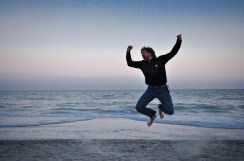
man-jumps-for-joy

Isaiah says the wilderness and the dry land shall be glad. The desert shall rejoice and blossom. The prophet looks to the future and shares the ridiculousness of the renewal that is waiting for God’s people. Like a desert blooming in the middle of a drought, like old and worn out people finding strength in their knees, like tongues of the speechless being filled with words, so will the glory of the Lord transform the world.

In this vision everything is made new from the farthest reaches of creation, to the deepest aspects of our souls. The deserts shall rejoice and blossom, flowers will grow abundantly in the forgotten places, the blind will see, the deaf will hear, and waters will break forth in the wilderness.

God promises transformation and joy. Though not necessarily the transformations and joys we pray for, but ridiculous and redemptive reversals nonetheless. Isaiah sings of liberation, joyful homecomings, and the end of all sorrow and sighing.

Signs of this future of joy will be made manifest in the weak being strengthened, those with feeble knees will stand firm, the fearful will be strong. Those who have long been isolated to the powers of loneliness will be grafted in and never forgotten.

Isaiah sings about the Holy Highway cutting through the wilderness, a way for God’s travelers to move without threat or fear, a place where the people of God’s can sing on their way home.

It sounds a lot like the Garden of Eden, and it sounds a lot like heaven.

But just like last week, Isaiah’s song about the promises of God are not just things that will happen in the distant future; they are part of God’s wonderful and creative reality here and now.

Yet, there are things in this world that hold us back, accidents on the highway of God’s grace, that prevent us from traveling the way to God’s promised salvation. There are chains and bumps that derail us from the pathway to glory: economic fears, political disappointments, spiritual droughts, emotional baggage, relational frustration, and seasonal depression, to name a few. And yet over and over again, whether it’s through a child walking back to his pew with bits of saliva soaked bread falling out of his mouth, or a host of other means, God transforms this world and fills us with joy.

I love to tell stories. From the time we are young children we learn important lessons more through stories and less through object lessons. That’s why scripture is so powerful, and it’s why Jesus used parables to relate the immensity of God to his disciples. This week, in anticipation of this sermon, I emailed a number of you to ask for stories of how God has transformed your life. I wanted to hear about the times that God’s living water broke forth in the midst of an otherwise desert-like existence.

And you did not disappoint.

One of you came to church for years without it really meaning much. It was just the thing you were supposed to do. And on one particular occasion, you were sitting in these pews listening to the choir sing an anthem. There wasn’t anything particularly moving about the words or even the melody, but you found yourself watching the individuals as they were singing and you could tell they meant it. Though you had seen and heard the choir many times, God spoke to you through their faithfulness that fateful day, and since then you have known and experienced the power of God through the music of our church, and through those who provide it.

One of you expressed how narrow-minded and intolerant you used to be. Whether it had to do with politics, or religion, or social status, you judged others unfairly. And then a pastor came to this church named Zig Volskis and he changed everything for you. His spiritual presence and demeanor taught you the importance of asking the right questions, and the importance of being content with answers that pushed you into a new direction. Instead of treating you like a student who needed to be lectured, Zig encouraged you with amazing insights and discernment. And through God working in him, you began to see the Bible not as a book to be consumed, but a life-giving witness to the reality of God.

One of you wrote about recent event whereby you attended a funeral for a man out of guilt because you were afraid that very few people would be in attendance. And yet, when you arrived, there was a line out the door and across the street full of people trying to get into the chapel. You described the experience as a moment through which God made you aware of one of your many sins, your judgment of others based on accomplishments you deemed as worthy, and through it you were transformed to know and believe that everyone has worth, and everyone is sacred.

God transformed the world through the advent of Jesus Christ, and God continues to transform our lives in ways we cannot even anticipate or imagine. The devastated deserts of our souls will once again blossom through a crowded funeral, a faithful pastor, a passionate choir, or a child-receiving communion. God uses people in our lives to change our lives so that we might change other lives.

Isaiah’s song is all about the ridiculous renewal awaiting us, God’s people. That through God’s transformative work, joy will rain down from the skies, and all the scattered promises of the bible will be fulfilled like a dance – the earth will spring forth new life, bodies will be remade, freedoms will be conferred, the city will be reclaimed, joys will erupt from unexpected places, and sorrow and sighing will be banished from the earth.

Isaiah’s song ends with the happy and joyful homecoming of those who have been liberated from the bondage that keeps them from traveling on the Holy Highway. For there is a new way that cuts through desolate deserts and turns them into beautifully blooming fields. God’s people will travel on this path without threat or fear, they will sing with joyful hearts, because the Lord is doing a new thing.

God is not done.

            God is not done with creation and God is not done with us.

            God breaks the chains of our slavery to sin and death.

            God delivers us to places yet unknown.

            God transforms our hopes and dreams into real and tangible experiences.

            God fills the deserts of our souls with living water.

            God blossoms and brings forth new life and opportunities in ways we cannot even imagine.

            God offers unending joy to the redeemed.

            God makes a way where there is no way. Amen.


Not To Boast, But…

2 Thessalonians 1.1-4, 11-12

Paul, Silvanus, and Timothy, To the church of the Thessalonians in God our Father and the Lord Jesus Christ: Grace to you and peace from God our Father and the Lord Jesus Christ. We must always give thanks to God for you, brothers and sisters, as is right, because your faith is growing abundantly, and the love of everyone of you for one another is increasing. Therefore we ourselves boast of you among the churches of God for your steadfastness and faith during all your persecutions and the afflictions that you are enduring. To this end we always pray for you, asking that our God will make you worthy of this call and will fulfill by his power every good resolve and work of faith, so that the name of our Lord Jesus may be glorified in you, and you in him, according to the grace of our God and the Lord Jesus Christ.

love_god_love_people_1x

“I’d like to come by and shoot a story about St. John’s.”

The producer from WHSV had called the church and when I heard his request through the phone I was both nervous and excited. A story. About St. John’s. On Television. But then I realized I needed to ask a question.

“About what exactly?”

We do a fair amount for our local community, but I had a feeling this request was for something else. And in the pit of my stomach I was worried that he wanted to do a story about the controversy series we recently finished. After two months of standing up in the pulpit and belaboring different points of friction, I was looking forward to leaving the controversies aside for a little while, and did not want to speak on behalf of a church where we are clearly divided over a number of issues.

But then he said, “I saw on your website that your church is hosting a communion service on Election Day, and I thought that was something more people should know about.”

He arrived about 30 minutes later with a bag full of camera equipment and a spiral bound notebook full of questions. He set everything up in the office and ran a microphone cable under the desk and into my lap to pick up on all of the dialogue. We tested for light and volume levels for a couple minutes, made sure I was in the frame, went over the specifics about looking at him and not directly into the camera, and then he pressed the record button.

“Tell me a little about the church…”

“Well,” I began, “Not to boast, but, this is the best church in the entire Shenandoah Valley. We’ve got a Preschool that has been in existence for about 30 years and has the greatest reputation for its education. The children are nurtured by our beloved teachers, they receive the necessarily information to excel when they leave for Kindergarten, and we strive to teach them about the virtues of love, grace, and mercy.

We have a solid youth group that meets on Wednesday evenings from 7-8pm for communion, discipleship formation, and bible study. The group contains the best and brightest kids from Staunton and they regularly out disciple me, their pastor. They have a hunger for the Word and are willing to vulnerably encounter one another in questions about their faith. To be honest, they give me hope for the future of the church because they believe in what we are doing almost more than most of the adults.

We have a lectionary bible study of which more than half of the attendees are not members of our church. Every week they gather in the room next door to read four scripture texts and prayerfully discern what God is saying to them through the text. They bring their experience and love of the bible to that group and all of us have grown in our faith because of that bible study.

On Sunday mornings we have some of the best worship that any church in Staunton has to offer. Our order of worship is streamlined for maximum impact, our hymns directly relate to the greater theme and narrative of worship, most of the time the sermons aren’t half bad, and we’ve got an organist who can really make our organ move and groove. The kind of hospitality that our church members extend to strangers and longtime members is worthy of imitation by all churches and they are truly the reason people come back week after week.

On any given week our building is used by a number of local civic organizations including girl scouts, cub scouts, and boy scouts. We have a quilt-for-a-cause team that regularly works on quilts that are then given away to local children in need. We’ve got a group of volunteers called the Cheer Team who take time to visit with those who are lonely or afraid in the community. We’ve got others who go to the Trinity Soup kitchen to cook and serve food to the homeless. We send a mission team of youth every summer to help different communities in need. We’ve got…”

“Just a little bit” he said. “Now,” he went on, “tell me about this Election Day communion service.”

“Are you sure you don’t want to know more about St. John’s? I really could go on, I was only really getting started.”

“No, let’s try to stay on task.”

So for the next 45 minutes he recorded as we went back and forth about the current state of politics in our country, we waxed lyrical about pamphlets and fliers we’ve received here at the church about who we should vote for as Christians, we explored the theological implications of a communion service in the midst of such political division, and we even discussed the practical matters of how much bread to purchase and how many people we should expect to attend.

All in all, we examined just about every aspect of the Election Day Communion service and when we had gone through all his questions, we shook hands and he left to get some exterior shots of the building. The last thing he said was, “It should be on the evening news in the next day or two.”

We don’t have cable at the parsonage, but you better believe I kept checking the WHSV website for the story about our church. With every click to reload the page I dreamt about how many people would see the wonderful descriptions of the church, I imagined how many people would hear all the things I boasted about, and I began picturing our pews filled to the brim on Sunday morning.

Two days later, the story finally appeared on in the news cycle. The opening shot was an image of our altar, the one right behind me, and as the news anchor began introducing the story my teeth chattered with excitement.

The anchor said, “St. John’s Pastor Taylor Mertins has this to say….”

Then the shot cuts to me in the office, with Star Wars figurines and works of theology on my shelves. Here was the big moment. And then I watched myself say, “We are going to pray for our political leaders whether it’s the person we voted for or not. That would be the most Christian thing we could do.”

And then it ended. 10 seconds. The vast majority of our conversation was left on the cutting room floor, and 45 minutes of bragging was reduced to a 10 second sound bite.

Now, don’t get me wrong. I am grateful that WHSV came to do a story about our Election Communion Service, it will be a profound moment of unity in the midst of chaos and division, I only wish that everyone watching got to hear and experience all the things that make our church what it is.

And then I reread our scripture text for this morning.

2 Thessalonians is one of the earliest Christian documents that the church has. It is the second letter written by Paul to the church in Thessalonica. And apparently, the Thessalonians have their act together. Not only does Paul mention the fact that he gives thanks and prays for their little community, but also Paul boasts about their church to all the other churches. They are the city on the hill to which all the others churches should aspire to, they are the standard by which other churches should measure themselves, and they are worth bragging about.

But why did Paul choose to brag about them?

Was it the number of people they had in the pews on Sunday morning? Perhaps they had a remarkable preschool that was helping to shape the future? Maybe they had a youth group that met once a week for communion, fellowship, and bible study? Or perhaps they had streamlined their worship services to connect all of the hymns with the scripture, and the sermon, and the offering, and the prayers?

No.

Paul boasted about the Thessalonians because they remained steadfast in their faith in the midst of persecutions and afflictions. Paul boasted about their church because they grasped and lived into the mission of the church: to grow in love of God and love of neighbor.

We, the church, are a different people. We, the church, are an alternative form of community. Rather than being labeled and defined by the marks of culture that surround us – consumption, power, greed, political parties, nationalities, sexual identities, economics – we are like strangers living in a strange land.

What we value and desire is not what the world values and desires.

            What we proclaim and believe is not what the world proclaims and believes.

            What we worship and affirm is not what the world worships and affirms.

            We are a different people, we Christians.

Though the world may change, though new presidents may reside in the oval office, though new pastors can be sent to different churches, we grow in love of God and love of neighbor. That is our mission, and if anyone can say we love God and others, if that’s what they boast about, well that’s good enough.

love-god-love-others-720-e1340940523238

So perhaps, the ten-second sound bite about the Election Day Communion service is precisely what the community should know about our church. They don’t need to know about our different activities and ministerial programs, they don’t need to know the specifics of our Sunday liturgy, they don’t need to hear a forty-five minute speech about all the best things we’ve got going on at St. John’s.

All they need to know is that we are growing in love of God and neighbor by putting aside things like all of our political differences and joining together to feast at God’s table. Instead of being captivated by the world as the results pour in on Novembers 8th, we will be here loving one another and remembering that we worship the living God.

Therefore, maybe it is our sense of challenge, our willingness to return to this place Sunday after Sunday that connects us with the church in Thessalonica from so long ago. They suffered under persecution and affliction and were able to keep the faith. We wrestle with the competing narratives that vie for our allegiance and we keep the faith. Rather than falling prey to the whims of the world, instead of being consumed by the popularity of politics, we remember that we are God’s people. This land is going through a time of great division and schism, but because of God’s grace, we have not lost sight of who we are and whose we are.

To this end we pray, asking that God will continue to make us worthy of the call and that God will fulfill by His power every good resolve and work of faith so that the name of our Lord Jesus may be glorified in us, and us in him, according to the grace and mercy of God.

The mission of the church, and the mission of all Christians, is to love God and love others. That’s it. Amen.


On Homosexuality

Leviticus 20.13

If a man lies with a male as with a woman, both of them have committed an abomination; they shall be put to death; their blood is upon them.

Colossians 3.12-15

As God’s chosen ones, holy and beloved, clothe yourselves with compassion, kindness, humility, meekness, and patience. Bear with one another and, forgive each other; just as the Lord has forgiven you, so you also must forgive. Above all, clothe yourselves with love, which binds everything together in perfect harmony. And let the peace of Christ rule in your hearts, to which indeed you were called in the one body. And be thankful.

000

Preachers can fall into the rut of preaching on whatever keeps the congregation pleased; keep them happy and they’ll keep coming back, or something like that. This sermon series has been different. Instead of falling back to the familiar narratives that keep us smiling on our way out of the sanctuary, we have confronted some of the greatest controversies facing the church. There is a better than good chance that I have said something from this pulpit during the series that you don’t agree with, and I am thankful for the vulnerability and honesty that has been present in our conversations following worship. We can only grow as Christians in community, and that requires some honesty and humility and dialogue. Today we conclude the series with the topic of Homosexuality.


When someone rings the doorbell at St. John’s, you can hear it throughout the entire building. More often than not our wonderful church secretary will answer the door with a smile on her face and direct the person to their particular destination. We regularly have people down on their luck knock on our door looking for a little bit of financial help, sometimes we have people in the midst of a crisis who want to speak with a pastor, and every once in a while we have someone who is just interested in learning more about the church.

A couple months ago I was sitting in my office working diligently when the doorbell rang. I listened for the echoes down the hallway to discern what kind of interaction I was about to have when the secretary called my office and said, “Someone needs to talk to you.”

The visitor was an older woman, recently to Staunton, dressed to the nines with a gold cross hanging across her neck. When she offered her hand in order to introduce herself she had a subtle grandmotherly smell about her that immediately elicited visions of old books with tattered dust covers, prescription pill dispensers, and Vicks VapoRub.

She said, “I’m a United Methodist.”

            I said, “How wonderful, so am I.”

            She said, “I’m new to town, and I was just driving by and saw the sign out front and I thought I’d like to know more about the church.”

For the next thirty minutes we sat in the front pews of the sanctuary and I gave her the elongated elevator speech about St. John’s UMC. I pointed to the particularly pertinent aspects of our Christian architecture here in the sanctuary. I shared with her about the hilarity and joy of our Preschool that meets in the basement. I offered her reflective stories about the intellect of our Circle group of youth who are regularly more faithful than their pastor. I talked about our lectionary bible study that meets on Thursdays and how they contribute more to the sermon on Sunday mornings than they get credit for. And then I started to tell her about how we worship, how we let the Lord speak to us through scripture, hymns, prayers, and even sometimes the sermon.

When she asked about our attendance and giving, I proudly proclaimed our Sunday average and told her that we are about to pay our apportionments in full for the third year in a row. When she asked about the kind of people who participate in the life of the church, I told her the truth: that on Sunday mornings this placed is filled with the most beautiful and brilliant people Staunton has to offer.

For thirty minutes we discussed the ins and outs of the church, and for thirty minutes I watched her fall in love with the descriptions I shared. With every anecdote and short story I could see her seeing herself becoming a vital part of our worshipping community. Honestly, it was one of the best conversations I’ve had in a while and when it ended she said that she was eager and excited to join us in worship on Sunday morning.

We shook hands and said goodbye, but right before she made it to the door she turned around and said, “Just one more question… What do you think we should do about the gays?”

            Without hesitation I said, “I think we should love them.”

            “Well then,” she said with a sigh, “I won’t be coming back.”

Human sexuality, and in particular homosexuality, is one of the most polarizing issues in the United Methodist Church today. Like all of the controversies we have confronted over the last month and a half, it requires a tremendous amount of vulnerability and patience whenever it is discussed.

The controversy regarding homosexuality and the church is made manifest in a number of ways. For many, like the woman I met in the sanctuary, it is the defining question that determines whether someone joins a church or not. That specific conversation is not the only time I have been asked about the church’s stance on homosexuality in the middle of a conversation about joining or participating in the life of the church. In fact, during my second week at St. John’s, I received a phone call from the Newsleader inquiring whether or not I, as the pastor, offer sessions to counsel individuals out of their gayness. Which is to say, our local newspaper wanted to know if I could turn a homosexual into a heterosexual.

            But beyond church participation and local media questions, the controversy is one at the heart of what it means to wrestle with being a Christian today.

The United Methodist Church has a governing document called The Book of Discipline that is edited and republished every four years. In it we receive our organizational structure, the means by which individuals can become ordained clergy, and a host of other relevant church matters. In that book you can find the following statement regarding homosexuality: “The United Methodist Church does not condone the practice of homosexuality and considers the practice incompatible with Christian teaching.”

The language in the Book of Discipline about the incompatibility of homosexuality has led the church to also assert that any bishop, clergy member, or local pastor may be tried (as in a church trial) when charged with the following offenses: being a self-avowed practicing homosexual; or conducting ceremonies which celebrate homosexual unions or performing same sex wedding ceremonies.

So, to summarize, according to the United Methodist Church to be gay is to be incompatible with Christian teaching; you cannot be a clergy person if you are in a gay relationship, and clergy can be punished for marrying a gay couple.

When it comes to the bible, the witness of scripture is explicit regarding homosexuality. In Leviticus, God proclaims that anyone engaged in homosexual behavior is an abomination and should be put to death. In Paul’s letters, the sin of homosexuality is listed along the likes of envy, murder, deceit, gossip, slander, and faithlessness.

It is no wonder, therefore, that the United Methodist Church has taken the stance it has, and that many a preacher proclaim the incapability of homosexuality from the pulpits in the churches they serve.

At this point, I could point out that the few texts that do speak about homosexuality in scripture have been overly emphasized again and again whereas other biblically prohibited behaviors are tolerated. For instance, some of us like to eat shellfish, some of us have tattoos on our bodies, and some us have let our hair become unkempt (all worth punishment in scripture).

Or I could talk about how our country guarantees the rights of its citizens to not be discriminated against because of their sexuality, and how it has affirmed the constitutional right of its gay citizens to be married.

Or I could mention how many scientists and geneticists believe that one’s sexual identity is not a choice and is instead fundamentally wired into who they are through a particular gene.

Or I could bring up the fact that God, rather than condemning the marginalized and calling them incompatible, commands us to go to those on the fringes of society to be present with and for them.

Or I could make mention of the fact that Jesus [remember him?] says absolutely nothing about homosexuality in any of the four gospels.

But I won’t talk about that.

            Instead, I want to talk about repentance. Not the repentance the church thinks someone from the LGBTQ community should confess because of their identity. But the repentance the church desperately needs for singling out a particular community and denigrating them for decades.

175 years ago, many pastors across the United States preached sermons from their pulpits about how the bible reveals a divine sanction of slavery. There are plenty of verses in the Old and New Testaments that seem to affirm the subjugation of one people by another. We, as a church, were wrong.

60 years ago, many churches across the United States believed that scripture makes it clear that white churches should remain white. There are scriptures in the Old and New Testaments that can be interpreted to proclaim that society needs to be segregated and that birds of a different feather are not supposed to flock together. We, as a church, were wrong.

50 years ago, and still today, many Christians throughout the country believe that a literal reading of the bible makes plain God’s design for women to be submissive toward men. There are verses from the Old and New Testaments that can be understood to advocate for women to not have the same rights as men. We, as a church, were wrong.

And for all the wrongs we have committed, we confess and repent. We look back on the days long gone and shake our heads about how foolish we once were. We dig up old dusty sermons and can’t believe that a pastor would be so filled with hatred to single out a particular group of people and label them as property, or unworthy, or subordinate, or incompatible. We see the scars that are still very present in our society because of what the church once believed and for that we pray for God’s forgiveness.

            And we need to do it again today.

For too long, the church has abused its power to dominate and condemn particular people out of fear and bigotry. Pastors all across this land use pulpits like this one to isolate the LGBTQ community and tell them they are incompatible, they have no worth, and they have no value.

            Can you imagine what it would feel like to bravely take a step in faith to attend a Sunday worship service at a church only to hear that you are incompatible with Christian teaching?

Can you picture the pain and agony that would come if you felt God calling you to ordained ministry and the church said you’re wrong because of who you are?

Can you imagine the anger that would percolate inside you if you found someone you wanted to spend the rest of your life with and the church told you it would not be a part of your wedding?

If we’re honest, our answer is probably “no, we can’t imagine.” We can’t imagine what it would be like because we sit comfortably in our ivory towers of heteronormativity, assuming that the world would be a better place if other people looked like us, thought like us, and acted like us. But the beautiful and wonderful diversity of humanity is part of God’s divinely created order, and it is one that we foolishly try to fix on a regular basis.

Months ago, a woman wandered into this sanctuary to ask about the church, but what she really wanted to know was what we should do about the LGBTQ community. In her question, and response, I experienced the fear and loathing that is fundamentally disconnected from the love and grace and mercy of the living God. And I wish could go back and change my answer. Not because the answer I gave her was wrong, but there’s a better one.

“What do you think we should do about the gays?”

As God’s chosen ones, holy and beloved, we are to clothe ourselves with compassion, kindness, humility, meekness, and patience. We are supposed to bear with one another and forgive each other just as the Lord has forgiven us. Above all, we are called to clothe ourselves with love, which binds everything together in perfect harmony.

If can’t agree that the least we can do is love them, then we have no business calling ourselves Christians.

Devotional – 1 Timothy 6.10

Devotional:

1 Timothy 6.10

For the love of money is a root of all kinds of evil, and in their eagerness to be rich some have wandered away from the faith and pierced themselves with many pains.

Weekly Devotional Image

In the United Methodist Church we spend a lot of time every fall preparing for Charge Conference. Charge Conference is an annual meeting in the life of the church where we evaluate where we’ve been and where we’re going, we discuss challenges and new approaches, and we vote on things like the budget and pastoral compensation.

Paying pastors is one of those things in the life of the church that we like to handle quickly and then move on to a different subject. Frankly, whenever we talk about money we want to address it as fast as possible and then get back to “doing church.” Money makes us uncomfortable.

On some level this is a good thing. We know that Paul writes to Timothy about the love of money being a root of all kinds of evil. Or we can think about a time when the fear regarding finances sent the church in a frightening direction. Or we can reflect on how the love of money has reshaped a relationship with a friend or with someone in our family.

tithe

However, money and wealth is one of the things that Jesus talks about more than anything else, and we have slowly removed it from our common experiences in the life of the church.

On the Virginia Conference website for the United Methodist Church there is a page dedicated to the bishop. On that particular page anyone can find narrative information about our bishop, but there is also a link to what is called the “Appointment Workbook.” If you click on the link you will have access to a list of all the pastors in the Virginia Conference, how long they served, how many new people are attending their churches, how much their churches are required to pay in apportionments, what percentage of the apportionments have they paid, AND their annual compensation. This is good and important information for the life of the church, but the fact that the entire list of pastors is not organized by name, or region, or new disciples, but by salary, shows how we have wandered away from the faith.

Paul warns us about the love of money in our individual lives and in the community of the church. When we become so consumed by the pursuit of money whether we are a teacher, or a doctor, or a denomination, we fall captive to the evil the sends us wandering away from the faith. As Christians, our ultimate call is to grow in our faith and Christlikeness, not in our annual salary.

The Good, The Bad, and The Ugly (of Annual Conference)

Every year the Virginia Annual Conference of the United Methodist Church meets for holy conferencing. This is an event whereby lay and clergy representatives from the entire conference meet to discuss pertinent matters facing the denomination in our particular geographic locality. Additionally, the Conference has a memorial service for clergy and lay representatives who have died in the previous year, we learn about campaigns and initiatives like “Imagine No Malaria”, we celebrate the licensing, commissioning, and ordination of clergy, and we worship together.

Every Annual Conference is filled with moments of holiness in addition to sinfulness. We are a church of broken people; therefore we fall prey to our own desires and forget to pray for God’s will to be done. At times, our “holy conferencing” brings out the best in us and the worst in us. Below are three categories of experiences I had from last weekend. And let’s go backwards…

2016AClogocolornoflame

The Ugly

After joining together in one voice to proclaim the powerful and dynamic hymn “And Are We Yet Alive” (The traditional first hymn to be used since nearly the beginning of the Methodist movement), we jumped right into the business of Annual Conference: The presentation of the Rules Committee. This makes complete sense of course, we need to re-establish the rules of conference every year before we get to the important stuff, but this year we spent the first 45 minutes of our time as a denomination arguing about the color of our name badges.

Depending on one’s conference relationship, there are areas that are forbidden from being voted upon. For instance: last year I was a provisional elder which meant that I could not vote during the clergy session, or on constitutional amendments. But now that I am “an elder in full connection” I am granted to the right to vote in the clergy session and on constitutional amendments. In order to streamline who can vote on what, different name badge colors were distributed. And this resulted in chaotic responses in the forms of Robert’s Rules of Order. Specific representatives (both lay and clergy) were livid not about their name badge color, but that the conference did not trust them to know what they could and could not vote on. (even though it took ten minutes for the clergy to figure out where they had to sit in order to vote during the clergy session [something we do EVERY year]).

During the name badge debate I was sitting next to a couple that were attending Annual Conference for the very first time. I witnessed them shaking their heads in astonishment and disbelief for most of the 45 minutes and when all was said in done I heard them say, “No wonder people complain about coming to this every year.” What does it say about our church to new people when we can go from a beautiful hymn to an argument about name badge colors in the blink of an eye? What does it say about the future of our denomination when our first priority becomes the color of our name-tags?

Later during the conference a motion was made from the floor to propose a resolution regarding the recent tragedy in Orlando, Florida. The resolution called for all churches in the conference to be in prayer for the victims and their families from the shooting, to pray for the greater LGBTQI community, and to pray for our Muslim brothers and sisters so that they might not be lumped into the violent identity of the shooter. While the majority of the conference voted in favor of the resolution, there were a decisive number of people who vehemently opposed it. We might not think alike about the LGBTQI community or the Muslim community, but the least we can do is pray for them in the midst of such a horrific tragedy. So what does it say about our commitment to loving others the way Jesus commanded while some of us would rather remain silent?

Finally, our conference had the good fortune of hearing the proclaimed Word from Rev. Eun Pa Hong who is the senior pastor of Bupyeong Methodist Church in Incheon, Korea. Rev. Hong is one of the most dynamic leaders in Korean Methodism and under his leadership for the past 35 years his church has grown to include 5,500 people most Sundays. Rev. Hong spoke in his native tongue and was translated into English while he preached. And while I walked around later in the day, I overheard delegates complaining about having to listen to someone speak in Korean. What does it say about our church, when some cannot stand to witness the diversity that makes us who we are? What does it say about our future when we’ve forgotten the most beautiful part of the Pentecost story?


The Bad

The church continues to decline: Lack of new professions of faith, lowering numbers of baptisms, and more churches closing. Or to put it the way I heard someone else reflect on it: “Annual Conference is all about death.” The report of the Conference Statistician offers bleak prospects for the future and causes anxiety for those with eyes to see and ears to hear. At the same time we were reminded over and over again about the power of fear, and how is has limited us as a denomination without offering hope for new vitality. The frightening statistic that the average United Methodist invites someone to church once every 38 years was mentioned on more than one occasion without any examples of how this statistic is being combatted.

Moreover, fears about the recent General Conference were made apparent through muffled conversations, uncomfortable responses to the General Conference report, and the apathy toward institutional change. More than ever, Annual Conference focused one what we have to fear, than what we have to be hopeful about; it felt more like crucifixion, and less like resurrection.


The Good

There is nothing quite like singing together in one voice with thousands of other United Methodists. As Garrison Keillor has noted, singing is part of our DNA. And so, when at the beginning of Annual Conference, thousands of us joined together with those faithful words: “And are we yet alive, and see each others face? Glory and thanks to Jesus give for his almighty grace!” you can’t help but feel the Spirit’s presence. When we mourned the loss of life over the last year, when we sat in profound silence in memory of the victims in Orlando, when we watched as new pastors were licensed, commissioned, and ordained, we felt the Spirit’s presence. Worship is always part of the “good” of Annual Conference. In worship we remember that God is God and we are not. In sermons and prayers and hymns we hear God saying, “Yes!” even though our hearts say “No.” In worship we let our baggage and preconceived notions start to fall away and we truly become Christ’s body redeemed by his blood.

Additionally, we celebrated the fruits that came from our commitment to “Imagine No Malaria,” we rejoiced in new faith communities that are planting seeds of faith across Virginia, and we recognized the 20th anniversary of the Order of the Deacon. All of these events witnessed to our commitment to serve the needs of others and the ways that we are making God’s kingdom manifest here on earth.

On Thursday night, before Annual Conference officially began, a group of United Methodists gathered for Pub Theology led by the minds behind the podcastCrackers & Grape Juice.” We met for an informal conversation about theology, toxic Christianity, and the future of the denomination. During that gathering a number of young people made it clear that they believe in the future of the United Methodist Church even while some of us remain anxious. In their willingness to articulate how their local churches helped nurture them in the faith, their witness blessed us all. Later we heard from voices largely missed at Annual Conference and all of us were reminded about the strange and beautiful diversity of this thing we call “the church.” As I was leaving, a young man told me (with a smile on his face), “This is what Wesley must have felt like when he gathered with his friends.” It doesn’t get a whole lot better than that.

On Saturday evening I was privileged to join an Ordination class of some of the most gifted pastors and deacons I have ever met. We submitted ourselves to the yoke of a stole over our shoulders and covenanted to serve the church with all of our hearts, souls, and minds. I witnessed countless people rise when names were read before the conference and I was reminded about the great communal effort required in identifying effective clergy. In the ordination service I saw the bright future for our church; not in our bureaucratic commitments to Roberts Rules of Order, not in our debates about nametag colors, not in our frightening statistics, but in the local church where the heart of God is revealed each and every day.

I have hope for the future of the United Methodist Church because the new clergy leaders believe in the power of the gospel to radically transform the world. They recognize that the local church is where disciples are formed (not Annual Conference). They see the bread and the cup of communion as our spiritual food necessary for the journey of faith. They have given their lives over to this strange and wondrous calling and will bear fruit for years to come.

But most of all, I have hope for the church because it does not belong to us. It belongs to God. The more we remember that we serve the risen Lord, the more we learn to pray for God’s will and not our own, the more our church will become what God is calling us to be: the body of Christ.


The-Good-The-Bad-The-Ugly