God Helps Those Who Help Themselves

Psalm 121

I lift up my eyes to the hills – from where will my help come? My help comes from the Lord who made heaven and earth. He will not let your foot be moved; he who keeps you will not slumber. He who keeps Israel will neither slumber nor sleep. The Lord is your keeper; the Lord is your shade at your right hand. The sun shall not strike you by day, nor the moon by night. The Lord will keep you from all evil; he will keep your life. The Lord will keep your going out and your coming in from this time on and forevermore.

A guy was walking down a street when all of the sudden he fell into a deep hole. The walls were so steep that he couldn’t climb out and he began crying out for help. A doctor was passing by and looked down into the pit when the man yelled up, “Hey! Can you help me out?” The doctor thought about it for a moment, wrote a prescription, threw it down into the hole and kept walking.

Then a preacher came walking along and the guy shouted up, “Reverend, I’m stuck down here in this hole, can you help me up?” The pastor slowly put his hands together, said a prayer for the man, and kept walking.

Next, a sweet older woman from the local church came up and the man yelled, “Please help me. I’m stuck down here and I can’t get out.” The woman stared right into the man’s eyes and said, “Don’t you know that God helps those who help themselves?” And with that she went on her way.

Finally, a friend walked up and the man shouted, “Hey! It’s me down here! Can you help me out?” And the friend jumped right into the hole. The first guy said, “Are you stupid? Now we’re both stuck down here!” The friend said, “Yeah, but I’ve been down here before and I know the way out.”

A relatively recent poll found that better than eight in ten Americans think, “God helps those who help themselves” is in the Bible. In fact, more than half the people who responded to the poll were strongly convinced that it is one of the major messages of scripture.

Quote Typographical Background - vector design

Guess what? It’s not in the bible!

Do you know where it actually comes from? There are hints of the phrase in ancient Greek mythology, but it became popularized by Benjamin Franklin in Poor Richard’s Almanac published in 1736.

And yet, a majority of people in this country believe it is a major aspect of Christianity straight from the lips of Jesus.

Of course, there is some, very small, truth to the statement. After all, if we sit around our dinner tables praying for God to miraculously provide us with food, we’re going to be disappointed. We can eat because God has blessed creation with abundance and through things like employment we can afford to provide food for our tables. God helps us because we work to help ourselves.

Likewise, focusing in school, listening to our spouses, nurturing our children, these things result in our lives being better because we have worked for them to be better.

But that pales in comparison to how “God helps those who help themselves” has been used by Christians to avoid our obligation to help others.

Like the woman walking passed the man in the hole, it blinds us from our responsibility toward others and frees us from feeling guilty for how broken the world is outside of our respective bubbles.

The truth is: some people cannot help themselves. Societal discrimination, generational poverty, institutional racism, and a host of other problems prevent people from helping themselves. Some people, in fact many people, are in holes so deep, with walls so steep, that they can’t climb out without help.

About a year ago, some of the pastors in Staunton got together to talk about ways we could minister to the homeless population in our community. We asked ourselves how our respective churches could work together to help the people that cannot help themselves.

At first we debated the pros and cons of establishing something like a computer lab to help individuals apply for jobs. The thought being that if they found work, they could have an income, and no longer be homeless. We discussed offering weekly classes in reading, mathematics, and financial management at the Valley Mission to teach important skills necessary for breaking free from the cycle of homelessness. But in the end, only after we finally connected with homeless community members in Staunton, we discovered what they really needed were showers and a place to do their laundry.

What we failed to realize was that all the best training and teaching would be meaningless if the individuals arrived to a job interview wearing the same clothes they had been sleeping in for months.

We, the pastors, had walked passed the hole many times and decided how to fix the problem from our vantage point, rather than jumping into the hole in the first place.

The Church, and I mean big “C” Church, cannot shrug off the responsibility to help others with the use of another trite and cliché sentence because God, over and over again, commands his people to take special care of the poor, the widow, the orphan, and the needy.

A cursory scan through the prominent stories of the Old and New testaments leads us to the biblical truth that God helps those who cannot help themselves.

maxresdefault-1

In Leviticus, God commands the farmers to not harvest all the way to the edge of the fields. Certain amounts of the produce were supposed to be left for the poor and the immigrant. Instead of consuming it themselves, or selling it for a profit, a portion was to be left for those who were not able to make ends meet or for the strangers in the land.

In another part of the Old Testament, God says that compassion for others is itself a form of worship. There are times when the priest and the religious leaders heaped up sacrifice after sacrifice, they had the perfect worship services with all the right prayers and all the right songs, and God tells them their worship has become lifeless.

            What difference does it make if we show up at a place like this for an hour a week if we ignore the people God tells us to care about the rest of the week?

In the New Testament, Jesus is forever going from town to town and seeks out the last, the least, and the lost. And when he finds them, the sick and the needy, does he say, “God will help you if you help yourself?” When the crowds gathered to hear Jesus speak, did he command the disciples to tell the hungry 5,000 that God will give them food if they go collect it for themselves?

No. Jesus helps them. He connects with their brokenness and brings healing. He sends the abandoned back to the villages that disowned them, he feeds the hungry out of the abundant grace of God, and he helps people precisely because they cannot help themselves.

Have you ever felt like you’ve been the one down in the pit? Have you ever encountered a moment in your life that felt so suffocating and oppressive that you knew you couldn’t get out of it on your own? Have you lost a job, or a spouse, or a child? Have you received a frightening medical diagnosis, or a horrible tip for the stock market, or a habit that you couldn’t kick?

We can claw all we want, we can plead on our knees with our hands clasped in the air, but sometimes the only way out of the pit is if someone jumps in to help us find the way out.

From where will out help come? We lift our eyes to the edge of the pit and we see that our help comes from the Lord. The Lord who sends us a friend willing to jump down into the depths of our despair, the Lord who never abandons us even when we feel alone, the Lord who was willing to jump down into the pit of humanity and be born into this fractured world of ours.

That, my friends, is the whole point. We help others who cannot help themselves because God helps us when we cannot help ourselves. God came into the world as a baby in the deep pit of fear and suffering of a couple all alone in the world. God went to the margins of society in Jesus Christ to sink low into the stink of the world and offer hope. God went to the broken families and the battered spouses and the abandoned children and showed the way out. God went to the very depth of death just so that all of us could find the way to salvation.

Tomorrow, some of us who work will not have to because of Martin Luther King Jr. Day. It is a day set apart to remember the man who led this country through a particularly horrible period of racial injustice. His life, his teachings, his marches, and his protests all bear witness to his willingness to jump into the pit of his people’s suffering, in order to find a way out.

A father was with his four year old daughter last Christmas, and it was the first time she ever asked what the holiday meant. He explained that Christmas is all about the birth of Jesus, and the more they talked the more she wanted to know about Jesus so he bought a kid’s bible and read to her every night. She loved it.

They read the stories of his birth and his teachings, and the daughter would ask her father to explain some of the sayings from Jesus, like “Do unto others as you would have them do unto you.” And they would talk about how Jesus teaches us to treat people the way we want to be treated. They read and they read and at some point the daughter said, “Dad, I really like this Jesus.”

Right after Christmas they were driving around town and they passed by a Catholic Church with an enormous crucifix out on the front lawn. The giant cross was impossible to miss, as was the figure that was nailed to it. The daughter quickly pointed out the window and said, “Dad! Who’s that?”

He realized in that moment that he never told her the end of the story. So he began explaining how it was Jesus, and how he ran afoul of the Roman government because his message was so radical and unnerving that they thought the only way to stop his message was to kill him, and they did.

The daughter was silent.

A few weeks later, after going through the whole story of what Christmas meant, the Preschool his daughter attended had the day off in celebration of Martin Luther King Jr. The father decided to take the day off as well and treat his daughter to a day of play and they went out to lunch together. And while they were sitting at the table for lunch, they saw the local newspaper’s front-page story with a picture of Martin Luther King Jr. on it. The daughter pointed at the picture and said, “Dad! Who’s that?”

“Well,” he began, “that’s Martin Luther King Jr. and he’s the reason you’re not in school today. We’re celebrating his life. He was a preacher.”

And she said, “for Jesus?!”

The father said, “Yeah, for Jesus. But there was another thing he was famous for; he had his own message and said you should treat everyone the same no matter what they look like.”

She thought about it for a minute and said, “Dad, that sounds a lot like do unto others as you would have them do unto you.”

The dad said, “Yeah, I never thought about it like that but it’s just like what Jesus said.”

The young girl was silent again for a brief moment, and they she looked up at her dad and said, “Did they kill him too?”

If we are serious about following Jesus, it’s going to cost us. It might cause embarrassment, or ridicule, or shame. It might cost us money, or time, or status. But jumping into the pit comes with a cost. Thanks be to God.


dumb-things-christians-say-sermon-series-idea

Devotional – Galatians 6.2

Devotional:

Galatians 6.2

Bear one another’s burdens, and in this way you will fulfill the law of Christ.

Weekly Devotional Image

One of my friends has incurable cancer. He’s in his 30’s, married, has two kids, serves as a pastor, and his cancer will never go away. When he shared the news of his diagnosis, I was speechless; as far as I could tell he was in perfect health and it felt like I was smacked in the face. And then I did something that I’m ashamed of: I avoided him.

The days became weeks, and the weeks became months, and every time I picked up the phone to call him just to check in, I couldn’t muster the courage to dial the number. As a pastor, I spend time in hospitals and rehab centers almost every week with people from the church community who are suffering through cancer, or a major surgery, or depression. But when it came to Jason, I just couldn’t do it.

10471256_10202693825137758_887788040838328281_n

Maybe it was my own selfish need to believe that nothing was wrong with him; I wanted to keep the image I had of him in my head, instead of seeing his bald head and weakening body. Or perhaps his cancer hit too close to home and made me fear for my own health. Or maybe his cancer was just another frightening reminder of the fragility of life.

While I was ignoring him, my little sister was doing the opposite. When Jason needed to go for chemotherapy treatments, Laura-Paige volunteered to drive him and sit with him through the whole procedure. She told me that she never felt pressured to talk or console him, because the only thing he really needed was for someone else to be there.

Paul wrote to the church in Galatia and called for them to “bear one another’s burdens.” For by bearing the burdens of the people around us we can fulfill the law of Christ. It took me a long time to finally pick up the phone to call Jason and apologize for my lack of presence during his treatments and I still feel guilty for abandoning him in the midst of his pain. But I give thanks for my little sister and the countless others who bore his burdens during his fight against cancer.

In church we like to pretend that we’ve got everything together in our lives. So long as we can get on the right outfit, sit in the right pew, and offer the rights prayers we can appear however we want toward the people around us. The truth however, is that we are all broken and suffering through something. This week, let us take the time to reach out to just one person in our lives and start bearing their burden. Maybe we can attend an AA meeting with a friend who suffers from alcoholism, or we can sit with a neighbor going through chemotherapy, or maybe we can just ask how we can be present for someone in the midst of their life right now. And in so doing, we will fulfill the law of Christ.

Let’s Talk About Heaven

Revelation 7.9-17

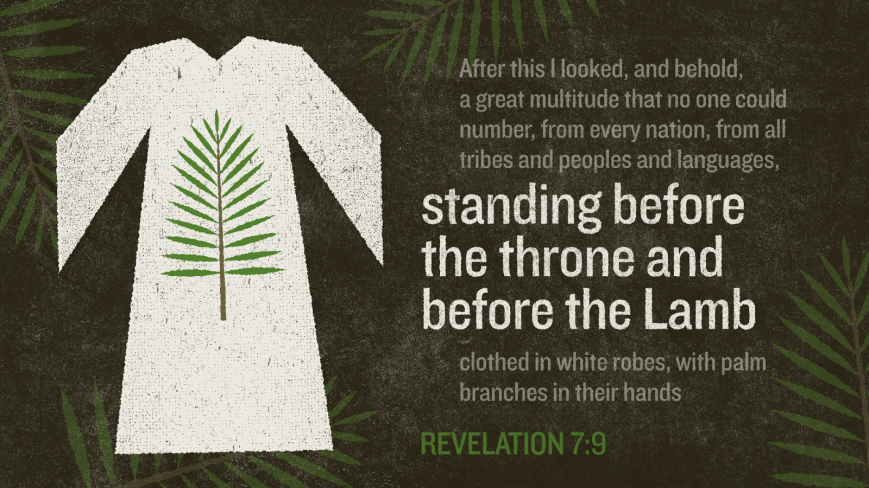
After this I looked, and there was a great multitude that no one could count, from every nation, from all tribes and peoples and languages, standing before the throne and before the Lamb, robed in white, with palm branches in their hands. They cried out in a loud voice, saying, “Salvation belongs to our God who is seated on the throne, and to the Lamb!” And all the angels stood around the throne and around the elders and the four living creatures, and they fell on their faces before the throne and worshiped God, singing, “Amen! Blessing and glory and wisdom and thanksgiving and honor and power and might be to our God forever and ever! Amen.” Then one of the elders addressed me, saying, “Who are these, robed in white, and where have they come from?” I said to him, “Sir, you are the one that knows.” Then he said to me, “These are they who have come out of the great ordeal; they have washed their robes and made them white in the blood of the Lamb. For this reason they are before the throne of God, and worship him day and night within his temple, and the one who is seated on the throne will shelter them. They will hunger no more, and thirst no more; the sun will not strike them, nor any scorching heat; for the Lamb at the center of the throne will be their shepherd, and he will guide them to springs of the water of life, and God will wipe away every tear from their eyes.”
agnus-dei-window-1024x768

The couple had recently celebrated their 60th wedding anniversary when they tragically died in a car crash. They were in relatively good health at the time, mainly due to the wife’s dedication to their diet and forcing them to both get exercise, but when the crash occurred they were immediately brought before St. Peter and the pearly gates.

After a quick check-in, much like the first minutes at a tropical resort, St. Peter volunteered to give them a tore of their heavenly abode. The mansion they would be calling home for eternity was filled with more rooms than they could count with a beautiful kitchen, swimming pool, and movie theater in the basement. As the wife squealed in delight with every passing accommodation, the husband grew skeptical and finally leaned over to Peter and asked, “So how much is this going to cost?”

Peter, flabbergasted, replied, “It’s free, this is Heaven.”

Later, they toured the endless golf course that started in their backyard. With perfect rolling hills that they could only have imagined on earth, they took in the beauty that was available whenever they wanted. The old man, again, asked Peter, “So what are the green fees?

Peter replied, “This is Heaven and you play for free.”

Finally Peter brought the couple to the clubhouse that was filled with people from their lives that they had loved and lost. The joyful reunions went on for some time until Peter motioned for the couple to go through the lavish buffet that had been prepared. The old man, still skeptical, quietly asked Peter how much the food would cost.

Peter, now growing frustrated, said, “Don’t you understand yet? This is Heaven, it’s all free!

The old man stood still and then asked, “Well where are the fat free and low cholesterol tables?”

Peter then began to lecture, “That’s the best part. You can eat as much as you like of whatever you like, and you never get fat or sick. This is Heaven!

Immediately the old man went off with a fit of anger, throwing down his hat and stomping out of the clubhouse.

Peter and the wife both tried to calm down the old man and asked what was wrong. The old man looked at his wife and said, “This is all your fault! If it wasn’t for your diet and exercise, I could have been here ten years ago!

What’s heaven like? I get asked this question on a pretty regular basis. I might be in my office with a grieving family who just lost someone they loved and someone will ask what the person is now “doing” in heaven. Or I’ll be here in the sanctuary teaching a lesson to the preschoolers when the subject of heaven comes up and one of them will say something like: My mommy told me that heaven is full of your favorite candy, and you can have as much of it as you want!

What’s heaven like? There are a decent number of times when scripture is descriptive about the beyond, but it is a far stretch from the jokes and movies many of have experienced on the subject. John caught a glimpse of the heavenly glory of God’s presence in a vision and described it like the grandest worship service to have ever occurred. Countless beings that have made it through the great tribulation surround the throne of the Lord where the Lamb is in the center. They sing with full voices and praise the Lord unceasingly for his majesty is beyond comprehension.

Rev 7v9

The problem with talking about heaven is that whatever we say, it is speculative at best. We can point to scripture where it is described, but the descriptions are made in such a way that heaven is beyond our comprehension. The whole point of heaven after all, is that it is totally other from earthly life. It is beyond life. It is glory and wisdom and thanksgiving and honor and power and might in a way that is impossible for us to understand during our earthly lives.

And even though we can only hint at what heaven might be like, it has become the pinnacle concern for many churches and Christians. What do I have to do to make it to heaven? Or what do we have to do in order to get other people to heaven? These questions dominate our thoughts and we grow anxious about whether or not we, and the people we love, will go on to our heavenly reward.

When talking about heaven, there is a strong temptation to make it so appealing with comparisons to earthly beauty that we neglect to think about the fact that we are called to exist here on earth until our deaths. But this text, this worshipful understanding of heaven, lets us know that God never promised we would not suffer. In fact the opposite is true. Suffering has always been part of our story, and even we here in the blessed region of Western civilization are not immune.

Only in death can we receive the gift of resurrection. It was only through Christ’s crucifixion that he could one day be raised again. The same holds true for us. Only when the bell tolls for us will we share in Christ’s victory over death.

And yet we still talk about it all the time. It is good and right for us to celebrate Christ’s resurrection, but when daydreams about our everlasting reward later prevent us from serving the needs of others right now it becomes cheap grace.

In many churches, like the ones most concerned about whether others are going to heaven or hell after they die seem less concerned with the hells on earth right now. Here in scripture John is confronted with the suffering of the great multitude before they arrive at the throne. They are granted a peace they did not have on earth: they will not hunger, nor thirst, the sun will not strike them, nor any scorching heat because the Lamb of God has shepherded them to the springs of life where God wipes away all tears. But before we can rejoice with the Lord in his divine kingdom, we will endure tribulations in our earthly lives.

Imagining that our lives will be free from suffering is what often leads people to leave the church when something goes wrong. I know too many people my age who were forbidden from attending funerals as children, and then when they finally attended a funeral for the first time when they were older they fell away from the church. I also know too many people who lived such perfect and sheltered lives that when they encountered true poverty for the first time they were overwhelmed by the brokenness of the world and have been unable to return to church.

The church is supposed to be the alternative to this overly rosy view of the world. We have the church to help us remember exactly what God has promised, and what God has not. The church is the place where we confront the hardships of life and rely on the people in the pews next to us to help us through the great tribulations we experience. We are not here to prance around pretending that we have perfect lives without suffering, but instead to proclaim that in trusting the Lord we will find the strength and courage to sustain us until that time when we will join Jesus in the victory over death.

The church is the means by which we combat the hells we experience on earth by attempting to give people hope and faith in something greater than earthly life can offer.

bigstock-Cross-against-the-sky-24690071-panorama

In this church, at St. John’s, we strive to help guide and nurture one another through a variety of means. We have bible studies for the young and the old to help us wrestle with how scripture can speak into our everyday experiences. We collect food and clothing and money for others who are desperately in need. We send people on mission trips to build and plant new foundations and relationships for people who really feel like they are living in hell right now.

But we also have a woman here in the church who has made it her calling to help nurture people in the midst of suffering in the best way she knows how. I believe that Dianne Wright is keeping Hallmark in business through the countless cards she sends out to the community. If you’ve been coming to this church for any regular period of time, and have had so much as a cold, you’ve probably received a card from Dianne Wright. They are always thoughtful, they are always written with purposeful words, and they are always filled with love.

I have the added benefit of not just receiving cards when I need them, but I visit enough of you and our shut-ins to know how prized these letters have become. I was visiting someone at King’s Daughters recently when I saw the familiar script sticking out of the cards adorned in a row on the window sill. The woman I visited described them as the most precious gift she had received since she went in to rehab.

Time and time again I will find myself visiting someone and the subject of Dianne’s cards will come up. They might appear to be a simple and casual gesture, but they speak volumes in the realm of how we are sustained by God’s grace through our neighbor Dianne.

As Christians, we are called to combat the countless hells on earth that plague people through our love and presence. For Dianne Wright, this has meant a ceaseless commitment to communicating through cards the love, depth, and peace of God.

Each of us, in some way shape or form, has gifts that we use to share God’s love with others. Perhaps we have the freedom to visit with people who can no longer visit us. Maybe we, like Dianne, have a penchant for penning letters. Perhaps we have been blessed with lucrative careers that allow us to give charitably to help others. Maybe God has molded us with a spirit of prayer and we can lift up the world through our clasped hands. Perhaps we have become familiar with a particular need in the world and all we need is a little nudge to start serving God by serving others. Maybe we have toyed with the idea of a calling to the ministry and we just need to take a step in faith that God can use us to spread the gospel. Perhaps we have the gift of carpentry like Jesus only we’ve been too nervous to ask someone we know if they need any repairs. Whatever our gift might be, God is calling us to use them to draw people into moments of heaven on earth.

When our time comes God will do with us what God wants. In God’s infinite wisdom and glory we will surround the throne and join in one voice with the saints who came before us, and with the saints who will come after us. We will be washed with the blood of the lamb and God will wipe away every tear from our eyes.

We know not when we will gather with the great multitude, but each day God gives us is a gift. A gift we should celebrate by being a gift for others. Amen.

This Is Not The End

Mark 13.1-8

As he came out of the temple, one of his disciples said to him, “Look, Teacher, what large stones and what large buildings!” Then Jesus asked him, “Do you see these great buildings? Not one stone will be left here upon another; all will be thrown down.” When he was sitting on the Mount of Olives opposite the temple, Peter, James, John, and Andrew asked him privately, “Tell us, when will this be, and what will be the sign that all these things are about to be accomplished?” Then Jesus began to say to them, “Beware that no one leads you astray. Many will come in my name and say, ‘I am he!’ and they will lead many astray. When you hear of wars and rumors of wars, do not be alarmed; this must take place, but the end is still to come. For nation will rise against nation, and kingdom against kingdom; there will be earthquakes in various places; there will be famines. This is but the beginning of the birth pangs.

511238384_640


The temple in Jerusalem was something to behold. It captivated the hearts and imaginations of countless Israelites throughout the centuries and was the pivotal focus of their faith. During times of strife and warfare the Hebrews would pray for the foundation of the temple. When uncertainties remained in the air, the temple was the place to offer sacrifices. It stood as a beacon to all with eyes to see regarding the power and the glory of the Lord.

It is no wonder therefore why the disciples couldn’t help but marvel at the giant stones when they were walking with Jesus. After spending a considerable amount of time ministering to the last, least, and lost in Galilee, Jesus triumphantly entered Jerusalem on the back of a donkey and brought his friends to the temple.

“Look Lord! Look at the large stones and large buildings!” Like the dwarfing power of a modern skyscraper the temple kept the disciples’ eyes in the sky. But then Jesus said, “See these buildings? Not one stone will be left here upon another; all will be thrown down.

I can almost imagine the disciples rubbing their hands together in anticipation; “Finally Jesus is getting ready for the revolution! He keeps talking about the first being last and the last being first, now is the time to strike!”

Later, when Jesus was sitting on the Mount of Olives opposite the temple, the inner circle of disciples gathered close and asked Jesus privately, “Tell us, when is it going to happen? What will be the sign that all these things are about to be accomplished?”

Then Jesus began to teach them, “Beware that no one leads you astray with empty promises about the end. Many will come in my name declaring change and messianic power, and they will lead people astray. When you hear about wars and destruction, do not be alarmed; this must take place, the end is still to come. There will be earthquakes. There will be famines. This is just the first part of the birth pangs, the beginning of the end.

this-is-not-the-end

We call this an apocalypse. Commonly understood to mean the destruction of the world, it conveys much more than that. An apocalypse is a revelation from God; it is a vision of a timeless reality. It is the past, the present, and the future. Jesus’ friends saw the temple as the end-all-be-all of faithful living, and he quickly brushed it aside to say that even bricks and mortar will fall away. Don’t put your faith in the buildings and in the structure but in the Lord who reigns forever.

But then Jesus takes the time to warn his friends about the coming days, things that we are still experiencing even now. Watch out for the deceivers who claim to know when the end of the world is coming, beware of the preacher who proclaims words in Jesus name that don’t match what Jesus said, keep guard when you encounter the Christian as sales-rep and instead look for the Christian as servant.

Jesus’ words are tough to swallow in our comfortable contemporary condition. We would rather hear about the miracles or the ethical teachings of Jesus. But today we hear about the devastation, the destruction, and the death that will come before the end. When you look out at the world and it looks like the very fabric of life is unraveling, the end is still to come. When you feel lost and alone deep in your soul, unsure of your future and welfare, the end is still to come. When you lose a loved one to death, and you feel like you can’t go on, the end is still to come.

Only a Messiah like ours would dare to proclaim the end as the beginning, the fear as the new birth.

Francine Christophe is an 83-year-old French writer and poet who survived the Holocaust. She was recently interviewed for a documentary about what it means to be human and this is what she said:

“My name is Francine Christophe. I was born on August 18th, 1933. 1933 was the year when Hitler took power… When I was 11 years old in the Bergen-Belsen camp, an amazing thing happened. Let me remind you, as the children of prisoners of war, we were privileged. We were permitted to bring something from France. A little bag, with two or three small items. One woman brought chocolate, another some sugar, a third, a handful of rice. My mom had packed two little pieces of chocolate. She said to me, “We’ll keep this for a day when I see you’ve collapsed completely, and really need help. I’ll give you this chocolate, and you’ll feel better.

“One of the women imprisoned with us was pregnant. You couldn’t tell, she was so skinny… But the day came, and she went into labor. She went to the camp hospital with my mom, the barracks chief. Before they left, my mom said, “Remember that chocolate I was saving for you?” “Yes, Mama.” “How do you feel?” “Fine, Mama. I’ll be okay.” “Well, then, if it’s alright with you, I’d like to bring your chocolate to this lady, our friend Helene. Giving birth here will be hard. She may die. If I give her the chocolate, it may help her.” “Yes, Mama. Go ahead.”

“Helene gave birth to the baby. A tiny, little, feeble thing. She ate the chocolate. She did not die. She came back to the barracks. The baby never cried. Never! She didn’t even wail. 6 months later, the camp was liberated. They unwrapped the baby’s rags, and the baby screamed. That was when she was born. We took her back to France. A puny little thing, for 6 months.

“A few years ago, my daughter asked me, “Mama, if you deportees had had psychologists or psychiatrists when you returned, maybe if would have been easier for you.” I replied, “Undoubtedly, but we didn’t have them. No one thought of mental illness. But you gave me a good idea. We’ll have a lecture on that topic.” I organized a lecture on the theme: “If the survivors of concentration camps had had counseling in 1945, what would have happened?”

“The lecture drew a crowd. Elderly survivors, historians, and many psychologists, psychiatrists, psychotherapists… Very interesting. Many ideas emerged. It was excellent. Then, a woman took the podium and said, “I live in Marseille, where I am a psychiatrist. Before I deliver my talk, I have something for Francine Christophe.” In other words, me. She reached into her pocket, and pulled out a piece of chocolate. She gave it to me and she said, “I am the baby.”

I can’t imagine the fear of being pregnant while in one of the concentration camps. New birth and new life is supposed to be filled with such hope and promise, but to be pregnant in one of the camps was basically a death sentence.

Francine Christophe’s story is a powerful reminder of the power of new life in the midst of chaos and calamity. We see the truth and depth of Jesus’ words, “the end is not yet.

Today, faithfulness and religious observance is either a fanatical or apathetic endeavor. Turn on the news and you will quickly hear about the destructive powers of ISIS, the greed of the Church, or the failure of Christian politicians. The world quickly identifies the people who claim to speak on behalf of Jesus who then rapidly lead disciples away from the truth. They care more about the color of Starbucks coffee cups than they do about children going hungry. They preach intolerance instead of love, they emphasize death over resurrection, and they support destruction above new life.

On the other side, countless churches contain only the blandness of discipleship. Week after week the pews are filled with less and less people as the sermons are filled with more and more trite clichés about living a better life. Cultural Christians might take the time to attend worship and offer up a few dollars and change when the plate comes around but their once deeply rooted faithfulness has been replaced with apathy for all things religious. They have a bible displayed at their homes but it is covered in dust, they go to church simply because that’s what you’re supposed to do, and they only pray when they don’t know what else to do.

Against the fanatical religious leaders of today, Jesus warns us to “beware that no one leads us astray.” Hold fast to the love that has been revealed to you in scripture and in the church, remember who you are and whose you are.

            And against the apathetic churches of today, Jesus announces an electrifying message: the end is not yet!

This kind of scripture might terrify us to the core; we might see the world falling apart and immediately identify what we witness with what Jesus warned his disciples about. From our comfortable vantage point, these verses are more horrifying than hopeful. But for those for whom the present is a terrifying reality, it is a truly hopeful word.

For a pregnant woman in the middle of a concentration camp, “this is not the end” rings true in a young woman with a gift of chocolate.

For a grieving family preparing to gather for a funeral, “this is not the end” takes on a whole new meaning when they hear about the glory of the promised resurrection.

For a city in France that is still mourning the loss of so many innocent lives, “this is not the end” becomes powerful through the global community responding in love and prayer.

For a church that sees fewer and fewer people in the pews each week, “this is not the end” resonates in the commitment to spread the Good News of Jesus Christ.

No matter what you are going through in your life right now, hear Jesus’ hopeful words and know that they are meant for you, “this is not the end.” Amen.


151114-paris-peace-sign.jpg.CROP.promovar-mediumlarge

Devotional – 1 Thessalonians 5.9-11

Devotional:

1 Thessalonians 5.9-11

For God has destined us not for wrath but for obtaining salvation through our Lord Jesus Christ, who died for us, so that whether we are awake or asleep we may live with him. Therefore encourage one another and build up each other, as indeed you are doing. 

Weekly Devotional Image

When I arrived at church yesterday morning I had a lot on my mind. We had a rough and busy week here at St. John’s and the events from the previous days were weighing heavily upon my heart. After having the funeral service and burial for Chris Harris on Monday afternoon, I was surprised to hear on Wednesday that her husband and now widower, George, was rushed to the hospital and passed away shortly thereafter. Moreover on Thursday I received a phone call informing me that Howard Cassidy had been placed on Hospice care, and by the time I got to his room next door, he too had passed away. Our church quickly became the location for a tremendous amount of heartache and grief, and I was tasked with entering into that suffering and proclaiming the hope of the resurrection.

While I stood in the pulpit yesterday morning, talking with the gathered people about the importance of telling the great story, Marshall Kirby stood up from his pew and walked to the front. The sanctuary became silent as all eyes were on Marshall as he made his way up into the pulpit and wrapped his big arms around me in a hug. In the midst of our embrace Marshall said, “You do a great job telling the story for those who have died, and we are praying for you.” Up until that moment I had neglected to realize how much the recent funerals had taken a toll on me, and how badly I needed to be encouraged by the church through Marshall’s hug and words.

1Th5.11

Therefore, readers of this devotional, I task you with the same responsibility that Marshall exemplified yesterday in worship. The gathered body of Christ is tasked with encouraging one another and building up each other for the betterment of the community. Whether you know it or not there are people in your lives who are suffering and need some encouragement. It can be as simple as a phone call, an email, or even a letter. All it takes is that extra effort to ask how someone is doing, and then truly listen to their response.

I needed Marshall’s embrace and kind words yesterday. I needed to be reminded of my calling and feel the support of the people I serve during this difficult time. Moreover we are now called to encourage and build up the families who have lost their loved ones in the midst of death. We gather to support them at the funerals, but our support cannot end there; it must transcend the walls of our church into the great bounds of our community so that we can be Christ’s hands and feet for the world.

Who needs encouragement and building up in your life? How can you show them a glimpse of God’s love through your actions this week?

Devotional – Psalm 130.1-2

Devotional:

Psalm 130.1-2
Out of the depths I cry to you, O Lord. Lord, hear my voice! Let your ears be attentive to the voice of my supplications!

Weekly Devotional Image

The church service went as well as could be expected. The small gymnasium was perfect for the contemporary service setting and most of the chairs were occupied. Like a lot of contemporary services, it began with a succession of three or four songs all focused on praising the glory of God; some of the lyrics included phrases such as: “Your love never fails,” “He’s been so good, so so good to me, Jesus,” and “you are amazing God!” Immediately following the collection of praise songs, there was a time of welcome, a brief reading from scripture, and then a focused sermon with images and themes being displayed on two screens hung from the ceiling.

I don’t remember much about the sermon except for the refrain: “God loves you no matter what!” The preacher’s perfectly executed contemporary outfit (Black Tee-Shirt with Blue Jeans) was matched with a consistently dynamic smile throughout the message. I wanted some of whatever he was having.

4050-rote worship.630w.tn.jpg

After another dose of positive and uplifting music to close out the service, we were all dismissed to re-enter the world. I stood in the back watching the people neatly file out of the gymnasium, observing sporadic examples of fellowship between people. In the corner I noticed an older woman, clearly frustrated with something, and trying to vent her frustrations to those around her. When it became clear that no one was listening to her, I walked over to ask if something was wrong. “I can’t stand services like this!” she nearly shouted, “Its just too happy!” And with that she threw her complimentary coffee in the trash, and left the building.

Have you ever felt that way in worship? Have you noticed the abundance of smiling faces in worship, discovered the overwhelmingly uplifting nature of some hymns, all brought together with a happy and positive sermon delivered with three primary points? Have you ever felt suffocated by the amount of joy that some worship services attempt to produce?

Christian discipleship is not a blindly happy-go-lucky journey. There should be more time and focus in worship devoted to the suffering that is present in each of our lives (however small or large). The psalmist writes, “Out of the depth I cry to you, O Lord. Lord, hear my voice!” Sometimes, the most appropriate form of worship is clenching your fists and shouting out those same words.

So, do not be conformed to the ways of so many churches that appear to say that happiness is a requirement for discipleship. If you are deep in one of the valleys of life right now, I encourage you to cry out to God. If you are on one of the mountaintops of life right now, open your eyes to the needs of those around you, and make God’s presence known through your actions.

The Lord Will Raise Them Up – Sermon on James 5.13-20

(Preached at Aldersgate UMC on 9/30/2012)

James 5.13-20: “Are any among you suffering? They should pray. Are any cheerful? They should sing songs of praise. Are any among you sick? They should call for the elders of the church and have them pray over them, anointing them with oil in the name of the Lord. The prayer of faith will save the sick, and the Lord will raise them up; and anyone who has committed sins will be forgiven. Therefore confess your sins to one another, and pray for one another, so that you may be healed. The prayer of the righteous is powerful and effective. Elijah was a human being like us, and he prayed fervently that it might not rain, and for three years and six months it did not rain on the earth. Then he prayed again, and the heaven gave rain and the earth yielded its harvest. My brothers and sisters, if anyone among you wanders from the truth and is brought back by another, you should know that whoever brings back a sinner from wandering will save the sinner’s soul from death and will cover a multitude of sins.”

James, the brother of Jesus wrote to the early Christians: Are any among you suffering? They should pray. Are any cheerful? They should sing songs of praise. Are any among you sick? They should call for the elders of the church and have them pray over them, anointing them with oil in the name of the Lord. The prayer of faith will save the sick, and the Lord will raise them up. Let us pray.

The man was dying. The sterile controlled atmosphere of the hospital room was almost beyond comprehension. Electronic devices were hung particularly from metallic arms, fluids were flowing, and the low buzz of the oxygen machine provided the only audible accompaniment. The man in the bed was dying and he knew it. His pale blue eyes rested upon mine as I sat across from him not knowing what to say. The sounds of the hospital filled the void of our conversation while his wife wept next to me and his 12 year old son sat stoically staring out the window. I was in the first week of my internship in Birmingham, Michigan and had naively volunteered to make the hospital visits that day. The Henry Ford Hospital was what the parishioners affectionately referred to as the “Cadillac of Hospitals” and it certainly felt that way. Upon entering through the magnificently large main entrance, you were greeted by an assortment of boutiques and small restaurants; there were more trees planted inside the opulent hospital than there were outside on the grounds. Everything about it screamed the opposite of hospital until you explored far enough in to find the patients in their rooms.

The man continued to stare at me from his bed; his eyes spoke more to me than anything conversation would have. I expected to see fear and anxiety in those pale blue eyes, but instead I saw peace, a peace that existed in stark contrast with the tears being spilled on the couch next to me. I had attempted to initiate small talk when I had entered the room, but it went nowhere. As I returned to the dying man’s gaze I was overwhelmed with a profound desire, one that was instigated beyond myself. I leaned forward from my chair toward his bed and though I was afraid of how he would respond, I asked, “May we pray together?”

Throughout the gospel narrative Jesus constantly finds himself in a setting where his saving touch is required. As he made his way throughout Galilee, droves of suffering human beings followed the humble rabbi and implored him to make them well. He was dragged into houses to cure fevers, followed by crawling lepers seeking his simple touch, compelled by friends of a paralytic to bring back restoration. He was confronted with people consumed by demons that were then cast out at the touch and sound of Jesus’ voice. A woman with a hemorrhage reached out just to touch the hem of his garment as he passed by. The blind and deaf were brought before him over and over again, requiring only the simplest touch from Jesus to be made well.

The God who became flesh in Jesus Christ was intimately involved in the healing business. The church, it seems then, should be decidedly emphasizing the healing power that Jesus presented in his earthly ministry. Important for us is that according to the New Testament Jesus also laid his hands on his disciples enabling them to perform similar miracles to those that he himself had accomplished. He sent out the twelve two by two in order to proclaim the Good News and “they cast out many demons, and anointed with oil many who were sick and cured them” (Mark 6.13) Even after Jesus’ death and resurrection, the early church continued in this tradition and was capable of healing the crippled, casting out demons, and even restoring the dead back to life (Acts 3.1-10; 5.12-16; 9.32-43).

Written at some point in the latter half of the first century, the epistle of James has been traditionally connected with James, the younger brother of Jesus. The letter is famous for being Martin Luther’s least favorite book of the bible. Part of the letter addresses the difficult problem of wrestling between faith and work, and what really accomplishes salvation. But this morning we find ourselves at the end of the letter, and James confronts us: Are any of you suffering? You should pray. Are any of you cheerful? You should sing songs of praise. Are any of you sick? You should call for the elders of the church and have them pray over you, anointing you with oil in the name of the Lord. The prayer of faith will save the sick, and the Lord will raise them up.

I wonder about what it really means to be healed. Its very clear in the Bible that when Jesus and the disciples pray or lay their hands on someone that they are physiologically healed from their suffering: the blind see, the deaf hear, and the lame walk. But is this the full intent of healing? What does the “prayer of faith” have to do with being made well? Do we gather every week in order to worship the God who fixes broken bones, or is there more to “healing?”

Beyond physical restoration, Jesus places significant emphasis on the power of being healed in the community. Because of the fear of weakness and sickness in the first century, many who suffered were ostracized from their families and were isolated outside of the community. The people of the New Testament were very logical: they needed to isolate the sick from those who were well. However, Jesus does not agree with the logic of the world. After most of the healing narratives, Jesus commands the newly restored to return to their family or town. Jesus inverts this prescription institutionalized on the suffering with his resounding command: “Go home to your friends.”

The letter of James falls completely in line with Jesus’ perspective of the way the church should stand in contrast to the world. James specifically addresses those within the community who are suffering and sick and admonishes them to call upon the elders to pray over them. James, in line with Jesus, places all of the power with the weak and the last rather than the strong and the first.

Though James’ letter is filled with many commands for Christian living, this scripture right at the very end of the letter is the first and only time that he addresses the ekklesia, the church. The church of the first century existed in sharp contradiction to the expectations of the world. Can you imagine what that community looked like, where the sick had the power to call on the elders to come visit them; a place where the weak and lonely were no longer isolated from their families and friends; an intentional way of living predicated on the practice of mutuality? Remember this: What we believe shapes how we behave.

When I asked the dying man if we could pray together, I did not know how he would respond. The tension in the room was palpable, but he held my gaze and nodded in approval. Before I reached out my hands, I asked if there were certain things I could pray for in that moment. Usually, when I’ve asked this question in hospital rooms the answer is same: “Pray for this to go away, pray for me to get better.” But that afternoon in Michigan, the dying man turned my world upside down: “I want you to pray for the church,” he said, “I want you to pray for the church so that it can take care of my wife, so that my son can have role-models to emulate. I want you to pray for the church so that my wife won’t remain lonely without me, so that my son has someone to throw a baseball with. I want you to pray for the church so that it can be a family for mine… I know I’m dying, but I’m not worried about that anymore because I have faith in our God”

That dying man’s faith is what grace is all about. He believed in something greater, more wonderful, and magnificently mysterious. He, in those simple words, spoke the truth of Gospel better than many preachers ever have. Living a life of faith is not about what you do but it’s about who you are. It’s not about signing up for every Sunday suppers or mission trips, but about believing in the goodness of God and the redemptive quality of Jesus’ death on the cross. It’s not about isolating the weak and the sick away from the healthy; it’s about making community. It’s about being the place where the dying man’s wife and son could be family. The life of faith is predicated on the grace poured out on us everyday of our lives, whether its the simple touch of a hand in a hospital room, or a young boy hugging his father when he finally comes home from work.

The dying man, James, and Jesus all show us how grace works. We are called to live in such a way that we can live up to the expectations of that dying man’s prayer. The church, this church, is the place where we can answer his prayer. We can come together in our suffering through praying and being present with one another. We can come together in our cheerfulness singing our songs of joy and praise. We can come together when we are sick and weak calling for everyone in the church to pray over one another.

How many of us our suffering? How easy it is to pretend like we’re okay when everything is falling apart around us? Have we told anyone about our suffering? Over the last month and a half I have been interning for a church in Durham, North Carolina. As the church’s congregational care intern, it is my responsibility to visit members from the church in the hospital or those who can no longer make it to church. Maybe it’s because they know I’m studying to be a pastor, but many of the people I have visited have shared with me the depth of their being: I have learned about cancers, divorces, unemployment. What I come to discover later is that I am the only one who knows about any of it. Many of these people have not shared their suffering with the best friends, or even their real pastors. Why are we so afraid to open up with on another? Have you told anyone about how you’re suffering? Listen to the command of Jesus through his brother James! We are the church James is speaking to! What would it mean for you to share your fears and failures with your brothers and sisters in Christ. How differently might we view each other when we know the depth of one another’s being?

James is showing us how we can be healed. Part of that responsibility rests on our shoulders: Are any of you sick? You should call for the church to pray over you! We are called to be a community committed to the welfare of the entire body of Christ, one where we know how we are doing, and what we can do for each other. That is our responsibility. What we believe shapes how we behave!

“The prayer of faith will save the sick, and the Lord will raise them up.”

Our belief is that through God’s grace that we find our truest wellness. The grace that he gave to us without any merit of our own, the grace that was poured upon us in the redemption of the world by our Lord Jesus Christ, the grace that knows no bounds! Through grace, the Lord will raise us up.

Amen.