The Methodists – Sermon on Psalm 22.25-31

Psalm 22.25-31

From you comes my praise in the great congregation; my vows I will pray before those who fear him. The poor shall eat and be satisfied; those who seek him shall praise the Lord. May your hearts live forever! All the ends of the earth shall remember and turn to the Lord; and all the families of the nations shall worship before him. For dominion belongs to the Lord, and he rules over the nations. To him, indeed, shall all who sleep in the earth bow down; before him shall bow all who go down to the dust, and I shall live for him. Posterity will serve him; future generations will be told about the Lord, and proclaim his deliverance to a people yet unborn, saying that he has done it.
3-abstract-stained-glass-textures

How can we get young people to worship?” I get asked this question all the time. Because I am young and involved the church, many assume that I have the secret to unlocking the riddle of putting younger people in pews. The truth is, I have no answer to the question. For me, it is as simple as discovering God in a place and time such as this, and therefore I return week after week because it provides the strength for my own discipleship. I don’t know what to do to get younger people to worship other than doing what we do well. 

However, some believe the key to growing the church can be found in contemporary worship. The belief goes that traditional worship styles with stained glass sanctuaries, organs, and hymnals, no longer connect with people and give life.

So, contemporary services strive for the opposite, instead of traditional church architecture they meet in auditoriums or gymnasiums, instead of stained glass they use projectors and screens, instead of an organ and hymnals they use a rock band and display lyrics on the screen. Many church planters believe this is the future of worship, that if we want the church to grow we have to be willing to let go of the past and embrace the future.

I’m not so sure.

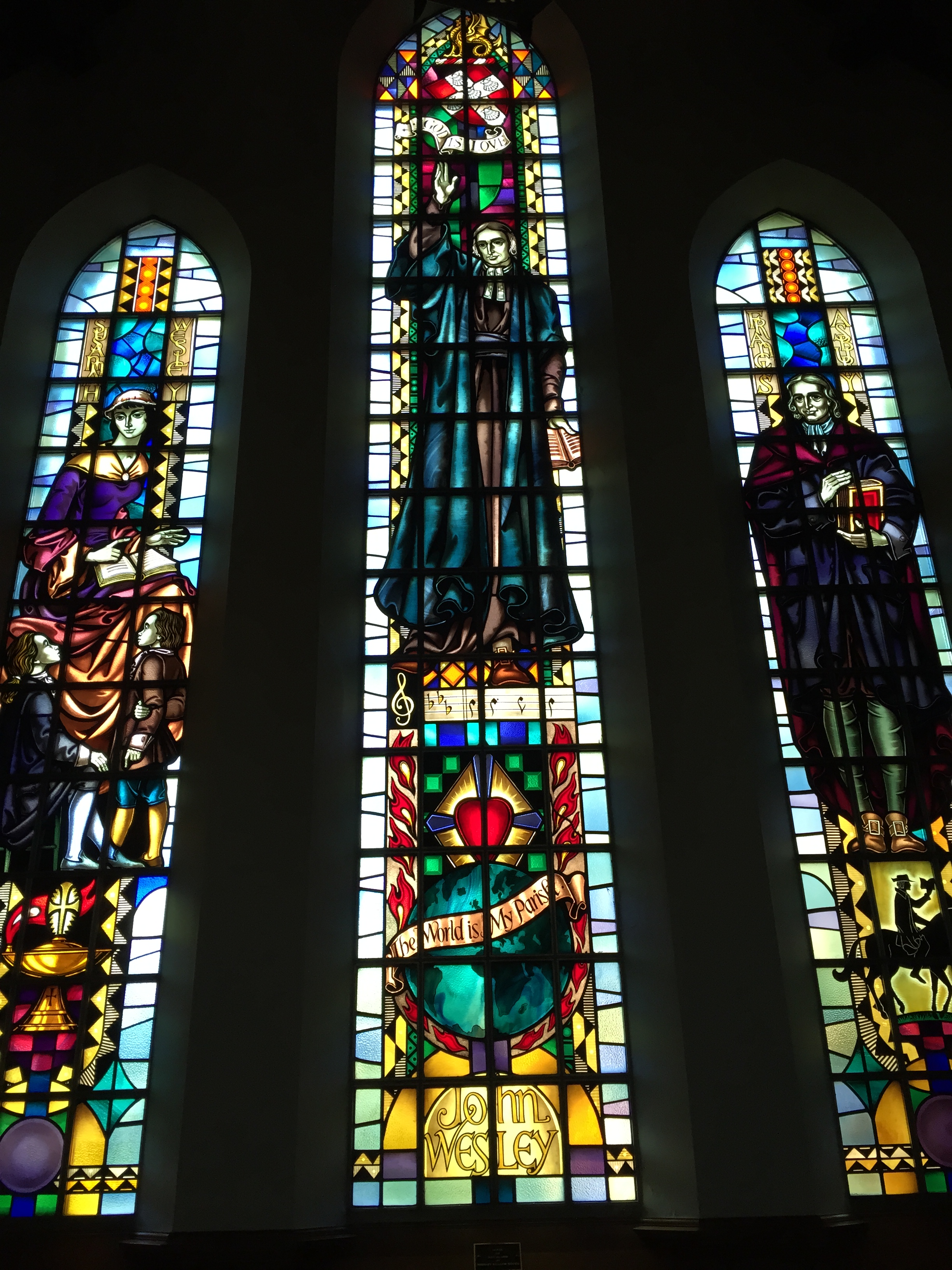
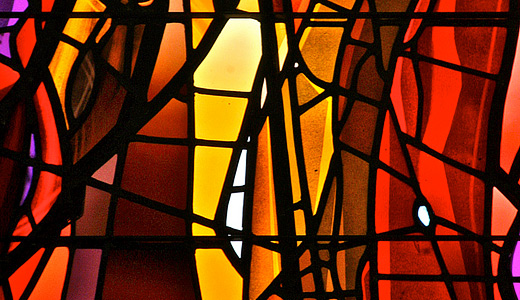
Interestingly, many young people are finding themselves drawn to traditional worship, while contemporary services are regularly filled by the boomer generation. Why? What we discover in traditional worship is unlike anything we encounter during the week. Worship is supposed to be different than our daily lives and fill us with God’s grace. I could go on an on about the importance of listening to the organ and singing our faith from the hymnal, but I’ll save that for another sermon series. This month we will take time each week looking at the Stained Glass of our sanctuary and wrestle with how they convey the Good News to us today.

We begin with what I call “The Methodists.

IMG_0062

The first window contains the mother of Methodism Susanna Wesley. Born in 1669, Susanna was the twenty-fifth of twenty-five children. Her father, was a preacher of sorts who rebelled against the status quo of the Church on England and he consistently encouraged his daughter to study books from his library (against the conventional wisdom). Susanna eventually married Samuel Wesley, a clergyman from the Church of England and gave birth to 19 children, of which only 10 lived to adulthood.

Because her husband was often busy with the responsibilities of the parish, Susanna was left to raise and educate the children on her own. They all learned Latin and Greek and were well informed in classical studies.

The image in our window shows Susanna teaching two of her sons, John and Charles Wesley. She took seriously the need for her children to be raised with a proper education and also put a tremendous emphasis on raising them in the faith. I don’t know for sure why the artist chose this particular representation, but I imagine it has something to do with an episode during her life when her willingness to engage her children sent them on a path that led to a renewal within the church, and eventually a new church.

The story goes that her husband was gone in London for a period of time, and a guest preacher was brought into the local parish. After a few weeks of particularly sub-par sermons, Susanna decided to assemble her children on Sunday afternoon for her own services. It would begin with the singing of a psalm, then Susanna read a sermon written by her father or husband, and concluded the worship with another psalm. Word about the services began to spread and people started to ask if they could attend. At the height of her Sunday afternoon services, over two hundred people were attending regularly, while the Sunday morning service at the local church dwindled to nearly nothing. 

Susanna, like the psalmist, believed in the importance of remembering and returning to the Lord. She took time each week to educate her children, and the local community, about God’s dominion so that future generations would be told about the Lord.

Whenever our eyes fall upon this window we remember that we, like Susanna, are called to nurture and teach and love those around us. John and Charles Wesley would eventually grow into the men who sparked a theological revolution. Charles will always be remembered for his hymn writing (all of the hymns we are using this morning were written by him) and John would become the founder of Methodism.

This window helps us to remember that we can serve the Lord by sharing the Lord with others. Our words are powerful and they can be the spark that ignites a revolution of the heart.

The second window portrays a grown John Wesley during the height of the Methodist renewal movement. Born in 1703, he was raised and taught by his mother and followed a call to ministry within the Church of England. However, John grew disenfranchised with the way the church was being run, he saw pastors who were following a career path rather than giving their lives to Christ. He saw people fighting for positions within the church rather than submitting to the will of God. He saw hypocritical preachers rather than people seeking holiness of heart and life.

After a particular string of episodes that left him filled with doubt, John Wesley had his heart strangely warmed during a small service on Aldersgate Street in London. He wrote in his journal: “I felt my heart strangely warmed. I felt I did trust in Christ, Christ alone for salvation: And an assurance was given me, that he had taken away my sins, even mine, and saved me from the law of sin and death.” (The Journal of John Wesley, 35).

The glowing heart in our window is a reminder of his conversion experience. From that point forward he felt called to spread scriptural holiness of heart and life throughout the lands and helped to form small groups through the country to help disciples grow in love of God and one another. The moment of heart warming encouraged him to see the world as his parish. Rather than being limited to a particular time and place, John Wesley listened to the Spirit’s call and moved according to God’s will.

IMG_0065

John, like the psalmist, believed in the importance of remembering the Lord’s works even to the ends of the earth. He understood Jesus as Lord and did whatever he could to share the love he experienced in his heart with other people.

Whenever we take in the beauty of this window we remember that we, like John, are called to feel and experience God’s pardoning and loving nature. Having our hearts strangely warmed is at the heart of what it means to follow Christ and give our lives to discipleship. Yet, once we feel this assurance like Wesley did, we cannot just keep it to ourselves. If it really is something that transforms our very lives then we should be willing to go even to the ends of the earth to help others remember the Lord.

The gift of God’s love is something worth sharing with others just like John did. Our words are powerful and they can be the spark that ignites a revolution of the heart.

Our third window displays Francis Asbury, the symbol of American Methodism. John Wesley discovered Asbury while a young man in England and encouraged him to become a circuit riding lay-preacher for the renewal movement. He was remarkably successful as a preacher even at a young age.

In 1771 Wesley sent lay preachers to continue the movement in the colonies including the young and talented Francis Asbury. However, by 1777, at the height of the American Revolution, all but one, Asbury, would return back to England. For Asbury the kingdom of God was more important than any human nation, and nothing would stop him from following his call.

Asbury became the de facto leader of the movement and spent the rest of his life traveling on horse back to spread scriptural holiness. When he arrived in the colonies there were 600 people participating in Methodist ministries. By the year of his death (1816) there were more than 200,000 members (2.3% of the population) making it the single largest Christian tradition in America at the time. 

Why was he so successful? In our stained glass we see Asbury holding a bible and riding on a horse. He had a strong and fundamental belief that the Lord was calling him to reform the continent, and to spread scriptural holiness over the land. Asbury was willing to go wherever whenever with only the Word of God to guide his words and actions. He traveled so widely across the landscape that at one time he was the most well known man in America simply because of how much he traveled.

Asbury, like the psalmist, believed the people were hungry and yearning for something greater than themselves. He understood that if he was willing to bring the Word to the people, that they would feast and be satisfied. He gave his life to the mission of spreading holiness so that people would praise the Lord.

Whenever we gaze upon this particular window we remember that we, like Asbury, have a responsibility to help people feast on the Word. Going out and meeting people where they are is fundamental to the kingdom of God. If we are content to just wait for people to show up with their questions and hopes, then we will be disappointed. This window gives us the encouragement to give of ourselves for other people just like Francis Asbury was willing to do.

The gift of God’s grace and mercy is something worth sharing so that others might feast and be satisfied. Our words are powerful and they can be the spark that ignites a revolution of the heart. 

What we do in worship, how we understand discipleship, and even why we gather for communion was largely determined by the three Methodists in our stained glass. From Susanna’s Sunday afternoon lessons, to John’s heart-warming experience, to Asbury’s commitment to mission of God, we are who we are because of what they did. However, if we call ourselves Wesleyans or Methodists, it is fundamentally important to remember that we are first disciples of Jesus Christ.

These three Methodists followed Christ and their lives were results of their discipleship. It was through their reading of scripture and persistent prayers that they started a revolution within the greater church and brought the Word to people to tell them about the Lord.

When we come to gather at the Lord’s table in a few moments, let us remember that Susanna, John, and Asbury all gathered at a table such as this to feast on the Lord and receive the strength for their discipleship. Wesley in particular believed in constant communion, doing whatever he could to experience the Lord’s grace at all times. If you want to know God’s grace and love, look no further than this table.

But after we feast, what shall we do? Shall we return to the busyness of our lives and forget the importance and value of finding holiness? Will we limit the power of the Lord to Sunday mornings at 11am?

Or will we take the bread and cup and let it nourish our souls for the work of discipleship? Will we pray fervently for the Lord’s will to be done? Will we go out into the world to tell future generations about the power of God?

Now is the time for a revolution of the heart. Amen.

5484428341_c71e6c50c4_z

What Is Love? (Jesus Don’t Hurt Me) – Sermon on 1 John 3.16-24

1 John 3.16-24

We know love by this, that he laid down his life for us – and we ought to lay down our lives for one another. How does God’s love abide in anyone who has the world’s goods and sees a brother or sister in need and yet refuses help? Little children, let us love, not in word or speech, but in truth and action. And by this we will know that we are from the truth and will reassure our hearts before him whenever our hearts condemn us; for God is greater that our hearts, and he knows everything. Beloved, if our hearts do not condemn us, we have boldness before God; and we receive from him whatever we ask, because we obey his commandments and do what pleases him. And this is his commandment, that we should believe in the name of his Son Jesus Christ and love one another, just as he has commanded us. All who obey his commandments abide in him, and he abides in them. And by this we know that he abides in us, by the Spirit that he has given us.

tumblr_lcd0x7hrio1qectnco1_500_large1

1 John is a letter written by a wise, old, veteran Christian leader who continues to help those who are new and young to the faith by addressing the challenges of discipleship. What we have read this morning encompasses John’s understanding of love, Christ’s love, and the need for Christians to find this same love in their lives. Now, to be clear, I am not like John. I am not a mature Christian leader, with years of experience to rely upon. I cannot pull from the wisdom of leading churches throughout the decades to help those who are struggling. I am not like John. In fact, I’m the kind of person that John wrote this letter to in the first place.

Yet, knowing I am not qualified, I decided to write my own letter this week as if I were John to our contemporary church…

tumblr_nlfp9qcFN51u06rnxo1_500

Dear St. John’s,

What is love? Do you ever find yourself asking that very question? Love seems to be one of those things, those words, that we tend to just throw around without really thinking about what it means. I love your outfit! I love what you’ve done with the place! I love eating frozen Kit Kats! I love you!

Love, as a word, has the power to mean everything and nothing. For instance: when we start dating and we grow closer and closer to someone else and they say for the first time: “I love you” it can mean everything in the world. Time can slow down and we can remember the way we felt when we heard it for the first time. However, years later, “love” can become routine, that word we use to end conversations rather than to declare how we feel in our heart of hearts. Love becomes a filler rather than a feeling.

What is love? Is it something that we can only experience in a romantic way? Can we love our friends and family? Can we love our church? Can we love the Lord?

This is how we know what love is: that Jesus laid down his life for us – and we ought to do the same for one another. Now, stay with me if you can, I know that as you read this letter you might already start to grow weary of this thing called love. How willing are we to really lay down our lives for other people? Frankly, most of us will never have to come that far, we will never be martyred for our faith. For as much as we talk about lifting up our cross to follow Christ, it is unlikely that we will ever find ourselves hanging on that cross for what we believe.

Yet, as Christians, this is how we know what love looks like. That a man, fully God and fully human, delivered himself to die for us even when we did not deserve it.

St. John’s, how can the Lord’s love abide in us when we are filled with the world’s goods, but we refuse to help our brothers and sisters in need? Is it possible to love without sacrifice?

Most of us want to love and be loved so long as it doesn’t hurt. We want to know all about love, and we are ready to follow the Lord’s commands so long as it won’t cost us anything.

Love is never really love unless it has the power to harm us.

Discipleship is never holy unless we are willing to sacrifice and be deeply honest with ourselves and others. Trust is never fully possible until we know what’s its like to have our trust broken. Love is what it is because it can both build us up and tear us down.

We might never have to die for somebody else like Jesus did for us, but to love others implies a willingness to lay down our needs and desires for someone else’s needs and desires. What is love if not a willingness to be vulnerable with another?

So, if we want to love, let us do so not with words or speeches, but in truth and action. Anybody can say “I love you”; it is far harder for our lives to match our words. Do we practice what we preach? Are our feet and tongues in alignment? Do our actions match our professions?

Love is hard. It requires dedication and commitment, vulnerability and sacrifice, honesty and attention. We would rather love with our words because we do not have the strength to love with our actions. This is why we pray; We pray for the Lord to give us the strength to love the unlovable because we cannot do it on our own.

Have you ever noticed the covenants made at a wedding? The couple consents and promises to love one another in the sight of God and witnesses, but then the entire congregation makes a promise to nurture that couple in love. Romantic love and a promise between two people is not enough to sustain a life-long marriage. We need others to hold us accountable to the promises of love, and in particular to the love between partners.

Have you ever noticed that sometimes, in fact many times, the Lord does not answer our prayers? Or at least not the way we would want to the Lord to answer them? We know that the Lord is greater than our fickle hearts and that he answers our prayers, but sometimes we ask for the wrong things.

How often do we pray for the Lord to fix this or that, to make our children better, to rid us of our sickness when we could be praying for the Lord to give us the strength to address our own problems, the courage to be honest with our kids, and the endurance to bear the pain?

The Lord is greater than all of our selfish desires and trite fixations. The Lord’s love knows no bounds and continues to seek us out even when we turn away. This is the truth of the Good News, that God’s love remains steadfast even as ours falters. We will never be able to love others in the exact same way that God does, but our challenges is to strive for it nonetheless.

tumblr_m9ho7dWZYb1rcmqo9o1_500

St. John’s, our church needs some encouragement so despair will not take root. We need to love and feel loved. We need to lift one another up with this sacrificial love so that we might know and experience God’s love right now through each other.

If we fail in our own eyes, if we feel that we have been a disappointment, be assured that God knows our hearts better than we do. We might look in the mirror every morning and see regrets, failures, and short-comings, but the Lord sees hope, beauty, and wonder. We might replay in our minds the hateful words that have been shouted at us by our bosses, friends, and spouses, but the Lord wants us to hear only one thing: you are loved.

Do we know that we are loved? Do we feel it in our lives on a regular basis? Do we experience a feeling of worth from the Lord through others?

The Lord has given us a worthy commandment: we should believe in the power of his Son Jesus Christ, and we should love one another. 

I asked the children of our preschool about love and they were able to describe it in a way that many of us forget by the time we grow up. They want to love because it makes them happy, they feel love through hugs and snuggles and time well spent. Yet, when I asked one particular boy if he feels loved, this is what he said: “I feel loved by my mommy and daddy whenever they hug me and sit with me. But I don’t know why they love me.

It is so sad that we believe love can only exist when it is deserved or warranted. We live in such a commodified society, that we expect that love only accompanies good behavior.

God’s love is unconditional, and ours should be to.

You might not know it, or even believe it, but I have seen this love made real and tangible through the people in our pews.

When we learned about the needs of a community in West Virginia, men from our church volunteered to shave their faces just so we could raise money for the mission trip. They literally put their faces on the line for God’s kingdom. At the same time, everyone that contributed financially sacrificed from their lives so that we might bless and love on others in need. We responded in love not because of what people deserve, but simply as a reaction to need.

When we learn about someone’s recent diagnosis or loss of a loved one, we gather together to nurture them and surround them with care. We write cards and offer prayers, we drive to homes and cemeteries, we sit and we listen. We respond in love not because they once did the same for us and we believe that we owe it to them, but we do so because living by loving is the only way that makes sense as Christians.

If love is real, there is no “why?”

What is love? God is. We love others because God loves us. God was willing to humble himself to the form of flesh, to know what we know and feel. God was willing to walk among the people and listen to their needs and hopes, to lift them up and offer them worth. God was willing to carry death on his back and hang there for all to see. God was willing to die for you and the world. God was willing to love us, and continues to through every moment of our lives.

Do you know that you are loved? Whenever you look at a cross, remember that Jesus died on one for you. Whenever you look at a loaf of bread, remember that Christ’s body was given so that you could live. Whenever you look at another person, remember that Christ died for them just as much as he died for you. 

When we love we abide in the Lord and he abides in us. Loving others is the closest we can ever get to really being Christ’s body for the world. When we love with our actions we allow the Holy Spirit to live and move through us. Whether we love with a hug or a letter, a smile or a sacrifice, a commitment or a vow, we are abiding in the Lord.

St. John’s, loving is the greatest thing in the world, but it can also be the hardest. Love can build us up and break us down. Love can inspire majesty and travesty. Love can bring us closer to God and drive us away.

Love is hard, but if it wasn’t, it wouldn’t be worth it. Amen.

Reality Check – Sermon on Psalm 4

Psalm 4

Answer me when I call, O God of my right! You gave me room when I was in distress. Be gracious to me, and hear my prayer. How long, you people, shall my honor suffer shame? How long will you love vain words, and seek after lies? But know that the Lord has set apart the faithful for himself; the Lord hears when I call to him. When you are disturbed, do not sin; ponder it on your beds, and be silent. Offer right sacrifices, and put your trust in the Lord. There are many who say, “O that we might see some good! Let the light of your face shine on us, O Lord!” You have put gladness in my heart more than when their grain and wine abound. I will both lie down and sleep in peace; for you alone, O Lord, make me lie down in safety.

sleep_in_peace_lg

He was resting in the bed when I entered the room. Like many people suffering from a terminal illness, the living room had been reimagined as a bedroom with medical equipment spread throughout the space. The older man’s son stood next to me, trying not to cry while he watched his dad sleeping in the bed. The son gently nudged his father to wake up and introduced me as the young seminary intern. He then left us alone.

After his son left the room, the older man sat up from his bed with a smile that left me feeling disoriented. I could see his physical discomfort, but there was a sense of joy and peace that emanated from his whole person to anyone around. Unsure how to begin our conversation, I just sat there trying to come up with something, when he interrupted my thoughts by saying, “Taylor, this cancer has been the best thing that ever happened to me.

Rev. Willie Mac Tribble was dying of a brain tumor. He had spent the majority of his life serving as a United Methodist Pastor in the North Georgia Conference. He had pastored 10 different churches during his 40-year career, but now he was stuck in his living room talking to a young seminarian about his life and ministry. Though simple movements sent lightning bolts of pain throughout his body, and he was nearing the end of his life, he claimed that his suffering had been a blessing.

Psalm 4 is often overlooked in the life of faithfulness, but it conveys the depth of what it means to rely on the Lord and have the right perspective. Upon first inspection we might label it as an evening psalm, something to be prayed before our heads hit the pillows: I will both lie down and sleep in peace; for you alone, O Lord, make me lie down in safety. It sounds like a prayer that we hope the leaders of our community would utter up to God recognizing they have endured shame for the betterment of the people. It is selfless, hopeful, and faithful. 

Yet, this psalm is not just for a particular set of people with a specific set of problems, but it is a psalm for all of us, worthy to be prayed throughout our lives.

prayer-slide

Psalm 4 begins by addressing the Lord:

God, when I start praying, please listen and answer me. I know that you are the Lord of my life, and you are with me in all things, but I need you presence now.

In the past you provided for me when I was in need. You placed words on my tongue when I was speaking, you sent the right people into my life when I was lonely, and you provided food from the earth when I was hungry. So Lord, be gracious yet again and listen to me as I pray.

The psalmist then moves to address the people who no longer trust God:

How long will all you people fall short of you potential? Why do you continue to love words that puff up, that make you sound better than you are, that inflate your ego and self-perception? How long will you believe all the lies that surround you? Why are you so transfixed by the rumors and drama? Remember this: the Lord has set us apart to be a holy people who pursue holiness. The Lord listens when we call to him. 

When life is full of disappointment and regret, when you feel like nothing is going your way and the floor is crumbling underneath, when you experience loneliness and fear, do not sin. Instead of venting and taking out your frustrations on other people, ponder your circumstances and be silent. Give up the things that are tearing you down, and put your trust in the Lord. 

Too many people only believe and keep faith when everything is going right in their lives. They only praise the Lord when they are successful, and the minute something becomes derailed they blame the Lord first before looking at themselves. Too many prayers are based upon: “Lord, if you do this for me, I will turn my life around, or I’ll start going to church.”

We are at the peak of our faithfulness when we recognize the gladness the Lord has placed in our hearts more than when all the material things of life abounded. We do well to recognize the Lord’s blessing in all things and trust that God is with us. Because it is only with a deep trust and confidence in the Lord that we can sleep in peace, for the Lord is the one who brings us comfort in our rest.

Why are all of us here this morning? I count it as nothing short of a miracle that God continues to gather people together every week for worship. But the fact that people choose to spend their time doing something like this will always surprise me. With all the competing narratives in our world, we decided to come here to participate in an ancient practice of letting the Lord reorient our lives.

Why are we here? Perhaps the best answer to that question is this: we want to hear something true. All of us are constantly bombarded by the facts of the life, and the subsequent denial of those facts. We wake up feeling sore and then we watch a commercial about a cream that can make all of our pain go away. We struggle through relationship after relationship and then we get invited to an online dating service that promises to find us a companion for life. We wrestle with children who neglect to pay attention at home and school, and a friend tells us about the magic pill that will calm our children, and make them into who they are supposed to be.

And then we come to church and we hear the truth. We learn about our sinfulness and how we need to be better. But through the church there are no cheap fixes, there’s no pill or simple prayer that can turn everything around. Discovering our sinfulness and seeking holiness requires a lifetime of work.

Yet, here we are. I have to believe that even though the life of discipleship is remarkably difficult, we are here because we believe it is worth it. We are here because we hear the words of Psalm 4 and we know that it is speaking something new and truthful into our very lives on this very day.

Church, at its best, is the arena of reality checks. Whether we want to admit it or not, this is the time when we face the truth: The unrighteous often flourish, and the faithful are usually ridiculed and ignored. In fact, godliness tends to make suffering inevitable. Psalm 4 speaks to the deep truth of what it means to follow Christ: if we really act like the Christians we claim to be, we will be persecuted for our discipleship.

So here is the deep reality check of Psalm 4: True happiness and faithfulness is often found in the least likely of places. We imagine that the wealthy and powerful are joyful but what they have cannot make them happy and sleep in peace. It never ceases to amaze me, but I regularly discover happiness in places I would never imagine: hospitals and funerals. The people who are in the midst of pain and suffering are somehow renewing their own lives. They are the ones who are proving that they can face life’s harshness and still stand fast. There is an inner glow in the heart of a disciple who can show such faith in the midst of something so tragic.

Taylor” he said, “this cancer has been the best thing that ever happened to me. For the first time in years people have been anxious to come visit with me. For decades I served as a pastor and was surrounded by people, but since I retired I have never been so lonely in my life. Yet now, my sons and daughter, who used to just call once in awhile, have been driving to see me on a regular basis. I’ve had old confirmands and church members from past seek me out since my diagnosis. Friends from long ago have reached out through letters, phone calls, and even visits. I am ashamed that, for the first time in my life, I am thankful for living at all.

Mac’s faith was not grounded in simple and straightforward theological claims, but was instead rekindled by the recognition of how blessed his life really was. It is so sad that it often takes a profound loss or an unwavering diagnosis to make us appreciate what we have, but for Mac it made all the difference. He recognized the true gladness in his heart, even in the midst of suffering, because God’s love was being poured down upon him during the final days of his life. He could only claim his cancer as the best thing to happen, because he understood that death is not the end, and that God will take care of us when we die.

This room is full of sinners and maybe that’s exactly why we are here. While the world tells us to forget our mistakes and press forward, the church calls us to look upon our short-comings and repent. While we seek to find fulfillment in relationships and passions, the church challenges us to remember that only the Lord can provide wholeness. While we strive to ignore that annoying co-worker, and push off our children’s problems onto someone else, the church tells us to love one another and take responsibility.

This is one of the only places left that actually challenges us with the truth. 

I stand at the front door every Sunday and I see all the sinners gather for worship. I see the broken relationships, the arguments between friends, the bad blood that continues to boil over, the resentments and frustrations, the prejudices and failures. And we stand and sit, we praise and pray, and then the chief sinner of us all gets to stand at the front and talk about what God is still doing in our lives.

My friends, we can’t wait for something bad to happen before we begin to appreciate what we have. If we base our happiness around material success, then we will never feel truly fulfilled. If Psalm 4 is speaking something to us today, it’s to start giving thanks for what we have, and seeking out those whom God has placed in our lives.

But if we’re not at that point, then we can at least begin with prayer. Maybe like the psalmist we can commune with the Lord before we go to sleep, or perhaps we can go to God the moment we awake in the morning. It does not matter how we pray, but that we pray in the first place because prayer leads to trust, a trust in the Lord that even when we die, it will not be the end. Amen.

tumblr_mr2oiqKjz01r1c0cto1_500

What’s The Point? – Sermon on 1 John 1.1-4

1 John 1.1-4

We declare to you what was from the beginning, what we have heard, what we have seen with our eyes, what we have looked at and touched with our hands, concerning the word of life – this life was revealed, and we have seen it and testify to it, and declare to you the eternal life that was with the Father and was revealed to us – we declare to you what we have seen and heard so that you also may have fellowship with us; and truly our fellowship is with the Father and with his Son Jesus Christ. We are writing these things so that our joy may be complete.

Joy-1

Graveside services makes me nervous.

If we have a funeral at the church, most things can be taken care of and are under control. We can set the temperature, clear the parking lot, and witness to the ways that God moved through the person who we are celebrating.

But when you’re at the grave, things are often out of your control. You might be driving in the sunshine to the cemetery but the minute you arrive clouds appear and rain begins to fall. You might have your bible opened to a particular passage and the wind will begin to howl and when you look down you’ve gone from John to Nehemiah. And personally, I’m usually pretty nervous about getting lost so I always make sure to arrive exceptionally early.

A young pastor was once asked to do a graveside service for an older man from the community who had no friends and no family. The pastor was unable to speak with anyone about the man’s life, but he wrote a funeral sermon nonetheless, and when the appointed day arrived he got in his car and headed out for the country cemetery out in the middle of nowhere.

He drove and drove, and though he did not want to admit it to himself he was lost. He tried searching for the address on his GPS device, and he even stopped at a gas station to ask for local directions and he eventually arrived an hour late.

As he drove across the open landscape the hearse was nowhere in sight, the backhoe was next to the open hole, and he was a group of men under the shade of a nearby tree. The young pastor parked his car and walked to the open grave and discovered the the lid was already in place and dirt had already been sprinkled across the top.

Feeling incredibly guilty for being late the young man began preaching a sermon like he had never done before. He put every ounce of his faith into his words to proclaim all that God had done in the world from creation to resurrection.

When he returned to his car, sweating from his passionately delivered sermon, he overheard one of the men under the tree saying to the others, “I’ve been putting in septic tanks for years and I ain’t never seen anything like that.

When you laugh in church does it feel joyful? Does anything about worship make you experience joy?

When I read through the beginning of 1 John this week I felt particularly convicted by the final verse: We are writing these things so that our joy may be complete. I started wondering about how we experience joy in our faith, and if we experience it at all.

So I decided to pick up my phone and start calling people to ask them about church, worship, and joy. I started by calling friends of mine who no longer attend church and I was not surprised to discover that most of them explained that they stopped attending because church stopped bringing them joy. Many of them said that they often left church feeling bad about themselves and they had a harder and harder time going back each week. At some point church was joyful, but now the joy was gone.

Next I picked up our church directory and started making other phone calls asking everyone the same question: What is the most joyful part of worship for you? From the moment you arrive on Sunday morning till you go home, when do you feel joy? Here are some of the responses I received:

“I feel joy when I see people that I know and love. It’s the fellowship, I guess, but at the same time I can be joyful during the music, whether its the choir or when we are all singing a hymn together.”

“There is nothing more joyful than receiving communion and praying at the altar afterwards. Whatever I have going on in my life is remarkably replaced with a feeling of joy when I feast at God’s table and pray at God’s altar.”

“Having a community makes me feel joyful, when someone takes the time to come find me and seek me out to check on me. That’s when I experience joy in church.”

“When I see children in line for communion I am struck by the joyfulness of God’s grace. I remember that Jesus called the children to himself, and when they are invited to the table it makes me so happy.”

“I absolutely love hugging all the people who come to church, if I can make them happy I am filled with nothing but joy.”

“The height of joy for me happens when I get to serve communion. I love to receive it, but when I get to hold the cup I am actually sharing Jesus with another person and we become connected.”

“Taylor, you know that I can’t sing worth a bean, but when we sing hymns together I feel joyful, I find myself smiling simply because I am singing my faith.”

Now, I have to admit that I was a little disappointed when, after polling a number of people from our community, no one said that they experienced joy during the sermon! But then again, the point of a sermon is not to just make us feel joyful but it is to proclaim God’s Word and sometimes we need to leave feeling convicted, but that’s for another sermon.

joy-of-worship

If John was writing to a community for the purpose of making their joy complete, then we should be doing church and discipleship in such a way that our joy may be complete with one another. The church can be many things for many people but if there is no joy in our faithfulness then it will become harder and harder to give ourselves to Jesus.

While phoning people this week I also asked them a second question: Where have you seen God’s majesty?: Here are some of the responses I received:

“The natural beauty in the world. Like, if I’m walking through the woods and I start to see the trees swaying together, it feels like God’s majesty.”

“In creation. Walking outside and looking up at the stars or the clouds. When I run my fingers through a cold stream or drag them across rough bark.”

“When I hold a child in my arms and look into the depth of their eyes I catch a glimpse of God’s majesty.”

“In the sunrise every morning. When I see greenery and new life during the spring. I see God’s majesty through the beauty of the earth.”

Most of the responses were completely beautiful and inspiring. But not a single person said they saw or felt God’s majesty in church.

At first I was frightened by this realization. If people are not experiencing God’s majesty in a place like this then we are in trouble. But the more I thought about it, it began to make sense…

Holy_Living

Most of the time that I discover God’s majesty it is in the world outside of this building at 11am on Sunday mornings. However, it is precisely at a time and place such as this that I learned to speak the language of faith, to look at the world through a faithful perspective, and use my hands and feet to experience God’s majesty. Church, at its best, is the place where we learn a new language to speak truthfully about God’s majesty in the world. If and when we experience joy in our discipleship we begin to remember that God is the one from whom all blessings flow perfecting the saints below.

The whole point of 1 John is to proclaim the message of the reality of God revealed in Christ. As a church we proclaim all that God has done so that we can recognize God’s signature and handiwork in the world around us. Faithful worship equips us to feel God’s majesty during our lives. 

Whatever messages and proclamations we make on Sunday mornings are meant to be felt and experienced on a personal level if it is to bear fruit in the world. If what we do here does not take hold in the days in between services than we are no better than words on a piece of paper. It is our personal experience of God’s majesty that seals the truth of what we hold dear and claim as truth.

I experience God’s majesty whenever I work with youth, and particularly during mission trips. The first days are usually filled with painfully shy teenagers who are wrestling with their own identities and what it means to be in relationships with others. They work and work and by the end of the week they are scattered throughout the larger community with all of their new brothers and sisters in faith. I see how far they move from the first forced conversations to the natural dialogue that flows from their souls.

Yet, I can only claim that as God’s majesty because scripture and worship have taught me to see it that way. I read stories about the Israelites leaving Egypt and growing into a new nation together. I hear about the disciples embarking in a new community after the resurrection of Jesus Christ. And then I realize I am seeing the same thing happening again, and that God is the one who makes all of this possible.

I feel the greatest amount of joy during worship when we celebrate communion with each other. For years I dreamt about what it would mean to be a pastor, from the hospital visits, to the funerals, to the weddings, and to worship. But the thing that I was most excited about was breaking bread at the table together. When I see people lining up with their hands outstretched I am overfilled with joy because I see faithful people living out their faith. From those who are young in their faith to those who have journeyed to the table many times before, I feel the greatest sense of joy when we feast together.

Yet, I can only claim that as joyful because scripture and worship have taught me to see it that way. I read about the disciples gathering in the upper room with Jesus the night before he was betrayed. I hear about the new community of faith gathering together to break bread after Jesus was resurrected to continually remember all he was willing to do. And then I realize that I am seeing the same thing happen again, and that God is the one who makes all of this possible.

Joy is supposed to motivate our lives as Christians. Christ sought out people in Galilee who were lost and alone and brought them a sense of newness and joy. It is with thankful and joyful hearts that we may enter into the world to be Christ for others.

Joy is that tingling sensation we feel when we begin to grasp our part in God’s cosmic plan. Whether in the midst of a hymn or a hug we live into the Lord’s divine reality and we witness his kingdom on earth.

Joy is that beautiful moment when our cheeks begin to hurt because we have been smiling so much. As we gather for worship we can reach out to strangers and friends to demonstrate how wonderful they are to us and to God.

We spend time together as a community every week to worship so that our joy may be complete.

Joy is worth working for because if we’re not feeling joy in our discipleship, then what’s the point? Amen.

Lost and Found – Easter Sermon on Luke 24.13-35

Luke 24.13-35

Now on that same day two of them were going to a village called Emmaus, about seven miles from Jerusalem, and talking with each other about all these things that had happened. While they were talking and discussing, Jesus himself came near and went with them, but their eyes kept them from recognizing him. And he said to them, “What are you discussing with each other while you walk along?” They stood still, looking sad. Then one of them, whose name was Cleopas, answered him, “Are you the only stranger in Jerusalem who does not know the things that have taken place there in these days?” He asked them, “What things?” They replied, “The things about Jesus of Nazareth, who was a prophet mighty in deed and word before God and all the people, and how our chief priests and leaders handed him over to be condemned to death and crucified him. But we had hoped that he was the one to redeem Israel. Yes, and besides all this, it is now the third day since these things took place. Moreover, some women of our group astounded us. They were at the tomb early this morning, and when they did not find his body there, they came back and told us that they had indeed seen a vision of angels who said that he was alive. Some of those who were with us went to the tomb and found it just as the women had said; but they did not see him.” Then he said to the, “Oh, how foolish you are, and how slow of heart to believe all that the prophets have declared! Was it not necessary that the Messiah should suffer these things and then enter into his glory?” Then beginning with Moses and all the prophets, he interpreted to them the things about himself in all the scriptures. As they came near the village to which they were going, he walked ahead as if he were going on. But they urged him strongly, saying, “Stay with us, because it is almost evening and the day is now nearly over.” So he went in to stay with them. When he was at the table with them, he took bread, blessed and broke it, and gave it to them. Then their eyes were opened, and they recognized him; and he vanished from their sight. They said to each other, “Were not our hearts burning within us while he was talking to us on the road, while he was opening the scriptures to us?” That same hour they got up and return to Jerusalem; and they found the eleven and their companions gathered together. They were saying, “The Lord has risen indeed, and he has appeared to Simon!” Then they told what had happened on the road, and how he had been made known to them in the breaking of the bread.

the-road-to-emmaus-daniel-bonnell

I have been a Christian for as long as I can remember.

I was baptized at 19 days old and church has been there for me my entire life. As a child I loved hearing the incredible stories from scripture: Jesus walking on water, David defeating Goliath, Moses moving through the Red Sea. Church was an exciting place that was unlike anything else I did. In worship I learned how to listen, I learned what it meant to sing my faith, and I found tremendous joy in receiving communion.

Of course, as I grew older, the perfect glow of church began to fade away. We would learn about the importance of love and forgiveness during church, and then I would see a man screaming at his wife in the parking lot after worship. We learned about God’s kingdom as a rich and diverse new reality, but I only saw privileged white people in church. We heard about how important it was to keep the faith, but I started to have doubts about what scripture revealed.

Like most Christians, I have had my doubts. I have been kept awake late at night wondering about the divine, praying for God’s presence to be made known in my life and in the lives of others, and hoping for something to cleanse my unease.

Yet, it is almost always in the midst of a question, at the precise moment that I feel most lost, that God shows up and finds me.

The two disciples on the road were filled with doubt. We don’t know anything about the two who were walking to Emmaus; they weren’t famous, and they weren’t part of the 12 – they were just common, ordinary disciples like you and me.

I can’t even begin to imagine what it must have felt like to be walking on that road on that day so long ago. They had followed Jesus throughout Galilee and heard him proclaim the Good News, they had seen him heal the sick and feed the hungry, but just days previous they saw him betrayed, arrested, and murdered.

They might have known where they we walking, but I bet they felt lost. They had put all their hope and faith in a man who was buried in a tomb and now his body was missing. They thought the world was going to change, but the dirt under their feet felt even worse than before.

Suddenly, Jesus found them on the road and he went with them. Yet, they did not recognize the Lord in their midst. “What are you two talking about?” he asked. To which one of them replied, “Have you been living under a rock? How could you not have heard about the things that have taken place in Jerusalem?”

Jesus asked, “What things?

Immediately they began to explain all that they had seen and heard. “Jesus of Nazareth, a mighty prophet, was betrayed and sent to his death. We had hoped that he was the one who would save us. And now three days have passed and some of the women from our group went to his tomb and they say his body was missing and angels appeared, but no one has seen him.”

Jesus then began interpreting the scriptures to the men on the road, from Moses through the prophets, he showed how what had come to pass was part of God’s great cosmic plan. And yet, they still did not recognize him.

Later, as they came near Emmaus, Jesus kept walking on but the men invited him to stay. When they sat down at a table to eat, Jesus took bread, blessed it, broke it, and gave it to them. With the bread in their hands their eyes were opened and they finally understood who had been with them the whole time and he vanished.

All of the sudden everything started to make sense, the encounter on the road, the strange question, the interpretation of scripture, and even the holy meal. “Were not our hearts burning within us while we were together with the Lord?” Immediately they went back to Jerusalem to declare the good news: “The Lord has risen indeed!

resurrection-2

On Friday at noon I took the cross from our sanctuary, placed it on my shoulders and started walking around Staunton. When I did the same thing last year and I was largely ignored. For hours I walked through our community and most people averted their gaze, they tried to pretend that there was no cross for them to see.

This year, the opposite happened. People would honk their horns as they passed, they would roll their windows down and give me a thumbs-up. I saw familiar faces throughout my journey and felt glad for the sense of community that I experienced.

I carried the cross around because I want to bring the Lord to people outside of church. If we continue to falsely assume that we can only experience God’s grace in a place such as this, it will never grow and give life to other people.

Anyway, I was bearing my cross through Staunton and I was walking along the sidewalk on Beverly Street when I was stopped. In front of me stood an older woman with a large shawl draped around her shoulders and she kept staring at the cross. For a period of time that felt uncomfortably long we just stared at one another without saying anything until I saw her lip quiver and she asked a question that I was not expecting: “What will happen to me when I die?

I stood there with the cross digging into my shoulder and I felt the spirit of God fall upon us in that holy moment. Instead of giving some densely theological answer, and instead of evading the depth of her question I told her what I believed: “When we die God will take care of us. I don’t know what it will feel like or what we’ll experience, but the God that has been revealed to me will take care of us.

What kind of faith do you have?” she asked.

I explained that I am a pastor in the United Methodist Church, but above all I am a disciple of Jesus Christ.

Tell me about him,” she said.

So I did. I started with Christmas and the story of God coming in the form of flesh as a baby to be in the world with us. Jesus grew and called people to know that they were loved regardless of their life circumstances. This Messiah went out and found the people who were ignored by the rest of the world and he gave them value. He preached, healed, and he loved. And then Jesus was betrayed, arrested and killed on a cross for everyone to see, and three days later he was raised from the dead. The beauty of what Jesus did is that he died so that we might live. Jesus died for you, and for me, so that we might live.

Tears began to well up in her eyes, she reached forward to hug me, thank me, and before I knew it she was gone.

I can’t tell you anything about her other than our brief interaction, but to me it felt like she was lost and then Jesus found her in the cross and in the story. Whatever she had going on in her life suddenly fell away and she felt valued and loved by the one who came to live and die for us.

Jesus came to the disciples on the road, and not the other way around. They were lost in their thoughts and doubts and were incapable of recognizing Jesus in their midst. Only through the scriptures, and through the bread and wine did Jesus reveal himself to them, he demonstrated what his life had been all about: his resurrection means our resurrection.

Those of us here in church on Easter Sunday are in the same position as those two disciples on the road. Jesus has come to us here in this place through the reading of scripture, and in a few moments we will encounter the risen Christ through the bread and cup at the table.

I don’t know what you’ve got going on in your life. Most of us are pretty good about shielding away and hiding our doubts and insufficiencies. We turn on the smiles when we need to, and we know what we have to do to keep afloat. I don’t know what you might be wrestling with right now, or even if you’re wrestling with anything at all. But I do know this: If you took the time to come to a church on Easter, you believe in something more than yourself, even if its very faint.

road_emmaus

My faith is not perfect, and there are days that I struggle. I’ll be driving in my car on the way home from the hospital after praying with a family before a desperate surgery, or I’ll be standing above a casket with dirt still clinging to my fingers after saying goodbye to a faithful friend, or I’ll be reading the news online and be bombarded with never-ending negativity. There are many days that feel as if I’m walking to Emmaus all on my own with questions in my head just like those two disciples so long ago. But that’s when Jesus shows up.

Jesus isn’t looking for people with perfect faith and blind trust. God does not want puppets that he can string along. If Jesus is looking for anyone, it’s the people who are walking toward their own Emmaus. He’s looking for people like you and me who have questions.

Faith is an exciting thing not because it provides all the answers to our questions, but because it encourages us to ask questions in the first place. 

Jesus’ resurrection from the dead is not something that can be explained from a pulpit or from a book, it defies all logic and rationality, it exceeds our expectations, and often leaves us scratching our heads. But that’s the point. It is beyond anything we could ever imagine. Only the Lord who gives us life could have come up with something so incredible to change the world.

The resurrection is real, Christ appeared to the two on the road and revealed himself through the wonders of God’s word and holy table. God died in Christ on a cross and defeated death so that we might live with him in the kingdom; Christ died so that we might live.

The Lord is risen. God is on the move in the world seeking out those who are lost. God loves showing up in the words of scripture, in the bread and wine of communion, in chance encounters on the road, and in a variety of places to help find those of us who are lost.

Do we feel our hearts burning within us while we praise the living God? Do we feel the blessed holiness that comes with receiving this meal broken and shed for us? Are we ready to be found by the living God while we make our way to Emmaus?

The good news of Easter is that Christ’s resurrection has made our resurrection possible. But until that day when we feast with him at his heavenly banquet, I think the good news can be found when we feel lost on the old roads of life and Jesus finds us. Amen.

The Shadow of the Cross – Good Friday Homily on Luke 23.32-46

Luke 23.32-46

Two others also, who were criminals, were led away to be put to death with him. When they came to the place that is called The Skull, they crucified Jesus there with the criminals, one of his right and one on his left. Then Jesus said, “Father, forgive them; for they do not know what they are doing.” And they cast lots to divide his clothing. And the people stood by, watching; but the leaders scoffed at him, saying, “He saved others; let him save himself if he is the Messiah of God, his chosen one!” The soldiers also mocked him, coming up and offering him sour wine, and saying, “If you are the King of the Jews, save yourself!” There was also an inscription over him, “This is the King of the Jews.” One of the criminals who were hanged there kept deriding him and saying, “Are you not the Messiah? Save yourself and us!” But the other rebuked him, saying, “Do you not fear God, since you are under the same sentence of condemnation? And we indeed have been condemned justly, for we are getting what we deserve for our deeds, but this man has done nothing wrong.” Then he said, “Jesus, remember me when you come into your kingdom.” He replied, “Truly I tell you, today you will be with me in Paradise.” It was now about noon, and darkness came over the whole land until three in the afternoon, while the sun’s light failed; and the curtain of the temple was torn in two. Then Jesus, crying with a loud voice, said, “Father, into your hands I commend my spirit.” Having said this, he breathed his last.

8812217-good-friday

Religious people aren’t supposed to fail, or suffer, or get arrested. They’re not supposed to hang out with vagrants, and criminals, and failures. Religious people are supposed to live good lives, surrounded by good people, doing good things. They’re supposed to have life all figured out, to be content, and to be filled with joy.

Jesus was beaten, dirtied, and was marched to his death with two criminals. While they walked along the way, the few disciples who had yet to abandon him must’ve lost all their hope; their Messiah was carrying a cross to the place called The Skull where he was to be crucified. Yet while the crowds screamed and threw their complaints into the air, Jesus calmly forged ahead with his eyes on the ground and the cross digging into his shoulder.

When they arrived on the hill, the guards nailed Jesus and the two thieves to their crosses and hung them in the air. The crowds must have grown larger the closer they came to the place and they hurled insults at the man in the air, ridiculing him for all that he had said and done. With the chaos erupting around him, Jesus bowed his head to speak with his Father: “Forgive them, for they don’t know what they’re doing.” 

In the entirety of the Christian year, Ash Wednesday and Good Friday are the least attended services. Christmas Eve and Easter are big days in the life of the church because we celebrate the incarnation and Jesus’ resurrection from the dead. But Ash Wednesday and Good Friday are all about death; “You are dust and to dust you shall return,” “Father, into your hands I commend my spirit.”

We don’t want to talk about death, we don’t want to talk about our own suffering, we don’t want to “bring other people down.

One of the things that surprises me most about funerals is our inability to confront death. When I preside over services of death and resurrection I am tasked with talking about, and affirming, the one thing that most people are afraid of: death being real. The juxtaposition between a funeral and the reception afterwards is sometimes nauseating.

Here in the sanctuary we speak the truth about death, we begin the process of grieving, we talk about what the person did with their lives and we acknowledge the void we now feel. But then I go to a reception and everyone wants to talk about everything else: March Madness brackets, the latest movies, new restaurants, and children’s activities. I’m not saying that we need to wallow in the sadness of death, but it is clear that we want to avoid death because it stinks.

goodfriday

By the time Jesus made it to the cross, the disciples had all cleared out. They had abandoned him for the same reasons that we avoid death today, it is too frightening, too heavy, and too sad.

The people began to mock the messiah in the tree: “he saved others; let him save himself if he really is the Messiah!” The soldiers taunted him with sour wine and scream out: “If you are the King of the Jews, save yourself.” And above his head they hung a sign containing his conviction: “This is the King of the Jews.”

Verbal attacks kept pouring in from the ground, but the scene now moves to the air. One of the criminals rebuked Jesus: “If you are the Messiah, save yourself and us!” But the other criminal spoke up, “we are getting what we deserve, but this man has done nothing wrong. Jesus please remember me when you come into your kingdom.

Jesus replied, “Truly I tell you, today you will be with me in paradise.

For the next three hours darkness came over the whole land and the temple curtain was town in two. Then Jesus, crying out with a loud voice, said, “Father, into your hands I commend my spirit.And he died.

For a long time I always inserted myself into the story as the forgiven criminal. I believed that even at the end I would’ve understood what Jesus was doing. As I grew older I started seeing myself as one of the disciples who abandoned the Lord and was nowhere to be found. I recognized that my faith isn’t as strong as I would like it to be, and that I would’ve been more concerned with my safety than with Jesus on the cross. But now, now I see myself as one of the bystanders who was there on Palm Sunday screaming “Hosanna” and then quickly began to scream “crucify!” a few days laters.

We sinners are lousy and fall short of God’s glory. We avoid people who are not like us, we want to shy away from common criminals, we want our lives to be perfect, and organized, and clean, and comfortable. And more often than not we enjoy witnessing the suffering of others.

But there is no shade in the shadow of the cross.

It is vitally important for us to remember that Jesus Christ was executed as a criminal among criminals! His death was made real on a cross because it warned the people about crimes agains the state and it added shame, pain, and public ridicule.

From the cross Jesus had no anger, only peace. He did not save himself, instead he saved a criminal. He did not thrash about with frustration, instead he was filled with serenity. He did not doubt God’s presence, he only trusted and kept faith.

Death is messy and ugly. I have been in enough hospitals, and stood over enough caskets to know how frightening death can be. Jesus’ death was likewise ugly. It was filled with shame and embarrassment. How did this prophetic Messiah go from the crowds cheering his name to being killed on a cross? How did he go from having faithful disciples to spending his finals moments with two criminals?

Jesus’ crucifixion was dirty and shameful. Yet, the hardest thing to comprehend is his willingness to forgive. More than the physical suffering and his literal death, his forgiving spirit is what stops us in our tracks when we read these words from so long ago.

From the cross Jesus announces forgiveness – this is the heart of the Gospel, it is the crux of the story, and it is what we are called to do if we are to follow him.

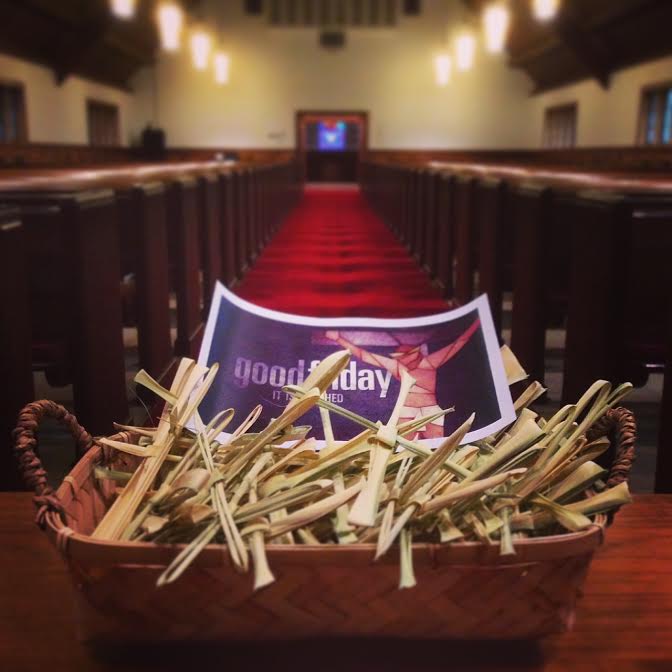
Last year I asked us to look at the cross and live. I implored us to give thanks to God for dying in Christ on our behalf to save us. I handed out crosses so that we might ponder the kind of divine love that was made real for us. I asked us to look at the cross and live.

This year I want to ask us to look at the cross and forgive. If Jesus was willing to use some of his final breaths to forgive the crowds for betraying him and bringing him to the cross, why are we so unwilling to forgive? If Jesus was so filled with love, shouldn’t we do the same?

Being a Christian is messy, ugly, and frightening if we are willing to follow Jesus. If we really want to be like him, then we have to start by forgiving others, and forgiving ourselves.

Amen.

unnamed

Washing With Tears – Maundy Thursday Homily on John 13.12-20

John 13.12-20

After he had washed their feet, had put on his robe, and had returned to the table, he said to them, “Do you know what I have done to you? You call me Teacher and Lord – and you are right, for that is what I am. So if I, your Lord and Teacher, have washed your feet, you also ought to wash one another’s feet. For I have set you an example, that you also should do as I have done to you. Very truly, I tell you, servants are not greater than their master, nor are messengers greater than the one who sent them. If you know these things, you are blessed if you do them. I am not speaking of all of you; I know whom I have chosen. But it is to fulfill the scripture, ‘The one who are my bread has lifted his heel against me.’ I tell you this now, before it occurs, so that when it does occur, you may believe that I am he. Very truly, I tell you, whoever receives one whom I send receives me; and whoever receives me receives him who sent me.”

bbo_ob_mcmca_40_slide

The disciples had already finished their food, they had passed around the bread and the cup, and Jesus had told them it was his body and blood. For many of them these words might’ve gone in one ear and out the other; after all Jesus was known for saying all sorts of the things that didn’t make sense right away. Perhaps some of them were picking up the crumbs from the bread when Jesus got up from the table. Others might have been refilling their cups with wine when Jesus tied a towel around his waist. But by the time he started to wash their feet the room must have been silent. 

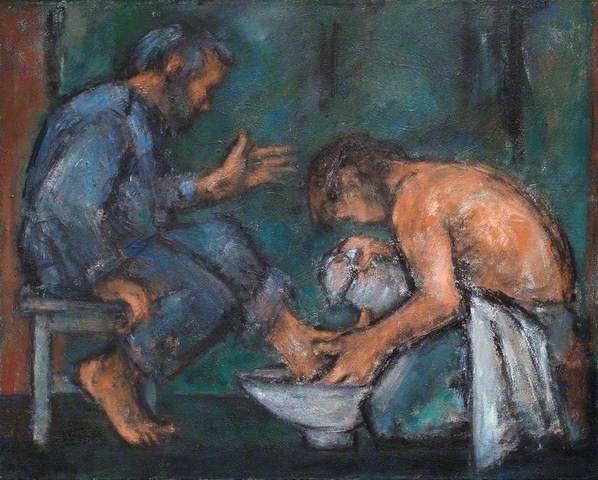
Imagine how profound it would have been to see Jesus kneeling on the floor and using water to wash away the grime of Jerusalem. Even more amazing is the fact that Jesus doesn’t waste time explaining what he’s about to do, he just gets down on the ground and goes to work.

However, Peter, the ever vocal disciple interrupts the serene mood with a question: “Lord, are you going to wash my feet?

“Right now it won’t make sense my friend, but soon it will all come together. If you want to be in this with me, you must let me wash your feet.”

Jesus went from one disciple to the next taking as much time as necessary, holding their feet in his hands, letting the water drip upon them, until he finished.

I took a group of middle-schoolers on a mission trip a number of years ago to Winchester, Virginia. We worked in trailer parks building wooden steps up to the doors, we worked on a wheel chair ramp that took up an entire yard, and we worked on clearing out areas that had been long forgotten. All week we did everything we could to serve the needs of the people from the nearby community, and every night we gathered to sing songs and praise our Lord.

At the end of the week we were invited into the fellowship hall for a foot-washing ceremony. I don’t know if any of you have had the chance to spend a week working outside with middle-schoolers, but it begins to smell pretty bad pretty fast; the prospect of washing one another’s feet was not high on my list of priorities. The leader explained that long ago Jesus washed his disciples feet and we would be doing the same thing. Everyone was invited to participate, but if you were uncomfortable you could simply ask for a prayer instead.

A few chairs and basins were set in the middle of the space, and when the music began we were on our own.

In my work group there was a precious young girl who had worked so incredibly hard all week and there was a young boy that annoyed her every chance he had. He would begin by playfully flicking paint onto her clothes, but when she asked him to stop he became relentless. He called her names behind her back, and schemed to turn the other kids against her. Even after I pulled him aside to set him straight he continued to prey on her at every opportunity. 

As we sat in the room waiting for the first people to go forward for the foot washing, I watched the young girl stand up, and bee-line across the room for the annoying boy. For a fleeting moment I was afraid that she had finally had too much and she was about to sock him in the face, but instead she leaned over and asked if she could wash his feet.

While other people started to do the same, my gaze was transfixed on the boy and girl from my group. The boy had gone over the line time and time again yet there she was holding his foot in her hand and washing it. When I looked closer I saw that she was crying and her tears were falling on his feet. And when I looked even closer I saw that he was crying and his tears were falling in her hair.

Foot washing is a service among equals in a company where no one’s status stands out. When Jesus finished with his friends, he called them to do the same to one another. We wash and are washed by our Lord through our brothers and sisters in Christ. When we kneel before a fellow Christian and hold their feet in our hands we make our way back to the upper room so long ago. We aren’t just called to wash the feet of those whom we love, but even the ones who drive us crazy and fill us with anger. Remember: Jesus washed Judas’ feet knowing full and well what he was about to do. 

Sometimes the people we need to reconcile with most are the ones in the pews next to us. We tend to sweep under the rug all of the proverbial problems we have with our friends and family and are far more inclined to complain about strangers. If we are filled with stress regarding the closest people in our lives than this might be the best place to embark on a new beginning. Perhaps the water can bring new life for us and for the ones we love and hate.

Jesus took time after breaking bread with his friends to wash their feet. He humbled himself to the floor and showed them what faithful love looks like. With each foot he equipped them for bringing the peace of God into the world. He washed away their insufficiencies and doubts. He rid them of labels and assumptions. He showed them how important they were for the kingdom of God.

If you want to know what faithful love looks like, look no further than this time when we follow the example of Jesus and wash one another. Amen.

IMG_2100

Palms Beneath My Feet – Sermon on Mark 11.1-11

Mark 11.1-11

When they were approaching Jerusalem, at Bethphage and Bethany, near the Mount of Olives, he sent two of his disciples and said to them, “Go into the village ahead of you, and immediately as you enter it, you will find tied there a colt that has never been ridden; untie it and bring it. If anyone says to you, ‘Why are you doing this?’ just say this, ‘The Lord needs it and will send it back immediately.’ “ They went away and found a colt tied near a door, outside in the street. As they were untying it, some of the bystanders said to them, “What are you doing, untying the colt?” They told them what Jesus had said; and they allowed them to take it. Then they brought the colt to Jesus and threw their cloaks on it; and he sat on it. Many people spread their cloaks on the road, and others spread leafy branches that they had cut in the fields. Then those who went ahead and those who followed were shouting, “Hosanna! Blessed is the one who comes in the name of the Lord! Blessed is the coming kingdom of our ancestor David! Hosanna in the highest heaven!” Then he entered Jerusalem and went into the temple; and when he had looked around at everything, as it was already late, he went out to Bethany with the twelve.

palm-sunday-2

Weekly Chapel Time requires a willing and humble spirit. What we do here on Sunday mornings carries an air of sophisticated and focused liturgy. But when I bring the Preschoolers in during the week… there are no rules. When we worship together most of us have fairly decent attention spans, but the 2, 3, and 4 year-olds need to be consistently bombarded with images and ideas in order to stay focused.

I’ll freely admit that I treat our preschoolers the same way that I treat our worshippers (I’ll let you decide whether or not that is a good thing) because we are all working toward the same goal: a greater awareness of God’s love and mercy in the world.

Anyway, this week, in preparation for Palm Sunday, we gathered the children in the sanctuary for their lesson. They sat in the pews up here in the choir loft, with their little legs dangling in the air, excited and nervous to keep learning about this guy named Jesus. I love quizzing them on previous stories because they are fascinated by scripture. For instance: If I could get all of us to be as excited about Zacchaeus, the wee-little man, climbing up a sycamore tree, just imagine how faithful we would become.

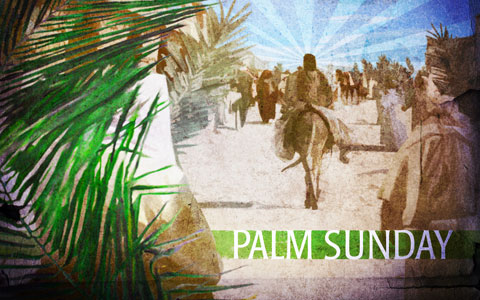
I shared with the children that Jesus needed to get to a strange place called Jerusalem to do something incredible for his friends. They gathered together outside the city and Jesus sent two men to find a donkey for him to ride on. The closer the came to the gates, more and more people gathered palms from the surrounding area and waved them in the air, and placed them on the ground all while shouting “Hosanna!” which means “save us!”

I then had all the children line up with their own palm branches in the center aisle and we were going to recreate the story. I found a young boy to be Jesus and when I asked who they thought the donkey should be they all emphatically yelled, “You Pastor Taylor!” I’m not sure how I felt about them so quickly identifying me with that particular animal, but I let it go.

So there I was on my hands and knees with a child saddled across my back making our way into Jerusalem. I had instructed all the children to either wave their palms or place them on the ground and shout “save us!” to the boy on my back. The entire journey down the center aisle took longer than I thought because I did not want to drop the Jesus on my back, but as I walked forward and saw the palms beneath my feet I was struck by the Holy Spirit.

The children continued to scream and beg for their salvation, the Jesus on my back kept kicking into my rib cage to make me go faster, but all I could think about was what the donkey must have experienced when he carried Jesus into Jerusalem, what it must have been like to deliver the Lord to his death.

The following is an imaginative retelling of the story from the donkey’s perspective…

Palm-Sunday

With palms beneath my feet, Jesus, there are so many things I wish I could tell you. Carrying you while the crowds scream on our sides, I wish I could share all the things I have seen and heard. This might be the only chance I’ll get, and it already feels too late.

I was there Jesus. I was there in the manger when you were born. Your parents had come into the tiny room and your mother looked like she was about to burst. I was but a young foal back then, but I remember. They were so afraid and alone when they cuddled together holding you close. While they were filled with fear, I was filled with joy. I knew from the moment I saw you that you were special, that you were the Son of God. The other animals could feel it too, and while your family fell into the familiar rhythm of sleep, we gathered around you to share our warmth. I watched you sleep all night and I could feel that our lives were connected, and I knew that I would see you again one day.

You left from Bethlehem but as the years passed I heard stories about your life. I would be in the marketplace, or moving about the village and rumors would fall upon my ears.

When you were a child they said that you stood apart. Other children would spend their days running around and getting into mischief, but you would sit in the synagogue and teach the elders. Your command of the scriptures spread before you even started your ministry. I would watch the people while they talked about you and they were filled with such hope. Words like “messiah, lord, and savior” were used to describe you and I could tell that the Lord was among us.

Then it came to pass that you were baptized by your cousin John in the Jordan river. Witnesses said they saw the sky open up and they heard the voice of God. While others denied the claims, I knew it was true, I could feel that your ministry was about to begin and that everything would change.

You traveled throughout Galilee proclaiming the year of the Lord’s favor. You healed the sick, gave sight to the blind, and restored the outcasts to their families. Everywhere you went stories about your love and mercy traveled ahead and the crowds grew larger and larger. You fed the multitudes by the sea, you walked on water, and you brought Lazarus back from the dead. You spoke of mustard seeds, prodigal sons, and good samaritans. You ate with sinners, worked on the sabbath, and argued with the Pharisees. Some say that even just a few weeks ago you were on the mountaintop when Moses and Elijah appeared and you were transfigured.

This morning I was tied up near the door when two of your disciples came close. One of them spoke to my owner and said, “The Lord needs him” and they brought me to you. I knew the time had come when we would be reunited, but the joy I expected to feel has been mixed with trepidation.

Jesus, how I wish you could hear me, how I wish I could tell you all I have seen and heard. We departed early this morning and the crowds gathered around us. It feels as if the closer we get to Jerusalem the people grow louder and more eager to cry out. Do they know what they mean when they say, “Hosanna! Blessed is the one who comes in the name of the Lord! Blessed is the coming kingdom of our ancestor David! Hosanna in the highest heaven!”?

I’m beginning to worry Jesus. I don’t think they know who you really are. The people sound more like an angry mob waiting for you to overthrow the Romans than a faithful group waiting for the kingdom of God. They want another Moses to lead them out of physical bondage, they want another David who can lead them into battle, they want another Solomon to build a giant temple.

a_liturgyofthepalms-large

These people have suffered but they believe in you. Did you see them take off their cloaks and place them in the road? I have been walking over garments for hours. Did you see them rush into the fields for palm branches to wave them in the air and create a royal pathway? The palms beneath my feet are a sign of how much these people believe in you.

What are you going to do Jesus? I can hear people murmuring about your coming mission, some are saying that you are going to the temple and you are going to overthrow the tables. Some are saying that you are going to lead the rebellion and kill the chief priests and scribes. Some are saying that you are going to destroy the temple and then build a new one.

Jesus I’m afraid for your life! These people don’t know who you really are and what you’ve come to do. They shout “Hosanna, Hosanna!” but I fear their shouts will soon turn to “Crucify, Crucify!” They are only concerned about themselves. Even your disciples on either side of us, I can smell their fear.

Jesus, I was there when you were born. I felt God’s presence in you and I knew you would save the world. But please Jesus, let me take you away from this place. Jerusalem can only bring about your death. We still have a chance to turn around and head home.

Or is it too late? 

The crowds are starting to thin Jesus. The people are beginning to head home. We are stepping through the gate and the palms are no longer beneath my feet. I want to believe in you and what you are doing. I want to believe this is God’s will. But I’m so afraid.

Jesus, I am an old donkey and I don’t know how much further I can carry you.

It’s just us now and the sun is beginning to set.

What will happen? What are you going to do?

If this is the last time I will see you, I wish I could talk to you. I wish I could warn you about what is to come. I wish I could stop you.

You swing your legs around and are standing right before me. Your eyes contain the same hope they did the day you were born in the humble manger. As you pet my old matted fur I can feel all the people you have already touched and healed. I can feel the sick children and parents, I can feel the blind and the lame, the last, least and lost.

What a privilege it was to carry you today my Lord. I knew that we would meet again, I only wish I could do something to warn you.

You’re now leaning in close to whisper in my ear. Is this goodbye? Is this the end?

You said, “No my old friend. I know exactly what I am doing. And this is only the beginning.” Amen.

Crucified Faith – Lenten Homily on John 14.1-7

John 14.1- 7

“Do not let your hearts be troubled. Believe in God, believe also in me. In my Father’s house there are many dwelling places. If it were not so, would I have told you that I go to prepare a place for you? And if I go and prepare a place for you, I will come again and will take you to myself, so that where I am, there you may be also. And you know the way to the place where I am going.” Thomas said to him, “Lord, we do not know where you are going. How can we know the way?” Jesus said to him, “I am the way, and the truth, and the life. No one comes to the Father except through me. If you know me, you will know my Father also. From now on you do know him and have seen him.”

image

Jesus is the way, and the truth, and the life.

I know a lot of people who want the greatest amount of reward for the least amount of effort. They have a faulty perception about how much they deserve based on how much they work.

Its like the guy who lets his grass grow and grow until you can barely see his porch because he only wants to have to mow it once. Or like the woman I recently saw at Food Lion who was using every single finger and both elbows to carry all of her bags to the car instead of making multiple trips. Or like the foolish pastor (cough *Me* cough) who believes that so long as he picks a scripture and prays about it, that God will give him a sermon to preach that will having people jumping and shouting “Amen!”

Sadly, I have come across a number of people (even myself at times) who want God without Jesus. We believe on some level that so long as we show up to church, and live a decent life, that we are doing all that the Lord would have us to do. We want salvation without suffering. We want love without expectations. We want resurrection without crucifixion.

Jesus is the way, and the truth, and the life. No one comes to the Father except through him.

way

The disciples are confused. Jesus tells them that he will go and prepare a place for them because there are many rooms in his Father’s house and they know where he is going. Then Thomas asks the question that all the other disciples are thinking: “Lord, we do not know where you are going. How can we know the way?” Jesus responds with hopeful and frightening words: I am the way.

The destiny in store for Jesus is likewise laid up for his friends, and for us. Those who want to save their life will lose it. If we want to experience the presence of God here and now, we can only do so by following the way, by following Jesus.

Sam Wells, the former dean of Duke Chapel, was appointed to a new church, and wanted to experience every single aspect of its mission. For the first few months he spent a couple of days each week going through the ins and outs of the church as if he was not the pastor; He toured the preschool like a prospective parent with a three-year old; He went to weekly prayer services and sat in the back like a stranger might if they randomly walked in off the street; He stood in line at the food pantry and patiently waited for his turn to receive some food.

One of the last things he needed to experience was the homeless shelter. He had heard that it was frequently attended because they gave out the best food and had the nicest provisions and he wanted to see it with his own eyes and taste it with his own tongue. So, for a few days before the experience, he stopped showering and shaving, he found some of his oldest and rattiest clothes, and prepared to spend a night with others in the basement of the building.

He began by waiting outside in line with everyone else. He tried to keep a low profile, but most of the people spotted his costume immediately. For whatever reason they welcomed him into their little group anyway and spent most of the night talking and learning about one another. He asked about their pasts and what had led them to where they were, most of them had normal lives until some unforeseen circumstance sent them out to the streets.

However, before the night ended one of the men shared an important perspective with the pastor. “We don’t come here for the food or for the warmth,” he said, “we come here because this is the only place where we can be with other people like us. Sure the food and shelter is nice, but the community is what we really need.

I don’t think Sam would necessarily put it this way, but I believe he encountered the living God in those homeless men and women precisely because he was acting like Jesus. I don’t think Sam actively went out with the hope that he could walk around like Jesus, but in meeting the people where they were he followed the way that Christ set up for us.

Sometimes the hardest part of being a Christian is recognizing that we cannot have resurrection without crucifixion. More often than not we need to crucify a part of our lives before we can meet and encounter the living God.

Maybe we need to crucify our false assumptions about the poor and how they wind up living on the streets. Perhaps we need to crucify our ridiculous prejudices toward people who are of a different sexual orientation. Maybe we need to crucify our faulty self-perceptions. Perhaps we need to crucify our selfish desires to crave our passions. Maybe we need to crucify a program in our church that is no longer giving life to anyone involved. Perhaps we need to crucify our willingness to hold on to a grudge from the distant past. Maybe we need to crucify our love and obsession with money.

Jesus is the way and we have been given the precious opportunity to follow him, even to the cross. If we want to encounter the living God, we can only do so by crucifying our brokenness and seeking out ways to be resurrected here and now. Amen.

You Cannot Save Yourself – Sermon on Ephesians 2.1-10

Ephesians 2.1-10

You were dead through the trespasses and sins in which you once lived, following the course of this world, following the ruler of the power of the air, the spirit that is now at work among those who are disobedient. All of us once lived among them in the passions of our flesh, following the desires of flesh and senses, and we were by nature children of wrath, like everyone else. But God, who is rich in mercy, out of the great love with which he loved us, even when we were dead through our trespasses, made us alive together with Christ – by grace you have been saved – and raised us up with him and seated us with him in the heavenly places in Christ Jesus, so that in the ages to come he might show the immeasurable riches of his grace in kindness toward us in Christ Jesus. For by grace you have been saved through faith, and this is not your own doing; it is the gift of God – not the result of works, so that no one may boast. For we are what he has made us, created in Christ Jesus for good works, which God prepared beforehand to be our way of life.

Screen Shot 2013-06-30 at 10.08.16 AM

Our series on “Back to the Basics” continues this morning by looking at the topic of salvation. We started this series in light of the fact that many of us are deeply rooted in our faith, but some of the basics have perhaps become so routined that we no longer understand what they mean. We began with a call to return to the basics, then we looked at the Ten Commandments and today we are talking about salvation. Here we go.

My friend Josh loved the Christian camp. Every summer he looked forward to returning to the familiar space with young people all growing in their faith. From tubing on the lake, to hiking around the compound, and even just praying at night with his friends, the camp was a place unlike any other; at camp he could be fully Christian without the world judging him for his discipleship.

By the time I met Josh, camp was long in the past though he remembered most of it fondly. Having never gone to a specifically Christian camp I was fascinated by the idea of being immersed in an intentional faith community with other young people and I regularly asked him questions about his experiences. After all, it was at camp where he met his future wife, and it was years later that he made a scavenger hunt at the camp in order to propose.

As a young Christian my faith was largely formed and nurtured by my home church. I was blessed to grow up around a number of people who took their commitment to raising me in the faith seriously. Josh, however, learned a lot about what it meant to be Christian from the counselors at camp, which, like many things, can be a blessing and a curse.

The young adult counselors embodied how you could still be cool and Christian. They made faith so appealing because they regularly demonstrated what God had done for them in their lives. They made efforts to make faith approachable and were able to share the love of God with campers every summer.

Yet, some of them deeply believed it was their chief responsibility to save others and did whatever they could to make that happen.

It would come at the end of an incredible week of building new relationships and ideas when one of the counselors who begin talking about the Roman Road and I imagine it went something like this:

“Have you accepted Jesus Christ as your personal Lord and Savior? Your life might feel pretty good right now, you might have a kind family and some nice friends, but what about your eternal life? Do you want to spend life after death burning in the fires of hell? Or do you want to be saved?

“Imagine that you are standing on the edge of a cliff. Being a good person isn’t enough to save you. You can see salvation on the other side of the divide, but the only way you can get there is through Jesus Christ. Try to picture the cross being a bridge for you to safely get to the other side. You have the power to decide your everlasting fate. What’s it going to be?”

5520158

When Josh explained these experiences to me I could sense the amount of manipulation that went into the dialogues. As the summers passed at camp, the conversations remained the same only the stakes became higher: What are you doing to save the people around you? Have you explained the Roman Road to your friends?

My friends, we are now alive though we were dead. Until the great gift of God in Jesus Christ we existed like lifeless bodies wandering around. Part of this came to be because we were guilty of sinfulness though we were also victims of our environment – people and organizations who told us we can save ourselves. But God, rich in mercy, saved us.

In the early church they did not spend their time going around trying to convince people with the Roman Road argument. They did not waste time going through the in and outs of theological proofs of Christ’s divinity and resurrection. Instead the church pointed at itself to prove the miracle. Want to know about death, the cross, and the resurrection? Here they are.

The budding Christian community grew not because it’s leaders were particularly articulate in their ability to save others through words, but because they believed in the Lordship of Jesus Christ. With the new family that was created in community they experienced a new kind of life with God at the core, a new opportunity that came with the Spirit.

While the early disciples went throughout their surrounding regions, their cries of evangelism did not begin with “Save yourselves!” Instead they, like Ephesians, triumphantly declared, “God saved you, come live your new life!

If we are anything we are a people of resurrection. Not a country club of like-minded individuals, not a political organization, not a club of devoted fans, but a people of resurrection.

Since the time of Christ, those who followed him have found new life, resurrected life, with God. New life has come by many ways – repenting for the wrongs of our lives, being forgiven by God and our friends, experiencing an assurance of the eternal dimension of God’s love and care, and by a number of other life events, even hearing about the Roman Road from camp counselors. However, we must be careful when putting too much emphasis on our power in salvation. Yes, God has opened the door and we must be the ones to walk through it, but the greater act came in the opening of the door and not our power to go through it.

Resurrected life is something that will come when Jesus returns but we can also experience it here and now. Whenever I’m asked about miracles I can quickly describe some of the incredible things I have witnessed, events I attribute to God’s grace. But some of the most powerful miracles, to me, are right here in our midst. I can look out from this pulpit and see people’s lives who have been turned around through Christ’s love. I see and remember stories about things that have happened to you, sinful desires that suffocated your ability to live fully, when God offered you a new resurrected life.

I heard someone once describe their days as lifeless. They went through the familiar motions but it all felt repetitious, pointless, and directionless. This went on and on until someone invited them to a church community. Suddenly people began to care about him without knowing anything about him or his past. It was like he was being seen and treated through God’s perspective. Through a simple invitation and a new opportunity he felt resurrected from the dead, and began living again. 

Salvation is not about receiving a perfect grade that allows us to make the cut into God’s heavenly kingdom. Who among us fulfills all of the laws from the Old and New Testaments? Loving our enemies, turning the other cheek, giving away our possessions? Even the greatest commandment to love God and neighbor with our hearts, souls, minds, and strengths is incredibly difficult.

romansRd31

If salvation was about getting the right grade, I’m sad to say that most of us would be failing. It’s as if the closer we get to visions of God’s glory, the more we realize our unholiness.

We pray to God before our meals and while we look out on the feast before us we are reminded of the many who have no food to eat. We kneel in a makeshift structure in Guatemala being served food by people who have nothing in terms of our materiality but have faith that we could never imagine. We sit on the stoops of a front porch in West Virginia after painting all day and we realize we could be doing so much more.

We were dead through the sins of our lives and we have been victims of our environment. The good news amidst this unholiness is that, by the grace of God, we have been saved. That through God’s incredible act of selflessness, our sinfulness has been forgiven.

Not a forgiveness as a nice plus added to a grade for our performance as Christians, but forgiveness as a completely unearned gift – a gift extended to a prodigal son who squandered his inheritance, a gift extended to a tax collector who only cared about himself, a gift extended to a thief who hung on a cross to die, a gift extended to you, or to me.

By grace we have been saved. 

Grace is like friendship. Josh, the one who shared with me his experiences of Christian camp, is my best friend and was the best man at my wedding. I did nothing to earn his friendship.  If it had been initiated over an exchange of goods (I will be your friend if you do this for me) it would never have become the true friendship that it is today. Friendship, and I mean true friendship, is an act of faith. Learning to trust the other knowing that they could hurt you.

I know that Josh will be there for me at a moment’s notice. He will listen to me and do whatever he can to help. I also know that he doesn’t expect anything in return. That is the meaning of true friendship; a willingness to give because the well-being of someone else matters more to you than your own. My friendship with Josh is an act of faith, but one that I am remarkably thankful for.

Salvation, for us, is the beginning of a covenant of friendship between us and God; between the divine and a sinner. Grace is another way of describing an incredible love story between God and his creation.

We cannot save ourselves. We cannot save other people. No matter what the commercials, advertisements, and camp counselors tell us. Only the Lord has the power to save. Thanks be to God that he came in the form of flesh in Jesus Christ to open up the gates of heaven to people like us.Thanks be to God that we are not called to save others, but merely help them to see what God has already done, and continues to do, in their lives.

We were dead but have been made alive through the greatest gift ever given. The question for us, then, should not be, “Am I saved?” Instead we should be asking, “What am I doing with this resurrected life?

Amen.

basics